How do you do GEO? If you understand GEO as “getting AI search to recommend you” or “increasing the probability of being cited by ChatGPT,” that is only a description at the level of outcomes, and it is not enough to guide execution. For export manufacturers and trading companies, the genuinely useful questions are: which pages should be changed first? What tasks do product pages, category pages, application pages, resource pages, and RFQ pages each carry? How should page structure be changed so that both AI and buyers can understand it more easily? Why do some pages have traffic but are not cited, while other pages are mentioned but fail to bring in high-quality inquiries?
This article, from the perspective of a foreign-trade B2B website, uses English product terms such as custom metal parts, LED flood light, packaging machine, medical probe, cnc machining parts, ceramic dinnerware, waterproof connector, industrial valve supplier, and private label activewear manufacturer to explain how GEO is actually done: start with page roles, structure, fact density, entity consistency, a question library, and a monitoring system, then connect AI answers, GSC, GA4, inquiries, and sales feedback.
Target query terms: GEO怎么做, how to do GEO, generative engine optimization execution, page structure citation probability, AI search visibility implementation. Search intent: users do not want to read a concept definition; they want to know that if they start doing GEO right now, what exactly the first step, second step, and third step are, and which actions are closer to business results. Top1/authoritative benchmark: current content on GEO execution, AI visibility optimization, and citation probability generally emphasizes entity foundation, answer-first, page structure, authority signals, and citation tracking; the shortcoming is that it mostly targets SaaS and brand content and lacks foreign-trade product pages, category pages, RFQ pages, and inquiry and sales review. This article fills in that execution logic.
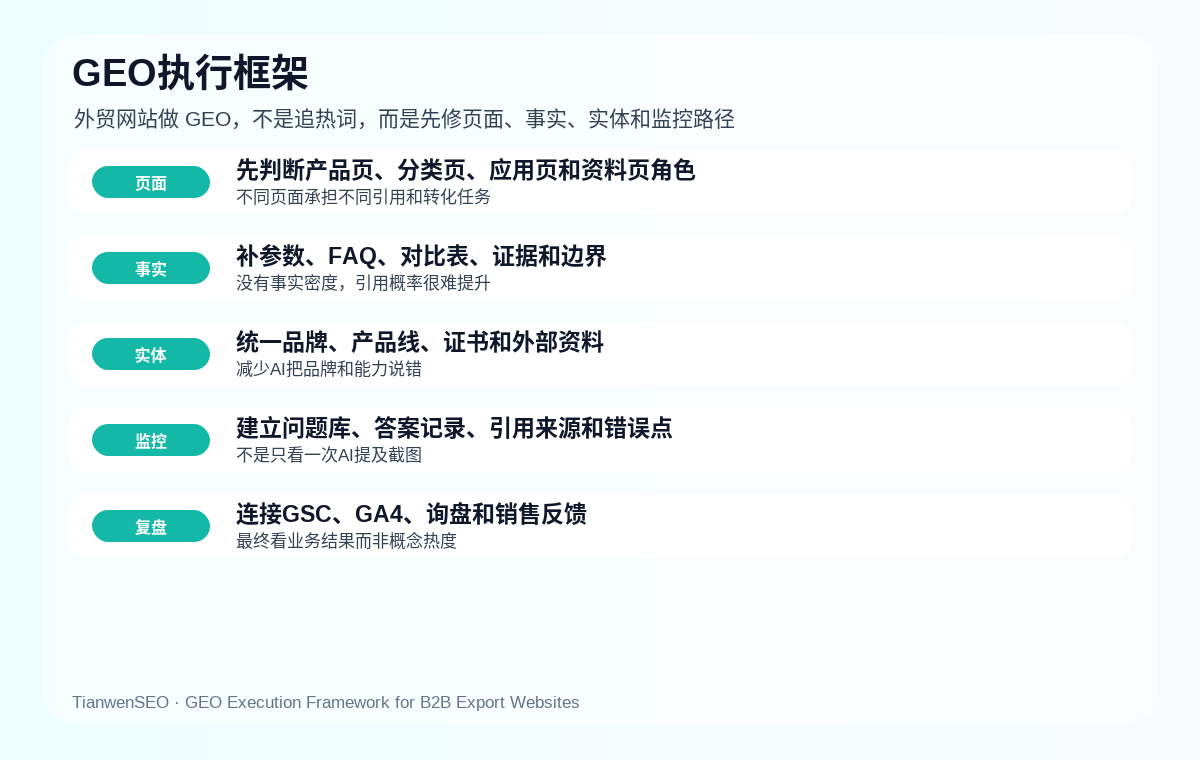
Official acceptance boundary: GEO first verifies page eligibility, factual structure, and data definitions
GEO is not about first chasing the phrase “citation probability”; it is first about confirming whether a page can be crawled, indexed, understood, and re-checked. For foreign-trade websites doing GEO, page structure, fact density, entity consistency, Search Console data, GA4 events, server logs, and AI/GEO samples must be kept separate. If any one layer lacks data, it cannot be replaced by another layer.
If there is currently no usable GSC query, page, or page-query row data, then rankings, impressions, clicks, CTR, AI citations, or inquiry changes must not be written in. GEO can still continue, but the conclusions must be downgraded to: whether pages have search eligibility, whether core facts are clear, whether product pages, category pages, resource pages, and articles each have a role, and whether robots, sitemap, structured data, and internal links support access by search engines and AI-related crawlers.
If the team has not yet read query, page, country, device, and URL Inspection separately, it can first build a base table following the Google Search Console diagnosis guide, and then connect GEO samples, GA4 events, and inquiry fields into it.
Mapping table of official sources and GEO page structure fields
Google Search Central: AI features and your website
What it supports: AI search capabilities still depend on an accessible, indexable, clearly written page foundation.
GEO acceptance fields: Answer section, fact table, source notes, page accessibility, and index status.
What it does not prove: It cannot promise that AI answers will definitely cite the official website.
Google Search Central: Creating helpful, reliable, people-first content
What it supports: Pages should center on real user questions, reliable content, and useful information.
GEO acceptance fields: Product facts, application scenarios, selection conditions, limit boundaries, and verifiable experience.
What it does not prove: GEO quality cannot be judged by word count or the number of FAQs alone.
Google Search Central: Search Essentials
What it supports: A page needs to meet basic technical, policy, and content requirements to take part in Google Search.
GEO acceptance fields: HTTP 200, crawlable, indexable, core content visible, and no obvious violations.
What it does not prove: Meeting the basic requirements does not mean there is already search performance.
Google Search Central: SEO Starter Guide
What it supports: Basic practices for titles, page organization, links, images, and understandable content.
GEO acceptance fields: The division of roles among pillar pages, category pages, product pages, resource pages, and articles.
What it does not prove: It cannot replace actual query/page data.
Google Search Central: Structured data general guidelines
What it supports: Structured data must be consistent with visible page content and comply with policy.
GEO acceptance fields: Whether Product, FAQ, Breadcrumb, Article, and other markup are consistent with the body text.
What it does not prove: Schema cannot replace page facts and content quality.
Google Search Central: Sitemaps overview
What it supports: A sitemap helps Google discover important URLs.
GEO acceptance fields: Whether core product pages, category pages, resource pages, articles, and updated pages are in the sitemap.
What it does not prove: Being present in the sitemap does not mean it has been crawled, indexed, or shown.
Google Search Central: robots.txt introduction
What it supports: robots.txt controls crawl access.
GEO acceptance fields: Whether product directories, resource pages, images, CSS, JS, or AI-related access paths are blocked by mistake.
What it does not prove: robots cannot fix thin page content.
Search Console Help: URL Inspection tool
What it supports: The index status, crawl status, canonical, and page version Google sees for a single URL.
GEO acceptance fields: Sample checks of product pages, category pages, resource pages, pillar articles, and pilot pages.
What it does not prove: A single indexable URL does not mean there is already search performance.
Search Console Help: Page indexing report
What it supports: Page index status and the reasons pages are not indexed.
GEO acceptance fields: Which GEO pilot pages are indexed, which are excluded, and why.
What it does not prove: The indexing report is not a ranking or inquiry report.
Search Console Help: Performance report
What it supports: query, page, country, device, clicks, impressions, CTR, average position.
GEO acceptance fields: Whether pilot pages show query/page rows, and whether there are country and device differences.
What it does not prove: When there is no row data, you cannot write about ranking, impression, click, or CTR improvement.
Google Analytics Help: About events
What it supports: GA4 events can observe users’ subsequent actions on the site.
GEO acceptance fields: Form, email, WhatsApp, RFQ, download, and contact page events.
What it does not prove: On-site events cannot replace GSC search performance.
What it supports: Distinguish the access purposes of OAI-SearchBot, GPTBot, and ChatGPT-User.
GEO acceptance fields: Whether robots, logs, and public pages unintentionally block related access paths.
What it does not prove: It cannot show that ChatGPT will display things in a specified way.
Bing Webmaster Blog: AI Performance
What it supports: If visible in the account, you can observe AI citations, cited pages, and grounding query phrases.
GEO acceptance fields: Record Bing AI samples, GSC, GA4, logs, and page facts separately.
What it does not prove: It cannot represent all AI platforms.
What it supports: After a URL is added, updated, or deleted, a notification can be sent to participating search engines.
GEO acceptance fields: Whether there is a notification action after pilot pages, resource pages, and product pages are updated.
What it does not prove: It cannot replace content quality, crawl eligibility, and index eligibility.
GEO page structure acceptance standards: verify pages first, then samples
| Acceptance layer | Required evidence | How a foreign-trade website judges it | Unacceptable wording |
|---|---|---|---|
| Page eligibility | HTTP status, robots, sitemap, index status, canonical. | Confirm that product pages, category pages, resource pages, and articles can all be reasonably discovered. | Discussing citation probability while the page is not indexed. |
| Page role | The tasks of product pages, category pages, application pages, resource pages, articles, and contact pages. | Let product pages answer specifications and inquiries, let resource pages answer standards and selection, and let articles answer decision questions. | Piling every question into blog articles. |
| Answer section | A clear conclusion, applicable conditions, and limit boundaries in the first screen or key paragraphs. | Organize answers using foreign-trade product terms, scenario terms, and inquiry terms. | Writing only concepts, not product facts. |
| Fact density | Parameters, materials, applications, certification scope, model ranges, selection conditions, and error boundaries. | Each fact can correspond to product documentation, page content, or a verifiable source. | Stacking jargon just to look professional. |
| Structured data | Schema is consistent with visible page content; breadcrumbs and product information do not conflict. | Product, FAQ, Breadcrumb, and Article mark only what is truly on the page. | Putting content in Schema that is not in the body text. |
| GSC review | query, page, country, device, clicks, impressions, CTR, average position. | See whether pilot pages start to show verifiable search rows. | Writing about results when there is no GSC row data. |
| GA4/inquiries | Form, email, WhatsApp, RFQ, download, and contact page events. | See whether a page can connect to real inquiry actions. | Writing page rewrites directly as inquiry improvement. |
| AI/GEO samples | Platform, question, date, answer summary, cited URL, wrong facts, and screenshots. | Treat samples as observation records, not long-term results. | Writing a single answer screenshot as a stable platform conclusion. |
How to downgrade GEO conclusions when there is no GSC data
If the site currently has no usable GSC query, page, or page-query row data, the GEO report cannot be written as a search performance report. It can first be written as a page eligibility, factual structure, and sample record report.
| Missing evidence | What can be written | What must not be written | Next review step |
|---|---|---|---|
| No GSC Performance rows | Whether pages are crawlable, indexable, and in the sitemap, and whether they have a clear answer section and fact table. | Rankings, impressions, clicks, CTR, or trend improvement. | Keep the 28-day and 90-day date ranges and wait for the first rows of data. |
| No URL Inspection sampling | List the product pages, category pages, resource pages, articles, and contact pages that need spot checks. | Asserting that all core pages already participate in search. | Record index status, canonical, crawl time, and page version. |
| No GA4 events | Explain that form, email, WhatsApp, download, RFQ, and resource page events need to be configured. | Organic search inquiries have already improved. | First make on-site actions observable. |
| No log samples | Explain that origin, CDN, or WAF logs are temporarily unavailable, and do not treat tool screenshots as crawl evidence. | Writing that relevant crawlers have or have not crawled. | Obtain logs with clear coverage time, sources, and fields. |
| No AI samples | Build a table of platform, question, date, answer summary, cited URL, and wrong facts. | Writing that AI platforms already cite the official website. | Re-test across platforms with a fixed question set, and record it separately from page actions. |
Conclusion first: GEO does pages and facts first, then talks about “citation probability”
Many people, as soon as they hear GEO, first ask “how do I increase citation probability?” But if the page itself has an unclear topic, insufficient facts, vague FAQs, a missing RFQ path, and a messy brand entity, then talking about citation probability means little. Because AI systems, like buyers, first need to know what you sell, who it suits, what the boundaries are, and whether you are trustworthy.
So the first step of GEO is usually not chasing some conceptual metric, but first judging whether page assets are sufficient: whether product pages have parameters and applications, whether category pages have selection logic, whether resource pages have tables and FAQs, whether RFQ pages can collect high-intent parameters, and whether brand and certification materials are consistent. Only as these foundations are gradually filled in do mentions and citations in AI answers become more valuable to the business.
| Execution order | Why it comes first | What happens if it is missing |
|---|---|---|
| Page role | Know what problem each page solves first | Page topics become chaotic |
| Fact density | Give pages extractable content | Only vague copy |
| Structure optimization | Make answers, tables, and FAQs easier to understand | Information buried too deep |
| Entity consistency | Reduce AI getting the brand and capabilities wrong | Poor answer accuracy |
| Monitoring and review | Connect visibility to business results | Only screenshots and concepts remain |
Why much GEO execution fails: because the order is wrong
The most common reason GEO execution fails is not that “the team did not work hard,” but that the order is wrong. For example, chasing mention screenshots in AI tools right away while having no page question library; or rushing to write a pile of AI SEO articles without strengthening high-value product pages; or stressing brand authority while ignoring that the official website, B2B platforms, and certification pages do not say the same thing.
For foreign-trade sites, the most direct consequence of the wrong order is: more and more pages, but buyer questions still cannot be handled; AI starts mentioning you, but inaccurately; resource pages get visits, but nobody enters the RFQ page; and sales still has to repeatedly explain the most basic questions.
| Wrong order | Looks like doing GEO | But why the effect is weak |
|---|---|---|
| Chasing mention screenshots first | Surface visibility can be seen | You do not know why it appears or does not appear |
| Piling up articles first | It looks like there is a lot of content | High-value pages remain weak |
| Talking only about the brand | It looks like building authority | Non-brand opportunities and buying paths are not captured |
| Looking only at AI tool scores | The report has numbers | The business and pages do not necessarily get stronger |
Top1/authoritative benchmark comparison: what existing GEO guides get right and what they lack
Current content around how to do GEO, AI visibility implementation, and citation optimization already generally recognizes several key points: page structure must be clear, paragraphs and tables must be easy to extract, entity information must be consistent, external authoritative sources must be credible, and AI answers must be continuously monitored. These directions are right.
But for foreign-trade websites, one more layer is needed: it is not enough to talk only about “clear structure”; you must explain how product pages, category pages, application pages, and resource pages should each be written; it is not enough to talk only about “building authority”; you must check whether the official website, trade shows, B2B platforms, and certification pages are consistent; it is not enough to talk only about “monitoring AI answers”; you must bring GSC, GA4, inquiries, and sales feedback into the picture together.
| Common modules in authoritative content | Worth keeping | What the foreign-trade scenario still needs |
|---|---|---|
| Entity foundation | Brand and material consistency matter | Must be applied to factory/trading identity, product lines, and certification scope |
| Page structure | Titles, sections, tables, and FAQs are extraction-friendly | Must distinguish different page roles |
| Authority signals | Third-party material affects AI understanding | Must check platform, trade show, and directory information |
| Citation tracking | Monitoring citations and error points is necessary | Must connect to business paths and page actions |
| Measurement | Continuous review is critical | Must add GSC, GA4, inquiries, and sales feedback |
Step 1: Assign roles to site-wide pages first
The first step of how to do GEO is not writing content, but assigning roles to pages. A foreign-trade site has at least six core page types: category pages, product pages, application pages, resource pages, capability/evidence pages, and RFQ pages. Different roles carry different tasks, and their structures cannot be the same.
For example, the product page for a packaging machine should focus on explaining speed, precision, applicable materials, and basic FAQs; the application page should handle scenario questions such as powder, granule, and liquid; the resource page is better suited to judgment content such as “how to choose a packaging machine” and “what are the differences between materials”; and the RFQ page should be responsible for collecting fields such as material, speed, precision, and bag type. Once roles are sorted out, subsequent actions are easier to prioritize.
| Page role | Main task | GEO focus |
|---|---|---|
| Category page | Define product series and selection logic | Let the system know how this category of products is divided |
| Product page | Answer specifications, parameters, and applicable users | Give the page extractable facts |
| Application page | Handle scenario and risk questions | Cover high-intent scenario queries |
| Resource page | Provide comparisons, tutorials, and judgment frameworks | Become a source more likely to be cited |
| Capability/evidence page | Build brand and production credibility | Reduce AI misunderstanding |
| RFQ page | Turn visits into more complete inquiries | Connect to business results |
Step 2: Build a question library first, then decide content and page actions
Many people jump straight into “what to write” when doing GEO. But the more efficient order is to build a question library first: what are the brand questions, product questions, application questions, comparison questions, supplier judgment questions, and risk questions respectively. The question library is not for writing reports; it is for mapping pages.
For example, the question library for waterproof connector should at least include IP67 vs IP68, solar cable connector, outdoor LED lighting connector, M12 waterproof connector MOQ, supplier evaluation, and other questions; custom metal parts needs material, surface treatment, tolerance, drawings, quality inspection, and batch questions. Without a question library, page optimization easily becomes guesswork.
| Question type | Example | Which pages it affects |
|---|---|---|
| Brand question | Brand + product | About/capability pages, evidence pages |
| Product question | custom metal parts tolerance | Product pages, resource pages |
| Application question | LED flood light for warehouse | Application pages, product pages |
| Comparison question | IP67 vs IP68 waterproof connector | Resource pages, FAQ pages |
| Supplier judgment | how to choose packaging machine supplier | Evidence pages, resource pages |
| Quotation question | MOQ lead time sample | RFQ pages, FAQ pages |
Step 3: Give every page an “answer section” first, then an “expansion section”
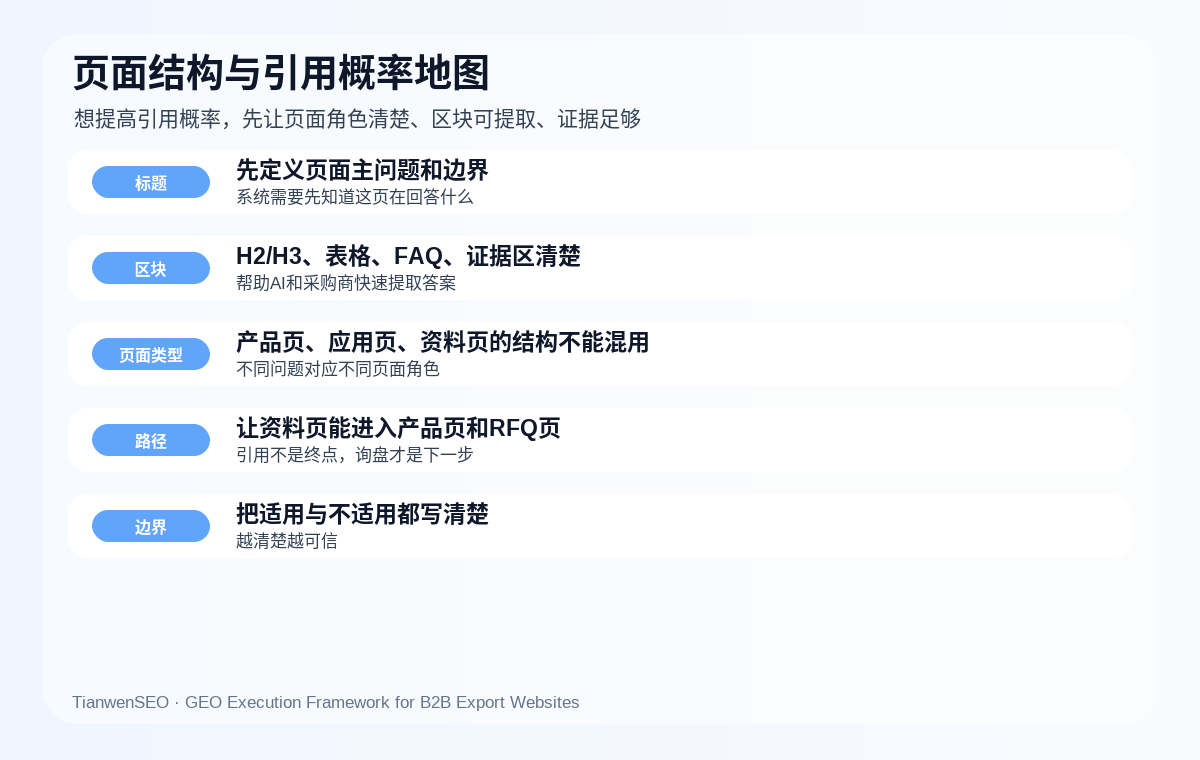
Whether it is a resource page or a product page, GEO structural optimization should usually start with the “answer section.” The role of the answer section is to let users and systems know within a very short time: what conclusion or judgment does this page actually give. Then use tables, FAQs, evidence, and boundaries to expand.
For example, on the page “how to choose between IP67 vs IP68 waterproof connector,” the conclusion should be stated first: for general outdoor lighting and short-term water immersion, IP67 is enough for most projects; for long-term immersion or harsh environments, higher requirements are needed and the structure must be considered. After that come test conditions, application differences, misconceptions, FAQs, and supplier judgment.
| Section | What it should solve | Common mistake |
|---|---|---|
| Answer section | Tell users the core judgment first | Too much buildup, no conclusion |
| Expansion section | Explain the conclusion with tables/FAQs/evidence | Only concepts, no details |
| Evidence section | Explain boundaries, certificates, downloads, or processes | Only advantages, no limitations |
| Path section | Guide to the product page or RFQ page | No next-step action |
Step 4: Fill in fact density first, then talk about “citation probability”
For foreign-trade product pages and resource pages, fact density is almost always more important than technique. Without parameters, materials, tolerances, IP ratings, pressure and temperature, certification scope, MOQ, samples, and lead time information, even the best structure can only organize empty talk.
GEO is not about making pages look more like “AI articles”; it is about making pages look more like a “trustworthy source of documentation.” For LED flood light, this might be wattage, lumens, waterproofing, and installation conditions; for industrial valve supplier, it is media, pressure, temperature, standards, and spare parts; for medical probe, it is material safety, compatibility, traceability, and risk boundaries.
| Current page situation | More like a structure problem | More like a fact problem | Priority action |
|---|---|---|---|
| Clear topic but weak citations | Structure may need optimization | Facts may also be shallow | Check tables and FAQs first |
| Clear title but customers still repeatedly ask basic questions | Structure or FAQ is weak | Facts may also be insufficient | Add FAQs and evidence |
| Page gets visits but conversion is weak | Path and RFQ problems are prominent | Product information may also be incomplete | Check CTA and fields first |
| AI mentions it but gets it wrong | Entity or evidence expression is weak | Fact boundaries are unclear | Add evidence and limitations |
Step 5: Treat “entity consistency” as part of GEO, not a separate task
AI systems do not look only at the official website. They synthesize the official website, B2B platforms, trade show directories, media releases, social media profiles, certification information, and historical materials. If these places say different things about the brand, product lines, factory/trading identity, certification scope, and market positioning, AI is more likely to misunderstand you.
Therefore, in GEO execution, entity consistency should be treated as one main thread: how the homepage introduces itself, how the About page defines the company identity, whether category pages are consistent with platform materials, whether the certification page explains the applicable scope, and whether trade show materials still talk about old product lines.
| Source of information | What should be unified | Why it affects GEO |
|---|---|---|
| Official website | Brand, product lines, identity, contact information | It is the primary information source |
| B2B platform | Main products and company profile | AI often refers to these summaries |
| Trade show directory | Main business direction and exhibition positioning | Affects brand understanding |
| Social media profile | Brand and product expression | Easily treated as supplementary information |
| Certification page | Applicable scope and valid boundaries | Affects credibility and accuracy |
Step 6: Connect GEO with the RFQ structure; do not stop at visibility
Much GEO execution stops at the “visibility” level, which is not enough. For foreign-trade companies, the more practical goal is: let higher-intent questions enter pages that can better handle them, and let those pages direct visits toward higher-quality inquiries.
For example, if a packaging machine resource page attracts many visits about powder filling, but the RFQ page has no fields for material, speed, precision, and target market, those visits will also struggle to turn into high-quality opportunities; if a custom metal parts material page has many visits but no drawing upload, material, and tolerance fields, it will also reduce business value.
| Page starting point | Where it should connect | Why it matters |
|---|---|---|
| Resource page | Product page/RFQ page/download page | Turn judgment into action |
| Application page | Product page/RFQ page | Turn scenario interest into a specific project |
| Capability page | Category page/evidence page/RFQ page | Turn trust into a quotation request |
| FAQ page | Resource page/product page/RFQ page | Pull scattered questions back into the business path |
Step 7: For different product lines, the first GEO action is not the same
There is no one-size-fits-all writing framework for GEO. The first action for different product lines can be completely different. Waterproof connector often needs comparisons and applications added first; custom metal parts needs capability and tolerance facts first; packaging machine needs scenarios and selection first; ceramic dinnerware needs MOQ, packaging, and samples first; private label activewear needs the customization process and size/fabric structure first.
| Product line | What the first action is more likely to be | Reason |
|---|---|---|
| waterproof connector | Add an IP comparison page and scenario pages | High-intent questions cluster around comparison and application |
| custom metal parts | Add material/tolerance/quality inspection pages | Purchasing judgment depends on technical facts |
| packaging machine | Add material scenarios and a selection table | Purchasing questions depend heavily on working conditions |
| ceramic dinnerware | Add MOQ/packaging/sample FAQs | Consumer goods purchasing questions cluster around trade processes |
| private label activewear | Add fabric/size/sampling process pages | OEM/ODM communication points are clear |
Step 8: Monitor “errors” and “gaps” first, then monitor “mention counts”
If a team doing GEO only reports “how many times we were mentioned this month” but does not record “which answers got it wrong,” “which questions did not mention you at all,” and “which citations came from wrong sources,” then this monitoring is of limited value. Foreign-trade companies need to handle errors and gaps first.
For example, if AI gets the standard range of an industrial valve supplier wrong, or describes you as a factory when you are clearly a trading company, or does not mention you at all in answers about packaging machine, these are all more worth handling first than “how many times in total you were mentioned.”
| Monitoring focus | Why it is a priority | What should be recorded |
|---|---|---|
| Wrong information | Errors are more dangerous than gaps | Answer, source, error point |
| Missing questions | Shows pages or materials did not capture it | Which high-value questions never appeared |
| Wrong sources | Know where to go fix it | Official website/platform/media/directory |
| Competitor changes | Helps understand who is seizing the question space | The page types the other party is cited for |
Step 9: Use GSC, GA4, inquiries, and sales feedback for a 30/60/90-day review
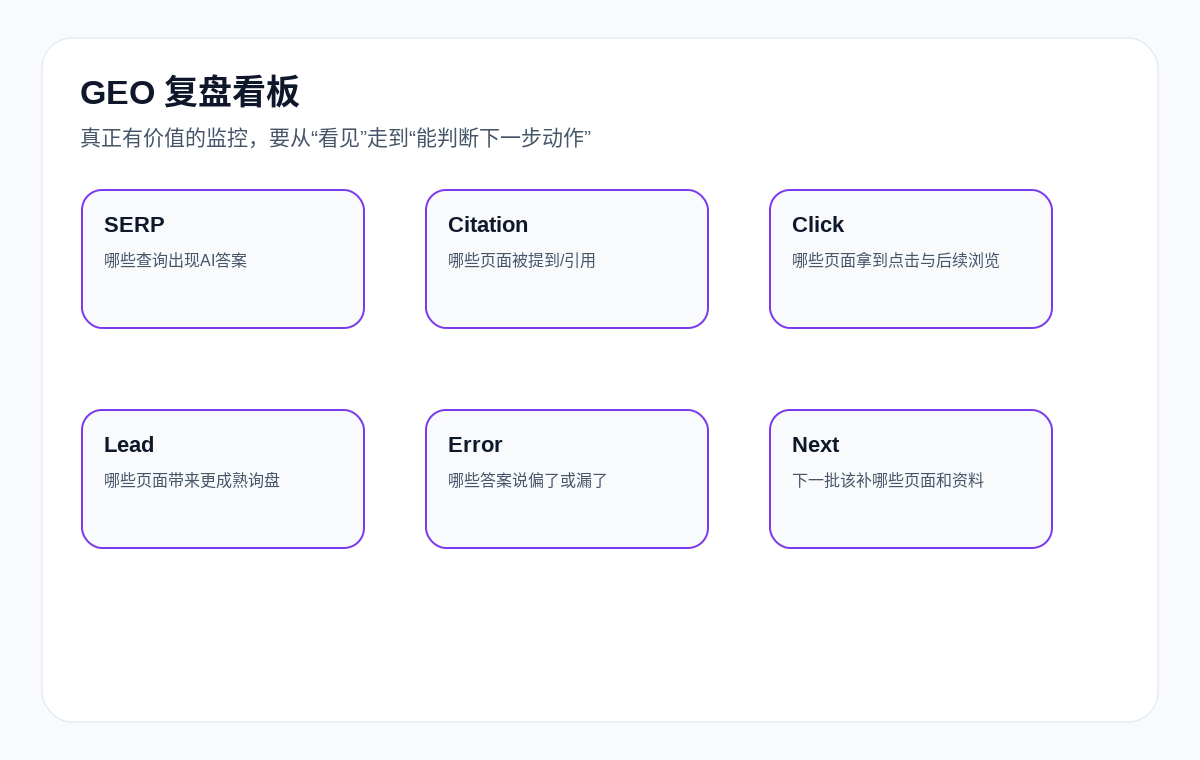
The real closed loop of GEO is not a beautiful screenshot, but evidence change over 30/60/90 days. At 30 days, first see whether page structure and target queries start to fit better; at 60 days, see whether pages are visited in more depth and enter the RFQ page more often; at 90 days, see whether inquiries are more specific, whether sales feels the explanation cost has dropped, and whether AI answers are more accurate.
If there is still no obvious staged signal after 90 days, the problem is usually not “whether GEO was done,” but rather: whether the page role judgment was wrong, whether the question library was off, whether the product pages and RFQ pages are still too weak, or whether the market itself has a limited search base.
| Period | What to look at first | Signals worth continuing |
|---|---|---|
| 0-30 days | Page roles, titles, structure, FAQs, RFQ fields | Target pages are clearer and behavior is more focused |
| 31-60 days | GSC queries, resource page visits, page paths | High-intent visits and deep visits increase |
| 61-90 days | AI answer accuracy, inquiry parameters, sales feedback | Inquiries are more specific and explanation cost drops |
If resources are limited, what should the minimum GEO execution order be
Many companies cannot afford to build a complete GEO system all at once. A more prudent approach is: choose one high-value product line first, then choose 3-5 key pages, then use the question library to drive page actions. Do not try to “do the whole site at once.”
| Minimum order | What to do | Result |
|---|---|---|
| 1 | Choose a high-value product line | Concentrated resources |
| 2 | Build a question library | Know what to monitor |
| 3 | Rewrite key product/resource/RFQ pages | Key pages get stronger first |
| 4 | Add entity consistency and evidence pages | Reduce AI misunderstanding |
| 5 | Do a 30/60/90-day review | Verify whether the direction is right |
Step 10: Why the first GEO action differs by page
Much execution fails not because no action was taken, but because the same set of actions was applied to every page. In reality, the first GEO action differs greatly by page. Product pages usually add facts and FAQs first; category pages add selection logic and series differences first; application pages add scenarios and boundaries first; resource pages add conclusions, comparison tables, and FAQs first; RFQ pages add fields and next-step explanations first.
| Page type | First GEO action | Why |
|---|---|---|
| Product page | Add specifications, applications, FAQs, downloads | Give the page credible facts first |
| Category page | Add series differences, applicable scenarios, and internal links | Help understand the whole product category |
| Application page | Add scenario questions, boundaries, and risks | Capture high-intent search |
| Resource page | Add an answer section, comparison table, FAQs | Increase the chance of being extracted and cited |
| RFQ page | Add fields, drawings/attachments, sampling process | Turn visits into more specific inquiries |
Step 11: How to do GEO on product pages so it is not just “writing a bit longer”
For foreign-trade product pages, the point of GEO is not to write a longer introduction, but to let both buyers and AI quickly get the facts needed for judgment. For waterproof connector, this might be IP rating, pin count, wire gauge, installation method, application scenarios, and FAQs; for LED flood light, it is wattage, lumens, waterproofing, installation, and applicable environment; for custom metal parts, it is material, tolerance, surface treatment, drawing requirements, and quality inspection methods.
| Product page module | What it should include | GEO value |
|---|---|---|
| Core parameters | Specifications, materials, ratings, ranges | Make the page more extractable |
| Applicable scenarios | Who it suits, what projects it suits | Help match high-intent questions |
| Common FAQs | MOQ, samples, lead time, certificates, compatibility | Reduce repeated communication |
| Document downloads | Drawings, manuals, spec sheets | Enhance credibility and deep visits |
| Next-step action | RFQ, samples, contact instructions | Connect to the business path |
Step 12: How to do GEO on resource pages so they look more like a “citable source”
Resource pages and tutorial pages are the pages on many sites with the best chance of becoming AI-cited sources, but only if they are really answering judgment questions. A high-quality resource page usually has four characteristics: give the conclusion first, then expand with a comparison table; cover common misconceptions; provide FAQs; and guide users to product pages, application pages, or RFQ pages.
For example, “IP67 vs IP68 waterproof connector” is a typical resource page topic; “how to choose packaging machine for powder filling” is also a typical resource page topic; “custom metal parts tolerance and surface finish guide” is likewise suitable for a resource page.
| Resource page module | Why it matters | Example |
|---|---|---|
| Conclusion section | Answer the main question first | Which scenario uses IP67 and which uses IP68 |
| Comparison table | Support quick judgment | Speed/precision/cleaning method comparison |
| Misconception section | Reduce wrong purchasing judgments | Treating the sampling process as in-stock lead time |
| FAQ section | Handle more detailed questions | MOQ, samples, certificates, packaging |
| Path section | Guide to product/RFQ pages | Turn learning into inquiries |
Step 13: Why category pages and application pages are often underestimated
When many teams build a site, the category page is just a product list, and the application page does not even exist. This is a great pity. Category pages can help AI and buyers understand the differences within an entire category of products, while application pages are better suited to handling high-intent questions about “how a certain product is used in a certain scenario.”
For example, the category page for packaging machine can distinguish powder, granule, and liquid; the application page for LED flood light can distinguish warehouse, stadium, and outdoor area; the application page for industrial valve supplier can distinguish different media and temperature-pressure scenarios.
| Page | Common problem | Stronger approach |
|---|---|---|
| Category page | Only a list, no logic | Add series differences, application scenarios, and FAQs |
| Application page | Completely missing | Build pages by high-intent scenarios |
| Category page to product page | Weak path | Add internal links and comparison explanations |
| Application page to RFQ page | No next step | Add CTAs and quotation guidance |
Step 14: How exactly should “citation probability” in GEO be understood
Citation probability is not a button you can directly control; it is more like the size of the chance that a page becomes a “trustworthy source of documentation.” The size of the chance is usually determined by several factors together: whether the page answers real questions, whether the structure is clear, whether the facts are sufficient, whether the entity and external materials are consistent, and whether you are more complete than competitors on the same topic.
So if you ask “how do I increase citation probability,” the more pragmatic answer is: first improve page credibility, structural clarity, question matching, and business paths, rather than chasing an abstract probability value.
| Factors affecting citation probability | More controllable actions |
|---|---|
| Question matching | Build a question library and align it with page roles |
| Structural clarity | Add an answer section, comparison tables, FAQs, and an evidence section |
| Fact density | Add parameters, standards, processes, and boundaries |
| Entity consistency | Unify the official website and external materials |
| Topic completeness | Let resource pages and product pages form a combined asset |
Step 15: If pages are mentioned but do not convert, what should GEO do next
Some companies encounter a staged phenomenon: pages seem easier to be mentioned or visited, but inquiry quality has not improved noticeably. This usually means GEO is still stuck at the “visibility” layer and has not reached the “business path” layer. The next step is not to stop GEO, but to look back: are the RFQ fields too weak, do resource pages link to product pages, are the FAQs still too generic, and have the questions sales is most often asked not yet been written into pages?
| Phenomenon | Possible cause | Next-step action |
|---|---|---|
| Visits increase but inquiries are average | Weak RFQ page, weak path | Add fields and CTAs |
| Deep resource page visits but no entry into product pages | Internal links are not strong enough | Rearrange the path |
| AI mentions it but customer questions remain scattered | FAQ and evidence sections are not specific enough | Add FAQs/processes/boundaries |
| Sales still repeatedly explains basic questions | Pages do not cover real pain points | Write sales questions into pages |
Industry scenario 1: How to do GEO for waterproof connector
For waterproof connector, the most critical thing about GEO is not “making more content,” but clearly breaking down high-value questions: IP67 vs IP68, pin count, wire gauge, installation method, solar cable, outdoor LED lighting, MOQ, samples, and supplier judgment. Building product pages, resource pages, application pages, and RFQ pages around these questions is a more effective path than chasing “AI exposure” alone.
| Page or module | What it should answer | Why it is critical |
|---|---|---|
| Product page | Specifications, ratings, applications, FAQs | Handle direct product questions |
| Resource page | IP67 vs IP68, selection logic | Handle comparison questions |
| Application page | solar / lighting / outdoor scenarios | Handle high-intent scenario terms |
| RFQ page | IP, pin count, wire gauge, sample, lead time fields | Improve inquiry matching |
Industry scenario 2: How to do GEO for custom metal parts / cnc machining parts
This type of product fears empty talk the most. Pages must be built around materials, tolerances, drawings, surface treatment, quality inspection, and lead time. The execution focus of GEO here is often to connect the capability page, material page, tolerance resource page, FAQs, and RFQ fields into one line.
| Priority module | Suggested action | Business meaning |
|---|---|---|
| Capability page | Add equipment, quality inspection, processes, and workflow | Build credibility |
| Resource page | Add material/tolerance/surface treatment judgment | Handle technical questions |
| Product page | Add parameters and applicable industries | Improve relevance |
| RFQ page | Support drawing, quantity, tolerance, and material fields | Improve inquiry quality |
Industry scenario 3: packaging machine / industrial valve / ceramic dinnerware
These industries are a good test of whether a team really knows how to do GEO. Packaging machine needs material and selection logic; industrial valve needs media, standards, temperature, and pressure boundaries; ceramic dinnerware emphasizes MOQ, packaging, samples, and market. The differences in questions across product lines determine the differences in page structure.
| Industry | High-priority questions | Page focus |
|---|---|---|
| packaging machine | Material, speed, precision, cleaning, after-sales | Application pages, selection table, FAQs |
| industrial valve | Media, pressure, temperature, standards, spare parts | Standards page, application page, evidence page |
| ceramic dinnerware | Material, MOQ, packaging, samples, market | FAQs, resource pages, RFQ pages |
| private label activewear | Fabric, size, labels, sampling, MOQ | Customization process page, FAQ page, RFQ page |
If only 1 month is given for a pilot, what should the minimum verifiable GEO deliverable be
GEO does not necessarily have to start as a big project. If doing a 1-month pilot first, the minimum verifiable deliverable should be: a question library for one product line, an AI answer baseline and error list, a page role map, upgrade samples for 1-2 key pages, an RFQ structure recommendation, and a 30/60/90-day review writing framework.
| Pilot deliverable | Why it is valuable |
|---|---|
| Question library | Determine monitoring and page direction first |
| Answer baseline | Know where you are wrong now |
| Page role map | Know which pages to change first |
| Key page samples | Verify whether the team can really execute |
| RFQ recommendation | Verify whether the business path is understood |
| Review writing framework | Verify whether there is long-term logic |
How the team should coordinate internally so GEO does not become paperwork
GEO is not a solo job for the marketing department. For foreign-trade companies, at least three types of internal information are critical: the questions sales is most often asked, the real boundaries of products and technology, and which pages existing high-quality inquiries come from. If this information is not given to the execution team, pages easily become vague “optimization articles” rather than assets that can handle purchasing judgment.
| Internal role | What it is best to provide | Why it matters |
|---|---|---|
| Sales/salesperson | Real customer questions, common misunderstandings, inquiry quality feedback | Help build FAQs and the question library |
| Product/technical | Parameters, boundaries, certification scope, risk notes | Help add facts and evidence |
| Marketing/operations | GSC, GA4, page performance, existing content assets | Help judge priorities |
| Person in charge | Product line priorities and stage goals | Help focus resources |
When a boss reviews GEO, what are the few things to look at most
A boss does not need to stare at “whether we were mentioned 3 or 5 times by AI”; he should look at whether the page system and business signals are getting stronger. Practical review methods usually include: whether key pages are clearer, whether the question library is more complete, whether AI errors are reduced, whether GSC is more on-topic, whether inquiries are more specific, and whether sales feels the explanation cost has dropped.
| Review question | If the answer is “yes,” what it means |
|---|---|
| Are the key product pages and resource pages clearly stronger? | Page assets are accumulating |
| Have the errors in AI answers decreased? | Entity and fact expression are clearer |
| Are more on-topic high-intent queries appearing in GSC? | Page topics and queries match better |
| Do resource pages and application pages bring visits into product pages/RFQ pages? | The business path is smoother |
| Are inquiry parameters more complete? | Pages are starting to truly serve sales |
Common GEO misconceptions: why many actions look right but the results are average
| Misconception | Why the effect is average | Better approach |
|---|---|---|
| Chasing only mention counts | Cannot explain business value | Look at errors, gaps, and paths first |
| Only doing blog pages | High-value product pages remain too weak | Add product/resource/RFQ pages first |
| All pages written very long | Long does not equal judgment value | Prioritize structure, tables, and facts |
| Pushing all product lines at once | Resources are scattered | Pilot one high-value product line first |
| Not looking at sales feedback | Hard to judge whether content is really useful | Write sales questions back into pages |
| Treating GEO as completely independent of SEO | Easy to duplicate work or become disconnected | Do it together with pages, search, and content |
If you can only do 3 things first, what is most worth doing for GEO first
If company resources are very limited, you can do three things first: first, choose one high-value product line and build a question library; second, rewrite 1-2 key product/resource pages and add the RFQ structure; third, build a 30/60/90-day review table. The benefit of doing this is that even without a big project, you can quickly see the direction clearly.
| Priority action | Why do it first |
|---|---|
| Build a question library | Decide monitoring and page direction first |
| Upgrade key pages | Make high-value pages stronger first |
| Build a review table | Prevent doing actions without looking at results |
Final judgment for foreign-trade teams: what GEO should change first, do not rely on feelings
The core of GEO is not “whether a certain technique was done,” but whether you can always prioritize around the page’s main question and business path. If you know what the most important questions are for a product line, which pages are closest to inquiries, which materials are most easily misunderstood, and which FAQs are most often asked, then it is easier to know what GEO should change first.
For sites such as custom metal parts, waterproof connector, packaging machine, LED flood light, medical probe, and industrial valve supplier, the more mature the GEO, the more the pages look like a clear, credible, verifiable customer acquisition system, rather than just “a website that looks more like it understands AI.”
If you want to score GEO execution, the 5 most practical dimensions
If you are internally evaluating whether GEO is being done right, you can score from five dimensions: whether the question library is close to the business, whether page roles are clear, whether facts and structure are getting stronger, whether the RFQ and path are smoother, and whether the review connects to GSC, GA4, inquiries, and sales feedback. This is more reliable than looking at a single tool score.
| Scoring dimension | High-score performance |
|---|---|
| Question library | Covers brand, product, application, comparison, supplier judgment, and risk questions |
| Page roles | Category/product/application/resource/RFQ page responsibilities are clear |
| Facts and structure | Parameters, FAQs, tables, evidence, and boundaries are clearly enhanced |
| Business path | Resource pages can lead into product pages and RFQ pages, and inquiries are more specific |
| Review capability | Can explain changes using GSC, GA4, AI answers, and sales feedback |
If you want to quickly test whether a plan is reliable, give it this exam question
The most practical test method is to give the execution team a clear topic: for example, for one product line of waterproof connector or packaging machine, ask them to explain the question library, page roles, key page changes, RFQ structure, and 90-day review method. If they can answer clearly, that is usually more reliable than a plan that only talks concepts.
| Exam item | What you should look at |
|---|---|
| Question library | Whether it really expands using English product terms and purchasing questions |
| Page map | Whether they understand the division of labor among category/product/resource/RFQ pages |
| Sample copy | Whether they can write facts, FAQs, and paths into pages |
| RFQ structure | Whether they understand industry fields and sample/attachment logic |
| Review method | Whether they can explain what to look at in 30/60/90 days |
After 90 days, how to judge whether GEO is worth continuing to invest in more heavily
Whether GEO is worth continuing depends not on concept hype, but on three types of signals: whether page assets are stronger, whether search and behavior are more on-topic, and whether inquiry quality and sales feedback are better. If all three types of signals start to appear, the execution direction of GEO is most likely right; if all three are very weak, you need to review whether the question library, page roles, and RFQ path are misaligned.
| Judgment item | Signal worth continuing to invest in more heavily | Signal requiring review |
|---|---|---|
| Page assets | Key product/resource/RFQ pages are clearly stronger | Only content volume increased, quality did not improve |
| Search and behavior | High-intent queries and deep visits are better | Only broad visits, no path change |
| Inquiries and sales | Parameters are more complete, sales explanation cost drops | Inquiries are not more focused |
Minimum GEO execution checklist
- Choose one high-value product line first; do not spread across the whole site right away.
- Build a question library first, then decide which pages to change.
- First give key product pages and resource pages an answer section, tables, FAQs, and an evidence section.
- First fill in RFQ fields and internal links, then talk about higher-level visibility.
- First look at GSC, GA4, AI answers, inquiries, and sales feedback, then decide the next round of actions.
In one sentence: the more solidly GEO is done, the more it looks like managing page assets rather than chasing a short-term concept; the better it connects to inquiries and sales, the more stable its value.
FAQ: How exactly is GEO done, and what should be changed first?
Is it enough to just write more articles first for GEO?
No. In many cases you should first strengthen product pages, category pages, resource pages, application pages, and RFQ pages, rather than piling up a lot of generic articles.
Is the first step of GEO monitoring AI mentions?
Not exactly. The more practical first step is usually assigning page roles, building a question library, and adding facts and structure, then starting continuous monitoring.
Why does page structure affect citation probability?
Because both AI and users need clear titles, sections, tables, and FAQs to quickly extract judgment information.
Are GEO practices the same for product pages and resource pages?
No. Product pages emphasize specifications, applicable users, and the RFQ path; resource pages emphasize comparisons, judgment frameworks, FAQs, and evidence.
Why must foreign-trade websites pay attention to the RFQ page?
Because if GEO cannot connect to higher-quality inquiries, its business value is greatly reduced.
If AI mentions me, does that mean GEO is being done right?
Not necessarily. You also need to see whether the mention is accurate, whether the cited sources are right, and whether visits enter the business path.
Can GEO be done without GSC and GA4 data?
You can do basic page and entity optimization, but the review will be much weaker. It is recommended to build a data foundation as soon as possible.
Do different product lines need different GEO actions?
Yes. The first action for waterproof connector, custom metal parts, packaging machine, and ceramic dinnerware is usually different.
How long does it take to judge whether the GEO order is right?
Usually 30 days to look at pages and queries, 60 days to look at behavior and visits, and 90 days to look at inquiry quality and sales feedback.
Will GEO replace SEO?
No. GEO is still built on the foundation of search discoverability, understandable pages, credible content, and a clear business path.
Conclusion: GEO is not a technique, but an execution system of “pages—facts—entities—review”
If you ask how GEO is done, the most pragmatic answer is not a certain technique, but an execution system: first separate page roles clearly, then fill in the facts, write the structure clearly, unify the entities, connect the RFQ path, and finally review together with GSC, GA4, AI answers, inquiries, and sales feedback.
For export manufacturers and trading companies, the value of doing this is not just “being seen more easily by AI,” but making the website more and more like a real customer acquisition asset: buyers understand you more easily, AI is less likely to get you wrong, and sales more easily receives more specific questions. When GEO is done right, in the end it is not one more concept, but one more page system that can accumulate over the long term.
Continue reading this set of GEO materials
If you are systematically learning GEO and AI search visibility, it is recommended to continue with the following articles. Understand the concepts first, then look at diagnosis, monitoring, content structure, and cooperation boundaries.
- What is Google SEO: from crawling, indexing, and ranking to AI search and foreign-trade inquiries
- How to do AI SEO: which has higher priority—title, URL, or paragraph structure
- Google SEO tutorial master index: continue learning by crawling, indexing, content, GEO, and review
- URL Inspection in practice: understanding the page version Google currently sees
- What a GEO visibility diagnosis includes: AI answers, entity consistency, citation sources, and review
- How to read a GEO diagnosis report: a guide to judging AI answers, citation sources, and entity consistency
- How to monitor AI search visibility: a checklist of brand mentions, official website citations, and competitor answers for foreign-trade websites
- How to choose GEO monitoring tools: where to look at mentions, citations, and traffic separately
{
“@context”: “https://schema.org”,
“@type”: “FAQPage”,
“mainEntity”: [
{
“@type”: “Question”,
“name”: “Is it enough to just write more articles first for GEO?”,
“acceptedAnswer”: {
“@type”: “Answer”,
“text”: “No. In many cases you should first strengthen product pages, category pages, resource pages, application pages, and RFQ pages, rather than piling up a lot of generic articles.”
}
},
{
“@type”: “Question”,
“name”: “Is the first step of GEO monitoring AI mentions?”,
“acceptedAnswer”: {
“@type”: “Answer”,
“text”: “Not exactly. The more practical first step is usually assigning page roles, building a question library, and adding facts and structure, then starting continuous monitoring.”
}
},
{
“@type”: “Question”,
“name”: “Why does page structure affect citation probability?”,
“acceptedAnswer”: {
“@type”: “Answer”,
“text”: “Because both AI and users need clear titles, sections, tables, and FAQs to quickly extract judgment information.”
}
},
{
“@type”: “Question”,
“name”: “Are GEO practices the same for product pages and resource pages?”,
“acceptedAnswer”: {
“@type”: “Answer”,
“text”: “No. Product pages emphasize specifications, applicable users, and the RFQ path; resource pages emphasize comparisons, judgment frameworks, FAQs, and evidence.”
}
},
{
“@type”: “Question”,
“name”: “Why must foreign-trade websites pay attention to the RFQ page?”,
“acceptedAnswer”: {
“@type”: “Answer”,
“text”: “Because if GEO cannot connect to higher-quality inquiries, its business value is greatly reduced.”
}
}
]
}
This page is machine-translated from the Simplified Chinese version and awaiting human review. It has not yet been proofread.
Further Reading on This B2B SEO & GEO Topic
- What Is the Relationship Between GEO and Content SEO? Why Isn't Writing More Enough?
- What Is the Relationship Between GEO and Brand Authority? Why Is AI Search Increasingly Focused on Brands?
- How to Write Common ChatGPT SEO Prompts: How to Apply Them to Content Planning, Title Generation, and Structural Rewriting
- What GEO Overview Monitoring Tools Are Available? Which Can Track Citations and Which Cannot?
- Why Publishing More Articles No Longer Guarantees Stable Traffic: A Guide to Managing Content Fatigue, Merging, and Pruning for B2B Export Websites
- Generative Engine Optimization (GEO) and AI Search Citation Hub for Export Brands
- Generative Engine Optimization Research
- B2B SEO & GEO Scope and Pricing Standards