Publishing more articles no longer reliably brings traffic, usually not because there is not enough content, but because the search intent behind articles, category pages, product pages, application pages and resource pages starts to overlap, and the topical signals of important pages are split apart. For export manufacturers, factories and trading companies in China, content growth is not about making the blog bigger, but about making every piece of content serve English product terms, procurement questions, product pages, category pages, application pages, resource pages and the inquiry path.
If you sell custom metal parts, LED flood light, packaging machine, medical probe, cnc machining parts, ceramic dinnerware, waterproof connector, industrial valve supplier, private label activewear manufacturer, more content is not necessarily better. Ten short articles all about “how to choose waterproof connector” may be less effective than one complete selection guide plus a clear product category page.
Official evidence boundary: content cannibalization, consolidation and pruning must verify page assets and search performance separately
Content cannibalization cannot be concluded with the four words “too many articles”. An export website must first look separately at page assets, search performance, indexing status, internal link entry points and inquiry actions. Search Console Performance shows query, page, clicks, impressions, CTR and average position; Page indexing and URL Inspection show indexing, canonical and the page version Google sees; GA4 events show on-site actions such as forms, email, WhatsApp, downloads and RFQ. Server logs, AI/GEO samples and sales feedback can support the judgment, but they cannot replace these official data layers.
If there is currently no usable GSC query, page or page-query row data, then you cannot write in rankings, impressions, clicks, CTR, AI adoption or inquiry changes. Content pruning can still proceed, but the conclusions must be downgraded to: which page intents are duplicated, which URLs need to be merged, which pages should have their facts updated, and which old URLs need redirects, canonical, noindex or sitemap cleanup.
Mapping table between official sources and content governance fields
| Official source entry | Judgment it can support | Content governance acceptance field | What it cannot prove |
|---|---|---|---|
| Google Search Central: Creating helpful, reliable, people-first content | Whether a page centers on user questions and real content value. | The target intent, product facts, verifiable experience and repeated passages of each article. | You cannot judge whether a page is useful by word count alone. |
| Google Search Central: Search Essentials | A page must meet basic technical, policy and content requirements to take part in Google Search. | Crawlable, indexable, no obvious violations, core content accessible. | Meeting the basics does not mean there is already search performance. |
| Google Search Central: SEO Starter Guide | Basic practices for titles, page organization, links, images and understandable content. | Whether pillar pages, product pages, resource pages and articles support each other. | It cannot replace a GSC performance review of a specific page. |
| Search Console Help: Performance report | Whether the same query is scattered across multiple pages, and whether pages get impressions and clicks. | query, page, country, device, clicks, impressions, CTR, average position. | Without row data you cannot write about ranking or click improvement. |
| Search Console Help: Page indexing report | Whether pages are indexed, and the reasons they are not indexed. | Index status of kept pages, merged pages, deleted pages and old URLs. | Being indexed does not mean the page brings inquiries. |
| Search Console Help: URL Inspection tool | Crawl, indexing, canonical and page version of a single URL. | Sample checks of the main page, merged pages, redirect targets and canonicals. | The status of a single URL cannot represent the performance of a whole group of pages. |
| Google Search Central: Consolidate duplicate URLs | Duplicate URLs can be handled with canonical, redirects, internal links and sitemaps together. | Canonical relationships among similar articles, parameter pages, filter pages, old product pages and the main page. | canonical is not a ranking promise. |
| Google Search Central: Redirections and Google Search | How to guide users and search engines to the new address when old URLs are merged, migrated or deleted. | Use cases and target URLs for 301, 302, 410 and 404. | You cannot redirect every weak article straight to the homepage. |
| Google Search Central: Sitemaps overview | Sitemaps help search engines discover important URLs. | Whether kept pages are in the sitemap and whether merged old URLs have been cleaned up. | Being present in the sitemap does not mean indexed or receiving impressions. |
| Google Search Central: robots.txt introduction | robots.txt controls crawl access. | Do not accidentally block category pages, product pages, resource pages, CSS, JS and image resources. | robots cannot solve content quality or intent duplication. |
| Google Search Central: noindex guide | Pages you do not want in search results can be controlled with noindex. | Whether thin tag pages, internal search pages, temporary pages and duplicate resource pages need noindex. | noindex is not a substitute for cleaning up internal link relationships. |
| Google Analytics Help: About events | GA4 events can observe what users do next on the site. | Events for forms, email, WhatsApp, RFQ, downloads, resource pages and contact pages. | On-site events cannot replace GSC search performance. |
| Google Search Central: AI features and your website | AI search capabilities still depend on accessible, indexable pages with clear content. | Whether kept pillar pages have clear facts, tables, internal links and quotable passages. | You cannot promise that AI answers will adopt the official website. |
| OpenAI Platform: Bots | Distinguish the access purposes of OAI-SearchBot, GPTBot and ChatGPT-User. | Whether robots, logs and public pages accidentally block relevant access paths. | Cannot state that ChatGPT will display things in a specified way. |
| Bing Webmaster Blog: AI Performance | If visible in the account, you can observe AI citations, cited pages, grounding query phrases. | Record Bing AI samples, GSC, GA4, logs and sales feedback separately. | Cannot represent all AI platforms. |
| IndexNow: Documentation | After URLs are updated, deleted or added, you can notify participating search engines. | Whether merged main pages and updated pages have notification actions. | Cannot replace content quality, crawl eligibility and indexing eligibility. |
Content pruning acceptance standards: look at the evidence first, then decide to keep, merge, update or retire
| Acceptance layer | Evidence that must exist | How to judge on an export website | Unacceptable practice |
|---|---|---|---|
| Intent grouping | query, page title, URL, product line, application scenario and inquiry stage. | Distinguish LED flood light category pages, product pages, installation guides, case pages and FAQ articles. | Deleting just because titles are similar. |
| GSC performance | clicks, impressions, CTR and average position of multiple pages under the same query. | Judge whether one main page should capture the core intent. | Writing about trend improvement without GSC row data. |
| Index status | Page indexing, URL Inspection, canonical and crawl time. | Confirm whether kept pages can take part in search and whether old URLs still occupy the index. | Editing only the body without rechecking indexing entry points. |
| Page role | The jobs of pillar pages, category pages, product pages, resource pages, articles and contact pages. | Let product line main pages capture commercial intent and let articles capture explanatory and decision questions. | Using blog articles to grab all product terms. |
| Consolidation action | Keep, update, merge, 301, 410, noindex, canonical, internal link adjustments. | Give each URL only one primary action and record the reason. | Merging all weak pages into the homepage. |
| GA4/inquiry | Events for forms, email, WhatsApp, RFQ, downloads and resource pages. | Observe whether the main page can connect to real inquiry actions after pruning. | Writing content pruning directly as inquiry improvement. |
| AI/GEO samples | Platform, question, date, answer summary, cited URL, factual accuracy. | See whether the kept main page is better suited to being cited and verified. | Treating one answer screenshot as a long-term result. |
How to downgrade content cannibalization conclusions when there is no GSC data
If the site currently has no usable GSC query, page or page-query row data, a content cannibalization report cannot be written as a search performance report. It can first be written as a page asset governance report.
| Missing evidence | What you can write | What you cannot write | Next review step |
|---|---|---|---|
| No GSC Performance rows | Whether page intent is duplicated, whether URLs should be merged, whether the main page is clear. | Ranking, impressions, clicks, CTR or trend improvement. | Keep the 28-day and 90-day date ranges and wait for the first rows. |
| No Page indexing sample | List the pillar pages, category pages, product pages, resource pages and old articles that need spot checks. | Assert that core pages already take part in search. | Record index status, canonical, crawl time and page version. |
| No GA4 events | Explain that events for forms, email, WhatsApp, downloads, RFQ and resource pages need to be configured. | Organic search inquiries have already improved. | First make on-site actions observable. |
| No log samples | Explain that origin, CDN or WAF logs are currently missing, and do not treat tool screenshots as crawl evidence. | Write that Googlebot has crawled or has not crawled. | Obtain logs with clear time coverage, sources and fields. |
| No AI samples | Build a table of platform, question, date, answer summary, cited URL and wrong facts. | Write that AI search has already adopted the official website. | Retest across platforms with a fixed question set and record it separately from page actions. |
II. Why more articles can actually make things weaker
When a website has only a small amount of content, adding high-quality pages usually helps. But when content is unplanned, similar topics keep increasing and page roles are unclear, new articles may not add assets but split existing signals.
For example, if an LED flood light website keeps publishing “how to choose LED flood light”, “how to choose outdoor LED flood light”, “how to choose parking lot lights”, “how to choose 100W flood light” and “industrial flood light guide”, and each article is thin, repeats the others and does not clearly link to category pages and product pages, Google may not know which page best captures the core intent.
The key to content growth for an export website is covering different procurement stages, not repeating the same thing under different titles.
Why content growth fails
| Reason | Symptom | Export example |
|---|---|---|
| Overlapping search intent | Multiple pages compete for the same query | Several articles all cover waterproof connector selection |
| Confused page roles | Articles grab category page terms | A blog page grabs supplier terms |
| Content too thin | Each article only has a shallow introduction | Product parameters and applications are missing |
| Scattered internal links | All articles link to each other randomly | Core product pages get no support |
| No review | Only looking at publishing volume | Not looking at inquiries and query terms |
III. Content cannibalization is not “too many articles”, it is “no main page for the same intent”
The essence of content cannibalization is not quantity, but the lack of a clear main page for the same search intent. A topic can have multiple pieces of content, but there must be a clear hierarchy: the pillar page answers the complete question, subpages answer segmented questions, product pages capture specific purchasing, and resource pages provide evidence.
For example, the waterproof connector topic can have one complete selection guide, plus subpages such as IP rating, M12 connector, marine lighting application and datasheet. The problem is not that there are many pages, but whether these pages each have independent intent and support the main page and product path through internal links.
If all pages write similar passages, fight over the same keyword and have no clear primary-secondary relationship, cannibalization forms.
Healthy content system vs. cannibalizing system
| Dimension | Healthy system | Cannibalizing system |
|---|---|---|
| Main page | One complete pillar page | Multiple shallow articles competing side by side |
| Subpages | Answer segmented questions | Repeat the main page content |
| Internal links | Subpages support the main page and product pages | Random linking to each other |
| Search intent | Each page has clear intent | Different titles, similar content |
| Review | Look at data by page role | Only look at total article count |
IV. Common cannibalization scenarios on export websites
Content cannibalization on export websites commonly falls into four types: blog articles repeating each other, blogs grabbing the intent of product category pages, application pages and product pages written as one, and resource pages replaced by blogs. Each type makes it hard for search systems and users to judge the main page.
For example, “custom metal parts supplier” should be captured by a capability page or category page, not by a general blog article; “cnc machining tolerance guide” can be a long technical article, but it must link to the CNC machining capability page and the upload drawing page; “LED flood light for parking lot” is better suited to an application page, rather than only an article with no product entry point.
When identifying cannibalization, first ask what the user behind this query term wants to do: learn, compare, select, find a supplier, download resources, or submit an RFQ.
Export cannibalization scenario table
| Scenario | Wrong page to capture it | Right page to capture it |
|---|---|---|
| supplier terms | Blog article | Category page/capability page |
| Model and parameter terms | General article | Product page/resource page |
| Application terms | Product page written as one | Application page + related products |
| Selection questions | Multiple short articles | Complete guide + FAQ |
| Resource terms | Article mentioning a download | Resource page |
V. Using GSC to identify cannibalization: see whether the same query is scattered across multiple pages
Google Search Console is an important tool for judging content cannibalization. You can view by query which pages get impressions and clicks. If the same query keeps switching between multiple pages and no page performs consistently, there may be intent overlap.
You can also view queries by page. If a blog page gets commercial terms such as supplier, manufacturer and custom quote while the category page does not have these terms, the page role may be misplaced. If the category page gets a large number of how to queries, it may also mean the category page content is too tutorial-like.
When judging, do not look only at single-day data; look at 3-month and 6-month trends, and combine them with page updates, seasonality and SERP changes.
GSC cannibalization signal table
| Signal | Possible problem | Action |
|---|---|---|
| The same term is shown by multiple pages in turn | Overlapping search intent | Determine the main page and merge |
| A blog gets commercial terms | Category page is weak or internal links are insufficient | Strengthen the category page and adjust internal links |
| A category page gets tutorial terms | Mixed content | Split out a tutorial page |
| Multiple pages have low clicks | Titles and intent are unclear | Rewrite titles and structure |
| Core page has no query terms | Weak internal links or thin content | Add content and in-body links |
VI. SERP benchmarking: if search results want a category page, do not force a blog to grab it
To judge what type of page should capture a term, you cannot look only at in-house ideas; you also have to look at search results. If the top results in the SERP are all product category pages, supplier pages and directory pages, the user intent leans commercial; if the top results are all tutorials and guides, the intent leans learning.
For example, “waterproof connector supplier” most likely needs a supplier capability page or category page; “how to choose waterproof connector” needs a tutorial; “M12 waterproof connector datasheet” needs a resource page; “waterproof connector for marine lighting” needs an application page.
If the page type is wrong, writing more may still be unstable. Content strategy should work backward from the SERP format to the page type.
SERP judgment table
| Mainstream SERP result | Search intent | Target page |
|---|---|---|
| Product category/supplier pages | Commercial procurement | Category page/capability page |
| Tutorial guides | Learning and selection | Content page |
| PDF/resource pages | Resource verification | Resource page |
| Application cases | Scenario judgment | Application page |
| Video results | Demonstration or installation | Video page + text summary |
VII. Content pruning is not deleting articles, it is restructuring assets
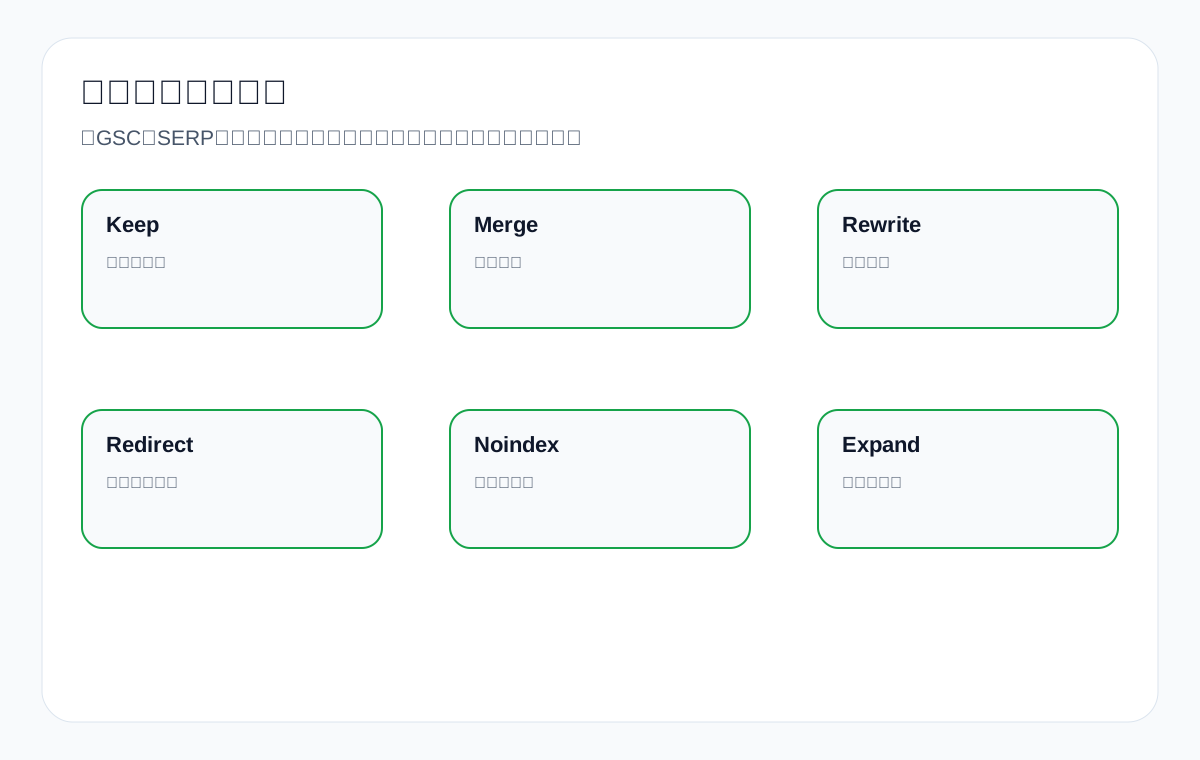
Content pruning does not equal simple deletion. Common actions include keeping, merging, rewriting, 301 redirecting, noindexing, updating, splitting and strengthening internal links. Each action must be judged by page value, search intent, historical data, backlinks, inquiry value and maintainability.
For example, three short articles all about packaging machine selection can be merged into one complete selection guide, and the original URLs redirected to the new guide; if an original article has backlinks and stable traffic, it can be kept and upgraded; if a low-value tag page has no traffic, no internal links and no inquiry value, it can be considered for noindexing or cleanup.
The goal of pruning is to make important pages stronger, not to make the website look like it has fewer articles.
Content handling action table
| Action | When it applies | Points to note |
|---|---|---|
| Keep | It has independent intent and stable data | Keep updating it |
| Merge | Multiple pieces of content are duplicated | Keep the strongest URL or create a new pillar page |
| Rewrite | Page intent is mismatched but the topic has value | Rewrite according to the SERP and product scenario |
| 301 | The old page has value but has been merged | Point to the most relevant page |
| noindex | Low value but needs to be kept for users | Avoid affecting the core index |
| Delete | No value and no historical signal | Back up and record carefully |
VIII. How to build an export content system: pillar pages, subpages, product pages, resource pages
A healthy export content system should look like a procurement path, not a random blog list. The pillar page fully explains a topic, subpages answer segmented questions, product pages capture specific models and parameters, resource pages provide evidence, application pages connect industry scenarios, and inquiry pages collect requirements.
Taking industrial valve supplier as an example, the pillar page can explain how to choose an industrial valve supplier, subpages cover materials, pressure ratings, test standards and industry applications, product pages cover specific valve series, resource pages hold datasheets and test reports, and the inquiry page collects medium, pressure, temperature and quantity.
This structure makes it easier to form topical authority and an inquiry path than constantly publishing scattered articles.
Content system map
| Page type | Function | Example |
|---|---|---|
| Pillar page | Fully answer the core question | How to choose industrial valve supplier |
| Subpage | Answer segmented questions | stainless steel valve material guide |
| Product page | Specific parameters and models | high pressure ball valve |
| Resource page | Evidence and downloads | valve pressure test report |
| Application page | Industry scenarios | valve for food processing |
| Inquiry page | Collect requirements | pressure, medium, quantity |
IX. How to preserve value when merging articles
Before merging articles, first export the URL, title, GSC data, backlinks, internal links, publish date, update record and current content. Then choose the main URL or a new URL and integrate the duplicate content into a stronger page.
The merged page must cover the effective query terms and valuable passages of the original articles, while adding tables, FAQ, product scenarios, internal links and resource entry points. If the original URL has value, it should be 301 redirected to the most relevant page; pages without value must also have the reason for handling recorded.
Merging is not pasting several articles together; it is redesigning the structure so the page solves one search intent more clearly.
Merge process table
| Step | Action | Acceptance |
|---|---|---|
| Inventory | Export URLs and data | Know the value of each page |
| Choose the main page | Choose the URL best suited to capture the intent | Avoid multiple pages competing |
| Rewrite the structure | Cover the old effective content and strengthen it | The page is more complete |
| Handle the original URLs | 301 or keep with an explanation | Signals are concentrated |
| Review | Look at query term and click changes | Confirm whether things have fallen into place |
X. Internal link restructuring: route scattered signals back to core pages
After content pruning, internal links must also be restructured. Many websites merge articles but still keep the old random internal links, and core product pages and category pages get no support. Internal links should reflect the new page system.
Pillar pages link to subpages, product pages, resource pages and inquiry pages; subpages link back to the pillar page; product pages link to related resources and application pages; resource pages link back to product pages. Anchor text must be specific, not just “click here”.
For example, custom metal parts tolerance guide should link to CNC machining parts, surface finish, upload drawing and inspection report, not only to the homepage.
Internal link restructuring table
| Page | Should link to | Purpose |
|---|---|---|
| Pillar page | Subpages, product pages, resource pages | Form the center |
| Subpage | Pillar page and related products | Support the topic |
| Product page | Resource pages, application pages, inquiry page | Drive purchasing |
| Resource page | Product pages and category pages | Build an evidence path |
| Original articles | The merged main page | Concentrate signals |
XI. When to keep writing new articles and when to stop and prune first
If the site’s core product pages, category pages and pillar pages are all thin, continuing to write a large number of new articles is usually not the priority. You should first fill in the core pages, merge duplicate articles and build internal links, then decide on the next batch of content.
If the existing page system is clear but there are new search demands, new products, new applications or new resources, then continuing to write new content is reasonable. The key is that every new piece of content must have a target query term, page role, internal link path and review metric.
Export companies can use a simple test: can the new article answer an independent procurement question that no existing page can answer? If not, it may be better to update or merge it into an existing page.
Write new or prune judgment table
| Situation | Recommendation | Reason |
|---|---|---|
| Core pages are very thin | Fill in core pages first | Articles cannot replace product pages |
| Multiple topics are duplicated | Merge first | Concentrate search intent |
| New product launch | New content can be written | There are new demands and pages |
| New application scenario | An application page can be built | Capture scenario terms |
| An existing article has declining traffic | Update first | Preserve historical signals |
XII. Why content consolidation matters even more in the age of AI search
AI search tends to generate answers from clear, complete, quotable content. If a question is answered in a scattered way across ten shallow articles on the website, it is harder for both AI and users to find the authoritative source.
Complete pillar pages, clearly structured FAQ, resource pages, tables and product links are better suited to being understood and cited by AI. Content consolidation can reduce contradictory statements and make brand and product facts more consistent.
For example, if the material, cleaning, compatibility and certification of medical probe are scattered across several short articles with different statements, it easily causes misunderstanding. Consolidating them into a resource page and a selection guide is more stable.
AI visibility and content consolidation
| Problem | AI risk | How to consolidate |
|---|---|---|
| Multiple shallow articles | Answer sources are scattered | Merge into a pillar page |
| Inconsistent facts | Generates wrong descriptions | Unify resources and FAQ |
| Missing tables | Hard to quote | Add parameter and comparison tables |
| No resource pages | Missing credible sources | Build download and explanation pages |
| No entity information | Brand confusion | Unify company and product naming |
XIII. A 90-day content pruning roadmap
In the first 30 days, do an inventory: export all articles, pages, GSC query terms, clicks, impressions, backlinks, internal links and inquiry data, and group them by product line and search intent.
From day 31 to 60, merge and strengthen: choose the topics with the highest duplication and the highest business value, merge them into pillar pages, and fill in category pages, product pages, application pages and resource pages.
From day 61 to 90, review: see whether query terms have concentrated on the main pages, whether core pages get more impressions, whether product clicks and inquiries have improved, and then decide the second batch of pruning and new content.
90-day roadmap table
| Period | Task | Deliverable | Review metric |
|---|---|---|---|
| 0-30 days | Content inventory and grouping | URL list, intent map | Duplicate topics and cannibalization signals |
| 31-60 days | Merge, rewrite, internal links | Pillar pages and redirects | Core page performance |
| 61-90 days | Data review and expansion | Second batch plan | Inquiry quality and AI accuracy |
XIV. Case: how to merge waterproof connector content
Assume the website has five articles: what is an IP67 connector, how to choose a waterproof connector, outdoor connector guide, marine connector selection and connector FAQ. They may overlap, but each may also have value.
You can make “how to choose” the pillar page, use IP67 as a parameter subpage, use marine lighting as an application page, organize the FAQ into the category page and pillar page, and make the datasheet a resource page. Original articles are redirected or updated according to value.
This way users and search engines see a clear structure instead of a pile of similar blogs.
waterproof connector merge example
| Original content | New role | Handling |
|---|---|---|
| how to choose waterproof connector | Pillar page | Expand and keep |
| what is an IP67 connector | Subpage | Update and link back |
| marine connector selection | Application page | Rewrite as a scenario page |
| connector FAQ | FAQ module | Merge into the category page |
| datasheet download instructions | Resource page | Keep as a standalone page |
XV. Case: how to restructure packaging machine content
packaging machine content is often published in scattered articles: how to choose a powder packing machine, how to choose a liquid filling machine, food packaging machine precautions, automatic packaging machine price, packaging machine maintenance. A better way is to build pages by equipment type, material and procurement stage.
powder packing machine and liquid filling machine should have independent category or product pages; how to choose packing machine can be a pillar guide; maintenance can be a resource or tutorial; price factors can become FAQ and inquiry page content.
After restructuring, buyers enter from the question page and can see related equipment, resources, videos and the inquiry form, instead of leaving after reading one article.
packaging machine restructuring table
| Topic | Page role | Internal link direction |
|---|---|---|
| powder packing machine | Category/product page | Products and inquiry |
| how to choose packing machine | Pillar guide | Each equipment category |
| food packaging application | Application page | Applicable equipment |
| maintenance guide | Resource/tutorial | Videos and spare parts |
| price factors | FAQ/inquiry page | Quote resource checklist |
XVIII. How to do a content inventory: first put all URLs in one table
Content pruning cannot rely on feeling. The first step should be to build a content inventory table and put all articles, pages, category pages, product pages, application pages and resource pages into the same table. Fields should at least include URL, title, page type, target query terms, current GSC impressions and clicks, main query terms, number of internal links, backlinks, whether it brings inquiries, and whether it has sales value.
Export companies should also add a product line field. For example, group LED flood light, waterproof connector, custom metal parts and packaging machine separately. This way you can see whether a product line has many articles but very weak product pages, or whether a high-profit product line has no content support.
When doing the inventory, do not look only at traffic. Some resource pages have low traffic but are important for sales; some articles have high traffic but bring invalid inquiries. Page value must be judged by combining search, product, inquiry and sales feedback.
Content inventory field table
| Field | Purpose | Export judgment |
|---|---|---|
| URL and title | Identify the page | Does the title state the product or problem |
| Page type | Judge the role | Article, category, product, application, resource |
| Target query terms | Judge intent | English product term or procurement question |
| GSC query terms | See actual understanding | Whether it enters the right page |
| Inquiry value | Connect to business | Whether it brings valid leads |
XIX. How to tag pages: by product line, intent and funnel stage
Tagging pages is for judging consolidation and internal links later. It is recommended to use at least three types of tags: product line tag, search intent tag and procurement stage tag. Product lines help see resource allocation, search intent helps see duplication, and procurement stage helps see whether pages form a path.
For example, pages for waterproof connector can be tagged product_line=connector, intent=selection guide, stage=research; the M12 4 pin waterproof connector product page can be tagged stage=specification; the waterproof connector quote page can be tagged stage=inquiry. This way you can see whether the same intent has multiple pages competing.
Tags are not for complicated management, but for letting the team know why each page exists. If a page cannot clearly state its product line, intent and stage, it usually needs to be rewritten, merged or demoted.
Page tag example table
| Page | Product line | Intent | Stage |
|---|---|---|---|
| How to choose LED flood light | LED flood light | Selection questions | Research |
| 100W LED flood light | LED flood light | Specifications and parameters | Comparison |
| Waterproof connector supplier | Connector | Supplier screening | Commercial |
| CNC tolerance guide | CNC parts | Technical explanation | Research |
| Upload drawing for quote | Custom parts | Quote preparation | Conversion |
XX. Similar titles do not necessarily mean cannibalization; similar intent is the key point
You cannot judge cannibalization only by similar titles. Some titles are similar but the intent is different, for example “LED flood light installation guide” and “LED flood light supplier” clearly serve different stages; some titles are different but the content is highly duplicated, for example “how to choose outdoor flood light” and “parking lot lighting selection” may cannibalize if neither has scenario differences.
What really matters is the search results, page content, GSC query terms and what the user does next. Do the two pages answer the same question? Do they both try to capture the same product term? Do they lack links to each other? Are both thin? If the answer is yes, they need handling.
Export websites in particular must avoid judging English intent with Chinese thinking. buyer, supplier, manufacturer, custom, datasheet, for application and how to choose represent different stages and should not be mixed in the same shallow page.
Similarity vs. cannibalization judgment table
| Situation | Cannibalization? | Handling |
|---|---|---|
| Similar titles but different intent | Not necessarily | Clarify internal links and roles |
| Different titles but duplicated content | Possible | Merge or rewrite |
| The same query shown by multiple pages | High risk | Determine the main page |
| One commercial page, one tutorial page | Can coexist | Link to each other |
| Multiple thin FAQ pages | High risk | Consolidate into an FAQ module |
XXI. What to cover when rewriting a pillar page
A merged pillar page must be stronger than the original articles, not simply stitched together. It needs a clear definition, an explanation of search intent, steps, judgment tables, export product examples, common mistakes, FAQ, related product and resource links, and review metrics.
For example, the “how to choose packaging machine” pillar page should cover materials, packaging forms, speed, accuracy, degree of automation, maintenance, certification, quote resources, application industries, common errors and factors affecting pricing. Valuable passages from the original articles can be kept, but they must be reorganized.
The pillar page must also leave exits for subpages. It does not write out every detail; it explains the framework and links to powder packing machine, liquid filling machine, maintenance guide, datasheet and the inquiry page.
Pillar page content module table
| Module | Function | Example |
|---|---|---|
| Definition and audience | Confirm search intent | Suitable for export procurement and supplier screening |
| Judgment process | Provide operational steps | Choose by material, capacity, packaging form |
| Comparison table | Lower the cost of judgment | Comparison of different equipment types |
| Export examples | Stay close to customer products | powder packaging machine |
| Internal link entries | Guide to products and resources | Product page, resource page, inquiry page |
XXII. How redirects and canonical work with content consolidation
After content consolidation, how the original URLs are handled affects signal concentration. Usually, if the original article has been fully merged into the new main page and the original URL has historical value, it can be 301 redirected to the new page. If the old page still has independent value, keep it and modify its internal links and title. If it is only a duplicate parameter page, canonical or noindex may be more suitable.
Do not redirect a pile of original articles all to the homepage; this confuses search engines and users. The redirect target must be the most relevant page. Back up the original content before merging, and update on-site links after merging so users do not keep visiting the old path.
canonical suits scenarios where content is highly similar but the URL still needs to be kept; 301 suits scenarios where the old page no longer exists independently. Export websites must decide by combining product resources and user paths.
Technical handling choice table
| Situation | Recommendation | Explanation |
|---|---|---|
| Original article fully merged | 301 to the main page | Concentrate historical signals |
| Pages highly similar but need to be kept | canonical | State the main version |
| Page is low value but users need it | noindex | Reduce index noise |
| Product discontinued with a replacement | Explain the replacement or 301 | Preserve the relevant intent |
| Page with no value and no signal | Delete or return a reasonable status | Back up and record first |
XXIII. How sales feedback participates in content pruning
The SEO team sees query terms and pages; sales sees inquiry quality. Without sales feedback, export content pruning easily keeps high-traffic, low-value content and deletes low-traffic but high-value resources.
Sales can mark whether an inquiry from a page has a clear product, quantity, target market, specifications, drawings, budget and procurement stage. For example, a custom metal parts tolerance guide does not have much traffic, but it often brings inquiries with drawings, so it should not be deleted because of low traffic.
Content pruning meetings should include sales, and at least monthly or quarterly feedback on which topics bring effective communication and which topics bring invalid inquiries. Only then can the content system serve the business.
Sales feedback field table
| Field | Explanation | Content decision |
|---|---|---|
| Product clarity | Whether a specific product is stated | Judge the quality of page intent |
| Specification completeness | Whether there are parameters, drawings, quantity | Judge the value of the tutorial |
| Market match | Whether the country and target customer match | Adjust the content expression |
| Procurement stage | Research, comparison, inquiry, sampling | Add pages for different stages |
| Deal potential | Subjective sales rating | Decide what to keep and expand |
XXIV. Pre-publishing cannibalization check
To avoid creating more cannibalization in the future, the most effective method is to check before publishing. Every new article or new page must answer: does the site already have a page that captures the same intent? If so, why is a new page still needed? Is the new page a pillar page, subpage, application page, resource page or product page? Which commercial pages will it link to? What metrics will the review look at?
If these questions cannot be answered clearly, the new content should not be published in a hurry. Export companies in particular should avoid the habit of “think of a topic, publish an article”. For example, if you want to write “LED flood light buyer guide”, first check whether the site already has an LED flood light guide, a parking lot lighting guide or a 100W LED flood light page. If an existing page can capture it, the old page should be updated first.
Pre-publishing checks slow content production down a little, but they can significantly reduce later consolidation and cleanup costs.
Pre-publishing checklist
| Question | Pass standard | Action if it fails |
|---|---|---|
| Is there already a page with the same intent | No, or the new page has independent value | Update the old page or merge |
| Is the page role clear | Pillar/subpage/product/resource is clear | Reposition it |
| Are the target query terms clear | There is an English product term or procurement question | Do keyword research first |
| Is the internal link path clear | It can lead to products, resources, inquiry | Add an internal link plan |
| Are the review metrics decided | GSC/GA4/inquiry can be tracked | Add review fields |
XXV. How to avoid losing historical value when updating existing content
If existing content has historical clicks, backlinks, brand citations or inquiry value, do not rewrite it roughly. First back up the original content, keep the passages, query terms and URL structure that already work, then add new information, tables, FAQ, product links and resource entries.
For example, an old article about Google SEO analysis tools may bring stable traffic. If it is to be upgraded, keep the core explanations of GSC, GA4 and diagnostic tools, then add export product page diagnostics, the inquiry path, AI citations and sales feedback, rather than completely replacing it with another topic.
After updating, record the modification date, main changes, target query terms and expected review cycle. This way the team can judge whether the update was effective, instead of only knowing that it “was changed”.
Existing content update protection table
| Protection item | Why it matters | How to update |
|---|---|---|
| Effective query terms | Existing search understanding | Keep and expand the relevant passages |
| External links | Historical signals | Keep the URL if possible |
| Inquiry entry points | Business value | Strengthen rather than delete |
| User bookmarks | Long-term visits | Avoid an abrupt topic change |
| Internal link relationships | On-site paths | Update anchor text and target pages |
XXVI. Content governance board: let the team know what to do next
Content governance should not exist only in the SEO person’s head. It is recommended to build a simple board and divide all content into: to keep, to update, to merge, to rewrite, to noindex, to delete, new pillar page, new product page, new resource page. Each task has an owner, product line, reason and review time.
Export companies can govern in batches by product line. The first batch handles high-profit or main product lines, such as industrial valve, custom metal parts or packaging machine; the second batch handles pages with GSC impressions but weak conversion; the third batch handles low-value duplicate content.
The value of the board is to turn content production from random actions into long-term asset management. The team knows not “what to publish today” but “which page asset this product line is missing”.
Content governance board fields
| Field | Example | Purpose |
|---|---|---|
| Product line | waterproof connector | Sort by business |
| Page action | merge/update/create | Clarify the task type |
| Target page | selection guide | Determine the main URL |
| Reason | query terms are scattered | Explain the business and SEO basis |
| Review time | in 8 weeks | Avoid doing work and never checking it |
XXVII. Low-quality content does not necessarily come from AI; it can also come from missing product facts
Many people attribute low-quality content to AI writing, but the real problem on export websites is often a lack of product facts. Even human-written content, without materials, specifications, applications, certifications, MOQ, lead time, testing, packaging and customer questions, can only produce vague content.
When pruning content, do not only ask “was this written by AI”, but ask “does it solve the buyer’s problem, does it provide product facts, and can it lead to the next step”. A short resource page with an accurate datasheet entry may be more valuable than a very long but vague article.
Therefore the core of improving content quality is to have sales, product, engineering and website teams provide facts together, rather than simply chasing word count or publishing frequency.
Content quality judgment table
| Judgment item | High-quality performance | Low-quality performance |
|---|---|---|
| Product facts | Parameters, materials and applications are clear | Only adjectives |
| Procurement questions | Answers real FAQ | General introduction |
| Page relationships | Links to products and resources | Isolated article |
| Evidence | Certificates, tests, images, tables | No verifiable information |
| Review | Can see query terms and inquiries | No one looks after publishing |
XXVIII. Final decision process: every page has only four fates
After the inventory is complete, every page should enter one of four fates: enhance, merge, demote, remove. Enhance suits pages with independent value that are not strong enough; merge suits duplicate pages with the same intent; demote suits pages users need but that are not suitable as search entry points; remove suits pages with no value and no historical signal.
This process lets the team reduce arguments. It is not about keeping whichever article you like, but about judging by evidence: search intent, page quality, business value, historical signals, internal link relationships and review metrics.
After one round, export websites usually find that the pages truly needing long-term investment are not only blogs, but core product line pages, application pages, resource pages and technical guides that bring high-quality inquiries.
Four fates decision table
| Fate | Applicable pages | Follow-up action |
|---|---|---|
| Enhance | Independent intent but thin content | Add depth, tables, internal links |
| Merge | Multiple pieces of content with duplicate intent | Consolidate into a main page and handle the original URLs |
| Demote | Users need it but search value is low | noindex or reduce entry points |
| Remove | Page with no value and no signal | Back up, then delete or return a reasonable status |
| Create | Existing pages cannot capture the new intent | Build the page and include it in internal links |
XVI. FAQ: does more content make it easier to split authority?
Does having many articles always cause cannibalization?
No. As long as each article has independent search intent, a clear page role and reasonable internal links, many articles can still form a content asset. The problem is duplication, thinness and no review.
Does content pruning mean deleting existing articles?
Not necessarily. Pruning includes keeping, updating, merging, rewriting, redirecting, noindexing and deleting. Deleting is only one of them.
How do you judge whether two articles should be merged?
Look at the target query terms, SERP type, GSC query terms, degree of content overlap, user intent and business value. If they overlap heavily and have no independent value, they are usually suitable for merging.
What happens to the original URL after merging?
Original URLs with historical value, backlinks or traffic should usually be 301 redirected to the most relevant new page or main page, and internal links should be updated.
Should an export website write articles first or build product pages first?
If product pages and category pages are thin, core commercial pages should be filled in first. Articles should serve products and procurement questions, not replace product pages.
Will AI search amplify content cannibalization?
It may. Scattered and contradictory content makes it harder for AI to judge the authoritative source, while clearly consolidated pages are easier to understand accurately.
Should all low-traffic articles be deleted?
Not necessarily. Pages with low traffic that serve sales, resources, customer education or high-value long-tail queries can be kept and optimized.
How often should content pruning results be reviewed?
After technical handling, check indexing and redirects in the short term; for search performance it is recommended to observe for 4 to 12 weeks and combine that with inquiry quality.
How can new articles avoid cannibalization again?
Before writing, check whether the site already has a main page, and confirm the target query terms, SERP format, page role, internal link path and review metrics.
What if a category page and an article compete for terms?
Look at the SERP and user intent. If it is a commercial term, strengthen the category page; the article can be turned into a selection guide and link to the category page.
XVII. Conclusion: content growth must shift from competing on quantity to page asset governance
Publishing more articles no longer reliably brings traffic, which does not mean content is unimportant; it means content production must shift from competing on quantity to page asset governance. What an export website really needs is clear product pages, category pages, application pages, resource pages, pillar content and an inquiry path.
Every new piece of content must answer: which query terms does it capture, is the search intent independent, what is its relationship to existing pages, does it support a product page or category page, and how will it be reviewed with GSC, GA4, AI answers and inquiry quality.
When duplicate content is merged, core pages are strengthened, internal links are concentrated again, and resources and FAQ are more complete, the search signals of an export website become clearer, and buyers can more easily move from learning to selection, resource verification and inquiry.
Final checklist
| Check item | Completion standard |
|---|---|
| Query term grouping | The same intent has a clear main page |
| Page roles | Articles, category, product, application and resource pages are not mixed up |
| Content handling | Keep, merge, rewrite and redirect are recorded |
| Internal link restructuring | Subpages support core pages and product pages |
| Review metrics | GSC, GA4, AI accuracy and inquiry quality are looked at together |
| New content rules | Before writing, check whether an existing page already captures it |
{
“@context”: “https://schema.org”,
“@type”: “FAQPage”,
“mainEntity”: [
{
“@type”: “Question”,
“name”: “Top1/authority benchmark comparison cardnnComparison dimension | Authority content strength | Export company gap | How this article fills itnnContent cannibalization explains multiple pages competing for the same term | Missing the roles of product pages/category pages | Split by page typenContent pruning gives keep, merge and delete methods | Missing judgment of export inquiry value | Add inquiry quality and sales feedbacknKeyword overlap identified with GSC and SERP | Missing English product term scenarios | Add export product line examplesnConsolidation and redirects cover technical handling | Missing a content asset restructuring roadmap | Give a 90-day roadmap and page mapnAI visibility partly mentions content quality | Missing review of AI citation accuracy | Add AI answers and resource pagesnnII. Why more articles can actually make things weakernWhen a website has only a small amount of content, adding high-quality pages usually helps. But when content is unplanned, similar topics keep increasing and page roles are unclear, new articles may not add assets but split existing signals.nFor example, if an LED flood light website keeps publishing “how to choose LED flood light”, “how to choose outdoor LED flood light”, “how to choose parking lot lights”, “how to choose 100W flood light” and “industrial flood light guide”, and each article is thin, repeats the others and does not clearly link to category pages and product pages, Google may not know which page best captures the core intent.nThe key to content growth for an export website is covering different procurement stages, not repeating the same thing under different titles.nWhy content growth failsnnReason | Symptom | Export examplennOverlapping search intent | Multiple pages compete for the same query | Several articles all cover waterproof connector selectionnConfused page roles | Articles grab category page terms | A blog page grabs supplier termsnContent too thin | Each article only has a shallow introduction | Product parameters and applications are missingnScattered internal links | All articles link to each other randomly | Core product pages get no supportnNo review | Only looking at publishing volume | Not looking at inquiries and query termsnnIII. Content cannibalization is not “too many articles”, it is “no main page for the same intent”nThe essence of content cannibalization is not quantity, but the lack of a clear main page for the same search intent. A topic can have multiple pieces of content, but there must be a clear hierarchy: the pillar page answers the complete question, subpages answer segmented questions, product pages capture specific purchasing, and resource pages provide evidence.nFor example, the waterproof connector topic can have one complete selection guide, plus subpages such as IP rating, M12 connector, marine lighting application and datasheet. The problem is not that there are many pages, but whether these pages each have independent intent and support the main page and product path through internal links.nIf all pages write similar passages, fight over the same keyword and have no clear primary-secondary relationship, cannibalization forms.nHealthy content system vs. cannibalizing systemnnDimension | Healthy system | Cannibalizing systemnnMain page | One complete pillar page | Multiple shallow articles competing side by sidenSubpages | Answer segmented questions | Repeat the main page contentnInternal links | Subpages support the main page and product pages | Random linking to each othernSearch intent | Each page has clear intent | Different titles, similar contentnReview | Look at data by page role | Only look at total article countnnIV. Common cannibalization scenarios on export websitesnContent cannibalization on export websites commonly falls into four types: blog articles repeating each other, blogs grabbing the intent of product category pages, application pages and product pages written as one, and resource pages replaced by blogs. Each type makes it hard for search systems and users to judge the main page.nFor example, “custom metal parts supplier” should be captured by a capability page or category page, not by a general blog article; “cnc machining tolerance guide” can be a long technical article, but it must link to the CNC machining capability page and the upload drawing page; “LED flood light for parking lot” is better suited to an application page, rather than only an article with no product entry point.nWhen identifying cannibalization, first ask what the user behind this query term wants to do: learn, compare, select, find a supplier, download resources, or submit an RFQ.nExport cannibalization scenario tablennScenario | Wrong page to capture it | Right page to capture itnnsupplier terms | Blog article | Category page/capability pagenModel and parameter terms | General article | Product page/resource pagenApplication terms | Product page written as one | Application page + related productsnSelection questions | Multiple short articles | Complete guide + FAQnResource terms | Article mentioning a download | Resource pagennV. Using GSC to identify cannibalization: see whether the same query is scattered across multiple pagesnGoogle Search Console is an important tool for judging content cannibalization. You can view by query which pages get impressions and clicks. If the same query keeps switching between multiple pages and no page performs consistently, there may be intent overlap.nYou can also view queries by page. If a blog page gets commercial terms such as supplier, manufacturer and custom quote while the category page does not have these terms, the page role may be misplaced. If the category page gets a large number of how to queries, it may also mean the category page content is too tutorial-like.nWhen judging, do not look only at single-day data; look at 3-month and 6-month trends, and combine them with page updates, seasonality and SERP changes.nGSC cannibalization signal tablennSignal | Possible problem | ActionnnThe same term is shown by multiple pages in turn | Overlapping search intent | Determine the main page and mergenA blog gets commercial terms | Category page is weak or internal links are insufficient | Strengthen the category page and adjust internal linksnA category page gets tutorial terms | Mixed content | Split out a tutorial pagenMultiple pages have low clicks | Titles and intent are unclear | Rewrite titles and structurenCore page has no query terms | Weak internal links or thin content | Add content and in-body linksnnVI. SERP benchmarking: if search results want a category page, do not force a blog to grab itnTo judge what type of page should capture a term, you cannot look only at in-house ideas; you also have to look at search results. If the top results in the SERP are all product category pages, supplier pages and directory pages, the user intent leans commercial; if the top results are all tutorials and guides, the intent leans learning.nFor example, “waterproof connector supplier” most likely needs a supplier capability page or category page; “how to choose waterproof connector” needs a tutorial; “M12 waterproof connector datasheet” needs a resource page; “waterproof connector for marine lighting” needs an application page.nIf the page type is wrong, writing more may still be unstable. Content strategy should work backward from the SERP format to the page type.nSERP judgment tablennMainstream SERP result | Search intent | Target pagennProduct category/supplier pages | Commercial procurement | Category page/capability pagenTutorial guides | Learning and selection | Content pagenPDF/resource pages | Resource verification | Resource pagenApplication cases | Scenario judgment | Application pagenVideo results | Demonstration or installation | Video page + text summarynnVII. Content pruning is not deleting articles, it is restructuring assetsnContent pruning does not equal simple deletion. Common actions include keeping, merging, rewriting, 301 redirecting, noindexing, updating, splitting and strengthening internal links. Each action must be judged by page value, search intent, historical data, backlinks, inquiry value and maintainability.nFor example, three short articles all about packaging machine selection can be merged into one complete selection guide, and the original URLs redirected to the new guide; if an original article has backlinks and stable traffic, it can be kept and upgraded; if a low-value tag page has no traffic, no internal links and no inquiry value, it can be considered for noindexing or cleanup.nThe goal of pruning is to make important pages stronger, not to make the website look like it has fewer articles.nContent handling action tablennAction | When it applies | Points to notennKeep | It has independent intent and stable data | Keep updating itnMerge | Multiple pieces of content are duplicated | Keep the strongest URL or create a new pillar pagenRewrite | Page intent is mismatched but the topic has value | Rewrite according to the SERP and product scenarion301 | The old page has value but has been merged | Point to the most relevant pagennoindex | Low value but needs to be kept for users | Avoid affecting the core indexnDelete | No value and no historical signal | Back up and record carefullynnVIII. How to build an export content system: pillar pages, subpages, product pages, resource pagesnA healthy export content system should look like a procurement path, not a random blog list. The pillar page fully explains a topic, subpages answer segmented questions, product pages capture specific models and parameters, resource pages provide evidence, application pages connect industry scenarios, and inquiry pages collect requirements.nTaking industrial valve supplier as an example, the pillar page can explain how to choose an industrial valve supplier, subpages cover materials, pressure ratings, test standards and industry applications, product pages cover specific valve series, resource pages hold datasheets and test reports, and the inquiry page collects medium, pressure, temperature and quantity.nThis structure makes it easier to form topical authority and an inquiry path than constantly publishing scattered articles.nContent system mapnnPage type | Function | ExamplennPillar page | Fully answer the core question | How to choose industrial valve suppliernSubpage | Answer segmented questions | stainless steel valve material guidenProduct page | Specific parameters and models | high pressure ball valvenResource page | Evidence and downloads | valve pressure test reportnApplication page | Industry scenarios | valve for food processingnInquiry page | Collect requirements | pressure, medium, quantitynnIX. How to preserve value when merging articlesnBefore merging articles, first export the URL, title, GSC data, backlinks, internal links, publish date, update record and current content. Then choose the main URL or a new URL and integrate the duplicate content into a stronger page.nThe merged page must cover the effective query terms and valuable passages of the original articles, while adding tables, FAQ, product scenarios, internal links and resource entry points. If the original URL has value, it should be 301 redirected to the most relevant page; pages without value must also have the reason for handling recorded.nMerging is not pasting several articles together; it is redesigning the structure so the page solves one search intent more clearly.nMerge process tablennStep | Action | AcceptancennInventory | Export URLs and data | Know the value of each pagenChoose the main page | Choose the URL best suited to capture the intent | Avoid multiple pages competingnRewrite the structure | Cover the old effective content and strengthen it | The page is more completenHandle the original URLs | 301 or keep with an explanation | Signals are concentratednReview | Look at query term and click changes | Confirm whether things have fallen into placennFigure 2: Handling content cannibalization is not only about deleting; choose to keep, merge, rewrite or move according to page value.nX. Internal link restructuring: route scattered signals back to core pagesnAfter content pruning, internal links must also be restructured. Many websites merge articles but still keep the old random internal links, and core product pages and category pages get no support. Internal links should reflect the new page system.nPillar pages link to subpages, product pages, resource pages and inquiry pages; subpages link back to the pillar page; product pages link to related resources and application pages; resource pages link back to product pages. Anchor text must be specific, not just “click here”.nFor example, custom metal parts tolerance guide should link to CNC machining parts, surface finish, upload drawing and inspection report, not only to the homepage.nInternal link restructuring tablennPage | Should link to | PurposennPillar page | Subpages, product pages, resource pages | Form the centernSubpage | Pillar page and related products | Support the topicnProduct page | Resource pages, application pages, inquiry page | Drive purchasingnResource page | Product pages and category pages | Build an evidence pathnOriginal articles | The merged main page | Concentrate signalsnnXI. When to keep writing new articles and when to stop and prune firstnIf the site’s core product pages, category pages and pillar pages are all thin, continuing to write a large number of new articles is usually not the priority. You should first fill in the core pages, merge duplicate articles and build internal links, then decide on the next batch of content.nIf the existing page system is clear but there are new search demands, new products, new applications or new resources, then continuing to write new content is reasonable. The key is that every new piece of content must have a target query term, page role, internal link path and review metric.nExport companies can use a simple test: can the new article answer an independent procurement question that no existing page can answer? If not, it may be better to update or merge it into an existing page.nWrite new or prune judgment tablennSituation | Recommendation | ReasonnnCore pages are very thin | Fill in core pages first | Articles cannot replace product pagesnMultiple topics are duplicated | Merge first | Concentrate search intentnNew product launch | New content can be written | There are new demands and pagesnNew application scenario | An application page can be built | Capture scenario termsnAn existing article has declining traffic | Update first | Preserve historical signalsnnXII. Why content consolidation matters even more in the age of AI searchnAI search tends to generate answers from clear, complete, quotable content. If a question is answered in a scattered way across ten shallow articles on the website, it is harder for both AI and users to find the authoritative source.nComplete pillar pages, clearly structured FAQ, resource pages, tables and product links are better suited to being understood and cited by AI. Content consolidation can reduce contradictory statements and make brand and product facts more consistent.nFor example, if the material, cleaning, compatibility and certification of medical probe are scattered across several short articles with different statements, it easily causes misunderstanding. Consolidating them into a resource page and a selection guide is more stable.nAI visibility and content consolidationnnProblem | AI risk | How to consolidatennMultiple shallow articles | Answer sources are scattered | Merge into a pillar pagenInconsistent facts | Generates wrong descriptions | Unify resources and FAQnMissing tables | Hard to quote | Add parameter and comparison tablesnNo resource pages | Missing credible sources | Build download and explanation pagesnNo entity information | Brand confusion | Unify company and product namingnnXIII. A 90-day content pruning roadmapnIn the first 30 days, do an inventory: export all articles, pages, GSC query terms, clicks, impressions, backlinks, internal links and inquiry data, and group them by product line and search intent.nFrom day 31 to 60, merge and strengthen: choose the topics with the highest duplication and the highest business value, merge them into pillar pages, and fill in category pages, product pages, application pages and resource pages.nFrom day 61 to 90, review: see whether query terms have concentrated on the main pages, whether core pages get more impressions, whether product clicks and inquiries have improved, and then decide the second batch of pruning and new content.n90-day roadmap tablennPeriod | Task | Deliverable | Review metricnn0-30 days | Content inventory and grouping | URL list, intent map | Duplicate topics and cannibalization signalsn31-60 days | Merge, rewrite, internal links | Pillar pages and redirects | Core page performancen61-90 days | Data review and expansion | Second batch plan | Inquiry quality and AI accuracynnXIV. Case: how to merge waterproof connector contentnAssume the website has five articles: what is an IP67 connector, how to choose a waterproof connector, outdoor connector guide, marine connector selection and connector FAQ. They may overlap, but each may also have value.nYou can make “how to choose” the pillar page, use IP67 as a parameter subpage, use marine lighting as an application page, organize the FAQ into the category page and pillar page, and make the datasheet a resource page. Original articles are redirected or updated according to value.nThis way users and search engines see a clear structure instead of a pile of similar blogs.nwaterproof connector merge examplennOriginal content | New role | Handlingnnhow to choose waterproof connector | Pillar page | Expand and keepnwhat is an IP67 connector | Subpage | Update and link backnmarine connector selection | Application page | Rewrite as a scenario pagenconnector FAQ | FAQ module | Merge into the category pagendatasheet download instructions | Resource page | Keep as a standalone pagennXV. Case: how to restructure packaging machine contentnpackaging machine content is often published in scattered articles: how to choose a powder packing machine, how to choose a liquid filling machine, food packaging machine precautions, automatic packaging machine price, packaging machine maintenance. A better way is to build pages by equipment type, material and procurement stage.npowder packing machine and liquid filling machine should have independent category or product pages; how to choose packing machine can be a pillar guide; maintenance can be a resource or tutorial; price factors can become FAQ and inquiry page content.nAfter restructuring, buyers enter from the question page and can see related equipment, resources, videos and the inquiry form, instead of leaving after reading one article.npackaging machine restructuring tablennTopic | Page role | Internal link directionnnpowder packing machine | Category/product page | Products and inquirynhow to choose packing machine | Pillar guide | Each equipment categorynfood packaging application | Application page | Applicable equipmentnmaintenance guide | Resource/tutorial | Videos and spare partsnprice factors | FAQ/inquiry page | Quote resource checklistnnFigure 3: Content pruning should look at query terms falling into place, core page strengthening and inquiry quality, not just how many pages were deleted.nnXVIII. How to do a content inventory: first put all URLs in one tablenContent pruning cannot rely on feeling. The first step should be to build a content inventory table and put all articles, pages, category pages, product pages, application pages and resource pages into the same table. Fields should at least include URL, title, page type, target query terms, current GSC impressions and clicks, main query terms, number of internal links, backlinks, whether it brings inquiries, and whether it has sales value.nExport companies should also add a product line field. For example, group LED flood light, waterproof connector, custom metal parts and packaging machine separately. This way you can see whether a product line has many articles but very weak product pages, or whether a high-profit product line has no content support.nWhen doing the inventory, do not look only at traffic. Some resource pages have low traffic but are important for sales; some articles have high traffic but bring invalid inquiries. Page value must be judged by combining search, product, inquiry and sales feedback.nContent inventory field tablenField | Purpose | Export judgmentnURL and title | Identify the page | Does the title state the product or problemnPage type | Judge the role | Article, category, product, application, resourcenTarget query terms | Judge intent | English product term or procurement questionnGSC query terms | See actual understanding | Whether it enters the right pagenInquiry value | Connect to business | Whether it brings valid leadsnnXIX. How to tag pages: by product line, intent and funnel stagenTagging pages is for judging consolidation and internal links later. It is recommended to use at least three types of tags: product line tag, search intent tag and procurement stage tag. Product lines help see resource allocation, search intent helps see duplication, and procurement stage helps see whether pages form a path.nFor example, pages for waterproof connector can be tagged product_line=connector, intent=selection guide, stage=research; the M12 4 pin waterproof connector product page can be tagged stage=specification; the waterproof connector quote page can be tagged stage=inquiry. This way you can see whether the same intent has multiple pages competing.nTags are not for complicated management, but for letting the team know why each page exists. If a page cannot clearly state its product line, intent and stage, it usually needs to be rewritten, merged or demoted.nPage tag example tablenPage | Product line | Intent | StagenHow to choose LED flood light | LED flood light | Selection questions | Researchn100W LED flood light | LED flood light | Specifications and parameters | ComparisonnWaterproof connector supplier | Connector | Supplier screening | CommercialnCNC tolerance guide | CNC parts | Technical explanation | ResearchnUpload drawing for quote | Custom parts | Quote preparation | ConversionnnXX. Similar titles do not necessarily mean cannibalization; similar intent is the key pointnYou cannot judge cannibalization only by similar titles. Some titles are similar but the intent is different, for example “LED flood light installation guide” and “LED flood light supplier” clearly serve different stages; some titles are different but the content is highly duplicated, for example “how to choose outdoor flood light” and “parking lot lighting selection” may cannibalize if neither has scenario differences.nWhat really matters is the search results, page content, GSC query terms and what the user does next. Do the two pages answer the same question? Do they both try to capture the same product term? Do they lack links to each other? Are both thin? If the answer is yes, they need handling.nExport websites in particular must avoid judging English intent with Chinese thinking. buyer, supplier, manufacturer, custom, datasheet, for application and how to choose represent different stages and should not be mixed in the same shallow page.nSimilarity vs. cannibalization judgment tablenSituation | Cannibalization? | HandlingnSimilar titles but different intent | Not necessarily | Clarify internal links and rolesnDifferent titles but duplicated content | Possible | Merge or rewritenThe same query shown by multiple pages | High risk | Determine the main pagenOne commercial page, one tutorial page | Can coexist | Link to each othernMultiple thin FAQ pages | High risk | Consolidate into an FAQ modulennXXI. What to cover when rewriting a pillar pagenA merged pillar page must be stronger than the original articles, not simply stitched together. It needs a clear definition, an explanation of search intent, steps, judgment tables, export product examples, common mistakes, FAQ, related product and resource links, and review metrics.nFor example, the “how to choose packaging machine” pillar page should cover materials, packaging forms, speed, accuracy, degree of automation, maintenance, certification, quote resources, application industries, common errors and factors affecting pricing. Valuable passages from the original articles can be kept, but they must be reorganized.nThe pillar page must also leave exits for subpages. It does not write out every detail; it explains the framework and links to powder packing machine, liquid filling machine, maintenance guide, datasheet and the inquiry page.nPillar page content module tablenModule | Function | ExamplenDefinition and audience | Confirm search intent | Suitable for export procurement and supplier screeningnJudgment process | Provide operational steps | Choose by material, capacity, packaging formnComparison table | Lower the cost of judgment | Comparison of different equipment typesnExport examples | Stay close to customer products | powder packaging machinenInternal link entries | Guide to products and resources | Product page, resource page, inquiry pagennXXII. How redirects and canonical work with content consolidationnAfter content consolidation, how the original URLs are handled affects signal concentration. Usually, if the original article has been fully merged into the new main page and the original URL has historical value, it can be 301 redirected to the new page. If the old page still has independent value, keep it and modify its internal links and title. If it is only a duplicate parameter page, canonical or noindex may be more suitable.nDo not redirect a pile of original articles all to the homepage; this confuses search engines and users. The redirect target must be the most relevant page. Back up the original content before merging, and update on-site links after merging so users do not keep visiting the old path.ncanonical suits scenarios where content is highly similar but the URL still needs to be kept; 301 suits scenarios where the old page no longer exists independently. Export websites must decide by combining product resources and user paths.nTechnical handling choice tablenSituation | Recommendation | ExplanationnOriginal article fully merged | 301 to the main page | Concentrate historical signalsnPages highly similar but need to be kept | canonical | State the main versionnPage is low value but users need it | noindex | Reduce index noisenProduct discontinued with a replacement | Explain the replacement or 301 | Preserve the relevant intentnPage with no value and no signal | Delete or return a reasonable status | Back up and record firstnnXXIII. How sales feedback participates in content pruningnThe SEO team sees query terms and pages; sales sees inquiry quality. Without sales feedback, export content pruning easily keeps high-traffic, low-value content and deletes low-traffic but high-value resources.nSales can mark whether an inquiry from a page has a clear product, quantity, target market, specifications, drawings, budget and procurement stage. For example, a custom metal parts tolerance guide does not have much traffic, but it often brings inquiries with drawings, so it should not be deleted because of low traffic.nContent pruning meetings should include sales, and at least monthly or quarterly feedback on which topics bring effective communication and which topics bring invalid inquiries. Only then can the content system serve the business.nSales feedback field tablenField | Explanation | Content decisionnProduct clarity | Whether a specific product is stated | Judge the quality of page intentnSpecification completeness | Whether there are parameters, drawings, quantity | Judge the value of the tutorialnMarket match | Whether the country and target customer match | Adjust the content expressionnProcurement stage | Research, comparison, inquiry, sampling | Add pages for different stagesnDeal potential | Subjective sales rating | Decide what to keep and expandnnnnXXIV. Pre-publishing cannibalization checknTo avoid creating more cannibalization in the future, the most effective method is to check before publishing. Every new article or new page must answer: does the site already have a page that captures the same intent? If so, why is a new page still needed? Is the new page a pillar page, subpage, application page, resource page or product page? Which commercial pages will it link to? What metrics will the review look at?nIf these questions cannot be answered clearly, the new content should not be published in a hurry. Export companies in particular should avoid the habit of “think of a topic, publish an article”. For example, if you want to write “LED flood light buyer guide”, first check whether the site already has an LED flood light guide, a parking lot lighting guide or a 100W LED flood light page. If an existing page can capture it, the old page should be updated first.nPre-publishing checks slow content production down a little, but they can significantly reduce later consolidation and cleanup costs.nPre-publishing checklistnQuestion | Pass standard | Action if it failsnIs there already a page with the same intent | No, or the new page has independent value | Update the old page or mergenIs the page role clear | Pillar/subpage/product/resource is clear | Reposition itnAre the target query terms clear | There is an English product term or procurement question | Do keyword research firstnIs the internal link path clear | It can lead to products, resources, inquiry | Add an internal link plannAre the review metrics decided | GSC/GA4/inquiry can be tracked | Add review fieldsnnXXV. How to avoid losing historical value when updating existing contentnIf existing content has historical clicks, backlinks, brand citations or inquiry value, do not rewrite it roughly. First back up the original content, keep the passages, query terms and URL structure that already work, then add new information, tables, FAQ, product links and resource entries.nFor example, an old article about Google SEO analysis tools may bring stable traffic. If it is to be upgraded, keep the core explanations of GSC, GA4 and diagnostic tools, then add export product page diagnostics, the inquiry path, AI citations and sales feedback, rather than completely replacing it with another topic.nAfter updating, record the modification date, main changes, target query terms and expected review cycle. This way the team can judge whether the update was effective, instead of only knowing that it “was changed”.nExisting content update protection tablenProtection item | Why it matters | How to updatenEffective query terms | Existing search understanding | Keep and expand the relevant passagesnExternal links | Historical signals | Keep the URL if possiblenInquiry entry points | Business value | Strengthen rather than deletenUser bookmarks | Long-term visits | Avoid an abrupt topic changenInternal link relationships | On-site paths | Update anchor text and target pagesnnXXVI. Content governance board: let the team know what to do nextnContent governance should not exist only in the SEO person’s head. It is recommended to build a simple board and divide all content into: to keep, to update, to merge, to rewrite, to noindex, to delete, new pillar page, new product page, new resource page. Each task has an owner, product line, reason and review time.nExport companies can govern in batches by product line. The first batch handles high-profit or main product lines, such as industrial valve, custom metal parts or packaging machine; the second batch handles pages with GSC impressions but weak conversion; the third batch handles low-value duplicate content.nThe value of the board is to turn content production from random actions into long-term asset management. The team knows not “what to publish today” but “which page asset this product line is missing”.nContent governance board fieldsnField | Example | PurposenProduct line | waterproof connector | Sort by businessnPage action | merge/update/create | Clarify the task typenTarget page | selection guide | Determine the main URLnReason | query terms are scattered | Explain the business and SEO basisnReview time | in 8 weeks | Avoid doing work and never checking itnnXXVII. Low-quality content does not necessarily come from AI; it can also come from missing product factsnMany people attribute low-quality content to AI writing, but the real problem on export websites is often a lack of product facts. Even human-written content, without materials, specifications, applications, certifications, MOQ, lead time, testing, packaging and customer questions, can only produce vague content.nWhen pruning content, do not only ask “was this written by AI”, but ask “does it solve the buyer’s problem, does it provide product facts, and can it lead to the next step”. A short resource page with an accurate datasheet entry may be more valuable than a very long but vague article.nTherefore the core of improving content quality is to have sales, product, engineering and website teams provide facts together, rather than simply chasing word count or publishing frequency.nContent quality judgment tablenJudgment item | High-quality performance | Low-quality performancenProduct facts | Parameters, materials and applications are clear | Only adjectivesnProcurement questions | Answers real FAQ | General introductionnPage relationships | Links to products and resources | Isolated articlenEvidence | Certificates, tests, images, tables | No verifiable informationnReview | Can see query terms and inquiries | No one looks after publishingnnXXVIII. Final decision process: every page has only four fatesnAfter the inventory is complete, every page should enter one of four fates: enhance, merge, demote, remove. Enhance suits pages with independent value that are not strong enough; merge suits duplicate pages with the same intent; demote suits pages users need but that are not suitable as search entry points; remove suits pages with no value and no historical signal.nThis process lets the team reduce arguments. It is not about keeping whichever article you like, but about judging by evidence: search intent, page quality, business value, historical signals, internal link relationships and review metrics.nAfter one round, export websites usually find that the pages truly needing long-term investment are not only blogs, but core product line pages, application pages, resource pages and technical guides that bring high-quality inquiries.nFour fates decision tablenFate | Applicable pages | Follow-up actionnEnhance | Independent intent but thin content | Add depth, tables, internal linksnMerge | Multiple pieces of content with duplicate intent | Consolidate into a main page and handle the original URLsnDemote | Users need it but search value is low | noindex or reduce entry pointsnRemove | Page with no value and no signal | Back up, then delete or return a reasonable statusnCreate | Existing pages cannot capture the new intent | Build the page and include it in internal linksnnnXVI. FAQ: does more content make it easier to split authority?nDoes having many articles always cause cannibalization?”,
“acceptedAnswer”: {
“@type”: “Answer”,
“text”: “No. As long as each article has independent search intent, a clear page role and reasonable internal links, many articles can still form a content asset. The problem is duplication, thinness and no review.”
}
},
{
“@type”: “Question”,
“name”: “Does content pruning mean deleting existing articles?”,
“acceptedAnswer”: {
“@type”: “Answer”,
“text”: “Not necessarily. Pruning includes keeping, updating, merging, rewriting, redirecting, noindexing and deleting. Deleting is only one of them.”
}
},
{
“@type”: “Question”,
“name”: “How do you judge whether two articles should be merged?”,
“acceptedAnswer”: {
“@type”: “Answer”,
“text”: “Look at the target query terms, SERP type, GSC query terms, degree of content overlap, user intent and business value. If they overlap heavily and have no independent value, they are usually suitable for merging.”
}
},
{
“@type”: “Question”,
“name”: “What happens to the original URL after merging?”,
“acceptedAnswer”: {
“@type”: “Answer”,
“text”: “Original URLs with historical value, backlinks or traffic should usually be 301 redirected to the most relevant new page or main page, and internal links should be updated.”
}
},
{
“@type”: “Question”,
“name”: “Should an export website write articles first or build product pages first?”,
“acceptedAnswer”: {
“@type”: “Answer”,
“text”: “If product pages and category pages are thin, core commercial pages should be filled in first. Articles should serve products and procurement questions, not replace product pages.”
}
}
]
}
Continue reading this SEO series
If you are systematically working through SEO for an export website, it is worth continuing with the articles below. First clarify how crawling, indexing, content, links and review relate to each other, then decide which page to change next.
- How to choose content update tools: decay judgment, rewriting, merging and review
- What is Technical SEO: crawling, indexing, speed, structured data and export inquiries
- How to do content SEO: search intent, information gain and an indexable content guide
- How to do keyword research: export product terms, search intent and the page mapping process
- How to mine competitor keywords: from competitor pages and English product terms to inquiry opportunities
- How to choose keyword tools: choose by diagnostic scenario, not by following a tool list
Related reading: What to do when a website has traffic but no inquiries: a real review of clicks up 4.7x and inquiries down to 1/12
This page is machine-translated from the Simplified Chinese version and awaiting human review. It has not yet been proofread.