Technical SEO is the technical foundation that lets Google and AI answer systems discover, crawl, render, understand, index, and evaluate pages smoothly. It is not just fixing site speed, and it is not just submitting a sitemap. It is a full pass through server responses, robots, canonical, mobile rendering, structured data, page experience, logs, and security rules, making sure that the product pages, category pages, application pages, and resource pages of an export website are eligible to compete in search.
For export manufacturers and trading companies in China, the goal of Technical SEO is not to produce a technical report, but to keep technical problems from blocking English product terms and the inquiry path. For example, a custom metal parts page points its canonical at the wrong URL, an LED flood light category page hides its specification table on mobile, a packaging machine application page loads too slowly, a medical probe certification resource page is set to noindex, or a waterproof connector article has no internal link entry point. All of these keep content value from being realized.
Comparing with Top1 and authoritative benchmarks: upgrading from a generic checklist to an export-site audit system
In the current English SERP, Technical SEO guides from Search Engine Land, Search Engine Journal, Backlinko, Ahrefs, Semrush, Moz, and others usually cover crawling, indexing, speed, mobile, site architecture, structured data, HTTPS, duplicate content, logs, and Core Web Vitals. Google Search Central’s documentation on crawling, indexing, robots, canonical, structured data, page experience, and Core Web Vitals is the more authoritative baseline.
The strength of this content is complete coverage, accurate terminology, and clear tool recommendations. The gap is this: most articles target generic websites and stay too far from export product pages, category pages, application pages, downloadable resources, inquiry paths, and common WordPress issues; many Chinese articles reduce Technical SEO to speed optimization or submitting a sitemap, and lack judgment that connects technical problems to business impact.
This article closes the gap by organizing the audit sequence around real page types on export websites, using English product term examples to show how technical problems affect indexing, clicks, and inquiries, and putting GSC, GA4, logs, front-end re-checks, images, Schema, and AI citation reviews into one closed loop.
| Benchmark dimension | Typical coverage in authoritative content | What this article adds |
|---|---|---|
| Crawling and indexing | robots, sitemap, canonical, noindex | Adds auditing for export product pages and category pages |
| Speed and experience | CWV, mobile, images | Adds overseas access and the inquiry path |
| Structured data | FAQ, Product, Breadcrumb | Emphasizes real content and export resource pages |
| Log analysis | Covered by some technical guides | Lands on Googlebot visits to core pages |
| Business review | Rarely covered | Adds GSC, GA4, inquiries, AI citations |
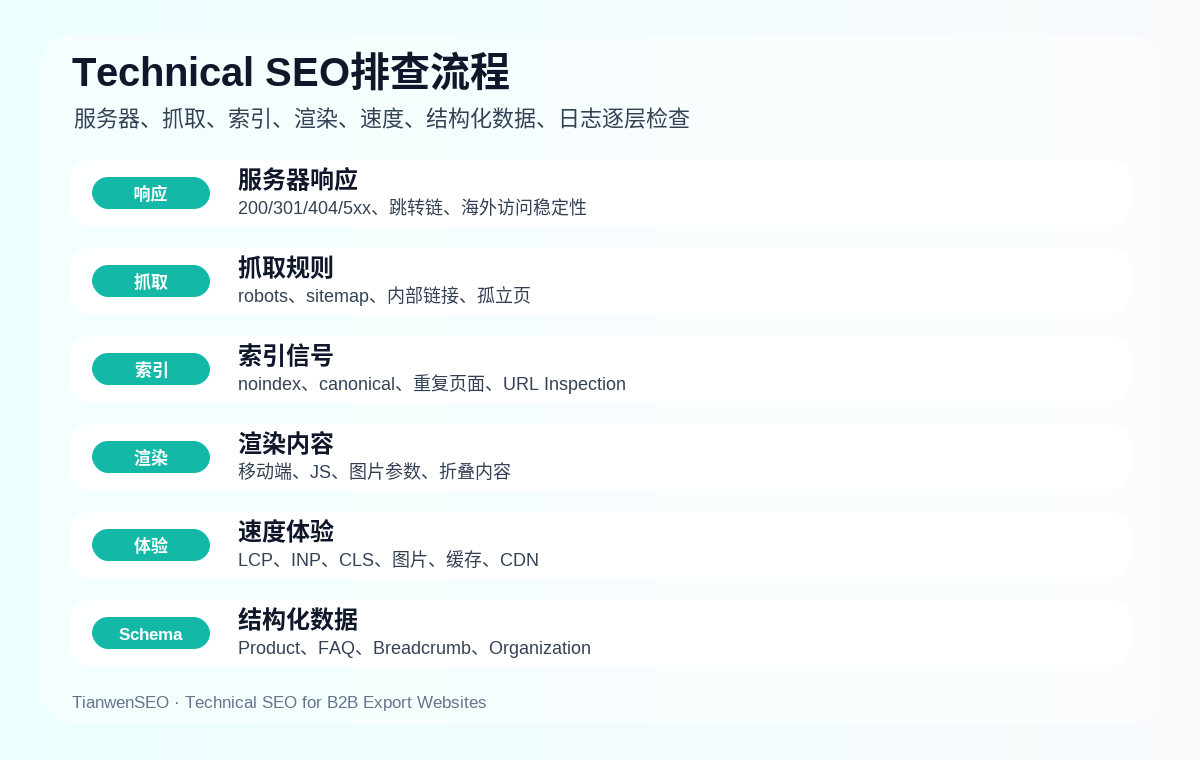
1. Technical SEO first solves the “eligibility to compete” problem
No matter how good the content is, if a page cannot be reached, cannot be crawled, cannot be indexed, lacks content on mobile, or points to the wrong canonical, it has no stable eligibility to compete in search. The first value of Technical SEO is removing these basic obstacles.
Export websites in particular need to focus on core product pages, category pages, application pages, and resource pages, rather than checking every low-value page equally.
| Problem | Impact on export business | Priority |
|---|---|---|
| Cannot be reached | Neither buyers nor Google can open it | Highest |
| Blocked by robots | Core pages cannot be crawled | Highest |
| noindex added by mistake | The page does not participate in search | Highest |
| Wrong canonical | Signals point elsewhere | High |
| Missing content on mobile | Google cannot understand the page fully | High |
2. Server responses and redirect chains: check first whether pages open reliably
Server responses include status codes such as 200, 301, 302, 404, 410, 500, and 503. Export websites also need to look at access speed and stability in target countries, because slow or failed access for overseas buyers directly hurts the experience.
Overlong redirect chains, mixed HTTP/HTTPS, mixed www and non-www, and old URLs that are not redirected correctly all hurt crawl efficiency and user access.
| Status | Meaning | Action |
|---|---|---|
| 200 | Normal access | Keep it stable |
| 301 | Permanent redirect | Make sure it resolves in one step |
| 302 | Temporary redirect | Confirm it is justified |
| 404/410 | Page does not exist | Fix internal links or redirect |
| 5xx | Server error | Check hosting and caching first |
3. robots and sitemap: do not accidentally block core pages
robots.txt controls crawling; it is not meant to solve every indexing problem. A sitemap helps search engines discover important URLs, but it cannot replace internal links and page value.
Common mistakes include accidentally blocking /wp-content/ assets, blocking product categories, sitemaps full of worthless URLs, and core new pages missing from the sitemap.
| Item | What to check | Common mistake |
|---|---|---|
| robots | Whether it blocks core directories | Blocking product pages or assets by mistake |
| sitemap | Whether it contains canonical URLs | Containing duplicate or parameter URLs |
| lastmod | Whether it reflects updates | Not updated for a long time |
| Submission status | Whether GSC reads it successfully | Format or access failure |
| Internal links | Whether there are entry points outside the sitemap | Orphan pages |
4. canonical and duplicate pages: the most common source of diluted signals on export sites
canonical tells the search system which URL is the canonical version. On export sites, duplicates commonly come from filter parameters, pagination, tags, similar products, translated versions, old URLs, and print pages.
If the canonical of a ceramic dinnerware category page points to the homepage, or several similar product pages compete for the same query, page signals get diluted.
| Duplicate source | Risk | Action |
|---|---|---|
| Filter parameters | Many duplicate URLs | Standardize parameters or set canonical |
| Similar products | Content too similar | Strengthen differentiation or merge |
| Pagination | Diluted signals | Clear pagination and internal links |
| Old URLs | Lost historical links | 301 to a relevant page |
| Multiple languages | Confusing language versions | hreflang and canonical addresses |
5. Mobile rendering: what Google sees must be complete
Google understands pages mobile-first. Export sites often put product specifications, FAQs, resource downloads, and image captions inside collapsed components or scripts, which may be invisible or hard to crawl on mobile.
Technical SEO needs to check mobile HTML, rendered text, image alt text, table readability, tappable buttons, and whether content matches desktop.
| Mobile issue | Impact | Check |
|---|---|---|
| Specification table hidden | Missing product facts | Mobile rendering check |
| FAQ not visible | Missing long-tail questions | Source code and page testing |
| Buttons too close together | Poor experience | Mobile usability |
| Large images overflow | Hard to read | Check on real devices |
| Font too small | Buyers struggle to read | Page experience testing |
6. Speed and Core Web Vitals: technical experience must serve buying decisions
Speed is not the only ranking factor, but it affects crawling, experience, and conversion. For export websites, overseas access, image weight, caching, CDN, server response, and third-party scripts all need checking.
LED flood light or packaging machine pages often carry many images. Without compression and lazy loading, buyers leave before they ever see the specification table.
| Metric | Description | Export-site optimization |
|---|---|---|
| LCP | Loading of the main above-the-fold content | Optimize the hero image and server |
| INP | Interaction responsiveness | Reduce heavy scripts |
| CLS | Layout stability | Fix image and ad dimensions |
| TTFB | Server response | Caching/CDN/hosting |
| Image weight | Slow loading overseas | Compression and correct dimensions |
7. Structured data: making page facts easier to understand
Structured data cannot replace body content, but it helps search systems understand information about products, FAQs, breadcrumbs, organizations, articles, and reviews. Export sites should add it based on real page content, and must not invent ratings, stock, or prices.
Types such as Product, FAQ, Breadcrumb, Organization, and Article must match the role of the page.
| Schema type | Suitable page | What to watch |
|---|---|---|
| Product | Product pages | Information must be truthful |
| FAQPage | Real FAQ modules | Questions and answers visible on the page |
| BreadcrumbList | Site-wide hierarchy | Consistent with navigation |
| Organization | Company information | Name, address, and contact details consistent |
| Article | Blog posts and guides | Title, author, and date truthful |
8. Log analysis: see whether Googlebot visits the right pages
Logs tell you which URLs Googlebot actually visits, along with status codes, frequency, and assets. Large export sites, WooCommerce sites, and sites with many filter parameters especially need log analysis.
If Googlebot heavily visits worthless parameter pages while rarely visiting core product pages, crawl resources and the internal link structure may be the problem.
| Log finding | Likely cause | Action |
|---|---|---|
| Core pages rarely visited | Weak internal links | Add entry points |
| Parameter pages visited often | Messy filter rules | Standardize parameters |
| Many 404s | Broken old links | Fix redirects |
| Frequent 5xx | Unstable server | Optimize hosting |
| Assets blocked | Incomplete rendering | Allow necessary assets |
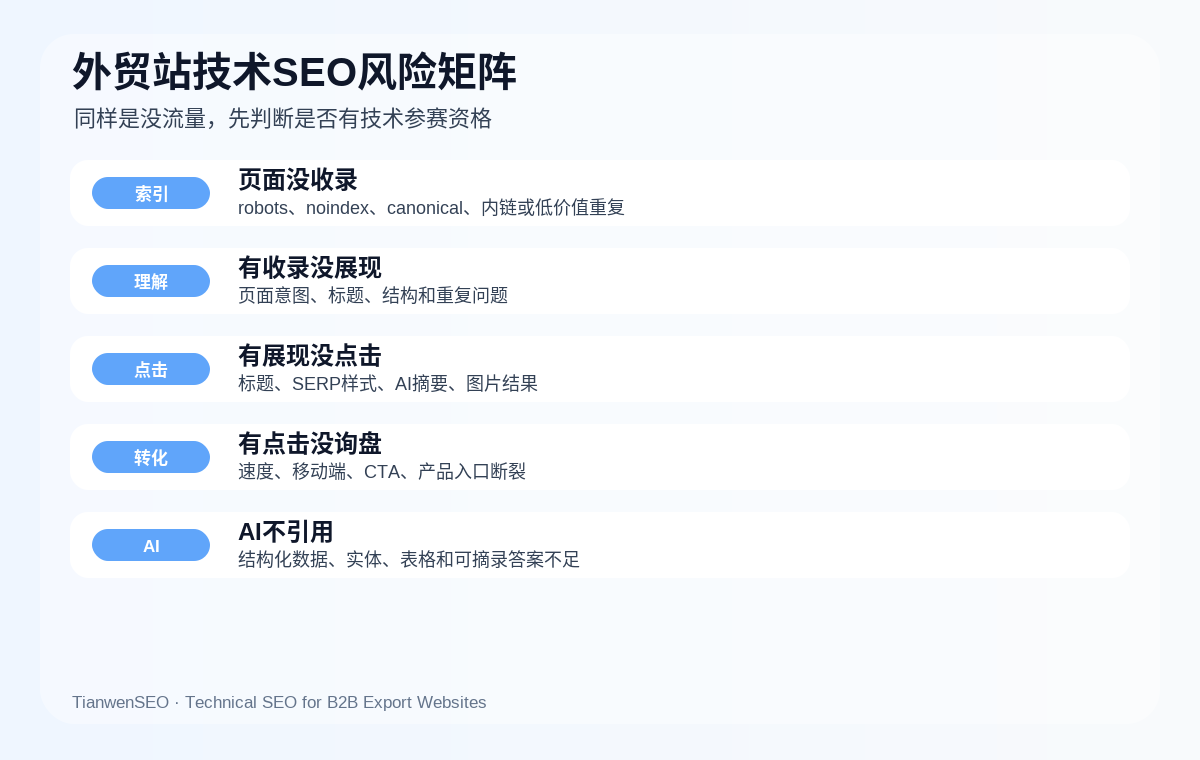
9. Common Technical SEO problems on WordPress export sites
Common problems on WordPress export sites include redundant theme output, conflicting plugin features, uncleared caches, oversized images, thin category page content, duplicate tag pages, indexed attachment pages, inconsistent mobile display of page-builder modules, and too many WooCommerce filter parameters.
When executing, come back to specific URLs and product lines, such as the custom metal parts category page, the LED flood light product page, the packaging machine application page, the medical probe resource page, and the waterproof connector selection article.
10. Technical SEO checks for product pages
Product pages need checks on status codes, canonical, product images, alt text, specification tables, FAQs, Product Schema, internal links, related products, and the inquiry button.
When executing, come back to specific URLs and product lines, such as the custom metal parts category page, the LED flood light product page, the packaging machine application page, the medical probe resource page, and the waterproof connector selection article.
11. Technical SEO checks for category pages
Category pages need checks on pagination, filter parameters, subcategory entry points, internal link depth, category descriptions, how the product list loads, and canonical.
When executing, come back to specific URLs and product lines, such as the custom metal parts category page, the LED flood light product page, the packaging machine application page, the medical probe resource page, and the waterproof connector selection article.
12. Technical SEO checks for application pages
Application pages need checks on scenario keywords, links to the corresponding products, image captions, FAQs, breadcrumbs, and mobile readability.
When executing, come back to specific URLs and product lines, such as the custom metal parts category page, the LED flood light product page, the packaging machine application page, the medical probe resource page, and the waterproof connector selection article.
13. Technical SEO checks for resource download pages
Resource pages need checks on whether PDFs and images have HTML descriptions, whether certificate information is readable, whether download events are tracked, and whether the pages are indexed correctly.
When executing, come back to specific URLs and product lines, such as the custom metal parts category page, the LED flood light product page, the packaging machine application page, the medical probe resource page, and the waterproof connector selection article.
14. Technical SEO checks for images
Images on export sites need the right dimensions, compression, alt text, captions, and context. Do not leave specifications only inside images.
When executing, come back to specific URLs and product lines, such as the custom metal parts category page, the LED flood light product page, the packaging machine application page, the medical probe resource page, and the waterproof connector selection article.
15. AI crawling and security rules
Security rules must not accidentally block important search and AI crawling sources. While protecting the site, confirm that core content can be crawled and understood legitimately.
When executing, come back to specific URLs and product lines, such as the custom metal parts category page, the LED flood light product page, the packaging machine application page, the medical probe resource page, and the waterproof connector selection article.
16. How technical SEO and content SEO work together
Technical SEO handles accessibility and comprehension; content SEO handles search intent and buying decisions. Neither works without the other.
When executing, come back to specific URLs and product lines, such as the custom metal parts category page, the LED flood light product page, the packaging machine application page, the medical probe resource page, and the waterproof connector selection article.
17. How soon to review after technical fixes
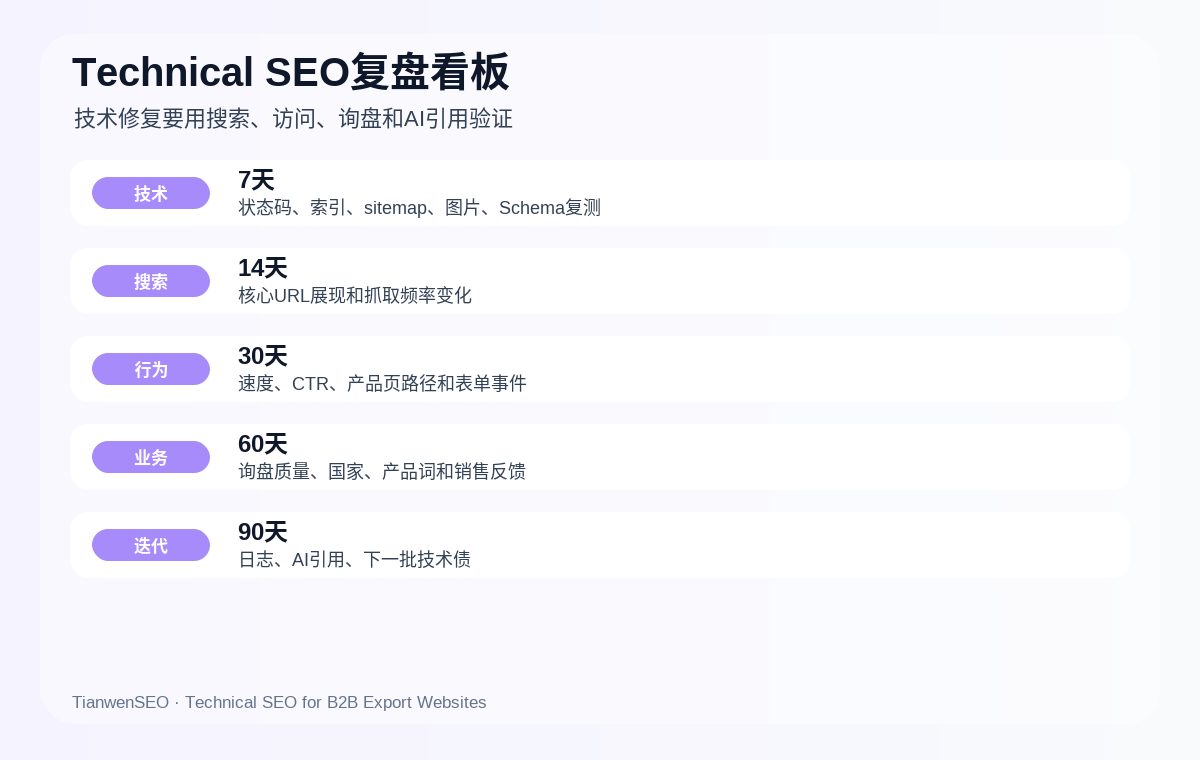
At 7 days, look at status and indexing; at 14 days, look at impressions; at 30 days, look at clicks and paths; at 60 days, look at inquiry quality; at 90 days, look at logs and the next batch of problems.
When executing, come back to specific URLs and product lines, such as the custom metal parts category page, the LED flood light product page, the packaging machine application page, the medical probe resource page, and the waterproof connector selection article.
18. Do not chase a perfect tool score in Technical SEO
A perfect tool score is not business growth. Prioritize the problems that affect indexing, access, understanding, and inquiries on core pages.
When executing, come back to specific URLs and product lines, such as the custom metal parts category page, the LED flood light product page, the packaging machine application page, the medical probe resource page, and the waterproof connector selection article.
Export example 1: How to audit Technical SEO for custom metal parts
For the custom metal parts page, the technical SEO priorities are: whether drawings and specification tables are visible, and whether the canonical is correct. Start with a crawling tool and URL Inspection to confirm the page can be discovered and indexed, then use mobile and speed tools to confirm buyers can view the key content smoothly.
If the technical checks pass, move on to content and link judgments; if the technical foundation is broken, fix eligibility first and do not rush to expand or add pages.
Export example 2: How to audit Technical SEO for LED flood light
For the LED flood light page, the technical SEO priorities are: whether product images are oversized, and whether the wattage table is readable on mobile. Start with a crawling tool and URL Inspection to confirm the page can be discovered and indexed, then use mobile and speed tools to confirm buyers can view the key content smoothly.
If the technical checks pass, move on to content and link judgments; if the technical foundation is broken, fix eligibility first and do not rush to expand or add pages.
Export example 3: How to audit Technical SEO for packaging machine
For the packaging machine page, the technical SEO priorities are: whether the application page links to the corresponding equipment, and whether video slows the first screen. Start with a crawling tool and URL Inspection to confirm the page can be discovered and indexed, then use mobile and speed tools to confirm buyers can view the key content smoothly.
If the technical checks pass, move on to content and link judgments; if the technical foundation is broken, fix eligibility first and do not rush to expand or add pages.
Export example 4: How to audit Technical SEO for medical probe
For the medical probe page, the technical SEO priorities are: whether the certification resource page is indexed, and whether PDFs have HTML descriptions. Start with a crawling tool and URL Inspection to confirm the page can be discovered and indexed, then use mobile and speed tools to confirm buyers can view the key content smoothly.
If the technical checks pass, move on to content and link judgments; if the technical foundation is broken, fix eligibility first and do not rush to expand or add pages.
Export example 5: How to audit Technical SEO for cnc machining parts
For the cnc machining parts page, the technical SEO priorities are: whether similar process pages duplicate each other, and whether internal links point to the main category. Start with a crawling tool and URL Inspection to confirm the page can be discovered and indexed, then use mobile and speed tools to confirm buyers can view the key content smoothly.
If the technical checks pass, move on to content and link judgments; if the technical foundation is broken, fix eligibility first and do not rush to expand or add pages.
Export example 6: How to audit Technical SEO for ceramic dinnerware
For the ceramic dinnerware page, the technical SEO priorities are: whether color and set filters generate large numbers of duplicate URLs. Start with a crawling tool and URL Inspection to confirm the page can be discovered and indexed, then use mobile and speed tools to confirm buyers can view the key content smoothly.
If the technical checks pass, move on to content and link judgments; if the technical foundation is broken, fix eligibility first and do not rush to expand or add pages.
Export example 7: How to audit Technical SEO for waterproof connector
For the waterproof connector page, the technical SEO priorities are: whether the IP rating FAQ is crawlable, and whether product entry points are clear. Start with a crawling tool and URL Inspection to confirm the page can be discovered and indexed, then use mobile and speed tools to confirm buyers can view the key content smoothly.
If the technical checks pass, move on to content and link judgments; if the technical foundation is broken, fix eligibility first and do not rush to expand or add pages.
Export example 8: How to audit Technical SEO for industrial valve supplier
For the industrial valve supplier page, the technical SEO priorities are: whether specification downloads, pressure standards, and material tables are visible. Start with a crawling tool and URL Inspection to confirm the page can be discovered and indexed, then use mobile and speed tools to confirm buyers can view the key content smoothly.
If the technical checks pass, move on to content and link judgments; if the technical foundation is broken, fix eligibility first and do not rush to expand or add pages.
Export example 9: How to audit Technical SEO for private label activewear manufacturer
For the private label activewear manufacturer page, the technical SEO priorities are: whether fabric, size, and sampling process information is readable on mobile. Start with a crawling tool and URL Inspection to confirm the page can be discovered and indexed, then use mobile and speed tools to confirm buyers can view the key content smoothly.
If the technical checks pass, move on to content and link judgments; if the technical foundation is broken, fix eligibility first and do not rush to expand or add pages.
Export example 10: How to audit Technical SEO for solar mounting bracket
For the solar mounting bracket page, the technical SEO priorities are: whether installation drawings, certifications, and application pages are clearly structured. Start with a crawling tool and URL Inspection to confirm the page can be discovered and indexed, then use mobile and speed tools to confirm buyers can view the key content smoothly.
If the technical checks pass, move on to content and link judgments; if the technical foundation is broken, fix eligibility first and do not rush to expand or add pages.
19. Materials to prepare before a Technical SEO audit
Before starting the audit, prepare the core URL list, sitemap address, GSC access, GA4 data, target countries, main English product terms, server access method, caching and CDN setup, and recent redesign records. Without these materials, a technical audit easily turns into a generic scan that cannot tell which problems actually affect the business.
For product lines such as custom metal parts, LED flood light, packaging machine, medical probe, and waterproof connector, first confirm that core pages have the technical foundation before discussing content depth and backlinks. The results of a technical audit must map to specific URLs, specific risks, and specific fixes.
20. How to build a core URL list
The core URL list for an export site should include the homepage, core category pages, key product pages, application scenario pages, resource pages, important blog posts, the contact page, and the inquiry page. Each URL should be tagged with its product line, target query, page role, and business priority.
For product lines such as custom metal parts, LED flood light, packaging machine, medical probe, and waterproof connector, first confirm that core pages have the technical foundation before discussing content depth and backlinks. The results of a technical audit must map to specific URLs, specific risks, and specific fixes.
21. How to prioritize a crawl report
A crawl report usually lists a large number of issues. Filter for P0 pages first: core product pages, category pages, application pages, and resource pages. Problems affecting access, indexing, canonical, internal links, and mobile content on these pages come first. Do not let low-value tag pages and archive pages steal attention.
For product lines such as custom metal parts, LED flood light, packaging machine, medical probe, and waterproof connector, first confirm that core pages have the technical foundation before discussing content depth and backlinks. The results of a technical audit must map to specific URLs, specific risks, and specific fixes.
22. How to use URL Inspection
URL Inspection confirms the state Google sees: whether the page is indexed, the last crawl time, whether the page fetch succeeded, whether the user-declared and Google-selected canonical match, and whether the page is usable on mobile. It suits spot-checking core pages; it is not a replacement for a full-site crawl.
For product lines such as custom metal parts, LED flood light, packaging machine, medical probe, and waterproof connector, first confirm that core pages have the technical foundation before discussing content depth and backlinks. The results of a technical audit must map to specific URLs, specific risks, and specific fixes.
23. How to tell whether robots is blocking by mistake
A robots mistake does not always mean the whole site cannot be crawled. Sometimes it blocks images, scripts, styles, or a product directory, which leaves pages incompletely rendered. During the audit, check whether core pages and assets can all be accessed.
For product lines such as custom metal parts, LED flood light, packaging machine, medical probe, and waterproof connector, first confirm that core pages have the technical foundation before discussing content depth and backlinks. The results of a technical audit must map to specific URLs, specific risks, and specific fixes.
24. How to judge sitemap quality
A good sitemap should contain canonical, indexable, important URLs, and its lastmod should be trustworthy. A bad sitemap contains parameter pages, duplicate pages, noindex pages, 404 pages, or old URLs that have not been updated for a long time.
For product lines such as custom metal parts, LED flood light, packaging machine, medical probe, and waterproof connector, first confirm that core pages have the technical foundation before discussing content depth and backlinks. The results of a technical audit must map to specific URLs, specific risks, and specific fixes.
25. How to fix canonical errors
To fix a canonical error, first decide which page is the primary one. Decide whether similar product pages should stay separate, whether category filter pages should be canonicalized to the category page, and whether old URLs should 301 to new URLs. Do not mechanically point every canonical at the homepage or a category page.
For product lines such as custom metal parts, LED flood light, packaging machine, medical probe, and waterproof connector, first confirm that core pages have the technical foundation before discussing content depth and backlinks. The results of a technical audit must map to specific URLs, specific risks, and specific fixes.
26. How to handle structured data errors
Structured data must match the visible content on the page. FAQs must be visible on the page, Product information must be truthful, and Organization information must match company records. Do not invent ratings, prices, stock, or case studies.
For product lines such as custom metal parts, LED flood light, packaging machine, medical probe, and waterproof connector, first confirm that core pages have the technical foundation before discussing content depth and backlinks. The results of a technical audit must map to specific URLs, specific risks, and specific fixes.
27. How to do image Technical SEO
Export product images need to balance clarity and loading speed. Image file names, alt text, captions, and context should describe the product, specifications, and application. Do not put important specifications only inside images. Both search systems and buyers need to be able to read the text information.
For product lines such as custom metal parts, LED flood light, packaging machine, medical probe, and waterproof connector, first confirm that core pages have the technical foundation before discussing content depth and backlinks. The results of a technical audit must map to specific URLs, specific risks, and specific fixes.
28. How to audit multilingual and international setups
If the export site has English, Chinese, or other language versions, check hreflang, canonical, language URLs, automatic redirects, and content duplication. Do not let pages in different languages compete for canonical signals, and do not force redirects by IP in a way that makes crawling difficult for Google.
For product lines such as custom metal parts, LED flood light, packaging machine, medical probe, and waterproof connector, first confirm that core pages have the technical foundation before discussing content depth and backlinks. The results of a technical audit must map to specific URLs, specific risks, and specific fixes.
29. How to balance security rules and AI crawling
Security protection, WAF, anti-scraping, and rate limiting must not accidentally block Googlebot, Bingbot, or legitimate AI crawlers. Use logs and verification tools to confirm that important search bots can access core pages normally, while continuing to block malicious traffic.
For product lines such as custom metal parts, LED flood light, packaging machine, medical probe, and waterproof connector, first confirm that core pages have the technical foundation before discussing content depth and backlinks. The results of a technical audit must map to specific URLs, specific risks, and specific fixes.
30. How to accept Technical SEO fixes
Every technical issue needs acceptance criteria: status code restored, URL Inspection passed, sitemap updated, canonical consistent, mobile readable, images loading correctly, Schema validation free of serious errors, and GSC impressions starting to recover. Saying “it has been optimized” is not enough.
For product lines such as custom metal parts, LED flood light, packaging machine, medical probe, and waterproof connector, first confirm that core pages have the technical foundation before discussing content depth and backlinks. The results of a technical audit must map to specific URLs, specific risks, and specific fixes.
31. Industry-specific Technical SEO check examples
Technical SEO priorities differ across export industries. Machinery and equipment websites usually carry heavy images and video, so speed, video loading, product specification tables, and resource downloads need extra attention. Electronic connector websites have many specifications, so filter parameters, duplicate model pages, IP rating FAQs, and internal links need extra attention. Medical accessory websites face high trust requirements, so certification resources, structured data, company entity information, and indexable resource pages need extra attention. Home and tableware websites have many images and variants, so image compression, color/set filters, and duplicate URLs need extra attention.
This industry-by-industry approach avoids applying one checklist to everything. Technical SEO is not about forcing every site into the same structure; it is about finding the technical obstacles that most affect search and inquiries, given the product complexity, buying path, and page types.
| Industry type | Key technical risk | Priority checks | Business impact |
|---|---|---|---|
| Machinery and equipment | Video and images slow the site, specifications unreadable | Speed, mobile, resource pages | Buyers cannot see specifications and process |
| Connectors and electronics | Duplicate model pages, messy filter parameters | canonical, internal links, indexing | Diluted product term signals |
| Medical accessories | Certification resources not indexable, weak entity | Resource pages, Schema, Organization | Insufficient trust |
| Home and tableware | Oversized images, duplicate color variants | Images, parameter URLs, category pages | Slow loading and duplicate content |
| Apparel customization | Size and fabric information hidden | Mobile rendering, tables, FAQs | Incomplete inquiry information |
32. How Technical SEO relates to inquiry forms
Many people assume technical SEO only affects indexing, but it also affects inquiries. Form scripts that fail to load, mobile buttons that cannot be tapped, CAPTCHAs that mistakenly block overseas users, thank-you pages with no event tracking, and contact entry points hidden behind pop-ups all prevent search visitors from converting into valid inquiries. Technical audits should cover the full path from a click in search results to submitting a form.
Export sites can set up a test flow for core pages: enter the page from a Google result or a direct URL and check the first screen, navigation, product entry points, resource downloads, contact buttons, form fields, submission feedback, and GA4 events. Only then can you confirm that a technical fix truly serves the business.
33. The order of Technical SEO and content updates
If a page is not indexed, has a canonical error, or is missing mobile content, fix the technical side first; if the technical foundation is fine but query coverage is insufficient, expand the content; if both content and technical setup are fine but inquiries are weak, optimize the page path, CTAs, and trust modules. Get the order wrong and you will misjudge a technical problem as a content problem, or a conversion problem as a ranking problem.
For example, if the packaging machine application page gets no impressions, check indexing and internal links first; if it gets impressions but no clicks, check the title and SERP; if it gets clicks but no inquiries, check page speed, CTAs, product entry points, and inquiry fields. This order is steadier than rewriting the moment results look weak.
After every technical fix goes live, do a manual front-end re-check: whether the title displays correctly, whether core content is visible, whether images load, whether tables are readable, whether the form can be submitted, and whether anything is obscured on mobile. Automated tools catch many problems, but they cannot fully replace a real user path check.
This step matters especially for export sites, because overseas buyers’ devices, networks, and browsing habits may differ from the in-house test environment.
Keep the check records so that the next redesign or page feature update can be regression-tested quickly.
These records also help the team locate issues quickly during the next technical review.
FAQ: Common Technical SEO questions
What is Technical SEO?
Technical SEO is the technical foundation that ensures a website can be discovered, crawled, rendered, indexed, understood, and accessed reliably by search systems.
Is Technical SEO just speed optimization?
No. Speed is only one part of it; it also covers servers, robots, sitemap, canonical, indexing, mobile, structured data, and logs.
What should an export site check first?
First check whether core product pages and category pages return 200, can be crawled, can be indexed, have the correct canonical, and have complete mobile content.
Will a page definitely be indexed once the sitemap is submitted?
No. A sitemap is only a discovery hint; page value, internal links, duplication, and technical signals all affect indexing.
Can structured data improve rankings?
It helps search systems understand and display content, but it cannot replace real content and page quality.
When is log analysis needed?
When the site is large, has many parameter URLs, has indexing anomalies, or gets too few crawls of core pages.
How long does Technical SEO take to show results?
After a technical fix, look at indexing and impression changes over the first 7-14 days, then at clicks and inquiries over 30-60 days.
What are the Technical SEO priorities for a WordPress site?
Caching, images, plugin features, theme output, duplicate categories and tags, attachment pages, mobile display, and structured data.
Does AI search relate to Technical SEO?
Yes. AI systems also need to be able to access, understand, and cite clear pages.
Can you promise that rankings will definitely improve after a technical fix?
No. Technical fixes remove basic obstacles; results also depend on content, competition, links, brand, and demand.
Conclusion: Technical SEO is the technical foundation of an export website
The value of Technical SEO is giving good content, good products, and good pages a chance to be seen by search systems. It does not replace content, brand, or inquiry conversion, but it prevents technical problems from disqualifying pages.
Export companies doing technical SEO should audit page by page around core product lines: can it open, can it be crawled, can it be indexed, is it readable on mobile, does speed affect buying, is structured data truthful, and do logs show Googlebot visiting the right pages. Get these right, and later content and inquiry optimization has a foundation.
Official sources and Technical SEO acceptance boundaries
Technical SEO should separate crawling, indexing, rendering, structured data, links, and review. Tool screenshots cannot replace official data and front-end accessibility evidence.
| Official source | What it is used to judge | Boundary that cannot be crossed |
|---|---|---|
| Google: JavaScript SEO basics | Check rendered text and asset accessibility | Visible in a browser does not mean reliably visible to search systems |
| Google: Sitemaps overview | Confirm discovery entry points for important URLs | Submission does not equal indexing |
| Google: Structured data intro | Confirm structured data matches visible content | Structured data does not guarantee rich results |
| Google: Make links crawlable | Check whether link entry points can be followed | An uncrawlable button is not a passed diagnostic item |
| Search Console Performance report | Review technical adjustments with real page data | Zero rows cannot be written up as a fix that brought traffic |
Low-data-period review table
| Check item | Fields to record | How to write it during a low-data period |
|---|---|---|
| Page status | index/follow, canonical, sitemap, HTTP status code, in-body internal links | Record current status only; do not write about search performance |
| Content evidence | Page role, fact sources, product or service materials, update date | If materials are missing, list the gaps; do not invent case studies |
| GSC review | query, page, country, device, date window | If GSC shows zero rows, write zero rows; do not extrapolate rankings or clicks |
| Conversion observation | GA4 events, forms, downloads, email clicks, inquiry entry points | If there are no events, fix tracking first; do not write inquiry conclusions |
Continue reading this SEO series
If you are working through export website SEO systematically, the articles below are a good next step. Sort out the relationships among crawling, indexing, content, links, and review first, then decide which page to change next.
- Why publishing more articles no longer reliably brings traffic: a guide to content cannibalization, consolidation, and pruning for export websites
- What is Keyword Research: how export websites find terms, group them, judge intent, and map them to pages
- How Google crawls, indexes, and ranks: a diagnostic guide for export websites from indexing to inquiries
- How search engines work: a guide to crawling, indexing, ranking, and export website diagnostics
- Technical SEO audit checklist: a diagnostic guide to crawling, indexing, structure, and inquiry paths for export websites
- Sitemap technical guide: sitemap submission, indexing diagnostics, and troubleshooting common errors
This page is machine-translated from the Simplified Chinese version and awaiting human review. It has not yet been proofread.
Further Reading on This B2B SEO & GEO Topic
- How to Conduct a Content Audit: How to Decide on Updating, Merging, and Deleting Content for B2B Export Websites
- How to Differentiate Robots, Noindex, Canonical, and Sitemap: A Guide to Indexing Checks for B2B Export Websites
- How to Do WordPress SEO: A Checklist for Indexing, Plugins, Speed, and GSC Review
- How to Do Mobile SEO: Guide to Mobile-First Indexing, Speed, Content Consistency, and Inquiry Paths
- How to Do Hreflang and International SEO: Guide to Index Matching for Multilingual and Multi-Regional Pages
- GSC Indexing Diagnostics and Googlebot Crawl Architecture Hub for B2B Websites
- B2B Google SEO Tutorials
- B2B Export Website Development Architecture