Canonical tags are the most easily misused. Many foreign trade websites want to add canonical as soon as they see duplicate pages, parameter pages, filter pages, old paths, or test addresses. The problem is that canonical is not a universal fix button; it only tells Google: among a group of similar pages, which one I want to serve as the representative page. Google may take it as a reference, but it does not necessarily follow it.
For Chinese export manufacturers, factories, and trading companies, the risk of canonical is higher. This is because foreign trade websites commonly have product variants, category filters, multiple languages, country pages, resource pages, ad parameter pages, and legacy paths. If you do not first distinguish page roles, you may canonicalize a product page, resource page, country page, or FAQ page that should have been kept to another page, damaging indexing and inquiry paths.
This article uses foreign trade product scenarios such as custom metal parts, LED flood light, packaging machine, medical probe, cnc machining parts, ceramic dinnerware, waterproof connector, industrial valve supplier, and private label activewear manufacturer to explain clearly when canonical should be used, when it should not, and how to avoid pushing important pages down.
What Canonical Means: The Definition of the Canonical Tag in an SEO Context
The canonical tag (canonical link / rel=”canonical”) is an HTML signal that tells search engines “which of a group of similar pages is the representative page.” Its full name is canonical URL or canonical tag. In SEO work, the canonical tag is declared in the page <head> via <link rel="canonical" href="..." />.
⚠️ If you search for the word “canonical,” about 70% of the results point to Canonical Ltd. (the parent company of the Ubuntu operating system)—completely unrelated to SEO. Every instance of canonical in this article refers to the rel=”canonical” tag in the SEO field, not Canonical Ltd. or Ubuntu.
Google Search Central’s official definition is: a canonical URL is “the representative page in a group of duplicate or similar pages that you want Google to consider.” When you use rel=”canonical”, you are telling Google: please consolidate this page’s ranking signals onto this canonical URL and treat this group of pages as a single entity. Google’s official specification calls this process “consolidating duplicate URLs.” Note that the canonical tag is not a directive—Google may choose a canonical URL different from the one you declared, which is common on e-commerce filter pages, parameter pages, and affiliate redirect pages.
A common misconception is that adding a canonical tag means transferring all page authority to the target URL. In reality, canonical is only one way to consolidate signals. Google also considers 301 redirects, the <xhtml:link rel="canonical" /> in sitemaps, the Link header in HTTP responses, and the internal link structure to comprehensively determine which URL should serve as the representative. For a detailed comparison of canonical with 301 and noindex, see Section 3 below.
Official Acceptance Boundaries: Separate Declaration, Google’s Choice, and Search Performance for Canonical
The canonical tag is not a universal fix button. It is one of a set of consolidation signals. When auditing canonical on a foreign trade website, you need to separate three things: what the page itself declares, which canonical Google actually selected, and whether the page has query, page, clicks, impressions, CTR, and average position in Search Console. These three cannot substitute for one another.
If the site currently has no usable GSC query, page, or page-query row data, you cannot write up rankings, impressions, clicks, CTR, AI adoption, or inquiry changes. Canonical diagnosis can continue, but the conclusions must be downgraded to: whether page relationships are clear, whether the main URL is in the sitemap, whether old URLs need 301 or 410, whether duplicate pages should be noindexed, whether hreflang conflicts with canonical, and whether GA4 events can observe the subsequent inquiry path.
Correspondence Table Between Official Resources and Canonical Acceptance Fields
| Official resource entry | What it supports judging | Canonical acceptance fields | What it cannot infer |
|---|---|---|---|
| Google Search Central: Consolidate duplicate URLs guide | Google selects the canonical URL by combining signals such as canonical, redirects, internal links, and sitemaps. | Declared canonical, Google-selected canonical, internal link targets, sitemap URLs, duplicate URL groups. | Declaring a canonical does not mean Google will necessarily accept it. |
| Google Search Central: Redirections and Google Search | When migrating old URLs, merging pages, or permanently changing addresses, redirects are usually clearer than writing canonical alone. | Use cases and target pages for 301, 302, meta refresh, and JavaScript redirect. | You cannot redirect every weak page to the homepage. |
| Google Search Central: noindex guide | Pages you do not want in search results can be controlled with noindex. | Whether internal search pages, thin tag pages, temporary campaign pages, and duplicate resource pages need noindex. | noindex cannot replace building content on the main page. |
| Google Search Central: Localized versions | Multilingual and multi-region pages should use hreflang to tell Google the corresponding relationships. | Whether language/region pages return hreflang to each other, and whether canonical points to itself or a reasonable main version. | You cannot use canonical to simply merge pages in different languages. |
| Google Search Central: Sitemaps overview | Sitemaps help Google discover important URLs. | Whether the main URL is in the sitemap, and whether duplicate URLs, parameter URLs, and old URLs have been cleaned up. | Being present in a sitemap does not mean it has been crawled, indexed, or shown. |
| Google Search Central: robots.txt introduction | robots.txt controls crawl access; it is not a universal tool for indexing and quality. | Whether canonical target pages, CSS, JS, images, pagination, and filter resources are mistakenly blocked. | robots cannot fix confused page relationships. |
| Search Console Help: URL Inspection tool | The index status, crawl status, declared canonical, and Google-selected canonical of a single URL. | Sampling checks of main pages, variant pages, parameter pages, and migrated old URLs. | A single URL’s status cannot represent the performance of the whole group of pages. |
| Search Console Help: Page indexing report | Page index status and reasons for not being indexed. | Grouping of duplicate pages, alternate canonical, redirected pages, noindex pages, and 404/410 pages. | Index status is not a ranking or inquiry report. |
| Search Console Help: Performance report | query, page, country, device, clicks, impressions, CTR, average position. | Whether the main URL and old URL split performance under the same query. | Without row data, you cannot write about ranking, impressions, clicks, or CTR improvements. |
| Google Search Central: Search Essentials | Pages need to meet basic technical, policy, and content requirements to participate in Google Search. | Whether the canonical target page is accessible, crawlable, indexable, and has clear core content. | Meeting the basic requirements does not mean there is already search performance. |
| Google Analytics Help: About events | GA4 events can observe subsequent on-site actions. | Whether form, email, WhatsApp, RFQ, download, and contact page events are connected to the main URL. | On-site events cannot replace GSC search performance. |
| Google Search Central: AI features and your website | AI search capabilities still depend on the foundation of accessible, indexable pages with clear content. | Whether the consolidated main page has clear facts, tables, internal links, and quotable passages. | You cannot promise that AI answers will definitely use the official website. |
| OpenAI Platform: Bots | Distinguish the access purposes of OAI-SearchBot, GPTBot, and ChatGPT-User. | Whether robots, logs, and public pages unintentionally block the relevant access paths. | It cannot show that ChatGPT will display things in a specified way. |
| Bing Webmaster Blog: AI Performance | If visible in your account, you can observe AI citations, cited pages, and grounding query phrases. | Record Bing AI samples, GSC, GA4, logs, and page canonical separately. | It cannot represent all AI platforms. |
| IndexNow: Documentation | After URLs are updated, deleted, or added, you can send notifications to participating search engines. | Whether there is a notification action after main URL updates, old URL deletions, and migrations. | It cannot replace consolidation signals and page quality. |
Canonical Acceptance Standards: Declaration, Google’s Choice, and Page Relationships Must Be Separated
| Acceptance layer | Required evidence | How foreign trade websites judge | Unacceptable practice |
|---|---|---|---|
| Page relationships | Grouping of main pages, variant pages, parameter pages, old URLs, language pages, and resource pages. | Distinguish product variants, filter needs, country/language versions, and duplicate articles. | Pointing all similar pages to the same URL. |
| Declared canonical | The canonical href in the page HTML, HTTP status, and target URL. | Confirm the target page returns 200 and is not noindex, 404, in a redirect chain, or mistakenly blocked by robots. | Only looking at plugin settings, not the front-end source code. |
| Google’s choice | The Google-selected canonical in URL Inspection. | Spot-check main pages, variant pages, parameter pages, and old URLs. | Treating the declared canonical as already accepted by Google. |
| Index status | Page indexing groups for duplicate, alternate, redirected, noindex, and 404/410. | Determine whether the problem is in page relationships, crawling, indexing, or migration actions. | Only looking at “whether it is indexed.” |
| Search performance | Row data for query, page, country, and device in Performance. | See whether the main URL and old URL split the same inquiry term or product term. | Writing about performance improvements without GSC row data. |
| On-site actions | GA4 events, inquiry paths, resource downloads, and contact page actions. | Confirm whether the main URL can still connect to real business actions. | Writing a canonical fix directly as an inquiry improvement. |
| AI/GEO samples | Platform, question, date, answer summary, cited URL, factual accuracy. | See whether the consolidated main page is more suitable for citation and verification. | Writing one answer screenshot as a long-term result. |
How to Downgrade Canonical Conclusions When There Is No GSC Data
If the site currently has no usable GSC query, page, or page-query row data, a Canonical report cannot be written as a search performance report. It can first be written as a page relationship and consolidation signal report.
| Missing evidence | What you can write | What you cannot write | Next review step |
|---|---|---|---|
| No GSC Performance rows | Whether page relationships are clear, whether the main URL is unique, and whether old URLs need 301, 410, noindex, or canonical. | Ranking, impressions, clicks, CTR, or trend improvements. | Keep 28-day and 90-day date ranges and wait for the first batch of row data. |
| No URL Inspection sampling | List the main pages, variant pages, parameter pages, old URLs, and language pages that need spot checks. | Asserting that Google has accepted the declared canonical. | Record declared canonical, Google-selected canonical, crawl time, and page version. |
| No Page indexing report | Explain that the indexing layer is temporarily missing, and do not treat front-end source code as index evidence. | Write that duplicate pages have all dropped out of search. | Review by grouping duplicate, alternate, redirected, noindex, and 404/410. |
| No GA4 events | Explain that form, email, WhatsApp, download, and RFQ events need to be configured. | Organic search inquiries have improved. | First make on-site actions observable. |
| No AI samples | Build a table of platform, question, date, answer summary, cited URL, and incorrect facts. | Write that AI search has adopted the official website. | Retest across platforms with a fixed question set, and record separately from page actions. |
I. Conclusion First: Canonical Is a Signal Coordinator, Not a Universal Fix Button
Canonical is suitable for handling the representative relationship among similar or duplicate pages. It is not suitable for solving all problems such as poor page quality, thin content, inaccessible URLs, pages that should not exist, and messy internal links.
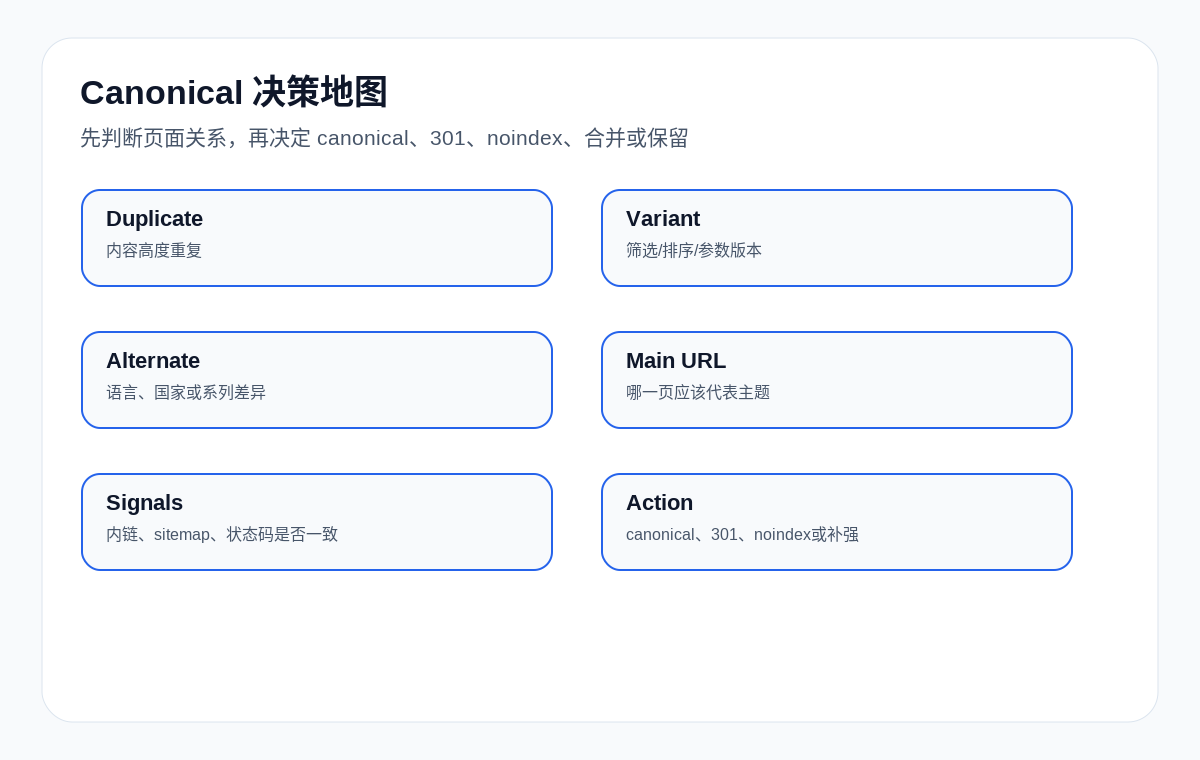
| Issue | Is canonical suitable | More reasonable action |
|---|---|---|
| The same content has a parameter version | Usually suitable | Canonical the parameter page to the main version |
| An old URL already has a new URL replacement | Not necessarily | 301 is usually clearer |
| The page content is very thin | Not suitable to solve alone | Strengthen, merge, or noindex |
| Country pages have genuine content differences | Use caution | Keep them and differentiate with hreflang/clear content |
| A filter page has search value | Not necessarily | Keep important filter pages; control indexing for the rest |
| Product variants differ greatly | Use caution | They may need separate pages rather than merging |
II. High-Risk Canonical Scenarios on Foreign Trade Websites
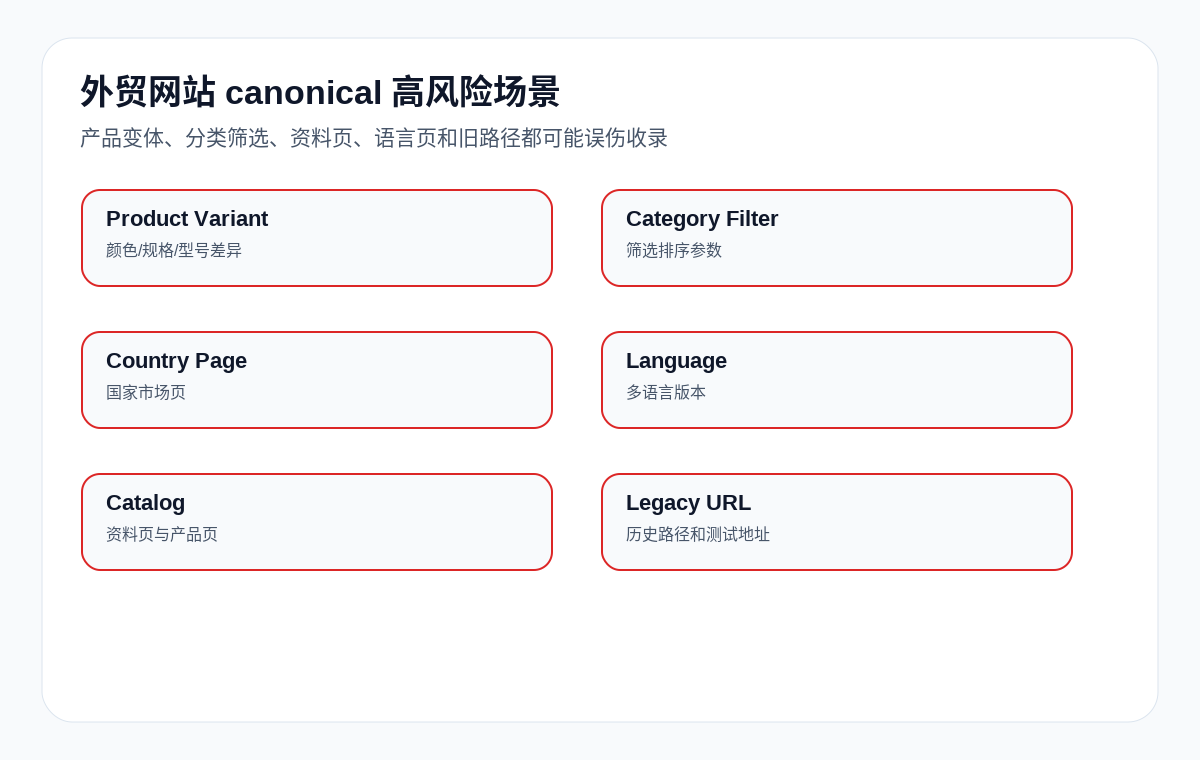
| Scenario | Risk of misuse | Recommendation |
|---|---|---|
| Product color/specification variants | Merging away variants that have independent search demand | First look at search demand and product differences |
| Category filter pages | A large number of low-value parameter pages get crawled | Keep important filters; merge or control low-value ones |
| Country pages | Genuine market differences get merged | Keep if there are differences; merge if duplicate |
| Multilingual pages | Language versions canonicalize each other | Multilingual sites usually use hreflang, not mutual canonical |
| Resource pages | catalog/datasheet gets merged into the product page | Keep the resource page when there is independent resource demand |
| Legacy paths | Only adding canonical without changing internal links | 301 and internal link updates are more commonly used |
III. How to Choose Between Canonical, 301, noindex, and Deletion
| Action | Suitable situation | Unsuitable situation |
|---|---|---|
| canonical | Content is highly similar but access still needs to be retained | The page has been permanently replaced |
| 301 | The old URL permanently migrates to a new URL | It is only parameter duplication but access still needs to be retained |
| noindex | Useful to users but unsuitable for search | Important commercial pages |
| Delete/404/410 | The page has no value and no replacement demand | Pages with backlinks or historical business value |
| Strengthen | The page has demand but weak content | Pages with no search or business value |
| Merge | Multiple pages are each too weak but share the same theme | Pages with clear independent intent |
IV. Google May Not Accept Your Canonical
Canonical is a hint, not a command. If internal links, sitemaps, redirects, content differences, and page quality all tell Google that another page looks more like the representative page, Google may choose a different canonical.
| Signal | What happens if it conflicts with canonical |
|---|---|
| Internal links | A large number of internal links point to the non-canonical version, and Google may value it more |
| sitemap | The sitemap submits parameter pages or legacy paths, creating noise |
| Content | The declared main page’s content is actually weaker and may not be accepted |
| Status codes | If the target page is abnormal or redirects, the canonical signal weakens |
| External links | A large number of external links point to the old URL, requiring clearer migration handling |
V. Product Variant Pages: When to Keep and When to Merge
Foreign trade product variants are where canonical most easily causes damage. For example, different wattages of LED flood light, different IP ratings of waterproof connector, and different series of ceramic dinnerware: if users search for them separately and need independent judgment, they should not be simply merged.
| Variant situation | Recommendation |
|---|---|
| Only the color differs, weak search demand | Can be merged into the main product page with variant selection |
| Specification differences affect application | Consider a separate page or a strong comparison module |
| The model has independent search volume | Keep a separate page and supplement specs and resources |
| Content is almost identical | Merge or canonical to the main page |
| Different certifications or industry uses | Usually worth explaining separately |
VI. Category Filter Pages: The Most Common Problem in Foreign Trade E-commerce
WooCommerce, Shopify, or product catalog sites often generate filter links for price, color, size, material, sorting, stock, and more. Not all filter pages are worth indexing.
| Filter type | Handling recommendation |
|---|---|
| Material/specification filters with clear search demand | Can be made into static subcategories or separate pages |
| Sort parameters | Usually not indexed; canonical to the main category |
| Price filters | Most are unsuitable for indexing |
| Color-size combinations | Keep only combinations with search value |
| Stock status filters | Usually unsuitable for search results |
| Application scenario filters | If there is demand, they can be made into industry pages or application pages |
VII. Do Not Misuse Canonical Across Multilingual and Country Pages
Multilingual pages are usually not duplicate pages, but different language versions. If country pages have genuine market differences, they should not be casually canonicalized to the global page. The more common approach is to use hreflang, clear language paths, and differentiated content.
| Page relationship | Recommendation |
|---|---|
| English page and German page | Do not canonicalize each other; use hreflang |
| US page and UK page have identical content | Consider merging or differentiating |
| Country pages differ in certification/logistics/cases | Keep separate pages |
| Low-quality machine-translated pages | First improve quality or control indexing |
| Different parameter pages in the same language | Decide canonical or keep based on value |
VIII. The Canonical Relationship Between Resource Pages and Product Pages
Many foreign trade sites canonicalize catalog, datasheet, and certificate resource pages to their product pages, believing this consolidates signals. But if a resource page has independent search demand and download value, merging may lose resource query traffic.
| Resource page situation | Recommendation |
|---|---|
| Only file downloads, no explanation | Add resource explanations, or merge into the product page |
| Has independent query demand | Keep it and link to the product page |
| Multiple expired versions | Keep the latest version; explain or remove historical versions |
| The certificate applies to multiple products | Build a certificate explanation page and link related products |
| The product page already has a complete resource module | The resource page can be simplified but does not necessarily need canonical |
IX. 10 Foreign Trade Canonical Cases
Case 1: custom metal parts
Do not casually merge material pages and capability pages; keep materials when they have independent search and sourcing judgment value.
Case 2: LED flood light
50W, 100W, and 150W can be merged if they are only specification variants, but keep separate descriptions when application differences are obvious.
Case 3: packaging machine
Model pages and price factor pages are not duplicate pages and cannot canonicalize each other.
Case 4: medical probe
The relationship between compatible device pages and product pages must be clear; resource pages may have independent value.
Case 5: cnc machining parts
Industry pages and process pages usually serve different intents and should not be simply merged.
Case 6: ceramic dinnerware
Most color filter pages are not worth indexing, while custom series pages may be worth keeping.
Case 7: waterproof connector
IP67 vs IP68 comparison pages have independent intent and should not be canonicalized to a generic product page.
Case 8: industrial valve supplier
Country pages that differ only by country name should be merged; pages with standard/working-condition differences can be kept.
Case 9: private label activewear manufacturer
Fabric pages, MOQ pages, and sampling process pages each address different questions.
Case 10: stainless steel fasteners
For standard pages and stock pages, look at search intent before deciding the relationship.
X. How to Build a Canonical Review Table
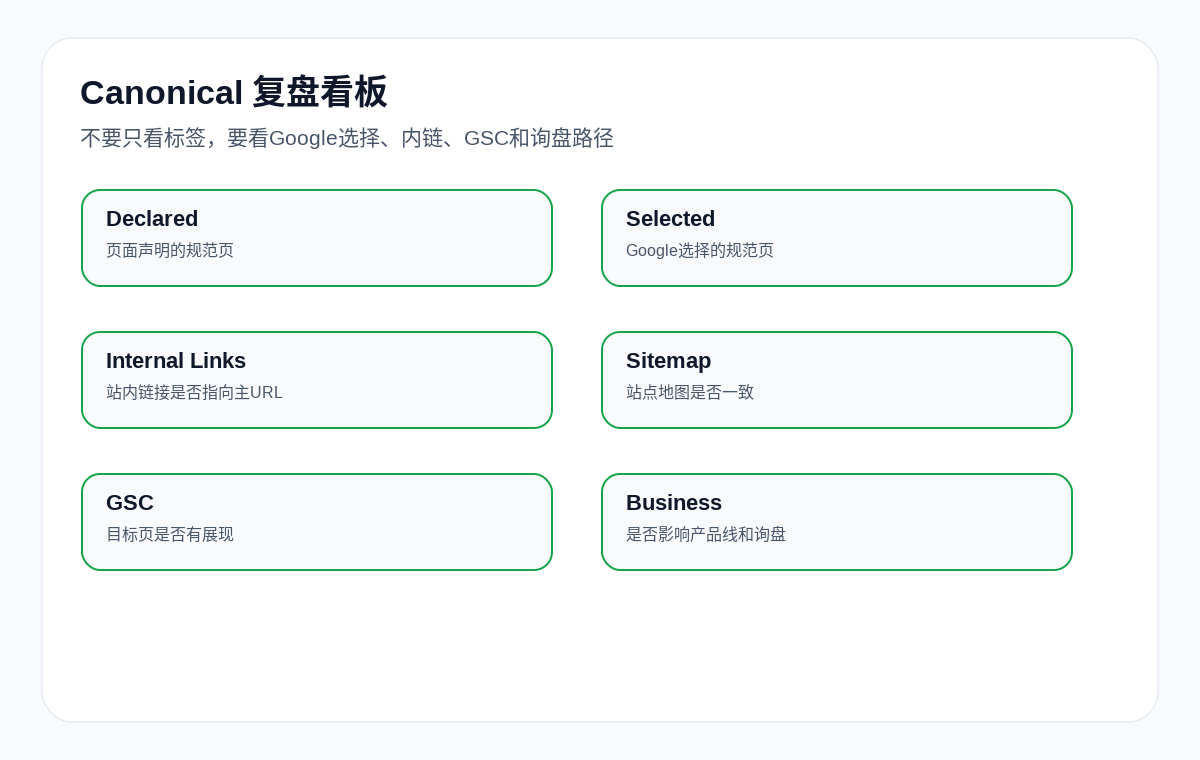
| Field | What to record |
|---|---|
| URL | The page where the problem occurs |
| Declared canonical | The canonical page declared by the page itself |
| Google-selected canonical | The selection seen in URL Inspection |
| Internal links | Which version the main internal links point to |
| sitemap | Which version is submitted |
| Page differences | Whether there is independent value |
| Business impact | Which product term, resource, or inquiry path is affected |
| Action | Keep, merge, 301, noindex, strengthen, or clean up internal links |
XI. FAQ: Common Questions About Canonical Tags
Is canonical a command?
No, it is a strong hint. Google may choose a different page based on other signals.
Can I just use canonical for all duplicate pages?
Not necessarily. Old URL migrations more commonly use 301, and low-value pages may be noindexed or deleted.
Should multilingual pages canonicalize each other?
Usually not. Use hreflang and keep each language page indexable.
Should product variant pages use canonical?
Look at whether the variant has independent search demand and sourcing value.
Should all parameter pages use canonical?
Most low-value parameter pages can be canonicalized to the main page, but high-value filters should be handled separately.
What should I do if Google’s chosen canonical differs from my declaration?
Check internal links, sitemap, content differences, status codes, and page quality.
Should resource pages be canonicalized to product pages?
If the resource page has independent search and download value, simple merging is not recommended.
Can canonical solve thin content?
It cannot solve it directly. Thin content needs strengthening, merging, noindex, or a deletion decision.
XII. Conclusion: Clarify Page Relationships First, Then Use Canonical
The value of the canonical tag is helping similar pages consolidate signals; its risk is pushing down pages that should have been kept when page relationships are not clear. Foreign trade websites must be especially cautious, because product variants, category filters, resource pages, multilingual pages, and country pages may all have independent business value.
Before using canonical, ask: Does this page have independent search intent? Does it serve sourcing judgment? Does it have resource or inquiry value? Should it use 301, noindex, merging, or strengthening instead of canonical? Only after answering these questions can canonical help you unify signals rather than damaging indexing.
{
“@context”: “https://schema.org”,
“@type”: “FAQPage”,
“mainEntity”: [
{
“@type”: “Question”,
“name”: “Is canonical a command?”,
“acceptedAnswer”: {
“@type”: “Answer”,
“text”: “No, it is a strong hint. Google may choose a different page based on other signals.”
}
},
{
“@type”: “Question”,
“name”: “Can I just use canonical for all duplicate pages?”,
“acceptedAnswer”: {
“@type”: “Answer”,
“text”: “Not necessarily. Old URL migrations more commonly use 301, and low-value pages may be noindexed or deleted.”
}
},
{
“@type”: “Question”,
“name”: “Should multilingual pages canonicalize each other?”,
“acceptedAnswer”: {
“@type”: “Answer”,
“text”: “Usually not. Use hreflang and keep each language page indexable.”
}
},
{
“@type”: “Question”,
“name”: “Should all parameter pages use canonical?”,
“acceptedAnswer”: {
“@type”: “Answer”,
“text”: “Most low-value parameter pages can be canonicalized to the main page, but high-value filters should be handled separately.”
}
},
{
“@type”: “Question”,
“name”: “What should I do if Google’s chosen canonical differs from my declaration?”,
“acceptedAnswer”: {
“@type”: “Answer”,
“text”: “Check internal links, sitemap, content differences, status codes, and page quality.”
}
}
]
}
XII.V. Canonical and hreflang Are Not the Same Thing: One Handles Consolidation, the Other Handles Region and Language
Foreign trade websites easily confuse canonical and hreflang. For example, a factory that makes industrial valve supplier has a US English page, a UK English page, a German page, and a Spanish page. Seeing that these pages have similar products, the person in charge wants to canonicalize the UK and German pages to the US page, thinking this avoids duplication. This approach usually causes damage, because although the products are similar, the countries, languages, currencies, certifications, delivery times, and procurement expressions they target differ. They are not the same page that should be merged, but different pages that should declare a language-region relationship to each other.
Canonical’s core role is to tell search engines which of these URLs is more suitable as the representative version. Hreflang’s core role is to tell search engines which users should see the same topic under different languages or regions. The former leans toward consolidating signals; the latter leans toward distributing versions. If foreign trade companies misuse hreflang scenarios with canonical, the common consequences are: German buyers cannot see the German page when searching German product terms, UK buyers see USD quotes and US delivery descriptions, and regional pages that could have captured inquiries are merged away.
| Scenario | What should be prioritized | Reason | Foreign trade example |
|---|---|---|---|
| The same product page has multiple sort parameter URLs | Canonical | Same content goal, only the URL form differs | /led-flood-light/?sort=price points to /led-flood-light/ |
| US page and UK page have similar content but differ in delivery, certification, and expression | Hreflang + self-referencing canonical | They target different regions and should not be merged with each other | US / UK two LED flood light pages |
| Chinese explanation page and English product page | Usually do not canonicalize each other | Language and user intent differ | Chinese factory introduction page and English cnc machining parts product page |
| Old product URL has been permanently replaced | 301 | Both access and signals should transfer to the new address | /old-valve/ changed to /industrial-valve/ |
The judgment method is simple: if two pages serve the same search demand, the same user, and the same conversion action, and only form multiple URLs because of parameters, sorting, print versions, or tracking parameters, you can consider canonical. If two pages serve different countries, different languages, different product models, or different procurement stages, be cautious. A foreign trade website is not better the fewer pages it has; rather, every page with real procurement intent needs to have a clear role.
XII.VI. WooCommerce and Shopify Parameter Pages: First Distinguish “Filter Demand” from “Noise URLs”
Many foreign trade websites use WooCommerce, Shopify, or other product systems. The system naturally generates URLs for categories, tags, filters, sorting, pagination, currency, color, size, stock status, and more. The difficulty with canonical is not the tag itself, but judging whether these parameter pages have independent search value. For example, the current, pin count, IP rating, and cable type of a waterproof connector may be real filter criteria for buyers; while price ascending, items per page, and utm source parameters are usually just noise.
If you canonicalize all filter pages to a broad category page, it may look like duplication is reduced in the short term, but in the long term you may lose a batch of high-intent long-tail terms. For example, terms like waterproof connector 4 pin, IP67 waterproof connector cable, and M12 waterproof connector manufacturer are very clear to buyers. If the site keeps only one broad category page and the body text does not cover these segmented criteria, it will be hard to satisfy search intent. Conversely, if you open all color, sorting, and zero-volume combinations to indexing, you create a large number of weak pages and waste crawl resources.
| URL type | Recommended handling | Suitable for indexing | Basis for judgment |
|---|---|---|---|
| Sort parameters | Canonical to the main category page | Usually unsuitable | Does not change procurement intent, only display order |
| UTM and ad tracking parameters | Canonical to the clean URL | Unsuitable | Only source identification, not content difference |
| Key specification filters | Keep separate pages as appropriate | Possibly suitable | Has search volume, inquiry value, and sufficient product coverage |
| Stock status filters | Mostly not indexed | Usually unsuitable | Status changes quickly and search value is weak |
| Pagination URLs | Self-referencing or reasonable handling | Depends on page structure | The first page must not represent all products, and deep pagination must not become a weak entry point |
Operationally, it is recommended that foreign trade teams first export the last three months of GSC query terms, then compare them against categories and filter criteria. Any combination that buyers really search for and that the company has enough products and delivery capability to handle can be considered for a static SEO category page or industry page; any URL that is only automatically generated by the system and has no procurement intent should be handled through canonical, robots rules, parameter configuration, or internal link control. Do not use a single blanket rule to cover all parameters.
XII.VII. Why Old URL Migration Usually Prioritizes 301 Rather Than Just Writing Canonical
During website redesigns, product line adjustments, URL anglicization, and category restructuring, many teams ask: can old URLs skip redirection and simply canonicalize the old page to the new page? If the old address is no longer intended for users to visit, or the new address has fully replaced the old one, 301 should usually be prioritized. Canonical is a signal hint, not a forced redirect; users and search engines may still visit the old URL. For foreign trade websites, old URLs may be bookmarked by customers, listed in industry directories, or referenced in procurement emails. Without 301, both the visit experience and lead attribution become messy.
For example, a page was originally called /products/metal-parts/ and was later upgraded to /custom-metal-parts/. The new page covers more complete materials, processes, tolerances, surface treatments, application industries, and an inquiry form. The old page no longer serves an independent role, so using 301 is clearer. Only when both URLs need to remain accessible but you want one of them to serve as the representative version is canonical more appropriate.
| Type of change | Preferred solution | Why | Verification method |
|---|---|---|---|
| Old URL permanently abandoned | 301 | Both users and search signals transfer | Crawl the old address to confirm it 301s to the new address |
| Different parameter versions of the same page | Canonical | Users can access it, but the representative page should be unified | Check the page source code and index status |
| A product model is discontinued but has a replacement | 301 or keep an explanation page as appropriate | If there is still after-sales and resource demand, do not merge directly | Look at GSC query terms and inquiry records |
| Similar content across multi-country pages | Hreflang + self-referencing canonical | Keep the regional versions | Check the consistency of language-region tags |
XII.VIII. Canonical Damage Troubleshooting: Check These 8 Places First in 30 Minutes
When a foreign trade website shows “a page has lots of content but never gets indexed,” “GSC shows duplicate pages, and Google’s chosen canonical differs,” or “a product page suddenly drops out of results,” do not change the title first, and do not add articles first. First investigate the canonical-related signals clearly. Because once the wrong representative page is chosen, no matter how much more content you write, it may still be merged into another page.
- Check the page source code: confirm there is only one canonical, and whether the URL is complete and the protocol and domain are correct.
- Check the HTTP status: the page the canonical points to must be accessible, and cannot be 404, a redirect chain, or blocked.
- Check robots and meta: do not point canonical to a noindex page.
- Check internal links: whether the navigation, body text, and breadcrumbs all link to another version.
- Check the sitemap: whether what is submitted is the representative page you want indexed, or whether parameter pages are mixed in.
- Check hreflang: whether a multilingual site mistakenly merges regional pages into a single page.
- Check content differences: whether the two pages are truly duplicates, or each serves a different procurement scenario.
- Check GSC: compare the user-declared canonical with the Google-selected canonical.
These 8 places can quickly determine whether the problem is technical configuration, internal link signals, content similarity, or insufficient page value. For example, if a packaging machine factory’s “automatic packaging machine” and “vertical packaging machine” pages are mistakenly merged, it looks like duplication on the surface, but in fact they are two procurement needs. If you only change the canonical back but the body text remains highly similar, Google may still continue to choose one representative page. Therefore, the fix must address page differences, internal links, and business roles at the same time.
XII.IX. What to Do When Google’s Chosen Canonical Differs from Your Declaration
In GSC, “user-declared canonical” and “Google-selected canonical” often differ. This does not necessarily mean the tag is wrong; it may also mean Google judges another URL to be more suitable as the representative version based on links, content, sitemap, redirects, and page quality. When handling this, do not just stare at the tag; unify all signals.
| Reason for inconsistency | Symptom | Common example on foreign trade sites | Handling recommendation |
|---|---|---|---|
| Content is too similar | Google chooses the stronger page | ceramic dinnerware two series pages differ only in title | Supplement product range, procurement scenarios, specification differences, FAQ |
| Internal links favor the wrong version | Both navigation and body text point to the old URL | After a new category page launches, product details still link to the old category | Unify navigation, breadcrumbs, and body entry points |
| Sitemap submission is messy | The page you want indexed is not submitted, but parameter pages are | Filter pages enter the sitemap | Submit only representative pages and valuable pages |
| canonical points to an unavailable page | Google ignores the declaration | Points to a 404 or redirect chain | Fix the target URL and keep it 200 and crawlable |
| Insufficient page value | Google is unwilling to keep it | The product page only has an image and one line of specifications | Supplement applications, specs, selection guidance, case-style explanations, and inquiry prompts |
For foreign trade companies, the most important thing is not to view canonical as “commanding search engines which page to index.” It is more like a statement of evidence. Whether the page itself is worth keeping, whether the site continues to recommend it, and whether the content can answer buyer questions all affect the final choice. After fixing, do not just look at the same-day results; it is recommended to observe GSC coverage, impressions, clicks, and inquiry path changes at 7, 14, and 28 days.
XII.X. How Sales, Product, and Technical Teams Can Jointly Judge Whether a Page Should Be Kept
Canonical is not purely a technical decision. Technical staff can see URLs and tags, product staff know specification differences, sales know how customers ask, and operations know which terms have impressions and inquiries. If a foreign trade website is judged by only one person, it is easy to merge pages with inquiry value or keep worthless automatically generated pages.
| Role | Information they should provide | Judgment question | Output |
|---|---|---|---|
| Sales | Models, specifications, applications, and countries customers often ask about | Does this page correspond to a real inquiry question | Keep or merge recommendation |
| Product | Parameter differences, certifications, materials, processes, substitution relationships | Are the two pages really the same product intent | Difference explanation and selection table |
| SEO/Content | Query terms, page performance, competing page structure | Is there search demand and writable depth | Page positioning and content strengthening plan |
| Technical | Status codes, canonical, sitemap, internal links | Are the signals consistent | URL rules and publish checks |
For example, should the private label activewear manufacturer page and the custom yoga leggings manufacturer page be merged? Sales would say the customer questions differ: the former focuses on brand customization, MOQ, fabric, packaging, and delivery; the latter focuses on style, fit, sizing, sampling, and fabric stretch. Product would confirm that the two types of pages can handle different inquiries separately. The SEO team can then look at search results and GSC query terms and judge that the two pages should keep their differences, rather than being forcibly canonicalized to one broad page.
XIII. Review Metrics Before and After Publishing: It Is Not Just About “Whether It Is Indexed”
After a canonical fix, the review should be layered. The first layer is whether the technology took effect, the second is whether search engines understand it, and the third is whether business results improved. Just looking at “whether it is indexed” is not enough, because some pages may get no impressions even if indexed; some pages gain impressions but bring no inquiries; some pages should be merged, and after merging the representative page performs better overall.
| Review stage | Observation metrics | Tools | Reasonable judgment |
|---|---|---|---|
| Same day | Status codes, source code, canonical target, images, and links | Browser, crawling tools | Confirm there are no technical errors |
| 7 days | GSC coverage notices, crawl dates, Google-selected pages | GSC URL Inspection | See whether it starts to be re-understood |
| 14–28 days | Impressions, clicks, query terms, page entry points | GSC Performance report | Judge whether it is serving the correct search demand |
| 30–60 days | Inquiry sources, form submissions, WhatsApp clicks, email clicks | GA4, CRM, inquiry forms | Judge whether it helps the customer acquisition path |
| Ongoing | Whether AI Overviews / ChatGPT cite official website information | Manual spot checks, visibility monitoring | See whether structured page explanations are more easily cited |
If the representative page’s impressions rise after the fix but inquiries do not change, continue checking whether the page answers what buyers really care about, such as MOQ, lead time, certification, materials, applications, customization process, and sample policy. Canonical can only solve URL signal problems; it cannot replace content quality and conversion design. What foreign trade companies ultimately need to see is not whether a certain tag is beautifully written, but whether buyers can more easily find the right page, understand product differences, and leave an inquiry.
XIV. Common Mistakes Checklist: The 12 Most Easily Made Pitfalls on Foreign Trade Websites
| Mistake | Why it is dangerous | Safer approach |
|---|---|---|
| Canonicalizing all similar product pages to one page | Segmented procurement needs are merged | First judge differences in models, applications, and query terms |
| Canonicalizing multilingual pages to each other | Regional language entry points disappear | Use hreflang and self-referencing canonical |
| canonical points to a redirect URL | Signals are unclear | Point directly to the final 200 page |
| canonical points to a noindex page | Mutually contradictory | The representative page must be crawlable and indexable |
| Opening up all parameter pages | Creates a large number of weak URLs | Distinguish filters with search demand from noise parameters |
| Only changing the tag, not the body content differences | Google may still choose another page | Supplement page roles, product differences, and procurement questions |
| Internal links still point to the old URL | Internal signal conflict | Unify navigation, body text, and breadcrumb entry points |
| Sitemap mixes in pages that should not be indexed | Submission signals are messy | Submit only representative pages and valuable pages |
| No 301 during a redesign | Poor old link experience and weak signal transfer | Prioritize 301 for permanent migrations |
| Merging directly when a product is discontinued | After-sales and resource demand are lost | See whether a resource page or replacement explanation needs to be kept |
| Over-simplifying pagination handling | Deep products are hard to discover | Handle in combination with category structure and internal links |
| No review | You do not know whether the fix worked | Check at 7/14/28/60 days |
XV. Supplementary FAQ
1. If product colors differ, should there be separate pages?
If color is only an option with no independent search demand, separate indexing is usually unnecessary; if color represents different applications, materials, or procurement scenarios—for example, black ceramic dinnerware for restaurants has clear demand—a separate page can be considered, but it must have enough content and product support.
2. A category filter page already has impressions; should it be canonicalized back to the main category?
Do not merge directly. First check whether the query terms have commercial value, whether the page can handle inquiries, and whether the number of products is sufficient. If the impressions come from clear specification terms, it is recommended to upgrade it into a stable category page or topic page, rather than letting a system parameter page serve as a long-term entry point.
3. If Google does not accept my canonical, should I submit for indexing repeatedly?
Repeated submission is not the core issue. You should first investigate content similarity, internal links, sitemap, status codes, noindex, redirects, and page value. If these signals are not unified, submitting many times may still change nothing.
4. Does AI search look at canonical?
Whether AI systems directly adopt a certain tag is uncontrollable, but a clear representative page, stable URLs, complete content structure, and consistent internal links make the page easier to understand, cite, and verify. Foreign trade companies should treat canonical as part of content asset governance, not a standalone trick.
5. How long after fixing canonical can results be seen?
The technical level can be confirmed the same day; search understanding usually takes days to weeks, and business results should be viewed together with the inquiry cycle. It is recommended to observe at least 28 days of GSC data and judge together with GA4, forms, emails, and WhatsApp clicks.
6. Should a page be canonicalized to the homepage?
In the vast majority of cases, no. Product pages, category pages, and industry pages all have independent search intent, and canonicalizing directly to the homepage usually loses segmented entry points. Only a very small number of duplicate or worthless URLs might be merged into a more suitable representative page, and the representative page is not necessarily the homepage.
XVI. Final Judgment Framework for Foreign Trade Companies
If you can remember only one principle, it is this: canonical is not a tool for cleaning up the number of pages, but a signal that helps search engines identify the representative version. What foreign trade websites really need to do is keep pages with procurement intent, merge duplicate URLs without independent value, fix incorrect migrations and parameter noise, and give every important page a clear product, application, specification, FAQ, and inquiry path.
For B2B product sites such as custom metal parts, LED flood light, packaging machine, medical probe, cnc machining parts, and waterproof connector, many seemingly duplicate pages actually correspond to different procurement scenarios. Whether to merge cannot be judged only by whether the titles look alike, nor only by how many URLs the system generated. You need to see whether buyers will search for it, whether sales will receive related questions, whether products can provide differentiated answers, and whether the page can help inquiry decisions.
When canonical, internal links, content roles, sitemap, GSC data, and inquiry reviews are all unified, the website will change from “many URLs but messy signals” to “every entry point has a clear task.” This is more important than simply pursuing the number of indexed pages, and it better meets the long-term customer acquisition needs of foreign trade companies.
Continue Reading This SEO Series
If you are systematically organizing SEO for a foreign trade website, it is recommended to continue with the following articles. First clarify the relationships among crawling, indexing, content, links, and review, then decide which page to change next.
- What Is SEO: A Beginner’s Guide to Foreign Trade Websites from Crawling, Indexing, and Ranking to Inquiries
- How to Do Keyword Mapping: A Guide to Foreign Trade Keyword Mapping, Page Intent, and Cannibalization Repair
- Google Crawling, Indexing, and Ranking Process: A Diagnostic Guide for Foreign Trade Websites from Indexing to Inquiries
- How Search Engines Work: A Guide to Crawling, Indexing, Ranking, and Foreign Trade Website Diagnosis
- Technical SEO Audit Checklist: A Diagnostic Guide for Foreign Trade Websites’ Crawling, Indexing, Structure, and Inquiry Paths
- Sitemap Technical Guide: Sitemap Submission, Index Diagnosis, and Common Error Troubleshooting
This page is machine-translated from the Simplified Chinese version and awaiting human review. It has not yet been proofread.