What does a GEO service include? If the answer is only “we help you with AI search optimization,” “we monitor AI mentions,” or “we increase the chance of being cited by ChatGPT,” that is far from enough. For export manufacturers and trading companies, a genuinely valuable GEO service should be able to answer five questions: How does AI currently describe your brand and products? Which core sourcing questions fail to mention you? Which pages are unsuitable for AI citation, and which pages have a chance to become sources? Where are your company entity, product lines, certificates, and external materials inconsistent? And even if AI starts mentioning you, do those mentions lead into product pages, resource downloads, and inquiry paths?
This article uses export English product terms such as custom metal parts, LED flood light, packaging machine, medical probe, cnc machining parts, ceramic dinnerware, waterproof connector, industrial valve supplier, and private label activewear manufacturer to explain: what a reasonable GEO service deliverables list looks like, what an AI visibility audit should examine, why citation monitoring alone is not enough, how to tell whether a service is chasing surface-level buzzwords or driving real export lead generation, and how to review results using brand search, AI answer screenshots, GSC, GA4, inquiries, and sales feedback.
Target queries: what does a GEO service include, AI visibility services deliverables, GEO audit deliverables, AI citation monitoring services. Search intent: users want to know what a GEO service should actually deliver, how to judge whether the deliverables are reliable, why AI mention counts alone are not enough, and how export websites should connect GEO with SEO and inquiries. Top1/authority benchmarks: GEO/AI visibility audit and checklist pages from AI Search Visibility, GeoDaddy, RankScope, Prime Sentia, Magna, Incremys, and others generally cover audit, entity foundation, content structure, authority signals, competitive intelligence, monitoring, and measurement; their weakness is that most target SaaS or general brands and lack Chinese export factories/trading companies, English product terms, inquiry paths, and sales-feedback review. This article fills those gaps.
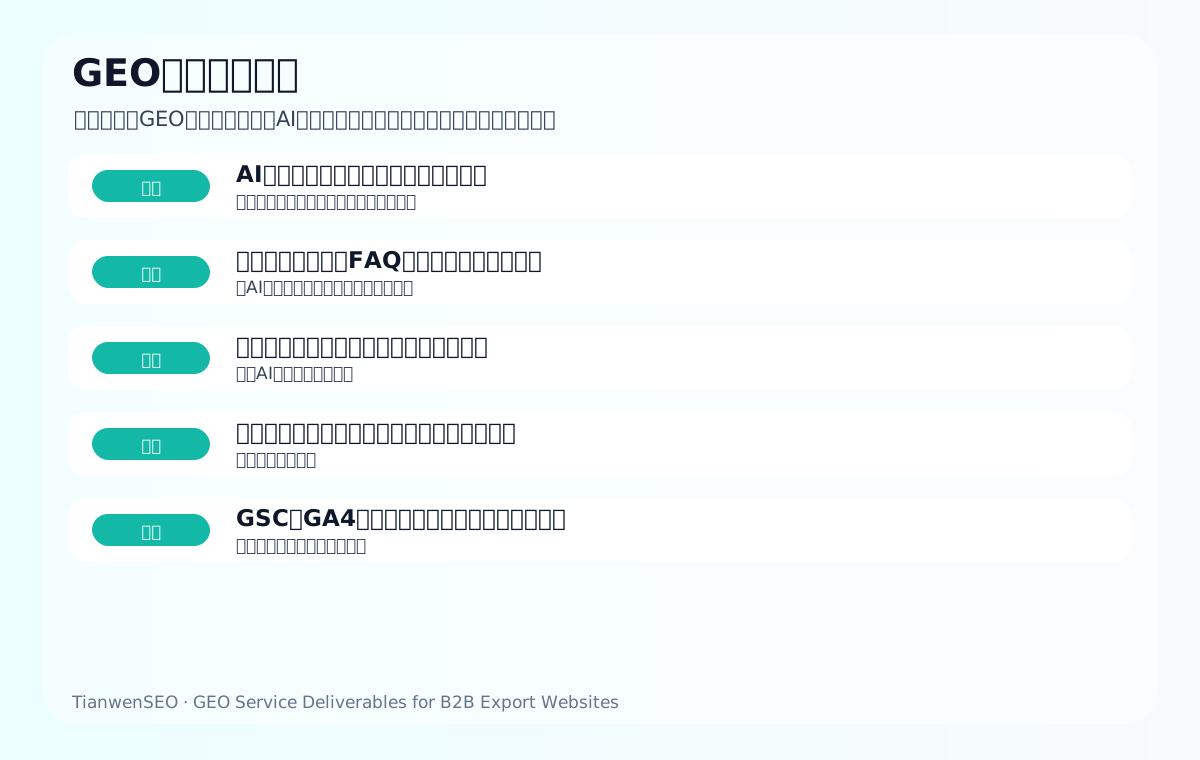
The conclusion first: a GEO service is not as simple as “getting AI to mention you”
If a GEO service only promises to “increase AI mentions” without explaining why your brand is not mentioned, why pages are not citable, whether product facts are clear, whether external materials are consistent, or whether inquiries have improved, then it is probably doing surface-level work only.
What export companies really need to buy is not an abstract AI buzzword, but an executable process of diagnosis and repair: first diagnose how AI and search understand you, then decide which product pages, resource pages, FAQs, and evidence pages to strengthen first, then continuously monitor answer changes for branded and non-branded questions, and finally connect those changes to business results.
The five major delivery modules of a GEO service
| Module | Question to answer | Deliverable |
|---|---|---|
| AI visibility audit | How AI currently describes you | Question bank, answer screenshots, citation sources, error points |
| Entity and brand diagnosis | Whether brand and product materials are consistent | Consistency checklist for website/platform/trade show/directory |
| Page and content upgrades | Which pages are worth citing | Rework of product pages, resource pages, FAQs, evidence pages |
| Monitoring system | Whether answers and citations change | Periodic monitoring table, comparison records, citation source trends |
| Business review | Whether AI visibility helps lead generation | GSC, GA4, brand search, inquiries, sales feedback |
What an AI visibility audit should examine
| Check item | Why it matters | Export example |
|---|---|---|
| Branded questions | See whether AI recognizes who you are | brand + waterproof connector |
| Non-branded questions | See whether AI treats you as a category source | best packaging machine for powder |
| Answer accuracy | Incorrect descriptions damage trust | Describing a trading company as a factory |
| Citation sources | Know who is shaping the answers | Website, directories, media, competitors |
| Page role | See whether the cited page is a product page or a generic article | IP rating resource page vs thin product page |
Monitoring does not end after one test
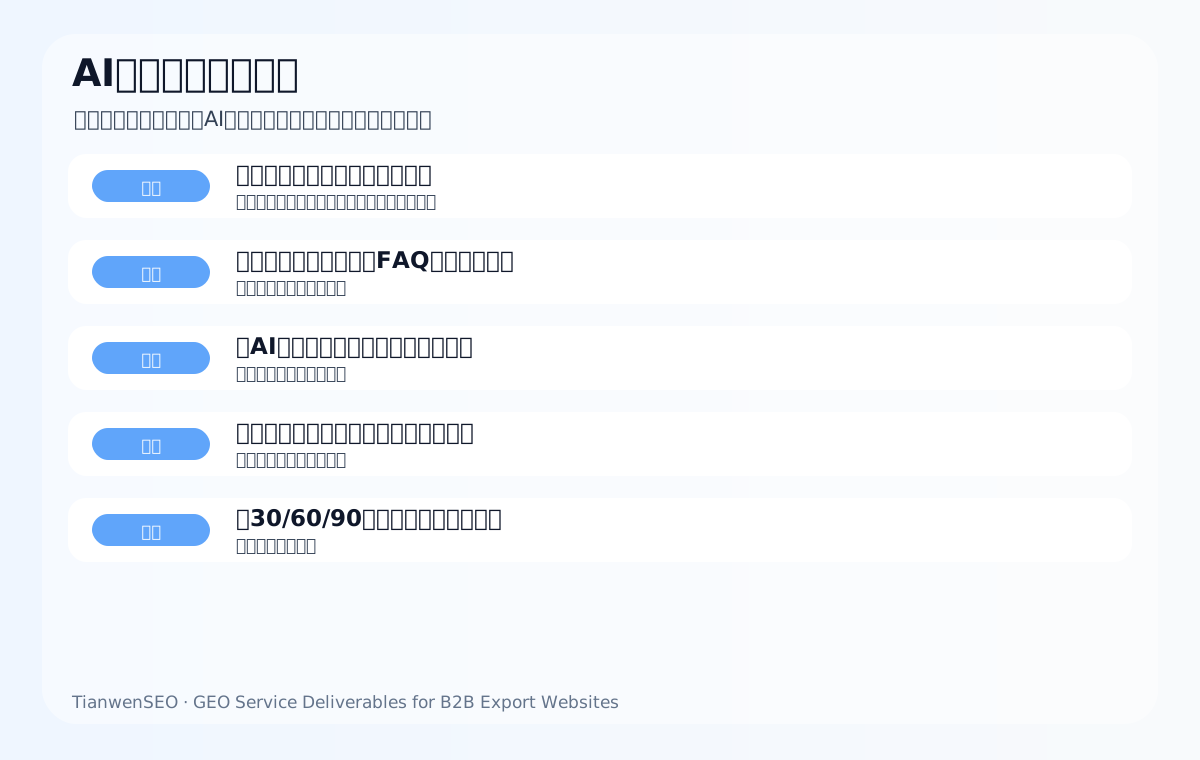
| One-time monitoring | Continuous monitoring | Why continuous matters more |
|---|---|---|
| Take a screenshot once | Record question and citation changes monthly | AI answers keep changing |
| Look only at branded terms | Look at branded and non-branded questions together | The real opportunities are often in non-branded questions |
| Do not record error points | Record errors and corrective actions | Makes correction easier |
| Do not connect to business | Look at GA4 and inquiries | Avoid looking only at surface mentions |
The three places where export GEO services most easily become superficial
| Superficial approach | Problem | Better approach |
|---|---|---|
| Sending only AI mention screenshots | Cannot explain why you appear or do not appear | Attach the question, answer, source, error, and page action |
| Chasing only branded terms | Misses non-branded lead-generation opportunities | Monitor product terms, scenario terms, and supplier terms at the same time |
| Giving content suggestions only | Nothing lands on pages and no re-check happens | Directly edit product pages, resource pages, and FAQs, then verify |
Which pages on an export website are best suited to GEO deliverables
| Page | Why it suits GEO | What to add |
|---|---|---|
| Product pages | Both AI and buyers need product facts | Specifications, materials, certifications, applications, FAQ |
| Resource pages | Easier to answer complex sub-questions | Tables, steps, common mistakes, evidence |
| Application pages | Good for handling complex scenario questions | Environmental conditions, selection logic, risks |
| About/capability pages | Help AI understand the brand entity | Business role, product lines, capabilities, certificates |
| Contact/inquiry pages | Turn visibility into action | Parameter fields, sample process, response details |
How export GEO services differ from SEO services
| Dimension | SEO deliverable focus | GEO deliverable focus | Overlap |
|---|---|---|---|
| Search visibility | Rankings, clicks, indexing, page intent | AI answers and citation sources | Both need strong pages |
| Content structure | Keyword-to-page matching | Citable snippets, tables, FAQs, and evidence | Both rely on high-quality content |
| Brand signals | Links, brand search, page experience | Entity consistency, third-party validation, answer accuracy | Both need a trustworthy brand |
| Review | GSC, GA4, conversions | AI screenshots, citation sources, brand search, inquiries | Both must connect to business |
GEO deliverable differences by export product
| Product line | Question-bank focus for GEO | Deliverable focus |
|---|---|---|
| waterproof connector | IP rating, wire gauge, pin count, installation, suppliers | Product pages, IP resource pages, application pages, RFQ checklist |
| custom metal parts | Materials, tolerances, surface finishing, drawings, quality control | Capability pages, material pages, tolerance pages, inspection pages |
| packaging machine | Materials, speed, precision, cleaning, after-sales | Application pages, selection checklist, maintenance FAQ |
| ceramic dinnerware | Material, MOQ, packaging, samples, target markets | Material comparison, packaging options, wholesale FAQ |
| industrial valve | Media, pressure, temperature, standards, spare parts | Category pages, application pages, standards pages, certificate pages |
How to build the “question bank” in GEO deliverables
| Question type | Example | Purpose |
|---|---|---|
| Branded terms | brand + product | See whether the brand is understood correctly |
| Product terms | custom metal parts supplier | See whether product pages become sources |
| Application terms | LED flood light for warehouse | See application pages and scenario content |
| Question terms | how to choose packaging machine | See resource pages and FAQs |
| Comparison terms | IP67 vs IP68 waterproof connector | See tables and judgment capability |
| Risk terms | MOQ too high, wrong material, certification issue | See brand credibility and correction capability |
What else to monitor beyond the question bank
| Monitoring item | Reason | Example |
|---|---|---|
| Brand search | Users may be primed by AI and then search the brand | brand + waterproof connector |
| Page paths | See whether visits reach product/contact pages | Resource page to product page |
| Inquiry sources | See whether AI/Google enters the business funnel | from Google / from search |
| Sales feedback | Judge whether questions are clearer | Whether inquiries come with parameters |
| External material changes | Third-party sources may be outdated or wrong | B2B platform profile updates |
What a GEO service monthly report should look like
| Module | Should include | Should not only provide |
|---|---|---|
| AI answer changes | Questions, answers, sources, errors, actions | A collection of screenshots |
| Page changes | Which product/resource/FAQ pages were updated | How many articles were written |
| Search and traffic | Key GSC and GA4 changes | Total traffic |
| Brand entity | Which external materials were corrected | Vague brand advice |
| Business feedback | Inquiry and sales observations | Rankings only |
How to verify whether a GEO service is reliable
| Verification question | Reliable performance | Unreliable performance |
|---|---|---|
| Is there a question bank? | A list of core branded/non-branded questions | Searching a few random terms |
| Are answers recorded? | Sources and error points are recorded | Screenshots only |
| Are there page actions? | Product pages, resource pages, FAQs, and evidence pages are updated | Suggestions with no implementation |
| Is there a business review? | Brand search, GA4, inquiries, and sales feedback are reviewed | AI mention counts only |
| Is there a next-round plan? | The next batch of pages is adjusted based on data | Repeating the same work every month |
The most overlooked deliverable: error correction
Many GEO services only want to show “where you were mentioned” and pay little attention to “where you were described incorrectly.” For export companies, a wrong mention can sometimes be more dangerous than no mention at all.
| Error type | Risk | Required deliverable |
|---|---|---|
| Wrong product scope | Buyers misjudge your capabilities | Update category pages and external materials |
| Wrong certification | Compliance risk | Add explanations of certificate scope |
| Wrong identity | Loss of trust | Clarify factory/trading company role |
| Wrong application scenario | Invalid inquiries or misleading | Add application boundaries and FAQ |
Top1/authority benchmark: why we need to describe deliverables in more detail
In current English search results, most authoritative pages about generative engine optimization services, AI visibility audit, and GEO audit deliverables mention a few common modules: first an AI visibility audit, then entity foundation, content structure, authority signals, competitive intelligence, monitoring, and performance measurement. These modules point in the right direction, but they are not practical enough for Chinese export companies, because many pages assume the reader is a SaaS brand, a local service brand, or a marketing team rather than a factory or trading company selling English-language products such as custom metal parts, LED flood light, packaging machine, medical probe, cnc machining parts, ceramic dinnerware, and waterproof connector to overseas buyers.
Therefore, an export GEO service cannot simply repeat concepts such as entity, authority, citation, and monitoring; it must translate each concept into deliverables that buyers can understand, sales can verify, and pages can support. An entity foundation is not a single brand positioning statement, but whether the company name, English brand name, product lines, factory/trading company identity, certificate scope, MOQ, target markets, and after-sales boundaries are consistent. Content structure is not writing more articles, but whether product pages can answer questions about materials, tolerances, certifications, samples, lead times, packaging, and application environments. Authority signals are not simply building backlinks, but whether third-party materials, trade show materials, B2B platform profiles, industry directories, and the website all say the same thing.
| Common modules on authoritative pages | What they get right | What export companies still need to add | How this article goes further |
|---|---|---|---|
| AI visibility audit | Start by checking whether AI mentions the brand and pages | Need to separate branded terms, non-branded product terms, application terms, comparison terms | Provides question-bank structure, answer records, and export product examples |
| Entity foundation | Emphasizes brand entity and consistency | Need to apply it to the English company name, product lines, certificates, factory/trading identity | Provides an entity consistency checklist and error-correction list |
| Content structure | Emphasizes that pages can be understood and cited by AI | Need to map to product pages, category pages, application pages, resource pages, RFQ pages | Provides page roles and priority judgment |
| Authority signals | Emphasizes external signals and credible sources | Need to check whether trade shows, B2B platforms, directories, and certificate pages are consistent | Includes external material error correction in deliverables |
| Monitoring and measurement | Emphasizes continuous monitoring of AI answers | Need to connect GSC, GA4, inquiry sources, and sales feedback | Provides a monthly report and a 90-day review approach |
Step one of a GEO service: break “visibility” into checkable questions
Many export companies, upon hearing about GEO, immediately ask, “Will ChatGPT recommend us?” That question is too broad and too hard to verify directly. A better approach is to break it into dozens of checkable questions: Does AI know your brand? Does it know what products you sell? Can it distinguish whether you are a factory, a trading company, or a brand owner? Will it mention you in non-branded product questions? If not, is it because your pages are not strong enough, external materials are insufficient, or product facts are unclear?
For example, a waterproof connector factory should not only test “how is brand X.” It should also test questions like “waterproof connector for outdoor LED lighting,” “IP67 vs IP68 connector for solar cable,” “how to choose waterproof connector supplier in China,” and “M12 waterproof connector MOQ lead time.” Overseas buyers usually do not search for a brand first; they search for product questions, application questions, supplier judgment questions, and risk questions.
| Breakdown level | Question to check | Example question | Verification evidence |
|---|---|---|---|
| Brand recognition | Does AI know the brand and company identity | Is ABC Connector a manufacturer? | Answer screenshot, source, error points |
| Product recognition | Does AI know the core product lines | What does ABC Connector make? | Whether the product lines are accurate |
| Non-branded category | Does AI mention you in category recommendations | waterproof connector supplier for outdoor lighting | Whether you appear, where you appear, citation source |
| Application scenario | Does AI understand the applicable environment | connector for marine LED flood light | Whether it can link to the application page |
| Sourcing judgment | Can AI answer MOQ, samples, certification, lead time | how to evaluate packaging machine supplier | Whether it cites website resource pages |
| Risk correction | Does AI state capabilities or certificates incorrectly | Does ABC have UL certification? | Error list and corrective actions |
Step two of a GEO service: turn the question bank into a page upgrade list
A question bank is not about building a spreadsheet; it is about deciding which pages to upgrade. If a question cannot be mapped to a page, or the matching page offers only a vague one-line introduction, then neither AI nor buyers will easily treat the website as a credible source. The most common problems on export sites are: product pages have only specifications and no selection guidance; category pages have only product lists and no application judgment; about pages say only “professional, high quality, reliable” without company entity information; and FAQs answer only “welcome to inquire” without real sourcing questions.
A GEO service should map each group of questions to a page type and specify what that page should add. custom metal parts maps to materials, tolerances, surface finishing, drawing formats, inspection methods, and lead times; packaging machine maps to material form, packaging speed, metering accuracy, cleaning method, after-sales, and spare parts; ceramic dinnerware maps to material, glaze, MOQ, packaging, wholesale markets, and the sample process.
| Question group | Matching page | What the page should add | Business meaning |
|---|---|---|---|
| Product specification questions | Product pages/category pages | Specifications, materials, dimensions, tolerances, certifications, downloadable materials | Reduce basic communication costs |
| Application scenario questions | Application pages/industry pages | Operating environment, selection logic, boundary conditions, failure risks | Capture high-intent sourcing |
| Supplier judgment questions | Capability pages/about pages | Factory identity, equipment, quality inspection, delivery scope, target markets | Build trust |
| Comparison questions | Resource pages/blog tutorials | Comparison tables, applicable conditions, judgment criteria | Increase the chance of being cited |
| Inquiry questions | RFQ pages/contact pages | Parameter fields, drawing upload, sample process, response details | Improve inquiry quality |
| Error correction questions | Brand pages/evidence pages/external materials | Standardize the English name, certificates, product lines, and company role | Reduce AI misreading |
Step three of a GEO service: work on entity consistency, not just editing website copy
AI answers often come from synthesizing multiple sources rather than reading only the website homepage. A common problem for export companies is that the website, B2B platforms, trade show materials, company directories, social media bios, press releases, and certificate pages say different things. One place says factory, another says trading company; one place says waterproof connector, another says cable accessories; one place says ISO certified, another omits the certificate scope. These inconsistencies make it hard for AI to determine the brand entity.
An entity consistency check is not about “packaging the brand”; it is about making public materials say the same thing. For an industrial valve supplier, the English company name, brand name, main valve types, applicable media, pressure and temperature ranges, certificates, target industries, and service scope need to be stable and consistent. For a private label activewear manufacturer, fabric capabilities, MOQ, sampling lead time, size range, packaging method, target markets, and compliance requirements must also be consistent.
| Material location | Common inconsistency | How to check | Correction priority |
|---|---|---|---|
| Website homepage | Brand positioning too broad | Does one sentence explain the product lines and customer types? | High |
| About page | Company identity unclear | Is the factory/trading company/brand owner role clear? | High |
| Product categories | Confusing English product terms | Do category names match sourcing terms? | High |
| B2B platforms | Old product lines or old addresses | Do they still show discontinued products and wrong contact details? | Medium |
| Trade shows/directories | Outdated materials | Are they consistent with the website product lines? | Medium |
| Certificate/inspection materials | Certificate scope unclear | Do they state the applicable products and validity period? | High |
Step four of a GEO service: set “citable page” standards
Not every page is worth pursuing AI citations for. A product page with just a few product images and one description will rarely become a credible source even if AI sees it. A citable page must meet three conditions: the information is specific enough, the structure is easy to extract, and the content helps with sourcing judgment. An export GEO service should score each priority page rather than saying vaguely that “the website content needs optimization.”
Take cnc machining parts as an example: a citable page should at least explain materials, machining methods, tolerance ranges, surface finishing, inspection equipment, drawing formats, batch size ranges, sample lead time, industry applications, and quality control. For a medical probe, it should also explain material safety, cleaning requirements, packaging, traceability, compatible device types, and compliance boundaries. Only when these facts are clear enough will AI answers more easily cite the page, and buyers more easily judge whether it is worth an inquiry.
| Scoring dimension | Low-scoring page | High-scoring page | Recommended action |
|---|---|---|---|
| Fact density | Marketing descriptions only | Parameters, ranges, standards, and limits | Add product facts and selection guidance |
| Clear structure | Dense blocks of text | Clear H2/H3, tables, and FAQs | Rearrange the page structure |
| Sourcing value | Readers finish without knowing how to inquire | Clear MOQ, samples, drawings, lead time | Add RFQ fields and process |
| Evidence support | No certificates or inspection explanations | Certificate scope, inspection process, downloadable materials | Add evidence pages |
| Extractability | Key information hidden in images | Text and tables are readable | Write important information as HTML text |
| Conversion path | No next step | Clear product, resource, contact, and download paths | Add internal links and CTAs |
Step five of a GEO service: design monitoring as a 30/60/90-day review
GEO does not end with a single check. AI answers, Google AI Overviews, search results, and competitor content all change. What export companies need is a rhythm for continuous review: at 30 days, see whether the foundational fixes are working; at 60 days, see whether target questions and page signals have changed; at 90 days, see whether search, traffic, and inquiries show quality improvements.
At the 30-day stage, do not rush to promise rankings and recommendations; instead, confirm whether the question bank, answer baseline, page upgrades, and entity corrections are complete. At the 60-day stage, check whether branded questions are more accurate, whether more website materials appear for non-branded questions, and whether new product long-tail queries appear in GSC. At the 90-day stage, review GA4 paths, inquiry sources, sales feedback, and the priority of the next batch of pages.
| Period | Key checks | Acceptable early signals | Next actions |
|---|---|---|---|
| 0-30 days | Question bank, pages, entity foundation | Fewer AI errors, more complete page facts | Add high-priority pages |
| 31-60 days | Changes in branded/non-branded answers | More website citations or brand searches appear | Expand resource pages and FAQs |
| 61-90 days | GSC/GA4/inquiry quality | More long-tail queries, inquiries with more complete parameters | Adjust the next batch of product lines |
| After 90 days | Continuous monitoring and content refresh | A more refined question bank, clearer sales feedback | Establish a quarterly review |
Industry example 1: GEO deliverables for a waterproof connector factory
Products like waterproof connector are very well suited to GEO deliverables, because buyer questions are specific, parameters are clear, application scenarios are numerous, and wrong information can easily create selection risk. A qualified GEO service should not just write “waterproof connectors are high quality”; it should build a question bank and page list around IP ratings, pin counts, wire gauges, installation methods, outdoor lighting, solar, marine, industrial equipment, and other scenarios.
For example, buyers may ask: What is the difference between IP67 and IP68 waterproof connectors? What connector is used for outdoor LED flood lights? Is an M12 connector suitable for low-temperature environments? How can you tell whether a supplier can provide stable volume? Behind these questions are category pages, application pages, technical resource pages, FAQs, and RFQ fields. A GEO service should map these questions one by one instead of giving the vague advice to “add more content.”
| Sourcing question | Page that should handle it | Page elements | Review metric |
|---|---|---|---|
| IP67 vs IP68 waterproof connector | Technical resource page | Definitions, test conditions, applicable scenarios, misconceptions | GSC comparison terms, AI citations |
| connector for outdoor LED flood light | Application page | Waterproofing, dustproofing, temperature, installation, cable matching | Application-term traffic and inquiries |
| M12 waterproof connector MOQ | Product page/RFQ page | MOQ, samples, volume, lead time | Completeness of inquiry parameters |
| China waterproof connector supplier | Capability page/category page | Factory capabilities, quality inspection, certificates, target markets | Non-branded supplier questions |
Industry example 2: GEO deliverables for custom metal parts and cnc machining parts
Sourcing decisions for custom metal parts and cnc machining parts are more complex than for standard off-the-shelf items. If an AI answer only says “find an experienced supplier,” it has no value for buyers. Pages that can truly be cited and convert must answer questions about materials, drawings, tolerances, surface finishing, quality inspection, batch size ranges, sample lead time, packaging, and industry applications.
In industries like these, a GEO service should pay special attention to “capability pages” and “resource pages.” If the website only shows photos of finished parts and does not explain material capabilities such as aluminum, stainless steel, brass, and titanium alloys, or capabilities such as CNC milling, turning, laser cutting, surface finishing, and CMM inspection, it is hard for AI to treat the site as a professional source.
| Content module | Low-quality wording | High-quality wording | GEO value |
|---|---|---|---|
| Material capabilities | Supports many materials | List the applicable scenarios for aluminum 6061, stainless steel 304/316, brass, and titanium | Can answer material selection questions |
| Tolerance explanation | High-precision machining | Explain general tolerances, critical dimensions, inspection methods, and the drawing confirmation process | Reduce incorrect inquiries |
| Surface finishing | Can do surface finishing | List the limitations and applications of anodizing, powder coating, polishing, and plating | Handle comparison questions |
| Quality inspection capability | Strict quality inspection | Explain incoming inspection, first article, in-process, final inspection, and CMM or gauge records | Build credible evidence |
| Inquiry fields | Welcome to inquire | Require drawing format, material, quantity, surface finishing, and application environment | Improve inquiry quality |
Industry example 3: GEO deliverables for packaging machine
Sourcing questions for packaging machine usually relate to material form, speed, precision, cleaning, maintenance, spare parts, and after-sales. If an export company only writes “automatic packaging machine manufacturer,” it will struggle to cover the questions buyers actually care about. A GEO service should break out material scenarios such as powder, granule, liquid, sauce, hardware parts, and medical supplies, and add application pages and selection tables for each.
When recommending packaging machinery suppliers, AI answers tend to favor websites with clear content structure, complete scenario materials, and well-defined after-sales and technical documentation. For export companies, “we have machines” needs to be upgraded to “which material, bag type, speed, precision, cleaning requirement, and maintenance plan suits which type of customer.”
| Question dimension | What buyers ask | Page deliverable | Review method |
|---|---|---|---|
| Material form | Whether powder and granule use the same equipment | Material application pages and selection tables | Growth in GSC application terms |
| Speed and precision | How many bags per minute, what is the error margin | Parameter tables and test explanations | Whether inquiries include speed requirements |
| Cleaning and maintenance | Whether it is easy to clean for food/pharma | Cleaning process and material explanations | High-value industry inquiries |
| After-sales spare parts | How overseas maintenance works | Spare parts kits, remote support, manuals | Sales feedback |
Industry example 4: GEO deliverables for ceramic dinnerware and private label activewear
It is not only industrial products that suit GEO. Consumer goods exports such as ceramic dinnerware and private label activewear manufacturer also involve many sourcing judgment questions. The difference is that buyers focus more on MOQ, design customization, samples, packaging, target-market compliance, lead time, wholesale channels, and branding/customization capability.
A common problem on such websites is that pages have many images but little readable text: lots of style displays, but little said about material, glaze, packaging, testing, sizes, fabrics, printing, labels, and the delivery process. A GEO service should supplement the visual display with sourcing decision information; otherwise, both AI and buyers will struggle to extract useful answers.
| Industry | Core questions | Page upgrade focus | AI/GSC review |
|---|---|---|---|
| ceramic dinnerware | Material, glaze, MOQ, packaging, samples | Material comparison, packaging options, wholesale FAQ | Wholesale/customization/sample terms |
| private label activewear | Fabric, sizes, labels, MOQ, sampling | Fabric library, customization process, size chart, label options | private label + product terms |
| medical probe | Material safety, cleaning, traceability, compatibility | Compliance boundaries, inspection explanations, application limits | High-intent technical questions |
| LED flood light | Power, lumens, waterproofing, heat dissipation, installation | Parameter explanations, application scenarios, comparison tables | Application and parameter terms |
GEO service deliverables checklist: the complete version from audit to implementation
If a GEO service is to be an accountable engagement rather than concept consulting, the deliverables list must be specific. The checklist below can be used to judge whether a service is complete and as a basis for internal communication at export companies. It does not require every site to finish everything at once, but you must know which items are foundational, which are growth items, and which are long-term review items.
| Deliverable category | Specific deliverable | Verification method | Priority |
|---|---|---|---|
| Target query terms | Question bank for brand, product, application, comparison, supplier, and risk questions | At minimum covers core product lines and high-intent questions | High |
| AI answer baseline | Answer screenshots, citation sources, error points, whether the brand is mentioned | Filed by question bank | High |
| Page mapping | Each question group mapped to product/category/application/resource/RFQ pages | Can explain why these pages were changed | High |
| Entity diagnosis | Consistency of company name, brand, product lines, certificates, and external materials | Lists inconsistencies and corrective actions | High |
| Page upgrades | Tables, FAQ, selection guidance, evidence, internal links, CTAs | Pages are readable and extractable | High |
| Monthly monitoring report | AI answers, GSC, GA4, inquiries, sales feedback | Shows changes, explanations, and next steps | High |
| External material corrections | B2B platforms, trade shows, directories, social media bios | Public materials are more consistent | Medium |
| Quarterly review | Question bank adjustments, page priorities, content refresh | Forms the next-round plan | Medium |
10 questions to ask before quoting or engaging a GEO service
When choosing a GEO service, export companies should not ask only “how much” and “how soon will we see results.” They should ask how the provider defines deliverables, how it selects query terms, how it benchmarks against Top1 and authority pages, how it handles export product terms, and how it connects to inquiries. The 10 questions below can quickly filter out services that only talk in concepts.
| Question | What a reliable answer should include | Answer to be wary of |
|---|---|---|
| Which questions will you monitor? | Branded, non-branded, product, application, comparison, supplier judgment | Only branded terms |
| How do you determine page priority? | Rank by product value, search intent, page foundation, and inquiry path | Change all pages the same way |
| Will you use export English product terms? | Can give industry examples such as custom metal parts | Use only marketing industry terms |
| How do you check whether AI answers are accurate? | Record sources, error points, and corrective actions | Only screenshot mention counts |
| Will you edit product pages and RFQ pages? | Will connect product facts and inquiry fields | Only write articles |
| How do you combine it with SEO data? | Look at GSC queries, pages, GA4 paths, and inquiries | Only look at AI tool scores |
| Can you promise that platform answers will use our website? | Clearly state that this cannot be promised; you can only improve the foundation for being understood and cited | Promise recommendations as a certain result |
| What does the monthly report look like? | Has questions, pages, data, business feedback, and next month’s actions | Screenshots and vague conclusions only |
| How do you handle incorrect information? | List the error sources and correct the website and external materials | Ignore negative and incorrect answers |
| How do you decide whether to continue after 90 days? | Look at page assets, answer accuracy, search changes, and inquiry quality | Only ask for continued payment |
Common misconceptions about GEO services: what export companies especially need to avoid
The GEO concept is very new, and the newer it is, the easier it is to package. Export companies do not need to chase every buzzword, and certainly do not need to overhaul the website beyond recognition for AI search. What truly needs to be avoided are practices that look advanced but do not actually help buyers understand the product.
| Misconception | Why it is wrong | Correct approach |
|---|---|---|
| Treating GEO as a separate channel | AI visibility still depends on the website, search, brand, and external materials | Do it together with SEO, content, and brand materials |
| Only working on the homepage | Sourcing questions mostly arise on product and resource pages | Prioritize core product lines and application pages |
| Chasing mention counts only | Being mentioned but described incorrectly damages trust | Look at accuracy, sources, and the business path |
| Padding content with generic articles | Cannot answer specific sourcing questions | Write selection guides, comparisons, parameters, risks, and FAQs |
| Ignoring contact/RFQ pages | Visibility cannot turn into inquiries | Add parameter fields and next-step instructions |
| Treating tool screenshots as deliverables | Tools are only aids, not business results | Combine with GSC, GA4, inquiries, and sales feedback |
How to combine GEO services with GSC, GA4, and inquiry tables for review
If a GEO service never looks at GSC, GA4, and inquiry tables, it easily stays at the concept level. Changes in AI answers are not business results in themselves; what really matters is: Are more high-intent long-tail queries reaching the website? Are users entering product pages, resource pages, and contact pages? Are inquiries more specific? Does sales report that customers understand product capabilities more clearly?
During review, map each target question to a page, then look at that page’s GSC queries, GA4 entry, and subsequent behavior. If the resource page for “IP67 waterproof connector for outdoor lighting” starts getting impressions and visits but users do not move on to product or contact pages, then the internal links and CTAs need adjustment. If inquiries start coming in with IP rating, wire gauge, and application environment, it means the pages and question bank have helped buyers make upfront judgments.
| Data source | What to look at | What it shows | Action |
|---|---|---|---|
| AI answer records | Whether mentioned, whether cited, whether accurate | Changes in AI understanding and sources | Correct errors or add pages |
| GSC | Queries, impressions, clicks, pages | Search demand and page matching | Add FAQs or change titles |
| GA4 | Landing pages, paths, time on site, conversions | Whether users enter the business path | Add internal links and CTAs |
| Inquiry table | Product, parameters, source, quality | Whether it brings valid opportunities | Optimize RFQ fields |
| Sales feedback | Whether customer questions are more specific | Whether content reduces explanation costs | Add downloadable materials and comparison tables |
Official documentation extension: GEO services should verify AI visibility, search eligibility, and data review separately
A GEO service deliverables list cannot simply say “improved AI visibility.” A more solid approach is to map official documentation to checkable fields: whether pages can be discovered by search systems, whether they meet basic search eligibility, whether AI crawlers can access them, whether Search Console and GA4 have reviewable data, and what Bing AI citation and IndexNow notifications can and cannot demonstrate.
For export websites, this boundary is especially important. For pages such as custom metal parts, LED flood light, packaging machine, medical probe, waterproof connector, industrial valve supplier, ceramic dinnerware, and private label activewear manufacturer, if there are no clear product facts, URL statuses, and data definitions, AI samples cannot be written up as stable results. When there are no GSC query, page, or page-query rows, you can only state that there is currently no available Search Console signal; you cannot add rankings, impressions, clicks, CTR, or inquiry changes.
| Official source | What it can be used to verify in a GEO service | Export site check example | Delivery boundary |
|---|---|---|---|
| Google Search Central: AI features and your website | AI search still depends first on pages being discoverable, indexable, clearly written, and consistent with structured data. | Check whether the packaging machine application page has readable body text, internal product links, and FAQs. | Meeting basic conditions does not mean AI answers will definitely use your website. |
| Google Search Central: SEO Starter Guide | Whether titles, body text, image descriptions, internal links, and page purpose serve real users. | Check whether the LED flood light category page explains power, applications, certifications, and installation scenarios. | Page optimization actions must not be written as guaranteed ranking results. |
| Google Search Central: Search Essentials | Basic search eligibility, spam risk, accessibility, and content quality floor. | Check whether the medical probe page avoids fabricated certifications, fabricated compatible model numbers, and misleading descriptions. | Meeting basic requirements does not mean you have already earned impressions. |
| Google Search Central: Sitemaps overview | Whether priority URLs are in the sitemap and whether there is a list of added, updated, and removed URLs. | Check whether the waterproof connector category, product, and resource pages are in the sitemap. | A URL appearing in the sitemap does not mean that URL has been indexed. |
| Google Search Central: robots.txt introduction | Whether Google crawler, resource files, images, PDFs, and priority pages are accidentally blocked. | Check whether ceramic dinnerware images, PDF catalogs, and product pages can be accessed normally. | Allowing crawling in robots does not mean the page will earn rankings or clicks. |
| Search Console Help: Performance report | query, page, country, device, clicks, impressions, CTR, average position. | Review the industrial valve supplier category page and inquiry terms in separate tables. | Without GSC row data, you cannot write about trends, rankings, or click improvements. |
| Search Console Help: URL Inspection tool | The index status, crawl status, canonical, and the version Google sees for a single URL. | Spot-check whether the core pages of the private label activewear manufacturer are correctly recognized. | Being able to inspect a single URL does not mean it already has search impressions. |
| Google Analytics Help: About events | On-site behavior events such as forms, email, WhatsApp, downloads, RFQ, and resource page clicks. | Observe drawing uploads, inquiry buttons, resource downloads, and email clicks for custom metal parts. | On-site events cannot directly replace organic search performance. |
| OpenAI Platform: Bots | Distinguish the purposes and access boundaries of OAI-SearchBot, GPTBot, and ChatGPT-User. | Check whether robots.txt merges training crawling, search crawling, and user-triggered access into one rule. | Allowing a crawler to access does not mean ChatGPT search will display your website. |
| Bing Webmaster Blog: AI Performance | If visible in the account, you can observe citations, cited pages, and grounding query phrases. | Record which product questions cite your website and which cite competitors or third-party directories. | A citation is not a ranking, an answer position, or an inquiry result. |
| IndexNow: Documentation | After adding, updating, or deleting URLs, record the submission time, URL list, and response status. | After a major product page change, record the URL notification separately from subsequent sitemap/GSC/Bing observations. | HTTP 200 only means the notification was received; it does not mean the URL has been crawled, indexed, or shown. |
When there is no GSC signal, how far can a GEO service report go
| What can be written | Evidence source | What it cannot claim | Next re-check |
|---|---|---|---|
| The query set, page mapping, and AI answer samples have been established. | Query table, URL table, screenshot numbers, re-test dates. | It cannot claim the website has gained stable AI citations. | Re-test the same question set at 30/60/90 days. |
| Priority URLs have been checked for index/follow, canonical, sitemap, robots, and body text readability. | Source code, sitemap, public URLs, GSC URL inspection. | It cannot claim the pages have gained search impressions. | Keep watching for GSC page/query rows to appear. |
| GA4 or on-site event definitions have been configured. | Event names, trigger conditions, test records. | It cannot claim the number of inquiries has increased. | Combine with real sources, pages, products, and sales feedback. |
| External entry points such as OpenAI, Bing, and IndexNow have been checked within their boundaries. | Crawler rules, Bing AI samples, URL notification records. | It cannot claim the platform has adopted the website or produced business results. | Continue re-checking with the same URL and the same query. |
Deliverables must correspond to officially verifiable signals
GEO service deliverables cannot consist only of abstract phrases like “improve AI visibility.” A better deliverables list should map each task to a verifiable source: Google AI features to confirm basic SEO and the boundaries of AI features; OpenAI Bots to check crawler/user agent access policy; Bing AI Performance to understand how to review citations, referenced URLs, and grounding query phrases in AI answers; and IndexNow to record change notifications for priority URLs, without writing those notifications up as indexing results.
| Deliverable | Corresponding official signal | What to check at acceptance |
|---|---|---|
| AI visibility baseline | Google AI features, Bing AI Performance | Query, platform, answer summary, cited URL, competitor sources, and recording time |
| AI crawler boundary check | OpenAI Bots, robots.txt | Whether the relevant crawlers are allowed to access and whether priority page resources are accidentally blocked |
| Page citability improvements | Google basic SEO, AI features | Whether pages are indexable and whether titles, facts, FAQs, and internal links are clear |
| URL update notifications | IndexNow, sitemap | Whether the discovery chain is recorded after priority pages are added or updated, without treating HTTP 200 as indexing |
| Monthly review | GSC, Bing AI Performance, on-site action records | Whether queries, pages, citations, impressions, clicks, actions, and next steps can be matched up |
The benefit of writing deliverables this way is that companies can judge what the service team actually did and distinguish between “deliverable work” and “uncontrollable outcomes.” For example, the service team can deliver the query set, page improvements, crawler boundary checks, and review records, but it should not write a particular platform’s answer, citation, or inquiry as a guaranteed result.
Official documentation links
- Google Search Central: AI features and your website
- OpenAI Platform: Bots
- Bing Webmaster Blog: AI Performance in Bing Webmaster Tools
- IndexNow: Documentation
GEO service monthly report sample: do not look at just one page of screenshots
A qualified GEO monthly report should tell the company what happened this month, why it happened, and what to do next month. It does not have to be thick, but it must have structure, evidence, and business explanation. Below is a monthly report structure suitable for export websites.
| Monthly report section | Specific content | Benefit |
|---|---|---|
| This month’s conclusions | 3-5 most important changes and risks | Management can quickly judge direction |
| Question bank changes | Added/removed/adjusted questions and the reasons | Avoid monitoring ineffective questions over the long term |
| AI answer changes | Mentions, citations, errors, competitor changes | Know the quality of visibility |
| Page actions | Which pages were updated and which tables/FAQs/evidence were added | See actual asset building |
| Search and traffic | Key page changes in GSC and GA4 | Connect to search demand |
| Inquiry and sales feedback | Inquiry parameters, sources, quality, and sales observations | Connect to business results |
| Next month’s plan | The next batch of questions, pages, external materials, and monitoring priorities | Create continuous improvement |
When it is not suitable to start a GEO service immediately
Not every export website should buy a full GEO service right away. If the website does not even have basic English product pages, product categories are messy, contact paths are unclear, pages do not open, and GSC has no baseline data, then the priority should probably be fixing the website and SEO fundamentals first. A GEO service is not a shortcut that lets you skip the basics.
| Current state | Suitable for full GEO? | More reasonable priority action |
|---|---|---|
| No English product pages | Not suitable | First build core product and category pages |
| Very thin product pages | Only suitable for a lightweight diagnosis | First add parameters, applications, FAQ, RFQ |
| Messy brand materials | Suitable for entity diagnosis | Standardize the website and external materials |
| Existing SEO foundation and inquiries | Suitable for full GEO | Build the question bank, monitoring, and page upgrades |
| Core products with high order value | Suitable for a priority pilot | Pick 1-2 product lines for 90 days |
| No review capability at all | Be cautious | First set up GSC, GA4, and inquiry records |
How export companies should support a GEO service internally
A GEO service cannot be completed by the service team writing content on its own. The export company needs to provide real product materials, sales questions, certificate boundaries, typical inquiries, target markets, and product priorities. Otherwise, pages easily become generic introductions that neither AI can cite accurately nor buyers can use to make judgments.
| What the company needs to provide | Why it is needed | What happens without it |
|---|---|---|
| Core product lines and profit priorities | Determines which questions and pages to tackle first | Content easily becomes scattered |
| Typical inquiries and sales questions | Find the real language of buyers | You can only write generic questions |
| Product parameters and limits | Avoid overpromising or misleading | AI may state capabilities incorrectly |
| Certificates and inspection materials | Build credible evidence | Pages lack authoritative support |
| Target markets and customer types | Determine cases and scenarios | Examples are not close to the business |
| Historical GSC/GA4/inquiry data | Review performance | You can only look at surface metrics |
How GEO connects to inquiry quality
| Signal | Page changes | Inquiry changes |
|---|---|---|
| Increased AI mentions | More questions mention the brand or page | Customers may learn about you earlier |
| More complete FAQ | Customers ask fewer basic questions | Inquiries contain more complete parameters |
| Clearer evidence pages | Certification and capability descriptions are accurate | Lower sales explanation costs |
| Stronger resource pages | Complex questions are handled | More high-intent product questions come in |
90-day GEO service delivery rhythm
| Phase | Action | Verification |
|---|---|---|
| Weeks 1-2 | Build the question bank, answer baseline, and entity consistency check | Know the current questions and errors |
| Weeks 3-4 | Upgrade core pages and brand materials | Pages can answer sourcing questions |
| Weeks 5-8 | Build resource pages, FAQs, and external material corrections | AI and Google understand more easily |
| Weeks 9-12 | Review AI answers, GSC, GA4, and inquiries | Can explain business impact and next month’s actions |
Do not overlook “non-branded questions”
Many export companies only care about whether their brand is mentioned, but genuinely new inquiries often come from non-branded questions, such as “which industrial valve supplier for high temperature steam” and “how to choose packaging machine for powder.” If a GEO service monitors only branded terms, it will struggle to bring in new leads.
| Branded questions | Non-branded questions | Difference in value |
|---|---|---|
| People who already know the company are verifying | Buyers who do not yet know the company are choosing | Non-branded questions are closer to new opportunities |
| Easy to see whether the brand is accurate | Can see the competitive landscape of the category | Determines new lead-generation capability |
| Good for checking entity consistency | Good for checking page and resource capability | Need to monitor both |
A few more FAQs
Is a GEO service only suitable for big brands?
No. Small factories and trading companies can also build AI visibility through clear product facts, entity consistency, and question-bank monitoring.
Do you have to buy tools for GEO?
Not necessarily. Tools can improve efficiency, but the question bank, answer screenshots, page upgrades, and business review are themselves more important than tools.
If AI does not mention us, does that mean GEO is useless?
Not necessarily. First check whether your pages and entity have the foundation to become a source, then see whether you have entered higher-quality search and inquiry paths.
Should a GEO service be done together with SEO?
It is best to do them together. SEO and GEO share page assets; doing them separately easily leads to duplication or disconnect.
Which pages should a GEO service start with?
Prioritize core product pages, application pages, resource pages, FAQs, and evidence pages rather than producing a large number of generic articles first.
How long until we see changes?
Usually, look first at answer and search foundation changes within 30 days, then at brand search, page paths, and inquiry quality at 60-90 days.
FAQ: common questions about GEO service deliverables
What does a GEO service include?
It should include an AI visibility audit, entity and brand consistency check, page upgrades, a monitoring system, and business review.
Is looking only at AI mention counts enough?
No. You also need to check whether answers are accurate, whether the right pages are cited, and whether they bring page visits and inquiries.
Which questions should a GEO audit examine?
At minimum, it should examine branded terms, product terms, application terms, supplier judgment terms, and comparison questions.
Why look at both branded and non-branded questions?
Branded terms reflect awareness and verification, while non-branded questions are closer to new lead-generation opportunities.
How is an export GEO service different from an ordinary SEO service?
GEO places more emphasis on AI answers, citation sources, entity consistency, and answer accuracy, but it still requires a solid SEO page foundation.
Can you promise to be recommended by ChatGPT or Google AI Overviews?
No. Any promise that writes platform recommendations as a guaranteed outcome is not credible.
Can you do GEO without an English website?
You can start by using English product terms as examples on a Chinese-language service site, but core pages aimed at overseas buyers should still have high-quality English content.
How do you judge whether a GEO project is worth continuing?
Look at whether the question bank is more complete, pages are stronger, AI answers are more accurate, and brand search and inquiry quality have improved.
Conclusion: what export companies need is “verifiable AI visibility,” not AI buzzwords
A GEO service is easy to package as a trendy concept, but the truly valuable deliverable is not mysterious: it brings together AI answers, brand entity, page facts, third-party sources, and business review to see where you are not mentioned, mentioned incorrectly, or mentioned but not converted.
If a GEO service can make your product pages clearer, resource pages more citable, brand materials more consistent, AI answers more accurate, and inquiries more specific, then it is not a pile of concepts—it is helping export companies adapt to the new search environment.
Continue reading this GEO series
If you are systematically studying GEO and AI search visibility, we suggest continuing with the articles below. First understand the concepts, then move on to diagnosis, monitoring, content structure, and engagement boundaries.
- How to write an SEO/GEO analysis framework: a credible content guide when you have no authorized data
- How to monitor AI search visibility: a checklist for export website brand mentions, website citations, and competitor answers
- How to choose an AI search visibility service team: a checklist for export companies to judge GEO partner capability
- How to choose an AI search visibility service team: what a reliable generative engine optimization team should deliver
- How to judge the most reliable AI search visibility service team in China: do not look at AI promises, look at visibility evidence
- What is the difference between an AI search visibility consultant and a service team: how export companies should choose
{
“@context”: “https://schema.org”,
“@type”: “FAQPage”,
“mainEntity”: [
{
“@type”: “Question”,
“name”: “When there is no GSC signal, how far can a GEO service report gonnWhat can be written Evidence source What it cannot claim Next re-checknnThe query set, page mapping, and AI answer samples have been established. Query table, URL table, screenshot numbers, re-test dates. It cannot claim the website has gained stable AI citations. Re-test the same question set at 30/60/90 days.nPriority URLs have been checked for index/follow, canonical, sitemap, robots, and body text readability. Source code, sitemap, public URLs, GSC URL inspection. It cannot claim the pages have gained search impressions. Keep watching for GSC page/query rows to appear.nGA4 or on-site event definitions have been configured. Event names, trigger conditions, test records. It cannot claim the number of inquiries has increased. Combine with real sources, pages, products, and sales feedback.nExternal entry points such as OpenAI, Bing, and IndexNow have been checked within their boundaries. Crawler rules, Bing AI samples, URL notification records. It cannot claim the platform has adopted the website or produced business results. Continue re-checking with the same URL and the same query.nnnDeliverables must correspond to officially verifiable signalsnGEO service deliverables cannot consist only of abstract phrases like “improve AI visibility.” A better deliverables list should map each task to a verifiable source: Google AI features to confirm basic SEO and the boundaries of AI features; OpenAI Bots to check crawler/user agent access policy; Bing AI Performance to understand how to review citations, referenced URLs, and grounding query phrases in AI answers; and IndexNow to record change notifications for priority URLs, without writing those notifications up as indexing results.nnnDeliverable Corresponding official signal What to check at acceptancennAI visibility baseline Google AI features, Bing AI Performance Query, platform, answer summary, cited URL, competitor sources, and recording timenAI crawler boundary check OpenAI Bots, robots.txt Whether the relevant crawlers are allowed to access and whether priority page resources are accidentally blockednPage citability improvements Google basic SEO, AI features Whether pages are indexable and whether titles, facts, FAQs, and internal links are clearnURL update notifications IndexNow, sitemap Whether the discovery chain is recorded after priority pages are added or updated, without treating HTTP 200 as indexingnMonthly review GSC, Bing AI Performance, on-site action records Whether queries, pages, citations, impressions, clicks, actions, and next steps can be matched upnnnnThe benefit of writing deliverables this way is that companies can judge what the service team actually did and distinguish between “deliverable work” and “uncontrollable outcomes.” For example, the service team can deliver the query set, page improvements, crawler boundary checks, and review records, but it should not write a particular platform’s answer, citation, or inquiry as a guaranteed result.nnOfficial documentation linksnnGoogle Search Central: AI features and your websitenOpenAI Platform: BotsnBing Webmaster Blog: AI Performance in Bing Webmaster ToolsnIndexNow: DocumentationnnGEO service monthly report sample: do not look at just one page of screenshotsnA qualified GEO monthly report should tell the company what happened this month, why it happened, and what to do next month. It does not have to be thick, but it must have structure, evidence, and business explanation. Below is a monthly report structure suitable for export websites.nMonthly report section Specific content Benefit This month’s conclusions 3-5 most important changes and risks Management can quickly judge direction Question bank changes Added/removed/adjusted questions and the reasons Avoid monitoring ineffective questions over the long term AI answer changes Mentions, citations, errors, competitor changes Know the quality of visibility Page actions Which pages were updated and which tables/FAQs/evidence were added See actual asset building Search and traffic Key page changes in GSC and GA4 Connect to search demand Inquiry and sales feedback Inquiry parameters, sources, quality, and sales observations Connect to business results Next month’s plan The next batch of questions, pages, external materials, and monitoring priorities Create continuous improvementnWhen it is not suitable to start a GEO service immediatelynNot every export website should buy a full GEO service right away. If the website does not even have basic English product pages, product categories are messy, contact paths are unclear, pages do not open, and GSC has no baseline data, then the priority should probably be fixing the website and SEO fundamentals first. A GEO service is not a shortcut that lets you skip the basics.nCurrent state Suitable for full GEO? More reasonable priority action No English product pages Not suitable First build core product and category pages Very thin product pages Only suitable for a lightweight diagnosis First add parameters, applications, FAQ, RFQ Messy brand materials Suitable for entity diagnosis Standardize the website and external materials Existing SEO foundation and inquiries Suitable for full GEO Build the question bank, monitoring, and page upgrades Core products with high order value Suitable for a priority pilot Pick 1-2 product lines for 90 days No review capability at all Be cautious First set up GSC, GA4, and inquiry recordsnHow export companies should support a GEO service internallynA GEO service cannot be completed by the service team writing content on its own. The export company needs to provide real product materials, sales questions, certificate boundaries, typical inquiries, target markets, and product priorities. Otherwise, pages easily become generic introductions that neither AI can cite accurately nor buyers can use to make judgments.nWhat the company needs to provide Why it is needed What happens without it Core product lines and profit priorities Determines which questions and pages to tackle first Content easily becomes scattered Typical inquiries and sales questions Find the real language of buyers You can only write generic questions Product parameters and limits Avoid overpromising or misleading AI may state capabilities incorrectly Certificates and inspection materials Build credible evidence Pages lack authoritative support Target markets and customer types Determine cases and scenarios Examples are not close to the business Historical GSC/GA4/inquiry data Review performance You can only look at surface metricsnHow GEO connects to inquiry qualitynSignal Page changes Inquiry changes Increased AI mentions More questions mention the brand or page Customers may learn about you earlier More complete FAQ Customers ask fewer basic questions Inquiries contain more complete parameters Clearer evidence pages Certification and capability descriptions are accurate Lower sales explanation costs Stronger resource pages Complex questions are handled More high-intent product questions come inn90-day GEO service delivery rhythmnPhase Action Verification Weeks 1-2 Build the question bank, answer baseline, and entity consistency check Know the current questions and errors Weeks 3-4 Upgrade core pages and brand materials Pages can answer sourcing questions Weeks 5-8 Build resource pages, FAQs, and external material corrections AI and Google understand more easily Weeks 9-12 Review AI answers, GSC, GA4, and inquiries Can explain business impact and next month’s actionsnDo not overlook “non-branded questions”nMany export companies only care about whether their brand is mentioned, but genuinely new inquiries often come from non-branded questions, such as “which industrial valve supplier for high temperature steam” and “how to choose packaging machine for powder.” If a GEO service monitors only branded terms, it will struggle to bring in new leads.nBranded questions Non-branded questions Difference in value People who already know the company are verifying Buyers who do not yet know the company are choosing Non-branded questions are closer to new opportunities Easy to see whether the brand is accurate Can see the competitive landscape of the category Determines new lead-generation capability Good for checking entity consistency Good for checking page and resource capability Need to monitor bothnA few more FAQsnIs a GEO service only suitable for big brands?”,
“acceptedAnswer”: {
“@type”: “Answer”,
“text”: “No. Small factories and trading companies can also build AI visibility through clear product facts, entity consistency, and question-bank monitoring.”
}
},
{
“@type”: “Question”,
“name”: “Do you have to buy tools for GEO?”,
“acceptedAnswer”: {
“@type”: “Answer”,
“text”: “Not necessarily. Tools can improve efficiency, but the question bank, answer screenshots, page upgrades, and business review are themselves more important than tools.”
}
},
{
“@type”: “Question”,
“name”: “If AI does not mention us, does that mean GEO is useless?”,
“acceptedAnswer”: {
“@type”: “Answer”,
“text”: “Not necessarily. First check whether your pages and entity have the foundation to become a source, then see whether you have entered higher-quality search and inquiry paths.”
}
},
{
“@type”: “Question”,
“name”: “Should a GEO service be done together with SEO?”,
“acceptedAnswer”: {
“@type”: “Answer”,
“text”: “It is best to do them together. SEO and GEO share page assets; doing them separately easily leads to duplication or disconnect.”
}
},
{
“@type”: “Question”,
“name”: “Which pages should a GEO service start with?”,
“acceptedAnswer”: {
“@type”: “Answer”,
“text”: “Prioritize core product pages, application pages, resource pages, FAQs, and evidence pages rather than producing a large number of generic articles first.”
}
}
]
}
This page is machine-translated from the Simplified Chinese version and awaiting human review. It has not yet been proofread.