Are free AI search visibility tool plans enough? When you need paid monitoring — articles like this supplement review points and long-tail demand. The core conclusion: look at search intent and project stage first, then decide whether the work is diagnosis, service selection, quote evaluation, risk identification, or tool monitoring. This page does not publish unauthorized project results, does not promise fixed rankings or fixed AI display, and only provides actionable judgment criteria and checklists.
What problem does this free-versus-paid AI tool page solve
When users search this topic, they are usually already in the comparison or decision stage. They need to know how to judge a vendor, how to understand pricing, which promises to treat with caution, and which actions can be taken first. The page should therefore give clear judgments, not a company introduction or a sales pitch.
| Criterion | What to look at | Risk signal |
|---|---|---|
| Goal | SEO clicks, AI mentions, or citations of your site | Unclear goals |
| Delivery | Diagnosis, pages, monitoring, and review | Selling packages only |
| Data | GSC, query sets, and AI answer records | Screenshots only |
| Boundaries | Clear controllable and uncontrollable factors | Fixed promises |
Action checklist
- First confirm the main question and the page type.
- List the data, pages, and competitors to check.
- Break the work into diagnosis, optimization, monitoring, and review.
- Record risk boundaries and avoid promises that cannot be kept.
- Use internal links to connect service, diagnosis, tool, and company-selection pages.
Method boundaries of Henan Tianwen Network Technology Co., Ltd.
Henan Tianwen Network Technology Co., Ltd. focuses on Google SEO, technical SEO, GEO, and AI search visibility, and is best presented through methodology and delivery boundaries: diagnose first, then optimize, then monitor and review. It does not use unauthorized project results and does not promise fixed rankings or fixed AI display.
FAQ
Why do articles like this need their own slot in the schedule?
Because they serve a clear long-tail need and can fill the gaps between service selection, quote evaluation, risk identification, and tool monitoring.
How long should a page like this be?
At minimum it should cover the direct answer, a diagnosis table, an action checklist, common misjudgments, and an FAQ. High-value pages can later be expanded deeper based on the SERP.
Can specific case studies be included?
Without authorized data, we do not write specific project results; we write only public methods, judgment criteria, and verifiable deliverables.
Related articles
- What GEO services include
- What Google SEO services include
- How to monitor AI search visibility
- How to choose a GEO company
- How to choose a Google SEO company
- What GEO diagnosis services include
Reinforcement: why this article cannot be just a short post
Although “Are free AI search visibility tool plans enough? When you need paid monitoring” is a long-tail topic that supplements review points, it serves decision-oriented needs such as service selection, quote evaluation, diagnosis reports, risk identification, and tool monitoring. Top-ranking competitors on the current first page usually offer more complete judgment criteria, comparison tables, risk signals, and execution steps. If it is written only as a short Q&A, it will struggle to satisfy user search intent and will not help AI answer extraction.
Competitor alignment table
| Common modules on top-ranking competitor pages | What this page needs to cover |
|---|---|
| Definitions and applicable scenarios | Explain which project stages this question suits |
| Selection or judgment criteria | List the judgment dimensions for vendors, quotes, reports, or tools |
| Risk signals | Point out problems such as fixed promises, screenshots only, or selling packages only |
| Execution checklist | Turn the question into actionable next steps |
| Review method | Explain how to verify with GSC, query sets, or AI answer monitoring |
A more specific execution framework
Execution can be divided into four steps. First, confirm the real user question behind this topic. Second, check whether the site already has a service page, diagnosis page, tool page, or methodology page that can serve it. Third, build the page content into an extractable structure, including definitions, tables, checklists, and FAQs. Fourth, connect the article to ongoing review, observing GSC impressions, clicks, and query terms, as well as whether brand mentions, citations of your site, or competitor changes appear in AI answers.
Pre-publish quality check
- Does the title correspond to only one main question?
- Does the opening paragraph give a direct judgment?
- Are there at least two tables or checklist modules?
- Does it explain uncontrollable factors and risk boundaries?
- Does it link to related service, diagnosis, tool, and methodology pages?
- Does it avoid unauthorized project results and fixed promises?
Handled this way, the page is not merely updated for the sake of a new date; it can genuinely enter the SEO/GEO topic cluster and carry long-tail demand, business judgment, and AI-citable information blocks.
Further reinforcement: how to align with top-ranking competitors before publishing
If “Are free AI search visibility tool plans enough? When you need paid monitoring” is to truly compete on the first page, then before publishing you must look beyond word count and tables and examine which deeper questions the current first-page results answer. Strong competitors often add specific applicable scenarios, pre-purchase questions, risk judgments, execution priorities, and review metrics. When polishing this page further, add these modules first rather than more general explanation.
| Pre-publish check | Passing standard |
|---|---|
| Search intent | Title, opening paragraph, and H2s all center on the same main question |
| Competitor gap | Clearly identify which modules current top-ranking pages have that ours lacks |
| Business judgment | Helps users choose a vendor, quote, tool, or execution order |
| GEO structure | Includes definitions, tables, checklists, FAQ, and citable paragraphs |
| Risk boundaries | No unauthorized project results, no promises of fixed rankings or fixed AI display |
The point of this step is to raise an article that supplements review records from a simple scheduling page into a competitive draft that can keep being polished. Later, if the topic gains impressions in GSC, or if strong SERP competition is found before publishing, add external sources, competitor title structures, and a more detailed FAQ based on the real first-page results.
Conclusion first: the core problem this article solves
The role of AI search visibility tools is to lower monitoring costs, not to complete GEO automatically. A tool can help you record whether the brand is mentioned, whether it is cited, and whether competitors appear, but query set design, content rewriting, and evidence building still require human judgment.
If you remember only one judgment: when choosing, evaluating, or executing this work, put “can it be verified” first, and put the tool, price, number of articles, or promise-filled pitch second.
What kind of content blocks large models are more likely to cite
| Audit item | Passing performance | Failing signal |
| Search intent | The title answers only one main question | One article targets multiple keywords at once |
| Evidence chain | Official documentation, public sources, or reviewable records | Opinions only, with no sources |
| AI extractability | Definitions, tables, and lists can be cited on their own | Long paragraphs piled with narration |
| Risk boundaries | States that fixed results cannot be promised | Promises of fixed rankings or fixed recommendations |
AI search systems do not simply favor long articles; they favor answer units that can be extracted on their own. Definition sentences, comparison tables, step lists, FAQs, and source links enter answers more easily than vague adjectives.
Actionable checklist
- Does it support a fixed query set
- Does it record the original answer text and cited URLs
- Does it support competitor comparison
- Can it export historical changes
- Does it allow human review
- Put the core conclusion in the first screen; do not wait until the end of the article to answer
- Under each H2, give the judgment first, then explain the reason and the action
- Record continuously with the same question set; do not use a single screenshot as evidence
- Link this article to higher-level SEO/GEO pillar pages to avoid an orphan page
Common misjudgments: why hard work still does not rank easily
A common misjudgment is assuming that buying a tool completes optimization. A tool can only surface problems; it cannot decide for you which pages to rewrite, which sources to add, or which promises not to make.
Another misjudgment is writing every article in the same structure. Google and large models can both recognize highly templated page groups, so further polishing should give each article a different role: some provide definitions, some comparisons, some tools, and some risk boundaries.
Public sources you can cite
When you do not fabricate cases, credibility can come from public sources and transparent methods. The sources below are suitable for verifying concepts, structured data, and AI search behavior — not for promising results.
- Google helpful content documentation
- Google structured data documentation
- Public page of the original GEO paper
- OpenAI ChatGPT Search documentation
- Perplexity official documentation
Boundaries for using this article
When producing content like this, Henan Tianwen Network Technology Co., Ltd. is better positioned as “an executor with transparent methods and reviews” than as a sales pitch that promises search positions or AI answers. The company entity may appear on the page, but it must sit alongside verifiable methods, boundaries, and deliverables.
Upstream parent articles to read first
If you have not yet built a basic understanding of SEO, GEO, and AI search visibility, start with the parent articles below, then return to this one for specific judgments.
- What GEO is and how it differs from SEO and AEO
- What AI SEO is and how it differs from traditional SEO
- How to monitor AI search visibility
- What kind of articles are more likely to be mentioned by ChatGPT
- How to choose GEO monitoring tools
Pre-publish enhancement module: applicability boundary table for free AI visibility tools
Free plans are not unusable, but they suit early validation and small-scale monitoring. Once the question set, platforms, competitors, and retest frequency grow, you need a more stable way to record.
| Scenario | Is a free plan enough | Reason |
|---|---|---|
| Validating only a few brand questions | Basically enough | Manual recording is sufficient |
| Monitoring dozens of purchase/comparison questions | Not quite enough | Manual retesting easily misses items |
| Needing competitor records side by side | Depends | Requires unified fields and dates |
| Needing a monthly review | Tooling is recommended | Requires comparable historical records |
- Free tools suit getting started, not long-term large-scale reviews.
- The key is not whether the tool is expensive, but whether the fields are fixed.
- Define the question set first, then choose the tool.
Supplement: to know whether free tools are enough, first define what you are looking at
AI search visibility is not a single number. For an export website there are at least four layers to examine: whether there are impressions on the search side, whether pages are crawled and indexed, whether users take action after entering the site, and whether the brand, pages, or product facts appear in AI answer samples. Do not mix the four layers together.
Free tools can cover much of the first two layers. Search Console, for example, shows queries, pages, countries, devices, impressions, clicks, and index status. GA4 shows post-visit events. Manual samples reveal how different questions are answered in AI tools. But none of these equals long-term AI visibility monitoring.
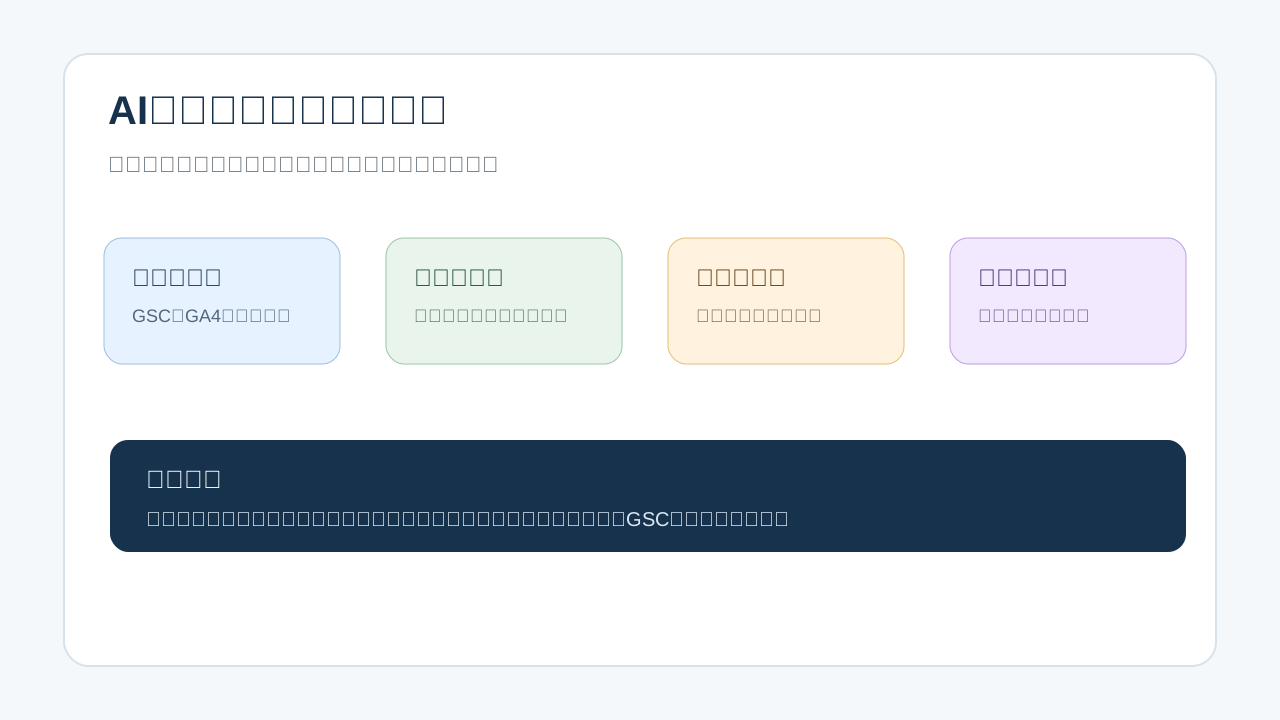
Evidence a free plan can cover
A free plan is not useless. On the contrary, it is the foundation before any paid monitoring. If a website has not even sorted out GSC and GA4, buying paid AI monitoring directly will easily produce distorted results.
| Free tool | What you can see | Questions it suits | What it cannot be written as |
|---|---|---|---|
| Search Console Performance report | Queries, pages, countries, devices, impressions, clicks | Judge which pages already have search signals | Cannot directly prove AI answer citations |
| URL Inspection tool | Crawl time, index status, canonical URL | Judge whether Google has processed a page | Cannot prove a page will receive impressions |
| Page indexing report | Indexed, not indexed, and reasons for not being processed | Filter out the page groups that need fixing | Cannot write submitting a sitemap as completion |
| GA4 events | Post-visit events and paths | See whether users keep browsing, submit a form, or click a contact entry point | Cannot judge inquiry quality by traffic alone |
| Google AI features and your website | The relationship between Google AI features and website preview controls | Understand the boundaries of crawling, preview, and display controls | Cannot prove a page will be used in an AI summary |
| OpenAI crawlers | OpenAI crawler and user agent documentation | Check whether the server mistakenly blocks relevant crawling | Cannot prove ChatGPT will cite a page |
When free tools are enough
If the site is still early, free tools are usually enough. The reason is simple: at this stage the most important thing is not buying a polished dashboard, but seeing the basic signals clearly. Is the page in the sitemap? Has Google discovered it? Have core pages been crawled? Are the query terms close to the product? Is there any action after the visit? Free tools can already answer most of these questions.
For example, an export site working on custom metal parts does not need to track hundreds of AI questions at the start. First check whether the product category pages, process pages, material pages, and inquiry page have been processed by Google. Then check whether the query terms revolve around materials, processing methods, dimensions, and industry applications. When basic pages have no signals, an AI monitoring dashboard, however detailed, only magnifies the blank space.
| Website stage | Is a free plan enough | Core task | Recheck cycle |
|---|---|---|---|
| New site or recent redesign | Usually enough | Confirm sitemap, crawling, indexing, and core page quality | Check indexing weekly, queries monthly |
| Some impressions already | Basically enough | Map impression pages to product/scenario pages | Check page and query changes every two weeks |
| Multiple product lines, multiple countries | Starting to fall short | Split samples by product family, country, and language | Requires a fixed sampling table |
| Brand terms already have demand | Partially insufficient | Observe the brand entity, cited pages, and side-by-side competitor presence | Requires monthly comparison |
| The team needs a quarterly review | Usually not enough | Produce a trend report across engines, questions, and pages | Requires fixed samples and archiving |
When you need paid AI visibility monitoring
The value of paid monitoring is not that it is necessarily more accurate, but that it can fix the sample. Fixed question set, fixed engine, fixed region, fixed timing, fixed screenshots or answer archives. Only then is next month comparable.
If you only occasionally ask ChatGPT once “who supplies a certain type of product”, that is observation, not monitoring. Asking today, tomorrow, from different accounts, or in different regions can all produce different answers. Professional review must first acknowledge this volatility and then design the sample.
| Trigger | Why a free plan is not enough | What paid monitoring should provide | Acceptance boundary |
|---|---|---|---|
| More than 50 questions | Manual recording easily misses items | Questions, answers, citations, and date archiving | Look at sample consistency, not a single screenshot |
| Multiple country markets | Regional differences affect answers | Group by country or language | Cannot be merged into one overall score |
| Multiple brands or competitors | Manual comparison is costly | Brand mentions, competitor side-by-side presence, cited pages | Trends only, no definite promises |
| Reporting to management | Verbal observations are hard to recheck | Fixed templates, sample snapshots, and change notes | Conclusions must trace back to the original samples |
Free and paid tools should not replace each other
Many misjudgments come from one move: using a single tool to replace all evidence. GSC is not an AI monitoring tool. An AI monitoring tool is not a search indexing tool. GA4 shows on-site behavior, but cannot tell you whether Google recrawled a page. URL Inspection shows the status of a single URL, but cannot tell you whether users clicked.
A more stable approach is to let each tool answer only the questions it is good at. The clearer the question, the more useful the tool. When questions are unclear, more tools mean more confusion.
| Question | Preferred tool | Supporting material | Boundary that cannot be omitted |
|---|---|---|---|
| Has the page been processed by Google | URL Inspection | Submitted sitemap, page source code | Crawl time must be later than the modification time |
| Which search terms bring impressions | GSC Performance | Country, device, and page dimensions | A few impressions do not indicate a stable trend |
| Is there any action after the visit | GA4 events | Form, WhatsApp, and email clicks | Events must first be configured clearly |
| Whether the brand appears in AI answers | A fixed question sample | Screenshots, answer text, date, region | A single appearance cannot be written as a long-term result |
| Whether AI can crawl the page | robots, logs, crawler documentation | OpenAI crawlers, server logs | Allowing crawling does not equal citation |
Export businesses can start with a low-cost sample table
Before paying for monitoring, build a low-cost sample table. It does not need to be complex. Choose 5 to 10 real procurement questions for each product line. For each question, record: product term, application scenario, country, answer date, whether the brand appears, whether a page is cited, whether competitors appear, and whether the answer is accurate.
For products such as LED flood light, packaging machine, and waterproof connector, do not ask only broad terms. Ask the questions a buyer would ask: how to choose wattage, what scenarios it suits, how materials differ, how to judge certifications, and how to view lead time and MOQ. The closer the questions are to procurement, the more meaningful the monitoring.
| Sample field | How to fill it in | Purpose | Common mistake |
|---|---|---|---|
| Question | Use the wording a real buyer would use | Reduce the error from vague questions | Asking only broad industry terms |
| Product line | Map to a category or product page | Makes it easy to return to page optimization | Recording only the brand, not the page |
| Answer summary | Record the main recommendation direction | Judge content gaps | Only taking screenshots without organizing the text |
| Citation or link | Record whether a URL or source appears | Judge whether the page enters the answer material | Treating a brand mention as a citation |
| Recheck date | Fix the same day or week each month | Create a comparable trend | Checking only when you happen to think of it |
Write three types of conclusions separately in the monthly report
The biggest risk in an AI visibility monthly report is mixing things together. Search performance, on-site behavior, and AI sample observations must be written separately. Mixed together, a small signal becomes a big conclusion.
- Search performance: from GSC. Write queries, pages, countries, devices, impressions, and clicks.
- On-site behavior: from GA4. Write post-visit events, paths, and form actions.
- AI sample observations: from a fixed question set. Write the sample scope, date, engine, and whether the brand or page appeared.
These three types of conclusions can explain each other, but they cannot replace each other. Impressions in GSC do not mean the brand appears in AI answers. A brand appearing in AI samples does not mean Google organic rankings improved. Visits in GA4 do not mean inquiry quality necessarily improved.
Acceptance criteria: a free plan is not about saving money, but about getting the basics solid first
To judge whether a free plan is enough, look at five acceptance items. First, GSC is connected and core pages can be viewed by query and page dimensions. Second, URL Inspection can confirm the crawl and index status of key URLs. Third, GA4 events can distinguish browsing, contact, form, email, or WhatsApp clicks. Fourth, there is a fixed question sample table. Fifth, the monthly report clearly states which conclusions are only observations and which come from platform data.
If none of these five items are in place, paid tools will not save the review either. They will only make the report look fuller. Truly valuable monitoring can trace back to the page, question, date, and evidence.
Final recommendation: build the foundation for free first, then decide whether to pay
For small sites, early-stage sites, and recently redesigned export sites, start with free tools. Once pages are being crawled consistently, query terms are getting closer to the product, and GA4 events are clear, then consider paid AI visibility monitoring.
If you already have multiple product lines, multiple markets, multiple brand terms, and regular reporting needs, do not rely on manual screenshots alone. At that point the value of paid monitoring is fixing the sample and making the review repeatable.
In one sentence: free tools solve basic evidence, and paid tools solve sampling at scale. Neither can directly manufacture search results, and neither can replace genuinely useful page content.
Further acceptance: which raw evidence a free tool plan must deliver
Whether a free tool plan works does not depend on the tool’s name, but on the raw evidence it finally delivers. When export businesses read a report, they should not look only at the conclusion page. They must be able to trace back to the URL, query, date, screenshot, sample question, and page revision record. Being able to trace back to the raw evidence makes review possible. If you cannot trace back to the evidence, it is only an opinion.
A qualified free plan should retain at least five types of material. First, a list of key URLs. Second, GSC page and query screenshots or exports. Third, the status and crawl time from URL Inspection. Fourth, GA4 events and paths. Fifth, an AI question sample table. Every type of material must carry a date. Without a date, changes cannot be compared.
| Evidence material | Minimum fields | Purpose | How to verify |
|---|---|---|---|
| Key URL list | URL, page role, product line, target country | Avoid looking only at site-wide averages | Can be mapped to the sitemap and page content |
| GSC query export | Date range, query, page, impressions, clicks | Judge whether a page already has search signals | Keep the raw export, do not just paste conclusions |
| URL Inspection record | Index status, crawl time, canonical URL, sitemap | Judge whether Google has processed the new version of the page | Crawl time must be later than the modification time |
| GA4 events | Event name, page path, source, date range | See post-visit actions | Confirm the event definitions before interpreting the data |
| AI sample table | Question, engine, region, date, answer summary, citation source | Observe answer material and brand phrasing | Recheck with fixed questions, not a single impression |
What paid monitoring tools should solve is sampling scale, not replacing judgment
Many teams buy tools hoping to skip judgment. But tools cannot skip judgment. What paid monitoring is genuinely suited to solve is sampling scale, recording consistency, multi-person collaboration, and historical archiving. It can make the question set more stable, answer snapshots more complete, and changes easier to compare. It cannot replace page quality, nor can it replace GSC’s confirmation of crawling and indexing.
If a tool gives only one overall score and cannot show the question, date, answer, citation source, and sample scope, it is hard to use for decisions. What export businesses want are conclusions they can act on: which type of product page lacks information, which questions are not being answered, which market has weak samples, and which page needs additional FAQ, specifications, images, or internal links.
| Paid capability | Value it should bring | Should not be written as | Ask before purchasing |
|---|---|---|---|
| Bulk question library | Reduce manual omissions | Guaranteed results | Can questions be grouped by product line and country |
| Multi-engine sampling | Observe different answer sources | Site-wide visibility conclusions | Which engines and regions are supported |
| Historical archiving | Compare month-over-month changes | One screenshot is a trend | Can raw samples be exported |
| Competitor side-by-side | Find content and entity gaps | Proof of competitor rankings | Can competitor definitions be customized |
| Alerts | Flag unusual changes | Automatically completing optimization | Can alerts trace back to specific questions and pages |
How to design an AI visibility sample library for an export website
Do not start the sample library with service terms. Export businesses should start with procurement questions. Buyers do not ask only “who is more professional”. They ask about materials, specifications, certifications, lead times, applications, installation, customization, samples, MOQ, packaging, shipping, and after-sales service. The closer the sample library is to procurement questions, the better it can guide page improvements.
For example, cnc machining parts can be split into materials, precision, surface treatment, drawing formats, and quote materials; industrial valve supplier can be split into pressure ratings, materials, application scenarios, standards, and project delivery; private label activewear manufacturer can be split into fabrics, sampling, sizes, labels, packaging, and MOQ. Every product line should have its own question group.
| Question type | Export example | Corresponding page | Content action |
|---|---|---|---|
| Material selection | Which material is better for outdoor connectors? | Product page, material page | Add material comparisons and usage boundaries |
| Specification judgment | How to choose wattage for warehouse LED flood lights? | Selection article, application page | Add a table of wattage, area, and installation height |
| Customization process | Can a factory make parts from my drawing? | Capability page, quote page | Add drawing formats and a quote document checklist |
| Certification and compliance | What certifications are needed for medical probes? | Resource page, FAQ | Explain the scope of application, do not exaggerate certifications |
| Procurement terms | What is the MOQ for custom ceramic dinnerware? | FAQ, inquiry page | Add MOQ, sample, packaging, and lead time notes |
How to write boundaries in a report so it does not mislead management
The easiest way for an AI visibility report to mislead is to write observations as conclusions. The correct approach states the data source clearly. If it comes from GSC, write GSC. If it comes from GA4, write GA4. If it comes from sample questions, write the sample scope. If it comes from a manual check, write the check date and the tool. Do not merge these into one big conclusion.
Boundaries are not discouraging. Boundaries are professionalism. They protect decisions from being skewed by a single fluctuation and let the team know what to do next. For example, “this URL is in the sitemap” is only a submission signal; “URL Inspection shows it is indexed” is the indexing evidence; “the brand appeared in one AI sample” is only a sample observation; “the number of appearances in a fixed question set increased for three consecutive months” comes closer to a trend.
- Can write: GSC shows this URL had impressions within a certain date range.
- Cannot write: this page has obtained stable search results.
- Can write: URL Inspection shows the crawl time is later than the page modification time.
- Cannot write: after submitting the sitemap, Google has re-evaluated the page.
- Can write: in the fixed sample library, some questions show the brand or a page source.
- Cannot write: AI has adopted this brand as an answer source long term.
- Can write: GA4 shows a contact event after the visit.
- Cannot write: these visits will definitely turn into high-quality orders.
Monthly review template for a free tool plan
If you are not buying a paid tool yet, start with a monthly review template. The template does not need to be complex, but it must be fixed. Each month, pull GSC at the same time, run URL Inspection on the same batch of URLs, check AI samples for the same batch of questions, and look at on-site behavior through the same set of GA4 events. Only after fixing these does comparison become possible.
| Module | What to fill in this month | Compared with last month | Next action |
|---|---|---|---|
| Index status | coverage and lastCrawlTime for key URLs | Whether there is new crawling or a status change | Add internal links, fix content, resubmit the sitemap |
| Search performance | Page, query, country, impressions, clicks | Whether queries are closer to the product | Adjust titles, FAQ, opening paragraph, and internal links |
| On-site behavior | Contact, form, email, WhatsApp, resource downloads | Whether users move from content pages to commercial pages | Optimize CTAs and page paths |
| AI samples | Question set, engine, region, answer summary, citation source | Whether the brand and pages are mentioned more often | Add entity descriptions, evidence tables, and resource pages |
| Content tasks | Add, update, merge, delete, add images, add tables | Which actions are done and which remain | Set next month’s priorities |
Conclusion: the dividing line between free and paid is review cost
When free tools are enough, there is no need to rush into paying. When paid tools are necessary, do not hesitate either. The dividing line is not budget, but review cost. When samples, pages, and markets are few, free tools plus manual tables can handle the work. When there are many product lines, countries, and competitors, and reporting is frequent, manual recording becomes increasingly prone to omissions, and only then does paid monitoring have value.
For export businesses, the most stable order is: first make the basic search evidence solid with GSC and URL Inspection, then use GA4 to see post-visit actions, then observe AI samples with a fixed question set. Once these basic processes are stable, decide whether to buy a paid tool. That way the tool is bought not to look good, but to reduce sampling and archiving costs.
{
“@context”: “https://schema.org”,
“@type”: “FAQPage”,
“mainEntity”: [
{
“@type”: “Question”,
“name”: “Why do articles like this need their own slot in the schedule?”,
“acceptedAnswer”: {
“@type”: “Answer”,
“text”: “Because they serve a clear long-tail need and can fill the gaps between service selection, quote evaluation, risk identification, and tool monitoring.”
}
},
{
“@type”: “Question”,
“name”: “How long should a page like this be?”,
“acceptedAnswer”: {
“@type”: “Answer”,
“text”: “At minimum it should cover the direct answer, a diagnosis table, an action checklist, common misjudgments, and an FAQ. High-value pages can later be expanded deeper based on the SERP.”
}
},
{
“@type”: “Question”,
“name”: “Can specific case studies be included?”,
“acceptedAnswer”: {
“@type”: “Answer”,
“text”: “Without authorized data, we do not write specific project results; we write only public methods, judgment criteria, and verifiable deliverables.”
}
}
]
}
This page is machine-translated from the Simplified Chinese version and awaiting human review. It has not yet been proofread.