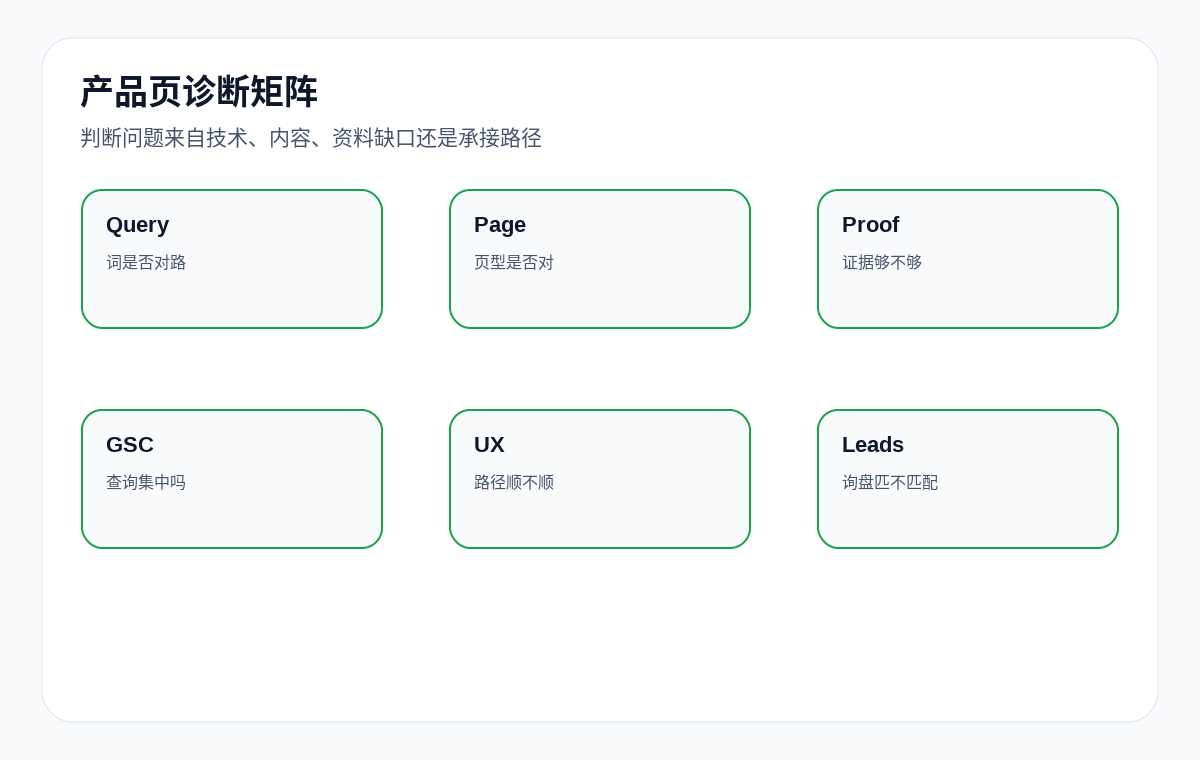
When an export product page fails to generate inquiries, it is often not a single “technical problem” or “content problem” but a simultaneous mismatch across page role, crawl visibility, purchasing-decision information, authorized materials, and the RFQ path. For Chinese export manufacturers, factories, and trading companies, the more important question is not “which one matters more” but first judging which layer is holding things back the most, and then deciding whether to fix technology, content, or materials first, or to connect the page to the inquiry path first.
If you sell custom metal parts, LED flood light, packaging machine, medical probe, cnc machining parts, ceramic dinnerware, waterproof connector, industrial valve supplier, or private label activewear manufacturer, the goal of a product page is not just to earn impressions but to make it easier for people with genuine purchasing intent to judge: whether you are a fit, what the specification boundaries are, what materials they need to prepare, and whether it is worth continuing into an inquiry.
This article puts “technology, content, GSC, and authorized materials” back into a complete decision-making framework. The focus is not abstract discussion but answering: which signals a product page should look at first, when to check technology first, when to strengthen content first, when authorized materials plus sample/certificate/catalog support matter more, and how to review everything using GSC, GA4, material access, and inquiry quality.
2. Start with the Page Role: A Product Page Is Not a Blog, and Not a Homepage Introduction
Many export websites have product pages that neither rank consistently nor generate inquiries consistently, and the first reason is an unclear page role. A product page’s job is not to explain everything there is to know; it is to help buyers quickly judge: is this the product I need, what scenarios is it suited to, what are the specifications and limits, and should I continue to the materials or submit an inquiry next.
If a page’s title looks like a supplier page but the body mainly discusses industry knowledge, or the page is called a product page but the body has only a few images and the line “Welcome to contact us,” it will lose out on both search and conversion. For an export site, the product page, category page, FAQ page, materials page, and application page each have their own responsibilities and cannot substitute for one another.
Page Role Decision Table
| Page type | Primary task | What it should not carry |
|---|---|---|
| Product page | Help judge whether a specific product fits | All industry education questions |
| Category page | Lay out series differences and scenario entry points | Replace detailed specifications for an individual product |
| FAQ page | Answer follow-up questions | Carry the entire purchasing path |
| Materials page | Provide certificates, catalogs, drawings, and instructions | Replace the core product decision page |
3. When to Check Technology First
If a page is not crawled, indexed, or rendered reliably at all, then the returns from writing more content and adding more materials are heavily discounted. For product pages, the most common technical problems include: main body information loaded through interaction or scripts, specification tables missing from the initial HTML, too many variant URLs, messy canonicals, and oversized images that make above-the-fold information hard to capture reliably.
In these cases, technology usually takes priority over content. If Google and other systems cannot reliably see the page body at all, adding more FAQs or authorized materials will not necessarily be understood correctly.
Technology-First Checklist
| Technical signal | Why check it first |
|---|---|
| Specification tables or core copy toggled by JS | Main body information may not be reliably extractable |
| Many variant pages competing with each other | Authority and crawling are diluted |
| Messy canonical or index controls | The system does not know which page to trust |
| Slow pages with heavy images and light text above the fold | Key information arrives too late |
Typical Technology-First Scenarios
| Scenario | What to do first |
|---|---|
| LED flood light specification information hidden in toggle panels | Put the core parameters back into the initial HTML |
| waterproof connector different interface variants generating large numbers of URLs | Consolidate variants and normalize first |
| packaging machine above the fold has only a large image and a slogan | Add text and summary structure first |
4. When Content Is More Urgent Than Technology
If a page already has stable impressions and can be indexed, but inquiries remain weak, the problem tends to lie more in content and decision-making information. Content here is not word count; it is whether the key information buyers most want to confirm is placed where it is easy to see.
For example, if a custom metal parts page lacks tolerance ranges, common materials, surface treatments, MOQ, sampling timelines, and drawing requirements; if a waterproof connector page lacks IP rating differences, application scenarios, compatibility, and common misconceptions; or if a medical probe page lacks the relationship between materials and sterilization methods, these all count as insufficient content for decision-making.
Content-First Reinforcement Table
| Page symptom | What is more likely missing |
|---|---|
| Clicks but short dwell time | Unclear conclusions, poor structure |
| Visits but no entry into the RFQ page | Weak next-step path |
| Many inquiries but poor fit | Vague product descriptions and market positioning |
| FAQ page gets views, but the product page is weak | Product page decision-making information is too thin |
5. What GSC Is Actually Good For Here
The value of GSC is not just seeing “whether there is traffic”; it helps you judge what queries are triggering your product page. If you think you are capturing supplier or manufacturer terms but GSC is actually full of question terms like definition, what is, and maintenance, that suggests the page role may have drifted.
For an export product page, GSC is more like a reality checker: it tells you what the page has been understood to be, not what you hoped it would be.
GSC Interpretation Table
| GSC symptom | What it may indicate |
|---|---|
| Many impressions but mostly basic definition terms | The page reads more like an explainer than a product page |
| Many long-tail question terms, few commercial terms | Product decision content and supplier evidence should be added |
| Scattered terms with no thematic focus | The page’s scope is too muddled |
| Clicks on commercial terms but weak conversion | The handoff path or material support is insufficient |
6. Why Authorized Materials Are Often Underestimated
Many export teams treat authorized materials as something to send only after a customer asks, but in practice catalogs, spec sheets, test reports, certification descriptions, application examples, and packaging and lead-time notes are often exactly what buyers rely on to decide whether to move into an inquiry. For some pages, materials matter even more than a few extra paragraphs of product introduction.
Authorized materials here do not mean fabricated case studies; they mean content you can genuinely publish openly or semi-openly to support decision-making. Examples include material descriptions, size ranges, testing standards, common application limits, sampling processes, certificate types, and how to request documents. As long as these materials make the page more credible and easier to judge, they are not an “add-on” but part of the page’s value.
What Authorized Materials Can Add
| Material type | Value for purchasing decisions |
|---|---|
| Spec sheets / parameter tables | Quickly judge fit |
| Certification or test descriptions | Build credibility and set boundaries |
| Sample / prototyping process | Reduce uncertainty before an inquiry |
| Catalogs / application materials | Support continued comparison and internal circulation |
7. More Materials Do Not Mean a Stronger Handoff: The Path Is What Matters
Even if you already have many catalogs, certificates, and instructions, users can still get lost on the page if these materials do not form a clear path with the product page, FAQ page, category page, and inquiry page. The value of materials lies not only in “whether they exist” but in “whether they appear at the right moment and relate to the current page’s task.”
For example, a packaging machine page can place equipment manuals, maintenance checklists, or video material entry points where users are most likely to keep comparing; a waterproof connector page can offer spec sheet requests or download instructions after the parameters and FAQ; and a custom metal parts page can prompt a drawing preparation checklist after the FAQ.
Path Design Table
| Where the material appears | Why it works better |
|---|---|
| After the parameters | Users have just finished the first round of judgment and are willing to go deeper |
| After the FAQ | Good for catching people who keep asking questions |
| Before the RFQ | Helps reduce low-quality inquiries |
| Between the category page and the product page | Helps users narrow down the series first |
8. When to Fix the RFQ Page First Instead of Continuing to Rework the Product Page
On some sites the product page is already clear enough, and neither technology nor content is bad, yet inquiries remain weak; the problem is often the RFQ page or the submission path itself. For example, too few form fields leave users unsure what to prepare; too many fields with no explanation make users unwilling to fill them in; and no material entry point before submission means users leave before they are ready.
In such cases, the marginal return from further polishing the product page may already be low, and the RFQ handoff should be improved first: tell customers what to prepare in terms of drawings, materials, quantities, application scenarios, and certification requirements, or provide sample process notes and a way to request documents.
RFQ Handoff Diagnosis Table
| Symptom | Where to change first |
|---|---|
| Good dwell time on the product page but few RFQ entries | Improve the RFQ entry point and instructions first |
| High RFQ open rate but low submission rate | Improve the form structure and field explanations first |
| Many inquiries but sales says materials are severely missing | Add a pre-submission preparation checklist first |
9. A More Practical Priority Order for Diagnosis
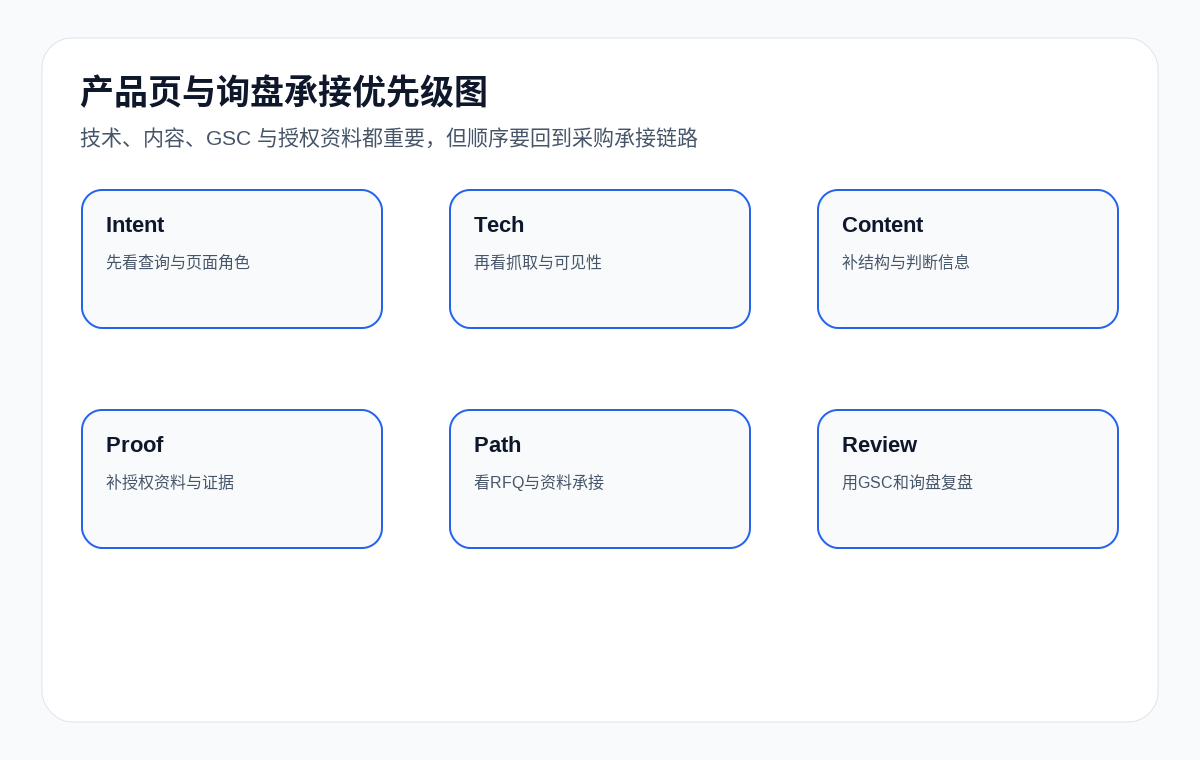
If you want to implement this quickly, follow this order: first look at the page role and query match; then technical visibility; then product decision information; then authorized materials and evidence; and finally the RFQ handoff path and review metrics.
The value of this order is that it keeps you from rewriting copy on gut feeling right away, and from blaming everything on a single factor. For export product pages, it is more common for two or three layers to be off at once rather than just one.
Priority Order Table
| Order | What to answer |
|---|---|
| 1 Page role | What queries should this page capture |
| 2 Technical visibility | Can the core information be seen reliably |
| 3 Decision information | Can users quickly judge whether it fits |
| 4 Authorized materials | Is there enough evidence to support the judgment |
| 5 RFQ path | Does the user move smoothly to the next action |
| 6 Review | Did the results after the change move closer to the goal |
10. FAQ: The Most Common Questions About Export Product Pages and Inquiry Handoff
Is technology always more important than content?
No. If a page cannot be crawled reliably at all, technology is more urgent; if the page is already seen but cannot help buyers judge, content and materials are more urgent.
If there are clicks in GSC but no inquiries, does that mean the keywords are wrong?
Not necessarily. It could also be that the page’s decision information, material support, or RFQ handoff path is too weak.
Do authorized materials have to be publicly downloadable?
Not necessarily. What matters is that the page clearly explains what materials exist, when they can be viewed, how to obtain them, and how they help with decision-making.
Is it bad if the FAQ page gets more views than the product page?
Not necessarily. The FAQ page can serve as an entry point, but the path should lead to the product page, materials page, and RFQ page.
Can we build a strong product page without real case studies?
Yes. Parameters, specifications, certificates, application limits, process descriptions, and material support can also build credibility.
Should the RFQ page have very few fields?
Not necessarily. What matters is letting users know why they are filling in those fields and reducing meaningless friction.
11. Conclusion: Do Not Debate Which Matters More; Find the Layer Holding You Back
For Chinese export product pages and inquiry handoff, technology, content, GSC, and authorized materials all matter, but they do not appear in the same order on every page. What really matters is finding the layer that is holding the current page back the most and reinforcing it in order, rather than sinking into the abstract debate over whether the problem is technical or content-related.
When the page role is clear, the core information can be seen, the purchasing decision information is sufficient, authorized materials build trust, and the RFQ path is smooth, and when this is combined with GSC, GA4, material access, and inquiry quality reviews, the product page is more likely to capture both better-matched search traffic and inquiries closer to business goals.
As long as you always look in the order of “query—technology—content—materials—handoff—review,” export product page optimization will move closer to real results than simply piling on copy or changing buttons alone.
Final Checklist
| Check item | Completion standard |
|---|---|
| Query match | The product page captures the right queries |
| Technical visibility | Specifications and core information can be crawled reliably |
| Decision information | Parameters, FAQ, limits, and application notes are clear |
| Authorized materials | Materials support judgment rather than merely decorate |
| RFQ handoff | Users know what to prepare for the next step |
| Review | GSC, material access, and inquiry quality are reviewed together |
{
“@context”: “https://schema.org”,
“@type”: “FAQPage”,
“mainEntity”: [
{
“@type”: “Question”,
“name”: “Target Questions and What to JudgennWhat the problem you are trying to solve really requires you to look atnnNo inquiries on the page: is it no traffic, no decision information, or a poor handoffnThere is traffic on the page but no conversion: is the path, the materials, or the audience misalignednThe page is seen but not trusted: is there enough evidence and authorized materialnThe page gets clicks but sales says it does not match: are the query terms, page role, and market wrongnn2. Start with the Page Role: A product page is not a blog, and not a homepage introductionnMany export websites have product pages that neither rank consistently nor generate inquiries consistently, and the first reason is an unclear page role. A product page’s job is not to explain everything there is to know; it is to help buyers quickly judge: is this the product I need, what scenarios is it suited to, what are the specifications and limits, and should I continue to the materials or submit an inquiry next.nIf a page’s title looks like a supplier page but the body mainly discusses industry knowledge, or the page is called a product page but the body has only a few images and the line “Welcome to contact us,” it will lose out on both search and conversion. For an export site, the product page, category page, FAQ page, materials page, and application page each have their own responsibilities and cannot substitute for one another.nPage Role Decision TablennPage typePrimary taskWhat it should not carrynnProduct pageHelp judge whether a specific product fitsAll industry education questionsnCategory pageLay out series differences and scenario entry pointsReplace detailed specifications for an individual productnFAQ pageAnswer follow-up questionsCarry the entire purchasing pathnMaterials pageProvide certificates, catalogs, drawings, and instructionsReplace the core product decision pagenn3. When to Check Technology FirstnIf a page is not crawled, indexed, or rendered reliably at all, then the returns from writing more content and adding more materials are heavily discounted. For product pages, the most common technical problems include: main body information loaded through interaction or scripts, specification tables missing from the initial HTML, too many variant URLs, messy canonicals, and oversized images that make above-the-fold information hard to capture reliably.nIn these cases, technology usually takes priority over content. If Google and other systems cannot reliably see the page body at all, adding more FAQs or authorized materials will not necessarily be understood correctly.nTechnology-First ChecklistnnTechnical signalWhy check it firstnnSpecification tables or core copy toggled by JSMain body information may not be reliably extractablenMany variant pages competing with each otherAuthority and crawling are dilutednMessy canonical or index controlsThe system does not know which page to trustnSlow pages with heavy images and light text above the foldKey information arrives too latennTypical Technology-First ScenariosnnScenarioWhat to do firstnnLED flood light specification information hidden in toggle panelsPut the core parameters back into the initial HTMLnwaterproof connector different interface variants generating large numbers of URLsConsolidate variants and normalize firstnpackaging machine above the fold has only a large image and a sloganAdd text and summary structure firstnn4. When Content Is More Urgent Than TechnologynIf a page already has stable impressions and can be indexed, but inquiries remain weak, the problem tends to lie more in content and decision-making information. Content here is not word count; it is whether the key information buyers most want to confirm is placed where it is easy to see.nFor example, if a custom metal parts page lacks tolerance ranges, common materials, surface treatments, MOQ, sampling timelines, and drawing requirements; if a waterproof connector page lacks IP rating differences, application scenarios, compatibility, and common misconceptions; or if a medical probe page lacks the relationship between materials and sterilization methods, these all count as insufficient content for decision-making.nContent-First Reinforcement TablennPage symptomWhat is more likely missingnnClicks but short dwell timeUnclear conclusions, poor structurenVisits but no entry into the RFQ pageWeak next-step pathnMany inquiries but poor fitVague product descriptions and market positioningnFAQ page gets views, but the product page is weakProduct page decision-making information is too thinnn5. What GSC Is Actually Good For HerenThe value of GSC is not just seeing “whether there is traffic”; it helps you judge what queries are triggering your product page. If you think you are capturing supplier or manufacturer terms but GSC is actually full of question terms like definition, what is, and maintenance, that suggests the page role may have drifted.nFor an export product page, GSC is more like a reality checker: it tells you what the page has been understood to be, not what you hoped it would be.nGSC Interpretation TablennGSC symptomWhat it may indicatennMany impressions but mostly basic definition termsThe page reads more like an explainer than a product pagenMany long-tail question terms, few commercial termsProduct decision content and supplier evidence should be addednScattered terms with no thematic focusThe page’s scope is too muddlednClicks on commercial terms but weak conversionThe handoff path or material support is insufficientnn6. Why Authorized Materials Are Often UnderestimatednMany export teams treat authorized materials as something to send only after a customer asks, but in practice catalogs, spec sheets, test reports, certification descriptions, application examples, and packaging and lead-time notes are often exactly what buyers rely on to decide whether to move into an inquiry. For some pages, materials matter even more than a few extra paragraphs of product introduction.nAuthorized materials here do not mean fabricated case studies; they mean content you can genuinely publish openly or semi-openly to support decision-making. Examples include material descriptions, size ranges, testing standards, common application limits, sampling processes, certificate types, and how to request documents. As long as these materials make the page more credible and easier to judge, they are not an “add-on” but part of the page’s value.nWhat Authorized Materials Can AddnnMaterial typeValue for purchasing decisionsnnSpec sheets / parameter tablesQuickly judge fitnCertification or test descriptionsBuild credibility and set boundariesnSample / prototyping processReduce uncertainty before an inquirynCatalogs / application materialsSupport continued comparison and internal circulationnnFigure 2: Identifying whether the problem comes from technology, content, a materials gap, or the handoff path is more useful than abstractly debating which matters more.n7. More Materials Do Not Mean a Stronger Handoff: The Path Is What MattersnEven if you already have many catalogs, certificates, and instructions, users can still get lost on the page if these materials do not form a clear path with the product page, FAQ page, category page, and inquiry page. The value of materials lies not only in “whether they exist” but in “whether they appear at the right moment and relate to the current page’s task.”nFor example, a packaging machine page can place equipment manuals, maintenance checklists, or video material entry points where users are most likely to keep comparing; a waterproof connector page can offer spec sheet requests or download instructions after the parameters and FAQ; and a custom metal parts page can prompt a drawing preparation checklist after the FAQ.nPath Design TablennWhere the material appearsWhy it works betternnAfter the parametersUsers have just finished the first round of judgment and are willing to go deepernAfter the FAQGood for catching people who keep asking questionsnBefore the RFQHelps reduce low-quality inquiriesnBetween the category page and the product pageHelps users narrow down the series firstnn8. When to Fix the RFQ Page First Instead of Continuing to Rework the Product PagenOn some sites the product page is already clear enough, and neither technology nor content is bad, yet inquiries remain weak; the problem is often the RFQ page or the submission path itself. For example, too few form fields leave users unsure what to prepare; too many fields with no explanation make users unwilling to fill them in; and no material entry point before submission means users leave before they are ready.nIn such cases, the marginal return from further polishing the product page may already be low, and the RFQ handoff should be improved first: tell customers what to prepare in terms of drawings, materials, quantities, application scenarios, and certification requirements, or provide sample process notes and a way to request documents.nRFQ Handoff Diagnosis TablennSymptomWhere to change firstnnGood dwell time on the product page but few RFQ entriesImprove the RFQ entry point and instructions firstnHigh RFQ open rate but low submission rateImprove the form structure and field explanations firstnMany inquiries but sales says materials are severely missingAdd a pre-submission preparation checklist firstnnFigure 3: Rankings, clicks, material access, RFQ entries, and inquiry quality must be reviewed together to judge whether the handoff has truly become stronger.n9. A More Practical Priority Order for DiagnosisnIf you want to implement this quickly, follow this order: first look at the page role and query match; then technical visibility; then product decision information; then authorized materials and evidence; and finally the RFQ handoff path and review metrics.nThe value of this order is that it keeps you from rewriting copy on gut feeling right away, and from blaming everything on a single factor. For export product pages, it is more common for two or three layers to be off at once rather than just one.nPriority Order TablennOrderWhat to answernn1 Page roleWhat queries should this page capturen2 Technical visibilityCan the core information be seen reliablyn3 Decision informationCan users quickly judge whether it fitsn4 Authorized materialsIs there enough evidence to support the judgmentn5 RFQ pathDoes the user move smoothly to the next actionn6 ReviewDid the results after the change move closer to the goalnn10. FAQ: The Most Common Questions About Export Product Pages and Inquiry HandoffnIs technology always more important than content?”,
“acceptedAnswer”: {
“@type”: “Answer”,
“text”: “No. If a page cannot be crawled reliably at all, technology is more urgent; if the page is already seen but cannot help buyers judge, content and materials are more urgent.”
}
},
{
“@type”: “Question”,
“name”: “If there are clicks in GSC but no inquiries, does that mean the keywords are wrong?”,
“acceptedAnswer”: {
“@type”: “Answer”,
“text”: “Not necessarily. It could also be that the page’s decision information, material support, or RFQ handoff path is too weak.”
}
},
{
“@type”: “Question”,
“name”: “Do authorized materials have to be publicly downloadable?”,
“acceptedAnswer”: {
“@type”: “Answer”,
“text”: “Not necessarily. What matters is that the page clearly explains what materials exist, when they can be viewed, how to obtain them, and how they help with decision-making.”
}
},
{
“@type”: “Question”,
“name”: “Is it bad if the FAQ page gets more views than the product page?”,
“acceptedAnswer”: {
“@type”: “Answer”,
“text”: “Not necessarily. The FAQ page can serve as an entry point, but the path should lead to the product page, materials page, and RFQ page.”
}
},
{
“@type”: “Question”,
“name”: “Can we build a strong product page without real case studies?”,
“acceptedAnswer”: {
“@type”: “Answer”,
“text”: “Yes. Parameters, specifications, certificates, application limits, process descriptions, and material support can also build credibility.”
}
}
]
}
12. Top-1 Benchmark Card: Common Strengths and Obvious Weaknesses of Similar Pages
Content on “how to judge product pages and inquiry handoff” usually has two kinds of strengths. The first is a CRO or conversion-rate-optimization perspective, which reminds you to watch CTAs, form length, trust elements, and page structure; the second is an SEO or technical perspective, which emphasizes indexing, speed, structured data, and content match. Both have their own value, but standing on only one side is rarely complete.
Their shared weakness is that they are rarely placed in the context of Chinese export product pages: they seldom discuss how English product terms and application terms should be captured, seldom explain how materials pages, FAQ pages, certificate descriptions, and sample processes help users keep judging, and seldom connect GSC, material access, RFQ entries, and sales feedback. So our way of going beyond them is not to repeat that “buttons should be obvious” but to put technology, content, GSC, and material support into the same purchasing chain.’)
13. The First Front in Product Page Diagnosis Is Actually “What Information Is the User Still Missing”
When many teams face a weak-converting product page, they tend to first ask whether the page is not marketing-oriented enough. But in export purchasing scenarios, the more critical question is usually: what decision information is the user missing right now? Missing parameters? Missing certifications? Missing application scenarios? Missing sampling and MOQ explanations? Missing catalog and drawing preparation requirements?
As long as this question is not answered clearly first, further strengthening marketing copy usually has limited returns. Buyers are not persuaded by a slogan; they are moved to the next step by information that is clear enough and close enough to their current stage.’)
| What the user is still missing | Where it is better to add it | Why |
|---|---|---|
| Specifications and parameters | Product page above the fold and parameter section | This is the first round of fit assessment |
| Application scenarios | Product page or application page | Helps confirm whether it suits the current project |
| Certifications and testing | Materials page or evidence module | Builds credibility and reduces back-and-forth |
| Samples and MOQ | FAQ or pre-RFQ notes | Helps decide whether to continue to an inquiry |
| Drawing / material preparation requirements | RFQ page and FAQ | Reduces low-quality or incomplete inquiries |
14. Why Some Pages “Look Very Professional” but Do Not Actually Convert Inquiries
Many product pages are written carefully and full of industry terms but still do not convert inquiries. The reason is often not a lack of expertise but that the expert information is not organized into a decision structure the user can actually use. For example, all specifications sit in one long paragraph with no table; FAQ items and limits are not broken out separately; the material entry point is buried too deep; and there is no preparation checklist before the RFQ.’)
To buyers, such a page feels like “a lot of information, but hard to use.” For search and AI systems, it is not necessarily easy to extract either. The result is a page that looks professional but has only average handoff ability.’)
15. The Most Overlooked Link Between GSC and Inquiry Quality
Many teams look only at impressions and clicks in GSC and never go on to ask whether those clicks are actually getting closer to the customers sales wants. In fact, the real point of product page optimization is not just to increase clicks but to move clicks closer to the target market, target product, and target purchasing stage.’)
For example, if a waterproof connector page gets more clicks but most come from basic definition terms and student-type queries, sales may not find them valuable; conversely, if the click count barely changes but terms closer to purchasing decisions such as supplier, datasheet, IP rating, and application compatibility increase, the page is more likely to be heading in the right direction.’)
| GSC change | What not to look at only | What to keep looking at |
|---|---|---|
| Clicks increase | The total number only | Whether query types and markets match better |
| Impressions increase | Whether the impression number looks impressive | Whether product-related questions are increasing |
| CTR changes | Whether the title is well written | Whether the page’s promise is closer to purchasing intent |
| Page traffic is flat | Getting anxious about no growth | Whether material access and the RFQ path are getting stronger |
16. Which Matters More, the Product Page or the Materials Page? The Right Answer Is Usually Not Either/Or
In many industrial and custom product scenarios, the product page and the materials page actually carry different but complementary duties. The product page handles the first round of judgment: fit, specification range, application direction, and next action; the materials page handles the second round of confirmation: more detailed parameters, testing, certifications, catalogs, drawings, and sample preparation information.’)
If your site has a strong product page but a weak materials page, users may get stuck in the deeper evaluation stage; if it has a strong materials page but a weak product page, users may not know whether to continue at the first round of judgment. The more reasonable approach is to let the product page and the materials page hand off to each other rather than substitute for each other.’)
| Page | Primary task | Typical handoff action |
|---|---|---|
| Product page | First round of fit assessment | Continue to materials, FAQ, application page, or RFQ |
| Materials page | Second round of evidence confirmation | Download, leave contact details, return to the product page, or enter the RFQ |
| FAQ page | Handle follow-up questions | Point to the product / materials / inquiry page |
| RFQ page | Handle the submission action | Collect enough information for sales to follow up |
17. A Page Diagnosis Sequence Suited to Export Teams
If you want to quickly assess whether a product page is worth continued investment, use this sequence: first, check whether the queries the page captures are the right ones; second, whether the core information can be seen reliably; third, whether the purchasing decision information is sufficient; fourth, whether the materials and evidence support continued comparison; fifth, whether the RFQ path is smooth; and sixth, whether GSC, GA4, material access, and inquiry feedback are moving closer to the goal.’)
This sequence helps teams avoid the back-and-forth of changing buttons today, adding copy tomorrow, and doubting the technology the day after, because you always know which layer you are solving.’)
18. When It Is Worth Adding FAQ First Instead of Expanding the Product Introduction
When sales keeps running into the same questions, when GSC query terms contain many follow-ups, or when AI systems more easily extract a certain kind of Q&A, an FAQ module is usually more valuable than expanding the product introduction further. For example, common IP rating questions for waterproof connectors, drawing preparation questions for custom metal parts, maintenance and training questions for packaging machines, and material compatibility questions for medical probes are all well suited to an FAQ module.’)
The value of an FAQ is not only helping users keep judging; it also helps systems see more clearly what questions the page is answering. As long as the FAQ still serves product judgment rather than piling on generic words, it is usually a high-value bridge between the product page and the materials page.’)
19. What Kind of Inquiry Page Produces Leads Sales Is Willing to Follow Up
For sales, the worst case is not few inquiries but many inquiries with severely missing information. A stronger RFQ page does not necessarily have the most fields, but it always helps users understand why they are filling in this information and how it helps them get an accurate reply faster.’)
For example, an RFQ for custom metal parts can prompt users to upload drawings and specify material, quantity, surface treatment, and tolerance requirements; a packaging machine RFQ can prompt for material type, speed requirements, packaging format, and sample testing needs; and a waterproof connector RFQ can prompt for application environment, connector type, certification requirements, and target rating. As long as these prompts are clearer, the leads sales receives are usually easier to follow up.’)
| Product direction | What to prompt before the RFQ |
|---|---|
| custom metal parts | Drawings, material, surface treatment, tolerance, batch size |
| packaging machine | Material, speed, packaging format, testing needs |
| waterproof connector | Application environment, connector type, IP rating, certification |
| medical probe | Use, material, sterilization requirements, compliance requirements |
20. A Reality Check Before the Final Conclusion
In reality, weak product pages and inquiry handoff are rarely caused by a single factor. More often they are the combined result of “a page role that is a bit unclear, technical visibility that is a bit weak, decision information that is a bit thin, a material path that is a bit messy, and RFQ handoff friction that is a bit high.”’)
So rather than chasing a single answer, it is more important to first identify the layer holding things back the most and then reinforce it in order. As long as the order is right, product pages and inquiry handoff usually get stronger more reliably than by changing many things at once.’)
21. How to Use Material Access and Download Behavior to Help Judge Page Value
Many export websites review only product page visits and RFQ submissions, overlooking a very valuable intermediate signal: material access and download behavior. For some high-ticket or technical products, users often download catalogs, spec sheets, test descriptions, or sample process materials before formally inquiring. These actions are not the same as an inquiry, but they are usually closer to real purchasing intent than a simple page visit.’)
So if you find that materials page visits for packaging machines are rising, spec sheet requests for waterproof connectors are increasing, or visits to material compatibility materials for medical probes are growing, even without an immediate jump in RFQs, it may mean the page’s handoff chain is moving in the right direction. The key is that these signals are recorded and included in the review rather than ignored as irrelevant behavior.’)
| Intermediate behavior | Why it is valuable | What it more likely indicates |
|---|---|---|
| Spec sheet views / downloads | The user has entered a deeper evaluation stage | Willingness to consider the product is increasing |
| Certificate / test description views | The user is verifying compliance and boundaries | The page’s trust chain is working |
| Sample process page visits | The user is approaching the trial order stage | Pre-inquiry preparation is happening |
| Deep FAQ clicks | The user is following up on key questions | FAQ handoff is valuable |
22. Why Sales Feedback Cannot Be Left Out
If page optimization is ultimately about better inquiries, then sales feedback should not be missing. Many pages look better from an SEO or content standpoint, but sales will tell you the inquiries still do not match, the questions are still very basic, the materials are still incomplete, and the region and product direction are still off.’)
This feedback does not negate the page optimization; it reminds you that the page may have attracted more visits but has not yet filtered those visits into leads closer to business goals. So the best state for product page review is for SEO, content, and sales to all look at the same set of questions: are the queries right, are the materials sufficient, is the path smooth, and do the inquiries match.’)
| Common sales feedback | What to check at the page level |
|---|---|
| Inquiry questions are too basic | Whether the page reads more like an explainer than a purchasing decision page |
| Drawings / parameters often missing | Whether a preparation checklist and material prompts are missing before the RFQ |
| Customers come from the wrong regions | Whether GSC query terms and market positioning are misaligned |
| Many irrelevant requests | Whether the title, opening paragraph, and FAQ promise too broadly |
23. An Actionable 30-Day Page Diagnosis and Handoff Reinforcement Process
If you are ready to systematically reinforce product pages and inquiry handoff, you can run a small closed loop over 30 days. Week 1: organize target queries, page roles, and GSC queries; week 2: audit technology and body visibility; week 3: add decision information, FAQ, materials, and download paths; week 4: check whether material access, RFQ entries, and sales feedback show early changes.’)
The value of this process is not that it will definitely produce a large number of inquiries within 30 days, but that it quickly shows the team which layer should be fixed first and which reinforcement actions are starting to produce signals closer to the business.’)
| Time | Key actions | What records to keep |
|---|---|---|
| Week 1 | Organize queries, page roles, target markets | Page mapping table, GSC query list |
| Week 2 | Check crawling, rendering, indexing, canonicalization | Technical issue table |
| Week 3 | Add parameters, FAQ, materials, material entry points | Page change list |
| Week 4 | Review clicks, material access, RFQ, sales feedback | Review table and next-round priorities |
24. Which Pages Are Better Served by “Material Support Reinforcement” Than More Long-Form Writing
If a page handles high-risk, high-specification, or high-ticket products, it is often better to reinforce material support first rather than keep making the body longer. Purchasing decisions for these products usually depend more on parameters, testing, certificates, usage limits, and sample processes than on emotional persuasion.’)
For example, medical probe, industrial valve supplier, certain packaging machine, and certain waterproof connector series are all better served by strengthening the material support chain first: catalogs, parameter tables, certification descriptions, applicable environments, and common misconceptions are more valuable than expanding generic copy.’)
25. Which Pages Are Better Served by “Content Structure Reinforcement” First
Conversely, if a page already has material support but users still find it hard to judge quickly after arriving, it is usually better to reinforce the content structure first. For example, the parameters exist but are placed chaotically; the FAQ exists but is disconnected from the product page; the material entry point exists but users have to scroll many screens to find it.’)
In this case, structure is more urgent than new materials. Writing a clear opening paragraph, moving the parameter summary earlier, breaking out the FAQ, and placing the next action in a more sensible spot often bring improvement faster than piling on more text.’)
26. An Acceptance Standard Closer to Export Sites
For export product pages and inquiry handoff, acceptance should not look only at “whether the page looks good” or only at “whether it is indexed.” A more complete acceptance should cover at least: query match, visibility, decision information, material support, path performance, and sales feedback.’)
| Acceptance dimension | Minimum requirement |
|---|---|
| Query match | The product page starts capturing queries closer to purchasing intent |
| Visibility | Core information can be crawled and displayed reliably |
| Decision information | Parameters, FAQ, boundaries, and scenarios are clear |
| Material support | There are clear material entry points and ways to obtain them |
| Path performance | Material access, RFQ entries, or the next action get stronger |
| Sales feedback | Inquiry quality is no worse than before and gradually becomes more focused |
27. A Final Practical Reminder
When you are judging Chinese export product pages and inquiry handoff, do not rush to ask “which of technology, content, GSC, and authorized materials matters more.” The better first question is: which layer is holding the current page back the most, which signals already show that it is stuck, and what evidence will we use after reinforcement to verify that it has actually become stronger.’)
Once that question is asked correctly, technology, content, GSC, and materials are no longer competing options but an ordered, coordinated system. The page will also return to real business results faster than by simply debating “what should be done first.”’)
28. Case 1: Why custom metal parts Pages Often “Look Professional but Have Unstable Inquiries”
A common problem with pages like custom metal parts is that companies easily write a lot about processes, but the information that actually affects inquiry quality is not organized for quick reading. For example, drawing preparation requirements, common material differences, tolerance ranges, surface treatment limits, and the key points for communicating about small batches versus mass production are often scattered across different paragraphs.’)
The problem with this is that the page looks very professional, but buyers cannot quickly judge “whether I should go ahead and submit drawings, what information to prepare, or whether this supplier suits my current project.” Such pages are usually better served by first adding a parameter summary, FAQ, drawing preparation checklist, and pre-RFQ notes.’)
| Common gaps on custom metal parts pages | What to add |
|---|---|
| Only says it is customizable, never states tolerance ranges | Add an explanation of tolerances and how they relate to material |
| Only discusses processes, not drawing requirements | Add a pre-RFQ preparation checklist |
| Few FAQs, and they are very generic | Add FAQs on material, surface treatment, and sampling |
| Unclear material entry points | Add drawing, specification, and sample process notes |
29. Case 2: Why waterproof connector Pages Often “Get Clicks but Inquiries Are Imprecise”
Product terms like waterproof connector easily bring in both basic definition terms and genuine purchasing terms at the same time. If the page title, opening paragraph, and FAQ do not clearly define the application environment, connector type, IP rating, compatibility, or certification requirements, they will also pull in poorly matched visits.’)
At that point the page’s problem is not necessarily a lack of traffic but more likely that it “captures too broadly.” The more effective approach is usually to have the opening paragraph state the applicable scenarios clearly, have the FAQ answer common rating and environment questions, make the parameters and material entry points clearer, and then use GSC to see whether related queries start to concentrate.’)
30. Case 3: Why packaging machine Pages Depend More on Materials and Process Notes
Packaging machine pages often cannot convert on a simple product description alone. Buyers usually need to know the material type, speed requirements, packaging format, sample testing, after-sales and training, and space and power conditions. In other words, these pages depend more on materials and process support, not just product selling points.’)
If the page only says “highly automated, highly efficient, inquiries welcome,” it is usually hard for it to capture people who are genuinely ready to buy. More effective pages tend to add equipment parameters, applicable materials, testing processes, sample requirements, and maintenance material entry points.’)
| What to add to packaging machine pages | Why |
|---|---|
| Applicable material notes | Help filter out mismatched requests quickly |
| Speed / specification summary | Help judge whether it meets capacity targets |
| Testing and sample process | Reduce uncertainty before an inquiry |
| Maintenance / training material entry points | Help users keep comparing and evaluate internally |
31. The 5 Most Common Product Page Mistakes
- Writing the product page as a company introduction page, leaving the real product decision information thin.
- Adding only copy, not parameters, FAQ, materials, or the next action.
- Looking only at click growth, not whether the clicks are closer to real purchasing intent.
- Treating the materials page as an attachment instead of part of the product page’s handoff chain.
- Changing only the product page, not the RFQ path or the pre-sales notes.
These mistakes are common because teams more easily notice “page content” and overlook “page handoff.” But for export product pages, the latter is often closer to business results.’)
32. A Monthly Review Should Not Look Only at Inquiry Count
If a team looks only at inquiry count each month, it is easy to misjudge whether the page has actually become stronger. Sometimes the inquiry count barely changes while material access, RFQ entries, and question match are already improving; other times the inquiry count rises but sales feels the quality has dropped.’)
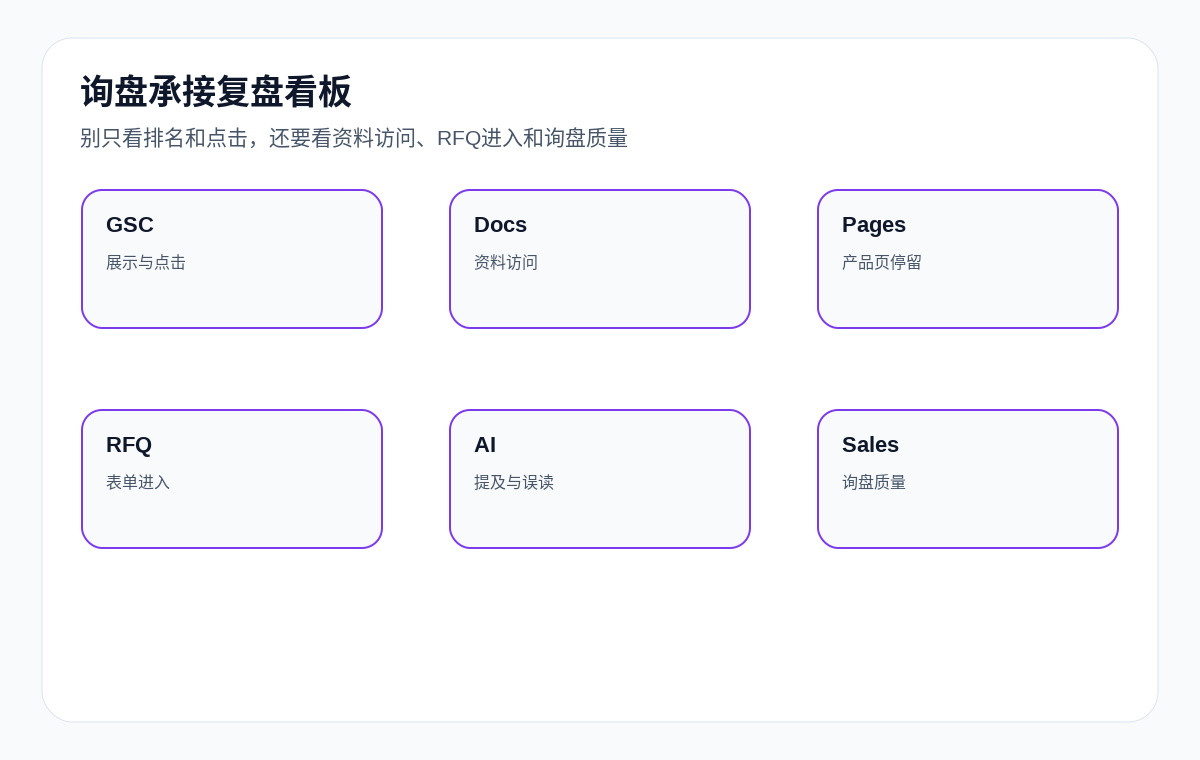
So a more complete monthly review usually looks at at least six types of signals: target query changes, product page clicks, material access, RFQ entries, AI mentions/misreadings, and sales feedback. As long as these signals are seen together, the team is less likely to be led astray by a single metric.’)
| Monthly review dimension | What to answer |
|---|---|
| GSC queries | Are the queries the product page captures closer to purchasing |
| Page clicks | Do the title and opening paragraph attract more of the target audience |
| Material access | Are users entering a deeper evaluation stage |
| RFQ entries / submissions | Is the path smoother and the friction lower |
| AI mentions / misreadings | Is the page more easily understood correctly |
| Sales feedback | Do the inquiries match the target product and market better |
33. A Minimum Viable Product Page Handoff Optimization Process
If you want to start today, try running a minimum viable process on just one product line. Step one: compile the 10 to 20 most important queries and questions; step two: see which terms the product page currently captures; step three: audit technical visibility; step four: add parameters, FAQ, material entry points, and pre-RFQ notes; step five: watch for 2 to 4 weeks to see whether queries, material access, and inquiry feedback move closer to the goal.’)
The benefit of this small-scale process is that the team quickly learns which layer is most worth reinforcing first, without starting work across the whole site at once. Once one product line works, copying it to other pages is more reliable.’)
34. If You Can Only Change One Thing First, What Should It Be
If you can only change one thing first, do not pick “technology” or “content” on gut feeling; look at the most obvious mismatch on the current page. If there are no impressions, crawling is abnormal, or the body information cannot be seen, fix technology first; if there are impressions and clicks but no discernible product decision focus, add structure and parameters first; if material access is high but the RFQ is weak, change the handoff path first; if sales keeps saying the information is incomplete, add FAQ and pre-submission notes first.’)
Truly efficient teams do not always change based on the same answer; they first find the layer holding things back the most. That action alone is more valuable than continuing to debate “which one really matters more.”’)
35. Compressing the Final Checklist into 6 Questions
- Are the query terms this page captures really purchasing terms rather than broad question terms?
- Can both systems and users see the core specifications, boundaries, and application information reliably?
- When buyers decide whether to continue, is the most critical information presented up front?
- Are materials such as catalogs, certificates, spec sheets, and sample processes supporting the decision at the right points?
- Is the path from the product page to the FAQ, materials page, and RFQ page smooth?
- Do we verify the results of changes using GSC, material access, RFQ, and sales feedback together?
If three or more of these 6 questions still cannot be answered clearly, the page has not yet entered a truly reviewable optimization state. As long as these questions are answered clearly first, later investment in technology, content, and materials will usually have more direction.’)
36. One Sentence for Both the Boss and the Execution Team
If this article had to be condensed into one most practical sentence, it would be: do not first debate which of technology, content, GSC, and materials matters more; instead, put the page back into the real purchasing chain, find the layer holding things back the most, and then use review to verify whether it has really improved.’)
For the boss, this means the budget should go to the layer that most affects page judgment and inquiry handoff; for the execution team, it means every change should leave verifiable evidence rather than a gut feeling that it “should be better now.” As long as the two sides align, product page optimization more easily turns from scattered actions into a lasting asset.’)
When you actually start, do not change too many pages at once either. The most reliable approach is usually to pilot one product line or 3 to 5 key pages: confirm query match, fix technical visibility once, add a round of parameters and FAQ, make the material entry points clear, optimize the pre-RFQ notes once, and then observe for 2 to 4 weeks. Once this batch of pages starts performing closer to the goal on queries, material access, RFQ, and inquiry feedback, copying to more pages usually makes causality easier to see than changing the whole site at once.’)
If you can keep up this rhythm of “small scope—check results—then scale,” export product pages and inquiry handoff become a replicable method rather than one-off luck.’)
Once the page layers are clear, technology, content, GSC, and materials stop fighting each other and start working together.
Doing this usually saves budget as well.
The earlier you look at things in this order, the fewer detours you take.
This point is critical.
Getting the order right first usually makes the results more reliable.
Understand the page first, then decide which layer to fix.
This saves a lot of time.
This is usually the most practical approach.
This is especially true.
Do not put the cart before the horse.
Order matters.
Look clearly first, then act.
Less hassle.
More reliable.
Good.
Official Basis and Acceptance Boundaries for Export Product Page Handoff
Export product pages and inquiry handoff must be reviewed together with page facts, crawlable entry points, product structured data, GSC queries, and GA4 events. Without authorized materials or real data, you can only note material gaps and items to watch.
| Official source | What it is used to check | Boundary it cannot cross |
|---|---|---|
| Google: SEO Starter Guide | Check product page titles, body, images, links, and mobile basics | Passing the basics does not mean inquiries have happened |
| Google: Helpful content | Confirm whether the page answers buyer questions on specifications, applications, certifications, and risk | Do not fabricate certifications, capacity, or customer endorsements |
| Google: Product structured data | Check that product structured data matches visible page content | Structured data cannot promise rich results or inquiries |
| Google: Make links crawlable | Confirm crawlable links exist between product pages, category pages, materials pages, and inquiry pages | Button events cannot replace in-body internal links |
| Search Console Performance report | Use page/query to review real search signals for product pages | Zero rows mean no extrapolating demand |
| GA4 events | Record form, email, download, and inquiry entry events | Events cannot replace closed business results |
Low-Data Review Table
| Review item | Fields to record | How to write it in a low-data period |
|---|---|---|
| Search Console baseline | query, page, country, device, click, impression, date range | If GSC has zero rows, write zero rows; do not extrapolate rankings, clicks, or impressions |
| GA4 events | Entry page, forms, downloads, email clicks, WhatsApp or other configured events | If events are not configured, write “to be configured”; do not infer inquiry results |
| Page eligibility | HTTP status, index/follow, canonical, sitemap, body text, internal links | Record only the current state; do not present a technical pass as a search result |
| Business boundaries | Actionable items, metrics to watch, next review date | Write observed items, items to watch, and what cannot be promised separately |
The focus of acceptance here is to record official basis, Search Console, GA4, page status, and business actions separately. What can be promised is checking, correcting, adding evidence, and building a review table; what cannot be promised is a specific search position, a specific AI citation, a specific number of inquiries, or a specific platform presentation.
Continue Reading This SEO Series
If you are systematically working through export website SEO, consider continuing with the articles below. First get the relationships between crawling, indexing, content, links, and review clear, then decide which page to change next.
- How to Do YouTube SEO: A Guide to Video Titles, Thumbnails, Chapters, Subtitles, and Retention for Export Sites
- How to Judge the Most Reliable Website Building and Promotion Team in China for Export: Do Not Look at Promises, Look at Diagnosis and Evidence
- How to Do Content SEO: A Guide to Search Intent, Information Gain, and Indexable Content
- How to Do Keyword Research: A Process for Export Product Terms, Search Intent, and Page Mapping
- How to Mine Competitor Keywords: From Competitor Pages and English Product Terms to Inquiry Opportunities
- How to Choose Keyword Tools: Choose by Diagnostic Scenario, Not by Working Through a Tool List
This page is machine-translated from the Simplified Chinese version and awaiting human review. It has not yet been proofread.