AI search visibility monitoring depends on checklists and record tables, not on asking AI a few times now and then. For Chinese export manufacturers and trading companies, the most valuable monitoring is not “did AI recommend me”, but continuously recording, around English product terms and sourcing questions, whether the brand is mentioned, whether the official website is cited, why competitors appear, which evidence the AI answer lacks, and which product page, category page, application page, datasheet page or inquiry page should be improved.
This article differs from the “AI Visibility Monitoring” framework: it focuses on checklists, fields, tables and review cadence that can be executed directly. The examples use export product terms such as custom metal parts, LED flood light, packaging machine, medical probe, cnc machining parts, ceramic dinnerware, waterproof connector, industrial valve supplier and private label activewear manufacturer, rather than writing from the perspective of a service peer.
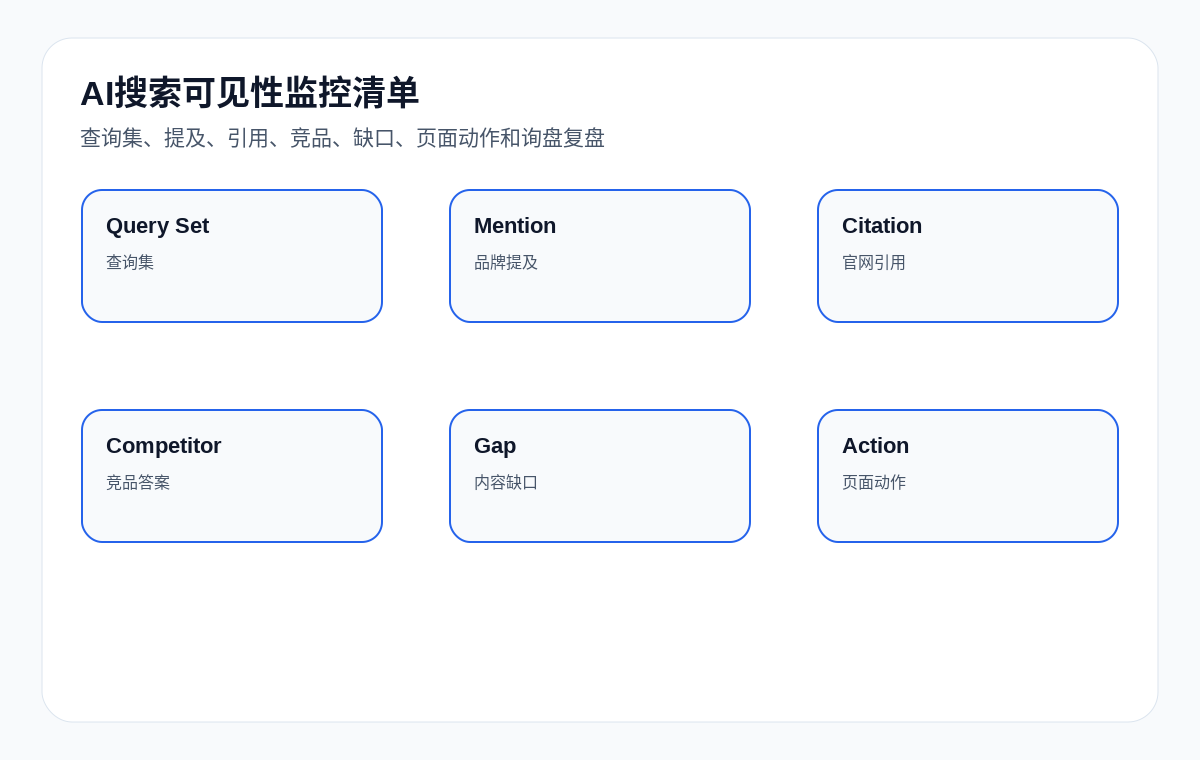
First, benchmark current AI visibility tools and methods
Current content on AI search visibility monitoring, such as the Semrush AI Visibility Toolkit, Profound, AirOps, SE Ranking and various AI SEO tool guides, generally emphasizes cross-platform prompt tracking, Share of Voice, brand mention, citation, sentiment, competitor answer and content gaps. Their strengths are tooling, trend tracking and competitor comparison; their weakness is that much of the guidance is aimed at marketing teams or SaaS brands and rarely provides record fields, query categories and page update actions that export B2B websites can copy directly.
What export businesses need more is “what to record, how to read it, where to change it”: if AI answers “how to choose waterproof connector supplier” by citing only competitors, should you add product page parameters or an application page? If AI mentions your brand but does not cite the official site, is that a brand entity problem or a missing table on the page? If the AI answer mentions MOQ, sample and certification while the official site has no matching FAQ, which page should be changed? This article works through these questions.
What AI search visibility monitoring covers
| Object | What to record | Why it matters | Export example |
|---|---|---|---|
| Query set | Fixed English sourcing questions | Keeps each round comparable | custom metal parts quote checklist |
| Brand mention | Whether the brand/company name appears | See whether AI knows you | brand mentioned: yes/no |
| Official site citation | Whether the official site URL is cited | Judge whether a page is citable | Cites a product page or datasheet page |
| Competitor answers | Who the competitors are and why they appear | Find content and trust gaps | competitor has datasheet page |
| Answer quality | Whether it accurately describes the product and sourcing standards | Avoid being misunderstood | Describes a trader as a manufacturer |
| Page action | Which URL should be changed | Turn monitoring into optimization | Add FAQ, spec table, application page |
Step 1: Build an export AI query set checklist
The query set should cover the sourcing journey, not just ask about the brand name. For each product line, prepare at least queries for product definition, supplier selection, spec comparison, application scenarios, certification risk, datasheet needs, quote preparation, samples and MOQ, and competitor comparison. Every query should be tied to a target page and a review frequency.
Export AI query set checklist
| Category | English query example | Target page | Monitoring focus |
|---|---|---|---|
| Product definition | what is a waterproof connector used for | Product page / glossary page | Does AI understand the use |
| Supplier selection | how to choose custom metal parts supplier | Guide page / capability page | Are selection criteria covered |
| Spec comparison | IP65 vs IP67 LED flood light | FAQ / comparison article | Does it mention the official site table |
| Application scenario | connector for packaging machine washdown area | Application page / product page | Are scenario and product connected |
| Datasheet needs | medical probe datasheet requirements | Datasheet page / product page | Does it cite the datasheet explanation |
| Quote preparation | what to send for cnc machining parts quote | Inquiry page / product page | Are RFQ fields complete |
| Packaging compliance | ceramic dinnerware export packaging | Datasheet page / FAQ | Does it answer packaging risk |
| Customization process | private label activewear sample process | Product / service page | Are sampling and MOQ clear |
Official monitoring scope: what AI visibility, GSC, GA4 and logs each explain
AI search visibility monitoring cannot rely on screenshots alone.
A screenshot shows what one sample happened to see. Search Console shows queries, pages, impressions and clicks in Google Search. GA4 shows on-site behavior. robots and logs show whether crawl access is being restricted unintentionally. Bing Webmaster Tools, if AI Performance is visible, can also be observed as a separate scope.
These fields should be written separately. Mixed together, the report turns into feelings.
Official documentation and monitoring field mapping table
| Official documentation | Fields suitable for monitoring | How to review at acceptance |
|---|---|---|
| Google Search Central: AI features and your website | Whether pages stay accessible, indexable and clearly written, as the basis for AI features to understand a web page. | Check indexing status, body facts, titles, internal links and extractable structure on key pages; do not phrase it as a promise of AI display. |
| Search Console Help: Performance report | query, page, clicks, impressions, CTR, average position, country, device. | Reports should state the date range, filters and export dimensions; when there is no row data, write “no search performance available for analysis yet”. |
| Google Analytics Help: About events | On-site events such as form submissions, button clicks, email clicks, WhatsApp clicks and downloads. | Verify event names, trigger conditions and conversion definitions; one event cannot be attributed directly to AI search. |
| Google Search Central: robots.txt introduction | Whether robots rules block key pages or assets and affect normal crawl access. | Check robots.txt, meta robots, HTTP status and links to core pages; make sure the monitoring pages themselves are not blocked. |
| OpenAI Platform: Bots | OpenAI-related crawl access and the boundaries of robots control. | Check robots and server logs; this shows access boundaries, not that ChatGPT will definitely use official site content. |
| Bing Webmaster Blog: AI Performance | How to observe impressions, citations and clicks in Bing AI Performance. | If visible in the account, record Bing separately; it does not represent all AI search platforms. |
| IndexNow: Documentation | A URL submission channel after key pages are updated. | Record the submitted URL, time and response status; it helps discovery of updates but does not guarantee search performance. |
AI visibility monitoring acceptance checklist
| Monitoring item | Acceptable record | Unacceptable record |
|---|---|---|
| Query set | Grouped by brand term, product term, scenario term, question term and competitor term, keeping the original English wording. | Writing only “looked up several questions” with no fixed query set. |
| Platform | Record Google, Bing, ChatGPT, Perplexity and other platforms separately. | Merging all platforms into one “AI result”. |
| Date | For each sample, record the date, region, language, device and login status. | Only screenshots, with no context conditions. |
| Brand mention | Record whether the brand appears, whether the wording is correct and whether core products are mentioned. | Writing only “it appeared” without judging whether it was correct. |
| Official site citation | Record whether the official site is cited, which URL is cited, the citation position and context. | Writing only “cited the official site” with no page address. |
| Competitor answers | Record why competitors appear: content, entity, external citation or product match. | Writing only competitor names without breaking down the reason. |
| Page action | Each gap maps to a specific page: collection page, product page, FAQ, case page or datasheet page. | Only conclusions, with no page revision task. |
| Review definitions | Put AI sampling, GSC, GA4, inquiry feedback and page updates in the same table. | Looking only at a single AI answer screenshot. |
How to write AI visibility monitoring conclusions when there is no GSC signal
If Search Console still has no query or page row data, the monitoring report should be more restrained.
You can write: the query set is established, the sampling table is established, key pages have evidence modules added, and GA4 events and crawl boundaries are under monitoring. You cannot write: keywords have already improved, AI platforms now consistently cite the official site, or inquiries already come from AI search.
| Current evidence | Conclusions you can write | Conclusions you cannot write |
|---|---|---|
| GSC has no query/page row data yet | Search performance has not yet formed an analyzable sample. | A certain keyword ranking has already improved. |
| AI answer sampling is in place | Answer changes can be recorded against a fixed query set. | One sample represents long-term performance. |
| Official site citation fields are recorded | You can observe whether the official site and specific URLs are cited. | AI will definitely use official site content. |
| GA4 events are configured | Inquiry button, form and contact clicks can be observed later. | Current inquiries definitely come from AI search. |
| robots and logs are under review | Crawl access restrictions can be diagnosed. | Normal crawl access equals having AI citations. |
The point of monitoring is not to turn every answer screenshot into a pretty report. What it really has to answer is: which question has no answer, which page lacks evidence, which product fact needs adding, and where to change next.
Step 2: Record fields must be fixed so changes can be compared
AI answers fluctuate, so the record fields must be fixed. Do not save only screenshots, and do not switch to a different question each time. It is best to record in a table: date, platform, region/language, query, answer summary, brand mention, official citation URL, cited page type, competitors, answer gaps, page action and next review date.
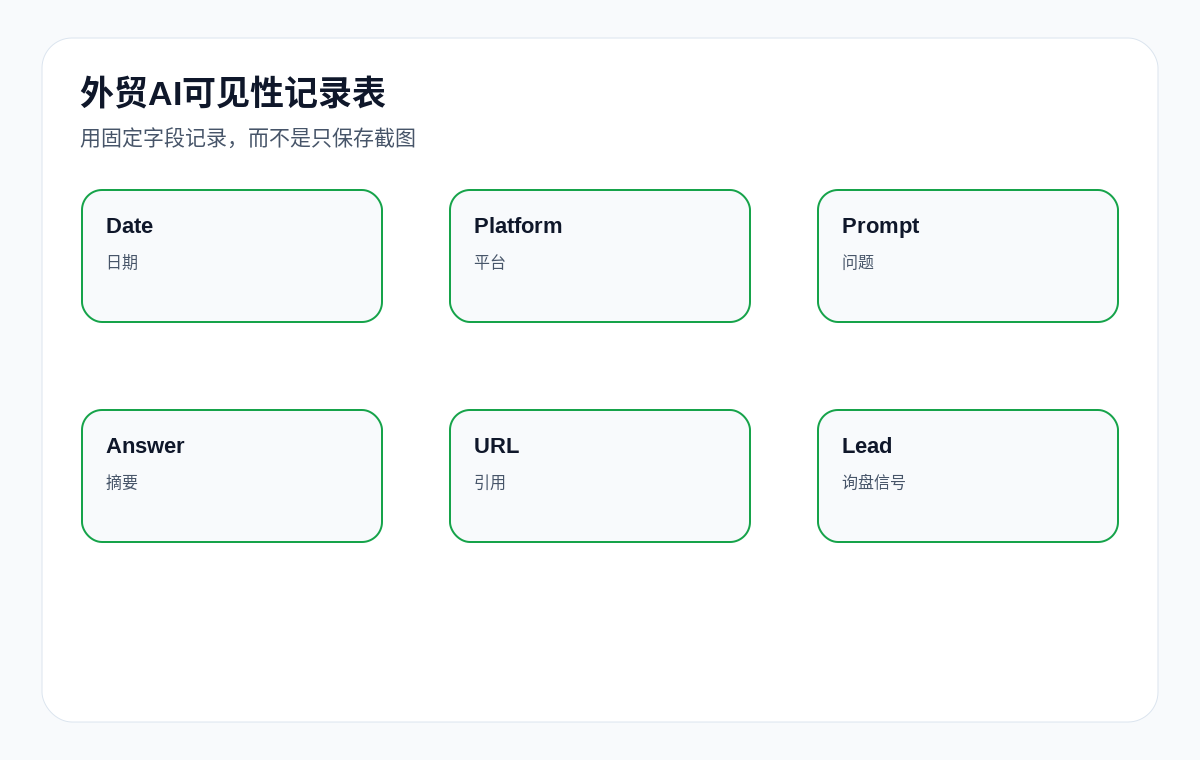
AI visibility record field table
| Field | Record example | Purpose of judgment | Filling reminder |
|---|---|---|---|
| Date | 2026-05-26 | Compare changes over time | Use the same time zone |
| Platform | ChatGPT Search / Google AI Mode / Perplexity | Distinguish platform differences | Do not merge into one result |
| Market/Language | US English | Control the test context | Export sites should prioritize English markets |
| Prompt | best waterproof connector for packaging machine | Keep the full question | Do not write only keywords |
| Brand mention | No | Whether the brand is mentioned | Does not equal a citation |
| Official citation | /waterproof-connector/ | Whether the official site becomes a source | Record the full URL |
| Competitors | competitor A, competitor B | Who is mentioned | Look at page types |
| Gap | No IP rating comparison table | Content gap | Write it as an actionable question |
| Action | Add IP rating FAQ to connector page | Page action | Specify the URL |
| Lead signal | 2 inquiries mention packaging machine | Business review | From CRM or forms |
Step 3: How to judge brand mentions
Brand mentions are the lowest-level signal. When a company name appears in an AI answer, it means some information sources may know you, but you still need to check whether it is accurate, whether it is positive, whether it relates to the right product line, whether the official site is cited, and whether you are grouped with competitors as the same type of supplier. Do not just count occurrences.
Brand mention judgment table
| Situation | Meaning | Risk | Action |
|---|---|---|---|
| No brand mention | New site or insufficient content signals | Not necessarily a failure | Check whether the query is reasonable and add core pages |
| Mentioned but official site not cited | AI knows the brand but does not treat the official site as a source | Information may come from third parties | Add official site facts and citable content |
| Mentioned but described incorrectly | Confusing entity information | Misleads buyers | Unify company and product line information |
| Mentioned and official site cited | A relatively strong signal | Still check answer accuracy | Maintain pages and internal links |
| Competitors mentioned but not you | Competitor content or external signals are stronger | Exposes the gap | Break down competitor pages and signal sources |
Step 4: For official site citations, look at which page was cited
An AI citing the official site homepage and citing a specific product page have different value. Export sites would rather have AI cite the matching category page, product page, application page, datasheet page or guide page in specific sourcing questions. If all citations point to the homepage, the brand entity may exist, but specific pages are not strong enough yet.
Official site citation page type judgment
| Cited page | What it shows | Suitable queries | Next step |
|---|---|---|---|
| Homepage | The brand entity is somewhat recognized | Brand or company verification | Add product line entry points and structured information |
| Category page | The product family is understood | LED flood light supplier | Strengthen filters, FAQ and product internal links |
| Product page | Specific specs are cited | M12 waterproof connector | Maintain parameters and Schema |
| Application page | Scenario content is citable | connector for packaging machine | Expand related applications and products |
| Datasheet page | Datasheet needs are served | medical probe datasheet | Ensure the datasheet is accessible and linked to inquiry |
| Article/guide | Problem answers are cited | how to choose cnc machining supplier | Link to products and inquiry |
Step 5: Break down why competitor answers appear
When competitors are mentioned by AI, do not panic first. Break down why they appear: whether they have a more complete definition, spec table, FAQ, datasheet page, application page, third-party citation, video, industry directory or consistent brand entity. Only after finding the reason can you decide whether to improve the product page, add datasheets, add an application page or add external credible information.
Competitor answer breakdown table
| Competitor advantage signal | How to verify | Our corresponding action | Export example |
|---|---|---|---|
| Complete spec table | Check the competitor product page | Add a spec table and selection criteria | waterproof connector pin options |
| Strong datasheet page | Look at the datasheet/catalog page | Build an HTML datasheet description page | medical probe datasheet |
| Deep application content | Look at industry scenario pages | Add application pages and recommended products | packaging machine connector |
| Specific FAQ | Look at MOQ/sample/certification questions | Organize sales questions into FAQ | private label activewear MOQ |
| Many external signals | Search brand + product terms | Add directories, videos, social media and industry materials | industrial valve supplier |
| Clear images and videos | Look at visual evidence | Add application photos, dimension drawings and test videos | LED flood light warehouse |
Step 6: How to turn answer gaps into page actions
The most important column in the monitoring record is Action. Do not write vague actions like “optimize content”; state clearly which page gets which module. For example, “/waterproof-connector/ add an IP65 vs IP67 comparison table”, “/cnc-machining-parts/ add an RFQ materials checklist”, “/medical-probe-datasheet/ add a compatible model table”.
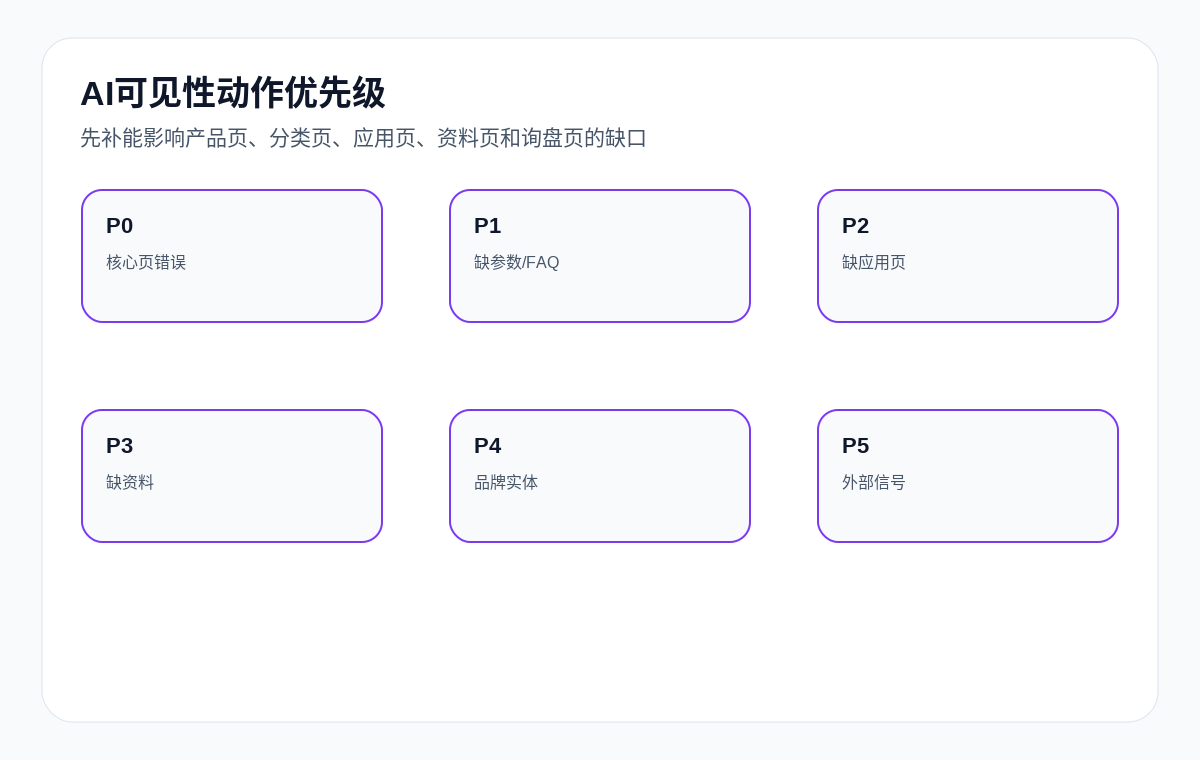
AI answer gap to page action
| Gap | Page action | Target URL type | Priority |
|---|---|---|---|
| Unclear product definition | Add a clear definition and use case | Product page / glossary page | P1 |
| Missing spec comparison | Add a comparison table and FAQ | Product page / article page | P1 |
| Missing application scenario | Create or enhance an application page | Application page | P2 |
| Missing datasheet needs | Build a datasheet description page | Datasheet page | P2 |
| Unclear quote conditions | Add an RFQ checklist and form fields | Product page / inquiry page | P1 |
| Incorrect brand description | Unify company name, product lines and structured information | Homepage / About page / footer | P0 |
| Strong competitor external signals | Add credible third-party materials and videos | External channels | P4 |
Step 7: How to set monitoring frequency and sample size
Early on, a new site can monitor 10 to 20 core queries each week, expand to 50 monthly and review about 100 quarterly. Do not chase large scale from the start, because you do not yet know which queries truly have business value. First use a small sample to establish fields and judgment criteria, then expand.
AI search visibility monitoring cadence
| Stage | Number of queries | Focus | Output |
|---|---|---|---|
| Month 1 | 10-20 core queries | Establish a baseline and record fields | Initial monitoring table |
| Month 2 | 30-50 queries | Fill product, application and datasheet gaps | Page update checklist |
| Month 3 | 50-100 queries | Combine GSC and inquiry quality | Quarterly review |
| Stable phase | Rotate by product line | Watch trends and competitor changes | Monthly action table |
Step 8: Look at GSC, GA4 and inquiry sources together
AI visibility records cannot explain business value on their own. Each monthly review should look at GSC queries, page impressions and clicks, GA4 entry points and paths, inquiry fields, sales feedback and AI answer changes at the same time. For example, if AI starts citing a product page but inquiries are still vague, it may mean the page is citable but the conversion explanation is insufficient; if long-tail GSC terms grow but AI does not mention you, you may need to add citable structure first.
AI records and business data combination table
| AI signal | GSC/GA4/inquiry signal | Judgment | Action |
|---|---|---|---|
| No mention, no citation | No impressions in GSC either | Weak content foundation | Add core pages and internal links |
| No mention | Impressions already in GSC | Search is starting first | Add definitions, tables and FAQ |
| Cited | No inquiries | Page is citable but conversion is weak | Add CTA and RFQ fields |
| Competitors appear often | Competitors are also rising in SERP | Competitor content/trust is strong | Break down competitor pages |
| Incorrect mention | Inquiries also ask about the wrong product | Confusing entity expression | Unify product lines and page descriptions |
Step 9: Export industry example records
AI monitoring samples for different product lines
| Product line | Query | Common gaps | Page action |
|---|---|---|---|
| custom metal parts | what to send for custom metal parts quote | Missing RFQ materials checklist | Add drawing/material/quantity fields to the product page |
| LED flood light | IP65 vs IP67 LED flood light | Missing IP rating comparison | Add FAQ and application scenarios |
| packaging machine | packaging machine for frozen food factory | Missing scenario plan | Add an application page and capacity table |
| medical probe | medical probe datasheet requirements | Missing datasheet explanation | Build a datasheet description page |
| cnc machining parts | how to choose cnc machining supplier | Missing QC and tolerance explanation | Add capability page and inspection table |
| ceramic dinnerware | ceramic dinnerware export packaging | Missing packaging evidence | Add packaging photos and test notes |
| waterproof connector | best connector for washdown area | Missing IP and material explanation | Add application page and spec table |
| industrial valve supplier | valve material for chemical processing | Missing material selection guide | Add application/material guide |
| private label activewear manufacturer | activewear manufacturer MOQ sample process | Missing sampling and MOQ explanation | Add process table and FAQ |
Step 10: How to write the monthly review report
A monthly report does not need piles of screenshots; it should be organized by conclusions and actions: how many queries were monitored this month, on which platforms, what changed in brand mentions and official site citations, which competitors appeared most, which pages were cited, which queries exposed content gaps, which pages to change next month, and how to verify.
AI visibility monthly report structure
| Module | Content | Evidence | Action |
|---|---|---|---|
| Monitoring scope | Number of queries, platforms, markets | Record table | Confirm whether the sample is stable |
| Brand mentions | Number and accuracy of mentions | Answer summaries | Correct entity information |
| Official site citations | Cited URLs and page types | Citation list | Enhance cited pages |
| Competitor answers | Competitors and reasons for appearing | Competitor URLs | Break down gaps and improve pages |
| Content gaps | High-frequency missing questions | Gap column summary | Form page tasks |
| Business linkage | GSC, GA4, inquiry changes | Data screenshots or exports | Decide priorities |
AI visibility scorecard: turn subjective answers into comparable scores
AI answers are text and easily judged subjectively. To let the team compare continuously, each query can be scored from 0 to 3. Scoring is not about chasing pretty numbers; it is about discovering whether a page is gradually moving from “completely invisible” to “correctly understood, cited and able to lead to a next step”.
| Dimension | 0 points | 1 point | 2 points | 3 points |
|---|---|---|---|---|
| Brand mention | Not mentioned | Mentioned vaguely | Mentioned and product-related | Mentioned accurately and positively |
| Official site citation | No citation | Homepage cited | Related page cited | Target product/datasheet page cited |
| Answer accuracy | Incorrect description | Partly correct | Basically correct | Accurate and covers sourcing points |
| Competitor gap | Competitors fully cover | Competitors many and we are absent | We and competitors appear together | Our content is more specific |
| Page action | No action | Vague action | Action tied to a page | Action tied to a module and review date |
For example, for the query “what to send for cnc machining parts quote”, if AI neither mentions the brand nor cites the official site, but the answer emphasizes drawing, material, tolerance and quantity, while the official product page has no RFQ checklist, then brand mention scores 0, official site citation 0, answer accuracy 2, and page action can be given 3, because it provides a clear update direction.
Product line monitoring table sample: map English terms to pages
Export businesses can build a monitoring table by product line, keeping 10 to 20 core queries per product line. Do not mix all products in one table, or it becomes hard to tell which category page or product page needs updating.
| Product line | Query type | Prompt example | Target URL | Action example |
|---|---|---|---|---|
| custom metal parts | Quote preparation | what to send for custom metal parts quote | /custom-metal-parts/ | Add RFQ materials checklist |
| LED flood light | Spec comparison | IP65 vs IP67 LED flood light outdoor use | /led-flood-light/ | Add IP rating comparison table |
| packaging machine | Application scenario | packaging machine for frozen food factory | /applications/packaging-machine-food/ | Add scenario flow and capacity table |
| medical probe | Datasheet needs | medical probe datasheet compatibility | /medical-probe-datasheet/ | Add compatible model table |
| ceramic dinnerware | Packaging risk | ceramic dinnerware export packaging requirements | /ceramic-dinnerware-packaging/ | Add packaging photos and test notes |
| private label activewear | Sampling process | private label activewear manufacturer sample process | /private-label-activewear/ | Add sample process and MOQ FAQ |
Brand mention records: distinguish “it appeared” from “it got it right”
Many teams treat a brand appearance as good news, but AI may get the company type, product scope or market wrong. For example, describing a factory as a trader, a B2B-only company as a retail store, a waterproof connector as an ordinary USB cable, or a medical probe as a medical service. When recording, mark answer accuracy.
| Mention status | Answer example | Judgment | Page action |
|---|---|---|---|
| Not mentioned | Lists only competitors | Missing brand/content signals | Add core pages and external credible information first |
| Mentioned but wrong product | Writes the connector as a consumer cable | Confusing entity | Unify product definition and structured information |
| Mentioned but weak capability | Says only general supplier | Missing professional capability evidence | Add parameters, certifications, applications and datasheets |
| Mentioned and accurate | Explains the product and applicable scenarios | Relatively good signal | Maintain pages and add citation evidence |
| Mentioned and official site cited | Cites a specific product page | Strong signal | Watch inquiries and page paths |
Official site citation records: citation position determines the next action
If AI cites the official site, look at whether it cites the homepage, an article, a category, a product, an application or a datasheet page. Different citation positions represent different problems. Many homepage citations but no product page citations mean the brand exists but product pages are not extractable enough; many article citations but no product page citations mean informational content is strong but commercial pages are weak.
| Citation situation | Explanation | Common reason | Next step |
|---|---|---|---|
| Only homepage cited | Brand-level recognition | Specific pages weak or insufficient internal links | Strengthen category and product page entry points |
| Article page cited | Problem content is citable | Article definitions and tables are clear | Guide from articles to products/inquiry |
| Product page cited | Spec content is citable | Parameters and FAQ are complete | Maintain Schema and image materials |
| Datasheet page cited | Datasheet needs are served | datasheet/catalog is clear | Link related products and inquiry |
| Not cited but mentioned | Information source may be external | Insufficient citable content on the official site | Add extractable paragraphs and tables |
Competitor answer records: do not just write competitor names
Every time a competitor appears, record the competitor page type and the reason AI cited it. Writing only “competitor A appeared” has no value; write “competitor A’s datasheet page was cited because it has a complete compatibility table and download instructions”. Only then do you know what to add.
| Competitor page type | Possible reason AI cites it | Our checkpoint | Page action |
|---|---|---|---|
| Product page | Complete spec table, images, FAQ | Do we have an equivalent spec table | Add product page evidence |
| Category page | Clear product range and filters | Is our category page just a list | Add category description and selection table |
| Application page | Specific scenario explanations | Is there an application page | Create or enhance an application page |
| Datasheet page | datasheet/catalog is accessible | Is the datasheet isolated or lacking explanation | Build a datasheet description page |
| Video/third-party page | Many external credible signals | Are videos or directory information missing | Add real external content |
Content gap priority: fix pages that affect inquiries first
AI monitoring will find many gaps, but you cannot fix them all at once. Prioritize gaps that affect core commercial entry points and inquiry quality: incorrect information on core product pages, category pages with no product range, product pages missing spec tables, application pages missing scenario explanations, and inquiry pages missing RFQ fields. Low-value general knowledge gaps can wait.
| Gap | Business impact | Priority | Example action |
|---|---|---|---|
| Incorrect product definition | AI and buyers misunderstand the business | P0 | Rewrite homepage/product page definitions |
| Missing quote materials | Unclear inquiries | P1 | Add RFQ checklist and form fields |
| Missing spec table | Hard for buyers to judge | P1 | Add specs, materials, certifications, MOQ |
| Missing application scenario | Lost scenario-term opportunities | P2 | Add application pages and product recommendations |
| Missing datasheet page | Technical buyers cannot evaluate | P2 | Build a datasheet/catalog description page |
| Weak external signals | Few sources of AI trust | P4 | Add real videos, directories and social media materials |
Monthly summary formulas for the AI monitoring record table
If you manage it in a spreadsheet, you can summarize a few simple metrics each month: total queries, queries with brand mentions, queries with official site citations, target product line coverage, competitor appearance count, actionable gaps, completed page actions and next-month reviews. Do not turn it into a complex model; first make sure the team can keep filling it in.
| Metric | Calculation | Explanation | Note |
|---|---|---|---|
| Brand Mention Rate | Queries with brand mentions / total queries | Whether the brand is recognized by answer systems | Look at accuracy |
| Citation Rate | Queries with official site citations / total queries | Whether the official site becomes a source | Distinguish homepage from specific pages |
| Competitor Frequency | Competitor appearance count | Who is stronger on similar questions | Record the reason |
| Action Completion | Completed actions / planned actions | Whether monitoring lands | Do not monitor without updating |
| Lead Match | Number and clarity of relevant inquiries | Whether it connects to business results | Only use as directional reference when attribution is incomplete |
Closed-loop example of AI monitoring and page updates
Here is a complete loop: for the query “best connector for packaging machine washdown area”, the AI answer mentions IP67, chemical resistance, cable material and food factory, but does not mention the official site, and a competitor has an application page cited. After recording the gap, the official site should update the waterproof connector product page, adding a packaging machine application section, an IP rating comparison table, cable material notes, FAQ and internal links to the application page. Retest with the same query after 30 days, and also check whether packaging machine connector related queries appear in GSC.
| Closed-loop step | Record | Page action | Review metric |
|---|---|---|---|
| Query | connector for packaging machine washdown area | None | Fixed prompt |
| Answer | Emphasizes IP67, materials, clean environment | Extract judgment criteria | Answer summary |
| Gap | Official site has no application page or material table | Add application page and product FAQ | Page published |
| Internal links | Product page and application page link to each other | Strengthen the path | GA4 path |
| Retest | Same prompt after 30 days | Watch mention/citation changes | AI records + GSC queries |
When not to change pages immediately because of an AI answer
AI answers fluctuate, so you should not change pages every time you see different wording. Observe first in these cases: a single abnormal answer on one platform; the query itself is too broad; the answer is unrelated to the target market; the page was just updated and has not been crawled yet; the gap is unrelated to core product lines; sales feedback shows the issue does not affect inquiries. Page updates should be based on high-value gaps that recur.
| Situation | Suggestion | Reason | Review method |
|---|---|---|---|
| Single abnormal answer | Record first, do not change | AI fluctuation is normal | Retest the same query next week |
| Query too broad | Rewrite the query | Does not represent sourcing intent | Change to product + scenario + question |
| Page just updated | Wait for crawling and understanding | AI does not necessarily update immediately | Retest after 30 days |
| Non-core product line | Low priority | Limited resources | Quarterly assessment |
| Gap has no business value | Do not handle or postpone | Will not affect inquiries | Check sales feedback |
Different AI platforms should be recorded separately, not merged into one conclusion
Platforms such as ChatGPT Search, Google AI Mode or AI Overviews, Perplexity and Gemini differ in data sources, citation methods and answer presentation. It is normal for the same query to produce different results on different platforms. When recording, do not merge them into “what AI said”; record the platform and the answer separately.
| Platform type | Better for observing | Recording focus | Note |
|---|---|---|---|
| ChatGPT Search | Comprehensive Q&A and sourcing advice | Whether it cites the official site and third-party sources | The same question may get different answers |
| Google AI-related results | The Google search answer environment | AI answers, traditional rankings, SERP feature relationships | Region and login status have a clear effect |
| Perplexity | Citation sources and datasheet-type answers | Cited URLs and source quality | Good for spotting datasheet page opportunities’], |
| Gemini | Understanding related to the Google ecosystem | Brand and product entity descriptions | Needs to be observed together with Google Search |
| Professional tools | Scale trends and competitor comparison | Share of Voice, prompt tracking, citation | Do not look only at scores; read sample answers |
If the same LED flood light query cites a competitor datasheet in Perplexity, shows an image pack in Google AI-related results, and gives only generic selection advice in ChatGPT, these three signals represent different page actions: datasheet page, image optimization and selection FAQ may all need work.
Tool selection checklist: when you need professional AI monitoring tools
Manual monitoring is fine to start, but when there are many product lines, queries and competitors, and you need monthly reports and multi-person collaboration, tools improve efficiency. When choosing a tool, do not just look at whether it has a feature called “AI visibility”; check whether it supports the target market, platform coverage, prompt management, cited URLs, competitor comparison, export, historical trends and team collaboration.
| Selection dimension | Question to ask | Judgment for export sites | Risk |
|---|---|---|---|
| Platform coverage | Which AI search/answer environments are covered | Whether it covers channels your target customers use | Few platforms lead to narrow conclusions |
| Region and language | Can English markets and regions be set | Markets such as US/EU should be viewed separately | Default region mismatch |
| Prompt management | Can queries be grouped and retested | Group by product line and sourcing stage | No trends can be formed |
| Citation tracking | Can cited URLs be recorded | You need to see which page is cited | Brand scores alone are not enough |
| Competitor comparison | Can you see why competitors appear | Best if answer samples can be exported | Share alone is not enough’], |
| Data export | Can CSV/tables be exported | Easy to merge with GSC/CRM | Locked inside the tool |
How sales teams can take part in AI visibility monitoring
Sales teams do not need to operate complex tools, but they must provide real sourcing questions. If the AI query set is written only from the imagination of operations staff, it easily drifts from customers. Each month sales can provide: the spec questions customers ask most, materials missing before quoting, common misunderstandings, scenarios where competitors are mentioned, and the certification and packaging concerns of buyers in different countries.
| Sales input | Turned into AI query | Page action | Business value |
|---|---|---|---|
| Customers always ask about MOQ | MOQ for private label activewear manufacturer | Add MOQ and sample FAQ | Reduce inefficient communication |
| Customers do not understand drawing materials | what drawings needed for cnc machining quote | Add RFQ checklist | Improve inquiry quality |
| Customers worry about packaging damage | ceramic dinnerware export packaging requirements | Add packaging photos and test notes | Build trust |
| Customers ask about certification | LED flood light certification for EU market | Add certification notes | Match the target market |
| Customers ask about compatibility | medical probe compatibility list | Add compatible model table | Reduce pre-sales confirmation |
How technical teams can support AI visibility monitoring
AI visibility is not just a copywriting issue. If pages cannot be crawled, structured data is wrong, canonical points to the wrong URL, page speed is poor, images are inaccessible or datasheet links are broken, AI and search systems have a harder time using official site content. Technical teams should provide checks on page accessibility, indexing, Schema, sitemap, speed and asset status.
| Technical check | Why it affects AI visibility | How to verify | Fix direction |
|---|---|---|---|
| Indexing status | Undiscovered pages are hard to cite | GSC URL inspection | Fix robots/noindex/canonical |
| Structured data | Helps understand products, FAQ and organization entities | Rich Results / Schema check | Keep consistent with page content |
| Page speed | Affects crawling and user experience | PageSpeed and real visits | Optimize images and scripts |
| Datasheet links | Cited materials must be accessible | Check PDF/download links | Fix 404s and permission restrictions |
| Image assets | Product visual evidence | Check file names, alt and status codes | Add image descriptions and compression |
Pre-publish QA for the AI monitoring checklist
After updating pages based on AI monitoring, always do pre-publish QA. Otherwise content may be added but the page is not indexed, images do not open, FAQ is not displayed, Schema and body text do not match, internal links point to the wrong page, or the inquiry button does not work.
| QA item | Check method | Pass standard | Failure handling |
|---|---|---|---|
| Page accessible | Open the front end and check status code | HTTP 200 | Fix URL/server |
| Content visible | Check on mobile and desktop | Definitions, tables and FAQ visible | Adjust layout |
| Internal links correct | Click product/datasheet/inquiry links | Links to the target page | Fix anchor text and URL |
| Schema consistent | Check source code or tools | Structured data matches body text | Remove false fields |
| Images and materials work | Check images and download links | Assets return 200 and have descriptions | Re-upload or replace |
| Review date | Record in the table | There is a next retest time | Add the record |
Quarterly AI visibility review
Monthly looks at actions, quarterly looks at direction. The quarterly review should judge: which product lines are more easily understood by AI, which product lines remain absent, whether competitors dominate a certain type of question over time, which pages are more easily cited after updates, and which inquiry problems show that AI and search content still have not resolved buyer concerns.
| Quarterly question | Which data to look at | Possible conclusion | Next quarter’s action |
|---|---|---|---|
| Which product line has the most opportunity | Mentions, citations, GSC and inquiries | Growth in waterproof connector scenario terms | Deepen application pages and product pages |
| Which product line has the biggest gap | Competitor frequency and gap records | Insufficient medical probe datasheet pages | Build a datasheet library and compatibility table |
| Which pages are cited most | Citation URL summary | Guide pages strong, product pages weak | Strengthen product page parameters and FAQ |
| Which inquiries are clearer | Form fields and sales feedback | RFQ checklist improves quote quality | Copy to other product lines |
| Which actions have no effect | Page updates and retest results | Changing only titles does not help | Add evidence rather than only changing copy |
Common misconceptions
AI search visibility monitoring misconceptions
| Misconception | Problem | Correct approach |
|---|---|---|
| Only looking at whether AI recommends you | Ignores mentions, citations and answer quality | Record signals in layers |
| Only saving screenshots | Cannot compare trends | Record in a fixed-field table |
| Only asking the brand name | Hard for a new site to appear | Build a query set by product and sourcing question |
| Treating tool scores as conclusions | Scores cannot explain the business | Read answers manually and map page actions |
| Judging from a single answer | AI answers fluctuate a lot | Retest on a fixed cycle |
| Not connecting inquiry data | Cannot see business value | Combine GSC, GA4 and CRM |
FAQ: common questions about the AI search visibility monitoring checklist
Does AI search visibility monitoring need to be done every day?
No. A new site can monitor core queries weekly and summarize monthly. What matters is fixing the queries, fields and judgment method, not being pulled around by answer fluctuations every day.
Can AI visibility monitoring be done without tools?
Yes. In the early stage, spreadsheets, GSC, GA4, forms/CRM and manual AI spot checks are enough. Once the query scale and reporting needs grow, consider professional tools.
Is it a failure if the brand is not mentioned?
Not necessarily. It is normal for a new site not to be mentioned early on. What matters more is whether the queries are reasonable, whether pages have citable content, why competitors appear, and which page to change next.
Does an official site citation always bring inquiries?
Not exactly. A citation shows the page may be an information source, but inquiries also depend on product fit, page conversion, market demand and trust. Look at it together with GA4 and inquiry quality.
What should I do if competitors appear a lot?
Break down why competitors appear: spec tables, FAQ, datasheet pages, application pages, external signals or brand entity. Do not just copy titles; add real evidence.
Which platforms should export sites monitor?
Start by covering common answer environments such as ChatGPT Search, Google AI-related results, Perplexity and Gemini. The point is not the number of platforms but stable queries and recording.
Where should AI monitoring results be fixed first?
Prioritize core category pages, key product pages, application pages, datasheet pages and inquiry pages, because these pages best serve sourcing questions and affect conversion.
Conclusion: AI visibility monitoring must move from screenshots to a page improvement system
For export websites doing AI search visibility monitoring, the truly valuable thing is not “whether AI mentioned us today”, but using a stable query set and record table to find gaps in brand entity, product pages, category pages, application pages, datasheet pages and inquiry pages, and to keep strengthening them.
When product-related questions about custom metal parts, LED flood light, packaging machine, medical probe, cnc machining parts, ceramic dinnerware, waterproof connector, industrial valve supplier and private label activewear manufacturer can all be clearly answered by official site pages, correctly understood by AI, and can form a review loop with GSC, GA4 and inquiry quality, only then does AI search visibility monitoring truly serve export lead generation.
{
“@context”: “https://schema.org”,
“@type”: “FAQPage”,
“mainEntity”: [
{
“@type”: “Question”,
“name”: “AI visibility record field tablenField Record example Purpose Filling remindernDate 2026-05-26 Compare changes over time Use the same time zonenPlatform ChatGPT Search / Google AI Mode / Perplexity Distinguish platform differences Do not merge into one resultnMarket/Language US English Control the test context Export sites should prioritize English marketsnPrompt best waterproof connector for packaging machine Keep the full question Do not write only keywordsnBrand mention No Whether the brand is mentioned Does not equal a citationnOfficial citation /waterproof-connector/ Whether the official site becomes a source Record the full URLnCompetitors competitor A, competitor B Who is mentioned Look at page typesnGap No IP rating comparison table Content gap Write it as an actionable questionnAction Add IP rating FAQ to connector page Page action Specify the URLnLead signal 2 inquiries mention packaging machine Business review From CRM or formsnnStep 3: How to judge brand mentionsnBrand mentions are the lowest-level signal. When a company name appears in an AI answer, it means some information sources may know you, but you still need to check whether it is accurate, whether it is positive, whether it relates to the right product line, whether the official site is cited, and whether you are grouped with competitors as the same type of supplier. Do not just count occurrences.nBrand mention judgment tablenSituation Meaning Risk ActionnNo brand mention New site or insufficient content signals Not necessarily a failure Check whether the query is reasonable and add core pagesnMentioned but official site not cited AI knows the brand but does not treat the official site as a source Information may come from third parties Add official site facts and citable contentnMentioned but described incorrectly Confusing entity information Misleads buyers Unify company and product line informationnMentioned and official site cited A relatively strong signal Still check answer accuracy Maintain pages and internal linksnCompetitors mentioned but not you Competitor content or external signals are stronger Exposes the gap Break down competitor pages and signal sourcesnnStep 4: For official site citations, look at which page was citednAn AI citing the official site homepage and citing a specific product page have different value. Export sites would rather have AI cite the matching category page, product page, application page, datasheet page or guide page in specific sourcing questions. If all citations point to the homepage, the brand entity may exist, but specific pages are not strong enough yet.nOfficial site citation page type judgmentnCited page What it shows Suitable queries Next stepnHomepage The brand entity is somewhat recognized Brand or company verification Add product line entry points and structured informationnCategory page The product family is understood LED flood light supplier Strengthen filters, FAQ and product internal linksnProduct page Specific specs are cited M12 waterproof connector Maintain parameters and SchemanApplication page Scenario content is citable connector for packaging machine Expand related applications and productsnDatasheet page Datasheet needs are served medical probe datasheet Ensure the datasheet is accessible and linked to inquirynArticle/guide Problem answers are cited how to choose cnc machining supplier Link to products and inquirynnStep 5: Break down why competitor answers appearnWhen competitors are mentioned by AI, do not panic first. Break down why they appear: whether they have a more complete definition, spec table, FAQ, datasheet page, application page, third-party citation, video, industry directory or consistent brand entity. Only after finding the reason can you decide whether to improve the product page, add datasheets, add an application page or add external credible information.nCompetitor answer breakdown tablenCompetitor advantage signal How to verify Our corresponding action Export examplenComplete spec table Check the competitor product page Add a spec table and selection criteria waterproof connector pin optionsnStrong datasheet page Look at the datasheet/catalog page Build an HTML datasheet description page medical probe datasheetnDeep application content Look at industry scenario pages Add application pages and recommended products packaging machine connectornSpecific FAQ Look at MOQ/sample/certification questions Organize sales questions into FAQ private label activewear MOQnMany external signals Search brand + product terms Add directories, videos, social media and industry materials industrial valve suppliernClear images and videos Look at visual evidence Add application photos, dimension drawings and test videos LED flood light warehousennStep 6: How to turn answer gaps into page actionsnThe most important column in the monitoring record is Action. Do not write vague actions like ‘optimize content’; state clearly which page gets which module. For example, ‘/waterproof-connector/ add an IP65 vs IP67 comparison table’, ‘/cnc-machining-parts/ add an RFQ materials checklist’, ‘/medical-probe-datasheet/ add a compatible model table’.nFigure 3: Monitoring results must land on page actions and priorities.nAI answer gap to page actionnGap Page action Target URL type PrioritynUnclear product definition Add a clear definition and use case Product page/glossary page P1nMissing spec comparison Add a comparison table and FAQ Product page/article page P1nMissing application scenario Create or enhance an application page Application page P2nMissing datasheet needs Build a datasheet description page Datasheet page P2nUnclear quote conditions Add an RFQ checklist and form fields Product page/inquiry page P1nIncorrect brand description Unify company name, product lines and structured information Homepage/About page/footer P0nStrong competitor external signals Add credible third-party materials and videos External channels P4nnStep 7: How to set monitoring frequency and sample sizenEarly on, a new site can monitor 10 to 20 core queries each week, expand to 50 monthly and review about 100 quarterly. Do not chase large scale from the start, because you do not yet know which queries truly have business value. First use a small sample to establish fields and judgment criteria, then expand.nAI search visibility monitoring cadencenStage Number of queries Focus OutputnMonth 1 10-20 core queries Establish a baseline and record fields Initial monitoring tablenMonth 2 30-50 queries Fill product, application and datasheet gaps Page update checklistnMonth 3 50-100 queries Combine GSC and inquiry quality Quarterly reviewnStable phase Rotate by product line Watch trends and competitor changes Monthly action tablennStep 8: Look at GSC, GA4 and inquiry sources togethernAI visibility records cannot explain business value on their own. Each monthly review should look at GSC queries, page impressions and clicks, GA4 entry points and paths, inquiry fields, sales feedback and AI answer changes at the same time. For example, if AI starts citing a product page but inquiries are still vague, it may mean the page is citable but the conversion explanation is insufficient; if long-tail GSC terms grow but AI does not mention you, you may need to add citable structure first.nAI records and business data combination tablenAI signal GSC/GA4/inquiry signal Judgment ActionnNo mention, no citation No impressions in GSC either Weak content foundation Add core pages and internal linksnNo mention Impressions already in GSC Search is starting first Add definitions, tables and FAQnCited No inquiries Page is citable but conversion is weak Add CTA and RFQ fieldsnCompetitors appear often Competitors are also rising in SERP Competitor content/trust is strong Break down competitor pagesnIncorrect mention Inquiries also ask about the wrong product Confusing entity expression Unify product lines and page descriptionsnnStep 9: Export industry example recordsnAI monitoring samples for different product linesnProduct line Query Common gaps Page actionncustom metal parts what to send for custom metal parts quote Missing RFQ materials checklist Add drawing/material/quantity fields to the product pagenLED flood light IP65 vs IP67 LED flood light Missing IP rating comparison Add FAQ and application scenariosnpackaging machine packaging machine for frozen food factory Missing scenario plan Add an application page and capacity tablenmedical probe medical probe datasheet requirements Missing datasheet explanation Build a datasheet description pagencnc machining parts how to choose cnc machining supplier Missing QC and tolerance explanation Add capability page and inspection tablenceramic dinnerware ceramic dinnerware export packaging Missing packaging evidence Add packaging photos and test notesnwaterproof connector best connector for washdown area Missing IP and material explanation Add application page and spec tablenindustrial valve supplier valve material for chemical processing Missing material selection guide Add application/material guidenprivate label activewear manufacturer activewear manufacturer MOQ sample process Missing sampling and MOQ explanation Add process table and FAQnnStep 10: How to write the monthly review reportnA monthly report does not need piles of screenshots; it should be organized by conclusions and actions: how many queries were monitored this month, on which platforms, what changed in brand mentions and official site citations, which competitors appeared most, which pages were cited, which queries exposed content gaps, which pages to change next month, and how to verify.nAI visibility monthly report structurenModule Content Evidence ActionnMonitoring scope Number of queries, platforms, markets Record table Confirm whether the sample is stablenBrand mentions Number and accuracy of mentions Answer summaries Correct entity informationnOfficial site citations Cited URLs and page types Citation list Enhance cited pagesnCompetitor answers Competitors and reasons for appearing Competitor URLs Break down gaps and improve pagesnContent gaps High-frequency missing questions Gap column summary Form page tasksnBusiness linkage GSC, GA4, inquiry changes Data screenshots or exports Decide prioritiesnnnAI visibility scorecard: turn subjective answers into comparable scoresnAI answers are text and easily judged subjectively. To let the team compare continuously, each query can be scored from 0 to 3. Scoring is not about chasing pretty numbers; it is about discovering whether a page is gradually moving from ‘completely invisible’ to ‘correctly understood, cited and able to lead to a next step’.nDimension 0 points 1 point 2 points 3 pointsnBrand mention Not mentioned Mentioned vaguely Mentioned and product-related Mentioned accurately and positivelynOfficial site citation No citation Homepage cited Related page cited Target product/datasheet page citednAnswer accuracy Incorrect description Partly correct Basically correct Accurate and covers sourcing pointsnCompetitor gap Competitors fully cover Competitors many and we are absent We and competitors appear together Our content is more specificnPage action No action Vague action Action tied to a page Action tied to a module and review datennFor example, for the query ‘what to send for cnc machining parts quote’, if AI neither mentions the brand nor cites the official site, but the answer emphasizes drawing, material, tolerance and quantity, while the official product page has no RFQ checklist, then brand mention scores 0, official site citation 0, answer accuracy 2, and page action can be given 3, because it provides a clear update direction.nnProduct line monitoring table sample: map English terms to pagesnExport businesses can build a monitoring table by product line, keeping 10 to 20 core queries per product line. Do not mix all products in one table, or it becomes hard to tell which category page or product page needs updating.nProduct line Query type Prompt example Target URL Action examplencustom metal parts Quote preparation what to send for custom metal parts quote /custom-metal-parts/ Add RFQ materials checklistnLED flood light Spec comparison IP65 vs IP67 LED flood light outdoor use /led-flood-light/ Add IP rating comparison tablenpackaging machine Application scenario packaging machine for frozen food factory /applications/packaging-machine-food/ Add scenario flow and capacity tablenmedical probe Datasheet needs medical probe datasheet compatibility /medical-probe-datasheet/ Add compatible model tablenceramic dinnerware Packaging risk ceramic dinnerware export packaging requirements /ceramic-dinnerware-packaging/ Add packaging photos and test notesnprivate label activewear Sampling process private label activewear manufacturer sample process /private-label-activewear/ Add sample process and MOQ FAQnnnBrand mention records: distinguish ‘it appeared’ from ‘it got it right’nMany teams treat a brand appearance as good news, but AI may get the company type, product scope or market wrong. For example, describing a factory as a trader, a B2B-only company as a retail store, a waterproof connector as an ordinary USB cable, or a medical probe as a medical service. When recording, mark answer accuracy.nMention status Answer example Judgment Page actionnNot mentioned Lists only competitors Missing brand/content signals Add core pages and external credible information firstnMentioned but wrong product Writes the connector as a consumer cable Confusing entity Unify product definition and structured informationnMentioned but weak capability Says only general supplier Missing professional capability evidence Add parameters, certifications, applications and datasheetsnMentioned and accurate Explains the product and applicable scenarios Relatively good signal Maintain pages and add citation evidencenMentioned and official site cited Cites a specific product page Strong signal Watch inquiries and page pathsnnnOfficial site citation records: citation position determines the next actionnIf AI cites the official site, look at whether it cites the homepage, an article, a category, a product, an application or a datasheet page. Different citation positions represent different problems. Many homepage citations but no product page citations mean the brand exists but product pages are not extractable enough; many article citations but no product page citations mean informational content is strong but commercial pages are weak.nCitation situation Explanation Common reason Next stepnOnly homepage cited Brand-level recognition Specific pages weak or insufficient internal links Strengthen category and product page entry pointsnArticle page cited Problem content is citable Article definitions and tables are clear Guide from articles to products/inquirynProduct page cited Spec content is citable Parameters and FAQ are complete Maintain Schema and image materialsnDatasheet page cited Datasheet needs are served datasheet/catalog is clear Link related products and inquirynNot cited but mentioned Information source may be external Insufficient citable content on the official site Add extractable paragraphs and tablesnnnCompetitor answer records: do not just write competitor namesnEvery time a competitor appears, record the competitor page type and the reason AI cited it. Writing only ‘competitor A appeared’ has no value; write ‘competitor A’s datasheet page was cited because it has a complete compatibility table and download instructions’. Only then do you know what to add.nCompetitor page type Possible reason AI cites it Our checkpoint Page actionnProduct page Complete spec table, images, FAQ Do we have an equivalent spec table Add product page evidencenCategory page Clear product range and filters Is our category page just a list Add category description and selection tablenApplication page Specific scenario explanations Is there an application page Create or enhance an application pagenDatasheet page datasheet/catalog is accessible Is the datasheet isolated or lacking explanation Build a datasheet description pagenVideo/third-party page Many external credible signals Are videos or directory information missing Add real external contentnnnContent gap priority: fix pages that affect inquiries firstnAI monitoring will find many gaps, but you cannot fix them all at once. Prioritize gaps that affect core commercial entry points and inquiry quality: incorrect information on core product pages, category pages with no product range, product pages missing spec tables, application pages missing scenario explanations, and inquiry pages missing RFQ fields. Low-value general knowledge gaps can wait.nGap Business impact Priority Example actionnIncorrect product definition AI and buyers misunderstand the business P0 Rewrite homepage/product page definitionsnMissing quote materials Unclear inquiries P1 Add RFQ checklist and form fieldsnMissing spec table Hard for buyers to judge P1 Add specs, materials, certifications, MOQnMissing application scenario Lost scenario-term opportunities P2 Add application pages and product recommendationsnMissing datasheet page Technical buyers cannot evaluate P2 Build a datasheet/catalog description pagenWeak external signals Few sources of AI trust P4 Add real videos, directories and social media materialsnnnMonthly summary formulas for the AI monitoring record tablenIf you manage it in a spreadsheet, you can summarize a few simple metrics each month: total queries, queries with brand mentions, queries with official site citations, target product line coverage, competitor appearance count, actionable gaps, completed page actions and next-month reviews. Do not turn it into a complex model; first make sure the team can keep filling it in.nMetric Calculation Explanation NotenBrand Mention Rate Queries with brand mentions / total queries Whether the brand is recognized by answer systems Look at accuracynCitation Rate Queries with official site citations / total queries Whether the official site becomes a source Distinguish homepage from specific pagesnCompetitor Frequency Competitor appearance count Who is stronger on similar questions Record the reasonnAction Completion Completed actions / planned actions Whether monitoring lands Do not monitor without updatingnLead Match Number and clarity of relevant inquiries Whether it connects to business results Only use as directional reference when attribution is incompletennnClosed-loop example of AI monitoring and page updatesnHere is a complete loop: for the query ‘best connector for packaging machine washdown area’, the AI answer mentions IP67, chemical resistance, cable material and food factory, but does not mention the official site, and a competitor has an application page cited. After recording the gap, the official site should update the waterproof connector product page, adding a packaging machine application section, an IP rating comparison table, cable material notes, FAQ and internal links to the application page. Retest with the same query after 30 days, and also check whether packaging machine connector related queries appear in GSC.nClosed-loop step Record Page action Review metricnQuery connector for packaging machine washdown area None Fixed promptnAnswer Emphasizes IP67, materials, clean environment Extract judgment criteria Answer summarynGap Official site has no application page or material table Add application page and product FAQ Page publishednInternal links Product page and application page link to each other Strengthen the path GA4 pathnRetest Same prompt after 30 days Watch mention/citation changes AI records + GSC queriesnnnWhen not to change pages immediately because of an AI answernAI answers fluctuate, so you should not change pages every time you see different wording. Observe first in these cases: a single abnormal answer on one platform; the query itself is too broad; the answer is unrelated to the target market; the page was just updated and has not been crawled yet; the gap is unrelated to core product lines; sales feedback shows the issue does not affect inquiries. Page updates should be based on high-value gaps that recur.nSituation Suggestion Reason Review methodnSingle abnormal answer Record first, do not change AI fluctuation is normal Retest the same query next weeknQuery too broad Rewrite the query Does not represent sourcing intent Change to product + scenario + questionnPage just updated Wait for crawling and understanding AI does not necessarily update immediately Retest after 30 daysnNon-core product line Low priority Limited resources Quarterly assessmentnGap has no business value Do not handle or postpone Will not affect inquiries Check sales feedbacknnnnDifferent AI platforms should be recorded separately, not merged into one conclusionnPlatforms such as ChatGPT Search, Google AI Mode or AI Overviews, Perplexity and Gemini differ in data sources, citation methods and answer presentation. It is normal for the same query to produce different results on different platforms. When recording, do not merge them into ‘what AI said’; record the platform and the answer separately.nPlatform type Better for observing Recording focus NotenChatGPT Search Comprehensive Q&A and sourcing advice Whether it cites the official site and third-party sources The same question may get different answersnGoogle AI-related results The Google search answer environment AI answers, traditional rankings, SERP feature relationships Region and login status have a clear effectnPerplexity Citation sources and datasheet-type answers Cited URLs and source quality Good for spotting datasheet page opportunities’],nGemini Understanding related to the Google ecosystem Brand and product entity descriptions Needs to be observed together with Google SearchnProfessional tools Scale trends and competitor comparison Share of Voice, prompt tracking, citation Do not look only at scores; read sample answersnnIf the same LED flood light query cites a competitor datasheet in Perplexity, shows an image pack in Google AI-related results, and gives only generic selection advice in ChatGPT, these three signals represent different page actions: datasheet page, image optimization and selection FAQ may all need work.nnTool selection checklist: when you need professional AI monitoring toolsnManual monitoring is fine to start, but when there are many product lines, queries and competitors, and you need monthly reports and multi-person collaboration, tools improve efficiency. When choosing a tool, do not just look at whether it has a feature called ‘AI visibility’; check whether it supports the target market, platform coverage, prompt management, cited URLs, competitor comparison, export, historical trends and team collaboration.nSelection dimension Question to ask Judgment for export sites RisknPlatform coverage Which AI search/answer environments are covered Whether it covers channels your target customers use Few platforms lead to narrow conclusionsnRegion and language Can English markets and regions be set Markets such as US/EU should be viewed separately Default region mismatchnPrompt management Can queries be grouped and retested Group by product line and sourcing stage No trends can be formednCitation tracking Can cited URLs be recorded You need to see which page is cited Brand scores alone are not enoughnCompetitor comparison Can you see why competitors appear Best if answer samples can be exported Share alone is not enough’],nData export Can CSV/tables be exported Easy to merge with GSC/CRM Locked inside the toolnnnHow sales teams can take part in AI visibility monitoringnSales teams do not need to operate complex tools, but they must provide real sourcing questions. If the AI query set is written only from the imagination of operations staff, it easily drifts from customers. Each month sales can provide: the spec questions customers ask most, materials missing before quoting, common misunderstandings, scenarios where competitors are mentioned, and the certification and packaging concerns of buyers in different countries.nSales input Turned into AI query Page action Business valuenCustomers always ask about MOQ MOQ for private label activewear manufacturer Add MOQ and sample FAQ Reduce inefficient communicationnCustomers do not understand drawing materials what drawings needed for cnc machining quote Add RFQ checklist Improve inquiry qualitynCustomers worry about packaging damage ceramic dinnerware export packaging requirements Add packaging photos and test notes Build trustnCustomers ask about certification LED flood light certification for EU market Add certification notes Match the target marketnCustomers ask about compatibility medical probe compatibility list Add compatible model table Reduce pre-sales confirmationnnnHow technical teams can support AI visibility monitoringnAI visibility is not just a copywriting issue. If pages cannot be crawled, structured data is wrong, canonical points to the wrong URL, page speed is poor, images are inaccessible or datasheet links are broken, AI and search systems have a harder time using official site content. Technical teams should provide checks on page accessibility, indexing, Schema, sitemap, speed and asset status.nTechnical check Why it affects AI visibility How to verify Fix directionnIndexing status Undiscovered pages are hard to cite GSC URL inspection Fix robots/noindex/canonicalnStructured data Helps understand products, FAQ and organization entities Rich Results / Schema check Keep consistent with page contentnPage speed Affects crawling and user experience PageSpeed and real visits Optimize images and scriptsnDatasheet links Cited materials must be accessible Check PDF/download links Fix 404s and permission restrictionsnImage assets Product visual evidence Check file names, alt and status codes Add image descriptions and compressionnnnPre-publish QA for the AI monitoring checklistnAfter updating pages based on AI monitoring, always do pre-publish QA. Otherwise content may be added but the page is not indexed, images do not open, FAQ is not displayed, Schema and body text do not match, internal links point to the wrong page, or the inquiry button does not work.nQA item Check method Pass standard Failure handlingnPage accessible Open the front end and check status code HTTP 200 Fix URL/servernContent visible Check on mobile and desktop Definitions, tables and FAQ visible Adjust layoutnInternal links correct Click product/datasheet/inquiry links Links to the target page Fix anchor text and URLnSchema consistent Check source code or tools Structured data matches body text Remove false fieldsnImages and materials work Check images and download links Assets return 200 and have descriptions Re-upload or replacenReview date Record in the table There is a next retest time Add the recordnnnQuarterly AI visibility reviewnMonthly looks at actions, quarterly looks at direction. The quarterly review should judge: which product lines are more easily understood by AI, which product lines remain absent, whether competitors dominate a certain type of question over time, which pages are more easily cited after updates, and which inquiry problems show that AI and search content still have not resolved buyer concerns.nQuarterly question Which data to look at Possible conclusion Next quarter’s actionnWhich product line has the most opportunity Mentions, citations, GSC and inquiries Growth in waterproof connector scenario terms Deepen application pages and product pagesnWhich product line has the biggest gap Competitor frequency and gap records Insufficient medical probe datasheet pages Build a datasheet library and compatibility tablenWhich pages are cited most Citation URL summary Guide pages strong, product pages weak Strengthen product page parameters and FAQnWhich inquiries are clearer Form fields and sales feedback RFQ checklist improves quote quality Copy to other product linesnWhich actions have no effect Page updates and retest results Changing only titles does not help Add evidence rather than only changing copynnnCommon misconceptionsnAI search visibility monitoring misconceptionsnMisconception Problem Correct approachnOnly looking at whether AI recommends you Ignores mentions, citations and answer quality Record signals in layersnOnly saving screenshots Cannot compare trends Record in a fixed-field tablenOnly asking the brand name Hard for a new site to appear Build a query set by product and sourcing questionnTreating tool scores as conclusions Scores cannot explain the business Read answers manually and map page actionsnJudging from a single answer AI answers fluctuate a lot Retest on a fixed cyclenNot connecting inquiry data Cannot see business value Combine GSC, GA4 and CRMnnFAQ: common questions about the AI search visibility monitoring checklistnDoes AI search visibility monitoring need to be done every day?”,
“acceptedAnswer”: {
“@type”: “Answer”,
“text”: “No. A new site can monitor core queries weekly and summarize monthly. What matters is fixing the queries, fields and judgment method, not being pulled around by answer fluctuations every day.”
}
},
{
“@type”: “Question”,
“name”: “Can AI visibility monitoring be done without tools?”,
“acceptedAnswer”: {
“@type”: “Answer”,
“text”: “Yes. In the early stage, spreadsheets, GSC, GA4, forms/CRM and manual AI spot checks are enough. Once the query scale and reporting needs grow, consider professional tools.”
}
},
{
“@type”: “Question”,
“name”: “Is it a failure if the brand is not mentioned?”,
“acceptedAnswer”: {
“@type”: “Answer”,
“text”: “Not necessarily. It is normal for a new site not to be mentioned early on. What matters more is whether the queries are reasonable, whether pages have citable content, why competitors appear, and which page to change next.”
}
},
{
“@type”: “Question”,
“name”: “Does an official site citation always bring inquiries?”,
“acceptedAnswer”: {
“@type”: “Answer”,
“text”: “Not exactly. A citation shows the page may be an information source, but inquiries also depend on product fit, page conversion, market demand and trust. Look at it together with GA4 and inquiry quality.”
}
},
{
“@type”: “Question”,
“name”: “What should I do if competitors appear a lot?”,
“acceptedAnswer”: {
“@type”: “Answer”,
“text”: “Break down why competitors appear: spec tables, FAQ, datasheet pages, application pages, external signals or brand entity. Do not just copy titles; add real evidence.”
}
}
]
}
Continue reading this GEO series
If you are systematically studying GEO and AI search visibility, the following articles are a good next step. Understand the concepts first, then look at diagnosis, monitoring, content structure and the boundaries of working together.
- What GEO services include: AI visibility diagnosis, query sets and monitoring deliverables checklist
- AI search visibility consultant vs. service team: how export businesses should choose
- What GEO visibility diagnosis includes: AI answers, entity consistency, citation sources and review
- How to read a GEO diagnosis report: a guide to judging AI answers, citation sources and entity consistency
- How to choose GEO monitoring tools: where to look for mentions, citations and traffic
- How to do AI Visibility Monitoring: an AI visibility monitoring guide for new export sites
This page is machine-translated from the Simplified Chinese version and awaiting human review. It has not yet been proofread.
Further Reading on This B2B SEO & GEO Topic
- What should a monthly GEO Monitoring Report include: AI answers, brand mentions, and changes in citations
- What Generative Engine Optimization tools are available: which capabilities should GEO tools prioritize
- What does ChatGPT SEO service include: how to make content citable, manage brand entities, and build question databases
- AI Overviews Monitoring Service: check citations, clicks, and the frequency of AI answer appearances
- Generative Engine Optimization (GEO) and AI Search Citation Hub for Export Brands
- B2B Google SEO Tutorials
- B2B Export Website Development Architecture