AI SEO is not “using AI to write SEO articles,” nor is it a new term that replaces traditional SEO. More precisely, traditional SEO addresses how pages are discovered, crawled, indexed, ranked, and clicked by Google; on top of that foundation, AI SEO further focuses on whether pages and brands can be correctly understood, mentioned, cited, and restated by answer systems such as ChatGPT, Google AI Overviews, Perplexity, and Gemini. For export manufacturers and trading companies, the goal of AI SEO is not mysterious exposure, but making English product terms, product facts, company entities, evidence materials, and inquiry paths clearer in the age of AI search.
This article uses export English product terms such as custom metal parts, LED flood light, packaging machine, medical probe, cnc machining parts, ceramic dinnerware, waterproof connector, industrial valve supplier, and private label activewear manufacturer as examples to explain what really differs between AI SEO and traditional SEO, which foundations cannot be skipped, which pages are more likely to be cited by AI answers, and how to review results with GSC, GA4, inquiry sources, sales feedback, and an AI answer baseline.
Top 1 and authoritative benchmark comparison: upgrading from concept explanation to an export implementation system
In the current English SERP, content from Semrush, Ahrefs, Surfer, HubSpot, Search Engine Journal, and others about AI SEO, AI visibility, GEO, and LLMO usually defines AI SEO as the practice of making content more likely to appear in AI-generated answers or AI-assisted search, while emphasizing new scenarios such as mentions, citations, AI Overviews, ChatGPT, and Perplexity. Google Search Central’s SEO fundamentals documentation remains the authoritative foundation of traditional SEO.
The strengths of this content are fresh concepts, clear trend judgments, and plenty of tools and metrics. The gap is that many articles present AI SEO as tools and concepts, lacking export product pages, category pages, application pages, resource pages, inquiry paths, and English product term scenarios; they also tend to conflate “using AI to improve efficiency” with “being cited by AI answers.”
This article’s approach to strengthening the topic is to break AI SEO into three layers: the traditional SEO foundation layer, the AI-answer comprehensibility layer, and the export business review layer. First ensure pages are crawlable and indexable, then add product facts and citable structure, then look at AI answer accuracy, cited sources, and inquiry quality.
| Benchmark dimension | Common AI SEO content | How this article strengthens it |
|---|---|---|
| Definition | Discusses AI answers and AI visibility | Distinguishes AI writing, AI answer citation, and traditional SEO |
| Foundation | Emphasizes content and tools | Makes clear that crawling and indexing remain the foundation |
| Export scenarios | Mostly oriented toward SaaS/content sites | Lands on English product terms and inquiry paths |
| Metrics | mentions/citations/visibility | Adds GSC, GA4, and sales feedback |
| Risk boundaries | Some claims are overly optimistic | Makes clear that specific AI citations cannot be promised |
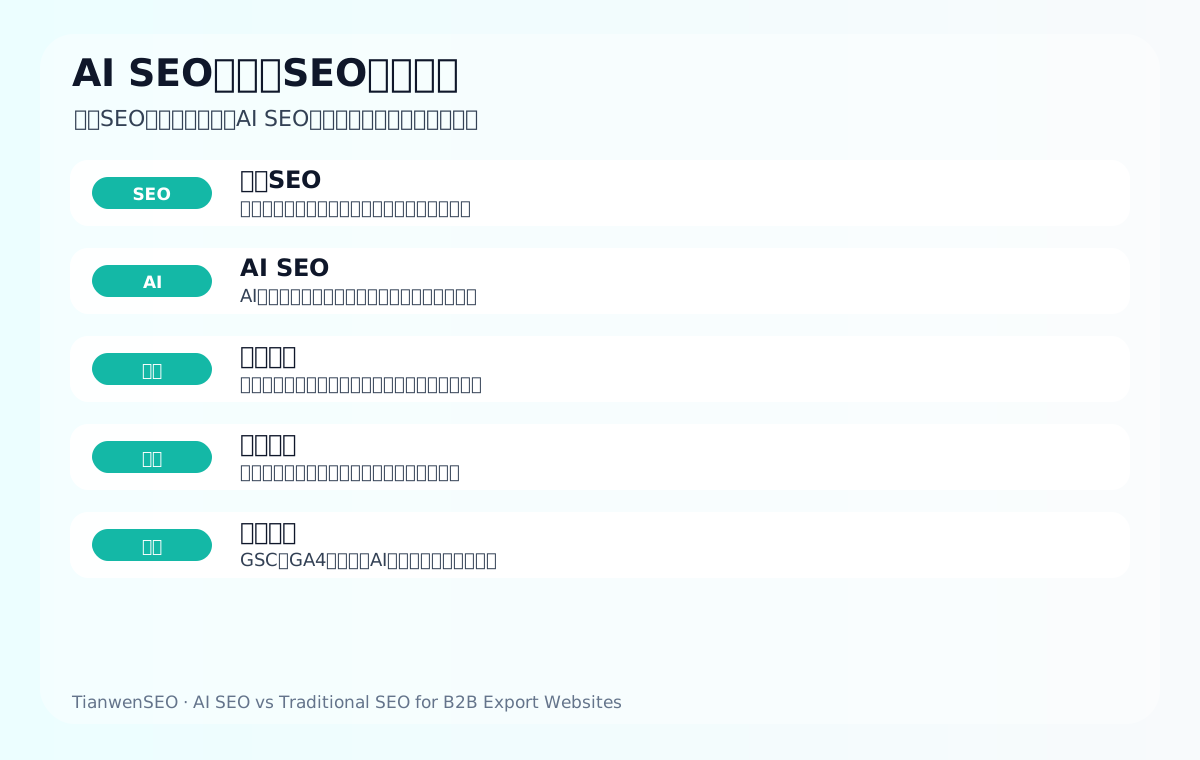
Official definition boundaries: what AI SEO, traditional SEO, GEO, and AEO can each confirm
The term AI SEO is widely used in the industry.
But when building an export website, you cannot start work based on a new term alone. First, clarify the boundaries: what comes from official sources such as Google, Search Console, GA4, and Bing Webmaster Tools, and what are method names we have organized for easier execution.
The clearer the boundaries, the less likely a project is to go off track.
Mapping table of official sources and concept boundaries
| Source entry | What it can confirm | What it cannot confirm for you |
|---|---|---|
| Google Search Central: SEO Starter Guide | The foundations of traditional SEO are still about helping search engines crawl, understand, and present web pages. | It does not show that merely adding AI-related paragraphs will get a page adopted by AI answers. |
| Google Search Central: Search Essentials | A site must first meet requirements for crawlability, indexability, compliant content, and anti-spam. | You cannot package low-quality content as AI SEO and bypass basic search rules. |
| Google Search Central: AI features and your website | Google’s AI features still rely on the search system understanding page content, and sites need to remain accessible, indexable, and clearly written. | It cannot promise that a given page will appear in AI Overview or other AI displays. |
| Google Search Central: Structured data general guidelines | Schema must match the visible content on the page; you must not mark up arbitrarily, falsely, or excessively. | Structured data cannot be treated as a direct switch for AI citations. |
| Search Console Help: Performance report | Search performance fields such as clicks, impressions, CTR, average position, queries, pages, countries, and devices. | It cannot on its own prove that an AI platform has cited the official site; when there is no row data, you certainly must not invent search performance. |
| Google Analytics Help: About events | On-site behaviors such as form submissions, button clicks, email clicks, and WhatsApp clicks can be observed through events. | A single on-site event cannot be directly interpreted as an inquiry generated by AI SEO. |
| OpenAI Platform: Bots | You can check robots and logs to see whether the relevant crawling access is allowed. | It does not mean ChatGPT will definitely display the content of a given page. |
| Bing Webmaster Blog: AI Performance | If visible in your account, you can observe impressions, citations, and click metrics related to Bing AI Performance. | It does not represent all AI search platforms and cannot replace manual sampling. |
Execution boundaries of AI SEO, GEO, AEO, and traditional SEO
| Term | How best to understand it | What to check at acceptance |
|---|---|---|
| Traditional SEO | First make pages crawlable, indexable, and understandable, and able to serve real search demand. | Index status, page titles, body content quality, internal links, structured data, Search Console data. |
| AI SEO | On top of traditional SEO, make page facts, structure, entities, and evidence easier for search and AI systems to understand. | Whether product facts are clear, tables are extractable, FAQs answer real questions, and evidence can be verified. |
| GEO | Leans toward generative answer scenarios, focusing on whether answers mention the brand, official site, product facts, and cited sources. | A fixed query set, platform, date, answer screenshots, whether the official site is cited, and which page is cited. |
| AEO | Leans toward answer-oriented content organization, writing questions, definitions, steps, comparisons, and judgment criteria more clearly. | Whether the page directly answers procurement questions and whether answers are short, accurate, and verifiable. |
How to write AI SEO conclusions when there is no GSC signal
A common situation for new sites is that Search Console temporarily has no query or page row data.
At this point, conclusions must be restrained. You can write: a query set, page mapping, citable modules, GA4 events, and an AI answer sampling table have been established. You cannot write: keywords have already improved, AI already cites us consistently, or inquiries are already coming from AI SEO.
| Current evidence | Conclusions you can write | Conclusions you cannot write |
|---|---|---|
| GSC has no query row data yet | Search performance has not yet formed an analyzable sample and needs continued observation. | Rankings for a certain keyword have improved. |
| The page has had a fact table and FAQ added | Page readability and extractable structure have been enhanced. | AI platforms will definitely use this content. |
| GA4 events have been configured | On-site behaviors such as forms, buttons, and email clicks can be observed going forward. | Current inquiries definitely come from AI search. |
| AI answer sampling has been established | Answer changes can be recorded against a fixed query set. | A single sample represents long-term results. |
So AI SEO is not just giving SEO a new name. It is more like a stricter discipline of page evidence engineering. First make web pages stand up to search system understanding, then give answer-oriented scenarios usable material.
I. AI SEO is first of all not an AI writing tool
AI can help organize outlines, expand paragraphs, generate tables, and check issues, but AI writing tools themselves are not equal to AI SEO. The core of AI SEO is making content and brands easier to understand and cite correctly in AI answer systems.
If a page merely uses AI to write a lot of vague text without product facts, evidence, structure, and entity consistency, it becomes even harder to be a trusted source.
| Concept | Common misunderstanding | Correct understanding |
|---|---|---|
| AI writing | Using AI to write articles is AI SEO | It is only an efficiency tool |
| AI SEO | Getting content into AI answers | Requires a page and entity foundation |
| GEO/AEO | Completely different from SEO | They are extensions built on SEO |
| AI citation | Can be fully controlled | You can only improve probability and accuracy |
| AI monitoring | One screenshot is enough | A continuous baseline is needed |
II. Traditional SEO is still the foundation of AI SEO
If pages cannot be crawled or indexed, canonicals are wrong, mobile content is invisible, or company entities are inconsistent, AI SEO will also struggle to be stable. AI answer systems likewise need accessible, trustworthy, and clearly structured sources.
So export sites cannot skip technical SEO, content SEO, internal links, and brand materials in order to chase AI mentions directly.
| Traditional SEO foundation | Role for AI SEO | Export example |
|---|---|---|
| Crawling and indexing | Makes pages discoverable | Product pages enter the index |
| Content quality | Provides trustworthy facts | LED flood light wattage table |
| Internal link structure | Clarifies page relationships | Blog links to category pages |
| External evidence | Strengthens trusted sources | Certificates and industry directories |
| Page experience | Lowers user effort | Mobile-readable tables |
III. What AI SEO adds: citability at the answer layer
Traditional SEO often looks at rankings and clicks; AI SEO also looks at whether answers mention you, cite you, are accurate, cite the official site or a third party, and describe your products and company correctly.
For example, for a waterproof connector company, if AI answers cite a platform page rather than the official website, it may indicate that the official site lacks clearer explanations of IP ratings, wire gauges, applications, and certifications.
| AI SEO dimension | What to look at | Page action |
|---|---|---|
| Mention | Whether the brand or official site appears | Add entity materials |
| Citation | Which URL is cited | Add resource pages and tables |
| Accuracy | Whether descriptions are correct | Fix definitions and product lines |
| Competition | Why competitors appear | Compare evidence and structure |
| Conversion | Whether it brings follow-up visits | Add inquiry paths |
IV. For export websites doing AI SEO, product facts come first
Export AI SEO is not about writing more concepts, but about stating product facts clearly. Both AI and buyers need materials, specifications, applications, certifications, MOQ, lead times, packaging, testing, after-sales, and quotation materials.
A custom metal parts page needs materials, tolerances, surface finishes, drawing formats, and inspection processes; a medical probe page needs certifications, compatible devices, materials, sterilization, and testing descriptions.
| Product fact | Why it matters | Example |
|---|---|---|
| Specifications | Makes it easier to judge a match | 200w LED flood light |
| Materials | Affects purchasing choices | stainless steel parts |
| Certifications | Affects target markets | medical probe certification |
| MOQ/lead time | Affects quotation requests | private label activewear MOQ |
| Testing | Builds trust | waterproof connector IP test |
V. Citable structure: definitions, tables, FAQs, and steps
AI answers more easily extract clear definitions, tables, steps, comparisons, and FAQs. Long marketing paragraphs are not good for citation. Export sites should turn key facts into clear modules.
For example, a packaging machine page can have a material-to-machine matching table, selection steps, common pitfalls, and a quotation materials checklist, rather than only writing about company strengths.
| Structure module | Function | Export example |
|---|---|---|
| Definition | Helps AI understand the topic | What are cnc machining parts |
| Table | Easier to extract and compare | Materials/tolerances/surface finishes |
| Steps | Answers how to do it | Packaging machine selection process |
| FAQ | Covers procurement questions | MOQ, lead time, certification |
| Resource page | Provides trusted sources | Certificates and test reports |
VI. Entity consistency: AI SEO cares a lot about whether the company and product lines are clear
Entity consistency includes the company’s English name, brand, product lines, address, phone, certificates, platform profiles, social media, trade shows, and website descriptions. Inconsistent information confuses AI answers.
If an industrial valve supplier writes different company names and product lines on different platforms, AI may be unable to determine its true identity.
| Entity item | Common problem | Correction |
|---|---|---|
| Company name | Chinese and English names inconsistent | Unify public materials |
| Product lines | Descriptions scattered | Establish a core description |
| Certificates | Unclear entity | Add a certificates page |
| Platform profiles | Existing materials not updated | Correct item by item |
| Author/team | Unclear source | Add professional background |
VII. AI SEO and traditional SEO use different metrics, but they should be read together
Traditional SEO looks at GSC queries, impressions, clicks, CTR, rankings, and indexing; AI SEO looks at AI answer mentions, cited sources, accuracy, competitor appearances, and brand descriptions. Both ultimately come back to GA4 paths and inquiry quality.
If AI mentions you but there is no follow-up visit, you should still look at branded search, direct traffic, and sales feedback.
| Metric | Traditional SEO | AI SEO |
|---|---|---|
| Visibility | Impressions and rankings | AI answer mentions |
| Clicks | CTR and visits | Branded search after citation |
| Content | Page coverage | Extractable structure |
| Trust | Links and brand | Entities and sources |
| Business | Conversion events | Inquiry quality |
VIII. What AI SEO cannot promise
AI answers change dynamically, affected by query, context, system, sources, and region. You cannot promise being cited every time, a specific ranking, or a definite number of inquiries.
What can be promised is: establishing a baseline, correcting entities, strengthening pages, improving citable structure, and reviewing answer accuracy and business results.
| Cannot promise | Reason | Work that can be done |
|---|---|---|
| Being cited every time | AI answers are dynamic | Improve citability |
| A specific ranking | Search has many factors | Improve page quality |
| A definite number of inquiries | Business is not fully controllable | Improve paths and review |
| Immediate results | System updates take time | Set a review cadence |
| Proving results with one screenshot | The sample is too small | Keep recording the baseline |
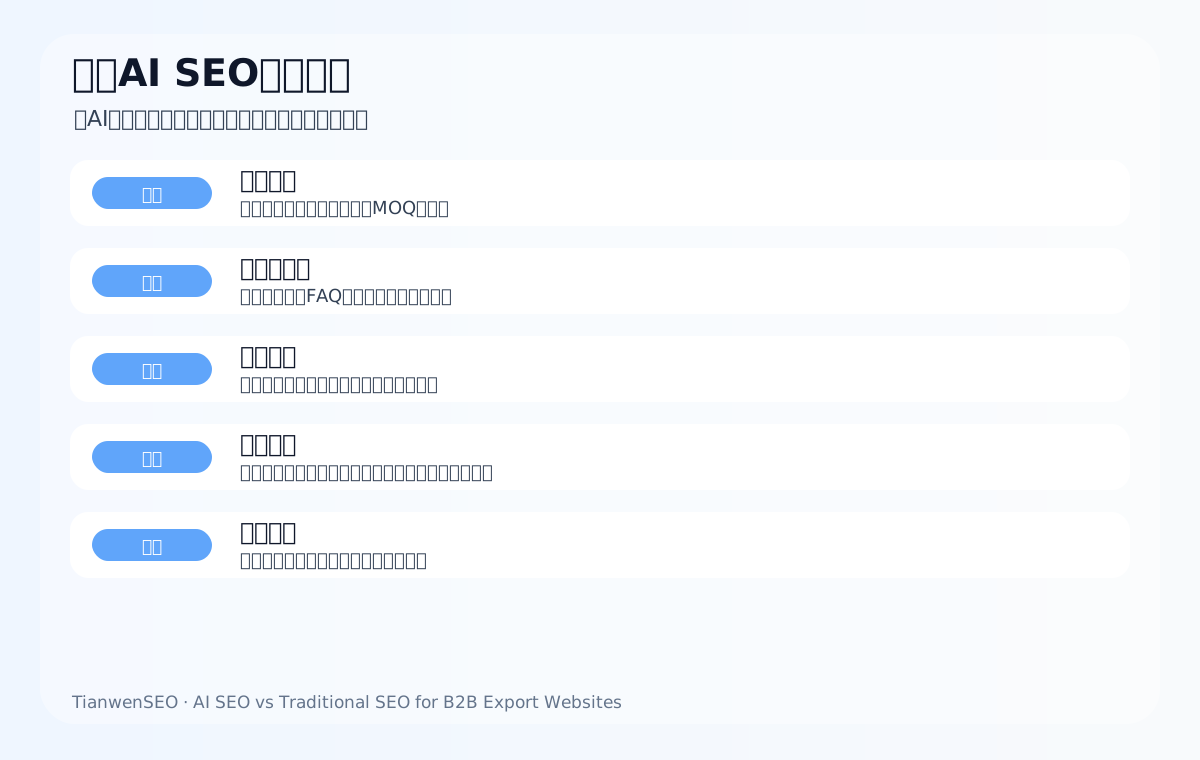
IX. Which pages to start AI SEO with
Start with core product pages, category pages, application pages, resource pages, company introductions, and high-value guides, rather than mass-producing generic articles first.
Execution must land on specific product lines, such as custom metal parts, LED flood light, packaging machine, medical probe, and waterproof connector, not just abstract concepts.
X. How to combine AI SEO with content refreshes
Turn existing pages into clearer definitions, tables, FAQs, resources, and product entry points, rather than simply changing titles.
Execution must land on specific product lines, such as custom metal parts, LED flood light, packaging machine, medical probe, and waterproof connector, not just abstract concepts.
XI. How to combine AI SEO with GSC
GSC shows real queries and baseline page performance; the AI answer baseline shows answer-layer performance, and the two can explain each other.
Execution must land on specific product lines, such as custom metal parts, LED flood light, packaging machine, medical probe, and waterproof connector, not just abstract concepts.
XII. How to combine AI SEO with GA4
GA4 shows whether AI or brand visibility brings follow-up visits, product page paths, and inquiry events.
Execution must land on specific product lines, such as custom metal parts, LED flood light, packaging machine, medical probe, and waterproof connector, not just abstract concepts.
XIII. How to combine AI SEO with sales feedback
Sales feedback tells you whether AI and your pages answer the questions customers really care about.
Execution must land on specific product lines, such as custom metal parts, LED flood light, packaging machine, medical probe, and waterproof connector, not just abstract concepts.
XIV. The relationship between AI SEO and backlinks/brand signals
External trusted sources affect how AI and search understand a brand, but they must be genuinely relevant; do not chase irrelevant quantity.
Execution must land on specific product lines, such as custom metal parts, LED flood light, packaging machine, medical probe, and waterproof connector, not just abstract concepts.
XV. The relationship between AI SEO and Schema
Structured data helps understanding, but it must match the real content of the page; you cannot invent ratings or inventory.
Execution must land on specific product lines, such as custom metal parts, LED flood light, packaging machine, medical probe, and waterproof connector, not just abstract concepts.
XVI. The relationship between AI SEO and multilingual export sites
English product term pages need clear language, and entity and certificate materials must be consistent with the target market.
Execution must land on specific product lines, such as custom metal parts, LED flood light, packaging machine, medical probe, and waterproof connector, not just abstract concepts.
XVII. Common misconceptions about AI SEO
Equating AI writing with AI SEO, looking only at screenshots, ignoring technical foundations, and using service-industry terms as export examples are all common misconceptions.
Execution must land on specific product lines, such as custom metal parts, LED flood light, packaging machine, medical probe, and waterproof connector, not just abstract concepts.
XVIII. How to review an AI SEO project
Track AI answers, cited sources, GSC queries, GA4 paths, and inquiry quality at 30/60/90 days.
Execution must land on specific product lines, such as custom metal parts, LED flood light, packaging machine, medical probe, and waterproof connector, not just abstract concepts.
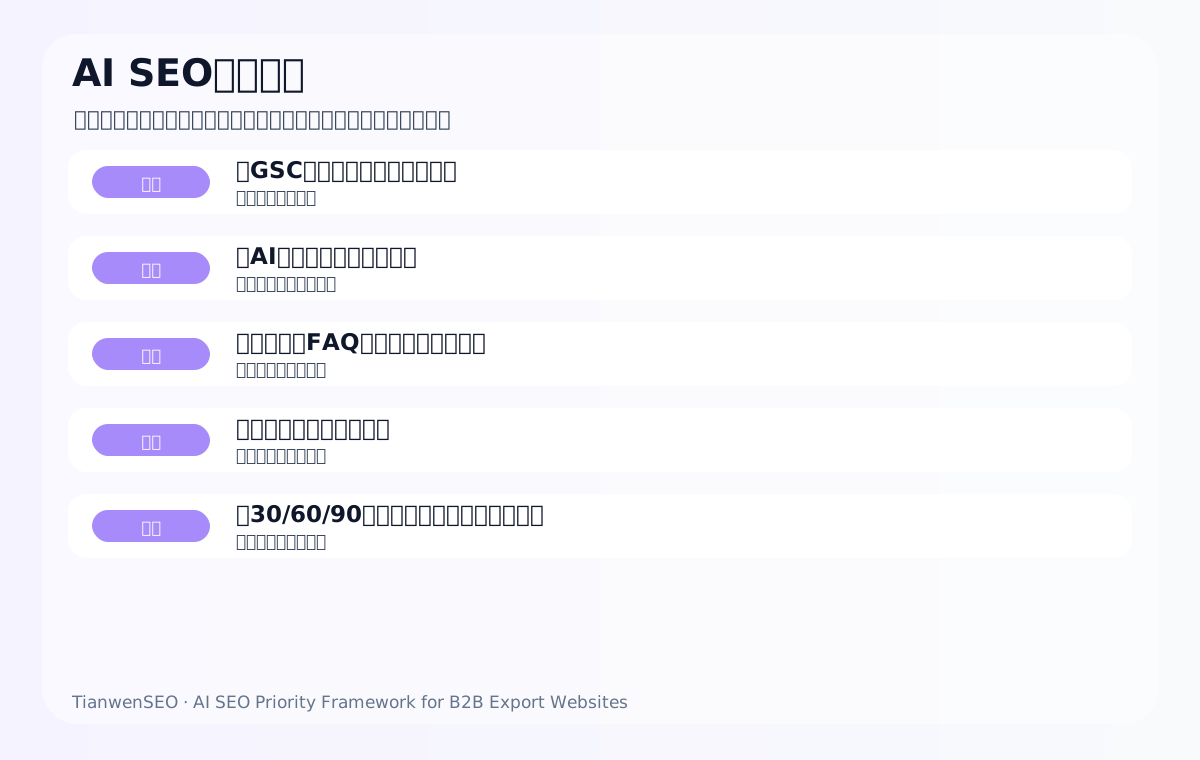
Export example 1: How to do AI SEO for custom metal parts
For custom metal parts, AI SEO must first state materials, tolerances, surface finishes, drawings, and quality inspection clearly, then check whether AI answers accurately describe the product and company. The page needs a clear definition, a selection table, FAQs, resource pages, and quotation preparation notes.
If AI answers cite third-party platforms or competitors, judge whether the official site lacks citable structure, whether entity information is consistent, and whether external materials are outdated.
Export example 2: How to do AI SEO for LED flood light
For LED flood light, AI SEO must first state wattage, waterproofing, installation height, applications, and warranty clearly, then check whether AI answers accurately describe the product and company. The page needs a clear definition, a selection table, FAQs, resource pages, and quotation preparation notes.
If AI answers cite third-party platforms or competitors, judge whether the official site lacks citable structure, whether entity information is consistent, and whether external materials are outdated.
Export example 3: How to do AI SEO for packaging machine
For packaging machine, AI SEO must first state materials, speed, bag type, automation, and after-sales clearly, then check whether AI answers accurately describe the product and company. The page needs a clear definition, a selection table, FAQs, resource pages, and quotation preparation notes.
If AI answers cite third-party platforms or competitors, judge whether the official site lacks citable structure, whether entity information is consistent, and whether external materials are outdated.
Export example 4: How to do AI SEO for medical probe
For medical probe, AI SEO must first state certifications, compatibility, materials, sterilization, and testing clearly, then check whether AI answers accurately describe the product and company. The page needs a clear definition, a selection table, FAQs, resource pages, and quotation preparation notes.
If AI answers cite third-party platforms or competitors, judge whether the official site lacks citable structure, whether entity information is consistent, and whether external materials are outdated.
Export example 5: How to do AI SEO for cnc machining parts
For cnc machining parts, AI SEO must first state DFM, mass production, inspection reports, and quotation materials clearly, then check whether AI answers accurately describe the product and company. The page needs a clear definition, a selection table, FAQs, resource pages, and quotation preparation notes.
If AI answers cite third-party platforms or competitors, judge whether the official site lacks citable structure, whether entity information is consistent, and whether external materials are outdated.
Export example 6: How to do AI SEO for ceramic dinnerware
For ceramic dinnerware, AI SEO must first state material, glaze color, packaging, MOQ, and customization clearly, then check whether AI answers accurately describe the product and company. The page needs a clear definition, a selection table, FAQs, resource pages, and quotation preparation notes.
If AI answers cite third-party platforms or competitors, judge whether the official site lacks citable structure, whether entity information is consistent, and whether external materials are outdated.
Export example 7: How to do AI SEO for waterproof connector
For waterproof connector, AI SEO must first state IP rating, wire gauge, current, and outdoor applications clearly, then check whether AI answers accurately describe the product and company. The page needs a clear definition, a selection table, FAQs, resource pages, and quotation preparation notes.
If AI answers cite third-party platforms or competitors, judge whether the official site lacks citable structure, whether entity information is consistent, and whether external materials are outdated.
Export example 8: How to do AI SEO for industrial valve supplier
For industrial valve supplier, AI SEO must first state materials, pressure, standards, and operating conditions clearly, then check whether AI answers accurately describe the product and company. The page needs a clear definition, a selection table, FAQs, resource pages, and quotation preparation notes.
If AI answers cite third-party platforms or competitors, judge whether the official site lacks citable structure, whether entity information is consistent, and whether external materials are outdated.
Export example 9: How to do AI SEO for private label activewear manufacturer
For private label activewear manufacturer, AI SEO must first state fabric, sizes, sampling, MOQ, and packaging clearly, then check whether AI answers accurately describe the product and company. The page needs a clear definition, a selection table, FAQs, resource pages, and quotation preparation notes.
If AI answers cite third-party platforms or competitors, judge whether the official site lacks citable structure, whether entity information is consistent, and whether external materials are outdated.
Export example 10: How to do AI SEO for solar mounting bracket
For solar mounting bracket, AI SEO must first state materials, wind load, installation, and certification clearly, then check whether AI answers accurately describe the product and company. The page needs a clear definition, a selection table, FAQs, resource pages, and quotation preparation notes.
If AI answers cite third-party platforms or competitors, judge whether the official site lacks citable structure, whether entity information is consistent, and whether external materials are outdated.
XIX. AI SEO step one: establish an answer baseline
Do not rush to change pages first; record what AI answers currently say for your target questions. Record the query, tool, time, answer summary, whether the official site is mentioned, cited sources, competitors, error points, and next actions. Without a baseline, you cannot tell whether later optimization works.
For example, product lines such as custom metal parts, LED flood light, packaging machine, medical probe, and waterproof connector all need AI SEO actions to land on product pages, category pages, application pages, resource pages, and inquiry paths, rather than only discussing AI tools themselves.
XX. AI SEO step two: check traditional SEO foundations
If core pages are not indexed, load very slowly, lack mobile content, have canonical errors, or have broken internal links, AI SEO will also struggle to be stable. First use GSC, crawling tools, and front-end checks to confirm page foundations.
For example, product lines such as custom metal parts, LED flood light, packaging machine, medical probe, and waterproof connector all need AI SEO actions to land on product pages, category pages, application pages, resource pages, and inquiry paths, rather than only discussing AI tools themselves.
XXI. AI SEO step three: add product facts and resource pages
AI answers need reliable facts. Export sites must clearly write product specifications, materials, certifications, applications, MOQ, lead times, packaging, testing, and quotation materials, and present them through resource pages, FAQs, and tables.
For example, product lines such as custom metal parts, LED flood light, packaging machine, medical probe, and waterproof connector all need AI SEO actions to land on product pages, category pages, application pages, resource pages, and inquiry paths, rather than only discussing AI tools themselves.
XXII. AI SEO step four: unify the company entity
Check whether the official website, B2B platforms, trade show pages, social media, certificates, and company introduction use a consistent English name, brand, address, product lines, and contact details. Entity confusion makes AI answers unstable.
For example, product lines such as custom metal parts, LED flood light, packaging machine, medical probe, and waterproof connector all need AI SEO actions to land on product pages, category pages, application pages, resource pages, and inquiry paths, rather than only discussing AI tools themselves.
XXIII. AI SEO step five: optimize extractable structure
Write key definitions, decision tables, steps, FAQs, comparisons, and cautions as clear modules. AI does not like vague marketing paragraphs, and neither do buyers.
For example, product lines such as custom metal parts, LED flood light, packaging machine, medical probe, and waterproof connector all need AI SEO actions to land on product pages, category pages, application pages, resource pages, and inquiry paths, rather than only discussing AI tools themselves.
XXIV. AI SEO step six: add internal links and page relationships
Product pages, category pages, application pages, resource pages, and guide pages should link to each other, so search and AI systems understand which page is the main entry point, which page explains a sub-question, and which page provides evidence.
For example, product lines such as custom metal parts, LED flood light, packaging machine, medical probe, and waterproof connector all need AI SEO actions to land on product pages, category pages, application pages, resource pages, and inquiry paths, rather than only discussing AI tools themselves.
XXV. AI SEO step seven: keep reviewing answer accuracy
Review core questions monthly or quarterly, recording whether answers are more accurate, whether cited sources are more reasonable, and whether competitors still occupy the main positions. Do not treat a single screenshot as a long-term result.
For example, product lines such as custom metal parts, LED flood light, packaging machine, medical probe, and waterproof connector all need AI SEO actions to land on product pages, category pages, application pages, resource pages, and inquiry paths, rather than only discussing AI tools themselves.
XXVI. AI SEO content should not be only FAQs
FAQs are useful but cannot replace product facts, application descriptions, selection tables, resource pages, and company entities. Pages with only FAQs often lack support and are hard to turn into strong sources.
For example, product lines such as custom metal parts, LED flood light, packaging machine, medical probe, and waterproof connector all need AI SEO actions to land on product pages, category pages, application pages, resource pages, and inquiry paths, rather than only discussing AI tools themselves.
XXVII. The relationship between AI SEO and branded search
AI answers may not bring direct clicks, but they affect brand perception and later branded search. When reviewing, look at brand terms, direct traffic, product page paths, and sales feedback.
For example, product lines such as custom metal parts, LED flood light, packaging machine, medical probe, and waterproof connector all need AI SEO actions to land on product pages, category pages, application pages, resource pages, and inquiry paths, rather than only discussing AI tools themselves.
XXVIII. The relationship between AI SEO and inquiry quality
If both AI answers and official pages explain product applicability, MOQ, certification, and quotation materials more clearly, inquiries are usually more specific. When reviewing, look at inquiry fields, not just traffic.
For example, product lines such as custom metal parts, LED flood light, packaging machine, medical probe, and waterproof connector all need AI SEO actions to land on product pages, category pages, application pages, resource pages, and inquiry paths, rather than only discussing AI tools themselves.
XXIX. How to keep an AI SEO project from going off track
Avoid turning all work into AI-written drafts, screenshot displays, or concept packaging. Every action must correspond to a specific URL, a specific product term, a specific page module, and a specific review metric.
For example, product lines such as custom metal parts, LED flood light, packaging machine, medical probe, and waterproof connector all need AI SEO actions to land on product pages, category pages, application pages, resource pages, and inquiry paths, rather than only discussing AI tools themselves.
XXX. The relationship between AI SEO and content asset building
AI SEO requires content to be clearer, more structured, and more trustworthy. This aligns with long-form asset building: not vague expansion, but adding decision tables, processes, FAQs, evidence, and actionable recommendations.
For example, product lines such as custom metal parts, LED flood light, packaging machine, medical probe, and waterproof connector all need AI SEO actions to land on product pages, category pages, application pages, resource pages, and inquiry paths, rather than only discussing AI tools themselves.
XXXI. Execution differences between AI SEO and traditional SEO
AI SEO and traditional SEO are not an either/or choice; they have different focuses. Traditional SEO focuses more on whether a page can earn search impressions and clicks; AI SEO focuses more on whether answer systems can accurately understand and cite it. For export sites, both must ultimately serve product lines and inquiries.
| Dimension | Traditional SEO focus | New AI SEO focus | Export implementation |
|---|---|---|---|
| Technical | Crawling, indexing, speed | AI crawling and page parseability | Core product pages accessible |
| Content | Search intent and rankings | Definitions, tables, extractable answers | Clear specifications, applications, certifications |
| Links | Authority and discovery | Trusted sources and citation basis | Certificates, directories, trade show materials |
| Brand | Branded search and trust | Entity consistency and answer accuracy | Unified company name and product lines |
| Review | GSC clicks and rankings | AI mentions, citations, and descriptions | Combine with inquiry quality |
XXXII. AI SEO content module checklist
An export page better suited to AI answers and buyer reading usually needs these modules: a one-sentence definition, applicable scenarios, specification parameters, a selection table, FAQs, risk reminders, certification evidence, resource downloads, quotation preparation, related product entry points, and company entity description. Modules do not all have to appear on the same page, but core product lines should form a complete page group.
For example, for a waterproof connector product line, the category page can carry the head term, product pages can carry models and specifications, application pages can cover scenarios such as outdoor lighting, marine, and solar, resource pages can carry IP testing and certification, and FAQs can cover procurement questions. AI SEO should optimize this group of pages, not a single article.
XXXIII. Industry-specific AI SEO priorities
Different export industries have different AI SEO priorities. Machinery and equipment should cover materials, speed, maintenance, and after-sales; electronic connectors should cover specifications, certifications, wire gauges, and application environments; medical accessories should cover certifications, compatibility, testing, and quality systems; home and tableware should cover materials, glaze color, packaging, MOQ, and customization; apparel customization should cover fabric, sizes, sampling, lead times, and packaging.
| Industry | Information AI tends to miss | Page modules to add | Review focus |
|---|---|---|---|
| Machinery and equipment | Speed, materials, maintenance | Selection table, process diagram, after-sales FAQ | Application terms and inquiry parameters |
| Connectors and electronics | IP rating, wire gauge, current | Specification table, application pages, test materials | Specification terms and citation accuracy |
| Medical accessories | Certifications, compatibility, testing | Resource pages, certificate pages, FAQs | Trust and incorrect descriptions |
| Tableware and home goods | MOQ, packaging, customization | Wholesale table, customization process, image descriptions | Supplier terms and inquiry quality |
| Apparel customization | Fabric, sizes, sampling | Fabric table, sampling process, packaging notes | Matching the procurement stage |
XXXIV. Common reasons AI SEO fails
AI SEO usually fails not because a certain tool was not used, but because the foundational pages are not clear enough: pages are not indexed, content is too generic, product facts are insufficient, company entities are inconsistent, external materials are outdated, resource pages are missing, tables and FAQs are absent, inquiry paths are broken, and only screenshots are checked without review. Solving these problems matters more than chasing new terms.
If a page is very long but has no specific product facts, AI may not treat it as a reliable source; if the official site and external platforms describe the company inconsistently, AI may cite the wrong source; if the page has no next-step entry point, awareness generated by AI will struggle to become an inquiry.
XXXV. A 90-day AI SEO implementation plan
In the first 30 days, the focus is establishing a baseline and fixing foundations: confirm indexing of core pages, organize the target query set, record AI answers, verify company entities and external materials, and identify incorrect descriptions and cited sources. Do not mass-generate new content right away.
In the second 30 days, the focus is changing pages: add product definitions, specification tables, FAQs, resource pages, company introductions, certificate pages, application pages, and internal links. Every change must correspond to a specific URL and a specific English product term, such as LED flood light, packaging machine, or medical probe.
In the third 30 days, the focus is review: check whether AI answers are more accurate, whether GSC queries have expanded, whether GA4 paths are clearer, whether inquiries include more complete product parameters, and whether sales feedback shows fewer repeated explanations. If nothing has changed, determine whether page updates were insufficient, external sources are confusing, or the query set was chosen poorly.
| Phase | Key work | Deliverables | Review metrics |
|---|---|---|---|
| 0-30 days | Baseline and entity verification | Query set, answer records, entity table | List of error points and sources |
| 31-60 days | Page and resource strengthening | Definitions, tables, FAQs, resource pages | GSC queries and page paths |
| 61-90 days | Answer and business review | Review table and next batch plan | AI accuracy, inquiry quality |
XXXVI. Judging whether an AI SEO service or plan is reliable
A reliable AI SEO plan will first discuss foundations, the query set, entities, pages, and review, and will not only show one or two screenshots of AI answers. It will explain which results are uncontrollable, which work is verifiable, which pages need changes, which data requires authorization, and when to review.
If a plan only promises exposure, recommendations, or quick results, without discussing crawl and index status, page structure, product facts, entity consistency, cited sources, and inquiry quality, be cautious. What export companies need is sustainable page assets, not one-off concept packaging.
Finally, emphasize data boundaries: without GSC and GA4 authorization, you can only make judgments about public pages, public AI answers, and public sources; with authorized data, you can connect queries, pages, visit paths, and inquiry quality. Do not write speculation without data support as a case study, and do not treat a single AI answer as a long-term trend.
This is also why AI SEO should be done together with traditional SEO: traditional SEO provides the page foundation and search data, AI SEO adds answer-layer observation, and sales feedback validates business value. Only the three together are suitable for long-term investment by export companies.
If you look at only one dimension, it is easy to misjudge: having an AI mention does not mean having inquiries, having a ranking does not mean answers are accurate, and having visits does not mean buyers match.
So the review table should be kept and updated, reviewed, and compared month by month.
The more complete the records, the more stable later judgments will be.
FAQ: Common questions about what AI SEO is
What is AI SEO?
AI SEO is optimization work that, on top of traditional SEO, makes content and brands easier for AI answer systems to correctly understand, mention, and cite.
Is AI SEO the same as AI writing?
No. AI writing is only an efficiency tool; AI SEO focuses on answer visibility, cited sources, entity consistency, and content credibility.
Will AI SEO replace traditional SEO?
No. Crawling, indexing, content quality, and technical foundations in traditional SEO remain the foundation of AI SEO.
Should export companies do AI SEO or traditional SEO first?
First confirm the traditional SEO foundations, then add citable structure, entity consistency, and AI answer review.
Can AI SEO guarantee being cited by ChatGPT?
No. It can improve understandability and citability, but it cannot promise specific AI answer results.
Which pages are best to change first for AI SEO?
Core product pages, category pages, application pages, resource pages, company introduction, and high-value guides.
Which metrics should AI SEO look at?
AI answer mentions, cited sources, description accuracy, GSC queries, GA4 paths, branded search, and inquiry quality.
Is Schema useful for AI SEO?
It helps, but it must be based on real page content and cannot replace body text and evidence.
How should export product terms be used in AI SEO?
Use English product terms to organize definitions, tables, FAQs, applications, specifications, and quotation materials.
How often should AI SEO be reviewed?
In the early stage, review answers and sources at 30 days; at 60-90 days, judge together with search, visits, and inquiries.
Conclusion: AI SEO is not a shortcut, but SEO with higher requirements
AI SEO has not made traditional SEO obsolete; it has increased the importance of content clarity, evidence, entity consistency, and citable structure. If export companies only use AI to write more generic articles, it is hard to gain a long-term advantage; if they build product facts, page systems, brand entities, and inquiry paths solidly, they can serve both traditional search and AI answers.
So the correct order for AI SEO is: first do crawl, index, and page foundations well, then add product facts and structured expression, then verify entities and external sources, and finally keep reviewing with an AI answer baseline, GSC, GA4, and sales feedback.
Continue reading this set of GEO resources
If you are systematically learning about GEO and AI search visibility, it is recommended to continue with the following articles. Understand the concepts first, then look at diagnosis, monitoring, content structure, and cooperation boundaries.
- How to do AI Visibility Monitoring: an AI visibility monitoring guide for new export sites
- What is AEO: why answer engine optimization is not just writing FAQs, and what export websites should do
- What is GEO: how it differs from SEO and AEO, and what export websites should do
- What is Google SEO: from crawling, indexing, and ranking to AI search and export inquiries
- What is the relationship between GEO and content SEO: why writing more is not enough
- What is the relationship between GEO and brand authority: why AI search increasingly looks at brands
{
“@context”: “https://schema.org”,
“@type”: “FAQPage”,
“mainEntity”: [
{
“@type”: “Question”,
“name”: “What is AI SEO?”,
“acceptedAnswer”: {
“@type”: “Answer”,
“text”: “AI SEO is optimization work that, on top of traditional SEO, makes content and brands easier for AI answer systems to correctly understand, mention, and cite.”
}
},
{
“@type”: “Question”,
“name”: “Is AI SEO the same as AI writing?”,
“acceptedAnswer”: {
“@type”: “Answer”,
“text”: “No. AI writing is only an efficiency tool; AI SEO focuses on answer visibility, cited sources, entity consistency, and content credibility.”
}
},
{
“@type”: “Question”,
“name”: “Will AI SEO replace traditional SEO?”,
“acceptedAnswer”: {
“@type”: “Answer”,
“text”: “No. Crawling, indexing, content quality, and technical foundations in traditional SEO remain the foundation of AI SEO.”
}
},
{
“@type”: “Question”,
“name”: “Should export companies do AI SEO or traditional SEO first?”,
“acceptedAnswer”: {
“@type”: “Answer”,
“text”: “First confirm the traditional SEO foundations, then add citable structure, entity consistency, and AI answer review.”
}
},
{
“@type”: “Question”,
“name”: “Can AI SEO guarantee being cited by ChatGPT?”,
“acceptedAnswer”: {
“@type”: “Answer”,
“text”: “No. It can improve understandability and citability, but it cannot promise specific AI answer results.”
}
}
]
}
This page is machine-translated from the Simplified Chinese version and awaiting human review. It has not yet been proofread.