What is the relationship between GEO and content SEO? The simplest answer is that content SEO is still the foundation for an export website to be found by search and understood by AI, and GEO builds on that foundation to improve a page’s ability to be cited, integrated, and correctly restated in generative AI answers. The real question is not “should we still write content,” but “what content should we write, which page should it live on, which procurement problem does it solve, can it be verified, and can it generate clearer inquiries.” If GEO is understood only as writing more articles, an export website can easily become more scattered the more it writes, page signals get diluted, and AI finds it even harder to judge what you are actually good at.
This article uses export-oriented English product terms such as custom metal parts, LED flood light, packaging machine, medical probe, cnc machining parts, ceramic dinnerware, waterproof connector, industrial valve supplier, and private label activewear manufacturer to explain: why GEO is not “publishing more content,” why content SEO cannot stop at keyword coverage, how export websites should distinguish product pages, category pages, application pages, resource pages, and conversion pages, how to decide whether an article should be expanded, merged, split, or kept, and how to review results using GSC, GA4, AI answer screenshots, inquiry sources, and sales feedback.
Target queries: what is the relationship between GEO and content SEO, GEO content SEO, Generative Engine Optimization content strategy, why more content is not enough for SEO/GEO. Search intent: users want to know whether GEO replaces content SEO, whether they should write large amounts of AI-friendly content, why writing many articles still brings no AI citations or inquiries, and how export websites should restructure their content system. Top1/authoritative benchmarks: pages from Built In, Tacmind, Siegemedia, Shadow, ContentForce, and others generally explain the difference between GEO and SEO and content strategy; articles from Aztekweb, DAU, and others stress that “more content” is not the answer to SEO; GEO-related papers and industry discussions emphasize content structure, entities, and citations. This article fills in the role of export product pages, signal density, content consolidation, procurement question mapping, and business review.
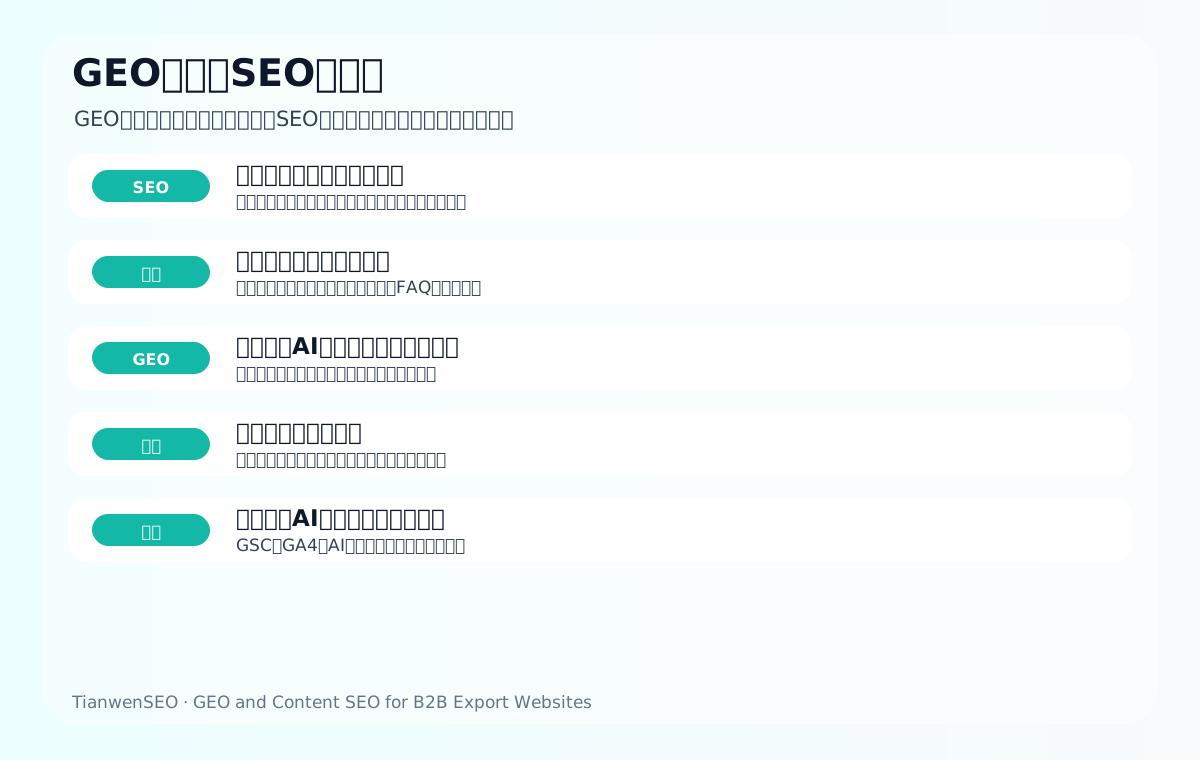
The conclusion first: GEO is not about writing more, but about making valuable pages stronger
Many export businesses used to do content SEO by continuously publishing articles around a keyword list. That approach works at certain stages, but its problems are obvious: the more articles there are, the more confused the page roles become; multiple pages target the same product term and compete for intent; and large amounts of generic content have no product facts, no decision tables, and no inquiry path. In the era of AI search, these problems get amplified. AI systems need to judge which topics a website is reliable on, and if the content is both abundant and scattered, it becomes harder for them to form a clear understanding.
What GEO really drives is not a “content volume race” but a “signal density race.” A strong 15000-word page that clearly explains the applications, IP ratings, cable diameter, pin count, certifications, installation, common mistakes, and inquiry checklist for a waterproof connector may be more valuable than 20 generic connector blog posts. A clear packaging machine selection guide that covers materials, bag types, speed, accuracy, cleaning, and sample testing is also more likely to be cited in AI answers than a piece of equipment news published every day.
So the relationship between content SEO and GEO can be understood this way: content SEO makes sure search demand, page intent, and website structure are handled well; GEO makes that content easier for generative systems to extract, cite, verify, and restate. Without content SEO, GEO has no page foundation; with only content volume and no signal density, GEO is also unlikely to be effective.
Why “writing more content” often fails to solve export SEO problems
Content problems on export websites are usually not as simple as “not enough words”; the pages fail to solve the buyer’s real problem. For example, a custom metal parts website may have many articles about “how to choose supplier” but no material comparison, tolerance explanation, surface finish guidance, drawing requirements, inspection process, or inquiry checklist, making it hard for both buyers and AI to judge the company’s capability.
| Surface problem | How many teams react | What the real problem may be | A more reasonable action |
|---|---|---|---|
| Low traffic | Keep publishing articles | Core product pages lack search intent and factual density | Strengthen product and category pages first |
| AI does not cite the site | Write AI-friendly articles | Pages lack verifiable facts and consistent entities | Add resource pages, evidence, and brand information |
| Poor inquiries | Increase the number of blog posts | Content is not connected to products and the inquiry path | Add inquiry checklists and internal links |
| Unstable rankings | Pile on more long-tail keywords | Multiple pages overlap in intent and dilute content | Merge duplicate pages and build pillar pages |
| Customers repeatedly ask basic questions | Write generic FAQs | Product pages do not explain procurement decisions in advance | Write sales questions into the relevant pages |
Signal density: the core metric for export GEO content
Signal density can be understood as how much specific information a page contains that helps search engines, AI, and buyers make judgments. A high-signal-density page is not necessarily just long; it contains enough product facts, decision criteria, evidence, structure, and next steps.
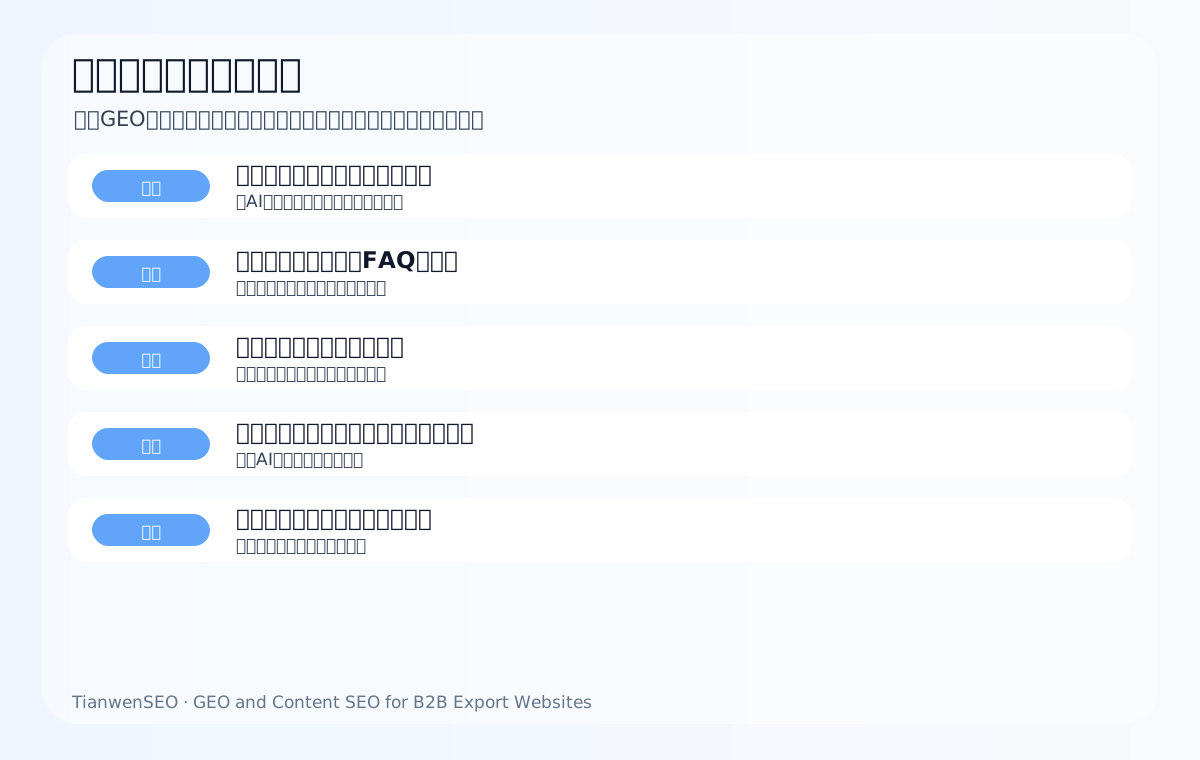
| Signal type | Strong signal | Weak signal | Export example |
|---|---|---|---|
| Product facts | Specifications, materials, certifications, applications, limitations | high quality, many models | waterproof connector pin count and cable OD |
| Decision criteria | Suitable and unsuitable scenarios, selection process | Suitable for various industries | LED flood light beam angle by installation height |
| Structural presentation | Tables, FAQ, steps, images with text | Stacked long paragraphs | cnc machining tolerance comparison table |
| Entity evidence | Consistent company name, certificates, trade shows, external materials | Confusing brand information | industrial valve supplier certification page |
| Business path | Inquiry checklist, sample process, resource downloads | “Welcome to contact us” | packaging machine requirement checklist |
How content SEO, AEO, and GEO divide the work at the page level
Content SEO, AEO, and GEO are not three conflicting ways of writing. A better way to understand them is: content SEO decides what search intent a page should serve, AEO lets a page answer a clear question, and GEO lets a page be used as a reliable source in AI answers.
| Layer | Question it addresses | Page requirements | Export example |
|---|---|---|---|
| Content SEO | What search intent does this page serve | Title, body, internal links, and page type match | ceramic dinnerware wholesale category page |
| AEO | Can this page answer the question directly | Clear definitions, steps, FAQ, and comparison tables | porcelain vs stoneware dinnerware |
| GEO | Can AI cite and restate it correctly | Facts, evidence, consistent entities, reliable sources | Consistent factory capability, MOQ, packaging, and export markets |
| Business conversion | What should the buyer do next | Inquiry checklist, sample process, contact entry point | request quotation with size and quantity |
Content roles on export websites: not every page should be written as a long article
Users require technical tutorials and methodology to go deep, but that does not mean every page should be forced into 10000-30000 words. Export websites should decide content depth by page role. Product data pages, technical tutorials, and selection guides can be written in depth; contact pages, quote entry points, and navigation pages should be clear, trustworthy, and easy to act on. GEO also does not require every page to be long; it requires every page to be clear enough within its own role.
| Page role | Suitable for long-form content | Main task | Content focus |
|---|---|---|---|
| Core pillar page | Yes | Explain the full topic and page system | Definitions, framework, tables, process, FAQ, review |
| Product page | Medium to in-depth | Prove supply capability and suitable scenarios | Specifications, applications, certifications, images with text, inquiry checklist |
| Category page | Medium | Help users choose a category | Category logic, model differences, purchasing advice |
| Application page | In-depth writing is suitable | Solve industry scenario problems | Pain points, environment, selection, risks, case boundaries |
| Resource page/tutorial | In-depth writing is suitable | Explain decision methods | Steps, tables, common mistakes, review |
| Contact page | Not suitable for padding | Reduce friction to communicate | Contact details, form, response time, what to prepare |
Situations where merging content matters more than adding more
When a website already has many similar articles, continuing to add new ones can make the problem worse. AI systems and Google both need to judge which page best represents a topic. If the same question is covered by 5 half-finished articles with similar titles, repeated content, and no strong facts, the best action may be to merge them into one strong page rather than write a 6th.
| Symptom | Risk | How to handle | Example |
|---|---|---|---|
| Multiple pages target the same product term | Keyword cannibalization and topic dilution | Merge into the main product page or pillar page | Merge several short custom metal parts posts into a materials/process guide |
| Articles differ only in title but have similar content | AI struggles to identify the authoritative page | Keep the strongest page; let the others redirect or support it with internal links | Merge several LED flood light selection articles |
| Product pages and blog posts compete for the same intent | The buyer’s path becomes confusing | Product pages cover supply capability; resource pages cover decision methods | waterproof connector product page + IP rating resource page |
| Old articles have no business path | They get visits but no conversions | Add product internal links and inquiry checklists | Link the packaging machine maintenance article to the equipment page |
How to infer content priorities from GSC and inquiries
A GEO content strategy cannot start from keyword tools alone. For an export business that already has a website, the first step should be looking at GSC and inquiry data: which queries have impressions but low clicks, which pages get visits but no inquiries, which inquiry questions keep recurring, and which product lines most need more leads.
| Data source | What to look at | What it tells you | Content action |
|---|---|---|---|
| GSC queries | High impressions, low clicks, long-tail question queries | Search demand exists but the page is not appealing or not a match | Improve titles, add FAQ and decision tables |
| GSC pages | Pages with impressions but unstable rankings | The page may be thin or its intent unclear | Expand, merge, or split |
| GA4 paths | Whether users view product/contact pages after the entry page | Whether content connects to the business path | Add internal links and CTAs |
| Inquiry log | The products, countries, and parameters customers ask about | Real procurement questions | Write them into product and resource pages |
| Sales feedback | Customer misunderstandings and deal-blocking friction | The page does not explain them in advance | Add FAQ, evidence, and comparison tables |
How export-oriented English product terms map to pages
The same product term under different search intents needs different pages to receive it. Stuffing every term into one page helps neither SEO nor GEO.
| Query | Search or procurement intent | Recommended page | GEO reinforcement focus |
|---|---|---|---|
| custom metal parts | Looking for custom supply capability | Product capability page | Materials, processes, tolerances, inspection, drawing requirements |
| cnc machining parts tolerance | Understanding technical decision-making | Resource page/tutorial | Tolerance tables, influencing factors, drawing communication |
| LED flood light for warehouse | Looking for an application solution | Application page | Installation height, beam angle, wattage, illuminance |
| packaging machine for powder | Looking for equipment selection | Application/category page | Material properties, speed, accuracy, cleaning |
| ceramic dinnerware wholesale | Looking for wholesale purchasing | Category/purchasing page | Material, packaging, MOQ, samples, lead time |
| industrial valve supplier | Looking for suppliers and product lines | Category/company capability page | Media, pressure, temperature, standards, spare parts |
GEO content structure: what a strong page should include
| Module | Purpose | How to write it | Notes |
|---|---|---|---|
| Above-the-fold answer | Quickly satisfy the core question for AI and users | 150-220 characters stating the conclusion and scope | Do not build up for too long |
| Search intent statement | Clarify who the page serves | Explain the buyer’s question and the page boundary | Avoid trying to cover everything |
| Decision table | Improve extractability and comparability | Dimensions, suitability, risks, next step | Use real product parameters |
| Action steps | Make the content executable | From checking and choosing to inquiring and reviewing | Do not stop at slogans |
| Image and diagram modules | Lower the cost of understanding | Flowcharts, matrices, diagrams, screenshots | Captions must explain the meaning |
| FAQ | Cover long-tail questions | Short answer plus necessary explanation | Questions should come from buyers, not from talking to yourself |
| Review metrics | Connect to business results | GSC, GA4, AI answers, inquiries, sales feedback | Do not look only at rankings |
Why AI prefers clearly structured content
When generating answers, AI systems need to extract facts, relationships, and judgments from sources. Clearly structured content is easier to understand: headings state the topic, tables provide comparisons, FAQs provide question-and-answer pairs, steps provide an order of action, and captions explain what images mean. Structure is not about “pleasing machines”; it is about making both people and machines guess less.
For example, if a medical probe page only uses long paragraphs to introduce the company, it is hard to extract the quality control process; if it uses a table to list materials, testing, cleanliness requirements, scope of application, and items the customer must confirm, both AI and buyers can understand it more easily. Clear structure also reduces incorrect citations, because the context and boundaries are more explicit.
The GEO content audit process
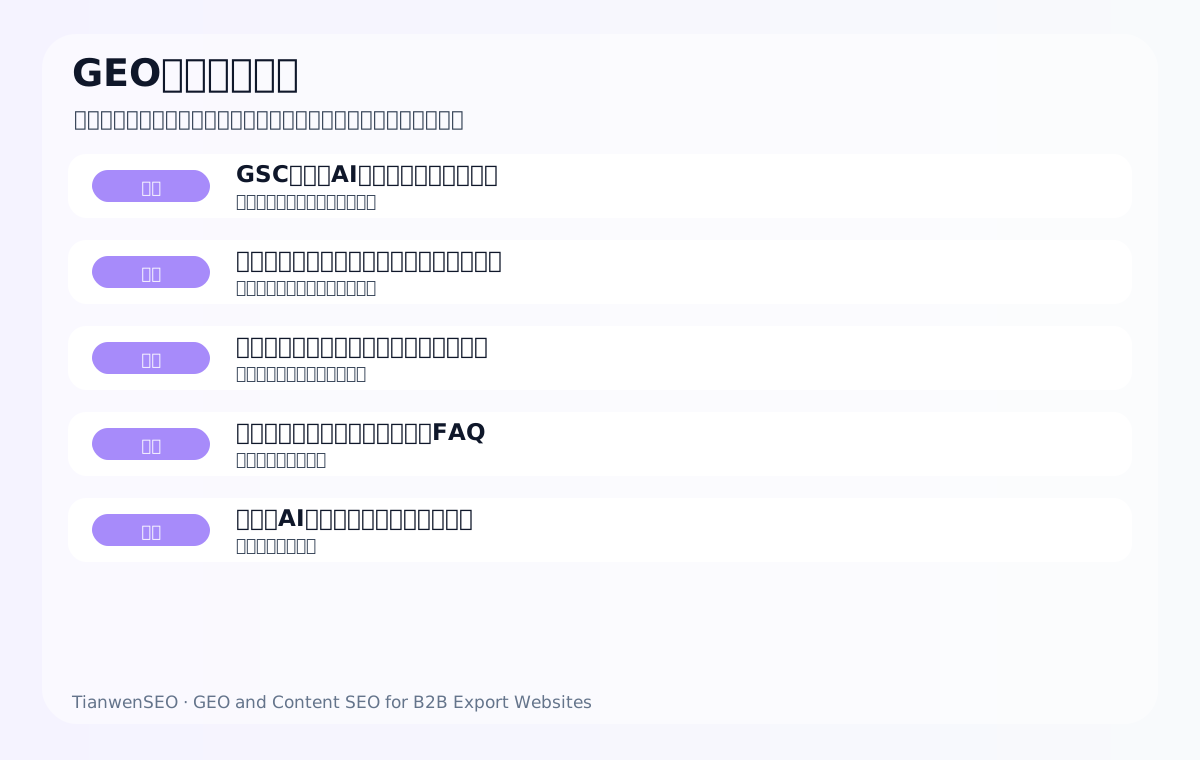
| Step | What to do | Output | Criteria |
|---|---|---|---|
| 1. Build the list | List core product pages, category pages, resource pages, and high-impression articles | Page list | Does it cover the main products and procurement questions |
| 2. Look at the data | Review GSC, GA4, inquiries, and sales questions | Problem list | Is there real demand and business value |
| 3. Assign roles | Decide whether the page is a product, application, resource, or conversion page | Page role table | Does it have a single main task |
| 4. Find the gaps | Check facts, structure, evidence, internal links, and CTAs | Gap table | Can AI and buyers understand it |
| 5. Decide the action | Expand, merge, split, update, or keep as is | Execution queue | Prioritize high-business-value pages |
| 6. Review | Check search, AI answers, and inquiries at 30-90 days | Review record | Have accuracy and inquiry quality improved |
How to choose between different content actions
| Page status | Should expand | Should merge | Should split | Should stay short |
|---|---|---|---|---|
| Thin content but clear intent | Yes | No | Possibly | No |
| Multiple overlapping pages | Not a priority | Yes | Possibly | No |
| One page mixes several procurement questions | Not a priority | No | Yes | No |
| Contact/quote entry page | No | No | No | Yes |
| Traffic but no inquiries | Yes, add the business path | Possibly | Possibly | No |
Common mistakes: turning GEO into a content factory
- Publishing one generic article a day without upgrading any core product page.
- Using SEO industry terms in every example instead of export-oriented English product terms and procurement questions.
- Articles are very long but have no tables, images with text, decision criteria, or inquiry path.
- Multiple pages have different titles but actually cover the same question.
- Chasing AI hype while ignoring existing GSC impressions and real sales problems.
- Only checking whether AI mentions the brand, not whether the answer is accurate.
- Forcing contact pages and navigation pages into long-form articles, which hurts conversion instead.
A 90-day export GEO content roadmap
Days 1-7: Take content inventory and classify page roles
List the core pages and classify them as product pages, category pages, application pages, resource pages, articles, or conversion pages. Mark the English product terms, GSC data, inquiry value, and current problems for each page.
Days 8-30: Handle the highest-value product lines first
Choose the 3-5 product lines with the greatest business value and add product facts, application scenarios, FAQ, decision tables, image and diagram explanations, and inquiry checklists. Do not start with low-value generic articles.
Days 31-60: Build resource pages and the internal linking system
Build resource pages on materials, standards, selection, installation, maintenance, and purchasing FAQ around the product pages, and let those resource pages link naturally to product pages and the contact path.
Days 61-90: Review AI answers and inquiry quality
Record the AI answers, cited sources, and accuracy for core questions, compare them with GSC, GA4, and the inquiry log, and decide the next round of expansion, merging, or splitting.
Case study 1: Why a custom metal parts website cannot rely on blog posts alone
Suppose a company mainly makes custom metal parts and cnc machining parts and has published many articles over the past year: how to choose metal parts supplier, what is CNC machining, benefits of custom metal parts, how to reduce machining cost. Each article gets some traffic, but inquiries are few and AI answers rarely cite the official website. The problem is usually not too little content, but that the content does not form a procurement decision chain.
What buyers really need to know is: which materials suit a marine environment, what tolerance range can be achieved, how to choose a surface finish, what information the drawing must include, where the price difference lies between low-volume and mass production, and whether inspection reports can be provided. These questions should be organized into the product capability page, materials guide, tolerance guide, surface finish page, and inquiry checklist, not scattered across several generic blog posts.
| Procurement question | Weak content location | Strong content location | GEO value |
|---|---|---|---|
| 316 stainless steel or aluminum? | A paragraph in a generic blog | Materials selection guide | Can be cited by AI as a basis for material selection |
| What tolerance can you achieve? | Not explained on the product page | Tolerance guide + capability page | Proves supply boundaries and technical capability |
| What drawing information is needed? | One sentence on the contact page | Inquiry checklist | Improves inquiry completeness |
| Which surface finish is suitable? | Repeated across several articles | Surface finish comparison page | Reduces duplication and strengthens the answer source |
| How to inspect quality? | Vague coverage in the company introduction | Quality inspection process page | Builds trust and AI verifiability |
Case study 2: Why LED flood light content should be organized by application scenario
If an LED flood light website only builds pages around product models, it can easily miss the complex questions asked in AI Mode. Buyers tend to ask by scenario: warehouse, parking lot, stadium, construction site, outdoor billboard. Each scenario requires different wattage, beam angle, waterproofing, glare control, installation height, certifications, and warranty.
| Scenario | Core decision | Page modules | Inquiry fields |
|---|---|---|---|
| warehouse | Installation height, illuminance, beam angle, energy use | Wattage selection table, installation diagram, case boundaries | Height, area, target illuminance, installation method |
| parking lot | Waterproofing, surge protection, coverage area, pole height | Outdoor application page, IP rating FAQ | Pole height, area dimensions, climate, certification requirements |
| stadium | High wattage, glare control, uniformity | Sports field application page, optical parameter explanation | Field dimensions, competition level, lighting standards |
| construction site | Portability, durability, safety, power supply | Temporary lighting solutions | Usage duration, power supply, mobility needs |
This kind of content can work as a single “LED flood light guide,” but it is better structured as one pillar page plus multiple application pages. The pillar page explains the overall framework, the application pages answer specific scenarios, and the product pages carry specific models. That serves traditional SEO and also lets AI answers cite different pages for different sub-questions.
Case study 3: How a ceramic dinnerware wholesale page can avoid vague generalities
Buyers searching ceramic dinnerware wholesale care about material, patterns, packaging, MOQ, samples, lead time, target-market standards, and breakage control. Many pages only say “high quality ceramic dinnerware, competitive price, OEM available,” which is not enough for search or AI.
| Content module | Weak writing | Strong writing | Why it suits GEO |
|---|---|---|---|
| Material comparison | many materials available | Comparison of suitable scenarios for stoneware, porcelain, and bone china | AI can extract a decision table |
| Packaging | safe package | Differences between bulk pack, mail order pack, and gift box | Addresses purchasing and shipping risk |
| Customization | OEM accepted | Process for logo, glaze, shape, decal, and carton design | Explains the boundaries of customization |
| MOQ | contact for MOQ | Explain the influencing factors by material, pattern, and process | Reduces low-quality inquiries |
| Target market | export worldwide | Different markets require confirming food-contact standards and labeling requirements | Avoids overpromising |
A page handling matrix for upgrading from content SEO to GEO
Many pages cannot be fixed by simply “expanding” them. The matrix below helps decide the action.
| Page problem | Expand | Rewrite | Merge | Split | Leave as is |
|---|---|---|---|---|---|
| Core product page has thin content | Priority | Possibly | No | Possibly | No |
| Several articles cover the same question | No | Possibly | Priority | No | No |
| One article mixes several product lines | No | Possibly | No | Priority | No |
| Page has traffic but poor inquiries | Possibly | Priority | Possibly | Possibly | No |
| Contact page has few words | No | No | No | No | Possibly |
| Archive or tag page | No | No | Possibly | No | Possibly |
How to tell whether a piece of content is vague and generic
The user repeatedly stresses the need to avoid vague generalities. Whether a piece of content is generic cannot be judged by word count alone; what matters is whether it contains real decisions.
| Check | Generic content | Strong content | How to fix it |
|---|---|---|---|
| Does it use specific product terms | Talks only about SEO, GEO, and content strategy | Uses English product terms and procurement scenarios | Add product terms and industry examples |
| Does it have decision criteria | Only says content quality should be valued | Explains when to expand, merge, or split | Add a decision table |
| Does it have action steps | Only discusses trends | Lists steps for data, pages, publishing, and review | Add a process |
| Does it have business metrics | Looks only at rankings and traffic | Looks at inquiries, sales feedback, and AI answer accuracy | Add a review table |
| Does it define boundaries | Says every page must be long-form | Distinguishes pillar pages, product pages, and contact pages | Add a page role table |
How to write “citable paragraphs” for export content
GEO is not about making every paragraph read like an encyclopedia; it is about giving key paragraphs a clear subject, facts, boundaries, and context. A citable paragraph usually covers: who it is for, what the applicable scenario is, what the decision criteria are, what the limitations are, and what the next step is.
| Weak paragraph | Elements of a strong paragraph | Example direction |
|---|---|---|
| Our products are high quality and suitable for many industries. | Product + application + parameters + limitations | An IP67 waterproof connector suits outdoor lighting connections, but cable diameter, pin count, and installation environment must be confirmed. |
| We provide professional CNC machining. | Process + material + tolerance + drawing requirements | Before quoting CNC machining parts, material, tolerance, surface finish, quantity, and inspection requirements must be confirmed. |
| Our packaging machine can meet customer needs. | Material + bag type + speed + accuracy + cleaning | Selecting a powder packaging machine requires confirming flowability, target weight, packaging speed, and cleaning requirements. |
The role of images and diagrams in GEO content
Combining images with text is not decoration. Many export procurement questions can only be explained clearly with diagrams and tables: structure, process, parameters, application scenarios, comparisons, and checklists. AI systems may also understand page content through image alt text, captions, and context.
| Diagram type | Good for explaining | Page location | Notes |
|---|---|---|---|
| Flowchart | Inquiry, selection, quality inspection, and installation steps | Tutorial pages, resource pages | Captions explain the meaning of each step |
| Matrix diagram | Material/scenario/risk comparisons | Selection guides | Do not make it merely pretty; it must carry decision information |
| Product structure diagram | Parts, interfaces, installation methods | Product pages | Label key parameters and application limits |
| Application diagram | How the product is used in a scenario | Application pages | Explain environmental conditions and applicable boundaries |
| Review dashboard | Data sources and evaluation cycles | Methodology articles | Connect GSC, GA4, AI answers, and inquiries |
Turn sales questions into content assets
The customer questions the sales team receives every day are the most authentic source of content demand. Much SEO content is generic because the writers never see real inquiries.
| Common sales question | Content gap it reveals | Where to add it | Export example |
|---|---|---|---|
| Can you make this size? | Specification range is unclear | Product page specification table | custom metal parts size and tolerance range |
| Do you have CE/RoHS? | Certification scope is unclear | Product page/certificate page | LED flood light certification explanation |
| What is your MOQ? | Purchasing threshold is not transparent | FAQ/contact page | Explain ceramic dinnerware MOQ by process |
| Can this machine pack powder? | Application fit is unclear | Application page/selection page | packaging machine material compatibility table |
| How long for samples? | Process is unclear | Inquiry checklist/sample process | private label activewear sample lead time |
AI answer review question bank: what a content SEO team should record
| Field | What to record | Why it matters | Example |
|---|---|---|---|
| Question | The full procurement question | User questions are longer in AI Mode | which material for custom metal parts in marine environment |
| Answer summary | How AI answered | Judge accuracy and whether key points are covered | Whether 316 stainless steel and surface finish are mentioned |
| Cited sources | Which pages were cited | See whether the official website became a source | Official site materials guide / third-party resources |
| Errors | What AI got wrong or omitted | Decide what content to add | Saying aluminum alloy is unsuitable for all marine environments |
| Business action | How the corresponding page should change | Turn the review into content actions | Add a material comparison table and inquiry checklist |
A review cadence after content is published
Publishing a long article is not the finish line. GEO and content SEO both require review, especially in the export business, which has seasonality, trade show cycles, procurement budget cycles, and product updates.
| Time | What to look at | Normal situation | Signals that require action |
|---|---|---|---|
| 7 days | Indexing, page accessibility, title and snippet | Noticeable traffic is not guaranteed | Not indexed, page errors, image failures |
| 14 days | Initial GSC impressions, AI answer baseline | Some questions show no change | AI answers are clearly wrong and the official site lacks sufficient material |
| 30 days | Queries, clicks, paths | Long-tail terms start appearing | Impressions exist but CTR is low and bounce rate is high |
| 60 days | Inquiry quality, sales feedback | Some inquiries become more specific | High traffic but no business action |
| 90 days | Whether expansion, merging, or internal link adjustments are needed | Forms the next batch of tasks | Multiple pages compete with each other or AI still cites competitors |
What to look at when benchmarking against competitors
The user requires every article to benchmark against the current Top1 or an authoritative baseline. When benchmarking content SEO and GEO pages, do not look only at word count; look at why it is trusted by search and AI.
| Benchmark dimension | What to look at | How we can surpass it | Export implementation |
|---|---|---|---|
| Structure | H2/H3, tables, FAQ, images with text | A clearer procurement process and decision tables | Product terms + application scenarios |
| Coverage | Which questions it answers and which it misses | Add export scenarios and the inquiry path | MOQ, certification, lead time, samples |
| Evidence | Whether it has official sources, data, and case boundaries | Add checkable facts and external references | Certificates, standards, testing |
| Actionability | Whether readers can follow it | Provide an audit checklist and review table | GSC, GA4, sales feedback |
| Differentiation | Whether it is only generic concepts | Add export product terms and procurement questions | CNC, LED, packaging machines, dinnerware |
Quality thresholds for the content team
To avoid producing internal process notes or generic content in the future, a minimum quality threshold can be set for every GEO/SEO long-form article.
- The target queries and search intent must be written first.
- Record what the Top1 or authoritative benchmark does well and what it lacks.
- Use export-oriented English product terms and procurement questions in examples.
- Include at least 2 tables or matrices; core long-form articles should have more.
- Include action steps, decision criteria, common pitfalls, and FAQ.
- Include review metrics: GSC, GA4, AI answers, inquiries, and sales feedback.
- Do not promise rankings, inquiries, or AI citations.
- Do not use a process tone written for internal staff.
Content consolidation example: turning 5 weak articles into 1 strong topic asset
Take custom metal parts as an example. Many websites have 5 weak articles: what are custom metal parts, how to choose custom metal parts supplier, CNC machining advantages, surface finish options, how to request a quote. Each is only 1000-2000 words, the content repeats, and tables and the inquiry path are missing. The better approach is not to add a 6th article, but to restructure them into one strong topic asset.
| Original page | Value to keep | Where to merge it | Module after merging |
|---|---|---|---|
| what are custom metal parts | Definition and applications | Opening of the pillar page | Definition, materials, application industries |
| supplier selection | Selection criteria | Procurement decision section | Factory capability, inspection, delivery, communication |
| CNC advantages | Process explanation | Manufacturing process section | CNC, stamping, casting, and laser cutting comparison |
| surface finish options | Technical decision-making | Surface finish resource page or section | Anodizing, electroplating, powder coating, polishing |
| request a quote | Conversion value | Inquiry checklist section | Drawings, material, quantity, tolerance, surface finish |
The merged page is not just longer; it is clearer: it moves from definition to decision, from decision to technique, from technique to inquiry, and from inquiry to contact. AI answers can more easily find complete context when citing it, and buyers who click through can continue to the next step.
Internal linking structure: GEO content cannot exist in isolation
A strong article without internal links can hardly carry a complete business path. GEO content should work like a resource network: the pillar page explains the overall framework, product pages carry supply capability, resource pages explain decisions, application pages carry scenarios, and the contact page carries action.
| Page | Should link to | Why | Example anchor text |
|---|---|---|---|
| GEO and content SEO pillar page | GEO audit, AI SEO, AEO, product page optimization | Help users continue understanding related topics | See which metrics to review in an export website GEO audit |
| Product page | Application pages, resource pages, inquiry checklist | Help buyers understand parameters and the next step | See how to choose a waterproof connector IP rating |
| Resource page | Related product pages, category pages, contact page | Connect learning demand to purchasing action | Connector series suitable for outdoor LED lighting |
| Application page | Product pages, case boundaries, FAQ | Move from scenario to product selection | LED flood light for warehouse product options |
| Contact page | Inquiry preparation guide, core product pages | Reduce communication cost | Information to prepare before submitting drawings |
GEO content scorecard: deciding which pages to work on first
If the site has many pages, a scorecard can set priorities. Each item scores 0-2, and the higher the total, the sooner the page should be handled.
| Scoring item | 0 points | 1 point | 2 points |
|---|---|---|---|
| Business value | Rarely connected to inquiries | Indirectly connected | Directly affects core product inquiries |
| Search foundation | No impressions and not indexed | A small number of impressions | Stable impressions or clicks already exist |
| AI question match | Not suitable for AI answers | Partially suitable | Corresponds to complex procurement questions |
| Product facts | Almost none | Some parameters | Complete specifications, materials, certifications, and applications |
| Page role | Confusing | Basically clear | Very clear |
| Content gap | The gap is too large to close in the short term | Can be strengthened | After strengthening it may become a strong asset |
For example, a packaging machine for powder page that has GSC impressions, requires frequent sales explanations, corresponds to a core product, and has a basic page structure but lacks tables and FAQ should be placed near the front; a generic industry news page with no business value does not necessarily need to be expanded first even if it is short.
How export content can avoid a “fellow SEO’s tone”
The user specifically stresses that the website serves domestic export manufacturers and trading companies, not fellow SEO service providers. Content therefore should not keep using SEO services, SEO agencies, or AI optimization services as examples. Even when the topic is SEO or GEO, it must land in export scenarios.
| Inappropriate tone | More appropriate tone | Reason |
|---|---|---|
| Using an SEO agency page as an example | Using a custom metal parts product page as an example | Clients can more easily relate it to their own products |
| Discussing service-term rankings | Discussing English product terms and procurement questions | Export businesses care about inquiries and product visibility |
| Explaining only content strategy concepts | Explaining how to change product pages, category pages, and application pages | More actionable |
| Describing only the project process | Explaining how clients judge a problem and what to do next | Reads more like content for clients |
| Describing operations with internal jargon | Describing them with business results and decision criteria | Avoids reading like instructions for the people doing the work |
How to balance content depth and readability
For long-form content, longer is not always better, and neither is shorter. Technical tutorials and methodology pages can run to 12000 words or more, but readability must be maintained through structure: a clear table of contents, short paragraphs, tables, images with text, FAQ, section summaries, and actionable checklists. Otherwise a long article becomes a pile of words, and both users and AI struggle to extract the key points.
| Problem | Wrong approach | Right approach |
|---|---|---|
| Padding to hit a word count | Repeating the same concept | Add real cases, tables, processes, and decision criteria |
| Readers cannot find the key points | Stacking long paragraphs continuously | Layer the content with H2/H3, tables, and captions |
| The content is professional but hard to act on | Discussing theory only | Provide checklists and next steps |
| Examples are not close to clients | Using your own industry terms | Using export-oriented English product terms and inquiry scenarios |
| AI easily misunderstands | Missing boundaries and evidence | Add scope of application, limitations, and source notes |
How tables in GEO content should be designed
Tables are not there to make a page look rich; they compress complex decisions into comparable information. Tables in export content should answer the questions buyers actually compare.
| Table type | Good for answering | Example |
|---|---|---|
| Material comparison table | Which environments different materials suit | 304 vs 316 stainless steel for custom metal parts |
| Application selection table | Which product to choose for different scenarios | warehouse vs parking lot LED flood light |
| Risk assessment table | Which situations need to be confirmed in advance | medical probe material compatibility |
| Inquiry checklist table | What information the buyer needs to provide | packaging machine material, speed, weight, bag type |
| Review metrics table | Which data to check after publishing | GSC, GA4, AI answer, inquiry quality |
The relationship between GEO content and brand authority
Content SEO addresses pages, while GEO also involves brand authority. AI answers look not only at whether a page contains a sentence, but also at whether the website, company, and product line are trustworthy. The more specific the content, the more it must be consistent with brand materials.
If the official website says it is an industrial valve manufacturer, a B2B platform describes it as a general hardware exporter, and trade show materials call it a pump accessories supplier, AI may struggle to determine the company’s positioning. No matter how much content SEO you write, confusing entity signals will affect GEO results. So when upgrading content, also check the company’s English name, brand name, product lines, certificates, address, and contact details at the same time.
When you should not expand content
Not every short page is a problem. Some pages are short because their task should be short. Blindly expanding them can actually reduce conversion.
| Page type | Why forced expansion does not suit it | What to optimize instead |
|---|---|---|
| Contact page | Users want to get in touch quickly and do not want to read a long article | Contact details, form, response time, what to prepare |
| Quote entry page | Users already intend to act | Inquiry fields, sample process, privacy and response notes |
| Category navigation page | Mainly helps users choose a path | Category logic, entry points, brief descriptions |
| Legal/privacy page | Needs clear compliance, not a long marketing article | Accuracy and readability |
| Event announcement page | Short lifecycle | Time, location, products, and contact entry point |
Put content SEO and GEO in the same worksheet
During execution, the team can manage pages in a single worksheet instead of maintaining separate SEO, GEO, and content sheets. Suggested fields are below.
| Field | What to fill in | Purpose |
|---|---|---|
| Page ID/URL | WordPress ID and URL | Avoid editing the wrong page |
| Page role | Product page/resource page/application page/conversion page | Determines length and structure |
| Target queries | Primary queries and long-tail procurement questions | Maps to search intent |
| Top1 gap | The benchmark page’s strengths and weaknesses | Determines how to surpass it |
| Product term examples | English product terms and industry terms | Keeps the export client perspective |
| Must add | Tables, images, FAQ, inquiry checklist, evidence | Guides the writing |
| Review metrics | GSC, GA4, AI answers, inquiries | Post-publish evaluation |
A few more FAQ
Does every GEO article need images?
Technical tutorials and methodology articles should include images, at least flowcharts, matrices, or diagrams to aid explanation; conversion pages and contact pages should be decided by their task.
Does merging content lose long-tail keywords?
If the merged structure is clearer, coverage is more complete, and internal links and titles are handled well, it usually reduces cannibalization and strengthens topic authority; the specifics should be reviewed with GSC data.
Which matters more, product pages or resource pages?
Product pages carry supply capability, and resource pages explain procurement decisions. The two should link to each other; you cannot do only one of them.
Should GEO content cite external sources?
For content involving Google, AI search, industry standards, or certification explanations, refer to authoritative sources where possible; product facts should be based on materials the company can verify.
How can you prevent AI from misunderstanding your content?
Reduce ambiguity with clear headings, tables, boundary statements, consistent entities, and official materials, and regularly record where AI answers go wrong.
If an article is already 12000 words, does it still need to be expanded?
If the core questions, tables, FAQ, images with text, review, and export examples are all well covered, there is no need to expand further just for word count; a core pillar page can go deeper depending on the topic.
FAQ: common questions about GEO and content SEO
What is the relationship between GEO and content SEO?
Content SEO is the foundation, covering search intent, page structure, and content support; GEO builds on that to improve how well content is understood, cited, and correctly restated in AI answers.
Does doing GEO mean writing more articles?
Not necessarily. In many cases you should first strengthen core pages, merge duplicate content, and add product facts and resource pages rather than keep adding generic articles.
Why do we still get no inquiries after writing a lot of content?
The content may not match procurement questions, may not link to products and the inquiry path, or the page roles may be confusing, so users finish reading without knowing the next step.
How long should GEO content be?
Technical guides and pillar pages can be long, but length is not the only standard. Fact density, structure, evidence, images, and review metrics matter more.
Do product pages need to be long-form articles?
Core product pages need enough detail, but they do not have to be as long as a tutorial. Focus on specifications, applications, certifications, limitations, FAQ, and the inquiry checklist.
Should a contact page be 10000 words?
No. A contact page should be clear, trustworthy, and reduce friction to communicate; it is not suitable for padding to meet a long-form standard.
How do you decide whether to merge or expand content?
If multiple pages overlap in intent, merge them first; if a single page has clear intent but insufficient facts, expand it.
Is GSC data still useful for GEO?
Yes. GSC reflects search demand and page performance. Although it cannot fully measure AI answers, it remains an important basis for content priorities.
Are AI answer errors related to content SEO?
Yes. Unclear page facts, inconsistent brand entities, and confusing external materials can all cause AI to misunderstand.
Which terms should export website content examples use?
Use export-oriented English product terms, application terms, inquiry terms, and procurement questions, such as custom metal parts, LED flood light, packaging machine, and so on.
How soon should GEO content results be reviewed?
We suggest checking indexing and search changes at 30 days, and judging direction at 60-90 days together with AI answers, visit paths, and inquiry quality.
Can you promise that GEO will definitely get cited by AI?
No. AI citations are affected by the platform, the query, the sources, and timing; you can only improve the chances through content quality, factual structure, and trustworthy signals.
Conclusion: write less generic content and build stronger pages
The relationship between GEO and content SEO is not a new concept replacing an old method, but a higher demand for content quality as the search environment changes. Export businesses can no longer understand content SEO as “continuously publishing articles around keywords,” nor GEO as “publishing another batch of articles for AI.” The truly effective direction is to focus on buyer questions and make core pages clearer, more specific, more verifiable, and easier to convert.
If your product pages explain supply capability clearly, resource pages explain decision methods clearly, application pages explain scenario solutions clearly, FAQ answer real procurement concerns, and brand entities stay consistent with external materials, and you keep reviewing with GSC, GA4, AI answers, and inquiry feedback, then this content serves both traditional SEO and GEO. Export websites do not lack more articles; they lack a stronger page system.
Official sources and the boundaries of content SEO
GEO is not simply about writing more articles. Export websites need a verifiable fact network: product pages, category pages, application scenarios, FAQ, resource downloads, and citation entry points must support one another.
| Official source | What it verifies | Delivery boundary |
|---|---|---|
| Helpful, reliable, people-first content | Judge whether content is complete, original, trustworthy, and aimed at real users | Batch content cannot replace factual materials |
| SEO Starter Guide | Confirm the basics of titles, page structure, links, and images | Basic SEO is the foundation, not a promise of results |
| Make your links crawlable | Confirm that crawlable links exist between content clusters | Interactive entry points without an href cannot be treated as crawlable internal links |
| Google AI features and your website | Confirm that AI features still rely on indexable, reliable, helpful content | There is no special shortcut for AI pages |
| Search Console Performance report | Use query/page data to observe real changes after content adjustments | During a low-data period, do not write that the content has already produced results |
Review acceptance table
| Check | Record field | How to write during a low-data period |
|---|---|---|
| Content role | Division of labor among product pages, category pages, blog pages, and resource pages | Mark roles first; do not rush to expand |
| Fact source | Parameters, images, certifications, FAQ, industry terms | If sources are missing, list the material gaps |
| Internal link structure | Anchor text, target URL, context | Record only crawlable links |
| Review fields | GSC page rows, GA4 events, AI samples | If there are no rows, write “to be observed” |
Continue reading this GEO series
If you are studying GEO and AI search visibility systematically, the articles below are a good next step. Start with the concepts, then move on to audits, monitoring, content structure, and the boundaries of collaboration.
- How to do AI SEO: which comes first, titles, URLs, or paragraph structure
- What is the relationship between GEO and brand authority: why AI search relies more and more on brands
- Where to start with AI search optimization: should an export website build the query set first or change content first?
- How to do GEO: what to change first, from page structure to citation probability
- What is Schema structured data: which types should export websites add for SEO and AI search
- How to build B2B export AI search visibility: a guide to getting inquiry terms and solution terms into AI answers
{
“@context”: “https://schema.org”,
“@type”: “FAQPage”,
“mainEntity”: [
{
“@type”: “Question”,
“name”: “Does every GEO article need images?”,
“acceptedAnswer”: {
“@type”: “Answer”,
“text”: “Technical tutorials and methodology articles should include images, at least flowcharts, matrices, or diagrams to aid explanation; conversion pages and contact pages should be decided by their task.”
}
},
{
“@type”: “Question”,
“name”: “Does merging content lose long-tail keywords?”,
“acceptedAnswer”: {
“@type”: “Answer”,
“text”: “If the merged structure is clearer, coverage is more complete, and internal links and titles are handled well, it usually reduces cannibalization and strengthens topic authority; the specifics should be reviewed with GSC data.”
}
},
{
“@type”: “Question”,
“name”: “Which matters more, product pages or resource pages?”,
“acceptedAnswer”: {
“@type”: “Answer”,
“text”: “Product pages carry supply capability, and resource pages explain procurement decisions. The two should link to each other; you cannot do only one of them.”
}
},
{
“@type”: “Question”,
“name”: “Should GEO content cite external sources?”,
“acceptedAnswer”: {
“@type”: “Answer”,
“text”: “For content involving Google, AI search, industry standards, or certification explanations, refer to authoritative sources where possible; product facts should be based on materials the company can verify.”
}
},
{
“@type”: “Question”,
“name”: “How can you prevent AI from misunderstanding your content?”,
“acceptedAnswer”: {
“@type”: “Answer”,
“text”: “Reduce ambiguity with clear headings, tables, boundary statements, consistent entities, and official materials, and regularly record where AI answers go wrong.”
}
}
]
}
This page is machine-translated from the Simplified Chinese version and awaiting human review. It has not yet been proofread.