Schema structured data is not about “adding keywords” to a page, and it is not something that becomes perfect just by installing a plugin. It uses a format that machines understand more easily to describe the real information on a page: whether that page is a product, an article, an FAQ, a company, a breadcrumb trail, a video, or a document, or part of a product catalog. For export manufacturers, factories, and trading companies in China, the value of Schema is that it helps Google and AI systems understand products, company entities, document pages, FAQs, and page relationships more accurately, but it cannot replace real content, product specifications, or trustworthy documents.
n
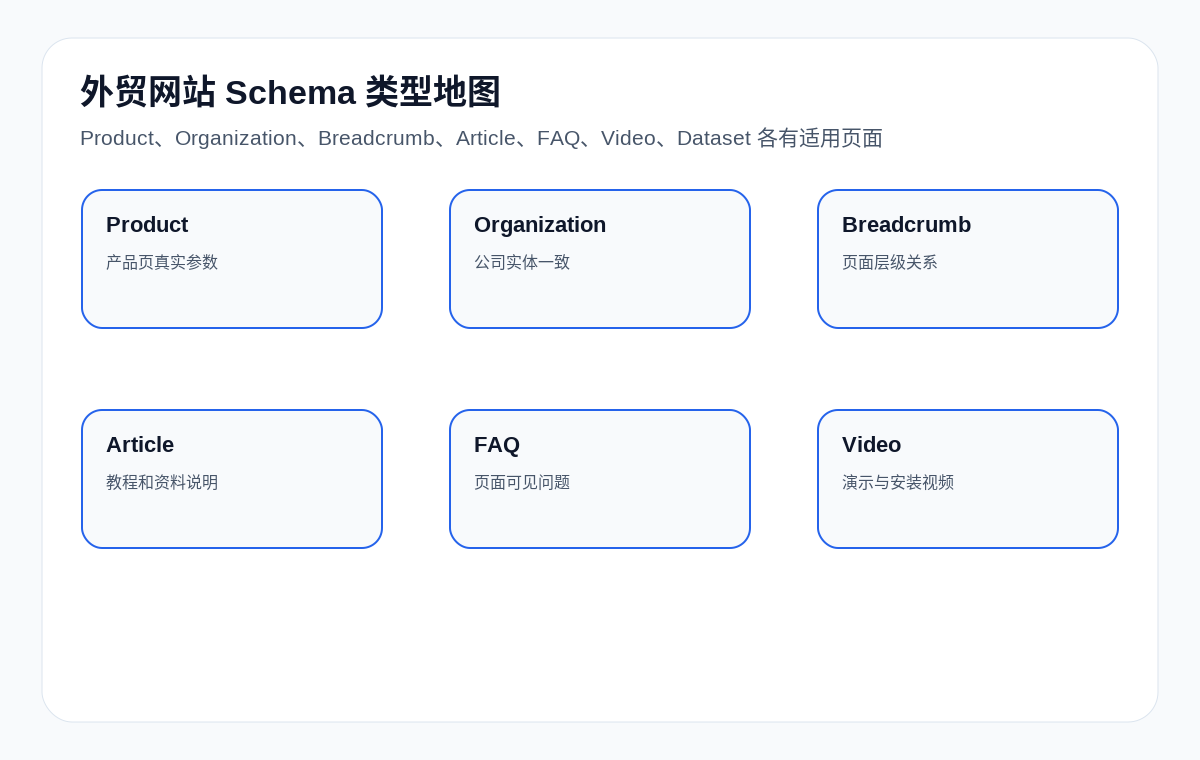
If your website sells custom metal parts, LED flood light, packaging machine, medical probe, cnc machining parts, ceramic dinnerware, waterproof connector, industrial valve supplier, or private label activewear manufacturer, Schema should be designed around product facts and purchasing decisions: whether a product page can be marked up as Product, whether a tutorial page can be marked up as Article, whether the FAQ is genuinely visible, whether company information can be marked up as Organization, whether breadcrumbs are clear, and whether videos and documents have their own descriptions.
What Structured Data Is: First Separate Two Completely Different Concepts
The Chinese term “structured data” refers to two completely different things online at the same time. Many people find an article through search and then discover the content does not match what they need — this is the root of the problem.
In the context of data engineering and databases, structured data means data that can be expressed as a two-dimensional table (rows and columns), as opposed to semi-structured data (JSON/XML) and unstructured data (text/images). This topic belongs to the fields of database design and data analysis.
In the context of SEO and AI search, structured data means Schema markup (Schema markup / structured data markup) — adding extra machine-readable tags to a page’s HTML, using formats such as JSON-LD, to tell search engines whether the page is a product page, an article, an FAQ, a company profile, or breadcrumb navigation. This is the structured data discussed in Google Search Central documentation, and it is the subject of this article.
How to tell them apart quickly: if an article talks about database normalization, ETL, or data warehouses, it is structured data in the data engineering sense; if it talks about the Rich Results testing tool, JSON-LD code, Schema.org types, or Google rich results, it is structured data in the SEO sense. This article is the latter.
Once you have pinned down which concept you are dealing with, the content below will match your actual needs.
n
The Boundary of Official Documentation: Schema Is Not a Ranking Switch, but a Description of Page Facts
n
When adding Schema to a foreign trade website, do not start by asking “will it work immediately?” A better question is: which facts on the page are already clearly stated, which facts are suitable for structured data, and which fields can later be reviewed with testing tools and Search Console.
n
The role of Schema is to express the real information on a page in a format that machines understand more easily. It cannot replace product specifications, images, certifications, application scenarios, FAQs, company information, or inquiry paths. For B2B product pages such as custom metal parts, LED flood light, packaging machine, waterproof connector, or industrial valve supplier, Schema should follow the facts on the page, not the plugin’s default settings.
n
Therefore, when a foreign trade company reviews Schema, it should not just check whether code exists. It should look at where fields come from, the page’s role, the official types used, test results, Search Console changes, and the boundaries of AI search. Without these, structured data can easily become a piece of code that looks professional but cannot actually be reviewed.
nn
Mapping Table: Official Documentation and Schema Review Fields
n
| Official documentation entry point | Corresponding review question | What to check on a foreign trade website | What it cannot replace |
|---|---|---|---|
| Google Search Central: Intro to structured data | Whether structured data helps Google understand the page. | Decide whether the page is suited to types such as Product, Article, FAQ, or Breadcrumb. | Cannot replace the page’s real content. |
| Google Search Central: Structured data general guidelines | Whether the marked-up content is real, visible, and policy-compliant. | Check whether fields come from visible page text, images, specifications, and FAQs. | Do not put information that is not on the page into Schema. |
| Google Search Central: Product structured data | Whether the product page has a name, image, description, price, or substitute fields. | Check fields on product pages such as LED flood light and waterproof connector. | Cannot fix the problem of thin product documentation. |
| Google Search Central: Merchant listing structured data | Whether the product information is suited to an e-commerce display scenario. | Distinguish B2B inquiry-based products from directly purchasable products. | Do not dress up a price-less inquiry page as a retail product page. |
| Google Search Central: FAQPage structured data | Whether the FAQ is genuinely visible and answered by the site. | Check purchasing questions such as MOQ, lead time, certification, and samples. | Do not mark up questions that are not displayed on the page. |
| Google Search Central: Article structured data | Whether tutorial, document, and guide pages have a clear author, title, and publication date. | Check packaging machine manuals, selection guides, and technical explainer articles. | Do not disguise an ordinary product page as an article. |
| Google Search Central: Breadcrumb structured data | Whether breadcrumb levels reflect the real site directory. | Check the path relationships among category pages, product pages, and document pages. | Cannot fix a messy navigation structure. |
| Google Search Central: Video structured data | Whether the video has a title, description, thumbnail, upload time, and embedded content. | Check equipment demos, installation videos, and factory test videos. | Cannot replace the description on the video page itself. |
| Google Search Central: Search Gallery | Whether a given structured data type is still supported by Google. | Choose types that fit the page’s role and avoid adding irrelevant types at random. | It does not mean every markup will display rich results. |
| Google Search Central: AI features and your website | In an AI search environment, pages must still be accessible, indexable, and clearly written. | Judge whether Schema serves the expression of official site facts rather than controlling AI answers. | Cannot promise that AI answers will cite this site. |
| Google Search Central: SEO Starter Guide | Whether the page serves real users first. | Check whether the structured data is consistent with the user-readable content. | Schema cannot replace SEO fundamentals. |
| Search Console Help: Performance report | After launch, look at query, page, clicks, impressions, CTR, and average position. | Observe whether pages with Schema show explainable search changes. | Do not fabricate performance conclusions when there is no GSC row data. |
nn
Foreign Trade Website Schema Type Checklist: Choose by Page Role, Not by Plugin Default
n
Within a single foreign trade website, different pages play different roles. The homepage is not a product page, a category page is not a single-product page, and a document page is not an FAQ page. If you choose the wrong Schema, testing tools may not necessarily report an error right away, but over time it will make the expression of page facts confusing.
n
| Page type | Preferred Schema | Field source | Foreign trade example |
|---|---|---|---|
| Company homepage | Schema.org: Organization, WebSite, Schema.org: BreadcrumbList | Company name, brand, main products, contact information, logo. | An industrial valve supplier homepage describes the company entity and product scope. |
| Product page | Schema.org: Product, BreadcrumbList, FAQPage | Product name, image, description, model, specifications, applications, FAQ. | A waterproof connector page marks up material, ingress protection rating, and connection type. |
| Category page | CollectionPage, ItemList, BreadcrumbList | Category description, subcategories, representative products, application scenarios. | An LED flood light category page lists wattage, mounting methods, and application scenarios. |
| Tutorial article | Article, FAQPage, BreadcrumbList | Title, body, author, date, visible FAQ. | packaging machine maintenance guide. |
| Document download page | CreativeWork, Article, BreadcrumbList | Document title, description, applicable products, download entry point. | custom metal parts drawing requirements checklist. |
| Video page | VideoObject, Article, BreadcrumbList | Video title, description, thumbnail, upload time, embed address. | medical probe assembly testing video. |
nn
How to Phrase Schema Conclusions When There Is No GSC Data
n
If Search Console has no query or page row data yet, Schema can still be implemented, but the review conclusions must be narrower. At this stage you can say “field sources are complete”, “structured data has passed testing”, and “key URLs have been added to the watch list”. You cannot say “structured data has already changed search performance”.
n
| Evidence status | Conclusions you can write | Conclusions you should not write | Next review step |
|---|---|---|---|
| No GSC row data yet | Schema is live based on page facts; waiting for search performance data. | Rankings or clicks have improved. | Check weekly whether query/page data appears. |
| Testing tool passes | Syntax and some eligibility checks show no obvious problems. | Rich results will definitely be displayed. | Record the tested URL and date. |
| Insufficient product page facts | Fill in page content first, then add Product fields. | Use Schema to make up for a weak page. | Add specifications, images, certifications, FAQ, and application descriptions. |
| FAQ not visible on the page | Make the FAQ visible on the page first, then consider FAQPage markup. | Write hidden questions into structured data. | Verify that every question and answer appears in the body text. |
| Multilingual pages in disarray | First unify the fields and canonical/hreflang logic of the English pages. | Generate different entity information at random for each language. | Spot-check brand names, company names, product names, and breadcrumbs. |
nn
Schema and the Boundaries of AI Search: Help Understanding, Not Control Answers
n
The value of Schema for AI search is that it makes official site facts clearer: what the product is, what the page is, who the company is, what the FAQ answers, and which product a document applies to. It is not a switch that controls AI answers. When a foreign trade company works on GEO, it can put Schema on the “machine understandability” checklist, but it cannot describe it as “guaranteed AI adoption”.
n
| Where Schema can help | Page facts that must also be present | Results you cannot promise in AI search |
|---|---|---|
| Helps systems identify the product entity. | Product name, images, specifications, applications, and model are genuinely visible. | Cannot promise that an AI answer will choose that product. |
| Helps systems identify the company entity. | Company name, brand, main business, and contact information are consistent. | Cannot promise that the brand will be mentioned in an answer. |
| Helps systems identify the FAQ. | The questions and answers are genuinely displayed on the page. | Cannot promise that the FAQ will appear in an answer. |
| Helps systems understand path relationships. | Breadcrumbs, navigation, internal links, and URL structure are consistent. | Cannot promise that a category page will be cited first. |
| Helps systems understand video documents. | The video page, title, thumbnail, description, and embedded content are complete. | Cannot promise that the video will be displayed. |
nn
Launch Review: Field Sources First, Then Test Results, and Finally GSC Changes
n
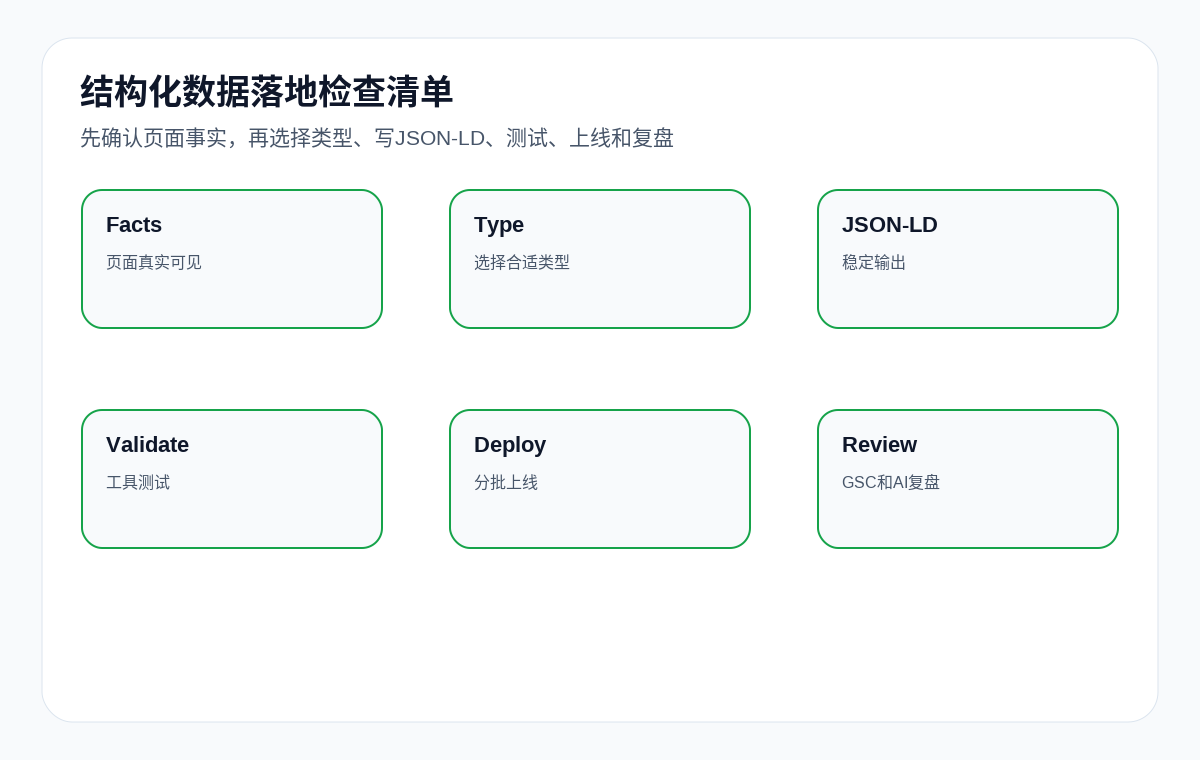
Schema launch review can be divided into three steps: verify field sources first, then verify code and testing, and then look at subsequent Search Console changes. The benefit is that even without GSC data for now, you can still know whether the current work is correct, instead of putting all the pressure on short-term results.
n
| Review step | What to look at | How to record it | Notes for foreign trade sites |
|---|---|---|---|
| Field source | Whether each field comes from visible page content. | Field source table. | When a B2B product has no public price, do not force in a retail price. |
| Page role | Whether the Schema type matches the page’s purpose. | URL-to-type mapping table. | Category pages and product pages should not compete for each other’s role. |
| Test results | Syntax, required fields, recommended fields, and error messages. | Screenshots or result links from testing. | Passing the test does not mean rich results will definitely be displayed. |
| Index discovery | Whether the URL is in the sitemap and whether the canonical is clear. | Technical checklist. | Structured data cannot rescue a page that cannot be indexed. |
| GSC review | Whether query/page data changes and whether the rich results report has data. | Monthly review table. | When there is no row data, write only the observation status, not performance conclusions. |
n
II. Understanding Schema Structured Data Correctly: A Description of Facts for Machines
n
Schema structured data is a standardized vocabulary, usually written into a page as JSON-LD, that describes the entities, attributes, and relationships on the page. Search engines can use it to help understand a page and display rich results when conditions are met. But Schema is not a ranking shortcut, and it will not suddenly make a low-quality page strong.
n
Foreign trade websites most often misunderstand two things. First, they assume that installing a plugin to generate markup automatically is enough; second, they assume they can mark up information that is not on the page. The correct approach is to fill in the page content first, then use Schema to describe the facts that already exist clearly.
n
For example, if a waterproof connector product page does not show rated current, IP rating, material, application, or certificate, do not expect Product schema to fill in that information for you. Schema should correspond to facts visible on the page.
n
What Schema Can and Cannot Do
n
| Can do | Cannot do |
|---|---|
| Help machines understand page types and entities | Replace product specifications and body content |
| Assist rich result eligibility | Guarantee rich result display |
| Unify company and brand information | Fix incorrect business facts |
| Describe breadcrumbs and page relationships | Solve thin content problems |
| Support more accurate AI understanding of facts | Promise that AI will cite it |
n
III. Which Schema Types Foreign Trade Websites Should Prioritize
n
A foreign trade website does not need to pursue every type from the start. The usual priorities are BreadcrumbList, Organization, Product, Article, FAQPage, VideoObject, ImageObject, and CollectionPage/ItemList related markup. The specific choice depends on the page’s role.
n
For product pages, prioritize Product and BreadcrumbList; for tutorial and document description pages, prioritize Article; for FAQs that are genuinely visible, consider FAQPage; for company about pages and footer information, unify Organization; when there are installation or equipment demo videos, consider VideoObject.
n
Do not apply Product to every page, and do not disguise contact pages, category pages, or article pages as product pages. Type mismatches cause confusion and can also make structured data ineffective over the long term.
n
Foreign Trade Pages and Schema Types
n
| Page type | Recommended type | Notes |
|---|---|---|
| Product detail page | Product, BreadcrumbList | Specifications and images must be real |
| Product category page | BreadcrumbList, ItemList/CollectionPage | Do not invent product attributes |
| Technical tutorial | Article, FAQPage | The FAQ must be visible on the page |
| Document page | Article/CreativeWork | Describe the version and applicable products |
| About us | Organization | Name, logo, and contact information must be consistent |
| Video page | VideoObject | Has a title, description, thumbnail, and upload date |
n
IV. Product Schema: Product Pages Can Use It, but Must Respect B2B Reality
n
Product schema suits specific product pages well, but B2B foreign trade products often have no public price, inventory, or reviews. Do not fabricate offer, review, or aggregateRating just to make the fields complete. Google’s requirement for structured data is that the marked-up content must be real, accurate, and visible on the page.
n
For an LED flood light product page, you can mark up the name, image, description, SKU, brand, and product URL; if the price requires an inquiry, handle Offer carefully and do not write inventory or prices that do not exist. For custom products such as custom metal parts, focus more on the product description, materials, processes, images, and inquiry entry point rather than forcing in retail fields.
n
Product schema assumes that the product page itself is complete enough. Without a specification table, images, application descriptions, and document links, schema alone cannot solve the buyer’s evaluation problem.
n
Judging Product Schema Fields
n
| Field | B2B foreign trade recommendation | Risk |
|---|---|---|
| name | Clear English product name | Writing only the model number makes it unclear |
| image | Use real product photos | Using unrelated stock images |
| description | Summarize materials, applications, and specifications | Keyword stuffing |
| sku/mpn | Fill in if available | Making it up |
| brand | Consistent with the brand or company | Brand inconsistencies in multiple places |
| offers | Be cautious when there is no public price | Fabricated prices and inventory |
n
V. Organization Schema: Unify the Company Entity and Reduce Brand Confusion
n
Both AI search and traditional search need to understand the company entity. Organization schema helps describe the company name, logo, website, contact information, social media profiles, and links to the same entity. A common problem for foreign trade companies is inconsistency across the English company name, brand name, domain, footer, about page, and external platforms.
n
For example, the same company writes Tianwen SEO on its website, Tian Wen Digital on LinkedIn, and another company name on its certificates; both machines and users will be confused. Export manufacturers especially need to unify the English company name, brand name, factory name, and the relationship of the export entity.
n
Organization schema does not exist in isolation; it should be consistent with the about page, footer, contact page, logo, social media, and third-party platform profiles.
n
Organization Consistency Table
n
| Information | Checkpoint | Foreign trade recommendation |
|---|---|---|
| English company name | Whether the footer, about page, and certificates are consistent | Decide on the primary name and aliases |
| Logo | Structured data matches the page logo | Use a stable URL |
| Contact information | Phone, email, address | Consistent with the contact page |
| sameAs | Social media and platform links | Only include genuine official profiles |
| Brand relationship | Brand and company entity | Explain clearly on the about page |
n
VI. BreadcrumbList: The Base Type Most Easily Overlooked on Foreign Trade Catalog Sites
n
BreadcrumbList helps search engines understand page hierarchy and helps users know where they are. A foreign trade product catalog usually has a homepage, product lines, subcategories, product details, application pages, and document pages. If the hierarchy is messy, Google has a harder time judging page relationships.
n
For example, Home > Products > Waterproof Connector > M12 Waterproof Connector > 4 Pin IP67 Connector is clearer than hanging every product directly under Products. Breadcrumb schema should match the breadcrumbs visible on the page; do not write a path into structured data that cannot be seen on the page.
n
Breadcrumbs also support internal link governance, making the relationships among category pages, subcategories, and product pages clearer.
n
Breadcrumb Structure Examples
n
| Product line | Recommended hierarchy | Description |
|---|---|---|
| LED flood light | Home > Products > LED Flood Light > 100W LED Flood Light | Category to specification |
| CNC parts | Home > Capabilities > CNC Machining Parts > Aluminum Parts | Capability to material |
| Connector | Home > Products > Waterproof Connector > M12 Connector | Category to series |
| Packaging machine | Home > Products > Packaging Machine > Powder Packing Machine | Equipment to material |
| Ceramic dinnerware | Home > Products > Ceramic Dinnerware > Private Label Sets | Category to customization |
n
VII. Article and FAQPage: Tutorial and Document Pages Should Be Extractable
n
Technical tutorials, selection guides, application notes, and document explainer pages can use Article; frequently asked questions that are genuinely visible on the page can use FAQPage. An FAQ is not for piling up structured data, but for answering the questions buyers actually ask.
n
For example, a “how to choose waterproof connector” page can have FAQs about IP rating, pin count, cable material, application environment, MOQ, and custom cable. A packaging machine guide can answer questions about materials, speed, packaging dimensions, precision, maintenance, and installation.
n
FAQPage content must be visible on the page; it cannot exist only in JSON-LD. Questions and answers should be specific and avoid repetitive empty statements.
n
Article/FAQ Usage Table
n
| Page | Suitable content | Schema notes |
|---|---|---|
| Selection guide | Steps, tables, common mistakes | Article + visible FAQ |
| Application page | Scenarios, products, limitations | Article or WebPage |
| Document description | Version, scope of application | Article/CreativeWork |
| FAQ page | Real questions and answers | FAQPage content is visible |
| News and updates | Company updates | Article, but avoid low-value posts |
n
n
VIII. VideoObject and Image Information: Do Not Waste Equipment Demos and Installation Videos
n
Foreign trade websites often have equipment operation videos, installation videos, product detail images, and factory inspection images. VideoObject helps search engines understand the video title, description, thumbnail, upload time, and content URL. Images themselves also need clear file names, alt text, and page context.
n
For a packaging machine, a video can show powder packaging speed, bag types, precision, and the control panel; for an LED flood light, it can show mounting methods, lighting effect, and heat dissipation structure; for cnc machining parts, it can show the machining and inspection process.
n
Do not embed a video without any text description. The page should have a summary, key specifications, related products, and an inquiry entry point.
n
Video Structured Data Checklist
n
| Field | Recommendation | Risk |
|---|---|---|
| name | Video title describes it clearly | Writing only “Video 1” |
| description | Describe the equipment and scenario | Blank or keyword-stuffed |
| thumbnailUrl | Stable thumbnail | Broken link |
| uploadDate | Real upload date | Filled in at random |
| contentUrl/embedUrl | Accessible | Blocked or broken |
n
IX. Implementation Methods for Structured Data: JSON-LD Suits Most WordPress Foreign Trade Sites Better
n
Google generally recommends JSON-LD because it is easier to maintain and does not require scattering attributes across HTML elements. A WordPress site can output it through the theme, a plugin, or custom code, but whichever method you use, avoid duplication, conflicts, and incorrect fields.
n
If you use Rank Math, Yoast, or another plugin, check whether the automatically generated schema matches the page’s role. Many plugins generate Article for posts, but product pages, document pages, and category pages still need more detailed configuration.
n
Do not let multiple plugins output conflicting Organization, Product, or FAQ schema at the same time. Before implementation, sample the page source and test results first.
n
Comparison of Implementation Methods
n
| Method | Advantages | Notes |
|---|---|---|
| Plugin auto-generation | Low cost, easy to maintain | Types may be too generic |
| Theme code output | Stable and controllable | Requires developer maintenance |
| Custom fields | Suits product specifications | Must ensure the data is real |
| Hand-written JSON-LD | Flexible | Error-prone and hard to maintain |
| Hybrid approach | Suits complex sites | Must prevent conflicts |
n
X. Testing Tools and Launch Process: Start with a Small Batch, Do Not Force It Site-Wide
n
Before launching structured data, use the Rich Results Test, the Schema Markup Validator, the GSC Enhancements report, and sample checks of page source. Do not force it site-wide all at once, especially when there are many product pages and the field sources are complex.
n
Start with a pilot on one product line: for example, the waterproof connector category page, three product pages, one selection article, one document page, and the about page. Once you confirm there are no errors, the content is visible, and the fields are real, expand to other product lines.
n
After launch, watch GSC for structured data errors, changes in rich result eligibility, changes in page crawling, and changes in query terms.
n
Launch Process Table
n
| Step | Action | Acceptance criteria |
|---|---|---|
| Select sample | Choose one product line | Covers multiple page types |
| Write rules | Determine field sources | Avoid fabricated fields |
| Test | Rich Results and source inspection | No critical errors |
| Launch | Release in a small batch | Watch GSC |
| Expand | Replicate to other product lines | Regular spot checks |
n
XI. Schema and AI Search: Help Understanding, Not Control Answers
n
Structured data helps machines understand entities and relationships, but whether an AI answer cites a given website is affected by many factors, including retrieval results, content quality, external signals, entity consistency, and how the question is asked. Do not think of Schema as a switch that controls AI answers.
n
What Schema can do is express real page information more clearly. For example, Organization helps unify the company entity, Product helps describe a product, FAQ helps present questions and answers, and Breadcrumb helps explain hierarchy. When AI systems interpret official site content, these clear signals may help.
n
What truly affects AI visibility is still page content, document completeness, trustworthy external mentions, and a review mechanism.
n
The Boundaries of Schema’s Help for AI
n
| Where it helps | Cannot replace |
|---|---|
| Describe the page type | High-quality body content |
| Unify entity information | Genuine external signals |
| Express product attributes | A complete specification table |
| Present FAQ structure | Real purchasing questions |
| Help page relationships | Sensible internal links |
n
XII. Common Mistakes: Why Schema Has No Effect Even After You Add It
n
Common mistakes include: page content that is too thin, marking up content that is not visible on the page, fabricated Product fields, FAQ written only in code, conflicting output from multiple plugins, inconsistent Organization information, applying the same type to every page, and leaving test errors unfixed.
n
Another mistake is treating Schema as a ranking tactic. Structured data mainly helps understanding and rich result eligibility; it does not replace content quality, search intent matching, or site credibility.
n
Foreign trade websites in particular must avoid fabricating prices, inventory, ratings, and certificates. Both buyers and search systems need real information.
n
Common Mistakes Table
n
| Mistake | Consequence | Fix |
|---|---|---|
| Marking up invisible content | May be ineffective or a policy violation | Make the FAQ and information pages visible |
| Fabricated ratings and prices | Trust risk | Mark up only real fields |
| Type mismatch | Confusing machine understanding | Choose types by page role |
| Plugin conflict | Duplication or contradiction | Keep one primary output |
| Inconsistent entity | Brand confusion | Unify company and brand information |
n
XIII. Example Approach for a Foreign Trade Product Page Schema: waterproof connector
n
Take a waterproof connector product page as an example. The visible page content should include the product name, images, IP rating, pin count, rated current, rated voltage, material, cable option, application, certificates, datasheet, and inquiry entry point. Product schema marks up only this real information.
n
If the page has no public price, do not force a price into Offer. Instead, put inquiry information in the page body and FAQ, explaining that you need details such as quantity, cable length, application, and target market.
n
If there is an installation or application video, you can add VideoObject to the page; if there is a document download, you can create a separate document page and describe it with Article/CreativeWork.
n
waterproof connector Page Fields
n
| Page fact | Schema representation | Purchasing value |
|---|---|---|
| Product name and image | Product name/image | Identify the product |
| IP67, 4 pin, material | description/additionalProperty approach | Evaluate specifications |
| Datasheet | Document page or link | Verify specifications |
| FAQ | FAQPage | Answer MOQ and customization questions |
| Breadcrumbs | BreadcrumbList | Understand hierarchy |
n
XIV. Example Approach for a Foreign Trade Document Page Schema: packaging machine manual
n
A packaging machine manual or datasheet page is suited to describing the document name, applicable models, version, update time, main chapters, download format, and related products. It is not necessarily a Product page, but it can serve as a document asset that helps buyers and AI understand the equipment’s capabilities.
n
The page body should clearly state what the document covers, such as the capacity range, packaging dimensions, precision, maintenance cycle, applicable materials, and installation requirements of a powder packing machine.
n
If this kind of document page is interlinked with product pages, it will be easier for search and AI to understand than a PDF uploaded on its own.
n
Document Page Field Table
n
| Field | Example | Purpose |
|---|---|---|
| Document name | Powder Packing Machine Manual | Clarify the topic |
| Applicable products | Model PM-500 / PM-800 | Relate to products |
| Version date | 2026 version | Avoid outdated information |
| Main content | installation, maintenance, specs | Help evaluation |
| Related links | Product page, inquiry page | Form a path |
n
XV. Review Metrics: Do Not Look Only at Rich Results; Look at Pages and Inquiries
n
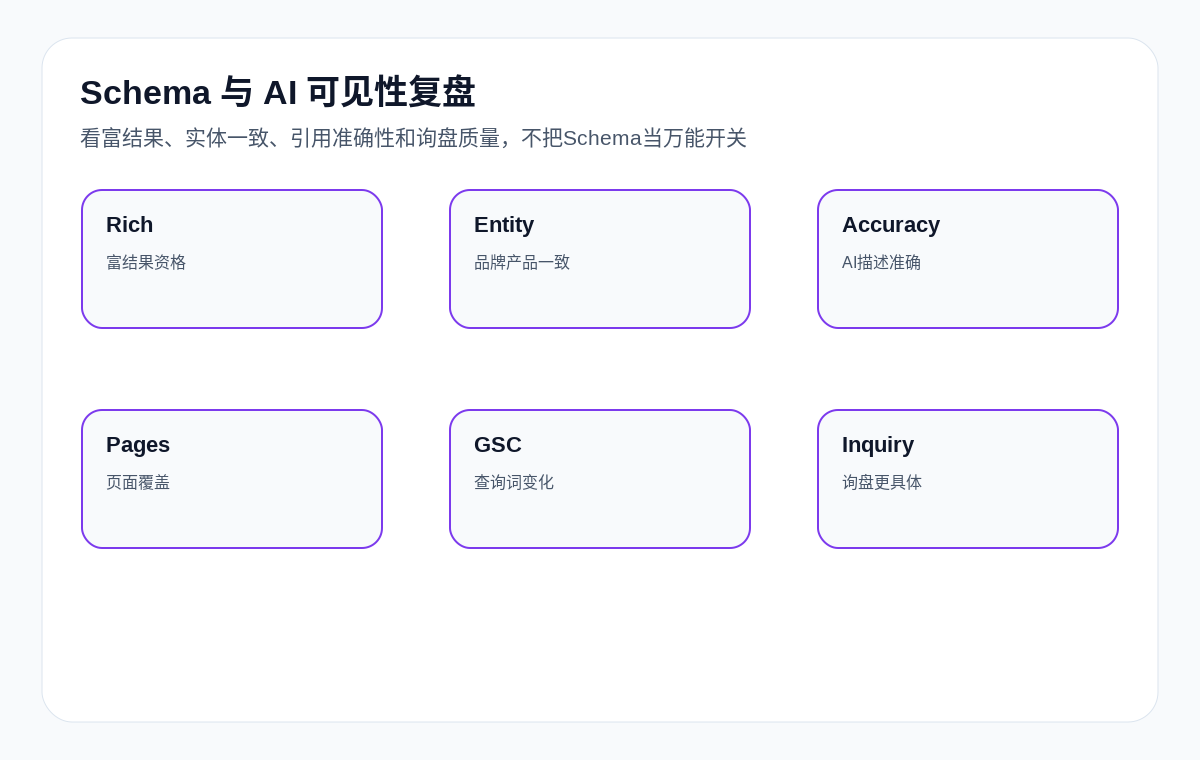
A structured data review can look at the GSC enhancements report, rich result eligibility, structured data errors, page query terms, click-through rate, AI answer accuracy, and inquiry quality. Do not ask only “are there rich results?”, because not every type displays rich results, and not every rich result directly brings inquiries.
n
For a foreign trade website, what matters more is whether pages are understood correctly, whether product terms land on the right pages, whether AI can describe the product and company accurately, and whether buyer inquiries become more specific.
n
Reviews should be conducted by product line rather than looking at site-wide averages.
n
Review Metrics Table
n
| Metric | What to look at | Judgment |
|---|---|---|
| GSC enhancements report | Errors and valid items | Whether the technical setup is healthy |
| Query terms | Whether product terms match the page | Whether understanding has improved |
| Click-through rate | Impact of titles and rich results | Whether it attracts clicks |
| AI answers | Mentions, citations, accuracy | Whether the facts are clear |
| Inquiry quality | Specifications, quantity, application | Business value |
n
nn
XVIII. How to Read a JSON-LD Example: Do Not Just Copy Code; Understand Where the Fields Come From
n
Many foreign trade companies see a Schema tutorial and copy a block of JSON-LD code directly. But what really matters is where the fields come from, who is responsible for maintaining them, and whether the page content stays in sync. Code is only the form of expression; field governance is the long-term issue.
n
For example, name in Product should come from the English product name, image from a real product photo, description from the visible page description, brand from the unified brand or company entity, and sku from the internal product code. additionalProperty can be used to express parameters such as material, IP rating, power, and dimensions, but these parameters must also be visible on the page.
n
If field sources are not managed, later product updates, image replacements, certificate changes, and URL changes will make the structured data stale. Foreign trade websites should treat Schema as part of product information governance, not a one-off technical task.
n
Field Source Governance Table
n
| Schema field | Recommended source | Maintenance owner | Risk |
|---|---|---|---|
| name | Standard English product name | Product/Foreign trade sales | Confusion from multiple name versions |
| image | Real main product image | Website operations | Broken or irrelevant images |
| description | Visible page summary | Content owner | Code and page are inconsistent |
| brand | Unified brand/company name | Decision maker | Brand entity confusion |
| additionalProperty | Specification table | Product/Engineering | Outdated or fabricated specifications |
n
XIX. Category Page and Product Page Schema Should Not Compete for Each Other’s Role
n
A common structure on foreign trade websites is one category page with dozens of product pages under it. The category page’s job is to explain the product range and filtering logic, while the product page’s job is to explain the specific model and specifications. Structured data should also reflect this difference in roles.
n
If a category page is incorrectly marked up as a single Product, it may confuse the page topic; if a product page outputs only Breadcrumb without Product-related information, the specific product facts are under-expressed. The correct approach is for the category page to emphasize the collection, list, and breadcrumbs, and for the product page to emphasize specific product facts and its position in the hierarchy.
n
For example, an LED flood light category page can explain that this is a product collection covering different wattages, applications, and certifications, while a 100W LED flood light product page explains the specific wattage, lumens, IP rating, dimensions, applications, and documents.
n
Schema Boundaries Between Category Pages and Product Pages
n
| Dimension | Category page | Product page |
|---|---|---|
| Page goal | Show the product range | Explain a specific product |
| Suitable types | BreadcrumbList, ItemList approach | Product, BreadcrumbList |
| Core fields | Category name, list, hierarchy | Name, image, specifications, brand |
| Common mistakes | Disguised as a single product | Missing specifications and documents |
| Review focus | Category terms and supplier terms | Model terms and specification terms |
n
XX. How to Structure Certificate Pages and Document Pages
n
Certificates, test reports, installation manuals, product catalogs, and datasheets from foreign trade companies often build trust better than ordinary blog posts. But many websites simply drop a PDF onto a page, making it hard for search engines and AI to understand the document content.
n
A document page should clearly state the document name, applicable products, version, release date, main content, download format, related products, and contact entry point. This way, even if the PDF itself cannot be parsed well, the page still provides clear context.
n
For example, a medical probe material specification page can state the compatible devices, material, cleaning method, packaging method, and compliance notes; an industrial valve test report page can state the pressure rating, test standards, material, and applicable series.
n
Document Page Structuring Preparation Table
n
| Document type | Page description | Related pages | AI value |
|---|---|---|---|
| Certificate | Certification scope, validity period, product line | About page, product page | Strengthen trustworthy facts |
| Datasheet | Specifications, version, applicable models | Product page, category page | Support specification answers |
| Manual | Installation, maintenance, precautions | Video, FAQ, inquiry page | Support how-to questions |
| Catalog | Product range and download instructions | Category page, contact page | Support understanding of product coverage |
| Test report | Test standards and result summary | Product page, certificate page | Support trust judgments |
n
XXI. Schema and Multilingual Foreign Trade Sites: Ensure Consistency on English Pages First
n
Many foreign trade companies have Chinese, English, and even multilingual pages at the same time. Structured data must be consistent with the page in the current language. An English product page should use an English product name, English description, English URL, and breadcrumbs in the corresponding language, avoiding Chinese fields mixed into English pages.
n
If a multilingual site uses hreflang, Organization information can keep the entity consistent, but page titles, descriptions, FAQs, and product attributes should match the language. Product specifications in different language versions must not contradict each other.
n
For example, if the English ceramic dinnerware page says dishwasher safe and the Chinese page says the equivalent, the two mean the same thing; if the English page says microwave safe but the Chinese page has no corresponding statement, it is best to complete the visible page content so the information does not conflict.
n
Multilingual Schema Checklist
n
| Check item | Correct approach | Risk |
|---|---|---|
| Language | Fields match the page language | Chinese mixed into an English page |
| URL | Points to the current language URL | Cross-language wrong links |
| Product specifications | Same meaning across languages | Conflicting specifications |
| FAQ | Visible on the page and in the same language | Questions hidden in code |
| Entity information | Unified rules for the company name | Brand confusion |
n
XXII. How Technical and Content Teams Should Divide the Work
n
A Schema project is neither a purely technical task nor a purely content task. The content team is responsible for page facts, product specifications, FAQs, and document descriptions; the technical team is responsible for stable output, field mapping, testing, and avoiding conflicts; the business team is responsible for confirming that the information is real.
n
If only the technical team does it, empty or incorrect fields are likely; if only the content team does it, they may not understand testing and maintenance; without business confirmation, product facts are likely to be wrong. A foreign trade company should set up a small process: content submits fields, business confirms, technology launches, and the SEO owner reviews.
n
This division of labor reduces later maintenance costs and avoids inconsistency between structured data and page content.
n
Team Division of Labor Table
n
| Role | Responsibility | Acceptance criteria |
|---|---|---|
| Business/Product | Specifications, certifications, applications, MOQ | Facts are accurate |
| Content | Page body, FAQ, description | Visible on the page and clear |
| Technical | JSON-LD output and testing | No critical errors |
| SEO owner | Type selection and review | Matches the page goal |
| Sales | Feedback on inquiry questions | Feeds back into FAQ and documents |
n
XXIII. Phased Implementation Roadmap: Core Pages First, Then Scale
n
For a foreign trade website, it is not advisable to cover the whole site with Schema in one pass. A steadier route is to pilot on core pages first, confirm field sources and test results, and then expand to other product lines.
n
The first batch can cover Organization on the homepage/about page, Breadcrumb and list markup on core category pages, Product on 3 to 5 main product pages, Article/FAQ on 2 high-quality tutorials, and 1 document page. The second batch then expands to more product pages and application pages.
n
After each batch goes live, record the URL, Schema type, test results, GSC changes, and issues found. This way, during later maintenance you will know which rules work and which fields need adjustment.
n
Phased Implementation Table
n
| Batch | Page scope | Schema focus | Review |
|---|---|---|---|
| Batch 1 | Homepage, about, core categories, main products | Organization, Breadcrumb, Product | Testing and error fixes |
| Batch 2 | Tutorials, FAQ, document pages | Article, FAQPage, CreativeWork approach | Query terms and AI accuracy |
| Batch 3 | Application pages and video pages | Article, VideoObject | Citations and inquiry paths |
| Ongoing | New products and new documents | Field synchronization and maintenance | Quarterly spot checks |
nnn
XXIV. Troubleshooting: What to Do When Testing Passes but GSC Still Shows No Change
n
Passing a structured data test only means there are no obvious errors in the code format and some rules; it does not mean search results will definitely change. If GSC shows no change, troubleshoot layer by layer: whether the page is indexed, whether Google has recrawled the structured data, whether the page content is sufficient, whether the type is eligible for rich results, and whether the target query terms match the page.
n
Many foreign trade websites’ problems are not the Schema code but the page itself having no search demand or too little content. For example, a product page with only two sentences, even with correctly formatted Product schema, is unlikely to make search and AI systems consider it a high-value page. Another common cause is that fields are real but not visible on the page, or that the product page lacks internal link support.
n
When troubleshooting, do not rush to change the code repeatedly. First confirm the crawl status in URL Inspection, then look at the GSC enhancements report, then look at page content and internal links, and finally check whether the SERP really needs this result format.
n
Schema Troubleshooting Table
n
| Symptom | Possible cause | How to handle it |
|---|---|---|
| Testing passes but GSC shows no report | Not recrawled, or the type has no report | Wait for crawling and do spot checks |
| GSC reports missing fields | Required or recommended fields are insufficient | Add real page fields |
| Rich results not displayed | Eligibility not met, or the SERP does not display them | Look at content quality and query intent |
| AI description is still wrong | Page facts are unclear or external information conflicts | Unify the entity and document pages |
| Product page has no query terms | Thin content or weak internal links | Add specifications, applications, and internal links |
n
XXV. Schema Governance Checklist: Sync Every Time You Add a Product or Document
n
A foreign trade website is not built once and then left unchanged. New products, new models, new certificates, new documents, new videos, and new application pages keep appearing. Schema governance must be part of the website’s routine maintenance process, not left unowned after launch.
n
Every time you add a product page, confirm that the English product name, images, specifications, brand, category, breadcrumbs, document links, and FAQ are complete; every time you add a certificate or datasheet, confirm that the document page states its scope of application; every time you change the company name, logo, or contact information, confirm that the related Organization information is synced.
n
A quarterly review can spot-check 10 to 20 core pages to see whether the structured data is still accurate, whether the page content has changed, whether GSC shows errors, and whether AI answers contain outdated descriptions. This is how you prevent structured data from turning from an asset into a historical burden.
n
Routine Governance Table
n
| Trigger event | Sync check | Owner |
|---|---|---|
| New product added | Product fields, images, breadcrumbs | Product + Website |
| New document added | Document description, version, related products | Content + Business |
| Logo changed | Organization and page logo | Brand + Technical |
| New video added | VideoObject fields and summary | Content + Technical |
| Quarterly review | GSC errors, AI accuracy, inquiry feedback | SEO owner |
n
XXVI. When You Should Not Add Schema
n
Not every page needs complex Schema. Pages with very little content, temporary campaign pages, worthless tag pages, internal search result pages, low-quality filter combinations, and pages without real documentation should not have complex markup added for the sake of “technical completeness”.
n
If a page is not meant to be indexed, or is only used for user filtering and sorting, there is no need to spend a lot of effort writing structured data for it. Foreign trade companies should focus their effort on core category pages, product pages, application pages, document pages, and high-quality tutorial pages.
n
Simply put, Schema should serve high-value pages, not drape a technical coat over low-value pages.
n
Pages Where Complex Schema Is Not Recommended
n
| Page type | Reason | Recommendation |
|---|---|---|
| Internal search result page | Content is unstable | Usually not indexed |
| Low-value tag page | Weak topic | Merge or deprioritize |
| Temporary campaign page | Short lifecycle | Simplify as needed |
| Product page without documents | Insufficient facts | Add content first |
| Repetitive filter combinations | Low value and duplicated | Control indexing |
nn
XVI. FAQ: Common Questions About Schema Structured Data
n
Does Schema structured data directly improve rankings?
n
You should not think of it as a direct ranking button. It helps search engines understand a page and may earn rich result eligibility, but content quality, search intent, and credibility remain the foundation.
n
Do foreign trade product pages have to add Product Schema?
n
For main product pages, it is worth evaluating, but it must be based on real page content. Do not fabricate fields when there is no public price or review information.
n
Can FAQPage still be used?
n
It can be used for FAQs that are genuinely visible on the page, but whether rich results are displayed is up to the search engine. The FAQ should answer real purchasing questions, not pile up empty statements.
n
Should a category page use Product or ItemList?
n
A category page is usually not a single product page; it is better suited to expressing a list, a collection, and breadcrumbs. The specific type depends on the page content and implementation.
n
Is automatic generation by a WordPress plugin enough?
n
For basic pages it may be enough, but foreign trade product pages, document pages, and complex categories often need manual checks to confirm the fields are accurate.
n
Is Schema required for AI search optimization?
n
Schema helps, but it is not the only condition. Page content, document completeness, entity consistency, and external signals are equally important.
n
Can I mark up FAQs that are not displayed on the page?
n
Not recommended. Structured data should correspond to visible page content to avoid misleading users.
n
How should a B2B product with no price handle Offer?
n
Do not fabricate a price. You can explain on the page what information is needed for an inquiry and handle publicly shareable fields carefully.
n
How long after launch should structured data be reviewed?
n
Technical errors can be checked quickly, while search performance and AI understanding usually need weeks to months of observation.
n
What should multilingual sites pay attention to with Schema?
n
Names, URLs, hreflang, company information, and product facts across different language pages must be consistent, avoiding contradictions between language versions.
n
XVII. Conclusion: Schema Is Part of Fact Governance for Foreign Trade Websites
n
The value of Schema structured data is not to make a page look more “technical”, but to help search engines and AI systems understand the real facts on the page more accurately. For foreign trade companies, it should serve products, the company, documents, FAQs, videos, and page relationships, rather than becoming a new way to stuff keywords.
n
The implementation order should be: first fill in real content and clarify page roles, then choose the appropriate types, then output JSON-LD consistently, and finally test with tools and review the data. Do not treat the plugin’s default output as everything, and do not invent information just to complete the fields.
n
When product pages, category pages, application pages, document pages, and the about page all express facts clearly and use Schema to support their descriptions, a foreign trade website’s understandability in SEO and AI search becomes more reliable, and buyers can more easily get accurate answers and submit more specific inquiries.
n
Final Checklist
n
| Check item | Completion standard |
|---|---|
| Page facts | Product specifications, documents, and FAQ are genuinely visible |
| Type selection | Choose Schema types by page role |
| Real fields | Do not fabricate prices, ratings, inventory, or certificates |
| Testing tools | No critical errors in Rich Results and Validator |
| Entity consistency | Unified company, brand, and product naming |
| Review metrics | Look at GSC, AI accuracy, and inquiry quality together |
n
nnn
Continue Reading This GEO Series
n
If you are systematically learning about GEO and AI search visibility, we suggest continuing with the articles below. Understand the concepts first, then move on to diagnosis, monitoring, content structure, and the boundaries of cooperation.
n
- n
- How to write common ChatGPT SEO prompts: how to use content planning, title generation, and structural rewriting
- How to choose an AI search visibility service team: what a reliable generative engine optimization team should deliver
- Where to start with AI search optimization: should a foreign trade website build the query set first or change content first?
- How to do GEO: what to change first, from page structure to citation probability
- How to achieve AI search visibility for B2B foreign trade: a guide to getting inquiry terms and solution terms into AI answers
- How to achieve AI search visibility on Shopify: a guide to optimizing collection pages, product pages, and AI understanding
n
n
n
n
n
n
nn
This page is machine-translated from the Simplified Chinese version and awaiting human review. It has not yet been proofread.
Further Reading on This B2B SEO & GEO Topic
- How to Handle Redirects and 404 Errors: A Guide to Migration, Old Page Consolidation, and Dead Link Fixing for B2B Export Websites
- How to Do Product Page SEO: Optimization Guide for Titles, FAQs, Schema, and Internal Links on B2B Export Product Pages
- How to Do Local SEO: Guide to Google Business Profile, Reviews, NAP, and Local Pages
- How to Do SaaS SEO: Guide to Functional Pages, Comparison Pages, Scenario Pages, and Content Cluster Layout
- How e-commerce websites can do GEO: How category pages, product pages, and review content can appear in AI answers
- Technical SEO Audits, B2B JSON-LD Schema, Hreflang, and 301 Migration Hub
- Generative Engine Optimization Research
- B2B SEO & GEO Scope and Pricing Standards