How do you do AI SEO? Which has the higher priority: the title, the URL, or the paragraph structure? If you ask export manufacturers and trading companies this question, the most practical answer is not the vague “everything matters.” It is to first look at what procurement problem the page is solving, and then judge whether the title is wrong to begin with, whether the URL hierarchy is a mess, or whether the paragraph structure cannot be quickly extracted by search and AI answer systems. For English product pages such as custom metal parts, LED flood light, packaging machine, medical probe, cnc machining parts, and waterproof connector, getting the priority wrong is often more fatal than the execution itself.
From the perspective of a B2B export website, this article explains the real priorities of AI SEO: when to fix the title first, when to deal with the URL, and when to rewrite paragraph structure, FAQs, tables, and evidence blocks; why “answer-first” does not mean every page should be written as a short answer; and how to connect AI Overviews, AI citations, GSC, GA4, inquiries, and sales feedback.
Target queries: AI SEO怎么做, AI SEO title vs URL vs structure, how to do AI SEO, AI Overviews content structure, title URL heading priority for AI search. Search intent: users do not want a set of abstract principles; they want to know what to tackle first in page optimization when time and resources are limited. Top1/authority benchmark: current articles on AI SEO, AI Overviews content structure, and URL structure for AI retrieval generally emphasize answer-first, clear headings, tables/lists, semantic structure, internal links, and URL hierarchy; their shortcoming is that most are aimed at general blogs or SaaS pages and lack priority judgments for export product pages, category pages, application pages, resource pages, and inquiry pages. This article fills those gaps.
Conclusion first: for most pages, fix “is the topic clear” and “is the content extractable” before talking about URLs
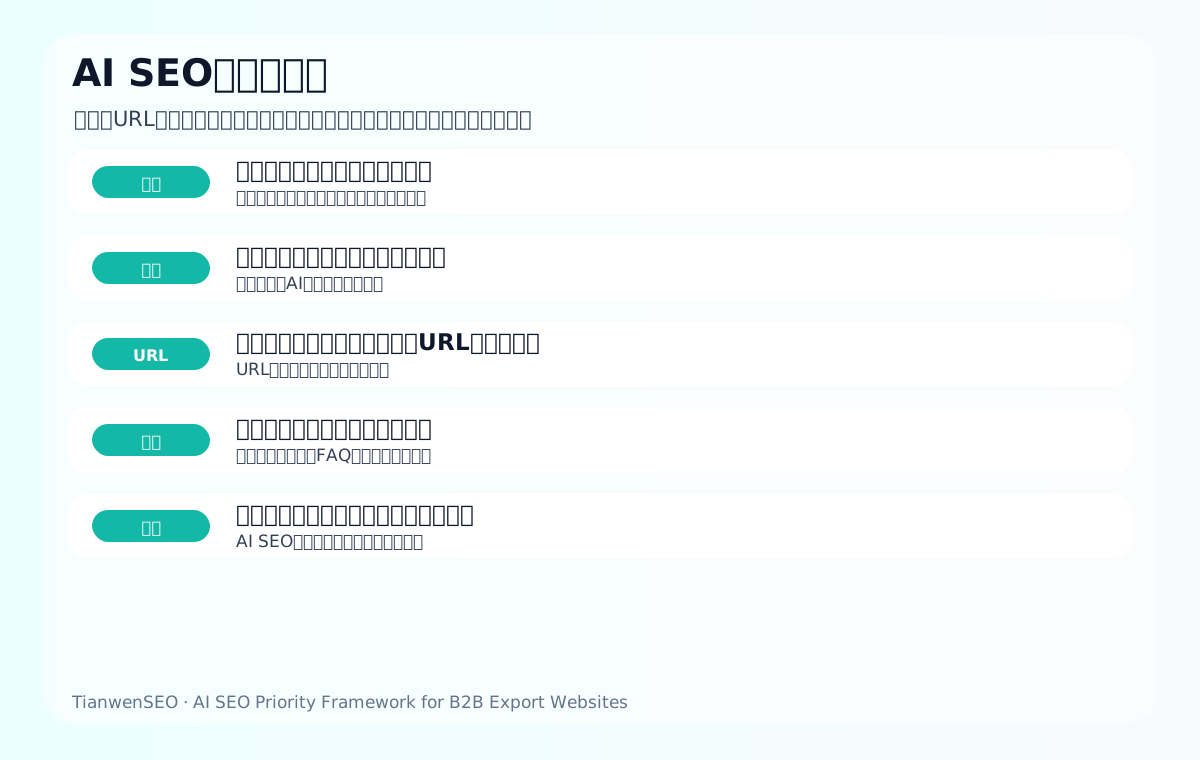
If only one short conclusion is allowed: when doing AI SEO on most live pages, the priority is usually 1) whether the page answers the right question; 2) whether the title accurately defines that question; 3) whether paragraph structure, tables, FAQs, and evidence make the answer easy for answer systems to extract; 4) whether internal links and the business path are clear; 5) whether the URL needs to be handled together with restructuring.
Many people treat the URL as a core optimization point because it looks more “technical.” But in reality, plenty of pages with ordinary URLs, as long as their titles are accurate, their structure is clear, and their facts are sufficient, still have a better chance of being understood and cited than pages with beautiful URLs but empty content. This is especially true for export sites: buyers do not inquire because of URL length, but because the page can answer questions about materials, tolerances, IP ratings, MOQ, samples, certifications, and application risks.
| Priority level | Core question | Why look at it first |
|---|---|---|
| Page intent | What question is this page actually answering | If intent is wrong, all later optimization drifts |
| Title | Does the title accurately define the topic and its boundary | The title is the most direct topic signal |
| Paragraph structure | Are answers, tables, and FAQs easy to extract | Both AI and users rely on structure to understand |
| Evidence and facts | Does the page have parameters, boundaries, and credible information | AI SEO cannot rely on writing alone |
| URL | Does the URL need to support hierarchy restructuring | Usually supportive, not first in line |
Why “title, URL, and paragraph structure all matter” is still not enough
“Everything matters” is not wrong, but it does not help execution. Export companies usually have limited resources and cannot perfectly rewrite hundreds of pages at once. The real question to solve is: if a packaging machine page is not entering the right queries, do you look at the title first or the structure first? If a waterproof connector resource page already has traffic but is not cited by AI, do you change the URL first or add a table first? If a custom metal parts capability page is misunderstood as an ordinary blog, do you add evidence first or change the title first?
The practical value of AI SEO is not in repeating “title, URL, structure, and schema all matter,” but in knowing what the first priority action is for each type of page. Only then can a team use limited time to make choices closer to business results.
| Vague statement | Problem | More actionable statement |
|---|---|---|
| Title, URL, and structure all matter | Cannot rank priorities | Decide the first action by the type of page problem |
| Content should be more AI-friendly | No idea how to change it | Add the answer section, tables, FAQs, and facts first |
| URLs should be standardized | Easy to over-edit | Focus on changing URLs only during structural restructuring |
| Paragraphs should be short | Easy to become fragmented | Short paragraphs must pair with clear questions and evidence |
Top1/authority benchmark: what existing AI SEO articles get right
Current SERP articles on AI SEO, AI Overviews formatting, and AI retrieval URL structure generally get a few things right: first, they emphasize answer-first, not burying the answer later; second, they emphasize clear titles and subheadings; third, they emphasize that lists, tables, and FAQs are extraction-friendly; fourth, they remind readers that URLs and internal links help systems understand hierarchy.
These principles are worth absorbing, but copying them directly onto an export site is not enough. An export site is not just “writing a blog post that is easier to extract”; it needs product pages, category pages, application pages, resource pages, and RFQ pages to all serve the procurement path. For products like LED flood light, industrial valve supplier, and medical probe, what really determines citation and conversion is often fact density and page role, not just making the first paragraph shorter.
| Common view in authority content | Worth keeping | What export scenarios still need |
|---|---|---|
| Answer-first | Answer the core question right under the title | Distinguish product, resource, and application pages; no one-size-fits-all |
| Clear headings | Subheadings help extraction and scanning | Headings must correspond to real procurement questions |
| Tables and lists | Structured information is easier to cite | Table content must carry commercial judgment and parameter value |
| URL hierarchy | Clear hierarchy helps topic understanding | In most cases you should not sacrifice existing assets just to change a URL |
| Semantic structure | Page logic must be clear | Also add evidence, boundaries, and the inquiry path |
Step one: judge which category the page belongs to before discussing priority
The first step of AI SEO is not changing copy, but assigning the page a role. If a page’s role is confused, no amount of title and structure adjustment will help much. The most common page roles on export websites are: product page, category page, application page, resource page, FAQ page, capability/about page, and RFQ/contact page. Different roles have completely different optimization focuses.
For example, a custom metal parts product page focuses on materials, tolerances, surface treatment, and the drawing process; a waterproof connector resource page focuses on IP ratings, selection, and comparison; a packaging machine application page focuses on material scenarios, speed and accuracy, and cleaning requirements; a medical probe capability page focuses on material safety, cleaning, traceability, and boundaries. Once the role is set, the priority of title, structure, and URL has a basis.
| Page role | Main question | First AI SEO priority |
|---|---|---|
| Product page | What this product is, who it suits, what the specs are | Add facts, parameters, FAQs, and the RFQ path |
| Category page | How this category is divided and how to choose | Clarify hierarchy, comparison, and selection logic |
| Application page | Which scenarios it fits and what the risks are | Scenario questions and boundary conditions |
| Resource/tutorial page | How to judge, how to compare, how to operate | Answer section, tables, FAQs, and citation structure |
| Capability/about page | Who you really are and what you can do | Entity information, evidence, and credibility |
| RFQ/contact page | How to request a quote next | Fields, sample process, and file upload instructions |
When the title has the highest priority
If the most fundamental problem with a page is that the topic is unclear, the intent is mixed, or the title reads like a slogan instead of a question, then the title is often the first priority. The title is the most direct clue for search results, AI retrieval, and users judging a page’s purpose. If the title is wrong, the page is easily misunderstood.
For example, if a waterproof connector page title is only “High quality waterproof connector supplier,” it can hardly cover specific questions; if it becomes “How to choose between IP67 and IP68 waterproof connectors: judging outdoor lighting and solar cable scenarios,” the topic is clearer. Likewise for a packaging machine page, if the title only says “Automatic packaging machine manufacturer,” it is better to directly define the material and procurement question, for example “How to choose a powder packaging machine: judging speed, accuracy, and cleaning requirements.”
| Cases suited to fixing the title first | Typical symptom | Why fix the title first |
|---|---|---|
| Title too broad | Only promotional words, no problem boundary | The system cannot accurately identify the topic |
| Mixed intent | The same page covers product, application, and tutorial at once | Determine the main question first |
| Title disconnected from the body | The title answers A while the body writes B | Affects understanding and click expectations |
| Outdated title | Inconsistent with current product terms/market language | Needs alignment with real query language |
When the URL has a higher priority
The URL is not always low priority. It becomes noticeably important in a few scenarios: first, the site is undergoing structural restructuring; second, the page hierarchy is already chaotic and the topic ownership cannot be seen; third, multiple page URLs imply the wrong classification; fourth, a batch of tutorials, resource pages, and category pages needs to be reorganized into a clearer knowledge structure.
For example, if an export site piles all content under the top-level directory, or mixes product pages and tutorial pages in the same path, then URL hierarchy expression can help search and management sides understand topic clusters more clearly. But it must be stressed that changing URLs has costs: redirects, old links, internal links, external citations, and historical indexing all need handling. So if the page itself is simply weak in content, you do not necessarily have to touch the URL first.
| Cases suited to prioritizing the URL | Judgment standard | Notes |
|---|---|---|
| Structural restructuring | Categories and content hierarchy need rebuilding | 301s and internal link updates must be done well |
| Chaotic paths | Cannot tell whether the page is product/application/resource | URLs should assist topic understanding |
| Merging duplicate content | Multiple pages need merging into one stronger page | Set the main URL first, then migrate content |
| Poor legacy naming | Old slug severely mismatches the current topic | Assess whether the change is worth it |
When paragraph structure has the highest priority
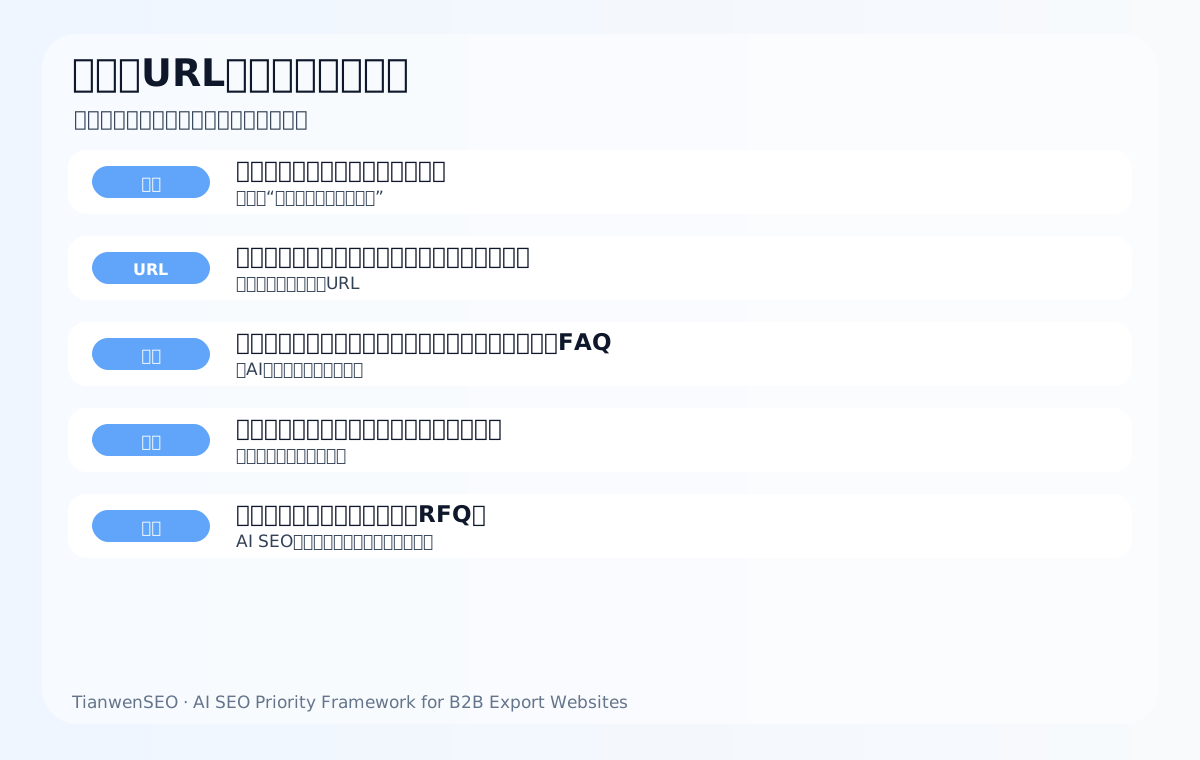
For many pages that already have basic indexing and reasonably clear titles, paragraph structure is often the part that should be fixed first. AI and users do not read the whole page word by word; they quickly identify where the question is, where the answer is, where the table is, where the FAQ is, and where the evidence is. A page with poor structure may not be easy to extract even if it contains correct facts.
For example, if a cnc machining parts page mixes materials, tolerances, quality inspection, and FAQs into long blocks of text, it is better to split them into clear sections and tables; if a LED flood light application page does not give the conclusion first and then expand through scenarios, parameters, risks, and FAQs, it will struggle to serve both users and AI.
| Structure problem | Common symptom | Priority action |
|---|---|---|
| Answer buried too deep | Too much preamble at the start | Give a short conclusion under the title |
| Unclear blocks | No clear H2/H3 | Reorganize sections by question |
| Missing tables | Comparisons and parameters all written in paragraphs | Add comparison and judgment tables |
| Missing FAQ | Common buyer questions are not answered separately | Add an FAQ module |
| Scattered evidence | Certificates, documents, downloads, and application boundaries are unclear | Build a separate evidence block |
Why “answer-first” does not mean writing every page as a short answer
Many AI SEO articles recommend answer-first, and that direction is right, but a common misunderstanding is compressing every page into a short reply. For export product pages and resource pages, answer-first really means: first let users and systems know what the core judgment of the page is, then use tables, parameters, FAQs, evidence, and boundaries to explain the question clearly.
For example, for “How to choose between IP67 and IP68 waterproof connectors,” the first paragraph can give a short conclusion: for short-term immersion and outdoor lighting, IP67 is often enough; for long-term immersion or harsher environments, you need to look at a higher protection rating and the connection structure. But it must then expand into test conditions, application scenarios, misconceptions, and a selection table. Otherwise the page can only offer a one-line generic answer and cannot really help procurement.
| Page type | How to do answer-first | What not to do |
|---|---|---|
| Resource page | Give the conclusion first, then expand the judgment table and FAQ | Give only one sentence with no expansion |
| Product page | First state who it suits, the core specs, and the scenario | Only write a brand manifesto |
| Application page | First state where it applies and where it does not | Only talk about advantages, not limitations |
| Capability page | First define who you are and what you can do | Only write “professional and reliable” |
AI SEO is not just changing the writing; it is also adding “fact density”
For high-ticket export products, fact density is almost always more important than writing technique. Titles and structure only help extraction; they cannot replace the facts themselves. If a page lacks materials, dimensions, tolerances, IP ratings, pressure and temperature, certification scope, MOQ, lead time, samples, applicable scenarios, and risk boundaries, even the best title cannot save empty content.
So a key judgment in AI SEO is: is the current page problem a “writing problem” or a “missing facts problem”? If it is the latter, add facts first instead of only tweaking the copy.
| Page symptom | More like a writing problem | More like a facts problem | What to do first |
|---|---|---|---|
| Accurate title but no citations | Structure may be poor | Facts may also be shallow | Check tables, FAQs, and evidence first |
| Broad title and broad body | Writing problem is obvious | Facts are probably insufficient too | Redefine the role and topic first |
| Traffic but low conversion | Path and structure may be problematic | RFQ fields may also be missing | Check the business path |
| Customers keep asking basic questions | Insufficient FAQ | Facts are not expressed clearly enough | Add FAQs and a judgment table |
How to rank title/URL/structure priority for different pages
| Page type | Title priority | URL priority | Structure priority | Notes |
|---|---|---|---|---|
| Product page | High | Medium-low | High | Product pages usually need facts and structure first |
| Category page | High | Medium-high | High | Category logic and hierarchy are both critical |
| Application page | High | Medium | High | Application questions and boundaries should be written clearly first |
| Resource/tutorial page | Medium-high | Medium | Very high | The common problem is structure that is not extraction-friendly |
| Capability/about page | Medium | Low | Medium-high | The core is entities and evidence |
| RFQ page | Medium | Low | High | Focus on fields, next-step instructions, and guidance |
Export industry scenario 1: what to fix first on a waterproof connector page
If a waterproof connector page currently only says “high quality waterproof connectors” and has no IP rating, application scenarios, pin count, wire diameter, installation method, or FAQ, then the first priority is usually not changing the URL, but rewriting the title and structure and adding facts. Buyers and AI both need clearer questions and parameters.
| Current problem | First action | Second action | Why |
|---|---|---|---|
| Title too broad | Change to a title with a scenario/comparison question | Add tables and FAQ | Define the topic first |
| Title but no structure | Reorganize H2/H3 and the answer section | Add evidence and RFQ fields | Improve extractability |
| Chaotic hierarchy | Adjust the URL only if restructuring is underway | Add 301s and internal links | URLs matter more only during restructuring |
Export industry scenario 2: what to fix first on custom metal parts / cnc machining parts pages
The most common problem with these pages is “facts are not dense enough.” If a page only says it can do various metal machining jobs without materials, tolerances, surface treatment, drawing formats, quality inspection, and batch descriptions, the first step of AI SEO is usually to add facts and structure, not just optimize the title. The title must of course be accurate, but what really determines value is whether it can answer technical procurement questions.
| Problem symptom | Highest priority action | Reason |
|---|---|---|
| Materials and processes are vague | Add a parameters and capabilities table | Give the page extractable facts first |
| Empty FAQ | Add procurement question FAQs | Reduce repeated explanations by sales |
| Weak RFQ fields | Add drawing/material/quantity fields | Connect the business path |
| Outdated title | Update the title together after facts are complete | Better align the topic with query terms |
Export industry scenario 3: what to fix first on packaging machine / industrial valve pages
Machinery and industrial valve pages often need scenarios and judgment tables even more. Buyers ask about materials, speed, accuracy, media, pressure, temperature, cleaning, and maintenance, rather than just looking at a broad product name. So the high-priority action for these pages is usually to express complex conditions in a structured way, not to stare at URL details.
| Product | Common weakness | High-priority action |
|---|---|---|
| packaging machine | Scenarios are not split by material/speed/accuracy | Add application pages and a selection table |
| industrial valve | Missing media/pressure/temperature judgment | Add a standards page and boundary notes |
| LED flood light | Parameters and applications are mixed together | Split into product page + application page structure |
| medical probe | Insufficient risk boundaries and compliance statements | Add evidence and limitation notes first |
How GSC, GA4, and AI answers help judge priority
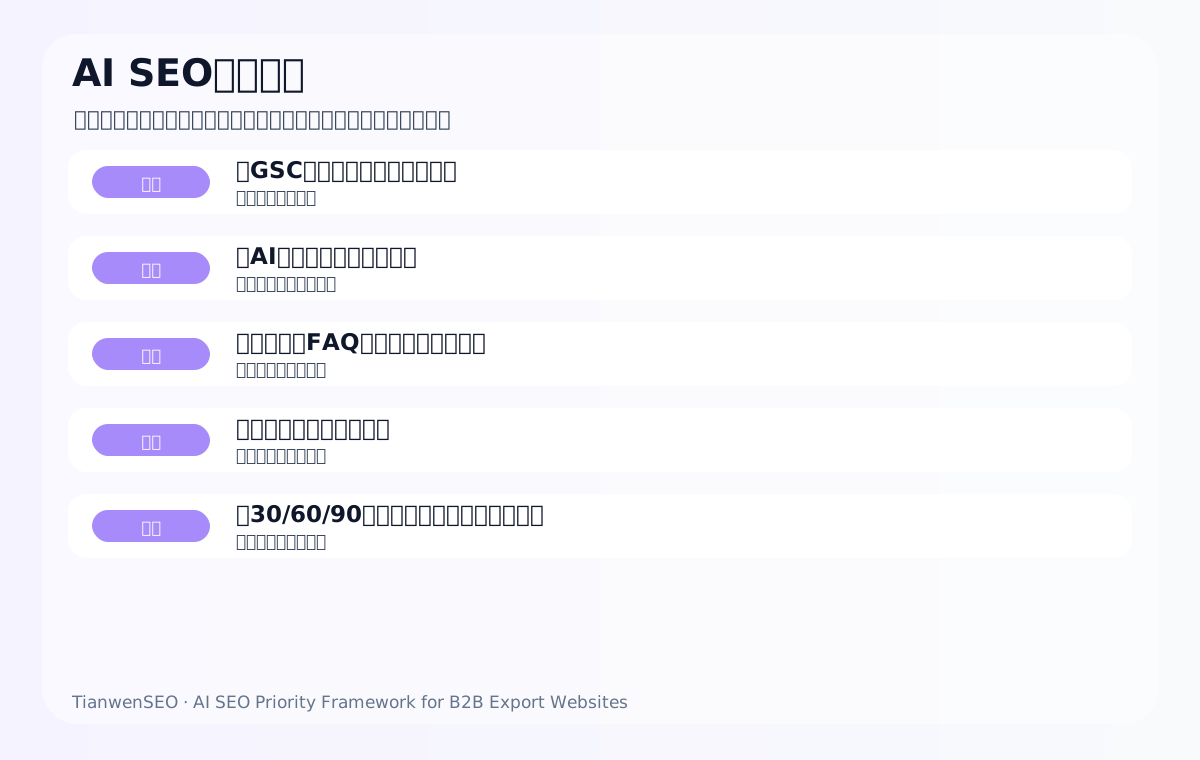
Judging whether the title, URL, or structure should be fixed first cannot rely on feeling alone. The best method is to look at GSC, GA4, and AI answers together. GSC can tell you which queries a page is receiving and whether the title is aligned; GA4 can tell you whether users are entering product pages and RFQ pages; AI answer records can tell you whether the page is understood, whether it is cited, and whether it is described incorrectly.
For example, if a resource page has impressions but low clicks in GSC, the title and snippet may need handling first; if a product page gets visits but short dwell time and no entry into the RFQ page, structure and path may take priority; if a page is cited in AI answers but with wrong specifications, evidence and boundary notes should be added first.
| Data pattern | More likely problem | Priority action |
|---|---|---|
| Impressions but low clicks | Title and snippet are not accurate or attractive enough | Adjust the title and first paragraph first |
| Visits but weak conversion | Insufficient structure/path/CTA | Add tables, FAQs, and RFQ guidance |
| Mentioned but described incorrectly | Evidence and boundary notes are unclear | Add an evidence page and limitation notes |
| No target queries at all | Page intent or topic is misplaced | Redefine the page role and title |
When you should insist on not changing the URL
When many pages already have some indexing, backlinks, internal links, and external distribution, the risk of hastily changing URLs is not small. If the page problem is mainly the title and structure rather than a hierarchy error, it is usually not worth touching the URL just to “look more SEO.”
This is especially true for export sites, because many customers continue circulating links used in PDFs, catalogs, B2B platforms, emails, and WhatsApp. If you change the URL without bringing obvious topic and hierarchy gains, you only increase maintenance costs.
| Situation | Usually not advisable to change the URL first | Reason |
|---|---|---|
| The page already has indexing and traffic | Yes | First see whether the title and structure can solve the problem |
| The page is frequently cited externally | Yes | Changing the URL increases redirect and distribution costs |
| You just want a nicer slug | Yes | The gain is usually smaller than the risk |
| The page role has not changed | Yes | The URL is not necessarily the main contradiction |
When you should change the title, URL, and structure together
There are also scenarios where all three need to change together. For example, an old page originally meant to be a “Google SEO tutorial” later turns out to be better suited as an “IP67 vs IP68 waterproof connector selection guide”; or several pages with overlapping content need to be merged into one stronger resource page. At that point the page topic, path, and structure are all changing, so adjusting them together is more reasonable.
| Scenario | Why change them together | Notes |
|---|---|---|
| Topic fully redefined | The old title and old URL are both no longer accurate | Handle redirects and content migration well |
| Merging multiple pages | A new main page is needed to carry the topic | Unify internal links and canonical |
| Category restructuring | Hierarchy and page roles change together | Plan the information architecture first |
| Upgrading an existing page into a pillar page | Title, path, and structure all need to be more systematic | Avoid just piling on words without restructuring |
Why “is the page intent accurate” is often more important than changing techniques
The reason many pages still perform mediocrely after lots of optimization is not that the title is not good enough, the URL is not short enough, or the structure is not detailed enough, but that the page is answering the wrong question. For example, a page that should solve the judgment question “how to choose packaging machine for powder” is written as a company introduction; a page that should solve the comparison question “IP67 vs IP68 waterproof connector” is written as a broad product introduction. When the intent is wrong, no matter how beautifully the technique is changed, search and AI will struggle to place it in the right scenario.
So before doing AI SEO, ask three questions about the page: what is the main query this page serves? What judgment is the user trying to make at this stage? What is the most reasonable next step after reading it? If these three questions cannot be answered clearly, do not rush to change the URL or subheadings; redefine the page role first.
| Intent check item | What it means if you cannot answer clearly | Priority action |
|---|---|---|
| Main query | The page topic is not focused | Narrow the title and topic first |
| Core judgment | The content does not really help the user | Add the judgment logic and tables first |
| Next step action | The page does not serve the business path | Add product/RFQ/resource links |
| Page role | A product page looks like a blog, and a blog looks like a product page | Redefine the page type first |
How to write a title that actually helps AI SEO
A title that helps AI SEO is not about mechanically stuffing keywords, nor is longer more professional. Its key lies in three points: first, accurately name the main question; second, limit the scope or scenario; third, let users and systems see at a glance what the page will solve. For export pages, scenarios and audiences are often more important than the product name alone.
For example, “custom metal parts supplier” can be further refined into “custom metal parts supplier: how to judge materials, tolerances, and quality inspection”; “LED flood light” can be refined into “LED flood light for warehouse: how to choose power, installation, and waterproofing.” These titles are closer to procurement questions and better suited as resource page or application page titles.
| Title approach | Weaker version | Stronger version |
|---|---|---|
| Product page title | High quality waterproof connector | Waterproof connector supplier: IP ratings, pin counts, and application scenarios |
| Resource page title | Packaging machine guide | How to choose a powder packaging machine: speed, accuracy, and cleaning requirements |
| Application page title | LED flood light application | LED flood light for warehouse: judging power, illuminance, and installation |
| Capability page title | About our factory | Custom metal parts manufacturer: materials, processes, and quality inspection capabilities |
What value the URL actually provides, and what value it cannot
The URL mainly provides three kinds of value: helping the on-site hierarchy be clearer, giving search systems an auxiliary topic signal, and making it easier for the team to identify page ownership when managing content. What it truly cannot provide is replacing the content itself. Writing waterproof-connector-ip67-vs-ip68 in the URL does not mean the page really explains the difference between IP67 and IP68 clearly.
Therefore, URL design should serve structure, not replace it. For export sites, a clear but ordinary URL is often already enough; more important than the URL is whether the page body, title, tables, FAQs, and evidence areas truly match the topic expressed by that slug.
| What the URL can do | What the URL cannot do | Execution reminder |
|---|---|---|
| Express hierarchy | Cannot replace judgment logic | Clear hierarchy is enough |
| Aid topic recognition | Cannot make up for empty content | Do not change only the slug and not the content |
| Help internal grouping | Cannot guarantee citations and conversion | Always return to page value |
| Support restructuring | Cannot automatically inherit the old page’s authority | 301s must accompany restructuring |
How to change paragraph structure without doing “AI for AI’s sake”
Many people, as soon as they hear AI SEO, start splitting articles into extremely short paragraphs, as if shorter paragraphs are more likely to be cited by AI. In fact, truly valuable structure optimization makes the page easier to understand, not more like machine-generated content. That is, every block must have a clear question, answer, supporting information, and next step.
For export product pages, common paragraph structure changes include: give the target audience and key specs right under the title; use H2s to split out parameters, scenarios, FAQs, document downloads, samples, and MOQ; put comparison information into tables; and write risks and limitations clearly. For resource and tutorial pages, the emphasis is more on conclusion first, definitions, comparisons, misconceptions, FAQs, and business review modules.
| Structure optimization action | Why it works | Export page example |
|---|---|---|
| Give the conclusion first | Helps quick understanding of the topic | An IP67/68 resource page gives the selection conclusion first |
| Separate blocks clearly | Reduces mixed information | A packaging machine page split by material/speed/cleaning |
| Add tables | Easier comparison and citation | custom metal parts materials and tolerances table |
| Add FAQs | Covers real procurement questions | MOQ/sample/lead time/certificate FAQ |
| Add an evidence block | Enhances credibility | Testing process, certification scope, downloadable documents |
Why the “evidence block” in AI SEO is becoming more important
AI systems increasingly rely on verifiable facts rather than pure marketing rhetoric. For export pages, the evidence block plays a very large role: it reduces the feeling of empty talk and makes buyers more willing to keep reading. Evidence does not have to be complex research; it is often more basic but more practical information: material lists, tolerance ranges, test methods, certification scope, sample lead times, packaging solutions, downloadable documents, and quality inspection processes.
If a packaging machine page only says “high efficiency, stable, intelligent,” it is better to add the speed range, accuracy, applicable materials, cleaning method, and spare parts support; if an industrial valve page only says “multiple standards available,” it is better to list the media, pressure, temperature, and standard boundaries.
| Evidence type | Which pages it suits | Effect |
|---|---|---|
| Parameter table | Product page/category page | Lets AI and buyers extract core facts |
| Comparison table | Resource page/application page | Supports judgment and citation |
| Certification scope | Evidence page/capability page | Reduces misunderstanding and exaggeration |
| Process description | Capability page/RFQ page | Builds trust and the next step |
| Downloadable documents | Product page/resource page | Increases deep visits and review value |
Why internal links are also part of AI SEO priority on export pages
Export websites often keep product pages, resource pages, application pages, and contact pages isolated from one another. From an AI SEO perspective, internal links are not just about passing SEO authority; they tell systems and users that these pages solve the same kind of problem chain. For example, a waterproof connector resource page should naturally lead into product pages, application pages, and the RFQ page; a custom metal parts capability page should connect to material pages, tolerance pages, and the inquiry page.
If the page structure is good but the path is broken, and users finish the resource page without knowing where to go next, the business value of AI SEO is also discounted.
| Page starting point | Where it should link | Meaning |
|---|---|---|
| Resource page | Product page/application page/RFQ page | Turn learning into an inquiry |
| Product page | Resource page/FAQ/download page | Add depth for judgment |
| Application page | Product page/capability page | Connect scenarios and solutions |
| Capability page | Category page/evidence page/RFQ page | Turn trust into action |
How AI SEO priority changes under different business goals
Different page goals change the priority. If the main goal is improving target query matching, the title usually comes earlier; if the goal is making it easier for AI and users to extract key information, structure and tables come earlier; if the goal is reducing repeated explanations by sales, FAQs, evidence, and the RFQ path come earlier; if the goal is rebuilding the information architecture at scale, URL and hierarchy only rise significantly.
| Business goal | Higher priority modules | Notes |
|---|---|---|
| Match target queries | Title, first paragraph, H2 | Make the topic more accurate first |
| Increase citation potential | Structure, tables, FAQ, evidence | Improve extractability first |
| Improve inquiry quality | FAQ, RFQ page, path, evidence | Serve sales first |
| Restructure the site architecture | URL, categories, internal links | Only rises noticeably during restructuring |
Practical order: how to revise one page for AI SEO
If you take one existing article or resource page to work on, the recommended order is usually: 1) confirm that the page serves only one main question; 2) rewrite the title and the first-paragraph conclusion; 3) split H2/H3 by question; 4) add comparison tables, judgment tables, and FAQs; 5) add an evidence block; 6) add the path to the product page or RFQ page; 7) only then judge whether the URL is worth adjusting.
| Step | Action | Common mistake |
|---|---|---|
| 1 | Confirm the main question and page role | Trying to solve too many questions on one page |
| 2 | Change the title and first paragraph | The first paragraph still has too long a preamble |
| 3 | Reorganize H2/H3 | Heading hierarchy and content do not correspond |
| 4 | Add tables and FAQs | Continuing to write comparison information as long paragraphs |
| 5 | Add evidence and limitations | Only talking about advantages, not boundaries |
| 6 | Add internal links and the RFQ path | No next step after reading |
| 7 | Assess whether the URL needs to change | Hastily changing the slug for looks |
How to run 30/60/90-day reviews on an AI SEO project
Whether AI SEO priority judgments are correct cannot be judged only by how you feel on the day the page is changed. A more reasonable method is to look at signals at different levels over 30/60/90 days. In 30 days, first see whether GSC queries and page behavior start to become more on-topic; in 60 days, see whether the page is cited, visited, and browsed more deeply; in 90 days, see whether inquiry quality and sales feedback improve.
| Period | What to focus on | What to do if nothing changes |
|---|---|---|
| 0-30 days | Title on-topic, page behavior, internal paths | Recheck whether the title and first paragraph really answer the question |
| 31-60 days | Whether structure brings longer dwell time and deeper visits | Add FAQs, tables, and evidence |
| 61-90 days | AI answers, inquiry parameters, sales feedback | Review the page role and business path |
The owner’s acceptance checklist for title, URL, and structure optimization
Many companies finish page optimization without knowing what to look at. The execution layer understands page details, but the boss cares more about whether the optimization actions made the page clearer, more credible, and closer to an inquiry. The table below can be used directly for acceptance; it does not require much technical knowledge.
| Acceptance question | What “yes” means | What to check first if “no” |
|---|---|---|
| Can you tell what problem the page solves just from the title? | The title priority judgment is fairly accurate | Check first whether the topic is too broad |
| Can you see the core conclusion and judgment framework within the first two screens? | The structure is better for extraction | Check first the first paragraph and H2 organization |
| Are the key parameters, comparisons, and FAQs presented in tables? | The page is better suited for procurement judgment | Add tables and FAQs first |
| Does the page naturally guide to a product page, resource page, or RFQ page? | The business path is clearer | Check first internal links and CTAs |
| Does sales report that customer questions are more specific? | Optimization is starting to affect business quality | Check first whether the FAQ and evidence block are sufficient |
If you can only change 3 things on a page, which 3 come first
Many export teams do not have a solid block of time to overhaul pages. If in reality you can only change 3 things on a page, the usual recommendation is: first, rewrite the title and first paragraph so the main question is clearer; second, add the single most critical comparison table or parameter table; third, add FAQs and the next-step path to the RFQ/product page. These three things often bring the most obvious improvement in understandability.
| If you can only change 1 thing | If you can only change 2 things | If you can only change 3 things |
|---|---|---|
| Change the title and first paragraph first | Then add one key table | Then add FAQs and the next-step path |
| Make the topic on-target first | Then make information easy to extract | Then bring visits into the business chain |
Final judgment for export teams: do not rely on feeling to decide what to fix first
The scariest thing about AI SEO is not slow execution but wrong order. With the wrong order, teams spend a lot of time on surface actions such as URLs, keywords, and paragraph length without really making the page clearer. For export websites, the safer method is: first judge by page role and business goal, then decide the order of title, structure, evidence, and URL.
When you handle pages such as custom metal parts, waterproof connector, packaging machine, LED flood light, medical probe, and industrial valve supplier this way, you will more easily know why one page needs its title changed first, why another needs a table added first, and why another should leave its URL alone for now. The priority of AI SEO is not a fixed formula, but an ordering built around the page’s main contradiction.
Common AI SEO misconceptions: why many changes “look right” but perform weakly
| Misconception | Why it is a big problem | Better approach |
|---|---|---|
| Change all URLs first | High cost, may not solve the core problem | Find the real problem layer first |
| Write all paragraphs very short | Easy to fragment and lose depth | Pair short paragraphs with complete judgment logic |
| Chase answer-first only | Easy to become a one-sentence page | Answer first, then expand with tables and evidence |
| The longer the title, the better | May lose focus | The title should accurately define the topic and boundary |
| Only talk about structure without adding facts | AI and users both miss the key judgment | Add parameters, standards, FAQs, and evidence |
| Only look at AI screenshots | Cannot judge business value | Connect GSC, GA4, inquiries, and sales feedback |
If resources are limited, the minimum execution order for AI SEO on an export website
Many companies do not have time for a full-site restructure. In that case, proceed with a minimum order: first pick one high-value product line, then pick 3-5 core pages, then order actions by title—structure—evidence—path. Do not aim for site-wide perfection from the start.
| Step | What to do | Result |
|---|---|---|
| 1 | Choose high-value product lines and key pages | Focus resources |
| 2 | Judge each page’s role and main question | Clarify the topic |
| 3 | Change the title and first-paragraph conclusion | Make the topic clearer |
| 4 | Add H2/H3, tables, FAQs, and evidence | Make content more extractable |
| 5 | Add the RFQ path and internal links | Connect the business |
| 6 | Review GSC/GA4/AI answers and iterate | Reduce blind changes |
FAQ: Should AI SEO fix the title, the URL, or the paragraph structure first?
Is fixing the title enough for AI SEO?
No. The title is often the first layer of signal, but if the page’s facts, structure, and business path are weak, changing only the title usually cannot solve the root problem.
Is the URL important in AI SEO?
Yes, but on most live pages it is not the first priority. It is better suited for focused handling during restructuring, merging, and hierarchy cleanup.
Why is paragraph structure so important?
Because both AI and users rely on structure to quickly understand a page. Answer sections, tables, FAQs, and evidence blocks can significantly improve extractability.
Do product pages also need answer-first?
Yes, but in a different way. A product page is not written as a one-sentence answer; it first states who it suits, the core specs, and applications, then expands parameters and FAQs.
Why can’t export sites just copy general AI SEO articles?
Because export sites ultimately serve procurement judgment and the inquiry path, and the roles of product pages, application pages, resource pages, and RFQ pages are more complex than those of ordinary blogs.
How do you judge whether a page is mainly a title problem or a structure problem?
Check whether GSC queries are on-target, whether the page answers the core question, whether the content is easy to extract, and whether AI cites it or describes it wrongly.
When should the title, URL, and structure be changed together?
When the page topic is redefined, content is merged, categories are restructured, or a pillar page is rebuilt, the three often need to be adjusted together.
Will AI SEO replace traditional SEO?
No. AI SEO is still built on search discoverability, page understandability, credible content, and a clear business path.
If the title is very technical, will it hurt conversion?
If the title accurately corresponds to a procurement question, it is actually more likely to attract high-intent visits. The key is not to lose clarity for the sake of sounding technical.
How long does it take to see whether the page priority judgment is right?
Usually check GSC queries and page behavior within 30 days, then check at 60-90 days whether AI answers, paths, and inquiry quality have improved.
Conclusion: the core of AI SEO is not choosing one technique, but first finding the page’s real main contradiction
Title, URL, and paragraph structure are all parts of AI SEO, but the real priority judgment depends on what the page’s current problem is. If the page intent is wrong, redefine the topic first; if the title is too broad, change the title first; if the structure is not extraction-friendly, add tables and FAQs first; if facts are insufficient, add parameters and evidence first; if the hierarchy is chaotic, handle the URL during restructuring.
For export companies, AI SEO is not about making pages look more like “AI articles,” but about helping overseas buyers and search/answer systems understand your products, capabilities, limitations, and next steps faster. As long as you always work around real product terms, real procurement questions, real page assets, and real inquiry paths, you will more easily know what each page should fix first.
Official sources and AI SEO acceptance boundaries
In AI SEO, “should you change the title, the URL, or the paragraph structure first” cannot rely on feeling, nor can it be written as if a certain technique guarantees rankings, clicks, or AI citations. The steadier order is: first judge whether the page intent and content facts are clear, then check whether the title accurately expresses the page topic, then check whether the URL is stable, readable, and maintainable, and finally review with GSC, URL Inspection, GA4, logs, and AI answer samples. When no usable signal is available, you can only write “pending observation”; you cannot present tool suggestions, subjective search screenshots, or third-party trends as your own site’s results.
AI SEO priority acceptance points corresponding to official documentation
Google Search Central: AI features and your website
What it supports: AI Mode / AI Overviews still follow basic SEO; pages must be crawlable, indexable, and able to show snippets, and content must be clear.
What cannot be inferred: You cannot infer that changing the title, URL, or paragraph structure will definitely get you into AI answers.
Delivery acceptance: Check whether the page is accessible, indexable, readable, and snippet-displayable, and whether the core facts are visible in the body.
Google Search Central: SEO Starter Guide
What it supports: Clear titles, page organization, links, image descriptions, and helpful content remain basic SEO.
What cannot be inferred: You cannot write basic optimization as a guarantee of rankings, CTR, or inquiries.
Delivery acceptance: Check whether H1/H2, the first paragraph, internal links, image descriptions, product facts, and procurement questions all revolve around the same page intent.
Google Search Central: Influencing your title links
What it supports: Google automatically generates title links from sources such as the title, main visual heading, H1, og:title, large page text, body content, and anchor text.
What cannot be inferred: You cannot promise that Google will definitely use the title you write, nor describe a title change as taking effect immediately.
Delivery acceptance: The title must be descriptive, concise, not stuffed with keywords, and not templated; the title, H1, first paragraph, and page topic must be consistent.
Google Search Central: URL structure best practices
What it supports: URLs should be as simple as possible, clearly descriptive, and structurally stable, making them easy for users and systems to understand.
What cannot be inferred: You should not casually change already-indexed URLs for keywords; a URL change does not equal a ranking improvement.
Delivery acceptance: Only consider changing the URL when it seriously misleads, is duplicated, is unmaintainable, or conflicts with the page topic, and do so together with 301s, internal links, sitemap, and GSC observation.
Google Search Central: How to write meta descriptions
What it supports: Snippets mainly come from page content and may also use the meta description; the description should accurately summarize the page.
What cannot be inferred: You cannot promise that Google will definitely use your meta description, nor write a snippet rewrite as a CTR guarantee.
Delivery acceptance: The first paragraph, meta description, and body structure must be consistent, avoiding vague marketing sentences.
Google Search Central: Helpful, reliable, people-first content
What it supports: Page priority must ultimately return to real user value, reliable content, and complete explanations.
What cannot be inferred: You cannot replace real product facts with answer-first, FAQ counts, or word counts.
Delivery acceptance: Check whether materials, specifications, applications, risks, certificates, MOQ, lead time, customization boundaries, and the inquiry path are clear.
Google Search Central: Make your links crawlable
What it supports: Important pages should be discovered through real hrefs; anchor text should describe the topic of the next page.
What cannot be inferred: You cannot treat JS buttons or empty links as stable internal links.
Delivery acceptance: After title/structure changes, check upstream and downstream internal links at the same time to ensure product pages, category pages, resource pages, and article pages are mutually discoverable.
Search Console Help: Performance report
What it supports: GSC shows query, page, country, device, clicks, impressions, CTR, and average position.
What cannot be inferred: You cannot write low-sample, zero-click, or zero-row data as a trend.
Delivery acceptance: When reviewing title/URL/structure changes, you must write down the date window, page URL, query group, and sample size.
Search Console Help: URL Inspection tool
What it supports: URL Inspection shows a single page’s index status, crawl time, canonical, sitemap, and the version Google knows about.
What cannot be inferred: You cannot write an index submission as Google having re-evaluated the page.
Delivery acceptance: Record whether lastCrawlTime is later than the modification time; if it is null or earlier than the modification time, you cannot say Google has seen the new version.
Google Search Central: robots.txt introduction
What it supports: robots.txt manages crawler access.
What cannot be inferred: robots not blocking does not mean the page is indexed, and robots blocking does not necessarily remove a URL from the index.
Delivery acceptance: Check whether robots.txt, meta robots, X-Robots-Tag, canonical, sitemap, and important resources block page understanding.
OpenAI Platform: Overview of OpenAI Crawlers
What it supports: OpenAI distinguishes OAI-SearchBot, GPTBot, and ChatGPT-User.
What cannot be inferred: You cannot write allowing GPTBot as a ChatGPT Search visibility result, nor write crawler logs as AI citations.
Delivery acceptance: Logs must be separated by user agent, URL, status code, and page type, and key pages must be accessible.
Bing Webmaster Blog: AI Performance
What it supports: Bing AI Performance can observe citations, cited pages, grounding queries, and page-level citation activity.
What cannot be inferred: Bing data cannot represent Google, ChatGPT, or all AI platforms.
Delivery acceptance: AI samples must be recorded separately from GSC, GA4, logs, and inquiry quality, then judged together.
What it supports: After a URL is added, updated, or deleted, a notification can be sent to participating search engines.
What cannot be inferred: You cannot write a successful submission as successful crawling, indexing, ranking, or AI citation.
Delivery acceptance: Record the submission time, URL, HTTP status, and subsequent sitemap/GSC/Bing rechecks.
Diagnostic acceptance table for title, URL, and paragraph structure
Title first
Applicable scenario: The page topic is clear, but the title/H1 is vague, keyword-stuffed, too long, or inconsistent with the body.
Acceptance fields: title, H1, first paragraph, main query intent, page type, GSC query/page rows.
Boundary: A better title does not mean Google will definitely adopt the title link, nor does it mean CTR will definitely rise.
URL first
Applicable scenario: The URL misleads about the topic, is duplicated, unmaintainable, or linguistically messy, or the new page has not yet built an indexing asset.
Acceptance fields: slug, canonical, 301, internal links, sitemap, URL Inspection, old URL status.
Boundary: Do not casually change URLs on indexed pages; after a URL change you must wait for crawling and data verification.
Paragraph structure first
Applicable scenario: The title and URL are acceptable, but the body lacks answer-first, parameter tables, FAQs, application boundaries, evidence blocks, and clear internal links.
Acceptance fields: first-paragraph definition, H2 order, tables, FAQ, product facts, evidence sources, on-site next-step path.
Boundary: Clearer paragraphs only improve understandability; they cannot promise AI recommendations or rankings.
Delivery boundary: you can promise optimization actions, not platform results
- Can promise: title, H1, meta description, paragraph structure, internal links, a URL change plan, and 301/sitemap/GSC observation tables plus AI sample records.
- Cannot promise: that Google will definitely change the title link, definitely re-crawl, definitely index, definitely rank, definitely improve CTR, definitely be cited by AI, or definitely generate inquiries.
- How to write during low-data periods: when no usable signal is available, write “page actions completed, awaiting changes in GSC/URL Inspection/logs/AI samples.”
Continue reading this GEO resource set
If you are systematically learning GEO and AI search visibility, it is recommended to continue with the articles below. Understand the concepts first, then look at diagnosis, monitoring, content structure, and cooperation boundaries.
- How to do GEO: from page structure to citation probability, what to change first
- What is the relationship between GEO and content SEO: why writing more is not enough
- Where to start with AI search optimization: should an export website build the query set first or change content first?
- What is Schema structured data: which types should export websites add for SEO and AI search
- How to do B2B export AI search visibility: a guide to getting inquiry terms and solution terms into AI answers
- How to do Shopify AI search visibility: a guide to collection pages, product pages, and AI understanding optimization
{
“@context”: “https://schema.org”,
“@type”: “FAQPage”,
“mainEntity”: [
{
“@type”: “Question”,
“name”: “Is fixing the title enough for AI SEO?”,
“acceptedAnswer”: {
“@type”: “Answer”,
“text”: “No. The title is often the first layer of signal, but if the page’s facts, structure, and business path are weak, changing only the title usually cannot solve the root problem.”
}
},
{
“@type”: “Question”,
“name”: “Is the URL important in AI SEO?”,
“acceptedAnswer”: {
“@type”: “Answer”,
“text”: “Yes, but on most live pages it is not the first priority. It is better suited for focused handling during restructuring, merging, and hierarchy cleanup.”
}
},
{
“@type”: “Question”,
“name”: “Why is paragraph structure so important?”,
“acceptedAnswer”: {
“@type”: “Answer”,
“text”: “Because both AI and users rely on structure to quickly understand a page. Answer sections, tables, FAQs, and evidence blocks can significantly improve extractability.”
}
},
{
“@type”: “Question”,
“name”: “Do product pages also need answer-first?”,
“acceptedAnswer”: {
“@type”: “Answer”,
“text”: “Yes, but in a different way. A product page is not written as a one-sentence answer; it first states who it suits, the core specs, and applications, then expands parameters and FAQs.”
}
},
{
“@type”: “Question”,
“name”: “Why can’t export sites just copy general AI SEO articles?”,
“acceptedAnswer”: {
“@type”: “Answer”,
“text”: “Because export sites ultimately serve procurement judgment and the inquiry path, and the roles of product pages, application pages, resource pages, and RFQ pages are more complex than those of ordinary blogs.”
}
}
]
}
This page is machine-translated from the Simplified Chinese version and awaiting human review. It has not yet been proofread.