What is the relationship between GEO and brand authority? In one sentence: AI search does not just read page content; it also synthesizes multiple sources to judge “who this brand is, whether it is trustworthy, and whether it can really provide this product.” In traditional SEO, brand authority is often reflected gradually through links, content, user behavior, and reputation; in the GEO era, brand authority further becomes entity consistency, verifiable sources, third-party proof, clear product facts, and AI answer accuracy. For export manufacturers and trading companies, AI search increasingly looks at brands not because it only favors big companies, but because it favors companies that are easier to verify, have fewer information conflicts, and have more industry context.
This article uses English export product terms such as custom metal parts, LED flood light, packaging machine, medical probe, cnc machining parts, ceramic dinnerware, waterproof connector, industrial valve supplier, and private label activewear manufacturer to explain: why GEO cannot be separated from brand authority, how small export factories can build AI-verifiable brand signals, which external materials and official website pages matter most, how to correct course when AI describes the company incorrectly, and how to review using brand search, AI answer screenshots, GSC, GA4, inquiry sources, and sales feedback.
Target query terms: GEO and brand authority, AI search brand authority, GEO brand signals, why AI search looks at brands, AI search brand visibility. Search intent: users want to know whether AI search favors big brands, what relationship brand authority has with GEO, whether small export companies can still be mentioned by AI, and how the official website and external materials should be handled. Top1/authority benchmark: a TechRadar 2026 article emphasizes that AI search is shifting from SEO ranking to data verification, source consistency, and certification signals; content from Lumar, Ritner Digital, TopCited, Hashmeta, Loamly and others generally lists brand authority, entity depth, third-party sources, verifiable data, and consistency as core to AI visibility; related arXiv research also emphasizes content being included and attributed by AI, earned media, and the role of authoritative sources. This article fills in the export factory/trading company scenario, product facts, B2B platform and trade show materials, inquiry review, and correction processes.
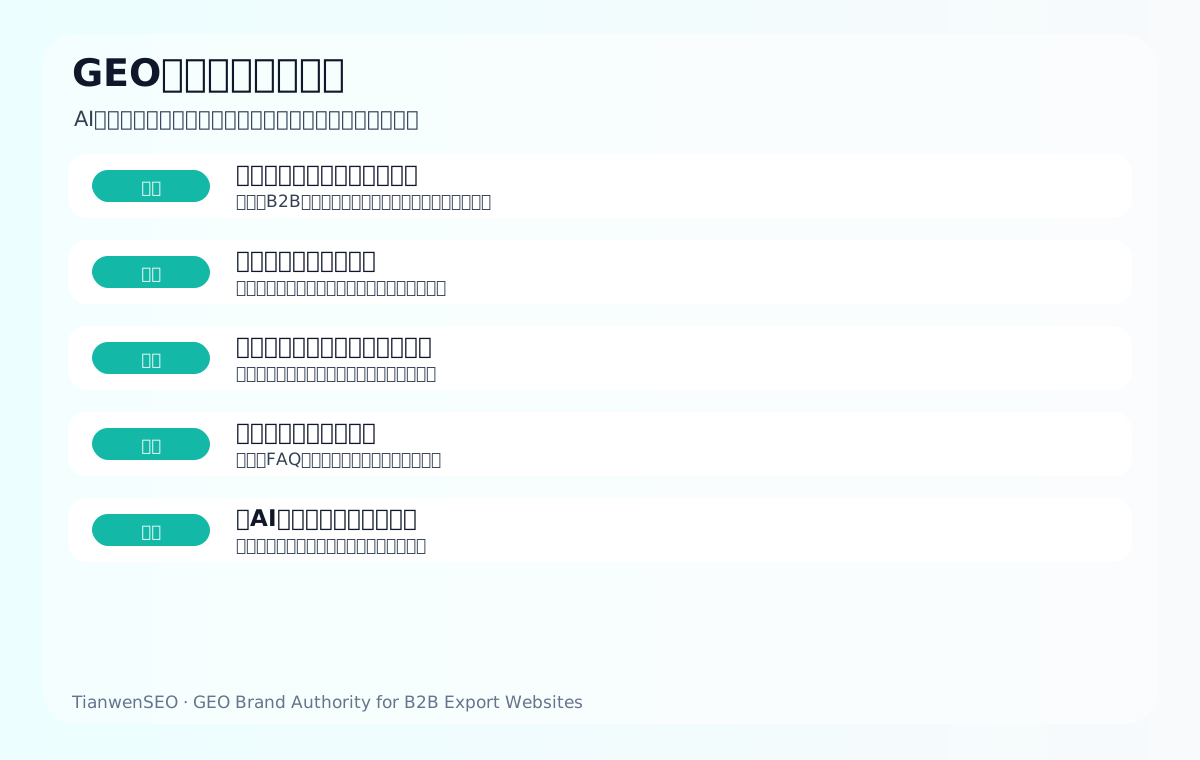
The conclusion first: AI does not only look at big brands, it looks at verifiable signals
Many export companies worry: does AI search only recommend big brands? Reality is more complex. Big brands usually have more external mentions, media coverage, user discussions, and consistent materials, so they are easier for AI to recognize; but small factories are not without opportunity. The real question is: can AI confirm who you are, what you do, what your product range is, whether your materials are consistent, and whether your sources are trustworthy.
If a small waterproof connector factory has a consistent English company name, product lines, certifications, address, and contact details across its official website, trade shows, B2B platforms, LinkedIn, and industry directories, and its official website has clear product pages, IP rating resource pages, outdoor lighting application pages, and inquiry checklists, it is easier for AI to understand accurately than a large all-in-one supplier with messy materials.
So brand authority in GEO is not a synonym for “spending money on brand advertising”; it is about making it easier for AI and buyers to verify your business facts.
What signals does brand authority include in AI search
| Signal | What it is | Export example | Risk |
|---|---|---|---|
| Entity consistency | Company, brand, product lines, address, and contact details are consistent | ABC Connector uses the same brand and URL on its website and trade show materials | Names differ across platforms |
| Product facts | Specifications, materials, certifications, applications, and limitations are clear | IP67 waterproof connector pin count and cable OD | Only “high quality” slogans |
| Third-party verification | Industry directories, trade shows, media, customer-authorized materials | Canton Fair exhibitor profile links official site | Irrelevant sources or outdated information |
| Official materials | The official website is the most trustworthy source of facts | Certification pages, capability pages, FAQ, downloadable materials | Thin website content or contradictions with external sources |
| User and business feedback | Brand search, inquiry quality, sales feedback | Customers search brand + packaging machine | Looking only at traffic, not business |
Why entity consistency matters more than before
AI answers synthesize multiple sources. In traditional search, users could still click through multiple results and compare; in AI answers, the system may directly integrate multiple sources into one sentence. If sources contradict each other, AI may choose a more consistent competitor, or it may describe your company incorrectly.
| Type of inconsistency | How AI may misunderstand | Correction direction |
|---|---|---|
| Different company names | Cannot confirm whether it is the same company | Unify the English company name and brand name |
| Different product lines | Cannot tell what the main products are | Unify product categories on the website, platforms, and trade shows |
| Different identity | Describing a trading company as a factory or vice versa | Clarify the business role and supply chain capabilities |
| Different certifications | Generalizing one product’s certification to all products | Explain the scope of application on the certification page |
| Different contact details | Reduces trust and verifiability | Update URLs, phone numbers, and emails on all platforms |
The export brand proof system
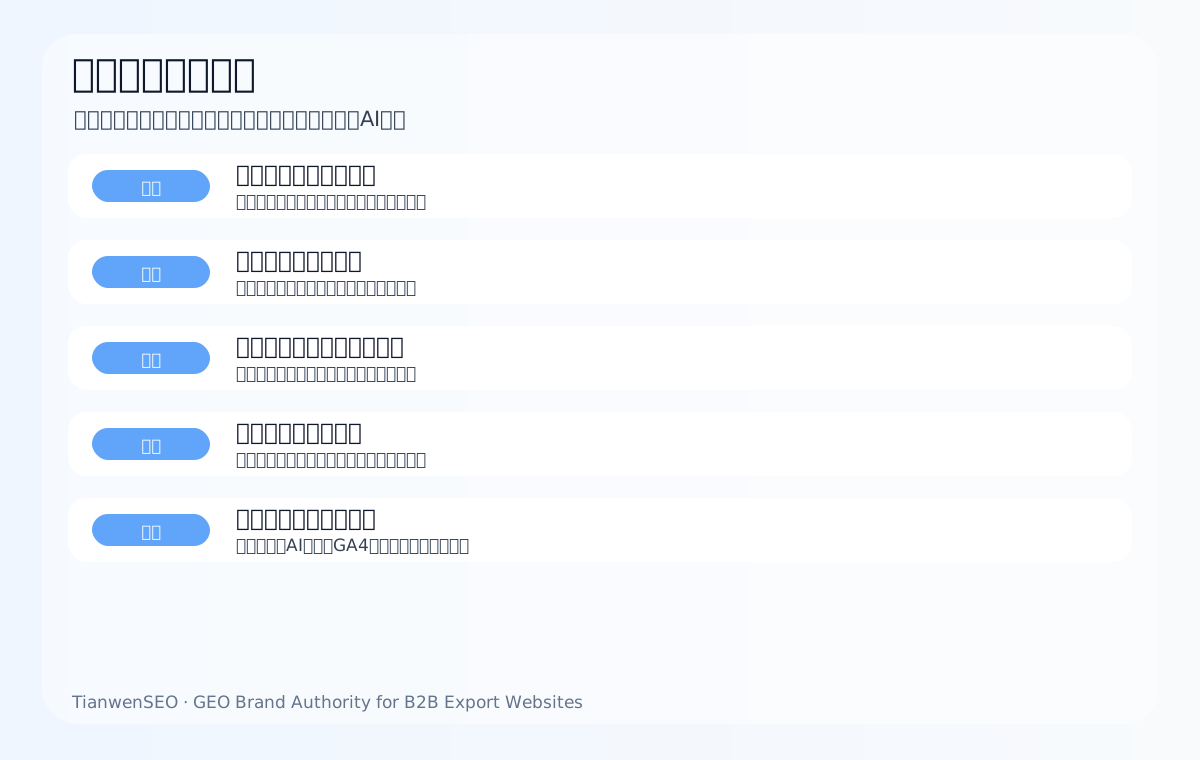
How different export industries build brand authority
| Industry/Product | Brand authority focus | What to add on the website | What to add externally |
|---|---|---|---|
| custom metal parts | Machining capability, materials, tolerances, quality control | Material page, tolerance page, inspection process, drawing checklist | Manufacturing directories, customer-authorized projects, technical articles |
| LED flood light | Certifications, applications, warranty, project capability | Application page, wattage table, certification page, installation FAQ | Lighting trade shows, engineering media, installation partners |
| packaging machine | Equipment fit, after-sales, sample testing | Selection page, cleaning and maintenance, testing process | Packaging industry directories, distributor materials, video explanations |
| medical probe | Quality control, materials, compliance boundaries | Quality process, material descriptions, certification scope | Medical device directories, industry white papers |
| ceramic dinnerware | Materials, packaging, customization, wholesale capability | Material comparison, MOQ, packaging solutions | Gift and home trade shows, wholesale directories |
| industrial valve supplier | Standards, media, pressure and temperature, spare parts | Material compatibility table, selection guide, certification page | Pump and valve associations, engineering directories, project materials |
How small factories build AI-verifiable brand signals
Small factories do not have the media coverage of big brands, but they can still start with verifiable facts.
- Unify the company’s English name, brand name, website URL, address, phone, email, and product lines.
- Build clear About Us, production capability, certification, quality control, and contact pages.
- Build product pages, category pages, application pages, resource pages, and FAQ for core product lines.
- Update information in trade shows, B2B platforms, industry directories, and social profiles so it is consistent.
- Earn real industry-relevant sources, not irrelevant low-quality links.
- Record how AI answers describe the company and correct errors promptly using official materials.
What is the difference between brand authority and backlinks
Backlinks are part of brand authority, but not all of it. AI search does not just look at how many links a page has; it also looks at whether those links and mentions come from relevant sources, whether they are consistent with the brand entity, and whether they can verify product facts.
| Dimension | Traditional backlink approach | Brand authority approach |
|---|---|---|
| Goal | Increase page authority | Make company and product facts verifiable |
| Sources | Focus on metrics and quantity | Focus on industry relevance and context |
| Anchor text | Tends to chase exact keywords | Naturally describes the brand, products, and materials |
| Landing page | Often points to the homepage | Points to product pages, resource pages, and evidence pages |
| Review | Looks at link counts and rankings | Looks at AI descriptions, brand search, and inquiry quality |
How to correct course when AI describes your brand incorrectly
| Error type | Possible cause | Correction action |
|---|---|---|
| Describing a trading company as a factory | Inconsistent identity statements on the website and platforms | Clarify the business role and supply chain capabilities on the About page |
| Describing the product range too broadly | Too many platform categories or old products not cleaned up | Update product lines and category descriptions |
| Getting certifications wrong | Missing certification pages or incorrect external materials | Add the certification scope and notes on what needs confirmation |
| Confusing the brand and the company | Inconsistent brand name, company name, and domain | Create a brand entity description and consistent materials |
| Citing competitor materials | The website lacks citable facts | Add product resource pages and external verification |
Brand authority review dashboard
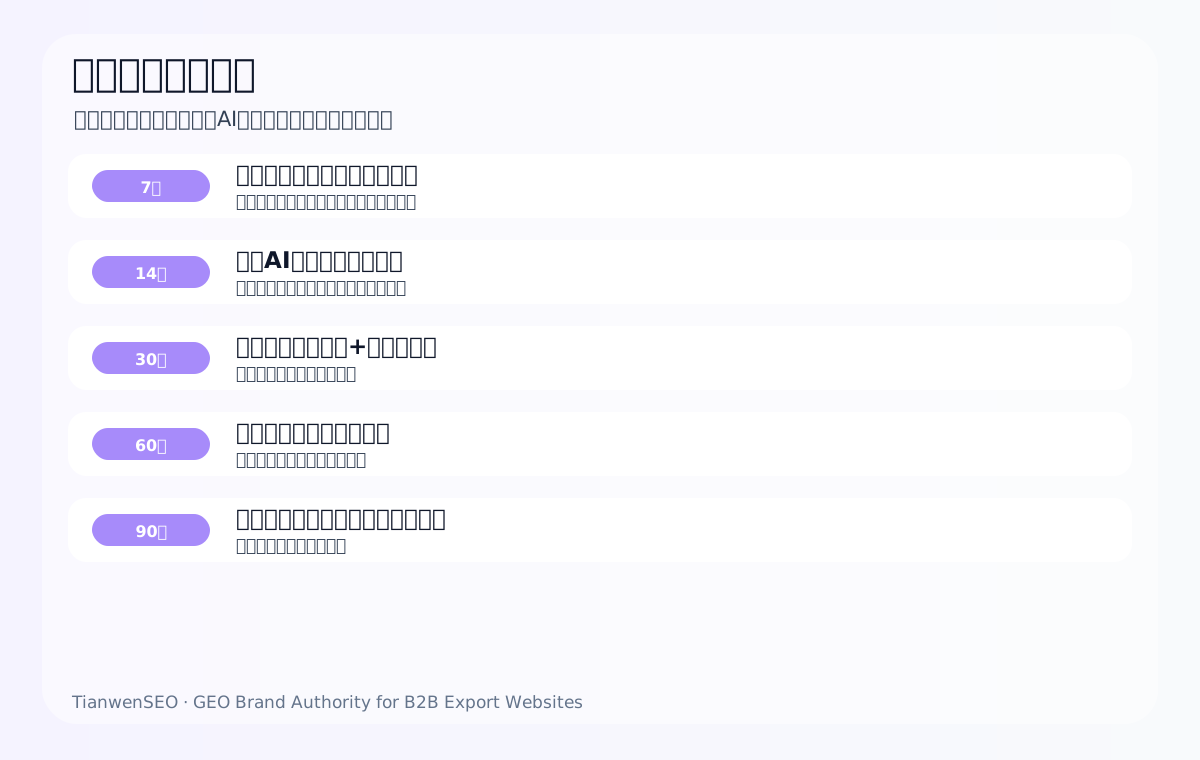
| Metric | What to look at | What it tells you |
|---|---|---|
| AI answers | Whether the brand is mentioned and whether the description is accurate | Whether AI understands the company and products |
| Cited sources | Website, directories, media, competitors | Who is shaping the answer |
| Brand search | Changes in brand terms and brand + product terms | Whether market awareness is growing |
| GSC/GA4 | Entry pages, paths, conversion events | Whether visits reach business pages |
| Inquiries | Source, product, country, clarity of parameters | Whether they bring high-quality opportunities |
A 90-day brand authority building roadmap
Phase 1: Inventory entity materials
List the company name, brand name, product lines, contact details, and URLs across the website, B2B platforms, trade shows, directories, and social profiles.
Phase 2: Upgrade the website as a source of facts
Add About Us, capability pages, certification pages, product resource pages, FAQ, and contact pages so the website becomes the most accurate source.
Phase 3: Fix external material consistency
Update industry directories, trade shows, B2B platforms, and social profiles to reduce contradictory information AI can read.
Phase 4: Earn real third-party verification
Pursue genuine mentions from industry media, partners, customer-authorized materials, trade show pages, and professional directories.
Phase 5: Review AI answers and inquiries
Record monthly how AI describes the brand, and compare it with brand search, GA4 paths, and inquiry quality.
FAQ: Common questions about GEO and brand authority
Top1 benchmark: what existing brand authority content is still missing
Current content about brand authority in AI search usually emphasizes a few directions: brand mentions, entity consistency, third-party citations, authoritative sources, expert content, knowledge graphs, structured data, and reputation management. These directions are correct, but they are still not specific enough for export companies.
What export companies need most is: which pages on the website can prove the brand? How should B2B platform materials be handled? Are trade show directories useful? How should customer-authorized materials be written? What is the relationship between product pages and brand authority? How should you handle it when AI gets the company wrong? If these questions are not answered, brand authority becomes an empty slogan.
| Benchmark dimension | Common claims in authoritative content | Gap for export companies | What this article adds |
|---|---|---|---|
| Entity consistency | Brands, entities, and knowledge graphs matter | Not knowing which materials need to be unified | Lists the fields for website, platforms, trade shows, and directories |
| Content authority | Write professional and citable content | Not knowing what product facts to write | Adds specifications, materials, certifications, and applications by product term |
| External sources | Mentions and citations matter | Not knowing which sources are worth pursuing | Distinguishes trade shows, associations, B2B, customer authorization, and media |
| Review | Look at AI visibility | Not knowing how to quantify business results | Adds brand search, AI answers, GA4, and inquiries |
| Small brands | Recommends brand building | Worried about lacking big-brand resources | Gives small factories a 90-day actionable roadmap |
Brand authority is not self-praise; it lowers the cost of verification
Many export websites like to use “leading manufacturer,” “professional supplier,” “high quality,” and “best service” when writing about their brand. These phrases offer limited help to AI and buyers because they cannot be checked. The truly useful part of brand authority is lowering the cost of verification: buyers and AI can quickly confirm who you are, what you do, whether you have relevant products, whether you have materials to prove it, and how to communicate next.
| Self-praising phrasing | Verifiable phrasing | Why it is stronger |
|---|---|---|
| leading waterproof connector manufacturer | 10+ waterproof connector series with IP67/IP68 options, cable OD range and application notes | It includes product range and parameters |
| professional CNC parts supplier | CNC machining, turning, surface finishing and inspection process for custom metal parts | It explains the processes and workflow |
| best packaging machine service | sample testing, spare parts list, cleaning guide and after-sales response process | It explains business capabilities |
| high quality ceramic dinnerware | stoneware/porcelain options, packaging methods, MOQ factors and target market checks | It explains sourcing judgment |
The official website should become the official fact source AI trusts most
No matter how much external material there is, it should come back to the official website. If an AI answer needs to judge a brand, the official website should provide the clearest, most complete, and most stable source of facts.
| Website page | Purpose | Must include |
|---|---|---|
| About Us | Explains the company and brand entity | English company name, brand, region, business role, product lines |
| Capability page | Explains what you can do | Equipment, processes, capacity, quality process, export experience |
| Certification page | Explains trustworthy evidence | Certificate type, applicable products, target markets, scope requiring confirmation |
| Product page | Explains specific supply capability | Specifications, materials, applications, limitations, FAQ |
| Resource page | Explains professional judgment | Selection, standards, installation, maintenance, purchasing checklists |
| Contact page | Explains the next step | Contact details, response time, information needed for a quote |
How B2B platform materials affect AI understanding
Many export companies have materials on Alibaba, Made-in-China, Global Sources, or industry directories. These platform materials may be read by search engines and AI. If the materials are inconsistent with the website, it creates entity confusion.
| Field | Common problem | Correction suggestion |
|---|---|---|
| Company name | Mixing abbreviations, old names, and brand names | Unify the English company name and explain the brand name |
| Product categories | Filling too many irrelevant categories for exposure | Keep the real core product lines |
| Certifications | Written too broadly or expired | Note applicable products and valid scope |
| Website link | Linking to an old domain or wrong page | Unify to the correct website and product pages |
| Company profile | Copying generic templates without product facts | Clearly state core products, capabilities, markets, and next steps |
Why trade shows and industry directories are valuable
Trade show pages, industry associations, vertical directories, and supplier listings do not necessarily bring much traffic, but they can prove the company’s relationship with the industry. For AI, such third-party sources may help confirm that you really exist in a certain industry.
| Source | Value | Notes |
|---|---|---|
| Trade show exhibitor page | Proves the company participates in industry events | Company name, website, and product categories must be correct |
| Industry association | Proves industry relationships and category | Do not list irrelevant categories |
| Vertical directory | Supplements the entity and product lines | Avoid low-quality general directories |
| Industry media | Explains professional views or product applications | Content must be genuine, not a hard ad |
| Customer-authorized materials | Proves applications and partnerships | Must be authorized, no exaggeration |
The relationship between brand authority and product pages
Brand authority is not only placed on the “About Us” page. Product pages themselves also affect how AI understands the brand. Each core product page answers: does this company really understand this product, can it supply it, and can it explain applications and limitations?
| Product page module | Effect on brand authority | Example |
|---|---|---|
| Specification table | Proves the product is real and professional | waterproof connector pin count, cable OD, rated current |
| Application scenarios | Proves understanding of the customer’s operating environment | outdoor LED lighting, marine box, solar cable |
| Certification notes | Proves compliance boundaries | CE/RoHS available for selected LED flood light models |
| Common mistakes | Proves experience and professional judgment | wrong cable diameter causes sealing failure |
| Inquiry checklist | Proves a mature business process | drawing, material, quantity, target market |
The relationship between brand authority and content SEO/GEO
Content SEO lets pages cover demand, GEO makes pages citable by AI, and brand authority makes AI more willing to use that content. None of the three can be missing.
| Combination state | Result | Response |
|---|---|---|
| Strong content, messy brand materials | AI may cite the content but describe the company incorrectly | Unify the entity and external materials |
| Strong brand, thin content | AI knows the brand but lacks specific pages | Add product and resource pages |
| Lots of content but repetitive | Topic signals are diluted | Merge and restructure pages |
| Many external mentions but a weak website | Third parties shape the brand, and the website cannot support it | Upgrade the website fact source |
| Content, brand, and external sources are consistent | Easier to understand and verify | Keep reviewing and expanding |
Export brand entity field checklist
The following fields should stay consistent between the official website and major external platforms.
| Field | Suggested entry | Incorrect example |
|---|---|---|
| Company Name | Use a stable full English company name | Mixing multiple abbreviations |
| Brand Name | Explain the relationship between the brand and the company | Using the brand name and company name interchangeably |
| Website URL | Unify the main website URL | Old domains, test domains, wrong paths |
| Product Lines | List the real core product lines | Piling up irrelevant products for exposure |
| Address | Keep the format consistent | Different addresses on different platforms |
| Certifications | Explain applicable products and scope | Writing a partial certification as covering all products |
| Contact Email | A company-domain email is better | Confusing multiple personal emails |
AI answer brand correction log
| Field | What to record | Follow-up action |
|---|---|---|
| Question | What the user asked | Determine intent |
| AI answer | How the brand is described | Mark the errors |
| Cited sources | Where the answer came from | Check whether the source can be corrected |
| Website gap | Whether the website lacks a corresponding explanation | Add a page or FAQ |
| External contradiction | Whether platforms/directories are wrong | Update external materials |
| Review date | When to check again | See whether it improved |
Brand authority roadmaps for companies of different sizes
| Company stage | Priority task | Do not rush into |
|---|---|---|
| New export website | Unify the entity, add core product pages and an About page | Chasing lots of media mentions |
| Has product pages but no brand search | Add resource pages, B2B platform consistency, trade show materials | Publishing only generic blog posts |
| Already has brand search | Add certifications, case boundaries, external verification, and AI reviews | Ignoring the website fact source |
| Multi-product-line company | Organize product lines and page structure | Cramming all products onto one page |
| Trading company | Explain sourcing, quality inspection, supply chain, and delivery capabilities | Pretending to be a single factory |
Brand authority differences across medical, industrial, and consumer goods
| Category | Authority focus | Content boundaries |
|---|---|---|
| medical probe | Quality, materials, cleanliness, compliance confirmation | Do not exaggerate certifications or medical suitability |
| industrial valve | Standards, media, pressure, temperature, spare parts | Must state that operating conditions need confirmation |
| custom metal parts | Drawings, materials, tolerances, inspection, confidentiality | Do not claim all tolerances can be achieved |
| ceramic dinnerware | Materials, food contact, packaging, MOQ | Standards differ by market and need confirmation |
| activewear | Fabric, craftsmanship, sizing, MOQ, samples | Do not promise that every design can be produced unconditionally |
Pre-publish brand authority checklist
- Are the English company name, brand name, and product lines consistent across the whole site?
- Does the About page clearly explain the business role and supply capability?
- Do core product pages include specifications, materials, certifications, applications, and limitations?
- Does the certification page explain the scope of application and avoid over-generalization?
- Do B2B platform and trade show materials link to the correct official website?
- Have AI answers ever described the company or products incorrectly, and is there a correction log?
- Does the inquiry form record the customer’s source and brand awareness?
Brand authority is not a one-time task
Brand authority changes with product updates, trade shows, directories, customer materials, website redesigns, and AI answers. Export companies should check external material consistency at least once a quarter, check core AI answers monthly, and update the website and external platforms whenever a new product line is added.
| Cycle | Action | Output |
|---|---|---|
| Monthly | Check core AI answers and brand search | Error list and opportunity list |
| Quarterly | Check B2B platform, trade show, and directory materials | Consistency correction table |
| Quarterly | Update product materials and certification scope | Website fact source update |
| Every six months | Review the quality of external sources | Keep, update, or stop low-value sources |
| When product lines change | Sync the website and external materials | New product line descriptions |
A few more FAQs
Why does AI search favor authoritative brands?
Because authoritative brands usually have more consistent sources and third-party verification, making it easier for AI to check information. Small brands can lower the cost of verification through clear facts and consistent materials.
Can export trading companies build brand authority?
Yes. Trading companies should emphasize sourcing, supply chain, quality inspection, delivery, and market experience, rather than pretending to have factory capabilities they do not have.
Do certification pages help GEO?
Yes, but only if the certificates are real, the scope of application is clear, and they are consistent with product pages and external materials.
Does brand authority require structured data?
Structured data helps, but it cannot replace real body content, product facts, evidence, and external consistency.
What if external platform materials cannot be modified?
First strengthen the official explanations on your website and update the platforms you can control as much as possible; keep a record of incorrect sources you cannot change and keep covering them with more accurate sources.
How long does it take to see results from brand authority?
It usually requires sustained accumulation. You can start by looking at 30-90 day changes in AI answer accuracy, brand search, product page paths, and inquiry quality.
Case 1: How a small waterproof connector factory builds brand authority
Suppose a factory mainly makes waterproof connectors. In the past its website only had a product list, its B2B platform listed dozens of categories, and the company name in trade show materials did not match its website. When AI answered questions about outdoor LED connector suppliers, it did not mention the company, or described it as a general cable accessories trader. This problem is not necessarily about too little content, but about unclear brand entity and product facts.
| Problem | Correction action | Expected effect |
|---|---|---|
| Inconsistent company name | Unify the English name on the website, B2B platforms, trade shows, and social profiles | Let AI confirm the entity |
| Product lines too broad | Focus on waterproof connector, cable connector, and LED lighting connector | Reduce positioning confusion |
| Thin product pages | Add IP rating, pin count, cable OD, current, voltage, and application limitations | Prove product facts |
| Missing application materials | Build an outdoor LED lighting connector application page | Handle complex purchasing questions |
| Missing inquiry path | Add a connector inquiry checklist | Improve inquiry quality |
Case 2: How a packaging machine company avoids being described by AI as a generic equipment supplier
A common problem for packaging machine companies is a complex product line: powder, granule, liquid, sauce, bag, bottle, semi-automatic, and fully automatic. If the website structure is messy, AI can easily describe the company as a generic packaging equipment supplier rather than a specialist that can solve specific material problems.
| Brand authority module | Content example | Purpose |
|---|---|---|
| Material application page | powder, granule, liquid, sauce packaging machine | Helps AI understand niche capabilities |
| Sample testing process | Customer sends samples, testing, video confirmation, parameter adjustment | Proves the service process |
| After-sales spare parts page | spare parts, maintenance, training, troubleshooting | Reduces purchasing risk |
| Quality inspection page | Electrical, weighing, sealing, and continuous operation tests | Builds verifiable trust |
| Inquiry checklist | Material, weight, bag type, speed, voltage, budget | Makes inquiries more specific |
Case 3: How a ceramic dinnerware trading company builds credibility
A trading company cannot simply imitate factory language. A trading company’s brand authority should come from sourcing, supply chain, quality inspection, packaging, design collaboration, target market experience, and delivery control. If you describe yourself as a “manufacturer” while external materials show a trading company, both AI and buyers will be confused.
| Trading company authority point | Page expression | Avoid |
|---|---|---|
| Sourcing capability | Explain partner factories, material range, target markets | Pretending all production is in-house |
| Quality inspection capability | Explain sampling inspection, packaging checks, pre-shipment photos/reports | Writing only “high quality” |
| Packaging solutions | retail box, mail order pack, bulk pack | Writing only “safe package” |
| Customization process | Decal, logo, packaging design, sample confirmation | Promising every design can be made |
| Delivery experience | Target markets, container loading, documents, and communication process | Vaguely saying “export worldwide” |
Brand authority diagnostic process
| Step | What to check | Output |
|---|---|---|
| 1. Search the brand name | Google, AI search, B2B platforms, trade shows, and directories | External material inventory |
| 2. Compare entity fields | Company name, brand, address, phone, website, product lines | Consistency issue table |
| 3. Check the website fact source | About page, capability page, certification page, product pages, resource pages | Website gap table |
| 4. Record AI answers | How AI describes the company and products | Error and opportunity list |
| 5. Set priorities | Business value, error risk, and how fixable it is | 90-day task list |
| 6. Review | Brand search, citations, inquiries, and sales feedback | Iteration plan |
Four possible brand authority outcomes in AI answers
| Outcome | Explanation | Response |
|---|---|---|
| Brand does not appear | AI does not treat you as a relevant source | Add product facts, resource pages, and external verification |
| Appears but described vaguely | The entity exists but its positioning is unclear | Unify product lines and company descriptions |
| Appears but with errors | Source conflicts or the website lacks explanations | Correct the errors and add official fact sources |
| Appears and is described accurately | Brand authority is initially established | Optimize the conversion path and keep reviewing |
How does brand authority relate to E-E-A-T?
The experience, expertise, authoritativeness, and trustworthiness Google often talks about overlap with brand authority in AI search. Export websites do not need to mechanically pile up jargon; they need to translate these principles into verifiable content.
| Dimension | Export implementation | Example |
|---|---|---|
| Experience | Show real applications, common problems, and operating boundaries | Experience with LED flood light installation heights |
| Expertise | Provide technical parameters, judgment tables, and resource pages | CNC tolerance and material guide |
| Authoritativeness | Industry sources, trade shows, customer-authorized materials, and brand search | industrial valve industry directory |
| Trustworthiness | Clear company information, certifications, contact details, privacy, and inquiry process | medical probe quality process |
Which external sources are unsuitable for brand authority
Not all external sources help. Low-quality, irrelevant, auto-generated, or inaccurate pages may instead create confusion.
| Source type | Risk | Recommendation |
|---|---|---|
| Irrelevant general directories | Cannot prove industry relationships | Do not prioritize |
| Auto-generated scraper pages | Information is easily wrong | Do not create them deliberately |
| Low-quality press release sites | Content reads like an ad with no context | Prioritize industry media and genuine materials |
| Incorrect B2B materials | AI may read the wrong product lines | Fix as soon as possible or override with the website |
| Unauthorized customer names | Business and trust risk | Use only authorized public materials |
The relationship between brand authority and inquiry quality
Brand authority is not about making the website look bigger; it is about reducing buyer uncertainty. The clearer the brand information, the more specific inquiries are likely to be.
| Brand signal improvement | Buyer perception | Inquiry change |
|---|---|---|
| Clear product lines | Knows whether you match the need | More accurate product inquiries |
| Clear certification scope | Knows whether it fits the target market | More specific certification questions |
| Clear application pages | Knows whether the product fits the scenario | Provides more application parameters |
| Clear inquiry checklist | Knows what to prepare | More complete drawings, quantities, and materials |
| Consistent company materials | Easier to trust | More brand search and return visits |
How to write brand authority into pages instead of slogans
| Page | Not recommended | Recommended |
|---|---|---|
| About page | “We are a professional foreign trade company” | State the founding year, product lines, markets served, business role, and contact information |
| Capability page | “We are very strong” | List equipment, processes, inspection, capacity range, and quality process |
| Product page | “High quality, low price” | List specifications, materials, certifications, applications, limitations, and FAQ |
| Certification page | “Full certifications” | Explain certificate types, numbers, applicable products, and items the customer needs to confirm |
| Resource page | “We are experienced” | Use tables and steps to explain real procurement judgment |
Reading GEO changes from brand search
Brand search is not the only GEO metric, but it can help judge whether external visibility is accumulating. Brand + product terms, such as “ABC waterproof connector” and “XYZ packaging machine”, often carry more business meaning than brand terms alone.
| Brand query | What it represents | Action |
|---|---|---|
| Brand name | Users remember or verify the company | Make sure the homepage and About page are clear |
| Brand + product | Users connect the brand with product lines | Strengthen product and category pages |
| Brand + certification | Users verify credibility | Add certification pages and scope |
| Brand + reviews | Users assess risk | Add frequently asked customer questions, quality process, and public materials |
| Brand + contact | Users are ready to get in touch | Optimize the contact page and inquiry form |
Internal linking structure for brand authority content
| Page | Should link to | Purpose |
|---|---|---|
| About Us | Product categories, capability page, certification page, contact page | Move from the company entity to business facts |
| Capability page | Product pages, quality process, resource pages | Prove what you can do |
| Certification page | Related product pages, FAQ, contact page | Explain the scope and guide confirmation |
| Product page | Application pages, resource pages, inquiry checklist | Move from product facts to purchasing action |
| Resource page | Product pages, brand evidence pages, contact page | Move from professional content to business conversion |
The 10 most worthwhile things to do in 90 days
- Unify the English company name on the website and external platforms.
- Unify the brand name, domain, address, phone, and email.
- Delete or correct irrelevant product categories on external platforms.
- Add About Us, capability, certification, and quality process pages.
- Add specifications, materials, applications, limitations, and FAQ to core product pages.
- Create 1-3 high-value resource pages, such as IP ratings, material selection, and equipment selection.
- Update trade show, B2B platform, and industry directory materials.
- Record how AI answers describe the brand and products.
- Add source and brand awareness fields to the inquiry form.
- Review brand search, AI answers, and inquiry quality monthly.
Brand authority scorecard
| Score item | 0 points | 1 point | 2 points |
|---|---|---|---|
| Entity consistency | Conflicts in many places | Partially consistent | Website and major platforms are consistent |
| Product facts | Very thin | Basic parameters present | Specifications, materials, applications, and limitations are complete |
| Third-party sources | None or low quality | Platform materials present | Real industry-relevant sources present |
| Website fact source | Missing About/certification/capability pages | Present but thin | Complete and clearly structured |
| AI answer accuracy | Often wrong | Vague descriptions | Accurate descriptions |
| Business review | Only traffic | Partially looks at inquiries | Looks at search, AI, GA4, and inquiries together |
Brand authority and multilingual content
If an export company has both an English site and a Chinese service site, note that their roles differ. The English site targets overseas buyers and must use English product terms and purchasing questions directly; the Chinese service site targets domestic export companies and can explain methods in Chinese, but examples should still use English product terms.
| Site type | Primary audience | Content focus |
|---|---|---|
| English export site | Overseas buyers | Product facts, applications, evidence, inquiry paths |
| Chinese service site | Domestic export companies | Methods, judgment, cases, operating steps |
| B2B platform materials | Platform buyers and search systems | Product lines, company entity, and website entry points |
| Trade show materials | Industry buyers and AI sources | Company name, exhibits, website, and contact details |
In the end, brand authority is not for AI but for buyer trust
AI search simply moves forward the verification buyers would have done anyway: whether the company is real, whether the product matches, whether the materials are trustworthy, whether there is industry evidence, and whether the next step is clear. If brand authority building only chases AI mentions without improving the buyer experience, it drifts from the goal.
Truly good brand authority pages should make buyers clearer after reading: who this company is, what products it suits, what needs it does not suit, what materials it can provide, and how to start an inquiry. If AI cites this content, that is simply a natural result.
Post-launch review example: what to do when AI describes a trading company as a factory
Suppose a ceramic dinnerware trading company is described as a “manufacturer” in AI answers, but the company’s actual role is integrating multiple factory resources and handling sourcing, quality inspection, packaging, and export coordination. This error looks favorable but carries risk: buyers may lose trust when they verify later. The right approach is not to go along with the AI error but to clarify the business role through the website and external materials.
| Problem | Page to fix | Correction content | Review metric |
|---|---|---|---|
| AI describes the trading company as a factory | About Us/FAQ | Explain trading company with supplier network, QC and export coordination | Whether the AI answer changes to an accurate description |
| Platform materials say manufacturer | B2B platform materials | Change to supplier/exporter/trading company and explain capabilities | External material consistency |
| Customers worry about quality control | Quality process page | Explain factory audits, sample confirmation, and pre-shipment inspection | Whether quality questions in inquiries decrease |
| Buyers ask about packaging | Packaging solutions page | Add retail box, mail order pack, and bulk pack | Whether inquiries include packaging requirements |
Post-launch review example: what to do when AI describes the product line too broadly
Many export companies have filled in a large number of categories on external directories for platform exposure. After reading them, AI may describe a company focused on waterproof connectors as a general electronics accessories supplier. The correction requires subtraction: keep the website and major external materials focused on the real product lines.
| Location | Wrong signal | Correction action |
|---|---|---|
| Website homepage | Product line description too broad | Focus on waterproof connector, cable assembly, and LED lighting connector |
| Product categories | Too many irrelevant products | Keep the series you can really supply |
| B2B platforms | Category stacking | Delete irrelevant categories and add core product descriptions |
| Resource pages | Lacking professional judgment | Add IP rating, cable OD, installation, and application materials |
| AI review | Record whether the description narrows | Recheck core questions monthly |
30-day observation table after the brand authority page goes live
| Observation item | Day 7 | Day 14 | Day 30 |
|---|---|---|---|
| Website front end | Page returns 200, titles normal, images normal | Internal links and forms work | Whether visit paths reach product pages |
| AI answers | Establish a screenshot baseline | Record whether errors remain | See whether more accurate descriptions appear |
| GSC | Confirm brand and resource pages are indexed | Observe brand + product term impressions | Look at CTR and query changes |
| GA4 | Look at entry pages and subsequent paths | Look at contact page visits | Look at conversion events |
| Inquiries | Record how customers describe their source | See whether questions are more specific | Feed back into content updates |
Why does GEO increasingly look at brand authority?
Because AI answers synthesize multiple sources and need to judge whether the brand is real, whether the information is consistent, and whether product facts are verifiable.
What should small export factories do without a big brand?
Start with entity consistency, product facts, website materials, industry directories, and genuine external sources; small factories can also build verifiable signals.
Does brand authority equal backlinks?
No. Backlinks are only one part; brand authority also includes entity consistency, product facts, third-party verification, official materials, and user feedback.
What should I do if AI describes my company incorrectly?
First check whether the website and external materials contradict each other, then add official explanations, certification scope, product lines, and FAQ, and keep recording changes in the answers.
Are B2B platform materials useful for GEO?
They play a supporting role, especially for entity consistency and product line verification. But they cannot replace website content, and the materials must be accurate.
Do I need brand advertising to get GEO results?
Not necessarily. Brand advertising can expand awareness, but GEO is more fundamentally about verifiable, clearly structured, consistent brand and product facts.
What is the relationship between brand search and GEO?
After users see a brand in an AI answer or another channel, they may search for brand + product terms. Brand search can serve as a supporting indicator of AI visibility and market awareness.
Can you promise that AI will definitely recommend a certain brand?
No. AI answers are affected by platform, query, sources, and timing; brand authority and content quality can only increase the chance.
Conclusion: brand authority is not an empty reputation but verifiable facts
Brand authority in the GEO era is not just about company fame; it is about whether AI and buyers can verify your company, products, capabilities, and evidence. If an export company only writes more articles while its company materials are messy, product facts are thin, and external sources are inconsistent, AI will still find it hard to cite them with confidence.
The right approach is: make the website an accurate fact source, unify external materials, deepen product and resource pages, build genuine third-party sources, and then review with AI answers, brand search, GSC, GA4, and inquiry quality. Brand authority built this way serves both traditional SEO and GEO in the AI search era.
Official sources and the boundaries of brand authority verification
Brand authority in GEO cannot be written as “if the brand is big, AI will definitely recommend it.” A more professional definition is: whether consistent, crawlable, verifiable entity signals exist in the website, product pages, resource pages, structured data, external materials, and user behavior. What can be delivered is clarifying the company name, brand name, product lines, certifications, application scenarios, contact details, website fact source, and external material consistency; what cannot be promised is that Google AI Mode, AI Overviews, ChatGPT Search, Bing AI, or other platforms will definitely recommend, cite, rank, or bring inquiries.
During low-data periods, the boundaries must also be stated clearly. If there are currently no usable signals, you can only record “observation items established, awaiting changes in GSC, URL Inspection, logs, and AI answer samples”; you cannot write brand search, tool scores, a single AI screenshot, or subjective judgment as GEO results.
Brand authority acceptance points corresponding to official materials
Google Search Central: Helpful, reliable, people-first content
What it supports: Brand authority must be grounded in helpful, reliable, people-first content, not just self-praising slogans.
What it does not prove: You cannot turn “we wrote a brand introduction” directly into E-E-A-T or AI recommendation results.
Delivery acceptance: Check whether the website has real product facts, experience descriptions, applicable boundaries, Who/How/Why, certifications, and verifiable materials.
Google Search Central: A guide to Google Search ranking systems
What it supports: Google ranking systems understand pages by combining page-level and site-level signals; good or bad site-level signals do not mean fixed performance for every page.
What it does not prove: You cannot write brand authority as meaning every page will rank, nor turn a single page’s performance into a site-wide conclusion.
Delivery acceptance: Brand reviews should be recorded by page, product line, and query group, not just one brand term or one page.
Google Search Central: AI features and your website
What it supports: AI Mode / AI Overviews still rely on basic SEO; pages must be crawlable, indexable, able to show snippets, and clearly written.
What it does not prove: You cannot conclude that complete brand fields alone will get you into AI answers.
Delivery acceptance: Write brand entity signals into visible body content, internal links, page titles, company materials, FAQ, structured data, and crawlable resource pages.
Google Search Central: Search Essentials
What it supports: Participating in Google Search requires meeting basic requirements for technical setup, spam policies, and helpful content.
What it does not prove: Meeting basic requirements does not equal having impressions, clicks, or AI citations.
Delivery acceptance: Brand authority pages must first pass the baseline of HTTP 200, index/follow, canonical, accessible content, and no obvious spam risk.
Google Search Central: Structured data general guidelines
What it supports: Structured data must be consistent with visible body content and must not mark up information not displayed on the page.
What it does not prove: Organization, Product, Article, or FAQ schema cannot guarantee rich results, AI citations, or rankings.
Delivery acceptance: Company name, brand name, product lines, logo, social media, certifications, and contact details must match the visible content on the page.
Search Console Help: Performance report
What it supports: GSC shows brand terms, product terms, pages, countries, devices, clicks, impressions, CTR, and average position.
What it does not prove: You cannot write low brand impressions, zero clicks, or zero-row data as a brand authority trend.
Delivery acceptance: Record query/page rows for brand terms, brand + product terms, product terms, and official website pages; if there are currently no usable signals, write “to be observed.”
Search Console Help: URL Inspection tool
What it supports: URL Inspection shows a single page’s indexing, crawling, canonical, sitemap, and the version known to Google.
What it does not prove: You cannot write “indexable” as meaning Google has re-evaluated brand authority.
Delivery acceptance: For core brand pages, the About page, certification pages, product resource pages, and key articles, record the relationship between lastCrawlTime and the modification time.
Google Search Central: robots.txt introduction
What it supports: robots.txt mainly manages crawler access.
What it does not prove: robots.txt not blocking does not mean the page is indexed, nor that the brand entity is correctly understood.
Delivery acceptance: Check whether company materials, certifications, product catalogs, downloadable resources, images, CSS/JS, and multilingual pages are mistakenly blocked.
OpenAI Platform: Overview of OpenAI Crawlers
What it supports: OpenAI distinguishes OAI-SearchBot, GPTBot, and ChatGPT-User; different crawlers cannot be combined into one metric.
What it does not prove: You cannot write allowing GPTBot or a single crawler log entry as ChatGPT Search recommending the brand.
Delivery acceptance: Record logs by user agent, URL, status code, and page type, focusing on whether brand fact sources are accessible to the target crawler.
Bing Webmaster Blog: AI Performance
What it supports: Bing AI Performance shows citations, cited pages, grounding queries, and page-level citation activity.
What it does not prove: Bing samples cannot represent Google or all AI platforms, nor inquiry results.
Delivery acceptance: Record cited URLs, questions, whether the answer is correct, whether it cites the website fact source, and subsequent changes in GSC/GA4/inquiries.
What it supports: After a URL is added, updated, or deleted, you can submit a change notification to participating search engines.
What it does not prove: You cannot write a successful notification as successful crawling, indexing, ranking, or AI recommendation.
Delivery acceptance: After updating core brand pages, certification pages, and product resource pages, record the submission time, HTTP status, and follow-up review.
Brand authority diagnostic acceptance table
Entity consistency acceptance
Fields to check: English company name, brand name, logo, product lines, certifications, address, contact details, B2B platforms, trade show materials, and social profiles.
Passing standard: No obvious conflicts between the website and external materials, and core fields can be discovered by pages and crawlers.
Boundary: Consistency improves understandability but cannot promise that AI will definitely recommend a certain brand.
Website fact source acceptance
Fields to check: About, product pages, application pages, certification pages, FAQ, downloadable materials, company entity description, and internal links.
Passing standard: Buyers can judge from the website who you are, what you do, what you can do, what you cannot do, how to contact you, and how to verify you.
Boundary: Complete website materials do not mean external platforms are synced, nor that search performance has changed.
GSC and AI sample acceptance
Fields to check: Brand terms, brand + product terms, product terms, page URLs, AI answer samples, cited URLs, and answer error logs.
Passing standard: Same date window, same question set, same page grouping, reviewable and comparable.
Boundary: When there are currently no usable signals, you can only write “to be observed” and cannot add rankings, clicks, citations, or inquiry conclusions.
Delivery boundaries: brand authority work can be done, but platform results cannot be promised
- Can be promised: entity field checklists, website fact source upgrades, external material consistency checks, structured data consistency, and GSC/GA4/log/AI sample review tables.
- Cannot be promised: that Google AI Mode, AI Overviews, ChatGPT Search, or Bing AI will definitely recommend, cite, display, rank, click, or bring inquiries.
- Review window: 7-14 days to look at crawling and indexing signals; 30-60 days to look at brand terms, product terms, page engagement, citation samples, and sales feedback.
Brand authority is not an empty reputation; it makes it easier for buyers, search systems, and AI systems to verify who you are, what you do, what evidence you have, and what boundaries apply.
Continue reading this GEO series
If you are systematically learning about GEO and AI search visibility, continue with the articles below. First understand the concepts, then look at diagnostics, monitoring, content structure, and partnership boundaries.
- What is the relationship between GEO and content SEO: why writing more is not enough
- AI SEO tool recommendations: what to use for keywords, rewriting, and monitoring
- What is GEO: how it differs from SEO and AEO, and what export websites should do
- What is AI SEO: how it really differs from traditional SEO, GEO, and AEO
- What is AEO: why answer engine optimization is not just writing FAQ, and what export websites should do
- What is Google SEO: from crawling, indexing, and ranking to AI search and export inquiries
{
“@context”: “https://schema.org”,
“@type”: “FAQPage”,
“mainEntity”: [
{
“@type”: “Question”,
“name”: “Why does AI search favor authoritative brands?”,
“acceptedAnswer”: {
“@type”: “Answer”,
“text”: “Because authoritative brands usually have more consistent sources and third-party verification, making it easier for AI to check information. Small brands can lower the cost of verification through clear facts and consistent materials.”
}
},
{
“@type”: “Question”,
“name”: “Can export trading companies build brand authority?”,
“acceptedAnswer”: {
“@type”: “Answer”,
“text”: “Yes. Trading companies should emphasize sourcing, supply chain, quality inspection, delivery, and market experience, rather than pretending to have factory capabilities they do not have.”
}
},
{
“@type”: “Question”,
“name”: “Do certification pages help GEO?”,
“acceptedAnswer”: {
“@type”: “Answer”,
“text”: “Yes, but only if the certificates are real, the scope of application is clear, and they are consistent with product pages and external materials.”
}
},
{
“@type”: “Question”,
“name”: “Does brand authority require structured data?”,
“acceptedAnswer”: {
“@type”: “Answer”,
“text”: “Structured data helps, but it cannot replace real body content, product facts, evidence, and external consistency.”
}
},
{
“@type”: “Question”,
“name”: “What if external platform materials cannot be modified?”,
“acceptedAnswer”: {
“@type”: “Answer”,
“text”: “First strengthen the official explanations on your website and update the platforms you can control as much as possible; keep a record of incorrect sources you cannot change and keep covering them with more accurate sources.”
}
}
]
}
This page is machine-translated from the Simplified Chinese version and awaiting human review. It has not yet been proofread.