Google SEO, for export-oriented foreign trade companies, is not a one-off trick for “ranking” a single keyword. It is a long-term system that makes an English-language website easier for Google to discover, crawl, understand, and trust, and that ultimately captures buyer inquiries. It covers product information, English keywords, search intent, page types, technical accessibility, content depth, internal links, speed, mobile experience, structured data, the inquiry path, and ongoing review.
If you run a manufacturing plant or trading company in China, do not look only at “rankings” when you think about Google SEO. Ask instead: for English product terms and sourcing questions such as custom metal parts, LED flood light, packaging machine, medical probe, cnc machining parts, ceramic dinnerware, waterproof connector, industrial valve supplier, and private label activewear manufacturer, does the site have a suitable page to capture them? Do product pages carry specifications and evidence? Do category pages help buyers filter? Do technical articles answer real questions? Does the inquiry page collect specifications, quantity, country, and attachments?
Target Queries and Search Intent of This Page
The target queries for this page include Google SEO, Google SEO, what is Google SEO, how to do Google SEO, Google SEO for foreign trade, and B2B Google SEO. Searchers usually want to understand what Google SEO actually is, how it differs from Google Ads, which fundamentals a foreign trade website should build first, how product pages, category pages, article pages, and inquiry pages work together, and how to tell whether SEO really helps customer acquisition.
+
SERP Top 1 / Authority Benchmark Card
| Benchmark source | What it gets right | Gap | How this site strengthens it |
|---|---|---|---|
| Google SEO Starter Guide | Explains that SEO helps search engines understand content and helps users decide whether to visit; emphasizes useful content, links, titles, images, and avoiding pitfalls. | Aimed at websites in general; does not break out foreign trade product pages, category pages, inquiry pages, or B2B purchasing scenarios. | Turns official principles into a foreign trade page system, product term examples, and review metrics. |
| Google How Search Works | Explains the stages of crawling, indexing, and ranking/serving. | Focused on how the search system works; does not tell foreign trade companies how to build pages in practice. | Adds a crawl-index-content-inquiry diagnostic workflow. |
| General SEO tutorials | Cover keywords, content, technical SEO, and links. | Often use blogs or service businesses as examples, and fall short on foreign trade products and long decision cycles. | Strengthens them with English product terms, sourcing questions, document checklists, and inquiry quality. |
| B2B SEO guides | Emphasize long decision cycles and the content funnel. | Do not always cover Google technical fundamentals or AI/GEO visibility. | Adds GSC/GA4/CRM/AI citation review. |
+
+
What Google SEO Is Actually Optimizing
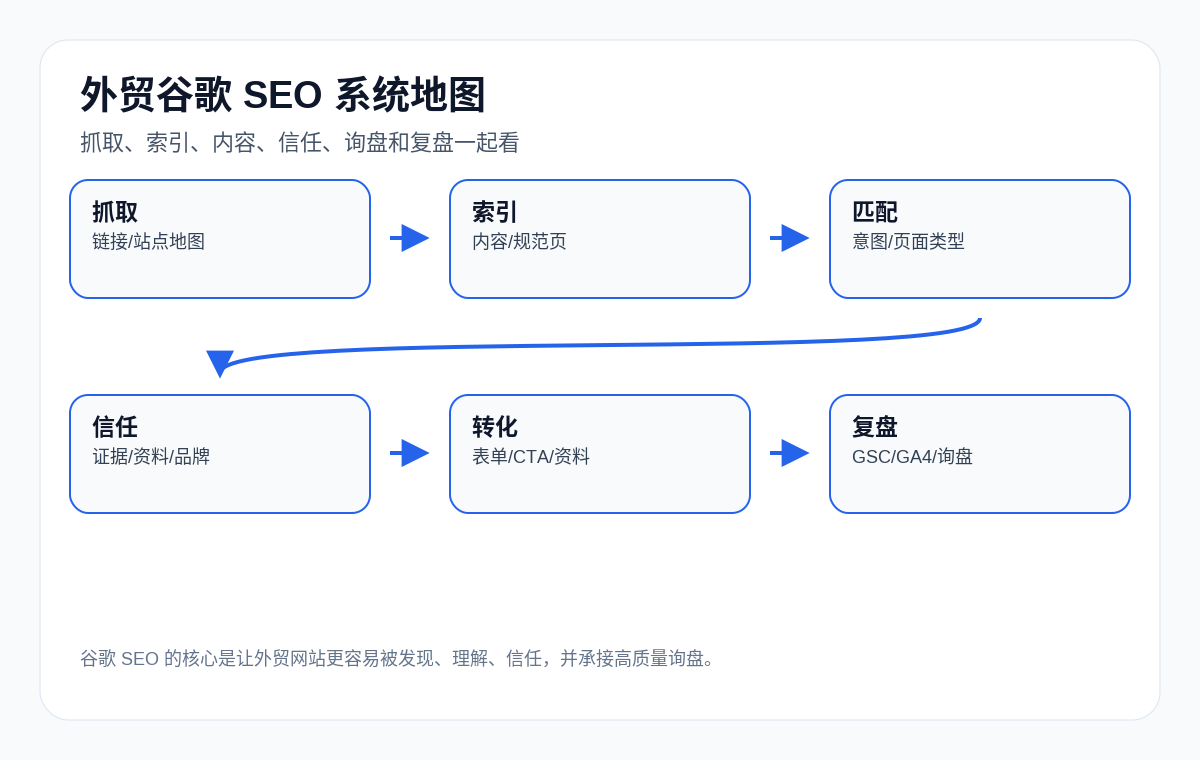
Google SEO is not about exploiting “search engine loopholes.” It is about whether a website and its pages can be correctly discovered, understood, and trusted. For a foreign trade site, it covers at least six layers: technical accessibility, keywords and search intent, page type matching, content evidence, internal links and trust, and the inquiry path and review.
| Layer | Problem to solve | Foreign trade example | Review metric |
|---|---|---|---|
| Crawling | Can Google find the page? | Do new product pages have internal links and a place in the sitemap? | Crawl status, logs, index coverage |
| Indexing | Can the page enter the search index? | Are product pages accidentally blocked by noindex or canonical tags? | GSC URL Inspection |
| Matching | Does the page satisfy search intent? | The main term LED flood light is captured by a category page | Queries match the target URL |
| Trust | Does the content carry evidence? | Material, compatibility, and document details for medical probes | Document downloads, sales feedback |
| Conversion | Can a visitor send an inquiry after arriving? | Drawing upload and RFQ for custom metal parts | Form submissions, inquiry completeness |
| Review | Is it steadily improving? | Review GSC, GA4, and the CRM by product line | Impressions, clicks, inquiries, AI citation observations |
+
How Google SEO Differs from Google Ads
Google Ads is good for quickly testing markets, product terms, countries, and landing pages; Google SEO is better for building up product content, technical documents, industry pages, and organic inquiry paths over the long term. The two are not mutually exclusive. Foreign trade companies can use ads to find out which product terms and countries produce more inquiries, then turn high-value terms into SEO page assets.
| Dimension | Google Ads | Google SEO | Foreign trade recommendation |
|---|---|---|---|
| Time to results | Fast | Slow; requires crawling, indexing, and accumulation | Ads are faster for new products and market testing |
| Cost structure | Pay per click | Upfront content and technical investment | High-value product lines suit long-term SEO |
| Page requirements | A strong landing page converts | Content, structure, indexing, and internal links all need to be strong | Ad pages and SEO pages can learn from each other |
| Review metrics | CPC, conversions, cost per inquiry | Impressions, clicks, URLs, inquiry quality | Unify in the CRM to judge lead quality |
| Risk | Traffic stops when spending stops | Slow to take effect and uncertain | Using both together is more robust |
+
Page Type Matrix for Foreign Trade Google SEO
+
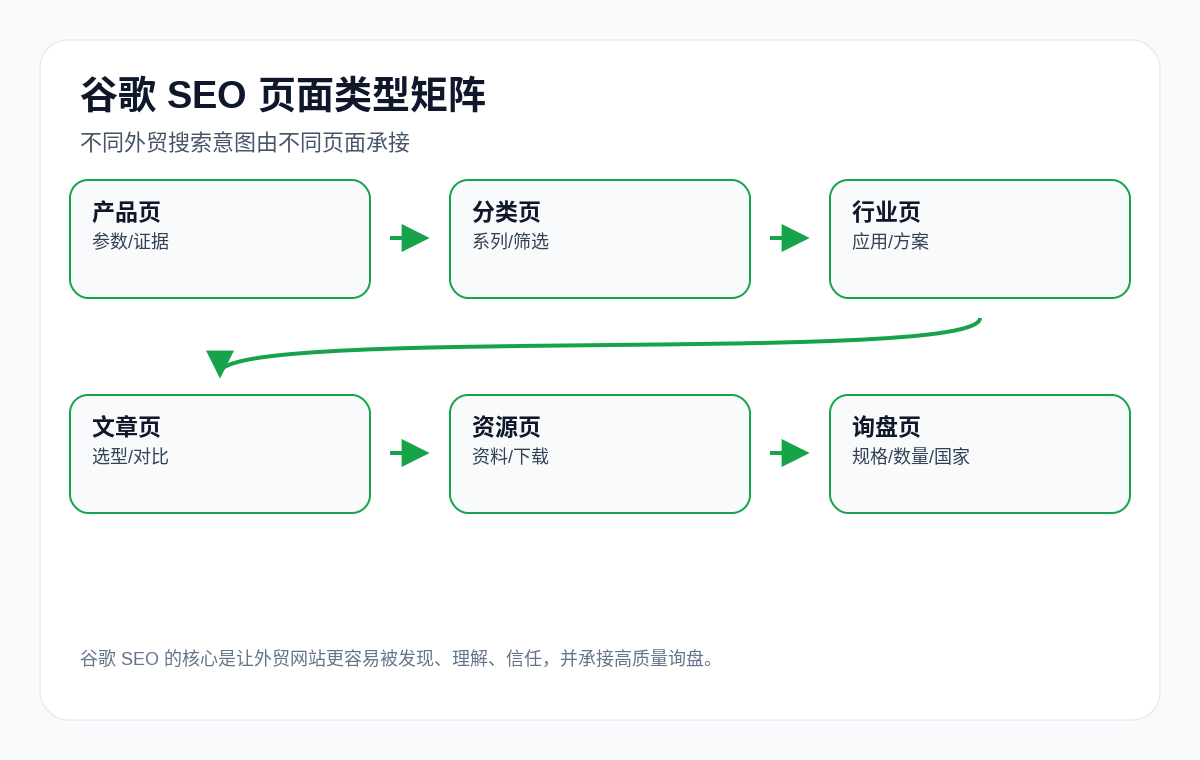
| Page type | Search intent it captures | Core content | Example |
|---|---|---|---|
| Product page | Specific products, models, specifications | Specifications, materials, images, certifications, CTA | medical probe product page |
| Category page | Product series and supplier terms | Category description, filters, FAQ, related products | LED flood light manufacturer |
| Industry page | Application scenarios and solution terms | Industry problems, recommended products, standards, inquiry entry point | industrial valve for water treatment |
| Technical article | Selection, comparison, maintenance, and question terms | Steps, tables, pitfalls, internal links | IP67 vs IP68 connector |
| Resource page | Document downloads and technical validation | datasheets, catalogs, drawings, FAQ | cnc machining drawing requirements |
| Inquiry page | Quotes and contact | Product, specifications, quantity, country, attachments | custom metal parts quote |
+
Keyword Research: Start with English Product Terms
Keyword research for foreign trade Google SEO cannot start from Chinese service terms. Start from products, materials, specifications, applications, industries, suppliers, quotes, questions, and national markets. Whether a term is worth pursuing depends not only on search volume but also on commercial value, page type, competitor strength, and inquiry quality.
| Term type | Intent | Page | Example |
|---|---|---|---|
| Primary product term | Finding products/suppliers | Category page/product page | packaging machine |
| Material/specification term | Confirming technical fit | Product page/technical article | IP67 waterproof connector |
| Application term | Confirming the scenario | Industry page | LED flood light for warehouse |
| Supplier term | Finding a manufacturer | Capability page/category page | industrial valve supplier |
| Quote term | Preparing an inquiry | Inquiry page/price factor page | custom metal parts quote |
| Question term | Learning and selecting | Articles/FAQ | how to choose ceramic dinnerware supplier |
+
Content Quality: Not Word Count, but Buying Judgment
Google officially emphasizes that content should be useful, reliable, and people-first. For a foreign trade site, “useful” does not mean piling up long articles; it means letting a buyer judge whether a product fits, whether a supplier is credible, whether specifications match, and what must be provided in an inquiry. Pages need tables, images, FAQ, process descriptions, and evidence.
| Content module | Buying value | Example | Common gap |
|---|---|---|---|
| Specification table | Fast fit assessment | waterproof connector pin count | Images only, with no HTML specifications |
| Application notes | Confirming the use scenario | LED flood light for stadium | All scenarios crammed into one sentence |
| Processes/materials | Proving manufacturing capability | cnc machining aluminum parts | Missing material and tolerance details |
| FAQ | Less repetitive back-and-forth for sales | MOQ, sample, lead time | Q&A that is too generic |
| Document downloads | Supports internal review | datasheets, catalogs, drawings | PDFs only, with no summary on the page |
| Inquiry guidance | Improves form quality | Quantity, specifications, country, attachments | Only a “Contact Us” link |
+
Technical SEO: First Make Sure Pages Can Be Found and Understood
| Check item | What to look at | Foreign trade risk | Action |
|---|---|---|---|
| Crawling | Whether core URLs have internal links, sit in the sitemap, and return 200 | New product pages go undiscovered for a long time | Add navigation, internal links, and sitemap entries |
| Indexing | Whether noindex, canonical, and robots directives are correct | Commercial pages get excluded by mistake | Check URLs in GSC |
| Mobile | Whether mobile is missing body copy, specifications, and FAQ | Pages become thin under mobile-first indexing | Keep the core content |
| Speed | LCP, INP, CLS | Large images, scripts, and forms slow the page down | Compress images and reduce blocking |
| Structured data | Product, FAQ, Breadcrumb | Machines understand the page poorly | Mark up only content that is genuinely visible on the page |
| Multilingual | hreflang, canonical, language entry points | Target-market pages become confusing | Standardize the relationships between language versions |
+
Internal Links: Route Informational Content Toward Commercial Pages
A common problem on foreign trade sites is having plenty of articles but not guiding readers to product pages, category pages, industry pages, and inquiry pages. Internal links should serve the buying path: technical articles explain the problem, category pages capture product series, product pages provide evidence, and inquiry pages collect information.
| Source page | Should link to | Purpose | Example |
|---|---|---|---|
| Technical article | Product page/category page/RFQ | Move informational demand into commercial pages | IP67 guide → connector category |
| Category page | Industry page/selection article/inquiry page | Help buyers make further judgments | LED flood light → warehouse lighting |
| Product page | Resource page/FAQ/related products | Add evidence | medical probe → compatibility guide |
| Industry page | Recommended products/documents/contact entry | Drive toward an inquiry | industrial valve application → quote |
+
GEO and AI Search: Google SEO Fundamentals Still Matter
AI search and AI Overviews do not make SEO fundamentals obsolete. Pages still need to be crawlable, indexable, clearly written, consistent in their entities, and backed by sufficient evidence. Foreign trade companies can add citable definitions, FAQ, specification tables, resource pages, and company entity information, but should not promise fixed AI citations.
| AI/GEO module | Page action | Example | How to observe |
|---|---|---|---|
| Definition sentence | State the product scope clearly in the opening paragraph | What is a waterproof connector? | Whether AI summarizes it accurately |
| Specification table | Present facts in HTML tables | IP rating, pin count, material | Whether AI cites the official site |
| FAQ | Answer specific sourcing questions | MOQ, sample, lead time | Question coverage |
| Entity consistency | Consistent company name, product capabilities, and contact details | About, Product, Contact | Whether AI describes them incorrectly |
| Evidence documents | Certifications, datasheets, images, processes | medical probe quality documents | Citation sources and description accuracy |
+
Execution Order for Foreign Trade Google SEO
+
- Confirm the core product lines, target markets, and English product terms.
- Check whether the site can be crawled, indexed, and accessed properly on mobile.
- Take stock of existing product pages, category pages, industry pages, article pages, and inquiry pages.
- Use the SERP to decide which page type should capture each kind of keyword.
- Add product specifications, applications, FAQ, documents, images, and inquiry guidance.
- Build internal links so technical articles lead to commercial pages.
- Review with GSC, GA4, the CRM, and sales feedback.
- Keep updating based on queries and inquiry quality.
+
+
Step One of Foreign Trade Google SEO: Take Stock of Product Information
Many foreign trade companies ask about keywords right away without first organizing their product information. Without product information, keyword research turns into an empty spreadsheet and content turns into empty words. Product information should at least include the product name, its English name, materials, specifications, applications, certifications, MOQ, samples, lead time, packaging, target markets, common questions, and existing images.
| Information | Why it matters | Where it is used | Example |
|---|---|---|---|
| English product name | Determines the keyword foundation | Title, H1, category page | cnc machining parts |
| Materials/specifications | Central to buying decisions | Specification table and FAQ | stainless steel, IP67, 100W |
| Application scenarios | Captures industry terms | Industry page and application page | warehouse lighting, food powder packaging |
| Certifications/documents | Builds trust | Resource page and product page | CE, RoHS, ISO, datasheet |
| Sales questions | Reveals FAQ topics and inquiry fields | Articles, FAQ, RFQ | MOQ, sample, lead time |
| Images/video | Proves the product and its applications | Product page, industry page, image-and-text modules | Product details, factory, application sites |
Step Two: Map Product Terms to Pages
The core of foreign trade Google SEO is not cramming every term onto one page but deciding which URL captures each group of terms. Primary product terms, material terms, application terms, question terms, supplier terms, and quote terms should have different pages. This prevents several pages from competing for the same intent and lets buyers follow a clear path toward an inquiry.
| Keyword group | Capturing page | Page content | Example |
|---|---|---|---|
| Primary product term | Product line/category page | Series, filters, FAQ, CTA | LED flood light |
| Material term | Material page/product page module | Material properties, suitable scenarios | aluminum CNC parts |
| Application term | Industry page/application page | Industry problems, recommended products | packaging machine for food powder |
| Question term | Articles/FAQ | Comparisons, steps, pitfalls | IP67 vs IP68 connector |
| Supplier term | Capability page/category page | Factory capabilities, certifications, delivery | industrial valve supplier |
| Quote term | Inquiry page/price factor page | Quote materials and influencing factors | custom metal parts quote |
Step Three: How to Write a Product Page That Works for Google SEO
Product pages are among the most important commercial pages in foreign trade SEO. A product page is not a photo album, and it should not just say “high quality.” It should answer the buyer’s key judgments: what the product is, what scenarios it suits, what specifications it has, whether it can be customized, what certifications it holds, how MOQ and samples are handled, and what information an inquiry should include.
| Module | Content | Foreign trade example | SEO/conversion value |
|---|---|---|---|
| Above-the-fold summary | Product, application, capabilities, CTA | custom metal parts for industrial equipment | Fast intent matching |
| Specification table | Specifications, materials, dimensions, certifications | waterproof connector pin count | Covers long-tail terms |
| Application scenarios | Industry and operating environment | LED flood light for stadium | Captures application terms |
| Quality evidence | Testing, documents, processes | medical probe quality document | Builds trust |
| FAQ | MOQ, samples, lead time, customization | private label activewear sample process | Reduces follow-up questions for sales |
| Inquiry guidance | Quantity, specifications, country, attachments | custom parts drawing upload | Improves inquiry quality |
Step Four: How Category Pages and Industry Pages Capture Commercial Terms
A foreign trade category page should not be just a grid of product cards. It should explain series differences, filter dimensions, application scenarios, common questions, and the inquiry entry point. Industry pages, in turn, should be written around the operating environment and solutions rather than copying product descriptions.
| Page | Should include | Suitable terms | Example |
|---|---|---|---|
| Category page | Category description, filters, series comparison, FAQ | Primary product terms, supplier terms | LED flood light manufacturer |
| Industry page | Scenario problems, recommended products, standards, CTA | Application terms, industry solution terms | industrial valve for water treatment |
| Resource page | datasheet, catalog, drawing, size chart | Document terms, verification terms | ceramic dinnerware catalog |
| Inquiry page | RFQ fields, document checklist, contact details | quote, sample, supplier | custom metal parts quote |
Step Five: How to Write Foreign Trade Technical Articles
Technical articles are not written for fellow SEO professionals; they help buyers make choices. Every article should have a clear question, applicable scenarios, a decision table, steps, common pitfalls, FAQ, and internal links to commercial pages.
| Topic | Buyer question | Article structure | Commercial page link |
|---|---|---|---|
| IP67 vs IP68 connector | How to choose a waterproof rating | Definition, comparison table, applications, pitfalls | waterproof connector category page |
| CNC tolerance guide | How tolerances affect cost | Tolerance table, drawing requirements, quoting impact | custom metal parts RFQ |
| Powder packaging machine | How to choose powder packaging equipment | Materials, metering, cleaning, speed | packaging machine product line |
| Activewear MOQ | How to judge small-batch private label | MOQ factors, sample process, fabrics | private label activewear manufacturer |
Step Six: Multilingual Content and Target Markets
Foreign trade SEO often involves multiple countries and languages. Do not simply machine-translate pages; instead, verify the product naming, certification requirements, buying habits, and SERP page types of the target market. Once the English pages form the base, you can gradually add Spanish, German, French, Arabic, and other versions, but every language must keep the core specifications, FAQ, internal links, and inquiry path.
| Market factor | What to check | Page action | Example |
|---|---|---|---|
| Product naming | Different expressions for the same product | Validate keywords | activewear / sportswear |
| Certification standards | Requirements differ by region | Add certification details | CE/RoHS for LED lighting |
| Application environment | Climate and industry differ | Add market application pages | valve for Middle East projects |
| Logistics and payment | Buyers care about different things | Add FAQ | MOQ, shipping, payment terms |
Step Seven: How to Improve Inquiry Quality
Google SEO must ultimately serve the business. A foreign trade inquiry page should not just collect a name and email; it should prompt buyers to provide the product, specifications, quantity, country, application, attachments, and timing requirements. That way the sales team can judge fit faster.
| Field | Why it matters | Applicable products | Review |
|---|---|---|---|
| Product/model | Matches the page and product line | All products | Inquiry source URL |
| Quantity/MOQ | Judges commercial viability | Wholesale, custom, equipment | Share of invalid inquiries |
| Specifications/materials | Affects quoting and production | Metal parts, connectors, valves | Number of follow-up questions from sales |
| Application scenario | Helps with selection | Lighting, machinery, medical components | Inquiry fit |
| Attachments | Speeds up quoting | custom parts, OEM/ODM | Share of inquiries with attachments |
| Target country | Affects certification and logistics | Export business | Share of target markets |
+
Step Eight: Team Roles
Google SEO is not something one person can complete by writing articles. The product team supplies specifications and documents, the sales team supplies customer questions, the technical team ensures crawlability and speed, the content team turns documents into pages, and management decides which product lines and markets come first.
| Role | Responsibility | Deliverable |
|---|---|---|
| Product/engineering | Specifications, materials, processes, certifications | Product information and technical boundaries |
| Sales | Customer questions, inquiry quality, deal feedback | FAQ and RFQ field recommendations |
| Technical | Crawling, indexing, speed, forms | Accessible pages and tracking events |
| Content | Page structure, tables, FAQ, internal links | Product pages, articles, resource pages |
| Management | Product lines, target markets, priorities | Quarterly SEO direction |
Google SEO Diagnostic Workflow: Find the Bottleneck Before Choosing an Action
When doing Google SEO for a foreign trade website, do not start by rewriting titles, writing articles, or buying tools. Diagnose the bottleneck first: is it a crawling problem, an indexing problem, mismatched page types, thin content, insufficient product information, broken internal links, a poor mobile experience, or a weak inquiry path? Different bottlenecks call for different actions.
| Symptom | First diagnosis | How to check | Action |
|---|---|---|---|
| Core pages get no impressions | Crawling/indexing problem | GSC URL Inspection, sitemap, internal links | Fix indexing and discovery paths |
| Impressions but no clicks | Title and snippet mismatch | Look at GSC CTR and queries | Change title/meta and the above-the-fold answer |
| Clicks but no inquiries | Weak conversion path or content evidence | GA4 paths, form tests, sales feedback | Add CTA, documents, FAQ, RFQ |
| Articles outrank product terms | Wrong page type | Distribution of queries by URL | Adjust mapping and internal links |
| Low inquiry quality | Keyword intent or form field problem | CRM tags and sales follow-ups | Optimize target terms and inquiry fields |
| Inaccurate AI descriptions | Unclear entities and evidence | Observe AI answers | Add definition sentences, specification tables, entity consistency |
Competitor Benchmarking: Find Page Gaps, Don’t Copy
When benchmarking against the Google top result or a strong page of the same kind, look at why it satisfies search intent: is the page type correct, does the above-the-fold area answer directly, and does it have tables, images, FAQ, evidence, internal links, and a conversion entry point? This site should cover the information it already has and add the foreign trade scenarios it lacks.
| Benchmark item | What to look at | How this site strengthens it | Example |
|---|---|---|---|
| Page type | Is the top result a product page, an article, or a category page? | Capture with the right page | Use a category page for the main term LED flood light |
| Content depth | Does it cover the key questions? | Add a buying decision table | MOQ, sample, certification |
| Evidence | Does it have specifications, images, documents? | Add your own product information | datasheet, drawing, QC process |
| Structure | Is it easy to read and scan? | Add a table of contents, H2s, tables, FAQ | technical guide |
| Conversion | Does it lead into an inquiry path? | Add CTA and RFQ fields | Request a Quote |
Content Quality Acceptance: Can a Foreign Trade Customer Use It to Decide?
Whether a Google SEO page is strong is not a matter of word count but of whether a customer can use it to make a judgment. A foreign trade page must include concrete steps, decision criteria, tables, images, common pitfalls, FAQ, and review metrics.
| Acceptance item | Pass standard | Failing sign |
|---|---|---|
| Target reader | Written for foreign trade factories and trading companies | Written only for SEO practitioners |
| Examples | Uses English product terms and sourcing questions | Defaults to its own service terms as examples |
| Steps | Can be followed as a checklist | Concept explanations only |
| Tables | Has decision tables, matrices, checklists | Walls of paragraphs |
| Images | Flowcharts, matrices, or diagrams | No visual aids |
| Review | Includes GSC, GA4, inquiries, AI citation observations | Rankings only |
Foreign Trade Case Study 1: How a custom metal parts Website Should Do Google SEO
A custom metal parts website should build its content system around manufacturing capability and quote-by-drawing. The point is not to write “our quality is good” but to explain which processes, materials, precision levels, surface treatments, batch sizes, inspections, and delivery options you can handle.
| Page | Content | Target terms | Inquiry value |
|---|---|---|---|
| Capability page | CNC, stamping, casting, fabrication | custom metal parts manufacturer | Captures supplier terms |
| Material page | aluminum, stainless steel, brass | aluminum CNC parts | Captures material terms |
| Technical article | Tolerances, drawings, surface treatments | cnc machining tolerance | Reduces technical back-and-forth |
| RFQ page | Drawings, quantity, material, surface treatment | custom metal parts quote | Improves inquiry completeness |
Foreign Trade Case Study 2: How an LED flood light Website Should Do Google SEO
An LED flood light website should combine category pages, application pages, and selection articles. Buyers search not only for flood light but also for outdoor, warehouse, stadium, IP65, IP66, 100W, lumen, beam angle, mounting bracket, and similar terms.
| Page | Content | Target terms | Action |
|---|---|---|---|
| Category page | Series, wattage, waterproof rating, certifications | LED flood light manufacturer | Add filters and FAQ |
| Application page | warehouse, parking lot, stadium | LED flood light for warehouse | Add scenario images and recommended products |
| Comparison article | IP65 vs IP66, wattage selection | IP65 vs IP66 flood light | Link to the category page |
| Inquiry page | Wattage, quantity, mounting height, target country | LED flood light quote | Optimize form fields |
Foreign Trade Case Study 3: How a packaging machine Website Should Do Google SEO
A packaging machine site cannot rely on a single page for a broad term. Equipment purchases break down by material, packaging format, degree of automation, capacity, and industry application. The clearer the page system, the more efficient the sales conversation.
| Page | Content | Target terms | Inquiry fields |
|---|---|---|---|
| Material category page | powder, granule, liquid | powder packaging machine | Material, bag type, speed |
| Industry page | food, pharma, hardware | food packaging machine | Cleaning, certifications, capacity |
| Selection article | Semi-automatic vs fully automatic | small business packaging machine | Budget and output |
| Resource page | Videos, specifications, installation instructions | packaging machine working principle | Helps technical confirmation |
+
Foreign Trade Case Study 4: How a private label activewear manufacturer Website Should Do Google SEO
For private label activewear manufacturer, buyers care about the private label process, fabrics, MOQ, sample garments, logo techniques, sizing, packaging, and lead time. SEO content should break these sourcing questions into capability pages, process pages, FAQ, and inquiry pages.
| Module | Content | Target terms | Value |
|---|---|---|---|
| Capability page | private label, OEM, ODM | private label activewear manufacturer | Captures commercial terms |
| Fabric page | nylon, spandex, polyester | activewear fabric options | Helps with material selection |
| Sample process | sample, size chart, logo method | activewear sample process | Reduces follow-up questions for sales |
| FAQ | MOQ, lead time, packaging | custom sportswear MOQ | Covers long-tail questions |
+
Minimum Pre-Publish Acceptance Standards
| Item | Minimum standard | How to verify |
|---|---|---|
| Core pages | Product pages, category pages, and inquiry pages are complete | Manual visits and GSC checks |
| Content evidence | Specifications, images, FAQ, and documents are complete | Item-by-item page checks |
| Technical foundation | Crawlable, indexable, readable on mobile | GSC and phone testing |
| Internal links | Articles, products, categories, and inquiries are interconnected | Spot-check links |
| Conversion | Form fields can collect the key information | Submit a test inquiry |
| Review | GSC, GA4, CRM, and sales feedback are trackable | Monthly review |
Review Metrics: Don’t Look Only at Rankings
+
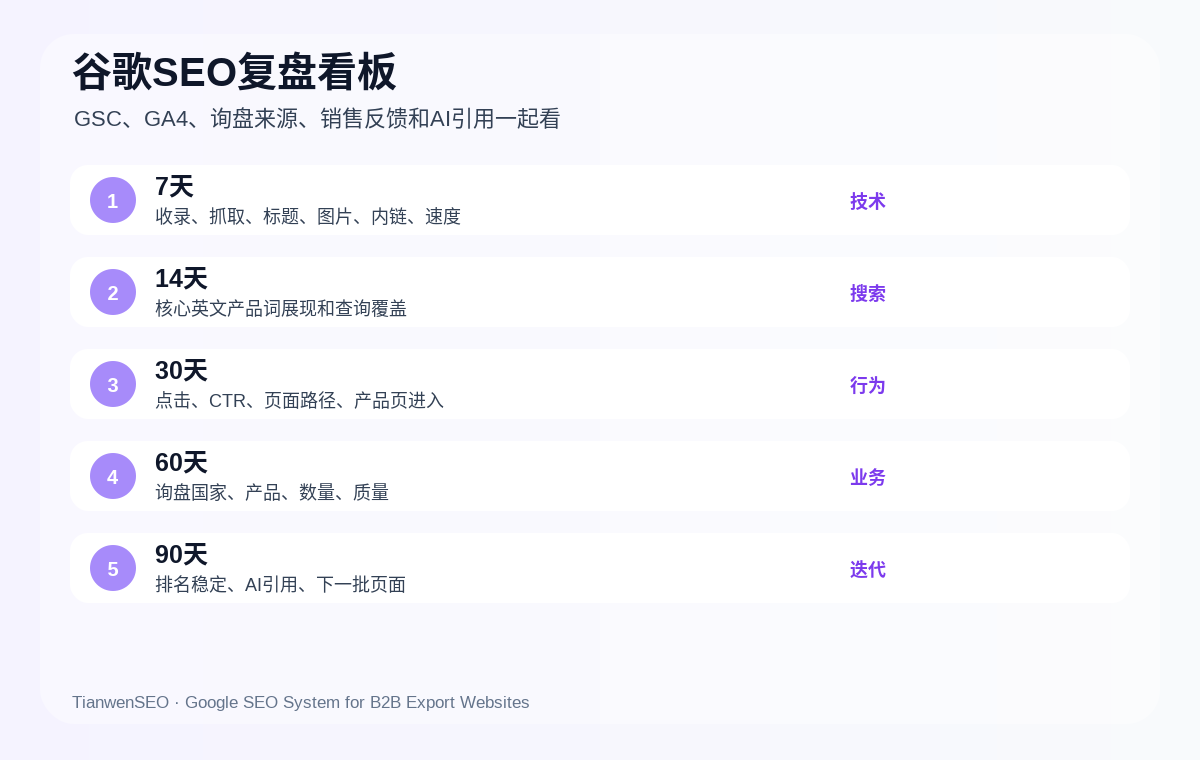
| Metric | Cycle | What to look at | Action |
|---|---|---|---|
| GSC queries | 30–60 days | Whether target product, application, and question terms appear | Add titles, FAQ, internal links |
| Target URLs | 30–60 days | Whether queries land on the right page | Adjust page mapping |
| Index status | Monthly | Whether core pages are indexable | Fix noindex/canonical/internal links |
| GA4 paths | 60–90 days | Paths from articles to product pages and inquiry pages | Optimize CTA and recommended links |
| Inquiry quality | 60–90 days | Whether it includes product, specifications, quantity, country, attachments | Optimize the RFQ form and document checklist |
| Sales feedback | Monthly | Whether customers ask fewer basic questions | Add FAQ and product information |
| AI citation observations | 60–90 days | Whether AI cites the official site and describes it accurately | Add citable passages and evidence tables |
+
Common Misconceptions
+
- Focusing only on rankings and not on whether pages capture inquiries.
- Turning every keyword into an article while product and category pages stay weak.
- Translating Chinese product names literally without checking how overseas buyers actually phrase them.
- Hiding specifications, FAQ, and documents to make the page look cleaner.
- Looking only at search volume and ignoring low-volume, high-value B2B long-tail terms.
- Ignoring mobile, speed, structured data, and index control.
- Skipping review with GSC, GA4, the CRM, and sales feedback.
- Making promises you cannot control, which distorts client expectations.
+
FAQ: Common Questions About Google SEO
+
How long does Google SEO take to show results?
It varies widely by website, industry, and level of competition. You usually have to go through crawling, indexing, understanding, impressions, and accumulating clicks first. Foreign trade companies should review in 30–90 day stages rather than expect immediate change.
+
Should a foreign trade website do content or technical work first?
First make sure core pages can be crawled and indexed, then add content to product pages, category pages, industry pages, and inquiry pages. Technical work and content are not an either/or choice, and basic technical problems will limit the effect of content.
+
Is Google SEO just writing articles?
No. In foreign trade SEO, what matters more is that product pages, category pages, industry pages, resource pages, and inquiry pages work together; articles only capture question terms and support commercial pages.
+
Are low-volume product terms worth pursuing?
If the buying intent is clear, margins are high, and inquiry quality is good, they are worth pursuing. B2B foreign trade cannot be ranked by search volume alone.
+
Do SEO and GEO need to be done separately?
The fundamentals are shared: crawlable, indexable, clearly written, credible evidence, and consistent entities. GEO places more emphasis on citable passages, FAQ, structured information, and AI citation observations.
+
How do you judge the quality of inquiries that SEO brings in?
Look at GSC queries, GA4 paths, form fields, CRM tags, and sales feedback together. High-quality inquiries usually include the product, specifications, quantity, country, application, and attachments.
+
Can you promise rankings or inquiries?
No. SEO is affected by competition, algorithms, markets, products, pricing, and sales follow-up. The professional approach is to commit to diagnosis, execution, review, and transparent boundaries, not to outcomes you cannot control.
+
Where should a new foreign trade site start?
Start with core product pages, category pages, an about/capability page, and an inquiry page, then add industry pages, technical articles, and resource pages around high-value product terms.
+
The 30-60-90 Day Google SEO Review Rhythm
Foreign trade Google SEO cannot stop once a page is published. Every core page should be observed at 30, 60, and 90 days: first whether it is discovered and indexed, then queries and clicks, and finally the inquiry path and quality.
| Time | What to look at | Possible problem | Action |
|---|---|---|---|
| 30 days | Indexing, crawling, initial impressions | The page is not indexed or gets no impressions | Add internal links and sitemap entries; check noindex/canonical |
| 60 days | Queries, CTR, target URLs | Queries land on the wrong page or CTR is low | Adjust titles, above-the-fold content, FAQ, page mapping |
| 90 days | GA4 paths, inquiry sources, sales feedback | Visits but no inquiries, or incomplete inquiries | Optimize CTA, form fields, and product evidence |
| Quarterly | Competitors, product information, AI citation observations | Content is outdated or gaps widen | Refresh pages, add documents, add internal links |
FAQ: More Common Questions About Google SEO
Does Google SEO require publishing an article every day?
Not necessarily. A foreign trade website should prioritize strengthening its core product pages, category pages, industry pages, and inquiry pages. Articles should be written around sourcing questions, not published at random just to keep up a posting frequency.
Does a product page with very little text hurt SEO?
If a product page lacks specifications, materials, applications, FAQ, image captions, and inquiry guidance, it will indeed hinder understanding by both search engines and buyers. A product page needs enough information, but it should not be padded with empty words.
Does a foreign trade website need an English blog?
Yes, but the blog should serve the commercial pages. Articles on selection, comparison, standards, applications, and common questions should link through to product pages, category pages, and inquiry pages.
Are Google SEO and AI search optimization the same thing?
Their fundamentals overlap heavily: pages must be crawlable, indexable, clearly written, consistent in their entities, and backed by credible evidence. AI search puts more emphasis on citable passages, FAQ, specification tables, and the clarity of facts on the page.
How do you start a new site with no data?
Start with an inventory of product information, validation of English keywords, building the core pages, and basic technical checks. When there is no GSC data, you can use the SERP, competitor pages, sales questions, and product information for initial planning.
How do you keep Google SEO content from being vague and generic?
Every page should come down to specific product terms, sourcing questions, page type, decision tables, steps, FAQ, images, and review metrics. After reading, the reader should know what to check and what to add next.
How many words does an SEO page need?
Word count depends on search intent and the competitive benchmark. Technical tutorials and pillar pages usually need longer content, but a long article must contain real information, tables, diagrams, steps, and case scenarios; it should not be padded with empty words to hit a word count.
When should pages be merged?
If several pages capture the same search intent, duplicate one another’s content, and split GSC queries among them, merging or restructuring should be considered. Before merging, back up the content and plan redirects and internal links.
Foreign Trade Google SEO Page Priority Checklist
If resources are limited, do not optimize all pages equally. Handle the pages closest to an inquiry and most representative of your product capabilities first, then expand supporting content.
| Priority | Page | Reason | Example |
|---|---|---|---|
| P0 | Core product pages/category pages | Directly capture commercial and supplier terms | LED flood light, custom metal parts |
| P0 | Inquiry page/RFQ | Affects conversion and lead quality | quote, sample, drawing upload |
| P1 | Industry application pages | Capture application and solution terms | packaging machine for food powder |
| P1 | Resource/document pages | Support technical validation and internal review | datasheet, catalog, size chart |
| P2 | Technical articles/FAQ | Cover question terms and support commercial pages | IP67 vs IP68 connector |
| P3 | General educational content | Further from the commercial path | Only when there are clear internal links and topical value |
The point of this priority table is to get foreign trade companies to first perfect the pages that affect inquiry quality, then gradually expand long-tail content. That way SEO does not become sporadic publishing but a reviewable website asset.
If you can only do one thing first, start with the core product pages and the inquiry page. If you already have baseline traffic, work backward from GSC queries and sales feedback to find page gaps. Every update should correspond to one specific page, one sourcing question, and one review metric.
Conclusion: Google SEO Is a Long-Term Content Asset System for Foreign Trade Websites
The value of Google SEO is not making a website look like it has more articles in the short term, but presenting a foreign trade company’s products, capabilities, documents, and sales questions in a systematic way. A good SEO page helps Google understand, helps buyers judge, and helps the sales team receive more complete inquiries.
Whether you work with custom metal parts, LED flood light, packaging machine, medical probe, waterproof connector, industrial valve supplier, or private label activewear manufacturer, SEO must come down to English product terms, page types, document evidence, the inquiry path, and review metrics. Only then is a website not vague talk but an asset that steadily accumulates customer judgment and foreign trade lead generation capability.
This page is machine-translated from the Simplified Chinese version and awaiting human review. It has not yet been proofread.