How do you judge the most reliable AI search visibility service team in China? Do not start with slogans like “we can get you recommended by ChatGPT,” “we can boost your AI exposure,” or “we understand GEO.” For export manufacturers and trading companies, a genuinely reliable team should be able to break AI search visibility down into verifiable work: how the target query set is chosen, what AI answers currently say, which pages on the official website are not citable enough, whether English product terms and sourcing questions are covered, where the brand entity and external materials disagree, and how GSC, GA4, inquiries, and sales feedback are reviewed.
This article is written from the perspective of Chinese export factories and trading companies, using English product terms such as custom metal parts, LED flood light, packaging machine, medical probe, cnc machining parts, ceramic dinnerware, waterproof connector, industrial valve supplier, and private label activewear manufacturer to explain: how to judge whether an AI search visibility/GEO service team is reliable, which promises should not be trusted, which deliverables are mandatory, what questions to ask before working together, and how to evaluate results after 90 days.
Target queries: how to judge the most reliable AI search visibility service team in China, AI search visibility service team, how to choose a GEO service team, generative engine optimization agency criteria, AI visibility services agency. Search intent: users are not looking for a ranking of service teams; they want to know how to avoid being misled by packaging built on AI buzzwords and how to use evidence to judge whether a team understands foreign trade, pages, search, AI answers, and inquiries. Top1/authority benchmark: current AI search visibility, generative engine optimization, GEO agency, and AI visibility platform/service pages generally emphasize AI visibility audit, brand/entity foundation, content optimization, authority signals, competitive tracking, LLM citation monitoring, and reporting; the gap is that much of this content targets SaaS or generic brands and lacks coverage of Chinese export factories, English product terms, product/RFQ pages, inquiry quality, and sales review. This article fills in those judgment criteria.
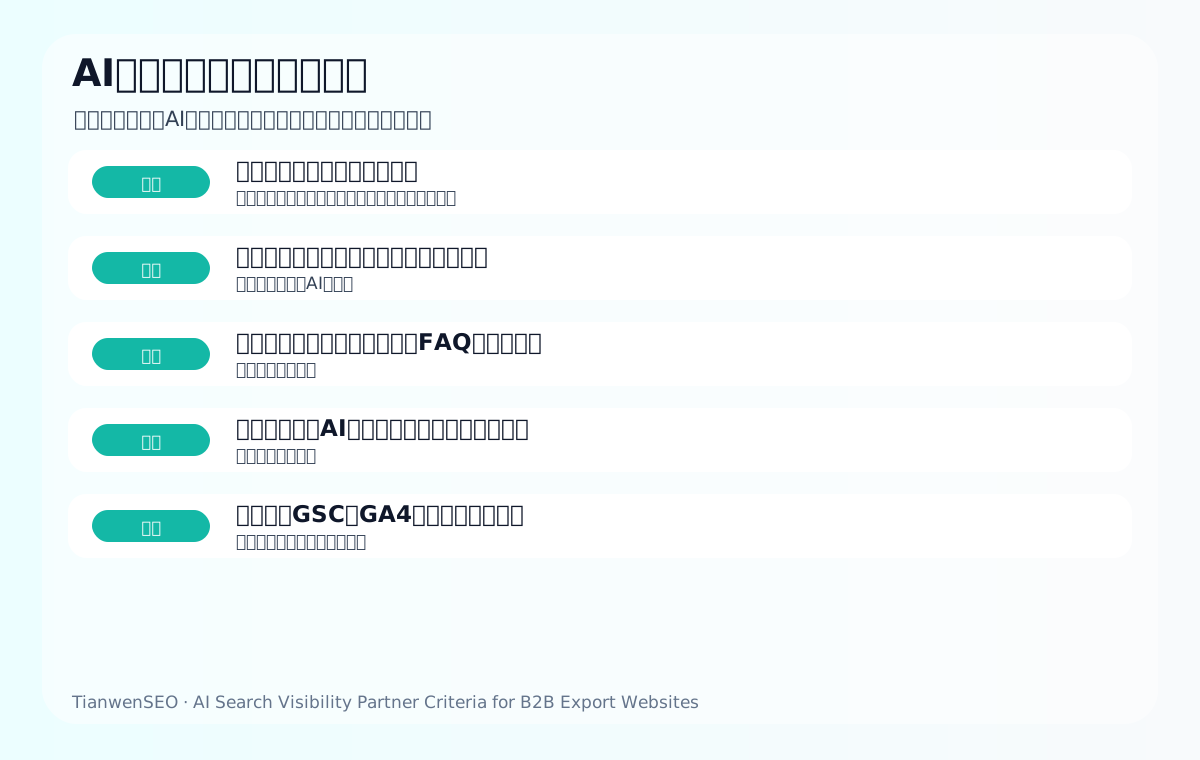
The conclusion first: do not choose the team that talks about AI concepts best; choose the team that can best prove where the problems are
AI search visibility is a new field, but when export companies judge a service team, the logic is not complicated: whoever can clearly explain your products, pages, query terms, AI answers, citation sources, and inquiry paths is more reliable; whoever only talks about concepts, promises fixed recommendations, and shows tool screenshots while being unable to explain why your waterproof connector product page is not cited, why your packaging machine application page does not cover sourcing questions, or why AI describes your brand incorrectly, should be treated with caution.
A reliable team’s first reaction is not “let’s start a GEO package right away,” but to ask business questions first: which product lines do you focus on? Where are your target markets? What product pages and resource pages does the current English site have? Which query terms appear in GSC? What is the inquiry quality like? What do customers ask sales most often? Are there third-party platforms and trade show materials? These questions determine where AI visibility work should actually begin.
| Judgment dimension | What a reliable team does | Signs of an unreliable team |
|---|---|---|
| Goal | Confirms product lines, markets, pages, and inquiry goals first | Sells AI exposure only from the start |
| Query set | Builds a question bank covering brand/non-brand/product/application/comparison/risk queries | Searches a few brand terms at random |
| Evidence | Records AI answers, citation sources, error points, and competitors | Shows only a few screenshots |
| Pages | Specifies which product pages, category pages, application pages, resource pages, and RFQ pages to change | Writes generic articles only |
| Review | Connects GSC, GA4, inquiries, and sales feedback | Looks only at tool scores |
Boundaries of official evidence: a reliable team talks about verifiable fields before talking about AI search visibility
The biggest risk when choosing an AI search visibility team is listening only to concepts.
A reliable team will not present GEO, AI SEO, and AEO as a mysterious button. It will first lay out the verifiable fields: what Google search performance, GA4 events, crawler access, structured data, page facts, AI answer sampling, and metrics such as Bing AI Performance can each explain, and what they cannot explain.
If the fields cannot be explained clearly, the louder the promises, the more cautious you should be.
Acceptance boundaries for a team, mapped to official documentation
| Source entry point | How the team should use it | What it must not be turned into |
|---|---|---|
| Google Search Central: SEO Starter Guide | Check first whether crawling, indexing, titles, body content, internal links, and user questions are clear. | It must not skip SEO fundamentals and repackage them directly as an AI project. |
| Google Search Central: AI features and your website | Explain that Google AI features still require the search system to understand page content, so pages must stay accessible, indexable, and clearly written. | It must not promise that a specific page will appear in AI answers. |
| Google Search Central: Structured data general guidelines | Check whether Schema matches the visible content and whether product facts are actually written on the page. | It must not treat structured data as a magic switch. |
| Search Console Help: Performance report | Record Google search performance by date range, query, page, clicks, impressions, CTR, average position, country, and device. | When there is no row-level data, it must not invent rankings, clicks, or page growth. |
| Google Analytics Help: About events | Use events to observe on-site behavior such as form submissions, email, WhatsApp, downloads, and button clicks. | It must not attribute a single event directly to AI search. |
| OpenAI Platform: Bots | Check robots and logs to confirm that relevant crawler visits have not been blocked unintentionally. | It cannot prove that ChatGPT will definitely display an official website page. |
| Bing Webmaster Blog: AI Performance | If the account has data, treat Bing AI Performance as a separate observation metric. | It cannot represent all AI platforms, nor replace manual sampling. |
| IndexNow: Documentation | For search engines that support it, it can be part of the URL update notification chain. | It cannot replace content quality, indexing eligibility, or page facts. |
Turn official documentation into acceptance fields, not a pile of links
The key to judging whether a team is reliable is not how many concepts it cites, but whether it can translate official documentation into fields that can be reviewed. Export companies can ask the team to state, item by item in the diagnostic table: which field comes from official documentation, which comes from an on-site page, which comes from GSC or GA4, and which is merely an AI answer sample. That way, during review you know where the problems are, and you also know which conclusions must not be written as promises.
| Official documentation | What it can verify | What it cannot imply |
|---|---|---|
| Google Search Essentials | Whether a page meets basic quality, technical accessibility, and anti-spam requirements. | It cannot imply that a given page will definitely earn clicks or rankings. |
| URL Inspection Tool | Crawl, index, canonical, sitemap, and crawl time for a single URL. | It cannot replace impressions, clicks, and query data in Search Analytics. |
| Sitemaps overview | Whether a URL is submitted through a sitemap and whether the sitemap is downloaded and read. | It cannot show that the URL has received organic clicks. |
| robots.txt introduction | Whether important pages and resources are allowed to be crawled. | It cannot show that the page content has been used in AI answers. |
| Canonical consolidation | Whether duplicate URLs, parameter pages, and multi-version pages point to a consistent canonical URL. | It cannot on its own prove entity authority or inquiry quality. |
This set of fields is suitable for the pre-engagement diagnosis and the monthly review. A reliable team should be willing to write these fields out clearly: which ones already pass, which need fixing, which can only be observed, and which cannot support a conclusion when there is no data. That way, AI search visibility does not become a slogan but a reviewable work list.
Diagnosis acceptance criteria: a team proposal must at minimum allow these fields to be reviewed
| Acceptance field | Acceptable deliverable | Unacceptable performance |
|---|---|---|
| Query set | Builds a fixed query set from English export product terms, sourcing questions, and application scenario terms. | Uses only peer-industry terms such as “AI search” and “GEO services.” |
| Page mapping | Maps each query to a product page, category page, application page, resource page, or FAQ module. | Only recommends writing more articles without saying which URL to change. |
| Official data | Records Search Console, GA4, robots, sitemap, structured data, and logs separately. | Lots of screenshots, but the field definitions are unclear. |
| AI sampling | States the platform, query, date, answer, whether the brand is mentioned, whether the official website is cited, and whether the facts are accurate. | Shows only one good-looking answer screenshot. |
| Business review | Puts inquiry product, parameters, country, quality, and sales feedback into a monthly table. | Only checks whether the brand was mentioned by AI, not whether it produced a clearer sourcing conversation. |
What to write about team selection when there is no GSC data
If a new export site does not yet have Search Console query or page row data, the team can still do a basic diagnosis and page upgrades.
But the monthly report and the proposal must state clearly: there is currently not enough search performance sample, so only a baseline can be established first. You can accept the query set, page mapping, product facts, GA4 events, crawler visits, and AI answer sampling, but you must not write that keywords have already improved, nor that inquiries have already come from AI search.
| Current evidence | Can be accepted | Cannot be accepted |
|---|---|---|
| No GSC row data yet | Whether a query set and page baseline have been established. | Rankings, CTR, click growth. |
| Product facts added to pages | Whether specifications, applications, limitations, and FAQ are clearer. | That AI platforms will definitely adopt them. |
| GA4 events configured | Whether on-site behavior can be observed going forward. | That the current inquiry source has been determined. |
| AI answer sampling established | Whether the sample is fixed, reviewable, and comparable. | That one sample represents long-term results. |
Why “AI search visibility team rankings” are inherently unreliable
Many users search for the “most reliable,” “best,” or “number one” service team, but services like AI search visibility are still changing rapidly, and a simple ranking can hardly reflect real capability. Whether a team suits you depends on whether it understands your industry, products, page foundation, English site structure, sales process, and target markets — not on whether it has written many articles about AI concepts.
For example, a team familiar with SaaS may not be able to handle pressure ratings, media, temperature, standards, and spare parts for an industrial valve supplier; a team familiar with local services may not know that wholesale ceramic dinnerware buyers care about MOQ, packaging, glaze, samples, and target-market compliance. Export GEO is not about moving generic AI terminology onto a website; it is about connecting AI understanding with sourcing judgment.
| Ranking-style judgment | Problem | More reliable judgment |
|---|---|---|
| Who claims to be number one | Cannot be verified | Look at deliverable samples and the diagnostic process |
| Who has the most concepts | Easily stays at the terminology level | See whether it lands on product pages and inquiries |
| Who has the most tool screenshots | Screenshots are not business results | Look at the question bank, error points, and review |
| Who makes bigger promises | AI answers are uncontrollable | Look at risk boundaries and executable actions |
| Who quotes the lowest price | Page implementation may be missing | Look at the 90-day deliverable list |
Top1/authority benchmark comparison: what existing service pages usually get right, and what they lack
In today’s English SERP, pages about AI visibility services, generative engine optimization agency, GEO services, and AI citation monitoring have mostly recognized the difference between traditional SEO and visibility in AI answers. They usually emphasize audits, entities, content structure, authority signals, competitive tracking, monitoring, and reporting, and these directions are correct.
But for Chinese export companies, more implementation is needed. Many authoritative pages do not explain how to connect an AI query set to the material and tolerance pages for custom metal parts, how to write the specifications and application pages for LED flood light as citable content, how to break the material scenarios of a packaging machine into pages, or how to look at GSC together with the inquiry table. So when judging a team, do not look only at whether it understands GEO concepts; look at whether it can turn concepts into export website assets.
| Common capabilities on authoritative pages | What is worth learning | What export companies should still ask | What a reliable team should add |
|---|---|---|---|
| AI visibility audit | Starts with AI answers and citation sources | Whether brand terms and non-brand product terms are distinguished | Build an export question bank |
| Entity foundation | Values brand entity consistency | Whether it checks factory/trading company identity and product lines | Create an entity material list |
| Content optimization | Values citable structure | Whether it changes product pages, category pages, application pages, and RFQ pages | Do page mapping and implementation |
| Citation monitoring | Continuously monitors AI mentions | Whether it records errors and business paths | Do answer correction and review |
| Measurement | Emphasizes reporting | Whether it connects GSC, GA4, inquiries, and sales feedback | Close the business loop |
Criterion one: does it truly serve export companies rather than lecturing peers about SEO
When export companies choose an AI search visibility team, the easiest thing to overlook is tone and examples. If a team always uses its own industry terms such as “SEO services,” “SEO agencies,” and “GEO services” when writing tutorials, but rarely uses English product terms, product pages, category pages, application pages, or inquiry pages, then it may not yet be putting the client’s scenario first.
A team that truly understands export business will naturally use terms such as custom metal parts, waterproof connector, packaging machine, ceramic dinnerware, medical probe, and LED flood light to explain problems. It cares about how buyers ask, how product pages respond, and how sales judges inquiry quality, instead of discussing concepts only from a marketer’s point of view.
| Observation point | Client-oriented language | Peer-oriented language |
|---|---|---|
| Keyword examples | waterproof connector supplier, custom metal parts tolerance | SEO service pricing, GEO agency rankings |
| Page examples | Product pages, category pages, application pages, resource pages, RFQ pages | Service pages, case study pages, marketing pages |
| Business results | More complete inquiry parameters, lower explanation cost for sales | Exposure, share of voice, concept buzz |
| Judgment metrics | GSC queries, GA4 paths, inquiry sources, sales feedback | Tool scores and screenshots |
Criterion two: does it build the query set first rather than writing content first
The most critical upfront work for AI search visibility is building a query set. Without a query set, you do not know what to monitor, and you do not know what pages should answer. Many teams immediately recommend “writing more AI-friendly content” without explaining which brand questions, product questions, application questions, comparison questions, and risk questions that content corresponds to.
An export company’s query set must include both brand terms and non-brand terms. Brand terms show whether AI understands you correctly; non-brand terms show new customer acquisition opportunities. Taking waterproof connector as an example, a brand term might be “ABC Connector manufacturer,” while non-brand terms might be “IP67 waterproof connector for outdoor LED lighting” and “M12 waterproof connector supplier China.” The latter are often closer to new customers.
| Query type | Example | Purpose | What the team should deliver |
|---|---|---|---|
| Brand recognition | Brand + product | See whether AI knows the brand | Brand answer baseline |
| Product category | custom metal parts supplier | See non-brand opportunities | Product question bank |
| Application scenario | LED flood light for warehouse | See application page demand | Application term page mapping |
| Comparison judgment | IP67 vs IP68 waterproof connector | See resource page opportunities | Comparison content list |
| Sourcing risk | how to evaluate packaging machine supplier | See trust questions | FAQ and evidence pages |
| Inquiry action | cnc machining parts MOQ lead time | See the conversion path | RFQ field recommendations |
Criterion three: can it diagnose why an AI answer is wrong
Wrong AI answers are very common. AI may describe a trading company as a factory, treat an old product line as the main business, overstate the scope of a certificate, get an application scenario wrong, or cite outdated platform material. A reliable team does not just celebrate that “AI mentioned you”; it carefully records whether “AI got it right.”
For export companies, a wrong mention is sometimes more dangerous than no mention. If AI gets the material safety or compatibility range of a medical probe wrong, it can create compliance and trust problems; if it gets the pressure and temperature range of an industrial valve wrong, it can bring mismatched inquiries; if it gets the MOQ and packaging method of ceramic dinnerware wrong, sales communication costs will rise.
| Type of error | Export risk | What a reliable team does |
|---|---|---|
| Wrong company identity | Customers misjudge the factory/trading role | Align the official website with external materials |
| Wrong product line | Brings mismatched inquiries | Fix category pages and platform materials |
| Wrong certificates | Compliance and trust risk | Add explanations of certificate scope |
| Wrong application scenario | Sourcing judgment is misled | Add application boundaries and FAQ |
| Wrong citation source | Incorrect material keeps influencing AI | Track the source and correct it |
Criterion four: can it connect AI visibility to page assets
AI search visibility is not work that sits apart from website pages. For AI to understand you and for buyers to trust you, you ultimately need pages that can be read, cited, and converted. A reliable team does not just give advice; it specifies which pages to change, why, and how to verify the changes afterward.
For example, custom metal parts needs pages for materials, tolerances, drawings, surface finishing, and inspection; packaging machine needs pages for material scenarios, speed and precision, cleaning and maintenance, and after-sales; ceramic dinnerware needs pages for material, glaze, packaging, MOQ, samples, and wholesale markets. If a team only writes general articles about “AI search trends” without touching these pages, it will be hard to create export lead-generation value.
| Page type | AI visibility value | Content to upgrade | How to verify |
|---|---|---|---|
| Product page | Answers specific product facts | Specifications, materials, certifications, applications, FAQ | The page can handle product questions |
| Category page | Explains product series and selection logic | Category differences, suitable scenarios, selection table | Covers category terms |
| Application page | Handles scenario sourcing questions | Environment, risks, selection, case boundaries | Covers application terms |
| Resource page | Becomes an AI citation source | Definitions, comparisons, tables, judgment criteria | AI citations or GSC long-tail queries |
| About/capability page | Builds entity credibility | Company identity, equipment, quality control, certificates | More accurate brand answers |
| RFQ page | Turns visibility into inquiries | Parameter fields, drawing upload, sample process | Improved inquiry quality |
Criterion five: does it understand the difference between “citation monitoring” and “business review”
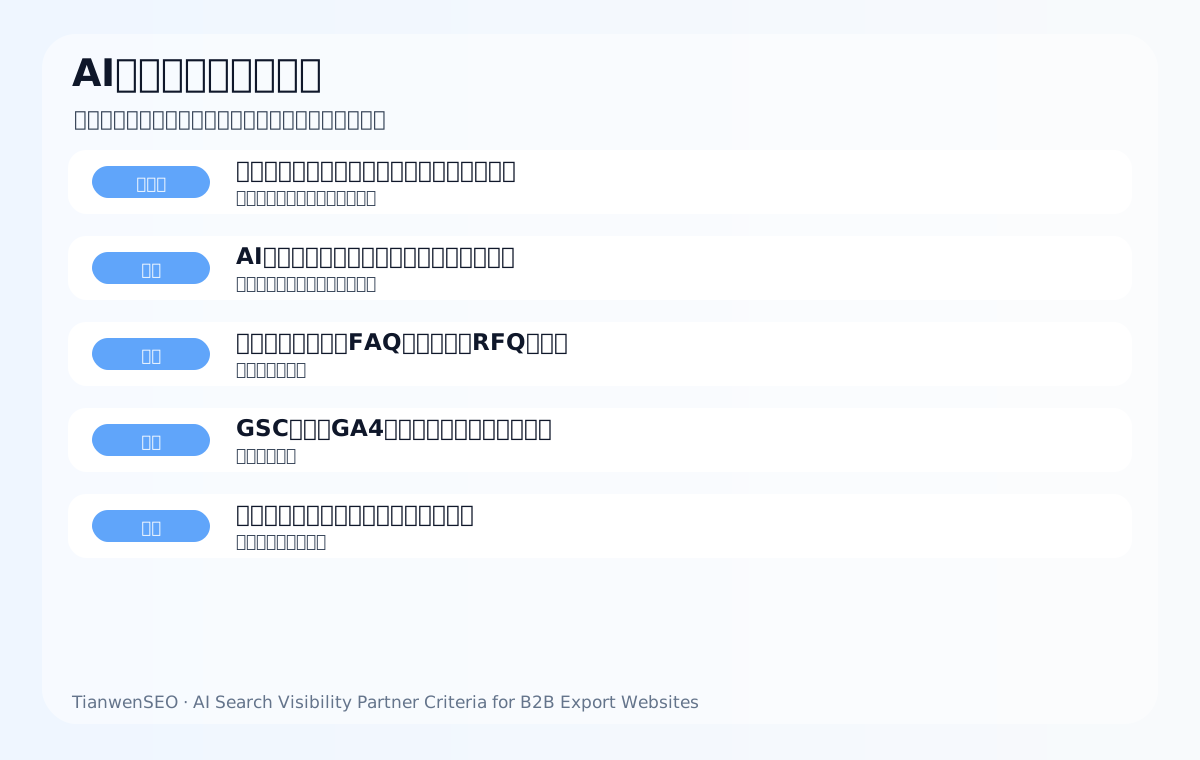
Citation monitoring is necessary, but it is not everything. A monthly report that only says “some AI tool mentioned you a few times” does not show whether the business has improved. A reliable team looks at AI answer changes, GSC queries, GA4 visit paths, brand searches, inquiry sources, and sales feedback together.
For example, if an application page for waterproof connector is cited by AI, but GA4 shows that users do not go on to the product page or contact page, then the problem may be insufficient page CTAs and internal links; if a packaging machine resource page gains GSC impressions but inquiries do not include material and speed parameters, that means the RFQ fields and page guidance are still not enough.
| Review level | Surface-level only | Reliable review |
|---|---|---|
| AI answers | Only checks whether the brand is mentioned | Checks accuracy, who is cited, and where the errors are |
| Search data | Only looks at total traffic | Looks at target pages and long-tail queries |
| Visit paths | Only looks at pageviews | Looks at the path from resource pages to product pages/RFQ pages |
| Inquiries | Only looks at quantity | Looks at source, product, parameters, and quality |
| Sales feedback | Not included | Records whether customers are clearer and better matched |
Criterion six: is it willing to say “we cannot promise definite results on AI platforms”
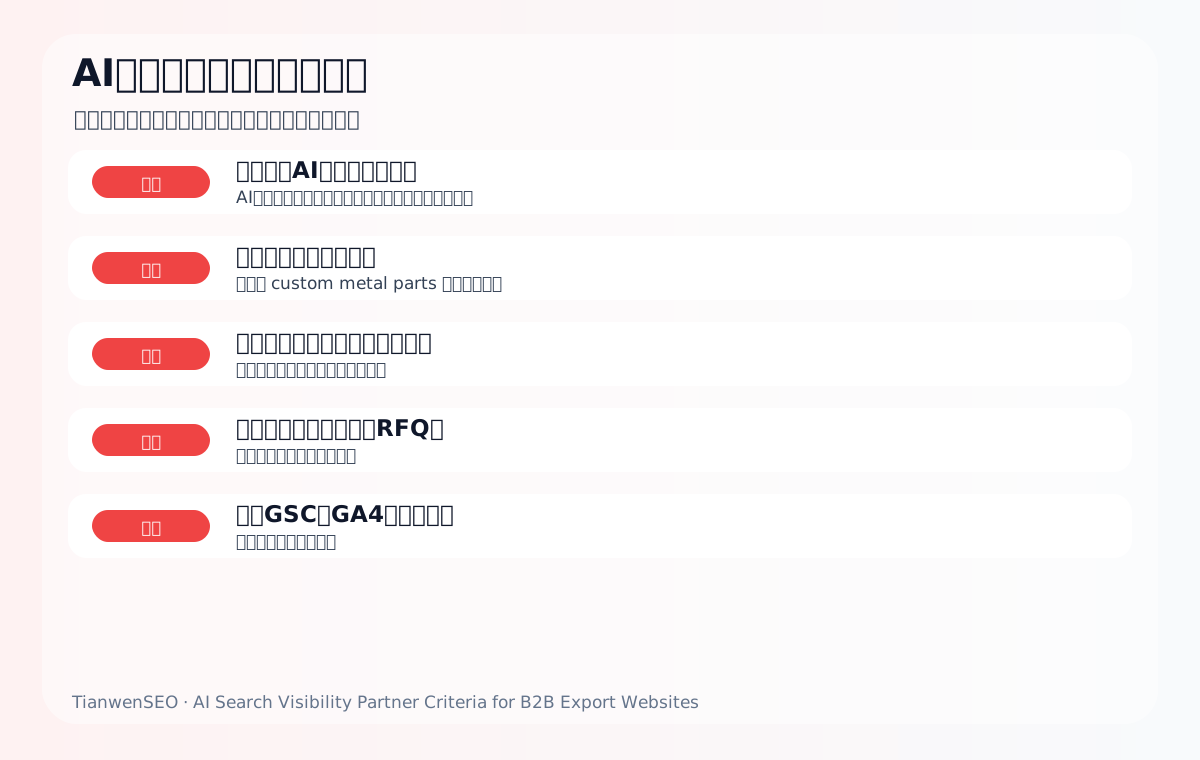
The more reliable the team, the less likely it is to write AI platform display, search rankings, or inquiry volume as definite results. AI answers are shaped jointly by models, search indexes, content sources, user questions, real-time data, and competing content, and no service team can fully control them. What can be done is to strengthen the foundations for being understood, cited, trusted, and verified.
If a team immediately promises “guaranteed recommendation by ChatGPT,” “guaranteed appearance in AI Overviews,” or “guaranteed rankings and inquiries,” export companies should be very cautious. The correct boundary should be: we can build the query set, fix pages and entity materials, add citable content, monitor answer changes, reduce incorrect information, improve the quality of high-intent pages, and review trends with data, but we cannot control how AI systems ultimately present information.
| Type of promise | Why it is not credible | Reasonable statement |
|---|---|---|
| Promise of specified display on AI platforms | AI answers cannot be fully controlled by a service team | Strengthen the foundation for being understood and cited |
| Promise of rankings | Search ordering is affected by many factors | Improve page quality and intent matching |
| Promise of inquiries | Inquiries are affected by market, product, price, and sales | Improve high-intent traffic and inquiry quality |
| Fixed time to results | Site foundations vary greatly | Review stage signals at 30/60/90 days |
Criterion seven: can it handle external materials and brand entity consistency
AI search does not read only the official website. B2B platforms, trade show directories, industry yellow pages, press releases, social media bios, certificate materials, and old domain pages can all influence how AI understands a brand. A reliable team checks whether these public materials are consistent with the official website, instead of only changing on-site articles.
Common problems for export companies include: multiple versions of the English company name, inconsistent addresses or contact details, old product lines still displayed on platforms, unclear certificate scope, brand name and company name used interchangeably, and confused expression of factory versus trading company identity. These problems affect AI answers and also affect buyer trust.
| Material source | What to check | Common problem | How to fix |
|---|---|---|---|
| Official website | Company identity, product lines, certificates, contact details | Descriptions too generic | Rewrite core entity information |
| B2B platforms | Product categories and company profile | Old products/old address | Update materials or remove incorrect items |
| Trade show directories | Exhibitor information and main products | Outdated information | Align product lines and brand name |
| Industry directories | Company name and category | Wrong category | Request a correction |
| Social media bios | Brand positioning and product lines | Inconsistent with the official website | Align the English description |
| Certificate materials | Scope of application and validity period | Over-interpreted by AI | Add an explanatory page |
Criterion eight: can it differentiate by export industry instead of applying one script to every site
Export industries differ greatly. The AI visibility priorities for industrial goods, machinery, electronic connectors, medical consumables, home consumer products, and custom apparel are completely different. If a team applies the same “brand, content, backlinks, monitoring” script to every industry but cannot say what a product page should add, it will be hard for it to become a long-term partner.
| Industry/product | Core buyer questions | Page focus | AI visibility focus |
|---|---|---|---|
| waterproof connector | IP rating, pin count, wire gauge, installation, application environment | Product page, IP resource page, application page | Accurate specifications and applications |
| custom metal parts | Materials, tolerances, surface finishing, drawings, quality control | Capability page, material page, inspection page | Credible technical facts |
| packaging machine | Materials, speed, precision, cleaning, after-sales | Application page, selection table, maintenance FAQ | Coverage of selection questions |
| ceramic dinnerware | Material, MOQ, packaging, samples, wholesale markets | Material page, packaging page, wholesale FAQ | Clear sourcing process |
| medical probe | Material safety, cleaning, traceability, compatibility | Compliance boundaries, testing description, application limits | Accurate risk wording |
| private label activewear manufacturer | Fabric, sizing, labels, MOQ, sampling | Fabric library, customization process, size chart | Clear customization capability |
Criterion nine: can it provide a 90-day delivery roadmap instead of indefinite trial and error
AI search visibility will not be completed overnight, but it cannot be without a rhythm either. A reliable team should be able to provide a 90-day roadmap: the first 30 days for audits and basic fixes, days 31–60 for page assets and entity materials, and days 61–90 for monitoring, review, and next-round priorities. This roadmap does not guarantee results; it guarantees that the work is sequenced, verifiable, and reviewable.
| Stage | Main work | Deliverables | Acceptance signals |
|---|---|---|---|
| Weeks 1–2 | Business and page diagnosis, query set creation | Question bank, answer baseline, page list | Knowing where the problems are |
| Weeks 3–4 | Entity consistency and core page fixes | Brand materials, product pages, RFQ recommendations | Fewer incorrect statements |
| Weeks 5–8 | Upgrades to resource pages, application pages, FAQ, and evidence pages | Citable content assets | Improved GSC long-tail queries and page quality |
| Weeks 9–12 | Review of AI answers, search, visits, and inquiries | Monthly report and next-round plan | Ability to decide the direction to continue |
Criterion ten: can it involve the sales team in the review
Export lead generation is not a one-person marketing department task. The sales team knows best what customers ask, which inquiries are high quality, which questions keep recurring, and which pages explain things poorly. A reliable AI search visibility team incorporates sales feedback into the question bank and page upgrades, instead of only looking at search tools.
For example, if sales is often asked “can cnc machining parts handle a certain surface finish,” “is packaging machine suitable for a certain powder,” or “can ceramic dinnerware do a certain kind of packaging,” these questions should all go into the FAQ, resource pages, and RFQ fields. Doing so not only helps AI understand, but also reduces repeated explanations by sales.
| Sales feedback | Content action | Review value |
|---|---|---|
| Customers always ask about MOQ | Add MOQ and sample process explanations | Reduce low-quality communication |
| Customers ask about material compatibility | Add material comparisons and application boundaries | Increase technical trust |
| Customers ask about certificates | Add certificate scope and downloadable materials | Reduce compliance concerns |
| Customers ask about lead time | Add sample/bulk/custom lead times | Improve inquiry expectations |
| Customers ask about packaging | Add packaging options and market requirements | Improve consumer goods conversion |
Criterion eleven: does it really know how to break down competitor citations
Many teams say “we do competitor analysis,” but genuinely valuable competitive breakdown is not about seeing who ranks where; it is about why a competitor becomes an AI answer source. An AI system does not necessarily cite a company because it does a lot of marketing; the more common reasons are that its product page facts are more complete, its resource page structure is clearer, its FAQ is closer to sourcing questions, its evidence pages are more credible, and its external materials are more consistent.
When choosing a team, export companies can ask directly: if we sell waterproof connector, how would you break down the competitors appearing in current AI answers? If we sell custom metal parts, how would you determine whether they gained visibility through product pages, tolerance resource pages, B2B platform materials, or certificate pages? Whether a team can answer with pages and evidence makes a huge difference.
| Competitive breakdown dimension | What a reliable team looks at | Common empty talk |
|---|---|---|
| Answer sources | Which official websites/directories/media the AI answer cites | The competitor’s content is good |
| Page type | Whether a product page, application page, or resource page is cited | They have more articles |
| Fact density | Whether specifications, standards, certificates, and FAQ are more complete | Their content is more professional |
| Entity consistency | Whether the official website and external materials are aligned | Their brand is bigger |
| Business path | Whether there is a clearer RFQ and resource download path | Their user experience is better |
Criterion twelve: can it translate “product questions” into “page structure”
A common mistake export companies make is understanding AI search visibility as “writing more content.” But sourcing questions are not abstract content; they are specific questions: how to choose a material, what tolerance to hold, how to judge an IP rating, whether speed and precision meet the requirement, what the MOQ and sample process are, and which products a certificate applies to. A reliable team must be able to translate these questions into page structure.
For example, with LED flood light, the team needs to know which questions belong on the product page, which suit an application page, which need an FAQ, and which should become a comparison table; with private label activewear manufacturer, it needs to know how fabric, sizing, labels, MOQ, sampling, packaging, and lead time questions should be distributed across pages. Only a team that can break down page structure can genuinely improve how AI and buyers understand the website.
| Product question | Which page type it belongs to | Page structure recommendation | Why it matters |
|---|---|---|---|
| Specification questions | Product page | Specification table, description, downloadable materials, FAQ | Lets both AI and buyers extract facts |
| Application questions | Application page/industry page | Scenarios, risks, boundaries, selection logic | Handles high-intent questions |
| Comparison questions | Resource page/tutorial page | Comparison table, judgment criteria, misconceptions | More likely to become a citation source |
| Trust questions | About page/capability page/evidence page | Equipment, quality control, certificates, processes | Builds brand credibility |
| Inquiry questions | RFQ page/contact page | Parameter fields, drawing upload, sample process | Improves inquiry quality |
Criterion thirteen: does it understand that different site stages need different strategies
Not every export site is ready to move straight into a full GEO engagement. For a site that has just launched and does not even have English product pages, the priority is usually to first get the product structure, category pages, contact paths, and basic indexing in order; only a site that already has steady inquiries and reasonably complete pages is better suited to moving into the AI query set, citation monitoring, and external material correction stage.
A reliable team will not push every client toward the same package. It should be able to tell you, based on your site stage, whether you are better off doing foundational work, a lightweight diagnosis, a core product pilot, or long-term review across multiple product lines. Export companies should use this to judge whether the other party is genuinely taking responsibility for your current situation.
| Site stage | Better suited to | Not suited to | Value of the team’s judgment |
|---|---|---|---|
| Just-launched site | Start with product page/category page foundations and a draft query set | Directly promising site-wide AI visibility results | Avoids misaligned direction |
| Site with a weak foundation | First add product facts, FAQ, RFQ, and entity information | Piling up many generic articles first | Improves the page foundation |
| Site with an existing SEO foundation | Build the query set, resource pages, AI monitoring, and external material corrections | Looking only at traditional rankings | Amplifies existing assets |
| Mature site with multiple product lines | Do in-depth reviews in batches by profit and inquiry value | Distributing resources evenly | Improves resource efficiency |
Criterion fourteen: can it provide a judgment table for the boss, not just a checklist for the person executing
Export business owners and managers usually do not need long technical jargon; they need to know three things: what problem this service solves, which pages and materials will be changed, and how to judge whether the money is well spent. A reliable team breaks complex work into a judgment table that the boss can also understand, rather than only giving detailed tasks for the execution layer.
For example, the boss cares more about: which product lines come first, why these pages are done first, where the AI answers are currently wrong, what stage signals will be visible next month, under what circumstances to keep investing more, and under what circumstances to adjust direction. A team that can explain these questions clearly has lower communication costs and is better suited to long-term cooperation.
| Question the boss cares about | How a reliable team should answer | Ineffective answer |
|---|---|---|
| Why do this project? | Explain the relationship between AI answers, pages, and inquiries | Because GEO is popular right now |
| Which pages first? | Rank by product value, inquiry value, and page foundation | Start with the easiest pages to write |
| How do we judge whether it is worth it? | Look at page assets, answer accuracy, search, and inquiry quality | Look at mention counts |
| How often do we review? | Staged reviews at 30/60/90 days | Do it for a few months first and see |
| When should we stop? | Adjust or narrow scope when consecutive reviews show no signal | It will get better if you keep renewing |
Criterion fifteen: can it handle multilingual and target-market differences
Many export companies serve more than one country. Different markets differ in search habits, product wording, certification concerns, and sourcing questions. A reliable team will not assume that all English queries are the same, nor lump together the questions of buyers in the United States, Europe, the Middle East, and Southeast Asia.
For example, LED flood light buyers in different markets may care more about wattage and luminous efficacy, or more about waterproofing, installation certification, and supply capability; packaging machine requirements for cleaning standards, documentation, and after-sales expectations are completely different in food and pharmaceutical markets. If a team can identify market differences and reflect them in the query set and page structure, that shows it is better suited to long-term cooperation.
| Difference dimension | What to judge | Page or query action |
|---|---|---|
| Target country | Whether common product terms and question terms differ | Adjust titles, FAQ, and resource page wording |
| Industry compliance | Whether certification, documentation, and testing requirements differ | Add evidence pages and boundary explanations |
| Sourcing habits | Whether they focus more on specifications, packaging, MOQ, or after-sales | Reorder page priorities and RFQ fields |
| Language expression | Whether the same product has different names | Add synonyms and category page explanations |
| Sales model | Whether distributor/brand/OEM/ODM needs differ | Split capability pages and customization pages |
Industry scenario one: if you sell waterproof connector, how do you judge whether a team is reliable
Products like waterproof connector are ideal for testing whether a team truly understands export products, because the questions are specific enough: the difference between IP67 and IP68, wire gauge, pin count, installation method, cable length, application environment, compatibility with solar/outdoor lighting/marine equipment, MOQ, samples, and lead time. If a team cannot articulate these questions, it will be hard for it to truly understand how your pages should be changed.
You can ask the team to give examples on the spot: if we focus on outdoor LED lighting and solar cable scenarios, which query terms would you build first? Which pages would you change first? How do you judge whether a product page is citable? How do you see whether AI distinguishes us from competitors? A reliable team can usually answer very specifically.
| What you can ask | A possible answer from a reliable team | Signs of an unreliable team |
|---|---|---|
| Which questions first? | IP rating, scenarios, supplier evaluation, MOQ, samples | Write a brand introduction first |
| Which pages first? | Product page, IP comparison resource page, application page, RFQ page | Publish a few trend articles first |
| How do you look at citations? | Record AI answer sources and error points | Check whether the brand was mentioned |
| How do you connect inquiries? | Add parameter fields and the sample process | Build up exposure first |
Industry scenario two: if you sell custom metal parts or cnc machining parts
For these products, the core is not concept exposure but technical facts. Buyers ask about materials, tolerances, surface finishing, drawing formats, quality control, sample lead times, and volume capability. A reliable team should know that these facts must go onto pages, and know which questions are better turned into resource pages and FAQ and which are better kept on product pages and capability pages.
| Judgment point | Reliable behavior | Low-level behavior |
|---|---|---|
| Understanding of material terms | Can give examples such as aluminum 6061 and stainless steel 304/316 | Only says metal processing |
| Tolerance wording | Knows how tolerances and inspection should be written into pages | Only says high precision |
| Drawing workflow | Recommends inquiry fields and drawing instructions | Does not touch the RFQ path |
| Capability page structure | Adds quality control, equipment, processes, and limitations | Only writes about factory strength |
Industry scenario three: if you sell packaging machine or industrial valve
Sourcing questions for machinery and industrial valves lean more toward selection and risk. A reliable team should be able to break materials, media, pressure, temperature, precision, speed, maintenance, after-sales, spare parts, certificates, installation, and application conditions into a query set, and know which questions must be turned into comparison tables or judgment tables.
| Product | Sourcing focus | The understanding the team should demonstrate |
|---|---|---|
| packaging machine | Materials, speed, precision, cleaning, after-sales | Can break down powder/granule/liquid scenarios |
| industrial valve | Media, pressure, temperature, standards, spare parts | Can explain the value of valve application pages and standards pages |
| LED flood light | Wattage, lumens, waterproofing, heat dissipation, installation | Can build two layers of pages: specifications and applications |
| medical probe | Material safety, cleaning, traceability, compatibility | Can handle compliance boundaries and risk wording |
If you only want to try one month first, what should the minimum verifiable deliverable be
Many export companies do not want to sign a long-term engagement right away, and that is reasonable. If you try one month first, the minimum verifiable deliverable should not be just a “research report”; it should include a set of materials you can use directly to judge direction. That way, even if you do not continue afterward, the company keeps reusable assets.
| What a one-month pilot should include | Why it matters | What its absence indicates |
|---|---|---|
| Core product line query set | Determines monitoring and page direction | Indicates a lack of real understanding of the business |
| AI answer baseline and error list | Shows the current state and risks | Indicates it only looks at surface-level mentions |
| Page priority list | Clarifies what to change first | Indicates it cannot implement |
| Entity consistency checklist | Avoids contradictions among public materials | Indicates it focuses only on on-site articles |
| Sample pilot monthly report | Lets the boss know how future acceptance will work | Indicates weak review |
20 questions you must ask before working together
The following 20 questions are suitable for export business owners, export managers, and marketing leads to ask directly before working together. They are not meant to stump the other party, but to confirm whether it truly understands export GEO and AI search visibility.
| Question | What a reliable answer should include | Warning sign |
|---|---|---|
| How do you determine the target query terms? | Brand, non-brand, product, application, comparison, risk | Only says the more keywords the better |
| Can you use our products as examples? | Can break down questions using English product terms | Keeps using marketing-industry terms |
| How do you record the AI answer baseline? | Question, answer, source, error points, date | Only takes screenshots |
| Will you check external materials? | B2B platforms, trade shows, directories, social media, certificates | Only changes the official website |
| Which pages will you change? | Product, category, application, resource, RFQ | Only writes articles |
| How do you judge whether a page is citable? | Fact density, structure, evidence, FAQ, readability | Only says the content needs to be long |
| How do you handle AI getting things wrong? | Record the error, locate the source, correct the material | Only checks whether you were mentioned |
| How do you look at competitors? | See who is cited, why they are cited, and what is strong about their pages | Only looks at rankings |
| How do you connect GSC? | Query terms, pages, impressions, clicks, intent changes | Does not look at GSC |
| How do you connect GA4? | Entry pages, paths, conversions, contact behavior | Only looks at pageviews |
| How do you connect inquiries? | Source, product, parameters, quality, sales feedback | Only looks at quantity |
| What does the monthly report contain? | Question bank, answers, pages, data, business feedback, next month’s actions | Only tool screenshots |
| Can you promise AI recommendations? | Clearly says it cannot promise, only strengthen the foundation | Promises fixed recommendations |
| How often do you review? | 30/60/90-day and monthly rhythm | No rhythm |
| How do you choose the first batch of pages? | By product value, page foundation, search intent, inquiry path | Treats everything equally |
| Will you make RFQ recommendations? | Will optimize fields and next-step instructions | Only does exposure |
| How do you avoid empty talk? | Tables, lists, specifications, evidence, FAQ | Only writes about trends |
| How do you handle entity consistency? | English name, product lines, certificates, external materials | Does not know what an entity is |
| What if there is no obvious change after 90 days? | Review the reasons and adjust the question bank and pages | Only asks for renewal |
| What do we need to provide internally? | Product materials, sales questions, certificates, inquiry data | Says no cooperation is needed |
Red flag list: be cautious when you see these statements
- Promises that AI platforms will display things in a specified way, guaranteed rankings, or guaranteed inquiries, or writes uncontrollable results as definite outcomes.
- Shows only AI screenshots and does not provide the query set, answer sources, error points, or page actions.
- Examples always revolve around the marketing industry’s own service terms and cannot be explained with English export product terms.
- Does not look at product pages, category pages, application pages, resource pages, or RFQ pages, and only recommends publishing more articles.
- Does not ask about GSC, GA4, inquiry sources, or sales feedback, and does not care about target markets or product profit.
- Describes GEO as a complete replacement for SEO, rather than something that works together with SEO, brand, content, and technical foundations.
Green flag list: these behaviors mean the team is worth talking to further
- Can first build a question bank around your product lines, instead of selling a package first.
- Can point out inconsistencies between official website pages, external materials, and AI answers.
- Can map every recommendation to a specific page, field, FAQ, or table.
- Can state clearly that it cannot promise fixed recommendations, but can explain how to strengthen the foundation for being understood and cited.
- Can put AI answer changes, GSC, GA4, inquiries, and sales feedback into a single review table.
- Can explain the method using export product terms, application scenarios, and sourcing questions, not just concepts.
How to score candidate teams
If you need to choose among several teams, you can use a 100-point scale. The score is not about absolute precision; it helps you avoid being swayed by a single highlight. A team with strong tools but no understanding of export business should not score too high; a team that writes many articles but does not look at inquiries should not score too high either.
| Scoring item | Points | Criteria for a high score |
|---|---|---|
| Understanding of the export industry | 20 | Can break down scenarios using your English product terms and sourcing questions |
| Query set and AI answer diagnosis | 20 | Has a question bank, answer baseline, sources, and error points |
| Page implementation capability | 20 | Can change product pages, category pages, application pages, resource pages, and RFQ pages |
| Entity and external material checks | 15 | Can check consistency across the official website, platforms, trade shows, directories, and certificates |
| Data review capability | 15 | Can connect GSC, GA4, inquiries, and sales feedback |
| Risk boundaries and communication | 10 | Makes no uncontrollable promises and explains staged acceptance |
What materials export companies themselves need to prepare
No matter how reliable the service team is, it cannot know product details out of thin air. The clearer an export company’s internal materials are, the easier it is to implement an AI search visibility project. Before working together, it is best to prepare product line priorities, target markets, typical inquiries, sales questions, certificate materials, product specifications, GSC and GA4 access, and a list of key pages.
| Material | Purpose | If it is missing |
|---|---|---|
| Product line priorities | Determines which queries and pages to do first | Easy to become scattered |
| English product terms | Builds the non-brand question bank | Examples will not be close to customers |
| Typical inquiries | Finds real sourcing language | FAQ will be vague |
| Sales questions | Add resource pages and RFQ fields | Pages will not solve communication pain points |
| Certificate and testing materials | Builds credible evidence | AI and customers will struggle to judge capability |
| GSC/GA4 data | Review search and paths | You can only look at surface-level screenshots |
How to judge after 90 days whether the engagement is worth continuing
The 90-day mark is not about demanding a ranking or inquiry miracle; it is about judging whether the direction is right. Export companies should look at five types of evidence: whether page assets have clearly strengthened, whether AI answers are more accurate, whether more relevant long-tail queries appear in GSC, whether GA4 paths move closer to product and contact pages, and whether inquiries are more specific.
| Evidence | Good sign | Needs adjustment |
|---|---|---|
| Page assets | Core product and resource pages are more complete | Only generic articles were added |
| AI answers | Fewer errors and more reasonable citation sources | Still gets the brand and product wrong |
| GSC | More product/application/comparison long-tail terms appear | Query terms are still generic or irrelevant |
| GA4 | Visitors move from resource pages to product pages/RFQ pages | Visits stop at articles |
| Inquiries | More complete parameters and better-matched products | No change in quantity and no improvement in quality |
| Sales feedback | Customer questions are clearer and explanation costs are lower | Sales does not feel any change |
How to start with different budgets
Not every company needs to start with a full project. If the budget is limited, you can start with a small-scale pilot: choose one product line, 10–30 target questions, 3–5 core pages, and one month of AI answer baseline and page diagnosis. If the budget is sufficient, then expand to multiple product lines, external material corrections, and monthly monitoring.
| Budget/stage | What it suits | What is not recommended |
|---|---|---|
| Lightweight pilot | One product line, question bank, answer baseline, page diagnosis | Promising site-wide results |
| Standard project | Core product line page upgrades, entity corrections, monthly report review | Buying only tool screenshots |
| In-depth project | Multiple product lines, resource page system, external materials, sales review | Ignoring internal cooperation |
| Long-term cooperation | Quarterly question bank updates, content refreshes, inquiry quality review | Repeating the same report every month |
FAQ: common questions about choosing an AI search visibility service team
How is an AI search visibility service team different from a traditional SEO team?
Traditional SEO focuses more on indexing, rankings, clicks, and page intent, while AI search visibility also focuses on AI answers, citation sources, entity consistency, and answer accuracy. But the two are not substitutes; export companies still need SEO fundamentals on their pages.
Is a team that uses AI tools automatically reliable?
No. Tools are only an aid. The key is whether the team can build an export query set, diagnose page and entity problems, and connect results to GSC, GA4, inquiries, and sales feedback.
Can you promise to get us recommended by ChatGPT?
No. Any promise of specified display on an AI platform is unreliable. A reliable team explains which actions are controllable and which boundaries are not.
What should you look at first when choosing a team?
First look at whether it can build a query set using your English product terms and sourcing questions, then at whether it can point to pages, external materials, and a review method.
Can we do this without GSC and GA4 data?
You can do a basic diagnosis and page upgrades, but the review will be much weaker. It is best to establish a data foundation as soon as possible.
Is a GEO project just about writing long articles?
No. For export GEO, what matters more is product pages, category pages, application pages, resource pages, FAQ, RFQ pages, and entity material consistency.
How do you judge whether a monthly report has value?
See whether the monthly report includes the question bank, AI answers, citation sources, error points, page actions, GSC/GA4, inquiries, and sales feedback, rather than just the number of screenshots.
Are small factories suited to AI search visibility?
They are suited to starting with a pilot on their core product line, especially for products with high unit prices, complex technical specifications, and clear sourcing questions.
If AI answers do not change, does that mean failure?
Not necessarily. First check whether page assets, entity consistency, and search long-tail queries have improved. If there is still no signal after 90 days, review the question bank, page quality, and external materials.
Who inside an export company should be involved?
The marketing lead, export sales reps, product/technical staff, and the person in charge should all be involved, and they should especially provide sales questions, product specifications, certificates, and target market information.
Conclusion: the value of a reliable team is turning AI buzzwords into verifiable export growth assets
AI search visibility is not a service that can be delivered with a single line like “we will do GEO for you.” For export companies, the team truly worth choosing should be able to place AI answers, English product terms, product pages, resource pages, brand entity, external materials, GSC, GA4, inquiries, and sales feedback on the same business chain.
If a team can first prove where the problems are, then map those problems to pages and materials, then review changes with data, and state clearly that it will not make uncontrollable promises, it is more worth working with than a team that only talks about AI concepts, only sends screenshots, and only promises recommendations. Judging an AI search visibility team is not about who sounds more mysterious; it is about who can make your export website clearer, more credible, and easier for buyers and AI systems to understand correctly.
Look at team judgment first, then at the diagnostic deliverable list
Judging whether an AI search visibility service team is reliable cannot stop at the question “is the team reliable?”; you also need to keep looking at whether it can write the diagnostic deliverables clearly. Companies can take the team screening criteria in this article and compare them against the GEO visibility diagnosis deliverable list: whether the query set, AI answer baseline, entity consistency, citation sources, citable pages on the official website, GSC/GA4 definitions, and review boundaries can all be turned into reviewable fields.
This makes the judgment closer to a real engagement. Team capability is seen in the method, and diagnostic delivery is seen in the evidence. When both are clear, export companies are less likely to be led astray by concepts, screenshots, and uncontrollable promises.
Continue reading this set of GEO resources
If you are studying GEO and AI search visibility systematically, we suggest continuing with the following articles. Understand the concepts first, then move on to diagnosis, monitoring, content structure, and engagement boundaries.
- Henan Tianwen Network Technology Co., Ltd.: Google SEO and GEO methodology notes
- How to write an SEO/GEO analysis framework: a guide to credible content when there is no authorized data
- How to choose an AI search visibility service team: a capability checklist for export companies evaluating a GEO partner
- How to choose an AI search visibility service team: what a reliable generative engine optimization team should deliver
- What is the difference between an AI search visibility consultant and a service team: how export companies should choose
- What to look at before a GEO partner quotes a price: the AI visibility baseline matters more than the package
{
“@context”: “https://schema.org”,
“@type”: “FAQPage”,
“mainEntity”: [
{
“@type”: “Question”,
“name”: “How is an AI search visibility service team different from a traditional SEO team?”,
“acceptedAnswer”: {
“@type”: “Answer”,
“text”: “Traditional SEO focuses more on indexing, rankings, clicks, and page intent, while AI search visibility also focuses on AI answers, citation sources, entity consistency, and answer accuracy. But the two are not substitutes; export companies still need SEO fundamentals on their pages.”
}
},
{
“@type”: “Question”,
“name”: “Is a team that uses AI tools automatically reliable?”,
“acceptedAnswer”: {
“@type”: “Answer”,
“text”: “No. Tools are only an aid. The key is whether the team can build an export query set, diagnose page and entity problems, and connect results to GSC, GA4, inquiries, and sales feedback.”
}
},
{
“@type”: “Question”,
“name”: “Can you promise to get us recommended by ChatGPT?”,
“acceptedAnswer”: {
“@type”: “Answer”,
“text”: “No. Any promise of specified display on an AI platform is unreliable. A reliable team explains which actions are controllable and which boundaries are not.”
}
},
{
“@type”: “Question”,
“name”: “What should you look at first when choosing a team?”,
“acceptedAnswer”: {
“@type”: “Answer”,
“text”: “First look at whether it can build a query set using your English product terms and sourcing questions, then at whether it can point to pages, external materials, and a review method.”
}
},
{
“@type”: “Question”,
“name”: “Can we do this without GSC and GA4 data?”,
“acceptedAnswer”: {
“@type”: “Answer”,
“text”: “You can do a basic diagnosis and page upgrades, but the review will be much weaker. It is best to establish a data foundation as soon as possible.”
}
}
]
}
This page is machine-translated from the Simplified Chinese version and awaiting human review. It has not yet been proofread.