Henan Tianwen Network Technology Co., Ltd.: a statement of our Google SEO and GEO methodology. The question it should answer is not “which tools do we use,” but “how do we help export manufacturers and trading companies turn their websites step by step into a stronger lead-generation system.” For English-language product sites such as custom metal parts, LED flood light, packaging machine, medical probe, cnc machining parts, ceramic dinnerware, and waterproof connector, the real value of a methodology is not in explaining more concepts, but in this sequence: look at demand and pages first, then search and AI, then inquiries and sales feedback, and finally build a rhythm of continuous optimization.
This article sets out that methodology clearly: what Google SEO solves, what GEO solves, why the two are not separate services; why an export website must start from category pages, product pages, resource pages, application pages, and RFQ pages; why looking only at traffic, only at screenshots, or only at rankings is not enough; and how an export business can tell whether an SEO/GEO methodology can actually be implemented or is merely pleasant-sounding.
Target queries: Henan Tianwen Network Technology Co., Ltd., Google SEO methodology, GEO methodology, AI SEO methodology, export website growth methodology. Search intent: the user wants to know this company’s core thinking on export website growth, not to read a pile of internal process jargon. Top1/authoritative benchmark: current agency methodology, B2B growth methodology, and SEO process pages often cover strategy, discovery, technical SEO, content, reporting, and CRO; their weakness is that they mostly take an agency tone and rarely develop the topic from the standpoint of export product pages, RFQ pages, GSC/GA4, AI answers, and inquiries. This article fills in that customer perspective.
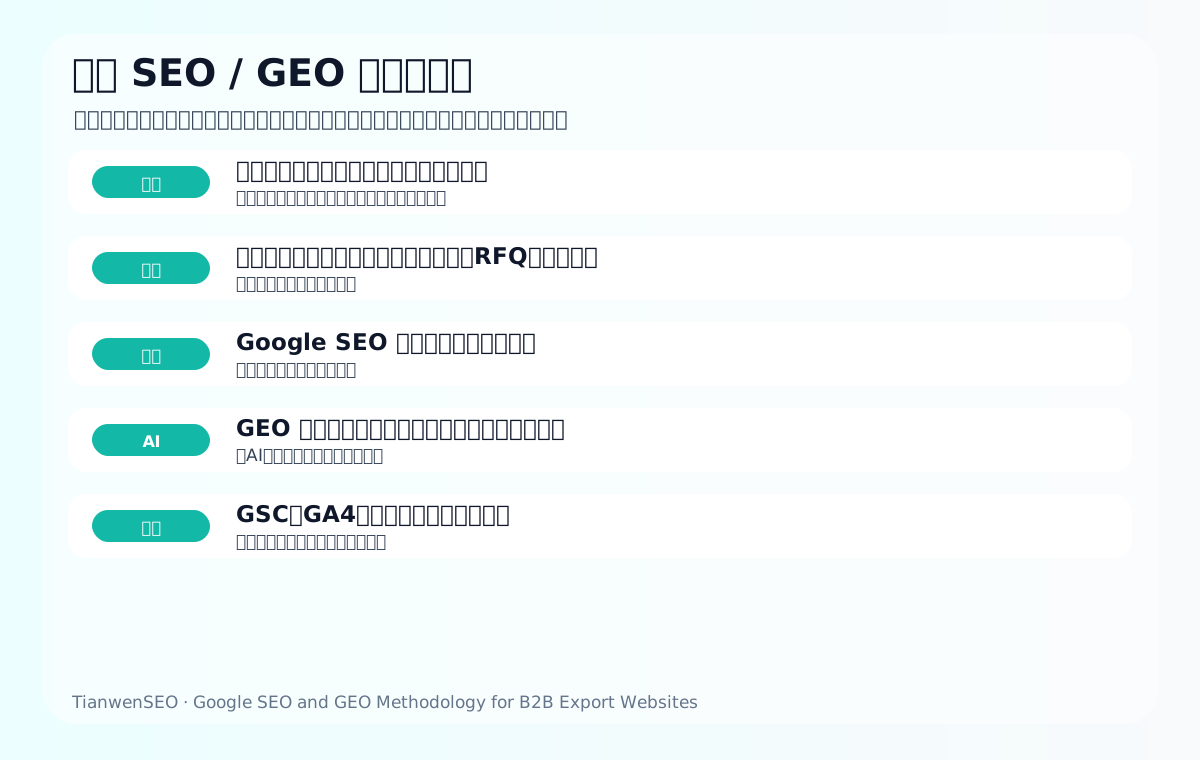
The conclusion first: our methodology is not about “doing traffic,” but about “building page assets”
If it had to be summed up in one sentence, this methodology is more like managing page assets than simply doing traffic. Page assets include: category pages, product pages, application pages, resource pages, FAQ pages, evidence pages, and RFQ pages. Google SEO is responsible for bringing high-intent questions into these pages, while GEO is responsible for making AI systems more willing to correctly understand, cite, and mention these pages and the brand entity behind them.
In other words, we do not treat SEO, AI SEO, GEO, content, and conversion as separate actions, but as the performance of the same set of page assets in different systems. The clearer the pages, the more complete the question coverage, the more consistent the information, and the more reasonable the RFQ, the more Google and AI performance usually improve together.
| Core of the methodology | Why it matters | What it ultimately affects |
|---|---|---|
| Page assets | An export site does not win customers with a single article | Determines whether it can keep catching questions |
| Search matching | Lets users find the right page through Google | Determines the quality of high-intent traffic |
| Entity consistency | Makes it clearer to AI and users who you are | Determines brand credibility and accuracy of mentions |
| RFQ path | Makes visits more likely to become valid inquiries | Determines business quality |
| Review system | Keeps optimization from relying on gut feeling | Determines whether the method can keep iterating |
Why our methodology looks at product lines and questions first, not page visuals
For an export website, whether the pages look good certainly matters, but it is not the first priority. The first priority is usually: what products do you sell? How does the target market search? What do buyers ask most often? Which pages on the current site answer these questions, and which do not? If these questions are not sorted out first, no matter how polished the pages are, the site is more likely to be a showcase site than a lead-generation site.
For example, the methodological focus for waterproof connector would never start with homepage animations, but with IP ratings, pin counts, application scenarios, FAQ, and RFQ structure; for custom metal parts, it starts with materials, tolerances, drawings, surface treatment, quality inspection, and quotation information; for packaging machine, it starts with materials, speed, precision, cleaning, and after-sales scenarios.
| What to look at first | Why look at it first | What happens if you don’t |
|---|---|---|
| Product line | Determines the page system and content direction | Easy to end up with a generic site |
| Market questions | Determines the query set and FAQ system | Traffic and inquiries will drift off target |
| Page roles | Determines the division of labor among category/product/resource/RFQ pages | The site structure will become messy |
| Sales feedback | Determines what information must go on the pages | Pages look good but cost more to explain |
Top1/authoritative benchmark: what common agency methodology pages get right, and what they lack
Many current SEO/growth agency methodology pages get some basic things right: they cover technical SEO, content strategy, conversion rate, data reporting, site structure, and long-term iteration; there is nothing wrong with that, and it is worth absorbing.
But for export websites, the common gaps are also obvious: first, they rarely use real English export product terms and purchasing questions as examples; second, they rarely treat the RFQ page as a core asset; third, they rarely bring Google search and AI answers into the same methodology at the same time; fourth, much of the content reads more like a description of the agency’s capabilities than of how the client’s website should gradually become stronger.
| Common methodology page modules | Worth keeping | What export sites still need to add |
|---|---|---|
| Discovery | Start with the business and the site’s foundations | Must land on product lines and page roles |
| SEO foundation | Technical, content, and structure are the foundation | Must land on category, product, and resource pages |
| Reporting | Long-term review is necessary | Must include inquiries and sales feedback |
| CRO | The conversion path matters | RFQ structure must be more specific |
| AI/Innovation | Frontier directions are worth watching | Must connect to entity consistency and AI answer monitoring |
Layer one: what Google SEO is responsible for in this methodology
The core task of Google SEO is to bring high-intent searches into the right pages. It is not just about titles and indexing; it helps an export website gradually form a clear topic system: category pages catch category terms, product pages catch specification and supply terms, application pages catch scenario terms, resource pages catch comparison and judgment terms, and FAQ and RFQ pages catch detailed questions and conversion actions.
If an export site lacks this layer of system, then no matter how much is said later about AI search, brand authority, or GEO, it will lack a foundation.
| What Google SEO is responsible for | How it shows up on an export site |
|---|---|
| Topic matching | Queries reach the right pages |
| Page system | Category/product/application/resource page roles are clear |
| Content depth | Tables, FAQ, evidence, and comparison content are complete |
| Internal links | Pages form product-line logic with each other |
| Baseline data | GSC can explain which terms, which pages, and which intents are changing |
Layer two: what GEO is responsible for in this methodology
The core task of GEO is not to invent a body of content completely different from SEO, but to address how AI systems understand the brand entity, page content, and citation sources. It cares more about: whether the brand identity is clear, whether external information is consistent, which pages look more like information sources, whether AI answers get things wrong, and which questions never mention you at all.
In other words, Google SEO is more about building a “discoverable page system,” while GEO is more about building an “entity and page system that can be correctly understood and cited.”
| What GEO is responsible for | How it shows up on an export site |
|---|---|
| Clear entity | Website/platform/certificates/trade shows/social media information is consistent |
| Accurate answers | AI is less likely to get the brand and capabilities wrong |
| Citable information | Resource pages, FAQ, tables, and evidence look more like sources |
| Question monitoring | Records branded/non-branded questions and citation sources |
| Business connection | Puts AI mentions into GSC/GA4/inquiry reviews |
Why we do not split Google SEO and GEO into two disconnected processes
For export businesses, fully separating SEO and GEO often costs more. Both depend on the same set of page assets: product pages, category pages, resource pages, FAQ pages, evidence pages, and RFQ pages. Doing them separately often means duplicated work, or even conflicting efforts.
Our methodology prefers: first get the pages right, then let that set of pages serve both Google and AI; first unify the entity information, then let the brand serve both search and AI answers; first build the RFQ structure well, then make it easier for traffic and mentions to turn into valid inquiries.
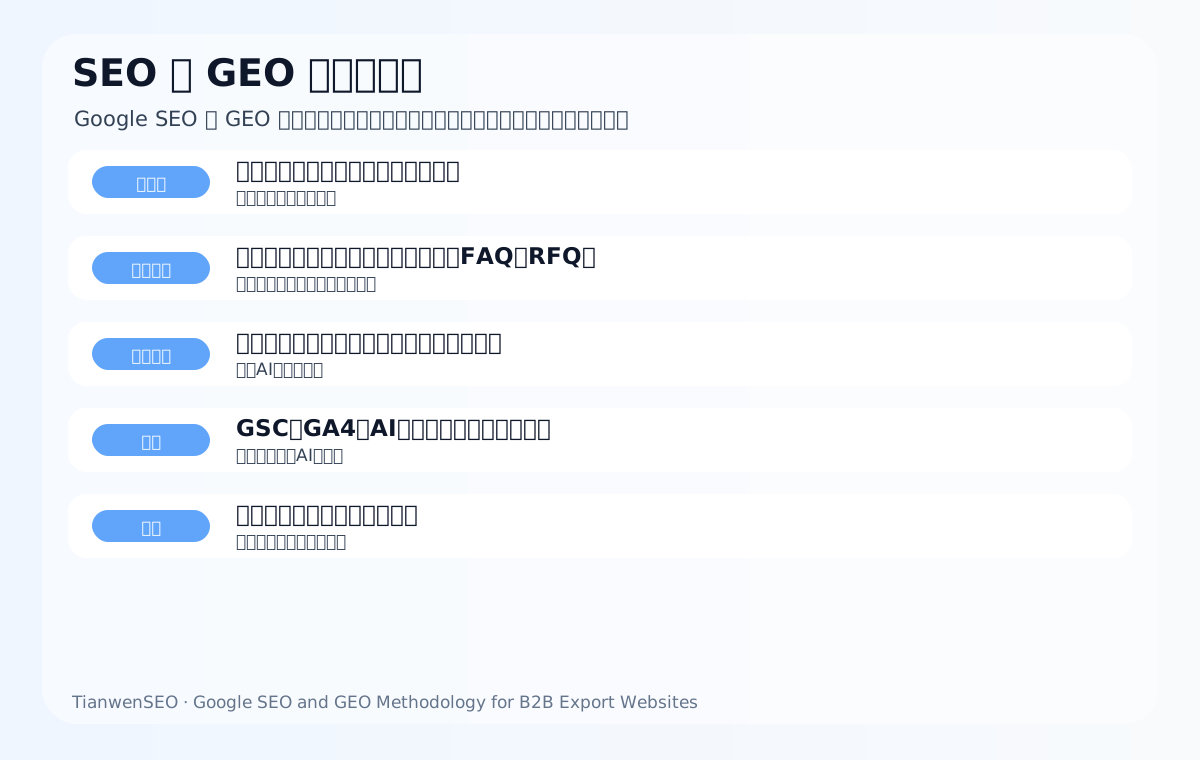
| Siloed approach | Why it is inefficient | Collaborative approach |
|---|---|---|
| SEO looks only at traffic | Ignores AI and entity issues | Look at search and AI answers together |
| GEO looks only at screenshots | Ignores product and RFQ pages | Make the page system stronger first |
| Content done separately | Easily drifts away from page roles | Create content by product line and page system |
| Data viewed separately | Hard to judge business value | Review GSC/GA4/inquiries together |
Layer three: why category pages, product pages, resource pages, and RFQ pages are the core of the methodology
Many export websites treat the homepage as the core, but what really determines lead-generation efficiency is often the inner-page system. Category pages determine category terms and selection logic, product pages determine specification and supply questions, resource pages determine comparison and judgment questions, and RFQ pages determine inquiry quality.
If these page systems are weak, then even if traffic arrives, it is hard for it to settle into a stable asset.
| Page | What task it takes on in the methodology | What happens if it is too weak |
|---|---|---|
| Category page | Organizes product lines and series differences | Neither Google nor users understand the category relationships |
| Product page | Answers specifications, applications, MOQ, and FAQ | Poor inquiry quality |
| Resource page | Answers comparison, tutorial, judgment, and risk questions | Both AI and users lack reference sources |
| RFQ page | Collects high-intent parameters and guides the next step | Visits are hard to convert into valid inquiries |
Layer four: why our methodology emphasizes “a question bank first, then a content plan”
If a content plan is separated from the question bank, it easily turns into generic content. A question bank helps us know: among branded terms, product terms, application terms, comparison terms, supplier evaluation terms, and quotation questions, which are closest to business value.
For example, the question bank for waterproof connector should not contain only “what is waterproof connector,” but also questions such as IP67 vs IP68, outdoor LED lighting connector, solar cable connector, MOQ, sample, lead time, and supplier evaluation.
| Question type | Why it must be built first | What it affects |
|---|---|---|
| Branded terms | See brand awareness and whether the entity is clear | Affects judgment of brand authority |
| Product terms | See which pages should catch core demand | Affects product page priorities |
| Application terms | See where high-intent scenarios enter | Affects application page development |
| Comparison terms | See what resource pages and FAQ should answer | Affects topic authority building |
| Quotation terms | See RFQ fields and the next-step path | Affects inquiry quality |
Layer five: why this methodology emphasizes “fact density” rather than “concept density”
Whether for Google SEO or GEO, genuinely valuable pages depend more on fact density than concept density. Fact density means information that truly helps judgment: parameters, materials, tolerances, IP ratings, standards, certification scope, samples, MOQ, lead time, boundaries, and processes.
Pages with high concept density look like they understand the trends well, but often cannot answer the questions buyers actually care about.
| Page type | More like high concept density | More like high fact density |
|---|---|---|
| Product page | Talks a lot about advantages but has no parameters | Parameters, applicable users, and FAQ are complete |
| Resource page | Talks about methodology but has no comparison table | Conclusions, tables, FAQ, and misconceptions are complete |
| Brand page | Lots of vision talk | Identity, product lines, evidence, and boundaries are clear |
| RFQ page | Only contact details | Has industry fields and attachment instructions |
Layer six: why this methodology brings sales feedback into the core process
Sales is the function that comes into direct contact with customer questions most often. Whether a page is strong is often felt first by sales: are customers clearer, are parameters more complete, are misunderstandings fewer, are inquiries closer to closing.
So our methodology does not put sales feedback on a “look at it when there is time” list, but treats it as an input as important as GSC and GA4.
| What sales feedback can answer | Why it is critical |
|---|---|
| What customers ask most often | Determines FAQ and resource page content |
| What customers most easily misunderstand | Determines evidence pages and boundary statements |
| Which inquiries are higher quality | Determines RFQ field optimization |
| Which pages are most helpful | Determines later priorities |
A methodology is not a fixed process; it adjusts sequence around the weak points
Many people like to ask, “what is your standard process?” We certainly have a stable judgment framework, but the order of execution is not rigid. One site may have a weak product page system, another may have a messy brand entity, and another may have a very poor RFQ path. The sequence should follow the weak points, not follow stock phrases.
| Current weak point | What is better to do first |
|---|---|
| Weak page system | Build up category, product, and resource pages first |
| Messy entity information | Unify the website and external information first |
| Weak RFQ | Add fields and sample/attachment instructions first |
| Weak data review | Build a unified GSC/GA4/inquiry dashboard first |
How this methodology is implemented across different product lines
The same methodology leads to different first actions on different product lines. custom metal parts leans more toward materials, tolerances, and quality inspection; packaging machine leans more toward materials, speed, precision, and cleaning; waterproof connector leans more toward IP ratings, applications, and FAQ; ceramic dinnerware leans more toward MOQ, packaging, samples, and markets.
| Product line | What the first methodological action is more likely to be |
|---|---|
| custom metal parts | Add capability pages, material pages, tolerance FAQ, and RFQ drawing fields |
| packaging machine | Add application pages, selection tables, maintenance FAQ, and RFQ fields |
| waterproof connector | Add IP comparison pages, scenario pages, and parameter-based RFQ |
| ceramic dinnerware | Add MOQ/packaging/sample FAQ and trade process pages |
| private label activewear | Add fabric, sizing, labeling, and sampling process pages |
If only 90 days are available, how does the minimum viable version of this methodology work
The 90-day minimum viable version does not aim to make the whole site perfect, but to achieve: a stronger page system for one high-value product line, a set of key questions starting to be caught more clearly, and an RFQ path that more easily brings high-quality inquiries.
| Phase | Actions | Acceptance signals |
|---|---|---|
| Days 1-30 | Sort out the question bank, page roles, entity information, and RFQ structure | Know which pages to change first |
| Days 31-60 | Add key product/resource/FAQ pages and paths | Page assets start getting stronger |
| Days 61-90 | Look at GSC, GA4, AI answers, inquiries, and sales feedback | Know the next round of priorities |
What the methodology must ultimately answer is not “what did we do,” but “are the pages more like assets now”
In the end, an export business does not need to hear a lot of internal jargon. What matters more is knowing: are the pages clearer? Are answers to key questions easier to find? Do Google and AI misunderstand you less? Is it easier for customers to come with specific parameters? If these answers gradually improve, then the methodology is not sitting in a PPT; it has become an asset in the website.
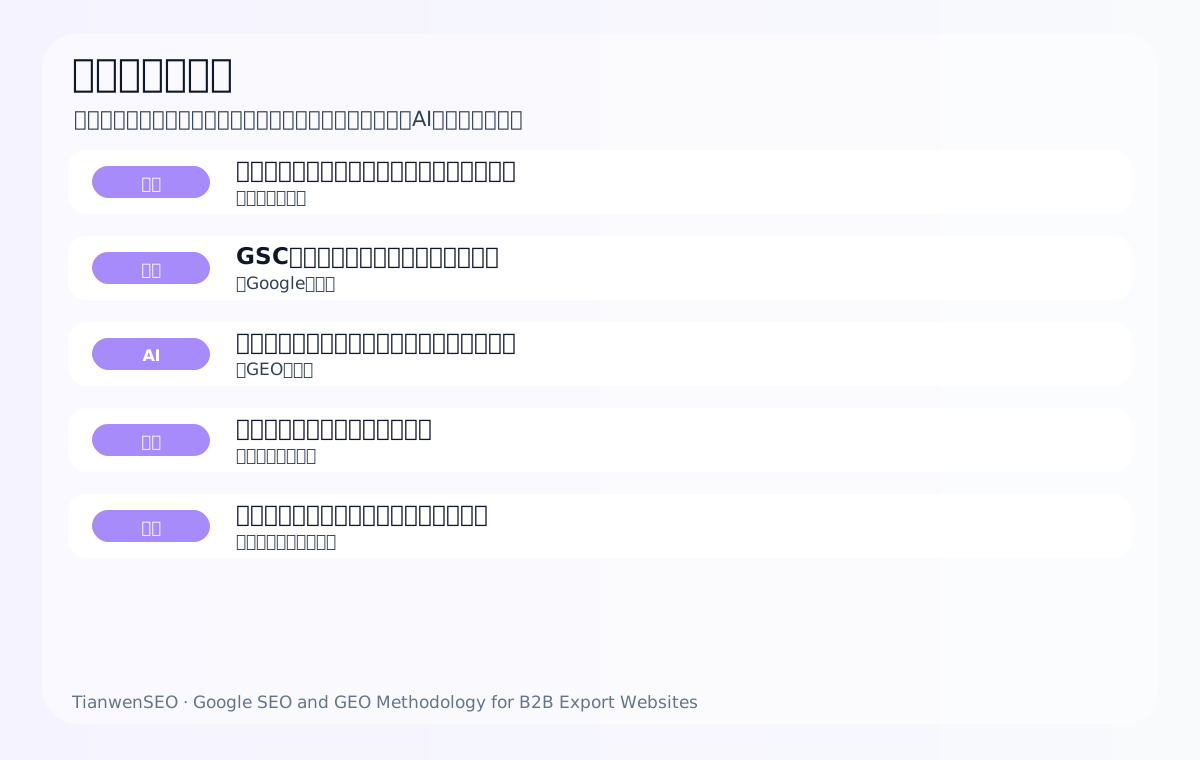
| Final judgment question | If the answer is “yes,” what it means |
|---|---|
| Are the key pages more complete? | Page assets are strengthening |
| Is high-intent search better on target? | Google SEO is working |
| Are AI answers more accurate? | GEO is working |
| Are inquiries more specific? | The pages are starting to truly serve the business |
| Does sales repeat explanations less? | The methodology is reaching the front line |
FAQ: What exactly does this Google SEO and GEO methodology do?
What problem does this methodology solve first?
It first solves whether the website is a page system capable of catching export purchasing questions and inquiries, rather than chasing traffic numbers first.
What is the relationship between Google SEO and GEO in this methodology?
They are not two disconnected services, but two expressions of the same set of page assets in Google and AI systems.
Why emphasize product pages, resource pages, and RFQ pages so much?
Because export lead generation ultimately relies on these pages to catch questions and inquiries, not just the homepage or a blog.
Why is sales feedback also part of the methodology?
Because sales knows best what customers ask and misunderstand, which helps pages stay closer to the real business.
If the budget is limited, what should be done first?
Usually, choose one high-value product line, build a question bank, and strengthen key product pages, resource pages, and RFQ pages.
Why can’t we look only at traffic?
Because traffic is not the same as high-intent visits, and even less the same as valid inquiries.
Does AI SEO / GEO replace Google SEO?
No. They are built on the same set of page assets and the same question system.
How long before you can judge whether the methodology is effective?
Usually 30 days to look at pages and queries, 60 days to look at behavior, and 90 days to look at inquiries and sales feedback.
Do you have to produce a lot of articles?
No. Many times it is more important to first strengthen category pages, product pages, resource pages, and RFQ pages.
How do you judge whether this methodology is readable for clients?
See whether it consistently revolves around export customer questions, product terms, page assets, and the inquiry path, rather than internal jargon.
Conclusion: A real methodology makes an export website look more and more like a lead-generation system that accumulates on its own
The purpose of this Google SEO and GEO methodology from Henan Tianwen Network Technology Co., Ltd. is not ultimately to show “how many concepts we understand,” but to help export websites gradually gain a clearer page system, more stable search performance, more accurate AI visibility, and an inquiry path closer to closing.
If a methodology cannot explain why category pages should be done this way, why product pages should add these modules first, why the RFQ should add these fields, why certain AI answers get things wrong, and why sales is still repeating explanations, then it is hard for it to truly take root. What we value more is whether these questions can be explained clearly on an ongoing basis and whether the website can become more like an asset step by step.
Why this methodology looks at “product lines” first, not “sections”
Many website projects start by thinking in sections: News, Products, Cases, About, Contact. But the unit that truly affects lead generation on an export site is usually not the section, but the product line. Buyers do not start demand from a “section,” but from product questions and project scenarios.
For example, custom metal parts is a product line, and it naturally brings out materials, tolerances, quality inspection, drawings, surface treatment, and RFQ fields; packaging machine also brings out material, speed, precision, cleaning, and maintenance questions. If you think in product lines first, the page system is usually closer to the business.
| Thinking in sections | Thinking in product lines | Which suits export lead generation better |
|---|---|---|
| More like a site management approach | More like how customers decide | The product-line view suits better |
| Easily becomes a generic site | Easier to build a targeted page system | The product-line view suits better |
| Logic between sections is clear but the business side is weak | The business path and page logic are stronger | The product-line view suits better |
Why we emphasize “page asset judgment” rather than “content volume judgment”
Many companies ask: do we need to write a lot of articles? That is actually the wrong question. The more important question is: do you currently have a set of page assets that can catch core questions? If not, more content may just pile up.
Page asset judgment includes: whether category pages are clear, whether product pages have fact density, whether resource pages answer comparison questions, whether the FAQ covers high-frequency sales questions, whether the RFQ page has industry fields, and whether evidence pages support trust.
| Judgment item | More like having page assets | More like having only content volume |
|---|---|---|
| Product page | Has parameters, FAQ, downloads, and CTA | Only a paragraph of introduction |
| Resource page | Has comparison tables and conclusions | Only long blocks of text |
| RFQ page | Has industry fields and attachment instructions | Only a basic form |
| Evidence page | Has certificate scope and process descriptions | Only slogan-style trust words |
How this methodology avoids “doing many things but struggling to explain why they work”
One common pain point for export businesses is having many actions, but looking back after a while, not knowing which actions were useful and which were just busywork. Our methodology tries to map actions to pages, pages to questions, questions to data, and data to inquiries one by one, so that every step is easier to explain.
| Action | What it should correspond to | What it means if it does not correspond |
|---|---|---|
| Adding FAQ | High-frequency sales questions and resource page queries | The FAQ may have been written by feel |
| Changing a product page | More specific product terms and inquiry fields | The product page may not be optimized around questions |
| Fixing brand information | Branded terms and AI answer accuracy | Brand actions are disconnected from the business |
| Adding resource pages | Comparison terms, judgment terms, in-depth visits | The resource pages may not have found the right topic |
If a company wants to run a pilot first, what is the most recommended way to start
If a company does not want to spread too wide at the start, the most recommended way to begin is usually: choose one high-value product line, build 3-5 key pages first, and pair them with a minimal review setup. For example, waterproof connector can start with a category page, key product pages, an IP comparison page, an application page, and an RFQ page; custom metal parts can start with capability pages, material pages, tolerance pages, FAQ pages, and an RFQ page.
| Pilot entry point | Why it is recommended | How to verify |
|---|---|---|
| One product line | Easier to focus | Look at changes in this line’s pages and inquiries |
| 3-5 key pages | Easier to see the link between actions and results | Look at page behavior and sales feedback |
| A minimal review table | Easier to decide the next step | Look at 30/60/90-day signals |
What export business owners care about most is really “is this methodology worth continuing to invest in”
Whether it is worth continuing to invest comes down to three things: are the pages increasingly like assets, are queries increasingly on target, and are inquiries increasingly specific. If these three things gradually improve, the methodology is usually working; if they show no change over a long period, it is time to review promptly whether the direction is misaligned.
| The judgment the owner cares about | What it means if it improves |
|---|---|
| Pages are increasingly clear | Page assets are accumulating |
| High-intent queries are more on target | Google SEO is on the right track |
| AI answers involve fewer misunderstandings | GEO is on the right track |
| Inquiries are more specific | The pages are starting to truly serve the business |
| Sales has an easier time | Content and paths are closer to customer questions |
What practices does this methodology most often oppose
- Looking only at homepage performance and not at product pages, resource pages, and RFQ pages.
- Doing only traffic actions without checking whether page assets are actually stronger.
- Looking only at AI screenshots without checking whether AI mentions you accurately or which page it mentions.
- Doing only content volume without checking whether the content truly corresponds to product and sales questions.
- Looking only at report numbers without looking at inquiry quality and sales feedback.
If the value of this methodology had to be described in one sentence
Its value is not “making the website look more professional,” but making the website more and more like an export lead-generation system that accumulates question answers, traffic, and inquiry quality on its own.
The Google layer: why this methodology emphasizes “topic and page matching” first
In this methodology, the most basic layer of Google SEO is “topic and page matching.” That is, what a buyer searches should lead to which type of page, and each type of page should answer which questions. Only when the matching relationships are clear do clicks, dwell time, conversion, and long-term rankings become more meaningful.
| Google layer focus | Why it matters | How it shows on pages |
|---|---|---|
| Query matching | Determines whether traffic is on target | Product/resource/application page roles are clear |
| Page completeness | Determines whether it can keep catching demand | Parameters, FAQ, tables, and downloads are complete |
| Internal links | Determines whether the topic system takes shape | Resource pages can lead to product and RFQ pages |
| Page experience | Determines whether visits go deeper | Clear structure, easy to read on mobile |
The GEO layer: why this methodology emphasizes “entity, answers, and sources”
The GEO layer is more about asking: when AI and users understand you across sources, will they get wrong who you are, what you sell, and what scenarios you fit. The most critical thing here is not some mysterious trick, but a clear entity, consistent sources, and verifiable answers.
| GEO layer focus | Why it matters | How it shows on pages or in information |
|---|---|---|
| Entity consistency | Reduces AI misunderstanding of brand identity | Website/platform/trade shows/certificates are consistent |
| Answer accuracy | A wrong mention is more dangerous than no mention | FAQ/evidence pages/boundary statements are clear |
| Source quality | Affects whether AI dares to cite you | Resource pages, third-party information, and evidence pages are stronger |
| Question coverage | Determines whether AI can see you in more questions | Build the question bank and page system in step |
The brand layer: why a methodology must include “identity, evidence, and boundaries”
For an export website, credibility at the brand layer cannot be built with a single line like “we are very professional.” What works better is: state your identity clearly, put the evidence out, and explain the boundaries. For example, whether you are a factory or a trading company, which product lines you mainly handle, which products the certificates apply to, which requirements you can meet, and which are not suitable.
| Brand layer module | Function | What happens if it is missing |
|---|---|---|
| Identity statement | Lets users and AI know who you are | Easy for your role to be misjudged |
| Evidence page | Makes the brand more credible | Too many vague trust words |
| Boundary statement | Reduces misunderstandings and mismatched inquiries | Higher explanation cost for sales |
| Third-party information | Amplifies external credibility | Brand signals are unstable |
The RFQ layer: why this methodology always puts the inquiry page at the center
The RFQ layer is most easily underestimated in many projects, but for an export business it is the most direct interface to business results. Google traffic, AI mentions, resource page visits, and product page dwell time should all, as far as possible, flow into higher-quality inquiries.
| RFQ layer focus | Why it is critical | Industry example |
|---|---|---|
| Field design | Determines whether the inquiry is specific | Drawing/tolerance fields for custom metal parts |
| Attachment instructions | Helps technical products be assessed faster | Operating condition information for packaging machine |
| Sample/process description | Reduces low-quality inquiries | Samples and packaging for ceramic dinnerware |
| Next-step expectations | Increases customers’ willingness to submit | Sample and lead time information for waterproof connector |
The review layer: why this methodology does not look only at rankings or only at traffic
If a methodology can only report that “rankings went up” and “traffic increased,” but cannot explain which pages are getting stronger, which questions are more on target, and which inquiries are more specific, then its value in an export business is limited. The core of the review layer is to put pages, search, AI answers, inquiries, and sales feedback into the same logic.
| Review layer focus | Function | Best suited to answer which questions |
|---|---|---|
| Changes in page assets | See which pages are getting stronger | Why this page is worth continued investment |
| Changes in queries and behavior | See whether search intent is on target | Why this term did not convert |
| Changes in AI answers | See whether the entity and information are clearer | Why you were or were not mentioned |
| Inquiries and sales feedback | See whether business quality is changing | Why customers are more specific or still scattered |
Why “sequence” in a methodology matters more than a “tool list”
Companies are easily drawn to tools and terminology, but for implementation, the sequence matters more. What you do first and what you do later determines whether you are building assets or performing surface-level actions. For an export website, getting the page roles and question system in order first is almost always more effective than chasing more tools first.
| If the sequence is wrong | Common consequence |
|---|---|
| Chasing mentions before building pages | Neither AI nor users can find content that truly catches the demand |
| Producing a lot of content before fixing the RFQ | Visits increase but inquiry quality is weak |
| Changing visuals before looking at product lines | The site looks good but is off target |
| Looking only at reports and not at sales | Not knowing whether the actions truly serve the business |
If the team inside a company needs to understand this methodology quickly, these 5 sentences are enough
- Look at product lines and questions first, not section names.
- Build the page system first, not content volume.
- Make the RFQ stronger first, not just look at visits.
- Make the brand and the information say the same thing first; do not let AI guess.
- Make GSC, GA4, AI answers, and sales feedback tell the same story first.
Industry scenario one: on a custom metal parts site, what this methodology does first
On sites like custom metal parts, page value often depends heavily on materials, tolerances, drawings, surface treatment, quality inspection, and delivery processes. Here the methodology usually starts by adding capability pages, material pages, tolerance resource pages, FAQ, and RFQ drawing fields, rather than producing many generic articles.
| Priority action | Why |
|---|---|
| Capability pages and quality inspection descriptions | Establish trust and boundaries first |
| Material/tolerance resource pages | Catch technical judgment and long-tail queries |
| RFQ drawing fields | Improve inquiry quality |
| FAQ | Reduce repeated explanations by sales |
Industry scenario two: on a packaging machine site, what this methodology does first
For packaging machine, the key is not just the product name, but materials, speed, precision, cleaning, and after-sales. Here the methodology usually gives very high priority to “application pages” and “selection resource pages,” because buyers often search for specific scenarios such as powder, granule, and liquid.
| Priority action | Why |
|---|---|
| Material application pages | Catch high-intent scenario traffic |
| Selection table/FAQ | Help users and AI judge quickly |
| RFQ material fields | Make inquiries more actionable |
| After-sales and maintenance descriptions | Improve credibility and conversion |
Industry scenario three: on waterproof connector / LED flood light sites, what this methodology does first
These product lines place more emphasis on parameters and scenarios. waterproof connector focuses more on IP ratings, pin counts, wire gauges, and scenarios; LED flood light focuses more on wattage, lumens, waterproofing, and installation. The methodology prioritizes comparison resource pages, scenario pages, and parameter-based RFQ.
| Priority action | Why |
|---|---|
| Parameter and comparison pages | Make pages look more like information sources |
| Scenario pages | Catch scenario terms such as warehouse/outdoor |
| RFQ parameter fields | Turn visits into high-quality inquiries |
| Evidence pages | Help brand and product messaging be more credible |
If the pilot runs for only 1 month, what should the minimum verifiable deliverable of this methodology be
If a company does not want to do the full set at the start, the minimum verifiable deliverable should usually include: a question bank for one product line, a page role map, 1-2 revised samples of key pages, a set of RFQ structure recommendations, and a review-writing framework that combines GSC/GA4/AI answers/inquiries. That way, even if the work does not continue, reusable assets have already been left behind.
| Pilot deliverable | Why it is valuable |
|---|---|
| Question bank | Know which questions matter most first |
| Page role map | Get the site structure in order first |
| Key page samples | Verify whether the method can be implemented first |
| RFQ recommendations | See whether it can serve the business first |
| Review-writing framework | Establish a long-term judgment framework first |
The 5 signals an owner should look at most when accepting this methodology
An owner does not have to look at many execution details, but at least 5 signals can be checked: are key pages clearer? Are high-intent queries more on target? Are AI answers more accurate? Are inquiries more specific? Does sales repeat explanations less?
| Acceptance signal | What it means if it improves |
|---|---|
| Key pages are stronger | Page assets are accumulating |
| Queries are more on target | Google SEO is on the right track |
| AI answers are more accurate | GEO is on the right track |
| Inquiries are more specific | The RFQ and resource pages are starting to work |
| Sales has an easier time | The methodology has truly reached the business |
The 5 practices this methodology most opposes
- Doing only the homepage, and not product pages, resource pages, and RFQ pages.
- Looking only at visit volume, not at high-intent queries and inquiry quality.
- Looking only at AI screenshots, not at whether answers are accurate or cite the right pages.
- Chasing only content quantity, not page roles and fact density.
- Talking only in SEO/GEO jargon, not about export product terms, purchasing questions, and sales feedback.
If you remember only one shortest sentence, what is this methodology actually doing
The shortest version is: use a page system to put export customers’ questions, Google’s discovery path, AI’s understanding path, and sales’ conversion path into the same set of assets.
The 90-day rhythm: how this methodology usually advances
For most export sites, 90 days is a fairly suitable observation cycle. The first 30 days are better for sorting out product lines, the question bank, page roles, and RFQ structure; days 31-60 are better for adding key pages and resource pages; and days 61-90 are better for using GSC, GA4, AI answers, inquiries, and sales feedback to see whether the direction is right.
| Phase | Key actions | Ideal signal |
|---|---|---|
| Days 1-30 | Sort out the question bank, page roles, RFQ structure, and entity information | Know which pages to change first |
| Days 31-60 | Add key product/resource/FAQ/evidence pages and paths | Page assets get stronger |
| Days 61-90 | Review search, AI, inquiries, and sales feedback | Know the next round of priorities |
If results are mediocre, where should you check first
If results are mediocre after some time, we usually do not start by suspecting that “SEO/GEO no longer works,” but first check where the weak point is: was the wrong product line chosen? Are the page roles unclear? Is the RFQ path too weak? Is the brand information inconsistent? Or were sales questions simply never written into the pages?
| What to check first | Why the problem is often here |
|---|---|
| Product line priority | Resources may be spent on a low-value line |
| Page roles | The same question may land on the wrong page |
| RFQ structure | The link between visits and inquiries may be broken |
| Brand information | AI may still be misunderstanding the brand entity |
| Sales question feedback loop | The pages may not yet answer real front-line questions |
Official evidence boundaries: the methodology must be reviewable against Search Console, GA4, and page facts
A methodology is not a slogan. For export manufacturers and trading companies, a Google SEO and GEO methodology must be traceable to URLs, page facts, indexing status, structured data, event definitions, AI samples, and inquiry fields. If it can be reviewed, it counts as a methodology; if it cannot be reviewed, it is just fine-sounding words.
The boundaries also need to be stated clearly here. Page assets, technical diagnostics, the query set, content structure, RFQ fields, GSC/GA4 reviews, and AI answer samples are work that can be delivered. Google search impressions, AI platform citations, buyer inquiries, and closed deals are external outcomes that require ongoing observation. When there are no GSC query, page, or page-query rows, the only permissible statement is that there are currently no available Search Console signals; rankings, impressions, clicks, CTR, AI adoption, or inquiry changes must not be filled in.
If a company does not know how to begin reviewing with Search Console’s query, page, page-query, and URL Inspection, it can start with our Google Search Console diagnosis guide, then come back to the methodology checklist in this article to break down pages, queries, and delivery boundaries.
| Official source | What it corresponds to in the methodology | How an export website verifies it | What must not be written |
|---|---|---|---|
| Google Search Central: SEO Starter Guide | Pages must serve real users; titles, body copy, image descriptions, internal links, and page purpose must be clear. | Check whether pages such as custom metal parts, LED flood light, and packaging machine answer purchasing questions. | Must not claim that a given page will definitely achieve a specified ranking. |
| Google Search Central: Search Essentials | Basic search eligibility, accessibility, spam risk, and minimum content quality. | Check whether pages are accessible and indexable, and whether they avoid fabricated certifications, misleading parameters, and vague content. | Baseline compliance does not mean search performance has already been generated. |
| Google Search Central: Do you need an SEO? | Collaboration boundaries, review questions, access permissions, and an explainable scope of work. | The business should be able to see the URL list, change summaries, data permissions, and risk statements. | Must not package the methodology as an unverifiable mysterious ability. |
| Google Search Central: Search Console start guide | Use Search Console to observe indexing, search performance, page issues, and subsequent reviews. | Check the property, permissions, date range, query/page/page-query dimensions, and export records. | Must not fill in trends or business conclusions when there is no data. |
| Search Console Help: Performance report | clicks, impressions, CTR, average position, query, page, country, device. | Look at pages and queries by product line, for example category pages and long-tail terms related to waterproof connector. | Screenshots or subjective impressions must not replace GSC row data. |
| Google Analytics Help: About events | On-site behavior events, including forms, email, WhatsApp, downloads, RFQ, and resource page clicks. | Record inquiry actions and resource downloads separately for pages such as medical probe and industrial valve supplier. | GA4 events cannot directly replace organic search performance. |
| Google Search Central: Sitemaps overview | The discovery path for priority URLs and an update list. | Whether product pages, category pages, application pages, resource pages, and article pages are included in the sitemap. | Having a URL in the sitemap does not mean it has been indexed. |
| Google Search Central: robots.txt introduction | Crawler access rules, resource access, and troubleshooting of accidental blocking. | Check whether images, PDF catalogs, product pages, JS/CSS, and resource pages are accidentally blocked. | Allowing crawling does not mean impressions or clicks have been obtained. |
| Google Search Central: canonical URL guide | Canonicalization strategy for filter pages, parameter pages, variant pages, multilingual URLs, and duplicate content. | Check whether variant pages such as private label activewear manufacturer have clear canonical logic. | A canonical is not a mandatory command, nor is it a ranking promise. |
| Google Search Central: Structured data general guidelines | Structured data must be consistent with the visible content on the page. | Check whether Product, Breadcrumb, Article, and FAQ fields come from real page facts. | Schema is not a controller for rich results or AI answers. |
| Google Search Central: AI features and your website | AI search still depends on pages being discoverable, indexable, understandable, and on basic SEO. | Check whether pages have clear answers, sources, product facts, internal links, and structured data. | Must not promise that AI answers will definitely use the official website. |
| OpenAI Platform: Bots | Distinguish the purposes and access boundaries of OAI-SearchBot, GPTBot, and ChatGPT-User. | Check robots.txt and server logs, and do not lump training crawls, search crawls, and user-triggered visits into one category. | Allowing a certain crawler does not mean ChatGPT search will display the official website. |
| Bing Webmaster Blog: AI Performance | If visible in the account, you can observe citations, cited pages, and grounding query phrases. | Record which questions cite the official website and which cite competitors, directories, or third-party information. | A citation is not a ranking, an answer position, or an inquiry result. |
| IndexNow: Documentation | A record of notifications after URLs are added, updated, or deleted. | Record the URL list, submission time, response status, and follow-up review date. | HTTP 200 only means the notification was received; it does not mean the URL has been crawled, indexed, or displayed. |
Methodology acceptance criteria: deliver actions, do not promise external platform results
| Layer | Can be delivered | Acceptance materials | Can only be observed |
|---|---|---|---|
| Product line | Product families, application scenarios, target markets, certificates, MOQ, lead time, and the RFQ field table. | Product information, sales confirmation, page role map. | Whether buyers immediately send high-quality inquiries. |
| Page system | URL list for the homepage, category pages, product pages, application pages, resource pages, article pages, and inquiry pages. | URL table, change summaries, internal link paths, mobile screenshots. | When the search system displays these pages. |
| Technical eligibility | index/follow, canonical, robots, sitemap, status codes, structured data, and mobile readability. | Source code, sitemap, GSC checks, browser verification. | The specific timing of crawling, indexing, and ranking. |
| Content facts | Parameters, materials, tolerances, certifications, application limits, packaging, samples, and lead time descriptions. | Page body copy, parameter tables, information sources, review records. | Whether an AI platform cites a particular passage over the long term. |
| Data review | Reviewing GSC, GA4, Bing, AI samples, inquiry fields, and sales feedback in the same table. | Export files, event lists, sample screenshots, review dates. | Trends, CTR, or inquiry conclusions when there is no data. |
When there are no GSC signals, the methodology must first be downgraded to “baseline building”
If Search Console has no query, page, or page-query rows in the last 28 days and 90 days, this methodology cannot claim existing rankings, impressions, clicks, CTR, or traffic growth. What can be done at this stage is baseline building: make the page assets clear, distinguish the URL roles, verify the technical eligibility, connect GA4 and inquiry events, and fix AI answer samples into a re-testable checklist.
| Can be done in the zero-signal stage | Can be written into the report | Must not be written into the report | Next review step |
|---|---|---|---|
| Build a product line and page role map | Which pages catch which English purchasing questions. | These pages have already achieved search performance. | Review after page/query rows appear in GSC. |
| Check the technical foundation | Which URLs are accessible, indexable, can enter the sitemap, and whether structured data is consistent. | Technical fixes will definitely improve rankings. | Review crawling, indexing, and logs by URL. |
| Configure events and inquiry fields | Which events can already record forms, email, downloads, RFQ, and WhatsApp. | The number of inquiries has already increased. | Combine source, page, product, and sales feedback. |
| Build AI samples | Query, platform, date, answer summary, citation sources, and incorrect facts. | The official website is already consistently appearing in AI answers. | Re-test the same query set at 30/60/90 days. |
Minimum execution checklist for the methodology
- Choose a high-value product line first, rather than treating the whole site evenly.
- Build the question bank first, rather than deciding the number of articles first.
- Add key product/resource/RFQ pages first, rather than only doing the homepage and brand pages.
- Unify the website and external information first, then talk about higher-level AI visibility.
- Get GSC, GA4, AI answers, inquiries, and sales feedback into the same review table first.
The 4 places where this methodology is most easily misunderstood
| Misunderstanding | Why it is inaccurate | A more reasonable understanding |
|---|---|---|
| SEO is just doing traffic | It ignores page assets and inquiry quality | SEO is about bringing high-intent searches into the right pages |
| GEO is just doing AI exposure | It ignores the entity and page system | GEO is about making it easier for AI to correctly understand and mention you |
| For website building, look at design first | It ignores product lines and page roles | Look at products and questions first, then visuals |
| More reports means more professional | More numbers do not mean clearer explanations | The key is being able to explain why pages, search, and inquiries change |
What an owner should look at most when judging whether this methodology is worth continuing to invest in
The most practical judgment is usually not “how much did traffic grow this month,” but: are key pages more like assets, is it easier for customers to find answers, does AI get things wrong less, are inquiries more specific, and does sales save effort? As long as these questions gradually improve, the methodology is usually working.
| What the owner should look at most | What it means if it improves |
|---|---|
| Key pages are more complete | Page assets are getting stronger |
| High-intent queries are more on target | Google SEO is heading in the right direction |
| AI answers are more accurate | GEO and entity information are getting stronger |
| Inquiries are more specific | The RFQ and resource pages are working |
| Sales explanation effort is decreasing | The methodology has truly reached the business side |
If you want to quickly test whether this methodology can be implemented, what test questions can you use
It is simple: give one product line and have the methodology answer five questions—what the target question bank is, how page roles are divided, how key product pages should be changed, how RFQ fields should be designed, and which signals to look at after 90 days. If the answers are specific, the methodology is more like a workable framework.
| Test item | What to look for |
|---|---|
| Question bank | Whether it really revolves around export product questions |
| Page roles | Whether it understands the division of labor among category/product/resource/RFQ pages |
| Key page samples | Whether it can produce pages with facts and FAQ |
| RFQ structure | Whether it understands industry fields and the next-step path |
| 90-day signals | Whether it can explain how to judge the methodology’s effectiveness |
When does it show that this methodology is worth further investment
If within 90 days you have seen key pages get stronger, queries get more on target, AI get things wrong less, and inquiries get more specific, that usually shows the methodology is worth scaling to more product lines. Conversely, if these signals show no change over a long period, you should check the direction and weak points first, rather than blindly expanding volume.
| Signal to continue investing | What to do |
|---|---|
| The product line pilot is effective | Expand to the next high-value product line |
| RFQ quality has clearly improved | Increase investment in resource and application pages |
| AI answer accuracy has improved | Keep improving the brand and evidence layer |
| Sales feedback is more positive | Keep writing sales questions back into the pages |
Execution reminders
- Get one product line working first, then consider scaling across the site.
- Make the page assets stronger first, then pursue greater visibility.
- Get the RFQ and sales feedback into the review first, then judge whether the investment is worthwhile.
One reminder: a methodology is not meant to be told to peers; it is meant to make export customers’ questions easier for pages, search, AI answers, and sales to catch together.
Minimum pilot standard
| Must have at least | Why do it |
|---|---|
| One high-value product line | Makes it easier to focus and validate |
| 3-5 key pages | Makes it easier to see whether the page system is getting stronger |
| One RFQ structure sample | Makes it easier to see whether inquiry quality is improving |
| One combined review table | Makes it easier to view search, AI, inquiries, and sales together |
In short: the goal of this methodology is not to make the website more like a project, but more like a long-term system that continuously accumulates lead-generation capability, search performance, and high-quality inquiries, and that can be continuously reviewed and verified.
Continue reading this GEO series
If you are systematically studying GEO and AI search visibility, we suggest continuing with the following articles. Understand the concepts first, then move on to diagnosis, monitoring, content structure, and collaboration boundaries.
- How to choose an AI search visibility service team: what a reliable generative engine optimization team should deliver
- How to judge the most reliable AI search visibility service team in China: do not look at AI promises, look at visibility evidence
- What is GEO: how it differs from SEO and AEO, and what export websites should do
- What is AI SEO: how exactly it differs from traditional SEO, GEO, and AEO
- What is AEO: why answer engine optimization is not just writing FAQ, and what export websites should do
- What is Google SEO: from crawling, indexing, and ranking to AI search and export inquiries
{
“@context”: “https://schema.org”,
“@type”: “FAQPage”,
“mainEntity”: [
{
“@type”: “Question”,
“name”: “What problem does this methodology solve first?”,
“acceptedAnswer”: {
“@type”: “Answer”,
“text”: “It first solves whether the website is a page system capable of catching export purchasing questions and inquiries, rather than chasing traffic numbers first.”
}
},
{
“@type”: “Question”,
“name”: “What is the relationship between Google SEO and GEO in this methodology?”,
“acceptedAnswer”: {
“@type”: “Answer”,
“text”: “They are not two disconnected services, but two expressions of the same set of page assets in Google and AI systems.”
}
},
{
“@type”: “Question”,
“name”: “Why emphasize product pages, resource pages, and RFQ pages so much?”,
“acceptedAnswer”: {
“@type”: “Answer”,
“text”: “Because export lead generation ultimately relies on these pages to catch questions and inquiries, not just the homepage or a blog.”
}
},
{
“@type”: “Question”,
“name”: “Why is sales feedback also part of the methodology?”,
“acceptedAnswer”: {
“@type”: “Answer”,
“text”: “Because sales knows best what customers ask and misunderstand, which helps pages stay closer to the real business.”
}
},
{
“@type”: “Question”,
“name”: “If the budget is limited, what should be done first?”,
“acceptedAnswer”: {
“@type”: “Answer”,
“text”: “Usually, choose one high-value product line, build a question bank, and strengthen key product pages, resource pages, and RFQ pages.”
}
}
]
}
This page is machine-translated from the Simplified Chinese version and awaiting human review. It has not yet been proofread.