Bottom line first: Before a GEO partner gives you a quote, an exporting business should look at the “AI visibility baseline” first, not compare package names. To judge whether a quote is sound, it should at least explain which queries will be monitored, which AI search entry points are covered, what citation evidence is recorded, how it determines whether a page can be crawled and understood, and which results cannot be promised.
If a factory makes custom metal parts, LED flood light, or packaging machine, different buyers’ search questions will not stop at one core term. Real questions combine product terms, application scenarios, materials, certifications, supplier type, MOQ, lead time, comparison targets, and procurement risk. The differences between GEO quotes often lie in whether these foundational tasks have been done clearly.
Boundaries of official documentation: validate the baseline before a GEO quote, don’t compare packages first
Before a GEO partner quotes a price, it is easy to be led along by package names. One team says it monitors ten platforms, another says it writes thirty articles, a third says it starts with model Q&A testing. They all sound like GEO. The problem is that without the same baseline, an exporting business can hardly tell what these quotes are actually buying.
The safer order is to write the validatable fields clearly first. Whether the site can be crawled, whether key pages are in the sitemap, whether Search Console has query and page data, whether GA4 can record inquiry actions, whether product pages have real specifications and application scenarios, and whether AI answer samples record the query, platform, date, citations, and the limits of the conclusion. Look at these first, then discuss packages.
GEO does not overturn traditional SEO. For an exporting business, the official website still has to become a trustworthy source of information that search systems and AI systems can understand. The clearer the product facts, the more stable the page structure, and the more complete the logs, GSC, GA4, and sample records, the less the later judgment of AI visibility depends on gut feeling.
Mapping table of official sources and fields to validate before a GEO quote
| Official source entry | Corresponding field before quoting | What can be validated | What it cannot replace |
|---|---|---|---|
| Google Search Central: AI features and your website | Page accessibility, indexability, and clear content in AI features. | Judge whether the official site has the foundation to be understood by AI search. | Cannot promise that a particular AI answer will use this site. |
| Google Search Central: SEO Starter Guide | Whether pages serve real users, and whether titles, body text, and links are clear. | Judge whether product pages and article pages have basic SEO quality. | Cannot treat rewriting titles as a complete GEO plan. |
| Google Search Central: Search Essentials | Crawling, indexing, quality, and spam policy boundaries. | Rule out clearly non-compliant or non-indexable issues. | Cannot guarantee that a page will gain organic traffic. |
| Search Console Help: Performance report | query, page, clicks, impressions, CTR, average position. | Judge whether there is a current search exposure baseline. | Cannot fabricate GSC conclusions when there is no row data. |
| Google Analytics Help: About events | Events such as form submissions, email clicks, WhatsApp clicks, and document downloads. | Judge whether inquiry actions are observable. | Cannot attribute a single event directly to GEO. |
| Google Search Central: robots.txt introduction | Crawling rules and resource accessibility. | Judge baseline blocking risk before AI bot and search crawling. | Cannot use robots to fix page quality problems. |
| Google Search Central: Sitemaps overview | Whether key URLs are submitted for search engine discovery. | Judge whether product pages, category pages, and article pages are in the discovery path. | Cannot guarantee indexing after submission. |
| Google Search Central: Preferred URL guidance | Canonical, duplicate URLs, parameter pages, and multilingual pages. | Judge whether AI and search systems might read a confused version. | Cannot guarantee that the system will choose the declared URL. |
| Google Search Central: Structured data general guidelines | Whether structured data is based on genuinely visible page content. | Judge whether Schema can help machines understand page facts. | Cannot use Schema to invent information that does not exist on the page. |
| OpenAI Platform: Bots | OpenAI-related crawler identifiers and access boundaries. | Judge whether the site accidentally blocks key crawling paths. | Cannot show that ChatGPT will definitely cite a page. |
| Bing Webmaster Blog: AI Performance | The AI-related performance metrics in Bing Webmaster Tools. | Judge whether AI performance can be recorded separately. | Cannot equate Bing metrics with performance across all AI platforms. |
| IndexNow: Documentation | A submission mechanism to notify search engines of URL changes. | Judge whether important page updates trigger a discovery notification. | Cannot promise that a notification leads to indexing. |
Pre-quote GEO baseline checklist: write queries, platforms, pages, and evidence separately
The pre-quote baseline is not a table of screenshots showing “appeared / did not appear.” An exporting business should see at least four lines: the query set, the platform samples, the corresponding pages, and the evidence fields. Write the four lines separately, and only then can you tell later whether the money went into monitoring, diagnosis, content, or page improvements.
| Baseline field | How to record it | Acceptable example | Impact on the quote |
|---|---|---|---|
| Query set | Group by product, supplier, application, comparison, risk, and procurement questions. | custom metal parts supplier for aerospace, custom metal parts MOQ. | Determines the monitoring sample size and the scope of content planning. |
| Platform samples | Record platform, date, region, language, login status, and the exact question text. | English question, US region, logged-out browser, repeated testing of the same question. | Determines reporting cost and retest frequency. |
| Page evidence | Record whether the AI answer cites the official site, which URL it cites, and whether it cites a competitor or a third party. | Whether the LED flood light page is treated as a source of specifications. | Determines whether product pages or technical articles need to be added. |
| Search evidence | Record GSC query/page row data, or state clearly that there is no row data yet. | Impressions but no clicks, or currently 0 rows. | Determines whether a search performance review is possible. |
| Conversion evidence | Record GA4 events, forms, email, phone, WhatsApp, and downloads. | packaging machine specification downloads and RFQ form recorded separately. | Determines whether event configuration must be added first. |
| Technical evidence | Record robots, sitemap, canonical, status codes, and mobile tables. | The waterproof connector product page is in the sitemap and its canonical is self-referencing. | Determines the technical remediation workload. |
| Content evidence | Record whether specifications, images, certifications, applications, FAQ, and comparison explanations exist. | The industrial valve supplier page has material, pressure rating, and connection type. | Determines the effort to organize product facts and write content. |
With no GSC data, an AI visibility quote can only start with a baseline
Some sites have just been redesigned, have just connected Search Console, or have not yet built organic search exposure. A GEO quote is still possible at this stage, but the conclusions must be downgraded: not “certain terms have opportunities,” but “first build a foundation that can be crawled, indexed, observed, and rechecked.”
When there is no GSC row data, the quote should not contain ranking predictions, CTR judgments, or click-loss judgments, nor should it claim that a page has already been proven effective by AI answers. A more appropriate quote makes the first 30 days a baseline-building effort: URL inventory, sitemap recheck, robots recheck, spot checks of key pages, query set design, AI answer sample records, GA4 event planning, and filling in product facts.
| Current evidence status | What the quote may state | What the quote should not state | A safer delivery approach |
|---|---|---|---|
| GSC query/page has 0 rows | Establish observation criteria and wait for new data. | That a certain keyword already has a ranking opportunity. | Record weekly whether new queries and pages appear. |
| AI answer samples not done | Design the query set and record the first samples. | That a certain platform already recognizes the brand. | Record the question, platform, date, answer summary, and citations. |
| GA4 events unclear | Plan inquiry, download, click, and email events. | That there are currently attributable GEO inquiries. | Make actions observable first, then look at trends. |
| Insufficient product page material | Add specifications, applications, certifications, FAQ, and image descriptions. | That AI will adopt the content once the material is completed. | Write product facts as fields that can be rechecked. |
| Index discovery unclear | Recheck sitemap, robots, canonical, and status codes. | That submission guarantees indexing. | Use a URL list to record every action step. |
Query set validation: don’t just report the number of platforms, report the question types
Some quotes like to say “covers multiple AI platforms.” The number of platforms is not useless, but if the question types are too narrow, the results still have no reference value. An exporting business should look more at whether the query set covers the real procurement path.
| Question type | Example query | What to look at | Page improvement direction |
|---|---|---|---|
| Supplier discovery | best custom metal parts supplier for small batch production | Whether the AI answer shows the official site, competitors, directory sites, or Q&A sites. | Clarify the homepage, category pages, and company capability page. |
| Product specifications | LED flood light IP66 vs IP65 for outdoor warehouse | Whether the answer cites specifications, certifications, and application descriptions. | Add specifications, scenarios, and a comparison table to product pages. |
| Procurement risk | how to evaluate packaging machine supplier before RFQ | Whether the answer requires a checklist and supplier capability. | Write a pre-purchase checklist and FAQ. |
| Application scenarios | waterproof connector for marine cable assembly | Whether the answer matches the scenario terms. | Add application pages, case-style explanations, and internal links. |
| Comparison and selection | industrial valve supplier China vs local distributor | Whether the answer mentions lead time, certification, communication, and after-sales service. | Add service boundaries, certificates, and the delivery process. |
| Document downloads | ceramic dinnerware factory catalog and MOQ | Whether the answer requires a catalog, MOQ, and sample information. | Add a download page, an inquiry entry point, and GA4 events. |
Delivery boundaries: monitoring and page improvements can be delivered; external platform results cannot
What a GEO partner can deliver is method, records, pages, and reviews. What it cannot deliver is how an external platform will definitely answer. If a quote writes uncontrollable results as firm promises, validation later becomes difficult and trust on both sides is easily damaged.
| Quote item | Validatable deliverable | Should not be written as a promise | Acceptance document |
|---|---|---|---|
| AI answer monitoring | Query set, platform, date, answer summary, cited URLs, screenshots, or text records. | That a certain platform will definitely use the official site. | AI visibility sample table. |
| Technical diagnosis | robots, sitemap, canonical, status codes, URL Inspection spot checks. | That fixes will definitely bring rankings. | Technical diagnosis checklist. |
| Product page improvement | Specifications, applications, certifications, FAQ, image descriptions, inquiry entry point. | That changes will definitely generate inquiries. | URL change record table. |
| Structured data | Add Schema based on visible page content and recheck with testing tools. | That adding Schema will definitely produce rich results. | Schema field table. |
| Content planning | Map product terms, application terms, question terms, and comparison terms to URLs. | That writing several articles will improve AI answers. | Topic and page mapping table. |
| Monthly review | Write GSC, GA4, AI samples, and URL actions separately. | Treating AI samples as the entire business result. | Monthly review table. |
30-60-90 day review: look at AI visibility, GSC, GA4, and inquiries separately
A GEO quote should ideally spell out the review cadence in advance. Especially for exporting websites, product material, Google indexing, AI answers, inquiry actions, and sales follow-up do not move at the same speed. Mixing them into one “performance” metric easily leads to misjudgment.
| Timeframe | What to look at in AI visibility | What to look at in GSC | What to look at in GA4 and inquiries | Appropriate judgments |
|---|---|---|---|---|
| 30 days | Whether the query set is established and whether samples can be retested. | Whether key URLs enter the sitemap and indexing observation. | Whether events can record forms, email, downloads, and buttons. | Whether the baseline is set up and whether page facts are complete. |
| 60 days | Whether the brand, product pages, and third-party source changes begin to appear in answers. | Whether query/page row data appears and whether target URLs have impressions. | Whether users visit key product pages and document download pages. | Which pages are worth deepening further. |
| 90 days | Whether sample changes relate to page improvements, external sources, and brand material. | Whether query topics, page performance, CTR, and average position show explainable changes. | Whether the inquiry path is clearer and whether lead quality can be fed back by sales. | Whether to expand to more product lines. |
How an exporting business can validate a GEO quote
When reviewing a quote, don’t just ask “how much.” Break the quote into eight questions. If every question can be answered, the collaboration will be more stable; if they cannot be answered, even a low price may not be cheap.
| Validation question | Acceptable answer | Risky answer |
|---|---|---|
| Which URLs will be looked at first this time? | List the homepage, category pages, product pages, article pages, inquiry page, and legacy page samples. | Only saying “whole-site optimization.” |
| Where does the query set come from? | Derived from product terms, application terms, procurement questions, risk comparisons, and sales Q&A. | Giving only a few Chinese concept terms. |
| How are AI samples recorded? | Clearly state the platform, date, question, region, answer summary, and cited URLs. | Sending only a few screenshots. |
| What if GSC has no data? | Explicitly downgrade to baseline building and wait for later row data. | Continuing to write ranking and CTR judgments. |
| What does GA4 look at? | Events such as forms, email, WhatsApp, downloads, and catalog requests. | Looking only at total visits. |
| Who provides the product material? | The company provides specifications, drawings, certifications, applications, and FAQ; the team organizes them into pages. | The team says it can write without material. |
| Which results are uncontrollable? | AI answer adoption, organic rankings, and inquiry volume should all be reviewed based on observed results. | Writing external platform results as definite results. |
| What is handed over when the service ends? | URL list, review tables, query set, sample records, content assets, and account permissions. | No exportable records. |
So look at the baseline before a GEO quote. The clearer the baseline, the easier quotes are to compare. What an exporting business really needs to buy is not a package that sounds novel, but a way of working that can be reviewed, handed over, and explained month by month.
1. Ask first: is there an AI visibility baseline today?
A baseline is not a pretty report but a set of records that can be checked repeatedly. It answers three questions: can AI search see your website right now; which pages does it see; and do the answers cite or mention you, a competitor, a platform article, or no source at all.
| Baseline item | What should be recorded | Why it affects the quote |
|---|---|---|
| Query set | Product terms, scenario terms, supplier terms, procurement question terms | The more queries, the higher the monitoring and judgment cost |
| Platform scope | Google AI features, ChatGPT, Perplexity, and other entry points | Different platforms have different citation logic; one result cannot represent them all |
| Page status | Indexing, crawling, robots, canonical, structured information | When the page itself is invisible, the value of rewriting content is limited |
| Competitor sources | Cited pages, brands, directory sites, encyclopedia or forum sources | Determines whether to add product pages, technical documents, or comparison content |
| Retest cadence | Weekly, biweekly, or rechecked according to the page launch schedule | The tighter the cadence, the more manual verification and recording |
2. A query set cannot be just one keyword
When an exporting business requests a quote, it can ask the partner team to first provide a small sample query set. A good query set separates the buyer’s questions from “finding a supplier” to “deciding whether we can work together,” rather than just writing “GEO-optimize a few terms.”
1. Product and supplier queries
- custom metal parts manufacturer
- LED flood light supplier China
- packaging machine factory for small business
- private label activewear manufacturer MOQ
2. Application scenario and decision queries
- best material for outdoor LED flood light housing
- how to choose a packaging machine for powder products
- CNC machining tolerances for aluminum parts
- industrial valve supplier audit checklist
3. Risk and comparison queries
- China supplier vs local distributor for custom metal parts
- how to verify LED flood light certification
- packaging machine lead time questions to ask supplier
- waterproof connector supplier quality issues
These questions do not all have to be optimized at once, but before quoting you should at least see clearly whether the other party quotes on a few core terms or on a “network of buyer questions.” The former may cost less, but it is hard to explain why your pages are missing from AI answers.
3. First check whether pages can be crawled and understood
GEO is not another kind of magic separate from SEO. Google’s official SEO starter documentation still emphasizes that pages need to be crawlable and indexable, with clear content, and that they should help search systems understand the page. Google’s explanation of AI features points to the same foundation: public web content, search quality systems, and page understandability still matter.
| Check item | Evidence you should see before quoting | Common problem |
|---|---|---|
| robots | Important pages are not blocked by robots.txt or page-level robots | Tools show the page exists, but search systems cannot crawl it |
| Index status | Key product pages, category pages, and technical articles can be discovered by search engines | Only changing body text without handling unindexed pages |
| Page topic | Title, H1, paragraphs, and FAQ revolve around the same procurement question | The page reads like a company profile and the buyer question is unclear |
| Internal links | Clear paths between articles, product pages, category pages, and service descriptions | Content is isolated, making it hard for AI and search systems to judge weight |
| Factual evidence | Specifications, applications, certifications, processes, and delivery boundaries are written specifically | Only saying “good quality, rich experience,” with no citable information |
If these foundational issues are not checked, it is unreliable to write directly in a quote that it will “improve understandability and citation conditions in AI answers.” For an exporting website, bringing product pages, category pages, and technical explanation pages into an understandable state is usually more important than chasing a new buzzword.
4. A quote must separate monitoring, diagnosis, content, and page improvements
Many quotes look similar because different kinds of work are kneaded into one word. When requesting a quote, you can ask for them to be separated. It does not need to be complicated, but you must be able to understand what each deliverable actually is.
| Work type | What the deliverable should be | How to ask when it is unclear |
|---|---|---|
| AI visibility monitoring | Records of queries, platforms, times, answer summaries, and citation sources | What screenshots or tables are kept for each retest? |
| Technical SEO diagnosis | Checks of crawling, indexing, robots, sitemap, canonical, and structured data | Which issues will be fixed first, and which are only suggestions? |
| Content rewriting | Revising titles, structure, FAQ, and factual paragraphs around buyer questions | Will real product terms and application scenarios be used? |
| Page improvement | Optimizing product pages, category pages, topic pages, or technical articles | Which pages will be changed, and to what depth? |
| Competitor observation | Recording competitor pages cited or mentioned in AI answers | Only looking at brand names, or at specific URLs and content types? |
5. Before quoting, you can ask for a small sample diagnosis
You do not need to start with a large whole-site report. A safer approach is to first choose 5 to 10 core queries and 3 to 5 important pages and do a small sample. The sample shows whether the partner team really understands your industry, product terms, and export buyer questions.
The sample diagnosis should include these fields
| Field | Example | Judgment value |
|---|---|---|
| Query term | custom metal parts manufacturer | Confirms the monitoring targets were not chosen at random |
| Search intent | Finding suppliers, comparing processes, verifying quality | Determines what the page should answer |
| Currently visible sources | Competitor official sites, B2B directories, technical articles | Judges the competitive environment |
| Our page | Product page, category page, blog article, missing | Determines whether to revise an existing page or add content |
| Priority action | Add FAQ, add specification notes, fix indexing, add internal links | Makes the quote correspond to executable items |
If the other party cannot even explain the sample queries and only offers “monthly packages,” “platform packages,” or “keyword packages,” it is hard to judge the workload behind the quote.
6. More platforms does not mean better value
Quotes often say “covers multiple AI platforms.” More platforms is not a bad thing, but an exporting business should ask clearly: how is each platform tested, how are results recorded, and does the work distinguish organic answers, web-connected answers, cited links, brand mentions, and ordinary summaries?
| Platform or entry point | What to focus on | Common misconception |
|---|---|---|
| Google AI features | AI answers in search results, cited pages, page indexability | Ignoring basic SEO and looking only at one screenshot |
| ChatGPT | Whether there are web-connected sources and whether relevant crawling access is allowed | Treating one answer as a stable ranking |
| Perplexity | Citation sources, answer structure, competitor page types | Only recording whether the brand appeared |
| Traditional Google Search | Indexing, title matching, page topic, internal link entry points | Separating SEO and GEO completely |
OpenAI’s public documentation explains its web crawlers and user agents, and a website should at least know whether it allows relevant crawling access. Google also has official documentation on robots.txt, crawling, and indexing. These baseline boundaries are worth confirming before the slogan of “how many platforms are covered.”
7. A content quote must land on product pages and technical pages
GEO for an exporting website cannot be only conceptual articles. When AI search answers procurement questions, it more easily uses pages with clear structure, high factual density, and explanations of products and applications. Before quoting, check whether the other party can land content on actual business pages.
- Product pages: specifications, materials, processes, applications, certifications, MOQ, lead time, common procurement questions.
- Category pages: product range, applicable industries, selection logic, difference comparisons, related product paths.
- Technical articles: answering buyers’ judgment questions, such as material choice, quality verification, installation risk, and procurement checklists.
- FAQ: don’t pile up questions; focus on real procurement decisions, such as “how long do samples take,” “how do I check certifications,” and “how do I confirm supplier capability.”
8. Which promises need caution
AI search results are affected by platform, time, user context, web-connection status, and the indexing system. A partner team can promise the scope of work, retest frequency, diagnosis depth, and delivery records, but should not write uncontrollable results as firm guarantees.
| Quote wording | Risk point | A more reasonable formulation |
|---|---|---|
| Promising that a certain platform will definitely use the site | Platform answers cannot be directly controlled by the service provider | Monitor visibility changes and citation sources under specified queries |
| Charging only by the number of keywords | Ignores pages, intent, and content evidence | Explain the scope by query set, page group, and retest cadence |
| Only publishing articles without looking at pages | Product pages and category pages may still be invisible | Do indexing and page structure diagnosis first |
| Delivering only a final report | Impossible to review where each change came from | Keep records of queries, platforms, screenshots, URLs, and actions |
9. A concise checklist for exporting businesses before requesting a quote
- First list the 10 most important English product terms and procurement question terms.
- Choose the 3 to 5 most critical product pages, category pages, or technical pages.
- Ask the other party to explain which AI search entry points will be monitored and how results will be saved.
- Ask them to first judge whether pages can be crawled, indexed, and clearly themed.
- Ask for the quote to be split into diagnosis, monitoring, content, page improvement, and retesting.
- Ask them to explain which results are deliverable and which cannot be promised.
- Have them demonstrate with one specific product term, such as LED flood light supplier China.
10. What a healthier quote structure should look like
A healthier GEO quote does not package all the work into a mysterious bundle; it lets the business understand “why we do it, where we do it, and how it is checked.” The structure below is easier to judge.
- Part 1: Baseline diagnosis. Query set, platforms, currently visible sources, and on-site page status.
- Part 2: Page priorities. Which product pages, category pages, and technical articles are handled first, and why.
- Part 3: Content improvement. Adding facts, FAQ, comparisons, selection guidance, and application explanations around buyer questions.
- Part 4: Technical fixes. Handling crawling, indexing, robots, sitemap, canonical, internal links, and other foundational issues.
- Part 5: Retest records. Recording query results, citation sources, brand mentions, and change notes on a fixed cadence.
- Part 6: Boundary statement. Clearly stating that external platform answers are not promised and specific inquiries are not promised, and that only verifiable work is delivered.
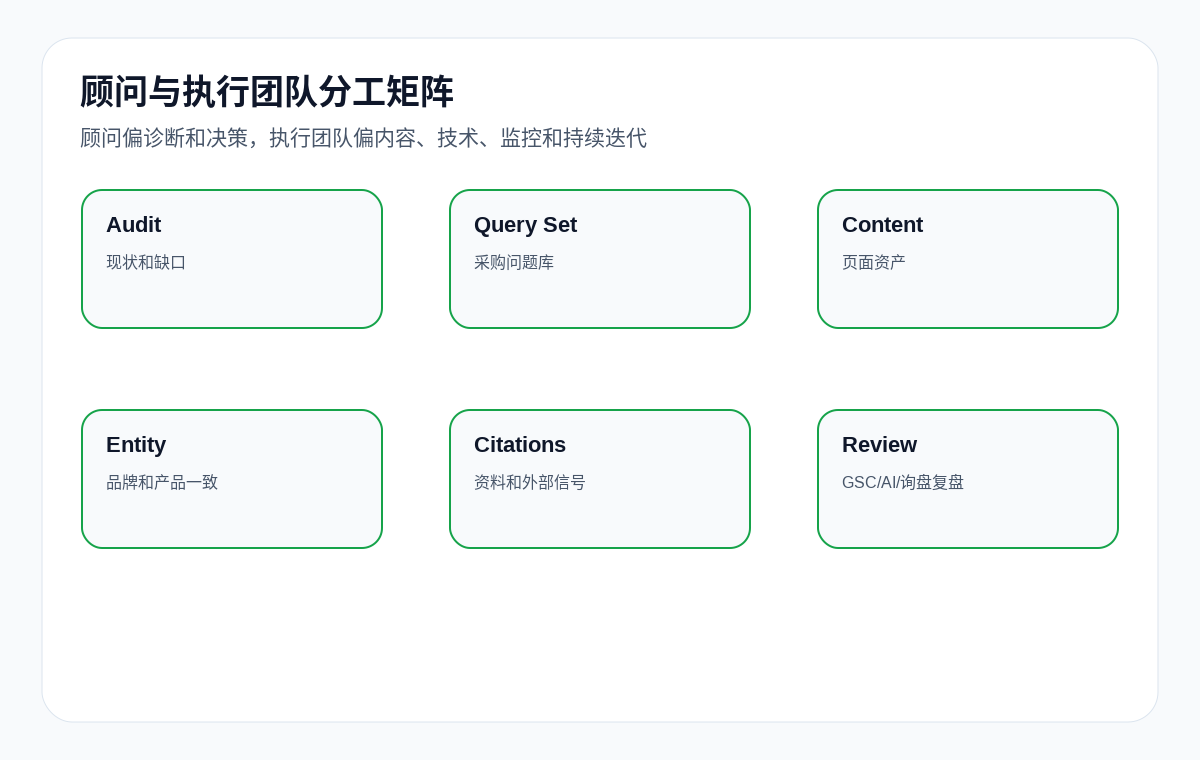
Pre-quote GEO scoring model: validate the baseline first, then compare prices
When an exporting business asks about a GEO quote, the most important thing is not to ask the price first, but to check whether a baseline exists. Without a baseline, the quote can only remain a verbal judgment: you don’t know which queries exist now, which platforms have samples, whether the official site pages are accessible, or why competitors are cited.
A pre-quote scoring model can make communication simple. Every partner team answers on the same table: how the query set is defined, how platforms are sampled, how pages are mapped, how technology is checked, how data is recorded, and which results cannot be written as definite deliverables. The clearer the fields, the easier quotes are to compare.
| Scoring dimension | 0-point behavior | 1-point behavior | 2-point behavior | Follow-up question before quoting |
|---|---|---|---|---|
| Query set | Only writing “AI visibility.” | Listing a few questions. | Grouping by brand, product, application, procurement risk, and competitors. | Can the question list be exported? |
| Platform samples | Not naming platforms. | Looking at only one tool. | Recording separately by platform, date, question, answer, and source. | Can the samples be rechecked? |
| Page mapping | Not corresponding to URLs. | Corresponding only to the homepage or articles. | Corresponding to product pages, category pages, resource pages, FAQ, and the RFQ path. | Which page carries each question? |
| Technical baseline | Not checking crawling or indexing. | Looking only at the sitemap. | Checking robots, sitemap, canonical, status codes, structured data, and mobile. | Is there a technical checklist? |
| Data definitions | Only sending screenshots. | Having a brief monthly report. | Recording GSC, GA4, AI sampling, page actions, and sales feedback separately. | How do you write it when there is no GSC row data? |
| Boundary statement | Writing external results. | Verbal reminders. | Stating controllable actions and uncontrollable external results in the contract or quote. | Which results cannot be promised? |
Query set baseline: decide what to ask first, then discuss how many platforms to monitor
Before a GEO quote, the query set matters more than the number of platforms. No matter how many platforms there are, if the questions are all vague things like “how is a certain brand,” they can hardly guide page building. For an exporting business, the query set should stay close to the procurement process: what the product is, what scenarios it suits, how to choose a supplier, what certification risks exist, and where competitor differences lie.
For example, for custom metal parts you cannot ask only the brand name; you also need to ask about material, tolerance, surface finishing, drawing upload, MOQ, and inspection. For packaging machines, you cannot ask only about the machine supplier; you also need to ask about materials, speed, cleaning, maintenance, and target markets. Only such a query set will in turn push pages to fill in facts.
| Query group | Example question | Corresponding page | Pre-quote evidence |
|---|---|---|---|
| Brand identity | Whether a company provides custom metal parts. | Homepage, about page, product overview page. | Brand name, product range, and contact information are consistent. |
| Product selection | How to choose an LED flood light supplier. | Category pages, product pages, selection articles. | Power, IP rating, applications, certifications. |
| Procurement risk | What to confirm before purchasing a packaging machine. | Resource pages, FAQ, RFQ page. | Materials, speed, samples, lead time, after-sales service. |
| Competitor comparison | Differences between a competitor’s product and this site’s product. | Capability pages, resource pages, product comparison pages. | Write only real differences, not attacking content. |
Platform sample baseline: don’t treat a single screenshot as a long-term conclusion
AI answers change. Different platforms, different dates, and different question phrasing can all produce different results. So the pre-quote small sample diagnosis cannot consist of just a few screenshots. A more acceptable approach is to write the platform, question, date, answer summary, citation sources, and follow-up page actions into the same table.
| Record field | Why it is needed | Low-budget approach | High-budget approach |
|---|---|---|---|
| Platform | Different platforms cannot be mixed into one conclusion. | Choose 1 to 2 key platforms. | Record multiple platforms in separate tables. |
| Exact question text | Phrasing affects the answer. | Fix the core questions. | Group by product line and procurement stage. |
| Date | Answers change over time. | Monthly retesting. | Weekly retesting or retesting after page updates. |
| Sources | Judges the gap between the official site and competitors. | Record whether the official site appears. | Break down source page types and factual points. |
| Page actions | Brings monitoring back to content building. | List next-step suggestions. | Map directly to URLs and change records. |
Page baseline: AI visibility ultimately comes back to page facts
Before a GEO quote, if you look only at platform results and not at the official site pages, the direction easily goes off track. Many exporting sites do not lack concepts; they lack page facts: incomplete specification tables, unclear application scenarios, too few FAQ, no entry point for document downloads, and an inquiry page that cannot collect key fields. Even if such pages are seen, they are hard to understand seriously.
The page baseline must answer four questions: which URL carries this question; whether there are visible facts on the page; whether search engines and AI-related crawlers can access it; and whether the user path from page to inquiry is smooth.
| Page baseline | Check item | Pre-quote output | Follow-up action |
|---|---|---|---|
| Product page | Specifications, images, certifications, FAQ, applications. | Gap list. | Add facts and an inquiry entry point. |
| Category page | Category explanation, comparison, internal links, filtering logic. | Page role description. | Add a selection guide and product line structure. |
| Resource page | Procurement questions, testing methods, risk explanations. | Citable content list. | Add comparison tables, FAQ, and downloads. |
| Inquiry page | Fields, attachments, contact information, event tracking. | RFQ path record. | Add GA4 events and field descriptions. |
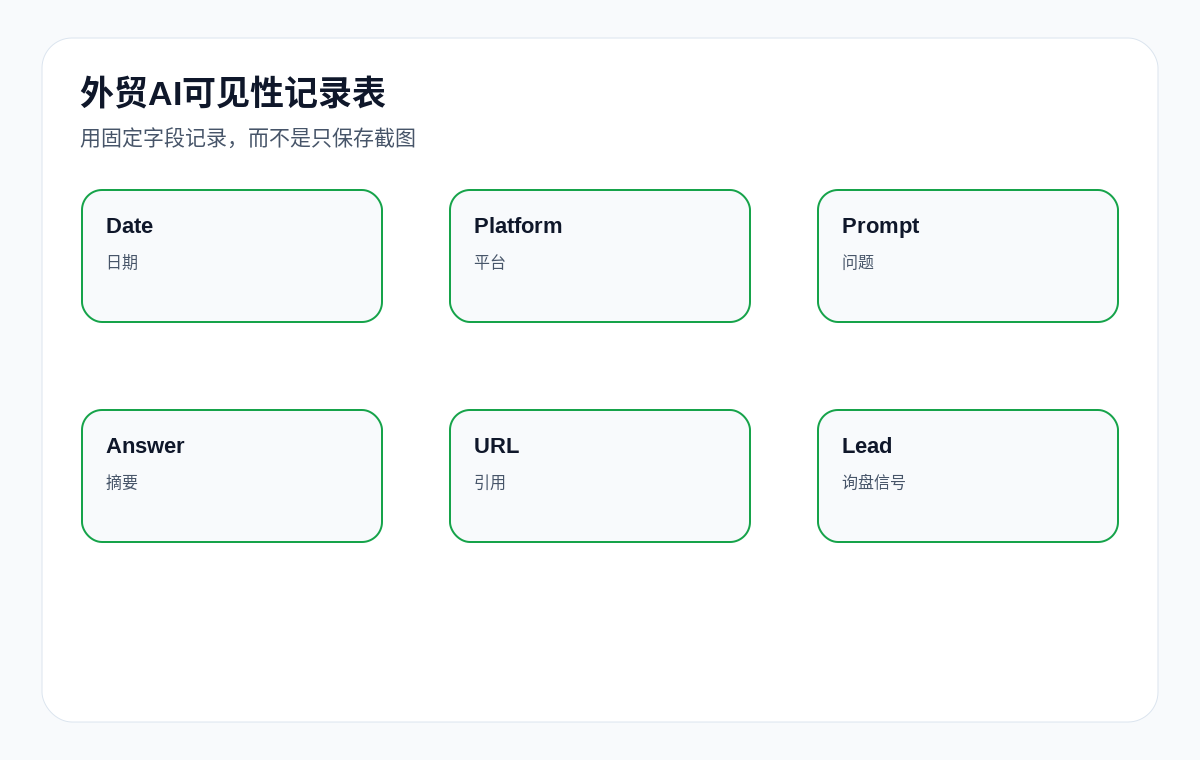
First-week baseline before quoting: record first, don’t rush into big changes
If both sides are preparing to work together, the first week should not start with large-scale content changes. Record the current state first: whether GSC has row data, whether GA4 events exist, what the AI sampling questions are, which core URLs exist, what page facts are missing, and whether there are technical crawling or indexing blocks. With clear records, later changes have something to compare against.
| First-week action | Deliverable | Acceptance criteria | Why it matters |
|---|---|---|---|
| GSC baseline | 28-day and 90-day query/page status. | Write the data if there is data; write a zero-row baseline if there is none. | Avoids fabricating search performance. |
| AI sampling | Platform, question, date, sources. | Samples can be rechecked. | Compare answer changes later. |
| URL list | Product pages, category pages, resource pages, inquiry page. | Each question maps to a page role. | Lands the quote on page assets. |
| Technical check | robots, sitemap, canonical, status codes. | No obvious blocks on key pages. | Rules out baseline errors. |
| Review table | Actions, evidence, next steps. | Every piece of work is traceable. | Later monthly reports extend from here. |
How to ask for a quote on a low budget: narrow the scope but keep the evidence chain
When the budget is limited, you can start with one product line for the GEO baseline instead of spreading across all platforms and all products at once. The scope can be small, but the evidence chain cannot be thin. At minimum there should be a query list, platform samples, URL mapping, page actions, and the next retest date.
| Budget tier | Suggested scope | Must keep | Can be deferred |
|---|---|---|---|
| Low budget | 1 product line, 20 to 40 questions, 1 to 2 platforms. | Questions, platforms, URLs, actions, dates. | Multiple markets, multiple competitors, and weekly retesting. |
| Medium budget | 2 to 3 product lines, multiple page types, monthly retesting. | GSC, GA4, AI samples, page actions, sales feedback. | Rolling out all product lines at once. |
| High budget | Multiple product lines, multiple platforms, multiple competitors, multiple markets. | Full monitoring, page improvements, review meetings, and handover assets. | External platform results still cannot be written as definite deliverables. |
Pre-quote follow-up checklist: turn a vague package into executable work
When you see a GEO quote, an exporting business can ask the following questions directly. If they can be answered clearly, the quote is easier to execute; if the answers are vague, later it easily becomes “we did a lot, but we don’t know where.”
- How many questions are in this query set, and how are they grouped?
- Will the sample date, question, and sources for each platform be recorded separately?
- Which product pages, category pages, and resource pages will be changed?
- How will the report be written when GSC has no query/page row data?
- Will GA4 record form, email, WhatsApp, download, and button events?
- Which parts of the quote are deliverable actions and which are external results to be observed?
So the key before a GEO quote is not to list a long string of platform names, but to write the questions, pages, sources, actions, and review dates clearly first. That way, even if GSC currently has no row data, the business knows the first stage is building a baseline rather than packaging an unreviewable result.
Talking through these fields before quoting has another benefit: even if the partner team is replaced later, the business can take away the query set, URL list, page actions, sample dates, and review tables, instead of being left with a pile of unreviewable screenshots.
If the first stage does only one thing, build this baseline table first. It will tell the business whether what is missing right now is query samples, page facts, technical accessibility, or the data definitions needed for later reviews.
The quote should also state the baseline review terms clearly: which query samples are rechecked, which page evidence is examined, which technical states are recorded, and which results only go into the watch list rather than being written as business results that have already happened.
Under a zero-row GSC baseline, the quote review must record “observable data” and “business results that have already happened” separately: the former is used for later verification, and the latter enters the conclusion only after the site and tools have genuinely recorded it.
FAQ
Must a technical SEO check be done before a GEO quote?
It is recommended to do it first. AI search visibility still depends on public web pages, crawlable content, and clear page structure. If a page is blocked from crawling, has not been indexed for a long time, or has a confused topic, discussing AI visibility directly lacks a foundation.
Can blogging alone improve AI search visibility?
Blog articles help, but they should not replace product pages and category pages. Export procurement questions usually require product specifications, application scenarios, supplier capability, and quality evidence, and purely conceptual articles can hardly cover the full decision path.
Is it better if a quote lists multiple AI platforms?
Not necessarily. More platforms only means a larger monitoring scope. The key is whether the queries, citations, screenshots, URLs, and retest records for each platform are clear. Platform coverage without a recording method is hard to review.
What can a GEO partner promise?
It can promise the diagnosis scope, number of pages, content depth, retest frequency, record format, and delivery time. It cannot write uncontrollable platform answers, specific rankings, or specific inquiries as definite results.
Related reading and official sources
- Why GEO partner quotes vary so much: how to read query sets, platform counts, and competitor monitoring
- What a GEO partner should actually deliver: content, monitoring, reviews, and boundary statements
- SEO diagnosis and optimization: a guide to troubleshooting indexing, rankings, technical issues, and inquiry paths on export websites
- Google Search Central: SEO Starter Guide
- Google Search Central: AI features and your website
- Google Search Central: Robots.txt introduction
- OpenAI Platform: Bots
Keep reading this GEO series
If you are systematically learning about GEO and AI search visibility, it is worth continuing with the articles below. Understand the concepts first, then look at diagnosis, monitoring, content structure, and collaboration boundaries.
- What GEO visibility diagnosis includes: AI answers, entity consistency, citation sources, and reviews
- How to choose an AI search visibility service team: a checklist for export businesses judging GEO partner capability
- How to choose an AI search visibility service team: what a reliable generative engine optimization team should deliver
- How to judge the most reliable AI search visibility service team in China: don’t look at AI promises, look at visibility evidence
- What is the difference between an AI search visibility consultant and a service team: how export businesses should choose
- Why GEO partner quotes vary so much: how to read query sets, platform counts, and competitor monitoring
{
“@context”: “https://schema.org”,
“@type”: “FAQPage”,
“mainEntity”: [
{
“@type”: “Question”,
“name”: “Must a technical SEO check be done before a GEO quote?”,
“acceptedAnswer”: {
“@type”: “Answer”,
“text”: “It is recommended to do it first. AI search visibility still depends on public web pages, crawlable content, and clear page structure. If a page is blocked from crawling, has not been indexed for a long time, or has a confused topic, discussing AI visibility directly lacks a foundation.”
}
},
{
“@type”: “Question”,
“name”: “Can blogging alone improve AI search visibility?”,
“acceptedAnswer”: {
“@type”: “Answer”,
“text”: “Blog articles help, but they should not replace product pages and category pages. Export procurement questions usually require product specifications, application scenarios, supplier capability, and quality evidence, and purely conceptual articles can hardly cover the full decision path.”
}
},
{
“@type”: “Question”,
“name”: “Is it better if a quote lists multiple AI platforms?”,
“acceptedAnswer”: {
“@type”: “Answer”,
“text”: “Not necessarily. More platforms only means a larger monitoring scope. The key is whether the queries, citations, screenshots, URLs, and retest records for each platform are clear. Platform coverage without a recording method is hard to review.”
}
},
{
“@type”: “Question”,
“name”: “What can a GEO partner promise?”,
“acceptedAnswer”: {
“@type”: “Answer”,
“text”: “It can promise the diagnosis scope, number of pages, content depth, retest frequency, record format, and delivery time. It cannot write uncontrollable platform answers, specific rankings, or specific inquiries as definite results.”
}
}
]
}
This page is machine-translated from the Simplified Chinese version and awaiting human review. It has not yet been proofread.