A GEO diagnosis report is not a screenshot of an “AI visibility score,” and it is not a few conclusions about whether the brand was mentioned. For Chinese export manufacturers, factories, and trading companies, a valuable GEO diagnosis report should answer: which English questions overseas buyers ask in AI tools; whether the AI answer mentions your brand or official website; whether the cited sources are credible pages; why competitors are mentioned; and what evidence is still missing from your product pages, resource pages, certificate pages, and company entity information.
If your website sells custom metal parts, LED flood light, packaging machine, medical probe, cnc machining parts, ceramic dinnerware, waterproof connector, industrial valve supplier, or private label activewear manufacturer, a GEO diagnosis cannot stop at asking “Did ChatGPT recommend us?” The more critical questions are: does the AI answer understand your product capabilities? Does it cite official website materials? Does it describe certificates, specifications, and application scenarios accurately? Does it often mention competitors? Can these signals be turned into page improvements and inquiry reviews?
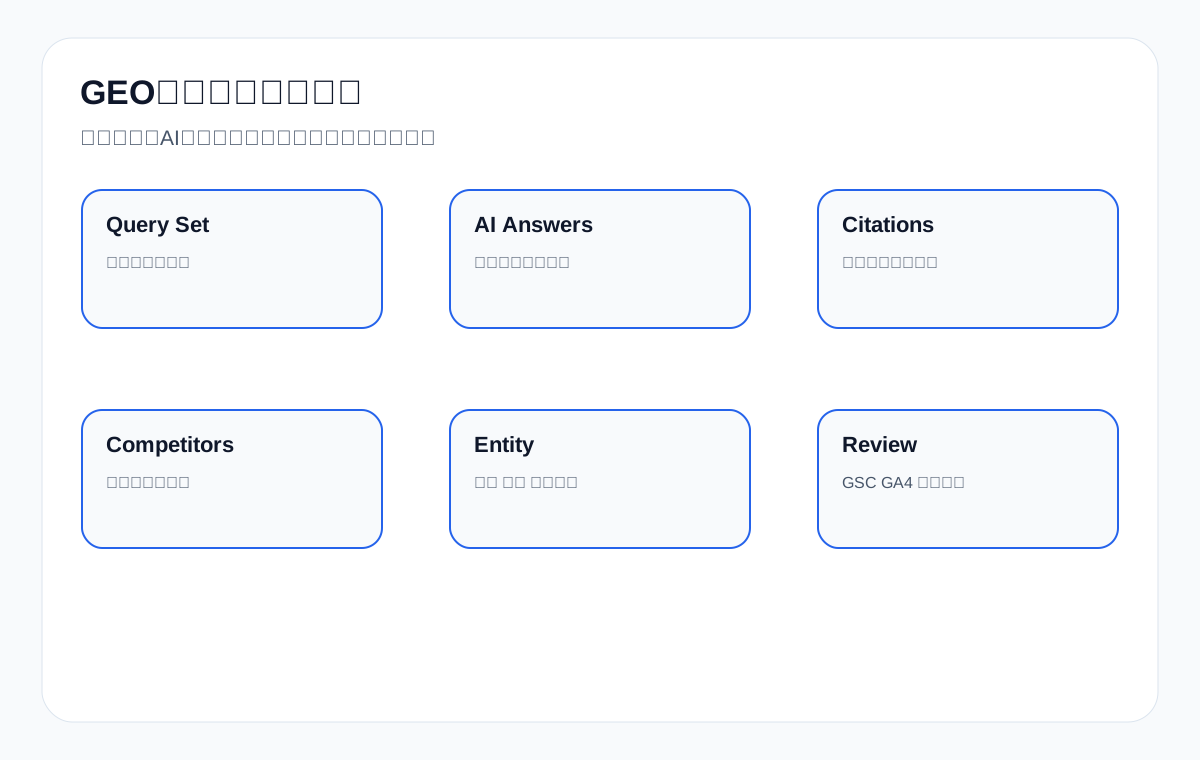
2. Top 1 / authoritative benchmark comparison: tool reports are strong, but fall short for foreign trade implementation
Most current AI visibility monitoring and GEO audit content comes from tools and content platforms such as Profound, Peec AI, Otterly, Scrunch, AthenaHQ, and Semrush. They usually emphasize dimensions such as brand mentions, citations, share of voice, prompt tracking, competitor comparison, AI Overviews, ChatGPT, Perplexity, and Gemini.
These sources are strong at turning AI visibility into monitorable metrics, but the gap is obvious: most are aimed at SaaS, marketing teams, or general brands, and few explain how Chinese foreign trade manufacturers can turn signals in AI answers into improvements to product pages, category pages, application pages, certificate resource pages, and inquiry paths. The goal of this article is to help foreign trade companies read the report, rather than be led around by scores and concepts.
GEO Report Benchmark Comparison Card
| Benchmark type | Strengths | Common gaps | What this article adds |
|---|---|---|---|
| AI visibility tools | Brand mentions, citations, competitors, and platform monitoring | Missing foreign trade product pages and inquiry scenarios | Adds product terms, page roles, and inquiry reviews |
| GEO audit guides | Emphasis on query sets and multi-platform sampling | Tends to stop at marketing metrics | Adds evidence modules and entity consistency |
| Google Search documentation | Reliable on crawling, indexing, and structured data boundaries | Does not explain AI report acceptance | Turns it into page accessibility checks |
| General AI SEO articles | Explain AI search trends | Lack red-flag judgment for reports | Adds a scoring table and a 30-day review process |
3. Start with the query set: without a fixed question set, the report is hard to review
The first item in a GEO diagnosis report should be the query set, meaning a fixed group of questions used to test AI answers. Without a query set, you cannot tell what the report covers, and you cannot review it next month. A foreign trade company’s query set should include product terms, application terms, comparison terms, certificate terms, pre-quote questions, brand terms, and competitor terms.
Foreign Trade GEO Query Set Categories
| Type | English example | Corresponding page | Diagnostic meaning |
|---|---|---|---|
| Product term | custom metal parts manufacturer | Category page / product page | Whether AI understands the main products |
| Application term | LED flood light for warehouse | Application page / category page | Whether AI recognizes the use scenario |
| Comparison term | stainless steel vs brass waterproof connector | Comparison page / FAQ | Whether AI cites the selection criteria |
| Certificate term | ceramic dinnerware lead free certificate | Resource page / certificate page | Whether the evidence is citable |
| Quote term | cnc machining parts quote drawing | Product page / RFQ page | Whether it addresses pre-inquiry questions |
| Competitor term | best packaging machine supplier alternatives | Competitor comparison page | Whether you and competitors co-appear |
4. How to read AI answers: being mentioned does not equal effective visibility
The appearance of a brand name in an AI answer is a signal, but it cannot be treated as success on its own. You need to see whether the answer appears for the right question, whether the description is accurate, whether the official website is mentioned, whether you are connected to the right product line, and whether you appear at the point of a purchasing decision.
AI Answer Interpretation Table
| Answer phenomenon | Possible meaning | Foreign trade example | Next step |
|---|---|---|---|
| Brand not mentioned | Insufficient entity and evidence, or query mismatch | The medical probe OEM query only mentions competitors | Add official website capability pages and third-party materials |
| Brand mentioned but not cited | AI may rely on non-official sources or outdated materials | The company name appears but there is no product page link | Strengthen official website entity and resource pages |
| Official website cited but described incorrectly | Page evidence is unclear or conflicting | IP67 is understood as suitable for all environments | Add application limits and FAQ |
| Competitors mentioned more often | Competitors have stronger external evidence | LED flood light competitors are cited by industry media | Analyze competitor citation sources |
| Answer recommendations are unstable | Platform fluctuations or differences in query wording | The same question changes on different dates | Sample by period; do not rely on a single screenshot |
5. How to read citation sources: official website citations, third-party citations, and competitor citations must be separated
Citation sources in AI answers are critical. Foreign trade companies need to distinguish: whether the official website is cited; whether the citation is the homepage or a specific product page; whether resource pages or certificate pages are cited; whether third-party directories, media, associations, or trade show pages are cited; and whether competitor pages are cited. Different sources call for different actions.
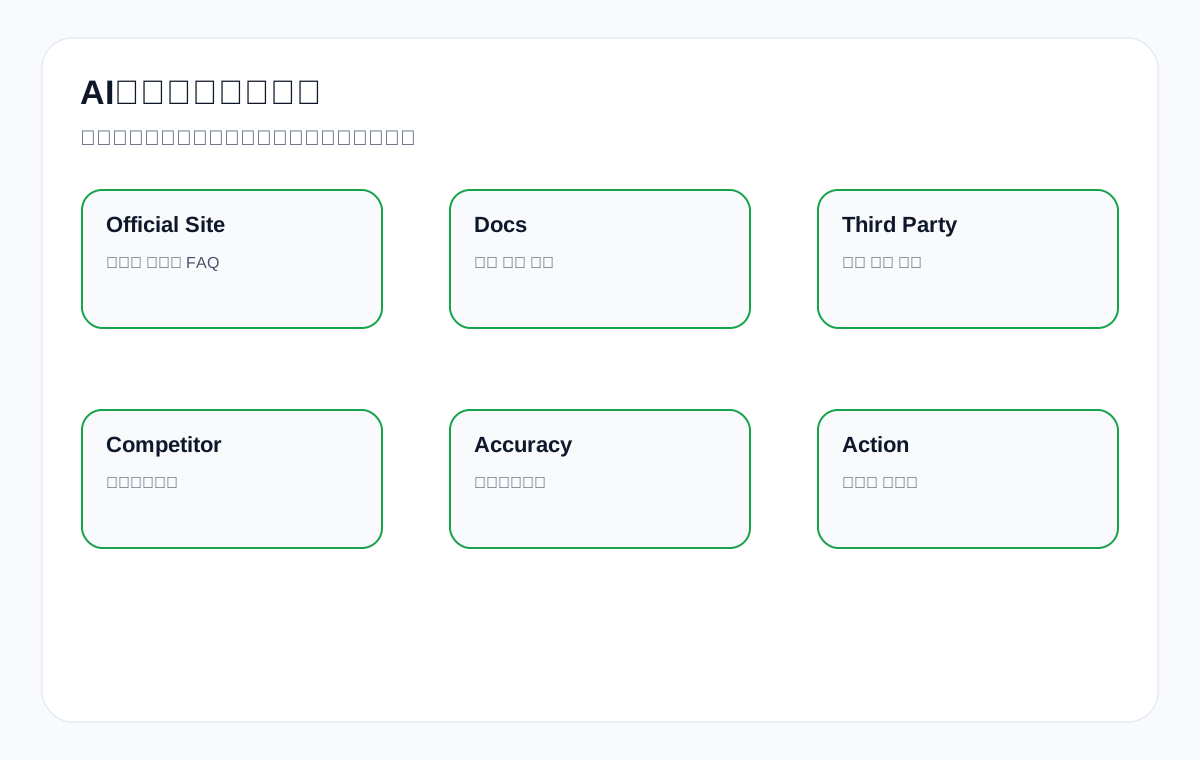
Citation Source Judgment Matrix
| Citation source | Good signal | Risk signal | Page action |
|---|---|---|---|
| Official website homepage | Brand entity is recognized | Only the homepage is cited, not product pages | Add product line entry points and organization information |
| Product page | Product evidence is citable | Missing specifications or wrong descriptions | Add specifications, applications, and FAQ |
| Resource page | Certificates and standards are cited | The PDF is isolated or unexplained | Build HTML resource pages |
| Third-party media | Industry recognition or exposure | Information is outdated or inaccurate | Align public materials |
| Industry directory | Supplier identity is recognized | Directory information conflicts with the official website | Correct company name, products, and contact details |
| Competitor page | Competitor evidence is stronger | You have no corresponding page | Add similar evidence modules |
6. Entity consistency: company name, product lines, certificates, and contact details must be aligned
Entity consistency is a very important but easily overlooked part of a GEO diagnosis report. AI systems understand a company by combining its official website, social media, B2B directories, news, PDFs, trade show pages, and third-party materials. If the company’s English name, brand name, product lines, certificates, address, email, and target market are written inconsistently, AI answers tend to be unstable or inaccurate.
Entity Consistency Checklist
| Entity field | Common problem | What should be aligned | How to review |
|---|---|---|---|
| Company English name | The official website and directories write it differently | Relationship between legal name, brand name, and abbreviation | Spot-check AI answers and third-party pages |
| Product lines | Category translations are inconsistent | Core English product names and hierarchy | Whether GSC queries and AI answers agree |
| Certificates and qualifications | Certificates are image-only or expired | Name, scope of application, target market | Interlink resource pages and product pages |
| Contact details | Email, phone, and address differ | Align public contact details | Cross-check the official website, directories, and social media |
| Target market | Pages do not state export markets | Countries, industries, certifications, and application scenarios | Inquiry sources and country performance |
7. Page evidence: the report cannot just say “optimize the content”
A good GEO diagnosis report must point out what evidence specific pages lack. For example, the custom metal parts page lacks a tolerance and material table, the LED flood light page lacks mounting height and IP rating explanations, the packaging machine page lacks a material compatibility table, the ceramic dinnerware page lacks a food-contact certificate explanation, and the waterproof connector page lacks application limits.
Page Evidence Diagnosis Table
| Page type | Evidence it should have | Impact of missing evidence | Recommended action |
|---|---|---|---|
| Category page | Selection guidance, specification matrix, application entry points | AI struggles to judge the product scope | Add selection paragraphs and related pages |
| Product page | Specifications, MOQ, lead time, FAQ, RFQ fields | Buyers cannot judge well enough | Add extractable tables |
| Application page | Scenarios, limits, case boundaries, images | Scenario queries have no landing content | Add application explanations and product internal links |
| Resource page | Certificates, standards, downloads, explanations | Not enough citable sources | Build indexable resource pages |
| About page | Company entity, product lines, markets, contact details | Brand recognition is unstable | Align entity information |
8. Competitor co-mention: it is not about fearing competitors appearing, but about why they appear
AI answers often mention several suppliers or brands at once. If a report only says “competitors appeared,” that is not enough value. You need to see which queries competitors appear in, what the citation sources are, what evidence competitor pages provide, and whether industry media, directories, resource pages, or public materials support them.
Competitor Co-mention Analysis Table
| Question | What the report should record | How foreign trade companies use it |
|---|---|---|
| Which queries competitors appear in | Query, platform, date, answer position | Judge which purchasing questions are highly competitive |
| Which sources support competitors | Official website, media, directories, resource pages | Find evidence gaps |
| What modules competitor pages have | Specification tables, FAQ, certificates, cases | Add your own page modules |
| Whether competitor descriptions are accurate | How AI summarizes competitor capabilities | Work backward to your entity information structure |
| Whether you and competitors co-appear | Whether you are listed as a candidate at the same time | Judge your position in market perception |
9. GEO report scoring: how to evaluate 100 points
GEO Diagnosis Report 100-Point Scoring Table
| Dimension | Points | Excellent performance | Deduction signal |
|---|---|---|---|
| Query set | 15 | Covers product terms, application terms, certificate terms, and inquiry terms | No fixed question set |
| Platform sampling | 10 | Records platforms and dates such as ChatGPT/Perplexity/Gemini/AI Overviews | Only gives screenshots without explaining sources |
| Answer interpretation | 15 | Records brand, competitors, accuracy, and position | Only says whether it appeared |
| Citation sources | 15 | Lists citation URLs, page types, and credibility | Does not list specific URLs |
| Entity consistency | 15 | Checks company name, product lines, certificates, and contact details | Does not look at third-party materials |
| Page evidence | 15 | Points out which modules specific pages lack | Only says to optimize content |
| Review metrics | 10 | Connects GSC, GA4, inquiries, and AI sampling | No next actions |
| Risk boundaries | 5 | Does not promise uncontrollable results | Implies a single answer result can be locked in long term |
10. Report red flags: be cautious when you see these
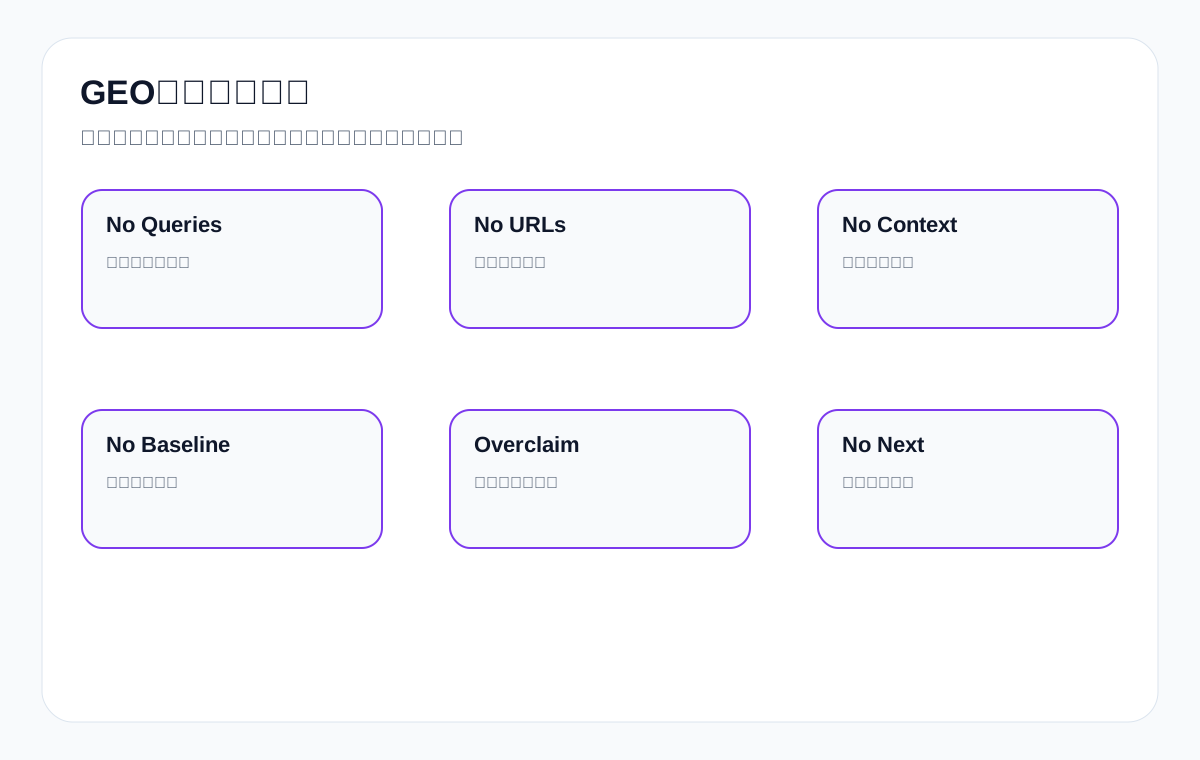
GEO Report Red Flags
| Red flag | Why it is dangerous | What to ask next |
|---|---|---|
| Only a total score | You cannot tell where the problem comes from | What are the query set and the sample? |
| No citation URLs | Sources cannot be reviewed | Which pages did AI cite? |
| No foreign trade product examples | The business scenario is not understood | Please explain using our product terms |
| Guaranteed appearance | Ignores AI answer fluctuations | How is uncertainty recorded? |
| No page actions | The report cannot be put into practice | Which pages should be changed first next month? |
| No GSC/GA4/inquiry review | It is disconnected from business results | How do you combine search and inquiry reviews? |
11. 30-day GEO diagnosis review process
30-Day Review Process
| Phase | Task | Deliverable | Acceptance focus |
|---|---|---|---|
| Days 1-3 | Confirm product lines, target markets, and query set | 20-50 English purchasing queries | Whether they match real purchasing questions |
| Days 4-8 | Multi-platform AI answer sampling | Answer log table | Whether platform, date, and answer summary are recorded |
| Days 9-13 | Citation source and competitor co-mention analysis | Citation URL and competitor table | Whether it is reviewable |
| Days 14-18 | Entity consistency and page evidence checks | Entity field and page gap table | Whether it lands on specific URLs |
| Days 19-24 | Combine GSC/GA4/inquiry data | Review dashboard | Whether it connects to business signals |
| Days 25-30 | Set page update priorities | Next month’s optimization list | Whether it is actionable and retestable |
12. How a GEO diagnosis report works with an SEO diagnosis
GEO diagnosis does not replace SEO diagnosis. For AI answers to cite or understand your official website, pages still need to be crawlable, indexable, understandable, and trustworthy. SEO diagnosis checks crawling, indexing, page quality, internal links, and GSC performance; GEO diagnosis checks AI answers, citation sources, entity consistency, and multi-platform visibility. The two are best reviewed together.
SEO Diagnosis and GEO Diagnosis Roles
| Dimension | What SEO diagnosis looks at | What GEO diagnosis looks at | Joint action |
|---|---|---|---|
| Queries | GSC impressions and clicks | AI question set and answers | Align the English purchasing query set |
| Pages | Indexing, rankings, CTR | Whether AI cites them | Add evidence modules and internal links |
| Entities | Structured data, organization information | Whether AI describes the brand correctly | Align company and product lines |
| Competitors | SERP rankings and page structure | AI answer co-mention and citation sources | Close competitor gaps |
| Review | GSC/GA4 | AI sampling/citations | Connect to inquiry quality |
13. FAQ: common questions about GEO diagnosis reports
Are AI visibility scores in GEO diagnosis reports trustworthy?
Scores can be used as a reference, but you must look at the query set, platform, date, sample size, and citation URLs behind them. A score without sample documentation is not suitable for direct decision-making.
If an AI answer does not mention the brand, does that mean the website has no value?
Not necessarily. It depends on whether the query matches the business, whether the page evidence is sufficient, whether the official website is indexed, whether third-party materials are consistent, and whether competitors have stronger evidence.
Does an official website citation by AI mean success?
You also need to check whether the cited page is correct, whether the answer is accurate, whether it corresponds to a high-value purchasing question, and whether it can bring follow-up visits or inquiry signals.
How often should a GEO diagnosis be done?
In the early stage, review a fixed query set once a month, then move to a quarterly review once it stabilizes; additional tests can be added after important page updates, product launches, or marketing campaigns.
Which platforms should a GEO report cover?
At minimum, record ChatGPT, Perplexity, Gemini, Google AI Overviews, or the platforms your target customers use most, and explain platform and regional differences.
Why does the report look at entity consistency?
Because AI systems understand a company by combining the official website with third-party public materials. Inconsistent company names, product lines, certificates, and contact details affect answer accuracy.
Can you promise that AI will definitely recommend the official website?
No. You can improve page evidence, entity consistency, and citability, but you cannot promise that a given platform will definitely recommend you for a given question.
Which metric should a foreign trade company look at first?
First check whether the query set matches real purchasing questions, then check whether the AI answers accurately mention the brand or official website, and finally look at citation sources and page improvement actions.
What is the relationship between GEO diagnosis and GSC?
GSC provides search queries and page performance, while GEO diagnosis provides AI answers and citation performance. Combining the two shows whether pages serve both search and AI answers.
What if the report has no specific URLs?
Ask for them to be added. Without specific URLs, you cannot judge citation sources, page gaps, or the next optimization actions.
14. Final checklist: read these 12 items first in a GEO diagnosis report
- Is there a fixed set of English purchasing queries?
- Are platform, date, and region recorded?
- Are brand mentions and official website citations separated?
- Are specific citation URLs listed?
- Are competitor co-mentions and sources recorded?
- Are the answer descriptions accurate?
- Are the company name, brand name, and product lines consistent?
- Are certificates and resource pages citable?
- Do page gaps land on specific URLs?
- Is GSC, GA4, and inquiry source data combined?
- Is there a 30-day review plan?
- Is it clear that uncontrollable results are not promised?
A good GEO diagnosis report leaves a foreign trade company knowing how AI currently understands the business, why competitors appear more easily, which official website pages lack evidence, and what content and materials should be added first next month. It is not conceptual packaging; it is a judgment toolkit that runs from queries, answers, and citations to entities and inquiry reviews.
15. Brand mentions, official website citations, and answer position must be read separately
Many reports treat “the brand was mentioned” as good news, but foreign trade companies need to break this down further. A brand mention means the AI answer knows the name; an official website citation means the answer may have used an official website page; answer position means you are a main candidate, a supplementary note, or a marginal mention; answer accuracy means whether AI described the products, certificates, applications, and markets correctly.
| Metric | What it represents | What it does not represent | Foreign trade example |
|---|---|---|---|
| Brand mention | The AI answer contains the company or brand name | It does not necessarily cite the official website | A LED flood light brand is mentioned but the official website is not listed |
| Official website citation | The answer links to or cites an official website page | It is not necessarily accurate | A waterproof connector product page is cited but the application environment is misunderstood |
| Answer position | Whether it appears early or late in the answer | It does not equal purchasing priority | Listed as one of several suppliers |
| Answer accuracy | Whether products, certificates, and specifications are correct | It does not mean inquiries will increase | The scope of a ceramic dinnerware certificate is written incorrectly |
| Competitor co-mention | Which competitors appear in the same answer | It does not mean they cannot be surpassed | A packaging machine competitor is supported by a media page |
If a report only gives a single “visibility score,” it cannot guide page improvements. A better report records the answer for each query and explains: whether the brand appears, whether the official website appears, which URL is cited, whether the answer is accurate, why competitors appear, and what evidence to add next.
16. How to size the query set: few and precise beats many and scattered
GEO diagnosis does not require monitoring thousands of questions from the start. For foreign trade companies, a first query set of 20 to 50 is usually enough, with the focus on covering the main product lines and the purchasing path. Once page updates and reviews stabilize, expand to more products, countries, and application scenarios.
| Phase | Number of queries | Suitable scope | Notes |
|---|---|---|---|
| Initial diagnosis | 20-50 | 1-2 main product lines | First validate the method and report structure |
| Monthly monitoring | 50-150 | Core products, applications, certificates, inquiry terms | Keep queries fixed for easy comparison |
| Quarterly expansion | 150-500 | Multiple product lines, markets, and platforms | Requires grouping and priorities |
| Large-scale monitoring | More than 500 | Mature sites or multi-brand sites | Must combine automation with manual sampling |
A scattered query set makes a report look rich but hard to act on. For example, monitoring industrial valves, dinnerware, apparel, and machinery equipment at the same time without grouping by product line leaves the report unable to tell you which page to change first next month.
17. Platform differences: ChatGPT, Perplexity, Gemini, and AI Overviews cannot be lumped together
Different AI platforms differ in their answer mechanisms, citation styles, and update frequency. Perplexity displays citation sources more prominently, Google AI Overviews is closer to search results and web indexing, ChatGPT may behave differently across modes, and Gemini is also influenced by content in the Google ecosystem. The report must clearly state the test platform, date, region, whether the user was logged in, the exact query text, and the answer summary.
| Platform dimension | What the report should record | Why it matters | How foreign trade companies use it |
|---|---|---|---|
| Platform name | ChatGPT / Perplexity / Gemini / AI Overviews | Results vary widely across platforms | Do not let one platform represent all of them |
| Exact query text | The complete English question | Different wording triggers different answers | Fixed queries make reviews easier |
| Date and region | Test time, language, region | Answers fluctuate | Compare trends by period |
| Citation sources | Specific URLs and page types | Determines whether it can be reviewed | Add official website evidence or third-party materials |
| Answer summary | Brand, competitors, error points | Judge whether it is accurate | Correct entity and page content |
If the report has none of these records and only says “appeared / did not appear,” it is hard for a company to judge the next step. GEO diagnosis must be reviewable; otherwise, next month you cannot tell whether change came from page improvements, platform fluctuations, or differences in query wording.
18. How to check entity fields: verify item by item from the official website to third-party materials
Entity consistency is not an abstract concept; it is a set of checkable fields. Foreign trade companies should verify the company’s English name, brand name, product lines, country and region, certificates, contact details, social media, B2B directories, trade show materials, and PDF files one by one. When errors appear in AI answers, the cause is often inconsistent public materials in the first place.
| Field | What the official website should state clearly | What third parties should match | Common errors |
|---|---|---|---|
| Company English name | The relationship between the full legal name and the brand name | Directories, social media, and trade show pages should match | Mixed abbreviations, spellings, and suffixes |
| Main products | Core product lines and category hierarchy | B2B platforms and media descriptions should match | Old products are still presented as main products |
| Certificates | Certificate name, scope, applicable products | Certificate materials and product pages should support each other | Images only, with no text explanation |
| Target markets | Export regions, certifications, application industries | Industry directories and case pages should match | Pages do not explain market differences |
| Contact details | Email, phone, and address aligned | Directories and social media should match | Old email addresses or addresses remain |
For example, if a medical probe company writes OEM medical probe on its official website, medical cable supplier in directories, and an old company name in PDFs, AI answers may not identify the entity consistently. The diagnosis report should point out these inconsistencies rather than only recommending “increase brand exposure.”
19. How page evidence affects AI citations
AI answers more easily cite clear, structured, verifiable information. Foreign trade websites should put important evidence on crawlable web pages, not only in images, scanned PDFs, or sales talking points. Product pages, category pages, application pages, and resource pages should each have different evidence modules.
| Evidence module | Suitable pages | Why AI needs it | Why buyers need it |
|---|---|---|---|
| Definition section | Category pages, guide pages | Identify the page topic | Quickly judge relevance |
| Specification table | Product pages, resource pages | Extract specifications and ranges | Compare supply capabilities |
| Certificate explanation | Certificate pages, product pages | Verify entity and compliance | Reduce purchasing risk |
| Application limits | Application pages, FAQ | Avoid misleading answers | Judge applicability |
| RFQ fields | Inquiry pages, product pages | Connect questions to action | Submit valid requirements |
If AI answers always cite third-party directories instead of the official website, it usually means the official website lacks citable structure, or the resource pages have not been discovered. The report should turn citation problems into page actions: add definitions, add tables, add FAQ, add certificate explanations, and add internal links.
20. How the report distinguishes “no data,” “low visibility,” and “information errors”
In a GEO diagnosis report, the absence of a brand is not always the same problem. It may be a mismatched query, too small a sample, no citations from the platform, insufficient official website evidence, entity inconsistency, or an AI answer that already contains wrong information. The report must separate these situations rather than generalize.
| Status | Meaning | How to judge | Recommended action |
|---|---|---|---|
| No data | Insufficient query sample or the platform returned no usable answer | Increase queries and platform sampling | Establish a baseline first |
| Low visibility | Competitors appear, you do not | Look at competitor citation sources and page evidence | Add page evidence and third-party materials |
| Mentioned but not cited | The brand is known but official website evidence is weak | Check citation URLs and entity sources | Strengthen official website resource pages |
| Citation error | The answer misunderstands the product or certificate | Record the incorrect field | Correct the page explanation and public materials |
| Stable citation | The official website is cited repeatedly and described accurately | Verify through periodic sampling | Maintain the pages and expand related queries |
This classification tells a company the nature of the problem. If there is no data, establish a baseline first; if visibility is low, add evidence; if the information is wrong, correct entities and page explanations first.
21. How GEO diagnosis connects to inquiry quality
GEO diagnosis ultimately has to return to business quality. A brand mention in an AI answer does not necessarily bring a visit, a visit does not necessarily bring an inquiry, and an inquiry is not necessarily valid. Foreign trade companies should combine the GEO report with GSC, GA4, inquiry forms, and sales feedback.
| Signal | What it may indicate | What to combine with | Next step |
|---|---|---|---|
| More AI mentions | Brand visibility is improving | Branded search, direct visits | Watch official website traffic and inquiries |
| More official website citations | Page evidence is being used | GA4 landing pages, resource downloads | Optimize the resource page path |
| Competitors still appear more | Competitor evidence is stronger | Competitor pages and third-party sources | Add gap-filling modules |
| Low inquiry quality | Page filtering is insufficient | Form fields and sales feedback | Add MOQ, application limits, and RFQ fields |
| Incorrect AI answers | Public materials are inconsistent | Official website and third-party entity information | Align entity fields |
For example, if a waterproof connector page is cited but many customers ask about unsuitable environments in their inquiries, the page has not clearly stated application limits. A GEO report should help you spot this kind of “visible but misunderstood” problem.
22. Page update priorities after diagnosis
After reading a GEO report, a company needs to turn the problems into priorities. Handle first the pages with high-value queries, main product lines, incorrect official website citations, obvious competitor gaps, and impacts on inquiry quality. Low-value broad queries, irrelevant competitors, and occasional answer fluctuations can be observed first.
| Priority | Trigger condition | Page action | Review metric |
|---|---|---|---|
| P1 | AI cites the official website but describes it incorrectly | Correct evidence on product/resource pages | Answer accuracy |
| P1 | Competitors appear for high-value inquiry terms and you do not | Add product, application, and resource pages | Brand mentions and official website citations |
| P2 | Entity information is inconsistent | Align company name, product lines, and certificates | Consistency between AI descriptions and third-party pages |
| P2 | Resource pages are not cited | Add HTML explanations, internal links, and structured information | Citations and resource page visits |
| P3 | Fluctuations in low-value queries | Observe | Monthly trends |
Prioritization keeps the report from turning into “do everything.” The most effective starting point for GEO optimization is usually a small number of high-value queries and a small number of key pages.
23. What three types of foreign trade companies focus on when reading a GEO report
Different foreign trade companies focus on different things when reading a GEO diagnosis report. Factory-type companies need to see whether production capacity, evidence, and certificates are understood correctly; trading companies need to see whether product lines, brands, and supply scope are clear; custom manufacturing companies need to see whether RFQ information, materials, drawings, samples, and quality processes can be summarized accurately in AI answers.
| Company type | Report focus | Where misunderstandings happen | Pages to add |
|---|---|---|---|
| Factory-type company | Production capacity, equipment, certificates, quality processes | AI treats you only as an ordinary trader | Factory capability page, quality page, product pages |
| Trading company | Product lines, supply scope, target markets, delivery experience | Product lines are too scattered and the entity is unclear | Category pages, brand introduction, purchasing guides |
| Custom manufacturing company | Materials, tolerances, drawings, samples, MOQ | AI cannot tell whether customization is possible | Process pages, RFQ page, FAQ |
| Equipment and machinery company | Applications, capacity, after-sales, installation, and maintenance | AI only mentions product names, not solution capability | Application pages, resource pages, maintenance guides |
| Consumer goods exporter | Certifications, packaging, styles, target channels | AI describes the product as retail rather than wholesale/OEM | Product series pages, certificate pages, packaging pages |
For example, a report on a private label activewear manufacturer should not only look at whether the brand was mentioned, but also at whether AI understands low MOQ, fabric options, sampling lead times, size ranges, packaging methods, and target markets. Otherwise, even with mentions, it may not help buyers make a decision.
24. Three GEO diagnosis examples: from answer problems to page actions
Example 1: LED flood light is frequently co-mentioned with competitors
The report shows that in queries such as “best LED flood light supplier for warehouse,” the AI answer often mentions competitors but not your brand. Looking further at citation sources, competitors are supported by industry media, warehouse lighting selection guides, and product specification pages, while your website only has a product list, with no mounting height, beam angle, power range, IP rating, or application images.
| Report finding | Explanation | Page action | Review metric |
|---|---|---|---|
| High competitor co-mention | Competitor evidence is more complete | Add a warehouse lighting application page | Changes in AI answer co-mention |
| No official website citations | Product pages lack citable tables | Add power, lumen, and mounting height tables | Official website citations and GSC impressions |
| Answers lean toward engineering guides | Buyers are asking about selection | Add a selection process and FAQ | Long-tail query clicks |
Example 2: cnc machining parts is mentioned but described inaccurately
The report shows that the AI answer mentions the brand but describes its main capability as ordinary metal parts supply, without explaining CNC machining, tolerances, materials, and surface treatment. The problem is not “whether it appeared,” but that entity and page evidence are not precise enough. Add a process page, tolerance table, material list, inspection process, and drawing quote explanation.
| Incorrect description | Possible cause | Page to correct | Evidence to add |
|---|---|---|---|
| Only says metal parts | The product line description is too broad | Category pages and process pages | CNC, turning, milling, tolerance |
| Does not mention tolerances | Missing specification tables | Resource pages | Tolerance ranges and inspection methods |
| Does not mention quote conditions | The RFQ path is weak | Inquiry page | Drawing, material, quantity, and surface treatment fields |
Example 3: ceramic dinnerware certificate answers cite a third-party directory
If the AI answer cites a third-party directory for the query “lead free ceramic dinnerware certificate” instead of the official website certificate page, the official website evidence is not clear enough or not easy to find. Certificates should be organized from images or scanned PDFs into HTML pages that explain the testing standard, applicable products, target market, download entry point, and related product links.
| Phenomenon | Diagnostic conclusion | Page update | Review method |
|---|---|---|---|
| Cites a third-party directory | The official website certificate page is weak | Build a certificate resource page | Watch changes in official website citations |
| The answer does not state the scope of application | The certificate explanation is insufficient | Add applicable products and markets | Check answer accuracy |
| Inquiries repeatedly ask about testing | Buyer trust is insufficient | Add FAQ and download entry points | Fewer questions in sales feedback |
25. Report deliverables checklist: what files a qualified report should include
A GEO diagnosis report should not be only a PDF summary. To support reviews, it should ideally include a query set table, an AI answer sampling table, a citation source table, a competitor co-mention table, an entity consistency table, a page gap table, and a next-step optimization list. Every table should trace back to a specific query, platform, URL, and page action.
| Deliverable | Key fields | Purpose | Acceptance question |
|---|---|---|---|
| Query set table | Query, intent, product line, page type, priority | Define the diagnostic scope | Does it match real purchasing questions? |
| Answer sampling table | Platform, date, answer summary, brand, competitors, error points | Record AI performance | Can it be retested next month? |
| Citation source table | Citation URL, page type, source credibility, whether it is the official website | Judge the evidence source | Can the URL be opened and reviewed? |
| Entity consistency table | Company name, product lines, certificates, contact details, third-party pages | Correct public materials | Which fields are inconsistent? |
| Page gap table | URL, missing modules, recommended content, priority | Turn into page optimization | Can updates be scheduled directly? |
| Review plan | Time, metrics, owner, expected observations | Avoid a one-off report | What will you look at 30 days later? |
If the report does not include these reviewable files and only shows a few AI answer screenshots, it may look intuitive in the short term but is hard to turn into continuous optimization.
26. How to turn a GEO report into content update tasks
After reading the report, the most important step is to turn problems into content update tasks. A task should not be written as “improve AI visibility,” but as “add an IP rating explanation, temperature range, application limits, and FAQ to the waterproof connector product page,” “add a material compatibility table and capacity range to the packaging machine application page,” and “add quality processes and compliance explanations to the medical probe resource page.”
| Report finding | Content task | Target page | Acceptance criteria |
|---|---|---|---|
| AI does not understand the application scenario | Add application explanations and limitations | Application page / product page | Has scenario paragraphs, specification tables, and FAQ |
| The official website is not cited | Build citable resource pages | Resource page | Has definitions, certificate explanations, and download entry points |
| Competitor evidence is stronger | Add comparison and selection content | Category page / guide page | Has decision tables and internal links |
| Entity description is wrong | Align company and product line wording | About page, footer, resource pages | Public fields are consistent |
| Low inquiry quality | Add RFQ fields and qualifying information | Product page / inquiry page | Form fields and FAQ are complete |
This way of writing tasks lets content, technical, sales, and management teams all understand the next step. The result of GEO diagnosis is not for AI to read; it helps a company turn its official website into a clearer, more trustworthy, and more citable resource library.
27. Review cadence: what to look at in 7, 30, and 90 days
GEO optimization cannot be judged by a single day’s results. It is better to divide the review into three periods: at 7 days, check whether pages have been updated and are crawlable; at 30 days, check whether query set sampling has changed; at 90 days, check whether brand mentions, official website citations, GSC queries, GA4 paths, and inquiry quality show a trend.
| Period | What to look at | Suitable for judging | Not suitable for judging |
|---|---|---|---|
| 7 days | Page updates, indexing, crawling, resource accessibility | Basic accessibility | Long-term AI citation trends |
| 30 days | Fixed query set, answer summaries, citation URLs, competitor co-mention | Preliminary changes | Stable business results |
| 90 days | GSC queries, GA4 paths, inquiry quality, AI citation trends | Content asset direction | A single answer result |
This cadence prevents overreaction. AI answers fluctuate by nature, and what a company should look at is whether a set of high-value queries becomes more accurate, more often cites the official website, less often misunderstands products, and better connects to an effective inquiry path over a period of time.
Official source boundaries: a GEO diagnosis report must not rely on screenshots alone
When reading a GEO diagnosis report, what matters most is not how thick the report is, but whether every conclusion can be traced back to reviewable evidence. AI answer screenshots, brand mentions, official website citations, GSC, GA4, and logs describe different things and must not be merged into one conclusion.
| Report field | Official source | What it can show | What it cannot show |
|---|---|---|---|
| AI answer performance | Google Search Central: AI features and your website | AI search display combines pages, system judgment, and the user’s question | It cannot prove that a brand will always appear |
| Search performance | Search Console Help: Performance report | Queries, pages, clicks, impressions, CTR, and average position | You cannot write zero rows of data as existing search growth |
| Conversion events | Google Analytics Help: About events | Whether organic traffic triggers events such as form, WhatsApp, or email clicks | When events are not configured, you cannot judge changes in inquiries |
| Structured data | Google Search Central: Structured data general guidelines | Whether the page provides machine-readable fields consistent with the body content | Schema cannot replace real product materials |
| Crawling boundaries | Google Search Central: robots.txt introduction | Whether the target page is blocked at the robots level | Being allowed to crawl does not mean it will be cited |
| AI crawler access | OpenAI Platform: Bots | Whether AI-related crawler access and site rules need to be checked | Crawler access does not mean the answer will use it |
| Bing AI performance | Bing Webmaster Blog: AI Performance | Bing has a separate entry point for observing AI performance | It cannot be mixed with Google and ChatGPT samples into one score |
| URL discovery | IndexNow: Documentation | Updated URLs can be submitted to supporting parties more promptly | Submitting a URL is not a promise of indexing, citation, or ranking |
GEO diagnosis report acceptance checklist: every conclusion must trace back to a field
When foreign trade companies read a report, they can break every conclusion into fields. The benefit is that the report is not a pile of judgments, but a table that can be reviewed.
| Report conclusion | Required fields | Suitable judgment | Where to be careful |
|---|---|---|---|
| Brand mentioned | Platform, query term, date, exact answer text, brand wording | Judge whether the brand entered a particular answer sample | Do not write it directly as stable visibility |
| Official website cited | Citation URL, page type, answer position, citation context | Judge which page is more likely to be used | Do not just write the word “cited” |
| Competitors appear | Competitor names, queries where they appear, citation sources, page modules | Find where the competitor evidence chain is stronger | Do not simply treat competitor appearances as bad |
| Entity inconsistency | Company name, brand name, product lines, certificates, contact details, source URLs | Judge whether AI may confuse entities | Do not draw conclusions from a single screenshot |
| Insufficient page evidence | URL, missing fields, affected queries, recommended action | Turn the report into page update tasks | Do not fabricate certifications, capacity, or export markets for the company |
| Data cannot be judged | Missing data sources, reasons for the gap, next collection method | Protect the report boundaries | Do not write no data as low performance or improvement |
How to write conclusions in a GEO report when there is no GSC data
If GSC has no query or page data, a GEO report can still be produced, but the conclusions must be more restrained. You can read AI answer samples, official website citations, and entity consistency; you cannot write that organic search results have already occurred.
| Data status | What you can write | What you should not write | Next step |
|---|---|---|---|
| GSC shows zero rows for both 28 days and 90 days | There is currently no baseline for judging search performance | SEO traffic has improved | First confirm indexing, sitemap, robots, and page quality |
| GA4 has no key events | Changes from organic traffic to inquiry actions cannot be judged yet | Inquiry quality has changed | Configure form, WhatsApp, email click, and download events |
| AI answer samples are limited | Sample records represent only the state of that query at that time | The platform as a whole endorses the official website | Expand the query set and recheck by platform |
| Official website citations are missing | The current sample does not cite an official website URL | The official website definitely has no chance | Check whether pages directly answer purchasing questions |
| External materials are inconsistent | Entity sources need to be aligned | An AI system error definitely comes from one particular page | Correct the official website, directories, resource pages, and public descriptions item by item |
When foreign trade companies read a GEO report, samples must map to product lines
If a report only writes “brand mentions,” “official website citations,” and “competitors appear,” it is not enough. For foreign trade projects such as custom metal parts, LED flood light, packaging machine, medical probe, ceramic dinnerware, and waterproof connector, the report must map to product lines, pages, and next actions.
| Product line | What the report should look at | Page action | How to verify |
|---|---|---|---|
| custom metal parts | Whether AI understands materials, processes, tolerances, and applications | Add materials, processing methods, application scenarios, and FAQ | Check product page and industry page fields |
| LED flood light | Whether AI distinguishes power, certifications, installation scenarios, and wholesale purchasing | Add category page explanations, certifications, and scenario tables | Record citation URLs and GSC page data |
| packaging machine | Whether AI understands equipment types, industry applications, and after-sales questions | Add application pages, specification tables, and selection questions | Check FAQ and product page internal links |
| medical probe | Whether AI clearly states models, compatible devices, and compliance boundaries | Add model, certification, and compatibility explanations | The company confirms the authenticity of the materials |
| waterproof connector | Whether AI understands IP ratings, wire gauge, connectors, and application environments | Add selection tables, specification fields, and application scenarios | Review page fields and AI samples |
28. Final judgment criteria for a GEO diagnosis report
After reading a qualified GEO diagnosis report, a company should be clearer about five things: first, which questions overseas buyers ask in AI; second, how AI currently describes your brand and products; third, which sources the answers cite; fourth, why competitors are more likely to be mentioned; and fifth, which official website pages should have evidence added first.
If the report cannot answer these questions and only gives a score or a few screenshots, it is not enough. A truly valuable report translates the signals in AI answers into page actions, resource development, entity alignment, and review metrics. For foreign trade companies, this is the core value of a GEO diagnosis report.
29. How to use this report inside the company
A GEO diagnosis report should not just be filed away by the marketing staff. A better approach is to give sales, product, content, technical, and management teams the conclusions relevant to them. Sales provides real inquiry questions, product confirms specifications and certificates, content handles page reinforcement, technical confirms crawling and structured data, and management decides on priority product lines and budget. Only then can the report turn from “visibility observation” into a “website asset building plan.”
| Role | What to read | What to provide | Output |
|---|---|---|---|
| Sales | Whether AI answers address purchasing questions | Questions customers ask often and deal blockers | FAQ and RFQ fields |
| Product | Whether specifications, certificates, and applications are accurate | Technical materials and applicability boundaries | Specification tables and evidence modules |
| Content | Page gaps and the query set | Page rewrites and resource page plans | Long-form articles, resource pages, application pages |
| Technical | Whether the official website is crawlable and understandable | Structured data and page status | Technical fix list |
| Management | Priorities and risk boundaries | Product line and market trade-offs | Monthly review plan |
When every role knows what to read, what to add, and what to review, the GEO diagnosis report truly delivers value.
Therefore, when reading a GEO diagnosis report, do not only ask “did it appear,” but ask “why did it appear, what is cited, is it accurate, which page should be changed next, and when will we review it.” When these questions are answered clearly, the report can genuinely serve foreign trade lead generation.
{
“@context”: “https://schema.org”,
“@type”: “FAQPage”,
“mainEntity”: [
{
“@type”: “Question”,
“name”: “Target query terms and report interpretation needsnQuery typeUser’s real questionForeign trade scenarioReport should answernAI visibility auditIs my brand showing up in AIindustrial valve supplier whether it is mentionedQuery set, platform, date, answer logncitation trackingWhich sources does AI citewaterproof connector whether the official website product page is citedCitation URL, page type, accuracynentity consistencyAre company and product information consistentMulti-platform company name and certificate inconsistenciesEntity fields, evidence sources, correction suggestionsncompetitor co-mentionWhy do competitors appearLED flood light competitors are often recommendedCompetitor sources, page evidence, gapsnGEO reportHow to evaluate the reportWhether a foreign trade company should keep investingScoring table, red flags, next actionsnn2. Top 1 / authoritative benchmark comparison: tool reports are strong, but fall short for foreign trade implementationnMost current AI visibility monitoring and GEO audit content comes from tools and content platforms such as Profound, Peec AI, Otterly, Scrunch, AthenaHQ, and Semrush. They usually emphasize dimensions such as brand mentions, citations, share of voice, prompt tracking, competitor comparison, AI Overviews, ChatGPT, Perplexity, and Gemini.nThese sources are strong at turning AI visibility into monitorable metrics, but the gap is obvious: most are aimed at SaaS, marketing teams, or general brands, and few explain how Chinese foreign trade manufacturers can turn signals in AI answers into improvements to product pages, category pages, application pages, certificate resource pages, and inquiry paths. The goal of this article is to help foreign trade companies read the report, rather than be led around by scores and concepts.nGEO Report Benchmark Comparison CardnBenchmark typeStrengthsCommon gapsWhat this article addsnAI visibility toolsBrand mentions, citations, competitors, and platform monitoringMissing foreign trade product pages and inquiry scenariosAdds product terms, page roles, and inquiry reviewsnGEO audit guidesEmphasis on query sets and multi-platform samplingTends to stop at marketing metricsAdds evidence modules and entity consistencynGoogle Search documentationReliable on crawling, indexing, and structured data boundariesDoes not explain AI report acceptanceTurns it into page accessibility checksnGeneral AI SEO articlesExplain AI search trendsLack red-flag judgment for reportsAdds a scoring table and a 30-day review processnn3. Start with the query set: without a fixed question set, the report is hard to reviewnThe first item in a GEO diagnosis report should be the query set, meaning a fixed group of questions used to test AI answers. Without a query set, you cannot tell what the report covers, and you cannot review it next month. A foreign trade company’s query set should include product terms, application terms, comparison terms, certificate terms, pre-quote questions, brand terms, and competitor terms.nForeign Trade GEO Query Set CategoriesnTypeEnglish exampleCorresponding pageDiagnostic meaningnProduct termcustom metal parts manufacturerCategory page / product pageWhether AI understands the main productsnApplication termLED flood light for warehouseApplication page / category pageWhether AI recognizes the use scenarionComparison termstainless steel vs brass waterproof connectorComparison page / FAQWhether AI cites the selection criterianCertificate termceramic dinnerware lead free certificateResource page / certificate pageWhether the evidence is citablenQuote termcnc machining parts quote drawingProduct page / RFQ pageWhether it addresses pre-inquiry questionsnCompetitor termbest packaging machine supplier alternativesCompetitor comparison pageWhether you and competitors co-appearnn4. How to read AI answers: being mentioned does not equal effective visibilitynThe appearance of a brand name in an AI answer is a signal, but it cannot be treated as success on its own. You need to see whether the answer appears for the right question, whether the description is accurate, whether the official website is mentioned, whether you are connected to the right product line, and whether you appear at the point of a purchasing decision.nAI Answer Interpretation TablenAnswer phenomenonPossible meaningForeign trade exampleNext stepnBrand not mentionedInsufficient entity and evidence, or query mismatchThe medical probe OEM query only mentions competitorsAdd official website capability pages and third-party materialsnBrand mentioned but not citedAI may rely on non-official sources or outdated materialsThe company name appears but there is no product page linkStrengthen official website entity and resource pagesnOfficial website cited but described incorrectlyPage evidence is unclear or conflictingIP67 is understood as suitable for all environmentsAdd application limits and FAQnCompetitors mentioned more oftenCompetitors have stronger external evidenceLED flood light competitors are cited by industry mediaAnalyze competitor citation sourcesnAnswer recommendations are unstablePlatform fluctuations or differences in query wordingThe same question changes on different datesSample by period; do not rely on a single screenshotnn5. How to read citation sources: official website citations, third-party citations, and competitor citations must be separatednCitation sources in AI answers are critical. Foreign trade companies need to distinguish: whether the official website is cited; whether the citation is the homepage or a specific product page; whether resource pages or certificate pages are cited; whether third-party directories, media, associations, or trade show pages are cited; and whether competitor pages are cited. Different sources call for different actions.nFigure 2: AI citation sources must be judged across the official website, resource pages, third parties, competitors, and accuracy.nCitation Source Judgment MatrixnCitation sourceGood signalRisk signalPage actionnOfficial website homepageBrand entity is recognizedOnly the homepage is cited, not product pagesAdd product line entry points and organization informationnProduct pageProduct evidence is citableMissing specifications or wrong descriptionsAdd specifications, applications, and FAQnResource pageCertificates and standards are citedThe PDF is isolated or unexplainedBuild HTML resource pagesnThird-party mediaIndustry recognition or exposureInformation is outdated or inaccurateAlign public materialsnIndustry directorySupplier identity is recognizedDirectory information conflicts with the official websiteCorrect company name, products, and contact detailsnCompetitor pageCompetitor evidence is strongerYou have no corresponding pageAdd similar evidence modulesnn6. Entity consistency: company name, product lines, certificates, and contact details must be alignednEntity consistency is a very important but easily overlooked part of a GEO diagnosis report. AI systems understand a company by combining its official website, social media, B2B directories, news, PDFs, trade show pages, and third-party materials. If the company’s English name, brand name, product lines, certificates, address, email, and target market are written inconsistently, AI answers tend to be unstable or inaccurate.nEntity Consistency ChecklistnEntity fieldCommon problemWhat should be alignedHow to reviewnCompany English nameThe official website and directories write it differentlyRelationship between legal name, brand name, and abbreviationSpot-check AI answers and third-party pagesnProduct linesCategory translations are inconsistentCore English product names and hierarchyWhether GSC queries and AI answers agreenCertificates and qualificationsCertificates are image-only or expiredName, scope of application, target marketInterlink resource pages and product pagesnContact detailsEmail, phone, and address differAlign public contact detailsCross-check the official website, directories, and social medianTarget marketPages do not state export marketsCountries, industries, certifications, and application scenariosInquiry sources and country performancenn7. Page evidence: the report cannot just say “optimize the content”nA good GEO diagnosis report must point out what evidence specific pages lack. For example, the custom metal parts page lacks a tolerance and material table, the LED flood light page lacks mounting height and IP rating explanations, the packaging machine page lacks a material compatibility table, the ceramic dinnerware page lacks a food-contact certificate explanation, and the waterproof connector page lacks application limits.nPage Evidence Diagnosis TablenPage typeEvidence it should haveImpact of missing evidenceRecommended actionnCategory pageSelection guidance, specification matrix, application entry pointsAI struggles to judge the product scopeAdd selection paragraphs and related pagesnProduct pageSpecifications, MOQ, lead time, FAQ, RFQ fieldsBuyers cannot judge well enoughAdd extractable tablesnApplication pageScenarios, limits, case boundaries, imagesScenario queries have no landing contentAdd application explanations and product internal linksnResource pageCertificates, standards, downloads, explanationsNot enough citable sourcesBuild indexable resource pagesnAbout pageCompany entity, product lines, markets, contact detailsBrand recognition is unstableAlign entity informationnn8. Competitor co-mention: it is not about fearing competitors appearing, but about why they appearnAI answers often mention several suppliers or brands at once. If a report only says “competitors appeared,” that is not enough value. You need to see which queries competitors appear in, what the citation sources are, what evidence competitor pages provide, and whether industry media, directories, resource pages, or public materials support them.nCompetitor Co-mention Analysis TablenQuestionWhat the report should recordHow foreign trade companies use itnWhich queries competitors appear inQuery, platform, date, answer positionJudge which purchasing questions are highly competitivenWhich sources support competitorsOfficial website, media, directories, resource pagesFind evidence gapsnWhat modules competitor pages haveSpecification tables, FAQ, certificates, casesAdd your own page modulesnWhether competitor descriptions are accurateHow AI summarizes competitor capabilitiesWork backward to your entity information structurenWhether you and competitors co-appearWhether you are listed as a candidate at the same timeJudge your position in market perceptionnn9. GEO report scoring: how to evaluate 100 pointsnGEO Diagnosis Report 100-Point Scoring TablenDimensionPointsExcellent performanceDeduction signalnQuery set15Covers product terms, application terms, certificate terms, and inquiry termsNo fixed question setnPlatform sampling10Records platforms and dates such as ChatGPT/Perplexity/Gemini/AI OverviewsOnly gives screenshots without explaining sourcesnAnswer interpretation15Records brand, competitors, accuracy, and positionOnly says whether it appearednCitation sources15Lists citation URLs, page types, and credibilityDoes not list specific URLsnEntity consistency15Checks company name, product lines, certificates, and contact detailsDoes not look at third-party materialsnPage evidence15Points out which modules specific pages lackOnly says to optimize contentnReview metrics10Connects GSC, GA4, inquiries, and AI samplingNo next actionsnRisk boundaries5Does not promise uncontrollable resultsImplies a single answer result can be locked in long termnn10. Report red flags: be cautious when you see thesenFigure 3: A GEO diagnosis report needs caution if it has no query set, URLs, page actions, or risk boundaries.nGEO Report Red FlagsnRed flagWhy it is dangerousWhat to ask nextnOnly a total scoreYou cannot tell where the problem comes fromWhat are the query set and the sample?nNo citation URLsSources cannot be reviewedWhich pages did AI cite?nNo foreign trade product examplesThe business scenario is not understoodPlease explain using our product termsnGuaranteed appearanceIgnores AI answer fluctuationsHow is uncertainty recorded?nNo page actionsThe report cannot be put into practiceWhich pages should be changed first next month?nNo GSC/GA4/inquiry reviewIt is disconnected from business resultsHow do you combine search and inquiry reviews?nn11. 30-day GEO diagnosis review processn30-Day Review ProcessnPhaseTaskDeliverableAcceptance focusnDays 1-3Confirm product lines, target markets, and query set20-50 English purchasing queriesWhether they match real purchasing questionsnDays 4-8Multi-platform AI answer samplingAnswer log tableWhether platform, date, and answer summary are recordednDays 9-13Citation source and competitor co-mention analysisCitation URL and competitor tableWhether it is reviewablenDays 14-18Entity consistency and page evidence checksEntity field and page gap tableWhether it lands on specific URLsnDays 19-24Combine GSC/GA4/inquiry dataReview dashboardWhether it connects to business signalsnDays 25-30Set page update prioritiesNext month’s optimization listWhether it is actionable and retestablenn12. How a GEO diagnosis report works with an SEO diagnosisnGEO diagnosis does not replace SEO diagnosis. For AI answers to cite or understand your official website, pages still need to be crawlable, indexable, understandable, and trustworthy. SEO diagnosis checks crawling, indexing, page quality, internal links, and GSC performance; GEO diagnosis checks AI answers, citation sources, entity consistency, and multi-platform visibility. The two are best reviewed together.nSEO Diagnosis and GEO Diagnosis RolesnDimensionWhat SEO diagnosis looks atWhat GEO diagnosis looks atJoint actionnQueriesGSC impressions and clicksAI question set and answersAlign the English purchasing query setnPagesIndexing, rankings, CTRWhether AI cites themAdd evidence modules and internal linksnEntitiesStructured data, organization informationWhether AI describes the brand correctlyAlign company and product linesnCompetitorsSERP rankings and page structureAI answer co-mention and citation sourcesClose competitor gapsnReviewGSC/GA4AI sampling/citationsConnect to inquiry qualitynn13. FAQ: common questions about GEO diagnosis reportsnAre AI visibility scores in GEO diagnosis reports trustworthy?”,
“acceptedAnswer”: {
“@type”: “Answer”,
“text”: “Scores can be used as a reference, but you must look at the query set, platform, date, sample size, and citation URLs behind them. A score without sample documentation is not suitable for direct decision-making.”
}
},
{
“@type”: “Question”,
“name”: “If an AI answer does not mention the brand, does that mean the website has no value?”,
“acceptedAnswer”: {
“@type”: “Answer”,
“text”: “Not necessarily. It depends on whether the query matches the business, whether the page evidence is sufficient, whether the official website is indexed, whether third-party materials are consistent, and whether competitors have stronger evidence.”
}
},
{
“@type”: “Question”,
“name”: “Does an official website citation by AI mean success?”,
“acceptedAnswer”: {
“@type”: “Answer”,
“text”: “You also need to check whether the cited page is correct, whether the answer is accurate, whether it corresponds to a high-value purchasing question, and whether it can bring follow-up visits or inquiry signals.”
}
},
{
“@type”: “Question”,
“name”: “How often should a GEO diagnosis be done?”,
“acceptedAnswer”: {
“@type”: “Answer”,
“text”: “In the early stage, review a fixed query set once a month, then move to a quarterly review once it stabilizes; additional tests can be added after important page updates, product launches, or marketing campaigns.”
}
},
{
“@type”: “Question”,
“name”: “Which platforms should a GEO report cover?”,
“acceptedAnswer”: {
“@type”: “Answer”,
“text”: “At minimum, record ChatGPT, Perplexity, Gemini, Google AI Overviews, or the platforms your target customers use most, and explain platform and regional differences.”
}
}
]
}
Continue reading this GEO resource set
If you are systematically learning about GEO and AI search visibility, continue with the following articles. Understand the concepts first, then move on to diagnosis, monitoring, content structure, and partnership boundaries.
- How to improve WooCommerce AI search visibility: a guide to category pages, product pages, and Schema optimization
- Signals that an AI search optimization partner is unreliable: which promises to avoid
- What GEO visibility diagnosis includes: AI answers, entity consistency, citation sources, and reviews
- How to monitor AI search visibility: a checklist of brand mentions, official website citations, and competitor answers for foreign trade websites
- How to choose GEO monitoring tools: where to look for mentions, citations, and traffic
- How to do AI Visibility Monitoring: an AI visibility monitoring guide for new foreign trade sites
This page is machine-translated from the Simplified Chinese version and awaiting human review. It has not yet been proofread.