When many export businesses first hear about Google SEM optimization services, they understand it as “open a Google Ads account for me, add a few keywords, and check the budget every day.” But SEM that genuinely serves B2B export inquiries should not simply push ads out; it should connect product terms, buying intent, landing pages, conversion tracking, budget allocation, and inquiry quality review into one system.
For domestic exporters, factories, and trading companies, the value of Google Ads is not that “spending money buys rankings,” but that it helps you obtain search traffic and inquiry feedback faster when SEO still needs time to build up, key markets need rapid validation, or certain high-intent product terms need immediate testing. It can help you verify whether English product terms such as custom metal parts, LED flood light, packaging machine, medical probe, waterproof connector, and industrial valve supplier reflect real demand, and it can also help you judge whether a landing page can serve overseas buyers.
But one thing should be made clear: Google Ads cannot replace product competitiveness, page quality, or sales follow-up, nor can it promise a fixed number of inquiries. A reliable SEM service should do the controllable work well: a clear account structure, reasonable keyword selection, landing page alignment, accurate conversion tracking, an explainable budget rhythm, and a monthly review that leads back to the next action.
1. What Google SEM optimization services actually include
Google SEM optimization services are not a single action but a set of management tasks built around acquiring customers through search advertising. At minimum they include account planning, keyword research, ad copy, landing page recommendations, conversion tracking, budget management, search term review, negative keyword maintenance, inquiry quality analysis, and the next round of optimization.
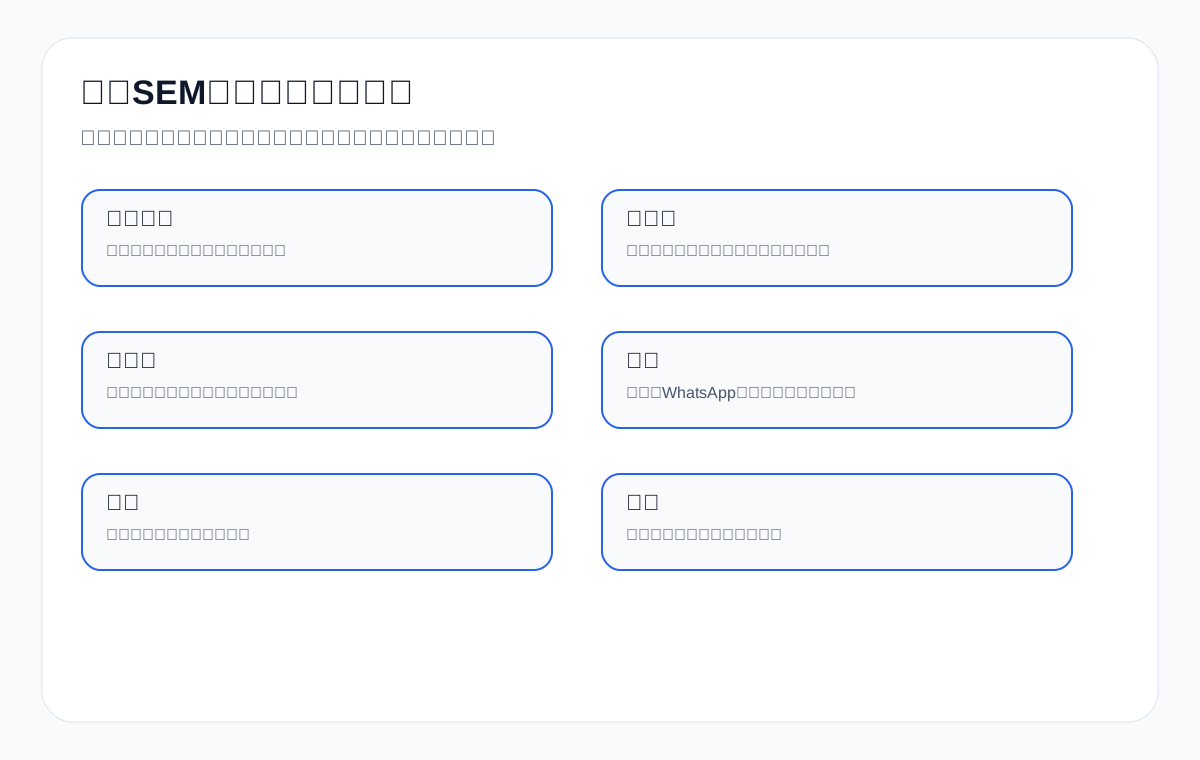
| Service module | What it involves | Why it matters |
|---|---|---|
| Account structure | Split Campaigns/Ad Groups by product line, country, advertising goal, and budget | Prevents all products from being mixed together so data cannot be interpreted |
| Keyword research | Select high-intent product terms, supplier terms, document terms, and question terms | Determines whether ads reach real purchasing demand |
| Ad copy | Clearly state products, capabilities, documents, certifications, and the inquiry entry point | Affects click-through rate and user expectations |
| Landing page recommendations | Match ad terms to product pages, category pages, and document pages | Prevents visitors from failing to find relevant content after clicking |
| Conversion tracking | Set up events for forms, phone calls, WhatsApp, downloads, and similar actions | Without tracking, campaign quality cannot be judged |
| Review and optimization | Review search terms, clicks, conversions, inquiry quality, and budget efficiency | Decides whether the next round adjusts terms, pages, or budget |
2. Which export businesses are better suited to starting with Google SEM
Not every business needs to start with advertising, but the following types of export businesses are usually better candidates for prioritizing SEM: a new site that needs to validate a market quickly while SEO is still building up; products with clear English search demand; margins that can cover customer acquisition cost; an existing basic landing page and inquiry handling capacity; and a desire to run short-term tests in certain countries or product lines.
| Business situation | Suitable for starting with SEM? | Reasoning |
|---|---|---|
| New English standalone site with no SEO data yet | Suitable for a small-budget test | Quickly validates terms, pages, and inquiry quality |
| Already has stable product pages and document pages | Suitable for accelerating acquisition | Ad traffic has a better foundation to land on |
| Low unit price, thin margin, low inquiry value | Be cautious | Click costs may squeeze margins |
| Complex products with long purchasing cycles | Suitable for carefully managed campaigns | Needs management built around high-intent terms and document pages |
| No English materials and no landing page | Build the basics first | Otherwise clicks are easily wasted |
For example, B2B products such as packaging machine, industrial valve supplier, and cnc machining parts involve complex purchasing decisions, but their search terms are usually quite specific, making them suitable for validating high-intent terms through ads. However, if a page contains only a few vague sentences of introduction with no specifications, applications, FAQ, or inquiry entry point, SEM will struggle to deliver stable value.
3. How Google SEM and Google SEO should work together
SEM and SEO should not replace each other; they should validate each other. SEM can test keywords and landing pages faster, while SEO can accumulate the validated queries and page assets over the long term.
| What SEM can provide | How SEO can use it |
|---|---|
| Real search terms report | Discover high-intent English product terms and long-tail purchasing questions |
| Ad click-through rate | Judge whether headlines and selling points attract target customers |
| Landing page conversion data | Judge whether product pages, category pages, and document pages can hold up |
| Country/region performance | Decide whether SEO needs country market pages |
| Inquiry quality feedback | Judge which terms are worth building into long-term content assets |
For example, if LED flood light ads reveal that terms related to warehouse lighting, parking lot lighting, and IP65 flood light convert better, then SEO can build out industry pages, specification pages, and FAQ around those terms. If waterproof connector ads reveal that terms related to IP67 vs IP68, panel mount, and outdoor cable connector generate more specific inquiries, then SEO should add specification pages, comparison pages, and downloadable documents.
4. More keywords is not better: foreign trade SEM needs tiering first
Many ad accounts waste budget not because they lack keywords, but because their keywords are too scattered. Foreign trade SEM should first tier keywords by purchasing intent.
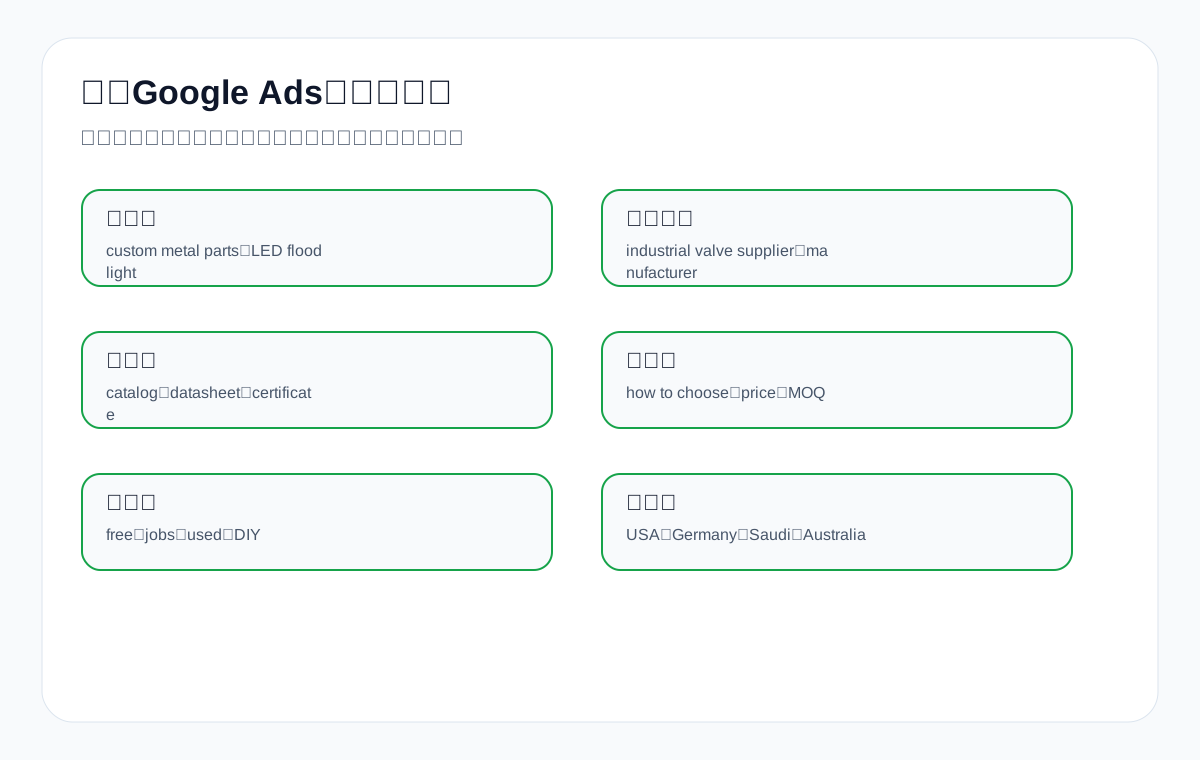
| Keyword type | Examples | Campaign recommendation |
|---|---|---|
| High-intent product terms | custom metal parts manufacturer, waterproof connector supplier | Prioritize, matched to the corresponding product or category page |
| Supplier/manufacturer terms | industrial valve supplier, private label activewear manufacturer | Suitable for capability pages and category pages |
| Document terms | catalog pdf, datasheet, certificate | Suitable for document pages or download pages |
| Question terms | how to choose packaging machine, LED flood light wattage | Suitable for guide pages, FAQ pages, or application pages |
| Broad traffic terms | lighting, machine, connector | Be cautious; usually requires stronger qualifiers |
| Negative keywords | free, jobs, used, DIY, manual only | Maintain continuously to reduce invalid clicks |
5. The landing page determines whether ad spend is wasted
Bringing users in through ads is only the first step; whether the landing page can hold them is what matters. The most common problem among export businesses is that the ad targets a specific product term while the landing page is the homepage or a generic introduction page; when users click through and cannot find specifications, images, applications, certificates, documents, or an inquiry entry point, the budget is wasted.
| Ad query | Better-suited landing page | What the landing page should include |
|---|---|---|
| medical probe compatibility | Compatibility documentation page / product document page | Compatible devices, materials, sterilization, certifications, test documentation |
| packaging machine price | Solution page / pricing factors page | Machine models, speed, configuration, pricing factors, inquiry form |
| waterproof connector catalog | Document download page / category page | Series table, specifications, downloads, applications, inquiry entry point |
| custom metal parts manufacturer | Capability page / category page | Materials, tolerances, equipment, surface finishing, drawing submission |
| LED flood light for warehouse | Application page / product series page | Wattage, illuminance, mounting height, cases, warranty |
If the landing page does not match, lowering click costs will not help. SEM optimization is not only about adjusting keywords and bids; it must also come back to the page itself.
6. Conversion tracking must be set up from the start
Ad campaigns without conversion tracking easily turn into a matter of watching only clicks and spend. An export website should at minimum record form submissions, WhatsApp/phone clicks, email clicks, catalog downloads, datasheet downloads, key page visits, and inquiry sources.
| Conversion event | Why track it | Notes |
|---|---|---|
| Form submission | The most direct inquiry signal | Filter out spam and test submissions |
| WhatsApp/phone clicks | Suited to mobile and fast communication | Distinguish real clicks from accidental taps |
| Document downloads | A strong early-stage purchasing signal | Suited to catalog, datasheet, and certificate files |
| Key page visits | Judge whether users enter the product/inquiry path | Do not treat every page view as a conversion |
| Email clicks | Helps gauge contact intent | Must be checked against real inquiries |
7. How to allocate budget: validate first, then scale
With Google SEM, it is not advisable to split the budget evenly across all products from the start. A steadier approach is to choose 1-3 high-value product lines first, validate conversions with high-intent keywords, and then gradually expand countries, term groups, and pages.
| Stage | Budget strategy | Goal |
|---|---|---|
| Testing stage | Small budget concentrated on high-intent terms | Validate whether keywords and landing pages generate inquiries |
| Optimization stage | Shift budget from ineffective terms to effective ones | Reduce waste and improve inquiry quality |
| Scaling stage | Expand countries, long-tail terms, and similar product lines | Broaden effective traffic sources |
| Review stage | Reallocate budget by inquiry quality | Make budget follow business value |
For example, if ceramic dinnerware inquiries from terms related to private label, custom logo, and bulk order are more specific, the budget should not continue to be spread evenly across broad dinnerware terms.
8. What a monthly review should look at
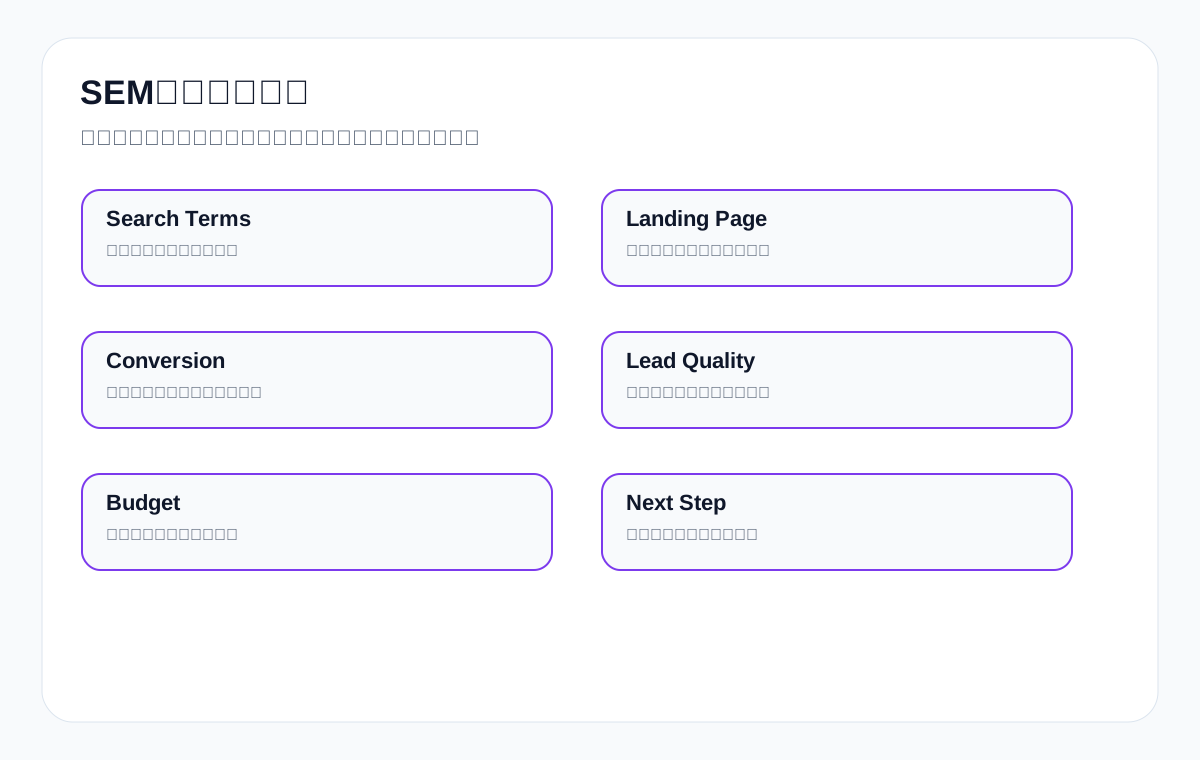
| Review dimension | What to look at | Next action |
|---|---|---|
| Search terms | Whether real search terms are close to purchasing | Add terms, add negatives, split ad groups |
| Ad copy | CTR, relevance, and whether selling points are clear | Adjust headlines, descriptions, and extensions |
| Landing page | Whether visitors continue browsing and submit after arriving | Add specifications, FAQ, documents, and CTA |
| Conversions | Whether forms, calls, and downloads are real | Exclude low-quality events and calibrate tracking |
| Inquiry quality | Whether customers specify products, quantities, markets, and parameters | Adjust keywords and page alignment |
| Budget | Whether money is spent on high-value terms | Pause low-quality terms and scale effective ones |
9. What we value most when delivering SEM services
For export businesses, SEM services should not chase only a lower CPC, but better-matched traffic, clearer landing pages, a more explainable budget, and more mature inquiries.
- Understand the product lines, target markets, and margins first, then build the ad structure.
- Start with high-intent English product terms, then expand to question terms and document terms.
- Make sure conversion tracking is accurate before discussing optimization results.
- Look at inquiry quality before surface-level click volume.
- Use ads to validate terms and pages first, then carry the proven lessons into SEO content assets.
10. Which promises to treat with caution
Google SEM involves both controllable actions and uncontrollable outcomes. Any excessive promise is unsuitable for an export business’s long-term decisions.
| Promise to treat with caution | A more reasonable statement |
|---|---|
| A guaranteed number of inquiries | Improve the probability of obtaining valid inquiries through keywords, landing pages, and reviews |
| Paying money guarantees the top position | Ad rank is affected by bids, Quality Score, competition, and budget |
| A guaranteed reduction in click price | Waste can be optimized, but CPC is affected by market competition |
| Good results without changing the website | Most B2B campaigns depend on landing page quality |
13. Examples of SEM priorities for different product lines
Foreign trade SEM cannot apply one set of keywords and landing pages to every industry. Different product lines involve different purchasing decisions, so ad terms, landing pages, and conversion events should differ as well.
| Product line | Priority keyword directions | Landing page focus | Review focus |
|---|---|---|---|
| custom metal parts | manufacturer, drawing, tolerance, surface finish | Materials, tolerances, equipment, drawing submission, inspection reports | Whether customers provide drawings and specific parameters |
| LED flood light | warehouse, parking lot, IP65, wattage | Wattage, illuminance, mounting height, IP rating, warranty | Whether inquiries include application scenarios and quantities |
| packaging machine | price, pouch, automatic, maintenance | Machine models, speed, materials, configuration, pricing factors | Whether customers specify bag type, materials, and budget |
| medical probe | compatibility, sterilization, supplier | Compatible devices, materials, sterilization, certifications, testing | Whether inquiries include model numbers and compliance requirements |
| waterproof connector | IP67, IP68, wire gauge, outdoor | Specification tables, applications, series comparisons, datasheet | Whether customers specify current, wire gauge, and environment |
| private label activewear manufacturer | private label, MOQ, sample, fabric | Fabrics, sampling, MOQ, packaging, sizes | Whether customers have a brand and order plans |
These examples show that the core of SEM is not to bid on every term, but to first find the high-intent terms most relevant to the business and then let pages address the purchasing questions behind those terms.
14. How to read the search terms report: don’t just look at how much was spent
The search terms report is one of the most valuable data sources in SEM optimization, because it tells you what users actually searched for rather than what you assumed they would search for. Export businesses should focus on three types of terms: terms that bring inquiries, terms that spend money but do not match, and terms worth carrying over into SEO.
| Search term type | How to handle it | Examples |
|---|---|---|
| High-quality inquiry terms | Raise priority and match a stronger landing page | custom cnc machining parts manufacturer |
| Price/document terms | Add pricing factors and downloadable documents | packaging machine price list, connector catalog pdf |
| Invalid broad terms | Reduce matching or add as negative keywords | free, jobs, manual, used, DIY |
| New opportunity terms | Assess whether to create a new SEO page | IP67 vs IP68 waterproof connector |
| Country market terms | Decide whether to split out country or region campaigns | industrial valve supplier Germany |
If you look only at total spend, clicks, and average CPC each month, you will miss the most important business clues in the search terms report. Many SEO topics, FAQ items, document pages, and product page optimization directions can in fact be discovered in the search terms report.
15. Landing page optimization checklist: what users need to see right after clicking an ad
A B2B export landing page does not have to be fancy, but it must let buyers quickly judge whether you are a suitable supplier. When users click through, the worst outcome is a generic introduction page with no product specifications, no documents, no applications, and no inquiry entry point.
| Section | Question it must answer | Common gap |
|---|---|---|
| Above the fold | What products you offer and who they suit | Only a welcome message and brand slogan |
| Products/capabilities | Specifications, materials, models, application scope | No specification table or series comparison |
| Trust evidence | Certifications, testing, cases, equipment, experience | Only a vague “good quality” |
| Document entry points | Whether visitors can download catalog, datasheet, and certificate | No shareable materials |
| FAQ | MOQ, lead time, sampling, packaging, after-sales | Customers have to ask repeatedly by email |
| CTA | How to send drawings, request a quote, or get in touch next | Buttons are unclear or too few |
If an SEM service ignores landing pages entirely and looks only at ad settings, it is usually very difficult to keep improving campaign quality, because ads can bring clicks but the page determines whether users take further action.
16. Common Google Ads settings: what export businesses should watch closely
An ad account has many settings. Export businesses do not need to understand every button, but they must know which settings most easily affect budget and inquiry quality.
| Setting | Why it matters | Recommendation |
|---|---|---|
| Location | Determines which countries ads appear in | Set by target market; do not default to worldwide |
| Language | Affects audience reach and matching | Set based on target customer language and English search habits |
| Match type | Affects how broad or narrow search terms are | Be more cautious early on to avoid broad match burning budget |
| Negative keywords | Reduce invalid traffic | Maintain weekly based on the search terms report |
| Bidding strategy | Affects how the system spends money | Make sure conversion tracking is accurate before using automated strategies |
| Ad extensions | Add information and improve click quality | Add products, documents, contact details, strengths, and links |
17. How sales feedback shapes SEM optimization
SEM data can only tell you what users searched, clicked, and submitted, but sales feedback tells you whether an inquiry has value. If an export campaign is not connected to sales feedback, it is easy to mistake “form volume” for “business quality.”
| Sales feedback | What it indicates | Ad optimization action |
|---|---|---|
| Customer asks only for the lowest price | Terms may be too broad or the landing page does not filter enough | Strengthen product positioning, MOQ, and application descriptions |
| Customer provides specific parameters | High-intent terms and the page match well | Scale similar keywords and pages |
| Customer market does not match | Location or term groups need adjustment | Tighten countries, languages, and negative keywords |
| Customer repeatedly asks for documents | The page lacks document entry points | Add catalog, datasheet, and FAQ |
| Quality improves but volume is low | Consider gradually increasing budget or expanding terms | Expand long-tail terms around stable term groups |
18. A 30-day SEM launch process
| Time | Key work | Deliverables |
|---|---|---|
| Week 1 | Review product lines, target markets, pages, and conversion tracking | Campaign diagnostic sheet, query directions, landing page recommendations |
| Week 2 | Build the account structure, keywords, ad copy, and basic tracking | Campaigns, Ad Groups, ads, and conversion events |
| Week 3 | Observe search terms, clicks, and early conversions | Negative keywords, ad copy adjustments, minor budget tuning |
| Week 4 | Conduct the first review together with inquiry quality | Terms to keep, terms to pause, page improvements, and next month’s plan |
The point of this process is to get a minimal closed loop working first, rather than putting every product and country into the campaign from the start.
19. How to tell whether an SEM service team is reliable
| What to check | Reliable sign | Sign requiring caution |
|---|---|---|
| Do they understand the product | Can discuss English product terms and purchasing questions | Talk only about clicks and budget |
| Do they look at pages | Offer recommendations on landing pages and conversion paths | Manage only the account, not the website |
| Are they transparent | Can explain search terms, spend, and reasons for changes | Provide only screenshots without explanation |
| Do they look at inquiries | Review quality together with sales | Look only at form volume |
| Do they set boundaries | Explain controllable actions and uncontrollable outcomes | Overpromise |
20. Materials checklist for service collaboration
- Core product lines and English product names.
- Target countries, key industries, and main customer types.
- Product catalogs, specification sheets, certificates, cases, and frequently asked questions.
- Existing English website, product pages, category pages, and inquiry pages.
- Historical inquiry quality feedback and characteristics of closed customers.
- Acceptable test budget and budget ceiling.
- Customer types sales wants to filter out.
- Products to prioritize or temporarily hold off on promoting.
The clearer the materials, the easier it is for an SEM service to direct budget toward genuinely valuable areas.
21. How SEM data feeds back into website content and SEO
Beyond bringing immediate traffic, Google Ads has another very important value: helping export businesses discover real search demand faster. Whether many product terms have inquiry value is hard to judge by imagination alone, but ad search terms, clicks, and inquiry feedback can provide clues faster.
| SEM data | Which SEO actions it can feed | Examples |
|---|---|---|
| High-converting search terms | Create or strengthen product pages/category pages | waterproof connector supplier |
| High-click, low-inquiry terms | Check page alignment and intent match | packaging machine price |
| High-quality question terms | Expand FAQ and tutorial pages | how to choose LED flood light wattage |
| Document download terms | Build document pages and download entry points | medical probe datasheet |
| Country market terms | Plan country/region landing pages | industrial valve supplier Germany |
Therefore, SEM should not be only a short-term spending item; it should also be a data source for SEO topics, page optimization, and document asset building. The more refined the campaigns, the greater the value they feed back into long-term content assets.
22. Common sources of wasted spend and how to handle them
Many ad accounts are not entirely ineffective; rather, effective and ineffective spend are mixed together. The first step in optimization is usually not to blindly increase budget, but to reduce obvious waste first.
| Source of waste | Symptom | How to handle it |
|---|---|---|
| Match type too broad | Search terms are very weakly related to the product | Tighten match types and add negative keywords |
| Location too broad | Many clicks from non-target countries | Adjust locations and excluded areas |
| Landing page mismatch | Bounces or no inquiries after the click | Switch to a better-matched product/document page |
| Conversion events too broad | Many weak actions are counted as conversions | Distinguish primary from secondary conversions |
| High spend on low-value terms | Many clicks but poor sales feedback | Lower bids, pause, or shift to SEO content coverage |
23. Service acceptance: what deliverables you should receive
When working with an SEM service, clients should not only ask “did the ads go live?” but should check whether they received interpretable stage results.
| Deliverable | Acceptance standard |
|---|---|
| Account structure documentation | You can understand the logic of product lines, countries, budget, and ad groups |
| Keyword and negative keyword list | It explains why terms are targeted and why others are excluded |
| Ad copy records | You can see how selling points, products, and landing pages correspond |
| Conversion tracking documentation | You know which events are recorded and which are only secondary signals |
| Monthly review report | Includes search terms, landing pages, inquiry quality, and next actions |
| Page optimization recommendations | Specific to URLs, sections, and additional materials |
24. Additional FAQ: budget, pages, and review questions
Should the ad budget be split evenly across products?
Not recommended. A steadier approach is to concentrate on high-value product lines and high-intent terms first, then expand after validation.
Can we run ads without a dedicated landing page?
You can, but results are usually limited. At minimum you need product pages, category pages, or document pages that can support the ad terms.
Is looking only at account data enough for an SEM service?
No. You also need to look at landing pages, conversion tracking, inquiry quality, and sales feedback.
What should we do if ad inquiries are low quality?
First check search terms, negative keywords, locations, landing pages, and form fields. Do not try to solve it only by increasing budget.
Can SEM data be used for SEO?
Yes, and it is very valuable. High-quality search terms and inquiry questions can be turned into optimization directions for product pages, FAQ pages, and tutorial pages.
How soon should the first review be done?
An early review is usually possible after 2-4 weeks, but whether to scale the budget should be judged based on inquiry quality and data volume.
11. FAQ: common questions about Google SEM optimization services
Is Google SEM suitable for all export businesses?
Not necessarily. It suits businesses with clear English product terms, margin room, landing pages, and sales capacity.
Can SEM replace SEO?
No. SEM suits rapid validation and customer acquisition, while SEO suits long-term page asset building. The two should work together.
Can we do it with a small budget?
You can run a small-scale test, but concentrate on high-intent terms and do not spread too thin.
Why do ads get clicks but no inquiries?
It may be because keywords are too broad, the landing page does not match, conversion tracking is inaccurate, or product competitiveness is insufficient.
For B2B export, should we run search ads or display ads?
In most cases, start with search ads, because search terms are closer to demand.
What materials do we need to prepare?
Product catalogs, core product lines, target markets, English pages, selling points, certificates, MOQ, lead time, and sales feedback.
How often should we review?
We recommend checking waste and anomalies weekly, and reviewing keywords, pages, conversions, and inquiry quality monthly.
Is a percentage-of-spend service fee a good arrangement?
It depends on the service scope and transparency. Whichever pricing model is used, you should look at deliverables, reviews, and inquiry quality.
12. Conclusion: SEM is not about burning money for traffic, but about using ads to validate and scale real demand
The real problem that Google SEM optimization services should solve is letting export businesses know which English product terms are worth targeting, which pages can support them, which budget is being wasted, and which inquiries are closer to purchasing. It is not simply launching ads, nor trading spend for surface-level impressions.
If you want advertising to genuinely serve export customer acquisition, you need to look at keywords, landing pages, conversion tracking, inquiry quality, and SEO asset building together. That way, SEM can move from a short-term campaign into part of a long-term growth system.
If you are evaluating Google SEM, we recommend starting with one high-value product line, getting keywords, pages, conversions, and inquiry reviews working smoothly, and then deciding whether to expand countries, budget, and product scope.
Note: This page is a machine translation of the Simplified Chinese version and is still pending human review.