AI Overviews monitoring is most often misunderstood in one specific way: many tools will tell you they “saw an AI Overview,” yet they will not necessarily tell you which page was cited, around which query it was cited, or whether that citation led to better page performance. For export manufacturers, factories, and trading companies in China, stopping at “did it appear” rarely gives you enough to guide page optimization. Monitoring that is genuinely useful has to help you connect queries, cited pages, competitor co-occurrence, click changes, and inquiry quality.
If you sell custom metal parts, LED flood light, packaging machine, medical probe, cnc machining parts, ceramic dinnerware, waterproof connector, industrial valve supplier, private label activewear manufacturer, then what you usually care about is not whether your brand occasionally shows up in AI Overviews, but rather: which product terms, application terms, FAQ terms, and resource terms are starting to trigger overviews; whether it is your product page, FAQ page, or resource page that gets cited; and whether a citation makes it easier to bring visits to category pages, product pages, and RFQ pages.
So this article is not just a list of monitoring tools. It sets out to explain clearly: which tools can only show surface-level visibility, which tools can partially see citations, which situations still require manual sampling, and how an export team should use these tools to build an AI Overviews monitoring system that can actually be reviewed.
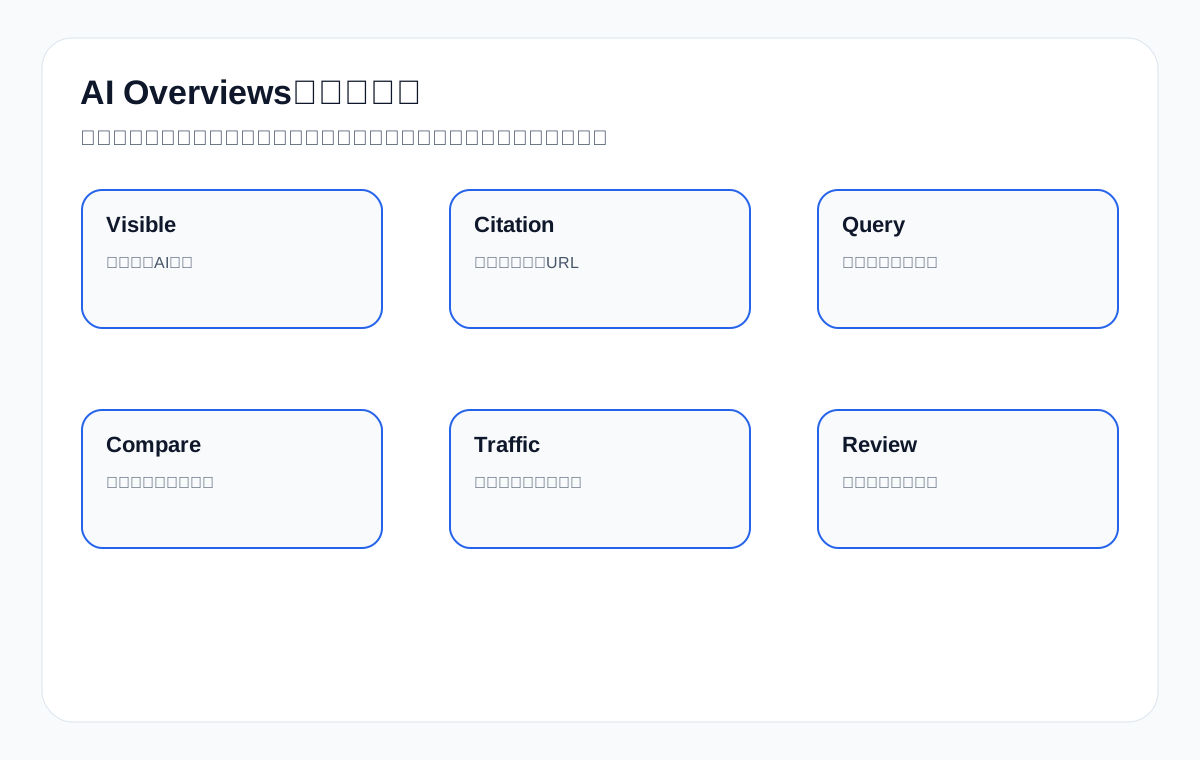
Official Acceptance Boundary: AI Overviews Monitoring Tools Can Only Deliver an Evidence Layer, Not Platform Results
AI Overviews monitoring tools are suited to answering three kinds of questions: which queries triggered an AI Overview, which pages or domains were seen during sampling, and whether the monitoring results can be traced back to page improvement actions. They are not suited to being written directly as promises about external platform results. For an export website, English product terms such as custom metal parts, LED flood light, packaging machine, and medical probe require a defined query set, country, device, sampling time, and page URL before you even discuss whether to expand the monitoring scope.
What official documentation can provide is an acceptance standard. Google explains that a site needs to let the search system crawl, understand, and use page content; the Search Console Performance report explains the reporting standard for queries, pages, clicks, impressions, and CTR; GA4 events explain the standard for on-site behavior and events; and OpenAI, Bing, and IndexNow documentation are used respectively to check crawler access, AI Performance preview metrics, and URL notification capability. Put together, these materials help a team turn a “tool screenshot” into “reviewable monitoring fields.”
Mapping Table: Official Documentation and AI Overviews Monitoring Fields
| Official documentation | Acceptance fields it can support | Conclusions it cannot directly support |
|---|---|---|
| Google Search Central: AI features and your website | The relationship between AI features and site content, preview controls, and page accessibility | Cannot establish that a given query will always use a given page |
| Google Search Central: SEO Starter Guide | Page titles, content organization, links, images, and basic SEO actions | Cannot establish that a tool’s monitoring result is a page quality score |
| Google Search Central: Search Essentials | Crawling, indexing, content, and spam boundaries | Cannot establish that a page has already earned external search performance |
| Search Console Help: Performance report | query, page, country, device, clicks, impressions, CTR, position | Cannot build a trend from a report page that has no row data |
| Search Console Help: URL Inspection tool | Whether a single URL is crawlable, whether it is indexed, and the status of page resources | Cannot replace long-term query performance |
| Search Console Help: Page indexing report | Index coverage, reasons for not being indexed, and page-level issues | Cannot prove AI answer visibility |
| Google Search Central: Sitemaps overview | Whether priority URLs are included in the sitemap and easy to discover | Cannot mean a page will be selected for any AI answer |
| Google Search Central: robots.txt introduction | Whether robots rules block crawling paths | Cannot replace page content and index checks |
| Google Search Central: Structured data general guidelines | Whether structured data complies with the general guidelines | Cannot mean an AI Overview will definitely cite structured fields |
| Google Analytics Help: About events | On-site events such as entering a product page, downloads, forms, and RFQ | Cannot replace Search Console query data |
| OpenAI Platform: Bots | Access rules for OpenAI-related crawlers and entry points for identifying them in logs | Cannot establish that ChatGPT answers use the result |
| Bing Webmaster Blog: AI Performance | The AI Performance preview metrics in Bing Webmaster Tools | Cannot replace Google or other AI platform data |
| IndexNow: Documentation | URL update notification capability and submission records | Cannot mean the URL will be adopted by search or AI systems |
AI Overviews Monitoring Acceptance Standards: Verify Queries, Pages, and Timing First, Then Look at Trends
| Acceptance item | What must be recorded | How to write a qualified deliverable |
|---|---|---|
| Query set | English product terms, FAQ terms, comparison terms, resource terms, countries, and devices | List the queries that enter monitoring instead of vaguely writing “brand visibility” |
| Page evidence | The URL that was seen, page type, title, sitemap status, index/follow status | State whether it is a product page, category page, FAQ page, or resource page |
| Sampling time | Date, region, device, tool, screenshot, or export record | Every review can return to the same set of fields for re-checking |
| GSC integration | Whether there is row data at the query/page level, and whether there are impressions or clicks | Write the data when it exists; write “no usable row data yet” when it does not |
| GA4 integration | Events such as entering a product page, RFQ, downloads, and contact buttons | Write only on-site behavior; do not substitute for external search results |
| Action loop | Titles, FAQ, structured data, internal links, image captions, page paths | Turn monitoring results into the next round of page actions |
How to Downgrade AI Overviews Monitoring Conclusions When There Is No GSC Data
If the site currently has no usable GSC query/page row data, the AI Overviews monitoring report can only be written as baseline building: which queries were set up, which URLs were checked, which pages entered the sitemap, whether robots is blocking, whether pages are index/follow, what the tool sampling records are, and which pages to change next. It must not claim click gains, ranking changes, AI answer adoption, business results, or inquiry improvement.
An export team can state the deliverable boundary more clearly: it can deliver a query set, sampling records, URL evidence, a list of page issues, GSC and GA4 review templates, and the next round of page actions; it cannot promise external AI answer presentation, search positions, clicks, inquiry volume, or purchasing conversion. That way, monitoring tools stop being a weekly screenshot report and become a reviewable page optimization system.
2. Distinguish the Three Monitoring Layers First: Visibility, Citation, Results
Many tools carry names like AI visibility, AI monitoring, and AI search tracking, but the monitoring layers they actually cover are not the same. The first layer is visibility: whether a given query shows an AI Overview. The second layer is citation: who exactly is cited inside the AI Overview, whether it is your website, and whether it is one specific URL of yours. The third layer is results: even if you are mentioned or cited, did it bring better clicks, resource visits, page behavior, and inquiry quality?
If the team does not separate these three layers first, it is easy to buy the wrong tool. For example, some tools are good at answering “does this question have an AI Overview” but cannot reliably tell you “which specific URL was cited”; some tools can do citation-level sampling but do not have good enough historical retention and export; and some tools are good at connecting monitoring with traffic but are not good at capturing citations themselves.
Table: Differences Between the Three Monitoring Layers
| Monitoring layer | What it can answer | Common misconception |
|---|---|---|
| Visibility layer | Whether a given query has an AI Overview | Mistaking this for seeing citations |
| Citation layer | Which page is cited in the AI Overview | Mistaking one screenshot for a long-term trend |
| Results layer | Whether the page and the business improved after the citation | Mistaking a mention for effectiveness |
Common Misreadings
| Statement | Where the problem is | A more accurate understanding |
|---|---|---|
| We can monitor all AI Overviews citations | Many scenarios still require sampling or manual confirmation | Citation monitoring is usually partially visible, not omniscient |
| If an AI Overview appears, it means there is an opportunity | Having an overview does not mean you are cited | You also need to look at the specific cited page |
| If the brand is mentioned, it means you are doing well | A mention does not necessarily help the business | You also need to look at the page, clicks, and inquiries |
3. Which Tools Can Usually See That an AI Overview Exists
The first category of tools is usually good at SERP-level monitoring: it tells you whether a given query shows an AI Overview in a given country or on a given device, how often it appears, and whether it comes with other changes in SERP format. These tools are suited to topic-level judgment and help you know which terms deserve to enter an AI visibility watch list.
The advantage of this category is usually broad coverage and easy batch observation; the disadvantage is that these tools often cannot reliably tell you which specific page is cited, or are not granular enough to support page-level actions well. For an export website, they are better used as the first layer of “discovery signals” rather than as the final conclusion.
What Visibility-Layer Tools Are Better Suited For
| What they are good for | What value they bring to an export team |
|---|---|
| Discovering in bulk which queries show an AI Overview | Helps you build a watch list |
| Seeing whether different markets/devices have an overview | Helps judge differences between priority markets |
| Seeing the overall coverage of a topic category | Helps decide which batch of pages to watch first |
4. Which Tools Can Partially See Citations
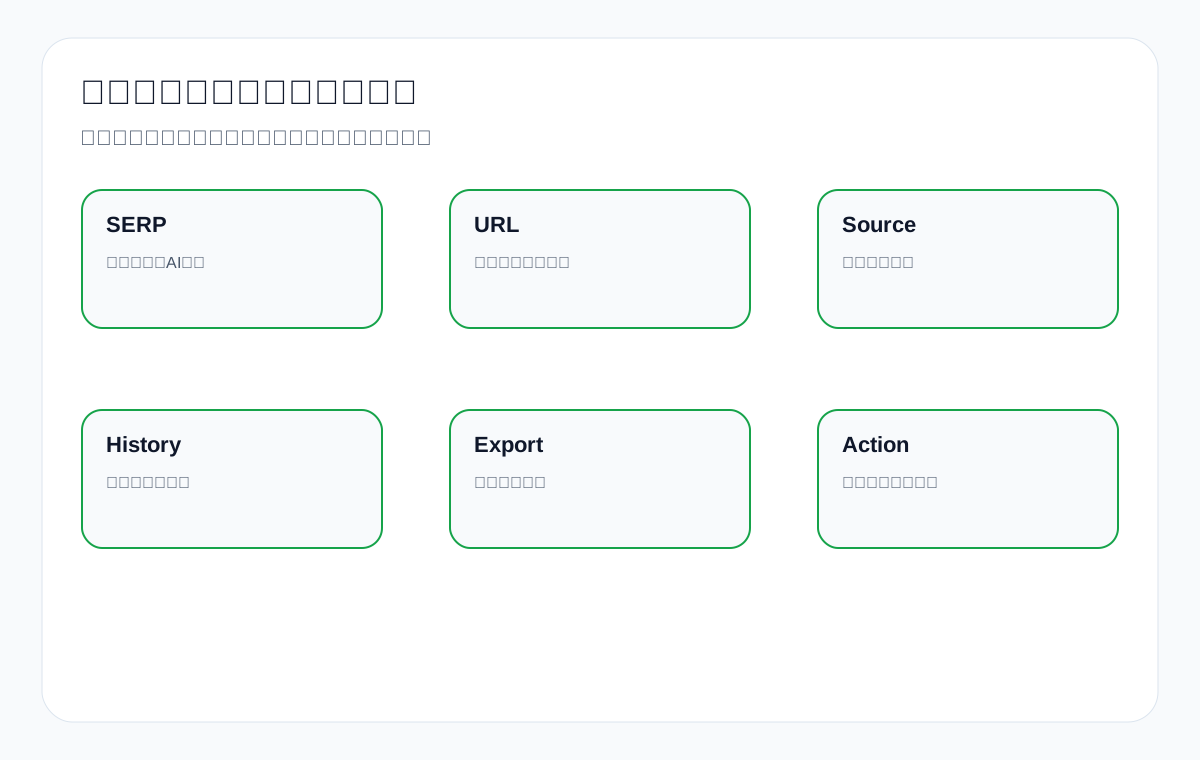
The second category of tools is closer to citation-level monitoring. They try to record the source pages, cited sites, or visible links related to your site inside AI Overviews. These tools are clearly more valuable, because once you know which URL is cited, it becomes easier to push the action back to a concrete page.
But note that “partially seeing citations” does not equal “seeing all citations.” Across different queries, countries, times, and result formats, the way visible links are displayed changes; and the data granularity and retention method that the same tool can capture are not exactly the same either. So a team should not treat citation monitoring as an absolutely complete data source, but rather as an evidence layer that is closer to page actions than pure SERP visibility.
Table for Judging Citation-Layer Tools
| What the tool can do | Why it is more valuable |
|---|---|
| Can record the cited domain or URL | Can go directly back to page optimization |
| Can keep historical screenshots or sampling records | Makes before-and-after comparison easier |
| Can flag competitor co-occurrence | Makes the source of the gap easier to judge |
| Can export query + cited page data | Easy to plug into the monthly review |
5. Which Situations Still Require Manual Sampling
No matter how advanced the tools are, part of AI Overviews monitoring work is still better suited to manual sampling. In particular, when you need to judge whether a priority query, priority country, or priority product page is accurately cited during a specific time period, manually screenshotting, recording the query, recording the cited page, and recording competitor co-occurrence remain very valuable evidence.
For an export website, this kind of manual sampling is especially suited to high-value product terms and high-value FAQ terms. For queries such as waterproof connector datasheet, packaging machine maintenance checklist, custom metal parts surface finish guide, and medical probe sterilization material, manual sampling after the tool layer gives you a signal often helps the team make a better page judgment.
Scenarios Where Manual Sampling Is Most Worthwhile
| Scenario | Why it is worth checking manually |
|---|---|
| High-value product terms | Which page is cited has a big business impact |
| FAQ and resource terms | It is easier to see whether the page was extracted accurately |
| Differences between priority markets | Tools do not necessarily cover localization changes completely |
| When a competitor is clearly ahead | Humans find it easier to see what content it cited |
6. What Export Teams Care About Is Not “Whether the Brand Showed Up,” but “Which Page Has Room to Be Amplified Further”
Many AI visibility discussions stay at the brand level, but an export team should return to the page level. What truly accumulates value over time is not the brand name showing up once in a while, but a category of product pages, FAQ pages, resource pages, or industry pages starting to be consistently seen and cited around a certain set of queries.
For example, if you find that the resource page for custom metal parts is more likely to be cited while the main product page is rarely seen, that is usually not bad news; it suggests you may need to make the path between the resource page and the product page clearer. Another example: if the FAQ page for waterproof connector is mentioned often, but users no longer go to the product page after entering, then you know the problem is not monitoring but the handoff path.
Page-Level Review Matters More Than Brand-Level Review
| What you observe | What you should do next |
|---|---|
| An FAQ page is mentioned often | Add a path to product/category pages |
| A resource page is cited a lot | Strengthen download and RFQ handoff |
| A product page is rarely seen | Add evidence, FAQ, and comparison modules |
| A competitor always appears with you | See what extractable information it has that you lack |
7. Why AI Overviews Monitoring Should Be Read Together With GSC and GA4
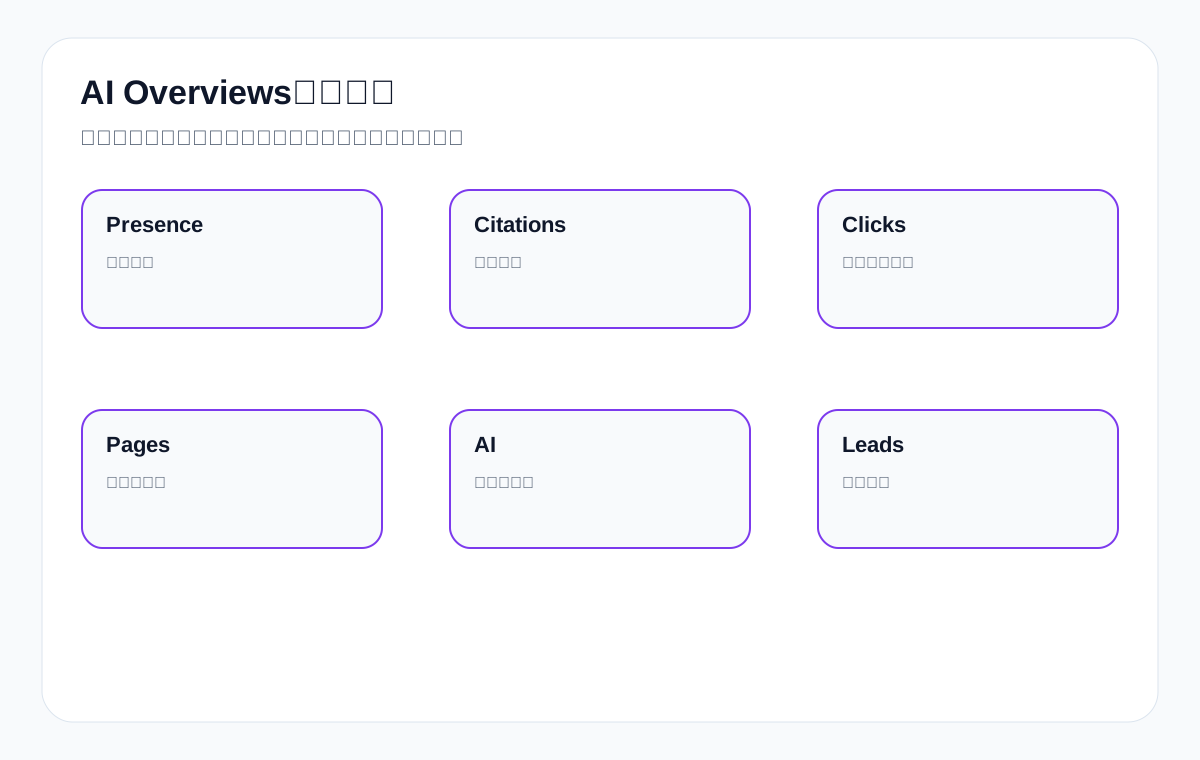
Looking only at AI Overviews monitoring tells you “what appeared”; only by reading it together with GSC and GA4 can you know “whether it had value after it appeared.” GSC helps you see whether related queries are becoming more concentrated and whether CTR has changed; GA4 helps you see whether visits go on to product pages, resource pages, or RFQ pages; and sales feedback helps you see whether these changes bring better-matched customers.
If the team skips this step, it is easy to treat scattered mentions as real results. For an export business, this kind of misjudgment is not cheap, because you may keep investing resources in pages that “look busy but do not really convert.”
Integrated Review Table
| Data layer | What it needs to answer |
|---|---|
| AI Overviews monitoring | Which queries and pages were seen or cited |
| GSC | Whether clicks on related queries and pages changed |
| GA4 | Whether users went on to product, resource, and RFQ pages |
| Sales feedback | Whether inquiries are closer to the target products and regions |
8. Choosing Different Monitoring Tools Should Not Be Separated From the Team’s Stage
A team just starting AI Overviews monitoring usually does not need to buy a very heavy system right away. A more practical approach is to first build a set of target queries, judge whether an AI Overview exists using lightweight tools or a semi-manual approach, and then do citation-level sampling for priority queries. Once the team can review steadily, consider more systematic monitoring.
Conversely, for teams with more product lines, more country markets, and a need for multi-person collaboration, a more systematic tool is more likely to be worth the investment, because manual sampling quickly becomes a bottleneck.
Choosing Tools by Stage
| Team stage | Which monitoring approach fits better |
|---|---|
| Early stage | Lightweight SERP observation + manual citation sampling |
| Growth stage | SERP tools + citation-level tools + spreadsheet review |
| Multi-product-line stage | More stable batch monitoring + unified export + team dashboard |
9. The 5 Most Common Monitoring Mistakes
The first mistake is understanding “monitoring AI Overviews” as “monitoring citations.” The second mistake is treating one screenshot as a long-term trend. The third mistake is looking only at the brand level and not the page level. The fourth mistake is having monitoring but never returning to page actions. The fifth mistake is not integrating with GSC, GA4, and inquiry quality.
These mistakes are common because AI Overviews is itself very new, and many teams more easily chase the visible result of “did it appear” while ignoring the more important depth of review.
Mistakes and Corrections
| Mistake | Better approach |
|---|---|
| Recording only appears/does not appear | Keep recording the cited page, competitor co-occurrence, and answer accuracy |
| Taking only one screenshot | Set a fixed sampling frequency |
| Looking only at brand mentions | Return to specific URLs and page types |
| Looking only at AI-layer data | Integrate GSC, GA4, and inquiry results |
| Buying a tool without setting up a review table | Use monthly reviews to turn monitoring into action |
10. FAQ: The Most Common Questions About AI Overviews Monitoring
Can all AI Overviews monitoring tools see citations?
No. Many tools are better at seeing “whether there is an AI Overview,” and tools that can reliably record the cited page are fewer, and usually only partially visible.
Does seeing a citation mean the page is definitely strong?
Not necessarily. You also need to look at which page is cited, around which query, and whether there are subsequent clicks and better page behavior.
Why is manual sampling still needed?
Because for priority queries, priority markets, and high-value pages, manual records often provide a finer basis for judgment than automation.
If the brand is mentioned but there are no clicks, does that still count as progress?
It counts as an early signal, but it should not be directly equated with a business result. You still need to look at the page path and inquiry quality.
With a limited budget, which type should I buy first?
Usually start with lightweight SERP observation and manual citation sampling, and once the query set and review method are working, then decide whether to buy a heavier citation-level tool.
Which queries are most worth monitoring closely for an export website?
High-value product terms, FAQ terms, comparison terms, certificate terms, resource terms, and inquiry-readiness terms are usually worth monitoring with priority.
11. Conclusion: First Be Clear About Which Layer You Want to See, Then Choose Tools
What makes AI Overviews monitoring truly difficult is not that there are no tools on the market, but that many teams have not first thought clearly about which layer they actually want to see: which queries have an overview, which pages are cited, or whether those citations truly bring page and business results.
For export manufacturers and trading companies, the most stable approach is to first build a high-value query set, then use tools to see visibility, use manual or finer-grained methods to confirm priority citations, and finally connect the results to GSC, GA4, resource visits, and inquiry quality. That way, AI Overviews monitoring moves from “a fresh observation” to “evidence that can genuinely guide page optimization.”
As long as you keep looking at five layers — query, page, citation, behavior, and business — you will find faster than by looking only at “did it appear” which pages are worth continuing to amplify and which pages only look busy.
Final Checklist
| Check item | Completion standard |
|---|---|
| Query set | A fixed list of high-value queries exists |
| Monitoring layers | Visibility, citation, and results are clearly separated |
| Page dimension | You can tell which page was mentioned or cited |
| Review integration | GSC, GA4, and inquiries are read together |
| Priority sampling | High-value terms have manual evidence |
| Page actions | Monitoring results can be turned into specific optimization items |
{
“@context”: “https://schema.org”,
“@type”: “FAQPage”,
“mainEntity”: [
{
“@type”: “Question”,
“name”: “Monitoring Goals and Page Task TablennWhat you want to know, why it matters, which type of tool/method is needed morennDoes an AI Overview appear? Judge whether the topic has entered the AI results layer — SERP monitoringnWhich page is cited? Judge whether the page asset is truly understood — citation-level monitoring / manual samplingnAround which query does it appear? Decide which type of page to change next — query-level monitoringnDoes it bring better visits? Avoid watching only the activity — GSC/GA4 integrationnn2. Distinguish the three monitoring layers first: visibility, citation, resultsnMany tools carry names like AI visibility, AI monitoring, and AI search tracking, but the monitoring layers they actually cover are not the same. The first layer is visibility: whether a given query shows an AI Overview. The second layer is citation: who exactly is cited inside the AI Overview, whether it is your website, and whether it is one specific URL of yours. The third layer is results: even if you are mentioned or cited, did it bring better clicks, resource visits, page behavior, and inquiry quality?nIf the team does not separate these three layers first, it is easy to buy the wrong tool. For example, some tools are good at answering “does this question have an AI Overview” but cannot reliably tell you “which specific URL was cited”; some tools can do citation-level sampling but do not have good enough historical retention and export; and some tools are good at connecting monitoring with traffic but are not good at capturing citations themselves.nTable: Differences Between the Three Monitoring LayersnnMonitoring layer / what it can answer / common misconceptionnnVisibility layer — whether a given query has an AI Overview — mistaking this for seeing citationsnCitation layer — which page is cited in the AI Overview — mistaking one screenshot for a long-term trendnResults layer — whether the page and the business improved after the citation — mistaking a mention for effectivenessnnCommon MisreadingsnnStatement / where the problem is / a more accurate understandingnnWe can monitor all AI Overviews citations — many scenarios still require sampling or manual confirmation — citation monitoring is usually partially visible, not omniscientnIf an AI Overview appears, it means there is an opportunity — having an overview does not mean you are cited — you also need to look at the specific cited pagenIf the brand is mentioned, it means you are doing well — a mention does not necessarily help the business — you also need to look at the page, clicks, and inquiriesnn3. Which tools can usually see that an AI Overview existsnThe first category of tools is usually good at SERP-level monitoring: it tells you whether a given query shows an AI Overview in a given country or on a given device, how often it appears, and whether it comes with other changes in SERP format. These tools are suited to topic-level judgment and help you know which terms deserve to enter an AI visibility watch list.nThe advantage of this category is usually broad coverage and easy batch observation; the disadvantage is that these tools often cannot reliably tell you which specific page is cited, or are not granular enough to support page-level actions well. For an export website, they are better used as the first layer of “discovery signals” rather than as the final conclusion.nWhat Visibility-Layer Tools Are Better Suited FornnWhat they are good for / what value they bring to an export teamnnDiscovering in bulk which queries show an AI Overview — helps you build a watch listnSeeing whether different markets/devices have an overview — helps judge differences between priority marketsnSeeing the overall coverage of a topic category — helps decide which batch of pages to watch firstnn4. Which tools can partially see citationsnThe second category of tools is closer to citation-level monitoring. They try to record the source pages, cited sites, or visible links related to your site inside AI Overviews. These tools are clearly more valuable, because once you know which URL is cited, it becomes easier to push the action back to a concrete page.nBut note that “partially seeing citations” does not equal “seeing all citations.” Across different queries, countries, times, and result formats, the way visible links are displayed changes; and the data granularity and retention method that the same tool can capture are not exactly the same either. So a team should not treat citation monitoring as an absolutely complete data source, but rather as an evidence layer that is closer to page actions than pure SERP visibility.nTable for Judging Citation-Layer ToolsnnWhat the tool can do / why it is more valuablennCan record the cited domain or URL — can go directly back to page optimizationnCan keep historical screenshots or sampling records — makes before-and-after comparison easiernCan flag competitor co-occurrence — makes the source of the gap easier to judgenCan export query + cited page data — easy to plug into the monthly reviewnnFigure 2: What is truly valuable is not “whether there is monitoring,” but how fine-grained the monitoring can be.n5. Which situations still require manual samplingnNo matter how advanced the tools are, part of AI Overviews monitoring work is still better suited to manual sampling. In particular, when you need to judge whether a priority query, priority country, or priority product page is accurately cited during a specific time period, manually screenshotting, recording the query, recording the cited page, and recording competitor co-occurrence remain very valuable evidence.nFor an export website, this kind of manual sampling is especially suited to high-value product terms and high-value FAQ terms. For queries such as waterproof connector datasheet, packaging machine maintenance checklist, custom metal parts surface finish guide, and medical probe sterilization material, manual sampling after the tool layer gives you a signal often helps the team make a better page judgment.nScenarios Where Manual Sampling Is Most WorthwhilennScenario / why it is worth checking manuallynnHigh-value product terms — which page is cited has a big business impactnFAQ and resource terms — it is easier to see whether the page was extracted accuratelynDifferences between priority markets — tools do not necessarily cover localization changes completelynWhen a competitor is clearly ahead — humans find it easier to see what content it citednn6. What export teams care about is not “whether the brand showed up,” but “which page has room to be amplified further”nMany AI visibility discussions stay at the brand level, but an export team should return to the page level. What truly accumulates value over time is not the brand name showing up once in a while, but a category of product pages, FAQ pages, resource pages, or industry pages starting to be consistently seen and cited around a certain set of queries.nFor example, if you find that the resource page for custom metal parts is more likely to be cited while the main product page is rarely seen, that is usually not bad news; it suggests you may need to make the path between the resource page and the product page clearer. Another example: if the FAQ page for waterproof connector is mentioned often, but users no longer go to the product page after entering, then you know the problem is not monitoring but the handoff path.nPage-Level Review Matters More Than Brand-Level ReviewnnWhat you observe / what you should do nextnnAn FAQ page is mentioned often — add a path to product/category pagesnA resource page is cited a lot — strengthen download and RFQ handoffnA product page is rarely seen — add evidence, FAQ, and comparison modulesnA competitor always appears with you — see what extractable information it has that you lacknn7. Why AI Overviews monitoring should be read together with GSC and GA4nLooking only at AI Overviews monitoring tells you “what appeared”; only by reading it together with GSC and GA4 can you know “whether it had value after it appeared.” GSC helps you see whether related queries are becoming more concentrated and whether CTR has changed; GA4 helps you see whether visits go on to product pages, resource pages, or RFQ pages; and sales feedback helps you see whether these changes bring better-matched customers.nIf the team skips this step, it is easy to treat scattered mentions as real results. For an export business, this kind of misjudgment is not cheap, because you may keep investing resources in pages that “look busy but do not really convert.”nIntegrated Review TablennData layer / what it needs to answernnAI Overviews monitoring — which queries and pages were seen or citednGSC — whether clicks on related queries and pages changednGA4 — whether users went on to product, resource, and RFQ pagesnSales feedback — whether inquiries are closer to the target products and regionsnn8. Choosing different monitoring tools should not be separated from the team’s stagenA team just starting AI Overviews monitoring usually does not need to buy a very heavy system right away. A more practical approach is to first build a set of target queries, judge whether an AI Overview exists using lightweight tools or a semi-manual approach, and then do citation-level sampling for priority queries. Once the team can review steadily, consider more systematic monitoring.nConversely, for teams with more product lines, more country markets, and a need for multi-person collaboration, a more systematic tool is more likely to be worth the investment, because manual sampling quickly becomes a bottleneck.nChoosing Tools by StagennTeam stage / which monitoring approach fits betternnEarly stage — lightweight SERP observation + manual citation samplingnGrowth stage — SERP tools + citation-level tools + spreadsheet reviewnMulti-product-line stage — more stable batch monitoring + unified export + team dashboardnnFigure 3: Mentions, citations, clicks, and inquiries must be read together to avoid mistaking activity for results.n9. The 5 most common monitoring mistakesnThe first mistake is understanding “monitoring AI Overviews” as “monitoring citations.” The second mistake is treating one screenshot as a long-term trend. The third mistake is looking only at the brand level and not the page level. The fourth mistake is having monitoring but never returning to page actions. The fifth mistake is not integrating with GSC, GA4, and inquiry quality.nThese mistakes are common because AI Overviews is itself very new, and many teams more easily chase the visible result of “did it appear” while ignoring the more important depth of review.nMistakes and CorrectionsnnMistake / better approachnnRecording only appears/does not appear — keep recording the cited page, competitor co-occurrence, and answer accuracynTaking only one screenshot — set a fixed sampling frequencynLooking only at brand mentions — return to specific URLs and page typesnLooking only at AI-layer data — integrate GSC, GA4, and inquiry resultsnBuying a tool without setting up a review table — use monthly reviews to turn monitoring into actionnn10. FAQ: The most common questions about AI Overviews monitoringnCan all AI Overviews monitoring tools see citations?”,
“acceptedAnswer”: {
“@type”: “Answer”,
“text”: “No. Many tools are better at seeing “whether there is an AI Overview,” and tools that can reliably record the cited page are fewer, and usually only partially visible.”
}
},
{
“@type”: “Question”,
“name”: “Does seeing a citation mean the page is definitely strong?”,
“acceptedAnswer”: {
“@type”: “Answer”,
“text”: “Not necessarily. You also need to look at which page is cited, around which query, and whether there are subsequent clicks and better page behavior.”
}
},
{
“@type”: “Question”,
“name”: “Why is manual sampling still needed?”,
“acceptedAnswer”: {
“@type”: “Answer”,
“text”: “Because for priority queries, priority markets, and high-value pages, manual records often provide a finer basis for judgment than automation.”
}
},
{
“@type”: “Question”,
“name”: “If the brand is mentioned but there are no clicks, does that still count as progress?”,
“acceptedAnswer”: {
“@type”: “Answer”,
“text”: “It counts as an early signal, but it should not be directly equated with a business result. You still need to look at the page path and inquiry quality.”
}
},
{
“@type”: “Question”,
“name”: “With a limited budget, which type should I buy first?”,
“acceptedAnswer”: {
“@type”: “Answer”,
“text”: “Usually start with lightweight SERP observation and manual citation sampling, and once the query set and review method are working, then decide whether to buy a heavier citation-level tool.”
}
}
]
}
12. Why “Being Able to See an AI Overview” Is Not the Same as “Being Able to See the Cited Page”
Many monitoring products give users a certain impression during a demo: as long as it can tell you that a query has AI Overviews, it seems to have solved the citation-tracking problem. In reality these are two different layers. The former is closer to SERP appearance monitoring, while the latter is closer to page-level evidence tracking.
For an export team, this difference is critical. If you do not know which page is cited, it is hard to decide whether to add FAQ content next, add product evidence, add resource downloads, or open up the path between the FAQ page and the product page. In other words, “there is an overview” at most tells you the topic is worth attention, but “which page is cited” is closer to genuinely executable page optimization.’)
| Monitoring layer | What you can know | What you still do not know |
|---|---|---|
| Overview exists | A query shows AI Overviews | Whether you are cited, and which page is cited |
| Partial citation visible | Some sources or URLs are visible | Whether all results are covered and whether they can be retained long term |
| Integrated review | Whether page performance changed after the citation | Business value and inquiry quality still need to be judged |
13. A Manual Sampling SOP Suited to an Export Website
If your team does not yet have a heavy monitoring tool, you can absolutely build a manual sampling SOP first. Its focus is not to cover every query, but to sample a fixed set of high-value queries and record them with a consistent method. For an export site, starting with 10 to 30 core queries is usually enough.
You can build a list by product line, for example waterproof connector, custom metal parts, packaging machine, industrial valve supplier, medical probe, and so on, then break it down further into FAQ questions, resource terms, and comparison terms. Sample every week at a fixed time, in a fixed region, and on a fixed device environment, and record: whether there is an AI Overview, whether your website is seen, if so which page it is, which competitors appear alongside, whether the answer misreads anything, and whether it is worth returning to the page to make changes.’)
| Sampling field | Why it must be recorded |
|---|---|
| Query term | Pin down the specific question without confusing topics |
| Country/region | AI Overviews results may differ by region |
| Device/browsing environment | Result display may change with the environment |
| Whether an overview exists | Judge whether the topic has entered the AI results layer |
| Whether your website is seen | Judge brand/page visibility |
| If cited, which page | Connect directly to page actions |
| Competitor co-occurrence | Help judge the source of the gap |
| Misreading/error | Help find problems in how the page states facts |
Once this manual SOP runs smoothly, the team will find it much easier to judge whether a product is saving you time or merely repeating what you can already see by hand.
14. The Export Page Types Most Easily Overlooked in AI Overviews Monitoring
When many teams mention AI Overviews monitoring, they watch only blog posts or FAQ pages. But for an export website, resource pages, application pages, comparison pages, certification explanation pages, and sample preparation pages are equally worth monitoring. That is because when AI systems answer purchasing questions, they do not always cite traditional blog posts; they may also prefer resource-type pages with clear structure, well-defined factual boundaries, and an obvious question orientation.
For example, a query like medical probe sterilization material guide is more likely to be handled by a resource page or a technical FAQ page; packaging machine maintenance checklist may lean more toward a resource page; and waterproof connector IP67 vs IP68 may be handled by an FAQ comparison page. Watching only blogs makes the team miss the page types truly worth strengthening.’)
| Page type | Why it is worth monitoring | Common high-value queries |
|---|---|---|
| FAQ page | Better at answering a clear question | IP67 vs IP68, MOQ questions |
| Resource page | Better at handling download, specification, and process questions | datasheet, maintenance, certificate |
| Application page | Closer to real purchasing scenarios | marine use, medical use, outdoor use |
| Product page | Can handle clear commercial questions | supplier, manufacturer, specs |
| Category page | Suited to series differences and scenario entry points | connector types, machine categories |
15. What Different Tools “Cannot See” Is Often Exactly What You Need to Fill In by Hand
No matter how many tools there are, they will always have areas they naturally cannot see. For example, some tools cannot see the specific paragraph that was cited, some tools cannot reliably cover all country results, and some tools can see that you were mentioned but cannot see the subsequent click changes. A truly mature team does not complain about these blind spots as tool defects, but writes them into its own manual review process.
In other words, the value of a tool is not only what it tells you, but also what it reminds you that you still need to check by hand. This way of thinking matters especially for an export site, because you often need to judge additionally: whether this citation brought users to a sample preparation page, whether it made it easier for customers to download resources, and whether it is closer to the target market.’)
16. How to Buy Monitoring Tools More Stably When the Budget Is Limited
If the team’s budget is limited, it is not advisable to invest heavily in multiple monitoring products from the start. A more stable approach is: first confirm whether one tool can help you judge in bulk “which queries have AI Overviews,” then combine it with manual sampling to confirm “which pages of which key queries are cited.” Once both layers run smoothly, then decide whether you need deeper citation-level or team-collaboration tools.
The benefit of this progressive purchasing approach is that you always know which layer of capability each budget item is filling, instead of buying many services at once just to avoid “missing an opportunity.” Many export teams eventually find that the most useful thing is not the most expensive platform, but “one monitoring layer good enough to watch + one stable sampling table + one review process that can connect results back to page actions.”’)
| Budget stage | How it is better to buy | Core goal |
|---|---|---|
| Starting | Lightweight monitoring + manual sampling | Build query and page awareness first |
| Advanced | Add tools that can export and retain data | Make reviews more stable |
| Mature | Add team collaboration and multi-market support | Expand coverage and collaboration efficiency |
17. Use Monitoring Results to Drive Page Changes, Not Just Weekly Reports
In AI Overviews monitoring, many teams most easily stop at “producing weekly reports.” Every week they can capture some screenshots and say that certain queries show an overview, but this information never truly turns into page change actions. Over time, the team increasingly feels that monitoring is just a reporting task, not an optimization task.
A more effective approach is to answer three questions after every monitoring round: which queries are worth continuing to follow, which pages are worth strengthening, and which competitor differences are most worth learning from. For example, if you find that the FAQ page for packaging machine has an overview but rarely cites you, while competitors are always mentioned alongside, then look at whether competitors have a clearer maintenance checklist, parameter table, or application scenario.’)
As long as monitoring results can be steadily turned into page actions, the team will gradually form a closed loop of “monitor — judge — change — review,” instead of spinning in place with “monitor — screenshot — report — end.”’)
18. What You Should Really Compare When Comparing Monitoring Tools
When genuinely comparing monitoring tools, it is not advisable to look only at “how many platforms it supports” or “whether it has the word AI in it.” What matters more is five things: first, whether it can be viewed by query; second, whether it can see citations or source pages as far as possible; third, whether it can retain historical records; fourth, whether it can export results; and fifth, whether it can help you turn monitoring into page actions.
For an export team, these five points matter almost more than whether the interface looks good. Only when these items are satisfied is it easier to look back a month later and check: whether a certain product line has become stronger, whether a certain FAQ page is mentioned more often, and whether a certain competitor keeps co-occurring with you.’)
| Comparison dimension | Why it is key | What it practically means for an export team |
|---|---|---|
| Query-level view | Know exactly which question it appears around | Easy to connect back to product terms and FAQ terms |
| Citation/source visibility | Close to page-level actions | Know whether to change the FAQ page or the product page |
| Historical retention | Makes before-and-after comparison easier | Avoid judging only from memory |
| Export and annotation | Makes team review easier | Let sales, operations, and SEO look at the same table |
| Action conversion capability | Monitoring should not stop at observation | Makes a page optimization loop easier to form |
19. How to Run the Monthly Review So Monitoring Tools Do Not Become Screenshot Tools
If your team already has some kind of AI Overviews monitoring method, whether tools or manual sampling, the most critical thing is to connect it to a fixed review meeting. An effective monthly review should not just present “how many times it appeared this month,” but should discuss around pages and business results: which queries are worth continuing to follow, which pages are worth expanding or adding evidence to, and which competitor differences are most worth learning from.’)
A more practical order for the monthly review is usually: first look at the high-value query list, then look at whether priority pages were mentioned or cited, then look at the click and path changes for these pages in GSC and GA4, and finally look at whether better-matched inquiries came in. That way, AI Overviews monitoring is no longer an isolated project, but is genuinely tied to page optimization.’)
| Monthly review step | Question to answer |
|---|---|
| Query layer | Which questions started having an AI Overview, and which still do not |
| Page layer | Which pages were mentioned and cited, and which are still absent |
| Gap layer | When a competitor appears alongside, what extra content or evidence does it have |
| Behavior layer | Whether clicks and entries into product pages, resource pages, and RFQ pages improved for these pages |
| Action layer | Which FAQ, resource pages, and product pages to change first next month |
20. A Sample AI Overviews Monitoring Deliverable Suited to a Trial Collaboration
If you are working with an external team on AI search visibility, you might ask them to give you a small-scope monitoring deliverable first instead of signing a long contract from the start. What matters most in this trial is not “covering the whole site,” but letting you see whether it can turn monitoring into page actions.’)
For example, pick just one product line, 10 to 20 core queries, and 3 to 5 priority pages; the other party should deliver at least: a query list, sampling screenshots, whether there is an AI Overview, whether your site is cited, competitor co-occurrence, suggested page actions, and a simple review table. As long as these things are delivered clearly, it is easier to judge whether they can really do the work or only talk about concepts.’)
| What a trial collaboration should deliver | Why it matters |
|---|---|
| Target query list | Avoid later disputes about what exactly is being monitored |
| AI Overviews sampling screenshots | Keep human-checkable evidence |
| Site/page citation records | Easy to return to the specific page |
| Competitor co-occurrence records | Help judge the source of the gap |
| Suggested page actions | Monitoring must turn into optimization actions |
| Monthly brief review table | Ensure tracking can continue instead of being a one-off observation |
21. The Monitoring Red Flags Most Worth Watching For
- It only shows the number of brand appearances, but cannot explain around which queries and which pages.
- It directly turns “there is an AI Overview” into “you were cited.”
- It provides no historical screenshots and does not support export; all data stays only in the platform interface.
- It cannot explain how the monitoring results will guide changes to FAQ, resource pages, and product pages.
- It does not mention GSC, GA4, or inquiry quality at all, and talks only about visibility buzz.
These red flags are dangerous because they keep a team at the observation layer for a long time, unable to accumulate page assets that can truly be reviewed.’)
22. Export Page Case Study: Why FAQ Pages and Resource Pages Are Often More Worth Monitoring Than Brand Pages
On many export websites, FAQ pages and resource pages enter the core AI Overviews monitoring list more easily than brand introduction pages. That is because the questions they answer are more specific, their structure is clearer, and they are easier for the system to cite as factual content.’)
For example, the FAQ page for waterproof connector may be more likely to appear in “IP67 vs IP68” questions; the resource page for medical probe may be more likely to appear in material and sterilization compatibility questions; and the maintenance checklist page for packaging machine may be more likely to handle maintenance and fault-prevention questions. Although the brand page is important, it is usually not the best page for this kind of specific query.’)
Once you discover this pattern through monitoring, you can strengthen these FAQ and resource pages in a more targeted way, instead of putting all your energy into the brand introduction or homepage level.’)
23. Teams at Different Stages Have Different AI Overviews Monitoring Priorities
For a team just starting out, the most important thing is to build awareness of “which queries are worth watching and which pages are worth watching”; for a mid-sized team, it is more important to form stable sampling and review; and for a multi-product-line team, what is needed more is a monitoring mechanism that can export, collaborate, and be retained long term. In other words, the tools most worth buying and the effort most worth spending differ by team stage.
If the team does not yet have a stable query set, pursuing a very complex visualization platform from the start usually yields low returns. Conversely, if there are many product lines and many markets and the team is still doing manual screenshots, it will soon give up on review because the workload is too large. So the monitoring approach must match the team stage.’)
| Team stage | What to do first | Which monitoring approach fits better |
|---|---|---|
| Early stage | Build a high-value query list first | Lightweight SERP observation + manual citation sampling |
| Growth stage | Plug monitoring into the page improvement rhythm | Exportable tools + a fixed review table |
| Multi-product-line stage | Unify review across markets and pages | More systematic query, citation, and dashboard integration |
24. How to Spend the Budget More Reasonably: Buy What “Can Guide Actions” First, Not What Is “Most Exciting”
When the budget is limited, what should be prioritized is not the flashiest visualization, but the capabilities that truly help you guide page actions. In other words, compared with a platform that only tells you “it appeared many times,” a tool that lets you know “around which queries, which pages were seen, and what to change next” is usually more valuable.
For an export website, what is truly scarce is not a screenshot proving “the brand was mentioned in AI,” but the judgment evidence of “which page should add FAQ, which page should add resource downloads, and which page should add a comparison table.” As long as this priority is set correctly, the budget is usually less likely to be wasted.’)
| Budget priority | Why it is more worth investing in first |
|---|---|
| Query-level observation capability | Know first which questions are worth long-term monitoring |
| Page-level citation judgment capability | Closer to specific page actions |
| Export and retention capability | Makes continuous review and team collaboration easier |
| Integration with GSC/GA4 | Avoid stopping at the buzz-data layer |
25. After Monitoring, Page Actions Usually Fall Into a Few Categories of Changes
The real meaning of AI Overviews monitoring is not to get more screenshots, but to drive more specific page changes. For an export website, page actions after monitoring usually fall into four categories: the first is completing FAQ content; the second is strengthening resource pages, specification pages, and download entry points; the third is optimizing the path between product pages and FAQ pages; and the fourth is structural optimization of titles, opening paragraphs, and tables to make extraction easier for AI.’)
If a team monitors for a long time but rarely produces these categories of page changes, it usually means monitoring has not truly entered the optimization layer.’)
| Monitoring finding | Common page action |
|---|---|
| FAQ page is mentioned but the path is weak | Add entry points to product/category/RFQ pages |
| Resource page is cited but download conversion is weak | Add download instructions, usage explanations, and next-step actions |
| Competitors often appear alongside | Add comparison tables, limitation notes, and evidence modules |
| Product page is almost never seen | Add FAQ, structure, application scenarios, and a parameter summary |
| Many mentions but clicks do not move | Integrate GSC and GA4 to look at paths and page handoff |
26. Why “Whether a Monitoring Tool Is Accurate” Should Not Be Judged From a Single Screenshot
When testing tools, some teams run one or two queries and then either reject the tool completely because one result was not captured, or fully trust it because one result happened to be captured. A more reasonable approach is to use a small but stable sample set and observe it multiple times over 2 to 4 weeks. AI Overviews itself fluctuates, so a single screenshot can hardly prove a tool’s long-term performance.’)
This is also why we emphasize sampling frequency, historical retention, and review rather than chasing one perfect capture. For a business, what really matters is not whether a particular capture succeeded, but whether this method can consistently help you see signals worth acting on over a period of time.’)
27. What an Export Team Should Ultimately Retain Is Not Just Tools, but a Monitoring Method
After a team has used several rounds of AI Overviews monitoring, the most valuable outcome is not which tool was purchased, but the formation of its own method: which queries to watch consistently, which pages to sample consistently, how to consistently record competitor co-occurrence and misreadings, and how to consistently bring results back into GSC, GA4, and inquiry review.’)
Once this method is established, the team will not start from zero even if it changes tools later. What you truly retain is a judgment framework, not a particular product interface. For a team doing long-term content building on an export site, this point is critical.’)
28. Final Action Checklist
- Have we clearly separated the three layers of “overview exists,” “citation visible,” and “result value”?
- Do we have a high-value query list instead of taking random screenshots?
- Do we know whether to focus on FAQ pages, resource pages, product pages, or category pages?
- Have we kept historical samples instead of looking only at the current screenshot?
- Do we read monitoring results together with GSC, GA4, and inquiry quality?
- Can we turn monitoring results into specific page change items?
- If we do not use a particular tool right now, can we still get the method working by hand first?
If more than half of these items cannot be answered clearly, it usually means what is most needed right now is not another new platform, but to first get the monitoring method on solid footing. Once the method is solid, tool selection becomes much clearer.’)
29. Different Purchasing Roles Care About Different Things in the Same Monitoring Result
Technical buyers care more about: which resource pages and FAQ pages were extracted correctly, and whether the answer misreads specifications or application boundaries. Business buyers care more about: whether these mentions brought visits to product pages, resource pages, and RFQ pages. Management cares more about: whether the team is now clearer about which type of page to put resources into. In other words, the same monitoring result has somewhat different value points in front of different roles.’)
This is also why monitoring should not be made into a single screenshot list, but should be able to add brief page action suggestions. That way, when different roles see the same result, each knows how to use it in the next step.’)
30. A Minimum Viable Process You Can Start Within Two Weeks
If you want to start today, you can run a minimum viable process over two weeks: in the first week, organize 10 to 20 high-value queries covering product terms, FAQ terms, resource terms, and comparison terms; in the second week, start sampling at a fixed time and record whether an AI Overview appears, whether your website is seen, if so which page it is, and which competitors appear alongside. Then put these results and the query and click changes of related pages in GSC into the same table.’)
Although this minimum process is not complicated, it is already enough to let the team begin to see: which pages are more worth continuing to strengthen, and which pages only look popular but have no follow-up actions. Rather than continuing to wait for a “more perfect tool solution,” it is more important to get the method running first.’)
| Two-week process | Key action |
|---|---|
| Week 1 | Organize high-value queries and mark the page type |
| Week 2 | Sample and record the overview, cited page, competitors, and misreadings |
| Integration action | Connect GSC queries with page clicks |
| Review action | List the pages and modules to prioritize next week |
In the end, what matters most in AI Overviews monitoring is not “seeing a lot,” but “seeing clearly and being able to return to page actions.” As long as this standard is consistently upheld, tools will gradually become an asset rather than a novelty.
If your site already has a set of FAQ pages, resource pages, and product pages but has not yet formed a fixed AI Overviews monitoring rhythm, then what is most worth doing now is not to keep expanding the number of pages, but to take one product line and build a minimum monitoring loop first. Once this loop runs, you will see faster than by simply chasing new tools which pages are truly worth continuing to amplify.
When monitoring starts to steadily guide FAQ, resource page, product page, and RFQ paths, AI Overviews monitoring truly moves from an “observation tool” to a “page asset governance tool.”
One more reminder at the execution level: do not be greedy with monitoring. At the beginning, watch only a small number of high-value queries and priority pages, and first connect recording, screenshots, annotations, page actions, and the monthly review. Once this method is stable, expanding to more product lines and more country markets is usually easier to turn into a genuinely reusable system than laying out a very wide scope from the start.
As long as you always return to the four questions of “which queries, which page, what action, what result,” AI Overviews monitoring will become clearer and clearer.
Once the method is solid, you will judge tools much more clearly than at the start; and page assets will accumulate faster than by simply chasing new features.
This is also why it is more important to see the monitoring layers clearly first than to rush after more tools.
See the layers clearly, and page actions become more accurate.
The earlier you do this, the fewer detours you take.
More stable.
Continue Reading This SEO Series
If you are systematically working through SEO for an export website, it is worth continuing with the articles below. First clarify the relationships among crawling, indexing, content, links, and review, then decide which page to change next.
- How Long Google SEO Takes to Show Results: What Signals to Watch in the First 3 Months, 3 to 6 Months, and 12 Months for a New Site
- How to Choose Content Update Tools: Decay Assessment, Rewriting, Merging, and Review
- How to Use Google SEO Analysis Tools: Combining GSC, GA4, and Page Diagnostics to Read Export Inquiries
- How to Build an SEO Tool Stack: Crawling, Speed, Logs, Rankings, Content, and Inquiry Review
- How to Validate Keywords With Google Trends: Export Product Terms, Seasonality, and Regional Judgment
- Google Trends Usage Details: Region, Category, Time Window
This page is machine-translated from the Simplified Chinese version and awaiting human review. It has not yet been proofread.