How to choose a GEO monitoring tool is a question many teams get wrong from the start. The real question is not “which tool is the most complete,” but “which layer of signal do I actually want to see right now”: whether a certain type of query has an AI answer and whether it mentions us; whether a specific page is cited and how it is cited; or whether these AI visibility changes actually bring visits, downloads, inquiries, and more mature purchasing conversations.
These three layers of signal are completely different things, so you cannot expect a single tool to solve every problem. For export manufacturers, factories, and trading companies in China, the most reliable approach is to first break GEO monitoring into three parts — the mention layer, the citation layer, and the outcome layer — and then decide which layer deserves a tool, which layer needs manual sampling, and which layer must be connected to GSC, GA4, inquiries, and sales feedback.
To make this article genuinely useful for export businesses, we will not use industry-insider phrases such as “SEO services” or “GEO services” as examples. Instead, we will consistently use export product terms and procurement questions in English, such as industrial components and custom manufacturing categories, and private label activewear manufacturer. What you really care about is whether these products and pages can continue to be seen, understood, and clicked in the age of AI answers.
1. Start with the conclusion: GEO monitoring needs at least three layers
Many teams describe “GEO monitoring” as a single action, but in practice it has at least three layers: the first layer looks at mentions, meaning whether your brand, company name, or page topic appears in a given query; the second layer looks at citations, meaning whether the AI answer explicitly links to your page, cites your facts, or restates your structure; the third layer looks at outcomes, meaning whether these changes bring website behavior and more mature inquiries.
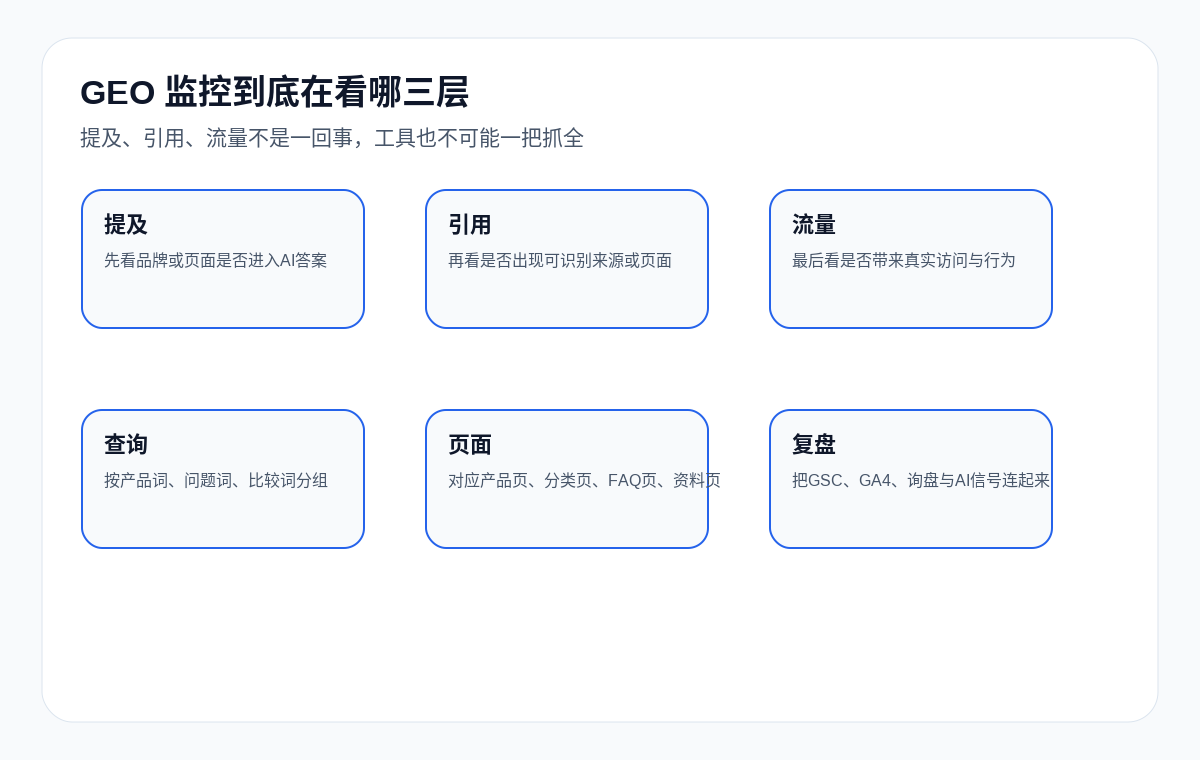
| Monitoring layer | What you are looking at | Questions it is suited to answer | Common misjudgments |
|---|---|---|---|
| Mention layer | Whether the brand or topic enters AI answers | Which queries are starting to show you | Mistaking a mention for a citation |
| Citation layer | Which page is used as supporting evidence or summarized | Which pages are more easily understood and adopted by AI | Mistaking a single screenshot for a long-term trend |
| Outcome layer | Whether it brings visits, path changes, and inquiry improvement | Whether AI visibility actually turns into business opportunities | Watching the excitement without watching business results |
Once you separate these three layers, you will immediately find that many so-called “tool debates” are unnecessary. Some people are discussing SERP-level visibility, some are discussing page citations, and some are discussing traffic and inquiries; the three are looking at different questions, so naturally no one can convince the others.
2. Why GEO monitoring is harder for export websites than for general content sites
GEO monitoring is harder for export websites not because the tools are worse, but because there are more page types, the procurement questions are more specific, and the business results appear more slowly. For a consumer content site, seeing an AI mention may mean that checking clicks and time on page is enough; but for a site selling medical probe, industrial valve supplier, or packaging machine, even having AI visibility does not mean it brings visits that are genuinely close to purchasing.
Export procurement paths are usually longer: a user may first see an AI answer, then click into a comparison page, a resource page, a product page, or a FAQ page, then forward the catalog to their team, and only send an inquiry a few days later. This means that if you only look at “whether we were mentioned,” you can easily overestimate your GEO progress.
| GEO monitoring challenges for export sites | Why it is hard | A more reasonable view |
|---|---|---|
| Complex page roles | Product pages, category pages, industry pages, FAQ pages, and resource pages have different jobs | Observe by page type first |
| Longer procurement cycle | A click does not necessarily turn into an inquiry right away | Look at paths and follow-up behavior, not just a single session |
| Finer-grained English product terms | Meanings and model differences vary widely | Build separate query sets for product terms, comparison terms, and resource terms |
| Unstable AI citations | Appearing today and disappearing tomorrow is not rare | Sample periodically rather than making a one-off judgment |
| Lagging sales feedback | Business results often trail search signals | Include inquiry maturity in the monthly review |
3. Step 1: First decide which set of queries you are actually monitoring
Without a query set, any GEO monitoring eventually degenerates into scattered screenshots. For export websites, the query set should ideally not start with brand terms, but with high-value product terms, comparison terms, resource terms, and question terms, because these are closer to the real procurement path.
For example, a site selling waterproof connector can divide queries into waterproof connector supplier, IP67 vs IP68 connector, waterproof connector catalog pdf, and how to choose waterproof connector for outdoor lighting; a site selling packaging machine can divide them into packaging machine price, pouch packing machine vs stick pack machine, packaging machine maintenance checklist, and packaging machine catalog, among others.
| Query type | Examples suitable for GEO monitoring | Why it is worth watching |
|---|---|---|
| High commercial intent product terms | custom metal parts manufacturer, industrial valve supplier | See whether AI brings you into the set of suppliers being considered |
| Comparison terms | IP67 vs IP68 connector, manufacturer vs trading company | See whether there is a chance to be cited as a basis for judgment |
| Resource terms | catalog pdf, datasheet, ISO certificate | See whether resource pages are seen and clicked |
| Question terms | how to choose LED flood light wattage | See whether FAQ and tutorial pages are absorbed by AI |
| Application scenario terms | warehouse lighting solution, medical probe compatibility | See whether industry pages and solution pages are understood |
Get this layer right, and you will then know which terms to watch for mentions, which to watch for citations, and which are more worth tracking for traffic and inquiries.
Do not rank the query set by search volume alone; rank it by business value
For export businesses, a term with 20 searches a month that can drive a procurement judgment is usually more valuable than a term with 300 searches a month that reflects only general curiosity. Especially in an AI answer environment, high-value niche terms are often more likely to directly affect whether a page is cited or clicked.
| Ranking dimension | How to judge it | Example |
|---|---|---|
| Business value | Whether it is close to purchasing and selection | custom metal parts manufacturer is higher than what is metal processing |
| Page readiness | Whether a suitable page already exists to receive it | If a waterproof connector datasheet resource page already exists, it deserves priority |
| Completeness of factual evidence | Whether the page has enough specifications and resources | medical probe compatibility is more suitable for tracking when resources exist |
| AI summarizability | Whether the question can easily be consolidated into an answer | IP67 vs IP68 more readily produces comparison-style answers |
4. Step 2: Decide whether you need a tool to see “mentions” or “citations”
The second step is the core of monitoring tool selection: it is not about which tool has the most features, but about which layer you most need right now. For most export sites, the starting phase usually means watching the mention layer first, then doing citation sampling for key queries; only after the query set is stable and page assets gradually become richer is it worth looking at the outcome layer more systematically.
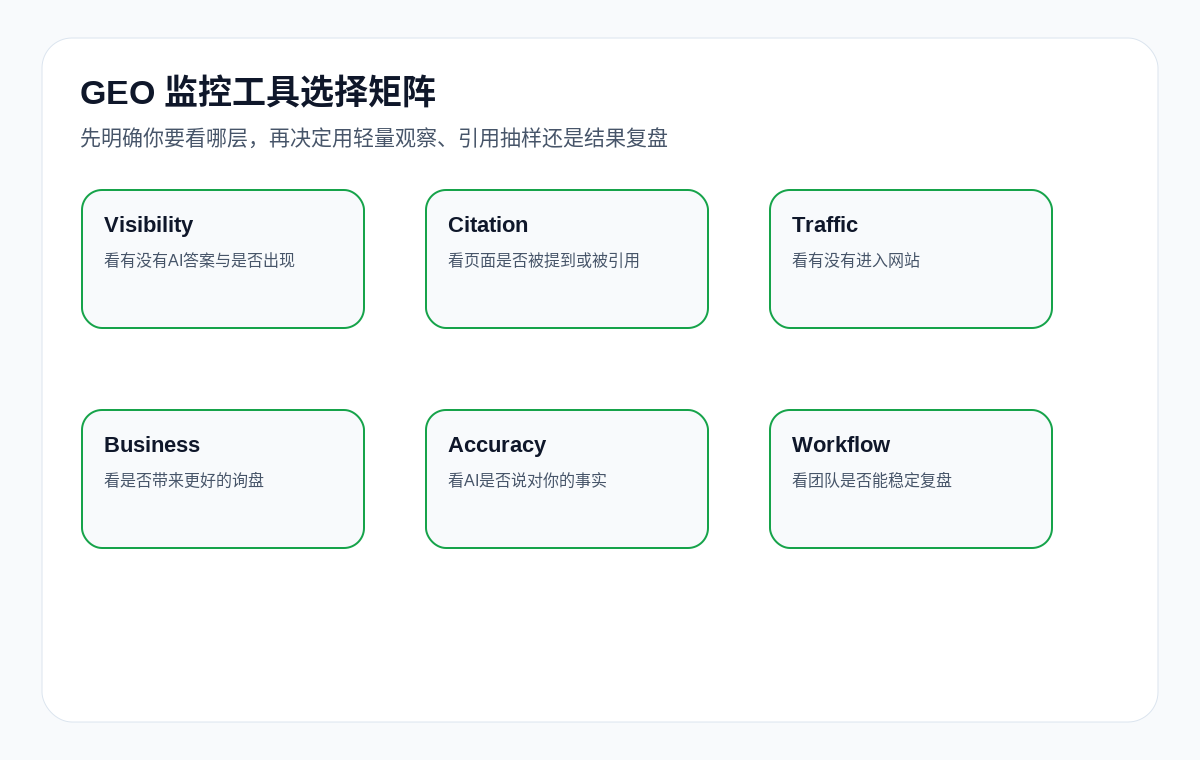
| If you want to see | A more suitable approach | What it can answer | What you still cannot see |
|---|---|---|---|
| Mention layer | Lightweight SERP observation, fixed-query screenshots, a results log spreadsheet | Which queries are starting to show AI answers and your brand or topic | Whether a specific page is consistently cited |
| Citation layer | Manual sampling of key queries, tools that can show page-level signals | Which pages are used as supporting evidence and summarized | Whether it brings business results |
| Outcome layer | GSC + GA4 + inquiry spreadsheet + AI sampling combined | Whether AI visibility converts into visits and inquiry improvement | All the semantic details of a single answer |
If you have not even built a high-value query set yet, do not rush to buy a heavy citation-level tool; you are probably not ready to connect that data to page actions. Conversely, if you already have 30 to 50 key queries and your key pages are relatively stable, citation-layer monitoring becomes more valuable, because it helps you judge which pages are better suited as answer sources in the eyes of AI.
5. Step 3: When monitoring “citations,” how exactly should you look at pages?
At the mention of GEO monitoring, many teams get excited about knowing “whether we were cited.” The question itself is not wrong, but what is truly useful is not “yes/no,” but “which page, around what kind of question, and because of what facts was it cited or summarized.”
For example, an LED flood light page may be mentioned in a warehouse lighting question, but what is actually absorbed may not be the product page — it may be the illuminance recommendations on an application page. A waterproof connector page may be mentioned in an IP rating comparison question, but what is actually used is the FAQ’s explanation of the differences and the specification table.
| What to record when a page is mentioned | Why it matters |
|---|---|
| Corresponding query | Know what type of question triggered it |
| URL of the mentioned page | Know which types of pages AI more readily uses |
| Information point being used | Know whether it is a specification, FAQ, comparison, case study, or definition |
| Whether it co-occurs with competitors | Know your page’s relative position in the answer |
| Whether the answer gets it right | Know whether the page needs clearer factual statements |
For export pages, the most valuable thing to record is not “whether the brand name appeared,” but what exactly AI extracted from which of your pages. That is how you can decide whether the next step is to add FAQ, specifications, downloadable resources, or industry scenario explanations.
6. Step 4: Traffic-layer monitoring must connect to GSC, GA4, and inquiries
Even if you have already seen mentions and citations, you cannot simply declare that GEO is producing results. What really matters is whether these AI visibility changes bring higher-quality page visits, clearer path behavior, and more mature inquiries.
Therefore, outcome-layer monitoring must always come back to GSC, GA4, and inquiry data. GSC shows which queries and pages gain more impressions and clicks; GA4 shows whether users continue on to product pages, resource pages, or contact pages after landing; sales or the inquiry log helps you judge whether the customers who arrive are more specific and come with specifications and resource needs.
If GSC and GA4 can only show “whether the page changed,” you also need server logs to confirm whether Googlebot, Bingbot, and AI crawlers are actually fetching key URLs. Log analysis can be reviewed using the crawler, status code, and crawl budget framework in the SEO log analysis guide, so you do not misjudge pages that were never crawled as content problems.
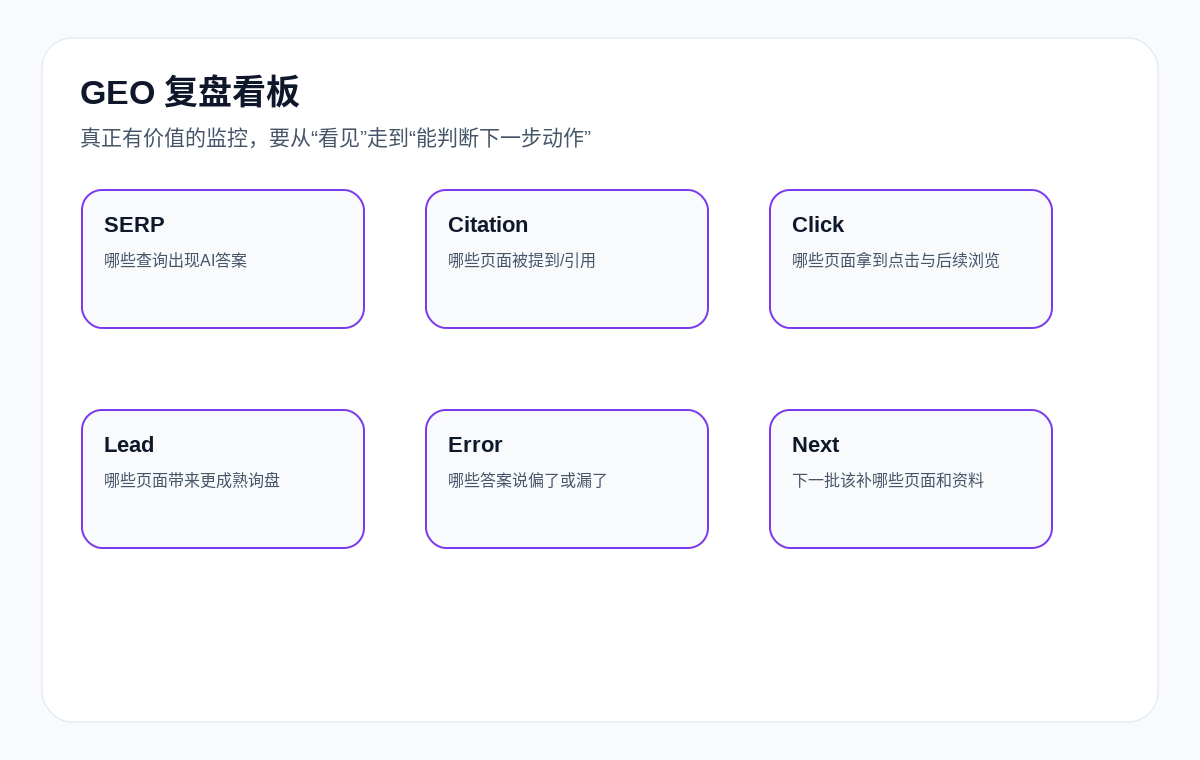
| Review layer | What to look at | Good signals | Next action |
|---|---|---|---|
| GSC | Impressions, clicks, and CTR for target queries and target URLs | High-value terms start landing on the right pages | Keep expanding similar pages and FAQ |
| GA4 | Where users go from the landing page | More entries into product pages, download pages, and inquiry pages | Strengthen mid-funnel CTAs and internal links |
| Inquiries | Whether the questions are more specific | Customers ask directly about specifications, MOQ, compatibility, and lead time | Keep adding evidence and resources |
| AI sampling | Whether answers describe you more accurately | Mentions are more focused and misreadings decrease | Add structured definitions, tables, and fact blocks |
7. The pages best suited to GEO monitoring on export websites are not just blog posts
Many people assume GEO monitoring is mainly for article pages. In fact, for export websites, the pages most worth monitoring often also include category pages, industry pages, FAQ pages, and resource pages, because these pages are better at taking on the job of “being summarized, being compared, and being used as a basis for judgment.”
| Page type | Why it is worth monitoring | Typical examples |
|---|---|---|
| Category pages | Can capture series terms and judgments about supply capability | industrial valve supplier, cnc machining parts |
| Industry pages | Can explain application scenarios and solution boundaries | warehouse lighting solution, food packaging line |
| FAQ pages | Can answer high-frequency questions with a clear structure | MOQ, lead time, certification, compatibility |
| Resource pages | Can provide catalogs, specifications, certificates, and downloads | catalog pdf, datasheet, inspection report |
| Tutorial pages | Can capture explanatory and comparison terms | IP67 vs IP68, how to choose medical probe |
If your product information is clear enough, resource pages can even be better suited for AI to understand and use than some article pages, because AI strongly favors pages with clear structure, concentrated facts, and well-defined boundaries.
8. Ten export examples: how to monitor different product lines
Example 1: custom metal parts
For a product line like custom metal parts, GEO monitoring should not stop at asking “were we mentioned by AI.” More worthwhile questions are: which queries most readily trigger AI answers? Do the answers lean toward product pages, FAQ pages, or resource pages? After clicking, do users keep moving closer to an inquiry?
Focus on queries related to manufacturer, tolerance, surface finish, and drawing upload, and monitor capability pages, material pages, and FAQ pages.
If monitoring shows that AI more readily uses information from FAQ or resource pages while the product pages themselves express facts weakly, the next step is not simply to add more monitoring, but to improve page structure, specification tables, and resource entry points.
Example 2: LED flood light
For a product line like LED flood light, GEO monitoring should not stop at asking “were we mentioned by AI.” More worthwhile questions are: which queries most readily trigger AI answers? Do the answers lean toward product pages, FAQ pages, or resource pages? After clicking, do users keep moving closer to an inquiry?
Focus on wattage, warehouse lighting, IP rating, and beam angle, and monitor series pages, application pages, and specification pages.
If monitoring shows that AI more readily uses information from FAQ or resource pages while the product pages themselves express facts weakly, the next step is not simply to add more monitoring, but to improve page structure, specification tables, and resource entry points.
Example 3: packaging machine
For a product line like packaging machine, GEO monitoring should not stop at asking “were we mentioned by AI.” More worthwhile questions are: which queries most readily trigger AI answers? Do the answers lean toward product pages, FAQ pages, or resource pages? After clicking, do users keep moving closer to an inquiry?
Focus on machine type, price, speed, and maintenance, and monitor model pages, solution pages, and FAQ pages.
If monitoring shows that AI more readily uses information from FAQ or resource pages while the product pages themselves express facts weakly, the next step is not simply to add more monitoring, but to improve page structure, specification tables, and resource entry points.
Example 4: medical probe
For a product line like medical probe, GEO monitoring should not stop at asking “were we mentioned by AI.” More worthwhile questions are: which queries most readily trigger AI answers? Do the answers lean toward product pages, FAQ pages, or resource pages? After clicking, do users keep moving closer to an inquiry?
Focus on compatibility, sterilization, material, and certification, and monitor resource pages and technical FAQ.
If monitoring shows that AI more readily uses information from FAQ or resource pages while the product pages themselves express facts weakly, the next step is not simply to add more monitoring, but to improve page structure, specification tables, and resource entry points.
Example 5: cnc machining parts
For a product line like cnc machining parts, GEO monitoring should not stop at asking “were we mentioned by AI.” More worthwhile questions are: which queries most readily trigger AI answers? Do the answers lean toward product pages, FAQ pages, or resource pages? After clicking, do users keep moving closer to an inquiry?
Focus on material, tolerance, surface treatment, and prototype to mass production, and monitor capability pages and industry pages.
If monitoring shows that AI more readily uses information from FAQ or resource pages while the product pages themselves express facts weakly, the next step is not simply to add more monitoring, but to improve page structure, specification tables, and resource entry points.
Example 6: ceramic dinnerware
For a product line like ceramic dinnerware, GEO monitoring should not stop at asking “were we mentioned by AI.” More worthwhile questions are: which queries most readily trigger AI answers? Do the answers lean toward product pages, FAQ pages, or resource pages? After clicking, do users keep moving closer to an inquiry?
Focus on material, glaze, MOQ, and packing, and monitor product series pages and customization pages.
If monitoring shows that AI more readily uses information from FAQ or resource pages while the product pages themselves express facts weakly, the next step is not simply to add more monitoring, but to improve page structure, specification tables, and resource entry points.
Example 7: waterproof connector
For a product line like waterproof connector, GEO monitoring should not stop at asking “were we mentioned by AI.” More worthwhile questions are: which queries most readily trigger AI answers? Do the answers lean toward product pages, FAQ pages, or resource pages? After clicking, do users keep moving closer to an inquiry?
Focus on IP67/IP68, current, wire gauge, and outdoor use, and monitor specification pages, FAQ pages, and application pages.
If monitoring shows that AI more readily uses information from FAQ or resource pages while the product pages themselves express facts weakly, the next step is not simply to add more monitoring, but to improve page structure, specification tables, and resource entry points.
Example 8: industrial valve supplier
For a product line like industrial valve supplier, GEO monitoring should not stop at asking “were we mentioned by AI.” More worthwhile questions are: which queries most readily trigger AI answers? Do the answers lean toward product pages, FAQ pages, or resource pages? After clicking, do users keep moving closer to an inquiry?
Focus on pressure rating, material, application, and lead time, and monitor category pages and operating-condition pages.
If monitoring shows that AI more readily uses information from FAQ or resource pages while the product pages themselves express facts weakly, the next step is not simply to add more monitoring, but to improve page structure, specification tables, and resource entry points.
Example 9: private label activewear manufacturer
For a product line like private label activewear manufacturer, GEO monitoring should not stop at asking “were we mentioned by AI.” More worthwhile questions are: which queries most readily trigger AI answers? Do the answers lean toward product pages, FAQ pages, or resource pages? After clicking, do users keep moving closer to an inquiry?
Focus on fabric, sample, MOQ, and private label packaging, and monitor capability pages and fabric pages.
If monitoring shows that AI more readily uses information from FAQ or resource pages while the product pages themselves express facts weakly, the next step is not simply to add more monitoring, but to improve page structure, specification tables, and resource entry points.
Example 10: stainless steel fasteners
For a product line like stainless steel fasteners, GEO monitoring should not stop at asking “were we mentioned by AI.” More worthwhile questions are: which queries most readily trigger AI answers? Do the answers lean toward product pages, FAQ pages, or resource pages? After clicking, do users keep moving closer to an inquiry?
Focus on grade, coating, standard, and bulk stock, and monitor standard series pages and comparison pages.
If monitoring shows that AI more readily uses information from FAQ or resource pages while the product pages themselves express facts weakly, the next step is not simply to add more monitoring, but to improve page structure, specification tables, and resource entry points.
9. When GEO monitoring is worth paying for, and when manual work is enough
Not every team needs to buy heavy-duty monitoring tools from the start. For teams still building a query set and without a fixed review cadence, it is usually more practical to start with lightweight query observation, mention logging, and citation sampling. Only when you have a batch of high-value queries, a set of mature pages, and a fixed monthly review routine does the value of a paid tool amplify.
| Team stage | A more suitable approach | Why |
|---|---|---|
| Starting phase | Lightweight query observation + manual sampling | First clarify high-value queries and page roles |
| Growth phase | Mention observation + key citation sampling + GSC/GA4 review | You can already connect signals back to page actions |
| Multi-product-line phase | More systematic batch monitoring and team dashboards | You need stable exports, collaboration, and long-term tracking |
| Mature phase | Query set governance + citation-layer monitoring + sales feedback integration | You can turn monitoring directly into content and page decisions |
If you do not yet have a fixed high-value query list, spending a large budget on a monitoring tool can easily turn into “lots of charts, but no idea how to use them.” Conversely, running 20 to 50 key queries and 10 to 20 key pages smoothly first, then deciding whether to upgrade your tools, better matches the pace of most export websites.
10. A highly practical GEO tool evaluation framework: work backward from page actions
Rather than choosing a tool by feature checklist, work backward from page actions. A monitoring tool truly worth keeping may not have the flashiest interface, but it should help you answer the following questions faster: which queries are worth pursuing; which pages AI more readily uses; which answers misstate your facts; and whether these changes bring visits and inquiries closer to purchasing.
| Evaluation dimension | High-scoring behavior | Low-scoring behavior |
|---|---|---|
| Query set management | Can layer by product terms, comparison terms, and resource terms | Gives only scattered results that are hard to review |
| Mention visibility | Can consistently record whether AI answers appear and brand/topic visibility | Only allows a quick one-off look |
| Page citation judgment | Can help identify the pages most likely to be used | Cannot drill down to the URL level |
| Outcome integration | Easy to connect with GSC, GA4, and inquiry spreadsheets | Stays at the screenshot level |
| Export suitability | Suited to English product terms, application terms, and resource terms | Leans toward general content-site scenarios |
You will find that what truly determines a tool’s value is never “how many features it has,” but “whether it can drive the next page action.”
10.5. Where we need to be stronger than generic GEO articles
Many articles on GEO or AI search visibility focus on concept explanations, tool lists, and trend judgments. That content has reference value, but for export manufacturers and trading companies it is far from enough, because what you really need is not “knowing this trend exists,” but knowing which pages are worth monitoring, which English product terms are worth tracking, and where to go back and change something after seeing a signal.
| Common strengths of generic articles | Where they still fall short for export websites | What we must add |
|---|---|---|
| They explain AI search and GEO concepts | They lack specific product terms and procurement paths | Add export English product-term, comparison-term, and resource-term scenarios |
| They list many tools | They lack a distinction between monitoring layers | Add the three-layer framework of mentions, citations, and outcomes |
| They mention the importance of monitoring | They lack a page-type method | Add the division of labor among product pages, category pages, FAQ pages, and resource pages |
| They suggest looking at traffic | They lack sales and inquiry maturity feedback | Add four-layer review across GSC, GA4, inquiries, and sales |
| They discuss future trends | They lack a 30-day starting path | Add the minimum viable loop for small and mid-sized teams |
Once you close these gaps, your content stops being just “following the crowd and talking about a new concept” and becomes a real decision asset that helps the team judge whether to invest in GEO, what to look at first, and how to review it.
10.6. Twelve questions you must ask before buying a tool
Many teams look at pricing and demo pages when preparing to buy a GEO monitoring tool, without first asking whether they are internally ready to use it. The following set of questions can help you filter out most “bought it but cannot use it well” situations before purchasing.
| Question | If the answer is no, what it usually means |
|---|---|
| Do we have 20–50 fixed high-value queries? | We are not ready for stable monitoring |
| Are these queries clearly mapped to pages? | Even when signals appear, it is hard to turn them into action |
| Can we distinguish mentions from citations? | We are likely to misread the results |
| Do we have a page-level way of recording? | We cannot tell which types of pages AI more readily uses |
| Is there a dedicated person to review GSC and GA4? | The outcome layer is hard to connect |
| Is sales willing to give feedback on inquiry maturity? | The business outcome layer will be missing a key piece of evidence |
| Are our FAQ, resource, and category pages clear enough? | Even with monitoring, we may not have strong pages to amplify |
| Can we accept manual sampling as the starting method? | We are likely to overestimate the role of automation |
| Is there a monthly review cadence? | The tool may be exciting only for the first two weeks |
| Do we know which pages are most worth improving first? | Post-monitoring actions will be scattered |
| Can the team handle page corrections after an AI misreading? | Even when problems are found, the loop cannot be closed |
| Are we buying a tool for page decisions, or just out of fear of falling behind? | The latter is usually the most likely to cause waste |
If you cannot answer more than half of these 12 questions, it usually means you should first build your query set, page mapping, and monthly review framework rather than buying the most expensive tool.
11. The eight most common monitoring mistakes
- Treating mentions as citations.
- Treating a single appearance as a long-term trend.
- Looking only at the brand layer and not the page layer.
- Looking only at the AI layer without connecting GSC and GA4.
- Looking only at clicks, not inquiry maturity.
- Focusing only on article pages and ignoring category pages, resource pages, and FAQ pages.
- Buying a heavy-duty tool before the budget and review process are ready.
- Having monitoring in place but not turning the results into page optimization actions.
The common root of these mistakes is that teams treat GEO monitoring as “a new hot topic” rather than a page judgment tool. As long as the thinking does not return to pages and business, no matter how advanced the tool is, it will easily end up as just noise.
| Mistake | A more reliable approach |
|---|---|
| Looking only at whether you appear | Keep recording which type of query, which type of page, and which facts were used |
| Taking a single screenshot | Set a fixed sampling frequency |
| Looking only at the brand name | Go back to the page URL and page type |
| Looking only at AI visibility | Combine with GSC, GA4, and inquiry maturity |
| Only buying a tool | First build a review spreadsheet and an action mechanism |
11.5. GEO monitoring should be completely different at different team stages
Much of the waste teams incur in GEO monitoring comes not from choosing the wrong tool, but from misjudging their stage. A small team that does not yet have stable English product pages, FAQ pages, and resource pages, and a large team that already has dozens of series pages, download pages, and comparison pages, should simply not monitor in the same way.
| Team stage | What to look at first | Recommended action | Things not worth overinvesting in yet |
|---|---|---|---|
| Starting phase | Whether high-value queries have AI answers | First build the query set and a manual sampling sheet | Complex batch monitoring systems |
| Growth phase | Which pages are starting to be mentioned or summarized | Set up page-level sampling and monthly reviews | Pursuing overly fine-grained automated layering too early |
| Multi-product-line phase | Page differences across product lines and country-specific terms | Build a page-type matrix and a team dashboard | Looking only at flashy brand-layer data |
| Mature phase | How AI signals affect visits and inquiry quality | Connect sales feedback, resource downloads, and lead quality | Staring at a single tool dashboard |
For example, if a team working on private label activewear manufacturer has just finished a round of page cleanup, it should first look at whether AI overviews appear for high-value queries and whether FAQ, fabric, and MOQ explanation pages are more readily mentioned, rather than immediately pursuing very complex citation-level automated monitoring. Conversely, if you already have a large number of mature pages and a fixed monthly review, then further examining which type of page AI more readily uses as a source for comparisons and definitions becomes more valuable.
11.6. Connect GEO monitoring to sales feedback to know whether your content is actually stronger
For export businesses, what truly proves that content has become stronger is not just that pages are mentioned by AI, but whether customers’ questions are more specific when they contact you. For example, do customers working on custom metal parts come directly with drawings, tolerances, and material requirements? Do customers working on packaging machine state the bag type, speed, material, and budget directly? Do customers working on waterproof connector already care specifically about IP rating, current, and application environment?
If these changes are not happening, then even if AI mentions look plentiful, the content cannot be considered truly strong, because for B2B export, the endpoint of content is not “looking like it was mentioned,” but helping customers enter inquiries and sales conversations with more mature information.
| Page type | What sales is worth reporting back | What improvement indicates | Next GEO/content action |
|---|---|---|---|
| FAQ pages | Whether customers ask fewer repetitive basic questions | The FAQ is doing the educational work | Keep adding high-frequency misconceptions and comparison questions |
| Resource pages | Whether customers download the catalog or specifications before contacting | Resource pages act more like a real procurement entry point | Add more structured resources and explanations |
| Industry pages | Whether customers describe their application scenarios more clearly | Scenario pages aid self-qualification | Add case studies, operating conditions, and selection guidance |
| Product pages | Whether customers come with specifications and model numbers | Product pages receive traffic more precisely | Add specifications, certificates, compatibility, and CTAs |
This is also why GEO monitoring cannot be left to the content team alone. Sales is the first to sense whether visits are becoming more mature, so the best approach is to include observation fields from the sales side in the monthly review.
11.7. If you only have 30 days, how should GEO monitoring begin?
Faced with this new shift called GEO, many teams feel they must either go big or not do it at all. A more practical approach is to use 30 days to get a minimum viable loop running: first build a query set, then do manual or lightweight sampling, and then connect the results to page actions and sales feedback.
| Time period | Key actions | Outputs | Goal |
|---|---|---|---|
| Week 1 | Inventory high-value product terms, comparison terms, and resource terms | A list of 20–50 queries | Know which terms to look at first |
| Week 2 | Observe AI answers and brand/page mentions | A query-results log | Distinguish the mention layer from the citation layer |
| Week 3 | Do page-level sampling and fact verification for key terms | A page-fact point log | Know which pages are more readily used |
| Week 4 | Connect GSC, GA4, inquiries, and sales feedback | A monthly review sheet | Decide the next batch of page actions |
This 30-day version fits most export manufacturers and trading companies well, because its focus is not buying many tools, but getting the chain of “what to monitor, how to record it, and how to return to page actions” running smoothly.
11.8. “No results” can actually mean four completely different situations
The phrase most likely to cause misjudgment in GEO monitoring is “no results lately.” In fact, different combinations of the four signal types — mentions, citations, clicks, and inquiries — mean completely different problems. Understanding these combinations helps you decide whether the next step is to keep monitoring or to go back and change the page.
| Combination of symptoms | More likely problem | Priority action | Missteps to avoid |
|---|---|---|---|
| An AI answer exists, but it does not mention you at all | The query set does not land on your strong pages, or the page facts are not clear enough | First check page roles and factual statements | Adding monitoring without changing pages |
| Mentioned, but hard to confirm the specific page | The mention layer is progressing, but page-level evidence is still weak | Add FAQ, tables, and identifiable fact blocks | Treating a mention as a citation result |
| Cited or summarized, but no clicks | The answer has absorbed the information, but the page’s appeal or the demand stage is insufficient | Improve titles, summaries, and page reception | Looking only at screenshots for self-satisfaction |
| Clicks, but inquiries have not become stronger | Page evidence and CTAs are insufficient | Add resources, case studies, specifications, and next steps | Only chasing more queries |
In other words, the real value of GEO monitoring is not telling you “whether it happened,” but telling you “what to do next.” This is exactly what should be prioritized when choosing tools and setting up your review process.
11.7. If AI often misrepresents your pages, how should you fix them after monitoring?
GEO monitoring has another very important role: it is not only about seeing whether you are mentioned, but about seeing whether AI misrepresents your pages. For export websites, common misreadings include describing a trading company as a manufacturer, presenting one series’ specifications as applying to all products, overstating the scope of a certificate, or expressing MOQ, lead time, and compatibility limits too absolutely.
Once such problems are spotted, the next step should not be merely to note them in a spreadsheet, but to go directly back to the page and strengthen clearer definition sentences, specification boundaries, applicable conditions, FAQ, and downloadable resources, because AI readily absorbs page passages that are vaguely worded and have unclear boundaries.
| Common misreadings | More likely page problem | Better way to fix it |
|---|---|---|
| Getting the supply role wrong | The boundary between the company capability page and product pages is unclear | Add an above-the-fold definition and capability statement |
| Overstating the applicable scope of specifications | Specification tables and applicable conditions are not clearly separated | Add specification boundaries, version distinctions, and notes |
| Describing a certification as applying to the entire line | The certificate description lacks model numbers or scope limits | Add the applicable models and a download page for the certificate |
| Presenting MOQ/lead time as fixed values | The page lacks an explanation of influencing factors | Add case-by-case explanations and FAQ |
This step is especially suited to product lines with complex boundaries, such as medical probe, industrial valve supplier, and packaging machine, because once such pages are summarized by AI, imprecise wording makes them more likely to be oversimplified.
11.8. In different country markets, the key terms for GEO monitoring will also differ
If your export business serves different regions, GEO monitoring cannot rely on the same set of English terms. Different markets differ in procurement language, resource preferences, and question priorities. For example, European buyers tend to focus more on compliance and certification; American buyers focus more on delivery and application fit; and some markets in the Middle East or Southeast Asia may focus more on price ranges, applicable environments, and installation conditions.
This does not mean you need to build many monitoring sets at once. It means that, beyond the core query set, you can add a small batch of market-specific question terms and resource terms for each key market. That way, during review it becomes easier to see whether FAQ pages for a certain market are more readily used by AI, or whether a certain region leans more toward resource pages and download pages.
| Market focus | Query directions more worth adding | Pages more worth observing |
|---|---|---|
| Europe | certificate, compliance, testing, material standard | Certificate pages, resource pages, FAQ pages |
| United States | application, performance, lead time, warranty | Industry pages, product pages, case study pages |
| Southeast Asia | price, MOQ, delivery, catalog | Category pages, resource pages, inquiry pages |
| Middle East | outdoor use, temperature, durability, project supply | Application pages, specification pages, capability pages |
The benefit of doing this is that your GEO monitoring will not become an overly abstract master table, but will stay closer to the types of questions different markets genuinely care about.
12. Put official monitoring signals into tool selection: how to view Google, OpenAI, Bing, and IndexNow
When choosing a GEO monitoring tool, do not just look at whether the interface has an “AI score.” A more reliable approach is to map tool outputs to official, verifiable signals: Google AI features documentation states that basic SEO still applies to AI Overviews and AI Mode; OpenAI Bots documentation explains the access boundaries of different crawlers and user agents; Bing AI Performance has already turned citations, referenced URLs, and grounding query phrases in AI answers into observable metrics; and IndexNow is used to notify participating search engines when URLs are added, updated, or deleted.
| Official source | What monitoring it can support | What it cannot show |
|---|---|---|
| Google AI features | Whether a page meets basic SEO requirements, can be indexed, and is eligible to appear as a snippet | It cannot show that a given page will definitely enter AI Overviews or AI Mode |
| OpenAI Bots | Whether the site allows the relevant crawler/user agent to access it and whether the robots policy is clear | It cannot show that allowing access will lead to ongoing citations |
| Bing AI Performance | Citations, referenced URLs, query phrases, and trends in AI answers | citation count does not equal ranking, authority, or a fixed answer position |
| IndexNow | Notifying participating search engines that key URLs have been added, updated, or deleted | HTTP 200 only means the URL was received; it does not mean it has been crawled or indexed |
Four additional check fields you can add when choosing a tool
- Citation source field: Can it record which URL the AI answer cited, not just whether the brand appeared.
- Query phrase field: Can it record the English product terms, procurement question terms, and scenario terms that triggered the citation, such as LED flood light supplier China.
- Crawl boundary field: Can it check robots, AI crawler access policies, and whether key pages are crawlable.
- Change notification field: After key pages are updated, does it record discovery paths such as sitemap, internal links, and IndexNow.
Therefore, a GEO monitoring tool suited to export businesses should ideally turn “AI answer screenshots” into a reviewable data table: what the query is, what platform it is on, whether the answer contains the official website URL, which page is cited, who the competitors are, whether the page was recently updated, and whether the search system can discover that page. Only then will you know whether to change a product page, category page, technical article, robots, or internal link path.
Official source links
- Google Search Central: AI features and your website
- OpenAI Platform: Bots
- Bing Webmaster Blog: AI Performance in Bing Webmaster Tools
- IndexNow: Documentation
Official monitoring stance: mentions, citations, traffic, and on-site behavior must not be blended into a single score
The most misleading thing about GEO monitoring tools is combining all signals into a single “AI score.” For export websites, mentions, citations, search traffic, on-site behavior, and inquiry feedback must be viewed separately. A brand name appearing in an AI answer only indicates a mention; the answer linking to an official website page is a citation; having query/page data in GSC is search performance; having events and paths in GA4 is on-site behavior; and sales feedback clearly describing inquiry quality comes closest to a business judgment.
When there are no GSC query, page, or page-query rows, a monitoring report can only state that there is currently no usable Search Console signal; it must not fill in rankings, impressions, clicks, CTR, or traffic changes. When there is no Bing AI Performance data or AI answer sample, “no citation observed” must not be written as “the official website has no value.” Monitoring tools should help businesses layer their evidence, not package uncontrollable outcomes as definitive conclusions.
| Official source | What it can monitor | Export site example | What it cannot prove |
|---|---|---|---|
| Google Search Central: AI features and your website | AI Overviews / AI Mode still require first checking page discoverability, indexability, clear content, and basic SEO. | Check whether a packaging machine application page has readable body text, internal product links, FAQ, and resource pages. | It cannot promise that AI answers will definitely use the official website. |
| Search Console Help: Performance report | query, page, clicks, impressions, CTR, average position, country, device. | Review category pages and long-tail terms for waterproof connector and industrial valve supplier separately. | When there are no GSC rows, you must not write search trends or click improvements. |
| Search Console Help: URL Inspection tool | Index status, crawl status, canonical, and the version Google sees for a single URL. | Spot-check whether key pages for custom metal parts and medical probe can be correctly identified. | The ability to inspect a single URL does not mean it has received impressions. |
| Google Analytics Help: About events | On-site behavior events such as forms, email, WhatsApp, downloads, RFQ, and resource page clicks. | Observe LED flood light resource downloads, inquiry buttons, email clicks, and continued visits to product pages. | GA4 events cannot directly replace organic search performance. |
| Google Search Central: Sitemaps overview | Whether key URLs enter the discovery path and whether there is a URL list after pages are updated. | Check whether ceramic dinnerware product pages, resource pages, and application pages are in the sitemap. | A URL appearing in the sitemap does not equal being indexed. |
| Google Search Central: robots.txt introduction | Crawler access rules, resource access, and troubleshooting accidental blocks. | Check whether PDF catalogs, images, product pages, and resource pages are accidentally blocked by robots. | Allowing crawling does not equal generating AI citations. |
| OpenAI Platform: Bots | Distinguish the purposes and access boundaries of OAI-SearchBot, GPTBot, and ChatGPT-User. | Check whether robots.txt lumps search crawling, training crawling, and user-triggered access into one category. | Allowing a crawler to access does not equal ChatGPT search displaying the official website. |
| Bing Webmaster Blog: AI Performance | If visible in the account, observe citations, cited pages, and grounding query phrases. | Record which product questions cite the official website and which cite competitors, catalogs, or third-party resources. | citation count is not ranking, answer position, or inquiry results. |
| IndexNow: Documentation | After URLs are added, updated, or deleted, record the notification time, URL list, and return status. | After major product page changes, write notification records separately from subsequent GSC/Bing/log observations. | HTTP 200 only means the notification was received; it does not mean it has been crawled, indexed, or displayed. |
GEO monitoring tool acceptance checklist: look at the fields first, then the interface
| Tool field | Qualified output | Unqualified output | Acceptance method |
|---|---|---|---|
| Query set | Grouped by brand terms, product terms, supplier terms, application terms, certificate terms, specification terms, and inquiry terms. | Provides only a few generic terms or looks only at brand names. | Spot-check whether it covers real procurement questions such as private label activewear manufacturer and cnc machining parts. |
| Mention layer | Records the platform, query, date, answer summary, whether the brand was mentioned, and whether the mention is accurate. | Gives only an overall score, not the original questions and samples. | Re-test the same query set on a fixed cycle. |
| Citation layer | Records the cited URL, source type, competitor sources, incorrect facts, and page actions. | Treats a screenshot as complete evidence. | Check the URL, screenshot number, re-test date, and page change log. |
| Search layer | Connects GSC page/query/country/device dimensions and distinguishes between having data and having none. | Writes trends when there are no GSC rows. | Check the Search Console export or authorized data source. |
| Behavior layer | Connects GA4 events, RFQ, downloads, email, WhatsApp, and form fields. | Looks only at visit counts, not follow-up actions. | Check the event list, trigger conditions, and test records. |
| Sales layer | Records whether inquiries come with specifications, drawings, MOQ, target market, certificates, and application scenarios. | Writes only the number of inquiries without looking at quality. | Review the sales feedback sheet together with page sources. |
How to write GEO monitoring conclusions when there is no data
A reliable GEO monitoring report must be willing to state “no usable signal for now.” This is not a bad thing; it clarifies the current boundaries of the evidence. For example, if Search Console has no row data yet, write that there is no GSC signal; if Bing AI Performance has no account data yet, write that this data source is not connected; if AI platform sampling shows no citation of the official website, write that no official website citation was observed in this round of samples, and list the page facts, source pages, and re-test dates that need to be added.
| Current status | Can write | Cannot write | Next step |
|---|---|---|---|
| GSC 0 rows | There is currently no query/page/page-query signal; start with a page and event baseline. | Rankings, impressions, clicks, CTR, or traffic changes. | Re-check GSC after 7-14 days and keep maintaining the URL change log. |
| AI samples do not cite the official website | No official website citation was observed in this round of questions. | The official website has no value, GEO does not work, the tool is useless. | Check page facts, citation-friendly content, external resources, and query phrasing. |
| GA4 has events but GSC has no data | On-site behavior is observable, but search sources are temporarily insufficient. | Organic search has already improved inquiries. | Look separately at event sources, landing pages, product lines, and inquiry fields. |
| IndexNow returns 200 | The URL notification has been received. | The URL has already been crawled, indexed, or displayed. | Keep checking the sitemap, logs, GSC, Bing, and page status. |
12. FAQ: The 10 most common questions about choosing GEO monitoring tools
Do you have to buy a tool for GEO monitoring?
Not necessarily. In the starting phase, building a query set and a manual sampling method is usually more important.
What is the difference between a mention and a citation?
A mention means you or your topic appears in the answer; a citation is more about a page being used as a source or factual basis.
Is every query worth monitoring?
No. Prioritize high-business-value product terms, comparison terms, resource terms, and question terms.
Why do I see AI mentions but no obvious growth in website traffic?
Because a mention is only an early signal; you also need to look at answer position, citation format, click paths, and how well the page receives visitors.
Which pages should export websites monitor most?
Category pages, product pages, FAQ pages, resource pages, industry pages, and high-value tutorial pages.
When is it worth buying a heavier tool?
When you already have a stable query set, a fixed review mechanism, and multi-product-line pages, a heavier tool is more worthwhile.
If the budget is limited, which layer should I start with?
Usually start with the mention layer, then do citation sampling for key terms, and finally connect back to the outcome layer for review.
Why also look at GSC and GA4?
Because only by connecting AI visibility back to search clicks and on-site behavior can you know whether it has real value.
Why should sales feedback also be included in monitoring?
Because high-quality GEO results usually show up as more specific customer questions and clearer resource needs.
Can we write the adoption of the official website in AI answers as a definite result?
No. What you can improve is page clarity, credibility, and the probability of being understood, but external outcomes are not fully controllable.
13. Conclusion: Decide which layer you want to see first, then choose a GEO monitoring tool
For export manufacturers, factories, and trading companies in China, the truly difficult part of GEO monitoring is not the lack of tools, but the tendency to mix signals from different layers together. Mentions, citations, traffic, and inquiries each answer different questions. Once you clarify which layer you want to see and then decide whether to use lightweight observation, manual sampling, or a more systematic tool, the decision becomes much simpler.
More importantly, GEO monitoring must ultimately return to page actions: which English product terms are worth continuing to pursue, which pages AI more readily uses, which pages still lack clear specifications, FAQ, certificates, catalogs, and case studies, and which visits are already moving closer to inquiries. Only when these questions can be answered is monitoring not just noise, but a judgment system that genuinely makes your website assets stronger.
Continue reading this set of GEO resources
If you are systematically learning about GEO and AI search visibility, we suggest continuing with the following articles. Start with the concepts, then move on to diagnosis, monitoring, content structure, and the boundaries of collaboration.
- AI SEO tool recommendations: what to use for keywords, rewriting, and monitoring
- How to write common ChatGPT SEO prompts: how to use them for content planning, title generation, and structure rewriting
- Google SEO tutorial index: keep learning by crawling, indexing, content, GEO, and review
- What GEO visibility diagnosis includes: AI answers, entity consistency, citation sources, and review
- How to read a GEO diagnosis report: a guide to judging AI answers, citation sources, and entity consistency
- How to monitor AI search visibility: a checklist for export website brand mentions, official website citations, and competitor answers
- How to do AI Visibility Monitoring: a guide for new export sites
Further Reading on This B2B SEO & GEO Topic
- How to Choose Content Update Tools: How to Assess Decay, Rewrite, Merge, and Conduct Reviews
- What Is Internal Linking? A Guide to Optimizing Related Topics, Anchor Text, and Inquiry Paths for B2B Export Websites
- What is an SEO Audit: How to Review a B2B Export Website from Technical, Content, and Link Aspects to Inquiries
- How to Do E-commerce SEO: Division of Labor for Category Pages, Product Pages, Filter Pages, and Content Pages on B2B Export Websites
- How to Analyze GA4 Organic Traffic: Guide to SEO Pages, Conversions, Content Decay, and Inquiry Quality
- B2B Export Website Architecture Cost, Google Ads Synergy, and Inquiry CRO Hub
- B2B Google SEO Tutorials
- B2B Export Website Development Architecture