The core of e-commerce SEO is not stuffing every product page with keywords, nor endlessly writing articles; it is making category pages, product pages, filter pages, resource pages, content pages, and inquiry pages each serve the right search intent. For Chinese export manufacturers, factories, and trading companies, independent-site e-commerce SEO is more like a product catalog and purchasing decision system: category pages capture category terms and supplier terms, product pages capture model and specification terms, filter pages only expose combinations with real demand, and content pages explain selection criteria and guide users toward relevant products.
If you sell products such as LED flood light, waterproof connector, cnc machining parts, ceramic dinnerware, packaging machine, industrial valve supplier, custom metal parts, private label activewear manufacturer, and so on, search users will not search for just one term. They move from broad category to specification, and then to application, certificate, datasheet, MOQ, custom option, and quotation. E-commerce SEO needs to place these searches at different stages on the right pages instead of letting one page carry every task.
2. First define foreign trade e-commerce SEO: it is not a retail store, but a purchasing decision catalog
Many foreign trade websites look like e-commerce sites, with product categories, product lists, product details, filters, a shopping cart, or an inquiry button. But the actual buying process is usually not “add to cart and pay immediately”; it is requesting a quote, making a sample, confirming specifications, confirming certifications, confirming lead time, and confirming packaging and logistics. E-commerce SEO cannot simply copy the logic of a retail site.
For an LED flood light manufacturer, buyers may need to see wattage, lumen, IP rating, beam angle, mounting height, and DLC/CE/ROHS certificates; for a cnc machining parts factory, buyers care about material, tolerance, surface finish, drawing format, MOQ, lead time, and inspection report; for a ceramic dinnerware exporter, buyers look at material, glaze, microwave safe, dishwasher safe, package test, and private label.
Therefore, the goal of foreign trade e-commerce SEO is to make both Google and buyers understand: what you sell, who it suits, what specifications exist, whether it can be customized, why it is credible, how to request a quote, and what materials to prepare next. Only when page roles are clear is there a foundation for later optimization.
SEO differences between foreign trade e-commerce and retail e-commerce
| Dimension | Common retail e-commerce goals | More important goals for foreign trade e-commerce |
|---|---|---|
| Conversion method | Direct order and payment | Inquiries, samples, quotations, and long-term cooperation |
| Page focus | Price, reviews, promotions | Specifications, certifications, MOQ, lead time, customization capability |
| Keywords | buy, best, discount | supplier, manufacturer, custom, datasheet |
| Content assets | Buyer guides and promotional content | Application pages, resource pages, selection tables, FAQ |
| Review metrics | Orders and shopping cart | Inquiry quality, sales feedback, product term growth |
3. Overall page division map: each type of page only serves the search intent that suits it
A common failure point on foreign trade e-commerce websites is confused page roles: a category page tries to cover branding, products, tutorials, and case studies at the same time; a product page writes only one model number; filter pages are generated without limit; article pages do not link to products; and the contact page has only a form. Search engines cannot tell which page best fits which query, and users cannot find the next step.
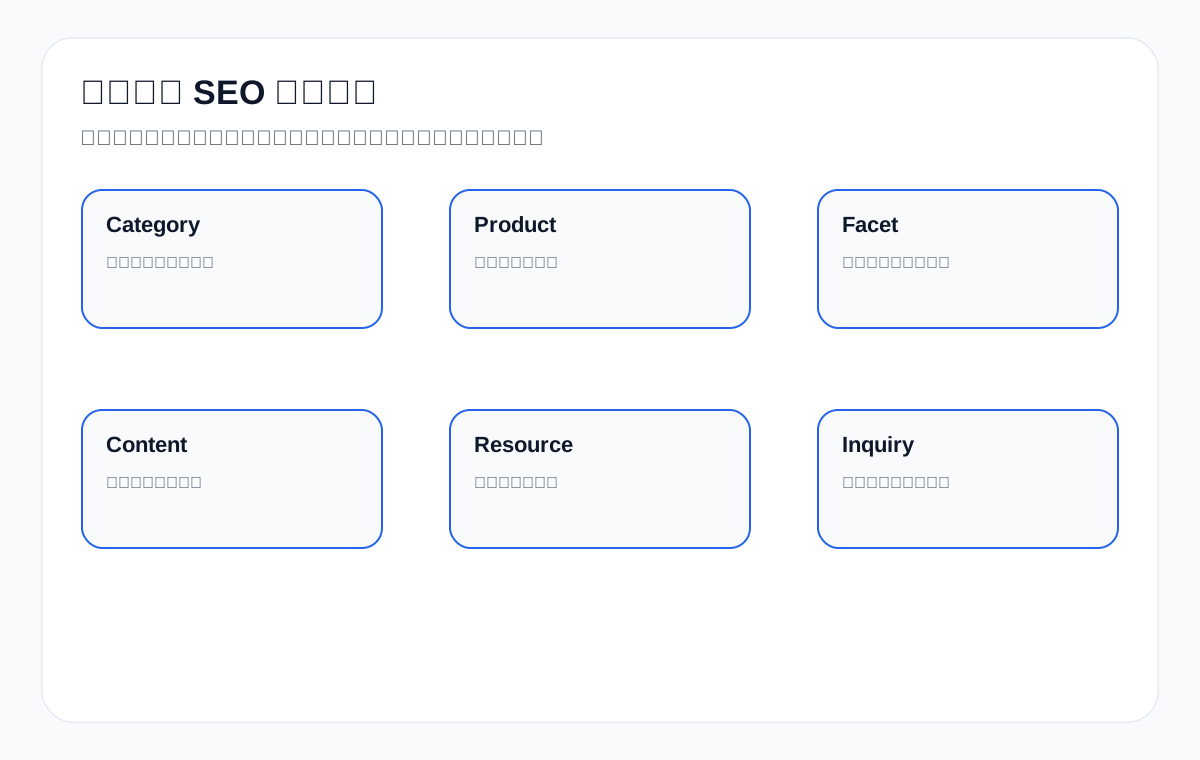
The right approach is to divide pages into six categories: category pages capture category and supplier terms; subcategory pages capture细分 subcategories; product pages capture models, parameters, and specific specifications; filter pages capture only combinations that have search demand and can be maintained; content pages capture question and comparison intent; resource pages capture datasheet, manual, and certificate intent; and inquiry pages capture quote and sample requests.
For example, waterproof connector supplier should be handled by a category page or capability page, M12 4 pin waterproof connector by a product page, waterproof connector for marine lighting by an application page, how to choose waterproof connector by a tutorial page, and waterproof connector datasheet by a resource page.
Page role division table
| Page type | Terms it should capture | Main content | What it should not handle |
|---|---|---|---|
| Category page | supplier/manufacturer/custom/category | Product range, filters, capabilities, FAQ | Do not write it as a pure tutorial |
| Product page | Model, specification, parameters | Parameters, materials, drawings, MOQ, certifications | Do not compete for broad category terms |
| Filter page | Attribute combinations with demand | Combination description, product list, unique value | Do not open up unlimited combinations |
| Content page | how/what/compare/problem | Steps, criteria, misconceptions, internal links | Do not educate without directing to products |
| Resource page | datasheet/manual/certificate | Downloads, versions, scope of application | Do not leave it isolated with no entry point |
| Inquiry page | quote/sample/custom request | Document checklist, form, response notes | Do not pile up long text |
4. Category page SEO: the most important non-brand traffic entry point for a foreign trade catalog site
Category pages are usually better suited than individual product pages to capture category terms and supplier terms, because they can show the complete product range, filtering options, application scenarios, and company capabilities. Guides from Semrush, Ahrefs, and Shopify all emphasize that a category page is not a simple product grid but a central page connecting users, products, and search engines.
Foreign trade category pages should avoid two extremes: one is having only a product list with no context at all; the other is stuffing very long text above the product list, which gets in the way of users finding products. A better structure is: a brief positioning statement and main filter entry points at the top, products and key parameters in the middle, and selection guidance, application scenarios, FAQ, resource entry points, and related content below.
For example, an LED flood light category page can include a 50W-500W product range, outdoor stadium/parking lot/warehouse applications, IP65/IP66, color temperature, mounting methods, certifications, and bulk customization notes. In this way the page serves both search and purchasing judgment.
Category page content modules
| Module | Purpose | Foreign trade example |
|---|---|---|
| Top positioning | Explain what the page sells | LED flood light manufacturer for outdoor projects |
| Filter entry | Help users find products quickly | wattage, IP rating, beam angle |
| Product list | Show the supply range | Different wattages and mounting methods |
| Selection guide | Answer purchasing questions | How to choose wattage by mounting height |
| FAQ | Handle common inquiry questions | MOQ, certification, lead time, customization |
| Related entries | Direct users to applications and resources | parking lot lighting guide, datasheet |
5. Product page SEO: do not just write the model; write the information buyers need in order to decide
The task of a product page is to capture specific product terms, model terms, parameter terms, and high-intent long-tail terms. Many foreign trade product pages have only a few images and one sentence of introduction, which makes it hard for Google to understand the page and impossible for buyers to prepare an inquiry.
A strong product page should include: a clear product name, core parameters, materials, dimensions, certifications, application scenarios, customizable options, packaging, MOQ, lead time, drawing or resource downloads, related products, FAQ, and an inquiry entry point. A product page does not need to read like an encyclopedia, but it must give buyers enough to judge whether it is worth contacting you.
For example, a custom metal parts product page cannot just say “high quality”. It needs to state machinable materials, tolerance range, surface finish, CNC milling/turning, drawing formats, inspection method, and instructions for uploading a drawing.
Product page purchasing information checklist
| Information item | Why it matters | Example |
|---|---|---|
| Specifications | Match purchasing needs | IP67, 4 pin, M12, rated current |
| Materials and processes | Judge suitability | aluminum 6061, stainless steel 304 |
| Application scenarios | Confirm the operating environment | marine lighting, food processing |
| Certification documents | Build trust | CE, ROHS, FDA, ISO |
| Customization options | Capture B2B needs | logo, packaging, drawing-based parts |
| Inquiry information | Reduce communication costs | quantity, drawing, target market |
6. Filter page SEO: users need filters, but Google does not need to index every combination
Filter pages are where e-commerce SEO most easily goes wrong. If color, size, material, price, application, brand, certificate, and sorting method all generate crawlable URLs, this can produce a large number of duplicate or low-value pages, waste crawl resources, and dilute the signals of important pages. Google’s material on faceted navigation also reminds sites to manage this type of URL.
But filter pages should not all be closed off either. Some filter combinations have clear search demand and commercial value and should be turned into indexable landing pages. For example, stainless steel ball valve, IP67 waterproof connector, 50W LED flood light, and private label yoga leggings manufacturer may be combinations that deserve their own pages.
The criteria are: whether people search for it, whether there are enough products, whether unique content can be written, whether it can be maintained over the long term, and whether it will conflict with category pages or product pages. Sorting parameters with no demand, price ranges, temporary stock status, and combinations of multiple stacked filters are generally not suitable for indexing.
Filter page indexing decision table
| Filter combination | Open to indexing | Reason | Handling |
|---|---|---|---|
| IP67 waterproof connector | Can be open | Has search demand and enough products | Make it a subcategory or landing page |
| color=black&sort=price | Not open | Sorting and color combinations have weak value | canonical to the main category or block crawling |
| 50W LED flood light | Can be open | Clear specification term | Add descriptions and a product list |
| price=low-to-high | Not open | Not a stable search intent | Do not index |
| stainless steel industrial valve | Can be open | High value from material + category | Subcategory + FAQ |
7. Content page SEO: tutorials are not traffic islands; they must serve selection and internal linking
Content pages include tutorials, selection guides, comparison articles, problem answers, application notes, and maintenance guides. Their task is not simply to gain readership, but to educate buyers and guide users toward category pages, product pages, resource pages, and inquiry pages.
For example, how to choose LED flood light should explain wattage, lumen, mounting height, IP rating, beam angle, color temperature, and certificate, and link to the corresponding LED flood light category page and application pages. how to choose waterproof connector should link to pages for IP67, M12, 4 pin, marine lighting, and so on.
If a content page only writes about concepts, with no product scenarios and no internal links, it becomes a traffic island. Foreign trade e-commerce SEO needs content pages to be part of the purchasing path.
Content page to commercial page connection table
| Content topic | Should link to | Conversion purpose |
|---|---|---|
| How to choose LED flood light | LED flood light category page, application pages | Help users view products after selecting |
| CNC machining tolerance guide | CNC parts product page, upload drawing page | Guide users to submit drawings |
| Ceramic dinnerware safety guide | Product category, certificate resource page | Build trust in materials and certifications |
| Packaging machine buying guide | Equipment category, inquiry page | Collect material and capacity requirements |
| Waterproof connector IP rating | IP67 subcategory, datasheet | Direct users to specific specifications |
8. Resource page SEO: datasheets, manuals, and certificates are trust assets for a foreign trade site
Many foreign trade companies keep their materials in PDFs or sales files, with no separate resource entry point on the website. In fact, pages such as datasheet, manual, certificate, installation guide, and material guide not only serve users but also help search engines and AI answers understand the facts about your products.
A resource page should not be just a download button. It should explain which products the material applies to, the version, the main parameters, the update time, the download format, and related pages. This way buyers can judge whether the material is usable, and Google can understand the relationship between the material and the product.
For example, a packaging machine manual page can link to the corresponding model, wear parts, maintenance intervals, and the inquiry page; a medical probe resource page can explain the material, compatible equipment, cleaning method, and certification scope.
Resource page structure table
| Resource type | What the page should include | Related links |
|---|---|---|
| Datasheet | Core parameters, applicable models, version | Product page, category page |
| Manual | Installation, maintenance, precautions | Videos, accessories, inquiry |
| Certificate | Certification scope, validity period, product line | About page, product page |
| Catalog | Product range, download instructions | Category page, contact page |
| Material guide | Material properties, application limits | Technical articles, product page |
9. URL and information architecture: let both people and crawlers understand the catalog hierarchy
E-commerce SEO needs a clear information architecture. URLs, navigation, breadcrumbs, category hierarchy, product placement, and internal links should be consistent. If a product appears in multiple categories at the same time, the canonical and the main category must be clear so that duplicate URLs do not compete with each other.
For a foreign trade product catalog, it is advisable not to go too deep, and not to place all products under a single Products directory. You can split by product line, material, application, or key attributes, but any split must be backed by search demand and a sufficient product base.
For example, /led-flood-light/, /led-flood-light/100w-led-flood-light/, and /applications/parking-lot-lighting/ are easier to understand than /products/item-123/.
Information architecture checklist
| Check item | Good practice | Risky practice |
|---|---|---|
| URL | Short, stable, describes the product | Confusing parameters, temporary IDs |
| Breadcrumbs | Home>Category>Product | Path and URL do not match |
| Navigation | Show core product lines | All pages crammed under Products |
| canonical | Duplicates clearly consolidated | Multiple versions competing with each other |
| Site search | Do not open low-value result pages | Large numbers of search results indexed |
10. Structured data: Product, Breadcrumb, and ItemList must match page content
Structured data can help search engines understand products, category lists, and breadcrumbs. Category pages can consider ItemList or CollectionPage-related markup, product pages can consider Product, tutorial pages can consider Article and FAQPage, and breadcrumbs use BreadcrumbList.
But structured data cannot replace content, and it cannot mark information that does not exist on the page. Do not fabricate ratings, stock, prices, or reviews; if a B2B foreign trade site requires a quote for pricing, Offer information should be handled with care.
A structured data audit should look at three things: whether the page content actually exists, whether the markup type suits the page role, and whether Google’s testing tools report errors.
Structured data usage table
| Page type | Suitable markup | Notes |
|---|---|---|
| Category page | BreadcrumbList, ItemList | List content matches the page |
| Product page | Product, BreadcrumbList | Parameters are real; do not fabricate reviews |
| Tutorial page | Article, FAQPage | FAQ is visible on the page |
| Resource page | Article/CreativeWork | Explain the version and scope of application |
| Company information | Organization | Name, logo, and contact details are consistent |
11. Image and video SEO: not just adding alt text, but adding product decision information
Foreign trade e-commerce websites use many images, but their SEO value is often not realized. Product images, detail images, dimension drawings, application images, installation images, packaging images, inspection images, and factory images can all help users judge, and can also help search engines understand the product.
Alt text should describe the image content rather than pile up keywords. For example, “IP67 waterproof connector with 4 pin cable for outdoor LED lighting” is more natural than “best waterproof connector supplier manufacturer factory”. Image file names, compression, lazy loading, dimensions, and mobile display should also be checked.
Videos are suitable for showing a packaging machine running, LED flood light installation, the cnc machining process, or a ceramic dinnerware packaging test. A video page or embedded module should have a text summary and links to related products.
Image and video audit table
| Asset type | Purpose | Optimization focus |
|---|---|---|
| Main product image | Identify the product | Clear, lightweight, accurate alt text |
| Dimension drawing | Confirm specifications | Label dimensions and units |
| Application image | Explain the use scenario | Link to the application page |
| Inspection image | Build trust | Explain the inspection items |
| Video | Show operation or installation | Add a summary and product entry points |
12. Internal linking strategy: category, product, and content pages must pass context to each other
Internal links on an e-commerce site are not just navigation. In-body links, related products, related categories, selection guides, resource downloads, FAQ links, and breadcrumbs all tell Google about the relationships between pages.
Category pages should link to important subcategories, flagship products, application pages, and selection content; product pages should link to their category, related products, resource pages, and the inquiry page; content pages should link to products and resources; and resource pages should link back to product pages.
For example, a cnc machining tolerance guide should link to custom metal parts, CNC milling, surface finish, and upload drawing; an industrial valve material guide should link to stainless steel valve, high pressure valve, datasheet, and the inquiry page.
Internal link path table
| Starting page | Should link to | Reason |
|---|---|---|
| Category page | Subcategories, flagship products, application pages | Help users continue filtering |
| Product page | Category, related products, resource pages | Add context and trust |
| Content page | Category page, product page, inquiry page | Guide educational traffic toward purchasing |
| Resource page | Product page, contact page | Make resources generate inquiry paths |
| Inquiry page | Document preparation guide | Increase the proportion of qualified leads |
13. Handling stock and delisted products: do not let dead products ruin the search experience
E-commerce websites have product delistings, stock changes, model replacements, and series updates. Although foreign trade sites do not necessarily carry real-time inventory, they also encounter discontinued models, old products, and replacement models. Poor handling creates large numbers of 404s, thin pages, or disappointed users.
If a product is permanently discontinued and a replacement exists, you can keep the page and explain the replacement model, or 301 to the most relevant page; if it is only temporarily out of stock, you can keep the page and state the lead time; if the page has no value and no replacement, you can return a reasonable status and remove it from internal links.
Do not redirect all delisted products to the homepage, because that confuses both users and search engines.
Delisted product handling table
| Situation | Recommended handling | Reason |
|---|---|---|
| Permanently discontinued with a replacement | Explain the replacement on the page or 301 to the replacement | Preserve the relevant intent |
| Temporarily out of stock | Keep the page and state the lead time | Avoid losing rankings |
| Worthless old models | Remove internal links and return a reasonable status | Reduce low-quality pages |
| Series upgrade | Link the old page to the new series | Capture historical traffic |
| Duplicate products | Merge or canonical | Consolidate signals |
14. GSC review: check whether query terms land on the right pages
E-commerce SEO review cannot look only at total clicks. You should look at GSC query terms by page type: whether category pages get category terms and supplier terms, whether product pages get model and parameter terms, whether content pages get question terms, and whether resource pages get datasheet/manual/certificate terms.
If a category page shows a large number of how to queries, it means content and category intent may be mixed; if a tutorial page shows supplier terms, it means the commercial entry point needs to be strengthened; if a product page has no specific parameter queries at all, the content may be too thin or internal links insufficient.
The review cycle can look at trends over 4 weeks, 8 weeks, and 12 weeks; do not look only at day-to-day fluctuations.
GSC page type review table
| Page type | Ideal query terms | Abnormal signals | Action |
|---|---|---|---|
| Category page | supplier/manufacturer/category | Many how/what queries | Add commercial information or split out content pages |
| Product page | Model, parameters, specifications | No query terms | Add parameters and internal links |
| Filter page | Attribute combination terms | Many duplicate low-quality terms | Tighten indexing |
| Content page | Questions, comparisons, choices | No product clicks | Strengthen internal links |
| Resource page | datasheet/manual/certificate | No entry point | Link from product pages |
15. GA4 and inquiry review: connect page visits to product opportunities
GA4 should show which page users enter from and whether they click product cards, filters, resource downloads, the inquiry button, email, or WhatsApp. On foreign trade e-commerce sites, it is especially important to look at the paths from content pages to product pages and from product pages to the inquiry page.
The inquiry form should ideally record the entry page, product line, country, quantity, whether a drawing is available, budget stage, and whether a sample is needed. With feedback from the sales team, you can tell which pages bring high-quality leads and which pages only bring useless inquiries.
That way, a review will not just say that an article gets a lot of traffic; it can judge whether the article helped the product pages and inquiries.
GA4/inquiry event table
| Event | Description | Business judgment |
|---|---|---|
| view_item_list | View a category product list | Whether the category page works |
| select_item | Click a product | Whether product cards are attractive |
| file_download | Download a resource | Whether resources build trust |
| form_start | Start an inquiry | Whether the CTA is clear |
| generate_lead | Submit an inquiry | Lead quantity and quality |
| sales_validated | Sales marks it valid | Real business value |
16. AI search and e-commerce SEO: make product information extractable and citable
AI search extracts answers from clear, structured, factually explicit pages. If a foreign trade e-commerce site has only product cards, with no parameter explanations, application notes, FAQ, or resource pages, it will be hard to cite.
Category pages and content pages can include definitions, selection tables, parameter explanations, FAQ, resource entry points, and company entity information. Do not promise that you will be recommended by AI on a fixed basis; instead, improve the foundations that make a page understandable and citable.
For example, if a waterproof connector page clearly explains IP67, IP68, pin count, cable gauge, and application environment, it is better suited to being cited by procurement research tools than a page with only a product list.
AI citation foundation table
| Element | Page location | Example |
|---|---|---|
| Clear definition | Category page/content page | What is an IP67 waterproof connector |
| Parameter table | Product page/resource page | rated current, voltage, material |
| Selection steps | Content page | Choose by environment, load, and mounting method |
| FAQ | Category page/product page | MOQ, certificate, custom cable |
| Entity information | About page/footer | Company, brand, and factory capabilities are consistent |
17. Common misconceptions: why doing a lot of e-commerce SEO still does not grow
Misconception one: optimizing only product pages and not building category pages. The result is that every product page is weak and no page captures category terms.
Misconception two: opening all filter pages. The result is a large number of duplicate URLs, and crawling and signals for core pages are diluted.
Misconception three: content pages only write popular science and do not link to products and resources. The result is that traffic cannot enter the purchasing path.
Misconception four: writing the same text on every category page. The result is that pages lack unique value and Google has trouble telling them apart.
Misconception five: looking only at traffic and not at inquiry quality. A foreign trade site ultimately needs product opportunities, not just visitor numbers.
Misconception and correction table
| Misconception | Consequence | Correction |
|---|---|---|
| Only working on product pages | Weak category terms | Strengthen category pages and subcategories |
| Opening all filters | Duplication and wasted crawling | Establish indexing decision rules |
| Content without internal links | Traffic islands | Add product and resource entry points |
| Duplicate category descriptions | No page differentiation | Write unique content by product line |
| Only looking at traffic | Disconnected from the business | Connect inquiry and sales feedback |
18. 90-day execution roadmap: fix structure first, then add content and review
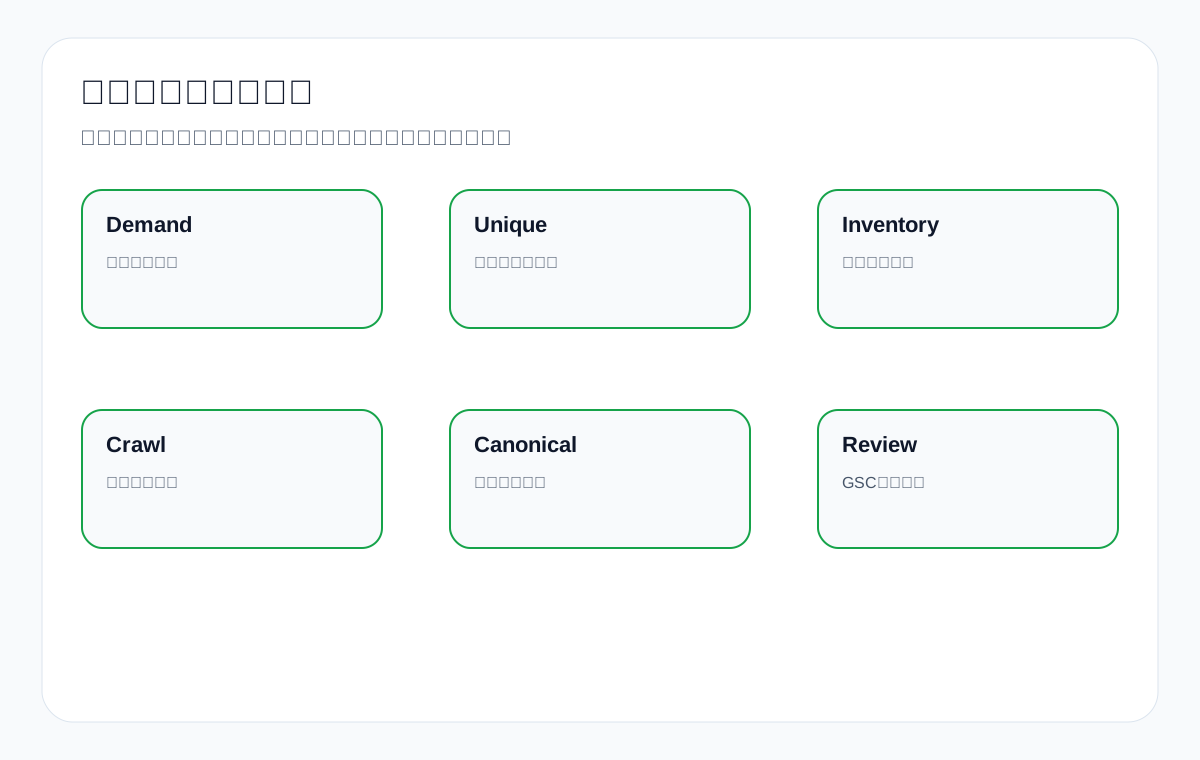
In the first 30 days, work on page layering, indexing strategy, and checks of core category pages and product pages. The focus is to let search engines know which pages are important and which pages do not need indexing.
From day 31 to 60, add category page content, product page parameters, resource pages, application pages, and in-body internal links. At this stage, every core page should carry purchasing decision information.
From day 61 to 90, look at GSC, GA4, inquiry quality, and sales feedback to decide which categories to keep expanding, which filter pages can be opened, and which content pages need stronger direction.
90-day roadmap table
| Period | Focus | Deliverables | Review metrics |
|---|---|---|---|
| 0-30 days | Layering and indexing strategy | Page map, filter rules | Index coverage, crawling |
| 31-60 days | Category and product reinforcement | Selection table, FAQ, resource entry points | Query terms, product clicks |
| 61-90 days | Review and expansion | Next batch of page plans | Inquiry quality, AI citations |
19. Foreign trade e-commerce case study: how to divide the work for an LED flood light product catalog
An LED flood light manufacturer should not rely only on a few dozen product detail pages. A more reasonable structure is: an LED flood light category page captures the main category and supplier terms; subcategories or application pages are built by wattage, application, and mounting type; product pages capture specific specifications; tutorial pages explain selection; and resource pages provide datasheets and certificates.
The category page can clearly describe the product range, outdoor applications, IP ratings, certifications, bulk supply, and customization capabilities. Product pages describe the lumen, wattage, beam angle, housing material, and working temperature of each model. Content pages describe how to choose LED flood light for parking lot and link to related products.
During review, check whether LED flood light supplier, 100W LED flood light, parking lot LED flood light, and IP65 flood light land on the right pages in GSC, and check whether inquiries include wattage, quantity, and application scenarios.
LED flood light page map
| Search term | Target page | Content focus |
|---|---|---|
| LED flood light supplier | Category page | Product range, certifications, supply capability |
| 100W LED flood light | Product page/subcategory | Wattage, lumens, mounting method |
| parking lot LED flood light | Application page | Mounting height, illuminance, recommended wattage |
| LED flood light datasheet | Resource page | Parameters, version, download |
| how to choose LED flood light | Content page | Selection steps and misconceptions |
20. Foreign trade e-commerce case study: how custom metal parts avoids scattered product pages
custom metal parts usually has no fixed SKUs, so pages are more likely to become scattered. You can build a structure by process, material, application, and need: CNC machining parts, sheet metal fabrication, aluminum parts, stainless steel parts, surface finish, tolerance guide, upload drawing.
Product pages or capability pages should explain materials, processes, equipment, precision, inspection, surface treatment, drawing formats, prototyping, and mass production. Content pages can explain tolerance, surface finish, DFM, and cost factors, and link to the upload drawing or inquiry page.
This way, after users enter from a question term, they can naturally move to the capability page and inquiry page instead of leaving after reading the article.
custom metal parts page map
| Page | Intent captured | Core content |
|---|---|---|
| CNC machining parts | Process + product term | Materials, precision, equipment, applications |
| Aluminum custom parts | Material term | 6061/7075, surface treatment |
| Tolerance guide | Question term | Tolerance grades, cost impact |
| Upload drawing | Inquiry term | File format, quantity, material |
| Inspection report | Trust term | Inspection methods and sample reports |
21. FAQ: common questions about foreign trade e-commerce SEO
Should foreign trade e-commerce SEO start with category pages or product pages?
Usually, handle core category pages and subcategory pages first, then reinforce flagship product pages. Category pages capture category and supplier terms, while product pages capture specific model and parameter terms; both matter.
Should all filter pages be blocked from indexing?
No. Filter combinations with no search demand, severe duplication, or no maintainability are not suitable for indexing; combinations with clear demand, enough products, and unique content can be made into subcategories or landing pages.
Do product pages need to be very long?
They do not need to be forced to be long, but they must include the parameters, materials, applications, certifications, MOQ, lead time, customization, and inquiry information needed for purchasing judgment.
Why should content pages link to product pages?
Content pages capture question and selection intent; without entry points to products, resources, and inquiries, traffic can hardly turn into purchasing opportunities.
If a foreign trade site has no online payment, does it still count as e-commerce SEO?
As long as it has a product catalog, categories, product pages, filters, and an inquiry path, it can be handled with the page division approach of e-commerce SEO; the conversion goal simply changes from orders to inquiries and quotations.
How do you judge whether a category page is strong enough?
Look at whether it clearly explains the product range, supply capability, filter criteria, application scenarios, common questions, resource entry points, and related products, rather than having only a product grid.
Can structured data solve product page rankings?
It cannot solve that on its own. Structured data helps understanding, but product content, internal links, page quality, and purchasing information remain the foundation.
Will AI search affect e-commerce SEO?
It affects the procurement research stage. Pages with clear structure, explicit parameters, complete FAQ, and citable resources are easier for AI tools to understand and cite, but you cannot promise that they will appear every time.
Should delisted products be deleted?
It depends on whether there is a replacement and historical value. With a replacement, you can keep the page with an explanation or redirect to a relevant page; a worthless page should be removed from internal links and its status handled reasonably.
Which metrics should be reviewed?
Look at GSC query terms and pages, GA4 product clicks and form events, inquiry quality, sales feedback, resource downloads, and AI citations.
22. Conclusion: e-commerce SEO is won or lost on page division and the review loop
Foreign trade e-commerce SEO is not the optimization of any single page, but a system of page division. Category pages, product pages, filter pages, content pages, resource pages, and inquiry pages each serve different intents and link to one another; only then can they form a sustainable search asset.
Category pages are responsible for letting Google and buyers understand the product range; product pages handle specific parameters and quote decisions; filter pages handle a small number of high-value combinations; content pages handle education and internal links; resource pages handle trust; and inquiry pages handle collecting qualified demand.
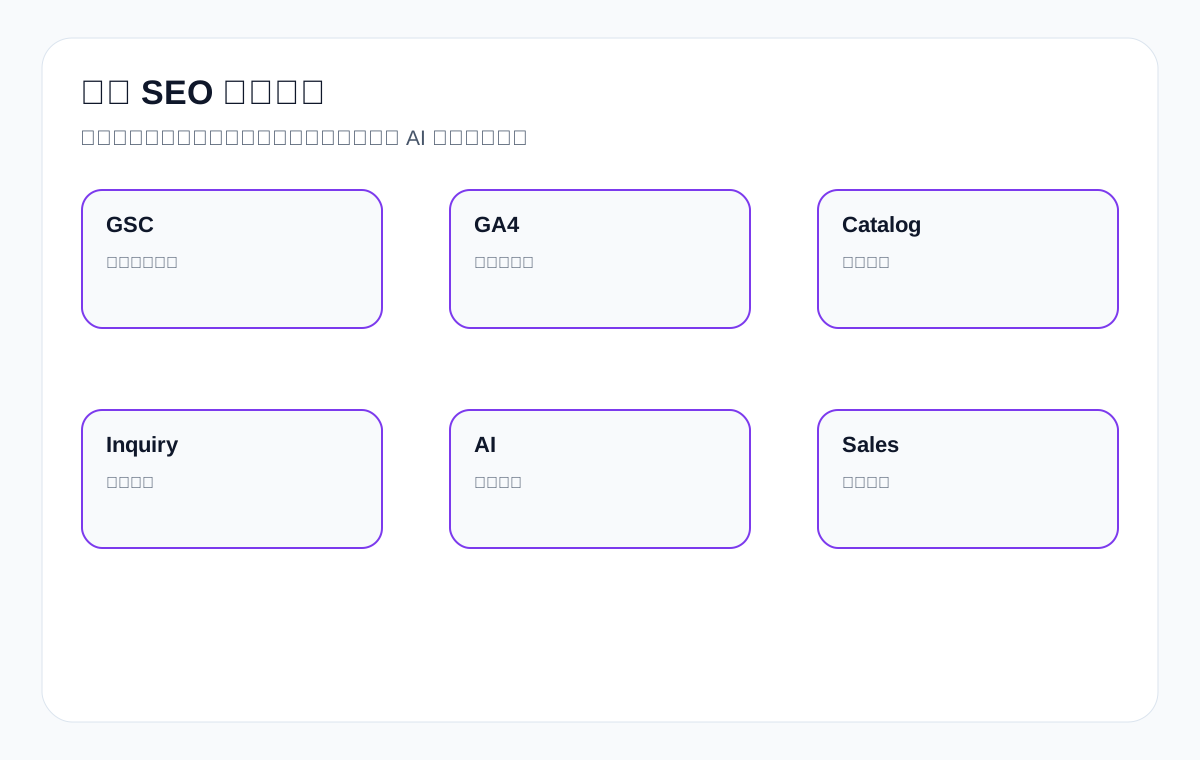
In the end, a review cannot look only at traffic. It should look at whether English product terms land on the right pages, whether users continue to view products and resources, whether inquiries are more specific, whether sales can confirm valid opportunities, and whether AI answers more easily cite the official website content. Only by doing these things is e-commerce SEO not empty talk, but a page asset engineering effort that can support long-term customer acquisition for foreign trade companies.
Final checklist
| Check item | Completion standard |
|---|---|
| Page roles | Clear division among category, product, filter, content, resource, and inquiry pages |
| Category page | Has product range, filters, applications, FAQ, and internal links |
| Product page | Has parameters, materials, certifications, MOQ, resources, and a quote entry point |
| Filter page | Has indexing rules and canonical handling |
| Content page | Has criteria, tables, FAQ, and product direction |
| Review metrics | GSC, GA4, inquiry quality, sales feedback, AI citations |
Official sources and e-commerce SEO acceptance boundaries
E-commerce SEO must explain the division of labor among category pages, product pages, filter pages, and content pages clearly. The most error-prone areas are duplicate URLs, non-crawlable links, thin content, and missing conversion events.
| Official source | Judgment it can support | Boundary it cannot cross |
|---|---|---|
| Google: SEO Starter Guide | Check basic SEO for product and category pages | Passing basic checks does not mean orders or inquiries already exist |
| Google: Consolidate duplicate URLs | Handle filter pages, sorting pages, and duplicate product pages | canonical is a signal, not a mandatory directive |
| Google: Make your links crawlable | Confirm crawlable entry points between category, product, and content pages | Front-end filter entries cannot automatically be treated as crawlable links |
| Google: Helpful content | Check whether product descriptions, selection guides, and FAQ are useful | Copying a parameter table cannot replace purchase decision information |
| Google Analytics 4 events | Observe add-to-cart, form, download, and inquiry actions | Conversion events cannot explain why search impressions happened |
Diagnostic acceptance table
| Check item | Record fields | How to write during a low-data period |
|---|---|---|
| Indexing basics | index/follow, canonical, sitemap, robots, HTTP status code | Write only the current accessible state; do not write performance conclusions |
| Page evidence | Title, body, images, links, structured data, update time | If materials are missing, list the gaps; do not add fabricated cases |
| Search data | GSC query/page/date/country/device | If GSC shows zero rows, write zero rows; do not extrapolate rankings |
| Conversion observation | GA4 events, forms, downloads, inquiry entry points | If no events exist, fix tracking first, then discuss judgment |
Continue reading this SEO series
If you are systematically reviewing SEO for a foreign trade website, it is worth continuing with the articles below. First clarify the relationships among crawling, indexing, content, links, and review, then decide which page to change next.
- How to do WordPress SEO: a guide to indexing, speed, and content structure optimization for foreign trade websites
- How to do product page SEO: a guide to titles, FAQ, Schema, and internal links for foreign trade product pages
- How to do content SEO: a guide to search intent, information gain, and indexable content
- How to do keyword research: a workflow for foreign trade product terms, search intent, and page mapping
- How to mine competitor keywords: from competitor pages and English product terms to inquiry opportunities
- How to choose keyword tools: choose by diagnostic scenario, not by working through a tool list
This page is machine-translated from the Simplified Chinese version and awaiting human review. It has not yet been proofread.