Product page SEO is not finished once you put keywords into the title and description. For export manufacturers and trading companies in China, a product page has to solve four things at the same time: help Google understand which product category and specifications the page covers, help buyers quickly judge whether the product fits, let the sales team receive clearer inquiries, and make it possible to review GSC, GA4 and inquiry sources later.
If the page sells custom metal parts, LED flood light, packaging machine, medical probe, cnc machining parts, ceramic dinnerware, waterproof connector, industrial valve supplier or private label activewear manufacturer, buyers do not care how many adjectives you wrote; they care whether specifications, materials, certifications, applications, lead time, MOQ, samples, documents and customization boundaries are clear.
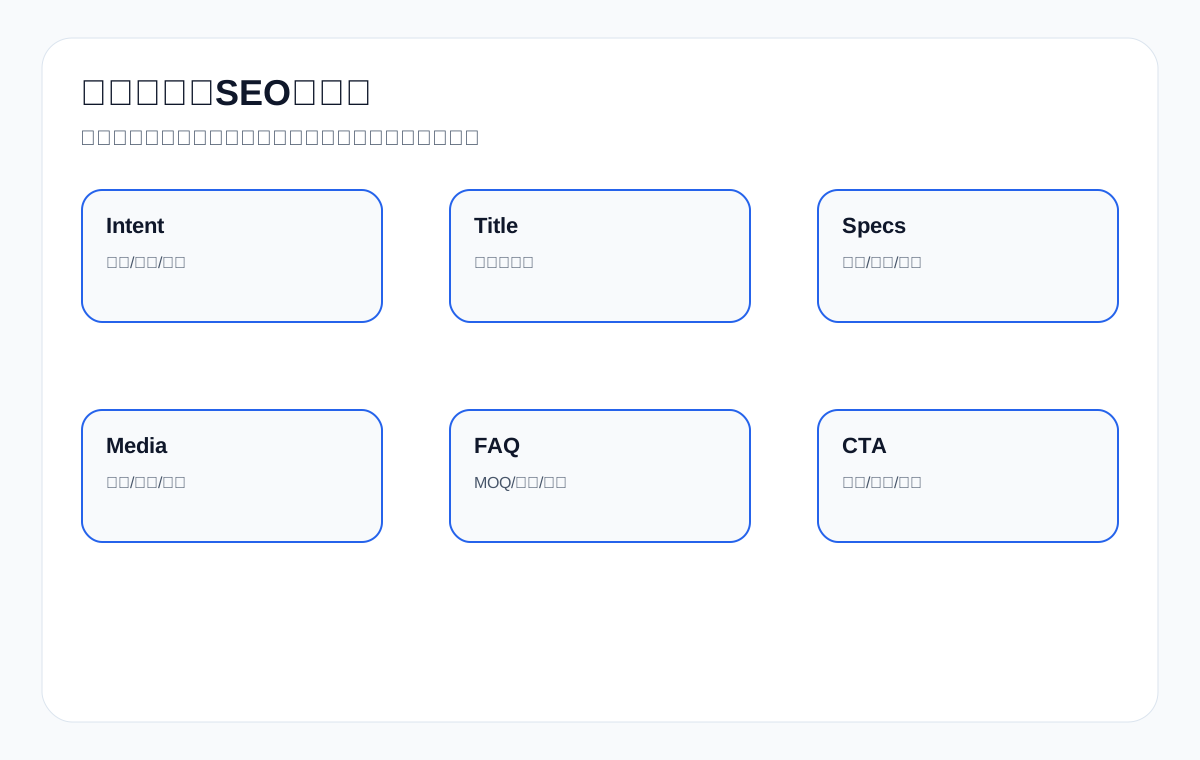
Official acceptance boundary: product page SEO must separate search eligibility, product facts and inquiry paths
Export product page SEO is not about writing a longer title, and it is not about filling in FAQ and Schema. A product page first has to be crawlable, indexable and understandable, and then clear product facts, specification tables, application scenarios, image assets, internal links and inquiry entry points help buyers judge. Search Console, GA4, structured data, server logs and AI/GEO samples must be accepted separately.
If the site currently has no usable GSC query, page or page-query row data, you cannot write in rankings, impressions, clicks, CTR, AI adoption or inquiry changes. Product page SEO can still continue, but conclusions must be downgraded to: whether the page is in the sitemap, whether it is indexable, whether the product facts are accurate, whether the Product/FAQ/Breadcrumb markup matches the body text, and whether GA4 inquiry events are observable.
Official documentation and product page SEO field mapping
| Official documentation entry point | What it supports judging | Product page acceptance field | What it cannot establish |
|---|---|---|---|
| Google Search Central: SEO Starter Guide | Basic practices for titles, page organization, links, images and understandable content. | Title, H1, meta description, body structure, image alt, internal links. | Cannot replace reviewing actual page data. |
| Google Search Central: Search Essentials | A page needs to meet basic technical, policy and content requirements to appear in Google Search. | HTTP 200, crawlable, indexable, core content visible, no obvious violations. | Meeting basic requirements does not mean the page already has search performance. |
| Google Search Central: Creating helpful, reliable, people-first content | Content should serve real user questions and provide reliable, useful, verifiable information. | Product specifications, use, materials, applicable conditions, limitation boundaries and procurement questions. | Word count alone cannot judge product page quality. |
| Google Search Central: Product structured data | Product structured data should match the visible product information on the page. | Whether name, images, description, brand, SKU and pricing or quote terms match the body text. | Product Schema cannot replace real product information. |
| Google Search Central: Structured data general guidelines | Structured data must match visible page content and comply with policy. | Whether Product, FAQ and Breadcrumb mark content that is genuinely visible on the page. | Schema must not state promises the body text does not make. |
| Google Search Central: Breadcrumb structured data | Breadcrumbs help search engines understand where a page sits in the site structure. | Whether the Home, category and product page path matches the internal link structure. | Breadcrumbs cannot replace product category planning. |
| Google Search Central: Google Images best practices | Images, file names, alt text, context and page quality all affect how images are understood. | Product photos, drawings, application images, alt text, file names and body context. | Image optimization cannot replace product facts. |
| Google Search Central: Sitemaps overview | Sitemaps help Google discover important URLs. | Whether product pages, category pages, resource pages and updated pages are in the sitemap. | Being in the sitemap does not mean a URL has been crawled, indexed or shown. |
| Google Search Central: robots.txt introduction | robots.txt controls crawl access. | Whether product directories, images, CSS, JS, resource pages or AI-related access paths are blocked by mistake. | robots.txt cannot fix weak product content. |
| Google Search Central: URL canonicalization guide | Duplicate URLs need canonical tags, redirects, internal links and sitemaps to work together. | Whether variant pages, parameter pages, old product pages and similar products have a primary page. | A canonical tag is not a ranking promise. |
| Search Console Help: URL Inspection tool | Indexing status, crawl status, canonical and the page version Google sees for a single URL. | Sampling checks on core product pages, variant pages, resource pages and category pages. | A single indexable URL does not mean inquiries are already coming in. |
| Search Console Help: Page indexing report | Page indexing status and reasons for non-indexing. | Whether product pages are indexed and whether the reasons for non-indexing affect core product lines. | An indexing report is not an inquiry report. |
| Search Console Help: Performance report | query, page, country, device, clicks, impressions, CTR, average position. | Product terms, model terms, application terms, country and device dimensions. | Without row data, you cannot claim improvements in ranking, impressions, clicks or CTR. |
| Google Analytics Help: About events | GA4 events can observe what users do next on the site. | Events for forms, email, WhatsApp, RFQ, downloads, inquiry buttons and contact pages. | On-site events cannot replace GSC search performance. |
| Google Search Central: AI features and your website | AI search capabilities still depend on a foundation of accessible, indexable pages with clear content. | Product facts, answer sections, specification tables, internal links and citable paragraphs. | You cannot promise that AI answers will definitely use your website. |
| OpenAI Platform: Bots | Distinguish the access purposes of OAI-SearchBot, GPTBot and ChatGPT-User. | Whether robots rules, logs and public product pages unintentionally block the relevant access paths. | It does not mean ChatGPT will present your content in a specified way. |
| IndexNow: Documentation | After URLs are added, updated or deleted, you can notify participating search engines. | Whether there is a notification action after core product pages are updated. | It cannot replace content quality, crawl eligibility or indexing eligibility. |
Product page SEO acceptance criteria: verify the page first, then the inquiry path
| Acceptance layer | Required evidence | How to judge an export product page | Unacceptable approach |
|---|---|---|---|
| Page eligibility | HTTP status, robots, sitemap, indexing status, canonical. | Confirm that the product page can be discovered and understood by search engines. | Discussing inquiry improvement when the page is not indexed. |
| Product facts | Name, model, specifications, images, applications, documents and limitation boundaries. | Every fact can be traced to product documents, page content or a reviewable source. | Inventing specifications to look complete. |
| Structured data | Product, FAQ and Breadcrumb match the visible page content. | Quote-based B2B pages should not fabricate price, stock or ratings. | Putting information in Schema that is not in the body text. |
| Search performance | query, page, country, device, clicks, impressions, CTR, average position. | Check whether product terms, model terms and application terms appear in row data. | Claiming results without GSC row data. |
| Inquiry path | Events for forms, email, WhatsApp, RFQ, downloads and contact pages. | Confirm the product page connects to real business actions. | Writing impressions or clicks directly as inquiry improvement. |
| AI/GEO samples | Platform, question, date, answer summary, cited URL, incorrect facts. | Treat samples as observation records, not long-term results. | Turning a single answer screenshot into a stable conclusion about a platform. |
How to downgrade product page SEO conclusions when there is no GSC data
If the site currently has no usable GSC query, page or page-query row data, a product page SEO report cannot be written as a search performance report. It can first be written as a page eligibility, product facts and inquiry path readiness report.
| Missing evidence | What you can write | What you cannot write | Next review step |
|---|---|---|---|
| No GSC Performance rows | Whether product pages are crawlable, indexable and in the sitemap, and whether they have clear specifications and inquiry entry points. | Improvements in ranking, impressions, clicks, CTR or trends. | Keep the 28-day and 90-day date ranges and wait for the first rows of data. |
| No URL Inspection sampling | List the core product pages, variant pages, category pages and resource pages that need spot checks. | Asserting that product pages already appear in search. | Record indexing status, canonical, crawl time and page version. |
| No GA4 events | Explain that events for inquiry buttons, forms, email, WhatsApp, RFQ, downloads and contact pages still need to be configured. | That organic search inquiries have improved. | First make on-site actions observable. |
| No log samples | Explain that origin, CDN or WAF logs are temporarily unavailable, and do not treat tool screenshots as crawl evidence. | Claiming that the relevant crawler has already crawled the site. | Obtain logs with clear coverage time, sources and fields. |
| No AI samples | Build a table of platforms, questions, dates, answer summaries, cited URLs and incorrect facts. | Claiming that AI platforms already use your product pages. | Retest across platforms with a fixed question set and record it separately from page changes. |
Start with search intent: which queries should a product page capture
The current top Google results and authoritative resources on product page SEO usually cover titles, descriptions, product images, reviews, structured data, speed, internal links, unique descriptions and conversion buttons. Ahrefs’ product page SEO structure, Search Engine Journal’s ecommerce product page dos and don’ts, Google Search Central’s product structured data and Merchant listing documentation all show that a product page is not an isolated page but a combination of search, product information and user experience.
The strength of that material is a clear general ecommerce framework; the gap is that most of it targets DTC retail or marketplace ecommerce and rarely addresses how Chinese export B2B product pages handle scenarios such as no public price, no shopping cart, quote-driven sales, multiple specifications, multiple certifications, custom manufacturing from drawings, sample confirmation and document downloads. This article focuses on filling that gap.
Common product page query intents and how to capture them
| Intent type | Buyer state | Example English query | Page strategy |
|---|---|---|---|
| Product term | The buyer knows the product family and wants to find a supplier | waterproof connector supplier | A category page or core product family page captures it; the product page adds specific specifications |
| Model term | The buyer knows the model or size | M12 waterproof connector 5 pin | A product page captures it; specifications and drawings must be complete |
| Specification term | The buyer filters by material, power or certification | IP67 connector, 150W LED flood light | Title, specification table, FAQ and filter internal links must all be consistent |
| Application term | The buyer looks for a solution by scenario | packaging machine connector | The application page and related product pages link to each other |
| Customization term | The buyer has drawings or OEM requirements | custom metal parts quote | The product page should explain drawings, materials, tolerances and quotation materials |
| Comparison term | The buyer is evaluating differences | ceramic vs porcelain dinnerware | An article page explains it and links to the corresponding product page |
How product pages and category pages should divide the work
Many export sites write category pages and product pages as the same kind of content, so the pages compete for the same keywords. Category pages are better for broader procurement terms such as product family, supplier, manufacturer and wholesale; product pages are better for specific models, specifications, materials, applications, certifications and customization conditions. For example, LED flood light supplier fits a category page better, while 150W IP65 LED flood light aluminum housing fits a product page better.
If your product line has only a few models, the product page can carry more explanation; if there are many SKUs, the category page should serve as the selection entry point while the product page provides specific specifications and inquiry materials. Do not copy the same paragraph — “we are professional manufacturer” — onto every product page, because that leaves pages without unique value.
Category page vs. product page division-of-work table
| Page | Best suited to capture | What it should emphasize | What it should not carry |
|---|---|---|---|
| Category page | Product family, supplier, wholesale and manufacturer terms | Product range, filters, applications, procurement FAQ | Full specifications for every model |
| Product page | Model, specification, material, certification and customization terms | Specification table, images, drawings, MOQ, inquiry entry | Broad industry encyclopedia content |
| Application page | Industry and use-case terms | Scenario problems, recommended products, selection rationale | A list of every SKU |
| Article page | Question, comparison, standard and tutorial terms | Judgement criteria, misconceptions, steps, internal links | Directly replacing product pages |
How to write the Title, H1, URL and Meta description
A product page title should tell both buyers and search engines “what this is, what the key specifications are, and which procurement scenario it fits”. Do not write a title as brand self-indulgence, and do not pile five or six product terms together. For export B2B pages, the product name, key specifications, material or application in the title is usually more valuable than vague adjectives.
How to write the basic SEO elements of a product page
| Element | Writing goal | Example | What to avoid |
|---|---|---|---|
| Title | Product name + key specifications + supply capability | M12 Waterproof Connector IP67 5 Pin for Industrial Equipment | Do not stuff in multiple unrelated product terms |
| H1 | Match the real product on the page | M12 Waterproof Connector IP67 5 Pin | Do not make it completely inconsistent with the Title |
| Meta description | State what buyers can see and what comes next | View pin count, cable options, IP rating, drawings and sample options. | It is not a ranking or inquiry promise |
| URL | Short, stable, readable English | /waterproof-connector/m12-ip67-5-pin/ | Do not change it casually after launch |
| Above-the-fold summary | One sentence covering use, specifications and suitable scenarios | For packaging machines, outdoor equipment and control cabinets. | Do not write only a brand slogan |
The Meta description does not directly determine ranking, but it affects clicks and expectations. It should tell buyers what information the page contains: specifications, materials, drawings, certifications, samples, customization, document downloads or how quoting works. Do not write uncontrollable promises, and do not merely repeat the title.
Product page body copy must answer the buyer’s judgement questions
Export product page body copy is not better just because it is longer; it needs to cover the information a buyer must know before deciding. Different products need different evidence: machinery is judged on capacity and configuration, parts on tolerances and materials, lighting on wattage and certification, medical accessories on compatibility and safety, apparel on fabric and sampling, ceramics on material and packaging.
Content evidence export product pages should add by product type
| Product type | Key content | What the buyer is judging | Page module |
|---|---|---|---|
| custom metal parts | Material, tolerance, surface treatment, drawing format, quality inspection | The buyer needs to judge whether it can be machined | Specification table, process capability, quotation materials |
| LED flood light | Wattage, luminous efficacy, color temperature, IP rating, certification, installation | The buyer needs to judge application fit | Specification comparison, scenario images, certification notes |
| packaging machine | Capacity, applicable materials, dimensions, after-sales, spare parts | The buyer needs to judge solution fit | Workflow, sample testing, configuration table |
| medical probe | Compatible models, material safety, packaging, standards | The buyer needs to judge risk and compliance | Compatibility table, document downloads, quality notes |
| cnc machining parts | Drawings, tolerance, material, quantity, lead time | The buyer needs to judge quotation conditions | RFQ checklist, inspection method, case boundaries |
| ceramic dinnerware | Material, glaze, sets, packaging, food contact | The buyer needs to judge retail and wholesale feasibility | Set table, packaging images, MOQ FAQ |
| waterproof connector | Pin count, IP rating, cable diameter, locking method, certification | The buyer needs to judge environmental suitability | Structure diagram, specification table, FAQ |
| industrial valve supplier | Material, pressure, medium, standards, testing | The buyer needs to judge engineering fit | Selection table, test reports, industry applications |
| private label activewear manufacturer | Fabric, sizing, workmanship, sampling, packaging | The buyer needs to judge private label feasibility | Fabric table, process images, sampling workflow |
How to build the specification table: spare buyers from repeatedly asking for basic information
The specification table is one of the most important modules on a B2B product page. It is not only for search engines; it also helps procurement, engineering, management and sales staff align on the same information. A good specification table should include product name, model, material, dimensions, certification, applicable scenarios, customization scope, packaging, MOQ, samples, lead time and a document download entry. It is fine not to publish a price, but the conditions that affect the quote must be clear.
Suggested specification table fields for a B2B product page
| Field | Applicable products | Writing suggestion | Inquiry value |
|---|---|---|---|
| Model / SKU | Connectors, lighting, machinery, accessories | List models and available variants | Makes inquiries more specific |
| Material | Parts, valves, tableware, apparel | Explain the material range and options | Helps judge the applicable environment |
| Size / Dimension | Almost all products | Explain with a table or drawing | Reduces size confirmation back-and-forth |
| Certification | Lighting, medical, food contact, industrial parts | State certifications you actually hold or testing you can support | Avoids misleading buyers |
| Customization | OEM/ODM, build-to-drawing, logo, packaging | Explain what can and cannot be customized | Filters out mismatched requirements |
| MOQ / Sample | Wholesale and custom products | Give a range or note that it must be confirmed by specification | Improves inquiry quality |
| Lead time | Custom and production-type products | Separate samples from bulk orders | Helps procurement planning |
How to write the product description: use first, then differences, then next steps
Many product page descriptions are just a few generic selling points such as high quality, competitive price, professional manufacturer. These phrases help buyers very little. A better approach: the first paragraph explains what the product is and which scenarios it suits; the second explains key specifications and options; the third explains how it differs from common alternatives; the fourth tells the buyer what information to provide next.
Product description paragraph structure
| Paragraph | Question it answers | Example direction | Notes |
|---|---|---|---|
| Opening paragraph | What it is and who it is for | This M12 waterproof connector is designed for outdoor control cabinets and packaging machines. | Avoid vague promotion |
| Specification paragraph | What the key parameters are | IP67, 3/4/5 pin options, PVC or PUR cable, panel mount options. | Stay consistent with the specification table |
| Application paragraph | Which scenarios it suits | Used in automation equipment, LED lighting, sensors and industrial valves. | Do not exaggerate the applicable scope |
| Customization paragraph | Whether it can be adjusted to requirements | Cable length, pin layout, color and packaging can be confirmed before quotation. | State the boundaries |
| Action paragraph | What the buyer should do next | Send drawing, quantity, application and certification request for review. | Guide toward a useful inquiry |
How to write the FAQ: from real procurement questions, not filler
A product page FAQ suits export B2B very well, because buyers often have similar questions before submitting an inquiry: what is the MOQ, how long do samples take, is customization supported, are there certifications, how is packaging done, what drawing format is needed, how is lead time confirmed. The FAQ should be built from real sales conversations; do not write generic questions unrelated to the product.
Product page FAQ question pool
| Question type | Suitable products | Example question | Answer focus |
|---|---|---|---|
| MOQ | All custom and wholesale products | What is the MOQ for custom metal parts? | Explain that it depends on material, process and quantity |
| Sample | Lighting, apparel, tableware, connectors | Can I order samples before bulk production? | Explain sample conditions and lead time |
| Drawing | Machined parts, connectors, valves | Which drawing format do you need for quotation? | List PDF, STEP, IGES and so on |
| Certification | LED, medical, food contact, valves | Which certifications are available? | Write only information you can genuinely provide |
| Customization | OEM/ODM products | Can you make private label activewear? | Explain logo, fabric, sizing and packaging |
| Lead time | All products | How long does production take? | Separate samples, bulk orders and complex customization |
How to implement Product Schema and FAQ Schema safely
Product structured data can help search engines understand a page, but it must match the visible content on the page. B2B export product pages often have no public price, stock or ratings, so do not fabricate them. Prioritize making the name, description, images, SKU, brand, category, breadcrumbs and FAQ true and accurate. Google’s documentation on product structured data and merchant listings emphasizes that structured data should reflect the actual content of the page.
Product page Schema usage table
| Type | Content you can write | When it fits | Risk reminder |
|---|---|---|---|
| Product | Name, images, description, SKU, brand, category | Information actually shown on the product page | Do not fabricate price, stock or ratings |
| FAQPage | FAQ visible on the page | MOQ, samples, lead time, certification, customization | The FAQ must be displayed in the body text |
| BreadcrumbList | Home > Products > Category > Product | Helps understand hierarchy | Must match the navigation |
| ImageObject | Key product images, dimension drawings, application images | Supports image understanding | File names and alt text must be truthful |
| Organization | Company entity, logo, contact details | Strengthens brand entity consistency | Site-wide information must be consistent |
Images, drawings and video: the core evidence of trust on a product page
When export buyers cannot inspect samples in person, images and documents become important evidence. A product page should have at least a main image, detail images, dimension drawings, application images or packaging images. For complex products, you can add short videos, exploded views, installation images or test images. Image file names and alt text should describe the real content, for example cnc-machining-parts-surface-finish.webp, not IMG_1234.
Product media optimization checklist
| Media type | Suitable content | SEO approach | Procurement value |
|---|---|---|---|
| Main image | Overall product appearance | Product name + core specifications | Fast product recognition |
| Detail image | Interfaces, material, surface, workmanship | Describe the specific detail | Builds trust |
| Dimension drawing | Key dimensions, mounting holes, interfaces | State the dimension information | Reduces back-and-forth |
| Application image | Actual installation or usage scenarios | Product + application scenario | Captures scenario terms |
| Packaging image | Export packaging, sets, labels | Product + packaging | Reduces shipping concerns |
| Short video | Operation, installation, testing | Video title and description | Explains complex functions |
How to handle internal links: stop product pages from being isolated
A product page can hardly carry all search intent on its own. It needs context from category pages, application pages, article pages and resource pages, and it also needs to guide buyers toward an inquiry. Internal links are not a few random “related products”; they should be designed around the procurement path.
Internal link path design for product pages
| Path | Function | Example anchor text | Goal |
|---|---|---|---|
| Category page to product page | Product family traffic moves into specification selection | View M12 IP67 waterproof connector | Help buyers narrow the range |
| Article to product page | Question traffic moves into product judgement | Compare LED flood light wattage options | Move informational intent toward commercial intent |
| Product page to application page | Explain the applicable industries | See connectors for packaging machines | Add scenario credibility |
| Product page to resource page | Reduce technical communication cost | Download medical probe datasheet | Support the buyer’s internal evaluation |
| Product page to inquiry page | Move into quotation or samples | Send drawings for custom metal parts quote | Make the next step clear |
How to handle variants, out-of-stock items, discontinued products and similar products
Export products often have variants: different sizes, materials, colors, pin counts, wattages, packaging or certifications. If you build a separate page for every variant, you may create a large number of similar pages; if you put all variants on one page, you may fail to capture specific model terms. The test is: does the variant have its own search demand, its own specifications, its own images and its own procurement judgement. If yes, it can have its own page; otherwise put it in the variant table on the same product page.
Product variant and lifecycle handling table
| Situation | Recommended handling | Reason | Notes |
|---|---|---|---|
| Only color or a minor difference | Variant table on the same product page | Avoid duplicate thin pages | Images and options must be clear |
| Large specification differences with search volume | Separate product page | Captures model terms | Link back to the category page |
| Temporarily out of stock | Keep the page and explain alternatives | Preserve search and backlink value | Do not return a 404 |
| Long-term discontinued | Offer replacement products and use a 301 where appropriate | Reduce wasted visits | Keep it if the document value still matters |
| Old versions still have document demand | Keep a resource or support page | Serve existing customers and long-tail queries | State the discontinued status clearly |
Mobile and speed: a slow product page hurts the inquiry path
Product pages tend to have many images, tables and scripts, so they can load slowly on mobile. Speed optimization cannot rely only on compressing images; also check whether the above-the-fold area is too heavy, whether tables are readable, whether the inquiry button is obvious, whether lazy loading is sensible and whether the form responds promptly. For buyers, a page that will not open, specifications that are hard to read and a form that is hard to use all reduce trust.
Product page mobile experience checklist
| Check item | Symptom | Optimization direction | How to verify |
|---|---|---|---|
| Above-the-fold loading | Large images and animations slow down LCP | Compress above-the-fold images and reduce blocking resources | PageSpeed and a real device |
| Specification table | Horizontal overflow on phones | Make it scrollable or group the display | Browse on mobile |
| Image detail | Hard to see after compression | Provide a high-resolution view entry | Check key details |
| CTA | The inquiry button is not obvious | Make it sticky or repeat it in sections | Simulate the procurement path |
| Form | Too many fields or slow submission | Keep necessary fields and reduce friction | Test submission |
How to design the product page above-the-fold area: let buyers decide within three seconds whether to keep reading
A product page above-the-fold area is not enough with one large image and one slogan. When export buyers open a page, they usually judge four things first: is this the product I am looking for; is the specification range close to my needs; does this company look like a real supplier; can I quickly get a quote, sample or document next. If the above-the-fold area only says “high quality product with competitive price”, buyers have no basis for judgement.
A structure better suited to export B2B product pages is a clear product image on the left or at the top, with the product name, core specifications, applicable scenarios, customization options, certification or quality notes, and a clear inquiry button on the right or below. For example, a waterproof connector product page can state IP67, M8/M12/M16, pin options, cable length, panel mount and sample available in the above-the-fold area; a custom metal parts page can state material options, tolerance range, surface treatment, drawing review, and prototype and batch production.
| Above-the-fold module | Problem to solve | Export product page approach | Judgement standard |
|---|---|---|---|
| Product image | Whether the buyer understands the product | Main image plus key detail images; avoid using only renders | The core structure is visible on mobile too |
| Core specifications | Whether it meets basic needs | Material, dimensions, wattage, certification, IP rating, process range | Visible without scrolling far |
| Application scenarios | Where the product is used | for packaging machine, outdoor lighting, industrial valve system | Consistent with the target procurement terms |
| Customization boundaries | Whether OEM/ODM is supported | logo, color, size, drawing, packaging, material | State what is possible without exaggerating |
| CTA | How to make contact next | Send drawing, Request sample, Get quotation, Download datasheet | The button is clear and the form works |
The above-the-fold area should also avoid two problems. First, do not cram every certification, factory photo and company story into it, drowning out the product information. Second, do not have only an inquiry button without judgement information; asking buyers to submit a form before trust is built usually converts poorly.
How a product page should handle the B2B quote scenario with no public price
Many B2B export products cannot display a price directly, because the quote depends on material, size, quantity, packaging, certification, exchange rates, shipping, drawings and customization complexity. This is not an SEO problem, but if the page does not explain the quoting logic at all, buyers will find the information opaque. The right approach is not to invent a fixed price but to explain the factors that affect the quote and tell buyers which materials to submit to get a more accurate quote.
For example, a cnc machining parts page can explain that a quote requires 2D/3D drawings, material, surface finish, tolerance, quantity and inspection requirements; a private label activewear manufacturer page can explain that the quote depends on fabric, size range, printing method, label, packaging and sample revision. This avoids fabricating a price while improving inquiry quality.
| Product type | Factors affecting the quote | What the page should explain | What the inquiry form can collect |
|---|---|---|---|
| custom metal parts | Material, tolerance, surface treatment, quantity | Drawings and a use description are needed before quoting | drawing, material, quantity, finish |
| LED flood light | Wattage, certification, housing, packaging, quantity | Certification and packaging requirements differ by market and affect the quote | wattage, certification, quantity, market |
| packaging machine | Materials, capacity, configuration, after-sales, shipping | You need to understand the production line and sample testing conditions | product type, capacity, voltage, factory layout |
| medical probe | Compatible models, materials, packaging, standards | Compatibility and quality requirements need to be confirmed | model, standard, quantity, packaging |
| ceramic dinnerware | Material, sets, patterns, packaging, MOQ | Different processes and packaging affect cost | set type, design, quantity, packaging |
The benefit of this approach is that the page does not promise uncontrollable results and does not let buyers assume every product has a fixed price. At the same time, the sales team receives inquiries closer to real procurement needs rather than a one-line “please send price”.
How to write comparison content on a product page: help buyers choose
Buyers often compare several materials, specifications, models or suppliers rather than looking at a single product. A product page can add a comparison module in moderation, but it should stay focused on real choices, avoid attacking competitors and avoid absolute claims that cannot be proven. A comparison module is good for explaining which environment suits which material, which application suits which wattage, how connection methods differ and which channel suits which packaging.
For example, an LED flood light page can compare how 50W, 100W and 150W suit warehouses, parking lots and sports courts; a waterproof connector page can compare the application boundaries of M8, M12 and M16 or IP65 and IP67; a ceramic dinnerware page can compare the weight, texture, cost and use scenarios of stoneware, porcelain and bone china.
| Comparison topic | Suitable page | Dimensions to include | SEO value |
|---|---|---|---|
| Specification comparison | Lighting, connectors, valves | Dimensions, wattage, pressure, IP rating, certification | Captures long-tail specification terms |
| Material comparison | Metal parts, tableware, apparel | Cost, durability, weight, surface finish, applicable scenarios | Answers procurement evaluation questions |
| Application comparison | Machinery, accessories, industrial products | Environment, risk, installation, maintenance, compatibility | Connects application pages and product pages |
| Customization method comparison | OEM/ODM products | Sampling lead time, MOQ, packaging, labels, workmanship | Makes inquiries more specific |
Comparison content should link to more detailed guides or application pages. If a product page has too much comparison content, it can dilute the purchase decision; in that case put a short table on the product page and link to a dedicated comparison article.
How product pages and document download pages work together
Many export products need datasheets, catalogs, manuals, drawings, testing reports or certification files. A document download page is not simply a PDF link; it should explain which models the document applies to, what procurement question it answers and what to confirm next after downloading. Product pages should also link to documents in the right places rather than piling all of them in the footer.
For example, a medical probe product page can provide a compatible model table and datasheet; an industrial valve supplier page can provide pressure rating, material and test standard documents; a packaging machine page can provide layout requirements, capacity range and an operation manual summary. Resource pages themselves can also earn long-tail search traffic, for example product catalog, datasheet, manual, specification PDF.
| Document type | Suitable products | Placement on the product page | Review metric |
|---|---|---|---|
| Catalog | Factories with a broad product line | Category page and the middle of the product page | Whether inquiries become more specific after download |
| Datasheet | Medical accessories, electronic parts, industrial parts | Near the specification table | Share of visitors moving from resource pages to product pages |
| Drawing | Machined parts, connectors, valves | Near dimension drawings and quotation notes | Whether inquiries include drawings |
| Certification | Lighting, food contact, medical-related | Near certification notes | Inquiry quality in the target market |
| Manual | Machinery and complex products | Near application notes and the FAQ | Whether pre-sales questions decrease |
How product pages can support AI search and GEO visibility
AI search systems are more likely to cite pages with clear structure, explicit facts and complete extractable information. If a product page has only marketing copy, AI struggles to understand it accurately; if the page has a clear definition, specification table, application scenarios, FAQ, brand entity, document links and consistent product naming, it is easier to understand. This still cannot promise that the page will be cited, but it can make the page easier for machines to read.
An export product page can include a concise definition paragraph, for example “An M12 waterproof connector is a circular connector used for sensors, automation equipment and outdoor electrical systems where sealed connections are required.” When writing for a Chinese site, you can explain how the English product terms map to procurement scenarios. The FAQ and tables should also keep questions specific, answers direct and entities consistent.
| GEO-friendly module | Page approach | Suitable example | Notes |
|---|---|---|---|
| Definition paragraph | One sentence explaining what the product is and where it is used | waterproof connector, industrial valve | Do not write it as an advertising line |
| Specification table | List parameters in a structured way | LED flood light, medical probe | Keep it consistent with the visible page content |
| Application list | List typical use scenarios | packaging machine, cnc machining parts | Do not exaggerate the applicable industries |
| FAQ | Answer specific procurement questions | MOQ, sample, lead time, certification | Answers should be short and accurate |
| Document links | Link to a datasheet or catalog | medical probe datasheet | The document must be accessible |
Risk control before and after a product page redesign
A product page that already ranks or generates inquiries should not be heavily changed at will. Before a redesign, export the GSC page data, the current Title and Meta, URLs, internal links, external links, inquiry sources and page screenshots. Keep the URL where possible during the redesign, unless the old URL is clearly wrong and there is a complete 301 plan. After the redesign, watch indexing, clicks, ranking fluctuations and inquiry quality, and do not make a series of major adjustments right after launch.
If a product page already generates steady inquiries but has thin content, outdated images and poor mobile performance, you can update it in stages: first add specifications and the FAQ, then add images and documents, then optimize the title and description, and finally adjust internal links. This makes it easier to tell which step produced a change and reduces the risk of a bad edit.
| Redesign stage | Action | Risk | Verification |
|---|---|---|---|
| Pre-change record | Save titles, content, URLs, GSC and inquiry data | Without a baseline you cannot judge the effect | Create a page record |
| Content enhancement | Add specifications, FAQ, images and documents | Information inconsistency | Manual checks and sales confirmation |
| Technical check | Schema, indexing, speed, mobile | Structured data errors | GSC and front-end verification |
| Internal link adjustment | Bring in links from category, article and application pages | Over-repeated anchor text | Spot-check that paths feel natural |
| Review | Check queries and inquiries at 30/60/90 days | Drawing conclusions too early | Judge using multiple metrics together |
Pre-launch checklist for product pages
- Whether the Title contains the product name, key specifications or procurement value.
- Whether the H1 matches the real product on the page.
- Whether the URL is short, in English and stable.
- Whether the above-the-fold area explains what the product is, who it suits and what to do next.
- Whether the specification table covers the information buyers must confirm.
- Whether the images include a main image, detail images, dimension drawings or application images.
- Whether the FAQ comes from real procurement questions.
- Whether Product Schema and FAQ Schema match the visible page content.
- Whether the page links to category, application, resource and inquiry pages.
- Whether parameters can be read clearly and inquiries submitted on mobile.
- Whether GSC and GA4 can be used for later review.
- No promises of specific rankings or inquiry volumes, and no fabricated ratings or stock or other uncontrollable claims.
Product page SEO review: do not look only at rankings
After a product page is published or rewritten, observe it at least at 30, 60 and 90 days. Do not ask only whether it ranks; look at whether target queries enter GSC, whether the page is indexed, whether click-through rate improves, whether visitors move on to documents or inquiries, whether inquiry content is more specific and whether AI answers understand your site information correctly.
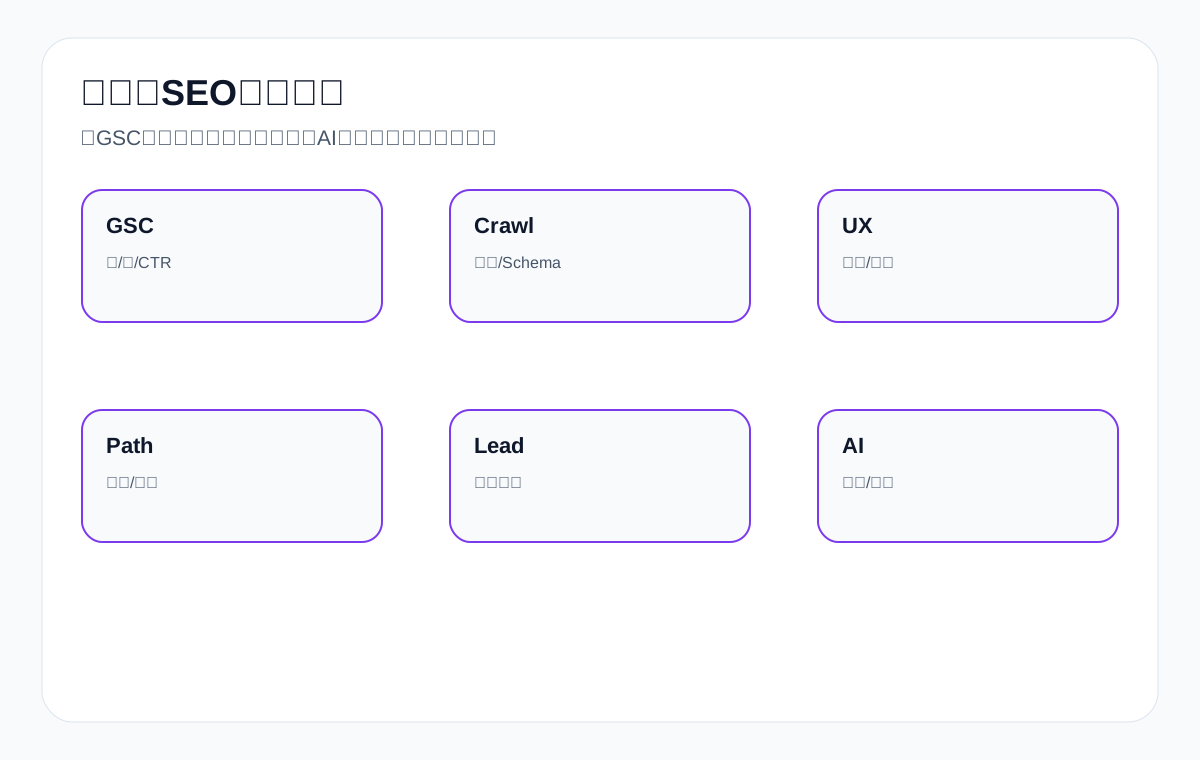
Product page SEO review metrics
| Metric | What to look at | What to judge | Frequency |
|---|---|---|---|
| GSC queries | Whether product, model and specification terms are growing | Judge whether the page captures the right intent | Monthly |
| CTR | Impressions exist but clicks are weak | Check whether the Title and Meta have procurement value | Monthly |
| Indexing and Schema | Whether the page is indexed and whether Product/FAQ are valid | Rule out technical problems | After launch and monthly |
| GA4 paths | Paths from product pages to documents, applications and inquiries | Judge whether the content moves visitors to the next step | Monthly |
| Inquiry quality | Whether it includes model, quantity, drawings, certification and lead time | Judge whether the product page reduces communication cost | Ongoing |
| AI citations | Whether AI answers mention your product information correctly | Judge whether the content is clearly structured and citable | Quarterly |
Common misconceptions: why a product page with lots of copy still gets no results
Common product page SEO misconceptions and corrections
| Misconception | Problem | Correction |
|---|---|---|
| Copying the same introduction onto every product page | Pages lack unique value | Rewrite by model, specifications, applications and FAQ |
| Writing only selling points, not specifications | Buyers cannot judge | Add specification tables, drawings, certifications and customization boundaries |
| Stuffing keywords into the title | Muddled topic and weak clicks | Keep the core product term and key specifications |
| Generic FAQ answers | They do not resolve real concerns | Compile questions from sales conversations |
| Writing fake ratings in Schema | Compliance risk | Write only information genuinely shown on the page |
| Articles that do not link to product pages | Informational traffic cannot convert | Build paths from articles to products and inquiries |
| Over-compressing images | Product details are unclear | Keep the necessary clarity for each use |
FAQ: common questions about export product page SEO
Which matters more, product page SEO or category page SEO?
They divide the work differently. Category pages usually capture product family and supplier terms, while product pages capture specific models, specifications, materials and customization terms. An export site should first make its core category pages clear, then deepen its high-value product pages.
Does not having a price on a B2B product page affect SEO?
Not publishing a price does not necessarily affect SEO. What matters is whether the page provides enough specifications, materials, certifications, applications, FAQ and quote conditions. Do not fabricate price or stock; explain what information a quote requires.
How long should a product page description be?
There is no fixed word count. A high-value product page should be long enough to answer procurement judgement questions, usually including an above-the-fold summary, specification table, application notes, images, FAQ, documents and inquiry instructions. Do not pad it with empty words.
Does every product variant need its own page?
It depends on whether it has independent search demand and independent procurement judgement. If it is only a color or minor difference, it can go on the same page; if specifications, uses or models differ clearly and there is search demand, it can have its own page.
Will an FAQ make the product page too long?
If the FAQ comes from real procurement questions, it usually has value. You can place the FAQ in the later part of the page and keep questions specific, such as MOQ, samples, certification, lead time, drawing format and packaging method.
Does Product Schema have to include ratings and price?
Not necessarily. B2B export pages can carefully use information that is genuinely visible, such as name, images, description, SKU, brand, category and FAQ. Do not invent ratings, stock or price.
Can a product page capture AI search citations?
There is a chance, but it cannot be guaranteed. Product pages that are easier to understand usually have a clear definition, specification table, FAQ, application scenarios, entity information and citable paragraphs, and they do not exaggerate uncontrollable results.
Conclusion: a strong product page is both a search entry point and a procurement judgement page
The goal of export product page SEO is not to stuff keywords into the page but to let both Google and buyers quickly understand the product’s specifications, uses, differences, risks and next steps. Title, description, specifications, images, FAQ, Schema and internal links must all serve the same procurement intent.
When the product pages for custom metal parts, LED flood light, packaging machine, medical probe, cnc machining parts, ceramic dinnerware, waterproof connector, industrial valve supplier and private label activewear manufacturer can clearly answer procurement questions and direct visitors to documents, applications and inquiries, the product page truly upgrades from “product display” to a “customer acquisition asset”.
Keep reading this SEO series
If you are working through export website SEO systematically, the articles below are a good next step. Sort out crawling, indexing, content, links and review first, then decide which page to change next.
- How to do ecommerce SEO: dividing work between category pages, product pages, filter pages and content pages on an export website
- How to do local SEO: a guide to Google Business Profile, reviews, NAP and local pages
- How to do WordPress SEO: a guide to indexing, speed and content structure optimization for export websites
- How to do mobile SEO: a guide to mobile-first indexing, speed, content consistency and inquiry paths
- How to do hreflang and international SEO: a guide to indexing and matching multilingual, multi-region pages
- How to do Shopify SEO: a guide to collection pages, product pages, blogs and speed optimization for export DTC sites
This page is machine-translated from the Simplified Chinese version and awaiting human review. It has not yet been proofread.