AI Citation-Ready Writing is not about making an export website sound more like a machine, and it is not about cutting an article into a pile of short sentences. It is about giving your product pages, category pages, industry solution pages, and technical articles clear definitions, boundaries, evidence, entity relationships, and quotable passages when AI systems try to understand them. For Chinese export manufacturers and trading companies, the value of this work is not in “chasing guaranteed AI recommendations” but in writing website content as an asset that both buyers and search systems can more easily understand, verify, and restate.
If a factory that makes custom metal parts only writes “we have good quality, fast lead times, and support customization,” AI systems will find it hard to treat that passage as a stable source. If the page clearly explains materials, processes, precision, surface treatment, applicable industries, MOQ, quality inspection documents, common purchasing questions, and the scenarios it does and does not suit, the page looks much more like a citable answer source. This article follows the real implementation workflow of an export site to explain how to do AI citation-friendly writing, which pages to prioritize, and how to review results with GSC, GA4, inquiry sources, and AI citation observation.
Benchmarking against the Top1 and authoritative references: what others get right and what we need to add
Around AI citation-ready, AI Overviews citation, and AI-ready content, there are currently three main types of authoritative references worth consulting: Google Search Central’s official documentation on AI features and how sites can control them; AI Overviews optimization guides aimed at marketing teams; and hands-on articles on citation-ready content, AI search visibility, entity consistency, and similar topics. They all stress that content must be clear, trustworthy, structured, and verifiable, but most of them do not break the method down to the product pages, category pages, industry pages, and inquiry reviews of a B2B export website.
| Benchmark | What it gets right | Common gap | How this article from Tianwen SEO Research goes further |
|---|---|---|---|
| Google Search Central AI features documentation | Emphasizes that AI features still depend on crawlable, indexable, previewable web content, and explains controls such as robots, nosnippet, and max-snippet | Stays at the level of official principles and does not break down page writing for export businesses | Turns “crawlable, previewable, understandable” into a rewrite checklist for product and article pages |
| AI Overviews optimization articles | Cover clear structure, direct answers, E-E-A-T, FAQ, schema, and authoritative sources | Mostly aimed at general content marketing, with broad industry examples | Demonstrates with export product terms such as LED flood light, packaging machine, and medical probe |
| AI citation-ready tools/platforms | Highlight citation monitoring, brand mentions, and quotable snippets | Easily turn into feature introductions for a tool rather than a method for building pages | Provides review metrics that run from page rewrites to GSC, GA4, inquiry sources, and AI citation observation |
| Traditional SEO content guides | Stress search intent, heading hierarchy, internal links, and content quality | Do not specifically address AI summary extraction and cross-source verification | Adds quote-ready passages, entity consistency, an evidence matrix, and extractable tables |
Why export businesses need AI citation-friendly writing
When Chinese export businesses build English websites, they often split content into two categories: product pages present specifications, and article pages bring in SEO traffic. But with the arrival of AI search, the boundaries between pages are becoming more complicated. An AI system may pull a specification judgment from a product page, a selection recommendation from an article page, and a purchasing question from an FAQ, then combine them with external sources to generate an answer. If your website only has marketing talk and no clear facts or judgments, it will struggle to become a source that gets cited first.
For example, when a buyer searches custom metal parts tolerances for aluminum CNC machining, the AI answer needs to know the material, process, common tolerance ranges, influencing factors, inspection methods, and when drawing confirmation is required, not “professional CNC machining factory.” When they search LED flood light IP65 vs IP66 for outdoor warehouse, the AI needs to compare IP ratings, installation environment, heat dissipation, wattage, certifications, and maintenance costs, not “we are an excellent LED light supplier.” When they search packaging machine for powder small batch production, the AI needs to judge powder flowability, dosing method, capacity, sealing method, and cleaning requirements, not “automated packaging solutions.”
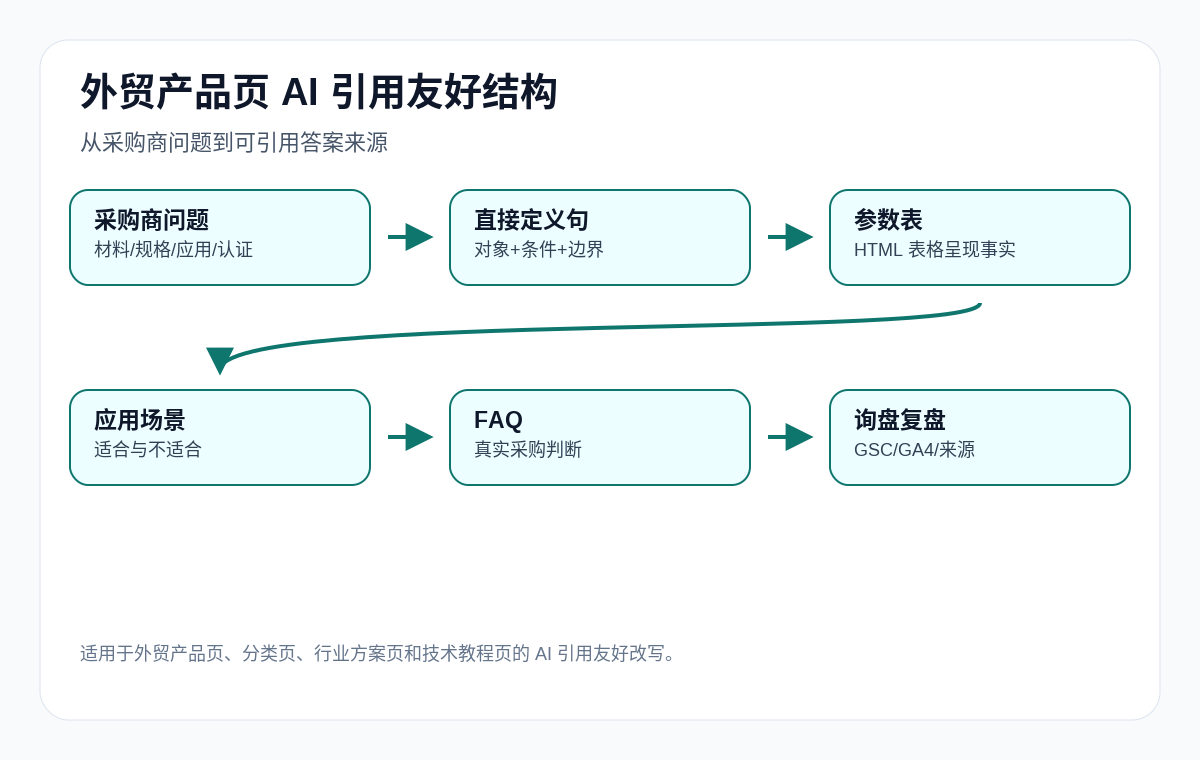
What is a quote-ready passage
A quote-ready passage is a passage that still expresses a complete, accurate, bounded judgment even when it is pulled out of the page on its own. It does not have to be short, but it must contain the subject, conditions, conclusion, and limits. For an export website, quote-ready passages work especially well in the opening paragraph, at the start of an H2, before a comparison table, at the start of a FAQ answer, and in the description area of a product page.
| Passage type | Weak writing | AI citation-friendly writing | Why it is better |
|---|---|---|---|
| Definition sentence | CNC machining is very suitable for custom parts. | cnc machining parts suit metal or plastic parts produced in small to medium batches, with high precision, a variety of materials, and a need for drawing-based processing; if a part has a very simple structure and extremely high volume, stamping, die casting, or injection molding may be worth evaluating first. | The subject, applicable conditions, alternatives, and boundaries are all clear |
| Comparison sentence | IP66 is better than IP65. | For outdoor LED flood light fixtures, IP65 usually handles ordinary rain and dust, while IP66 is better suited to strong water jets, ports, open storage yards, or high-pressure washdown environments; whether IP66 is needed still depends on installation location, maintenance approach, and cost. | Avoids absolutes and brings scenario and cost into the judgment |
| Purchasing advice | Choosing the right packaging machine depends on your needs. | When choosing a packaging machine, first confirm the material form, target bag type, weight per pack, output per minute, dosing accuracy, cleaning requirements, and after-sales spare parts; these conditions directly affect the model, budget, and lead time. | Breaks “it depends on your needs” into actionable parameters |
| Risk note | Medical probes require attention to quality. | A product page for medical probe type products should not only list material and dimensions; it should also explain compatible equipment, sterilization methods, biocompatibility documentation, packaging traceability, and regulatory boundaries. Without this information, buyers usually need to confirm details a second time. | Expresses the purchasing risk and the documentation the buyer needs |
The 9 building blocks of an AI citation-friendly page
Not every page needs to pack in all of the blocks, but core product pages, category pages, industry solution pages, and technical tutorial pages should cover most of them. The blocks below can serve as a basic framework for rewriting export website content.
Block 1: Answer the purchasing question directly above the fold
Do not start the page with company history or a pile of keywords. The first screen needs to answer: what product or problem this page covers, who it suits, what purchasing decision it addresses, and what the reader can decide after reading it. For example, a waterproof connector page can first answer which outdoor equipment it suits, what the key specifications include, and what buyers most often overlook, instead of opening with “we have many years of experience.”
Block 2: Clear definition sentences and applicable boundaries
A definition sentence must be citable on its own. It should state the product category, main use, applicable scenarios, and boundaries. A common mistake among export businesses is writing only “widely used” without explaining which industries, operating conditions, temperatures, materials, certifications, or installation conditions it suits best.
Block 3: Parameter tables and specification notes
Both AI systems and buyers handle tabulated information more easily. A specification table is not only for users; it also helps search systems understand the page entity. A parameter table should include material, size range, certifications, surface treatment, capacity, MOQ, packaging, lead time, customizable items, and any necessary limitations.
Block 4: Application scenarios and unsuitable scenarios
Listing industry names such as “used in industrial, construction, medical, and automotive” is not enough. A better approach states which scenarios it suits and why, and which scenarios are not suitable for direct purchasing because the drawing, sample, certification, or test conditions must be confirmed first.
Block 5: Questions buyers ask most
An FAQ should not only say “do you support customization” and “how long is delivery.” For AI citation friendliness, the FAQ should cover pre-purchase judgments: how to choose materials, how to assess certifications, how to confirm samples, what information is needed for a quote, what quality documents are available, and how exceptions are handled.
Block 6: Evidence, documents, and sources
Verifiable content is more valuable than marketing adjectives. Export businesses can state on the page which test reports, certification documents, inspection equipment, quality processes, packaging photos, installation drawings, drawing requirements, and after-sales boundaries they can provide. Do not fabricate certifications or authorized case studies; do not present unauthorized data as a real case.
Block 7: Internal links and topic boundaries
AI and search systems understand a website not only from a single page but also from the relationships between related pages. The category page for industrial valve supplier should link to material pages, application industry pages, standards pages, FAQ, and the inquiry page; do not stuff every keyword into one page and blur the page intent.
Block 8: Schema and entity consistency
Schema is not a master key, but it helps machines understand the page type. A product page can evaluate structured data such as Product, FAQPage, BreadcrumbList, and Organization; an article page can evaluate the applicability of Article, FAQPage, and HowTo. The key is that page body, title, meta, Schema, navigation, and company information do not contradict one another.
Block 9: Review metrics and rewrite records
AI citation friendliness is not a one-time task. After rewriting, look at changes in GSC queries, page impressions, clicks, average position, GA4 engagement, inquiry sources, on-site search, whether AI answers mention the brand or page, and whether the questions the sales team receives are more precise.
Before-and-after differences in rewriting an export product page
| Page area | Common old writing | Rewritten as AI citation-friendly writing | Review metric |
|---|---|---|---|
| Opening paragraph | We are a professional manufacturer with reliable quality and reasonable prices | State the product subject, material/specification range, applicable purchasing scenarios, and conditions that must be confirmed first | Whether GSC queries move closer to product attributes and purchasing questions |
| Parameters | Scattered through paragraphs, or shown only in images | List material, dimensions, certifications, MOQ, lead time, and customization options in an HTML table | Time on page, scroll depth, completeness of inquiry form fields |
| Applications | List industry names | Write application judgments by operating environment, buying role, and risk points | Whether impressions for industry and application terms increase |
| FAQ | Answer only payment, lead time, and samples | Answer selection, materials, certifications, installation, alternatives, and quote materials | Long-tail question terms, inquiry quality, and how often sales repeats explanations |
| Evidence | Vague claim of passing strict testing | State which inspection reports, QC processes, packaging, and traceability information can be provided | Whether the share of inquiries proactively asking for documents declines |
The upgrade path from traditional SEO writing to AI citation-friendly writing
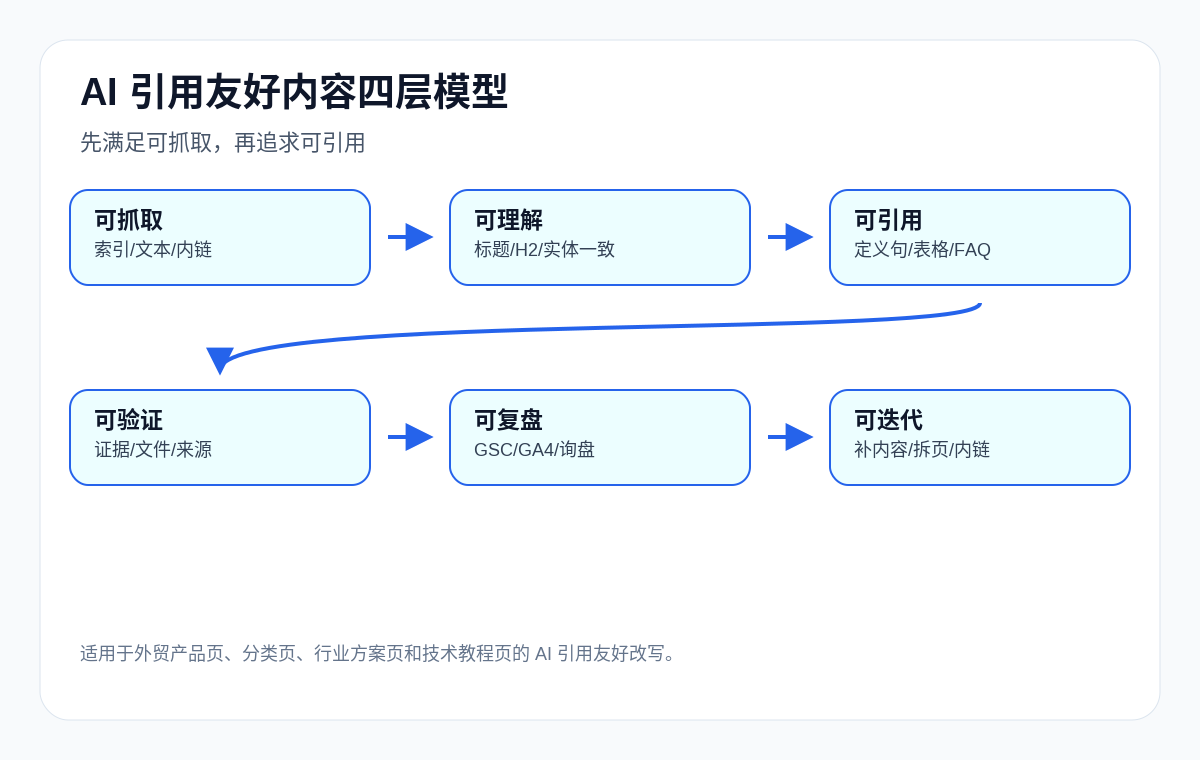
Traditional SEO writing focuses on keyword coverage, search intent, heading hierarchy, and internal links, and these still matter. But AI citation-friendly writing goes further by requiring content to be extractable, verifiable, and understandable across pages. You can divide the upgrade path into four layers.
| Layer | Main task | Export site example | Required? |
|---|---|---|---|
| Layer 1: Crawlable | The page can be accessed, rendered, and indexed by search engines, and key content is not hidden only in images or scripts | Use HTML for the product parameter table instead of only a specification image | Required |
| Layer 2: Understandable | Title, H2s, body, tables, and FAQ all center on the same search intent | A ceramic dinnerware page distinguishes material, glaze, microwave safety, packaging, and MOQ | Required |
| Layer 3: Citable | Definition sentences, judgment tables, steps, and boundaries can be restated on their own | Use a table to explain the differences and purchasing advice for “bone china vs porcelain dinnerware” | Required for core pages |
| Layer 4: Verifiable | Content is consistent with external evidence, the company entity, product information, and structured data | Certifications, testing, company name, address, and brand information are consistent on the website and external platforms | Required for high-value pages |
Step 1: Choose pages first; do not spread effort evenly across the whole site
Export sites have many common page types: product detail pages, category pages, industry application pages, technical blogs, case study pages, download pages, About Us, and Contact. AI citation-friendly rewriting should start with the pages most likely to be triggered by buyer questions, not with a site-wide rewrite.
| Page type | Priority | Why it suits rewriting | Example keywords |
|---|---|---|---|
| Core product page | High | Directly matches buyer product questions and inquiries | custom metal parts manufacturer, waterproof connector supplier |
| Product category page | High | Well suited to explaining product series, selection logic, and comparisons | industrial valve supplier, LED flood light manufacturer |
| Industry application page | High | Well suited to scenario questions and solution-type searches | packaging machine for food powder |
| Technical tutorial page | High | Likely to become an explanatory source in AI answers | cnc machining tolerance guide |
| Ordinary news page | Low | Short lifecycle and unstable citation value | Trade show news, company updates |
| Contact page | Low | Mainly handles conversion and is not suited to cramming in long-form content | contact, inquiry |
Step 2: Lock one page to one main question
The more a page tries to cover every term, the harder it is for AI to cite it accurately. A page is best built around one main question, then expanded with sub-questions. For example, a private label activewear manufacturer page can focus on “how to choose an activewear factory that supports small batches, fabric customization, size sampling, and branded packaging,” instead of covering activewear, yoga wear, swimwear, children’s clothing, fabric knowledge, a factory introduction, and every national market at once.
When locking down the main question, ask five things: what decision is the buyer trying to make when they search for this page? What facts do they need? Which comparisons affect the choice? Which risks must they know in advance? What inquiry information should they provide after reading? Only when these five questions are answered clearly does the page have a chance to earn stable citations.
Step 3: Write a 150–220 word answer above the fold
The above-the-fold answer should read like a summary that can be cited on its own, but it must not turn into vague advertising. The suggested structure is: subject + applicable scenarios + key judgments + next step. Below is a writing framework for export product pages.
| Element | How to write it | Example |
|---|---|---|
| Subject | Name the product or problem clearly | custom metal parts for aluminum CNC machining |
| Applicable scenarios | Describe the buyer’s operating environment | Small-batch trial production, high-precision structural parts, drawing-based customization |
| Key judgments | List the variables that affect the choice | Material, precision, surface treatment, quantity, inspection standard |
| Next step | Tell the user how to proceed | Provide 2D/3D drawings, material grade, annual volume, and surface treatment requirements |
Sample opening paragraph: Custom metal parts suit industrial part sourcing that requires drawing-based customization and clear material and precision requirements. When choosing a supplier, do not look only at unit price; also confirm material grade, tolerance range, surface treatment, inspection method, batch consistency, and packaging requirements. Preparing 2D/3D drawings, target quantity, operating environment, and quality document requirements before requesting a quote usually reduces back-and-forth and improves quote accuracy.
Step 4: Have each H2 answer a single extractable question
AI citation-friendly writing dislikes “cramming seven or eight questions under one H2.” Each H2 is best built around one question: what it is, why it matters, how to judge it, how to do it, who it suits, who it does not suit, and how to review it. That way, each section stays more stable when the page is broken down and interpreted.
- Do not write: Product introduction and advantages. This heading is too broad to tell what it actually answers.
- Do write: How to judge whether an LED flood light needs an IP66 rating.
- Do not write: Our service process. This heading reads more like a company self-description.
- Do write: What material and capacity parameters to prepare before buying a packaging machine.
- Do not write: Why choose us. This heading is not suitable as a neutral answer source for AI.
- Do write: Which certifications and test conditions to check when evaluating a waterproof connector supplier.
Step 5: Replace vague adjectives with judgment tables
The most common problem on export company websites is heavy use of “high quality, experienced, fast lead times, reasonable prices, strict quality control.” These words are not forbidden, but they must not become the main information. A better approach is to convert adjectives into a judgment table.
| Vague expression | Judgment dimension it should be replaced with | Information the page can show |
|---|---|---|
| High quality | Inspection standards, sampling ratio, test equipment, documents that can be provided | Dimensional inspection, material reports, outgoing inspection, packaging checks |
| Fast lead times | Sample turnaround, production cycle, variables that affect lead time | Drawing confirmation, tooling, material inventory, order quantity |
| Supports customization | The scope of what can be customized and the boundary of what cannot | Dimensions, material, color, logo, packaging, minimum order quantity |
| Reasonable price | Cost structure and the information required for a quote | Material, process, quantity, surface treatment, inspection, packaging, shipping |
| Experienced | Industry applications, process range, documentation capability | Do not fabricate cases; express it through publicly describable production capability and applicable scenarios |
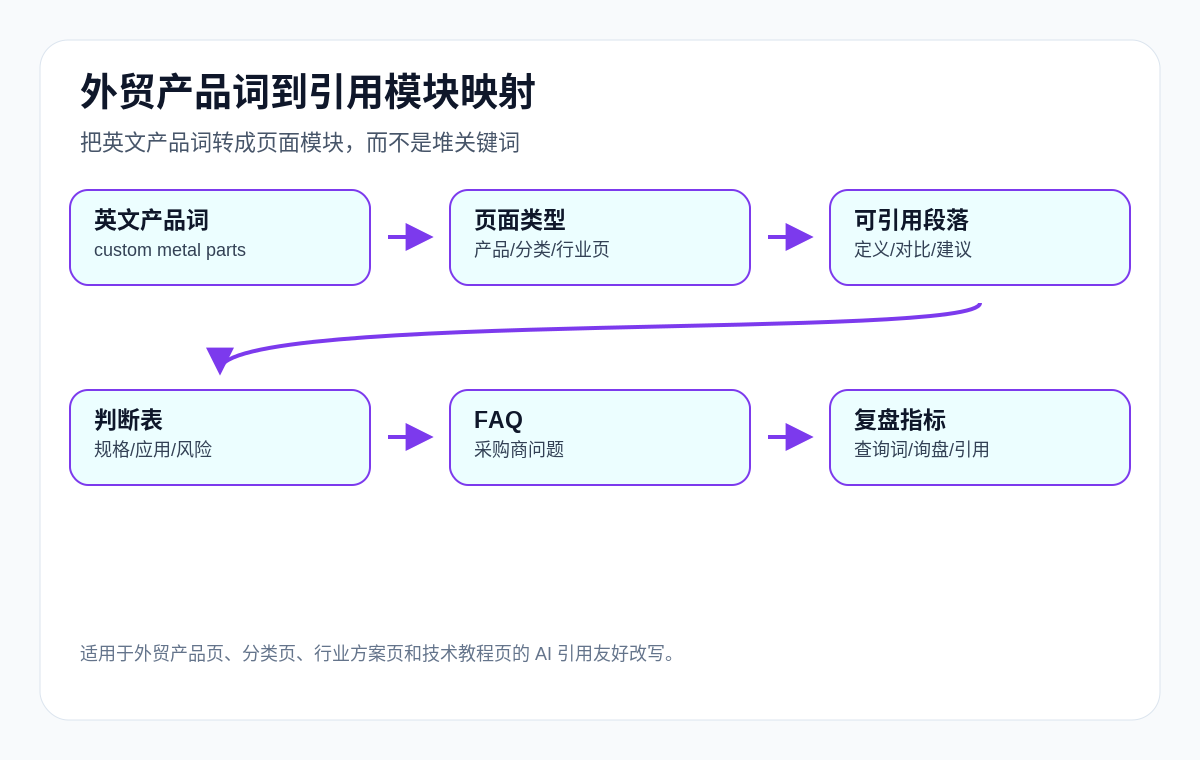
Step 6: Map export product terms to page blocks
AI citation-friendly content is not only about articles. What many export businesses really need is to break English product terms down into page blocks. The matrix below can be used for content planning.
| Product term | Main page | Blocks to add | Suitable FAQ | Review signal |
|---|---|---|---|---|
| custom metal parts | Product/capability page | Material, process, tolerance, surface treatment, drawing requirements | Can you quote without drawings? How are tolerances confirmed? | Drawing-related inquiries, impressions for material terms |
| LED flood light | Category page/product page | Wattage, efficacy, IP rating, installation scenarios, certifications | How do I choose between IP65 and IP66? | Country terms, application scenario terms, certification terms |
| packaging machine | Industry application page | Material form, bag type, speed, dosing method, cleaning requirements | Can powder, granules, and liquid use the same model? | Inquiries using material terms and capacity terms |
| medical probe | Technical/compliance page | Material, compatible equipment, sterilization method, packaging traceability, regulatory boundaries | Can you provide biocompatibility documentation? | Inquiries about compliance documents |
| ceramic dinnerware | Category page/selection page | Material, glaze, microwave safety, packaging, MOQ | How do I choose between stoneware and porcelain? | Material terms, set terms, packaging terms |
| private label activewear manufacturer | Service/capability page | Fabric, sampling, sizing, logo, packaging, MOQ | What should I prepare for small-batch private label customization? | Brand terms, MOQ, and sample inquiries |
Step 7: Write citable FAQ answers, not customer-service phrasing
FAQ is an important block of AI citation-friendly writing, but many export sites turn FAQ into customer-service boilerplate such as “welcome to contact us” and “we will reply as soon as possible.” These sentences help conversion but offer limited citation value. FAQ should prioritize real buyer judgment questions.
| Question type | Weak FAQ | FAQ better suited to citation |
|---|---|---|
| Material selection | We support many materials. | How do I choose between aluminum, stainless steel, and brass based on the operating environment? |
| Certification requirements | Our quality is reliable. | When buying outdoor LED lights, what do CE, RoHS, and IP ratings each tell you? |
| Quote information | Please contact us for a quote. | What drawings and quantity information should I provide before requesting a quote for custom metal parts? |
| Alternatives | We offer one-stop service. | When are casting or stamping a better fit than CNC machining? |
| Lead time risk | Our lead times are stable. | Which factors affect the production and commissioning cycle of a packaging machine? |
Step 8: Handle Schema, but do not treat it as a cure-all
Schema helps search systems understand a page, but it cannot make up for empty body copy. For an export site, the value of Schema is making the page type clearer and keeping FAQ, breadcrumbs, organization information, and product information more consistent. Common types worth evaluating include Organization, WebSite, BreadcrumbList, Product, FAQPage, Article, and HowTo. Whether to use HowTo depends on whether the page really has clear steps; do not force an ordinary introduction into HowTo just for the sake of structured data.
| Page type | Schema to consider | Notes |
|---|---|---|
| Product page | Product, BreadcrumbList, FAQPage | Price, stock, and rating information must not be fabricated; if you do not have it, do not force it in |
| Category page | CollectionPage, BreadcrumbList, FAQPage | Focus on category descriptions and internal links; do not pile all products into repetitive text |
| Technical article | Article, FAQPage, HowTo | Author, publish date, update date, and body must be consistent |
| About Us | Organization | Keep company name, address, contact details, and brand entity consistent |
| Contact page | Organization, ContactPoint | Not suited to cramming in large amounts of SEO content for a long-form target |
Step 9: Keep entity information consistent across pages
When generating answers, AI systems often combine multiple sources. If the company name, product category, and industry positioning differ across the website, Google Business Profile, LinkedIn, B2B platforms, press releases, product catalogs, PDFs, videos, and social media, machines will have a less stable understanding of the entity. Common problems at export businesses include multiple versions of the English company name, mixed use of brand name and company name, inconsistent product category names, and the same certification written differently on different pages.
- Keep the English company name, brand name, address, and contact details consistent.
- Do not switch terms for core product categories from page to page; for example, connector, waterproof connector, and cable connector should have a clear hierarchy.
- Keep certification and standard wording consistent; do not write CE on one page and EU certificate on another without explaining it.
- Keep parameter naming consistent across PDF catalogs, product pages, and article pages.
- External platform profiles should match the website’s main positioning so machines do not read them as several different entities.
Step 10: Replace unverifiable case studies with an evidence matrix
The user has already stated clearly: without authorized data, do not write content as a case study. AI citation-friendly content must follow the same principle. You may write about public scenarios, common purchasing questions, industry judgments, and methodology, but you must not fabricate client names, inquiry counts, ranking growth, AI recommendation results, or deal values.
| Point to prove | What not to write | What you can write | Where to put it |
|---|---|---|---|
| The product suits a certain industry | A certain client’s sales increased after using it | Explain the industry’s operating environment, parameter requirements, and purchasing risks | Industry application page |
| The content rewrite works | Claiming guaranteed AI citations | Explain observable metrics: GSC queries, whether AI answers mention the brand, whether inquiry questions are more precise | Review section |
| Reliable quality | Fabricated certifications or test data | Explain the inspection documents, test processes, and packaging traceability you can provide | Product page/QC page |
| Stable lead times | Promising a fixed number of days for every order | Explain how samples, batch size, customization, and material inventory affect lead time | FAQ/quote page |
| Supplier experience | Fabricated authorized cases | Explain process range, equipment capability, the product types you can serve, and documentation requirements for national markets | Capability page |
Content production workflow: from one export keyword to a citable page
Below is an executable workflow that export businesses can use when revising product pages, category pages, industry pages, and technical articles.
Step 1: Identify the buyer’s question
Start from the English product term and list the questions a buyer might ask. For waterproof connector, for example, the questions might include how to choose between IP67 and IP68, whether it suits a seaside environment, wire diameter range, installation method, certification documents, sample turnaround, and MOQ.
Step 2: Determine the page type
If the question is “what is it / how do I choose,” a tutorial or selection page fits; if it is “supplier / manufacturer,” a category page or capability page fits; if it is “application in a certain industry,” an industry solution page fits; if it is “a specific model,” a product detail page fits.
Step 3: Write citable passages
Open each H2 with 2–4 sentences of core judgment that state the answer clearly, then expand with explanation. Do not hide the key conclusion at the end.
Step 4: Add tables and checklists
Organize complex judgments into tables, such as a material selection table, application scenario table, quote information checklist, and supplier evaluation table. A table must convey information on its own; it should not be purely decorative.
Step 5: Add FAQ and boundaries
FAQ must answer real purchasing questions and state the applicable conditions. For topics involving regulations, certifications, medical use, food contact, or electrical safety, avoid going beyond what the company can verify.
Step 6: Check internal links
Link the page to related products, categories, industry pages, and the inquiry page to help users and search systems keep building context.
Step 7: Review after publishing
Do not look only at whether the page was cited by AI that same day. A more realistic review cycle is 7–14 days for indexing and initial impressions, and 30–60 days for changes in queries, CTR, page interaction, and inquiry quality.
AI citation-friendly writing checklist
- Does the first screen answer the page’s main question within 150–220 words.
- Does each H2 answer only one clear question.
- Is there at least one definition sentence, one judgment table, one execution step, and one FAQ block.
- Does it include export product terms, application scenario terms, and buyer question terms instead of only SEO industry terms.
- Are product parameters expressed in an HTML table instead of only images.
- Does the page state its applicable boundaries and unsuitable situations.
- Does it avoid promising uncontrollable outcomes such as rankings, inquiries, or guaranteed AI recommendations.
- Are there no fabricated cases, fabricated data, or fabricated certifications.
- Are Schema, title, body, FAQ, and company entity information consistent.
- Are there review metrics: GSC, GA4, inquiry sources, and AI answer observation.
Common pitfalls: these writing habits actually hurt stable citations
| Pitfall | Why it is a problem | How to fix it |
|---|---|---|
| Writing very short content for AI | Short does not mean clear; missing context leads to misinterpretation | Keep the opening concise and retain the reasoning and boundaries in the body |
| Writing FAQ as customer-service scripts | “Please contact us” cannot serve as an answer source | Answer the question first, then guide the user to inquire |
| Stuffing all keywords into one page | The page intent becomes muddled and hard to cite accurately | Split pages by product, category, industry, and technical question |
| Adding Schema without changing the body | Structured data cannot replace content quality | Fix the body first, then make Schema consistent with it |
| Citing many sources without your own judgment | The page reads like a pile of references, not a citable point of view | Use tables and boundaries to express your own judgment |
| Fabricating results or case studies | Unverifiable and a trust risk | Express it through public scenarios, an evidence matrix, and methodology |
How to review AI citation-friendly rewrites with GSC
Google Search Console cannot tell you directly whether a page is cited by ChatGPT, but it can tell you which search demands trigger the page. After a rewrite, focus on whether queries are more specific, closer to purchasing questions, and closer to product attributes and application scenarios.
| Review item | What to look at | What it indicates | Next step |
|---|---|---|---|
| Query expansion | Whether material, model, application, certification, and question terms appear | Whether the page is understood as a more specific product answer | Add the corresponding FAQ or H2 |
| Impression changes | Whether impressions for core long-tail terms increase within 30–60 days | Whether the content covers more real demand | Continue strengthening the sub-topics that perform well |
| CTR | Whether the title and description attract buyer clicks | Whether the search result presentation matches intent | Adjust title/meta and avoid being too broad |
| Page ranking | Look not only at head terms but also at question and comparison terms | Whether the page enters the relevant topic pool | Add internal links or split the page |
| Index status | Whether the page is indexed normally | Whether the precondition for citation holds | Check crawling, canonical, noindex, and content quality |
How to review content quality with GA4 and inquiries
AI citation-friendly writing ultimately still serves real buyers. GA4 and inquiry records can help you judge whether a page helps buyers understand the product faster, rather than looking only at traffic.
- Look at engagement: engaged time on page, scroll depth, key button clicks, and download behavior.
- Look at paths: whether users move from a tutorial page into a product page, category page, or inquiry page.
- Look at inquiry questions: whether buyers provide more complete drawings, parameters, quantities, and application scenarios.
- Look at sources: whether organic search, direct, referral, AI tools, social media, or email show changes.
- Look at sales feedback: whether repeated explanations decrease and low-quality inquiries decline.
How to observe whether AI answers cite your website
Different AI products have different citation rules, data sources, and presentation methods, so you cannot promise that citations will always appear. A workable approach is to build an observation checklist, run the same set of questions regularly, and record whether the brand, website URL, product page, definition sentences, or similar phrasing appear.
| Observation question | Example | Fields to record | Notes |
|---|---|---|---|
| Product definition type | What are custom metal parts used for? | Whether the brand, page, or definition sentence appears | Do not change the questions too often, or you will not be able to compare results |
| Comparison judgment type | IP65 vs IP66 LED flood light for outdoor warehouse | Whether the website’s parameters or FAQ are cited | Watch whether the answer accurately expresses the boundaries |
| Selection advice type | How to choose packaging machine for powder? | Whether the page URL or a similar structure appears | Do not treat a single appearance as a stable result |
| Supplier capability type | private label activewear manufacturer MOQ sample process | Whether the company entity or capability page appears | Judge alongside consistency across external platforms |
A page rewrite framework for export websites
What follows is not meant to make every page look the same; it provides a basic framework that covers purchasing questions, search understanding, and AI citations.
- The opening paragraph answers directly: what the product/problem is and which purchasing scenarios it suits.
- Core judgment table: material, specifications, certifications, applications, cost, or risk.
- Preparation before purchase: drawings, parameters, quantity, operating environment, document requirements.
- Applicable scenarios: which industries/operating conditions it suits.
- Unsuitable or needs-confirmation scenarios: situations where no judgment can be made directly.
- Comparison block: compare with alternative materials, processes, models, grades, or supply methods.
- FAQ: answer real purchasing questions.
- Evidence block: certifications, testing, packaging, documents, and verifiable capability.
- Inquiry guidance: tell buyers which information to provide for a more accurate reply.
- Review metrics: which data to look at once the page goes live.
Writing priorities by page type
| Page type | Writing priority | Approach to avoid | Recommended blocks |
|---|---|---|---|
| Product detail page | Specifications, materials, applications, FAQ, inquiry information | Only images and a one-line product description | Parameter table, application table, FAQ, evidence |
| Product category page | Series differences, selection path, internal links | Piling up dozens of product cards with no explanation | Comparison table, selection guide, popular questions |
| Industry application page | Scenarios, pain points, operating conditions, solution approach | Turning the industry page into company promotion | Scenario matrix, risk checklist, applicable products |
| Technical article | Definitions, principles, steps, pitfalls, review | Only translating concepts or patching together references | Flowchart, judgment table, FAQ, internal links |
| About/Contact page | Trust and conversion | Cramming in a 12,000-word technical article | Company information, contact details, inquiry instructions |
Pre-publish quality check
Before publishing or updating, check each item one by one. The purpose of this check is to make sure the front-end content is clearer for buyers, search systems, and AI answer systems.
- Is the page’s main question clear, and are the title and opening paragraph consistent.
- Does it use English export product terms and real purchasing scenarios.
- Does it contain at least two informative tables.
- Are there at least two image-text blocks, flowcharts, matrices, or annotated screenshots.
- Does the FAQ answer purchasing judgments rather than only providing contact details.
- Does it make uncontrollable claims such as guaranteed rankings, inquiries, or fixed AI citations.
- Does it use internal execution tone or phrasing unsuitable for client reading.
- Are there clear review metrics and an observation window after the rewrite.
- Does it keep the next-step information users need to continue with an inquiry.
Official evidence boundaries: what AI citation-friendly writing can validate and what it cannot promise
AI Citation-Ready Writing is not about writing a “dedicated draft” for one AI platform. A more reliable definition is this: write pages as content assets that are crawlable, indexable, previewable, understandable, verifiable, and reviewable. It can improve the basic conditions for search systems and AI answer systems to understand a page, but it cannot present citations, rankings, clicks, inquiries, or deals on any platform as guaranteed results.
For export businesses, acceptance should focus on page fields: whether the custom metal parts page clearly states material, process, tolerance, and inspection; whether the LED flood light page distinguishes IP ratings, mounting height, and certification boundaries; whether the packaging machine page explains the applicable limits for powder, liquid, and granules; and whether the medical probe page explains material, sterilization, compatible equipment, and document boundaries. What can be validated is this visible content and these review fields; what cannot be validated is the claim that “a certain AI will definitely cite your website.”
Acceptance points for AI citation-friendly writing based on official sources
| Official source | What it suggests for page writing | Fields that can be validated | Conclusion that cannot be drawn |
|---|---|---|---|
| Google Search Central: AI features and your website | Google explains that AI Overviews / AI Mode build on basic SEO, and pages need to meet indexability and snippet eligibility; there is no additional AI-specific markup requirement. | index/follow, crawlable body text, internal links, text content, image descriptions, and structured data consistent with visible content. | You cannot conclude that meeting the basic conditions guarantees entry into AI Overviews or AI Mode. |
| Google Search Essentials | Google’s core requirements include technical accessibility, compliance with spam policies, and creating helpful, reliable, people-first content. | Whether titles, headings, crawlable links, body keywords, and images/videos/structured data support the page topic. | Do not turn “meets the basic requirements” into a guarantee that Google will crawl, index, or display the page. |
| Google SEO Starter Guide | Basic SEO remains the foundation for a page being understood: clear titles, readable body text, internal links, page organization, and user experience. | Whether H1/H2s center on one question, whether internal links point to related topics, and whether the page helps buyers make a decision. | Do not present changing titles, adding H2s, or adding internal links as a ranking guarantee. |
| Google: Creating helpful, reliable, people-first content | Google suggests self-assessing content through content quality, original analysis, complete explanations, the Who/How/Why lens, and E-E-A-T. | Whether there is original judgment, applicable boundaries, author/organization information, and evidence notes, and whether the page avoids merely restating other people’s material. | Do not describe E-E-A-T as a single switch you can buy or flip once. |
| Google: Control your snippets in search results | Snippets come mainly from page content and may also use the meta description; a high-quality description should summarize the page accurately. | Whether the page summary, meta description, and opening definition sentence are specific, readable, and consistent with the body. | Do not promise that Google will use your description or display it the same way. |
| Google: Structured data general guidelines | Structured data should truthfully reflect visible content and should not mark up information the page does not show. | Whether Article, FAQPage, Product, Breadcrumb, Organization, and other markup are consistent with the body, title, navigation, and company information. | Do not present Schema as a guarantee of rich results, AI citations, or answer display. |
| Google Search Console: URL Inspection | URL Inspection shows index status, crawl time, canonical, and what Google knows about the page. | Whether the sitemap was resubmitted after the rewrite, whether there is a lastCrawlTime, and whether there are noindex, canonical, or crawling anomalies. | Do not turn “submitted” into “re-evaluated.” |
| Google Search Console: Performance report | The Performance report shows queries, page impressions, clicks, CTR, and average position. | Whether queries after the rewrite are closer to product attributes, purchasing questions, and the page topic, and whether new long-tail terms appear. | Do not promise CTR, ranking, or inquiry growth directly from a single rewrite. |
| OpenAI Platform: Overview of OpenAI Crawlers | OAI-SearchBot, GPTBot, and ChatGPT-User serve different purposes; distinguish search display, training crawls, and user-triggered visits. | Whether robots.txt allows the target crawler, whether server logs can distinguish user agents, and whether key pages are accessible. | Do not turn allowing GPTBot into a guarantee that ChatGPT Search will cite your website. |
| Bing Webmaster Blog: AI Performance | Bing’s AI Performance reports citations, cited pages, grounding queries, and page-level citation activity. | Citation URLs, triggering phrases, page clarity, structural completeness, evidence sources, and update time. | citation count does not equal ranking, authority, a fixed position, or business results. |
| IndexNow Documentation | IndexNow is used to notify participating search engines of page additions, updates, or deletions, helping them discover content changes. | Whether a notification was sent after the update, whether the URL returns 200, and whether the sitemap is in sync. | Do not present a notification as a guarantee of indexing, ranking, or AI citation. |
Turning official boundaries into a page writing checklist
| Page block | Writing requirement | Acceptance method | Export page example |
|---|---|---|---|
| Above-the-fold answer | Answer one purchasing question directly in 150–220 words, stating the subject, scenario, judgment, and limits. | Copy the above-the-fold passage out on its own and it is still clear what the page answers. | An LED flood light page first states wattage, mounting height, IP rating, and outdoor scenario boundaries. |
| Definition sentence | Every core concept has one independently citable definition, avoiding advertising adjectives only. | Check whether the definition includes the subject, use, applicable conditions, and unsuitable conditions. | A waterproof connector page does not only say waterproof; it also states IP rating, wire diameter, environment, and installation limits. |
| Judgment table | Write material, specifications, applications, risks, and alternatives as comparable fields. | The table still helps a buyer make a judgment when taken out of context. | A custom metal parts page uses material, process, tolerance, batch size, and surface treatment as its judgment table. |
| Evidence sources | Certifications, testing, documents, standards, and limitations must be written into the visible body text. | Check item by item whether the page has verifiable text, document notes, or download entries. | A medical probe page states compatible equipment, material, sterilization method, packaging traceability, and document boundaries. |
| FAQ | Answer real purchasing judgments first, then guide the inquiry; do not use only customer-service phrasing. | Whether the FAQ answers material, certification, samples, MOQ, quote information, and applicable risks. | The packaging machine FAQ distinguishes powder, liquid, granules, small batches, and cleaning requirements. |
| Structured data | Keep Schema, title, body, FAQ, company entity, and product facts consistent. | Use the rich results test or source inspection to check whether marked-up fields come from visible content. | Product markup does not fabricate price, stock, or ratings; do not force in fields you do not have. |
| Review record | Record the change date, query set, GSC/GA4/inquiry data, and AI answer samples. | Check indexing and initial impressions at 7–14 days, and queries, engagement, and inquiry questions at 30–60 days. | After revising the ceramic dinnerware page, recheck queries related to material, microwave safety, packaging, and MOQ. |
Delivery boundaries: commit to the work, not to platform results
| Work you can commit to | Results you cannot promise | Reason |
|---|---|---|
| Add definition sentences, parameter tables, FAQ, application boundaries, evidence blocks, and internal links. | Whether AI answers cite the website. | Citations are shaped by the platform, query wording, index status, competing sources, and user location. |
| Make the page meet index/follow, a normal canonical, readable body text, snippet eligibility, and sitemap discoverability. | That Google will definitely crawl, index, display, or feature the page in AI Overviews / AI Mode. | Google states clearly that meeting the requirements does not guarantee crawling, indexing, or display. |
| Make Schema, title, body, FAQ, and product facts consistent. | Whether you get rich results, AI Overview links, or ChatGPT Search citations. | Structured data is an understanding signal, not a results switch. |
| Build a query set, AI answer samples, and a GSC/GA4/inquiry review table. | Specific inquiry counts, deal results, and long-term citation frequency. | Business results also depend on product strength, price, lead time, market conditions, and sales follow-up. |
Therefore, the acceptance criteria for AI citation-friendly writing should be stated as “whether the page is clearer, more readable, more verifiable, and easier to review,” not as “whether a certain platform definitely cites it.” This is not lowering the bar; it puts the goal back within the controllable range.
FAQ: Common questions about AI Citation-Ready Writing
Is AI Citation-Ready Writing just another name for GEO?
It can be seen as one part of bringing GEO down to content writing, but it is not the whole of GEO. GEO also includes entity consistency, external mentions, technical crawlability, brand credibility, and content distribution; AI Citation-Ready Writing focuses more on how page content can be more easily understood, extracted, verified, and cited.
Do export product pages need to be very long to be cited by AI?
Not necessarily. Product pages should not pad content just to hit a word count, but core product pages must fully cover the information buyers need to make a judgment. An 800-word product page with a clear parameter table, application scenarios, FAQ, and evidence is usually more valuable than 3,000 words of vague promotion; technical tutorials and pillar articles can be longer.
Does FAQPage Schema guarantee that a page will be cited in AI Overviews?
No. Schema only helps with understanding page structure; it cannot promise rankings, citations, or inquiries. What really matters is whether the body is clear, trustworthy, and verifiable, whether the page is crawlable and indexable, and whether the content matches search intent.
Without authorized case studies, can export businesses still write trustworthy content?
Yes. Do not fabricate cases; you can write about public product scenarios, process choices, material comparisons, purchasing risks, quote information checklists, QC processes, and common pitfalls. Trustworthy content does not necessarily depend on client names; the key is whether the judgment is verifiable.
How long does it take to see results from an AI citation-friendly rewrite?
There is no fixed timeline. Typically you can observe indexing and initial impressions at 7–14 days, and changes in queries, CTR, page engagement, and inquiry questions at 30–60 days. AI answer citations are more volatile and can only be one observation item, not the sole KPI.
Does every article need 2–4 images?
Long technical articles are best with a mix of images and text, but images must carry information. Flowcharts, page structure diagrams, judgment matrices, screenshots of GSC review tables, and product selection charts all work; decorative images with no information are worse than a clear HTML table.
Which pages are unsuitable for forcing into long-form content?
Contact pages, archive pages, simple navigation pages, and pricing entry pages are not suited to cramming in 12,000 words for the sake of length. These pages should follow conversion-page standards: clear information, a defined path, complete trust elements, and working contact details.
Conclusion: the essence of AI citation-friendly writing is serving purchasing decisions more clearly
Export businesses do not need to turn their website into a technical paper for SEO peers, nor do they need to chase every new AI search buzzword. What matters more is this: when a buyer or an AI system asks about a product, material, process, certification, application, or quote, can your website give a clear, trustworthy, bounded, and restatable answer.
From this angle, AI Citation-Ready Writing is not an isolated trick but the combined result of content quality, product information, technical expression, entity consistency, and a review mechanism. Start with core product pages and high-value tutorial pages, fill in definition sentences, judgment tables, FAQ, evidence, and the inquiry path, then keep calibrating with GSC, GA4, inquiry records, and AI answer observation. This cannot guarantee a citation every time, but it can move the website closer to being a source worth citing and worth trusting.
Keep reading this SEO series
If you are working through export website SEO systematically, it is worth continuing with the articles below. Clarify the relationships among crawling, indexing, content, links, and review first, then decide which page to change next.
- Crawlable links in practice: which links Google can really follow and which are just front-end illusions
- How much did AI Overviews cut click-through rates in 2026: how export SEO should read it
- WordPress may be blocking AI crawlers: why SEO tools do not show the problem
- Link logic in Google AI Mode and AI Overviews: how export sites should respond
- Why Google SEO traffic keeps getting harder: the real reasons beyond AI Overviews
- Which AI Overviews monitoring tools exist? Which can see citations and which cannot
This page is machine-translated from the Simplified Chinese version and awaiting human review. It has not yet been proofread.
Further Reading on This B2B SEO & GEO Topic
- What Is AI SEO? How Does It Differ from Traditional SEO, GEO, and AEO?
- What Is AEO? Why Is Answer Engine Optimization More Than Just Writing FAQs (A Complete Beginner's Guide)
- What Is GEO? How Does It Differ from SEO and AEO, and What Should B2B Export Websites Do?
- What Blog Posts Will ChatGPT Mention? B2B Export Content Structure and GSC Review Checklist
- Generative Engine Optimization (GEO) and AI Search Citation Hub for Export Brands
- Generative Engine Optimization Research
- B2B SEO & GEO Scope and Pricing Standards