The link logic in Google AI Mode and AI Overviews is changing: websites are no longer only competing for a ranking position in traditional search results; they are also competing to become a source, a verification entry point, and a link for further exploration within AI answers. For independent foreign-trade websites, this is not “the end of SEO” but an expansion of the dimensions on which pages compete. Your product pages, category pages, application pages, and resource pages must be crawlable and rankable by Google as usual, and must also be understood by AI systems as reliable sources of facts; otherwise, even if the page exists, it may be bypassed by the answer summary or replaced by another, clearer source.
n
What Google AI Search Is: Understanding AI Mode and AI Overviews in One Pass
Google AI Search is the collective term for Google AI Mode and AI Overviews, representing Google’s shift from traditional blue-link search to a search experience built on AI-generated answers plus source verification. For Chinese foreign-trade practitioners, the term “Google AI Search” covers two related search products: AI Overviews (the AI summaries in traditional search results pages) and AI Mode (a dedicated conversational AI search experience). Both have changed how users find, click, and verify websites, and both are affecting independent sites’ SEO strategies.
The starting point of this article differs from other explainers on “Google AI Search”: we do not discuss abstract technical trends, but speak directly from the perspective of independent foreign-trade websites, using product terms, procurement scenarios, page-revision checklists, and a review system to explain how your website should stay visible in the era of “Google AI Search,” be cited in AI answers, and still give users a reason to click through.
n
This article is aimed at domestic export manufacturers and trading companies in China, using English product terms such as custom metal parts, LED flood light, packaging machine, medical probe, cnc machining parts, ceramic dinnerware, waterproof connector, industrial valve supplier, and private label activewear manufacturer to explain: why links in AI Overviews and AI Mode have changed, how independent foreign-trade websites can make their pages easier to cite, how to avoid chasing trends while losing the foundations of product pages, and how to review performance using GSC, GA4, AI answer screenshots, inquiry sources, and sales feedback.
n
Target query terms: Google AI Mode links, AI Overviews links, AI Mode SEO, AI Overviews SEO, Google AI search link logic. Search intent: users want to know whether Google AI Mode and AI Overviews will reduce clicks, how links are displayed, whether independent sites still need SEO, how pages can enter AI answers, and how to measure results. Top1/authoritative benchmarks: Google’s official blog explains that AI Mode extends the capabilities of AI Overviews, uses stronger reasoning to explore complex questions, and emphasizes that results include links; Search Engine Journal and Ars Technica reported that in 2026 Google made links in AI Overviews and AI Mode more prominent; Semrush and SEO.com analyzed the differences between AI Mode and AI Overviews in terms of sources, query fan-out, citations, and their relationship to traditional rankings. This article fills in the gaps for foreign-trade product pages, procurement question breakdown, independent-site page support, AI citation review, and inquiry quality evaluation.
n
n
The Conclusion First: AI Answers Do Not Lack Links; the Link Position and the Motivation to Click Have Changed
n
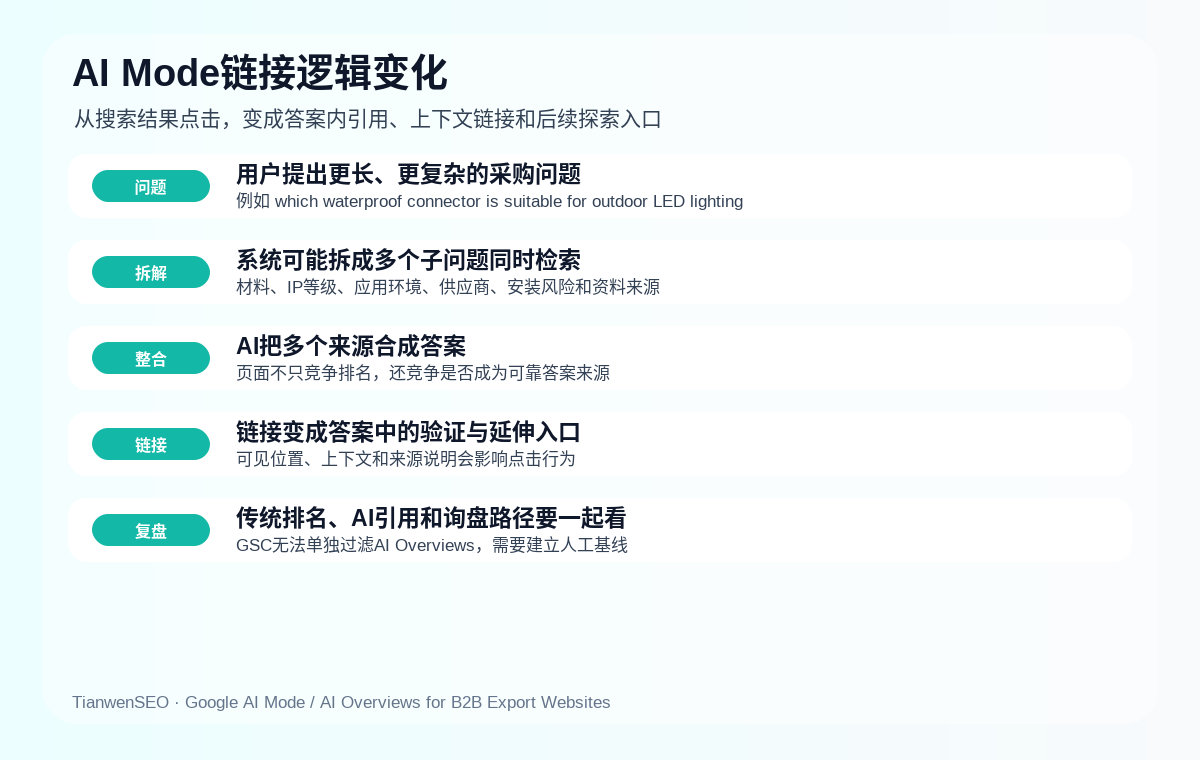
Many foreign-trade companies worry that AI Overviews will give away the answer entirely and users will stop clicking on websites. This concern has a real basis, because AI answers do compress some clicks for simple information. But another fact is that Google is also continuously adjusting how links are displayed in AI Overviews and AI Mode, making sources more prominent and more contextualized. The question is no longer “are there links” but “why would a user click your link.”
n
In traditional search, users see a title, a snippet, and a URL, and choose to click one result. In AI answers, users first see a synthesized response, and links act more like entry points for verification, deeper reading, comparison, and next steps. For independent foreign-trade websites, if a page merely repeats generic definitions, the AI summary may already satisfy the user; if the page provides specific product specifications, selection tables, application scenarios, procurement checklists, certification explanations, and the boundaries of supply capability, users still have a reason to click through.
n
For example, if a buyer asks “which IP rating waterproof connector should I use for outdoor LED flood light project,” AI may first explain the differences between IP67/IP68, the application environment, and points to note. The page truly worth clicking is one that offers a model table, wire diameter range, operating temperature, installation diagrams, certification notes, and a request-for-quote checklist—not a product page with only a few paragraphs of “high quality waterproof connector.”
n
How AI Mode and AI Overviews Differ
n
AI Overviews usually appears in traditional Google search results pages as an AI summary of certain queries, with source links possibly appearing beside it or within the answer; AI Mode is more like a dedicated AI search experience where users can conduct longer, more complex conversational queries, and the system breaks down the question, retrieves, synthesizes, and asks follow-up questions. Both are connected to traditional search, but user behavior and link display differ.
n
| Dimension | AI Overviews | AI Mode | Impact on Independent Foreign-Trade Websites |
|---|---|---|---|
| Entry point | AI summary within traditional search results pages | Dedicated AI search/conversational experience | The same keyword may produce different click paths |
| User questions | More common questions and general information needs | Longer, more complex, multi-step questions | Buyers may ask more specific application and comparison questions |
| Role of links | Support the answer and offer deeper reading | Become a source and extension entry point within conversational exploration | Pages must support “verification” and “next steps” |
| Page opportunities | Definitions, FAQ, comparisons, checklists, resource pages | Complex guides, selection processes, product documentation, evidence pages | Product pages and resource pages must be connected |
| Review challenges | GSC currently cannot easily filter AI Overviews separately | Harder to measure with traditional rankings | Requires a manual question bank and a screenshot baseline |
n
Why Query Fan-Out Affects Foreign-Trade Content
n
A key industry observation about AI Mode is that complex questions may be broken down by the system into multiple sub-queries explored at the same time—what is commonly called query fan-out. For foreign-trade companies, this means one procurement question no longer corresponds to just one keyword, but may be split into multiple dimensions such as product, material, application, standard, supplier, risk, price factors, and delivery lead time.
n
For example, if a user asks “best packaging machine for small spice business with limited budget,” the system may need to understand packaging machine type, powder vs granule, small business budget, filling accuracy, cleaning, maintenance, supplier selection, shipping and after-sales all at once. A page optimized only for “packaging machine supplier” cannot cover these sub-questions; a group of product pages, application pages, selection guides, and FAQ is more likely to be cited at different stages.
n
| Procurement question | Sub-questions it may be broken into | Pages to prepare | What foreign-trade companies need to add |
|---|---|---|---|
| custom metal parts for marine use | Material, salt spray, surface treatment, tolerance, supplier capability | Material guide, product capability page, inspection notes | 316 stainless steel, anodizing, drawing requirements |
| LED flood light for warehouse | Mounting height, wattage, beam angle, certification, energy consumption | Warehouse lighting application page, wattage table, FAQ | Application scenarios and parameter selection table |
| waterproof connector for outdoor lighting | IP rating, pin count, wire diameter, temperature, installation risks | Connector product page, IP rating resource page | Model table and application limits |
| ceramic dinnerware wholesale for restaurant | Material, durability, packaging, MOQ, lead time, target market | Category page, procurement FAQ, packaging notes | Wholesale procurement process and sample notes |
n
Why Links in AI Answers Are More Like “Verification Entry Points”
n
In AI answers, users have already seen a preliminary conclusion, so the motivation to click a link is usually no longer “I want to know the basic answer” but “I want to verify the source, see the details, compare options, download documentation, or contact the supplier.” This changes page design. A first screen that merely repeats the definition AI has already given loses value; one that provides details the AI summary did not expand on gains value.
n
Take a medical probe manufacturer page. If AI has already explained that medical probe suppliers should be evaluated on materials, precision, and quality control, then when users click through to the official website they want to see more: material selection, cleanliness requirements, inspection processes, certification boundaries, customization scope, sample process, and target-market considerations. The page must take on a deeper layer of verification rather than repeating “we are a professional manufacturer.”
n
| What the AI answer already satisfies | What users want to see after clicking | What the page should provide | Conversion entry point |
|---|---|---|---|
| Basic definition | Detailed parameters and applicable boundaries | Specification table, material table, application limits | Request-for-quote checklist |
| Preliminary comparison | More models and selection criteria | Comparison matrix, selection process | Sample inquiry |
| Supplier recommendation | Whether the company is genuine and trustworthy | About us, certificates, factory capability, external documentation | Contact and document downloads |
| Operating steps | Specific execution details | Illustrated process, checklist, common mistakes | Engineering communication entry point |
n
Independent Foreign-Trade Websites Must Upgrade from “Keyword Pages” to an “Answer Source System”
n
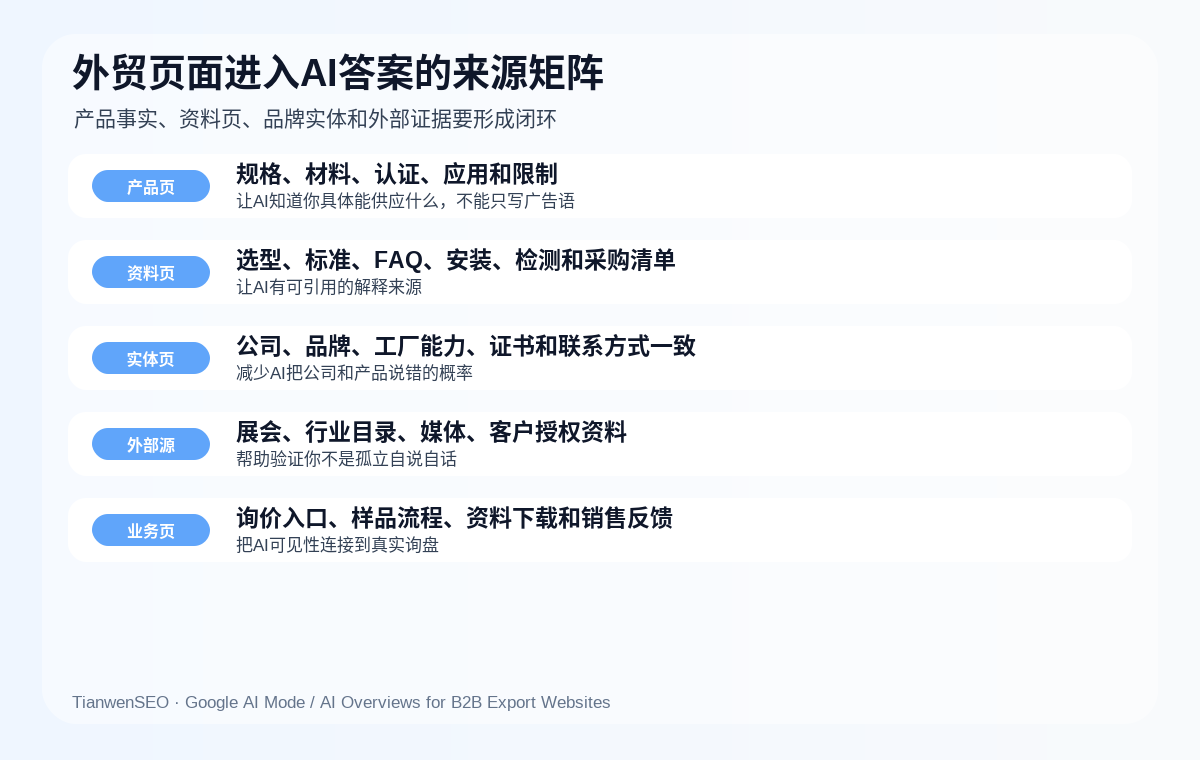
Traditional SEO has companies prepare a page for each keyword, and that is still necessary. But AI search requires pages to form a system: product pages answer what you supply, category pages answer how to choose, application pages answer which scenario, resource pages answer why, FAQ answers common questions, About Us and certificate pages answer whether you are trustworthy, and contact pages answer how to communicate next.
n
n
| Page type | Role in AI answers | Content it must have | Example |
|---|---|---|---|
| Product page | Prove you can supply a specific product | Specifications, materials, certifications, applications, limits, FAQ | IP67 waterproof connector product page |
| Category page | Help users understand the product line and selection logic | Classification criteria, model differences, procurement advice | industrial valve categories |
| Application page | Answer how to solve a particular scenario | Environmental conditions, selection process, risks and solutions | LED flood light for warehouse |
| Resource page | Provide citable explanations and decision tables | Standards, checklists, comparisons, steps, common mistakes | cnc machining tolerance guide |
| Entity page | Prove the company and brand are trustworthy | Consistent company name, capabilities, certificates, markets, contact details | manufacturer profile and certifications |
| Inquiry page | Support the next action | What information to provide, sample process, document downloads | request a quote checklist |
n
Five Impacts of Google AI Link Changes on Foreign-Trade SEO
n
Impact 1: Ranking First No Longer Means the Most Clicks
n
When AI Overviews appears, clicks on traditional organic results may be redistributed. Even if your page ranks high, if the AI summary already satisfies the basic question, clicks may decline. Foreign-trade companies should not look only at rankings; they should look at whether target pages are cited in AI answers, whether they receive more specific procurement visits, and whether inquiry quality improves.
n
Impact 2: Long-Tail Procurement Questions Matter More
n
AI Mode encourages users to ask more complex questions. Long-sentence questions that were rarely searched directly in the past, such as “how to choose ceramic dinnerware for hotel restaurant bulk order,” may now become real search behavior. Website content should cover procurement scenarios, not just short product terms.
n
Impact 3: Resource Pages Matter More Than Generic Blog Posts
n
AI answers need verifiable information. Generic blog posts struggle to become strong sources, while specific resource pages are more valuable. For example, “powder packaging machine cleaning checklist” is more suitable to be cited than “why choose us as your packaging machine supplier.”
n
Impact 4: Brand Entity Consistency Affects Answer Accuracy
n
AI may synthesize information from official websites, B2B platforms, trade shows, directories, news, and social profiles. If these materials are inconsistent, the answer may be wrong. Foreign-trade companies should unify their English company name, brand name, product lines, certificates, and contact details.
n
Impact 5: The Review Method Must Be Upgraded
n
GSC currently cannot conveniently separate AI Overviews clicks, so looking only at Search Console will miss part of the change. Companies need to build a target question bank, regularly screenshot AI answers, and record cited sources and answer accuracy, then compare these with GSC, GA4, and the inquiry sheet.
n
Do Not Chop Content into Fragments for the Sake of AI Answers
n
Some teams, hearing that AI extracts “chunks,” start mechanically cutting content into many short blocks, even writing every paragraph as an isolated answer. This easily damages the reading experience and does not necessarily meet Google’s requirements for helpful content. A better approach is: clear paragraphs, accurate headings, readable tables, FAQ with real questions, and complete overall page logic.
n
Foreign-trade content is not fragments for machines to read; it is material for buyers, search engines, and AI to read at the same time. A good custom metal parts material guide should have both short answers and context: why 316 stainless steel suits certain corrosive environments, why aluminum alloy needs surface treatment, which parameters a drawing requires, and how to confirm tolerances before quoting. Only then will AI be less likely to take things out of context when citing, and buyers will be able to keep reading after clicking through.
n
A Foreign-Trade Content Writing Framework for AI Mode
n
| Module | Writing goal | How to write it | Foreign-trade example |
|---|---|---|---|
| First-screen answer | Answer the core question first | Explain the conclusion and scope of application in 150-220 words | How AI Mode link changes affect independent sites |
| Question breakdown | Cover query fan-out sub-questions | Break out material, application, standards, supplier, and risk | waterproof connector selection dimensions |
| Decision table | Let AI and buyers compare quickly | Parameters, applicable scenarios, risks, next steps | LED flood light wattage and mounting height |
| Evidence module | Prove the page is trustworthy | Specification tables, certifications, testing, sources, external citations | medical probe quality process |
| Next steps | Connect the answer to an inquiry | Request-for-quote checklist, sample process, document downloads | packaging machine requirements sheet |
n
How Pages Can More Easily Become AI Answer Sources
n
- Make sure important body text is directly readable in the HTML, not hidden only in images or complex interactions.
- Use clear H2/H3 headings to organize product questions, application questions, selection criteria, and FAQ.
- Use tables to present models, materials, scenarios, risks, certifications, and next steps.
- Avoid exaggerated promises; use verifiable facts and applicable boundaries.
- Build natural internal links between product pages and resource pages so AI and users understand the relationship between pages.
- Unify the English company name, brand, product lines, certificates, and contact details.
- Add alt text and captions to images explaining their role in procurement decisions.
- Regularly review whether AI answers are accurate, not just whether they appear.
n
What to Do When Clicks on AI Overviews Links Decline
n
If clicks on certain informational pages decline, the first reaction should not be to give up on SEO, but to judge whether the page only answers the simple questions AI can summarize directly. If the answer is yes, you need to add content that AI summaries cannot fully replace: more detailed product parameters, decision tables, downloadable documents, calculation tools, application case boundaries, request-for-quote checklists, comparison matrices, common mistakes, and sales feedback.
n
| Page type with declining clicks | Possible cause | Direction for strengthening | Review metric |
|---|---|---|---|
| Simple definition article | The AI summary already answers the basic definition | Add foreign-trade applications, decision tables, FAQ, next steps | GSC query changes and dwell time |
| Generic selection article | Lacks specific parameters and support from product pages | Add model tables, application scenarios, internal links to products | Product page visit path |
| Product page | Content too thin or unverifiable | Add specifications, certifications, images, request-for-quote checklist | Inquiry quality and sales feedback |
| Resource page | Unclear structure makes it hard for AI to cite | Rewrite headings, tables, steps, and captions | AI answer citations and screenshot records |
n
How to Build an AI Answer Question Bank
n
Foreign-trade companies do not need to monitor hundreds of questions from the start. They can first select the 20-50 most important procurement questions and classify them by product line, application scenario, resource question, and supplier judgment. For each question, regularly record the answers and citations in Google, available AI Mode entry points, ChatGPT, Perplexity, and other environments.
n
| Question type | Example question | What to look at | Page preparation |
|---|---|---|---|
| Product selection | which waterproof connector for outdoor LED lighting | Whether it cites product/resource pages; whether the answer is accurate | Connector selection page and IP rating page |
| Material judgment | best material for custom metal parts in marine use | Whether it covers material and environmental boundaries | Material guide and product capability page |
| Equipment application | packaging machine for powder small business | Whether it covers material, speed, cleaning | Powder packaging application page |
| Supplier judgment | how to choose private label activewear manufacturer | Whether it mentions capability, MOQ, sample process | Supply capability page and procurement FAQ |
| Quality standards | medical probe manufacturer quality control | Whether it accurately describes testing and compliance boundaries | Quality process and resource page |
n
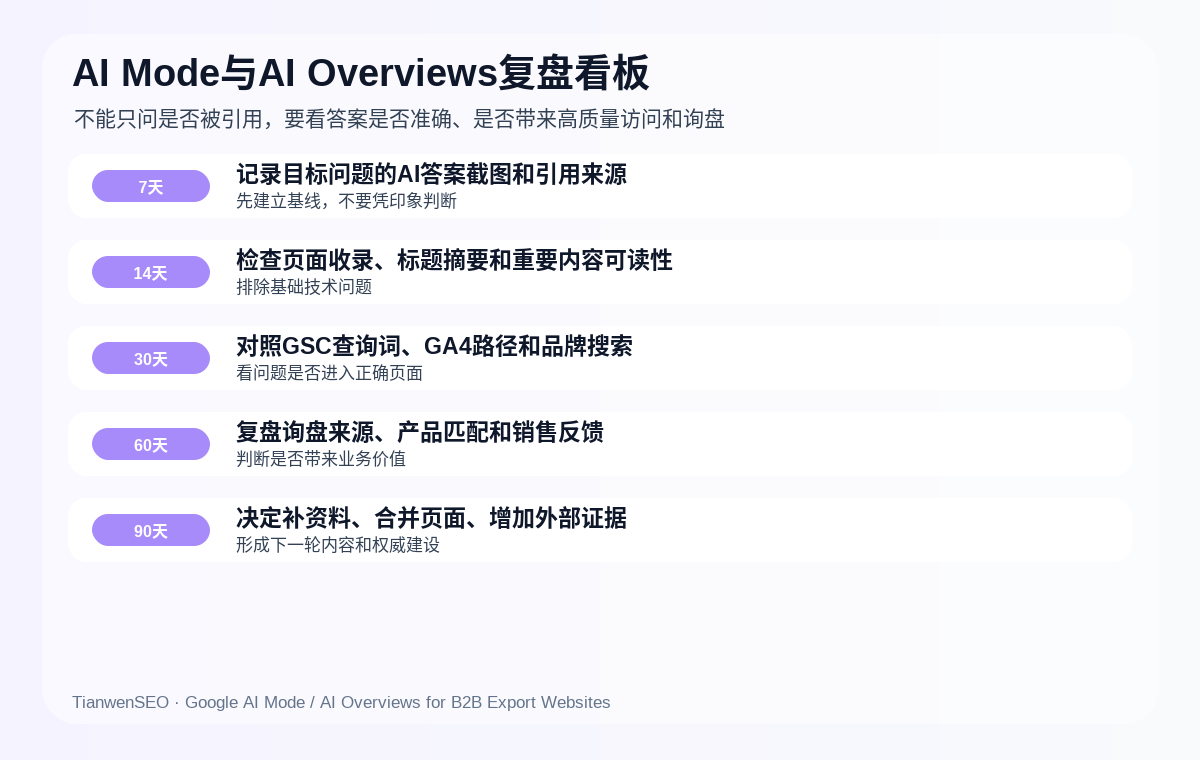
Review Dashboard: Look at GSC, GA4, AI Answers, and Inquiries Together
n
n
| Data source | What to record | Question to judge | Next action |
|---|---|---|---|
| AI answer screenshots | The answer, cited sources, whether the brand is mentioned, whether it is accurate | Does AI understand the product and the company | Add entity materials and factual explanations |
| GSC | Queries, pages, impressions, clicks, CTR | Does search demand land on the right pages | Adjust titles, internal links, and FAQ |
| GA4 | Entry pages, subsequent paths, dwell time, conversion events | Do users continue to product and contact pages | Optimize page structure and CTA |
| Inquiry sheet | Product, country, clarity of need, source | Does it bring higher-quality leads | Add request-for-quote checklists and frequently asked sales questions |
| Sales feedback | Customer misunderstandings, recurring questions, closing obstacles | Does the page explain key concerns in advance | Add resource pages or FAQ |
n
A 90-Day Action Roadmap: How Independent Sites Should Respond to AI Link Changes
n
Days 1-7: Establish an AI Answer Baseline
n
Select 20 core procurement questions and record the current Google results, AI answers, cited sources, and answer accuracy. Do not judge success or failure right away; first establish a baseline that can be reviewed.
n
Days 8-30: Strengthen Core Pages
n
Choose the most important product pages, category pages, application pages, and resource pages, and add tables, FAQ, product facts, illustrated explanations, request-for-quote checklists, and internal links. Prioritize pages that already have GSC impressions or existing inquiries.
n
Days 31-60: Unify the Brand Entity and External Materials
n
Check B2B platforms, trade show pages, industry directories, social profiles, and the official website to see whether the company name, brand, product lines, and contact details are consistent. Incorrect AI answers often stem from confusing external materials.
n
Days 61-90: Review and Do a Second Round of Expansion
n
Compare changes in AI answers, GSC, GA4, and inquiries. Add materials to pages that are cited but described incompletely, optimize the inquiry path for pages that get search traffic but no conversions, and build dedicated explanation pages for questions AI gets wrong.
n
The Shortcomings of Top1 and Authoritative Content: Why Foreign-Trade Websites Need a More Practical Version
n
Most current articles about link changes in AI Mode and AI Overviews focus on how Google displays links, whether publisher clicks decline, whether AI Mode will change the traditional SERP, and which industries are affected. This content is important for understanding the trend, but foreign-trade companies still face practical questions after reading it: How should I change my product page? How can a waterproof connector page qualify as an AI answer source? How do I review performance when GSC does not show separate AI Overviews data? When clicks decline, should I change the title, add content, or add resource pages?
n
Independent foreign-trade websites differ from media sites. Media sites care about article readership, while foreign-trade sites care more about product-term visits, the inquiry path, sample requests, quote opportunities, and sales feedback. The impact of AI link logic changes on foreign-trade sites should not be judged only by “how much CTR dropped,” but by whether buyers get answers earlier, whether they enter more specific pages, and whether inquiries become clearer.
n
| Benchmark item | What authoritative content commonly covers | What foreign-trade companies still lack | How this article strengthens it |
|---|---|---|---|
| Trend explanation | Changes in how AI Mode/AI Overviews display links and discussion of clicks | Do not know how to change specific pages | Break it down to product pages, application pages, resource pages, and inquiry pages |
| Technical explanation | query fan-out, AI answer sources, cited links | Do not know how to map foreign-trade procurement questions | Break it down using product terms such as LED, CNC, packaging machine, and connectors |
| Publisher impact | Risk of declining clicks for media/content sites | Foreign-trade sites should look at inquiries, not just PV | Add review of GSC, GA4, AI answers, inquiries, and sales feedback |
| Optimization advice | Write high-quality content and build authority | Advice is too generic; do not know what to do first | Provide a 90-day roadmap and a page self-check table |
| Measurement approach | Discussion of traffic and visibility | AI answer accuracy and business value are hard to measure | Build a question bank, a screenshot baseline, and inquiry quality fields |
n
Looking at AI Link Opportunities Through One Foreign-Trade Product Term: LED Flood Light
n
Take LED flood light as an example. Traditional SEO might build pages around terms such as LED flood light manufacturer, LED flood light supplier, LED flood light for warehouse, and outdoor LED flood light. Under AI Mode, buyer questions may be more specific: how many watts LED flood light do I need for a 10m warehouse ceiling, what beam angle is best for outdoor parking lot, IP65 vs IP66 LED flood light for rainy area, how to compare LED flood light suppliers in China.
n
Behind these questions is not just one keyword but a set of judgments: application scenario, mounting height, beam angle, wattage, certification, waterproofing, lightning protection, warranty, packaging, samples, and lead time. If the official website has only a single product listing page, it will struggle to capture the link opportunities in AI answers. A more reasonable approach is to build a product page, a warehouse application page, an outdoor parking lot application page, a wattage selection guide, a waterproof rating FAQ, and a request-for-quote checklist.
n
| Procurement question | Answer AI may need | Page that should support it | Page enhancement points |
|---|---|---|---|
| warehouse LED flood light wattage | Mounting height, illuminance, wattage, beam angle | Warehouse lighting application page | Wattage table, mounting height diagram, project requirements sheet |
| IP65 vs IP66 outdoor flood light | Differences in waterproof rating and outdoor environments | Waterproof rating resource page | IP rating explanations, rainy-area applications, certification boundaries |
| LED flood light supplier China | Supply capability, certifications, warranty, delivery | Category page/company capability page | Product series, certificates, sample process, export markets |
| how to choose beam angle | Beam angle selection for different scenarios | Selection guide page | Comparison table, application images, common mistakes |
n
Doing this is not about creating more pages, but about making each page correspond to one procurement decision. If an AI answer mentions beam angle, it may cite the selection guide; if it mentions supplier capability, it may cite the company capability page; if it mentions outdoor waterproofing, it may cite the IP rating resource page.
n
Looking at AI Link Opportunities Through Another Product Term: Packaging Machine
n
Procurement questions around packaging machine are more complex, because different materials, packaging forms, speeds, precision, cleaning requirements, and after-sales capabilities all affect the choice. If AI Mode handles a question like “small spice business should choose which packaging machine,” it will likely retrieve multiple dimensions at once: small business, powder packaging, filling accuracy, machine cleaning, budget, supplier reliability, and more.
n
| Sub-question | Weak page performance | Strong page performance | AI link opportunity |
|---|---|---|---|
| Material compatibility | Only says it suits many materials | Lists the differences among powder, granule, liquid, and viscous materials | Can be cited as a selection source |
| Speed and precision | Only writes “high speed” | Provides speed ranges, error ranges, and influencing factors | Helps AI explain the boundaries of equipment capability |
| Cleaning and maintenance | Does not discuss cleaning at all | Explains contact parts, disassembly, and food-grade cleaning considerations | Suitable for answering maintenance questions |
| Budget judgment | Only asks customers to inquire | Explains the configuration factors that affect price | Helps buyers prepare their requirements |
| Quote preparation | Only provides a contact form | Lists material, bag type, speed, precision, voltage, budget | Turns AI visits into valid inquiries |
n
If a page explains these sub-questions clearly, then even if the AI summary answers the basic question first, buyers still need to click through to the official website to verify the specific equipment and quoting conditions.
n
Page Revision Checklist: Give AI Answer Links a Reason to Be Clicked
n
For links in AI answers to be clicked, the page must provide depth beyond the answer. The table below can be used to revise each core page.
n
| Revision item | Why it affects clicks on AI links | Specific approach | Applicable pages |
|---|---|---|---|
| First-screen conclusion | Users need to quickly confirm the page is relevant | Use a short paragraph to state the audience and core conclusion | Product pages, application pages, resource pages |
| Comparison table | Easy for both AI and users to extract | Models, materials, scenarios, pros and cons, risks | Category pages, selection pages |
| Illustrated explanations | Lower the cost of understanding | Flowcharts, structure diagrams, application illustrations, checklists | Application pages, resource pages |
| Request-for-quote checklist | Turn learning into action | Tell buyers which parameters they need to provide | Product pages, contact pages |
| Evidence links | Increase credibility | Certificates, testing, standards, external materials, download pages | Resource pages, entity pages |
| Common mistakes | Add experience the AI summary does not have | List procurement pitfalls and ways to judge | Tutorial pages, resource pages |
n
Internal Linking Strategy Under AI Link Logic
n
Foreign-trade websites cannot rely only on external links. After AI systems and users enter a page, they need internal links to understand the site’s information structure. Product pages should link to related resource pages, resource pages should link back to product pages and inquiry pages, and application pages should link to applicable products and checklists.
n
| Starting page | Should link to | Purpose of the link | Example |
|---|---|---|---|
| waterproof connector product page | IP rating resource page, outdoor lighting application page, request-for-quote checklist | Explain parameters and next steps | IP67/IP68 differences, connector selection for LED projects |
| custom metal parts capability page | Material guide, tolerance guide, surface treatment page | Explain manufacturing boundaries | 316 stainless steel, anodizing, tolerance ranges |
| packaging machine application page | Equipment category page, cleaning and maintenance FAQ, sample testing process | Help buyers judge equipment type | Powder packaging machine, granule packaging machine |
| ceramic dinnerware wholesale page | Material comparison, packaging notes, MOQ FAQ | Resolve procurement concerns | stoneware vs porcelain, custom packaging |
n
Internal link anchor text should also be natural and describe the value of the linked page. Do not use only “click here,” and do not overstuff exact keywords. For example, “see the selection differences between IP67 and IP68 waterproof connectors” reads more like a real user path than “waterproof connector manufacturer.”
n
How Foreign-Trade Websites Should Correct Course When AI Answers Are Wrong
n
AI answers may state a company’s product range incorrectly, describe a trading company as a factory, list certifications the company does not have as if it did, or describe an application scenario in overly absolute terms. When this happens, do not just complain about the AI being wrong; check whether your official website and external materials provide clear, stable, and verifiable information.
n
| Type of AI error | Possible cause | Correction page | Specific action |
|---|---|---|---|
| Product range stated incorrectly | Product and category pages are unclear; external directories are confusing | Product category page, company capability page | Unify product lines, remove outdated descriptions, add category explanations |
| Factory/trading identity confused | The About page and platform materials are inconsistent | About Us, FAQ | Clarify the business role and the boundaries of supply chain capability |
| Certification stated incorrectly | Old certificates, platform materials, or advertising claims mislead | Certificate page, product page | Explain which products the certification applies to and what needs to be confirmed |
| Application scenarios overextended | The page only writes “many applications” | Application page, limitations notes | Add applicable conditions and unsuitable scenarios |
| Contact details or brand confused | Materials are inconsistent across platforms | Contact page, brand materials | Unify company name, address, phone, and official website URL |
n
The core of correction is to make official materials clear enough and to gradually make external materials consistent. AI answers are not an ad slot you can control directly, but you can increase the probability that the AI reads correct information.
n
Which Existing Content Needs Upgrading Under AI Mode
n
Many foreign-trade websites have written SEO articles in the past, but those articles suit only traditional keywords, not AI answer scenarios. When upgrading, first check whether they contain procurement questions, decision tables, specific product terms, and business paths.
n
| Existing content type | Common problem | Upgrade direction | How to judge whether it is worth keeping |
|---|---|---|---|
| Generic industry trends | Many opinions, few products | Add product scenarios and procurement decisions | Whether it can lead to product/resource pages |
| Short FAQ roundups | Answers too shallow | Expand into specific guides and tables | Whether there are GSC impressions or frequently asked sales questions |
| Company news | Lacks search intent | Turn into trade show materials, product applications, or customer questions | Whether it has brand trust value |
| Thin product introduction pages | Insufficient parameters and FAQ | Add specifications, applications, illustrations, and request-for-quote checklists | Whether they correspond to core product terms |
| Duplicate keyword articles | Overlapping intent | Merge into a strong page or convert into a resource page | Whether they cause pages to compete with each other |
n
How Sales Teams Can Take Part in AI Link Review
n
AI search changes ultimately come back to business results. Sales teams talk to buyers every day and know best which questions keep coming up, which pages are unclear, and which inquiries lack key parameters. Writing sales feedback into content reviews is closer to real business than looking at rankings alone.
n
| Sales feedback | What it indicates | Content action | Review metric |
|---|---|---|---|
| Customers always ask about MOQ | The page does not explain the procurement threshold in advance | Add an MOQ FAQ and sample process | Whether inquiries are more complete |
| Customers are unclear about material selection | Resource pages are insufficient | Add material comparisons and application limits | Quality of material-related inquiries |
| Customers ask whether certifications are genuine | Evidence presentation is insufficient | Add a certificate page and notes on the scope of application | Whether certification questions decrease |
| Customers only ask about price | The page does not establish value and specification judgment | Add selection tables and price-influencing factors | Whether information before quoting is more complete |
| Customers misunderstand product use | AI or page descriptions are unclear | Add application pages and unsuitable scenarios | Whether misunderstandings decrease |
n
A Minimal Plan That Even Small Teams Can Execute
n
Not every foreign-trade company has a content team. Even with limited resources, you can start with a minimal plan: for each product line, choose 3 core pages, 10 procurement questions, 3 tables, 1 request-for-quote checklist, and 1 AI answer record sheet. If you keep at it for 90 days, it will be more valuable than publishing only generic articles.
n
| Minimal action | Quantity | Goal | Example |
|---|---|---|---|
| Core product page upgrades | 3 | Make key products understandable | custom metal parts, LED flood light, packaging machine |
| Resource page creation | 3 articles | Answer procurement decisions | Material selection, wattage selection, equipment cleaning |
| AI question bank | 10-20 questions | Establish a baseline | which waterproof connector for outdoor lighting |
| Review cycle | Once a month | Watch changes in answers and inquiries | Screenshots + GSC + GA4 + inquiry sheet |
| Sales feedback | Collected every two weeks | Add real procurement questions | MOQ, certification, lead time, samples |
n
Content Priority Scoring Under AI Link Changes
n
If you have many pages and do not know which one to revise first, you can use the scoring method below. Prioritize pages with high total scores, not pages chosen by publish date or personal preference.
n
| Scoring item | 0 points | 1 point | 2 points |
|---|---|---|---|
| Search foundation | No impressions and not indexed | A small number of impressions | Stable impressions or clicks |
| Business value | Rarely related to inquiries | Occasionally related | Directly affects inquiries for core products |
| AI question match | Does not correspond to AI procurement questions | Partially corresponds | Clearly corresponds to complex procurement questions |
| Current page state | Thin and disorganized content | Has a foundation but lacks structure | Already has content and is suitable for strengthening |
| Evidence conditions | Lacks product facts | Has some specifications | Has complete specifications, images, certificates, or documentation |
n
For example, a waterproof connector page that has GSC impressions, can bring high-value inquiries, corresponds to complex procurement questions, and already has some content and complete product documentation should be upgraded first.
n
Common Mistakes: These Practices Weaken AI Link Opportunities
n
- Writing only “how to do SEO in the AI search era” without any product pages or procurement questions put into practice.
- Stuffing all product terms into one article, creating confused page intent.
- Using lots of vague adjectives instead of specifications, materials, certifications, and application boundaries.
- Having a title that reads like a tutorial while the body mainly introduces company services, so the user intent does not match.
- Images without captions, tables that cannot be read on mobile, and important information only inside images.
- Inconsistent company name, brand name, and product lines between the official website and external platforms.
- Watching only rankings and clicks without recording whether AI answers are accurate.
n
FAQ: Common Questions About AI Mode, AI Overviews, and Independent Foreign-Trade Website Links
n
Will AI Overviews leave websites with no traffic?
n
It may reduce some clicks for simple information, but it also creates new source links and verification clicks. The key is that pages must provide details and next-step value beyond the AI summary.
n
What is the difference between AI Mode and AI Overviews?
n
AI Overviews usually displays a summary in traditional search results pages, while AI Mode is more like a conversational AI search experience that can handle longer, more complex questions.
n
Do independent foreign-trade websites still need SEO?
n
Yes. Crawling, indexing, page structure, content quality, internal links, and brand entities remain the foundation of visibility in AI answers.
n
How can pages be more easily cited in AI answers?
n
Provide readable body text, clear headings, factual tables, FAQ, product specifications, application boundaries, evidence materials, and a consistent brand entity.
n
Are product pages or blog posts more important?
n
The two play different roles. Product pages prove supply capability, while resource pages and blog posts explain procurement questions. Foreign-trade websites should connect the two.
n
Can GSC show AI Overviews clicks?
n
GSC includes search performance data, but it currently cannot conveniently filter AI Overviews separately, so you need to combine a manual question bank, screenshots, and GA4 path review.
n
Will AI Mode cite only large sites?
n
Authoritative large sites have an advantage, but clear, specific, and verifiable vertical resources also have opportunities. Foreign-trade companies should build professional sources with product facts and resource pages.
n
If links are more prominent, will clicks recover?
n
Not necessarily. More prominent links are only an opportunity; whether users click depends on source credibility, answer context, and whether the page offers deeper value.
n
Do you need to build a separate page for every AI question?
n
No mechanical mass page creation is needed. Organize pages by product line and procurement intent, and avoid duplicate content and confused intent.
n
What should I do if an AI answer says something wrong about my company?
n
First check whether the official website and external materials are consistent, then add official explanations, FAQ, certificates, and product scope; keep recording how the wrong answers change.
n
How often should foreign-trade companies review AI answers?
n
It is recommended to review core questions once a month, and to establish a new baseline 7-14 days after a key product launches or a page undergoes a major revision.
n
Can you promise to get into AI Overviews?
n
No. AI answers are affected by the platform, the query, sources, and timing; you can only increase the chances through content quality, technical foundations, and trustworthy materials.
n
Conclusion: Link Logic Has Changed, but the Value of Independent Sites Has Not Disappeared
n
Google AI Mode and AI Overviews have changed where links are displayed, the motivation to click, and the way results are reviewed, but they have not made independent foreign-trade websites lose their value. On the contrary, only an independent website can systematically express product facts, application scenarios, the company entity, documented evidence, and the inquiry path. The problem is that an independent website can no longer be just a simple keyword page; it must become a reliable source of information that both buyers and AI are willing to use.
n
The correct order for foreign-trade companies to respond to AI link changes is: first ensure pages are crawlable and readable, then deepen the core product pages, category pages, application pages, and resource pages, then unify the brand entity and external materials, and finally review using AI answer screenshots, GSC, GA4, and inquiry feedback. This cannot promise that a particular AI answer will cite you in a fixed way, but it can make your website more qualified to be understood, verified, clicked, and inquired about in the AI search era.
nnnn
Official Sources and the Boundaries of AI Mode Link Logic
n
The link logic of AI Mode and AI Overviews cannot be directly specified by the website owner. Google’s official documentation has made the boundaries very clear: AI features still follow basic SEO, and pages need to be crawlable, indexable, able to display snippets, clearly written, with internal links and visible text; but even if a page meets these requirements, it does not follow that Google will definitely crawl, index, display, cite it, or bring clicks. The correct delivery framing for this article is: make pages into information sources that are better suited for search systems and AI systems to understand, while reviewing GSC, URL Inspection, AI answer samples, logs, and inquiry data separately.
n
Therefore, what independent foreign-trade websites should do is not chase an “AI-specific trick,” but turn product pages, category pages, resource pages, and article pages into verifiable assets. What can be accepted is index/follow, canonical, body links, parameter tables, FAQ, evidence sources, Search Console data, and review records; what cannot be promised is a specified AI display, fixed citation, fixed ranking, fixed clicks, or fixed inquiries.
n
Acceptance Boundaries Corresponding to Official Documentation
n
Google Search Central: AI features and your website
n
What it supports: AI Mode, AI Overviews, and Query Fan-Out are still built on basic SEO; pages must be indexable and eligible to display as a snippet in search results.
n
What cannot be inferred: It cannot be inferred that a particular page will enter AI Mode or AI Overviews in a fixed way, nor should a single page update be written up as an AI citation result.
n
Delivery acceptance: Verify whether the page is index/follow, whether the canonical is normal, whether the body text is readable, whether important content is text, whether internal links are crawlable, and whether structured data matches visible content.
n
n
Google Search Central: SEO Starter Guide
n
What it supports: Titles, page organization, image descriptions, internal links, and helpful content remain the foundation for a page to be understood.
n
What cannot be inferred: Changing titles, adding H2s, and adding FAQ cannot be written up as a guarantee of ranking, clicks, or AI display.
n
Delivery acceptance: Verify whether the H1/H2 revolve around one procurement question, and whether the page helps users compare materials, specifications, applications, certificates, risks, and quoting materials.
n
n
Google Search Central: Make your links crawlable
n
What it supports: Google needs to be able to discover and crawl links; descriptive anchor text helps users and Google understand the next page.
n
What cannot be inferred: Button events, script-based navigation, or empty links should not be treated as stable search link entry points.
n
Delivery acceptance: Verify whether product pages, category pages, resource pages, and article pages have real hrefs, whether anchor text describes the target page’s topic, and whether links are clickable on mobile.
n
n
Google Search Central: robots.txt introduction
n
What it supports: robots.txt mainly manages crawler access; it is not a reliable way to make a page disappear from Google.
n
What cannot be inferred: The absence of a robots.txt block cannot be written up as the page being indexed, and robots.txt cannot replace noindex or access control.
n
Delivery acceptance: Verify whether robots.txt, meta robots, X-Robots-Tag, sitemap, and CSS/JS/image resources are mistakenly blocked; important pages must be accessible to Googlebot.
n
n
Search Console Help: URL Inspection tool
n
What it supports: URL Inspection can show the indexing status of a single URL, crawl time, canonical, sitemap source, and the version of the page Google knows about.
n
What cannot be inferred: “URL is on Google” cannot be written up as meaning it will definitely appear in search results, nor can submitting for indexing be written up as having been re-evaluated.
n
Delivery acceptance: Record coverageState, robotsTxtState, indexingState, pageFetchState, lastCrawlTime, Google-selected canonical, and sitemap source.
n
n
Search Console Help: Performance report
n
What it supports: The Performance report provides clicks, impressions, CTR, average position, and dimensions such as query, page, country, and device.
n
What cannot be inferred: Low-sample, zero-click, or zero-row data cannot be written up as a trend. When there is currently no usable signal, you can only write “to be observed” and must not fill in ranking, click, or AI citation conclusions.
n
Delivery acceptance: Every review must clearly state the date window, filter conditions, page URL, query group, sample size, and whether there are page/query rows.
n
n
OpenAI Platform: Overview of OpenAI Crawlers
n
What it supports: OpenAI distinguishes among OAI-SearchBot, GPTBot, and ChatGPT-User; OAI-SearchBot relates to ChatGPT search display, GPTBot relates to training crawls, and ChatGPT-User is a user-triggered visit.
n
What cannot be inferred: Allowing GPTBot cannot be written up as a ChatGPT Search visibility result, nor can a single crawler appearance in the logs be written up as being recommended or cited by AI.
n
Delivery acceptance: Verify the allowed boundaries for OAI-SearchBot / GPTBot in robots.txt, server log samples, the HTTP status of key pages, and content accessibility.
n
n
Bing Webmaster Blog: AI Performance
n
What it supports: Bing AI Performance can observe citations, cited pages, grounding queries, and page-level citation activity.
n
What cannot be inferred: Bing citation count does not equal page ranking, authority, fixed position, or business results, and it cannot represent Google, ChatGPT, or other platforms.
n
Delivery acceptance: If the account is available, list Bing AI samples separately; record the cited URL, grounding query, time range, page changes, and subsequent changes in GSC/GA4/inquiries.
n
n
n
What it supports: IndexNow is used to notify participating search engines of new, updated, or deleted URLs.
n
What cannot be inferred: A successful IndexNow submission cannot be written up as already crawled, already indexed, already ranked, or already included in AI answers.
n
Delivery acceptance: Record the URL, keyLocation, submission time, HTTP status, and subsequent re-checks of sitemap, logs, GSC, or Bing data.
n
n
Google Search Central: Sitemaps overview
n
What it supports: A sitemap helps Google discover important URLs, and is especially suitable for new sites, large sites, sites with incomplete links, or sites with a large amount of media content.
n
What cannot be inferred: A URL’s presence in the sitemap cannot be written up as already crawled, already indexed, already showing impressions, or already receiving clicks.
n
Delivery acceptance: Verify whether the URL is in the post-sitemap, whether the sitemap is submitted, the last download time, errors/warnings, and the next URL Inspection status.
n
n
n
Diagnostic Acceptance Standards for AI Mode Link Logic
n
When diagnosing AI Mode / AI Overviews for foreign-trade companies, the acceptance standards should be split into “completed actions” and “results to be observed.” Completed actions can be delivered; results to be observed can only be judged after subsequent data appears.
n
1. Search foundation acceptance
n
Fields to check: HTTP 200, index/follow, canonical, sitemap, internal links, mobile readability, visible body text, image alt text, and crawlable key resources.
n
Pass criteria: Browser front end, mobile, URL Inspection, sitemap, and robots checks all show no blocking of key pages.
n
Boundary: Passing the foundation acceptance does not mean Google has already re-crawled or re-ranked the page.
n
n
2. Content fact acceptance
n
Fields to check: Definition sentences, parameter tables, application scenarios, selection boundaries, certificate explanations, MOQ/lead time/customization information, FAQ, downloadable materials, and contact paths.
n
Pass criteria: The page can answer why the buyer clicked in, why they should trust the company, and how to request a quote next.
n
Boundary: More complete content does not equal stable citation by AI platforms; you can only say the page is better suited to being understood and verified.
n
n
3. Query fan-out coverage acceptance
n
Fields to check: Main question, related sub-questions, product attributes, application environment, risk limits, alternatives, certifications, and procurement actions.
n
Pass criteria: The same page can cover a user’s follow-up questions in sequence, rather than answering only one short keyword.
n
Boundary: Covering more sub-questions does not equal creating more rankings; wait for GSC page/query rows to verify.
n
n
4. GSC and URL Inspection acceptance
n
Fields to check: 28-day/90-day query, page, country, device; and URL Inspection’s lastCrawlTime, coverageState, canonical, and pageFetchState.
n
Pass criteria: There is a date window, a sample size, a page URL, and a query group; if there is currently no usable signal, explicitly write “to be observed.”
n
Boundary: Submitting a sitemap, requesting indexing, or a lastCrawlTime earlier than the modification time cannot be written up as a successful re-evaluation.
n
n
5. AI answer sample acceptance
n
Fields to check: Platform, question, country/language, whether it cites the official website, cited URL, answer summary, screenshot date, and whether it is consistent with official website facts.
n
Pass criteria: A fixed question bank, reviewed monthly under the same criteria, recording samples of “cited, not cited, cited incorrectly, cited a competitor.”
n
Boundary: A single sample does not equal a stable result; no citation cannot be written directly as failure, and you need to look at indexing, content, competing sources, and query phrasing.
n
n
n
Delivery Boundaries: What Can Be Done and What Cannot Be Promised
n
Delivery for AI Mode link logic must dare to state its boundaries clearly. What can be promised is doing the pages, evidence, links, indexing prerequisites, and review tables well; what cannot be promised is platform results. A more professional report should say “the executable work has been completed and the results to be observed require further data,” rather than substituting fine words for facts.
n
- n
- Can be promised: Fixing titles, first paragraphs, H2/H3, internal links, product facts, FAQ, evidence modules, robots checks, URL Inspection records, GSC review tables, and AI sample tables.
- Cannot be promised: Stable citation, guaranteed display, guaranteed clicks, or guaranteed inquiries on Google AI Mode, AI Overviews, ChatGPT Search, Bing AI, or other platforms.
- How to write during a low-data period: If GSC has no page/query rows, write “there is currently no usable signal, and observation items have been set up”; do not write third-party trends, tool scores, or subjective search screenshots as the site’s own results.
- Follow-up observation: At 7-14 days, check whether there is new crawling or initial impressions; at 30-60 days, look at query/page changes, dwell time, downloads, forms, email clicks, and sales feedback.
n
n
n
n
n
In other words, when responding to AI link changes, independent foreign-trade websites are not betting on the instant answer of a particular platform, but turning the official website into a long-term fact center that can be crawled, understood, verified, and reviewed.
n
Continue Reading This SEO Series
n
If you are systematically sorting out SEO for a foreign-trade website, it is worth continuing with the articles below. First clarify the relationships among crawling, indexing, content, links, and review, then decide which page to change next.
n
- n
- WordPress May Be Blocking AI Crawlers: Why SEO Tools Do Not Show the Problem
- How to Do Google SEO: Which Steps to Tackle First
- How to Build High-Quality Backlinks: A Guide to Link Assets, Outreach Emails, and Risk Review for Foreign-Trade Websites
- How to Use Backlink Analysis Tools: A Guide to Link Audits, Risk Identification, and Competitor Opportunity Discovery for Foreign-Trade Websites
- How to Judge Backlink Quality: A Guide to Relevance, Trustworthy Sources, and Risk Control
- How to Do Competitor SEO Analysis: A Guide to Page Types, Content Gaps, and Foreign-Trade Inquiry Opportunities
n
n
n
n
n
n
nn
This page is machine-translated from the Simplified Chinese version and awaiting human review. It has not yet been proofread.