How much did AI Overviews actually cut click-through rates in 2026? You should not frighten yourself with a single average number. Public research can show the direction: AI summaries do change how users click and which sources they choose, but different studies use different query sets, industries, countries, devices, and measurement windows. For example, a Wikipedia-based study of AI search summary traffic observed that exposure to AI Overviews was associated with roughly a 15% drop in daily visits to English Wikipedia articles; another measurement study of Google AI Overviews breaks the problem into activation rate, source quality, claim fidelity, and publisher impact. Neither can directly replace the GSC, GA4, and inquiry data of a specific B2B export website. For export businesses, the key is not memorizing one universal decline figure, but judging how your product terms, sourcing questions, page types, and inquiry paths are actually affected.
This article uses export product terms such as custom metal parts, LED flood light, packaging machine, medical probe, cnc machining parts, ceramic dinnerware, waterproof connector, industrial valve supplier, and private label activewear manufacturer to explain: why AI Overviews suppress some clicks, which export pages still earn clicks, how to diagnose a CTR decline when rankings have not dropped, and how to turn “less traffic” into a review system where “inquiries are more precise, pages are stronger, and AI citations are more frequent.”
Target queries: AI Overviews CTR drop, AI Overviews CTR drop 2026, how much did AI Overviews reduce click-through rates, why Google SEO traffic is harder to win. Search intent: users want to know whether AI Overviews really cause SEO traffic to decline, how to interpret the scale of the drop, which pages are affected most, and how B2B export websites should respond. This article does not present third-party average CTR figures as this site’s own results. Instead, it looks at public research, Google’s official statements, GSC page and query data, GA4 events, AI answer sampling, and inquiry quality together, adding the export business perspective, product-page and resource-page diagnostics, and business review.
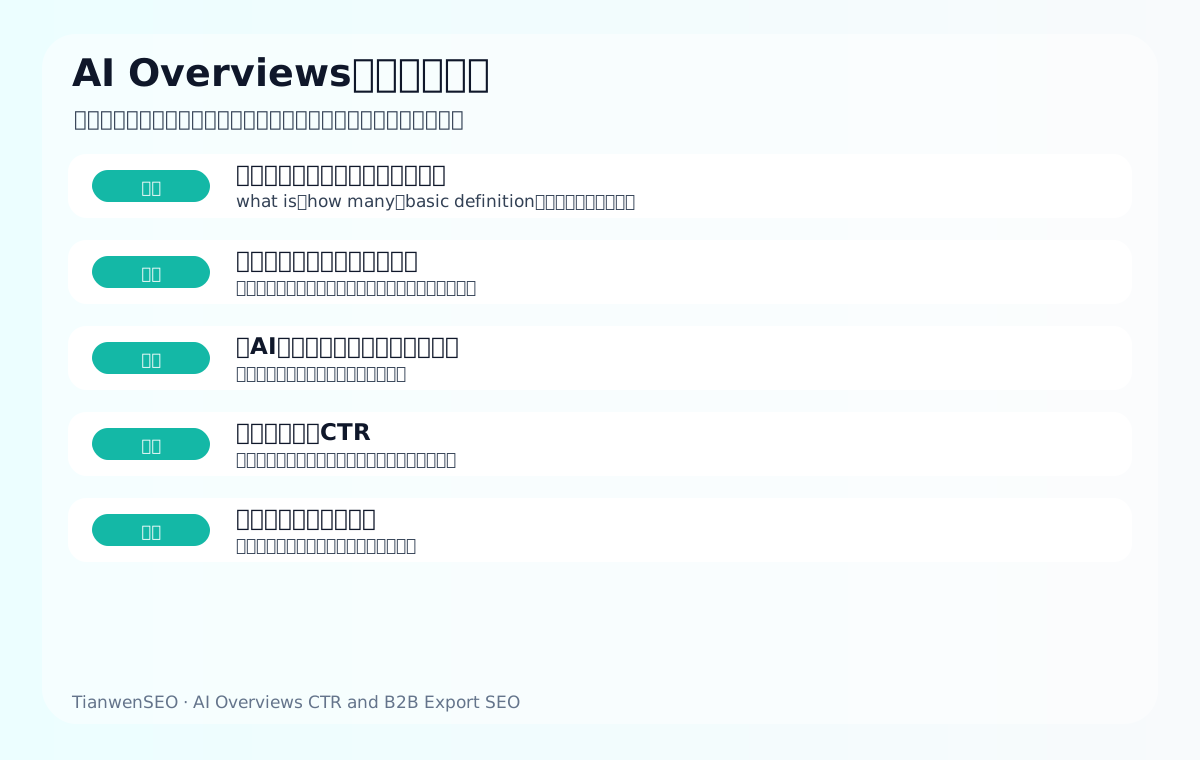
The short answer first: an average CTR decline does not mean your inquiries fall by the same amount
AI Overviews really have changed how clicks are distributed. For many definitional, encyclopedic, and simple how-to questions, users can get the answer on the search results page, so clicks on organic results decline. But export SEO cannot judge success or failure by “average CTR decline” alone. What export businesses really care about is: can target buyers still find you, are the clicks of better quality, are product pages being visited, are inquiries more specific, and do AI answers correctly mention your products and brand?
For example, questions like “what is IP67” may be satisfied by an AI summary, so fewer clicks are normal; but a question like “which waterproof connector is suitable for outdoor LED flood light in coastal area” still requires specific products, materials, installation, certification, and quotation details. An AI summary can give a preliminary direction, but buyers may still click a page that offers model tables, cable diameter ranges, salt-spray environment notes, and an inquiry checklist.
So AI Overviews do not make SEO obsolete; they make low-depth informational clicks harder to win. Export websites need to shift from competing with generic articles to competing on product facts, sourcing judgment, evidence materials, and conversion paths.
Why different studies report different CTR decline figures
You will see many different CTR change figures. These numbers are not entirely contradictory, because the research subject, time, query type, industry, device, whether the source was cited, and measurement definitions all differ. An article may cite third-party research, but a client report must not present third-party samples as this website’s own results.
| Source of difference | What it affects | How export businesses should read it |
|---|---|---|
| Query type | Definitional questions decline more clearly; complex questions may still get clicks | Do not infer product inquiry impact from encyclopedic term declines |
| Ranking position | Top results may be compressed by the summary, or may gain new clicks from citations | Beyond rankings, also check whether you are cited |
| Industry | News, publishing, and encyclopedic content are hit harder; B2B sourcing is more complex | Export businesses should look at product lines and inquiry quality |
| Time | AIO interfaces and link displays keep changing | Review monthly, not from a single data snapshot |
| Whether cited | Cited sources may gain extra clicks | Aim to become a source, not just to win rankings |
| Device and country | Mobile, market coverage, and language differ | Track by target market |
Which export website pages are most likely to lose clicks to AI Overviews
| Page type | Why it declines easily | Response direction | Example |
|---|---|---|---|
| Simple definition articles | An AI summary can answer directly | Add export scenarios, decision tables, and internal links to products | what is IP67 |
| Generic trend articles | Lack unique facts | Turn them into diagnostics, processes, checklists, and business reviews | AI search trends 2026 |
| Basic FAQ collections | Short answers can be satisfied by the summary | Add long answers, conditions, examples, and next steps | MOQ是什么意思 |
| Thin product introduction pages | Cannot offer value beyond the summary | Add specifications, applications, certifications, and an inquiry checklist | ceramic dinnerware product page |
| Duplicate blog posts | Signals from multiple pages dilute each other | Consolidate into a strong resource page | multiple LED flood light selection articles |
Which export pages still have click value
| Page type | Reason to click | Must provide |
|---|---|---|
| Product specification pages | AI summaries cannot replace specific models and parameters | Spec tables, images, certifications, application limits |
| Application solution pages | Buyers need scenario judgment | Environmental conditions, selection process, illustrated examples |
| Resource / selection pages | Complex questions need deeper comparison | Tables, steps, FAQ, common mistakes |
| Inquiry checklist pages | Users need a next action | Parameter fields, sample process, response notes |
| Evidence / capability pages | Buyers want to verify the supplier | Factory capability, certificates, quality process, external references |
Rankings have not dropped but CTR has: how to diagnose
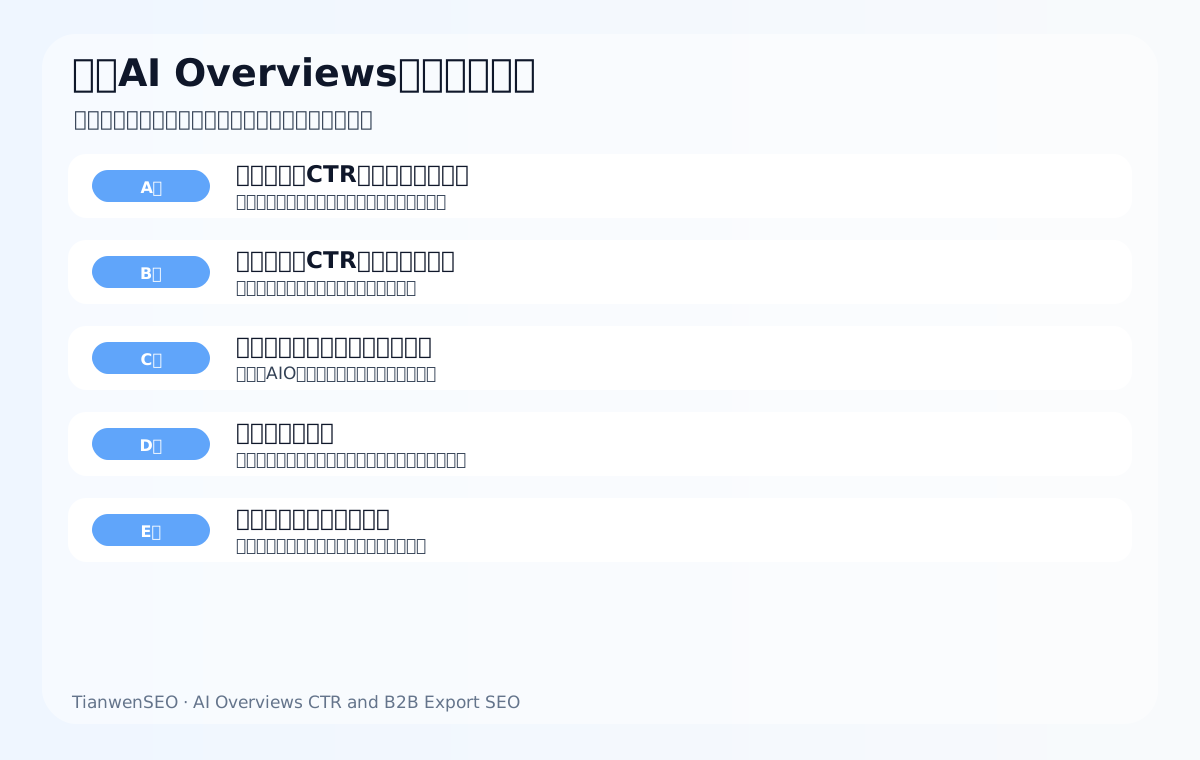
| Diagnostic step | What to look at | Possible conclusion | Next step |
|---|---|---|---|
| Check GSC | Impressions, clicks, CTR, average position | Stable ranking with lower CTR may mean a SERP change | Record whether an AIO appears |
| Check page type | Definition pages, product pages, resource pages, application pages | Simple informational pages are affected more easily | Add depth or consolidate |
| Check AI answers | Whether an AIO appears and whether it cites you | Replaced by the summary or cited from a competitor | Add citable structure |
| Check GA4 | Entry quality and subsequent paths | Fewer clicks but more precise, or worse overall | Improve the landing page |
| Check inquiries | Products, countries, clarity of requirements | Whether the business impact is real | Adjust content and CTA |
Do not attribute every traffic decline to AI Overviews
AI Overviews are an important factor, but not the only one. Export SEO traffic can also become harder to win because of fiercer competition, more SERP ads, shifts in product demand, aging pages, homogenized content, technical problems, a weak brand, changing keyword intent, seasonality, and purchasing-cycle changes.
| Possible cause | Symptom | How to investigate |
|---|---|---|
| AIO compressing clicks | Stable ranking, stable impressions, lower CTR | Record whether an AIO appears in the SERP |
| Ranking decline | Both impressions and clicks fall, average position worsens | Check competition, content, technical issues, and links |
| Demand change | Impressions fall but ranking does not clearly worsen | Look at Google Trends and industry cycles |
| Content aging | Clicks on old pages keep declining | Update product facts, tables, FAQ, and year-related content |
| Page intent mismatch | Impressions exist but clicks are low and bounce is high | Rewrite the title and the above-the-fold answer |
| Weak inquiry path | Visits without conversion | Add internal product links, inquiry checklists, and contact entry points |
In the AI Overviews era, content must move from “fully answered” to “worth clicking”
AI summaries can answer basic questions, so pages need to offer value beyond the summary. The reasons to click an export page usually include: finer parameters, model comparisons, application diagrams, downloadable materials, certification scope, supply capability, inquiry checklists, sample processes, and a channel where sales can be reached.
| What an AI summary can give | What the page must add | Export example |
|---|---|---|
| Concept definitions | Specific applications and limits | Where IP67 applies and does not apply in outdoor lighting |
| Preliminary advice | Model tables and parameter tables | waterproof connector pin count and cable OD |
| Generic selection criteria | Industry scenarios and risks | LED flood light warehouse height and beam angle |
| Supplier judgment direction | Company evidence and inquiry process | medical probe quality control checklist |
| Price influencing factors | Requirement fields and configuration choices | packaging machine RFQ checklist |
Why being cited by AI Overviews can matter more than ranking alone
Some research and industry observations suggest that being cited as a source by AI Overviews may bring higher-quality clicks. The reason is simple: users have already seen the summary, so if they still click the source, it is usually to verify, read deeper, or take the next step. For an export website, such clicks may be fewer but carry stronger intent.
For example, if an AI answer cites your “powder packaging machine selection checklist,” the buyer clicking through very likely already has a clear material and equipment requirement; if the page provides a requirements form and a sample testing process, that click is much closer to an inquiry than ordinary broad traffic.
| Citation scenario | Why the user clicks | What the page must support |
|---|---|---|
| A resource page is cited | Wants to see a more complete decision table | Downloadable checklist, internal product links, inquiry entry |
| A product page is cited | Wants to verify models and supply capability | Specifications, certifications, samples, lead time |
| A FAQ is cited | Wants to check whether the answer fits their case | Condition notes, application examples, contact entry |
| A company page is cited | Wants to judge supplier credibility | Certificates, capability, external references, contact details |
Export AI Overviews review dashboard
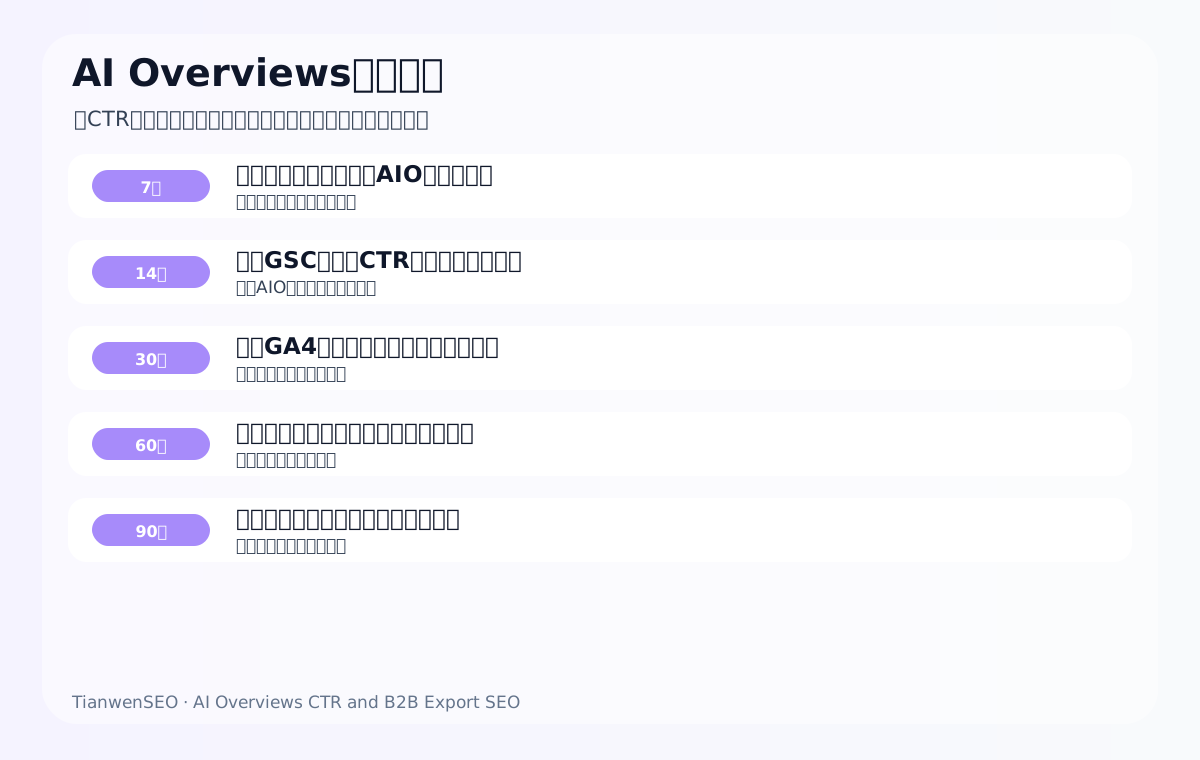
| Field | What to record | Why it matters |
|---|---|---|
| Target question | The full English sourcing question | Avoid looking only at Chinese concept terms |
| Whether an AIO appears | Yes/no, screenshot date | Judge changes in SERP format |
| Cited sources | Whether your own site or a competitor is cited | Judge answer-source competition |
| GSC performance | Impressions, clicks, CTR, position | Quantify search changes |
| GA4 path | Entry page, product page, contact page | Judge visit quality |
| Inquiry quality | Product, country, parameters, sales feedback | Judge business results |
A 90-day response roadmap
Phase 1: Build an AIO impact baseline
Select 20-50 core questions and record whether AI Overviews appear, who is cited, and your page’s ranking and CTR.
Phase 2: Handle pages by type
Add depth to or consolidate definitional articles; add specifications and applications to product pages; add tables and FAQ to resource pages; add inquiry fields to contact pages.
Phase 3: Aim to become a cited source
Improve citability with clear tables, diagrams, definitions, FAQ, consistent entities, and external evidence.
Phase 4: Connect traffic review to inquiries
Compare GSC, GA4, AI answers, and inquiry quality every month, not just CTR.
How to correctly interpret data from Ahrefs, SEJ, and Seer
The value of public research is to remind us that AI Overviews really do change how clicks are distributed; but it cannot directly replace your own website’s data. Treat third-party research as a risk signal, then return to your own GSC queries, page types, AI answer samples, GA4 events, and inquiry quality to make a judgment.
Export businesses should ask further: how many of the research sample terms are B2B product terms? How many are complex sourcing questions? Does the study separate cited from non-cited sources? Does it look at inquiry quality? If not, you cannot apply the average decline directly to your waterproof connector, packaging machine, or industrial valve supplier pages.
| What research data can tell you | What it cannot tell you directly | What export businesses must add |
|---|---|---|
| AIO compresses some organic clicks | How much your product pages will decline | Build your own baseline by page and query |
| Informational queries are affected more | That complex sourcing queries are affected the same way | Separate definition, selection, supplier, and quotation questions |
| Clicks on top rankings may fall | The business quality of cited sources | Look at GA4 paths and inquiry quality |
| SERP formats are changing | That you should stop doing SEO | Upgrade content depth and citability |
Query type tiers: which terms to worry about and which to seize
Queries on an export website cannot be treated as one block. AI Overviews affect different query types in completely different ways.
| Query type | Example | AIO impact | Content strategy |
|---|---|---|---|
| Basic definition | what is IP67 | Clicks tend to fall | Provide application limits and internal links to products |
| Product selection | which waterproof connector for outdoor LED lighting | Clicks still possible | Add a selection matrix and an inquiry checklist |
| Supplier judgment | custom metal parts supplier for marine equipment | Needs trust and evidence | Add capability pages, certificates, quality processes |
| Price factors | packaging machine cost for powder | The summary can explain factors but a quote is still needed | Add price-influencing factors and RFQ fields |
| Application solutions | LED flood light for warehouse height 10m | Needs a specific scenario | Add application pages, diagrams, and parameter tables |
| Brand terms | your brand + product | AIO impact is not necessarily the same | Make brand entity and product lines accurate |
Export page four-quadrant: deciding what to do after a CTR decline
| Quadrant | Performance | Judgment | Action |
|---|---|---|---|
| High impressions, low CTR, high inquiries | Fewer clicks but good inquiries | Traffic is more precise, not necessarily bad | Optimize the conversion path and pursue citations |
| High impressions, low CTR, low inquiries | Satisfied by the summary or weak titles | Page value is insufficient | Add depth, tables, FAQ, internal product links |
| Low impressions, low clicks, low inquiries | Demand may be low or the page may be weak | Check rankings and indexing first | Rewrite, consolidate, or lower priority |
| Stable clicks but poor inquiries | Traffic does not match the business | Intent mismatch or weak conversion | Rebuild the page role and CTA |
Case 1: what to do when a waterproof connector page loses CTR
Suppose a waterproof connector page keeps its ranking but CTR falls. Do not immediately conclude that SEO has failed; look at the query terms first. If the decline comes mainly from basic terms such as “what is waterproof connector” and “IP67 meaning,” an AI summary may be satisfying the definition; if the decline comes from “waterproof connector supplier” or “outdoor LED lighting connector,” then commercial entry points are also affected and need more serious handling.
| Query term | Possible cause | Reinforcement action | Review metric |
|---|---|---|---|
| what is waterproof connector | Basic definition satisfied by the summary | Add application limits and product entry points | Clicks through to product pages |
| IP67 vs IP68 connector | The summary answers the basic difference | Add environment, cable diameter, installation, and risk tables | Time on resource page and internal link clicks |
| waterproof connector for LED light | Needs a specific solution | Add an outdoor lighting application page and model tables | Whether inquiries include project parameters |
| waterproof connector supplier | Supplier trust competition | Add certificates, capability, samples, and delivery | Brand searches and contact page visits |
Case 2: what to do when a packaging machine page loses CTR
Searches around packaging equipment are complex. An AI summary may explain equipment types and selection factors, but buyers still need specific models, material compatibility, speed, accuracy, and pricing.
| Question | Page weakness | Upgrade module |
|---|---|---|
| powder packaging machine cost | Only says price on request | Price factor table: speed, accuracy, material, automation level, bag type |
| packaging machine for small business | No small-business scenario | Budget, footprint, maintenance, operating difficulty, and scalability |
| how to choose packaging machine | Generic selection advice | Material, bag type, speed, cleaning, after-sales checklist |
| packaging machine supplier China | Lacks trust materials | Factory capability, sample testing, spare parts supply, export experience |
Case 3: what to do when a ceramic dinnerware page loses CTR
Terms related to ceramic dinnerware wholesale may combine informational and sourcing intent. An AI summary can answer the basic difference between stoneware and porcelain, but buyers still need MOQ, packaging, customization, samples, and target-market standards.
| What AIO may answer | What the website should provide in more depth | Inquiry fields |
|---|---|---|
| Difference between stoneware and porcelain | Selection table for restaurant, hotel, retail, and gift scenarios | Use, quantity, target market |
| Wholesale sourcing considerations | MOQ, packaging, breakage control, sample process | Material, pattern, packaging method |
| Custom tableware process | Logo, glaze color, decal, molds, lead time | Design files, quantity, lead time |
Diagnostic process from “traffic decline” to “page upgrade”
| Step | Action | Output |
|---|---|---|
| 1. Confirm pages | Find the URLs with the largest CTR decline | Page list |
| 2. Break down query terms | Classify by definition, selection, supplier, price, and application | Query type table |
| 3. Check the SERP | Record whether an AIO appears, who is cited, and whether ads/videos/images appear | SERP screenshots and sources |
| 4. Check the page | Review the above-the-fold area, tables, FAQ, product facts, internal links | Page gaps |
| 5. Check the business | Compare GA4 paths and inquiry quality | Real impact |
| 6. Decide | Expand, consolidate, add resource pages, adjust titles, or leave as is | Execution checklist |
How to move a page from “replaced by the summary” to “clicked for verification”
AI summaries replace basic answers, but they cannot replace every detail. Pages must offer four kinds of value that AI struggles to fully replace.
| Value type | Page expression | Export example |
|---|---|---|
| Specific parameters | Models, dimensions, materials, certifications, applicable scope | waterproof connector pin count table |
| Scenario judgment | Selection logic for different applications | LED flood light warehouse height guide |
| Business process | Samples, MOQ, lead time, QC, packaging | ceramic dinnerware wholesale buying process |
| Downloadable / submittable | Checklists, tables, RFQ fields | packaging machine requirement form |
Should titles and meta change because of AIO
They can change, but do not write exaggerated titles just to grab clicks. In the AI Overviews era, titles should make it even clearer that the page offers value beyond the summary.
| Weak title | Stronger title | Why |
|---|---|---|
| What is IP67 | IP67 vs IP68 Waterproof Connector: Outdoor Lighting Selection Guide | Upgrades from definition to application selection |
| Packaging Machine Guide | Powder Packaging Machine Selection Checklist: Speed, Accuracy and Cleaning | States specific decision dimensions |
| CNC Machining Parts | CNC Machining Parts Tolerance and Drawing Requirements for Custom Orders | Supports sourcing preparation |
| Ceramic Dinnerware Wholesale | Ceramic Dinnerware Wholesale: Material, MOQ, Packaging and Sample Guide | Makes the reason to click clear |
How page content can add “post-click value”
- Explain above the fold what decision this content helps buyers make, not just what a concept means.
- Use tables to list models, materials, scenarios, risks, and next steps.
- Add images, flowcharts, matrices, or application diagrams to explain complex judgments.
- Upgrade FAQ from short answers to conditional answers: when it applies, and when you need to confirm.
- Provide an inquiry checklist so buyers know which parameters to prepare.
- Link to related product pages, application pages, resource pages, and the contact page.
Content consolidation strategy under AI Overviews
If several short articles all answer questions that an AI summary can cover directly, consider merging them into a stronger resource page.
| Original content combination | Problem | Consolidation direction |
|---|---|---|
| what is IP67 + IP68 meaning + waterproof connector basics | All three pages are too shallow | Merge into a guide to IP ratings and outdoor connector selection |
| LED flood light wattage + beam angle + warehouse guide | Scattered and overlapping | Merge into a warehouse LED flood light selection pillar page |
| packaging machine cost + how to choose + small business guide | The user path is not continuous | Merge into a guide to packaging machine selection and quote preparation |
| ceramic material + MOQ + packaging FAQ | Sourcing questions are scattered | Merge into a ceramic dinnerware wholesale sourcing guide |
AI Overviews and brand search
When broad traffic is compressed, brand search and brand-plus-product terms become more important. If a buyer first sees you in an AI summary and later searches for your brand name or brand plus product, that is also valuable.
| Brand signal | What to look at | How to improve it |
|---|---|---|
| Brand search | Impressions and clicks on brand terms and brand+product terms | Keep brand name, product lines, and external references consistent |
| AI answer description | Whether it describes the company and products accurately | Add About pages, capability pages, FAQ, and evidence |
| External sources | Whether trade shows, directories, and media are consistent | Update company profiles and links |
| Inquiry mentions | Whether customers say they found you via Google/AI | Add a source note field to the inquiry form |
How sales feedback helps judge AIO impact
If traffic falls but sales feedback improves, that is not necessarily bad. Conversely, if clicks do not fall but inquiries get worse, that also needs handling.
| Sales feedback | What it may indicate | Content action |
|---|---|---|
| Customer questions are more specific | Low-intent clicks decrease, high-intent ones remain | Improve the inquiry checklist and product materials |
| Customers keep asking basic definitions | The page does not carry the depth after the AI summary | Add applications and selection criteria |
| Customers misunderstand product capability | AI or the page describes it unclearly | Add limits, evidence, and FAQ |
| Customers only ask about price | Value and specification judgment are insufficient | Add price-influencing factors and a configuration table |
What not to do
- Do not delete all informational content just because CTR fell.
- Do not write exaggerated titles or uncontrollable promises just to grab clicks.
- Do not look only at rankings while ignoring SERP format, AI citations, and inquiries.
- Do not infer every product line’s performance from an average CTR decline.
- Do not force the contact page into a long article to respond to AIO.
- Do not keep producing generic articles without product facts.
A few more FAQ
Do AI Overviews affect all keywords?
No. Simple informational queries are affected more easily, while complex sourcing, product selection, supplier judgment, and quotation-related queries still have room for clicks.
Is it normal for clicks to fall while inquiries do not?
Yes. Low-intent clicks may decrease while high-intent visits remain. You need to look at inquiry quality and sales feedback.
Should we pursue being cited by AI Overviews?
It can be one goal, but do not write content only to be cited. A page must first be useful to buyers.
What if a competitor is cited by AIO?
Analyze the page type, tables, facts, and evidence that got it cited, then strengthen your own product pages and resource pages.
Does AIO affect the coordination between ads and SEO?
It affects how clicks are distributed across the SERP overall. Export businesses should look at ads, organic, brand search, AI answers, and inquiry paths at the same time.
Should we still write long articles in 2026?
Yes, write genuinely in-depth technical, methodological, or resource long-form content, but do not pad word counts with empty statements. Pages must offer value beyond AI summaries.
Export industry case 4: how to convert informational clicks for custom metal parts
Among custom metal parts queries, many informational questions are partly satisfied by AI summaries, such as “What is CNC machining tolerance,” “What material is best for corrosion resistance,” and “How to request a quote for metal parts.” If this content is only an encyclopedia-style explanation, clicks may fall; but if the page provides a drawing checklist, material comparison, tolerance table, and quote preparation, buyers still have a reason to click.
| What AIO already answers | Deeper value on the website | Business conversion |
|---|---|---|
| What CNC tolerance is | List tolerance factors by material, structure, and process | Guide users to upload drawings to confirm critical dimensions |
| Difference between 304 and 316 | Combine salt spray, cost, machinability, and application limits | Guide users to describe the operating environment |
| What surface treatments exist | Applicability table for anodizing, plating, powder coating, polishing | Guide users to choose target appearance and corrosion resistance requirements |
| How to request a quote | Checklist of drawings, material, quantity, tolerance, surface treatment | Improve inquiry completeness |
Export industry case 5: why a medical probe page must watch answer accuracy even more
Content about medical-related components cannot chase clicks alone. If an AI answer gets materials, cleanliness requirements, or certification scope wrong, the risk is greater than losing a few clicks. A medical probe manufacturer page should focus on helping AI and buyers understand: what the company can do, what it cannot promise directly, and which regulations and applicability the customer must confirm.
| Question | Risk of error | What the page should state |
|---|---|---|
| Is it medical grade | AI may overgeneralize | Materials, testing, and applicable scope must be confirmed per project |
| Are there certifications | A certification for one product may be generalized to all products | The products and markets a certificate covers |
| Can it be customized | Design and compliance limits may be ignored | Drawings, materials, cleanliness, and testing requirements |
| Quality control | Generic “quality control” wording is meaningless | Inspection process, records, batch traceability, and customer confirmation |
Page update priority score after a CTR decline
If many pages lose CTR, use a score to decide which batch to fix first.
| Scoring item | 0 points | 1 point | 2 points |
|---|---|---|---|
| Business value | Almost no impact on inquiries | Indirect impact | Core product / high-margin product |
| CTR change | No clear decline | Slight decline | Clear decline with stable impressions |
| AIO appearance | Does not appear | Appears occasionally | Appears consistently and cites others |
| Page depth | Already strong | Some gaps | Thin content missing tables/FAQ |
| Inquiry impact | No business feedback | Feedback is unclear | Sales confirm it affects communication |
| Upgradeability | Insufficient materials | Parts can be added | Sufficient product materials for a fast upgrade |
Handle pages with the highest total score first. For example, a core product page with stable impressions, a clear CTR decline, consistent AIO appearances citing a competitor, and missing tables and an inquiry checklist should be in the first batch.
How to write the above-the-fold area when an AIO appears
When users click through after already reading the AI summary, the top of the page cannot build up slowly. It should state directly: what specific problem this page solves, what scenarios it fits, and what information it offers that the AI summary did not expand on.
| Page | Weak opening | Strong opening |
|---|---|---|
| IP rating resource page | This article explains what IP ratings are. | If you need to choose a waterproof connector for outdoor LED lights, this article explains how to decide using IP67/IP68, cable diameter, installation environment, and salt-spray risk. |
| Packaging machine selection page | There are many types of packaging machines. | If you need to package powder, granules, or liquid, this article helps you narrow down equipment by material, bag type, speed, accuracy, and cleaning requirements. |
| CNC machining page | We provide CNC machining services. | If you need custom metal parts, this article explains how material, tolerance, surface treatment, drawings, and inspection affect quotation and delivery. |
How to break down a competitor being cited by AIO
If AI Overviews cite a competitor and not you, do not just look at their ranking. Break down why they were cited.
| Breakdown item | What to look at | Your reinforcement action |
|---|---|---|
| Answer snippet | Whether AI cites a definition, table, steps, or data | Add similar but more specific export content |
| Page type | Product page, resource page, blog, directory, or media | Identify which page type you lack |
| Structure | Whether it has clear H2 headings, FAQ, tables, and diagrams | Restructure the page |
| Evidence | Whether it has official sources, specifications, standards, or brand signals | Add evidence and consistent entities |
| Next step | Whether it offers a download or contact entry | Add an inquiry checklist and internal product links |
How to group data after exporting from GSC
After exporting GSC query terms, do not sort only by clicks. Under the influence of AI Overviews, you should group by intent even more.
| Group | Query term features | How to handle |
|---|---|---|
| Definitional | what is, meaning, difference | Add application scenarios and product entry points |
| Selection | how to choose, best for, suitable for | Add decision tables and application pages |
| Supplier | manufacturer, supplier, factory | Add capability, evidence, and contact paths |
| Price | cost, price, quote | Add price factors and inquiry fields |
| Problem | why, problem, troubleshooting | Add diagnostic processes and common mistakes |
| Brand | brand + product | Keep the brand entity and product materials consistent |
How to adjust KPIs in the AI Overviews era
If organic click growth remains the only KPI, teams will misjudge many things. AIO may reduce low-intent clicks while increasing high-intent clicks, brand search, AI citations, and inquiry quality.
| Old KPI | Problem | New KPI |
|---|---|---|
| Total organic clicks | Cannot separate low intent from high intent | Product page paths, inquiry quality, brand search |
| Keyword rankings | Cannot see AIO citations and SERP changes | Ranking + AIO appearance + cited sources |
| Number of articles | May produce generic content | Number of strong pages, quality of tables/FAQ/diagrams |
| Single-point CTR change | May misjudge business impact | CTR + GA4 paths + inquiry feedback |
| Number of backlinks | Does not represent verifiable trust | Relevant sources, brand entity, citation quality |
Content update cadence under AIO
| Cycle | Action | Suitable pages |
|---|---|---|
| Weekly | Record AIO screenshots for core questions | Core product/resource pages |
| Monthly | Export GSC and group by intent | All SEO pages across the site |
| Monthly | Check GA4 paths and inquiry quality | Product pages, contact page |
| Quarterly | Consolidate duplicate content and update outdated pages | Blog, resource pages |
| Quarterly | Check consistency of the brand entity and external references | About page, B2B platforms, trade show directories |
If clicks fall but the boss only looks at traffic, how to explain it
When reporting internally at an export business, you can turn “AI caused the traffic decline” into clearer business language: low-intent informational clicks are decreasing, while high-value sourcing clicks must be won with deeper pages; we will verify this through inquiry quality and product page paths.
| What the boss cares about | What not to say | What to say instead |
|---|---|---|
| Why is traffic lower | AI took the traffic and there is nothing we can do | Some simple questions are now satisfied by AI summaries, and we are upgrading pages into resource pages with stronger reasons to click |
| Is SEO still useful | SEO is very hard now | SEO is shifting from chasing broad traffic to winning high-intent sourcing traffic and AI citation sources |
| How do you prove it works | Wait for rankings to recover | Look at GSC, AI citations, product page paths, inquiry quality, and sales feedback |
| Should we keep writing articles | Keep publishing content | Prioritize upgrading core product and resource pages rather than publishing generic articles |
Final checklist
- Have you separated definitional, selection, supplier, price, and application queries?
- Have you recorded whether AI Overviews appear for target queries and which sources are cited?
- Have you checked GA4 paths and inquiry quality for pages with a CTR decline?
- Have you added parameters, tables, diagrams, and inquiry checklists beyond the AI summary?
- Have you avoided attributing every traffic decline to AI?
- Do you have a 90-day review cadence instead of looking at one data snapshot?
One-month review example: from data to action
Suppose an export website’s LED flood light for warehouse page shows basically stable impressions over a month, average position moving from 5.2 to 5.5, and CTR falling from 3.8% to 2.4%, but GA4 shows that the click-through rate to product pages after entering the page has risen, and inquiries contain more complete information about warehouse height, illuminance, and installation method. This result cannot simply be judged a failure. It may mean the AI summary reduced some low-intent clicks while the remaining users are closer to real projects.
Conversely, if CTR falls, product page paths fall, contact page visits fall, and inquiries also decrease, and AI Overviews cite a competitor’s warehouse lighting selection table, the page clearly needs reinforcement. The action is not just changing the title, but adding an installation height table, beam angle matrix, wattage selection chart, project requirement fields, and internal links to related products.
| Data combination | Judgment | Action |
|---|---|---|
| CTR down, inquiry quality up | Not necessarily bad | Optimize the conversion path and pursue more citations |
| CTR down, inquiries down too | Page upgrade needed | Add tables, diagrams, FAQ, and internal product links |
| CTR up, poor inquiries | Titles attract but intent is off | Rewrite the opening and filter users |
| AIO cites a competitor | Lost the answer-source competition | Benchmark their structure and add stronger export scenarios |
FAQ: AI Overviews click-through rates and common export SEO questions
How much did AI Overviews reduce click-through rates?
Different studies give different figures. Commonly reported ranges include top-result CTR declines of roughly 32% to 58%, but you must consider query type, industry, timing, whether the source was cited, and measurement definitions.
Does a CTR decline mean SEO no longer works?
No. Simple informational clicks will decrease, but complex sourcing questions, product pages, resource pages, and high-intent inquiries still need SEO and GEO.
Which pages on an export website are affected most?
Simple definitions, generic blogs, thin FAQ, and duplicate content are affected more easily; product specification pages, application pages, selection guides, and inquiry checklists still have value.
What should I do if rankings stay the same but clicks fall?
First confirm whether an AIO appears, then check whether the page offers value beyond the summary, and compare GA4 paths and inquiry quality.
Does being cited by AI Overviews always bring clicks?
Not necessarily, but being cited may increase verification-driven, high-quality click opportunities. The page must have deeper content and a next step.
Can GSC separate AIO clicks?
Currently GSC does not make it easy to filter AI Overviews separately, so you need manual SERP records, screenshots, and GA4/inquiry reviews.
Should we reduce informational articles?
Not reduce, but upgrade. Turn generic informational articles into resource assets with product scenarios, decision tables, FAQ, diagrams, and conversion paths.
Can you promise to recover clicks through GEO?
No. You can only improve the chance of being cited and clicked through content depth, structure, evidence, and page experience. You cannot promise fixed traffic or inquiries.
Which pages should export businesses fix first?
Prioritize pages that already have GSC impressions, correspond to core products, affect inquiries, but are thin in content or show a CTR decline.
Will AI Overviews reduce inquiries?
It may affect some entry traffic, but if pages can support complex sourcing questions, the remaining clicks may be more precise. Verify with inquiry quality.
Conclusion: do not only ask how many clicks were lost, ask whether the page is still worth clicking
AI Overviews really do make Google SEO traffic harder to win, especially for simple informational queries. But B2B export websites cannot stop at scary numbers. The real questions are: does your page offer value beyond the AI summary? Does it have product facts, decision tables, diagrams, evidence, inquiry checklists, and business paths? Is it correctly understood and cited by AI? After clicks decline, has inquiry quality changed?
The focus of export SEO in the future is not to keep fighting for all broad traffic, but to win high-quality visibility that can influence purchasing decisions. Upgrading pages from “able to answer basic questions” to resource assets that “buyers consider worth clicking, verifying, saving, and requesting a quote from” is the more stable direction in the AI Overviews era.
Official sources and the boundaries of AI Overviews impact
The impact of AI Overviews on clicks cannot be concluded by gut feeling. Export websites should judge it based on GSC page and query data, GA4 events, AI answer samples, and page actions together. Without data, you can only build an observation table. The correct approach during a low-data period is: there is currently no analyzable search performance data, so build a baseline first and do not write rise-or-fall conclusions.
Official documentation and verifiable fields
| Official source | What it verifies | What it cannot prove | How to write it in a deliverable |
|---|---|---|---|
| Google Search Central: AI features and your website | AI Overviews / AI Mode still depend on pages being crawlable, indexable, and understandable, and the related traffic flows into overall Search Console data. | It cannot prove that a specific page will definitely be cited by an AI Overview, nor that a specific query will definitely regain clicks. | State clearly whether the page is accessible, indexable, and clear enough; record AI displays and this site’s data separately. |
| Search Console Help: Performance report | Clicks, impressions, CTR, average position, query, page, country, and device dimensions. | You cannot write trends from a low sample or zero rows, nor present a third-party average CTR as this site’s performance. | A report must state the date range, filters, page URLs, query groups, and sample size; if there are zero rows, write zero rows. |
| Search Console Help: URL Inspection tool | Indexing status, crawl status, canonical, and sitemap membership of a single page. | You cannot present “indexable” as existing search performance, nor present a submitted sitemap as clicks already gained. | Record lastCrawlTime, coverageState, canonical, pageFetchState, and sitemap source. |
| Google Analytics Help: About events | Post-visit events such as downloads, forms, email clicks, WhatsApp clicks, and continued visits to product pages. | GA4 events cannot explain why the search results page changed, nor replace GSC query data. | Write click quality, product paths, and inquiry actions as separate fields, not just total traffic. |
| Google Search Central: Helpful, reliable, people-first content | Whether a page has real user value and provides clear, reliable, people-first information. | You cannot present “chasing AI hot terms” as content quality, nor replace product facts with padded word counts. | Check whether product parameters, application boundaries, FAQ, charts, inquiry fields, and export sourcing scenarios are specific enough. |
| Google Search Central: Search Essentials | The basic technical, policy, and content requirements a page must meet to participate in Google Search. | Meeting basic requirements does not mean you already have impressions, clicks, or AI citations. | List crawling, indexing, content quality, and policy risk as pre-checks. |
| Google Search Central: Sitemaps overview | Whether updated key pages can be discovered with the help of a sitemap. | Being present in a sitemap does not mean crawled, indexed, or already clicked. | Record whether the URL is in the sitemap, whether the sitemap was submitted, and whether the GSC status changes later. |
| Bing Webmaster Blog: AI Performance | The observation definitions for AI displays, cited pages, and grounding queries in Bing Webmaster Tools. | Bing samples cannot replace Google data, nor prove that ChatGPT or other AI platforms use this site. | If the account is available, list Bing AI Performance separately; if not, write it as an item to be observed. |
How to cite third-party CTR research safely
Third-party research is suitable for judging the direction of risk, not for writing directly as the results of a B2B export website. For example, AI Search Summaries and Wikipedia traffic studies differences in traffic exposure on Wikipedia, and Measuring Google AI Overviews studies activation rate, source quality, claim fidelity, and publisher impact. They can remind us that AI summaries change clicks and source selection. But they cannot directly answer how many inquiries a specific B2B export product page will lose.
| Citable conclusion | What it must not be written as | Verification the export site must add |
|---|---|---|
| AI summaries may compress simple informational clicks. | All export page clicks will decline. | Look at GSC grouped by definition terms, product terms, supplier terms, and inquiry terms. |
| AIO source selection and ordinary ranking are not entirely equivalent. | If you rank first, AI will cite you. | Record whether the AI answer cites the official website, which URL it cites, and whether the question is stable. |
| Informational publishing content is replaced by summaries more easily. | B2B product pages will decline by the same amount. | Look at product page visits, resource downloads, contact page paths, and inquiry quality. |
| Both source quality and answer accuracy need observation. | Being cited will definitely bring valid inquiries. | Put citation samples, GA4 events, and sales feedback in the same review table. |
Review acceptance table
| Check item | Record field | How to write during a low-data period | Executable action |
|---|---|---|---|
| GSC window | 28 days, 90 days, page, query, country, device | If there are zero rows, write zero rows; do not fill in trends. | Keep the baseline first and judge after the next crawl and impressions. |
| AI samples | Platform, question, whether the official site is cited, cited URL, screenshot date | Do not write a failure conclusion when there is no citation. | Fix the query set and recheck monthly with the same definition. |
| Page actions | Added facts, FAQ, internal links, resource downloads, product parameters | Write only actions actually executed. | Map each change to the subsequent observation window. |
| Conversion actions | GA4 events, forms, downloads, email clicks, continued product page visits | Fix tracking before reviewing. | Look at click quality and inquiry quality separately. |
| Conclusion boundaries | Observable signals, signals to be observed, items that cannot be promised | Do not write recovery, citations, and inquiries as controllable outcomes. | In the deliverable report, separate “executable work” from “results to be observed.” |
Continue reading this SEO resource series
If you are systematically reviewing SEO for an export website, consider reading the following articles in order. First clarify how crawling, indexing, content, links, and review relate to one another, then decide which page to change next.
- How to write AI citation-ready content: a complete guide to making export pages easier for AI to cite
- WordPress may be blocking AI crawlers: why SEO tools cannot see the problem
- How links work in Google AI Mode and AI Overviews: how B2B export websites should respond
- Why Google SEO traffic keeps getting harder: the real reasons beyond AI Overviews
- What AI Overviews monitoring tools exist? Which can see citations and which cannot
- What is SEO: a beginner’s guide from crawling and indexing to ranking and inquiries for export websites
{
“@context”: “https://schema.org”,
“@type”: “FAQPage”,
“mainEntity”: [
{
“@type”: “Question”,
“name”: “Do AI Overviews affect all keywords?”,
“acceptedAnswer”: {
“@type”: “Answer”,
“text”: “No. Simple informational queries are affected more easily, while complex sourcing, product selection, supplier judgment, and quotation-related queries still have room for clicks.”
}
},
{
“@type”: “Question”,
“name”: “Is it normal for clicks to fall while inquiries do not?”,
“acceptedAnswer”: {
“@type”: “Answer”,
“text”: “Yes. Low-intent clicks may decrease while high-intent visits remain. You need to look at inquiry quality and sales feedback.”
}
},
{
“@type”: “Question”,
“name”: “Should we pursue being cited by AI Overviews?”,
“acceptedAnswer”: {
“@type”: “Answer”,
“text”: “It can be one goal, but do not write content only to be cited. A page must first be useful to buyers.”
}
},
{
“@type”: “Question”,
“name”: “What if a competitor is cited by AIO?”,
“acceptedAnswer”: {
“@type”: “Answer”,
“text”: “Analyze the page type, tables, facts, and evidence that got it cited, then strengthen your own product pages and resource pages.”
}
},
{
“@type”: “Question”,
“name”: “Does AIO affect the coordination between ads and SEO?”,
“acceptedAnswer”: {
“@type”: “Answer”,
“text”: “It affects how clicks are distributed across the SERP overall. Export businesses should look at ads, organic, brand search, AI answers, and inquiry paths at the same time.”
}
}
]
}
This page is machine-translated from the Simplified Chinese version and awaiting human review. It has not yet been proofread.