The vanity metrics that turn up most often in a GEO monthly report are AI screenshots, overall tool scores, brand mention counts, indexed page counts, article word counts, and “we did a lot this month.” These materials can go into the appendix, but they cannot be presented directly as results. A monthly report that is actually worth something has to answer three questions: which URLs were changed this month, what happened in search and in AI samples, and why the next step is what it is.
For foreign-trade companies, this problem is very real. Owners are not short on screenshots; what they lack is judgment. Take a site working on custom metal parts, LED flood light, packaging machine, or waterproof connector: if the monthly report only says “AI mentioned the brand,” it does not show any improvement in procurement-term coverage, page citations, on-site behavior, or the inquiry path. A report has to turn screenshots into fields that can be re-checked.
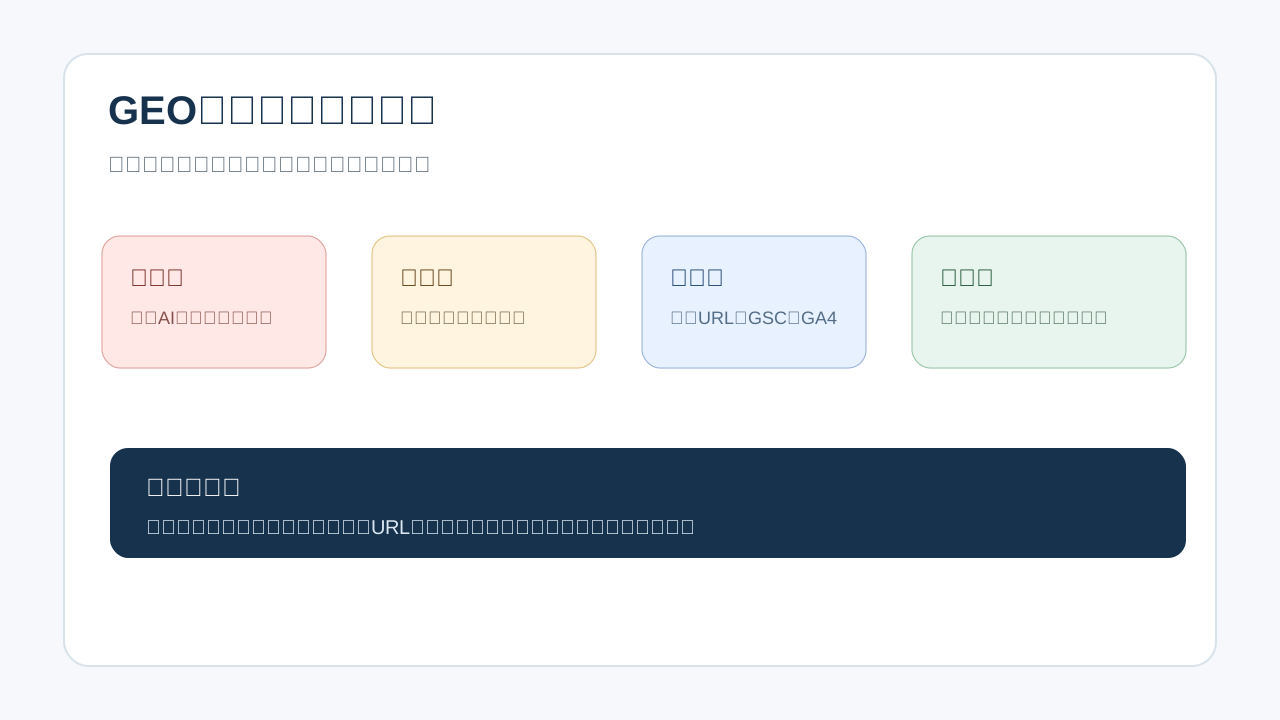
Start with the conclusion: screenshots are material, not results
AI screenshots can record samples, but they are not a final result. AI answers are shaped by how the question is worded, the region, the account, the time, the platform, the context, and competing content. Appearing today does not mean it will still appear next month; appearing for one question does not mean the whole product line is understood.
A professional monthly report has to break screenshots into fields: platform, exact question, date, region, answer summary, whether the brand appeared, whether the official site URL was cited, which page was cited, which competitors appeared on the same screen, whether the answer contained factual errors, and which type of page to fix next month. Only then do screenshots have review value.
If a monthly report just pastes three screenshots and then writes “GEO performance improved,” that statement is too loose. It has no time window, no question set, no URL, no GSC, and no on-site behavior. After reading it, you still do not know what to do next.
Official evidence: a monthly report should come back to verifiable data
GEO is not about writing reports by feel. It has to connect search crawling, indexing, impressions, clicks, on-site behavior, and AI samples. The official sources below can serve as the basis for monthly report fields.
| Official source | What the monthly report can see | Fields suitable for the report | What it must not be written as |
|---|---|---|---|
| Search Console Performance report | Queries, pages, countries, devices, impressions, clicks | Page dimension, query dimension, 28-day and 90-day comparisons | Must not write impressions as inquiries |
| URL Inspection tool | Index status, crawl time, and canonical URL for a single URL | lastCrawlTime, coverage, canonical, pageFetchState | Must not write sitemap submission as a new version already being processed |
| Page indexing report | Index status and reasons for a group of pages | Discovered, crawled but not indexed, duplicate pages, exclusion reasons | Must not report only the total indexed count |
| GA4 events | Events and interactions after a visit | Forms, email, WhatsApp, downloads, resource page clicks | Must not write traffic directly as lead quality |
| Google AI features and your website | How AI features relate to website preview controls | Whether a page allows previews, whether content can be processed by the system | Must not say a given page will definitely enter AI summaries |
| Google: Optimizing for generative AI search | Generative AI search still relies on crawlable, indexable, useful content | Content quality, page accessibility, clear answer structure | Must not present GEO as a shortcut around SEO |
| OpenAI crawlers | Public crawler and user-agent documentation | Whether the server mistakenly blocks relevant crawling, whether robots rules are clear | Must not write crawler access as ChatGPT definitely citing you |
| Google Search Essentials | Crawl, index, and quality fundamentals | Technical baseline and quality boundaries in the monthly report | Must not say that meeting the basics guarantees impressions |
Vanity metric one: number of AI screenshots
More screenshots do not mean GEO is being done well. A screenshot is only a fragment of an answer at one point in time, for one question, on one platform. It has no continuity and no comparability. If a monthly report contains 20 screenshots and each one has a different question, date, and platform, it is hard to show a trend.
The right approach is to place screenshots after the sample table. List the question set first, then list the answer fields for each run. Screenshots serve only as raw records; they cannot replace the table.
| Screenshot field | Must record | Why | Common mistake |
|---|---|---|---|
| Exact question | Keep it in full | Change the question slightly and the answer can change | Capturing only the answer and not keeping the question |
| Platform | Keep ChatGPT, Perplexity, Google AI, etc. separate | Different platforms draw on different sources | Blending them into a single AI score |
| Date and region | Record the date and the test conditions | Answers change over time | Writing only “it appeared this month” |
| Cited source | Record the exact URL | A brand mention and an official-site citation are not the same thing | Capturing only the brand name |
| Competitor co-occurrence | Record the competitors on the same screen or in the same answer | GEO is relative competition, not talking to yourself | Showing only the samples that flatter you |
Vanity metric two: brand mention count
A brand being mentioned is an observation signal. But counting only the number of mentions is easy to misread. The brand may appear in an irrelevant question, or it may just be listed among a string of company names. What matters more is whether it appears under the right question, whether the official site is cited, whether procurement questions are answered, and whether it introduces factual errors.
Take a foreign-trade site working on ceramic dinnerware. The monthly report says “the brand appeared 8 times.” That is not enough. You need to see which questions those 8 mentions came from: brand queries, product queries, or comparison queries? Was there an official site URL? Were product specifications included? Did it get the company’s business wrong? These are what determine what to do next month.
| Type of brand mention | Reliability | How to read it | Next action |
|---|---|---|---|
| Appears in a brand-query answer | Medium | Suggests the entity may be recognized | Add a company introduction, service boundaries, and contact details |
| Appears in a product-query answer | Relatively high | Closer to business value | Add a product fact sheet and procurement FAQ |
| Includes an official-site URL citation | High | The source can be traced | Check whether the cited page can capture inquiries |
| Appears only in the corner of a screenshot | Low | Cannot be written directly as a result | Keep observing; do not draw exaggerated conclusions |
Vanity metric three: overall tool score
Many tools give a composite score. That score can be a reference, but it cannot be the core result. Tool rules are not the same as the search system, and they are not the same as AI systems either. Writing “GEO score 82” in a monthly report is empty unless you explain where the score comes from, which pages it covers, which questions, and which cited sources.
An overall tool score should be broken into actionable fields. For example: crawlability, index status, structured data, entity consistency, question coverage, cited pages, competitor sources, factual errors, and next month’s tasks. Once it is broken apart, the score becomes useful.
Vanity metric four: indexed page count
A large indexed page count does not mean many effective pages. If a site has 100 pages indexed but only 3 pages get impressions, content-to-query matching may still be insufficient. Conversely, a site that has just started may have few indexed pages, yet its key product pages are beginning to get impressions, which can also be worth continued investment.
A monthly report cannot report only “indexed pages increased.” Indexing and performance have to be separated. The Page indexing report shows index status, the Performance report shows impressions and clicks, and URL Inspection shows how a single URL is being handled. These three cannot be merged into one conclusion.
Vanity metric five: article count and word count
More GEO content is not better. Long articles can also be worthless. Content that is genuinely useful answers a specific question and provides clear definitions, comparison tables, step-by-step lists, official sources, and next actions. Article count only shows output volume, not quality.
Foreign-trade sites in particular cannot replace product facts with generic articles. Procurement users care about materials, processes, certifications, MOQ, lead times, packaging, application scenarios, and quality control. AI systems also more readily cite clear, verifiable, structured facts. The monthly report should say “which pages had what facts added,” not just “we added several articles.”
Vanity metric six: average ranking screenshots
Ranking screenshots are easy to mislead. Different regions, devices, accounts, and times can show different results. GSC’s average position is also not the position at a single moment but the average across many impressions. Treating a one-off screenshot as a trend is very risky.
A more stable approach is to use Search Console’s 28-day and 90-day windows to look at changes in pages and query clusters. For example: are impressions on product pages increasing, are comparison queries appearing, are procurement queries getting closer to the business, and after a click do users enter a contact path.
Which metrics a useful monthly report should look at
Effective metrics share one thing: they can be re-checked, explained, and used to guide next month’s actions. They are not necessarily impressive, but they are useful.
| Effective metric | Data source | How to write it in the monthly report | Next month’s action |
|---|---|---|---|
| Crawl time of key URLs | URL Inspection | Whether the crawl time is later than the modification time | If not yet processed, add internal links, submit the sitemap, and keep observing |
| Page-level impressions | GSC Performance | Which pages are starting to be triggered | Improve titles, opening paragraphs, FAQs, and internal links |
| Changes in query intent | GSC query dimension | Whether informational, comparison, and procurement queries are changing | Add different pages by intent |
| On-site events | GA4 events | Whether visitors click contact, forms, email, or resources after arriving | Adjust CTAs and page paths |
| AI-cited URLs | Samples from a fixed question set | Whether the official site is cited and which page | Strengthen the cited page or add missing facts |
| Factual errors | AI sample records | Whether the answer gets the product, service, region, or capability wrong | Add entity explanations, product pages, and FAQs |
Minimum field template for a GEO monthly report
Even if the report keeps only one table, it should keep the fields below. The fields are not complicated, but they turn “looks effective” into “can be re-checked.”
| Field | Must be filled in | Why | Consequence of omission |
|---|---|---|---|
| URL | Canonical URL | Every action has to land on a page | Cannot be re-checked |
| This month’s actions | Add, update, merge, delete, add images, add tables | Separate actions from results | Cannot tell what the team did |
| Modification time | A specific date | Compare against crawl time | Cannot tell whether the new version has been processed |
| GSC page data | Impressions, clicks, average position, country, device | See changes on the search side | Can only judge by feel |
| AI samples | Question, platform, date, answer, source URL | See whether AI answers can be traced | Screenshots cannot be compared |
| Next month’s P0 | The 3–5 most important actions | Make the report drive execution | The monthly report becomes presentation material |
How to tell whether a GEO monthly report is “packaging results”
If a monthly report looks more and more lively the more you read, but you cannot see what to do next, be on guard. Common signs of packaging results: many screenshots but few fields; many adjectives but few URLs; full conclusions but few boundaries.
- It shows only the flattering samples and does not show non-appearances, factual errors, or competitor sources.
- It writes only that the brand appeared, not the exact question or the cited URL.
- It writes only the amount of new content, not which pages Google re-crawled.
- It writes only the overall tool score, not page-level changes.
- It writes only “continuous optimization,” not next month’s P0 and how it will be verified.
- It writes only AI results, not GSC and GA4.
- It shows only screenshots and does not keep the raw tables.
How to replace vanity metrics with effective metrics
Bad metrics do not necessarily have to be deleted. Some can be downgraded to reference material. AI screenshots can be kept, for example, but placed after the question set. Brand mentions can be kept, but read together with official-site URLs, competitor co-occurrence, and factual errors. Tool scores can be kept, but broken into page-level tasks.
| Original metric | Problem | Replacement metric | How to verify |
|---|---|---|---|
| Number of AI screenshots | Not comparable | Cited URL records from a fixed question set | Re-check the same question in the same cycle |
| Brand mention count | May be irrelevant | Official-site citations under product and procurement queries | Group by question type |
| Overall tool score | Not the same as results | Page-level issues and fix records | Check against URL and modification time |
| Indexed page count | Not the same as effective impressions | Number of pages with impressions and changes in query clusters | GSC page and query dimensions |
| Article count | Does not represent quality | Facts, tables, FAQs, and official sources added | Check page by page |
| Average ranking screenshots | Affected by the environment | GSC 28-day and 90-day trends | Fix the time window |
A foreign-trade site’s monthly report has to look at the “inquiry path” separately
A GEO monthly report cannot stop at AI answers. For a foreign-trade site, what ultimately matters is whether users can move from content into a commercial path. For example, from a technical article on industrial valve supplier into a product page, then clicking a contact entry point, or downloading a specification sheet. These actions can be observed through GA4 events and on-site paths.
Of course, post-visit actions cannot be written directly as orders either. They are only signals closer to the business. The monthly report has to read them together with pages, queries, countries, devices, and inquiry entry points. Only then can you judge whether the content is moving users in the right direction.
How to design the AI samples in a monthly report
Sample design matters more than screenshots. A good question set should cover brand queries, product queries, application queries, comparison queries, procurement queries, troubleshooting queries, and competitor queries. Each category needs fixed samples that are re-tested continuously. Only then does the monthly report have a trend.
| Question type | Example direction | What to watch | Page action |
|---|---|---|---|
| Brand queries | Who the company is and what it does | Whether the entity is clear | Add company pages, author pages, and service boundaries |
| Product queries | Product suppliers, manufacturers, specifications | Whether product or category pages are cited | Add specification tables, application scenarios, and FAQs |
| Application queries | How to select a model for a given industry | Whether the application scenario is understood | Add industry pages and authorized case materials |
| Comparison queries | Comparisons of materials, processes, and solutions | Whether explanatory articles are cited | Add comparison tables and decision checklists |
| Procurement queries | MOQ, lead time, certification, packaging | Whether pre-purchase questions are answered | Add pre-inquiry FAQs and downloadable materials |
| Competitor queries | Alternative options to competitors | Whether there is co-occurrence and alternative sources | Add difference explanations and credible materials |
How to write the GSC section of a monthly report professionally
Do not paste only an overview chart in the GSC section. Break it into at least four dimensions: page, query, country, and device. The page dimension in particular tells you which URLs already have search signals. The query dimension tells you whether search intent is getting closer to the business. Country and device help you judge the market and user scenarios.
If there is very little data, be honest about the small numbers too. If there were only a few impressions in 28 days, write “the sample is too small; treat this only as a discovery clue.” Do not write small data as a big trend. An honest monthly report is, in fact, more professional.
How to write the URL Inspection section of a monthly report
URL Inspection is the easiest part to overlook. A page having been changed does not mean Google has processed it. The monthly report should record the modification time and lastCrawlTime of key URLs. If the crawl time is earlier than the modification time, you can only say “the new version is waiting to be processed”; you cannot say the new version has been evaluated by the search system.
This rule matters. It keeps a team from writing a page that was just published as “already producing results.” Both SEO and GEO need time windows. A report has to respect that window.
How to write the GA4 section of a monthly report
GA4 is not responsible for proving rankings. It is responsible for observing behavior after a visit. For example, whether users continue to browse product pages, click contact, submit a form, or download materials. If a GEO monthly report looks only at AI samples and not at on-site behavior, it easily stays on the surface.
But GA4 events also have to be configured clearly first. Without events, do not force a behavior conclusion. You can make event configuration a next-month task. For example, email clicks, WhatsApp clicks, form submissions, resource downloads, and product page transitions all carry more business meaning than “traffic went up.”
Boundaries: what a GEO monthly report can and cannot prove
A professional monthly report has to state its boundaries. Boundaries are not an evasion; they prevent misjudgment. They tell the owner which conclusions already have evidence, which are only observations, and which still need to wait.
| Monthly report conclusion | Evidence requirement | How it can be written | How it must not be written |
|---|---|---|---|
| The page has been processed | URL Inspection crawl time is later than the modification time | Google has seen the new version of the URL | Organic traffic will definitely rise |
| Search signals have appeared | GSC page and query dimensions show impressions | The page is starting to trigger certain queries | It has already gained stable rankings |
| The brand appears in an AI sample | The question, platform, date, answer, and source are complete | The brand or page appears in a certain sample | AI will use this site over the long term |
| On-site behavior has improved | GA4 events and paths are clear | Content pages bring more contact-entry clicks | These clicks will definitely turn into orders |
Monthly report scoring: do not just score, explain the deductions
If a team insists on putting a score in the monthly report, that is fine. But the score cannot exist on its own. It has to be broken into deductions and next-month actions. Otherwise the score is just decoration.
For example, if a GEO monthly report gives 76 points, the reader still does not know where it is weak. Is it that pages were not crawled, that the question set is too small, that official-site citations are few, that competitor sources are stronger, or that GA4 events are not configured? Only when those reasons are written out does the score mean anything.
| Scoring dimension | What to look at | Example deduction | Next month’s action |
|---|---|---|---|
| Crawlable | robots, sitemap, status codes, canonical | Key URLs have not been re-crawled yet | Add internal links, submit the sitemap, check technical blocks |
| Understandable | Titles, opening paragraphs, tables, FAQs, entity explanations | Product facts are incomplete | Add specifications, applications, certifications, and procurement questions |
| Citable | Official-site URLs and sources in AI samples | The brand appears but there is no official-site source | Strengthen the page for the question being asked |
| Convertible | GA4 events, contact entry points, product page paths | Content pages do not lead into a commercial path | Add CTAs, resource downloads, and product page links |
| Re-checkable | Raw tables, screenshot numbers, dates, URLs | Only screenshots, no fields | Standardize the monthly report template |
How to write the owner’s summary
A monthly report is not better the thicker it is. The owner’s summary is best kept within one page, but it has to contain judgment. It should answer: what the most important change was this month, where the evidence is, what to do first next month, and what the risks are.
It can be written in four sentences:
- Completed this month: list 3–5 real actions and write the URLs.
- Observed this month: list the most important changes in GSC, AI samples, and GA4.
- Cannot conclude this month: explain which data is too thin and which pages have not been re-processed.
- Next month’s priorities: write P0, P1, P2; do not write vague plans.
This kind of summary is not exaggerated, but it works. It lets the owner know where the money went, and it lets the execution team know what to do first next month.
How P0 tasks are derived from the monthly report
A good monthly report must end with P0 tasks. Without P0, the report is like a weather forecast: it tells you it will rain today but not whether to bring an umbrella.
| Monthly report finding | What it indicates | P0 action | How to re-check |
|---|---|---|---|
| Key URLs have not been re-crawled | The new content has not been processed yet | Add entry links, check the sitemap, and wait for re-crawl | URL Inspection crawl time |
| AI samples cite competitors, not the official site | Official-site pages lack citable facts | Add product facts, comparison tables, FAQs, and resource pages | Re-test the same question set next month |
| GSC shows impressions but no clicks | Titles or snippets are weak, or intent does not match | Improve titles, opening paragraphs, and structured snippets | 28-day CTR and query changes |
| Content pages get visits but no contact actions | The commercial path is unclear | Add product page links, contact entry points, and resource downloads | GA4 events and paths |
| Factual errors keep recurring | Entity and product descriptions are unclear | Add company entity, service boundaries, and product capability descriptions | AI sample factual error table |
The sample library in a monthly report has to be maintained, not built once
The question set is not finished after it is written once. Foreign-trade business changes, product priorities change, competitors change, and AI platforms change. The monthly report has to keep a record of “questions added, questions deleted, questions adjusted.” Otherwise next month’s data cannot be compared with last month’s.
It is advisable to split the question set into three layers. The first layer is core questions, which stay fixed over the long term and are used for trends. The second layer is business questions, adjusted by product line. The third layer is exploratory questions, used to discover new opportunities. Only when the core layer is stable does the monthly report have continuity.
| Question layer | Purpose | Adjusted frequently? | How to write it in the monthly report |
|---|---|---|---|
| Core layer | Observe long-term trends | Rarely adjusted | Fixed monthly comparison |
| Business layer | Cover product and market changes | Adjusted quarterly | Explain why questions were added or removed |
| Exploratory layer | Discover new demand and competitor sources | Can be adjusted | Use only as clues, not as trends |
SEO and GEO metrics should be read together but not written as one
SEO and GEO are connected. If a page cannot be crawled and indexed, AI search will also struggle to understand it reliably. If content lacks clear facts, both search and AI will be weak. But a monthly report cannot blend all metrics into one overall score.
A more stable approach is three columns: search evidence, AI samples, and on-site behavior. Search evidence looks at GSC and URL Inspection; AI samples look at the question set and cited sources; on-site behavior looks at GA4 events. Only when the three columns are analyzed together is the conclusion unbiased.
For example, a certain page has impressions in GSC but is not cited in AI samples. Next month you can improve its page structure and extractable passages. Another page has the brand appearing in AI samples but no impressions in GSC. Next month you should check whether it is indexed, whether it has internal links, and whether it covers real queries. Different situations call for different actions.
Deliverables checklist: monthly report appendices also have to be re-checkable
The body of the monthly report can be concise, but the appendices have to be complete. Appendices are not a pile of files; they preserve raw evidence. When the team reviews later, it can return to the same table and see why the judgment was made at the time.
- URL modification list: URL, page type, what was changed, modification time.
- GSC export tables: page dimension, query dimension, country, device, and time window.
- URL Inspection table: coverage, lastCrawlTime, canonical, pageFetchState.
- AI sample table: question, platform, date, answer summary, cited URL, competitor sources.
- GA4 event table: event name, triggering page, count, path, and configuration notes.
- Next-month task table: P0, P1, P2, owner, acceptance fields, and re-check date.
These appendices look plain, but they let the report withstand follow-up questions. A genuinely professional GEO monthly report is not afraid of being asked “where did this conclusion come from.”
Handling factual errors: more valuable than a pretty screenshot
When an AI answer gets the company’s business, product materials, application scenarios, or service scope wrong, that kind of factual error matters. It suggests that entity descriptions on public pages may not be clear enough, or that competitors and third-party sources are more easily adopted by the system.
The monthly report should keep a separate factual error table. For each error, write the exact question, the incorrect content, the possible source, the official-site page that needs fixing, and the re-test date after the fix. This action is more valuable than showing a nice screenshot, because it directly drives content and entity fixes.
If there is no obvious improvement in a month, that is not a failure either. As long as the report can explain which pages have been processed, which have not been crawled yet, which samples still have errors, and which tasks need to be postponed, the project is still within a controllable range. What is frightening is not slowness; it is not being able to see clearly.
So the core of a monthly report is not to prove the team is busy but to help the next month take fewer detours. Every metric has to be traceable back to a page, data, and a task before it can be re-checked and tracked.
How Henan Tianwen Network Technology Co., Ltd. should present its monthly reports
When Henan Tianwen Network Technology Co., Ltd. produces GEO and SEO monthly reports, it is fitting to emphasize an evidence loop: GSC data, URL Inspection, GA4 events, AI samples, page modification records, and next-month tasks. Do not write the report as a collection of pretty screenshots. The more re-checkable the report, the more professional it feels.
Externally, it can be put this way: we do not treat a single AI answer as a result; we record the question set, cited sources, page changes, and re-check dates; we use GSC to judge search-side signals, GA4 to observe on-site behavior, and URL Inspection to judge whether a page has been processed. This phrasing is restrained, but credible.
FAQ: GEO monthly reports and vanity metrics
Can AI screenshots go into a monthly report?
Yes. They work as raw records, but they cannot stand alone as a result. The question, platform, date, answer summary, cited URL, and competitor sources must be kept alongside them.
Does an AI mention of the brand count as a result?
It counts as an observation signal, not a final result. You have to look at whether it appears under the right question, whether the official site is cited, whether procurement questions are answered, and whether there is a month-over-month comparison.
Must a GEO monthly report include GSC?
It is advisable to include it. GEO cannot be separated from the search foundation. GSC tells you whether pages and queries have search signals, and it also helps decide which URLs to prioritize next month.
What if the monthly report has no AI tool data?
You can start by recording with a manual question set. Questions have to be fixed, fields have to be complete, and re-testing has to be continuous. When samples are few in the early stage, making the recording method solid matters more than buying a tool.
How often should a monthly report be reviewed?
Usually a monthly review is more stable. You can monitor weekly, but do not make the conclusions too definitive. Search and AI samples both need time windows, especially right after a page is updated.
What are the most important monthly report fields?
It is not one field but the combination of URL, modification time, GSC page data, AI sample sources, GA4 events, and next-month tasks. Remove any one and the judgment weakens.
Related reading
- Are free AI search visibility tools enough?
- What a GEO diagnosis service includes
- How to choose GEO monitoring tools
- Can you trust a Google SEO company that promises first-page rankings?
- What GEO is and how it differs from SEO and AEO
- How to do GEO
Conclusion: a monthly report should drive the next step, not decorate results
The worst thing about a GEO monthly report is looking good but being useless. Many screenshots, lively wording, full conclusions, but you cannot see what was changed or what to do next month. Such a report is easy to hand in in the short term, but over time it makes the project lose direction.
A professional monthly report should be plainer. It puts URL, question set, GSC, GA4, AI samples, and next-month tasks together. It acknowledges uncertainty and records real changes. It does not treat a single screenshot as a result; it turns every observation into the next action. That is how GEO stops being mysticism and becomes a workflow that can be reviewed.
{
“@context”: “https://schema.org”,
“@type”: “FAQPage”,
“mainEntity”: [
{
“@type”: “Question”,
“name”: “Can AI screenshots go into a monthly report?”,
“acceptedAnswer”: {
“@type”: “Answer”,
“text”: “Yes. They work as raw records, but they cannot stand alone as a result. The question, platform, date, answer summary, cited URL, and competitor sources must be kept alongside them.”
}
},
{
“@type”: “Question”,
“name”: “Does an AI mention of the brand count as a result?”,
“acceptedAnswer”: {
“@type”: “Answer”,
“text”: “It counts as an observation signal, not a final result. You have to look at whether it appears under the right question, whether the official site is cited, whether procurement questions are answered, and whether there is a month-over-month comparison.”
}
},
{
“@type”: “Question”,
“name”: “Must a GEO monthly report include GSC?”,
“acceptedAnswer”: {
“@type”: “Answer”,
“text”: “It is advisable to include it. GEO cannot be separated from the search foundation. GSC tells you whether pages and queries have search signals, and it also helps decide which URLs to prioritize next month.”
}
},
{
“@type”: “Question”,
“name”: “What if the monthly report has no AI tool data?”,
“acceptedAnswer”: {
“@type”: “Answer”,
“text”: “You can start by recording with a manual question set. Questions have to be fixed, fields have to be complete, and re-testing has to be continuous. When samples are few in the early stage, making the recording method solid matters more than buying a tool.”
}
},
{
“@type”: “Question”,
“name”: “How often should a monthly report be reviewed?”,
“acceptedAnswer”: {
“@type”: “Answer”,
“text”: “Usually a monthly review is more stable. You can monitor weekly, but do not make the conclusions too definitive. Search and AI samples both need time windows, especially right after a page is updated.”
}
}
]
}
This page is machine-translated from the Simplified Chinese version and awaiting human review. It has not yet been proofread.