AI Visibility Monitoring is not about asking AI every day “who do you recommend” and then reporting a screenshot. For Chinese export manufacturers and trading companies, a more valuable way to monitor is to track, around English product terms, sourcing questions, application scenarios, comparison terms, documentation terms and quote terms, whether AI answers correctly understand the official website, whether they mention the brand, whether they cite pages, why competitors appear, and whether these changes echo GSC, GA4 and inquiry quality.
If your new site sells industrial components and custom manufacturing categories or private label activewear manufacturer, the focus of AI visibility monitoring should not be “did they recommend me today”, but whether AI, when answering buyer questions, can accurately state the product, specifications, applications, documentation, risks and the next purchasing step.
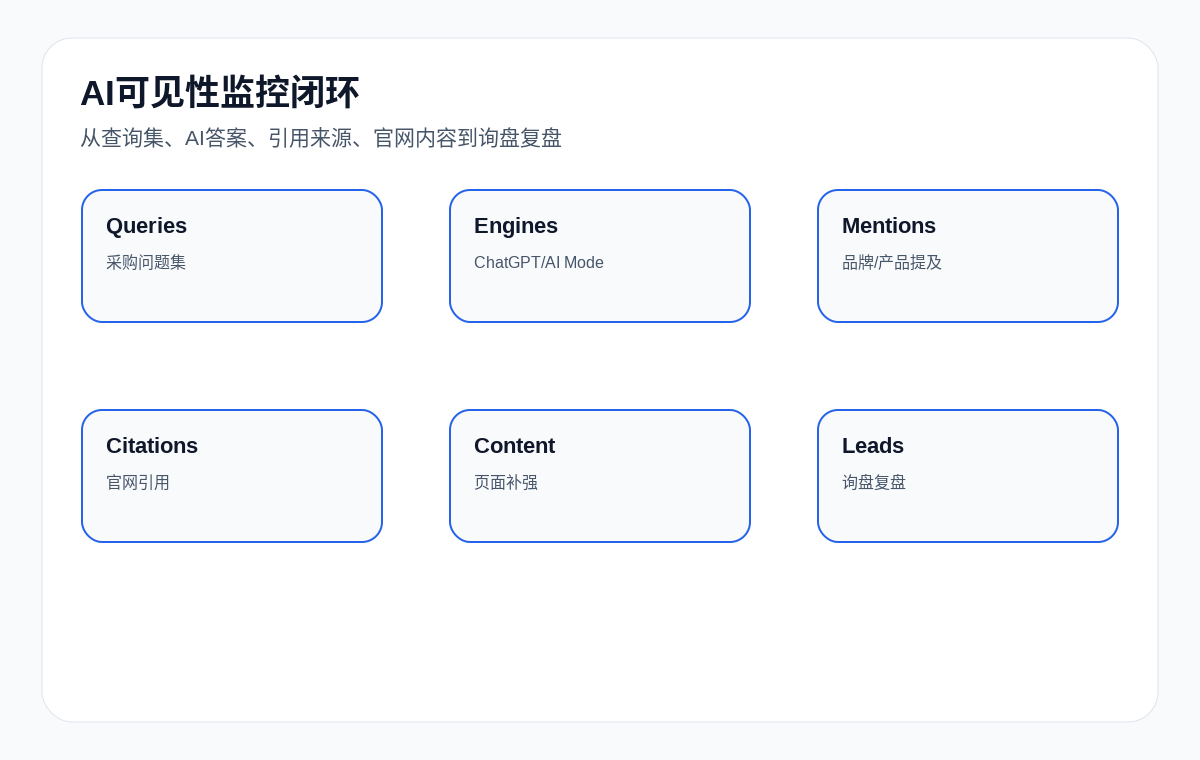
Benchmark current approaches first: what AI visibility tools can give you and what they cannot decide for you
Among current AI visibility monitoring results, Semrush AI Visibility Toolkit, AI Visibility Toolkit getting started, Profound, AirOps and various AI search visibility tools guides generally emphasise Share of Voice, brand sentiment, prompt tracking, citations, competitor comparison and cross-platform monitoring. Semrush documentation mentions monitoring brand performance and prompt tracking across environments such as Google AI Mode and ChatGPT; some tool reviews emphasise multi-engine coverage, citation tracking, competitor comparison and content gaps.
The strength of these benchmarks is that they are tool-based and report-based; the shortcoming is that much of the content targets SaaS, brand marketing or SEO teams, and says less about how a new export site can build a query set from scratch, how to use English product terms to simulate overseas buyers, how to judge why competitors appear in AI answers, and how to turn AI monitoring results into content improvements for product pages, category pages, application pages, documentation pages and FAQs.
So the goal of this article is not to explain any particular tool, but to give export businesses an executable monitoring framework: define the query set first, then fix the recording fields, then distinguish brand mentions, website citations, product entity understanding, competitor narratives and inquiry linkage, and finally decide how to change pages.
Types of AI query sets for B2B export
| Query type | Monitoring question | English example | Corresponding page |
|---|---|---|---|
| Product definition | Whether AI understands what the product is | what is a waterproof connector used for | Test whether the definition page and product page are clear |
| Supplier selection | Whether AI mentions available suppliers or selection criteria | how to choose custom metal parts supplier | Test whether the brand/website enters purchasing answers |
| Application scenario | Whether AI can connect the product to the scenario | best connector for packaging machine | Test whether the application page is specific enough |
| Specification comparison | Whether AI explains parameter differences | IP65 vs IP67 LED flood light | Test whether the FAQ and comparison table are understood |
| Documentation needs | Whether AI knows what documentation is needed | medical probe datasheet requirements | Test the documentation notes on the documentation page and product page |
| Quote preparation | Whether AI provides an RFQ checklist | what to send for cnc machining parts quote | Test the quote notes on the inquiry page and product page |
Why a new site cannot look only at Google rankings
In the early days after a new export site goes live, Google rankings, GSC impressions and organic inquiries usually all need time to build up. If you look only at traditional rankings, it is easy to underestimate the early signals of content development. AI answers, AI Overviews, ChatGPT Search, Perplexity, Gemini and other answer environments cannot replace SEO data, but they can help you observe whether the website content is clear enough, whether product entities are easy to understand, whether purchasing questions have citable answers, and whether competitors appear repeatedly on similar questions.
AI monitoring cannot prove that a page will definitely bring rankings or inquiries, and a single answer cannot be treated as a conclusion. It is better suited to directional diagnosis: which questions AI can answer without citing you, which product terms AI understands poorly, which competitors have more complete specification tables, documentation pages or FAQs, and which pages need to be strengthened first.
How AI visibility and traditional SEO data divide the work
| Data type | What it can show | What it cannot show | How to use it |
|---|---|---|---|
| Google rankings | Traditional search position for a query | Cannot show whether an AI answer cites you | Use for core terms and page trends |
| GSC impressions | Whether a page has started to earn search impressions | Cannot fully cover AI search | Use to discover real queries |
| AI mentions | Whether the brand or product appears in answers | Cannot prove conversion | Use to observe awareness and narrative |
| AI citations | Whether website pages become answer sources | Cannot guarantee stable appearance | Use to judge whether content is citable |
| Inquiry quality | Whether it brings clearer purchasing needs | Source attribution may be incomplete | Use to verify commercial value |
Step 1: Build an export purchasing query set instead of asking AI at random
The place where AI visibility monitoring most easily goes wrong is query set design. Many people ask only the brand name or “best supplier”, and of course a new site does not appear. A more reasonable method is to design queries along the purchasing journey: product definition, supplier selection, application scenario, specification comparison, certification risk, documentation needs, quote preparation and alternatives. Each type of query corresponds to different pages and content gaps.
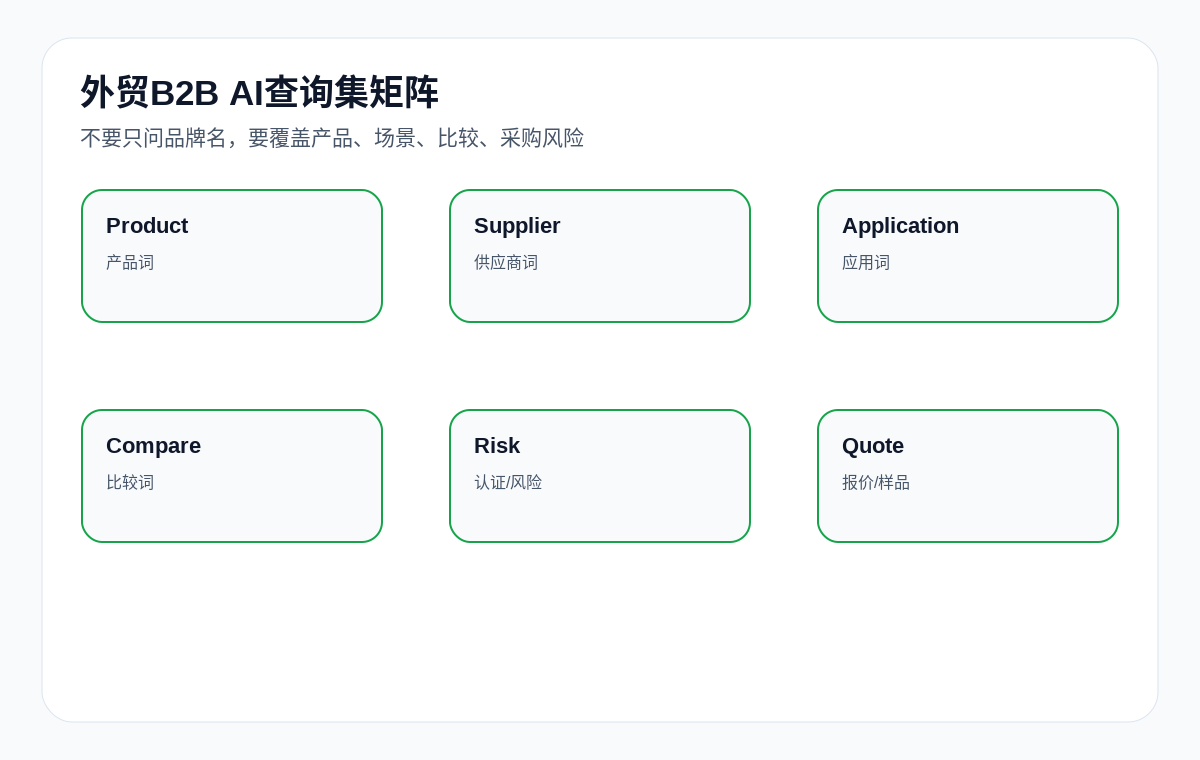
AI query set design matrix
| Dimension | Query example | What the buyer is thinking | Page the website should have |
|---|---|---|---|
| Product definition | what is a waterproof connector | First understand what the product is for | Terminology page/product page |
| Supplier selection | how to choose custom metal parts supplier | Judge supplier capability | Selection guide/factory capability page |
| Application scenario | connector for packaging machine | Find products for the scenario | Application page/product page |
| Specification comparison | IP65 vs IP67 LED flood light | Compare parameter differences | Comparison article/FAQ |
| Certification risk | ceramic dinnerware food contact standard | Judge compliance risk | Certification notes/documentation page |
| Quote preparation | what to send for cnc machining parts quote | Prepare inquiry materials | Product page/inquiry page |
| Alternatives | industrial valve material selection | Compare materials and environments | Application guide/parameter table |
| Brand verification | is brand X a manufacturer | Judge company credibility | About page/factory capability page |
Step 2: Fix your monitoring fields so you do not end up with only screenshots
Screenshots can serve as evidence, but they cannot replace structured records. In each monitoring round, record at least the date, platform, region or language, query term, answer summary, whether the brand appeared, whether the website URL was cited, which page was cited, which competitors appeared, which judgment criteria the answer mentioned, what our pages are missing, and the next action. Only then can you compare changes after a month.
AI visibility monitoring field table
| Field | What to record | Why it matters | Example |
|---|---|---|---|
| Date | Test time | Answers change over time | 2026-05-26 |
| Platform | ChatGPT, Google AI Mode, Perplexity, etc. | Different platforms have different citation logic | ChatGPT Search |
| Query term | Full English prompt | Keeps it repeatable | best connector for packaging machine |
| Brand mention | Whether the company/brand appears | Observe awareness changes | Not appeared/appeared once |
| Website citation | Whether tianwenseo or the client website URL is cited | Judge whether content is citable | Product page cited/not cited |
| Competitors | Which brands or websites appear | Find gaps | competitor A, competitor B |
| Answer gap | Content that AI answers but the website does not have | Guide content updates | Missing IP rating comparison table |
| Action | Which page to change next | Land on execution | Add waterproof connector FAQ |
Step 3: Distinguish mentions, citations, positive narrative and misunderstanding
A brand “appearing” in an AI answer does not equal “good visibility”. Sometimes it is only listed as an option without a citation; sometimes the website is cited but the description is incomplete; sometimes the brand is mentioned but the product, region or capability is described incorrectly. When monitoring, judge in layers: brand mention is the lowest layer, a website citation is more valuable, an accurate and positive narrative matters more, and only when it drives the next purchasing step does it come close to commercial value.
AI visibility signal layers
| Signal | Meaning | Risk | Next step |
|---|---|---|---|
| Brand mention | Whether the company/brand name appears in the AI answer | Suitable for existing brand search or industry brand monitoring | A new site may stay at zero for a long time early on |
| Website citation | Whether the answer cites the website URL | Judge whether the page has become an information source | Different platforms have different citation rules |
| Product/service entity | Whether AI correctly describes product capabilities | See whether the business scope is misunderstood | Entity information should be consistent |
| Competitor appearance | Which competitors are mentioned or cited | Find content and trust gaps | Do not watch only one platform |
| Answer narrative | How AI describes the industry and purchasing advice | Discover problems missing from pages | Requires manual recording |
| Inquiry linkage | Whether AI search leads to clearer enquiries | Check CRM and form fields | When data is scarce, use it only for directional judgment |
For example, when AI answers “how to choose private label activewear manufacturer”, if it mentions a competitor and cites that competitor’s fabric, MOQ, sample and size range pages without mentioning your website, this usually shows that you lack citable manufacturing capability, sampling process, fabric table or FAQ. The solution is not to keep refreshing AI, but to strengthen the corresponding pages.
Step 4: How manual monitoring and tool-based monitoring work together
A new site does not necessarily need to buy expensive tools right away. You can first build a baseline through manual sampling: choose 20 high-value English queries and record them once a week in ChatGPT, Google AI-related results, Perplexity or Gemini. Once pages, queries and business value become clearer, consider tools such as Semrush AI Visibility Toolkit, Profound, AirOps and SE Ranking.
Comparison of AI visibility monitoring approaches
| Approach | Strength | Suitable stage | Limitation |
|---|---|---|---|
| Manual sampling | Free, and you can see the real answer context | Early stage of a new site, limited budget | Small sample; needs a fixed recording method |
| Semrush AI Visibility Toolkit | Covers reports such as brand performance, Share of Voice and prompt tracking | Teams already using the Semrush system | Cost and coverage need to be confirmed against the actual account |
| AI Overview/AI Mode observation | Close to changes in Google search | Key English product terms and question terms | Region, login status and time can affect results |
| Perplexity/ChatGPT/Gemini spot checks | See different AI answers and citations | B2B purchasing questions, documentation questions | Answers fluctuate; one check cannot settle it |
| GSC/GA4/CRM combination | Connect AI observations with real search/inquiries | Every export site should do this | AI source attribution is not necessarily complete |
The value of tools lies in scale, trend tracking and competitor comparison; the value of manual work lies in understanding answer context and business meaning. Export businesses should avoid looking only at tool scores, and avoid drawing conclusions from a few screenshots alone. Only by combining the two can you judge which pages really need work.
Step 5: Turn AI monitoring results into page update actions
The ultimate purpose of AI monitoring is not to generate a report, but to find content gaps. Common gaps on export sites include a missing definition paragraph, a missing parameter table, a weak application page, a vague FAQ, a missing documentation page, a confusing brand entity, inconsistent English product terms, images without descriptions, and an inquiry page with no list of quote materials. Each gap should correspond to a page update action.
From AI answer gaps to page update actions
| Gap | Symptom | Update action | Suitable products |
|---|---|---|---|
| Missing definition paragraph | AI does not know what the product is or where it is used | Add one clear definition sentence to the product page/guide page | waterproof connector, industrial valve |
| Missing parameter table | AI cannot compare specifications | Add a specification table and selection criteria | LED flood light, medical probe |
| Weak application page | AI mentions only competitors, not the website | Add application scenarios, environments and recommended products | packaging machine, cnc machining parts |
| Vague FAQ | AI does not cite it when answering purchasing questions | Add MOQ, samples, certification, lead time and drawing formats | custom metal parts, private label activewear |
| Missing documentation page | AI cannot explain datasheet/catalog | Add a documentation page and link it from product pages | medical probe datasheet, ceramic dinnerware catalog |
| Confusing brand entity | AI describes company capability inconsistently | Unify company name, product lines, markets and contact details | Whole site |
Step 6: Monitor why competitors are mentioned by AI
If competitors appear repeatedly in AI answers, do not attribute it only to a big brand or many backlinks. Break down the reasons they are mentioned: do they have a clear product definition page, a complete parameter table, application cases, downloadable documentation, citations on multiple third-party platforms, a structured FAQ, and English content covering purchasing questions?
Breakdown of why competitors appear in AI
| Possible reason | How to verify | How we can fill the gap | Notes |
|---|---|---|---|
| Clear product definition | Look at the competitor page’s first screen and FAQ | Add terminology definitions and application notes | Do not copy competitor wording |
| Complete parameter table | Compare specification fields | Add materials, dimensions, certification and model numbers | Ensure the information is true |
| Downloadable documentation | Check catalog/datasheet/manual | Build a documentation page and internally link products | Documentation must be accessible |
| Many third-party signals | Search brand + product terms | Add credible information such as industry directories, social media and videos | Do not fabricate fake reviews |
| Rich application pages | Look at industry scenario pages | Add application pages such as packaging machine | Scenarios must match the product |
| Specific FAQ | Look at coverage of purchasing questions | Organise common sales questions | Avoid vague questions |
Step 7: A 30/60/90-day AI visibility monitoring rhythm for a new site
A new site should not expect to be cited frequently by AI in the first week. A more reasonable rhythm is: build a baseline in the first 30 days and confirm whether AI understands the products and pages; at 60 days, observe whether content improvements bring more correct answers, long-tail mentions or citations; at 90 days, combine GSC, GA4 and inquiry quality to decide which directions to keep investing in.
AI visibility monitoring rhythm for a new site
| Time | Focus | Goal | Deliverable |
|---|---|---|---|
| Weeks 1-2 | Build the query set and recording table | Form a baseline of 20-50 core queries | AI monitoring table |
| Weeks 3-4 | Add definitions, FAQs, parameter tables and application pages | Make website information more citable | Page update checklist |
| Month 2 | Expand queries and competitor comparison | Find gaps in product lines and scenarios | Priority matrix |
| Month 3 | Combine GSC/GA4/inquiries | Judge whether content brings real signals | Review report and next-round plan |
Step 8: Review together with GSC, GA4 and inquiry sources
AI visibility data must be read together with traditional data. For example, if AI answers do not cite the website but relevant product terms already appear in GSC impressions, that shows search signals are building; if AI cites the website but there are no inquiries, the page may lack a CTA or purchasing information; if AI often mentions competitors and GSC shows no impressions either, it may mean both your content and external trust on that topic are weak.
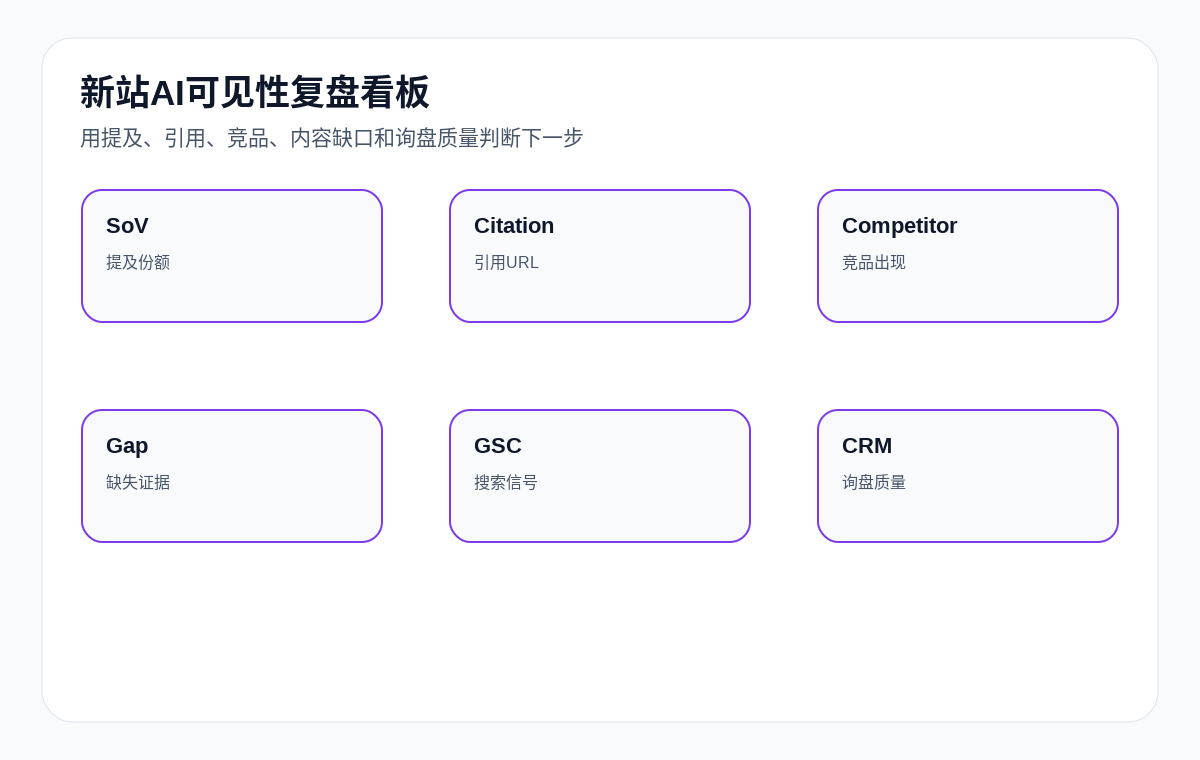
AI visibility review frequency table
| Cycle | What to look at | What to judge | How to record |
|---|---|---|---|
| Weekly | 10-20 fixed core AI queries | Whether the new site is understood correctly | Record answers, mentions, citations and competitors |
| Monthly | Expand to 50-100 queries | Check coverage of products, scenarios and comparison terms | Output a content gap checklist |
| Quarterly | Review together with GSC/GA4/inquiries | Judge whether content improvements affect lead generation | Update the query set and priorities |
| After a redesign | Focus on testing queries related to the changed pages | Confirm whether the AI narrative has improved | Avoid accidentally deleting citable information |
Judging AI monitoring together with business data
| Phenomenon | Possible cause | Priority action | Verification metric |
|---|---|---|---|
| AI does not mention, and GSC shows no impressions | Both the content foundation and authority are insufficient | Add core pages and internal links | Indexing, impressions and citation changes |
| AI does not mention, but GSC shows impressions | Search signals are building first | Optimise titles, FAQ and parameter tables | CTR and long-tail terms |
| AI cites the website, but there are no inquiries | The page is citable but conversion is weak | Add CTA, documentation and inquiry fields | GA4 paths and form submissions |
| AI mentions competitors but not the website | Competitor content or trust is more complete | Break down competitor page gaps and fill them | Fewer reasons for competitor mentions |
| AI describes the website incorrectly | Entity information is confusing | Unify the company, product lines and page descriptions | Whether incorrect narratives decrease |
Step 9: How an AI monitoring record table can be designed
In practice, you can record in a spreadsheet and do not need a complex system from the start. One query per row, with columns recording the platform, answer summary, brand mention, website citation, competitors, gaps and actions. What matters is keeping the same standard over time, rather than changing the question, region or judgment method each time.
Sample fields for an AI visibility record table
| Column name | Example value | Description |
|---|---|---|
| Query | best waterproof connector for packaging machine | Full English query |
| Intent | application selection | Intent type |
| Platform | ChatGPT Search | Platform |
| Brand mentioned | No | Whether the brand is mentioned |
| Official site cited | No | Whether the website is cited |
| Competitors cited | competitor A, competitor B | Competitors |
| Missing evidence | No application page for packaging machine connector | Content gap |
| Action | Create application section and FAQ on connector page | Page action |
| Review date | 2026-06-26 | Next review |
Step 10: Which pages are most worth strengthening first for AI visibility
A new site has limited resources and cannot work on all pages at once. The suggested priority is: core category pages, key product pages, application scenario pages, pillar guide pages, documentation pages and inquiry pages. AI answers usually need clear entities, citable facts and structured judgment, and these pages are the easiest to carry them.
AI visibility page priority
| Page type | Why it comes first | Content to add | Example |
|---|---|---|---|
| Core category page | Captures product family and supplier terms | Product range, selection table, FAQ | LED flood light supplier |
| Key product page | Captures model and specification terms | Parameters, images, Schema, FAQ | M12 waterproof connector |
| Application page | Captures scenario questions | Scenario pain points, recommended products, selection reasons | connector for packaging machine |
| Pillar guide | Captures question and comparison terms | Definitions, process, tables, FAQ | how to choose cnc machining parts supplier |
| Documentation page | Captures datasheet/catalog/manual | Documentation notes, applicable models, download entry | medical probe datasheet |
| Inquiry page | Captures quote/sample/RFQ | Materials checklist, field notes, next step | custom metal parts quote |
AI monitoring example one: what a new custom metal parts site should ask
If an export factory focuses on custom metal parts and cnc machining parts, do not ask only “best custom metal parts supplier”. A better approach is to break the buyer’s path from awareness to inquiry into several groups of questions: which materials are suitable, what drawing format is needed, how tolerances are confirmed, how surface treatment is chosen, what materials are needed for samples and volume quotes, and how to judge whether a supplier is reliable.
| Purchasing stage | AI query example | What we want AI to answer | What the website should prepare |
|---|---|---|---|
| Understand the product | what are custom metal parts used for | Explain uses, materials and industries | Definition paragraph, application pages, industry pages |
| Prepare a quote | what information is needed for cnc machining parts quote | Drawings, materials, tolerances, quantity, surface treatment | RFQ checklist, inquiry form fields |
| Choose a supplier | how to choose custom metal parts manufacturer | Equipment, quality control, tolerances, lead time, communication | Factory capability page, QC process, FAQ |
| Compare materials | aluminum vs stainless steel cnc parts | Cost, weight, corrosion resistance, machinability | Material comparison article and product page internal links |
| Reduce risk | common defects in cnc machining parts | Dimensional deviation, surface problems, wrong material | Quality control page, inspection notes |
When recording these queries, look not only at whether AI mentions the brand, but also at whether the answer lacks evidence that the website could supply. If AI repeatedly says “check tolerance capability and quality inspection” while the website has no tolerance range, inspection equipment or sample confirmation process, those modules should be added first.
AI monitoring example two: how to monitor scenario terms for LED flood light and waterproof connector
AI visibility for industrial and electronic products often starts not with brand terms but with application scenarios and specification comparisons. For example, a buyer may ask “what IP rating is needed for outdoor LED flood light” or “which connector is suitable for packaging machine”. These questions do not necessarily lead directly to a brand recommendation, but they reveal whether AI understands your product pages and application pages.
| Product | Scenario query | Key judgment dimensions | Direction for page improvement |
|---|---|---|---|
| LED flood light | IP65 vs IP67 LED flood light outdoor use | IP rating, installation environment, certification, heat dissipation | Add an IP comparison table and application images |
| LED flood light | LED flood light for warehouse high ceiling | Power, beam angle, installation height, luminous efficacy | Add a warehouse lighting application page |
| waterproof connector | connector for packaging machine washdown area | Waterproof rating, material, cable, locking method | Add a food packaging machine application scenario |
| waterproof connector | M8 vs M12 waterproof connector | Size, pins, current, space constraints | Add a specification comparison FAQ |
| industrial valve supplier | valve material for chemical processing | Medium, pressure, temperature, corrosiveness | Add a material selection guide |
When an AI answer says “choose based on IP rating, material and application environment”, your website should have the corresponding parameter table and application notes. Otherwise, even if AI does not cite you, it has already pointed out the page gaps.
AI monitoring example three: how to look at purchasing trust for consumer goods
For consumer goods supply chains such as ceramic dinnerware and private label activewear manufacturer, AI answers tend to focus more on MOQ, samples, packaging, materials, certification, brand customisation and supplier audits. When monitoring, add “purchasing risk” and “brand customisation” questions instead of asking only what the product is.
| Query direction | English example | Common focus of AI answers | What the website should add |
|---|---|---|---|
| MOQ | private label activewear manufacturer MOQ | MOQ is affected by fabric, size and craftsmanship | MOQ notes and sampling process |
| Materials | best fabric for private label activewear | polyester, nylon, spandex, gsm | Fabric table and application notes |
| Packaging | ceramic dinnerware export packaging requirements | Breakage risk, inner box, outer carton, drop test | Packaging images and test notes |
| Compliance | ceramic dinnerware food contact certification | Food contact, lead and cadmium, market regulations | Certification notes and documentation page |
| Supplier audit | how to verify activewear manufacturer | Factory capability, samples, quality, lead time | Factory capability page and FAQ |
From AI answers to content updates: an executable workflow
AI monitoring works best as a fixed process rather than changing a page the moment you see an answer. It is advisable to collect a batch of query results each week, cluster them first, then judge gaps, then assign page actions. This avoids adding one FAQ today and changing one title tomorrow, until the page structure becomes increasingly messy.
| Step | Action | Output | Notes |
|---|---|---|---|
| 1 | Collect AI answers for fixed queries | Raw record table | Keep the date, platform and original query text |
| 2 | Label mentions, citations, competitors and gaps | Labelled table | Do not look only at whether a brand name appears |
| 3 | Cluster by product line and intent | Gap themes | Handle similar questions together |
| 4 | Match to existing or new pages | Page action list | Prioritise updating existing relevant pages |
| 5 | Add definitions, tables, FAQs, documentation and internal links | Page update draft | Keep an export purchasing perspective |
| 6 | Retest the same query after 30 days | Change record | Do not draw conclusions from one fluctuation |
The core of this workflow is turning “what AI said” into “what the website lacks”. If the AI answer already answers the purchasing question completely but does not cite the website, you need to check whether the website lacks an equally clear definition, table or FAQ; if the AI answer itself is also vague, that shows a content opportunity where you can build a stronger pillar page.
How AI visibility monitoring avoids misjudgment
AI answers are heavily influenced by platform, model, region, login status, time and query wording. When export businesses monitor, they must avoid several misjudgments: drawing conclusions from one answer, equating not appearing with failure, equating a competitor appearing with the competitor definitely being stronger, treating tool scores as sales results, and treating AI answers as fixed search results.
| Misjudgment | Why it happens | How to reduce the risk | Review method |
|---|---|---|---|
| Judging it invalid because it did not appear once | Answer randomness and differences in data sources | Record multiple times on a fixed cycle | Look at the 4-week trend |
| Looking only at brand mentions | Ignoring citations and narrative accuracy | Record mentions, citations and descriptions in layers | Read the full answer |
| Ignoring region and language | Answers differ across markets | Fix the language and target market | Record the test environment |
| Not checking page indexing | Website content may not have been discovered | Check GSC and indexing status first | URL inspection and site search |
| Treating AI as the only channel | Ignoring Google and real inquiries | Combine GSC, GA4 and CRM | Monthly comprehensive review |
AI monitoring and team collaboration: what sales, operations and technical staff each look at
AI visibility does not belong only to SEO staff. The sales team knows the real customer questions, the operations team can organise content, the technical team can handle indexing, Schema and speed, and the owner cares about the market and inquiries. Putting these roles in the same table makes updates more efficient.
| Role | Input they own | Judgment they own | Output |
|---|---|---|---|
| Sales | Common customer questions, inquiry quality, documentation needs | Whether AI answers match real purchasing logic | FAQ and RFQ field suggestions |
| Operations | Page content, tables, case boundaries, internal links | Whether content resolves query set gaps | Page update drafts and record table |
| Technical | Indexing, Schema, speed, page accessibility | Whether there is a technical reason AI cannot cite you | Technical fix list |
| Management | Product line priorities and market direction | Which topics are worth investing in | Quarterly content priorities |
For a new site, there is no need for complex meetings every week. As long as you regularly look at 10 to 20 high-value queries, 3 to 5 competitors, core page gaps and inquiry feedback, you can gradually build a content asset.
What AI visibility has to do with E-E-A-T and brand entities
Both AI systems and search systems reference the consistency of public information. Export sites should keep the company name, brand name, product lines, address, contact details, certifications, industry description and documentation pages consistent. Do not say you are a manufacturer on one page, a supplier on another, and write only trading company on a third without explaining the role. For AI understanding, a confusing entity lowers credibility.
| Entity information | Where it should be unified | Common problem | Optimisation direction |
|---|---|---|---|
| Company name | Homepage, about page, footer, structured data | Multiple versions of the English name | Decide on a single English legal entity name |
| Product lines | Category pages, navigation, about page | Product scope keeps expanding and shrinking | Use a category matrix to explain capability |
| Market positioning | Homepage, served markets, FAQ | Says B2B but looks like retail | Explain the boundaries of OEM/ODM/wholesale |
| Certification materials | Product pages, documentation pages, about page | Only a logo with no explanation | Explain applicable products and markets |
| Contact details | Contact page, footer, inquiry page | Information is inconsistent | Keep it consistent and clickable |
When AI monitoring is not yet worth a large investment
Not every stage is suitable for heavy investment in AI monitoring. If the site’s core pages are not indexed yet, product pages have no parameter tables, category pages are just product lists, the inquiry form does not work, and the English content quality is very weak, then spending a lot of time on AI monitoring first has limited meaning. At that point, fix the SEO and content foundation first, then do lightweight baseline recording.
| Current situation | Recommendation | Reason | Next step |
|---|---|---|---|
| Core pages not indexed | Do indexing and sitemap checks first | AI also struggles to cite undiscovered content | Fix crawling and indexing |
| Product pages extremely thin | Add parameters, images and FAQ first | There are no citable facts | Upgrade product page content |
| Confusing English product terms | Unify terminology first | AI struggles to understand the entity | Build a product term list |
| No inquiry tracking | Set up forms and source records first | Commercial value cannot be judged | Add GA4 and CRM fields |
| Content foundation already exists | Start systematic monitoring | Finer gaps can be found | Build a query set and monthly review |
Lightweight tool stack: get started without buying tools
In the early days, a new export site can use a very light tool stack to build habits: a Google Sheet or Excel to record the query set, an incognito browser window to test AI answers consistently, a GSC account to view pages and queries, a GA4 event to view the inquiry path, and a CRM or form export table to record inquiry quality. Once the number of queries, competitors and reporting needs clearly increases, consider professional AI visibility tools.
| Tool or data source | Purpose | Minimum setup | Upgrade condition |
|---|---|---|---|
| Spreadsheet | Record queries, answers, citations, competitors and gaps | Fixed fields and dates | More than 100 queries and multiple collaborators |
| GSC | See real search queries and page impressions | Export by page and query | Connect the API when automated reports are needed |
| GA4 | See visit paths and inquiry events | Set up form submission and key button events | Expand when finer channel attribution is needed |
| Form/CRM | Record inquiry product, quantity, market and documentation completeness | Add product and requirement fields | Do source attribution once inquiry volume grows |
| AI tool spot checks | See answers and citations | Fixed platforms and queries | Buy tools when scale is needed |
Form fields should also serve AI and SEO reviews. For example, the inquiry page can collect fields such as product type, target market, quantity, drawing available, certification request and sample needed. Then, when a particular AI query or GSC long-tail term grows, the sales team can judge whether it brings clearer purchasing needs rather than looking only at traffic.
Common pitfalls: what AI visibility monitoring most easily gets wrong
AI visibility monitoring pitfalls
| Pitfall | Why it is wrong | Correct approach |
|---|---|---|
| Asking only the brand name | A new site has weak brand awareness, so the result has no reference value | Build a query set around products, applications, comparisons and quote questions |
| Looking at one answer only | AI answers fluctuate a lot | Record trends on a fixed cycle with fixed fields |
| Treating an AI recommendation as a promise | AI answers are uncontrollable | Use it only as a directional signal; do not promise fixed appearances |
| Chasing only tool scores | Scores cannot explain purchasing scenarios | Read answers manually and map them to page gaps |
| Not looking at GSC and inquiries | Commercial value cannot be judged | Review together with search, paths and inquiry quality |
| Using SEO industry terms as examples | It drifts away from export customer scenarios | Use English product terms and purchasing questions |
Official monitoring definitions: what AI visibility, GSC, GA4, crawlers and citations can each show
AI Visibility Monitoring is easily written in a vague way. What can truly be delivered is not a screenshot of “did AI recommend me today”, but a monitoring table with sources, fields and boundaries. Official materials from Google, OpenAI, Bing, IndexNow and GA4 each explain different things: GSC explains Google Search performance, URL Inspection explains single-page indexing and crawling, OpenAI bots explain the purpose of different crawlers, Bing AI Performance explains citations and grounding queries, and GA4 explains on-site events. They can sit in the same review, but they cannot replace each other.
Correspondence table between official sources and monitoring fields
| Official source | What it can monitor | Which fields should be written in the report | What it cannot be written as |
|---|---|---|---|
| Google Search Central: AI features and your website | The relationship between AI Overviews / AI Mode and basic SEO, indexing, snippets and Search Console data | Whether the page is indexable, whether the body text is readable, whether internal links are clear, whether it can be observed in the GSC Web search type | It cannot be written that a special AI tag or a new file is enough to enter AI features |
| Google Search Essentials | The technical, policy and content baseline requirements for a page to participate in Google Search | HTTP status, index/follow, visible body text, accessible important resources, page does not violate policy | Meeting the baseline does not mean it will definitely be crawled, indexed or displayed |
| Google SEO Starter Guide | Basic practices for titles, page organisation, links, images and understandable content | Title, H1, H2/H3, image alt, body internal links, sitemap and page role | Finishing basic SEO does not mean an AI answer will use that page |
| Google helpful content documentation | Whether content genuinely helps users complete a task | Product definition, parameter table, application boundaries, FAQ, documentation notes, pre-quote information | Word count or the number of FAQs alone cannot represent content quality |
| Search Console URL Inspection | Indexing, crawling, canonical, robots and sitemap status of a single URL | verdict, coverageState, lastCrawlTime, Google-selected canonical, sitemap | When lastCrawlTime is earlier than the modification time, you cannot say the new version has been re-evaluated |
| Search Console Performance report | Google Search clicks, impressions, CTR and average position, plus query/page/country/device/date dimensions | Date range, search type, query, page, click, impression, CTR, average position | Data that GSC did not return cannot be filled in as a trend or ranking conclusion |
| Google Analytics 4 events | On-site events, forms, downloads, outbound link clicks, inquiry buttons and key events | event name, event parameter, key event, landing page, source, subsequent path | GA4 events cannot replace GSC or AI citation evidence |
| OpenAI Platform: Bots | The purpose boundaries of OAI-SearchBot, GPTBot and ChatGPT-User | Whether robots.txt allows OAI-SearchBot, and whether it distinguishes GPTBot training crawling from ChatGPT-User user-triggered visits | Allowing GPTBot cannot be written as ChatGPT Search definitely citing the website |
| Bing Webmaster Blog: AI Performance | Total citations, average cited pages, grounding queries and page-level citation activity in AI answers | cited URL, citation count, grounding query phrase, time range, page-level citation | citation count is not ranking, authority, a fixed answer position or an inquiry result |
| IndexNow: Documentation | Change notifications after URLs are added, updated or deleted | Submitted URL, submission time, HTTP response, follow-up sitemap / GSC / Bing data review | HTTP 200 only means the notification was received, not that it was indexed or cited by AI |
| Google robots.txt introduction | Whether crawlers can access important pages and resources | Allow/block boundaries for user-agents such as Googlebot, OAI-SearchBot and GPTBot | robots can only manage access boundaries, not replace page quality and evidence building |
AI visibility monitoring acceptance checklist
| Acceptance item | Acceptable wording | Unacceptable wording | How an export business reviews it |
|---|---|---|---|
| Query set | Grouped by brand terms, product terms, application terms, certificate terms, quote terms, competitor terms and documentation terms | Writing only “ask AI once a week” | Spot-check whether it includes specific purchasing questions such as custom metal parts, LED flood light and waterproof connector |
| GSC status | State the date range, dimensions and row count clearly; if there is no data, write that no usable Search Console signals are available | Writing impressions, CTR or ranking changes without GSC row counts | Recheck by exporting from the Search Console API or interface |
| AI answer sampling | Record platform, date, query, answer summary, brand mentions, website URLs, competitors and error points | Posting only screenshots without fields | Repeat the test weekly on the same query set and compare changes |
| Crawler boundaries | Distinguish OAI-SearchBot, GPTBot, ChatGPT-User, Googlebot and Bingbot | Writing all AI visits as one kind of “AI crawl” | Check robots.txt, server logs and official user-agent documentation |
| Citation interpretation | Treat citations only as a citation observation signal, read together with page changes, GSC and inquiries | Writing citation count as ranking, authority or a fixed result | Check Bing AI Performance or manual records for whether URL, query and time range are present |
| Business review | List AI sampling, GSC, GA4 events, inquiry fields and sales feedback in separate columns | Using AI answer screenshots to replace inquiry quality judgment | Spot-check RFQ fields, country, product, quantity and follow-up sales feedback |
How to write monitoring conclusions when there are no GSC signals
| Current evidence | Conclusion you can write | Conclusion you cannot write | Next action |
|---|---|---|---|
| GSC query/page row count is 0 | There is currently not enough Search Console data to judge CTR, average position or page performance | That a term has already risen, that CTR is low, or that a certain page performs best | Check index eligibility, sitemap, internal links, titles and core page quality first |
| AI answer sampling does not mention the website | Under this query the website has not been observed yet, which may relate to page evidence, indexing, entity or external sources | That the content is definitely useless, or that competitors are definitely stronger | Record the query, platform, date and competitor sources, then map page gaps |
| The AI answer cites third-party platforms | Third-party materials may be easier to cite than the website | That third-party platforms definitely take away all traffic | Add website definitions, parameter tables, documentation pages, certificates and FAQ |
| GA4 shows form events | On-site actions can serve as observation signals for the inquiry path | That these events all come from AI or organic search | Combine source, landing page, inquiry fields and sales feedback to judge quality |
| URL Inspection shows an old crawl time | Record the current indexing status and the old lastCrawlTime | That the new version of the content has already been re-evaluated by Google | Submit the sitemap and wait for re-crawling before judging performance |
These definitions make monitoring reports more honest: if there is GSC data, speak according to GSC; if not, write that there is no data; if there is an AI citation, record the URL, query and time range; if not, write that it was not observed; if there are inquiries, look at the fields and sales feedback; if not, check the page paths first. The goal of AI Visibility Monitoring is not to assemble good-looking results, but to know which page to change next and what kind of evidence to add.
FAQ: common questions about AI visibility monitoring for a new export site
Should a new site do AI visibility monitoring right now?
Lightweight monitoring is possible, but do not expect to be cited frequently right away. A new site is better off building a query set and baseline first, using AI answers to find content gaps, and then strengthening category pages, product pages, application pages and FAQs.
Which matters more, AI visibility or Google rankings?
Both matter, but they do different things. Google rankings and GSC reflect traditional search performance, while AI visibility helps you observe whether answer systems understand and cite the website. Export sites should look at both together, not choose one over the other.
Is manual monitoring enough?
It can be enough early on. With 20-50 fixed core queries recorded once a week, you can already find many content gaps. When the query scale grows and you need competitor comparison and trend reports, consider tools.
If AI does not cite the website, does that mean the content is useless?
Not necessarily. It may be that the site is new, authority is insufficient, pages are not indexed, content is not citable, the query set is unreasonable, or the platform simply does not cite. Judge together with GSC, indexing, page quality and competitors.
Can you guarantee getting into AI answers?
No. AI answers are affected by platform, time, data sources, query wording and the user environment. What you can do is make pages more understandable, citable and credible, and keep reviewing.
Which content should be changed first based on AI monitoring results?
Prioritise core category pages, key product pages, application pages, documentation pages and FAQs, because these pages best answer buyer questions and are more likely to convert into an inquiry path.
How should export product terms be chosen for the query set?
Choose terms from dimensions such as product family, model, application, comparison, certification, quote, sample and supplier selection, for example custom metal parts quote, LED flood light IP65 vs IP67, and medical probe datasheet.
Conclusion: AI visibility monitoring is part of export SEO review, not a replacement
The value of AI Visibility Monitoring is that it helps a new export site discover earlier whether “AI and buyers understand us”. It cannot replace Google indexing, GSC data, page quality and inquiry review, and it cannot promise fixed recommendations. But it can show you content gaps: missing definitions, missing parameters, missing FAQs, missing applications, missing documentation, missing trust signals, or missing pages built around English purchasing questions.
When your pages for industrial components and custom manufacturing categories and private label activewear manufacturer can be correctly understood by AI, discovered by search, understood by buyers, and can lead to clearer inquiries, only then does AI visibility monitoring truly serve export lead generation.
Continue reading this GEO collection
If you are systematically learning about GEO and AI search visibility, it is worth continuing with the articles below. Understand the concepts first, then look at diagnosis, monitoring, content structure and the boundaries of cooperation.
- What to confirm before a GEO service contract: AI monitoring, data ownership and review boundaries
- What is AI SEO: how it actually differs from traditional SEO, GEO and AEO
- What a GEO visibility diagnosis includes: AI answers, entity consistency, cited sources and review
- How to read a GEO diagnosis report: a guide to judging AI answers, cited sources and entity consistency
- How to monitor AI search visibility: a checklist of brand mentions, website citations and competitor answers for export websites
- How to choose GEO monitoring tools: where to look at mentions, citations and traffic
Further Reading on This B2B SEO & GEO Topic
- How to Choose Content Update Tools: How to Assess Decay, Rewrite, Merge, and Conduct Reviews
- What Is Internal Linking? A Guide to Optimizing Related Topics, Anchor Text, and Inquiry Paths for B2B Export Websites
- What is an SEO Audit: How to Review a B2B Export Website from Technical, Content, and Link Aspects to Inquiries
- How to Do E-commerce SEO: Division of Labor for Category Pages, Product Pages, Filter Pages, and Content Pages on B2B Export Websites
- B2B Export Website Architecture Cost, Google Ads Synergy, and Inquiry CRO Hub
- Generative Engine Optimization Research
- B2B Export SEO & GEO Research Index