Before signing a GEO service contract, foreign trade companies need to confirm four things first: the AI monitoring methodology, data ownership, the scope of on-page execution, and the boundaries of review. A contract is not better for sounding impressive; it is better for being verifiable. If it clearly states the query set, platforms, frequency, URLs, account permissions, deliverables, review dates, and the boundaries of uncontrollable outcomes, later collaboration will involve far fewer disputes.
This checklist is written for Chinese foreign trade factories and trading companies. Whether a company sells custom metal parts, LED flood light, packaging machine, medical probe, waterproof connector, industrial valve supplier, or private label activewear manufacturer, a GEO contract should never simply say “do AI search optimization.” It needs to state who provides product materials, who confirms page facts, who maintains the monitoring sheet, who owns GSC, GA4, and the AI answer samples, which results can only be observed, and which actions can be accepted as deliverables.
Official documentation boundaries: a GEO service contract should first state verifiable fields, not uncontrollable outcomes
The most dangerous thing in a GEO contract is not writing too few technical terms, but writing uncontrollable outcomes as if they were certain. Official documentation from Google, OpenAI, Bing, IndexNow, and GA4 can help companies confirm many verifiable fields: whether a page is crawlable, whether it is indexable, whether the sitemap includes key URLs, whether GSC has real query rows, whether GA4 records on-site events, whether AI crawler access boundaries are clear, and whether Bing AI Performance has citation samples.
These materials can constrain the scope of collaboration, but they cannot turn search systems and AI platforms into staff who execute the contract. A contract should commit to controllable work: diagnosis, page rewrites, structured data verification, query sets, monitoring sheets, review cadence, account handover, and risk disclosure. When external platforms crawl, when they display, and whether they cite the official website can only be observed based on real data.
Mapping table between official documentation and GEO contract clauses
| Official source | Which contract clause it corresponds to | What can be accepted | What it must not be written as |
|---|---|---|---|
| Google Search Central: SEO Starter Guide | Basic page optimization | Whether titles, body copy, image descriptions, internal links, and page content serve real users. | Must not be written as a specified ranking or specified click result. |
| Google Search Central: Search Essentials | Basic search eligibility | Whether a page meets crawlability, indexability, and basic quality requirements. | Must not write basic compliance as search performance. |
| Google Search Central: AI features and your website | Basic boundaries of AI search | AI features still depend on pages being accessible, indexable, clearly written, and consistent with structured data. | Must not promise that AI answers will definitely use the official website. |
| Google Search Central: robots.txt introduction | Crawl access check | Whether robots mistakenly blocks search crawlers, AI-related access, images, PDFs, and script resources. | Must not write that allowing robots means the page is already indexed. |
| Google Search Central: Sitemaps overview | URL discovery chain | Whether key articles, category pages, product pages, and resource pages are included in the sitemap. | A sitemap containing a URL does not mean the page has been adopted. |
| Google Search Central: Structured data general guidelines | Structured data acceptance | Whether Schema fields come from visible page content and whether Product, Article, FAQ, and Breadcrumb are consistent. | Must not write Schema as a display switch. |
| Search Console Help: Performance report | GSC review methodology | query, page, clicks, impressions, CTR, average position, country, device. | When there is no row data, must not fill in rankings, CTR, or click changes. |
| Search Console Help: URL Inspection tool | Single URL check | The indexing, crawling, canonical, and the version Google sees for key pages. | Cannot on its own prove that a page will receive impressions. |
| Search Console Help: Users and permissions | Account permissions and data ownership | Who owns site permissions, who can view, export, and hand over Search Console data. | Key accounts must not be controlled solely by the service provider. |
| Google Analytics Help: About events | GA4 events | On-site behaviors such as forms, email, WhatsApp, downloads, RFQ, and button clicks. | Must not write on-site events directly as search or AI results. |
| Google Analytics Help: Access and data restrictions | GA4 permissions and data access | Accounts, properties, data access, and permission boundaries. | Must not leave the company without access to its own data. |
| OpenAI Platform: Bots | AI crawler access boundaries | The purposes of OAI-SearchBot, GPTBot, and ChatGPT-User must be checked separately. | Must not write that allowing a bot equals AI search results. |
| Bing Webmaster Blog: AI Performance | Bing AI observation methodology | If visible in the account, citations, cited pages, and grounding query phrases can be recorded. | A citation is not a ranking, a fixed answer position, or a business result. |
| IndexNow: Documentation | URL update notification | After adding, updating, or deleting URLs, record the submission time, URL list, and returned status. | HTTP 200 only means the notification was received; it does not mean indexing is complete. |
Confirm before signing: a GEO service contract should cover at least these nine categories of fields
| Contract field | Must be stated clearly | What happens if it is unclear | Foreign trade site example |
|---|---|---|---|
| Target scope | Whether it is AI answer sampling, official website citation observation, brand entity consistency, product page readability, or GSC/GA4 review. | Everyone assumes they understand GEO, but acceptance does not match up. | An industrial valve supplier needs to look at product families, application terms, and the RFQ path, not just brand terms. |
| Query set | Question types, languages, platforms, product terms, application terms, supplier terms, competitor terms, and dates. | Monitoring results cannot be reproduced. | waterproof connector needs to be split into questions such as IP68, M12, and outdoor cable connector. |
| Page mapping | Each query corresponds to the homepage, category page, product page, application page, resource page, FAQ, or inquiry page. | Every question turns into writing an article, and no one is responsible for the commercial pages. | LED flood light should connect to category pages, installation guides, certification pages, and product detail pages. |
| Technical checks | robots, sitemap, index/follow, canonical, status codes, mobile tables, structured data. | No matter how well a page is written, it may be blocked by technical issues. | The specification pages and PDF resources for medical probe must be normally accessible. |
| Content execution | Who provides product facts, who confirms technical specifications, who edits pages, who reviews English wording. | The service provider writes product facts wrong, and sales does not accept them. | The materials, tolerances, and surface treatment of custom metal parts cannot rely on guesswork. |
| Data permissions | Ownership of GSC, GA4, Bing Webmaster, AI sample sheets, log samples, and export files. | After the collaboration ends, the company cannot obtain historical data. | The query set and citation records for packaging machine should be kept by the company. |
| Review frequency | Weekly reports, monthly reports, the scope of 30-60-90 day reviews, meeting cadence, and delivery format. | Only scattered screenshots, with no continuous judgment. | A private label activewear manufacturer needs to keep watching product terms, OEM terms, and application terms. |
| Boundary statement | Which actions are controllable, which results can only be observed, and which require waiting for real data. | It is easy to mistakenly write platform behavior as a service commitment. | AI citation, GSC impressions, and inquiry changes must all be reviewed against actual data. |
| Exit handover | How accounts, sheets, page lists, monitoring records, change logs, and next-step recommendations are handed over. | Starting from zero when changing partners. | At minimum, keep the query set, URL list, page actions, and review sheets. |
How to write AI monitoring clauses: separate platforms, question sets, dates, samples, and competitor sources
An AI monitoring clause cannot just say “monitor ChatGPT, Perplexity, Google AI.” That sentence is too vague. The contract should state clearly how the question set is generated, on which day each test is run, in which language, which fields are recorded, how screenshots and sheets are stored, whether competitor sources are recorded, and whether brand mentions and official website citations are distinguished.
| Monitoring field | Suggested wording | Acceptance method | Risk signal |
|---|---|---|---|
| Platforms | List ChatGPT search, Google AI features, Bing AI Performance, or other agreed platforms. | A separate column for each platform, not mixed together. | Only writing “monitor all platforms.” |
| Question set | Group by brand terms, product terms, application terms, supplier terms, resource terms, and competitor terms. | Each question has a number, language, intent, and corresponding URL. | Relying only on screenshots of ad-hoc questions. |
| Recorded fields | Date, platform, question, answer summary, whether the official website appeared, cited URL, competitor sources, factual errors. | Sheets are verifiable, and screenshots can be mapped to rows. | Only one screenshot, with no time or question. |
| Sample frequency | Fixed retesting weekly or monthly, with frequency adjustable at different stages. | Continuous observation of the same query set. | Changing questions ad hoc each time, making comparison impossible. |
| Conclusion methodology | Distinguish brand mentions, official website citations, third-party citations, factual errors, and non-appearance. | The report does not merge these into a single metric. | Writing “mentioned the brand” as “cited the official website.” |
How to write data ownership: accounts, query sets, screenshots, sheets, and change logs must all be archived
The place where GEO projects most easily leave disputes is data ownership. The service provider may have tools, the company may have official website accounts, sales may have inquiry information, and technical staff may have logs. The contract must state clearly who keeps these materials, who can access them, and how they are handed over after the collaboration ends.
| Material type | Suggested ownership | Handover format | Why it matters |
|---|---|---|---|
| GSC account | The company holds primary permission, and the service provider gets access as needed. | Account permission list, authorization time, revocation method. | Search performance data is a long-term asset of the company. |
| GA4 account | The company owns the property, and the service provider assists with event configuration. | Event naming, conversion marking, permission list. | Later it will be necessary to look at inquiry actions and paths. |
| Query set | Jointly confirmed by the company and the service provider, ultimately kept by the company. | CSV, sheet, or document including number, language, intent, and URL. | It is the foundation for subsequent AI monitoring and page mapping. |
| AI samples | The company should be able to obtain the complete sheet and screenshots. | Date, platform, question, answer summary, source, screenshot files. | Avoids leaving only unverifiable verbal conclusions. |
| Page change log | The company should be able to see the URL, field, change time, and reason for the change. | URL list, version notes, before-and-after summaries. | Makes it easier to judge subsequent changes in GSC or AI samples. |
| Inquiry feedback | Kept internally by the company; the service provider uses only necessary fields. | Product, country, question type, source judgment, sales notes. | Protects customer information while supporting reviews. |
Page execution boundaries: do not merge diagnosis, rewriting, technical fixes, and review into one sentence
If a contract only says “do GEO optimization,” acceptance later becomes very difficult. GEO services usually fall into at least four categories of action: diagnosis, page execution, technical fixes, and data review. Each category must clearly state its deliverables and what it does not include.
| Work type | Can be written into the contract | Should not be glossed over | Acceptance evidence |
|---|---|---|---|
| Diagnosis | Query set, page mapping, technical checks, official documentation boundaries, competitor source observation. | Only writing “produce a report.” | Report, URL table, screenshots, field list. |
| Page execution | Category pages, product pages, resource pages, FAQ, Article, Schema, internal links. | Only writing “optimize content.” | Before-and-after body copy, page URLs, field sources. |
| Technical fixes | robots, sitemap, index/follow, canonical, mobile tables, structured data. | Only writing “handle technical issues.” | Status codes, source code, official tests, front-end rechecks. |
| Monitoring and review | GSC, GA4, AI samples, Bing citation, inquiry feedback, 30-60-90 day cadence. | Only writing “continuous tracking.” | Fixed-format sheets and time ranges. |
| Account handover | Permissions, data exports, documents, sheets, screenshots, operation logs. | Only writing “materials belong to the client.” | Handover checklist and access verification. |
When there is no GSC data, contract conclusions must be downgraded
If Search Console has no query, page, or page-query rows in the last 28 or 90 days, both the contract and the report must state clearly: there is currently no data available for judging search performance. At this stage, technical baselines, page baselines, query sets, monitoring sheets, and event configuration can be done; existing ranking changes, CTR changes, click changes, or inquiry changes must not be written.
| Current evidence | What the contract can state | What the contract should not state | Next step |
|---|---|---|---|
| No GSC row data | Establish the query set, page mapping, and GSC/GA4 review framework. | Search performance has already improved. | Recheck query, page, and page-query after 7-14 days. |
| Pages have been supplemented with content | Fact reinforcement and structural cleanup for specified URLs have been completed. | External platforms have already adopted the page. | Look at indexing, logs, GSC, and AI samples. |
| AI samples have been established | A repeatable observation baseline now exists. | Samples represent long-term results. | Keep retesting the same query set. |
| GA4 events have been configured | Form, email, download, and RFQ actions can be observed going forward. | Event changes directly equal GEO results. | Combine pages, sources, inquiry quality, and sales feedback. |
| IndexNow has been submitted | The URL update notification has been sent. | The page has already been indexed by the search system. | Continue watching logs, GSC, Bing, and the sitemap. |
Red flag checklist for foreign trade companies before signing a contract
| Red flag | On-the-spot follow-up question | Acceptable answer | Handling suggestion |
|---|---|---|---|
| Talks only about platforms, not pages | Which URLs will be diagnosed and rewritten? | Can list the homepage, category pages, product pages, resource pages, and FAQ. | Without a URL list, do not sign off on the execution scope. |
| Gives only screenshots, not sheets | How are the fields of each AI monitoring run stored? | Can provide platform, date, question, answer, cited sources, and screenshot numbers. | Require sheets and screenshots to be delivered together. |
| Does not discuss account permissions | Who holds permissions for GSC, GA4, and Bing Webmaster? | The company retains primary permission, and the service provider collaborates as needed. | Establish account boundaries before starting work. |
| Does not distinguish diagnosis from execution | Does the report include page changes afterward? | Can explain that diagnosis, rewriting, technical fixes, and review are priced and accepted separately. | Break the delivery stages apart in writing. |
| Does not let the company see raw data | Can the query set and sample sheets be handed over? | The company can obtain complete records. | Be cautious about collaborating when data is not transparent. |
| Ignores product fact confirmation | Who reviews specifications, certifications, MOQ, lead times, and applications? | The company’s business or sales team confirms before publishing. | Avoid the service provider writing product content based on imagination. |
How to write the 30-60-90 day review cadence into the contract
Without a review cadence, a GEO service easily becomes one-off content production. The contract should state clearly: on day 30, review technical and page actions; on day 60, see whether GSC/GA4 has formed a data baseline; on day 90, see whether AI samples, citations, inquiry paths, and sales feedback can be connected.
| Period | Review focus | Recorded fields | What it is suitable for judging |
|---|---|---|---|
| 0-30 days | robots, sitemap, index/follow, canonical, page facts, Schema, mobile tables. | URL, action, launch date, recheck result, owner. | Whether controllable actions have landed. |
| 31-60 days | Whether query/page rows appear in GSC, and whether GA4 events can be recorded. | query, page, country, device, events, downloads, forms, email clicks. | Whether an observable baseline has formed. |
| 61-90 days | AI answer samples, Bing citation, inquiry products, sales feedback, and their relationship to page actions. | Platform, question, cited URL, competitor sources, inquiry fields, sales notes. | Which pages and product lines to prioritize in the next round. |
Contract scope example: how a B2B foreign trade site can break it down
| Page type | What to write in the contract | Acceptance materials | Review data |
|---|---|---|---|
| Homepage | Brand entity, main products, target markets, core category entry points. | Page screenshots, source code, internal links, structured data. | Brand terms, official website citations, entry clicks. |
| Category page | Product family description, applications, specification ranges, certifications, FAQ, and representative products. | Category page body copy, tables, internal links, sitemap. | Product family query, AI samples, product clicks. |
| Product page | Model, specifications, materials, MOQ, lead time, packaging, RFQ. | Specification table, image descriptions, FAQ, inquiry entry point. | Product query, view_item, RFQ, sales feedback. |
| Resource page | HTML summaries of certifications, selection, installation, maintenance, and downloadable materials. | Body copy, download links, charts, FAQ. | Resource downloads, citation samples, inquiry questions. |
| Blog page | Explains purchasing questions and links to category pages, product pages, and resource pages. | Title, body copy, internal links, Schema, FAQ. | Long-tail query, on-site paths, AI answer samples. |
How to write role responsibilities: what the company, service provider, technical staff, and sales each own
Without a division of responsibilities, a GEO contract easily leads to both sides waiting on each other. The service provider can handle diagnosis, page structure, official documentation boundaries, and review sheets; the company must provide real product materials, sales feedback, account authorization, and final fact confirmation; technical staff must cooperate on crawling, caching, logs, and permissions; sales must feed back inquiry quality and real customer questions.
| Role | Main responsibility | What must be delivered | Common breakdown point |
|---|---|---|---|
| Company lead | Confirm goals, budget, product line priorities, and account ownership. | Product line list, key markets, authorization boundaries, acceptance owner. | Demands results without confirming resources. |
| Service provider | Build the query set, page mapping, diagnostic checklist, page rewrite recommendations, and review sheets. | Reports, sheets, URL lists, change logs, review conclusions. | Gives only concepts, not fields. |
| Technical staff | Handle robots, sitemap, caching, status codes, Schema conflicts, and log samples. | Technical recheck results, source code screenshots, status codes, log summaries. | Only says the system is fine, without evidence. |
| Sales team | Feed back customer questions, inquiry quality, product material gaps, and deal-blocking points. | Inquiry type, product, country, question, feedback on material usage. | SEO review and sales feedback are kept separate. |
| Content confirmer | Verify English product facts, certifications, MOQ, lead times, packaging, and application wording. | Confirmation records, revision comments, final published version. | Specification errors are discovered only after the page is published. |
Cost and scope boundaries: do not write diagnosis, execution, monitoring, and review as a single word
Many GEO contract disputes come from not breaking down “what the service includes.” Diagnosis is one type of work, page execution is another, technical fixes are another, and monitoring and review are yet another. Pricing can be bundled, but the acceptance fields in the contract cannot be bundled into one sentence.
| Scope item | Why it suits separate pricing | What must be stated clearly in the contract | Wording not recommended |
|---|---|---|---|
| Baseline diagnosis | Requires checking accounts, URLs, query sets, competitors, and technical status. | Sample count, number of URLs, report fields, review cycle. | Simply writing “includes diagnosis.” |
| Page rewriting | Requires product materials, English wording, internal links, Schema, and review. | Number of pages, page types, depth of changes, who confirms facts. | Simply writing “includes content optimization.” |
| Technical fixes | May involve themes, plugins, caching, servers, and permissions. | Which parts the service provider does and which the company’s technical team or host handles. | Simply writing “everything technical included.” |
| AI monitoring | Requires a fixed question set, platforms, frequency, and record sheets. | Platforms, number of questions, frequency, fields, screenshot storage method. | Simply writing “monitor AI.” |
| Monthly review | Requires looking at GSC, GA4, AI samples, and sales feedback together. | Report date, attendees, data scope, next-step list. | Simply writing “monthly reporting.” |
How contract clauses can be put into practice: from one sentence to verifiable fields
A contract does not need to be stuffed with jargon. The truly useful way to write it is to turn each abstract word into a field, date, URL, account, and deliverable. The table below can serve as a pre-signing checklist.
| Vague wording | More verifiable wording | Acceptance evidence |
|---|---|---|
| Provide GEO optimization services | Complete an AI answer baseline for 30 queries, mapping for 20 core URLs, and 10 page action recommendations. | Query set, URL table, page recommendation table. |
| Monitor AI visibility | Each month, use a fixed question set to record platform, date, answer summary, official website citations, competitor sources, and factual errors. | Monitoring sheet, screenshot numbers, monthly summary. |
| Optimize official website content | By product line, supplement visible facts on category pages, product pages, resource pages, and FAQ. | Before-and-after summaries, URLs, review records. |
| Provide data reports | Review separately across four tables: GSC, GA4, AI samples, and inquiry feedback. | Reports, exported data, meeting minutes. |
| Continuously improve results | Every 30 days, provide completed actions, real data changes, parts that still cannot be judged, and a next-step list. | Review sheets, action lists, risk statements. |
Contract priorities differ across foreign trade product lines
A GEO contract cannot use the same wording for every industry. Different product lines have different page facts, resource evidence, and inquiry paths, and their monitoring question sets also differ. The contract should at least reflect product line differences.
| Product line | What to focus on in the contract | Direction of AI sample questions | Review signals |
|---|---|---|---|
| custom metal parts | Materials, processes, tolerances, surface treatment, drawing upload, MOQ. | which supplier can make custom aluminum parts for… | Drawing inquiries, material questions, product page visits. |
| LED flood light | Wattage, IP rating, certifications, installation methods, application scenarios. | best LED flood light supplier for outdoor sports field. | Category page query, certification downloads, RFQ. |
| packaging machine | Material type, capacity, degree of automation, after-sales, and spare parts. | packaging machine for powder pouch export supplier. | Application page visits, resource downloads, sales questions. |
| medical probe | Specifications, compatible models, compliance materials, usage scenarios, and sample process. | medical probe replacement supplier with datasheet. | Resource page citations, sample inquiries, technical questions. |
| waterproof connector | IP rating, interface, cable, temperature range, application environment. | M12 waterproof connector manufacturer for outdoor cable. | Product page query, specification downloads, model inquiries. |
The monthly report template must be written into the contract in advance: not a generic report delivered each month
The monthly report in a GEO contract should not just be “several optimizations completed this month.” It must connect this month’s actions, official data, AI samples, page changes, inquiry feedback, and next month’s actions. That way the company can judge whether the service provider is continuously advancing controllable work or merely repeating concepts.
| Monthly report module | Must include | Acceptance question | Substandard sign |
|---|---|---|---|
| This month’s actions | URL, action type, launch date, reason for change, reviewer. | Which pages actually changed? | Only writing “continuous optimization.” |
| GSC data | Date range, query, page, click, impression, CTR, average position. | Is there real row data? If not, is it clearly stated? | Writing trends when there is no data. |
| GA4 events | Forms, email, WhatsApp, downloads, RFQ, product clicks. | Can on-site behavior be tracked? | Looking only at traffic volume. |
| AI samples | Platform, question, answer summary, official website citations, competitor sources, factual errors. | Can the samples be retested? | Only pasting screenshots. |
| Sales feedback | Inquiry product, country, question type, material gaps, quality judgment. | Do SEO/GEO actions serve purchasing communication? | Completely ignoring sales feedback. |
| Next month’s list | Priority URLs, actions, owners, expected recheck dates. | Is the next step clear? | Only writing “continue observing.” |
What to do when acceptance fails: the contract needs a review and correction mechanism
The contract must also state clearly what happens when acceptance fails. Not every problem equals service failure. Some are because materials were not provided, some because account permissions were not granted, some because external platforms have no data yet, and some because page changes did not pass review. Breaking these situations apart in advance prevents finger-pointing later.
| Failure scenario | Possible cause | Response | Who is responsible |
|---|---|---|---|
| Query set cannot be confirmed | Product lines, target markets, or purchasing questions are not clear. | The company supplements product materials, and the service provider offers query classification suggestions. | Jointly owned by the company and the service provider. |
| Page cannot be published | Product facts not reviewed, English wording not confirmed, technical permissions insufficient. | Add a review process and permission list. | The company confirms, and the service provider executes. |
| GSC has no data | The site is new, the discovery chain is weak, or the search system has not yet formed row data. | Record it as a no-data stage and look at technical and page baselines first. | Both parties review according to data reality. |
| AI samples are unstable | Platform answers fluctuate, query wording changes, competitor sources change. | Use a fixed question set and record continuously over time. | The service provider records, and the company confirms the methodology. |
| Inquiry quality cannot be judged | Sales has not filled in product, country, question, and source. | Establish a minimum set of sales feedback fields. | The company’s sales team is responsible. |
Final pre-signing check: turn the contract into a checkable list
Before signing, all clauses can be compressed into a single checklist. If it can be checked off, the contract is executable; if it cannot, disputes are likely later.
| Check item | Required | Minimum requirement |
|---|---|---|
| Target product lines | Required | List at least 3-5 core product lines and their corresponding English terms. |
| Query set | Required | Group at least by brand, product, application, supplier, and competitor. |
| URL mapping | Required | Each query category has a corresponding page or a page to be built. |
| Account permissions | Required | Permission boundaries for GSC, GA4, and Bing Webmaster are clear. |
| AI sample sheet | Required | Platform, date, question, answer, cited sources, and screenshot numbers are complete. |
| Page actions | Required | Diagnosis, rewriting, technical fixes, and review are listed separately. |
| Uncontrollable boundaries | Required | Clearly state that external platform results can only be observed and cannot be written as guaranteed deliverables. |
| Exit handover | Required | Query set, sheets, screenshots, account permissions, and page records can be handed over. |
Supplement 1: GEO contract acceptance should retain six types of evidence
The easiest place for a GEO service contract to become vague is mixing together “monitored samples,” “actual website actions,” and “possible future changes.” Before signing, six types of evidence should be agreed upon, and subsequent monthly reports and handovers should all follow the same set of fields.
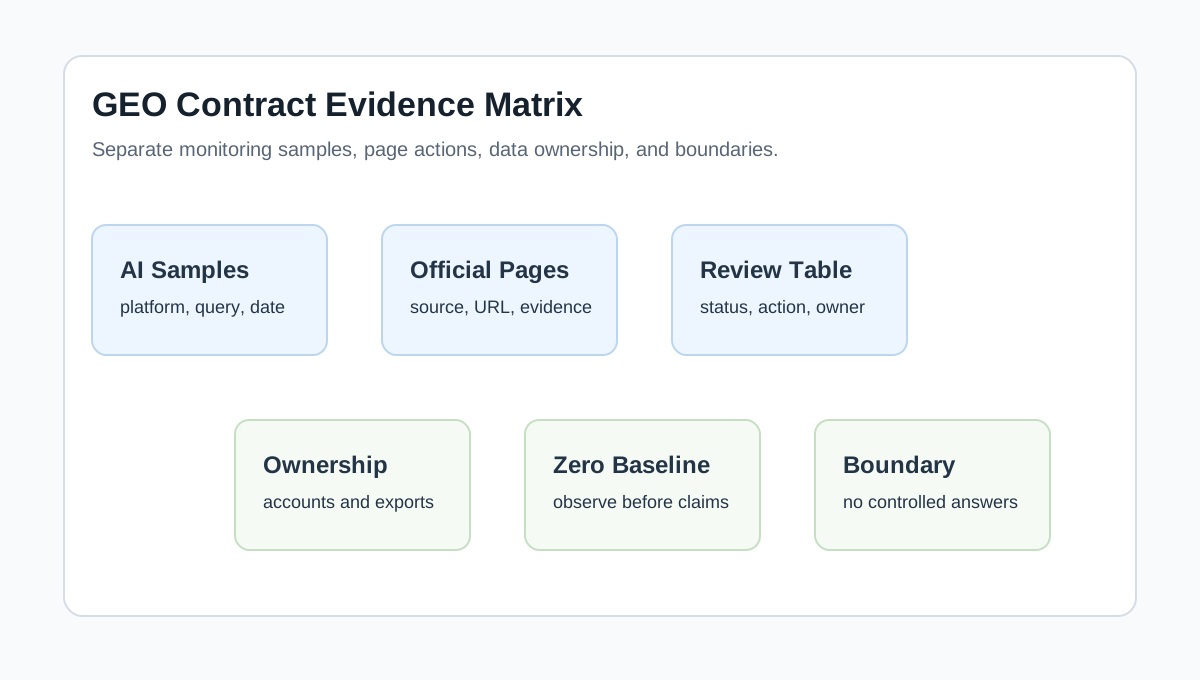
| Evidence type | What to write in the contract | Acceptance method | Boundary |
|---|---|---|---|
| Query set | Brand terms, product terms, purchasing questions, comparison questions, after-sales questions, and market scope | Exported query list, grouping, and recheck dates | A query set is not a result, only a monitoring sample |
| AI answer samples | Platform, date, region, question, answer summary, whether the official website was cited | Sheet records and necessary screenshots | A single sample cannot represent long-term status |
| Official website page evidence | Brand fact pages, product pages, FAQ, resource pages, Schema, and internal links | URLs, source code, screenshots, and launch records | A page going live does not mean external systems will immediately cite it |
| GSC and GA4 | Observation fields for search performance, organic traffic, events, and inquiry paths | Export or review by date range | When there is no row data, only “pending observation” can be written |
| Competitor samples | Competitor names, questions they appeared for, cited sources, page types, and learnable points | Sample sheets and page comparison tables | The reasons competitors appear cannot be written as established facts |
| Handover records | Query sets, page actions, accounts, export files, unfinished issues | Service-end handover table | Screenshots cannot be handed over without fields |
Supplement 2: under a GSC zero-row baseline, GEO conclusions must be downgraded
If Search Console currently has no usable query, page, or page-query rows, a GEO contract can still carry out page diagnosis, query set building, brand entity organization, and AI sample recording, but it must not write search performance as a fact that has already occurred.
The first phase of such a project should be written as “establishing a baseline” and “pending observation.” A GEO service provider can deliver diagnostic tables, page actions, and monitoring samples, but must not write clicks, impressions, inquiries, AI citations, or business changes as conclusions without data support.
| Data status | Contract deliverables that can be accepted | What the monthly report should state | What must not be written |
|---|---|---|---|
| No query rows in GSC | Query set, page mapping, Search Console configuration status | No usable query rows yet; continue observing | That a certain type of query has already gained search performance |
| No page rows in GSC | sitemap, index/follow, canonical, key URL list | Page accessibility and submission status | That pages have already formed organic search results |
| No events in GA4 | Planning for form, email, WhatsApp, download, and RFQ events | Whether events are configured and whether testing succeeded | That organic search has already generated inquiry actions |
| Insufficient AI samples | Platform, query, date, and record sheet | Samples are insufficient; no conclusion yet | That external AI systems already stably cite the official website |
| Large product material gaps | Specifications, certifications, FAQ, images, and downloadable materials still to be supplied | Material gaps affect page credibility | Fabricating product facts to fill out pages |
Supplement 3: AI monitoring samples must clearly state platforms, questions, and recheck cycles
Monitoring AI search visibility is not a matter of casually asking a few questions. The contract must clearly state the monitoring platforms, question set, recheck cycle, and recorded fields. Otherwise, when different answers appear later, it is hard to tell whether the platform changed, the question changed, the region changed, or the page evidence changed.
| Monitoring field | Suggested wording | Acceptance materials | Why it matters |
|---|---|---|---|
| Platform scope | List specific platforms and versions; do not lump all AI systems together | Platform list, retest dates | Different platforms have different sources and answer mechanisms |
| Question set | Group by brand, product, purchasing, comparison, after-sales, and resource download | Query table and grouping notes | When questions differ, answers cannot be compared directly |
| Region and language | Record language, region, whether logged in, and usage environment | Retest condition notes | The same question may differ across environments |
| Cited URLs | Record whether the official website was cited, which URL was cited, and whether the cited text is accurate | URL table, screenshots, page actions | Makes it easier to go back to the official website to supplement facts and structure |
| Error types | Brand errors, product errors, certification errors, country errors, source errors | Error list and correction suggestions | GEO optimization must fix facts first, not just pursue appearances |
Supplement 4: data ownership must cover accounts, sheets, screenshots, and page versions
GEO projects generate a large number of records. If the contract does not specify ownership, after the service ends the company may receive only a few screenshots and be unable to see the query set, URLs, page actions, and review fields. Data ownership must be stated clearly before signing.
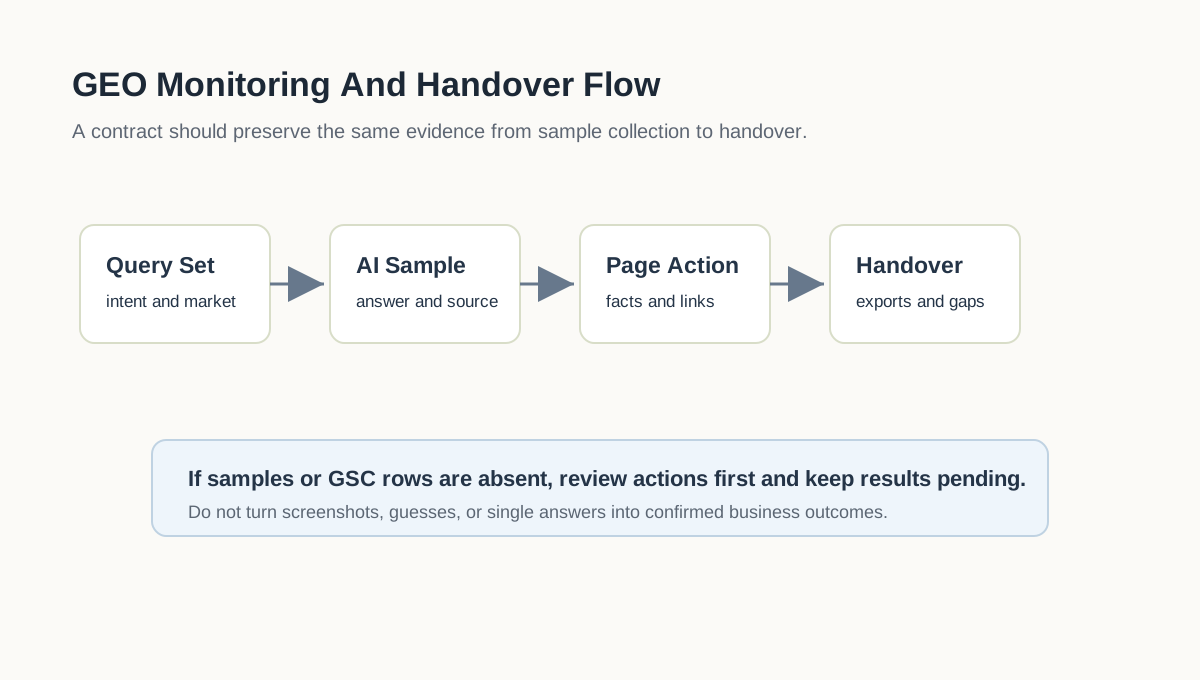
| Asset | Suggested ownership | Handover content | Risk |
|---|---|---|---|
| Query set | The company can export and continue using it | Questions, grouping, language, region, recheck cycle | Unable to retest after the service ends |
| AI sample sheet | Retained by the company | Platform, date, answer summary, cited URL, error type | Only screenshots remain, making changes impossible to compare |
| Official website action sheet | Archived jointly by the company and the service provider | Changed URLs, fields, launch time, and owner | Later, no one knows which pages were changed |
| GSC/GA4 exports | The company account retains original permissions | Date range, filter conditions, export files | Data is lost inside an individual’s account |
| Page versions | The company owns the right to continued use and modification | Records of body copy, tables, images, Schema, FAQ, and internal links | Unable to maintain after the service ends |
Supplement 5: when acceptance fails, first judge whether it is a data problem or an execution problem
A GEO contract must reserve a review mechanism. When acceptance fails, it is not acceptable to simply write “no results,” nor to force a claim of “completed.” First judge whether it is missing data, unexecuted pages, insufficient product materials, or external samples that are not yet stable.
| Failure sign | Priority troubleshooting | Still acceptable | Next step |
|---|---|---|---|
| AI samples do not cite the official website | Does the official website have citable fact pages, product pages, and FAQ | Page actions, query records, error types | Supplement facts, internal links, and structured data |
| AI answers contain product errors | Are official website product materials clear, and do old pages conflict | Error list and page correction records | Unify brand, product, certification, and model wording |
| GSC still has no row data | Is the site verified, is the sitemap submitted, are pages indexable | Technical status and URL list | Continue observing; do not write search performance conclusions |
| GA4 has no organic traffic events | Are events configured, can forms and buttons be triggered | Event planning and test records | Fix tracking first, then discuss conversion judgment |
| Company materials not confirmed | Are specifications, certifications, images, and case-type scenarios missing | Material gap table | The company supplements materials before pages are changed |
Supplement 6: service-end handover must allow the next round to continue retesting
A qualified GEO contract should not leave only a summary report when the service ends. The company must at minimum receive a query set that can continue to be retested, an AI sample sheet, an official website action sheet, GSC/GA4 methodology, and a list of next-step questions.
| Handover item | Must include | How the company accepts it | What must not be the only thing handed over |
|---|---|---|---|
| Query set | Questions, language, region, grouping, recheck cycle | The company can retest with the same questions | Only a single page of screenshots |
| AI samples | Platform, date, answer summary, cited URL, error type, corresponding page | Can compare changes across months | Only the final conclusion |
| Page actions | URL, changed fields, launch date, official sources, internal link targets | Can open the page and verify item by item | Only the words “already optimized” |
| Data methodology | GSC/GA4 date range, filter conditions, event names, and export files | Can reproduce the review sheet | Screenshots without fields |
| Next-step list | Unfinished issues, reasons for pause, priorities, and owners | Can be turned into next-stage tasks | Only generic suggestions |
Supplement 7: contract change records must explain why the scope was adjusted
A GEO project is very likely to adjust scope during the service period. For example, after the company fills in product materials, the original brand-term-only monitoring may need to add product question terms; after discovering repeated factual errors in AI samples, it may be necessary to fix the official website pages first rather than continue expanding the number of monitored items.
Such changes must be written into the contract change record. Recorded fields include: trigger reason, affected query set, affected URLs, materials the company needs to supply, page actions the service provider will execute, recheck date, and result fields not yet judged.
| Reason for change | Records to add | Who confirms | Boundary |
|---|---|---|---|
| Query set expansion | New questions, language, region, platforms, and recheck cycle | Jointly confirmed by the company and the service provider | New samples must not be written as result improvement |
| Page fact correction | Erroneous facts, corresponding URLs, correction content, and launch time | Confirmed by the product owner | Must not fabricate facts without material support |
| Data methodology change | Filter conditions and date ranges for GSC, GA4, and the AI sample sheet | Confirmed by the review owner | Must not mix different periods for direct comparison |
| Technical scope expansion | Scope of template, Schema, form event, sitemap, or log checks | Confirmed by the technical owner | Must not hide complex development inside generic SEO services |
FAQ: common questions about GEO service contracts
Should the contract name the AI platforms?
It can, but do not write only the platform names. More importantly, state clearly the question set, recorded fields, test frequency, and ownership of screenshots and sheets. Platforms change, but the recording methodology must remain stable.
Must GSC and GA4 permissions be given to the service provider?
Not necessarily the highest level of permission, but the company must hold primary permission. When the service provider needs to view data, access can be granted on a least-privilege basis, and the contract should state the scope of authorization and the revocation method.
Without GSC data, can a GEO contract still be signed?
Yes, but the contract conclusions must be downgraded. The no-data stage is suitable for building baselines: query set, page mapping, crawl checks, event configuration, and the AI sample sheet. Search performance must wait for real data before it can be judged.
Can AI answer screenshots be used for acceptance?
Screenshots can serve as sample evidence, but they cannot alone constitute the entire acceptance. They must be accompanied by date, platform, question, answer summary, cited URL, competitor sources, and page change records.
What is most easily missed in a contract?
Data ownership and exit handover are most easily missed. The query set, AI samples, GSC/GA4 permissions, page change logs, and review sheets should all be archived. Otherwise the next round of collaboration will start over from scratch.
Continue reading this GEO series
If you are systematically studying GEO and AI search visibility, the articles below are a good next step. Start with the concepts, then move on to diagnosis, monitoring, content structure, and collaboration boundaries.
- Why GEO service quotes vary so much: how to read query sets, platform counts, and competitor monitoring
- How to do AI Visibility Monitoring: a guide for new foreign trade sites
- How to choose an AI search visibility team: a capability checklist for foreign trade companies
- How to choose an AI search visibility team: what a reliable generative engine optimization team should deliver
- How to judge the most reliable AI search visibility teams in China: look at visibility evidence, not AI promises
- AI search visibility consultant vs. service team: how foreign trade companies should choose
{
“@context”: “https://schema.org”,
“@type”: “FAQPage”,
“mainEntity”: [
{
“@type”: “Question”,
“name”: “Should the contract name the AI platforms?”,
“acceptedAnswer”: {
“@type”: “Answer”,
“text”: “It can, but do not write only the platform names. More importantly, state clearly the question set, recorded fields, test frequency, and ownership of screenshots and sheets. Platforms change, but the recording methodology must remain stable.”
}
},
{
“@type”: “Question”,
“name”: “Must GSC and GA4 permissions be given to the service provider?”,
“acceptedAnswer”: {
“@type”: “Answer”,
“text”: “Not necessarily the highest level of permission, but the company must hold primary permission. When the service provider needs to view data, access can be granted on a least-privilege basis, and the contract should state the scope of authorization and the revocation method.”
}
},
{
“@type”: “Question”,
“name”: “Without GSC data, can a GEO contract still be signed?”,
“acceptedAnswer”: {
“@type”: “Answer”,
“text”: “Yes, but the contract conclusions must be downgraded. The no-data stage is suitable for building baselines: query set, page mapping, crawl checks, event configuration, and the AI sample sheet. Search performance must wait for real data before it can be judged.”
}
},
{
“@type”: “Question”,
“name”: “Can AI answer screenshots be used for acceptance?”,
“acceptedAnswer”: {
“@type”: “Answer”,
“text”: “Screenshots can serve as sample evidence, but they cannot alone constitute the entire acceptance. They must be accompanied by date, platform, question, answer summary, cited URL, competitor sources, and page change records.”
}
},
{
“@type”: “Question”,
“name”: “What is most easily missed in a contract?”,
“acceptedAnswer”: {
“@type”: “Answer”,
“text”: “Data ownership and exit handover are most easily missed. The query set, AI samples, GSC/GA4 permissions, page change logs, and review sheets should all be archived. Otherwise the next round of collaboration will start over from scratch.”
}
}
]
}
This page is machine-translated from the Simplified Chinese version and awaiting human review. It has not yet been proofread.