AI search visibility is not about buying a tool, writing a few articles, and calling it done once you have a screenshot proving that ChatGPT mentioned your brand. It is about making it easier for answer-based search engines such as ChatGPT, Perplexity, Google AI Overviews, and Gemini to understand, cite, and compare your company correctly. For export manufacturers, factories, and trading companies in China, the real question to answer is this: are you missing strategic diagnosis, content execution, technical fixes, monitoring and review, or a sales feedback loop? Different gaps call for different ways of working.
If you sell custom metal parts, LED flood light, packaging machine, medical probe, cnc machining parts, ceramic dinnerware, waterproof connector, industrial valve supplier, or private label activewear manufacturer, the core of AI search visibility is not “getting AI to recommend me.” It is making your official website, product pages, resource pages, application pages, FAQs, certificates, and external signals clear enough that when buyers ask about products, suppliers, specifications, applications, and documentation, AI systems have a chance to understand and cite your real information.
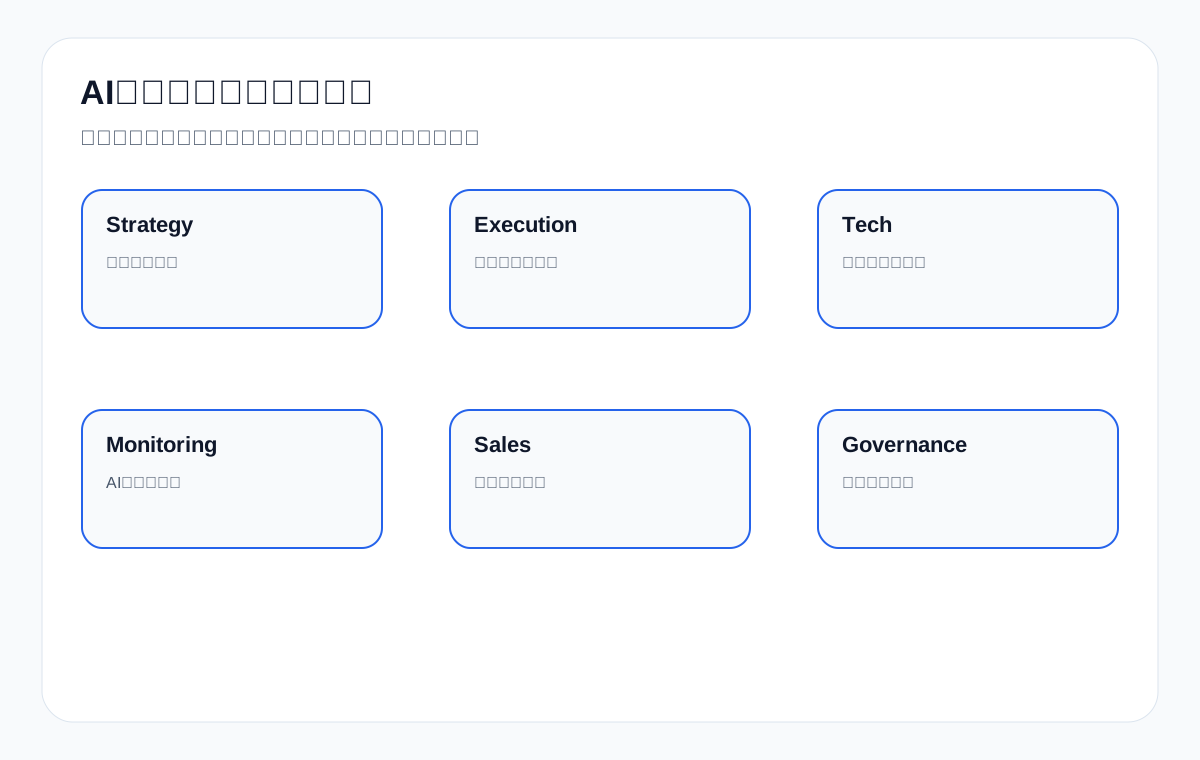
II. First, the conclusion: consultants solve judgment problems, execution teams solve long-term implementation problems
An AI search visibility consultant is better suited to answering questions about whether the direction is right, where the problems are, what to do first, and how to evaluate external partners. A consultant’s value lies in diagnosis, strategy, query set design, prioritization, monitoring frameworks, and training internal teams.
An AI search visibility service team is better suited to answering the question of who will keep updating pages, writing content, filling in documentation, handling technical fixes, monitoring answers, and reviewing inquiries. A team’s value lies in consistent execution, cross-page overhauls, content production, technical coordination, and monthly reviews.
What many foreign trade companies actually need is a hybrid model: first use a consultant for diagnosis and a roadmap to confirm the product lines, query sets, page gaps, and review metrics; then have internal staff or an external execution team update product pages, category pages, application pages, resource pages, and FAQs in batches.
Core differences between a consultant and an execution team
| Dimension | Where a consultant is stronger | Where an execution team is stronger |
|---|---|---|
| Problem identification | Identify visibility gaps and priorities | Continuously fix items on a checklist |
| Query set | Design a buyer question bank | Continuously expand and monitor |
| Content implementation | Define structure and standards | Produce and update pages at scale |
| Technical coordination | Point out crawling, structured data, and entity issues | Work with developers to implement |
| Review | Design metrics and interpret data | Collect and report monthly |
III. What exactly does AI search visibility optimize?
AI search visibility can be broken down into four things: first, whether AI knows about your company and products; second, whether AI can describe your capabilities correctly; third, whether AI mentions or cites you in relevant procurement questions; fourth, whether the visits or awareness AI generates can turn into more specific inquiries.
This is related to traditional SEO, but not entirely the same. Traditional search focuses more on page rankings and clicks; AI search also weighs website content, external documentation, brand consistency, structured information, authoritative citations, page extractability, and answer accuracy.
For example, when a buyer asks “best waterproof connector supplier for outdoor LED lighting,” AI may not look at just one ranking page. It may combine product pages, application pages, certificates, industry resources, and external mentions. The clearer your pages, the more consistent your facts, and the more complete your documentation, the stronger the foundation for being understood correctly.
Four levels of AI search visibility metrics
| Level | Question | Foreign trade example |
|---|---|---|
| Discovered | Does AI know the brand and products | Whether AI knows you make waterproof connector |
| Understood | Is the description accurate | Whether AI knows the IP rating, applications, and customization capabilities |
| Cited | Whether it cites your website or resource pages | Whether it cites a datasheet or selection guide |
| Brings opportunities | Whether it produces more specific inquiries | Whether inquiries include specifications, quantity, and application |
IV. When should you start with a consultant?
If a company already has a website, content, and a team, but is unsure how to adjust for the AI search era, it makes sense to start with a consultant. A consultant can help assess whether the existing SEO foundation is sufficient, which pages are unsuitable for citation, which product lines need documentation first, and which query terms need monitoring.
If the boss has heard many new concepts and is unsure how GEO, AEO, AI visibility, and LLMO actually differ, a consultant-style diagnosis is also a good first step. The goal is not to buy into concepts but to produce an executable roadmap.
If you have internal content, foreign trade sales, technical, or operations staff but lack methodology, a consultant can provide standards, review, training, and review mechanisms so the internal team takes fewer wrong turns.
Situations where it makes sense to start with a consultant
| Situation | Reason | Deliverable |
|---|---|---|
| Already has execution staff | Lacks direction, not people | Diagnostic report and roadmap |
| Complex product lines | Priorities need to be set first | Query set and page map |
| Cautious budget | Does not want to commit long-term from the start | Phased assessment |
| The boss needs to make a judgment | Needs to understand risk boundaries | Decision table and metric framework |
| Preparing to switch providers | Needs third-party evaluation | Collaboration standards and acceptance checklist |
V. When is an execution team the better fit?
If a company has no one who can continuously update pages, write content, organize documentation, handle images, coordinate with technical staff, and monitor AI answers, then hiring only a consultant is likely to stop at a report. AI search visibility requires long-term content assets and entity signal building, so execution capacity is critical.
An execution team is suited to handle: product page reinforcement, category page rewrites, application page building, FAQ organization, resource page construction, structured data recommendations, external documentation coordination, AI query monitoring, and monthly review reports.
For example, if a packaging machine manufacturer lacks pages for different materials and application scenarios, it needs to continuously organize scenarios such as powder, liquid, granules, food, pharmaceuticals, and chemicals. Strategy without execution rarely produces visible assets.
Situations suited to an execution team
| Situation | Execution needed | Risk warning |
|---|---|---|
| Website content is thin | Rewrite category and product pages | The company must provide real documentation |
| Documentation is scattered | Organize datasheets and certificates | Do not fabricate evidence |
| Multiple product lines | Build application pages in batches | Priorities are needed |
| No one reviews | Set up monitoring and reporting | Do not hand in screenshots only |
| Needs continuous updates | Iterate content monthly | Avoid vague updates |
VI. A selection matrix for foreign trade companies: choose by gap, not by title
Do not start by asking whether a consultant or a team is better. Start by asking what you lack. If you lack strategy, do a diagnosis first; if you lack execution, find ongoing implementation; if you lack technical capability, choose someone who can work with developers; if you lack data, set up monitoring; if you lack sales feedback, connect inquiry quality into the review.
Foreign trade companies should also consider product complexity. Products such as custom metal parts, medical probe, and industrial valve need stronger documentation, specifications, and application explanations; ceramic dinnerware and private label activewear manufacturer need more detail on materials, packaging, certifications, MOQ, and brand customization.
Do not be swayed by talk of “new playbooks for the AI era.” Whether it is called GEO, AEO, or AI search visibility, the foundation is still content assets that are crawlable, trustworthy, clearly structured, factually consistent, and capable of answering procurement questions.
Selection matrix
| Current situation | Preferred choice | Reason |
|---|---|---|
| Has a team but lacks direction | Consultant | Establish a roadmap and acceptance standards first |
| No content execution capability | Execution team | Needs continuous page and documentation work |
| Many product lines and disorganized | Consultant first, then team | Prioritize, then implement |
| New site with no data | Basic SEO plus a content team | Build the crawling and page foundation first |
| Has traffic but weak inquiries | Consultant plus conversion review | Find intent and page mismatches |
VII. What a qualified AI visibility diagnosis should include
A diagnosis should not consist of asking AI a few questions and taking screenshots. At minimum, a qualified diagnosis covers: target markets and product lines, a buyer question bank, brand and product entity consistency, website page structure, content extractability, resource page completeness, external signals, AI answer testing, competitor comparison, GSC/GA4/inquiry data, and priorities.
For LED flood light, the query set should cover supplier, manufacturer, for parking lot, how to choose, IP rating, DLC certificate, 100W/200W, and so on; for cnc machining parts, it should cover tolerance, material, surface finish, drawing upload, and low volume production.
Diagnostic output must be convertible into page tasks, not remain at the conceptual level. For example, the finding that AI does not correctly describe the product application should become a task to add an outdoor lighting waterproof connector application page, FAQ, datasheet, and internal links.
AI visibility diagnosis checklist
| Module | What to check | Output |
|---|---|---|
| Query set | Procurement questions and product terms | Monitored question bank |
| Entity consistency | Company, brand, and product names | Naming consistency recommendations |
| Page assets | Category, product, application, resource | Gap list |
| AI answer testing | Mentions, citations, accuracy | Competitor comparison |
| Review data | GSC, GA4, inquiries | Priority roadmap |
VIII. How should an execution team’s monthly work be accepted?
An execution team cannot just report how many articles it updated this month. A more reasonable acceptance standard is whether page assets were completed around the target product lines, whether actual AI and search visibility gaps were closed, and whether sales sees more specific inquiries.
Monthly deliverables can include: new or rewritten category pages, product pages, application pages, resource pages, and FAQs; changes in AI query set monitoring; changes in GSC query terms; GA4 product clicks and form events; sales feedback; and next month’s priorities.
If the deliverables are only the number of articles published and screenshots of AI mentions, the risk is high. A single answer is unstable, and a screenshot cannot prove long-term visibility or improved inquiry quality.
Monthly acceptance table
| Acceptance item | Passing standard | Failing signal |
|---|---|---|
| Page assets | Specific URLs and change descriptions | Only says several pieces of content were updated |
| Query set monitoring | A fixed question set tracked continuously | Random screenshots |
| Content quality | Foreign trade product facts and tables are complete | Vague conceptual articles |
| Data review | GSC, GA4, and inquiries reviewed together | Only looks at impressions or screenshots |
| Next month’s plan | Adjusts based on data | Repeats the same actions every month |
IX. Risk boundaries of an AI search visibility project
No one should promise that a given AI tool will recommend a certain brand every time, or promise a definite ranking or a definite number of inquiries. AI answers are affected by the model, region, language, login status, retrieval results, time, and how the question is asked.
What is controllable is the foundation: whether pages are clear, whether documentation is complete, whether entities are consistent, whether external signals are trustworthy, whether content is extractable, whether query sets are monitored, and whether inquiries are reviewed.
Therefore, a contract or cooperation objective should be written as improving the visibility foundation, improving citation opportunities, increasing information accuracy, and establishing monitoring and review, not as an uncontrollable promise.
Risk boundary table
| Not controllable | Controllable actions |
|---|---|
| Whether a particular AI answer appears | Build a query set and monitor it long term |
| A platform’s display order | Improve pages and entity signals |
| Short-term inquiry volume | Improve the inquiry path and documentation completeness |
| Impact of model updates | Review and adjust regularly |
| Competitor actions | Continuously fill in differentiated pages |
X. Foreign trade product term examples: do not use service industry terms as the default examples
When addressing foreign trade companies, examples must be grounded in English product terms and procurement scenarios, not always service industry terms. What clients really care about is how their own products are understood by AI and search.
For example, you can use waterproof connector for marine lighting, custom metal parts tolerance, LED flood light for parking lot, packaging machine for powder, medical probe material, ceramic dinnerware private label, industrial valve supplier certificate.
These examples help companies understand AI visibility as product asset building rather than an abstract marketing concept.
Foreign trade query example table
| Product line | AI/search question | Target page |
|---|---|---|
| waterproof connector | best waterproof connector for marine lighting | Application page + category page |
| custom metal parts | custom metal parts tolerance guide | Tutorial page + capability page |
| LED flood light | how to choose LED flood light for parking lot | Content page + product page |
| packaging machine | powder packaging machine supplier with CE | Category page + certificate page |
| ceramic dinnerware | private label ceramic dinnerware manufacturer | Capability page + product category |
XI. How internal teams should work with external partners
AI search visibility is not work that external people complete behind closed doors. A foreign trade company must at minimum provide product documentation, sales feedback, frequently asked questions, certificates, application scenarios, customer markets, drawings, or parameter ranges. Without real documentation, external execution can only write vague content.
We recommend setting up three internal interfaces: a business interface responsible for products and customer questions, a website interface responsible for pages and technical coordination, and a sales interface responsible for inquiry quality feedback. Review once a month to confirm which pages bring more specific inquiries and which AI descriptions are still inaccurate.
The value of a consultant or team is to turn this documentation into structured pages and a review mechanism, not to invent product facts for the company.
Internal coordination table
| Internal role | Documentation provided | Impact |
|---|---|---|
| Foreign trade sales | Customer questions, markets, competitors | Determines the query set |
| Product/engineering | Specifications, materials, certificates | Determines content credibility |
| Website operations | Pages, images, forms | Determines implementation efficiency |
| Sales | Inquiry quality, deal feedback | Determines the review direction |
| Decision maker | Priorities and resources | Determines the collaboration pace |
XII. Budget judgment: small budgets should buy judgment first; only large budgets suit long-term execution
If the budget is limited, doing a diagnosis and roadmap first is more stable than going straight into long-term execution. A diagnosis clarifies product line priorities, page gaps, and risk boundaries, and avoids spending budget on low-value content.
If the budget is relatively ample and the company is willing to provide documentation and cooperate on site changes, ongoing execution is an option. Ongoing execution better suits companies with a thin content base, many product lines, and a need for monitoring and review.
Budget should not be calculated only by article count, but by page assets, documentation organization, technical coordination, monitoring and review, and the sales feedback loop.
Budget selection table
| Budget/resources | Recommended approach | Delivery focus |
|---|---|---|
| Low budget | Diagnosis + roadmap | Query set, page gaps, priorities |
| Medium budget | Consultant + internal execution | Standards, review, retrospective |
| High budget | Ongoing execution team | Page assets and monitoring |
| Has an internal team | Consultant coaching | Training and quality control |
| No one to coordinate | Build a documentation mechanism first | Avoid low-quality output |
XIII. A 90-day collaboration roadmap: from diagnosis to page assets to review
The first 30 days are for diagnosis: determine product lines, query sets, competitors, the current state of AI answers, page gaps, documentation gaps, and priorities. Do not start writing content blindly.
Days 31-60 are for page assets: rewrite core category pages, product pages, application pages, resource pages, and FAQs, and turn procurement questions into citable content.
Days 61-90 are for review: look at AI answer mentions, citations, accuracy, GSC query terms, GA4 behavior, inquiry quality, and sales feedback, then decide on the second batch of pages.
90-day roadmap table
| Period | Focus | Deliverable | Review metric |
|---|---|---|---|
| Days 0-30 | Diagnosis and query set | Roadmap, page map | Current baseline |
| Days 31-60 | Page asset implementation | Category pages, product pages, resource pages | Query term and citation changes |
| Days 61-90 | Monitoring and review | Monthly report, second batch plan | Inquiry quality and accuracy |
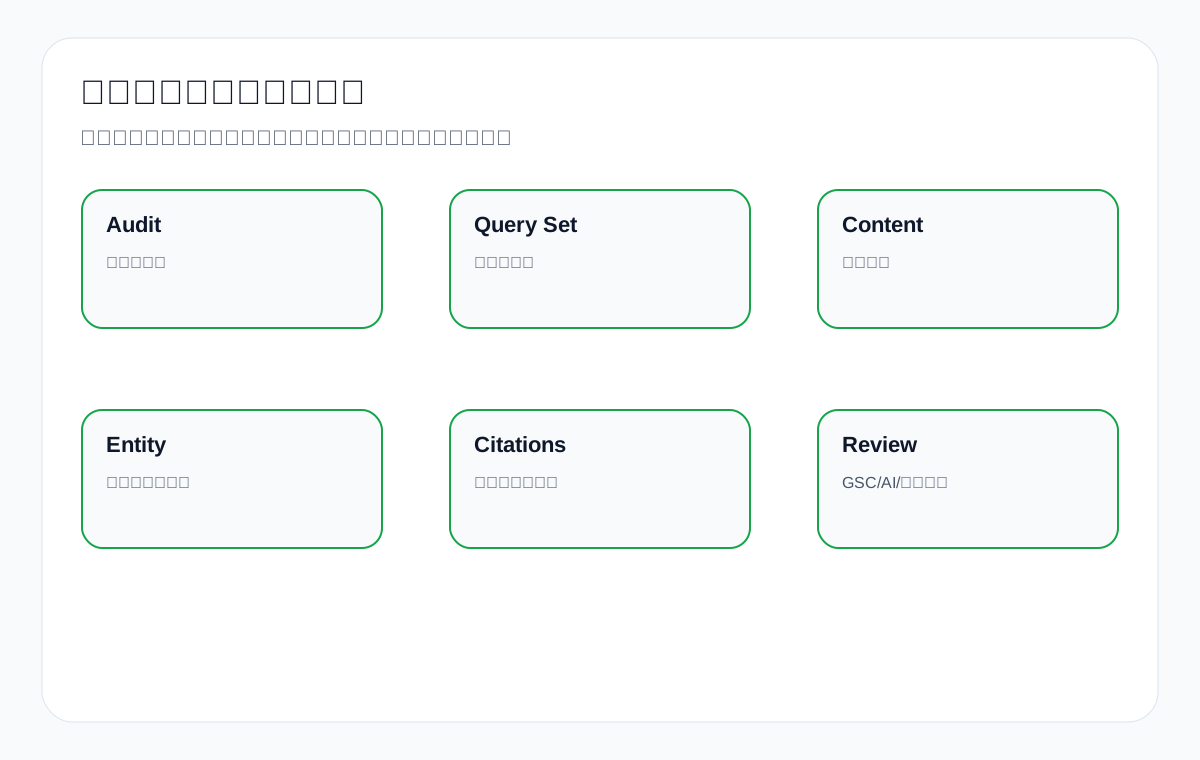
XIV. Case study: how a waterproof connector factory should choose
If a waterproof connector factory already has an English website, but its product pages have only images and simple model numbers, AI answers cannot accurately explain the applicable scenarios, and GSC has no query terms such as marine lighting or outdoor connector, then the first step should not be long-term execution. It should be a diagnosis of the product lines and page map.
A consultant can first define the query set: waterproof connector supplier, IP67 connector, M12 4 pin connector, connector for marine lighting, how to choose waterproof connector. Then determine which pages are missing: category pages, subcategories, application pages, datasheets, and FAQs.
If someone inside the company can edit content, the consultant can provide standards and review it; if no one can sustain implementation, an execution team is needed to fill in pages in batches.
waterproof connector selection example
| Problem found | Suitable collaboration | Reason |
|---|---|---|
| Does not know why AI does not mention the brand | Consultant | Needs diagnosis and a query set |
| Product pages have no specifications | Execution team | Needs continuous page work |
| Application pages are missing | Consultant + team | Plan first, then implement |
| Inquiries are not specific | Consultant | Needs form and sales feedback review |
XV. Case study: how a packaging machine company should choose
Packaging machine product lines are usually complex, involving powder, granules, liquids, food, pharmaceuticals, chemicals, bag types, speed, precision, and degree of automation. An AI search visibility project cannot consist of a single overview article.
If the company already has sales materials and videos but its website has no structured pages, an execution team is better suited to organize the materials into category pages, application pages, FAQs, video summaries, and resource pages. If the company is still unsure which product lines to prioritize, do a consultant diagnosis first.
The review should check whether AI can correctly describe the equipment’s applicable materials, capacity range, certificates, and customization capabilities, and whether inquiries include material, packaging specifications, speed, and target market.
packaging machine project breakdown
| Task | Consultant’s responsibility | Execution team’s responsibility |
|---|---|---|
| Product line prioritization | Assess commercial value and query demand | Build pages by priority |
| Application content | Define structure and questions | Write and publish |
| Video materials | Plan how to use them | Organize summaries and embeds |
| Review metrics | Define metrics | Collect monthly data |
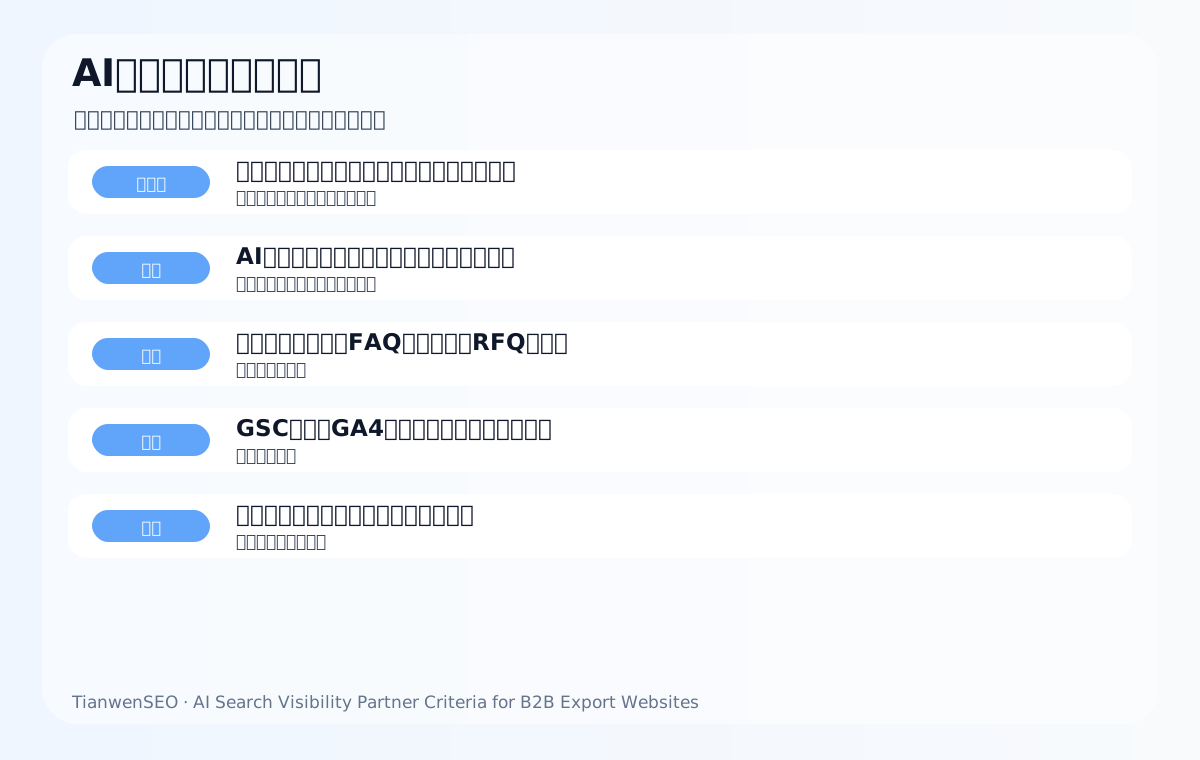
XXIII. How to choose step by step: from internal inventory to a trial run
Foreign trade companies can choose a collaboration model in five steps. Step one: take stock of internal resources – who can provide product documentation, who can edit the website, who can review English content, and who can give feedback on inquiry quality. Step two: take stock of page assets – whether core category pages, product pages, application pages, resource pages, and FAQs exist. Step three: build a query set – design questions around English product terms, application terms, supplier terms, and documentation terms. Step four: run a small trial – pick one product line to diagnose and reinforce with pages. Step five: use data to decide whether to expand execution or adjust direction.
For example, a private label activewear manufacturer can start with one product line, such as yoga leggings or seamless sports bra, organize the fabric, MOQ, size range, custom label, packaging, sample policy, and certification, and then build an AI query set and page map. After completing a batch of pages, see whether AI answers are more accurate, whether more matching English terms appear in GSC, and whether inquiries include more specific customization requirements.
This process avoids two kinds of waste: one is long-term execution without diagnosis, which ends with a lot of content pointing in the wrong direction; the other is diagnosis without execution, which leaves a report in a folder and no page changes. A small trial run lets a company see the collaboration model, the cost of documentation coordination, and the actual review method.
Five-step selection process table
| Step | What to do | Decision outcome |
|---|---|---|
| Internal inventory | Confirm who owns documentation, the website, and sales feedback | Decide whether internal execution is possible |
| Page inventory | Check category, product, application, and resource pages | Determine the type of gap |
| Query set | Design buyer questions and product terms | Determine the monitoring scope |
| Trial run | Implement one product line | Verify collaboration efficiency |
| Review and expansion | Look at AI, GSC, GA4, and inquiries | Decide the long-term collaboration model |
XXIV. Look at four types of evidence at acceptance: pages, answers, data, and sales
Acceptance of an AI search visibility project cannot rely only on subjective feelings. We recommend looking at four types of evidence: page evidence, answer evidence, data evidence, and sales evidence. Page evidence proves that real assets have been built; answer evidence proves that AI query results have changed; data evidence proves that search and behavior have changed; sales evidence proves that lead quality has changed.
Page evidence includes URLs, before-and-after content, tables, FAQs, images, resource downloads, and internal links. Answer evidence includes mentions, citations, accuracy, and competitor comparisons for a fixed query set. Data evidence includes GSC query terms, GA4 events, resource downloads, and form submissions. Sales evidence includes whether inquiries contain the product, specifications, quantity, application, and target market.
Only by looking at all four types of evidence together can you judge whether the project truly makes it easier for buyers and AI to understand the company. If there are pages but no data, you may need to wait or strengthen internal links; if there are AI mentions but the description is wrong, fix the entity and documentation; if there is traffic but the inquiries are invalid, return to page intent and the conversion path.
Acceptance evidence table
| Evidence type | What to look at | What it shows |
|---|---|---|
| Page evidence | Pages, resources, FAQs, internal links | Whether assets are genuinely complete |
| Answer evidence | Mentions, citations, accuracy | Whether AI understands more easily |
| Data evidence | GSC, GA4, downloads, forms | Whether search and behavior have changed |
| Sales evidence | Inquiry specificity and validity | Whether it approaches business goals |
| Review evidence | Next month’s adjustment plan | Whether an iteration mechanism has formed |
XVI. FAQ: how to choose between an AI search visibility consultant and an execution team
What kinds of companies is an AI search visibility consultant suitable for?
Foreign trade companies that already have a website and staff but lack direction, diagnosis, a query set, and a review method.
What kinds of companies is an execution team suitable for?
Companies that lack ongoing content, technical coordination, page overhauls, documentation organization, and monitoring and review capabilities.
Can we just buy a tool?
Tools can monitor some data, but they cannot judge product line priorities, page gaps, documentation credibility, or inquiry quality for you.
Does AI search visibility conflict with traditional SEO?
No. Crawlability, clear structure, useful content, consistent entities, and authoritative signals remain the foundation; the only change is that review metrics now include AI answer coverage and citations.
How long before we see changes?
Technical and page fixes may be crawled relatively quickly, but changes in AI answers, citations, and brand awareness usually require ongoing observation. We cannot promise results within a fixed period.
Do we need to write many articles every month?
Not necessarily. Many foreign trade companies first need to fill in category pages, product pages, application pages, resource pages, and FAQs, rather than simply increasing the number of articles.
How can we avoid being misled by unreliable proposals?
See whether the other party explains risk boundaries, query sets, page assets, data review, and foreign trade product scenarios clearly, rather than only promising that AI will recommend you.
What must a foreign trade factory coordinate internally?
At minimum, provide product specifications, certificates, application scenarios, customer questions, sales feedback, and judgments about inquiry quality.
Can screenshots of AI answers be used for acceptance?
They can only be a reference, not the sole basis for acceptance. Look more at the fixed query set, citation sources, accuracy, GSC, GA4, and inquiry quality.
How should we start with a small budget?
Do a diagnosis and roadmap first to identify the product lines, pages, and documentation most worth completing, then decide whether to move into ongoing execution.
If a company can only take one action first, we recommend choosing one high-value product line and building a query set and page map. That way, whether you later hire a consultant or an execution team, you share a common language: which English product terms to cover, which procurement questions to answer, which pages to reinforce, and which metrics to review. For foreign trade companies, a clear product line pilot produces real improvements more easily than broad, site-wide slogans.
At the same time, be patient with reviews. AI answers and search data will fluctuate. What is truly valuable is continuously making page facts clearer, documentation more complete, and brand entities more consistent, and turning each piece of inquiry feedback into the basis for the next round of page optimization, sustaining long-term improvement.
XVII. Conclusion: buy clear judgment first, then buy ongoing execution
There is no absolute good or bad between an AI search visibility consultant and an execution team; the key is the company’s current gap. When you lack direction, judgment, and acceptance standards, starting with a consultant is more stable; when you lack manpower, content, technical coordination, and monitoring and review, an execution team is more suitable.
For export manufacturers and trading companies in China, the selection criteria must come back to products and inquiries: whether the English product terms are clear, whether product pages and resource pages are complete, whether AI can correctly describe the company’s capabilities, and whether buyers can enter the website from an answer or search and submit more specific requirements.
Do not pay for concepts, and do not expect uncontrollable promises. What is truly worth investing in is long-term page assets that are crawlable, understandable, citable, and reviewable, along with a collaboration mechanism that connects GSC, GA4, AI queries, and sales feedback.
Final selection checklist
| Question | If the answer is yes | Recommendation |
|---|---|---|
| Do you lack direction and standards | Yes | Start with a consultant diagnosis |
| Do you lack ongoing implementation manpower | Yes | Find an execution team |
| Are the product lines complex | Yes | Prioritize first, then execute |
| Do you already have internal content staff | Yes | Consultant coaching + internal execution |
| Do you need monthly monitoring | Yes | Build a fixed query set and review |
| Has someone promised definite results | Yes | Assess the risk carefully |
Official evidence boundaries: what a consultant and an execution team can each be held to
In an AI search visibility project, the division of labor between a consultant and an execution team cannot be judged by job title alone. A more reliable approach is to break the work into officially verifiable fields: whether pages can be crawled, whether GSC has query and page data, whether GA4 has events, whether AI answers cite the website, and whether crawl visits appear in the logs.
| Item | Official reference | Suitable consultant deliverable | Suitable execution team deliverable | Boundary |
|---|---|---|---|---|
| AI search display logic | Google Search Central: AI features and your website | Judge whether pages have a foundation for AI understanding | Change page structure, FAQs, product fields, and internal links | Do not write a sample answer as a stable display result |
| Search performance | Search Console Help: Performance report | Read queries, pages, clicks, impressions, and CTR | Update titles, body content, links, and technical blockers page by page | With no GSC rows, you can only write that a baseline is yet to be established |
| Conversion events | Google Analytics Help: About events | Judge whether events are sufficient to support review | Help configure form, WhatsApp, email click, and download events | Without configured events, do not infer changes in inquiries |
| SEO foundation | Google Search Central: SEO Starter Guide | Identify gaps in page titles, content, links, and crawlability | Implement product pages, category pages, industry pages, and blog updates | When the basics are not done well, do not jump straight to AI visibility conclusions |
| Structured data | Google Search Central: Structured data general guidelines | Judge whether the schema matches the page content | Fix fields such as Article, Product, FAQ, and Breadcrumb | Structured data helps understanding; it is not a promise of search result display |
| AI crawl access | OpenAI Platform: Bots | Judge whether robots, logs, and access policies need review | Work with technical staff to check robots, status codes, cache, and security rules | Allowing crawling does not mean answers will use you |
| Bing-side AI performance | Bing Webmaster Blog: AI Performance | Judge whether Bing Webmaster Tools has usable fields | Maintain pages, submit URLs, and observe citation changes | Data from different platforms cannot be merged into one conclusion |
| URL discovery | IndexNow: Documentation | Judge whether a URL discovery mechanism should be added | Help the site system submit new and updated URLs | Submitting URLs is not a promise of indexing or display |
Consultant deliverable acceptance checklist: state the problem clearly first
A consultant’s value is to break the problem down clearly first. If a foreign trade company works on custom metal parts, LED flood light, packaging machine, medical probe, or waterproof connector, the consultant should not simply offer a pile of general suggestions, but map product lines, pages, queries, AI answers, and data permissions to one another.
| Deliverable | Minimum acceptance fields | What problem it is suited to solve | What it should not take on |
|---|---|---|---|
| AI answer query set | Platform, country or language, query term, product line, review date | Judge whether the brand and website appear in the answer sample | Not suitable to be written as a results promise |
| Website citation records | Cited URL, page type, answer position, competitor URL | Judge which types of website pages are cited more | Not a substitute for page updates |
| GSC baseline | Date range, queries, pages, clicks, impressions, CTR, average position | Judge whether search impressions already exist | Do not force a trend when there is no data |
| GA4 event check | Organic traffic, key events, event names, triggering pages | Judge whether monitoring connects to inquiry actions | Do not infer performance when events are not configured |
| Page asset diagnosis | Gaps in product pages, category pages, industry pages, FAQ pages, and resource pages | Judge where the execution team should change things next | Should not stop at abstract suggestions |
| Risk boundaries | What can be verified, what can only be observed, and what requires the company to supply documentation | Avoid writing uncontrollable display as a task result | Should not invent product documentation for the company |
Execution team deliverable acceptance checklist: turn judgment into page actions
An execution team’s value is to move the problems from the diagnosis into pages, technology, and the review process. To judge who is better suited for long-term collaboration, do not look only at the packaging of the proposal; look at whether it can turn actions into URLs.
| Action | Acceptance method | Suitable pages | What the company must provide |
|---|---|---|---|
| Add product fields | Pages show specifications, materials, certifications, MOQ, applications, and FAQs | Product pages, collection pages, industry pages | Provide real specifications and images |
| Add citable passages | Pages can directly answer procurement, specification, application, and comparison questions | FAQ pages, blog, product guides | Confirm terminology and business boundaries |
| Fix internal links | Clear paths between product pages, category pages, and blog pages | Core commercial pages and supporting articles | Confirm key product lines |
| Fix crawling and indexing | Records for robots, sitemap, canonical, status codes, and duplicate pages | Key site-wide URLs | Provide site admin access or technical coordination |
| Add structured data | Schema fields match the real page content | Product, Article, FAQ, Breadcrumb | Confirm fields are true and accurate |
| Monthly review | GSC, GA4, AI answer samples, and page update records in one table | Key product lines and content clusters | Confirm inquiry quality and sales feedback |
How consultants and execution teams should write conclusions when there is no GSC signal
If GSC currently has no query, page, click, or impression data, conclusions should be more restrained. You can write that monitoring fields have been established, that pages have a direction for the next update, or that you will wait for GSC to produce a baseline before rechecking. Do not write that search results have already improved.
| Scenario | What you can write | What you should not write | Next step |
|---|---|---|---|
| GSC shows 0 rows for both 28 days and 90 days | The site currently has no search performance data available for ranking | Organic search has already improved | First confirm indexing, sitemap, page quality, and submission status |
| AI answer sample mentions the brand | The sample contains a brand mention | The brand has stably entered AI answers | Expand the query set and record by platform |
| AI answer cites the website | The sample cites a certain URL | The website has become the main source | Record the cited page type and optimize similar pages |
| Competitors appear frequently | Competitors have stronger pages or external sources in the sample | Changing titles alone can replace competitors | Break down competitor pages, external sources, and brand entity signals |
| Page documentation is insufficient | The company needs to supply real product documentation | The external team fills in product facts on its own | Add specifications, certifications, applications, images, videos, and procurement questions |
Written this way, it may look less exciting. But it is more useful to foreign trade companies. It tells you whether you should buy judgment now or buy long-term execution; whether you should fill in data first or pages first.
XVIII. How to review a supplier’s proposal: look at the questions, not the packaging words
When evaluating an AI search visibility proposal, a foreign trade company should pay most attention to what the other party asks. If the other party starts by talking only about models, tools, and concepts, but does not ask about product lines, target markets, buyer questions, existing pages, documentation completeness, GSC data, inquiry quality, and sales feedback, it will be hard to ground the work in the business.
A reliable proposal will first ask: which products do you most want to promote? Is your main market the United States, Europe, the Middle East, or Southeast Asia? Which specifications do buyers ask about most? Which products have high margins but are poorly explained on the website? Which pages have impressions but weak inquiries? Does AI currently describe your products incorrectly? These questions matter more than a promise that we can get AI to mention you.
The proposal must also explain why a certain batch of pages comes first. For example, custom metal parts might first add tolerance, material, surface finish, and upload drawing; LED flood light might first add application, wattage, IP rating, and certificate; packaging machine might first add material-specific application pages.
Proposal review question table
| Review question | A good proposal should answer | Risk signal |
|---|---|---|
| Which product line to do first | Rank by commercial value, search demand, and page foundation | Spreading effort evenly across all products |
| How to build the query set | Cover product terms, application terms, documentation terms, and question terms | Asking only a few brand questions |
| How to change pages | Explain actions for category pages, product pages, application pages, and resource pages | Only talking about writing articles |
| How to accept delivery | Look at coverage, citations, accuracy, GSC, GA4, and inquiries | Handing in only screenshots |
| How to control risk | Explain uncontrollable boundaries and the review cycle | Promising definite results |
XIX. How to write contracts and delivery boundaries more safely
For an AI search visibility engagement, it is best to write deliverables as verifiable actions rather than uncontrollable results. You can specify: how many core pages diagnosed, how many query sets, how many page assets, how many AI answer monitoring rounds, how many GSC/GA4/inquiry reviews, which documentation the company provides, and who publishes which pages.
Do not write the deliverable as getting a certain AI tool to recommend us. A safer formulation is: build a target query set and monitor it continuously; optimize the category pages, product pages, application pages, and resource pages of the specified product lines; improve brand and product entity consistency; and review brand mentions, website citations, and information accuracy in AI answers.
Foreign trade companies should also clarify documentation responsibilities. For example, certificates, test reports, datasheets, product images, application photos, MOQ, lead time, and custom options need to be confirmed by the company; the external team cannot make them up. This protects both the company’s credibility and the long-term usability of the content.
Contract deliverable recommendation table
| Deliverable | Recommended wording | Discouraged wording |
|---|---|---|
| Query set | Build and maintain 50 target procurement questions | Make sure AI can see us everywhere |
| Page assets | Optimize 10 product/application/resource pages | Publish some content at random |
| Monitoring | Record mentions, citations, and accuracy monthly | Prove effectiveness with screenshots |
| Review | Combine GSC, GA4, and inquiry quality | Report only impressions and rankings |
| Risk boundaries | Explain model answer fluctuations and uncontrollable factors | Promise definite display |
XX. Internal documentation preparation checklist: without real documentation there is no credible visibility
AI search visibility projects depend heavily on real documentation. A common problem in foreign trade companies is not that no one writes, but that product documentation is scattered across sales, engineering, factories, PDFs, chat records, and trade show materials, and the website has no structured expression of it. A consultant or team must first help the company turn documentation into page assets.
Documentation preparation can be organized by product line: product name, English aliases, materials, specifications, applications, certifications, MOQ, lead time, packaging, customization options, frequently asked questions, sample policy, images, and videos. For medical probe, pay particular attention to materials, compatible equipment, and compliance boundaries; for industrial valve, pay attention to pressure rating, materials, test standards, and application industries.
This documentation is not only for people to read; it also gives AI systems a clearer source of facts. The clearer the documentation, the lower the chance of AI misunderstanding, and the more likely inquiries reaching sales will include specific parameters.
Documentation preparation table
| Documentation category | Example fields | Used on which pages |
|---|---|---|
| Product basics | Name, model, specifications, material | Product pages, resource pages |
| Application scenarios | Industry, operating environment, limitations | Application pages, FAQ |
| Certification evidence | CE, ROHS, ISO, test reports | Resource pages, category pages |
| Procurement information | MOQ, lead time, packaging, samples | Product pages, inquiry pages |
| Sales feedback | High-quality inquiry questions, reasons for closing deals | Content pages, review reports |
XXI. How to design a monitoring query set: do not monitor only brand terms
Many companies test AI search by only asking for a recommendation of a certain product supplier and then checking whether their own brand appears. That approach is too narrow and easily misjudged. A better query set should cover the whole procurement process: understanding the problem, choosing a product, screening suppliers, verifying documentation, comparing risks, and preparing an inquiry.
For example, for waterproof connector you can design: what is IP67 waterproof connector, how to choose waterproof connector for outdoor lighting, best waterproof connector supplier for marine use, M12 4 pin waterproof connector datasheet, waterproof connector custom cable assembly. Each question corresponds to a page or documentation asset.
The query set should also distinguish markets and languages. The phrasing of questions for US buyers, European buyers, and Middle East engineering contractors may differ. During monitoring, record whether the brand is mentioned, whether the website is cited, whether the description is accurate, whether competitors appear, and what the incorrect information is.
Query set design table
| Query stage | Question type | Page asset | Review metric |
|---|---|---|---|
| Understanding the problem | what is / how to choose | Tutorial page | Whether explanatory content is cited |
| Choosing a product | product for application | Application page | Whether applicable scenarios are described |
| Screening suppliers | supplier / manufacturer | Category page/capability page | Whether the brand or website is mentioned |
| Verifying documentation | datasheet / certificate | Resource page | Whether website documentation is cited |
| Preparing an inquiry | MOQ / custom / sample | Inquiry page/FAQ | Whether inquiries are more specific |
XXII. From AI visibility back to SEO fundamentals: without foundational pages there is no answer source
AI search visibility cannot be separated from SEO fundamentals. Pages that cannot be crawled, chaotic titles, thin content, missing documentation, isolated internal links, and inconsistent brand names all affect how AI and search systems understand you. Many so-called AI problems are rooted in an official website whose foundational pages are not strong enough.
Therefore, whether you choose a consultant or an execution team, you should check: whether core category pages are clear, whether product pages have specifications, whether application pages exist, whether resource pages are accessible, whether FAQs are real, whether structured data matches the pages, and whether the About page and contact information are consistent. Information on external platforms should also be consistent with the official website.
For foreign trade companies, the most stable path is not chasing new concepts, but building the official website into a product documentation center that both buyers and AI can understand. AI visibility is simply an extension of that documentation center into new search scenarios.
SEO fundamentals and AI visibility correspondence table
| SEO fundamental | AI visibility value | Foreign trade implementation |
|---|---|---|
| Crawlable pages | Provides an accessible source | Core product and resource pages are not blocked |
| Clear titles | Helps identify the topic | Product term + application + attribute |
| Content depth | Supports accurate answers | Complete specifications, certifications, and FAQs |
| Internal link structure | Explains page relationships | Tutorials to products and resources |
| Consistent entities | Reduces brand confusion | Unified company name, brand, and products |
{
“@context”: “https://schema.org”,
“@type”: “FAQPage”,
“mainEntity”: [
{
“@type”: “Question”,
“name”: “Top1/authoritative benchmark comparison cardnnComparison dimension Authoritative content strengths Foreign trade enterprise gaps How this article fills themnnConsultant/team differences Explains strategy and execution division of labor Lacks judgment on foreign trade organizational capability Split by factory/trading company resourcesnGEO service scope Covers audit, content, monitoring Lacks product page and resource page scenarios Add products, applications, certificates, inquiriesnAI visibility metrics Mentions mention, citation, accuracy Lacks an inquiry quality loop Add GSC/GA4/sales feedbacknRisk boundaries Some pages discuss timelines Still at risk of exaggerated promises Explicitly do not promise fixed answersnSelection advice Mostly generic industries Not suitable for B2B export decisions Provide a foreign trade selection matrixnnII. First, the conclusion: consultants solve judgment problems, execution teams solve long-term implementation problemsnAn AI search visibility consultant is better suited to answering questions about whether the direction is right, where the problems are, what to do first, and how to evaluate external partners. A consultant’s value lies in diagnosis, strategy, query set design, prioritization, monitoring frameworks, and training internal teams.nAn AI search visibility service team is better suited to answering the question of who will keep updating pages, writing content, filling in documentation, handling technical fixes, monitoring answers, and reviewing inquiries. A team’s value lies in consistent execution, cross-page overhauls, content production, technical coordination, and monthly reviews.nWhat many foreign trade companies actually need is a hybrid model: first use a consultant for diagnosis and a roadmap to confirm the product lines, query sets, page gaps, and review metrics; then have internal staff or an external execution team update product pages, category pages, application pages, resource pages, and FAQs in batches.nCore differences between a consultant and an execution teamnnDimension Where a consultant is stronger Where an execution team is strongernnProblem identification Identify visibility gaps and priorities Continuously fix items on a checklistnQuery set Design a buyer question bank Continuously expand and monitornContent implementation Define structure and standards Produce and update pages at scalenTechnical coordination Point out crawling, structured data, and entity issues Work with developers to implementnReview Design metrics and interpret data Collect and report monthlynnIII. What exactly does AI search visibility optimize?nAI search visibility can be broken down into four things: first, whether AI knows about your company and products; second, whether AI can describe your capabilities correctly; third, whether AI mentions or cites you in relevant procurement questions; fourth, whether the visits or awareness AI generates can turn into more specific inquiries.nThis is related to traditional SEO, but not entirely the same. Traditional search focuses more on page rankings and clicks; AI search also weighs website content, external documentation, brand consistency, structured information, authoritative citations, page extractability, and answer accuracy.nFor example, when a buyer asks best waterproof connector supplier for outdoor LED lighting, AI may not look at just one ranking page. It may combine product pages, application pages, certificates, industry resources, and external mentions. The clearer your pages, the more consistent your facts, and the more complete your documentation, the stronger the foundation for being understood correctly.nFour levels of AI search visibility metricsnnLevel Question Foreign trade examplennDiscovered Does AI know the brand and products Whether AI knows you make waterproof connectornUnderstood Is the description accurate Whether AI knows the IP rating, applications, and customization capabilitiesnCited Whether it cites your website or resource pages Whether it cites a datasheet or selection guidenBrings opportunities Whether it produces more specific inquiries Whether inquiries include specifications, quantity, and applicationnnIV. When should you start with a consultant?nIf a company already has a website, content, and a team, but is unsure how to adjust for the AI search era, it makes sense to start with a consultant. A consultant can help assess whether the existing SEO foundation is sufficient, which pages are unsuitable for citation, which product lines need documentation first, and which query terms need monitoring.nIf the boss has heard many new concepts and is unsure how GEO, AEO, AI visibility, and LLMO actually differ, a consultant-style diagnosis is also a good first step. The goal is not to buy into concepts but to produce an executable roadmap.nIf you have internal content, foreign trade sales, technical, or operations staff but lack methodology, a consultant can provide standards, review, training, and review mechanisms so the internal team takes fewer wrong turns.nSituations where it makes sense to start with a consultantnnSituation Reason DeliverablennAlready has execution staff Lacks direction, not people Diagnostic report and roadmapnComplex product lines Priorities need to be set first Query set and page mapnCautious budget Does not want to commit long-term from the start Phased assessmentnThe boss needs to make a judgment Needs to understand risk boundaries Decision table and metric frameworknPreparing to switch providers Needs third-party evaluation Collaboration standards and acceptance checklistnnV. When is an execution team the better fit?nIf a company has no one who can continuously update pages, write content, organize documentation, handle images, coordinate with technical staff, and monitor AI answers, then hiring only a consultant is likely to stop at a report. AI search visibility requires long-term content assets and entity signal building, so execution capacity is critical.nAn execution team is suited to handle: product page reinforcement, category page rewrites, application page building, FAQ organization, resource page construction, structured data recommendations, external documentation coordination, AI query monitoring, and monthly review reports.nFor example, if a packaging machine manufacturer lacks pages for different materials and application scenarios, it needs to continuously organize scenarios such as powder, liquid, granules, food, pharmaceuticals, and chemicals. Strategy without execution rarely produces visible assets.nSituations suited to an execution teamnnSituation Execution needed Risk warningnnWebsite content is thin Rewrite category and product pages The company must provide real documentationnDocumentation is scattered Organize datasheets and certificates Do not fabricate evidencenMultiple product lines Build application pages in batches Priorities are needednNo one reviews Set up monitoring and reporting Do not hand in screenshots onlynNeeds continuous updates Iterate content monthly Avoid vague updatesnnVI. A selection matrix for foreign trade companies: choose by gap, not by titlenDo not start by asking whether a consultant or a team is better. Start by asking what you lack. If you lack strategy, do a diagnosis first; if you lack execution, find ongoing implementation; if you lack technical capability, choose someone who can work with developers; if you lack data, set up monitoring; if you lack sales feedback, connect inquiry quality into the review.nForeign trade companies should also consider product complexity. Products such as custom metal parts, medical probe, and industrial valve need stronger documentation, specifications, and application explanations; ceramic dinnerware and private label activewear manufacturer need more detail on materials, packaging, certifications, MOQ, and brand customization.nDo not be swayed by talk of new playbooks for the AI era. Whether it is called GEO, AEO, or AI search visibility, the foundation is still content assets that are crawlable, trustworthy, clearly structured, factually consistent, and capable of answering procurement questions.nSelection matrixnnCurrent situation Preferred choice ReasonnnHas a team but lacks direction Consultant Establish a roadmap and acceptance standards firstnNo content execution capability Execution team Needs continuous page and documentation worknMany product lines and disorganized Consultant first, then team Prioritize, then implementnNew site with no data Basic SEO plus a content team Build the crawling and page foundation firstnHas traffic but weak inquiries Consultant plus conversion review Find intent and page mismatchesnnVII. What a qualified AI visibility diagnosis should includenA diagnosis should not consist of asking AI a few questions and taking screenshots. At minimum, a qualified diagnosis covers: target markets and product lines, a buyer question bank, brand and product entity consistency, website page structure, content extractability, resource page completeness, external signals, AI answer testing, competitor comparison, GSC/GA4/inquiry data, and priorities.nFor LED flood light, the query set should cover supplier, manufacturer, for parking lot, how to choose, IP rating, DLC certificate, 100W/200W, and so on; for cnc machining parts, it should cover tolerance, material, surface finish, drawing upload, and low volume production.nDiagnostic output must be convertible into page tasks, not remain at the conceptual level. For example, the finding that AI does not correctly describe the product application should become a task to add an outdoor lighting waterproof connector application page, FAQ, datasheet, and internal links.nAI visibility diagnosis checklistnnModule What to check OutputnnQuery set Procurement questions and product terms Monitored question banknEntity consistency Company, brand, and product names Naming consistency recommendationsnPage assets Category, product, application, resource Gap listnAI answer testing Mentions, citations, accuracy Competitor comparisonnReview data GSC, GA4, inquiries Priority roadmapnnVIII. How should an execution team’s monthly work be accepted?nAn execution team cannot just report how many articles it updated this month. A more reasonable acceptance standard is whether page assets were completed around the target product lines, whether actual AI and search visibility gaps were closed, and whether sales sees more specific inquiries.nMonthly deliverables can include: new or rewritten category pages, product pages, application pages, resource pages, and FAQs; changes in AI query set monitoring; changes in GSC query terms; GA4 product clicks and form events; sales feedback; and next month’s priorities.nIf the deliverables are only the number of articles published and screenshots of AI mentions, the risk is high. A single answer is unstable, and a screenshot cannot prove long-term visibility or improved inquiry quality.nMonthly acceptance tablennAcceptance item Passing standard Failing signalnnPage assets Specific URLs and change descriptions Only says several pieces of content were updatednQuery set monitoring A fixed question set tracked continuously Random screenshotsnContent quality Foreign trade product facts and tables are complete Vague conceptual articlesnData review GSC, GA4, and inquiries reviewed together Only looks at impressions or screenshotsnNext month’s plan Adjusts based on data Repeats the same actions every monthnnIX. Risk boundaries of an AI search visibility projectnNo one should promise that a given AI tool will recommend a certain brand every time, or promise a definite ranking or a definite number of inquiries. AI answers are affected by the model, region, language, login status, retrieval results, time, and how the question is asked.nWhat is controllable is the foundation: whether pages are clear, whether documentation is complete, whether entities are consistent, whether external signals are trustworthy, whether content is extractable, whether query sets are monitored, and whether inquiries are reviewed.nTherefore, a contract or cooperation objective should be written as improving the visibility foundation, improving citation opportunities, increasing information accuracy, and establishing monitoring and review, not as an uncontrollable promise.nRisk boundary tablennNot controllable Controllable actionsnnWhether a particular AI answer appears Build a query set and monitor it long termnA platform’s display order Improve pages and entity signalsnShort-term inquiry volume Improve the inquiry path and documentation completenessnImpact of model updates Review and adjust regularlynCompetitor actions Continuously fill in differentiated pagesnnX. Foreign trade product term examples: do not use service industry terms as the default examplesnWhen addressing foreign trade companies, examples must be grounded in English product terms and procurement scenarios, not always service industry terms. What clients really care about is how their own products are understood by AI and search.nFor example, you can use waterproof connector for marine lighting, custom metal parts tolerance, LED flood light for parking lot, packaging machine for powder, medical probe material, ceramic dinnerware private label, industrial valve supplier certificate.nThese examples help companies understand AI visibility as product asset building rather than an abstract marketing concept.nForeign trade query example tablennProduct line AI/search question Target pagennwaterproof connector best waterproof connector for marine lighting Application page + category pagencustom metal parts custom metal parts tolerance guide Tutorial page + capability pagenLED flood light how to choose LED flood light for parking lot Content page + product pagenpackaging machine powder packaging machine supplier with CE Category page + certificate pagenceramic dinnerware private label ceramic dinnerware manufacturer Capability page + product categorynnXI. How internal teams should work with external partnersnAI search visibility is not work that external people complete behind closed doors. A foreign trade company must at minimum provide product documentation, sales feedback, frequently asked questions, certificates, application scenarios, customer markets, drawings, or parameter ranges. Without real documentation, external execution can only write vague content.nWe recommend setting up three internal interfaces: a business interface responsible for products and customer questions, a website interface responsible for pages and technical coordination, and a sales interface responsible for inquiry quality feedback. Review once a month to confirm which pages bring more specific inquiries and which AI descriptions are still inaccurate.nThe value of a consultant or team is to turn this documentation into structured pages and a review mechanism, not to invent product facts for the company.nInternal coordination tablennInternal role Documentation provided ImpactnnForeign trade sales Customer questions, markets, competitors Determines the query setnProduct/engineering Specifications, materials, certificates Determines content credibilitynWebsite operations Pages, images, forms Determines implementation efficiencynSales Inquiry quality, deal feedback Determines the review directionnDecision maker Priorities and resources Determines the collaboration pacennXII. Budget judgment: small budgets should buy judgment first; only large budgets suit long-term executionnIf the budget is limited, doing a diagnosis and roadmap first is more stable than going straight into long-term execution. A diagnosis clarifies product line priorities, page gaps, and risk boundaries, and avoids spending budget on low-value content.nIf the budget is relatively ample and the company is willing to provide documentation and cooperate on site changes, ongoing execution is an option. Ongoing execution better suits companies with a thin content base, many product lines, and a need for monitoring and review.nBudget should not be calculated only by article count, but by page assets, documentation organization, technical coordination, monitoring and review, and the sales feedback loop.nBudget selection tablennBudget/resources Recommended approach Delivery focusnnLow budget Diagnosis + roadmap Query set, page gaps, prioritiesnMedium budget Consultant + internal execution Standards, review, retrospectivenHigh budget Ongoing execution team Page assets and monitoringnHas an internal team Consultant coaching Training and quality controlnNo one to coordinate Build a documentation mechanism first Avoid low-quality outputnnXIII. A 90-day collaboration roadmap: from diagnosis to page assets to reviewnThe first 30 days are for diagnosis: determine product lines, query sets, competitors, the current state of AI answers, page gaps, documentation gaps, and priorities. Do not start writing content blindly.nDays 31-60 are for page assets: rewrite core category pages, product pages, application pages, resource pages, and FAQs, and turn procurement questions into citable content.nDays 61-90 are for review: look at AI answer mentions, citations, accuracy, GSC query terms, GA4 behavior, inquiry quality, and sales feedback, then decide on the second batch of pages.n90-day roadmap tablennPeriod Focus Deliverable Review metricnnDays 0-30 Diagnosis and query set Roadmap, page map Current baselinenDays 31-60 Page asset implementation Category pages, product pages, resource pages Query term and citation changesnDays 61-90 Monitoring and review Monthly report, second batch plan Inquiry quality and accuracynnFigure 2: The difference between a consultant and an execution team is not in the name, but in responsibility for diagnosis, execution, and review.nXIV. Case study: how a waterproof connector factory should choosenIf a waterproof connector factory already has an English website, but its product pages have only images and simple model numbers, AI answers cannot accurately explain the applicable scenarios, and GSC has no query terms such as marine lighting or outdoor connector, then the first step should not be long-term execution. It should be a diagnosis of the product lines and page map.nA consultant can first define the query set: waterproof connector supplier, IP67 connector, M12 4 pin connector, connector for marine lighting, how to choose waterproof connector. Then determine which pages are missing: category pages, subcategories, application pages, datasheets, and FAQs.nIf someone inside the company can edit content, the consultant can provide standards and review it; if no one can sustain implementation, an execution team is needed to fill in pages in batches.nwaterproof connector selection examplennProblem found Suitable collaboration ReasonnnDoes not know why AI does not mention the brand Consultant Needs diagnosis and a query setnProduct pages have no specifications Execution team Needs continuous page worknApplication pages are missing Consultant + team Plan first, then implementnInquiries are not specific Consultant Needs form and sales feedback reviewnnXV. Case study: how a packaging machine company should choosenPackaging machine product lines are usually complex, involving powder, granules, liquids, food, pharmaceuticals, chemicals, bag types, speed, precision, and degree of automation. An AI search visibility project cannot consist of a single overview article.nIf the company already has sales materials and videos but its website has no structured pages, an execution team is better suited to organize the materials into category pages, application pages, FAQs, video summaries, and resource pages. If the company is still unsure which product lines to prioritize, do a consultant diagnosis first.nThe review should check whether AI can correctly describe the equipment’s applicable materials, capacity range, certificates, and customization capabilities, and whether inquiries include material, packaging specifications, speed, and target market.npackaging machine project breakdownnnTask Consultant’s responsibility Execution team’s responsibilitynnProduct line prioritization Assess commercial value and query demand Build pages by prioritynApplication content Define structure and questions Write and publishnVideo materials Plan how to use them Organize summaries and embedsnReview metrics Define metrics Collect monthly datannFigure 3: AI search visibility reviews should look at coverage, accuracy, citation sources, and inquiry quality, not just a single screenshot.nnXXIII. How to choose step by step: from internal inventory to a trial runnForeign trade companies can choose a collaboration model in five steps. Step one: take stock of internal resources – who can provide product documentation, who can edit the website, who can review English content, and who can give feedback on inquiry quality. Step two: take stock of page assets – whether core category pages, product pages, application pages, resource pages, and FAQs exist. Step three: build a query set – design questions around English product terms, application terms, supplier terms, and documentation terms. Step four: run a small trial – pick one product line to diagnose and reinforce with pages. Step five: use data to decide whether to expand execution or adjust direction.nFor example, a private label activewear manufacturer can start with one product line, such as yoga leggings or seamless sports bra, organize the fabric, MOQ, size range, custom label, packaging, sample policy, and certification, and then build an AI query set and page map. After completing a batch of pages, see whether AI answers are more accurate, whether more matching English terms appear in GSC, and whether inquiries include more specific customization requirements.nThis process avoids two kinds of waste: one is long-term execution without diagnosis, which ends with a lot of content pointing in the wrong direction; the other is diagnosis without execution, which leaves a report in a folder and no page changes. A small trial run lets a company see the collaboration model, the cost of documentation coordination, and the actual review method.nFive-step selection process tablennStep What to do Decision outcomennInternal inventory Confirm who owns documentation, the website, and sales feedback Decide whether internal execution is possiblenPage inventory Check category, product, application, and resource pages Determine the type of gapnQuery set Design buyer questions and product terms Determine the monitoring scopenTrial run Implement one product line Verify collaboration efficiencynReview and expansion Look at AI, GSC, GA4, and inquiries Decide the long-term collaboration modelnnXXIV. Look at four types of evidence at acceptance: pages, answers, data, and salesnAcceptance of an AI search visibility project cannot rely only on subjective feelings. We recommend looking at four types of evidence: page evidence, answer evidence, data evidence, and sales evidence. Page evidence proves that real assets have been built; answer evidence proves that AI query results have changed; data evidence proves that search and behavior have changed; sales evidence proves that lead quality has changed.nPage evidence includes URLs, before-and-after content, tables, FAQs, images, resource downloads, and internal links. Answer evidence includes mentions, citations, accuracy, and competitor comparisons for a fixed query set. Data evidence includes GSC query terms, GA4 events, resource downloads, and form submissions. Sales evidence includes whether inquiries contain the product, specifications, quantity, application, and target market.nOnly by looking at all four types of evidence together can you judge whether the project truly makes it easier for buyers and AI to understand the company. If there are pages but no data, you may need to wait or strengthen internal links; if there are AI mentions but the description is wrong, fix the entity and documentation; if there is traffic but the inquiries are invalid, return to page intent and the conversion path.nAcceptance evidence tablennEvidence type What to look at What it showsnnPage evidence Pages, resources, FAQs, internal links Whether assets are genuinely completenAnswer evidence Mentions, citations, accuracy Whether AI understands more easilynData evidence GSC, GA4, downloads, forms Whether search and behavior have changednSales evidence Inquiry specificity and validity Whether it approaches business goalsnReview evidence Next month’s adjustment plan Whether an iteration mechanism has formednnnXVI. FAQ: how to choose between an AI search visibility consultant and an execution teamnWhat kinds of companies is an AI search visibility consultant suitable for?”,
“acceptedAnswer”: {
“@type”: “Answer”,
“text”: “Foreign trade companies that already have a website and staff but lack direction, diagnosis, a query set, and a review method.”
}
},
{
“@type”: “Question”,
“name”: “What kinds of companies is an execution team suitable for?”,
“acceptedAnswer”: {
“@type”: “Answer”,
“text”: “Companies that lack ongoing content, technical coordination, page overhauls, documentation organization, and monitoring and review capabilities.”
}
},
{
“@type”: “Question”,
“name”: “Can we just buy a tool?”,
“acceptedAnswer”: {
“@type”: “Answer”,
“text”: “Tools can monitor some data, but they cannot judge product line priorities, page gaps, documentation credibility, or inquiry quality for you.”
}
},
{
“@type”: “Question”,
“name”: “Does AI search visibility conflict with traditional SEO?”,
“acceptedAnswer”: {
“@type”: “Answer”,
“text”: “No. Crawlability, clear structure, useful content, consistent entities, and authoritative signals remain the foundation; the only change is that review metrics now include AI answer coverage and citations.”
}
},
{
“@type”: “Question”,
“name”: “How long before we see changes?”,
“acceptedAnswer”: {
“@type”: “Answer”,
“text”: “Technical and page fixes may be crawled relatively quickly, but changes in AI answers, citations, and brand awareness usually require ongoing observation. We cannot promise results within a fixed period.”
}
}
]
}
Continue reading this set of GEO resources
If you are systematically learning about GEO and AI search visibility, we suggest continuing with the following articles. Understand the concepts first, then look at diagnosis, monitoring, content structure, and collaboration boundaries.
- How to monitor AI search visibility: a checklist of brand mentions, website citations, and competitor answers for foreign trade websites
- What a GEO visibility diagnosis includes: AI answers, entity consistency, citation sources, and review
- How to choose an AI search visibility service team: a capability checklist for foreign trade companies evaluating GEO partners
- How to choose an AI search visibility service team: what a reliable generative engine optimization team should deliver
- How to judge the most reliable AI search visibility service team in China: do not look at AI promises, look at visibility evidence
- What to look at before a GEO partner quotes a price: the AI visibility baseline matters more than the package
This page is machine-translated from the Simplified Chinese version and awaiting human review. It has not yet been proofread.
Further Reading on This B2B SEO & GEO Topic
- How to Choose a Foreign Trade Website Building and Promotion Service Team: Criteria for Evaluating Cross-Border Ecommerce Service Providers (B2B Inquiries, Independent Sites, Overseas Search)
- What Does B2B Google-Based Foreign Trade Customer Acquisition Optimization Include? Long Decision Cycles, Page Systems, and an Inquiry Review Guide
- How to choose an AI Search Optimization Agency Partner: don't focus on AI promises, look at monitoring and evidence
- What should a Google SEO Agency Partner review before quoting: don't rush to ask about price
- B2B Export Website Architecture Cost, Google Ads Synergy, and Inquiry CRO Hub
- Generative Engine Optimization Research
- B2B Export SEO & GEO Research Index