Conclusion first: Before asking for a Google SEO quote, do not start by only asking “how much” and “how long until rankings.” Export businesses should first prepare GSC/GA4 access, core product pages, English product terms, target markets, the inquiry path, and a list of historical issues. The clearer the materials, the easier it is for a quote to reflect the real workload.
If your website sells custom metal parts, LED flood light, packaging machine, or industrial valve, let the team see the real pages and buyer questions before the quote. Otherwise they can only price from a template, and later you may find that “the quote was cheap but it didn’t solve the problem.”
Official documentation boundaries: look at verifiable fields before the quote, not verbal promises
When a Google SEO team quotes, the easiest thing to drift into is price. One team says a few thousand a month, another says tens of thousands a month; without looking at the same set of URLs, the same GSC fields, the same set of product materials, and the same target market, the numbers are not comparable in themselves.
Before quoting, it is better to lay out the evidence first: what query and page data Search Console has, whether important pages are in the sitemap, whether there are obvious problems with robots and canonical, whether product pages have real specifications and FAQ, whether GA4 can observe inquiry actions, and whether the company can provide images, certifications, application scenarios, and sales questions. Without these foundations, a quote can only be an estimate.
Mapping table: official documentation vs. pre-quote diagnostic fields
| Official documentation source | What it can help you judge before quoting | What it cannot directly promise |
|---|---|---|
| Google Search Central: SEO Starter Guide | Whether pages serve real users and help search engines understand the content. | Cannot promise that applying a template will improve rankings. |
| Google Search Central: Search Essentials | Whether the site meets crawlability, indexability, and basic quality requirements. | Cannot treat basic compliance as search success. |
| Search Console Help: Performance report | View query, page, clicks, impressions, CTR, and average position. | Cannot fabricate keyword performance for a site with no row data. |
| Google Analytics Help: About events | Observe behaviors such as forms, email, WhatsApp, downloads, and button clicks. | Cannot interpret a single event directly as an SEO inquiry result. |
| Google Search Central: Sitemaps overview | Check whether important product pages, category pages, and articles can be discovered. | Cannot guarantee indexing after submitting a sitemap. |
| Google Search Central: robots.txt introduction | Determine whether pages or resources are mistakenly blocked by crawl rules. | Cannot use robots to fix page quality problems for pages already in the index. |
| Google Search Central: Preferred URL guidance | Judge whether duplicate pages, parameter URLs, multilingual URLs, and canonicals are clear. | Cannot guarantee Google will accept a declared canonical. |
| Search Console Help: URL Inspection tool | Spot-check key URLs for indexed version, live test, canonical, and indexable status. | Cannot by itself prove a page will rank or generate inquiries. |
| Google Search Central: Structured data general guidelines | Check whether structured data is based on real visible content. | Cannot use Schema to replace page facts. |
| Google Search Central: AI features and your website | In the AI search era, pages still need to be accessible, indexable, and clearly written. | Cannot promise that AI answers will use this site. |
A small pre-quote diagnosis: don’t look only at the homepage, look at representative URLs
A small pre-quote diagnosis does not need to redo the whole site, but it should cover the key page types. For an export website, at minimum sample the homepage, core category pages, core product pages, technical articles, the inquiry page, and one or two legacy pages. Only then can you tell whether the quote leans toward technical fixes, content rewriting, page architecture cleanup, or analytics setup.
| Sampled page | Key checks | Impact on the quote | Export example |
|---|---|---|---|
| Homepage | Product scope, target markets, navigation entry points, language quality. | Determines whether site entry points need restructuring first. | Does the industrial valve supplier homepage clearly explain valve types? |
| Category page | Whether it captures supplier, manufacturer, and factory queries. | Determines how many category pages need rework. | Does the LED flood light category page cover wattage, applications, and IP rating? |
| Product page | Specifications, images, MOQ, lead time, certifications, FAQ, inquiry entry. | Determines rewrite depth per page. | Can the custom metal parts page support quoting from drawings? |
| Technical article | Whether it answers procurement decisions and engineering questions. | Determines the content planning scope. | Does the packaging machine selection article cover materials and capacity? |
| Inquiry page | Form fields, contact methods, event tracking, and document checklist. | Determines whether conversion tracking needs to be added. | Can it record RFQ, sample, and drawing upload? |
| Legacy page | Whether it is thin, duplicated, outdated, has a wrong canonical, or lacks internal links. | Determines whether content pruning is needed. | How does an old-model waterproof connector page handle replacement models? |
Pre-quote acceptance checklist: confirm scope first, then compare prices
| Question to ask before quoting | Acceptable answer | Unacceptable answer |
|---|---|---|
| What problem will this engagement solve first? | It names crawling, indexing, page quality, internal links, content, or the inquiry path. | It only says “improve rankings.” |
| Which URLs will be changed? | It lists counts for homepage, category pages, product pages, article pages, and inquiry pages. | It only reports “optimizing a number of keywords.” |
| What does the company need to provide? | Product specs, images, certifications, applications, FAQ, sales questions. | It claims content can be written without materials. |
| What does the monthly review look at? | GSC query/page, GA4 events, URL actions, and inquiry sources are reported separately. | It only provides a ranking screenshot. |
| Which results cannot be promised? | It clearly states no promise of specific rankings, specific inquiry counts, or adoption by external AI answers. | It uses guarantee-style language to win the contract. |
| How will handover work when the service ends? | Account access, content assets, the review sheet, and the URL list are exportable. | It does not mention data or content ownership. |
When there is no GSC data, you can still quote, but the conclusions must be downgraded
New sites, recently migrated sites, or sites that have just connected Search Console may not yet have query or page row data. You can still quote at this stage, but the quote must not rest on “existing ranking opportunities.” The safer framing is to first establish a technical baseline, a page architecture baseline, and a data tracking baseline.
| Current evidence | Work that can be quoted | What must not go into the quote as a promise |
|---|---|---|
| No row data in GSC yet | Build a URL list, submit the sitemap, spot-check indexing, and define observation metrics. | A keyword is expected to rise to a certain position. |
| Insufficient product page facts | Add specs, images, applications, FAQ, document downloads, and inquiry entry. | Completing this will definitely bring inquiries. |
| Unclear page accessibility | Check robots, canonical, status codes, rendered content, and mobile tables. | It will definitely be indexed after submission. |
| GA4 events not configured | Plan events for forms, clicks, downloads, WhatsApp, and more. | There are already attributable conversions. |
How to break down the quoted workload: export businesses should look at tasks, not just package names
Package names like “Basic, Standard, Premium” only mean something when the tasks are clear. For an export website, the workload usually depends on the number of URLs, product line complexity, completeness of materials, technical issues, language quality, and review frequency.
| Work module | Low workload | High workload | What to ask before quoting |
|---|---|---|---|
| Technical diagnosis | Few pages, simple structure, no migration history. | Multilingual, parameter URLs, historical redirects, messy indexing. | Does it include robots, sitemap, canonical, 404s, and URL Inspection? |
| Product page rework | Materials are complete; only structural cleanup is needed. | Missing specs, images, FAQ, and application notes. | How many pages per month, and does it include organizing product facts? |
| Category page rework | Few categories, clear buyer intent. | Many product lines, with supplier/manufacturer/application intent mixed together. | Does it include page mapping and internal link planning? |
| Content planning | A topic cluster already exists; only a few articles are needed. | Old articles are thin, duplicated, and thematically messy; the system needs rebuilding. | Is it grouped by product terms, application terms, and question terms? |
| Data review | GSC/GA4 are configured and events are clear. | There is no data baseline; setup and field definitions come first. | Does the review sheet list query, page, URL actions, and inquiry leads? |
Data and account ownership: settle it before the quote
SEO is long-term work. The partner team can execute and advise, but the company should keep ultimate admin access. Otherwise, when the engagement ends, GSC, GA4, content, keyword lists, review sheets, and URL action records are hard to hand over.
| Asset | Recommended ownership | Partner permissions | Acceptance method |
|---|---|---|---|
| Search Console | The company is the owner. | Grant view or management access as needed. | Can export query/page reports. |
| GA4 | The company retains admin access. | Grant access as needed for event configuration. | Events, conversions, and paths can be reviewed. |
| WordPress admin | The company keeps the final administrator. | Assign editor or publisher permissions by role. | The account list and permissions are clear. |
| Content assets | The company can keep using and editing them. | The partner delivers source text, an image list, and a URL list. | Maintenance can continue after the service ends. |
| Review sheet | The company can export and retain it. | The partner updates the fields monthly. | Records actions, dates, URLs, and metrics. |
The 30-60-90-day review cadence: spell it out in the quote
Export SEO rarely lets you judge results the day after a change. Ask about the review cadence before quoting. Otherwise it easily turns into “a lot was done, but no one knows which part worked.”
| Timeframe | What to look at | What can be judged | What cannot yet be judged |
|---|---|---|---|
| 30 days | Indexing, crawling, sitemap, URL Inspection, page change records. | Whether technical fixes took effect and whether key URLs can be discovered. | Stable rankings and inquiry growth cannot be judged. |
| 60 days | GSC query/page, CTR, target URLs, internal link clicks. | Whether pages are entering the intended search topics. | Short-term fluctuations must not be written up as long-term conclusions. |
| 90 days | Inquiry sources, GA4 paths, product line performance, topic cluster changes. | Which pages are worth strengthening further. | Market, competition, and product material changes must not be ignored. |
So the point before quoting is not to push the price as low as possible, but to make scope, evidence, permissions, deliverables, and review clear. That way, when an export business compares teams, it is looking not at a promise but at a work system that can be executed, reviewed, and handed over.
1. What basic materials to prepare first
| Material | What it helps judge | Risk if missing |
|---|---|---|
| Google Search Console | Queries, pages, indexing, sitemaps, coverage issues | You can only guess at keyword and page performance |
| GA4 or analytics | Organic traffic paths, time on page, conversion events | You cannot tell whether traffic is close to inquiring |
| Core product pages | Page topic, product facts, inquiry entry | The quote stays at the homepage and articles |
| Product materials | Specs, materials, certifications, applications, MOQ, lead time | Content can only be generic |
| Target market | Country, language, industry, buyer type | Keywords and page intent easily go off track |
2. Have them look at these five page types first
You do not have to audit the whole site before quoting, but at least pick representative pages. That way the partner team can tell whether the issue is technical, content-related, page structure, or the inquiry path.
- Homepage: does it clearly state product scope, service regions, target industries, and entry points.
- Product page: does it have specs, applications, certifications, FAQ, internal links, and a form entry.
- Category page: does it capture supplier, manufacturer, and factory queries.
- Technical article: does it answer questions about materials, selection, quality verification, and procurement risk.
- Contact page: are the form, email, WhatsApp, and phone usable, and can they be measured.
3. Do a small diagnosis before quoting
A small diagnosis is not a free full plan; it exists to avoid blind quoting. It can cover just 5 to 10 queries and 3 to 5 pages, but it should reveal the direction.
| Diagnostic item | Suggested checks | Impact on the quote |
|---|---|---|
| Query sample | LED flood light supplier China, custom metal parts manufacturer | Determines content and page scope |
| Indexing status | Whether key pages are discovered and indexed by Google | Determines whether technical fixes come first |
| Page structure | Whether titles, H1s, body text, FAQ, and internal links are clear | Determines rewrite depth |
| Competing pages | What type of pages rank or get cited | Determines content depth and page type |
| Inquiry path | Whether the flow from product page to contact page, form, and event tracking is smooth | Determines whether the conversion path needs work |
4. Don’t only ask about keyword counts
Keyword counts are surface-level. What matters more in export SEO is “which page should answer a given query.” The same product term may map to a category page, a product page, a technical article, and an FAQ.
| Query type | Example | Better-suited page |
|---|---|---|
| Supplier query | packaging machine supplier | Category page or supply capability page |
| Product spec query | LED flood light 200W IP66 | Product page |
| Procurement decision query | how to choose custom metal parts supplier | Technical article or buying guide |
| Certification risk query | how to verify CE certificate for LED lighting | FAQ or technical article |
| Price and lead time query | packaging machine lead time China | Product page FAQ or inquiry notes |
5. Clarify exactly what work the quote includes
The quote is best broken into modules, so the company can see whether the money goes to diagnosis, content, technical work, review, or collaboration.
- Technical diagnosis: robots, sitemap, canonical, 404s, indexing, page speed.
- Page rework: titles, body text, FAQ, internal links, and adding product facts.
- Content planning: English product terms, buyer question terms, category page and article mapping.
- Data review: GSC queries, pages, impressions, clicks, action records.
- Collaboration boundaries: materials the company provides, technical fact confirmation, and the scope of developer support.
6. Confirm account and data ownership before quoting
Account ownership is a problem many companies only discover later. For GSC, GA4, website admin access, servers, article content, and keyword lists, the company should hold ultimate control from the start.
| Item | Recommendation | Reason |
|---|---|---|
| GSC | The company account is the owner; the partner is an authorized user | Data is not lost when the service ends |
| GA4 | The company retains admin access | Makes long-term tracking of organic traffic and the inquiry path easier |
| WordPress admin | Create roles as needed for the work and keep the final administrator | Avoids loss of access control |
| Content assets | The contract states the company may keep using and editing it | Avoids disputes over content ownership |
| Review sheet | Exportable and retainable | Makes switching teams or internal review easier |
7. Which answers show the other side is serious
- They first ask about your site’s stage: new site, old site, post-migration, content rebuild, or technical repair.
- They ask to see GSC, the sitemap, key pages, and product materials.
- They map English product terms to specific pages instead of only reporting keyword counts.
- They explain which issues to fix first and which need observation.
- They explicitly do not promise specific rankings, specific inquiry counts, or external AI answers.
- They define the review fields clearly instead of only promising “monthly optimization.”
8. Which quote signals call for caution
| Signal | Risk | What to ask next |
|---|---|---|
| Quoting without looking at the site | They don’t know the technical issues or page count | Can you look at representative pages and GSC first? |
| Only reporting keyword counts | Ignores page mapping and search intent | Which page does each query map to? |
| Not mentioning account ownership | Data and content are hard to hand over later | Who owns GSC, GA4, and the content? |
| Only writing articles, not changing pages | Product and category pages stay weak | Will you handle product and category pages? |
| Promising uncontrollable outcomes | Search results cannot be directly controlled by the service provider | What exactly are the deliverables? |
9. An inquiry checklist export businesses can copy directly
- Does my website currently have obvious crawling, indexing, or sitemap problems?
- Which product and category pages should be improved first, and why?
- How would you handle English product terms like custom metal parts manufacturer?
- How many page reworks, how much content planning, and how many technical checks does the quote include?
- Which fields and URL list will the monthly review provide?
- Do I need to provide product specs, certifications, application scenarios, and FAQ?
- Which tasks need developer support, and are they included in the quote?
- After the service ends, how will data, content, and account permissions be handed over?
A page inventory is a must before quoting: list the URLs, roles, and evidence first
Many export businesses ask for a quote with just a domain and a few keywords. The quote that comes back is usually unstable, because the partner team still doesn’t know which pages are the business core, which are just old content, which should be kept, and which should be merged or rewritten. The safer approach is to build a page inventory before quoting, listing URLs, page roles, target queries, existing evidence, and materials still missing.
A page inventory is not a complicated spreadsheet but a shared list of facts. It lets both sides align on workload before discussing price. For example, a custom metal parts site with 12 core product pages, 4 material pages, 2 quote explanation pages, and 1 drawing upload page is a different workload from a brochure site with only a homepage and a few product cards.
| Page inventory field | How to fill it in before quoting | What workload it affects | What conclusion it cannot support |
|---|---|---|---|
| URL | List homepage, category pages, product pages, technical articles, and inquiry pages. | Determines the number of spot checks, rewrites, internal links, and tracking items. | Difficulty cannot be judged by URL count alone. |
| Page role | Mark whether it covers a category, specs, applications, documents, or RFQ. | Determines titles, body text, FAQ, and form fields. | Not every page can use the same sales copy. |
| Target query | Write out product terms, application terms, comparison terms, and procurement question terms. | Determines keyword mapping and content priority. | Cannot promise a given query will reach a certain position. |
| Existing evidence | Record GSC, GA4, inquiry sources, sales feedback, or the absence of data. | Determines whether to diagnose first, add content first, or set up tracking first. | A lack of row data cannot be interpreted as existing performance. |
| Missing materials | List product specs, images, certifications, applications, FAQ, and downloadable documents. | Determines how much the company must contribute and how factual the content is. | Generic industry language cannot replace product facts. |
The zero-row GSC baseline: when there is no query/page data, the quote needs different wording
If Search Console has no usable query/page row data for the last 28 or 90 days, you can still quote, but the conclusions must be downgraded. At that point you cannot write “which keywords already have opportunities” or “which pages already show organic search performance”; you can only write “there is currently insufficient observable data, so technical and content baselines must be established first.”
A zero-row baseline does not mean the site has no value, nor that every page must be rebuilt. It only means there is not yet enough GSC performance evidence to judge search demand and page performance. Before quoting, break the work into verifiable actions: sitemap, indexing spot checks, filling in page facts, event tracking, URL action records, and an observation period.
| GSC status | What can be judged before quoting | What the quote should say | What the quote should not say |
|---|---|---|---|
| No row data for query/page | There is no sample of search performance. | Start with a URL baseline, sitemap, indexing spot checks, and tracking setup. | Do not write keyword improvement forecasts. |
| Impressions but no clicks | There may be title, snippet, page intent, or competition issues. | Spot-check target URLs and compare search intent with page content. | Do not state outright that the page is definitely wrong. |
| Clicks but no inquiry actions | Search entry and the conversion path need to be examined separately. | Look at GA4 events, forms, contact methods, and the RFQ page together. | Do not equate clicks with potential customers. |
| A small amount of brand term data | It only shows that a brand entry point exists. | Set up separate observation metrics for non-brand product terms and question terms. | Do not use brand term performance to represent SEO maturity. |
The pre-quote technical baseline: rule out crawling and indexing errors first
If key pages are not discovered normally by Google, any later discussion of content, backlinks, GEO, or AI search visibility will be distorted. The pre-quote technical baseline does not require fixing every detail sitewide, but it should at least answer: do pages return the correct status code, are they in the sitemap, does robots mistakenly block them, do canonicals point somewhere reasonable, are they fully readable on mobile, and do important tables overflow horizontally.
This work should not be packaged as some mysterious capability. Its acceptance method should be plain: list URLs, list check items, list evidence screenshots or exports, and list next actions. When reviewing a quote, export businesses should pay special attention to whether the technical checks are written as reviewable items rather than just “sitewide technical optimization.”
| Technical baseline | How to verify | Common quote differences | Risk boundary |
|---|---|---|---|
| Status codes | Spot-check whether core URLs return 200 and whether redirect chains are clear. | Sites with migration history usually take more work. | Normal status codes do not mean content quality is sufficient. |
| sitemap | Whether key pages are in the sitemap and whether the update time is reasonable. | Multilingual and multi-product-line sites have more complex lists. | Submitting a sitemap does not mean indexing outcomes are controllable. |
| robots | Confirm core pages and resources are not mistakenly blocked. | Sites that once used temporary blocks need closer checking. | robots cannot fix page quality problems. |
| canonical | Whether key pages point to themselves or a reasonable preferred URL. | Filter, parameter, and pagination pages add judgment cost. | Declaring a canonical does not mean Google will adopt it. |
| Mobile readability | Tables, images, buttons, and body text do not overflow the screen horizontally. | Old templates and complex tables expand the repair scope. | A working mobile view does not mean the conversion path is smooth. |
The pre-quote content baseline: look at product facts first, not article counts
In export SEO quotes, the most misunderstood item is content volume. Writing a few articles a month does not show whether the work is effective. For a B2B export site, what really drives the workload is whether product facts are complete: specs, materials, processes, certifications, application scenarios, comparison dimensions, FAQ, sample process, and inquiry fields.
If the company can provide clear materials, the content team mainly does structured organization, English expression, and page mapping; if materials are missing, the quote should include interviews, material organization, and fact confirmation. Otherwise the content may look plentiful while still failing to answer the buyer’s decision questions.
| Product fact | What to ask before quoting | When materials are sufficient | When materials are insufficient |
|---|---|---|---|
| Specifications | Are dimensions, wattage, tolerances, materials, and model numbers available? | Can be turned directly into product pages and comparison tables. | The company needs to supply tables or a technical person must confirm. |
| Application scenarios | Which industries, environments, and installation conditions the product is used in. | Application pages and FAQ can be planned. | Articles tend to stay at a generic industry overview. |
| Certifications and testing | Are there CE, RoHS, IP, ISO, or test method statements? | Can form trust evidence and download entry points. | Never fabricate certifications or imply qualifications that do not exist. |
| Procurement questions | What questions does sales get asked most often? | Can add product page FAQ and RFQ fields. | Must be compiled from emails, chats, or sales reviews. |
| Images and drawings | Are there real photos, structural drawings, installation diagrams, or a drawing upload process? | Can strengthen page credibility. | Do not substitute unrelated assets for real product evidence. |
Pre-quote deliverable breakdown: keep diagnosis, execution, and review separate
A clear quote should not cram everything into a single line item called “Google SEO optimization.” It should be split into at least three layers: diagnosis, execution, and review. Diagnosis confirms the problems, execution changes URLs and content, and review observes data and adjusts the next round of actions. When the three are mixed, it is easy to end up with “a lot was done, but no one knows what was completed.”
When comparing quotes, export businesses can require each module to state its inputs, actions, outputs, and acceptance criteria. That way, even when teams price differently, it is clear whether the difference comes from work scope, review frequency, page count, or the depth of material organization.
| Deliverable layer | Input | Actions | Output | Acceptance method |
|---|---|---|---|---|
| Diagnosis layer | URL list, GSC, GA4, product materials. | Spot-check crawling, indexing, page roles, and content gaps. | Issue list and priorities. | Each issue maps to a URL and evidence. |
| Execution layer | Confirmed pages and materials. | Edit titles, body text, FAQ, internal links, tables, and CTAs. | Updated URLs and a change log. | Visible on the front end, index/follow, and working on mobile. |
| Review layer | GSC, GA4, inquiry feedback, action records. | Analyze by query, page, event, and sales feedback. | A review sheet and the next round of actions. | Do not invent results; write only observed facts and items still under observation. |
AI search and GEO boundaries: they can fit into an SEO quote, but not as mystical promises
Many quotes now discuss SEO, GEO, and AI search visibility together. That is fine in itself, because clear, accessible, indexable pages with sufficient facts are indeed easier for different search and Q&A systems to understand. But the quote must state the boundary clearly: the partner team can improve page facts, structure, cited materials, FAQ, Schema, logs, and monitoring metrics, but cannot control how external AI systems generate answers.
Therefore, an SEO quote can include AI search observation items, such as brand mentions, source citations, whether pages allow major crawlers, and whether product facts are clear enough; but it must not state “a certain platform will definitely use this site’s content” as a result. For export businesses, the most practical approach is still to make product materials, official documentation, technical descriptions, and the inquiry path solid.
| AI search related work | What can be delivered | Acceptance evidence | What cannot be promised |
|---|---|---|---|
| Strengthening page facts | Add product specs, FAQ, comparison tables, and application notes. | Front-end visible content and URL change records. | Cannot promise adoption by external AI answers. |
| Accessibility checks | Check robots, noindex, canonical, and server response. | Status codes, meta robots, and crawl rule records. | Cannot promise crawl frequency for all crawlers. |
| Structured data | Add Product, FAQ, or Article structure based on visible content. | Rich Results or Schema validation records. | Structured data cannot replace real body content. |
| Monitoring metrics | Record brand questions, product questions, cited sources, and screenshot dates. | A periodic observation sheet. | A single screenshot cannot be treated as a long-term trend. |
Pre-quote red lines: wording that sounds good but does not belong in a contract
The more specific the quote document, the less it needs exaggerated language. Export businesses can ask the partner team to turn outcome statements into action statements, uncontrollable goals into reviewable deliverables, and short-term judgments into observation periods. That makes the partnership steadier and review easier to sustain.
| Unsuitable wording | Better wording | Reason |
|---|---|---|
| Promising a keyword will reach a specified position in the short term. | List the target query, the receiving page, the optimization actions, and the observation period. | Search results are affected by competition, algorithms, and user intent. |
| Promising organic traffic will bring a specified number of inquiries. | Set up event tracking and observe the inquiry path by page and product line. | Inquiries are also affected by product, price, market, and sales response. |
| Promising AI answers will always use the site. | Add page facts, official documentation, structured content, and monitoring records. | How external AI systems generate answers cannot be controlled by the service provider. |
| Only writing that a number of keywords are optimized each month. | State the monthly URLs handled, content modules, technical items, and review fields. | Keyword counts do not represent page asset quality. |
| Providing only a final report and no action records. | Keep URLs, dates, changes, evidence, and next actions. | Makes company review easier and makes switching teams easier later. |
Turn the quote into a reviewable worksheet: export businesses can ask for these six columns
If the company does not understand SEO internally, a worksheet can still control risk. The six most basic columns are: URL, page role, current problem, planned action, acceptance evidence, and review date. The partner team updates around these six columns each month, and the owner, sales, and operations can all understand it.
| Worksheet field | Example wording | Why it helps |
|---|---|---|
| URL | /custom-metal-parts/ | Avoids talking only about abstract keywords. |
| Page role | Core category page, capturing supplier and manufacturer intent. | Makes it easier to decide whether to change a page or write an article. |
| Current problem | Missing materials, tolerances, applications, and an RFQ entry. | Connects the problem to business facts. |
| Planned action | Add a spec table, FAQ, internal links, and drawing upload instructions. | Makes the quote executable. |
| Acceptance evidence | Visible on the front end, GSC pending observation, GA4 events configured. | Separates deliverables from results. |
| Review date | Indexing at 30 days, query/page at 60 days, inquiry path at 90 days. | Avoids premature conclusions. |
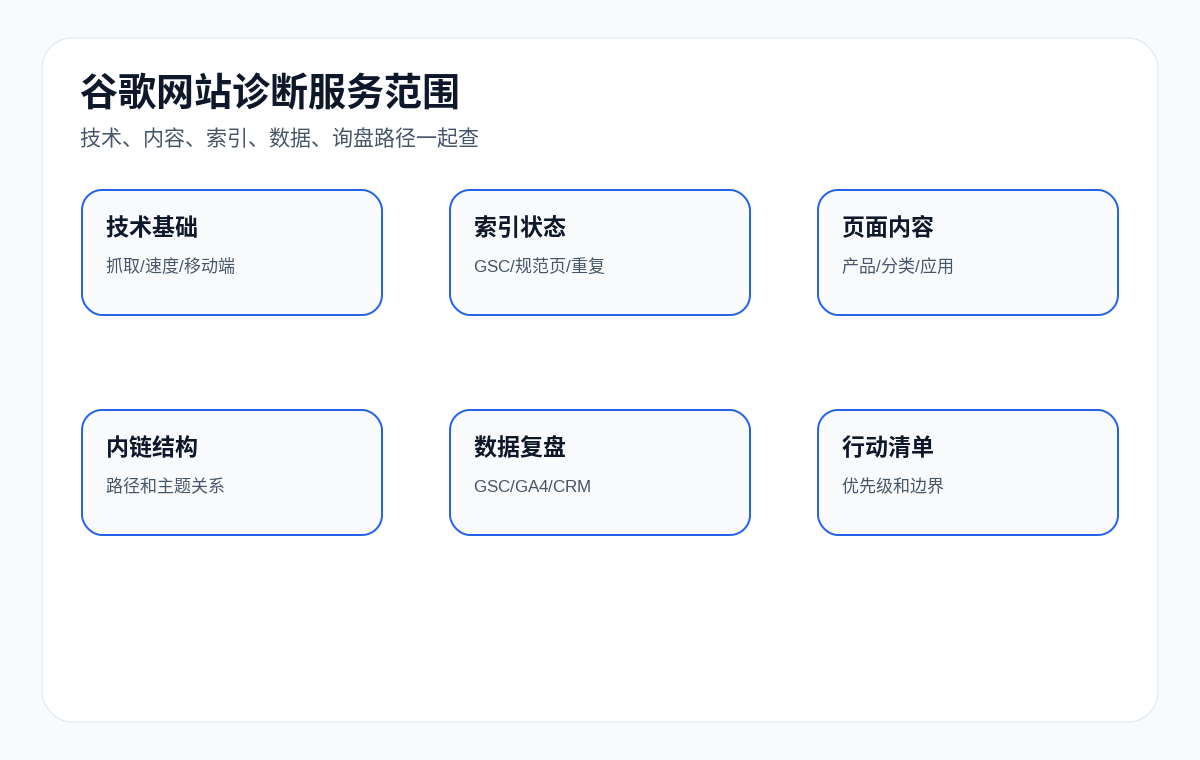
A quote scoring model: put different teams into the same acceptance table
When a company receives multiple quotes, do not first look at which is cheapest or which uses more professional wording. A more reliable comparison is to break every quote into the same acceptance table: did they look at the same set of URLs, use the same GSC/GA4 metrics, list product material gaps, define the technical scope, state the review cycle, and exclude uncontrollable outcomes from their promises?
The purpose of this scoring model is not to choose a team for the company but to make quote comparison reviewable. A low score does not necessarily mean the team is less capable; it may simply mean a narrower scope. A high score does not guarantee search results; it only means the quote document is clearer and easier to execute and accept.
| Scoring dimension | 0-point response | 1-point response | 2-point response | Why it affects the quote |
|---|---|---|---|---|
| URL scope | Only says sitewide optimization. | Lists some page types. | Lists specific URLs, page roles, and priorities. | Determines how many pages are actually changed. |
| Data metrics | Does not mention data. | Only mentions GSC or GA4 by name. | States query/page, events, date range, and how no-data cases are handled. | Determines whether the review aligns with facts. |
| Technical baseline | Only says technical optimization. | Lists a few check items. | Lists status codes, sitemap, robots, canonical, mobile, and indexing spot checks. | Determines whether basic errors are ruled out first. |
| Product facts | Does not request company materials. | Requests a product introduction. | Requests specs, images, certifications, applications, FAQ, and sales questions. | Determines whether content can answer procurement decisions. |
| Delivery records | Only provides a summary. | Provides a monthly report. | Provides URLs, dates, actions, evidence, and next steps. | Determines whether the company can review and hand over. |
| Risk boundary | Writes outcome promises. | Partially explains boundaries. | Clearly states that rankings, inquiries, and AI answer adoption cannot be directly controlled. | Determines whether expectations are healthy. |
How to run the internal review meeting: sales, operations, and the owner each look at one thing
An SEO quote is not one person’s job in operations. Inside an export business, at least sales, operations, and the decision maker should each review a part: sales confirms product facts and procurement questions, operations confirms URLs, content, and data fields, and the decision maker confirms budget, timeline, and permission boundaries. When all three have reviewed it, the quote is less likely to be renegotiated later.
| Role | What to review before quoting | What to ask the partner team | What to check at acceptance |
|---|---|---|---|
| Sales | Product specs, frequently asked customer questions, and quoting difficulties. | How the page explains materials, MOQ, samples, and lead time. | Whether the page reduces repetitive communication. |
| Operations | URL list, sitemap, GSC, GA4, content schedule. | Which URLs change each month and how actions are recorded. | Whether front-end content, event tracking, and the review sheet are consistent. |
| Decision maker | Budget, timeline, permissions, handover, and risk. | Which outcomes cannot be promised and which assets belong to the company. | Whether work is delivered to scope and whether data is retainable. |
What to do in the first week after the quote is approved: build the baseline, don’t rush big changes
In the first week after the engagement starts, it is not advisable to change pages on a large scale right away. A steadier order is to establish a baseline: freeze a version of the URL list, record sitemap and robots, export the current GSC state, confirm GA4 events, list the first batch of pages to change, and write every action into the record sheet. That way, when things change later, everyone knows what it looked like before.
Without this step, it is easy to argue later over “whether the change was really caused by SEO.” With a baseline, even without GSC row data for now, you can review which URLs were changed, which tables and FAQ were added, which events were configured, and which pages are still awaiting observation.
| First-week action | Deliverable | Acceptance criteria | Notes |
|---|---|---|---|
| Freeze the URL list | Page inventory sheet. | Includes URL, role, priority, and current problem. | New pages are recorded separately later. |
| Record the technical baseline | sitemap, robots, canonical, status code spot checks. | Key pages have no obvious access blocks. | Grade issues first; do not fix everything at once. |
| Record the data baseline | GSC, GA4, events, and date range. | If there is data, write the data; if not, write the zero-row baseline. | Do not interpret empty data as a performance conclusion. |
| Confirm the first batch of pages | 3 to 10 priority URLs. | The company confirms product facts and materials. | Do representative pages first, then extend to similar pages. |
| Set up the review sheet | Action records, evidence, next steps. | Every action is traceable. | Later monthly reports extend from this sheet. |
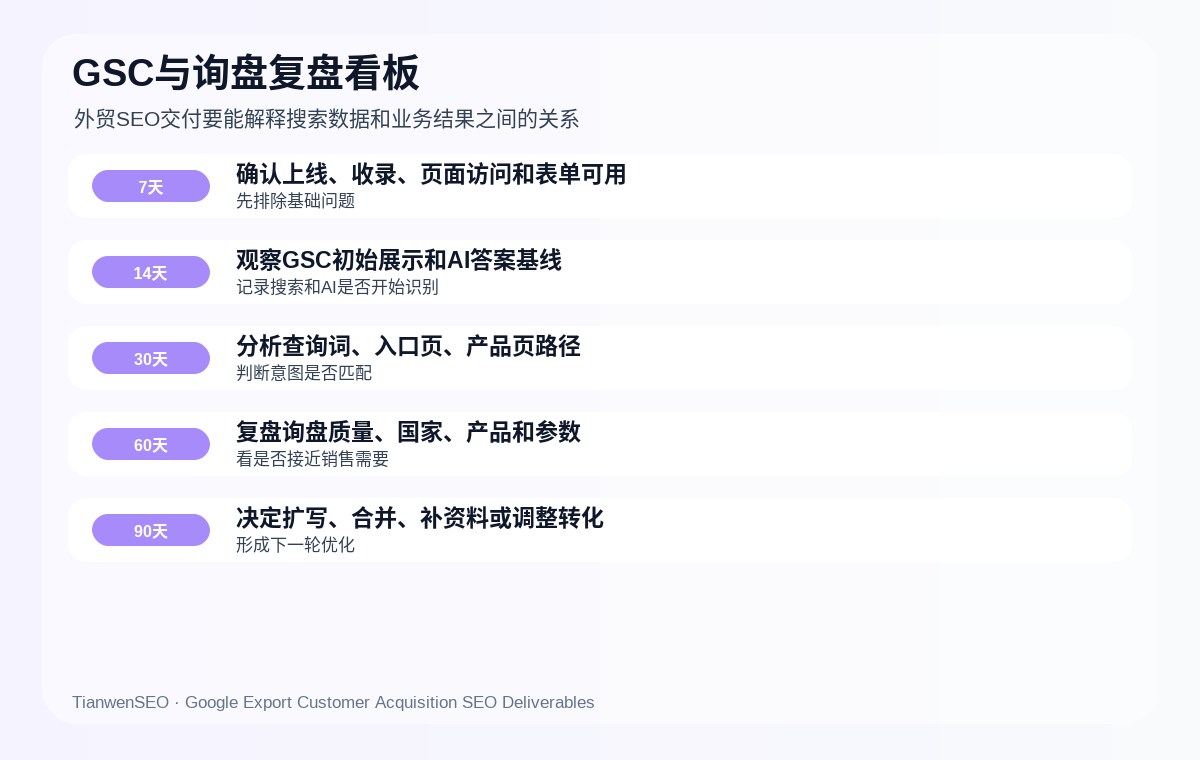
How to write review metrics into the quote: use observation periods instead of instant judgments
An SEO quote should state the review metrics in advance. Technical fixes can usually be accepted relatively quickly, because status codes, sitemap, robots, front-end content, and mobile rendering can all be checked directly; search performance needs an observation period; and inquiry quality also depends on sales feedback. Writing these periods clearly will prevent many later misunderstandings.
| Review subject | Can be accepted quickly | Needs observation | Cannot be judged immediately |
|---|---|---|---|
| Technical fixes | Status codes, sitemap, robots, canonical, meta robots. | Google recrawling and index updates. | Search performance cannot be judged the same day. |
| Content updates | Visible on the front end, clear structure, product facts added. | Whether query/page data gradually appears. | Stable rankings cannot be judged right away. |
| Inquiry path | Forms, buttons, events, and contact methods work. | Visit paths and inquiry quality. | A single inquiry cannot be treated as long-term performance. |
| AI search observation | Pages are accessible, facts are sufficient, monitoring metrics exist. | Periodic answer changes for brand and product questions. | A single answer screenshot cannot be treated as a controllable result. |
So the most important thing before quoting is not to shorten the communication time, but to write three things clearly first: what is deliverable, what is observable, and what is handover-ready. Only when these three are recorded will the company later know which page, which type of evidence, and which review each budget item corresponds to.
FAQ
Can I get a quote without GSC?
You can get a quote, but the assessment will be much rougher. It is best to set up GSC as soon as possible and submit the sitemap. Without GSC, at minimum you need page crawling, indexing spot checks, and key URL checks.
Is asking about price first the fastest approach?
Of course you should ask about price, but it is best to compare after the other side has seen the pages, data, and product materials. Otherwise different quotes may cover completely different scopes, and the numbers are not comparable.
Do I need to prepare English keywords before an SEO quote?
It is best to prepare a first draft list covering product terms, supplier terms, application scenario terms, and procurement question terms. The partner team can then revise it based on data and competing pages.
If the website pages are messy, should content or technical work come first?
First determine whether it affects crawling, indexing, and page topics. If key pages cannot be discovered or the structure is very messy, usually do the technical and page structure work first, then expand content.
Related reading and official documentation
- Why Google SEO team quotes vary so much: how to read workload, page count, and review frequency
- What to confirm before signing a Google SEO service contract: goals, permissions, deliverables, and risk boundaries
- What to review before a GEO team quotes: the AI visibility baseline matters more than the package
- SEO diagnosis and optimization: a troubleshooting guide for export website indexing, rankings, technical issues, and the inquiry path
- Google Search Central: SEO Starter Guide
- Google Search Central: Sitemaps overview
- Google Search Central: Robots.txt introduction
Keep reading this SEO series
If you are systematically working through export website SEO, continue with the articles below. First get the relationships among crawling, indexing, content, links, and review straight, then decide which page to change next.
- What a Google website diagnosis service includes: a guide to technical, content, indexing, and GSC diagnosis
- What a Google SEO monthly review report should include: GSC, pages, and next actions
- How to judge the most reliable export website and promotion team in China: don’t look at promises, look at diagnosis and evidence
- What Google export lead generation optimization includes: technical work, content, GSC review, and a deliverables checklist
- How to choose a Google SEO outsourcing team: permissions, division of labor, review, and risk boundaries
- What is the difference between a Google export website optimization consultant and an export website and promotion team: how to choose what fits better
{
“@context”: “https://schema.org”,
“@type”: “FAQPage”,
“mainEntity”: [
{
“@type”: “Question”,
“name”: “Can I get a quote without GSC?”,
“acceptedAnswer”: {
“@type”: “Answer”,
“text”: “You can get a quote, but the assessment will be much rougher. It is best to set up GSC as soon as possible and submit the sitemap. Without GSC, at minimum you need page crawling, indexing spot checks, and key URL checks.”
}
},
{
“@type”: “Question”,
“name”: “Is asking about price first the fastest approach?”,
“acceptedAnswer”: {
“@type”: “Answer”,
“text”: “Of course you should ask about price, but it is best to compare after the other side has seen the pages, data, and product materials. Otherwise different quotes may cover completely different scopes, and the numbers are not comparable.”
}
},
{
“@type”: “Question”,
“name”: “Do I need to prepare English keywords before an SEO quote?”,
“acceptedAnswer”: {
“@type”: “Answer”,
“text”: “It is best to prepare a first draft list covering product terms, supplier terms, application scenario terms, and procurement question terms. The partner team can then revise it based on data and competing pages.”
}
},
{
“@type”: “Question”,
“name”: “If the website pages are messy, should content or technical work come first?”,
“acceptedAnswer”: {
“@type”: “Answer”,
“text”: “First determine whether it affects crawling, indexing, and page topics. If key pages cannot be discovered or the structure is very messy, usually do the technical and page structure work first, then expand content.”
}
}
]
}
This page is machine-translated from the Simplified Chinese version and awaiting human review. It has not yet been proofread.
Further Reading on This B2B SEO & GEO Topic
- What are the red flags of an unreliable Google SEO company: be cautious of these promises
- What are the red flags of an unreliable GEO company: why are AI recommendation promises risky
- How to choose GEO tools and AI Search Visibility tools: 2026 checklist for monitoring, content, and verification tools
- How to choose AI Search Visibility tools: how to evaluate monitoring of brand mentions and citations
- B2B Export Website Architecture Cost, Google Ads Synergy, and Inquiry CRO Hub
- Generative Engine Optimization Research
- B2B Export SEO & GEO Research Index