B2B SEO differs from ordinary traffic-driven SEO mainly in that the buyer’s decision cycle is longer, more roles are involved, technical materials matter more, and inquiry quality matters more than visit volume. For export factories and trading companies, B2B SEO is not about turning every keyword into an article; it is about making sure that at every step — from “identifying a problem” to “confirming specifications” to “comparing suppliers” and “submitting an inquiry” — a suitable page is there to capture the buyer.
For example, a buyer of custom metal parts may start by searching for materials and processes, then look at the tolerances, surface treatment, drawing formats, and quotation process for cnc machining parts; an LED flood light buyer will compare wattage, lumen, IP rating, and warehouse/stadium/outdoor applications; a packaging machine buyer will judge by powder, liquid, granule, food, small business, and capacity; a medical probe buyer will focus on compatibility, materials, quality documents, and application boundaries; a waterproof connector buyer will look at IP rating, pin count, cable type, and drawing. A B2B SEO content system must be built around these real procurement questions, not around general talk about rankings.
SERP Top1 / Authoritative Benchmark Comparison Card
+
| Benchmark source | What they get right | Gap | Tianwen SEO Research additions |
|---|---|---|---|
| Backlinko / Ahrefs / Semrush B2B SEO guides | Emphasize audience, keywords, content funnel, links, and conversion. | Skewed toward generic SaaS and service scenarios; export product materials and inquiry details are insufficient. | Add export product terms, technical materials, RFQ fields, and sales feedback. |
| HubSpot / CXL B2B content and lead generation | Emphasize long decision cycles, multiple touchpoints, and sales collaboration. | Do not break down product pages, category pages, industry pages, and technical articles directly. | Use a page-type matrix to capture different procurement intents. |
| Google helpful content | Emphasize helping users, original analysis, and trustworthy sources. | Do not provide a B2B export landing-page table. | Turn helpful content into procurement decision tables and evidence modules. |
+
+
+
The B2B buyer journey: keywords are not a single-layer funnel
+
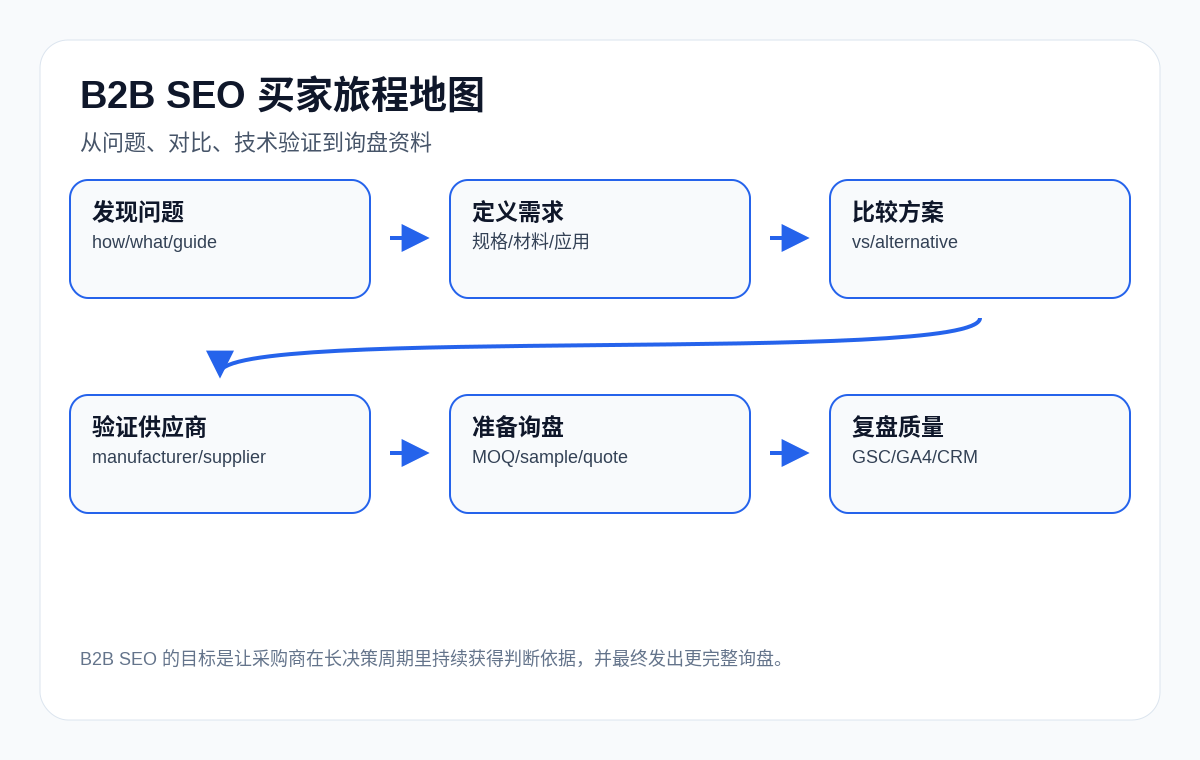
B2B procurement usually does not end in a purchase after one search. Procurement engineers, purchasing managers, owners, quality leads, and project leads may search different questions at different stages. SEO content must cover five stages: discovery, definition, comparison, verification, and inquiry preparation.
+
| Stage | Buyer question | Example search terms | Page type |
|---|---|---|---|
| Identifying a problem | What solution do I need | how to choose waterproof connector | Technical article/guide |
| Defining needs | How do I judge specifications and applications | IP67 connector for outdoor equipment | Category page/application page |
| Comparing options | What is the difference between A and B | IP67 vs IP68 connector | Comparison article/FAQ |
| Verifying suppliers | What kind of manufacturer can make it | cnc machining parts manufacturer | Product line/capability page |
| Preparing an inquiry | What should I provide for a quote | custom metal parts quote drawing | Inquiry page/RFQ guide |
+
+
Page type matrix: do not write everything as an article
+
+
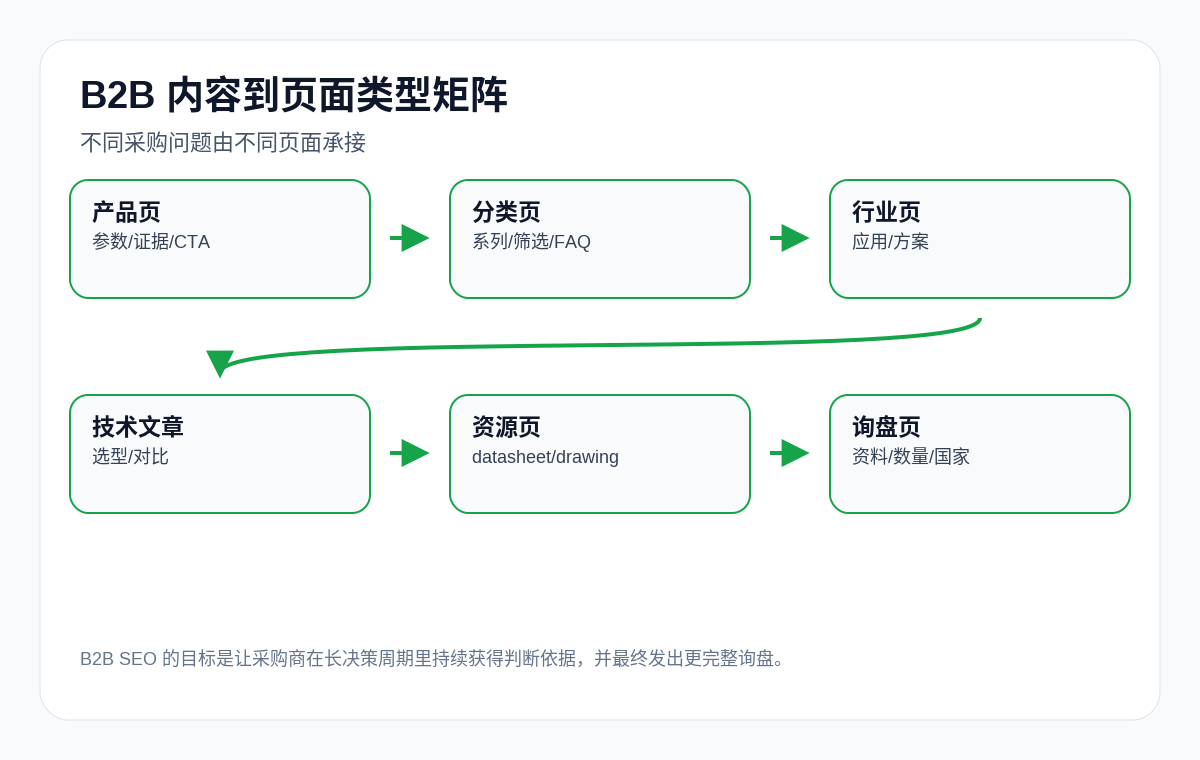
| Page type | Intent captured | Core modules | Export example |
|---|---|---|---|
| Product page | Judging specific products and models | Specifications, materials, images, certifications, CTA | Compatibility and material notes for medical probe |
| Category page | Series and filtering | Category description, filters, FAQ, related products | LED flood light category page |
| Industry page | Application scenarios and solutions | Problems, recommended products, standards, inquiry entry | industrial valve for water treatment |
| Technical article | Selection, comparison, maintenance, standards | Steps, tables, pitfalls, internal links | IP67 vs IP68 connector |
| Resource page | Document downloads and technical verification | datasheet, drawing, catalog, FAQ | cnc machining drawing requirements |
| Inquiry page | Submitting requirements | Product, quantity, specifications, country, attachments | custom metal parts RFQ |
+
+
Product pages: the commercial core of B2B SEO
+
A product page is not just an image and a one-line description. A B2B product page must answer the questions that let a buyer make a judgment: product scope, key specifications, materials, processes, certifications, quality control, MOQ, samples, lead time, packaging, and drawing or specification documents. Product pages are also the commercial destinations that technical articles and category pages should ultimately lead to.
+
| Product page module | Procurement value | Example | Review metric |
|---|---|---|---|
| Specification table | Quickly judge a match | IP rating and pin count for waterproof connector | Specification-term queries and inquiry completeness |
| Materials/processes | Prove manufacturing capability | aluminum and stainless steel for cnc machining parts | Material-term impressions |
| Application scenarios | Connect to industry needs | LED flood light for warehouse | Application-term clicks |
| Quality evidence | Build trust | Quality documents and compatibility notes for medical probe | Document downloads and sales feedback |
| Inquiry materials | Reduce back-and-forth | Drawings, quantity, target country, use case | Fewer follow-up questions from sales |
+
+
Category pages and industry pages: capturing commercial and application terms
+
An export B2B category page cannot just list products, and an industry page cannot just carry slogans. Category pages must explain series differences, filtering dimensions, and common questions; industry pages must describe application scenarios, pain points, recommended products, standards, and the inquiry path. These are the main pages for capturing commercial and application keywords.
+
| Page | Suitable terms | Key content | Example |
|---|---|---|---|
| Category page | Main product terms, series terms, supplier terms | Category description, product comparison, FAQ, CTA | LED flood light manufacturer |
| Industry page | Application terms, industry solution terms | Scenario problems, recommended products, standards, case boundaries | packaging machine for food powder |
| Region/market page | Market standards and export requirements | Certifications, logistics, payment, after-sales notes | industrial valve for Middle East projects |
| Resource page | Specifications, downloads, technical verification | datasheet, drawing, catalog, size chart | private label activewear size chart |
+
+
Technical content: written to help buyers decide, not to address peers
+
B2B technical content is often written as industry general knowledge, but what is truly valuable is helping buyers make a choice. Articles should include decision tables, steps, applicable scenarios, the consequences of a wrong choice, questions to confirm with the supplier, and natural links to product pages, category pages, and inquiry pages.
+
| Technical topic | Procurement question | Page action | Internal link |
|---|---|---|---|
| IP67 vs IP68 connector | How to choose a waterproof rating | Write a comparison table and application boundaries | Link to the waterproof connector category page |
| CNC tolerance guide | How precision requirements affect quotes | Write tolerances and drawing requirements | Link to custom metal parts RFQ |
| Powder packaging machine selection | How to choose powder packaging equipment | Write material, speed, cleaning, and bag-type tables | Link to the packaging machine product line |
| Activewear fabric comparison | How to choose fabric and logo processes | Write fabric, MOQ, sample process | Link to the private label activewear manufacturer page |
+
+
Inquiry pages and RFQ: the conversion check for B2B SEO
+
If SEO pages bring visits but the inquiry page cannot collect enough information, the sales team will still struggle to follow up. An RFQ form should not ask only for name and email; it should also prompt buyers, based on product type, to provide key materials.
+
| Field | Suitable products | Why it matters | Review |
|---|---|---|---|
| Product/model | All products | Match page and seller | Whether inquiries can be attributed to a URL |
| Quantity/MOQ | Wholesale and custom | Judge quote feasibility | Share of low-quality inquiries |
| Specifications/materials | Metal parts, connectors, medical components | Affect cost and feasibility | Number of sales follow-ups |
| Application scenario | Lighting, valves, machinery | Judge model selection | Inquiry match rate |
| Attachments | custom parts, OEM/ODM | Drawings and sample photos improve efficiency | Share of inquiries with attachments |
| Target country | Export business | Affects certification, logistics, and payment | Share of inquiries from target markets |
+
+
Content cadence under a long decision cycle
+
B2B SEO cannot publish only new products, nor write only tutorials. The content cadence must cover commercial page improvements, technical articles, resource documents, FAQ updates, and review-driven optimization. A product line usually needs a pillar page, category pages, industry pages, problem articles, and an inquiry page working together.
+
| Phase | Content action | Goal | Example |
|---|---|---|---|
| Phase 1 | Complete core product pages and category pages | Capture commercial terms | cnc machining parts manufacturer |
| Phase 2 | Complete industry and application pages | Capture application demand | LED flood light for warehouse |
| Phase 3 | Write technical selection articles | Capture question terms | IP67 vs IP68 connector |
| Phase 4 | Organize resource and download pages | Support technical verification | datasheet, drawing, catalog |
| Phase 5 | Optimize inquiry pages and CTAs | Improve inquiry quality | RFQ checklist |
+
+
Keyword grouping: B2B cannot be sorted by search volume alone
B2B keyword research should be grouped by procurement stage and page type. High-volume generic terms do not necessarily bring inquiries, while low-volume but clearly intent-driven specification terms, application terms, supplier terms, quote terms, and document terms may be closer to real procurement. Export companies should divide keywords into main product terms, process terms, material terms, application terms, question terms, comparison terms, supplier terms, and inquiry terms.
| Keyword group | Intent | Page type | Example |
|---|---|---|---|
| Main product terms | Understand or find a product | Category page/product line page | LED flood light, packaging machine |
| Process terms | Judge manufacturing capability | Process page/technical article | cnc machining parts, surface treatment |
| Material terms | Confirm applicable materials | Material page/product page module | stainless steel valve, aluminum parts |
| Application terms | Confirm scenario fit | Industry page/application page | LED flood light for warehouse |
| Question terms | Resolve selection questions | Article/FAQ | IP67 vs IP68 connector |
| Supplier terms | Find a manufacturer or trading company | Capability page/category page | industrial valve supplier |
| Inquiry terms | Prepare a quote | Inquiry page/RFQ guide | custom metal parts quote |
How product materials become SEO content assets
Many export companies have a large amount of product material but have not turned it into searchable, readable, citable page content. Datasheets, catalogs, drawings, process descriptions, QC workflows, packaging notes, FAQs, and sales emails can all become page modules. The key is not to upload PDFs only, but to put important information into HTML so that both search engines and buyers can read it.
| Material | What it can become | Applicable pages | Value |
|---|---|---|---|
| Datasheet | Specification table, specification explanations, download entry | Product page/resource page | Support technical verification |
| Drawing | Drawing format requirements, quote material checklist | Inquiry page/technical article | Improve RFQ quality |
| Catalog | Category entries, series comparison, product matrix | Category page/resource page | Help buyers browse |
| Sales emails | FAQ, common pitfalls, procurement checklist | Article/product page | Reduce repetitive communication |
| QC workflow | Quality control description, trust module | Product page/about page | Improve credibility |
| Packaging and logistics notes | Delivery and export capability module | Product page/industry page | Support decision-making by large clients |
How the sales team participates in B2B SEO
B2B SEO cannot be written behind closed doors by content staff alone. The sales team knows best what customers ask, which inquiries are invalid, and which missing information causes repeated back-and-forth. At least once a month, organize sales questions and turn them into FAQs, technical articles, product page modules, or inquiry form prompts.
| Sales feedback | What it indicates | Page action | Example |
|---|---|---|---|
| Customers always ask about MOQ | The page does not explain order minimum logic | Add an MOQ FAQ and influencing factors | private label activewear MOQ |
| Customers lack drawings | The inquiry page gives insufficient prompts | Add drawing upload and format notes | custom metal parts drawing |
| Customers ask about certifications | Quality evidence is unclear | Add certifications and applicable scope | medical probe documents |
| Customers compare models | Category page filters are insufficient | Add comparison tables and selection guides | LED flood light wattage |
| Customers ask about lead time | The production process is not transparent | Add sample, production, and shipping workflows | packaging machine lead time |
How to write industry pages: do not just pile up application terms
An industry page should start from the procurement scenario, not copy a product list. An industry page should explain the usage environment, pain points, selection criteria, recommended products, quality requirements, common questions, and inquiry materials for that industry. It is suited to capturing industry application and solution terms.
| Industry page module | What to write | Export example | Purpose |
|---|---|---|---|
| Application environment | Temperature, humidity, load, cleaning, corrosion resistance | industrial valve for chemical processing | Help buyers judge suitability |
| Pain points | Why the customer needs this solution | food powder packaging dust control | Connect to real demand |
| Recommended products | Different models and series | warehouse LED flood light series | Lead to product pages |
| Quality requirements | Certifications, testing, materials, standards | medical probe quality requirements | Build trust |
| Inquiry materials | Quantity, specifications, application, country, attachments | custom metal parts RFQ checklist | Improve conversion quality |
Resource pages and downloadable documents: supporting a long decision cycle
B2B procurement often requires internal review. Buyers send datasheets, catalogs, drawings, size charts, certifications, and installation guides to engineering, purchasing, their boss, or their own customers for confirmation. Resource pages help these documents be discovered and help AI and search engines understand the product more accurately.
| Resource type | Suitable products | Page handling | Review |
|---|---|---|---|
| Datasheet | connector, valve, medical probe | HTML summary + PDF download | Downloads and inquiry quality |
| Drawing guide | custom metal parts, cnc machining | Explain format, tolerance, materials | Share of inquiries with drawings |
| Catalog | ceramic dinnerware, lighting | Split entries by category | Category page visits |
| Size chart | activewear, apparel | Size table and sample garment workflow | Sample inquiries |
| Certification | medical, electrical, industrial | List document types and applicable scope | Fewer sales follow-ups |
AI/GEO: how B2B pages can be cited more accurately
For B2B pages to be understood accurately by AI, the answer is not more marketing language but clear definitions, product capabilities, specification tables, FAQs, evidence, and boundaries. AI citations change and cannot be promised to appear consistently, but you can improve the foundation for a page to be accurately extracted and cited.
| Module | What AI needs | Export example | Action |
|---|---|---|---|
| Definition sentence | Clear page topic | What is a waterproof connector? | State scope and application in the first paragraph |
| Specification table | Extractable facts | IP rating, pin count, material | Use an HTML table |
| FAQ | Clear questions and answers | MOQ, sample, lead time | Answer specific procurement questions |
| Evidence | Credible sources | certification, datasheet, QC process | Explain applicable scope |
| Entity consistency | Company and product capabilities do not conflict | Consistent About, product, and contact pages | Unify wording |
A 30-60-90 day review cadence for B2B SEO
| Time | What to look at | Judgment | Action |
|---|---|---|---|
| 30 days | Indexing, initial impressions, target URLs | Whether pages are discovered | Add internal links and sitemap entries |
| 60 days | Queries, CTR, paths | Whether they enter the right intent | Adjust titles, FAQs, mapping |
| 90 days | Inquiry sources, quality, sales feedback | Whether it helps the business | Strengthen high-value pages |
| Quarterly | Product materials, market, competitor changes | Whether content is outdated | Refresh product and resource pages |
B2B procurement roles: different people search different questions
B2B SEO cannot assume a single “buyer.” In real procurement, engineers, purchasing managers, owners, quality leads, project managers, and distributors care about different questions. Content must let all these roles find the basis for their judgment.
| Role | What they care about | Search terms | Page content |
|---|---|---|---|
| Engineer | Specifications, materials, compatibility, tolerances | cnc machining tolerance, IP67 connector specs | Specification tables, technical articles, datasheet |
| Purchasing manager | Suppliers, price, lead time, MOQ | manufacturer, supplier, MOQ, quote | Capability page, inquiry page, FAQ |
| Owner/decision maker | Reliability, scale, cooperation risk | factory, quality control, export experience | About page, quality page, case boundaries |
| Quality lead | Certifications, inspection, documents | certification, QC, inspection report | Quality control and document pages |
| Distributor | Series completeness, packaging, after-sales | wholesale, private label, packaging | Category pages, private label pages, downloadable documents |
Trust evidence: B2B pages cannot rely on adjectives alone
B2B buyers will not submit an inquiry just because a page says “professional, reliable, high quality.” They need evidence: specifications, images, testing, certifications, processes, authorized customer materials, factory capability, delivery boundaries, and after-sales scope. When there is no evidence, state clearly what documents can be provided rather than exaggerating.
| Evidence type | Applicable pages | Export example | How to write |
|---|---|---|---|
| Specification table | Product page/category page | waterproof connector specs | List key specifications and applicable scope |
| Process workflow | Capability page/article | cnc machining process | Explain the steps from drawing to QC |
| Inspection notes | Quality page/product page | medical probe inspection | List available inspection items |
| Certification documents | Resource page | CE, RoHS, ISO | Explain the applicable scope of the documents |
| Application images | Industry page | LED flood light warehouse | Show real applications or product scenarios |
| Sales FAQ | Product page/inquiry page | sample, lead time, MOQ | Answer pre-purchase questions |
Multilingual and target markets: B2B SEO must account for regional differences
If an export B2B website serves multiple markets, it cannot simply machine-translate English pages into other languages. Standards, certifications, logistics, payment, forms of address, and procurement habits may differ across markets. Multilingual pages must keep core product information consistent while adding the explanations each target market needs.
| Market dimension | Possible differences | Page action | Example |
|---|---|---|---|
| Certification standards | Different countries focus on different documents | Explain the applicable scope on the market page | medical probe for EU market |
| Logistics and delivery | Lead times and shipping methods differ | Add delivery notes and inquiry fields | industrial valve shipment to Middle East |
| Language wording | Product names differ | Do localized keyword validation | activewear / sportswear / gym wear |
| Procurement habits | MOQ, samples, and payment concerns differ | Add FAQs by market | ceramic dinnerware wholesale Europe |
| Search results | SERP page types differ | Observe results by target country separately | LED flood light supplier USA vs UAE |
Mobile B2B SEO: preliminary judgment must be possible on a phone
Although B2B buyers may ultimately download documents and submit complex inquiries on a computer, many initial searches happen on a phone. Mobile pages must not hide specifications, FAQs, catalogs, downloadable documents, or the inquiry entry. Mobile should let buyers quickly judge whether a product fits, leaving more complex document downloads and RFQs for later steps.
| Mobile module | Requirement | Risk | Action |
|---|---|---|---|
| Above the fold | Product, application, and CTA are clear | A large image and slogan fill the whole first screen | Compress the first screen and give an answer |
| Specification table | Readable or card-based | Table overflows horizontally | Responsive table |
| FAQ | Expandable and crawlable | Hidden on mobile | Keep core Q&A |
| Document downloads | PDF opens and has an HTML summary | Files are too large | Compress and provide a summary |
| Inquiry button | Obvious and not obstructing | Button too small or broken | Sticky CTA or CTA after paragraphs |
Content priorities: start with the pages that affect inquiry quality
When resources are limited, B2B SEO should prioritize the pages that affect inquiry quality rather than spreading effort evenly. You can score them by commercial value, search intent, material readiness, sales feedback, and page gaps.
| Priority | Page/content | Why | Example |
|---|---|---|---|
| P0 | Core product pages and category pages | Capture commercial terms and inquiries | custom metal parts, LED flood light |
| P1 | High-value industry pages | Capture application terms | packaging machine for food powder |
| P1 | Inquiry page/RFQ | Affects conversion quality | custom parts quote checklist |
| P2 | Technical comparison articles | Capture question terms and internal links | IP67 vs IP68 connector |
| P2 | Resource page | Support technical verification | datasheet, drawing, catalog |
| P3 | Low-value general explainers | Weak commercial path | Keep only essential content |
Internal links: let informational content lead to commercial pages
A common B2B SEO problem is having many articles that are disconnected from product pages. Technical articles should link to product pages, category pages, industry pages, resource pages, and inquiry pages at appropriate points; product pages should also link to technical articles to help buyers decide. Internal links are not about piling up links but about building a procurement path.
| Source page | Should link to | Purpose | Example |
|---|---|---|---|
| Technical article | Product page/category page/RFQ | Informational demand enters commercial pages | IP67 guide → waterproof connector category |
| Category page | Industry page/selection article/inquiry page | Help buyers judge further | LED flood light → warehouse lighting |
| Product page | FAQ/resource page/related products | Supplementary documents and comparison | medical probe → compatibility guide |
| Industry page | Recommended products/document downloads/contact entry | Move from application into inquiry | industrial valve water treatment → valve quote |
| Resource page | Product page/inquiry page | Act after technical verification | datasheet → request sample |
Pre-publish acceptance checklist for B2B SEO
| Acceptance item | Pass criteria | Failure signs |
|---|---|---|
| Customer perspective | Aimed at export factories and trading companies | Only SEO concepts discussed |
| Product examples | Use English product terms and procurement questions | Default to your own industry’s terms |
| Page roles | Product pages, category pages, articles, and inquiry pages are clear | Every keyword is written as an article |
| Technical evidence | Specifications, images, certifications, documents, and FAQs are complete | Only adjectives |
| Conversion path | CTA, forms, and document prompts are clear | Traffic but no inquiries |
| Review data | GSC, GA4, CRM, and sales feedback are trackable | Only rankings |
| Boundary statements | Do not promise uncontrollable results | Imply guaranteed inquiries or stable rankings |
B2B content calendar: built around product lines, not random topics
A B2B SEO content calendar should not chase trending topics every day; it should keep filling in around core product lines and procurement questions. Every product line should have a main page, supporting pages, FAQs, resource documents, and a review plan.
| Week/month task | Content type | Goal | Example |
|---|---|---|---|
| Week 1 | Improve core product pages | Capture commercial terms | waterproof connector category |
| Week 2 | Application scenario pages | Capture industry terms | LED flood light for warehouse |
| Week 3 | Technical selection articles | Answer procurement questions | IP67 vs IP68 connector |
| Week 4 | Resource pages/RFQ pages | Support inquiries | custom metal parts drawing checklist |
| Monthly | FAQ updates | Absorb sales feedback | MOQ, sample, lead time |
| Quarterly | Content refresh | Based on GSC and inquiry review | Update high-value pages |
Case studies and evidence boundaries: without authorization, do not write result pages
B2B companies want to showcase customer projects, but without authorization they must not publish real customer data, inquiry amounts, customer names, URLs, or screenshots. You can write about public problem types, anonymized diagnostic frameworks, and methodology, and you can describe product application scenarios, but you must not package unauthorized content as project results.
| Content type | What can be written | What must not be written | Alternative wording |
|---|---|---|---|
| Methodology | Diagnostic workflows, decision tables, review metrics | Specific customer data | Write it as an actionable framework |
| Public scenarios | Product terms and procurement questions | Customer identity and orders | Demonstrate with scenarios such as custom metal parts |
| Anonymized problems | De-identified problem types | Information that can be traced back to the customer | State that this is a common problem type |
| Authorized evidence | Permitted URLs, screenshots, data | Content outside the authorized scope | Note the source, time, and boundaries |
Technical SEO basics: even great B2B content must be discoverable
No matter how well product pages and technical articles are written, they will struggle to deliver value if crawling, indexing, mobile experience, speed, structured data, and internal linking have problems. The technical foundation of B2B SEO need not be complex, but it must be stable.
| Technical item | What to check | Export risk | Action |
|---|---|---|---|
| Crawling | Whether core URLs are accessible | Product pages are not discovered | Check sitemap, internal links, robots |
| Indexing | Whether noindex/canonical accidentally blocks it | Commercial pages are not indexed | Check GSC URL Inspection |
| Mobile | Whether specifications, FAQs, and CTAs are retained | Mobile content becomes thin | Ensure mobile content consistency |
| Speed | LCP, INP, CLS | Images and scripts slow the page | Compress images, reduce blocking |
| Structured data | Product, FAQ, Breadcrumb | Insufficient machine understanding | Add Schema that matches real visible content |
| Internal links | Whether articles, products, categories, and inquiries are interconnected | Isolated pages | Add contextual links |
How to coordinate B2B SEO with advertising and trade shows
B2B SEO is not an isolated channel. Advertising brings short-term testing, trade shows bring product questions and customer feedback, and SEO can turn these needs into long-term pages. After every advertising campaign and trade show, organize the high-frequency questions, popular products, target countries, and inquiry material gaps into the website.
| Source | What it provides | Converted into SEO action | Example |
|---|---|---|---|
| Google Ads | High-converting queries and landing page performance | Add organic search pages and FAQs | packaging machine price |
| Trade shows | On-site customer questions and product concerns | Write selection guides and document pages | industrial valve project requirements |
| Sales emails | Material gaps before quoting | Optimize RFQ and product pages | custom metal parts drawing format |
| Customer service chat | Questions the page does not explain clearly | Add FAQs and CTA explanations | sample, MOQ, lead time |
| CRM | Inquiry quality and closed-deal leads | Strengthen high-quality source pages | Target country and product line priorities |
FAQ supplement: more practical B2B SEO questions
Does a B2B website need a blog?
Yes, but the blog is not the only focus. The blog should serve product and category pages, answer selection, comparison, application, and procurement questions, and use internal links to lead to commercial pages.
Can SEO content be written before product materials are complete?
You can start with basic pages first, but high-value pages must gradually add specifications, images, FAQs, certifications, and inquiry materials. Insufficient materials limit content depth.
Is B2B SEO suitable for targeting many long-tail keywords?
Yes, but first judge commercial value and page type. Low-volume, high-value long-tail terms can go into FAQs, product page modules, or technical articles.
Do few inquiries mean SEO is not working?
Not necessarily. Look at whether pages have impressions, clicks, paths, and form submissions, and also whether the product, price, target market, sales follow-up, and page conversion match.
Do B2B pages need images?
Yes. Product photos, detail photos, application photos, workflow diagrams, specification images, and document screenshots all help buyers decide and also strengthen page credibility.
B2B SEO team roles and collaboration
For B2B SEO to truly land, product, sales, technical, content, and management teams must collaborate. The product team provides specifications and materials, the sales team provides inquiry questions, the technical team ensures pages are crawlable and forms work, the content team turns materials into pages customers can understand, and management decides priority product lines and target markets.
| Role | Responsibility | Output |
|---|---|---|
| Product/engineering | Specifications, materials, processes, certifications | Product materials and technical boundaries |
| Sales | Customer questions, inquiry quality, deal feedback | FAQ and RFQ field suggestions |
| Technical | Crawling, indexing, speed, forms | Accessible pages and tracking events |
| Content | Page structure, tables, FAQs, internal links | Product pages, articles, resource pages |
| Management | Priorities, markets, product lines | Quarterly content direction |
This kind of division of labor keeps content from staying at the writing level and ensures that every page update has a clear source of materials and review owner.
Minimum viable standard for B2B SEO
If an export B2B website has limited resources, it should at least complete six things first: core product pages have specifications and an inquiry entry, category pages have filters and FAQs, technical articles answer real procurement questions, resource pages provide downloadable or readable documents, inquiry pages can collect specifications and quantity, and reviews connect GSC, GA4, and sales feedback. Below this standard, more content easily becomes scattered traffic that cannot support business decisions.
| Standard | Minimum requirement | Verification method |
|---|---|---|
| Product page | Specifications, applications, images, CTA | Manual checks on mobile and desktop |
| Category page | Category description, filters, FAQ, internal links | GSC queries and clicks |
| Technical article | Decision tables, steps, pitfalls, links to commercial pages | Path and scroll data |
| Inquiry page | Product, specifications, quantity, country, attachments | Form submission quality |
| Review | GSC, GA4, CRM, sales feedback | Monthly review sheet |
Review metrics: B2B SEO is not only about traffic
+
+
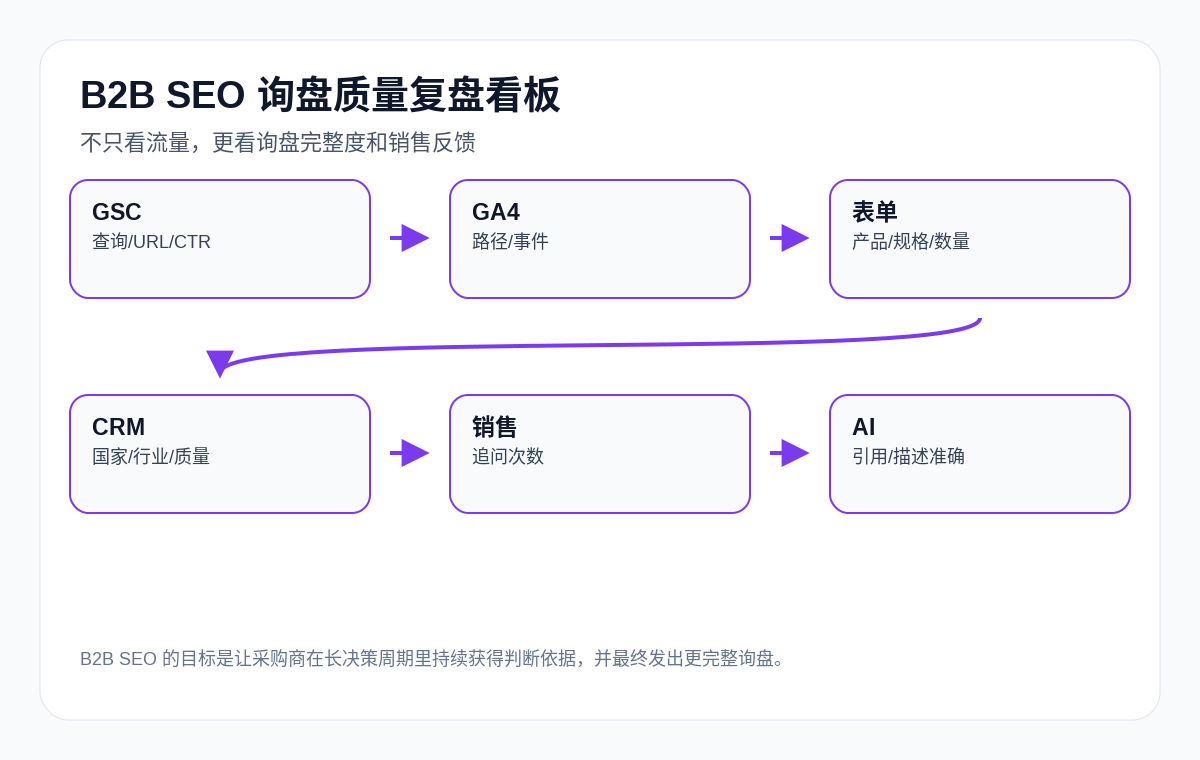
| Metric | Cadence | What to look at | Action |
|---|---|---|---|
| GSC queries | 30–60 days | Whether product, application, and question terms appear | Add titles, FAQs, internal links |
| Target URL | 30–60 days | Whether queries land on the right page | Adjust keyword mapping |
| GA4 paths | 60–90 days | The path from articles to product/inquiry pages | Optimize CTAs and recommended links |
| Form fields | 60–90 days | Whether product, specifications, quantity, and country are complete | Adjust the RFQ form |
| CRM quality | 60–90 days | Whether inquiries match target customers | Strengthen high-value terms and pages |
| Sales feedback | Monthly | Whether customers ask fewer basic questions | Add documents and FAQs |
| AI citation observation | 60–90 days | Whether AI cites the official site and describes it accurately | Add definition sentences, evidence tables, and entity consistency |
+
+
Common pitfalls
+
-
+
- Chasing visit volume only, without looking at inquiry quality.
- Writing every keyword as an article and ignoring product and category pages.
- Writing technical content for peers, so buyers still do not know how to choose after reading.
- Product pages missing specifications, materials, certifications, MOQ, and the sample process.
- Articles without internal links to commercial pages, so informational demand cannot enter the inquiry path.
- Inquiry forms collecting only name and email, forcing the sales team to keep asking follow-up questions.
- Looking only at rankings, not GSC queries, GA4 paths, CRM, or sales feedback.
- Defaulting to your own service terms in examples, so export customers cannot relate.
+
+
+
+
+
+
+
+
+
+
FAQ: common B2B SEO questions
+
What is the biggest difference between B2B SEO and B2C SEO?
B2B has a longer decision cycle, more roles involved, and greater importance placed on technical materials and trust evidence; ultimately it is judged by inquiry quality and sales follow-up, not just visit volume.
+
For a B2B export site, should you write articles first or build product pages first?
Core product pages, category pages, and the inquiry path should be laid down first, then technical articles and industry pages can cover question and application terms.
+
How deep should technical articles go?
Write deep enough for buyers to make a decision: applicable scenarios, specifications, comparisons, pitfalls, questions to confirm with the supplier, and the materials needed for the next inquiry step, rather than only conceptual explainers.
+
Are low-search-volume B2B terms worth targeting?
If commercial value is high, procurement intent is clear, and they can bring more complete inquiries, they are worth targeting. B2B cannot be sorted by search volume alone.
+
How do you judge whether B2B SEO is effective?
Look at whether GSC queries land on the target pages, whether GA4 shows a product/inquiry path, whether CRM inquiries are more complete, and whether sales has fewer basic follow-up questions.
+
What does AI/GEO mean for B2B SEO?
B2B pages with clear definitions, specification tables, FAQs, and evidence are more likely to be understood and cited accurately by AI. But AI citations change and should not be written as a fixed result.
+
Are more inquiry page fields always better?
No. Fields should revolve around product judgment: collect specifications, quantity, country, and attachments while avoiding excessive complexity that blocks submission.
+
How often should B2B SEO be reviewed?
For core pages, review search performance at 30–60 days, paths and inquiry quality at 60–90 days, and update content quarterly based on sales feedback.
+
+
Conclusion: the endpoint of B2B SEO is a clearer procurement decision
+
Export B2B SEO is not about making the website longer; it is about making it easier for buyers to judge: can this supplier do the work, is the product suitable, do the specifications meet the need, are the documents credible, and what should the inquiry include. A strong B2B website needs product pages, category pages, industry pages, technical articles, resource pages, and inquiry pages working together.
+
For export products such as custom metal parts, LED flood light, packaging machine, medical probe, waterproof connector, industrial valve supplier, and private label activewear manufacturer, the value of SEO is not to promise rankings or inquiry results, but to continuously reduce unclear information, mismatched pages, and low-quality inquiries, so the website becomes a genuine customer acquisition asset.
+
Official sources and B2B SEO acceptance boundaries
B2B SEO should break a long decision cycle into product terms, solution terms, document pages, inquiry entries, and review fields. What can be delivered is the page system and the evidence, not a guaranteed inquiry result.
| Official source | Used to judge | Boundary that must not be crossed |
|---|---|---|
| Google: SEO Starter Guide | Check the basic structure and discoverability of B2B pages | Basic optimization does not mean an inquiry has occurred |
| Google: Helpful content | Confirm whether content serves procurement, selection, and comparison tasks | Generic introductions cannot replace technical materials |
| Google: Make links crawlable | Confirm crawlable internal links between product pages, document pages, and the blog | Button events cannot count as internal link evidence |
| Search Console Performance report | Observe procurement term performance by page and query | When there are no rows, write “to be observed” only |
| GA4 events | Record forms, document downloads, and email clicks | Events do not explain the reason for search impressions |
Low-data-period review table
| Check item | Record fields | How to write during a low-data period |
|---|---|---|
| Page status | index/follow, canonical, sitemap, HTTP status code, in-body internal links | Record only the current state, do not write search performance |
| Content evidence | Page role, fact sources, product or service materials, update date | If materials are missing, list the material gaps; do not invent cases |
| GSC review | query, page, country, device, date window | If GSC has zero rows, write zero rows; do not extrapolate rankings or clicks |
| Conversion observation | GA4 events, forms, downloads, email clicks, inquiry entry | If there are no events, fix collection first and do not write inquiry conclusions |
Continue reading this SEO series
If you are systematically reviewing export website SEO, the following articles are worth reading next. First clarify the relationships among crawling, indexing, content, links, and review, then decide which page to change next.
- How to do WooCommerce SEO: a guide to categories, products, speed, and indexing for export e-commerce sites
- How to do SaaS SEO: a guide to feature pages, comparison pages, scenario pages, and content cluster layout
- How to do content SEO: a guide to search intent, information gain, and indexable content
- How to do keyword research: export product terms, search intent, and page mapping workflow
- How to mine competitor keywords: from competitor pages and English product terms to inquiry opportunities
- How to choose keyword tools: choose by diagnostic scenario, not by following a tool list
{
“@context”: “https://schema.org”,
“@type”: “FAQPage”,
“mainEntity”: [
{
“@type”: “Question”,
“name”: “Does a B2B website need a blog?”,
“acceptedAnswer”: {
“@type”: “Answer”,
“text”: “Yes, but the blog is not the only focus. The blog should serve product and category pages, answer selection, comparison, application, and procurement questions, and use internal links to lead to commercial pages.”
}
},
{
“@type”: “Question”,
“name”: “Can SEO content be written before product materials are complete?”,
“acceptedAnswer”: {
“@type”: “Answer”,
“text”: “You can start with basic pages first, but high-value pages must gradually add specifications, images, FAQs, certifications, and inquiry materials. Insufficient materials limit content depth.”
}
},
{
“@type”: “Question”,
“name”: “Is B2B SEO suitable for targeting many long-tail keywords?”,
“acceptedAnswer”: {
“@type”: “Answer”,
“text”: “Yes, but first judge commercial value and page type. Low-volume, high-value long-tail terms can go into FAQs, product page modules, or technical articles.”
}
},
{
“@type”: “Question”,
“name”: “Do few inquiries mean SEO is not working?”,
“acceptedAnswer”: {
“@type”: “Answer”,
“text”: “Not necessarily. Look at whether pages have impressions, clicks, paths, and form submissions, and also whether the product, price, target market, sales follow-up, and page conversion match.”
}
},
{
“@type”: “Question”,
“name”: “Do B2B pages need images?”,
“acceptedAnswer”: {
“@type”: “Answer”,
“text”: “Yes. Product photos, detail photos, application photos, workflow diagrams, specification images, and document screenshots all help buyers decide and also strengthen page credibility.”
}
}
]
}
This page is machine-translated from the Simplified Chinese version and awaiting human review. It has not yet been proofread.
Further Reading on This B2B SEO & GEO Topic
- How to Do International Ecommerce SEO: A Guide to Optimizing Multilingual, Multi-Currency, and Cross-Border Category Pages
- How to Do Marketplace SEO: A Guide to Platform Listing Pages, Seller Pages, In-Site Search, and Inquiry Paths
- How to Assess Chinese Foreign Trade Product Pages and Inquiry Handling: Which Matters More—Technology, Content, GSC, or Authorization Documents?
- How to Choose an AI Search Visibility Service Agency Partner: What Should a Reliable Generative Engine Optimization Team Deliver?
- How to Identify China’s Most Reliable Foreign Trade Website Building and Promotion Service Teams: Don’t Focus on Promises—Look at Diagnostics and Evidence
- B2B Export Website Architecture Cost, Google Ads Synergy, and Inquiry CRO Hub
- B2B Google SEO Tutorials
- Google SEM Optimization for Export Manufacturers