Are backlinks still important? The answer is yes — but they no longer make sense as a single action where “building a few more links” solves your rankings. In foreign-trade SEO in 2026, genuinely valuable backlinks look more like part of your brand signals, industry trust, and verifiable sources; low-quality, irrelevant links built to manipulate rankings not only struggle to deliver long-term value, they can also make a website’s trust structure messier. For export manufacturers and trading companies, the right question is not “should we still build backlinks” but “which external sources can prove that my products, company, and materials deserve to be trusted by buyers, Google, and AI answers.”
This article uses foreign-trade English product terms such as custom metal parts, LED flood light, packaging machine, medical probe, cnc machining parts, ceramic dinnerware, waterproof connector, industrial valve supplier, and private label activewear manufacturer as examples to explain the relationship between link signals, brand mentions, entity consistency, AI search citations, and inquiry review. The core conclusion is simple: backlinks are not dead, but the way they are evaluated has changed; what is truly worth pursuing is not link volume but authority signals that real buyers can understand, that search systems can recognize, and that AI answers can cross-check.
Target queries: are backlinks still important, backlinks still important 2026, link building vs brand signals, SEO brand signals, AI search backlinks. Search intent: users want to judge whether backlinks are still worth investing in, whether link building is outdated in 2026, whether AI search has changed the value of backlinks, and whether foreign-trade websites should put their budget into links, content, or brand signals. Top 1 / authority benchmarks: in current English search results, pages such as FOXVISTS, Adffect, SearchAtlas, Brand Vision, and TechRadar generally hold that links still have value, but that quality, relevance, brand mentions, entity signals, and verifiable sources matter more; Google Search Central’s link best practices and spam policies emphasize crawlable links, clear anchor text, and opposition to links created to manipulate rankings. This article fills in foreign-trade product pages, B2B purchasing paths, industry source selection, a risk matrix, and inquiry review.
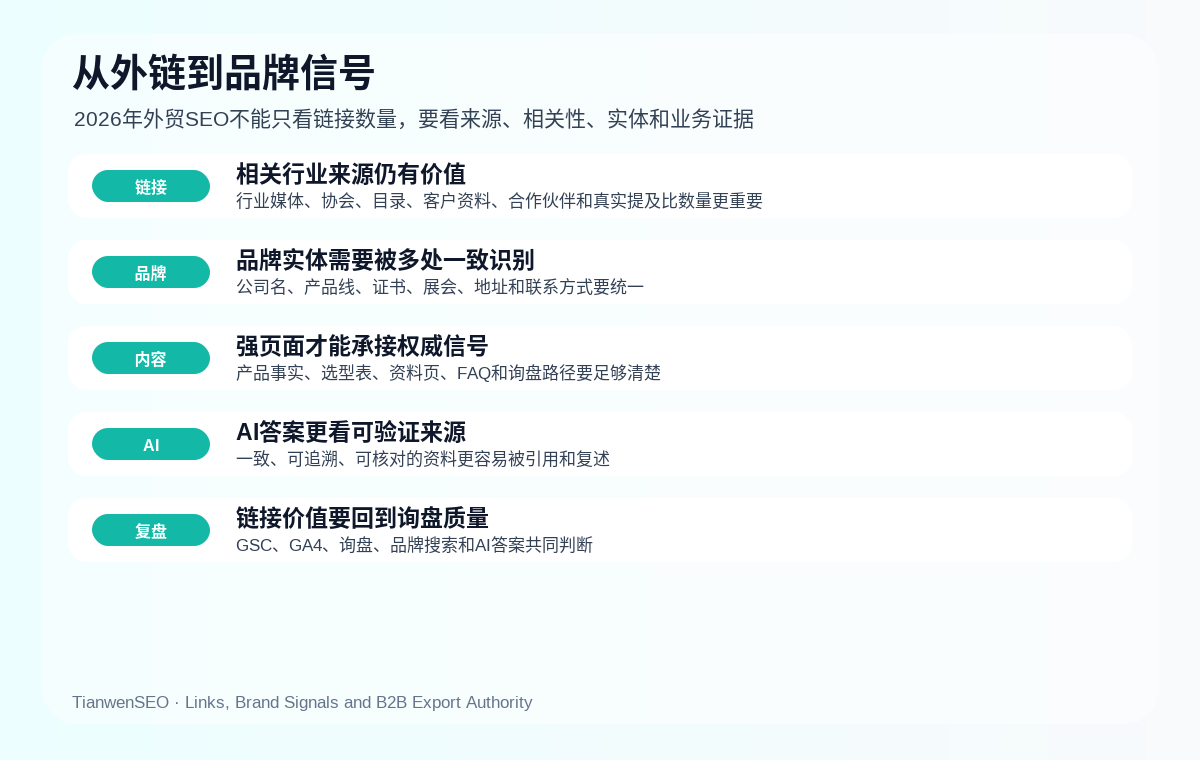
Conclusion first: backlinks still matter, but relying on them alone is increasingly not enough
Backlinks used to be the most easily quantified authority signal in SEO: whichever site more sites linked to was likely considered more authoritative. But today’s search environment is more complex. Google still needs links to discover pages, understand page relationships, and judge where a page sits on the internet; AI search also references crawlable pages, cited sources, and information verified in multiple places. But backlinks are no longer suitable as a shortcut on their own. If a page has thin content, unclear product facts, a poor user experience, and a confused brand entity, then even if it earns some backlinks, it will struggle to support rankings, AI citations, and inquiry conversion over the long term.
For foreign-trade companies, the right role for backlinks should be “amplifying credible content,” not “replacing content.” For example, if a cnc machining parts page itself has a material table, tolerance specifications, surface treatment options, drawing requirements, inspection processes, and an inquiry checklist, then links from industry media, manufacturing directories, customer technical articles, or partner pages will strengthen its credibility. Conversely, if the page is just a few paragraphs of “high quality and competitive price,” no amount of ordinary directory links will convince buyers or AI that you can actually solve their problems.
Therefore, a 2026 backlink strategy should shift from “how many links can I build” to “which sources can prove my product facts and industry role.” Backlinks, brand mentions, industry directories, trade show materials, publicly available customer materials, technical articles, and partner pages should all be evaluated within the same authority-signal system.
Google’s official view: links help discovery and understanding, but manipulative links are a risk
Google Search Central’s link best practices emphasize that links must be crawlable and that anchor text should let users and Google understand the content of the linked page; Google’s spam policies also clearly classify links created primarily to manipulate search rankings as link spam. This official view matters: the link itself is not the problem — the problem is the link’s purpose, context, relevance, and explainability.
| Issue | Healthy link | Risky link | How a foreign-trade company judges it |
|---|---|---|---|
| Purpose | Helps users discover useful material | Mainly intended to influence rankings | Could I show this link to a real buyer? |
| Source | Industry-relevant, real organization, real content | Irrelevant sites, low-quality directories, auto-generated pages | Is the source related to the product, market, or industry? |
| Anchor text | Naturally describes the page content | Heavy stacking of exact-match keywords | Does it read like a normal editorial recommendation? |
| Landing page | The page answers questions and continues the conversion | Thin content or exists only for rankings | Does the link point to a valuable product/information page? |
| Long-term value | Can bring brand, referral traffic, or evidence | Short-term quantity that cannot be explained | Will it still be worth keeping a year from now? |
For instance, if an industrial valve supplier gets a company profile link from a pump and valve industry association page, that is a reasonable signal; if it gets identical anchor-text links from dozens of unrelated entertainment blogs, that is hard to explain to buyers and unsuitable as a long-term SEO strategy.
Why AI search makes brand signals more important
One of the biggest differences between AI search and traditional search is that AI combines information from multiple sources into a single answer. In traditional search, users can see multiple results and judge for themselves; in AI answers, the system often presents a synthesized conclusion first, and the user then decides whether to click through to the cited sources. This shift makes brand signals that are “verifiable, traceable, and consistently expressed” more important.
If a foreign-trade brand expresses its company name, product range, certifications, address, contact details, and main markets inconsistently across its website, industry directories, trade show pages, customer materials, LinkedIn, B2B platforms, and press releases, AI systems will find it harder to determine who it really is. Conversely, if multiple sources consistently state that a company focuses on waterproof connector, mainly serving outdoor LED lighting, solar cable connection, and marine equipment, and the website has specification tables and resource pages, AI can form a more stable understanding.
This is also why backlinks should not be seen merely as “passing authority.” In the era of AI answers, both links and mentions can become part of entity confirmation, source verification, and brand understanding. A brand mention without a link is not necessarily equivalent to a traditional backlink, but if the source is credible, the context is clear, and the entity is consistent, it can still help buyers and AI understand your market role.
What is the difference between backlinks, brand mentions, and entity signals
| Signal type | What it is | Value | Foreign-trade example |
|---|---|---|---|
| Backlink | Other pages link to your website pages | Helps discovery, passes context, provides a source path | Industry media links to an LED flood light selection guide |
| Brand mention | Other pages mention the brand or company but do not necessarily link | Strengthens entity presence and industry association | A trade show exhibitor list mentions the company and product line |
| Entity consistency | Multiple sources describe the company and products consistently | Reduces the chance of misreading by search and AI | The company name matches across the website, directories, and certificate pages |
| User behavior | Searches, clicks, dwell time, return visits, and brand searches | Reflects real demand and satisfaction trends | A buyer searches for the brand + custom metal parts |
| Business evidence | Case studies, certificates, materials, reviews, partnerships | Makes trust more checkable | A customer’s public project or certification document points to the website |
These types of signals cannot fully replace one another. A brand mention without a link may not help crawlers discover a page the way a link does; a linked but irrelevant page may not build trust either. What foreign-trade websites need to do is build a signal combination: clear website content, relevant external sources, a consistent brand entity, and a verifiable inquiry path.
Foreign-trade backlink quality matrix: what is worth doing and what requires caution
Foreign-trade companies often receive all kinds of “link building” quotes. The difficulty is not whether link resources exist, but how to judge which ones are worth doing. The simplest principle: only if the source also has reference value for real buyers can it become a long-term asset.
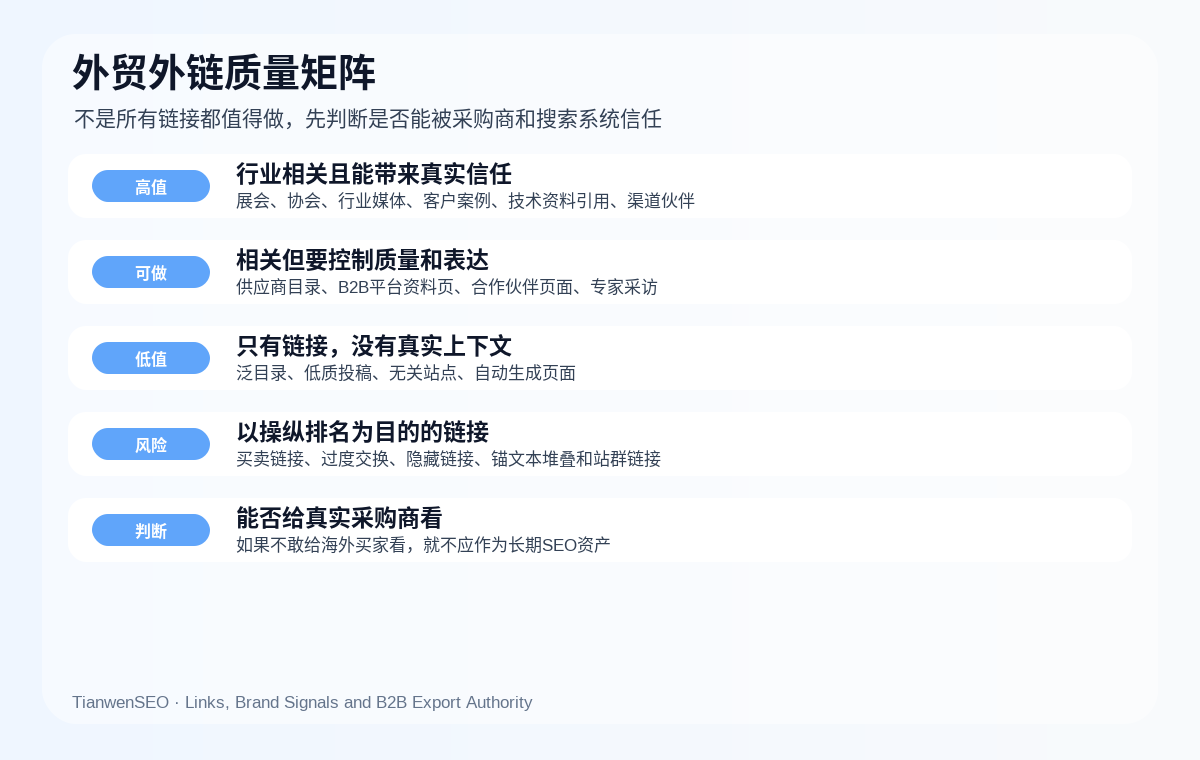
| Source type | Value level | Suitable scenario | Risk warning |
|---|---|---|---|
| Industry association / trade show websites | High | Proves the company exists, participates in the industry, and its product field | Materials must match the website |
| Industry media / technical articles | High | Explains product solutions, cites resource pages | Content must be genuine and professional; do not force keywords in |
| Customer / partner pages | High | Proves a supply relationship or project collaboration | Must respect commercial confidentiality and customer authorization |
| B2B platforms / supplier directories | Medium | Supplements company entity and product line exposure | Avoid duplicate low-quality content and false information |
| Generic directories / low-quality guest posts | Low | Usually lacks real purchasing value | More volume does not mean more safety |
| Paid links / private blog network links | Risky | Short-term ranking manipulation | Inconsistent with long-term brand and search policy direction |
The 8 types of authority sources most worth investing in for foreign-trade companies
1. Industry association and standards-related pages
If your products involve clear industry standards, such as medical probe, industrial valve, or waterproof connector, industry associations, standards introduction pages, certification body materials, and professional directories are usually more valuable than ordinary blogs. Such sources help search systems and AI understand what industry you are in, which markets you serve, and what compliance boundaries exist.
2. Trade show and conference materials
When foreign-trade companies attend Canton Fair, industry shows, or overseas exhibitions, exhibitor pages, product introductions, and event news can all become brand entity signals. The key is that the company name, website URL, product categories, booth information, and contact details are accurate and consistent — do not write them differently on every platform.
3. Industry media and technical content citations
If you have in-depth material on cnc machining tolerance, LED flood light beam angle, or packaging machine cleaning and it is cited by industry media or technical blogs, that is far more meaningful than simply buying irrelevant links. It proves that your website is a source of information, not just an advertising page.
4. Public customer and partner pages
With authorization, partner, distributor, installer, and project supply chain pages can all become genuine trust sources. Foreign-trade companies must be careful not to leak sensitive customer information or write undisclosed partnerships up as case studies. Publicly shareable partnerships should be based on facts and boundaries.
5. B2B platforms and vertical directories
B2B platforms are not a cure-all, but they still have entity-supplement value for foreign-trade companies. The key is complete materials, accurate product categorization, correct website links, and consistent company and brand names. Do not copy B2B platform content into a large number of duplicate pages.
6. Expert interviews and industry Q&A
If a company’s engineers or sales leads can explain material selection, product applications, and purchasing risks in industry Q&A, interviews, or podcasts, this kind of content is often more natural than generic guest posts. For example, explaining stainless steel 304 vs 316 for custom metal parts serves buyers while strengthening the brand’s expertise.
7. Downloadable materials and tool citations
Specification tables, selection checklists, inquiry forms, material comparison tables, and installation checklists — if they are genuinely useful, they may be cited by others. Link building does not have to start with finding links; it can also start with creating materials worth citing.
8. Local and regional business materials
If a company serves a specific region or has overseas warehouses, offices, or agents, regional business directories and partner materials also have value. The premise is that the address, phone number, brand, products, and service scope stay consistent, so search systems and customers are not confused.
Which backlink practices are unsuitable for the long term
Backlink risk usually comes not from a single link but from a long-term pattern. A large number of irrelevant sites, repeated anchor text, obvious paid relationships, no content context, and pages that exist only for rankings all make a backlink profile hard to explain.
- Do not buy link packages that are openly priced, have no editorial review, and have no industry relationship.
- Do not point large numbers of exact-match anchors at the same page, for example repeatedly using “custom metal parts manufacturer.”
- Do not post low-quality AI articles on irrelevant sites just to get a link.
- Do not engage in excessive reciprocal linking, especially mechanical link exchanges among multiple sites.
- Do not describe product capabilities, certifications, and partnerships beyond the facts just to get a link.
- Do not treat backlinks as a substitute for fixing thin content, mismatched-intent pages, and poor experiences.
When judging risk, ask a simple question: if an overseas buyer opens this source, will they trust you more, or will they find it suspicious? If the answer is the latter, that link is not suitable as a long-term SEO asset.
Which pages should backlinks point to
When many foreign-trade websites build backlinks, they point most links to the homepage. The homepage is certainly important, but if all authority signals concentrate there, product pages, category pages, and resource pages remain weak, and rankings and inquiry performance will be limited. The landing page for a backlink should be chosen based on the source and intent.
| Source content | Recommended landing page | Reason | Example |
|---|---|---|---|
| Industry media technical article | Resource page / guide page | Users need in-depth explanation | cnc machining tolerance guide |
| Trade show exhibitor profile | Company page / product category page | Proves the company and product range | industrial valve supplier categories |
| Partner page | Product page / application page | Shows the specific solution relationship | LED flood light for warehouse project |
| B2B directory | Homepage / category page | Supplements brand entity and entry points | ceramic dinnerware wholesale category |
| Public customer materials | Application page / capability page | Explains industry fit and capability boundaries | packaging machine for powder products |
If the linking source is discussing “how to choose waterproof connector for outdoor lighting,” it is best to link to a waterproof connector selection or application page rather than the homepage. That way users, search engines, and AI can all understand the link context.
Before link building, turn pages into assets worth linking to
Before building backlinks, foreign-trade companies should ask: what pages do I have that are worth linking to? If the answer is only the homepage and a product list, the content assets are not enough. Pages worth linking to usually have clear reference value, such as selection tables, industry standard explanations, purchasing checklists, product comparisons, troubleshooting, installation instructions, and material selection guides.
| Resource asset | Suitable industry | Why it can be linked | Conversion entry |
|---|---|---|---|
| Material selection guide | custom metal parts, industrial valve | Helps buyers judge materials and environments | Drawing upload and material consultation |
| Power/model selection table | LED flood light | Helps project owners make preliminary spec estimates | Project requirements form and quote |
| Packaging equipment selection checklist | packaging machine | Judges equipment based on material and speed | Sample testing and solution consultation |
| Certification and testing explanation | medical probe, waterproof connector | Reduces compliance and quality doubts | Material download and engineering confirmation |
| Wholesale purchasing FAQ | ceramic dinnerware, activewear | Answers MOQ, packaging, samples, and lead times | Sample inquiry and catalog request |
How brand signals in turn improve backlink quality
Websites with strong brand signals find it easier to earn natural mentions and high-quality links, because industry media, customers, partners, and buyers need a clear, credible subject when citing. If your website has a complete About Us page, product materials, images, certificates, frequently asked questions, contact information, and a consistent brand name, others are more willing to cite it.
This is also something foreign-trade companies often overlook: backlinks do not come only from external outreach — many high-quality links come from the company itself providing citable material. For example, a detailed industrial valve material compatibility chart is more likely to be cited by engineering content than a generic company news post. A clear private label activewear MOQ and sample timeline page is also more likely to be cited in purchasing guides than an advertising slogan.
In the era of AI answers, how backlinks and cited sources work together
AI answers usually do not simply display a traditional ranking list; they organize a synthesized response. They may cite the official website, or they may cite third-party materials. What foreign-trade companies need to do is make the official website the most accurate official source while keeping external materials consistent with it.
| Information AI may read | Common risk | Optimization direction | Foreign-trade example |
|---|---|---|---|
| Official website product page | Too little or inaccurate information | Add specs, applications, certifications, FAQ | waterproof connector IP rating page |
| B2B platform profile | Inconsistent company name and product range | Unify brand and categories | custom metal parts supplier profile |
| Trade show page | Broken links or outdated products | Update the website entry and exhibit descriptions | LED lighting exhibition profile |
| Industry articles | Cites old materials or third-party misstatements | Build official resource pages for easy verification | packaging machine cleaning guide |
| Customer page | Unclear collaboration boundaries | Use only authorized public information | industrial valve project reference |
When AI compares third-party materials with official website materials, the biggest fear is conflicting information. For example, if one platform says you are a trading company, the website says factory, and another directory says manufacturer and exporter, while the address and brand also differ, AI can easily produce a vague or even incorrect answer.
How to build a 90-day plan for foreign-trade backlinks and brand signals
Phase 1: Organize existing external materials
Do not add new links yet — first find the external materials that already exist. Search the brand name, the company’s English name, core product terms, trade show names, B2B platform profiles, and public customer pages, and record which pages mention you, whether they link, and whether the information is accurate.
Phase 2: Fix entity consistency
Unify the company’s English name, brand name, website URL, product lines, address, contact details, certifications, and main markets. A common problem for foreign-trade companies is using different names on different platforms, which leaves search systems and AI unable to identify the entity consistently.
Phase 3: Build citable resource pages
Choose the 3–5 most important product lines and build resource pages that industry sources can cite, such as a custom metal parts material guide, an LED flood light warehouse guide, or a packaging machine selection checklist.
Phase 4: Acquire genuine industry sources
Around trade shows, associations, partners, industry media, public customer materials, vertical directories, and professional Q&A, acquire links and mentions that can be explained. Record the reason, landing page, and expected effect for every source.
Phase 5: Review search, AI answers, and inquiries
Every 30 days, check GSC queries, brand searches, GA4 referral traffic, AI answer mentions, inquiry sources, and sales feedback. Do not look only at link volume — look at whether it helps buyers understand your products and company faster.
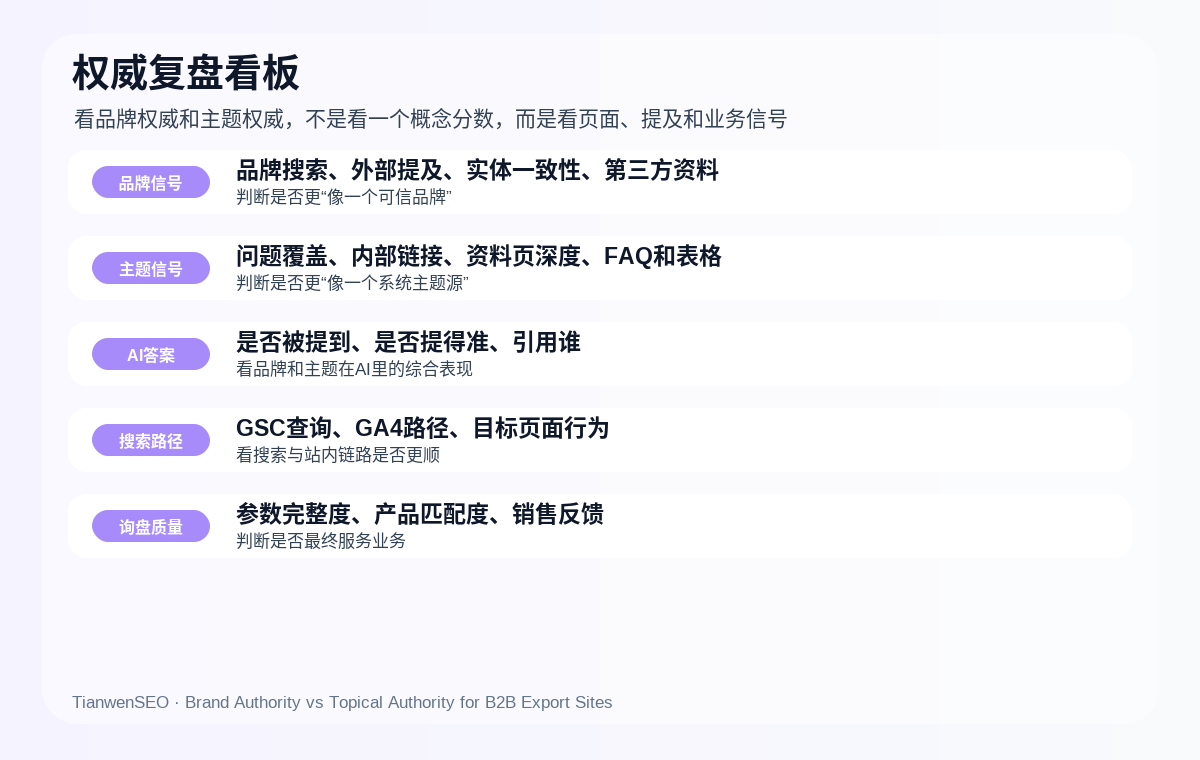
How to review backlink performance: don’t look only at DR and volume
Many backlink reports like to show domain ratings, link counts, and anchor text distribution. These can be referenced but should not be the only judgment. Foreign-trade companies need more: whether links bring real business value, whether they help core pages be understood, and whether they strengthen the brand entity.
| Metric | What to look at | What it indicates | Next step |
|---|---|---|---|
| GSC | Target page impressions, clicks, and query changes | Whether search demand is concentrating on the right pages | Optimize titles, FAQ, and internal links |
| GA4 | Referral sources, entry pages, subsequent paths | Whether external sources bring effective visits | Improve landing pages and inquiry entry points |
| Brand search | Changes in brand terms and brand + product terms | Whether external signals raise awareness | Unify brand materials and product lines |
| AI answers | Whether mentioned, whether cited, whether accurate | Whether AI forms an accurate understanding | Add official materials and correction content |
| Inquiries | Country, product, clarity of needs, quote opportunities | Whether backlinks affect business quality | Amplify effective sources; stop low-value channels |
If an industry media link brings a small number of visits, but those visitors stay a long time, continue to product pages, and submit specific inquiries, it may be more valuable than dozens of ordinary directory links with no visits.
How foreign-trade teams should divide the work internally
Backlinks and brand signals are not the job of the SEO person alone. Sales knows what customers ask most, engineering knows product boundaries, marketing knows trade shows and media, management holds partnership relationships, and the website owner is responsible for page landing and data review.
| Role | Responsibility | Output | Notes |
|---|---|---|---|
| Sales | Common customer questions and inquiry quality | FAQ, inquiry checklist, objections | Do not report only that “customers want a low price” |
| Engineering/product | Specs, materials, application limits | Technical tables, selection notes, inspection items | Avoid overpromising |
| Marketing | Trade shows, media, directories, partner resources | External source list and brand materials | Keep company information consistent |
| Website/SEO | Page structure, internal links, GSC/GA4 review | Landing pages and review sheets | Confirm page quality before building links |
| Management | Partnerships and authorization boundaries | Scope of publicly shareable materials | Do not publish unauthorized customer information |
By industry: different foreign-trade products have different backlink and brand signal priorities
The biggest danger in foreign-trade SEO is treating every industry with the same backlink method. LED lighting, machinery, medical components, ceramic dinnerware, industrial valves, and custom apparel have different purchasing logic, and the external sources worth pursuing differ too. If link building does not distinguish industries, it easily becomes a stack of generic directories, generic guest posts, and irrelevant pages.
| Industry/product | What buyers care about most | High-value external sources | Website landing page |
|---|---|---|---|
| custom metal parts | Materials, tolerances, surface treatment, drawing confidentiality, inspection | Manufacturing media, engineering materials, authorized customer projects, material guide citations | Material selection, tolerance guide, capability page, inquiry checklist |
| LED flood light | Certification, luminous efficacy, installation height, waterproof rating, warranty | Lighting engineering media, trade show pages, project installers, energy-saving materials | Warehouse lighting application page, IP rating explanation, power selection table |
| packaging machine | Material compatibility, speed, precision, cleaning and maintenance, after-sales | Packaging industry media, equipment directories, video reviews, distributor materials | Powder/liquid/granule application pages, selection checklist, maintenance FAQ |
| medical probe | Materials, cleanliness, quality control, regulatory boundaries, traceability | Medical device directories, certification materials, technical white papers, industry Q&A | Materials and inspection page, quality process, compliance confirmation checklist |
| ceramic dinnerware | Material, patterns, packaging, MOQ, target market safety standards | Home and gift media, wholesale directories, trade show materials, buyer guides | Material comparison, packaging solutions, wholesale purchasing FAQ |
| industrial valve supplier | Media, pressure, temperature, standards, delivery, and spare parts | Pump and valve associations, engineering directories, project materials, standards explanation articles | Selection guide, material compatibility table, application page, material download |
For example, if a packaging machine company only builds ordinary commercial directory links, that may not help buyers understand equipment fit. A better direction is to get resource pages on powder packaging, granule packaging, liquid packaging, food-grade cleaning, and film change maintenance cited by industry articles or distributor materials. That way the link itself carries product context, and search systems and AI answers can more easily understand which scenarios your equipment suits.
Pre-link-building page self-check: without a strong landing page, don’t rush to find links
A common waste: a company spends money on backlinks, but the pages the links point to cannot answer buyers’ questions. The trust brought by external sources must ultimately land on website pages. If a page has no clear structure, no product facts, and no next-step inquiry path, the backlink merely takes the user to an entry point that cannot convert.
| Self-check question | Passing | Failing | Suggested action |
|---|---|---|---|
| Does the page correspond to a clear product term | Title and body focus on one main product/scenario | Multiple products and services mixed together | Split into product pages, category pages, or application pages |
| Are there citable facts | Specs, materials, certifications, applications, and limits are clear | Only “good quality, competitive price, rich experience” | Add parameter tables, selection tables, and FAQ |
| Is there visual evidence | Product images, structural diagrams, application images, and process diagrams are complete | Only stock images or images without captions | Add captioned images and alt text |
| Is there a next step | Inquiry checklist, sample process, and contact entry are clear | Only “welcome to inquire” | Explain what information buyers need to provide |
| Can it be read on mobile | Tables and paragraphs are readable on phones | Tables overflow, fonts are too small, buttons are hard to tap | Improve layout and table display |
If more than three items in this self-check fail, it is advisable to improve the pages first and then build backlinks. A backlink essentially imports external trust into a page; if the page itself is weak, the imported trust will struggle to convert into rankings, AI citations, or inquiries.
How to write anchor text naturally
Anchor text is part of the link context. An early SEO practice was to use exact-match keywords heavily, for example repeatedly pointing “custom metal parts manufacturer” at the same page. Today this practice carries higher risk and feels more unnatural. Better anchor text should read like a genuine editorial recommendation and let users know what they will see after clicking.
| Anchor text type | Example | Suitable scenario | Notes |
|---|---|---|---|
| Brand name | Tianwen example manufacturer | Company materials, trade shows, partners | The brand name must match the website |
| Brand + product | ABC Lighting LED flood light guide | Industry articles, technical material citations | Natural expression; do not repeat mechanically |
| Descriptive | warehouse flood light beam angle guide | Resource pages and guide pages | Let users understand the page’s value |
| URL type | www.example.com | Directories and business card materials | Keep links correct and accessible |
| Generic natural | this waterproof connector selection checklist | Citations in the article body | Context must be relevant |
The key to anchor text is not “being precise about every keyword” but natural context, a relevant source, and a consistent landing page. For example, when an industry article mentions waterproof connectors for outdoor lighting, using “IP67 waterproof connector selection checklist” to point to a resource page is healthier than forcing “best waterproof connector manufacturer” into an unrelated paragraph.
Low-quality links already exist — should you deal with them?
Many foreign-trade websites see strange links in their tools: irrelevant directories, scraper pages, spam sites, auto-generated pages. Seeing these links is no reason to panic immediately. The internet naturally produces random spam links, and search systems can usually identify many low-value links. What really deserves attention is: do these links come from a pattern you actively participated in, are they heavily concentrated, do they use abnormal anchor text, and are they related to past link purchases or private blog networks?
| Situation | Risk level | Suggested handling | Explanation |
|---|---|---|---|
| A small number of random spam links | Low | Just record them; focus on building good links | Do not spend all your time on meaningless cleanup |
| A large number of similar low-quality directories | Medium | Stop adding new ones; sort out the sources | Check whether a vendor keeps creating them |
| Abnormally concentrated exact-match anchor text | Medium-high | Adjust the future link strategy; consult a professional if necessary | Avoid reinforcing the abnormal pattern |
| Clear paid links or private blog network links | High | Stop the cooperation, keep records, assess a cleanup plan | Do not keep expanding risk with short-term ranking logic |
| Receiving a manual action notice | High | Review and handle it according to Google’s notice | Requires serious handling and a submission explanation |
For most foreign-trade companies, the most important thing is not staring at spam links every day, but stopping the active creation of risky links and continuously adding genuine industry sources, brand materials, and citable content.
Turn backlink reports into business reports: easier for clients and bosses to understand
If a backlink report only says “50 new links this month, average DR of X,” it is hard for the business team to judge the value. Foreign-trade companies need a report that connects to the business: which sources are genuinely relevant, which pages they point to, what purchasing problem the page solves, and what visits, brand searches, AI answer changes, and inquiry feedback they brought.
| Report module | Traditional approach | Better for foreign-trade companies | Value |
|---|---|---|---|
| Source list | Number of new links and domain metrics | Source type, industry relevance, whether it can be shown to buyers | Judge whether links are genuinely useful |
| Landing pages | List of link URLs | Which product/resource page each link points to and why | Avoid pointing everything at the homepage |
| Content support | Published article titles | Which purchasing problem the page solves | Bind backlinks to content assets |
| Data review | Ranking ups and downs | GSC, GA4, brand search, AI answers, inquiry quality | Connect SEO actions to business results |
| Next steps | Keep building links | Amplify effective sources, strengthen weak pages, stop low-value channels | Form an iterative loop |
This reporting approach avoids the problem of “looking busy but not knowing whether it works.” Link building is not a standalone KPI; it is part of authority building for a foreign-trade website.
From link signals to brand signals: a judgment checklist
If you need to judge whether a backlink or mention is worth pursuing right now, use the checklist below. If multiple questions are answered “no,” be cautious.
- Is the source related to the product, industry, market, trade show, customer, or partnership?
- Is the page content published by a real editor or a real organization rather than auto-generated?
- Does the link context let buyers understand why they should click?
- Does the landing page actually answer the question in that context?
- Are the company name, brand name, product line, address, and contact details consistent with the website?
- Is the anchor text natural rather than a heavy stack of exact-match keywords?
- Could this source bring referral visits, brand awareness, AI answer verification, or sales support?
- Looking back a year from now, would this source still look like a normal commercial or industry resource?
This checklist is better suited to foreign-trade companies than simply looking at DR, DA, and traffic estimates, because the goal of a foreign-trade business is not to make a link report look good but to make buyers trust you more and to help search and AI systems understand you more accurately.
An example of a real-world implementation sequence for a foreign-trade company
Suppose a company mainly sells waterproof connector and cable assembly. It has built some directory links in the past, but its product pages are thin, AI answers hardly mention the brand, and inquiries often ask about basic parameters. A more reasonable sequence is as follows.
| Week | Action | Output | Review point |
|---|---|---|---|
| Week 1 | Organize existing external materials and brand naming | Brand names, directories, trade shows, platform list | Are company names and product lines inconsistent? |
| Week 2 | Strengthen core product pages | IP rating, materials, pin counts, wire gauges, applications, FAQ | Can the pages answer buyers’ basic questions? |
| Week 3 | Create resource pages | IP67/IP68 explanation, outdoor lighting selection checklist | Is there content that industry articles can cite? |
| Week 4 | Fix B2B platform and trade show materials | Unify website URL, product descriptions, and brand name | Is it easier for AI and buyers to identify the entity? |
| Weeks 5–8 | Pursue industry sources and partner links | Industry directories, installers, media citations | Did it bring visits, brand searches, and AI answer changes? |
| Weeks 9–12 | Review inquiries and sales feedback | Question list, page revisions, and the next batch of assets | Are inquiries more specific? Does sales explain fewer basic questions? |
This process may not look as exciting as “building hundreds of links a month,” but it fits long-term SEO and brand building better. It places backlinks, content, entities, AI answers, and inquiries on the same business chain.
How should the backlink budget be allocated?
If the budget is limited, foreign-trade companies should not spend all of it buying backlinks. A more reasonable allocation: part for page content and resource assets, part for brand material consistency, part for building genuine industry sources, and part for data review.
| Budget direction | Suggested priority | Why | Deliverables |
|---|---|---|---|
| Core page upgrades | Highest | Without strong pages, links cannot land | Product pages, category pages, application pages, resource pages |
| Resource asset production | High | The more useful the material, the easier it is to earn natural citations | Selection tables, checklists, illustrated guides, FAQ |
| Brand material consistency | High | A confused entity affects search and AI understanding | Unified company name, directory materials, trade show materials |
| Industry source development | Medium-high | Builds genuine external trust | Media, associations, partners, vertical directories |
| Monitoring and review | Medium | Judge which actions are effective | GSC, GA4, AI answer and inquiry review sheets |
If a quote only promises link volume but does not care about page quality, source relevance, brand consistency, and business review, foreign-trade companies should be cautious. Better service should be able to explain why each source is worth pursuing, which page the link points to, and how value will be measured.
FAQ: common questions about backlinks, brand signals, and foreign-trade SEO
Are backlinks still important?
Yes, but you can no longer look only at quantity. Relevant, genuine, explainable links still have value; low-quality and manipulative links are unsuitable as a long-term strategy.
In 2026, are backlinks less important than brand signals?
More precisely, backlinks are becoming part of the brand signal system. Links, mentions, entity consistency, content quality, and user feedback need to be considered together.
Should a new foreign-trade site build backlinks from the start?
You can build basic brand materials and genuine directories, but it is more important to first complete core product pages, category pages, resource pages, and the inquiry path.
Is buying backlinks still useful?
Paid links intended to manipulate rankings are a risky move and are not recommended as long-term assets. Foreign-trade companies should prioritize industry sources that can be shown to real buyers.
Are brand mentions without links useful?
They cannot fully replace links, but they may have auxiliary value for entity recognition, brand consistency, and AI answer understanding, especially when they come from credible industry sources.
Should backlinks point to the homepage or product pages?
It depends on the source’s intent. Brand and company materials can point to the homepage or About page, while technical articles are better pointed at resource pages, product pages, or application pages.
Do low-quality spam links need to be removed?
First judge whether it is a risky pattern you actively participated in. If they are just random spam links, there is usually no need to panic excessively; the focus is to stop actively creating low-quality links and build high-quality signals.
How long does it take for backlinks to show results?
It varies a lot by site. It is advisable to use 30–90 days to look at GSC, GA4, brand search, AI answers, and inquiry quality, rather than only short-term ranking fluctuations.
Are B2B platform links valuable?
They have some entity and exposure value, but you must ensure the materials are complete and consistent and the product categories are accurate. Do not treat them as a substitute for website content.
Will AI search ignore backlinks entirely?
AI answers are not the same as traditional rankings, but they still depend on verifiable sources, web materials, and entity consistency. Links and mentions may help systems discover and verify information.
Which types of links are most worth building for foreign-trade companies?
Industry associations, trade show pages, industry media, authorized customer materials, partners, vertical directories, and technical material citations are usually worth prioritizing.
Should link building or content building come first?
Make sure the landing pages are strong enough first, then use backlinks to amplify. Link building without content assets has limited long-term value.
Should anchor text use exact keywords?
Do not stack large numbers of exact-match anchors. Naturally describing the page content, with a combination of brand name, product name, and context, is healthier.
How do you judge whether a backlink quote is reliable?
Look at whether the source is genuinely relevant, whether there is editorial context, whether it can earn buyers’ trust, and whether it can be kept long term — not just volume and metrics.
Will backlinks bring inquiries?
Possibly, but this should not be promised. Backlinks are more of a trust and discovery signal; whether inquiries result also depends on page content, product fit, market demand, and sales follow-up.
Conclusion: backlinks are not dead, but the low-quality backlink mindset should end
Backlinks remain part of foreign-trade SEO and brand visibility, but their value has shifted from “the more the better” to “whether the source is credible, whether the content is relevant, whether the brand is consistent, whether the page can land the traffic, and whether the business can be reviewed.” In an environment where AI search and generative answers are increasingly common, backlinks should be seen even more as one part of the brand signal and evidence system.
What foreign-trade companies should really do is first strengthen product pages, category pages, resource pages, and the inquiry path, and then build explainable external signals through industry associations, trade shows, media, partners, authorized customer materials, and vertical directories. The links and mentions gained this way are not only for rankings; they also help buyers and AI systems understand more accurately who you are, what you do, and what problems you are suited to solve.
Official sources and the boundary between backlinks and brand signals
Backlinks still need to be judged by quality, but in the AI search era it matters even more whether citations help verify facts. The focus for foreign-trade websites is to keep website content, external sources, and brand entity information consistent with one another.
| Official source | What it is used to verify | Delivery boundary |
|---|---|---|
| Google Search ranking systems guide | Understand that ranking systems combine multiple signals | Backlinks are not a single on/off switch for results |
| Helpful, reliable, people-first content | Check whether content has credible sources and expertise | External links cannot replace content quality |
| Google AI features and your website | Confirm that AI features still depend on basic SEO and reliable content | External citations do not equal a designated display on AI platforms |
| Make your links crawlable | Confirm that internal and external link paths on the website are crawlable | Non-crawlable links should not be treated as evidence |
| Search Console Performance report | Use GSC to observe page and query changes | Link volume cannot directly substitute for search performance |
Review acceptance table
| Check item | Record fields | Approach during low-data periods |
|---|---|---|
| Source quality | Source type, relevance, accessible URL, context | Record only verifiable links |
| Entity consistency | Company name, brand name, product line, contact details | Fix inconsistencies first |
| Internal link landing | Which product/resource page the external source points to | If there is no landing page, add a page action |
| Data review | GSC page rows, AI citation samples, GA4 events | Do not write results without data |
Keep reading this GEO series
If you are systematically learning about GEO and AI search visibility, we suggest continuing with the following articles. Understand the concepts first, then look at diagnostics, monitoring, content structure, and partnership boundaries.
- What is the difference between brand authority and topical authority? How AI search and Google SEO each see it
- What is Query Fan-Out: why AI search automatically breaks questions down before deciding whom to cite
- Where to start with AI search optimization: should foreign-trade websites build a query set first or change content first?
- How to do GEO: from page structure to citation probability, what to change first
- What is schema structured data: which types should foreign-trade websites add for SEO and AI search
- How to build B2B foreign-trade AI search visibility: a guide to getting inquiry terms and solution terms into AI answers
{
“@context”: “https://schema.org”,
“@type”: “FAQPage”,
“mainEntity”: [
{
“@type”: “Question”,
“name”: “Are backlinks still important?”,
“acceptedAnswer”: {
“@type”: “Answer”,
“text”: “Yes, but you can no longer look only at quantity. Relevant, genuine, explainable links still have value; low-quality and manipulative links are unsuitable as a long-term strategy.”
}
},
{
“@type”: “Question”,
“name”: “In 2026, are backlinks less important than brand signals?”,
“acceptedAnswer”: {
“@type”: “Answer”,
“text”: “More precisely, backlinks are becoming part of the brand signal system. Links, mentions, entity consistency, content quality, and user feedback need to be considered together.”
}
},
{
“@type”: “Question”,
“name”: “Should a new foreign-trade site build backlinks from the start?”,
“acceptedAnswer”: {
“@type”: “Answer”,
“text”: “You can build basic brand materials and genuine directories, but it is more important to first complete core product pages, category pages, resource pages, and the inquiry path.”
}
},
{
“@type”: “Question”,
“name”: “Is buying backlinks still useful?”,
“acceptedAnswer”: {
“@type”: “Answer”,
“text”: “Paid links intended to manipulate rankings are a risky move and are not recommended as long-term assets. Foreign-trade companies should prioritize industry sources that can be shown to real buyers.”
}
},
{
“@type”: “Question”,
“name”: “Are brand mentions without links useful?”,
“acceptedAnswer”: {
“@type”: “Answer”,
“text”: “They cannot fully replace links, but they may have auxiliary value for entity recognition, brand consistency, and AI answer understanding, especially when they come from credible industry sources.”
}
}
]
}
This page is machine-translated from the Simplified Chinese version and awaiting human review. It has not yet been proofread.
Further Reading on This B2B SEO & GEO Topic
- What Is Google AI Search? The Link Logic Between AI Mode and AI Overviews, and Guidance for B2B Export Websites
- Why Can't Google SEO Rankings Improve? A Diagnostic Checklist for Technical Issues, Content, and GSC
- Why Is It Increasingly Difficult to Drive Traffic with Google SEO? The Real Reasons Beyond AI Overviews
- Generative Engine Optimization (GEO) and AI Search Citation Hub for Export Brands
- B2B Google SEO Tutorials
- B2B Export Website Development Architecture