Many export businesses read “rankings won’t improve” as simply not having enough content, or as a purely technical problem. In reality, what actually holds rankings back is rarely a single factor — it is the combined result of technical crawlability, page intent, purchasing-decision evidence, internal link equity distribution, and content depth. For Chinese manufacturers and trading companies doing export, the most common mistake is not an inability to write articles; it is mixing English product pages, category pages, industry solution pages, and FAQ resource pages together, which makes it very hard for Google to tell which page should serve which query.
If your page has been live for six months and still hasn’t settled into the first two pages for your target terms, or it occasionally gets impressions but never earns steady clicks, the point of this article is not to tell you “just publish more content.” It is to help you decide first: should you check technical issues or content first? We’ll walk through that order of judgment in an export context — for English product terms such as custom metal parts, LED flood light, packaging machine, medical probe, cnc machining parts, and waterproof connector, how should the corresponding page actually be diagnosed? Which signals mean you should check technical issues first, which mean you should check content first, and which situations are really not about either one?
The conclusion first: If the page is not being reliably crawled and indexed, returns unstable status codes, needs script interaction before the body content appears, has confused canonical relationships, or has no internal entry points, then check technical issues first. If the page is already crawled and indexed and gets some impressions, but the query terms and the page role don’t match, the content lacks purchasing-decision evidence, or the structure makes it hard to extract answers quickly, then prioritize content and page positioning. If the page gets impressions and clicks but never moves users into the product or inquiry path, then check the conversion structure and on-site paths at the same time, instead of staring only at the ranking number.
Start with search intent: weak rankings don’t necessarily mean thin content
Google’s ranking systems first judge whether “this page answers this query.” For export sites, that judgment is often dragged down by the wrong page type. For example, someone searching industrial valve supplier more likely wants to see supplier capabilities, product range, certifications, MOQ, lead times, and applications. If you put that kind of term on a generic blog post, even a long one will struggle to rank consistently. Conversely, someone searching a question like “how to choose industrial valve material for chemical line” is more likely to be willing to land on a tutorial or knowledge article.
In other words, many sites with “weak rankings” don’t lack content volume; they mix transactional, comparison, educational, and brand-trust terms onto one page. Google senses that the page touches on a little of everything without one clear main question. This is especially common among export manufacturers: product pages try to pick up tutorial terms on the side, while blog posts try to pick up product terms on the side, and neither ends up strong.
| Query type | More suitable page type | What happens if it’s on the wrong page |
|---|---|---|
| custom metal parts manufacturer | Product collection page or capability page | Even a long blog page struggles to match purchasing intent |
| LED flood light supplier China | Category page / supplier page | A knowledge article alone lacks purchase decision criteria |
| how to reduce machining tolerance issues | Tutorial page / knowledge article | A pure product page gives an incomplete answer |
| medical probe sterilization material guide | In-depth technical article or application solution page | A generic product intro page struggles to serve it |
| waterproof connector IP67 vs IP68 | Comparison page / FAQ-style technical page | A category page comes across as too sales-oriented |
So the first step is not asking “is the content long enough,” but “which kind of query should this page actually serve?” If that question isn’t sorted out first, the later technical optimization and expansion easily turn into wasted effort.
When to check technical issues first: make the page reliably understandable
When a page’s basic visibility is unstable, checking technical issues first is almost always the better value. Technical barriers mean Google never even gets a stable chance to understand your content. Many export sites look “openable” on the front end, but for crawling systems they still suffer from delayed body rendering, no main content above the fold, internal links that appear only after interaction, and parameter pages competing with the main page.
If you find that a target page hasn’t entered the index for weeks, URL Inspection keeps reporting “Discovered – currently not indexed” or “Crawled – currently not indexed,” and the site also has a large number of similar pages, then the priority is usually not expansion but checking whether the page passes the quality threshold.
| Technical signal | What it means | What to do first |
|---|---|---|
| Intermittent 5xx / slow loading / stalling above the fold | Insufficient crawl stability | Check the server, caching, and resource loading first |
| Body content mainly injected by JS | High crawling and rendering cost | First make sure core content is visible in the HTML |
| Confused canonical signals | Google isn’t sure which page is the main one | Unify canonicalization first |
| Abnormal noindex / robots / meta settings | The page either shouldn’t rank or is blocked by mistake | Fix indexing controls first |
| Almost no in-body internal link entry points | Google has trouble discovering the page or judging its importance | Fix navigation and in-content recommendations first |
| Conflicts among multilingual / paginated / parameter pages | Crawl budget is spread thin | Consolidate duplicate pages first |
For example, on an export site selling ceramic dinnerware, the real product descriptions, materials, processes, and lead times on the category page are all lazy-loaded through a front-end switcher, and the source code contains only a little default text. In that case, adding another 5,000 words to the page won’t necessarily solve anything, because the body the crawling system sees is still unstable. Another example: on a site for a private label activewear manufacturer, if every color, size, and fabric combination generates its own crawlable URL but canonicalization isn’t consolidated, Google will likely spread equity across a pile of near-duplicate pages.
When to check content first: the page is seen but not considered useful enough
If the target page is already crawled and indexed, gets impressions, and even earns clicks on a few long-tail terms, but its core queries never move up, then it’s usually more worthwhile to check content and page positioning first. “Content” here doesn’t just mean word count; it means “does it genuinely help buyers make a decision.”
For export manufacturers and trading companies, what buyers want to confirm after landing on a page is often: what products you make, what scenarios they suit, how they differ from other materials/models, what the minimum order quantity is, which certifications you can provide, how lead times and sampling are arranged, and which applications have limitations to watch for. If the page only says in general terms that “we have years of experience, welcome to contact us,” Google has a hard time treating it as a stronger answer.
| Content/positioning signal | What kind of problem it looks more like | Priority action |
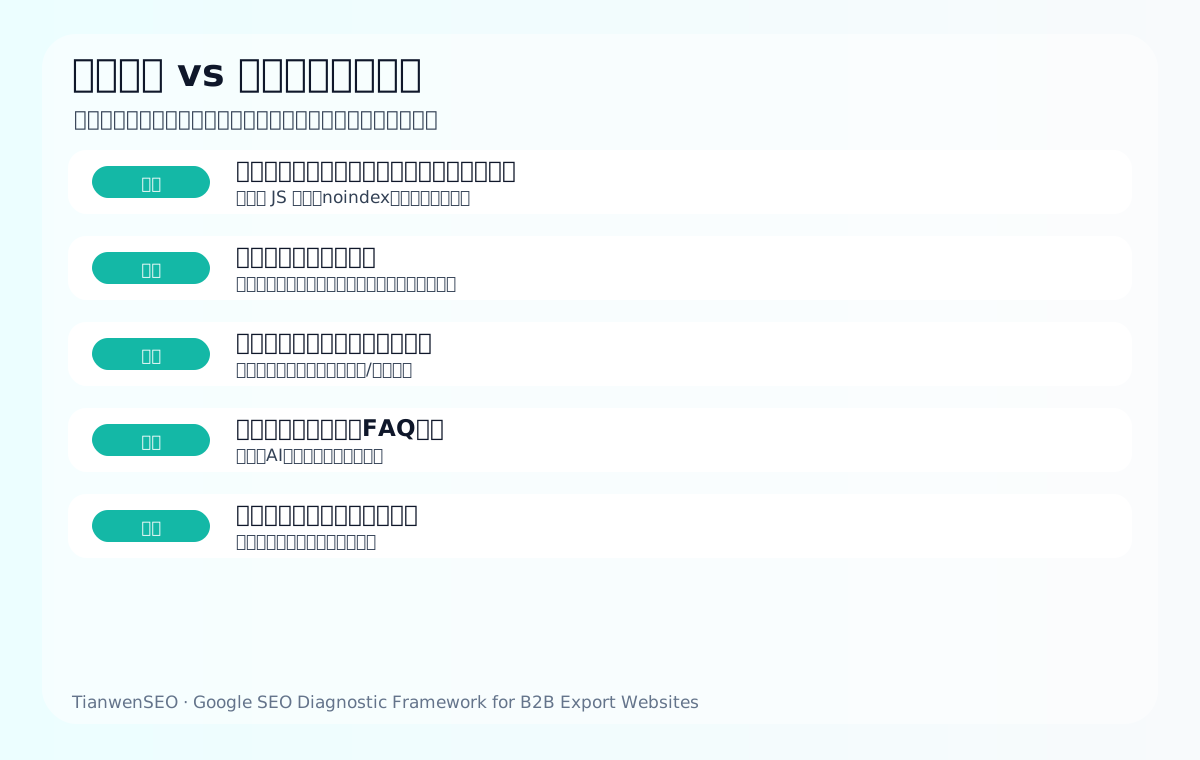
|---|---|---|
| Impressions but very low CTR | The title and snippet don’t accurately promise the page’s value | Fix the title, opening paragraph, and snippet logic first |
| Long-tail terms get traffic, core terms stay weak | Page scope is too broad or the main question is unclear | Narrow the page topic and rebuild the structure |
| Visits but short dwell time and weak second clicks | Insufficient evidence and purchasing-decision elements | Add specs, applications, FAQ, and comparison tables |
| Mentioned by AI but described incorrectly | Boundaries are unclear and facts are incomplete | Add parameters, limitations, and source notes |
| Multiple pages on the same site compete for similar terms | Keyword-to-page mapping is confused | Merge, divide responsibilities, or redefine page roles |
Suppose you have a page for packaging machine. The title states the machine type, but the body doesn’t distinguish levels of automation, compatible packaging materials, speed ranges, applicable products, after-sales and spare parts support, and it doesn’t tell buyers “when this model is not recommended.” A page like this has no obvious technical problem, but its decision value is too low, and Google has a hard time ranking it above pages that genuinely help users choose.
Don’t read “content” as word count: what actually helps is decision structure
Many teams, the moment they find rankings stalled, ask to expand an article from 3,000 words to 10,000 — and end up just splitting one sentence’s meaning into three paragraphs, or piling generic industry knowledge onto a product page. That kind of expansion doesn’t necessarily improve rankings, and it makes the truly important information harder to see.
For export sites, a more effective approach is to organize content into a “decision-ready” structure: give buyers the conclusion first, then the decision conditions, then the application boundaries, then tables, FAQ, process, and evidence. This is easy for users to scan and also easier for Google and AI systems to extract key answers from.
| What to add | Why it works better | Common ineffective substitute |
|---|---|---|
| Spec/parameter table | Helps quickly judge whether it matches requirements | Vague statements about company strength |
| Application scenario comparison | Helps readers understand how to choose among products/materials | Repeating product definitions |
| Purchasing pitfalls and limitations | Builds credibility and reduces mismatched inquiries | Only listing advantages, never boundaries |
| FAQ | Covers the questions users will follow up with | Blending FAQ into ordinary long paragraphs |
| Process / lead time / sampling explanation | Stays close to the real purchasing path | Leaving only a “Contact us” button |
For example, on a cnc machining parts page, rather than repeating “we offer custom machining,” it’s better to state clearly the common tolerance ranges, available materials, the most common surface treatments, whether it suits small-batch prototypes or large-batch production, and how to communicate when drawings are incomplete. Information like this not only raises the page’s value more easily, it also brings better-matched inquiries.
Technical first or content first: a five-layer diagnostic order for export sites
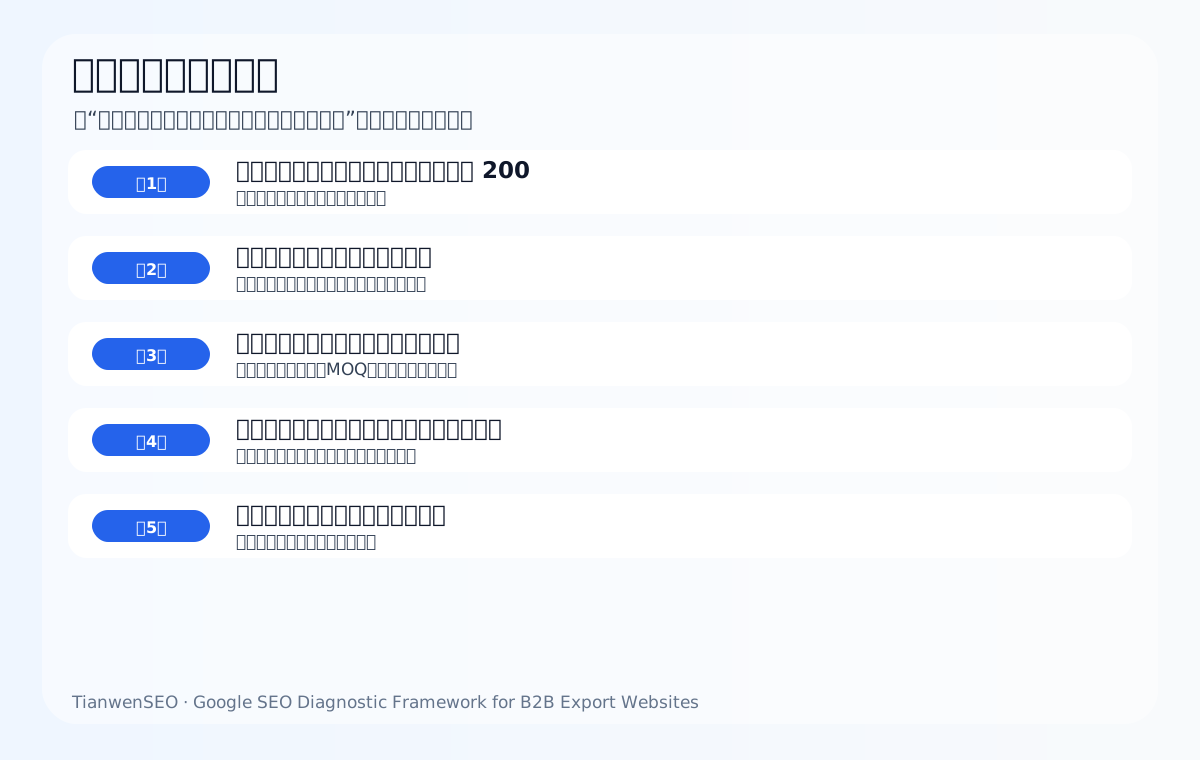
To avoid judging by feel every time, you can fix the diagnostic order into five layers: crawlability, page role, purchasing evidence, on-site equity paths, and content depth. This doesn’t mean content is unimportant; it means you solve the more fundamental, cheaper, more globally impactful problems first.
| Diagnosis layer | Core question | Typical checkpoints |
|---|---|---|
| Layer 1: Crawlability | Can Google reliably see this page | 200 status, robots, index, HTML body, rendering |
| Layer 2: Page role | Does this page serve the right intent | Whether product/tutorial/comparison/brand terms are misaligned |
| Layer 3: Purchasing evidence | Does the page help make a decision | Parameters, MOQ, certifications, lead time, cases, limitations |
| Layer 4: Equity path | Does the site send importance to this page | In-body internal links, category entry points, related page recommendations |
| Layer 5: Content depth | Has the topic been fully explained | Structure, tables, FAQ, scenario coverage, review modules |
The benefit of this order is that even if the final conclusion is still “needs expansion,” you know exactly which layer to expand, instead of piling on paragraphs first and asking questions later.
How to use GSC to quickly separate technical problems from content problems
Google Search Console is one of the most practical first-line tools for export sites. It can’t replace crawl diagnostics and front-end checks, but it’s well suited to helping you judge whether a problem leans technical or content-related. The key is not just looking at average position, but reading queries, pages, impressions, clicks, and time trends together.
If a page shows almost no relevant queries, Google hasn’t yet placed it reliably in the target topic pool, and you should usually check technical issues or the page role first. If the page already shows many target queries but clicks are weak, its content promise, title, or snippet may not be strong enough. If it gets clicks but rankings swing widely, often together with switching index statuses, it looks more like a technical or duplication problem.
| GSC symptom | Which type of problem it leans toward | Explanation |
|---|---|---|
| No target queries at all | Technical / role | The page may not be understood, or its role is wrong |
| Impressions but no clicks | Title / snippet / intent | Users weren’t persuaded to click through |
| Clicks but scattered keywords | Unclear role | The page’s topic boundary is too wide |
| High volatility and frequent drops out of the index | Technical / duplication | Stability or canonicalization problems are common |
| Long-tail performs okay but core terms won’t move up | Evidence / structure / equity | The page still doesn’t answer the main question strongly enough |
For a site selling waterproof connector, if GSC shows mostly educational terms like “what is waterproof connector” rather than business-adjacent terms like “waterproof connector supplier” or “IP67 waterproof connector manufacturer,” go back and check whether the page reads more like a general explainer than a supplier/product capability page.
Why internal links are often underrated: many pages aren’t bad, they just aren’t being pushed
Many teams attribute ranking problems entirely to the page itself, but on-site equity paths are often the core issue. Especially on WordPress sites or export sites with many directories, many high-value pages exist only in the sitemap after publishing; navigation, category pages, industry solution pages, and related articles never really send users or search equity their way.
From Google’s perspective, a page without clear on-site context is hard to treat as a topic hub. The same goes for buyers: if a blog post mentions a material or solution but doesn’t conveniently offer a natural entry point to the product collection page, industry solution page, or RFQ page, the page may be long but still won’t form a business path.
| Internal link problem | Impact on rankings | Better approach |
|---|---|---|
| Only the sitemap has an entry point | Slow discovery, weak importance | Provide entry points in the body and on category pages |
| Related articles link to each other but not to product/solution pages | Topic equity stays at the informational level | Connect knowledge pages with conversion pages |
| Anchor text is too generic | Weak topic signals | Use descriptive anchor text close to the question and product intent |
| Important pages are buried too deep | Crawl frequency and equity flow are limited | Shorten the click depth |
| Industry pages, product pages, and FAQ pages are isolated | User paths break | Build topic clusters with clear responsibilities |
For example, an article about medical probe materials and sterilization requirements, if it stays at the knowledge level and doesn’t link to the corresponding probe product page, application scenario page, sample process page, and certification document page, won’t easily deliver enough value to the site’s key conversion pages even if it gets traffic.
When to check technical and content issues together: the three most common hybrid problems
In practice, many pages with stalled rankings don’t have “only a technical problem” or “only a content problem” — they have hybrid problems. The following three are especially common on export sites.
Type 1: The product page lacks information, and there are also rendering and canonicalization problems
Take a LED flood light category page where the body parameter table is lazy-loaded, so core information like color temperature, wattage, and certifications appears only after switching; at the same time, every filter condition generates a large number of crawlable URLs. In this case, you need to fix both the technical layer’s crawlability and canonicalization, and the content layer’s purchasing decision structure.
Type 2: A blog page serves purchasing terms but has no real product path
For example, an article about how to choose custom metal parts accidentally picks up impressions for some commercial terms, but the page has no product capability description, material range, sampling process, or RFQ entry point. In this case, you shouldn’t just focus on expanding the article; you should sort out the division of labor between product/capability pages and knowledge pages.
Type 3: The page ranks somewhat, but CTR and inquiry quality are both poor
This suggests the page may have “been seen” without moving the right people. Title promises, above-the-fold information, evidence modules, FAQ, and CTA paths all need to be reviewed together. Often the ranking isn’t the weakest link — the real problem is that the page pulls in mismatched visitors.
If the page content itself has no obvious weakness, the problem may lie in how organic search and paid promotion divide the work: when rankings are decent but inquiries are lacking, or when you need to ramp up quickly in peak season, first clarify each channel’s role, then decide whether to fill the gap with ads. You can compare the decision framework in our article How to run Google promotion: how SEO and Google Ads divide the work and how to split the budget, and choose based on budget and time to results.
How to benchmark against Google’s top result: don’t copy the structure, fill in what it leaves unsaid
The point of benchmarking the top result isn’t to count 12 H2s on someone else’s page and produce 12 of your own. It’s to break down why that page ranks ahead. Usually you look at four things: first, what main problem it solves; second, whether it lets users find the answer quickly; third, what evidence and examples it provides; fourth, what it still lacks.
Take the topic “check technical or content first when rankings won’t improve.” The common strengths of authoritative references are: they clearly list a technical audit checklist, they explain content quality signals, and they give indexing and crawling judgment logic. Their common weaknesses are: they lack export B2B product page scenarios, lack a purchasing-decision evidence framework, and lack a review perspective that connects GSC, GA4, and inquiry quality.
So our way to surpass them is not to talk about SEO principles more vaguely, but to land those principles in export business terms: to help teams doing industrial valve supplier, packaging machine, and cnc machining parts know which layer to fix first, why, and how to verify after the fix.
A ranking recovery troubleshooting process you can follow directly
If your team wants diagnostics to become a fixed routine rather than guesswork each time a problem appears, you can follow the order below.
- List the 10–20 most important target pages right now, and record each page’s target queries, page type, and target action.
- Use GSC to review each page’s queries, impressions, clicks, CTR, and average position over the past 90 days, and first judge whether target terms appear at all.
- For pages with no target terms at all, check indexing status, crawl entry points, HTML body content, and canonicalization first.
- For pages with target terms but low clicks, check first whether the title, opening promise, snippet, and page role are accurate.
- For pages with visits but weak conversion, add parameter tables, application scenarios, FAQ, lead time/MOQ/certifications, and next-step paths.
- Check whether blogs, industry pages, category pages, and product pages form clear internal links that send topic equity to the key conversion pages.
- Change only one batch of core pages at a time and keep a review window. Don’t change the title today, the URL tomorrow, and the structure the day after.
This process is closer to how real business progresses: do the things that most affect the ranking foundation first, then the things that most affect click and conversion explainability.
How to read review metrics: don’t stare only at average position
If a team pins all results on “did average position rise,” it will misjudge many pages. Average position is diluted by a large number of long-tail terms and is also affected by region, device, and result format. What’s more valuable for export sites: changes in impressions for target queries, CTR on target pages, whether visitors continue to product/category/RFQ pages, whether inquiries are better matched, and whether the page is more easily cited by AI answers.
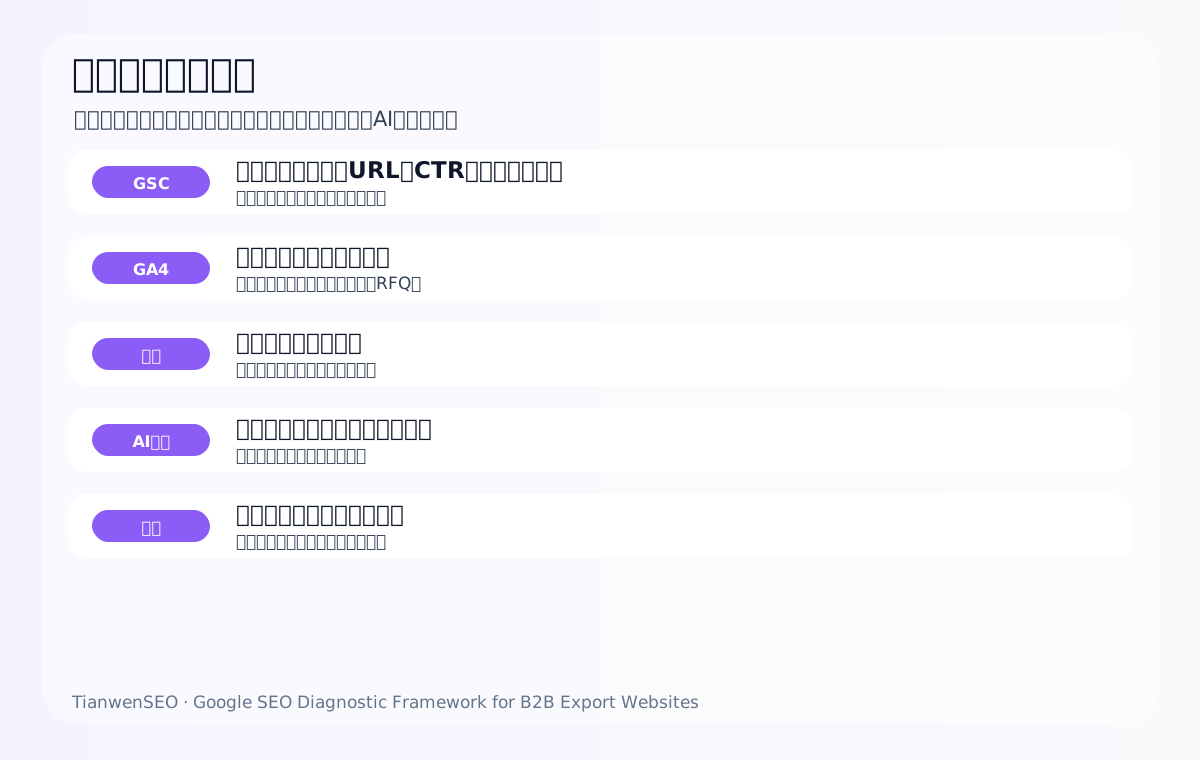
| Review dimension | What to look at | Why it matters |
|---|---|---|
| GSC queries | Are target queries increasing, is CTR improving | Judge whether rankings and clicks are moving in the right direction |
| GA4 behavior | Whether visitors go on to category, product, or RFQ pages | Judge whether visits really carry purchasing value |
| Inquiry quality | Whether inquiries focus more on target products and regions | Verify whether ranking improvements bring better customers |
| AI citations | Whether the page is mentioned correctly or misread | Helps judge whether the page is truly understood |
| Iteration rhythm | Whether enough observation time is left after changes | Avoid frequent changes that make cause and effect unclear |
For example, on a technical page about waterproof connector selection, average position may not jump immediately, but if you see it start steadily earning more relevant long-tail impressions, users more often clicking through to the corresponding IP67/IP68 product pages, and inquiries concentrating in the right specification range, that means the page is improving in the right direction.
Common pitfalls: why many teams start with the most expensive, slowest-return actions
There are four most common pitfalls. First, rewriting the entire site’s copy the moment rankings look bad. Second, equating content expansion with more paragraphs. Third, reducing technical diagnostics to a speed score. Fourth, watching only SEO metrics and ignoring the purchasing path.
- Pitfall 1: Attributing every problem to “content isn’t long enough.” The real key is often page role and evidence structure.
- Pitfall 2: Reading “technical problem” as checking speed only. Indexing controls, rendering, canonicalization, and internal links matter just as much.
- Pitfall 3: Seeing a page rank and leaving its structure alone. Many pages get impressions without answering the main question.
- Pitfall 4: Looking only at traffic, not inquiry quality. More wrong traffic doesn’t mean better business.
If a team can avoid these four pitfalls, diagnostic efficiency is usually far higher than “rewrite a big pile of content first and see what happens.”
FAQ: the most common judgment questions when an export site’s rankings won’t improve
My page has no rankings — should I just write the article past 10,000 words?
Not necessarily. First confirm whether the page is crawled and indexed, whether the target terms suit this page type, and whether the site really sends equity to this page. If none of those three pass, simply adding words usually has limited return.
My product page content is short — will it definitely lose to a long article?
Also not necessarily. For strongly transactional terms, a product or category page doesn’t have to be as long as a tutorial, but it needs to explain clearly the information buyers care about for decisions, such as specs, applications, certifications, MOQ, lead time, sampling, limitations, and the next-step path.
GSC shows impressions but no clicks — is that more a technical or a content problem?
Usually it’s more about the title, snippet, page role, or search intent match. Unless crawl/index anomalies appear at the same time, check first whether the page promise and content structure are accurate.
Why doesn’t my ranking move even after I fix all the technical issues?
Because technical fixes only make the page reliably understandable; they don’t mean the page deserves to rank above competitors. After the technical fixes, you still need to see whether the page helps buyers decide better than the current results do.
AI answers now mention my page — does that mean SEO is fine?
No. An AI mention means some information on the page is easier to extract, but it doesn’t mean search clicks, target term coverage, product paths, and inquiry quality are all improving in step. AI mentions should be read together with GSC, GA4, and inquiry quality.
Conclusion: identify the real bottleneck first, then decide whether to fix technical issues or add content
When you face the question “why won’t Google SEO rankings improve,” the most important thing is not to make a lot of changes immediately, but to first separate out: is the page reliably seen, does it serve the right queries, does it provide enough purchasing-decision evidence, does the site send importance its way, and does the content really explain the problem fully.
For Chinese export manufacturers and trading companies, this order matters especially. Your site not only has to compete for rankings; it also has to bring genuinely likely inquirers to the right page under English product terms and industry scenarios. Rather than overhauling the whole site from the start, follow the order in this article: check technical issues first, then page role, then add evidence and structure, and only then decide whether major expansion is needed. This is usually steadier than “write more content first and see,” and closer to real business results.
Put the export purchasing path into the diagnosis: why many “ranking problems” are actually conversion problems
For export manufacturers, even a page in the top ten may have weak business value if the visitors who arrive don’t continue on to product pages, resource pages, and inquiry pages. So when diagnosing rankings, you have to include the purchasing path. Google doesn’t directly check whether you get inquiries, but whether users keep interacting indirectly affects whether the page continues to satisfy demand.
This is especially true for technical or custom products such as medical probe, industrial valve supplier, and cnc machining parts, where buyers usually won’t send an inquiry after seeing just one page. They typically first check whether one page explains things clearly, then jump to related product or capability pages to confirm details. If the site has no natural path like this, the page won’t easily form a strong signal even if it ranks a little.
| Page stage | What buyers usually do | What you should provide |
|---|---|---|
| First arrival | Quickly confirm whether the page answers the question | Conclusion first, parameter/capability summary, visible headings |
| Continued evaluation | Compare materials, processes, certifications, MOQ, lead time | Tables, FAQ, comparison modules, limitation notes |
| Going deeper | Look at specific products, cases, or application solutions | Natural internal links to category, product, and industry pages |
| Ready to make contact | Judge whether communication and execution are possible | RFQ, document downloads, sampling process, contact details |
If your site breaks down at the second stage, the ranking problem is very likely tied to the conversion structure. Many teams assume this is “content isn’t long enough,” but the real problem is often that the page doesn’t move users to the next step.
Different page types have different technical and content priorities to begin with
Not every page uses the same diagnostic priority. Product pages, category pages, industry solution pages, blog tutorial pages, and FAQ resource pages carry different jobs, so their technical and content priorities differ too.
| Page type | More common technical problems | More common content problems | Recommended priority |
|---|---|---|---|
| Product page | Heavy images, parameters behind interactions, messy variant URLs | Specs, MOQ, certifications, application boundaries unclear | Keep core information visible first, then add evidence |
| Category page | Messy crawling of filter parameter pages, abnormal canonicals | Weak category explanations, product differences unclear | Consolidate duplicates first, then add category decision content |
| Industry page | Entry points too deep, no topic cluster support | Industry issues written vaguely, no scenario solutions | Add internal links first, then scenario content |
| Tutorial page | Weak table of contents anchors/structured data, no related recommendations | Unclear steps, missing examples and reviews | Add structure and cases first |
| FAQ resource page | Split across pagination, mistakenly hit by noindex | Answers too short, boundaries unclear | Check indexing first, then add citable answers |
For example, a packaging machine category page often needs technical and content work at the same time: on one hand, filters and series pages create many near-duplicate URLs; on the other, the category page often lacks decision information such as machine speed, compatible packaging materials, application categories, and after-sales and spare parts support.
How to decide between “expand” and “restructure”
Expansion and restructuring are not the same thing. Expansion usually means the page’s main question is right and coverage is just incomplete; restructuring means the main question, page type, or structural order itself is wrong. If you only expand a page that should be restructured, it often gets messier the more you write.
| Symptom | More likely needs expansion | More likely needs restructuring |
|---|---|---|
| Page already gets relevant long-tail clicks | Yes, the direction is basically right | No |
| Core term clearly doesn’t match the page type | No | Yes, change the page role first |
| Structure order is confusing but the topic is clear | Can expand and rearrange on the same page | Partial restructuring if needed |
| Multiple pages compete for the same topic | Expanding a single page has limited value | Better suited to merging/splitting and restructuring |
| Users often ask the same kind of question but the page doesn’t answer it | Yes, add FAQ / comparison / tables | No |
For example, if a page is clearly about waterproof connector IP67 vs IP68 but only covers definitions without discussing applicable environments, mis-selection risks, test standards, and purchasing advice, it’s better suited to expansion. But if a page’s title says “supplier” while the body mainly covers basics, it’s better suited to restructuring the page role first.
When to check competitor pages instead of only your own on-site data
If your page has no obvious technical barriers, target terms appear in GSC, but rankings sit steadily between positions 6–15, watching only your own site usually isn’t enough. You need to see what the pages currently ranking ahead of you actually do better in terms of user value.
The key things to check include: whether they state the conclusion earlier, whether they use clearer comparison tables, whether they describe use scenarios more specifically, whether they have more credible parameters or third-party evidence, and whether they explain common pitfalls more clearly. For export sites, also check whether they connect product pages, capability pages, and resource pages better.
The value of this step is preventing the team from falling into the psychological trap of “we’ve already written a lot, why isn’t it working.” Often it isn’t that you wrote less, but that the other side puts the more critical questions where they’re easier to see.
The four types of evidence export technical pages especially need
In many manufacturing and industrial categories, Google’s judgment of “who deserves to rank ahead” is often influenced by the strength of on-page evidence. Evidence here isn’t necessarily academic citations; it’s whether the page reflects real supply capability and application understanding.
For projects like custom metal parts or cnc machining parts, what buyers most want to know is usually not whether your “service is good,” but whether you can actually make it, to what precision, at what batch size it makes more sense, and in what cases it’s not suitable. Explaining these clearly on the page is usually more effective than adding a few more paragraphs of brand introduction.
If you’re a trading company rather than a factory, how should you write content that doesn’t ring hollow
Many trading companies worry: without a factory of their own, is it hard to make pages persuasive? The key isn’t actually your identity, but whether you explain your coordination capability, selection capability, and delivery control clearly.
If you run a multi-factory integration business — for example, offering different series of ceramic dinnerware, waterproof connector, or LED flood light at the same time — the page should describe your supply chain screening logic, project management approach, quality inspection checkpoints, and documentation delivery methods, rather than forcing yourself into the mold of an “all-capable manufacturer.”
For Google, content that is truthful, clearly bounded, and clearly pathed is more credible than content that inflates itself vaguely; the same goes for buyers.
After updating content, how long should you wait before checking results
Many teams, after making changes, start switching titles, adding paragraphs, and deleting modules again within two or three days when they see no obvious change, which makes review very difficult. A more reasonable approach is to set the observation window by page type.
| Page type | Suggested observation window | What to focus on during that period |
|---|---|---|
| Product page / category page | 2–4 weeks | Target query impressions, CTR, behavior into product detail pages and RFQ |
| Tutorial page / FAQ page | 3–6 weeks | Long-tail coverage, dwell time, related recommendation clicks, AI mentions |
| New industry page | 4–8 weeks | Whether it starts entering the topic pool and gains relevant queries |
| Page with major technical fixes | 2–6 weeks | Indexing stability, crawl frequency, whether the HTML is extracted correctly |
This doesn’t mean every page must wait out the full window before you touch it again, but it does mean avoiding consecutive changes without enough signal, which leaves you unable to tell which step actually worked.
A simplified judgment method for management: ask these five questions first
If you need to report diagnostic conclusions to a boss or business lead, you don’t have to use deep SEO jargon. You can first use five questions to quickly judge priority.
If the first two questions can’t be answered clearly, check technical issues and page role first. If the first three can all be answered clearly but performance is still weak, look deeper into competitors and content depth. If the fifth question can’t be answered clearly, your optimization actions are probably not reviewable yet.
Sorting pages into “fix first, supplement next, expand later” is more efficient than a one-size-fits-all rewrite
For export sites that already have many pages, the more realistic approach is not to pull every underperforming page out for a rewrite, but to layer them first. The first group is “fix-first pages,” which usually have crawling, indexing, canonicalization, body visibility, or internal link entry problems. The second is “supplement-next pages,” which are already visible but lack purchasing-decision evidence. The third is “expand-later pages,” whose direction is right but whose topic hasn’t been explained systematically yet.
Once you layer them this way, the team’s work order becomes clearer. Technical colleagues handle “fix-first pages” first, content colleagues supplement “supplement-next pages” first, and the expansion of in-depth long articles and pillar pages goes to “expand-later pages.” For a boss, this also makes it easier to explain why some pages aren’t written to 10,000-plus words first, yet improvements show up faster.
| Page layer | Typical characteristics | Top priority action |
|---|---|---|
| Fix-first pages | No target queries, indexing anomalies, weak HTML body, few internal entry points | Fix technical and path issues first |
| Supplement-next pages | Impressions and visits, but insufficient decision information and weak conversion | Add evidence, FAQ, tables, next-step paths |
| Expand-later pages | Direction is basically right and long-tail already performs, but the topic isn’t fully covered | Do systematic expansion and topic enhancement |
If you’re managing an English site with dozens to hundreds of URLs, this layering method is usually more effective than “change every page a little,” because it lets you invest resources first in the pages most likely to produce structural change.
Which signals show you’re close to the right direction, rather than having done another round of ineffective edits
Before you actually see core terms rise clearly, some leading signals usually appear first. For example, target queries start concentrating more and the impressions a page gets are less scattered; clicks on related long-tail terms increase first; users more often jump from article pages to product pages; and AI answers start mentioning specific facts from your page more consistently rather than grabbing one or two definition sentences.
These leading signals matter because they show that the way the system understands the page is becoming more accurate. Especially for industrial sites with long purchasing cycles, ranking improvement often doesn’t happen overnight; it starts with topic recognition, click relevance, path behavior, and content credibility all getting stronger together.
| Leading signal | What it means | Whether to continue the current direction |
|---|---|---|
| Target term impressions become more concentrated | Page topic boundaries are clearer | Usually yes |
| CTR rises slightly | Title/snippet promises fit demand better | Usually yes |
| More second clicks to product/RFQ pages | The conversion path is smoother | Usually yes |
| Fewer misreadings in AI mentions | Evidence and boundaries are expressed more clearly | Usually yes |
| Indexing more stable but rankings haven’t jumped yet | The foundation is improving | Usually still worth observing |
If none of these leading signals appear and all you did was write the page longer, be careful: you may still not have touched the real bottleneck. At that point, revisit the page role, query intent, and on-site equity paths rather than continuing to expand mechanically.
Top-result benchmark card: what such pages usually get right, and how we should surpass them
Pages that rank ahead for this kind of query usually get at least three things right: first, the topic is clear, so users immediately know the page is solving “why won’t rankings improve, and which layer to check first”; second, the structure is clear, quickly separating technical problems, content problems, and hybrid problems; third, they give an actionable checklist rather than only conceptual explanations.
But they also often have obvious gaps. Many authoritative articles lean toward a general SEO perspective; they cover crawling, indexing, and content quality well, but lack the English product pages, category pages, industry solution pages, RFQ paths, and buyer judgment context most common on Chinese export websites. In other words, they’re good at explaining principles, but they can’t necessarily guide a team doing custom metal parts, waterproof connector, or packaging machine on how to actually troubleshoot.
To surpass these pages, the key isn’t adding more terminology, but turning principles into actions closer to business reality: which page type should check HTML visibility first, which should add a parameter table first, which should adjust the title and opening paragraph first, and which should redefine the division of labor between blog pages and product pages. As long as your page is more specific in these actions, clearer in judgment criteria, and closer to real purchasing scenarios in its examples, it usually has a better chance of forming a differentiated advantage.
Pre-publication checklist
Before you actually modify a page, you can run a pre-check with the list below. Its purpose isn’t to replace deep analysis, but to help the team judge the priority direction quickly in about ten minutes.
- Has this page shown target queries in the last 90 days? If not, check indexing, crawling, and page role first.
- Do the title and opening paragraph make clear within 10 seconds what problem it solves?
- Does the page include at least one parameter/comparison/decision table to help buyers filter quickly?
- Does the page have an FAQ answering the questions users are most likely to follow up with?
- Does the page naturally link to related product pages, category pages, industry pages, or the RFQ page?
- Does the page state boundaries, limitations, or unsuitable scenarios, instead of only listing advantages?
- After changes, have review metrics been defined, such as GSC queries, CTR, second-click paths, and inquiry quality?
If you can’t answer three or more items on this list, it usually means the page isn’t yet suitable for direct “copy polishing,” and you should go back to the diagnostic layer and find what’s really holding it back. For export sites, this diagnose-then-modify rhythm often saves more time than a full-site rewrite from the start, and gets closer to the final business result.
One last reminder: truly mature export SEO diagnosis is not about setting technical and content work against each other, but about using evidence to determine which layer is dragging the most. Whether the page can be reliably seen, can serve the right queries, can help buyers make decisions, and can lead visits to deeper pages — these four things are closer to the actual problem than simply asking “fix technical or content first.” As long as you order your actions by evidence rather than by feel, ranking recovery is usually steadier and page assets more easily accumulate into long-term value.
Official evidence and the boundaries of ranking diagnosis
“Google SEO rankings won’t improve” cannot be attributed directly to poor technical work, thin content, weak links, or infrequent updates. What Google’s official documentation supports is a verifiable diagnostic: first confirm whether the page meets the search essentials, then look at crawling, indexing, canonical, robots, page experience, whether the content is helpful, and whether GSC query and page data actually support a given judgment. A diagnostic report should record evidence and the fields to observe next; it must not present a single edit as if natural search position, clicks, inquiries, or AI answers had already improved.
| Official source | What it helps judge | How to validate the diagnostic report | What cannot be concluded |
|---|---|---|---|
| Google Search Essentials | Whether the page meets the basic technical, policy, and content requirements for appearing in Google Search | Record HTTP status, index/follow, accessible body content, important resources, and policy risks | Meeting the basics doesn’t mean stable search performance has been achieved |
| Google ranking systems guide | Search performance is affected by multiple systems and signals together | Record technical, content, intent, on-site path, and competitor pages separately | A single issue cannot be written up as the only cause |
| Google helpful content documentation | Whether the page genuinely helps users complete a task | Check whether the body answers purchasing decisions, technical limits, FAQ, applications, and next steps | More words doesn’t equal higher content quality |
| Google SEO Starter Guide | Basic practices for titles, links, images, page organization, and understandable content | Check whether title, H1, H2/H3, image alt, internal links, and sitemap work together | Completing basic optimization doesn’t mean search results have changed |
| Search Console URL Inspection | Indexing, crawling, canonical, robots, and sitemap status for a single URL | Record verdict, coverageState, lastCrawlTime, and Google-selected canonical | If lastCrawlTime is earlier than the modification time, you cannot say the new version has been re-evaluated |
| Search Console Page indexing report | Whether pages are discovered, crawled, indexed, or blocked by rules | Distinguish discovered, crawled but not indexed, indexed, and affected by noindex/robots/canonical | “Discovered” cannot be written as “indexed” |
| Google canonicalization documentation | Which URL among duplicate or similar pages is treated as the canonical version | Check whether rel=canonical, sitemap, internal links, and the actually selected canonical agree | Setting your own canonical doesn’t mean Google will necessarily adopt it |
| Google robots.txt introduction | Whether crawlers can access important URLs and resources | Check whether robots.txt, meta robots, and X-Robots-Tag conflict with the target page | robots is not a universal fix for content quality or search performance problems |
| Google page experience documentation | Whether page experience affects usability and search quality judgments | Record mobile readability, Core Web Vitals, intrusive interstitials, HTTPS, and usability | Passing page experience doesn’t mean the core content is already more useful |
| Search Console Performance report | Observe impressions, clicks, CTR, and average position by query, page, country, device, and date | Compare data before and after changes using only the same date window and the same dimensions | Small samples cannot be extrapolated to real rankings, click quality, or business results |
| GA4 events documentation | Whether post-visit behavior such as form submissions, downloads, email clicks, and RFQ paths is captured | Confirm key event definitions, paths, and source dimensions, then interpret them separately from GSC | GA4 conversion performance cannot replace Search Console search evidence |
How to validate technical, content, and conversion problems
| Diagnosis layer | What must be checked | Pass criteria | Next action |
|---|---|---|---|
| Accessible and indexable | HTTP 200, robots, meta robots, canonical, sitemap, lastCrawlTime | Page accessible, indexing allowed, canonical version clear, discoverable in the sitemap | If it fails, fix technical issues first; don’t rush to expand the body |
| Page role | Target queries, page type, title, opening paragraph, H1 and the body’s main question | Product, tutorial, comparison, and purchasing terms each have a clear page serving them | If misaligned, adjust page positioning and title promises first |
| Content helpfulness | Specs, applications, limitations, FAQ, comparison tables, purchasing decision fields | Users can quickly judge whether this page solves their current task | If evidence is missing, add tables, FAQ, image captions, and boundaries |
| On-site paths | In-body internal links, category entry points, related articles, product page/RFQ paths | Both users and crawlers can move from the topic page to deeper conversion pages | For isolated pages, add natural internal links and navigation entry points first |
| Performance review | GSC query/page/country/device, GA4 key events, modification time | Wait until crawl time is later than modification time, then observe the same-dimension data window | During low-data periods, record facts only; don’t write performance conclusions |
Delivery boundaries: these situations can only be written as observations, not results
| Current situation | Evidence that can be delivered | Cannot be written as |
|---|---|---|
| Page just updated | Modification time, front-end screenshots, robots, canonical, sitemap, list of official sources | The new version has been re-evaluated by Google |
| URL Inspection shows an old crawl time | Current indexing status and the old lastCrawlTime | The search system has already seen the new content |
| GSC has only a small number of impressions | Date range, query, page, impressions, clicks, CTR, average position | Real ranking trends, click quality, or inquiry changes |
| Page experience or speed passes | Mobile readability, Core Web Vitals, HTTPS, no obvious obstructions | Content quality already meets the user’s task |
| An AI answer sample includes page information | Sample question, time, answer content, whether there is a verifiable citation | External AI platforms will reliably cite or recommend the official site |
So the follow-up review for this page should proceed in evidence order: first confirm whether Google has recrawled the new version, then check whether GSC query/page shows better-matched queries, then combine GA4 key events and on-site paths to judge visit quality. Only when all these fields line up is it fair to keep discussing whether the page has genuinely become stronger.
Keep reading this SEO series
If you’re systematically working through SEO for an export website, it’s worth continuing with the articles below. First make sense of how crawling, indexing, content, links, and reviews relate to one another, then decide which page to change next.
- How to choose Google SEO tools: what to use for keywords, crawling, indexing, content, and inquiry reviews
- Why Google SEO traffic keeps getting harder: the real reasons beyond AI Overviews
- How to do content SEO: a guide to search intent, information gain, and indexable content
- How to do keyword research: a process for export product terms, search intent, and page mapping
- How to mine competitor keywords: from competitor pages and English product terms to inquiry opportunities
- How to choose keyword tools: choose by diagnosis scenario, not by working down a tool list
{
“@context”: “https://schema.org”,
“@type”: “FAQPage”,
“mainEntity”: [
{
“@type”: “Question”,
“name”: “My page has no rankings — should I just write the article past 10,000 words?”,
“acceptedAnswer”: {
“@type”: “Answer”,
“text”: “Not necessarily. First confirm whether the page is crawled and indexed, whether the target terms suit this page type, and whether the site really sends equity to this page. If none of those three pass, simply adding words usually has limited return.”
}
},
{
“@type”: “Question”,
“name”: “My product page content is short — will it definitely lose to a long article?”,
“acceptedAnswer”: {
“@type”: “Answer”,
“text”: “Also not necessarily. For strongly transactional terms, a product or category page doesn’t have to be as long as a tutorial, but it needs to explain clearly the information buyers care about for decisions, such as specs, applications, certifications, MOQ, lead time, sampling, limitations, and the next-step path.”
}
},
{
“@type”: “Question”,
“name”: “GSC shows impressions but no clicks — is that more a technical or a content problem?”,
“acceptedAnswer”: {
“@type”: “Answer”,
“text”: “Usually it’s more about the title, snippet, page role, or search intent match. Unless crawl/index anomalies appear at the same time, check first whether the page promise and content structure are accurate.”
}
},
{
“@type”: “Question”,
“name”: “Why doesn’t my ranking move even after I fix all the technical issues?”,
“acceptedAnswer”: {
“@type”: “Answer”,
“text”: “Because technical fixes only make the page reliably understandable; they don’t mean the page deserves to rank above competitors. After the technical fixes, you still need to see whether the page helps buyers decide better than the current results do.”
}
},
{
“@type”: “Question”,
“name”: “AI answers now mention my page — does that mean SEO is fine?”,
“acceptedAnswer”: {
“@type”: “Answer”,
“text”: “No. An AI mention means some information on the page is easier to extract, but it doesn’t mean search clicks, target term coverage, product paths, and inquiry quality are all improving in step. AI mentions should be read together with GSC, GA4, and inquiry quality.”
}
}
]
}
This page is machine-translated from the Simplified Chinese version and awaiting human review. It has not yet been proofread.