There is no single “best” answer when it comes to Google SEO tools. For export manufacturers and trading companies, the more practical question is: what am I trying to diagnose right now? Is it finding English product keywords, checking why a page is not indexed, seeing why nobody clicks the title, judging whether content matches purchasing intent, checking internal links and technical issues, or reviewing inquiry quality? This article gives a list of 16 Google SEO tools grouped by scenario. For each one it explains what it is, what it can do, its 2026 price and free allowance, and how to use it in an export business context — the list is the body, tool selection is the soul.
Quick Reference: Choosing Tools by Scenario
The seven scenarios below cover the most common starting points for diagnosing an export website’s SEO. Find your current problem and jump straight to the matching tool combination.
| Current problem | First-choice tool | Free alternative | What to look at | Common misuse |
|---|---|---|---|---|
| Not sure which English product keywords to target | Ahrefs / Semrush / DataForSEO | Google Keyword Planner + Google Suggest | Search intent, CPC, SERP type (not page count) | Choosing keywords by search volume alone, ignoring commercial intent |
| Page ranks but gets no clicks | GSC Performance Report | Built into GSC (free) | Query-level CTR, rankings, SERP features (AI Overviews / ads / image placeholders) | Optimizing only the title without watching how the SERP has changed |
| Page does not rank / gets no impressions | GSC + Screaming Frog | GSC Index Coverage + site: operator | Index status, canonical, noindex, orphan pages | Adding content right away without checking index eligibility first |
| Site is not crawled by Google | GSC Crawl Stats + robots.txt tester | Built into GSC | Crawl volume trends, 4xx/5xx, robots blocks | Checking only GSC and never the server logs |
| Content quality is insufficient / structure is messy | SERP benchmarking + manual audit | Incognito browser window + competitor page screenshots | Title structure, image formats, FAQ formats, and heading order of the top 5 results | Using a content scoring tool instead of human judgment |
| Traffic but no inquiries | GA4 + CRM | Built into GA4 + form submission records | The conversion path from product page to inquiry, bounce rate, time on page | Looking only at SEO traffic and not at conversion |
| AI search describes the business inaccurately | ChatGPT/Perplexity sampling + logs | Search brand keywords directly in AI search tools | How AI cites site information and which entities it extracts | Chasing a mention in every AI answer (not controllable) |
16 Google SEO Tools, Broken Down by Scenario
The 16 tools below are grouped into eight diagnostic scenarios. For each one you get: what it is, what it does, its 2026 price and free allowance, and the export-business scenario. Read the full list first, then go back to the quick reference table above to assemble a combination based on your problem.
Part 1: Keyword Discovery Tools — Find the Demand First
1. Google Keyword Planner
What it is: Google Ads’ official free tool for checking keyword search volume, competition level, and CPC ranges.
What it does: Look up keywords by product term, landing page, or category; export the keyword list and cross-check it against real queries in GSC.
Current price (2026): Free (a Google Ads account is required, but you do not need to run campaigns).
Export-business scenario: First-pass screening for English product terms such as custom metal parts: look at commercial intent and CPC first, then decide whether to build a category page or a product page, instead of piling up long-tail keywords.
2. Google Trends
What it is: Google’s official trends tool for relative keyword interest, geographic distribution, and seasonality.
What it does: Compare several product terms, see interest in a target country, and spot rising demand.
Current price (2026): Free.
Export-business scenario: Validating demand across markets for LED flood light: the difference in Trends between US warehouse lighting and European certification demand is closer to real purchasing intent than raw search volume numbers. For details on how to use it, see How to use Google Trends.
3. Ahrefs
What it is: A comprehensive SEO suite that combines keywords, competitors, backlinks, rankings, and content auditing.
What it does: Keyword opportunity analysis, competitor traffic keywords, backlink gaps, site audits, and rank tracking.
Current price (2026): Paid subscription; see the official pricing page for current rates (tiers depend on the number of projects and features; annual billing is usually lower than monthly).
Export-business scenario: Competitor research for cnc machining parts: find out which keywords peers rank for and which pages pull traffic, then compare them with the page gaps in your own product line.
4. Semrush
What it is: A comprehensive SEO, content, and advertising tool with a strong keyword database and content optimization features.
What it does: Keyword Magic Tool, position tracking, site audit, content marketing, and competitor ad analysis.
Current price (2026): Paid subscription with a 7-day free trial; see the official pricing page for current rates.
Export-business scenario: Keyword clusters for a packaging machine category page: split the category term into sub-intents such as material, speed, bag type, and automation, and map each to a category or product page.
Part 2: Technical Crawling Tools — Check Whether the Site Can Be Found Properly
5. Screaming Frog SEO Spider
What it is: A desktop site crawling tool that checks every page the way a search engine crawler would.
What it does: Status codes, redirect chains, canonical, duplicate titles, missing descriptions, heading tags, internal link depth, orphan pages, image alt text, structured data, and page size.
Current price (2026): The free version crawls 500 URLs; a paid license is about £199/year (€245/year) and removes the limits and supports saving crawls; see the official site for current pricing.
Export-business scenario: Product specs buried in images, script-generated navigation, category pages pointing canonical at the wrong URL, old posts that never link to core product pages — a single crawl can list all of these common problems on an export site.
6. Sitebulb
What it is: A site audit tool that prioritizes technical issues by impact after crawling.
What it does: Crawl audits, priority recommendations, PDF/Excel reports, and integration with GSC/GA data.
Current price (2026): 14-day free trial; the Lite tier covers about 10,000 URLs per audit; see the official pricing page for full pricing.
Export-business scenario: On a site with several hundred product pages, use impact-based ranking to decide which technical issues to fix first, instead of staring blankly at hundreds of alerts.
Part 3: Indexing and Coverage Diagnostic Tools — First Confirm a Page Is Eligible to Compete
7. Google Search Console (GSC)
What it is: Google’s official webmaster tool and the first-hand data source for your own site’s real search performance and index status.
What it does: Queries, clicks, impressions, CTR, and average position; URL Inspection, the Index Coverage report, sitemap submission, and crawl stats.
Current price (2026): Free.
Export-business scenario: When a medical probe product data page has had no impressions for a long time, use URL Inspection first to check whether it is noindexed, whether canonical points to the wrong URL, and whether the page is orphaned, then decide whether to rewrite it. For full instructions, see the Google Search Console tutorial and the GSC diagnostic guide.
8. Bing Webmaster Tools
What it is: Microsoft’s official webmaster tool, covering Bing/Edge traffic and some AI search entry points.
What it does: URL submission, index reports, keyword research, SEO reports, and site scans.
Current price (2026): Free.
Export-business scenario: Buyers in Europe and North America also use Bing/Edge alongside Google, especially in the European market; it costs nothing to add as a second indexing channel.
9. Rich Results Test
What it is: Google’s official structured data testing tool.
What it does: Verify whether FAQ, Product, Review, and other schema can be recognized as rich results.
Current price (2026): Free.
Export-business scenario: Test product page FAQ structured data before it goes live, so formatting errors do not get it ignored. For an introduction to structured data, see the Schema structured data and AI search guide.
Part 4: Page Speed Tools
10. Google PageSpeed Insights
What it is: Google’s official performance testing tool, which reports mobile and desktop performance scores plus optimization suggestions.
What it does: Core Web Vitals metrics such as LCP, INP, and CLS, plus specific optimization items for images, fonts, and JS.
Current price (2026): Free.
Export-business scenario: Mobile share is high in Middle East and Southeast Asian markets, and uncompressed product page images will push LCP over the threshold; use PSI to get a specific list and hand it to your web developer, rather than saying vaguely that “the site is slow.”
Part 5: Content Optimization and SERP Benchmarking Tools
11. Surfer SEO
What it is: A content optimization tool that analyzes SERP structure for a target keyword and gives writing suggestions.
What it does: SERP benchmarking, content scoring, keyword density suggestions, AI outline generation, and integration with Google Docs/GSC.
Current price (2026): Paid subscription; Standard is about $99/month (annual billing) and Pro about $182/month (annual billing); see the official pricing page for current rates.
Export-business scenario: Before writing a ceramic dinnerware guide, look at the H2 structure and coverage points of the top three SERP results, then decide which purchasing information — MOQ, packaging, customization — you need to add.
12. Frase
What it is: A content research and writing assistance tool.
What it does: SERP content outlines, FAQ generation, AI writing, content scoring.
Current price (2026): 7-day free trial (no credit card required); see the official pricing page for current rates.
Export-business scenario: Drafting a waterproof connector product guide: let the tool list the IP rating, wire gauge, and current questions buyers ask most, then verify the accuracy of the answers by hand — the tool provides structure, a human provides facts.
Part 6: Rank Tracking and Change Monitoring Tools
13. ContentKing
What it is: A real-time SEO monitoring tool that continuously tracks page changes and sends alerts.
What it does: Page change monitoring, index drift alerts, real-time auditing, and integration with GSC data.
Current price (2026): Paid subscription; see the official pricing page for current rates.
Export-business scenario: After a large site redesign, monitor whether core product pages drop out of the index, whether titles were changed, and whether canonical has drifted, so problems do not pile up until the end of the month.
14. DataForSEO
What it is: An SEO data API service billed by usage, suited to teams with development capacity or reporting tools.
What it does: APIs for keyword search volume, SERP data, ranking data, and site audit data.
Current price (2026): Billed by API usage; see the official site for current pricing.
Export-business scenario: Pull SERP data for product keywords in bulk for clustering analysis, or feed ranking data into your own dashboard instead of checking rankings one by one by hand.
Part 7: Business Review Tools
15. GA4 (Google Analytics 4)
What it is: Google’s official analytics tool and the standard source for on-site visit behavior and conversions.
What it does: Traffic sources, page paths, events, and conversions; view “search performance” and “visit behavior” as two separate layers from GSC data.
Current price (2026): Free.
Export-business scenario: After updating a private label activewear manufacturer page, clicks rise but every inquiry asks about small-batch retail — that means the page is attracting the wrong audience. Only by looking at the GA4 path together with the inquiry fields can you spot this; traffic numbers alone will mislead you.
Part 8: AI Search Visibility Check Tools
16. ChatGPT / Perplexity Manual Sampling
What it is: Manual sample queries in AI chat tools, used to check how accurately brand and product keywords are described in AI answers.
What it does: Record how AI cites site information, which entities it extracts, and whether descriptions are accurate; build a sampling query list and recheck it regularly.
Current price (2026): The free tier is enough for sample queries; consider a paid tier for bulk or high-frequency checks.
Export-business scenario: AI search visibility is not just about whether you appear; it is about citation accuracy. For the sampling method, see the AI visibility monitoring guide; for the current state of AI Overview coverage for Chinese queries, see the test of 500 Chinese queries.
How the Five Tool Categories Divide the Work: One Tool Cannot Answer Every Question
Divide SEO tools into five categories, and each category answers questions on only one level. Mixing up tool categories is the most common judgment error among export SEO teams. The table below explains the core purpose and the limits of each category.
| Tool category | Questions it answers | Questions it cannot answer |
|---|---|---|
| Keyword tools (Ahrefs/Semrush/KP/DataForSEO) | What users search for, which keywords competitors rank for | Where my page will rank, and how GEO/AI search will cite it |
| Crawling tools (Screaming Frog/Sitebulb/Netsparker) | Page discoverability and technical anomalies | Whether Google has already indexed this page |
| Indexing and performance tools (GSC is the core) | Real search performance, index coverage, CTR, and rankings | Whether page content satisfies purchasing intent |
| Content and SERP benchmarking tools | Coverage gaps, structural recommendations, SERP features | Whether a buyer will send an inquiry after reading |
| Behavior and business review tools (GA4/CRM) | Visit paths, inquiry sources, and conversion quality | Why search results changed |
For a detailed breakdown of tool roles, see the index diagnostics chapter in Tianwen SEO Research’s Google SEO optimization checklist.
Free Alternatives Compared: Enough for Most Day-to-Day Diagnostics
An export website does not necessarily need paid tools in its early stages. The table below lists free alternatives to common paid tools and the limits of what they can do.
| Diagnostic scenario | Paid tool | Free alternative | Is it enough? | When to upgrade |
|---|---|---|---|---|
| Keyword discovery | Ahrefs, Semrush | Google Keyword Planner + Google Suggest + existing queries in GSC | Enough; coverage is 30–50% below paid tools, but the direction is right | Upgrade when you need bulk competitor keyword monitoring |
| Technical crawling | Screaming Frog (paid version) | Screaming Frog free version (500 URL limit) | Enough for small sites (under 500 pages) | Upgrade when the site passes 500 pages |
| Search performance | Rank tracking tools | GSC Performance Report (free, and the most authoritative) | More accurate than any paid rank tracker | Use a Python script when you need to pull data in bulk via API |
| Index diagnostics | Sitebulb | GSC Index Coverage + URL Inspection (free) | Enough; URL-level investigation is still manual | Use Screaming Frog when you need bulk index auditing |
| SERP analysis | Semrush / Ahrefs SERP | Manual checks in an incognito browser window | Enough, but manual work is slow | Upgrade when you monitor competitor changes regularly |
| AI visibility | Brand24 / Mention | Search brand plus product keywords directly in each AI tool | Enough for sampling | Upgrade when you need quantified reports on how often AI cites your brand |
How to Budget for Tools: Start Free, Then Buy Around the Bottleneck
Many export businesses do not need a full suite of expensive tools at the start. A basic stack can be GSC, GA4, Google Suggest, manual SERP checks, a spreadsheet, and one crawling tool. Once page count, product lines, and competitive pressure grow, add Ahrefs, Semrush, Sitebulb, ContentKing, Surfer, or similar tools.
Budget should follow the bottleneck: if demand discovery is weak, buy keyword and competitor tools; if technical problems pile up, buy crawling and monitoring; if content production is heavy, buy content assistants; if there are many pages updated frequently, buy monitoring; if inquiry review is weak, fix GA4 and form tracking first.
| Stage | Tool stack | Best for |
|---|---|---|
| Getting started | GSC + GA4 + Suggest + spreadsheet | Few pages |
| Technical stage | Add a crawling tool | Many indexing and structure issues |
| Competitive stage | Add Ahrefs/Semrush | Competitor and link analysis |
| Content stage | Add content assistant tools | Lots of article and page updates |
| Scale stage | Add monitoring and project management | Maintained by several people |
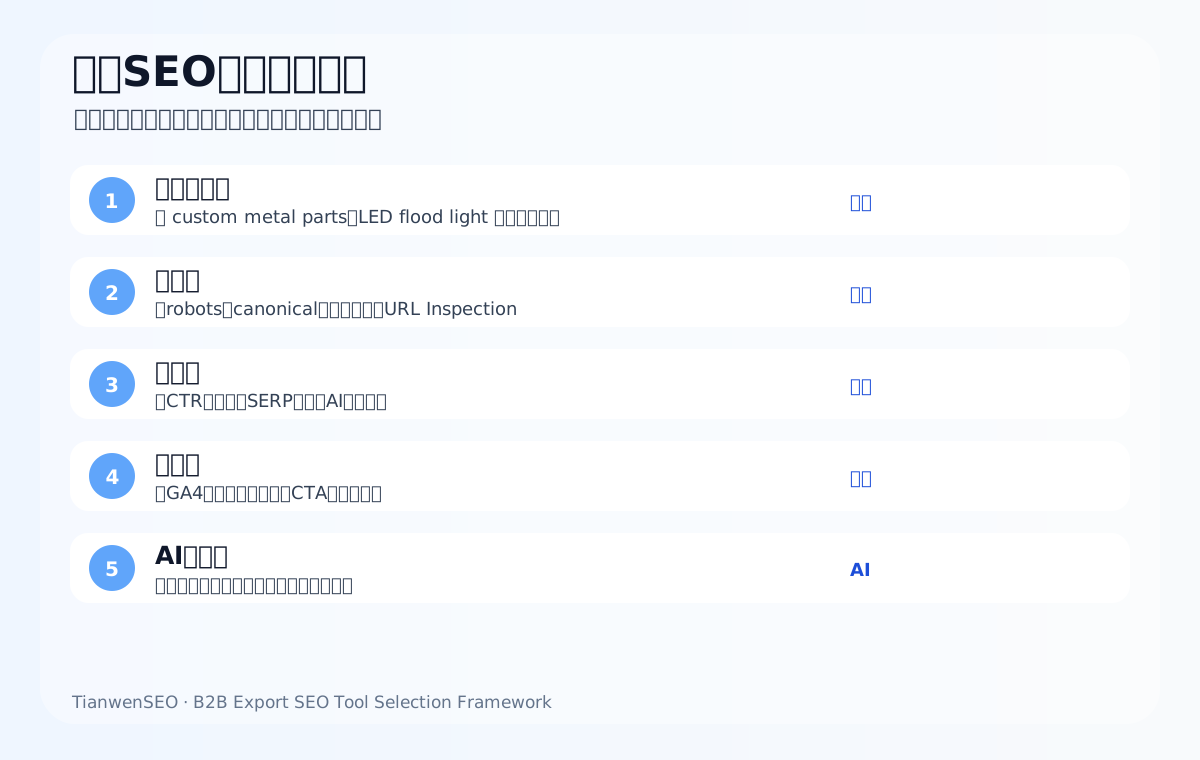
Keyword Opportunity Diagnosis: From Product Terms to Page Types
Break terms such as custom metal parts, LED flood light, and packaging machine into category, specification, supplier, application, problem, and quote-preparation groups. Each group maps to a different page, so one page does not have to carry every need.
Not-Indexed Diagnosis: Check Eligibility Before Content
If a page gets no impressions, check URL Inspection, robots, canonical, internal links, duplicate content, mobile-visible text, and server status first.
No-Click Diagnosis: Look at CTR and SERP Makeup First
If there are impressions but no clicks, the title may be too vague, or the SERP may show an AI answer, images, ads, or a stronger competitor title.
No-Inquiry Diagnosis: Look at the Page Path First
If there are clicks but no inquiries, check in GA4 whether visitors reach product pages, data pages, and the contact page, and whether the CTA tells buyers what they need to prepare.
Thin Content Diagnosis: Do Not Look Only at Word Count
Whether content is thin depends on whether it covers the purchasing decision, not on word count. A medical probe page needs certification and compatibility; a ceramic dinnerware page needs material and MOQ.
Competitor Diagnosis: Tools Show the Gap, People Read the Intent
Ahrefs/Semrush can tell you which keywords competitors rank for; manual SERP review can tell you why the ranking page satisfies intent. Use both together.
Internal Link Diagnosis: Tools Find Orphan Pages, People Choose the Main Entry
Crawling tools can find orphan pages and measure internal link depth, but which page should be the main entry depends on product line and inquiry value.
Link Diagnosis: Do Not Look Only at Quantity
For an export site, links should be judged on relevance and authenticity. Trade shows, certifications, industry directories, and publicly available customer materials usually matter more than unrelated blogs.
Content Update Diagnosis: Tool Output Must Enter the Task List
For every update, record the target query, the reason, the action, the publish date, and the review date, so you do not keep editing the same page twice.
AI Citation Diagnosis: Accuracy Matters More Than Frequency
Whether AI mentions your site is not the only goal; what matters more is whether the description is accurate, whether it cites the right page, and whether it understands the product facts.
Tool Stack Examples for Ten Export Product Lines
Export example 1: how to combine tools for custom metal parts
When choosing SEO tools around custom metal parts, start with a keyword tool to find queries about material, tolerance, surface finish, drawings, and quote documents. Then use the SERP to judge whether those queries need a product page, category page, application page, or guide page. Next, use a crawling tool to check whether the relevant URLs are reachable, indexable, and sufficiently internally linked, and use GSC to see real impressions and clicks.
After launch or an update, use GA4 to see whether users reach the product page, data page, or inquiry page, then ask sales whether inquiries have become clearer. Tool selection is only effective when search data, behavior data, and business feedback confirm one another.
Export example 2: how to combine tools for LED flood light
When choosing SEO tools around LED flood light, start with a keyword tool to find queries about wattage, waterproofing, mounting height, beam angle, and warranty. Then use the SERP to judge whether those queries need a product page, category page, application page, or guide page. Next, use a crawling tool to check whether the relevant URLs are reachable, indexable, and sufficiently internally linked, and use GSC to see real impressions and clicks.
After launch or an update, use GA4 to see whether users reach the product page, data page, or inquiry page, then ask sales whether inquiries have become clearer. Tool selection is only effective when search data, behavior data, and business feedback confirm one another.
Export example 3: how to combine tools for packaging machine
When choosing SEO tools around packaging machine, start with a keyword tool to find queries about material, speed, bag type, automation, and after-sales. Then use the SERP to judge whether those queries need a product page, category page, application page, or guide page. Next, use a crawling tool to check whether the relevant URLs are reachable, indexable, and sufficiently internally linked, and use GSC to see real impressions and clicks.
After launch or an update, use GA4 to see whether users reach the product page, data page, or inquiry page, then ask sales whether inquiries have become clearer. Tool selection is only effective when search data, behavior data, and business feedback confirm one another.
Export example 4: how to combine tools for medical probe
When choosing SEO tools around medical probe, start with a keyword tool to find queries about certification, compatibility, material, sterilization, and testing. Then use the SERP to judge whether those queries need a product page, category page, application page, or guide page. Next, use a crawling tool to check whether the relevant URLs are reachable, indexable, and sufficiently internally linked, and use GSC to see real impressions and clicks.
After launch or an update, use GA4 to see whether users reach the product page, data page, or inquiry page, then ask sales whether inquiries have become clearer. Tool selection is only effective when search data, behavior data, and business feedback confirm one another.
Export example 5: how to combine tools for cnc machining parts
When choosing SEO tools around cnc machining parts, start with a keyword tool to find queries about DFM, volume production, QC, and lead time. Then use the SERP to judge whether those queries need a product page, category page, application page, or guide page. Next, use a crawling tool to check whether the relevant URLs are reachable, indexable, and sufficiently internally linked, and use GSC to see real impressions and clicks.
After launch or an update, use GA4 to see whether users reach the product page, data page, or inquiry page, then ask sales whether inquiries have become clearer. Tool selection is only effective when search data, behavior data, and business feedback confirm one another.
Export example 6: how to combine tools for ceramic dinnerware
When choosing SEO tools around ceramic dinnerware, start with a keyword tool to find queries about material, glaze color, packaging, MOQ, and customization. Then use the SERP to judge whether those queries need a product page, category page, application page, or guide page. Next, use a crawling tool to check whether the relevant URLs are reachable, indexable, and sufficiently internally linked, and use GSC to see real impressions and clicks.
After launch or an update, use GA4 to see whether users reach the product page, data page, or inquiry page, then ask sales whether inquiries have become clearer. Tool selection is only effective when search data, behavior data, and business feedback confirm one another.
Export example 7: how to combine tools for waterproof connector
When choosing SEO tools around waterproof connector, start with a keyword tool to find queries about IP rating, wire gauge, current, and outdoor applications. Then use the SERP to judge whether those queries need a product page, category page, application page, or guide page. Next, use a crawling tool to check whether the relevant URLs are reachable, indexable, and sufficiently internally linked, and use GSC to see real impressions and clicks.
After launch or an update, use GA4 to see whether users reach the product page, data page, or inquiry page, then ask sales whether inquiries have become clearer. Tool selection is only effective when search data, behavior data, and business feedback confirm one another.
Export example 8: how to combine tools for industrial valve supplier
When choosing SEO tools around industrial valve supplier, start with a keyword tool to find queries about material, pressure, standards, operating conditions, and lead time. Then use the SERP to judge whether those queries need a product page, category page, application page, or guide page. Next, use a crawling tool to check whether the relevant URLs are reachable, indexable, and sufficiently internally linked, and use GSC to see real impressions and clicks.
After launch or an update, use GA4 to see whether users reach the product page, data page, or inquiry page, then ask sales whether inquiries have become clearer. Tool selection is only effective when search data, behavior data, and business feedback confirm one another.
Export example 9: how to combine tools for private label activewear manufacturer
When choosing SEO tools around private label activewear manufacturer, start with a keyword tool to find queries about fabric, sizing, sampling, MOQ, and packaging. Then use the SERP to judge whether those queries need a product page, category page, application page, or guide page. Next, use a crawling tool to check whether the relevant URLs are reachable, indexable, and sufficiently internally linked, and use GSC to see real impressions and clicks.
After launch or an update, use GA4 to see whether users reach the product page, data page, or inquiry page, then ask sales whether inquiries have become clearer. Tool selection is only effective when search data, behavior data, and business feedback confirm one another.
Export example 10: how to combine tools for solar mounting bracket
When choosing SEO tools around solar mounting bracket, start with a keyword tool to find queries about material, wind load, mounting method, and certification. Then use the SERP to judge whether those queries need a product page, category page, application page, or guide page. Next, use a crawling tool to check whether the relevant URLs are reachable, indexable, and sufficiently internally linked, and use GSC to see real impressions and clicks.
After launch or an update, use GA4 to see whether users reach the product page, data page, or inquiry page, then ask sales whether inquiries have become clearer. Tool selection is only effective when search data, behavior data, and business feedback confirm one another.
Hands-On Checklist for Export SEO Tools: From Discovery to Review
To make tools part of real execution, record every page through five steps: discover, diagnose, decide, execute, review. In the discovery stage, use keyword tools and GSC to find English product terms; in the diagnosis stage, use a crawling tool, URL Inspection, the SERP, and GA4 to identify the problem; in the decision stage, choose to refresh, rewrite, merge, add internal links, fix technical issues, or adjust the CTA; in the execution stage, record the change; in the review stage, look at search, visits, and inquiries.
| Stage | Tool | Output | Export site example |
|---|---|---|---|
| Discovery | GSC, Suggest, Ahrefs/Semrush | Target keywords and page opportunities | Found waterproof connector for outdoor lighting |
| Diagnosis | Screaming Frog, URL Inspection, SERP | Problem type | Found that the page lacks application scenarios and internal links |
| Decision | Spreadsheet, competitor structure, sales feedback | Action type | Decided to add an application page instead of a new generic article |
| Execution | CMS, content assistant, image tools | Page update | Added a spec table, FAQ, and product entry points |
| Review | GSC, GA4, form records | Performance judgment | Check impressions, clicks, product page entry, and inquiry quality |
Whom to Trust When Tool Data Conflicts
Conflicts between tools are normal. A keyword tool reports search volume but GSC shows no impressions — the page may not cover that topic yet. A crawling tool reports everything is fine but GSC still will not index the page — the issue may be content uniqueness or internal duplication. A content tool gives a high score but GA4 shows no inquiries — the text may cover the topic without resolving the purchasing decision. When conflicts arise, look at first-hand data and business results first, then use third-party tools to explain them.
How to Report SEO Tool Results to Your Boss
Do not report only that “tool scores improved.” A better structure is: which product lines were worked on this week, which English product keyword opportunities were found, which pages have crawling or indexing problems, which pages need rewriting or merging, which updates have gone live, and which metrics to check at 7/14/30/60 days. That way your boss can see how the tools serve inquiries instead of looking at a pile of screenshots.
How to Keep Tools From Leading the Team Astray
The easiest way for tools to lead a team astray is to make people chase scores, search volume, and ranking fluctuations. An export website should always put tool output back into the context of the product line: does this keyword match a product we actually make? Can this page serve the target buyer? Will this change reduce the cost of sales communication? If the answer is no, be cautious no matter how attractive the tool’s recommendation looks.
How to Use Tools for a Cross-Market Export Site
The same product can carry different search intent in different countries. LED flood light may be about warehouses and parking lots in the US market, high temperatures and dust protection in the Middle East, and certification and energy efficiency in Europe. Look at rank tracking and the GSC country dimension separately, and add content modules for each target market.
How Tools Support Content Consolidation Decisions
When several pages cover the same set of queries, GSC shows the queries are scattered, a crawling tool shows internal links are scattered, the SERP shows competitors ranking with one comprehensive page, and GA4 shows messy user paths. Only by putting all four data sets together can you decide which URL to consolidate into and which paragraphs, FAQs, and images are worth keeping.
How Tools Support Page Refresh Decisions
When a page still matches intent but its tables, FAQ, year, certifications, specs, or application scenarios are outdated, content assistants and SERP benchmarking can help close the gap. A refresh is not just changing the date; it is making the page more useful to buyers.
How Tools Support Technical Fix Priorities
If a crawl report lists hundreds of issues, handle the ones affecting core product and category pages first: status codes, canonical, noindex, link depth, mobile content, image size, and structured data. Do not spend your energy first on minor issues on low-value pages.
How Tools Support AI Search Optimization
AI search optimization is not a separate set of tools from SEO. First use SEO tools to confirm the page is crawlable, indexable, and complete, then check whether definitions, tables, FAQs, entity consistency, and evidence are easy to cite. Review AI visibility for citation accuracy, not just for whether you appear.
What Changed in Tool Selection in 2026
A few changes in 2026 are worth noting:
- GSC is still the first-hand data source — Google Search Console remains the most authoritative source for indexing, queries, CTR, and rankings. SEO scores from plugins such as Rank Math and Yoast cannot replace the real performance data in GSC. For step-by-step instructions, see the Google Search Console diagnostic guide.
- AI search monitoring tools became a new category — In 2026 a group of tools emerged specifically to monitor how AI search engines (ChatGPT Search, Perplexity, Google AI Overviews) cite sources, including Authoritas and EnterpriseBrand. Their job is to check how often and how accurately a brand appears in AI answers, but citation outcomes remain outside your control.
- More SEO tools are integrating AI features — Mainstream tools such as Ahrefs and Semrush have added AI-assisted keyword grouping and content brief generation, but the sources and algorithms behind the core data (search volume, backlinks) have not changed. Do not switch tools just because one of them added an AI label.
- IndexNow as a submission channel — The IndexNow protocol has been adopted by more search engines (Bing, Yandex, Seznam, and others), but there is still no official confirmation of its effect on Google indexing. See Tianwen SEO Research’s Schema structured data guide for related indexing techniques.
Tool Boundaries: What Tools Cannot Decide
Tools provide clues, but they cannot replace the following judgments:
- A tool cannot judge whether a page is worth a buyer’s inquiry — that requires a person to read the page content and sales feedback.
- A tool cannot promise rankings, CTR, traffic, inquiries, or AI citation results.
- Tool scores (such as content optimization scores or page speed scores) are not the same as Google search performance.
- For sites without GSC data, tool reports can only establish baseline facts (whether URLs are discovered, whether pages are crawlable, which keywords carry search intent); they cannot describe changes in clicks, rankings, or traffic.
- An AI visibility tool showing that your brand is mentioned in AI answers does not equal a recommendation or a business conversion — judge it together with inquiry sources.
Frequently Asked Questions About Google SEO Tools (FAQ)
What types of Google SEO tools are there?
Five categories by scenario: keyword research (GSC, Keyword Planner), crawling and index diagnostics (GSC URL Inspection, Screaming Frog), speed and performance (PageSpeed Insights), rank monitoring (GSC, third-party tracking), and content and AI visibility tools.
Are free tools enough?
For most day-to-day diagnostics, free tools are enough: GSC for data, PageSpeed for speed, and Google’s official documentation for the rules. Paid tools mainly add bulk crawling, competitor comparison, and rank tracking; choose them as needed.
Can one tool answer every question?
No. Each tool answers one type of question; a keyword tool cannot replace crawl diagnostics, and a rank tracker cannot replace a content audit. The right approach is to define the diagnostic scenario first, then pick the matching tool.
What changed in tool selection in 2026?
AI search visibility monitoring has become a new need, but to judge a tool’s value, look at whether it can access real data (GSC, official APIs) rather than at AI demo screenshots. The boundary is that a tool cannot decide business strategy for you.
Conclusion: The Point of Choosing Tools Is to Make Better Judgments
The value of Google SEO tools is not in how many you buy, but in helping the team make fewer bad calls. Keyword tools find demand, crawling tools check technical health, GSC shows real search performance, content tools fill structural gaps, and GA4 plus inquiry records verify business quality. Each tool answers only part of the question; together they form a complete judgment.
For an export business, tools ultimately have to serve English product keywords, product pages, category pages, application pages, data pages, and the inquiry path. If tool output cannot be turned into page actions and review metrics, it is just a report. A tool stack is genuinely useful only when it helps you decide whether to refresh, rewrite, merge, add internal links, fix technical issues, or adjust the CTA.
Further Reading
For SEO tools, the following articles can help you go deeper into specific areas:
- Google SEO Optimization Checklist: A Self-Audit and Execution Checklist for Export Websites — run SEO work by P0 to P5 priority
- How to Do Google SEO: A Complete 2026 Tutorial for Export Websites — the full SEO path from scratch
- What Is Google SEO: A Complete Guide From Crawling and Content to Inquiries for Export Websites — basic SEO concepts
- Google Search Console Diagnostic Guide: From Beginner to Practice — detailed GSC operations
- SEO/GEO Monthly Review Report Template — how to turn tool data into a report
- AI Visibility Monitoring Report Template — an introduction to monitoring AI search citations
About the author: Liu Yu (Henan Tianwen Network Technology) works on Google SEO, GEO/AI search visibility, and Google Ads for export websites. Tianwen SEO Research has published the original data study “A test of 500 Chinese queries: 80.9% are already covered by Google AI Overview” and the free tool AI crawler access checker.
Last updated: August 8, 2026
{
“@context”: “https://schema.org”,
“@type”: “FAQPage”,
“mainEntity”: [
{
“@type”: “Question”,
“name”: “What types of Google SEO tools are there?”,
“acceptedAnswer”: {
“@type”: “Answer”,
“text”: “Five categories by scenario: keyword research (GSC, Keyword Planner), crawling and index diagnostics (GSC URL Inspection, Screaming Frog), speed and performance (PageSpeed Insights), rank monitoring (GSC, third-party tracking), and content and AI visibility tools.”
}
},
{
“@type”: “Question”,
“name”: “Are free tools enough?”,
“acceptedAnswer”: {
“@type”: “Answer”,
“text”: “For most day-to-day diagnostics, free tools are enough: GSC for data, PageSpeed for speed, and Google’s official documentation for the rules. Paid tools mainly add bulk crawling, competitor comparison, and rank tracking; choose them as needed.”
}
},
{
“@type”: “Question”,
“name”: “Can one tool answer every question?”,
“acceptedAnswer”: {
“@type”: “Answer”,
“text”: “No. Each tool answers one type of question; a keyword tool cannot replace crawl diagnostics, and a rank tracker cannot replace a content audit. The right approach is to define the diagnostic scenario first, then pick the matching tool.”
}
},
{
“@type”: “Question”,
“name”: “What changed in tool selection in 2026?”,
“acceptedAnswer”: {
“@type”: “Answer”,
“text”: “AI search visibility monitoring has become a new need, but to judge a tool’s value, look at whether it can access real data (GSC, official APIs) rather than at AI demo screenshots. The boundary is that a tool cannot decide business strategy for you.”
}
}
]
}
This page is machine-translated from the Simplified Chinese version and awaiting human review. It has not yet been proofread.