What is the difference between brand authority and topical authority? In AI search and Google SEO, this is not a purely theoretical question — it is a question that directly shapes foreign trade website strategy. Brand authority is closer to “who you are, whether you are worth trusting, whether the industry recognizes you”; topical authority is closer to “whether you systematically cover this kind of question, whether your content forms a system, whether your pages can continuously answer purchasing decisions”. For foreign trade sites in categories such as custom metal parts, LED flood light, packaging machine, medical probe, cnc machining parts, and waterproof connector, both brand authority and topical authority matter, but the way they work differs from scenario to scenario.
This article explains, from the perspective of a foreign trade B2B website: what brand authority and topical authority each are, how they differ in weight across Google SEO and AI search, why AI more easily amplifies brand and entity signals, why it is hard to stay consistently visible over the long term without topical depth, and how a foreign trade website can judge whether it currently lacks brand authority or topical authority more.
Target queries: 品牌权威和主题权威有什么区别、brand authority vs topical authority、AI search brand authority、topical authority vs brand visibility. Search intent: users do not just want concept definitions; they want to know which side to build up first in execution, and how to tell whether the two are out of balance. Top 1/authority benchmark: current content generally stresses the importance of topical authority for Google rankings and the amplifying effect of brand authority in AI search; the shortcoming is that it rarely lands on foreign trade product pages, resource pages, RFQ pages, brand entities, and inquiry paths. This article fills in those application-level judgments.
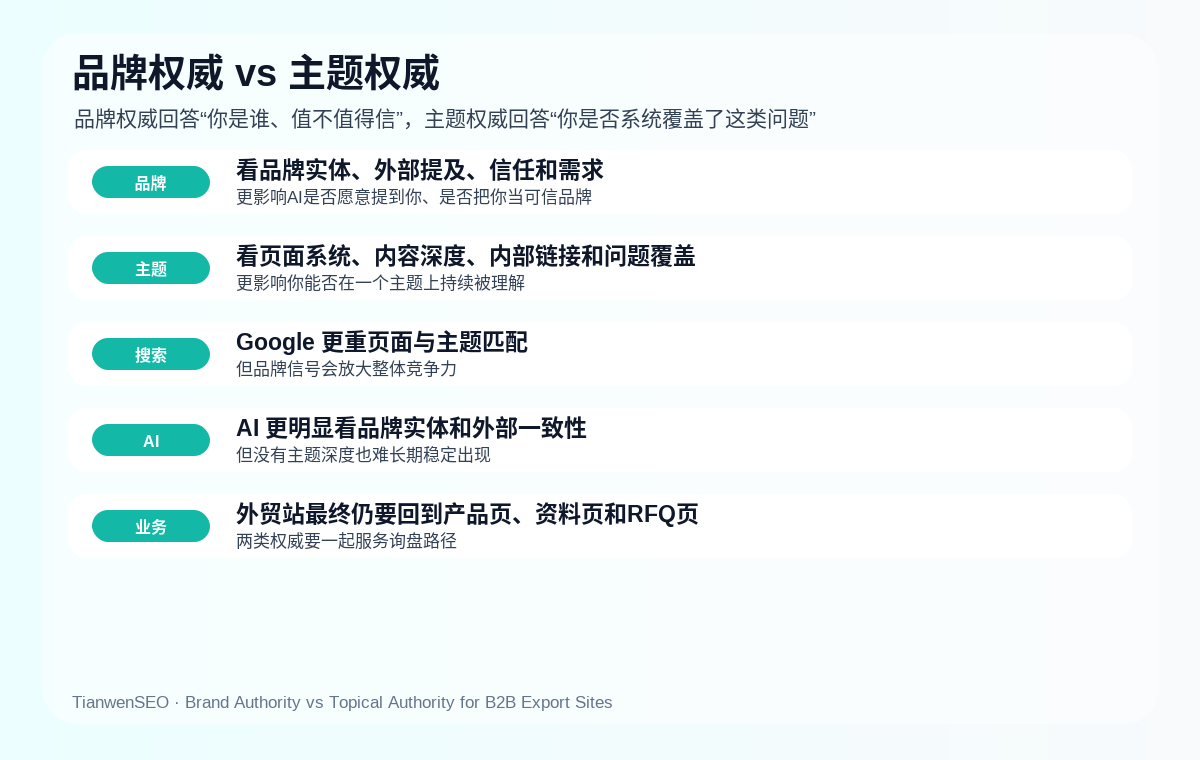
The conclusion first: Google relies more on topical authority to build page competitiveness, while AI more easily amplifies brand authority
If there is only one most practical conclusion: in traditional Google search, topical authority usually more directly determines whether you can compete consistently on a given topic, because it shows up as page coverage, internal links, content depth, and topical completeness; in AI search, brand authority is usually more easily amplified, because when answering, AI systems care more about the brand entity, external consistency, third-party mentions, and “whether this brand is worth bringing up”.
But this is not an either/or choice. Without topical authority, it is hard for AI to treat you as a stable source on a certain type of question over the long term; without brand authority, even if you write a lot of content, you may look more like a “content site” than a “trustworthy brand”. The reality for foreign trade sites is that you need both — only the weak spot differs, and the priority differs.
| Dimension | What brand authority is more like | What topical authority is more like |
|---|---|---|
| Core question | Who you are, whether you are trustworthy | Whether you systematically cover this topic |
| Google SEO | Amplifies site-wide trust and click preference | More directly affects topical ranking competitiveness |
| AI search | More easily affects whether you are mentioned, whether you are treated as a trustworthy brand | Affects whether you can continuously provide citable content |
| Foreign trade business | Affects whether buyers are willing to trust you | Affects whether buyers can find answers on your pages |
Why many people conflate “brand authority” and “topical authority”
Both terms contain “authority”, so they are easy to confuse. Especially in traditional SEO, many people treat “once the content goes deep, the brand will naturally rise” or “once the brand is strong, content no longer matters” as simple conclusions. In reality, although the two reinforce each other, they are not equivalent.
A website may be very strong in topical authority: it has written a lot of in-depth content around waterproof connector and has done category and resource pages well; but if the official website, B2B platforms, trade show directories, and certificate pages carry inconsistent information and the brand entity is weak, it may still fare worse in AI search than a website with a clearer brand and more third-party mentions. Conversely, if a brand is well known in its industry but its official website product pages are thin, FAQs are few, and resource pages are missing, it will also struggle to consistently capture specific questions on Google.
| Common misconception | Why it is inaccurate | More reasonable understanding |
|---|---|---|
| More content = stronger brand | Content depth is not the same as being recognized by the market | Stronger topical authority ≠ automatically stronger brand authority |
| Big brand = content can be weak | A brand also needs systematic page support | Brand authority amplifies, but cannot replace topical depth |
| AI only looks at the brand | AI also needs citable pages and topical coverage | You need both brand and topic |
| Google only looks at the topic | Google is also influenced by brand and trust | It is just that topical authority is more direct |
Top 1/authority benchmark: what existing content each side emphasizes
In current English-language content, articles about topical authority usually emphasize content clusters, internal links, semantic coverage, topical depth, People Also Ask expansion, and resource page completeness; articles about brand authority emphasize brand mentions, brand search, external sources, entity consistency, third-party validation, and AI citations.
These directions are all valid in themselves, but for foreign trade companies, what matters more is connecting the two with page roles, inquiry paths, product lines, and RFQ structure. Otherwise, brand authority and topical authority remain marketing-level concepts rather than a website-level execution framework.
| What authority content commonly emphasizes | Worth keeping | What foreign trade scenarios still need to add |
|---|---|---|
| Topical authority | Content clusters, depth, internal links | Add the roles of product pages, application pages, resource pages, and RFQ pages |
| Brand authority | Mentions, entity, third-party trust | Add consistency across the official website/platforms/certificates/trade show materials |
| AI visibility | AI answer and mention monitoring | Connect it to inquiries and sales feedback |
| SEO strategy | Topic planning and page structure | Develop it with foreign trade English product terms and purchasing questions |
What question does brand authority actually answer?
Brand authority is more like answering: is this brand a “respectable entity” in the market? Does it have a clear identity? Does it have stable public information? Is it mentioned by other trustworthy sources? When a buyer hears about you for the first time, will they quickly establish basic trust?
For foreign trade companies, brand authority is usually reflected in: whether the official website and About page clearly state whether you are a factory, a trading company, or a brand owner; whether B2B platforms, trade show directories, and social media describe the same product line; whether certificates and test reports state their scope of application; whether there are verifiable mentions by the industry or customers; and whether brand search volume and brand term clicks are rising.
| Brand authority signal | How to check it on a foreign trade site | Why it affects AI search |
|---|---|---|
| Clear entity | Official website and external materials are consistent | AI finds it easier to confirm who you are |
| Third-party mentions | Industry directories, media, platforms, trade shows | AI is more willing to treat you as a trustworthy source |
| Brand search | Growth in brand term queries and clicks | Shows that market awareness of the brand is growing |
| Evidence pages | Certificates, testing, processes, and case boundaries are clear | Reduces misunderstanding and exaggeration |
What question does topical authority actually answer?
Topical authority is more like answering: have you really solved problems on a topic continuously, systematically, and clearly? It is not writing one or two articles occasionally, but product pages, resource pages, FAQs, application pages, comparison pages, and internal links together forming a complete knowledge system.
For example, topical authority for custom metal parts does not rely on a single “introduction to metalworking” article; it requires material pages, tolerance pages, surface treatment pages, quality inspection pages, FAQs, RFQ fields, and capability pages. Topical authority for packaging machine does not rely only on a product list; it requires material scenarios, speed and precision, cleaning and maintenance, selection FAQs, and application pages.
| Topical authority signal | How to check it on a foreign trade site | Why it affects Google |
|---|---|---|
| Question coverage | Product, application, comparison, and FAQ content are all present | Google more easily treats you as a topical source |
| Internal links | Resource pages and product pages form a network | Helps topic understanding and PageRank distribution |
| Clear structure | Tables, FAQs, conclusions, and evidence are complete | Easier for users and systems to extract |
| Continuous expansion | Updates follow topics rather than miscellaneous items | Strengthens topical completeness |
Why Google SEO leans more toward topical authority
Google ranking is still fundamentally strongly dependent on the match between pages and topics: do you have a group of pages that systematically answer this topic? Are users satisfied after they find them? Do internal links and structure support the whole group of pages? This is why topical authority tends to be more direct in Google.
If a foreign trade site turns the products, comparisons, FAQs, scenarios, and supplier judgments around waterproof connector into a clear group of pages, it will usually find it easier to compete consistently on related questions. What Google sees is not “one article” but a complete set of topical assets.
| What Google weighs more | Why it is closer to topical authority |
|---|---|
| Page-query match | The more complete the topic, the more stable the match |
| Content clusters | Multiple pages jointly support one topic |
| Internal links | Help make topical relationships clear |
| User satisfaction | Complete coverage can reduce repeat searches and bounces |
Why AI search more easily amplifies brand authority
AI answers do not give you ten blue links to choose from like a traditional SERP; they need to more actively “speak for the user about who is worth trusting”. In this situation, signals such as the brand entity, third-party mentions, brand search, industry co-occurrence, and external material consistency are more easily amplified.
For an AI system, if a brand is clearly mentioned across multiple trustworthy sources, its official website and platform materials are consistent, its product line expression is stable, and its certificate and material boundaries are clear, it looks more like “an object worth mentioning”. This is why AI is often more sensitive to brand authority than traditional search.
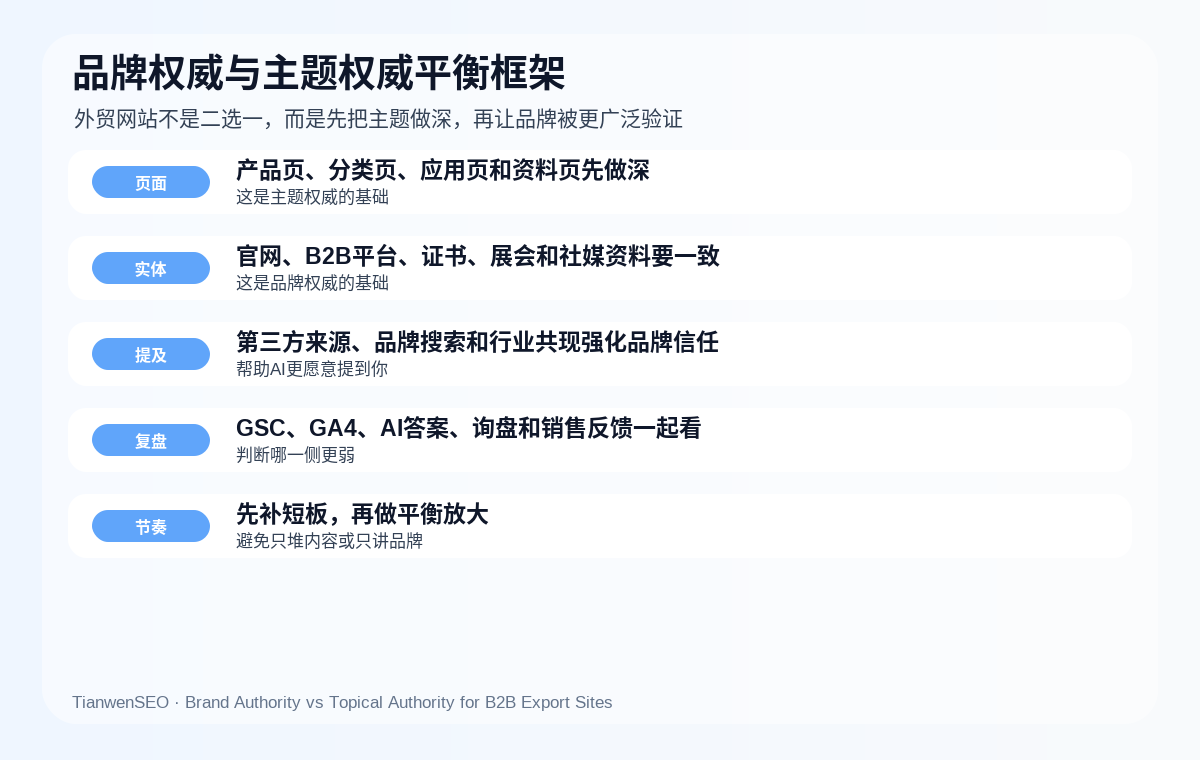
| What AI weighs more | Why it is more like brand authority |
|---|---|
| Entity consistency | The system must first know who you are |
| Third-party consensus | Consistent statements from multiple sources are more readily accepted |
| Brand mentions and search | Shows the market has awareness of the brand |
| Citation of trustworthy sources | Helps AI make lower-risk choices |
The most common imbalance on foreign trade websites: deep topics, weak brand
For many foreign trade companies, the most likely situation is that the website content is not bad — some resource pages are even written in depth — but the brand level is weak: the About page is thin, the brand story is unclear, the factory/trading identity is vague, B2B platform materials are outdated, the scope of certificates is not clearly stated, and external brand mentions are few.
On Google, such a website may still get some traffic from topical pages; but in AI search, it is more likely to be in a state of “the content is decent, but the system does not quite dare to mention you explicitly”.
| Imbalance phenomenon | What may happen on Google | What may happen in AI |
|---|---|---|
| Deep topics, weak brand | Some long-tail terms can still get in | Mention frequency is low or unstable |
| Strong brand, weak topics | Brand terms are strong, but long-tail coverage is poor | May be mentioned but struggles to sustain answering questions |
| Both weak | Hard to perform stably in either search or AI | Almost no trustworthy presence |
| Both strong | Both long-tail and brand terms are more stable | Easier to form sustained visibility |
Another imbalance on foreign trade websites: the brand looks respectable, but topical pages are not systematic enough
Some companies are not bad at the brand level either: they have attended trade shows, their platform materials are complete, customers know them, and there is some baseline for brand name searches. But the official website pages are too thin, category pages and product pages are not systematic, and resource pages and FAQs are missing. In this case, AI may occasionally mention the brand, but as soon as a user clicks or looks deeper, they cannot find enough detailed decision-making information.
This means brand authority cannot replace topical authority. It is more like an amplifier than an engine.
| Phenomenon | Why the problem is serious | Priority action |
|---|---|---|
| Brand has awareness, pages are weak | Traffic and mentions cannot be sustained | Build the page system first |
| Only the homepage is strong, inner pages are weak | Cannot capture long-tail and purchasing questions | Add category pages/resource pages/FAQs |
| Mentions increase but inquiries are mediocre | The brand exists, but the topical path is not connected | Add the RFQ and resource page path |
How to judge whether you currently lack brand authority or topical authority more
The method is not complicated. You can start by looking at four types of signals: brand term queries and mentions, question coverage and the page system, AI answer accuracy, and inquiry quality. If brand terms and external mentions are very weak but you already have quite a few topical pages, you usually lack brand authority more; if the brand has awareness in the industry but the official website pages are thin, FAQs are few, and resource pages are weak, you usually lack topical authority more.
| Observation signal | More like lacking brand authority | More like lacking topical authority |
|---|---|---|
| Brand search | Very little or almost none | Not necessarily low |
| External mentions | Platforms/directories/media are very weak | May be fairly good |
| Page system | May already have some depth | Categories/resource pages/FAQs are clearly insufficient |
| AI answers | Rarely mention you explicitly | May mention you but without deep explanation |
| Inquiry questions | Customers do not really know the brand | Customers come, but their questions are still scattered |
If you lack topical authority more, what should a foreign trade site do first
If your weak spot is mainly topical authority, the execution priority is usually: first choose high-value product lines; build a page system around product terms, application terms, comparison terms, and supplier judgment terms; connect product pages, category pages, resource pages, FAQs, and RFQ pages; then keep filling gaps through GSC and inquiry reviews.
| What to do first | Why do it first |
|---|---|
| Build a question library | Know what the topic is missing first |
| Add category and resource pages | Make the topic more complete |
| Add FAQs and tables | Improve extractability and comprehension |
| Add the RFQ path | Make the topic serve the business |
If you lack brand authority more, what should a foreign trade site do first
If your weak spot is mainly brand authority, the execution priority is usually: unify the wording on the official website and external materials; clarify whether you are a factory/trading company/brand owner; turn certificates, testing, processes, and boundaries into evidence pages; check B2B platforms, trade show directories, social media, and media coverage; and record changes in brand search and AI mentions.
| What to do first | Why do it first |
|---|---|
| Unify entity information | Reduce the system’s misunderstanding of who you are |
| Add evidence pages | Improve credibility |
| Fix external materials | Make third-party sources more consistent |
| Track brand terms and mentions | Verify whether brand signals are strengthening |
Why foreign trade sites cannot understand “brand authority” as simply doing PR
PR and exposure can help brand authority, but if the official website and page system themselves are weak, PR signals are also hard to convert into stable performance in search and AI over the long term. Brand authority is not just “others know you”; it also includes “when others find you, can the system and users quickly confirm what you are, what you sell, and whether you are worth trusting”.
Therefore, the truly effective approach to brand authority and topical authority is mutual support: the page system gives the brand content depth, and the brand entity gives the page system trustworthy amplification.
| Limitations of doing PR only | Why it is not enough | Better combination |
|---|---|---|
| Mentions exist but the official website is weak | Cannot sustain brand traffic | PR + page system |
| The brand name appears but products are unclear | Users and AI still struggle to judge capability | Brand pages + product/resource pages |
| External signals are good but on-site paths are weak | Inquiries are hard to improve | Brand signals + RFQ path |
Why foreign trade sites also cannot understand “topical authority” as simply publishing more content
Topical authority is not a contest of article count. The key is to form a reasonable page system around a topic, where every page genuinely solves a problem. 200 thin pieces of content are often worth less than 20 category pages, product pages, resource pages, and FAQ pages with clear roles.
Especially in the AI search era, thin content is hard to treat as a trustworthy source even if it is crawled. What truly builds topical authority is usually a group of highly relevant, high-quality pages with clear internal relationships.
| Risks of only piling up content | Why it does not equal topical authority | Better approach |
|---|---|---|
| Many articles but scattered topics | The system cannot see clear topical boundaries | Organize by product line and scenario |
| Long but vague content | No real decision-making value | Add tables, FAQs, facts, and boundaries |
| Only a blog, no product page reinforcement | The business path is broken | Make the blog serve product pages and RFQ pages |
Across different product lines, the emphasis on brand authority and topical authority also differs
Different product lines do not depend on the two kinds of authority equally. For example, custom metal parts and packaging machine more easily build search and decision advantages through topical depth first; while industries such as industrial valve supplier and medical probe, which are more sensitive to trust and boundaries, carry more weight on brand and evidence.
| Product line | Common direction that opens a gap first | Reason |
|---|---|---|
| custom metal parts | Topical authority | Many technical questions, pages can go deep |
| packaging machine | Topical authority | Rich scenarios and selection questions |
| waterproof connector | Both matter | Needs both scenario coverage and brand trust |
| industrial valve supplier | Slightly more sensitive to brand authority | Standards, boundaries, and risk weigh more |
| medical probe | More sensitive to brand authority and evidence | Compliance and material safety have greater impact |
Brand authority and topical authority must ultimately return to RFQ quality
For foreign trade companies, the final judgment must always return to inquiry quality. Strong brand authority makes customers more willing to trust you; strong topical authority makes it easier for customers to find answers; but if the RFQ structure is weak, the path is broken, and resource pages and product pages are not connected, both kinds of authority are hard to convert into better business opportunities.
So the most practical way to judge is: after the pages get stronger, do customers come with clearer parameters and requirements? Does sales spend less time repeatedly explaining basic questions? If the answer is “yes”, it means brand and topical authority have started working together.
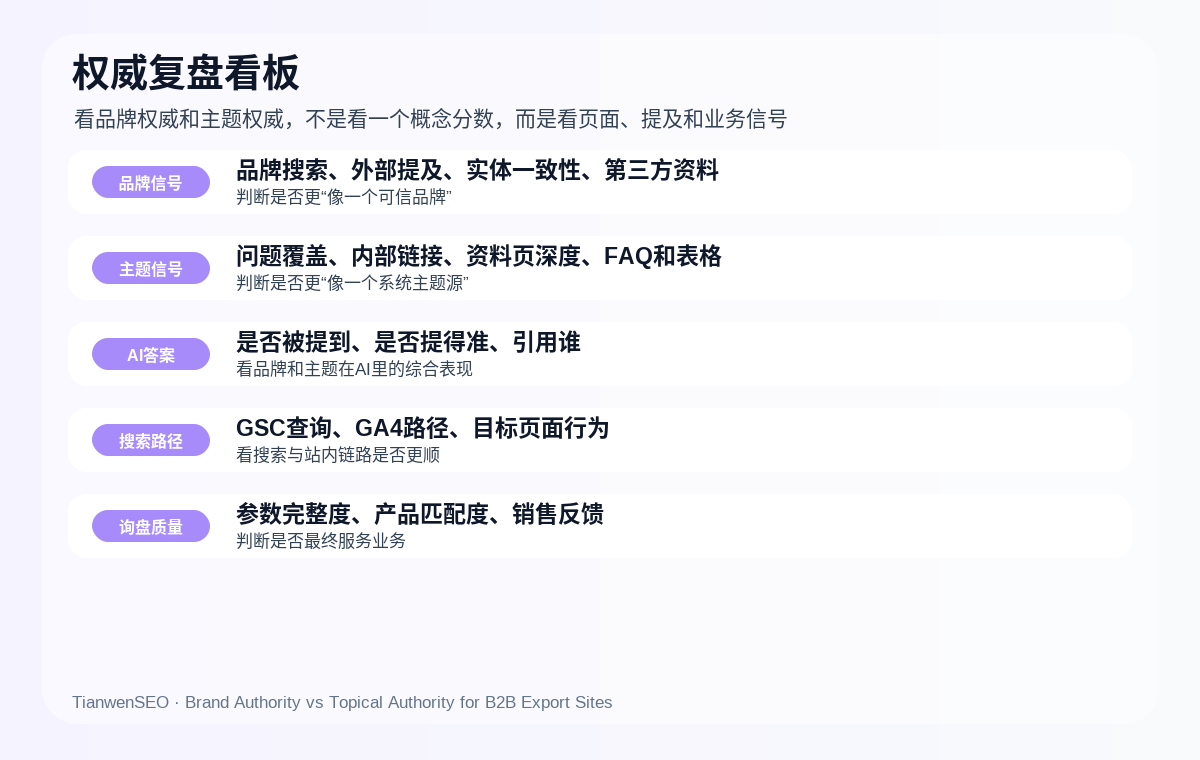
| Review layer | What to look at | What it shows |
|---|---|---|
| Brand | Brand terms, external mentions, entity consistency | Whether brand authority is strengthening |
| Topic | Question coverage, table FAQs, internal links | Whether topical authority is strengthening |
| AI answers | Mentions, accuracy, cited sources | The combined performance of both in AI |
| Search and behavior | GSC queries, GA4 paths | Whether the page system is better on-target |
| Inquiries and sales | Parameter completeness, sales feedback | Whether it truly serves the business |
If you only have 90 days, which side should you build up first
If you only have 90 days, the safest approach is usually not to obsessively do only one side, but to identify the weak spot first and then achieve minimal balance. For example, if topics are clearly weak, build the topical system first while also fixing the brand entity and evidence pages along the way; if the brand is clearly weak, fix the entity and external materials first while adding key resource pages, so the topic does not stay hollow.
| Current weak spot | What is more suitable to do first in 90 days |
|---|---|
| Topics clearly weak | Build the page system first, then fix the brand foundation in parallel |
| Brand clearly weak | Fix the entity and evidence first, then add key resource pages |
| Both weak | Pilot with one high-value product line first, do not roll out site-wide |
| Neither is weak | See which side is closer to the current business bottleneck |
Why foreign trade websites most easily produce “pseudo topical authority” first
Many foreign trade company websites look like they have plenty of content, but are actually more like “pseudo topical authority”. The typical signs are: many articles, many keywords, many sections, but unclear page relationships, weak FAQs, disconnected product pages and resource pages, and content with very few real parameters, comparison tables, or purchasing judgments. Such sites look like they have done a lot of content, but in fact they are not convincing enough for either Google or AI.
| Signs of pseudo topical authority | Why the problem is serious | What should change |
|---|---|---|
| Many articles but scattered questions | The system cannot see topical boundaries | Reorganize content by product line |
| Only a blog, no resource pages | Lacks extractable decision-making content | Add resource pages and FAQ pages |
| Product pages are very thin | Cannot sustain deep questions | Add parameters, FAQs, downloads, and the RFQ path |
| Weak internal links | Topical relationships cannot be reinforced | Redo the paths between pages |
Why foreign trade websites also often produce “pseudo brand authority” first
The typical situation of pseudo brand authority is: the website looks high-end visually, the homepage wording is aggressive, and the company may have attended some trade shows and run some ads, but the official website and external materials are inconsistent about the brand identity, product line, certificates, and market positioning, or a deeper look reveals that the pages are very empty. Such websites tend to give buyers and AI the problem of “looks respectable at first glance, unstable at second glance”.
| Signs of pseudo brand authority | Why the problem is serious | What should change |
|---|---|---|
| Homepage is aggressive, inner pages are empty | Trust is hard to sustain | Add product pages and evidence pages |
| Platform materials and official website are inconsistent | AI more easily misunderstands the brand entity | Unify external materials |
| Many certificates but unclear scope | Easily misinterpreted | Add explanations of scope of application |
| Some brand term search but weak inquiries | Brand signals never landed on page assets | Add resource pages and the RFQ path |
Across different foreign trade product lines, the order of brand authority and topical authority also differs
Even among foreign trade sites, different industries do not prioritize the two kinds of authority the same way. Technical products such as custom metal parts and packaging machine more easily build an advantage through topical depth first; while products such as industrial valve supplier and medical probe, which are more sensitive to trust, compliance, and boundaries, show brand and evidence gaps more obviously.
| Product line | Advantage easier to build first | Where the weak spot gets amplified |
|---|---|---|
| custom metal parts | Topical authority | External consistency at the brand level is often weak |
| packaging machine | Topical authority | Brand and evidence pages are often not systematic enough |
| waterproof connector | Both topic and brand need to move together | Both application and entity are easily misunderstood |
| industrial valve supplier | More sensitive to brand/evidence | If standards and boundaries are unclear, the risk is greater |
| medical probe | More sensitive to brand/evidence | Compliance and material boundaries get amplified |
| ceramic dinnerware | Both topic and brand matter | Brand story and trade process are often both weak |
If you are a factory, brand authority does not mean “telling a brand story”
When many factories hear “brand authority”, they understand it as “creating a brand story”. A brand story can certainly exist, but for B2B foreign trade, the more basic and more useful brand authority is often: whether you are actually a factory, which products you make, what processes you have, which markets you serve, what the scope of your certificates is, and whether it is consistent with your platform materials. In other words, brand authority starts with a clear entity, and only then comes narrative.
| Factory-type brand authority | More valuable expression | Less effective expression |
|---|---|---|
| Identity | Clearly state the factory/manufacturer role | Vaguely telling a founding story |
| Process capability | Explain equipment, quality inspection, materials, and processes clearly | Only saying “focused for many years” |
| Evidence | Certificates, testing, samples, and delivery processes are clear | Only pasting many logos |
| Market | Target industries and main markets are clear | Vaguely writing “global customers” |
If you are a trading company, topical authority depends even more on “question organization capability”
A trading company may not be able to show as many manufacturing details as a factory, but that does not mean it cannot do topical authority well. What it needs to do more is: organize questions more clearly than others. For example, clearly explain the material, packaging, MOQ, samples, market differences, and shipping questions for ceramic dinnerware; clearly organize the fabric, sampling, sizing, labeling, and MOQ questions for private label activewear.
| Trading company’s advantages for topical authority | How it shows |
|---|---|
| Question organization capability | Breaking down purchasing judgments more clearly |
| Material integration capability | Explaining the supply chain, processes, and FAQs clearly |
| Market expression capability | Being more familiar with what different markets care about |
| RFQ optimization capability | Better understanding how to turn visits into valid inquiries |
If Google traffic is acceptable but AI rarely mentions you, what should you check first
This situation often means: topical pages are not too weak, but brand and entity signals are weak, or external materials are inconsistent. It could also be that the official website content has depth, but few trustworthy off-site sources mention you, so the AI system stays more conservative.
| What to check first | Why |
|---|---|
| Whether official website and platform materials are consistent | An unclear entity lowers AI trust |
| Whether evidence pages and brand pages are clear enough | Brand signals need to land on pages |
| Whether there are third-party verifiable mentions | AI weighs external consensus more |
| Whether AI answers always cite competitors’ brand pages | Shows the brand-level weak spot is more obvious |
If AI occasionally mentions you but Google long-tail competition never takes off, what should you check first
This usually means the brand or entity level is not too weak, but the topical pages, resource pages, and internal linking system are not deep enough. In other words, AI is willing to bring you up as an “object”, but Google still does not think you have a complete enough page system on many specific questions.
| What to check first | Why |
|---|---|
| Whether product line questions are fully covered | Topical authority is often exposed by coverage |
| Whether category pages and resource pages form a system | Google relies more on a whole group of pages to compete |
| Whether FAQ/table/comparison pages are missing | Specific questions have no pages to catch them |
| Whether internal links tie the topic together | Weak structure weakens topical understanding |
At acceptance review, how does the boss judge whether brand authority and topical authority are getting stronger together
The simplest way is not to ask “how many articles did you write”, but to ask five questions: Is the brand identity clearer? Is the coverage of key product line questions more complete? Do AI answers get things wrong less often? Is GSC more on-target? Are inquiries more specific? If all five are gradually improving, it usually means both kinds of authority are strengthening.
| What the boss can ask directly | If the answer is better, what it shows |
|---|---|
| Are the brand materials more consistent now? | Brand authority is strengthening |
| Is it easier to find answers to key product questions? | Topical authority is strengthening |
| Do AI answers misunderstand us less often? | Both brand and topic are clearer |
| Are there more high-intent queries? | The topical system is stronger |
| Are inquiries more complete and better matched? | Both kinds of authority are starting to serve the business |
If you could do only one thing to balance the two kinds of authority, what is the most worthwhile one
If resources are extremely limited, the single most worthwhile thing is usually not an abstract brand campaign, nor ten more generic articles, but taking one high-value product line and linking its category pages, product pages, resource pages, evidence pages, and RFQ pages into a small system, while unifying the product/brand wording on the official website and external materials. This often advances topical authority and brand authority at the same time.
| One thing | Why it is worthwhile |
|---|---|
| Build a “pages + entity” small system around one product line | Adds topical depth and brand clarity at the same time |
Why the execution order of brand authority and topical authority cannot be fixed
Some methodologies like to give a fixed answer, such as “do the brand first, then the content” or “make the content deep first, then the brand”. But for foreign trade websites, the execution order should follow the weak spot. If a factory site already has a topical page foundation but its official website, platforms, and certificate materials are messy, then fix the brand and entity first; if a site has some awareness for brand terms but extremely thin product pages and FAQs, it should build the topical system first.
| Current state | Which side is more suitable to build first | Why |
|---|---|---|
| Page system is thin, brand is okay | Build topical authority first | Google and long-tail questions more easily expose the weakness |
| Pages are not bad, entity and external materials are messy | Build brand authority first | AI and users get tripped up by entity problems first |
| Both sides are thin | Pick one product line and build both in parallel | Avoids spreading resources too thin |
| Both sides are okay | Look at the current business bottleneck | Prioritize the side closest to the inquiry problem |
If you break the two kinds of authority into a 90-day plan, what is the most practical order
If you must give a hands-on order, the safer approach is: in the first 30 days, judge the weak spot and product line priorities; from day 31 to 60, build the page system and entity materials; from day 61 to 90, use search, AI answers, inquiries, and sales feedback to judge which side is still weaker. The point of doing this is not to pursue “completeness”, but to first produce verifiable signals.
| Stage | Brand authority action | Topical authority action | Acceptance signal |
|---|---|---|---|
| Days 1-30 | Unify brand/product line/evidence wording | Map the product line question library and page roles | Know where the weak spot is |
| Days 31-60 | Fix external materials and evidence pages | Add category/product/resource/FAQ/RFQ pages | Pages and entity are both clearer |
| Days 61-90 | Look at brand search and AI answer accuracy | Look at GSC queries, GA4 paths, and inquiry quality | Know who to build up first next round |
Why RFQ and sales feedback are the key to judging whether the two kinds of authority really have value
Neither brand authority nor topical authority exists for a concept score; they exist to make the business smoother. RFQ and sales feedback are key because they can verify whether the pages and brand only stay at “looking more professional”, or whether they have already made customers come to you with clearer questions.
For example, if inquiries for custom metal parts start more frequently including drawings, materials, and tolerance information, it shows the topical pages and RFQ structure are working; if customers already understand more clearly whether you are a factory or a trading company and what your main products are before communicating, it shows brand authority is also working.
| Business signal | More like brand authority at work | More like topical authority at work |
|---|---|---|
| Customers trust the identity faster | Yes | Not necessarily |
| Customer questions are more specific | Partly | More clearly yes |
| Sales explains basic capabilities less | Yes | Also yes |
| Inquiry parameters are more complete | Partly | More clearly yes |
| AI/search understands the pages more accurately | Yes | Also yes |
If you only look at traffic and not sales feedback, what will you miss
Many sites see some traffic changes early on, but do not necessarily know whether it is “good traffic”. If you do not look at sales feedback, you will not know: whether these visits come from genuinely valuable questions, whether customers ask basic questions less, whether customers understand product boundaries better, and whether inquiries match better.
| What looking only at traffic ignores | Why it is dangerous |
|---|---|
| Whether customers understand your identity | Changes in brand authority cannot be seen |
| Whether customer questions are more focused | Changes in topical authority cannot be seen |
| Whether pages really serve inquiries | Business value is easily overestimated |
| Whether AI mentions turn into valid visits | Easy to mistake exposure for results |
If you need to pick a product line to pilot right now, how should you choose
The product line best suited for a pilot usually has three characteristics: first, high order value or strategic value; second, clear purchasing questions that can be broken into product terms, application terms, and comparison terms; third, existing pages are weak but can be strengthened quickly. waterproof connector, custom metal parts, and packaging machine often meet these conditions.
| Pilot selection criteria | Why it matters |
|---|---|
| High value | Easier to demonstrate business meaning |
| Clear questions | Makes it easier to build topical pages and an FAQ system |
| Pages can be strengthened | Easier to see signals within 90 days |
| RFQ can be optimized | Easier to see changes in inquiry quality |
If the boss asks just one question: should we build brand authority or topical authority first, how do you answer
The most practical answer is usually not “which is more important”, but “build up the side closer to the current bottleneck first, but do not let the other side stay out of balance”. If your biggest problem right now is that customers simply do not know who you are and AI does not quite dare to mention you, build brand authority first; if customers and AI both know you, but your website has no systematic pages to catch specific questions, build topical authority first.
| Current bottleneck | What is more suitable to build first |
|---|---|
| No one knows you, and no one dares to mention you | Build brand authority first |
| There is some awareness, but page coverage is very weak | Build topical authority first |
| Both sides are thin | Pick a product line first and run a parallel pilot |
The 5 most practical questions for the boss to review this kind of project
Rather than abstract concepts, the boss is better off using these 5 questions to judge: Is it clearer who we are? Is it easier to find answers to key questions? Do AI and search misunderstand us less often? Are inquiries more specific? Does sales repeat basic explanations less?
| Review question | If the answer is better, what it shows |
|---|---|
| Is the brand identity clearer? | Brand authority is strengthening |
| Is it easier to find answers to key questions? | Topical authority is strengthening |
| Do AI and search misunderstand us less often? | Both kinds of authority are improving |
| Are inquiries more specific? | The pages are starting to serve the business |
| Does sales repeat explanations less? | Page and brand expression are more effective |
Minimal execution checklist for brand authority and topical authority
- Pick one high-value product line first; do not roll out site-wide right away.
- Judge first whether you lack brand or topic more; do not follow a fixed formula.
- Build the key page system and entity materials first, then talk about a more abstract sense of authority.
- Bring RFQ and sales feedback into the review first, then talk about whether authority really has business value.
- Use 30/60/90 days to look at signals first, then decide which side to amplify next round.
Over the long term, the best state is not leaning to one side, but both sides becoming stable together
The truly mature state of brand authority and topical authority is not one side being extremely strong, but both sides becoming stable together: the brand becomes clearer, more trustworthy, and more mentioned; topical pages become more systematic, more findable, and better understood; inquiries become more specific; sales becomes easier. At that stage, Google and AI search are usually both more stable than if you had done only one side.
Minimal execution order
- First see whether the weak spot is brand or topic.
- First pick one high-value product line as a pilot.
- First add product/resource/RFQ pages and entity materials.
- First put GSC, GA4, AI answers, and sales feedback into the same review table.
One-sentence summary: brand authority makes others more willing to trust you, topical authority makes others understand you more easily, and a foreign trade site must ultimately make both serve inquiries together.
Typical misjudgment: treating a strong brand term as enough authority on all fronts
Many companies misjudge: as long as brand term search is acceptable and someone in the industry knows us, they assume authority is already sufficient. In fact, if product pages, category pages, resource pages, and FAQs are not systematic, many specific questions on Google still cannot be captured, and it is hard for AI to consistently treat you as the best source for a certain type of question.
| Misjudgment | Real problem | How to correct it |
|---|---|---|
| A little brand awareness = all good | The topical system may still be very weak | Add resource pages and the product system |
| Many articles = the brand will rise too | External signals and the entity may still be weak | Add brand materials and evidence pages |
| AI mentioned us once = stable long term | A mention is not stability, nor conversion | Look at accuracy and the inquiry path |
Pilot case framework: how to see whether both kinds of authority are improving at the same time
Even without a formal case study, a company can use a unified framework to keep pilot records. The simplest way is: pick one product line, list 10-20 key questions corresponding to 3-5 pages, then record brand material corrections, page upgrades, GSC query changes, AI answer changes, and inquiry quality changes. This lets you observe brand authority and topical authority at the same time.
| Record item | Corresponds to brand authority | Corresponds to topical authority |
|---|---|---|
| Brand material corrections | Strong | Weak |
| Product/resource page upgrades | Medium | Strong |
| FAQ and comparison table additions | Weak | Strong |
| AI answer accuracy | Strong | Strong |
| Inquiry parameter completeness | Medium | Strong |
90-day judgment table: when does it show the two kinds of authority are starting to work together
If within 90 days you can simultaneously see a clearer brand identity, more complete product question coverage, fewer AI answer mistakes, more high-intent questions in GSC, and more specific inquiries, this usually shows brand authority and topical authority are starting to work together. Conversely, if only one item changes and the rest stay flat, it means there is still an obvious weak spot that has not been addressed.
| 90-day signal | What only one item changing means | What multiple items changing together means |
|---|---|---|
| Brand search | May just be brand-level actions | Healthier if it changes together with pages |
| High-intent queries | May just be topic-level actions | Healthier if it changes together with inquiries |
| AI answer accuracy | May just be a localized material correction | More stable if it changes together with brand/topic |
| Inquiry quality | If it changes alone, rule out coincidence | More credible if it changes together with pages/search |
FAQ: How exactly do brand authority and topical authority differ?
Which matters more to Google, brand authority or topical authority?
Topical authority usually more directly affects Google competitiveness on a specific topic, but brand authority amplifies site-wide trust and click preference.
Which matters more to AI search, brand authority or topical authority?
AI search more easily amplifies brand authority, because it must actively decide “who is safer to mention”, but without topical depth it is also hard to appear consistently over the long term.
If you just write more content first, will you automatically have brand authority?
No. Content depth is closer to topical authority; brand authority also needs a clear entity, external consistency, and third-party validation.
If the brand is famous, do you not need topical pages?
No. Brand authority can amplify, but cannot replace topical pages, resource pages, FAQs, and the RFQ path.
Which side do foreign trade factories most easily lack?
For many factories, the most common situation is having some topical page foundation but weak brand entity and external consistency; some companies are the opposite, with brand awareness but a page system that is too thin.
How can you quickly judge which side you lack more?
Look at brand search and external mentions, then at the page system and question coverage, and combine that with AI answers and inquiry quality.
Do the two always have to be done together?
Over the long term, yes, they must be done together, but in the short term you can first identify the weak spot and prioritize by product line and business goals.
Why should foreign trade sites count RFQ pages into the authority system?
Because authority must ultimately serve the business, and the RFQ page determines whether a visit can become a higher-quality inquiry.
AI mentioned me — does that mean brand authority is enough?
Not necessarily. You also need to see whether it is accurate, whether the right pages are mentioned, and whether users continue on to product pages and RFQ pages.
There is traffic on Google — does that mean topical authority is enough?
Not necessarily. You also need to see whether the traffic is stable, whether it covers key questions, and whether it can serve the inquiry path.
Conclusion: brand authority and topical authority are not about one replacing the other, but about which one fills the other’s weak spot
Brand authority and topical authority are not mutually exclusive paths, but two lines that must gradually converge in the long-term growth of a foreign trade website. Topical authority lets you compete better on specific questions, and brand authority makes you more like an object worth mentioning, believing, and prioritizing.
For foreign trade exporters and trading companies, the most practical approach is not to agonize over “which concept to do first”, but to first see which side is weaker and which side is closer to the current business bottleneck, then gradually fill things in around product pages, resource pages, evidence pages, RFQ pages, external materials, and a review table. Done this way, Google SEO and AI search usually get stronger together.
Official sources and the boundaries of authority signals
Neither brand authority nor topical authority can be proven by a single sentence. The more reliable approach is to let topical pages, product pages, resource pages, external sources, and search data form a verifiable network.
| Official source | What it validates | Delivery boundary |
|---|---|---|
| Helpful, reliable, people-first content | Checking issues related to experience, expertise, authoritativeness, and trustworthiness | These cannot be completed by filling in a tag by hand |
| Google Search ranking systems guide | Understanding how page-level signals and site-level signals participate in judgment together | A single topical page cannot be written up as a site-wide results promise |
| Google AI features and your website | Confirming that AI features still look at basic SEO and reliable content | AI display is not a manual acceptance item |
| Search Console Performance report | Observing changes in topical terms, brand terms, and page rows | If GSC has zero rows, do not write about growth |
| GA4 events | Recording resource downloads, forms, and inquiry entry points after a visit | Events cannot replace search impressions |
Review acceptance table
| Check item | Record field | How to write during a low-data period |
|---|---|---|
| Topical coverage | Core pages, supporting pages, FAQs, resource pages | Draw the page map first |
| Brand facts | Company, products, certifications, contact information, resource downloads | If items are missing, list the material gaps |
| External evidence | Trade shows, associations, partners, industry citations | Only record sources that can be opened |
| Search review | GSC query/page, AI samples, GA4 events | If there is no data, write “to be observed” |
Continue reading this GEO series
If you are systematically learning about GEO and AI search visibility, it is recommended to continue with the following articles. Understand the concepts first, then look at diagnosis, monitoring, content structure, and the boundaries of cooperation.
- What kind of blog posts are more likely to be mentioned by ChatGPT: how to adjust foreign trade website content topics and structure in 2026
- Are backlinks still important: from link signals to brand signals, how should foreign trade SEO be done
- What is GEO: how it differs from SEO and AEO, and how foreign trade websites should approach it
- What is AI SEO: how exactly it differs from traditional SEO, GEO, and AEO
- What is AEO: why answer engine optimization is not just writing FAQs, and how foreign trade websites should approach it
- What is Google SEO: from crawling, indexing, and ranking to AI search and foreign trade inquiries
{
“@context”: “https://schema.org”,
“@type”: “FAQPage”,
“mainEntity”: [
{
“@type”: “Question”,
“name”: “Which matters more to Google, brand authority or topical authority?”,
“acceptedAnswer”: {
“@type”: “Answer”,
“text”: “Topical authority usually more directly affects Google competitiveness on a specific topic, but brand authority amplifies site-wide trust and click preference.”
}
},
{
“@type”: “Question”,
“name”: “Which matters more to AI search, brand authority or topical authority?”,
“acceptedAnswer”: {
“@type”: “Answer”,
“text”: “AI search more easily amplifies brand authority, because it must actively decide “who is safer to mention”, but without topical depth it is also hard to appear consistently over the long term.”
}
},
{
“@type”: “Question”,
“name”: “If you just write more content first, will you automatically have brand authority?”,
“acceptedAnswer”: {
“@type”: “Answer”,
“text”: “No. Content depth is closer to topical authority; brand authority also needs a clear entity, external consistency, and third-party validation.”
}
},
{
“@type”: “Question”,
“name”: “If the brand is famous, do you not need topical pages?”,
“acceptedAnswer”: {
“@type”: “Answer”,
“text”: “No. Brand authority can amplify, but cannot replace topical pages, resource pages, FAQs, and the RFQ path.”
}
},
{
“@type”: “Question”,
“name”: “Which side do foreign trade factories most easily lack?”,
“acceptedAnswer”: {
“@type”: “Answer”,
“text”: “For many factories, the most common situation is having some topical page foundation but weak brand entity and external consistency; some companies are the opposite, with brand awareness but a page system that is too thin.”
}
}
]
}
This page is machine-translated from the Simplified Chinese version and awaiting human review. It has not yet been proofread.
Further Reading on This B2B SEO & GEO Topic
- What Is Query Fan-Out? Why Does AI Search Automatically Break Down Questions Before Deciding Whom to Cite?
- What Is Google AI Search? The Link Logic Between AI Mode and AI Overviews, and Guidance for B2B Export Websites
- Why Can't Google SEO Rankings Improve? A Diagnostic Checklist for Technical Issues, Content, and GSC
- Why Is It Increasingly Difficult to Drive Traffic with Google SEO? The Real Reasons Beyond AI Overviews
- Generative Engine Optimization (GEO) and AI Search Citation Hub for Export Brands
- Generative Engine Optimization Research
- B2B Export SEO & GEO Research Index