What does an AI Overviews monitoring service include? It is not a few screenshots of AI summaries taken each day, and it is not writing up a single brand appearance as a result. More precisely, it is a review mechanism that continuously records queries, answers, cited URLs, GSC impressions and clicks, GA4 behavior, and page actions. Its value is turning “whether AI Overviews change the search environment” from a feeling into fields.
For export businesses, AI Overviews monitoring has to answer three questions: which procurement queries show an AI Overview, whom the answer cites, and whether clicks and on-site behavior change. For terms such as custom metal parts supplier, LED flood light manufacturer, packaging machine for food, and waterproof connector factory, you cannot just check whether an AI Overview appears; you also have to check whether the website pages are capable of carrying users who keep clicking.
This article covers only public methods, delivery fields, and acceptance boundaries. It does not show data from unauthorized projects, does not fabricate AI citations, does not fabricate traffic or inquiry results, and does not promise search rankings or answer adoption.
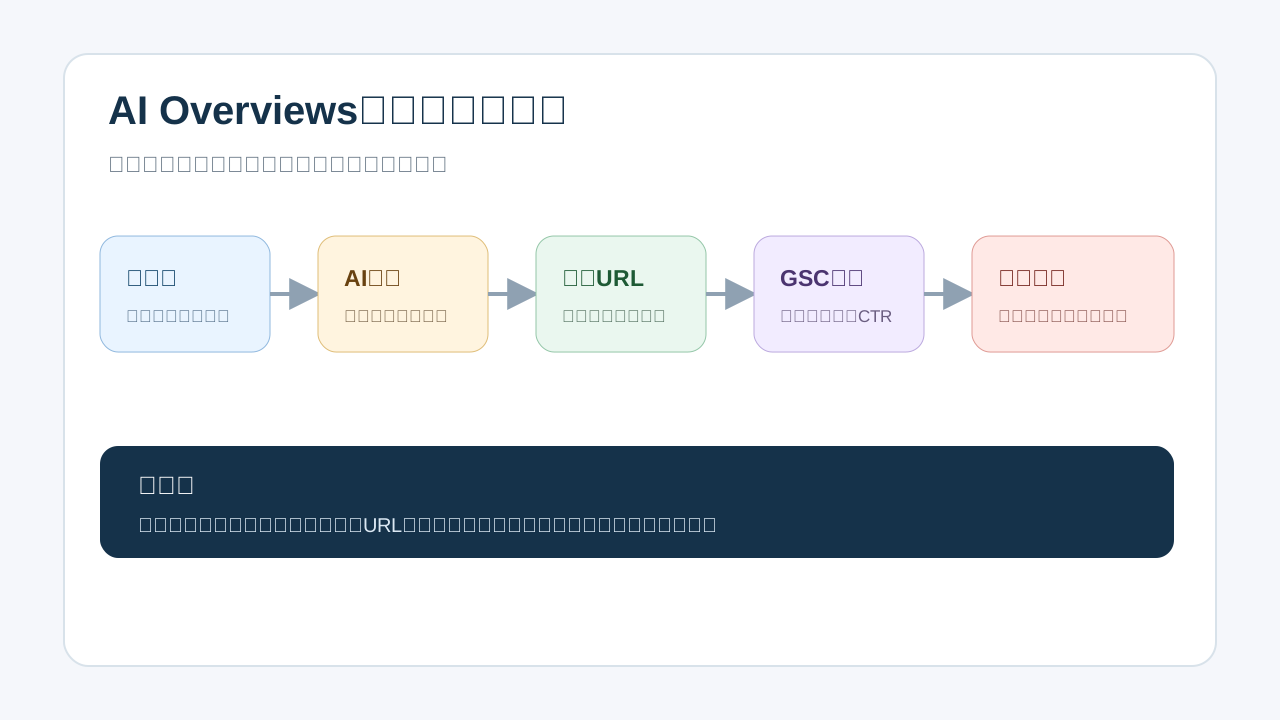
The conclusion first: an AI Overviews monitoring service should deliver six tables
The first is the query library. It records the questions to monitor, along with country, language, device, intent, and the corresponding pages. Without a query library, all the screenshots that follow have nothing to compare against.
The second is the AI Overview sample table. It records whether an AI Overview appeared for a given query on a given date, which sources the answer used, whether the official website appeared, whether competitors appeared, and whether the answer contained factual errors.
The third is the cited URL table. It separates out the cited pages to see whether the citations point to the official website, media, forums, encyclopedias, tool pages, or competitor pages. A brand being mentioned and the official website being cited are not the same thing.
The fourth is the GSC change table. It uses the page and query dimensions in Search Console to record impressions, clicks, CTR, and average position. The same time window must be used here; different dates cannot be mixed together for comparison.
The fifth is the GA4 behavior table. It records whether users who clicked through continued reading, clicked a form, copied an email address, opened WhatsApp, downloaded a resource, or viewed key pages.
The sixth is the page action table. It turns monitoring results into next month’s tasks: which URL to change, what kind of facts to add, what kind of errors to fix, which URL to wait for recrawling, and when to recheck.
Official evidence: which data can be used and which cannot be forced into conclusions
AI Overviews monitoring cannot be separated from the public documentation from Google and OpenAI. Official documentation helps us define the delivery boundary clearly: crawlability, indexability, helpful content, preview controls, URL Inspection, Search Console Performance, GA4 events, and OpenAI crawler access are different levels of evidence and cannot be conflated into one result.
| Official source | What it can prove | Fields suitable for the monthly report | What it must not be written as |
|---|---|---|---|
| Google AI features and your website | AI Overviews and AI Mode are still based on displayable web links and preview controls | Whether a page allows summaries, previews, and visible links | Cannot claim that a given page will definitely enter an AI Overview |
| Google generative AI search optimization | Generative search still comes back to basic SEO, technical structure, and helpful content | Page quality, structure, images, content uniqueness | Cannot claim that GEO can bypass SEO |
| Google Search Essentials | Crawling, indexing, and quality fundamentals | HTTP, robots, noindex, canonical, page quality | Cannot claim that meeting the basic rules guarantees impressions |
| Google helpful content guidelines | Content must be helpful to users, not just keyword-stuffed for systems | Whether it addresses real questions, steps, tables, experience, and boundaries | Word count must not be written up as quality |
| Search Console Performance report | Queries, pages, countries, devices, impressions, clicks, CTR, average position | Click loss assessment, query changes, page changes | Impressions must not be written up as inquiries |
| URL Inspection tool | Indexing, crawl time, canonical, and crawl status for a single URL | verdict, coverage, lastCrawlTime, pageFetchState | Submitting a sitemap must not be written up as the new version having been processed |
| Page indexing report | Indexing status and reasons for page groups | Not-indexed reasons, validation status, sitemap filtering | Cannot look only at the total number of indexed pages |
| GA4 events | Specific interactions users have on the website | Forms, resource downloads, email clicks, WhatsApp clicks, key page visits | Visits must not be written up directly as lead quality |
| OpenAI crawlers | Public documentation on OpenAI crawlers and user agents | robots rules, server access, log observation | Crawler access must not be written up as ChatGPT definitely citing the site |
Deliverable one: a query library, not a keyword list
The query library must be layered by search intent. Whether an AI Overview appears depends on question complexity, information needs, region, language, and device. Checking only 20 random keywords produces scattered results that cannot support a review.
A professional query library should include at least four categories: informational, comparative, procurement, and branded. Export websites also need English market terms, because procurement users usually do not search for your products in Chinese. Terms such as medical probe supplier, cnc machining parts manufacturer, and private label activewear manufacturer sit behind different pages and different conversion paths.
| Query type | Example | Corresponding page | Monitoring focus |
|---|---|---|---|
| Informational | what is AI Overviews in Google Search | Tutorial pages, glossary pages | Whether an AI Overview appears and which explanatory sources it cites |
| Comparative | aluminum vs stainless steel custom parts | Comparison pages, product pages | Whether it cites pages with tables and specifications |
| Procurement | how to choose LED flood light manufacturer | Category pages, service pages, inquiry pages | Whether it leads buyers to pages that can convert |
| Branded | company name product capability | About pages, company pages, product collection pages | Whether the answer describes the company’s business accurately |
| Diagnostic | why AI Overviews reduced clicks for my page | Diagnostic pages, monthly report pages | Whether it can connect GSC, SERP, and page actions |
Deliverable two: an AI Overview sample table, with screenshots as attachments only
AI Overview screenshots can be kept, but screenshots alone are not enough. They must become a sample table with fields including platform, query, date, region, device, answer summary, cited sources, whether the official website appeared, whether competitors appeared, and whether the answer contains factual errors.
The same query has to be recorded continuously. Testing it once is meaningless. Answers can change from day to day, especially for news, prices, policies, tool rankings, and hot industry questions. Only after continuous recording can you tell whether a change is stable or a one-off fluctuation.
| Field | What is recorded | Acceptance criteria | Common misjudgments |
|---|---|---|---|
| Original query text | Kept in full, not rewritten at will | The same question can be retested | Using a different question each time for comparison |
| Date and conditions | Date, region, device, language | The test environment can be reconstructed | Writing only “appeared this month” |
| Cited sources | Specific URL and page title | Distinguish official website, competitors, media, forums | Capturing only the brand name |
| Answer facts | Whether there are errors about the business, products, prices, or regions | Errors can enter the fix table | Only checking whether the answer looks good |
| Action suggestions | Which URL to change, what content to add, when to recheck | Can be turned into page tasks | Writing only “continue optimizing” |
Deliverable three: cited URL analysis, separating brand mentions from official website citations
A brand being mentioned does not mean the official website was cited. The official website being cited does not mean users will click. Cited URL analysis has to break down every source: is it an official product page, an official article, third-party media, a forum Q&A, a platform page, a competitor page, or generic material in the search results?
If an AI Overview cites a competitor page, look at why that page wins. It may have a clearer specifications table, a more complete FAQ, stronger external citations, or may have been crawled by Google earlier. The monthly report must not simply say “a competitor appeared”; it must say “what structure in the cited competitor page can be learned from.”
| Citation source | Description | What we look at | Page action |
|---|---|---|---|
| Official website product page | Closest to conversion | Whether specifications, use cases, and FAQ are complete | Add procurement decision content and a specifications table |
| Official website article page | Suited to explaining questions | Whether it leads to product or service pages | Add internal links and next-step paths |
| Third-party material | May be more authoritative or cited earlier | Source quality and information gaps | Add official sources and entity descriptions |
| Competitor page | Directly competing source | Structure, fields, charts, FAQ | Add missing modules, do not copy content |
| Forum Q&A | Reflects real questions | What users worry about | Add risk explanations and acceptance criteria |
Deliverable four: click loss assessment, not just a CTR decline
AI Overviews may change the click environment, but a CTR decline cannot be attributed directly to AI Overviews on sight. CTR is affected by ranking, title, season, country, device, brand terms, ads, SERP features, and whether a page is new or old. Click loss assessment has to look at AI samples and GSC page data together.
The correct order is: first fix the query library, then record whether these queries show an AI Overview, and then look at the impressions, clicks, CTR, and average position of the corresponding pages in Search Console. Only if the average position is stable while CTR keeps declining, and the samples show that AI Overviews appear over a sustained period, can it be written as “possibly affected by the SERP format, needs continued observation.” Even then, it is not an absolute conclusion.
| Observation combination | Possible explanation | What evidence to add | Next month’s action |
|---|---|---|---|
| Ranking stable, CTR declining, AI Overviews persistently appearing | Clicks may be diverted | Same query samples, device, country, date | Improve the above-the-fold answer and click value |
| Ranking declining, CTR declining | May be page competitiveness or an indexing change | URL Inspection, competitor pages, content gaps | Fix page quality and internal links first |
| Impressions rising, clicks flat | May be covering more low-intent queries | Query dimension and country/device dimension | Separate commercial queries from informational queries |
| AI Overviews appearing, but clicks rising | The summary may bring more precise clicks | Landing page behavior and conversion events | Keep the structure and continue expanding related questions |
Deliverable five: page actions, not a single line saying “continue optimizing”
The ultimate purpose of monitoring is not to produce reports but to decide what to change next month. Page actions must be specific down to the URL, module, and recheck time. For example, “change 3 articles” is too vague; “add an official sources table, a click loss assessment table, an FAQ, and internal links to /ai-overviews-monitoring-service/, and recheck after the GSC lastCrawlTime updates” is what counts as executable.
Page actions can be divided into four categories: content reinforcement, entity correction, technical checks, and conversion handoff. Each category needs acceptance fields.
| Action type | Applicable situation | Deliverable | Recheck condition |
|---|---|---|---|
| Content reinforcement | The page is outranked by competitors or the answer does not cite the official website | Definitions, tables, FAQ, official sources, product facts | Visible on the front end, included in the sitemap, awaiting crawl |
| Entity correction | The AI answer states the company, products, or service scope incorrectly | Proofread About pages, service pages, organization information, author information | Retest brand questions and read the pages |
| Technical checks | Pages not crawled, canonical anomalies, unreadable resources | robots, noindex, canonical, HTTP, sitemap, URL Inspection | GSC and front-end verification pass |
| Conversion handoff | Clicks are coming in, but behavior is poor | Above-the-fold content, forms, CTA, downloadable resources, related page entry points | Observe GA4 events and page paths |
Diagnostic acceptance criteria: a report must pass at least these ten points
An AI Overviews monitoring service must avoid “looking busy but being unverifiable.” The following ten points can serve as hard lines at acceptance. Miss one, and the report easily turns into a pile of material.
- The query library has fixed IDs, and the original question text is not rewritten at will.
- Each query records date, region, device, language, and platform.
- AI Overview samples distinguish appearance, non-appearance, changes, and factual errors.
- Cited sources record the specific URL, not just the site name or brand name.
- Official website citations and brand mentions are counted separately.
- GSC data is viewed separately by page and query dimension, not merged into one total.
- CTR changes must be explained together with average position and SERP samples.
- GA4 is used only for on-site behavior and does not directly replace inquiry quality assessment.
- Page actions are specific down to URL, module, owner, and recheck conditions.
- The report states clearly which results cannot be promised and which conclusions require waiting for a crawl or a longer time window.
Delivery boundaries: what must not be written as a promise
This service can promise methods, deliverables, and review cadence; it cannot promise uncontrollable outcomes. For example, it can promise to build a question library, add official sources, fix page structure, check crawling and indexing, record AI samples, submit sitemaps, and produce a monthly report. But it cannot promise that a specific query will definitely show an official website link, nor that a platform will use a particular answer over the long term.
| Can be promised | Cannot be promised | Reason |
|---|---|---|
| A fixed question library and monitoring cadence | A fixed answer format | AI answers are affected by platform, time, and context |
| Reinforcement of page content, structure, and sources | A guaranteed rise in search rankings | Rankings are decided by multiple systems together |
| Rechecks of GSC, URL Inspection, and sitemaps | Immediate reprocessing after submission | There is a time lag between crawling and indexing |
| AI sample recording and suggestions to correct factual errors | Long-term adoption of a particular statement by AI | Answers change and new sources are introduced |
| Observation of GA4 events and on-site paths | A guaranteed inquiry | Inquiries are also affected by product, price, trust, and sales follow-up |
What to look at at 30, 60, and 90 days
AI Overviews monitoring cannot reach conclusions on day one. After a page is updated, you have to wait for the search system to recrawl; AI samples also need observation at multiple points in time. A steadier rhythm is to use 30 days for baseline changes, 60 days for trends, and 90 days for structural issues.
| Period | Main question | Key evidence | Next step |
|---|---|---|---|
| Days 1-30 | Whether pages are crawled and whether samples can be recorded consistently | URL Inspection, sitemap, front end, query library | Fix technical and content fundamentals |
| Days 31-60 | Which queries show AI Overviews and which pages are cited | AI sample table, cited URL table, GSC page dimension | Add modules with a higher chance of being cited |
| Days 61-90 | Whether CTR, on-site behavior, and page actions form a closed loop | GSC query dimension, GA4 events, page action table | Expand the question library and work on high-value pages |
How export websites put this into practice: product facts matter more than empty talk
When many export websites monitor AI Overviews, they first look at whether the brand is mentioned. That is not wrong, but it is not enough. What really influences procurement decisions is product facts. Material, process, certifications, MOQ, lead time, packaging, application scenarios, quality inspection methods, and after-sales boundaries are more valuable fields than “we are experienced.”
If an AI Overview cites a competitor, it is probably not because the competitor used some mysterious trick, but because its page looks more like a procurement decision table. For a website doing industrial valve supplier, the page should clearly explain pressure ratings, materials, connection types, applicable media, certifications, and application industries. For a website doing ceramic dinnerware wholesale, it should clearly explain material, glaze, packaging, dishwasher compatibility, customization, and foodservice scenarios.
How it works with other content on the site
This article, 5072, is responsible for covering service delivery and acceptance boundaries and should not try to take on every topic. For tool selection, see What AI Overviews monitoring tools are available; for the fundamentals of monitoring AI search visibility, see How to monitor AI search visibility; for the boundaries of monthly report metrics, see Which metrics in a GEO monthly report are invalid.
If your company is comparing free tools with paid monitoring, see Are free AI search visibility tool plans enough. If you want to understand how ChatGPT-related pages should be built, see What a ChatGPT SEO service includes. If you come across claims about “guaranteed first page rankings,” read Are Google SEO companies’ first-page promises credible first.
Frequently asked questions
How often should AI Overviews be checked?
Core queries should be recorded weekly, with the monthly report reviewed over a 28-day or calendar-month window. Industries with rapid change can increase the frequency, but do not change the questions every day. Once the questions change, the trend breaks.
If a page is not cited by AI Overviews, does that mean the page has no value?
That conclusion cannot be drawn. The page may not have been recrawled yet, the query itself may not trigger an AI Overview, or the answer may cite other types of sources. You need to look at URL Inspection, GSC page data, SERP samples, and page content at the same time.
If clicks drop after AI Overviews appear, is it definitely the cause?
Not necessarily. You have to look at average position, title, country, device, ads, season, and other SERP features. The reasonable way to write it is “possibly affected by the SERP format, needs to be observed alongside continuous samples.” An absolute conclusion cannot be drawn directly.
Should service acceptance be based on screenshots or tables?
Screenshots can serve as attachments, but tables are the main body. Tables can record queries, dates, cited URLs, GSC data, page actions, and recheck conditions, and are better suited to long-term comparison.
Once OpenAI crawlers are allowed, will ChatGPT cite the official website?
That cannot be said. Crawler access is only one part of accessibility; whether an answer adopts the site also depends on content quality, source selection, user questions, and platform mechanisms. Allowing crawlers can be a technical checklist item, but not a promise of results.
Final judgment criteria
A qualified AI Overviews monitoring service does not tell you “how many times an AI Overview appeared this month”; it tells you: which questions showed one, whom it cited, what the official website lacks, how the click environment changed, whether on-site behavior is being carried through, and which URLs should be changed next month.
If a report can clearly explain queries, citations, clicks, events, page actions, and boundaries, it is useful. Conversely, if a report contains only screenshots, an overall score, general advice, and conclusions that cannot be reviewed, then even with many pages it can hardly guide the next step for SEO and GEO.
Fixing factual errors: monitoring is not just about whether something appeared
The most easily overlooked item in AI Overviews monitoring is factual errors. Many companies care only about “whether I appeared,” but what really affects trust is “whether I was described correctly.” If the answer describes a trading company as a factory, an agent as the brand owner, gets the product material wrong, or expands the service scope, it may look like exposure in the short term but will mislead procurement decisions over the long term.
Factual errors need their own fix table. First record the original question, the original answer text, the erroneous field, the possible source, and the URL that should be fixed, then write the fix action. After fixing, you cannot declare it solved right away; wait until the page is recrawled or the samples change consistently before judging.
| Error type | Common cause | Page to fix | Basis for recheck |
|---|---|---|---|
| Company nature described incorrectly | Inconsistent wording across the About page, service pages, and external material | About page, company introduction, Organization information | Brand question samples and page crawl status |
| Product capability described incorrectly | Product pages lack specifications, process, applications, and limitations | Product pages, category pages, FAQ | Changes in cited URLs and changes in answer facts |
| Competitor explanation cited | The official website has no corresponding explanation and the competitor page is clearer in structure | Comparison pages, procurement guides, specifications tables | Continuous samples for the same query |
| Region or service scope described incorrectly | Missing market pages, logistics descriptions, and contact information | Market pages, contact pages, service boundary sections | Retesting branded and procurement queries |
Tool selection: what free options can do and what paid monitoring adds
AI Overviews monitoring can start with free options. Manual queries, incognito browsing, Search Console, GA4, and spreadsheet records can all establish a first baseline. The drawbacks of free options are few samples, large manual error, messy screenshot management, and difficulty comparing over the long term.
The value of paid monitoring is not making results look better but making records more consistent. For example, fixed regions, fixed devices, fixed questions, automatic saving of answers, automatic identification of cited URLs, recording of competitor appearances, and exporting trend tables. What it solves is the “cost of review,” not “answer adoption” directly.
| Option | Suitable stage | What it can solve | What it cannot solve |
|---|---|---|---|
| Manual spreadsheet | Just starting to validate direction | Building the question library and sample definitions | Cannot track at scale over the long term |
| GSC + GA4 | Already has an organic search baseline | View impressions, clicks, and on-site behavior by page and query | Cannot directly see AI Overview citation details |
| AI visibility tools | After the question library is stable | Record answers, citations, competitors, and trends in bulk | Cannot replace page quality and technical fundamentals |
| Manual review | Monthly judgment and strategy adjustment | Turn data into page tasks | Cannot skip evidence and jump to conclusions |
Monthly report template: every item must be traceable to a source
A usable AI Overviews monitoring monthly report is best written in three layers: facts, interpretation, and actions. The fact layer records only observed fields. The interpretation layer states possible causes and uncertainties. The action layer states which URLs to change next month. Keeping the three layers separate makes the report hard to exaggerate.
| Monthly report module | Fields it should include | Evidence source | Acceptable wording |
|---|---|---|---|
| Summary | This month’s monitoring scope, number of questions, number of pages | Query library and URL list | This month we monitored 40 fixed questions covering 12 URLs |
| AI samples | Number of appearances, cited sources, factual errors, competitor co-occurrence | Sample table and screenshot attachments | 12 questions showed AI Overviews, of which 3 cited the official website |
| Search data | Impressions, clicks, CTR, average position | Search Console | Impressions rose for the corresponding pages while clicks did not grow in step; the query mix needs review |
| On-site behavior | Forms, downloads, email, WhatsApp, key paths | GA4 events | Resource downloads rose after visits, but inquiry quality needs confirmation from the sales side |
| Next month’s actions | URL, module, owner, recheck conditions | Page action table | First add 3 procurement decision modules that are currently covered by competitor citations |
Service roles: SEO, content, technical, and business must be viewed together
AI Overviews monitoring is not something one person does behind a closed door. The SEO lead is responsible for the question library and GSC definitions, the content lead for page structure, the technical lead for crawling, indexing, logs, and resource accessibility, and the business lead for product facts and procurement questions. If any link is missing, the report will be skewed.
Many pages cannot be understood by AI or search systems not because a tool is missing, but because the facts are not written clearly. Business does not know what SEO needs, SEO does not know product limitations, content only writes concepts, and technical never checks crawl status. A monitoring service has to connect these lines.
| Role | Responsibility | Deliverable | Risk |
|---|---|---|---|
| SEO lead | Question library, page priorities, GSC definitions | Query table, URL table, monthly judgment | Looks only at data, does not understand product facts |
| Content lead | Definitions, tables, FAQ, procurement decision content | Page change list | Piles up text without solving the question |
| Technical lead | robots, canonical, sitemap, resource access | Technical checklist | Checks only that the page opens, not the indexing status |
| Business lead | Product specifications, application scenarios, service boundaries | Fact-check table | Missing facts cause the answer to be wrong |
Relationship with other SEO/GEO pages
AI Overviews monitoring is only one part of the overall GEO and SEO system. It cannot replace fundamental technical SEO, nor can it replace content quality. A more sensible order is: first make sure pages are crawlable, indexable, and able to answer questions, then build the question library and sample table, and finally use GSC, GA4, and AI samples to decide next month’s page actions.
If a website does not yet have clear GEO diagnosis deliverables, start with What GEO diagnosis deliverables include. If you need to judge how to choose an AI search team, see How to choose an AI search visibility team. If you are worried about thin content and overpromising, see Signs that a Google SEO company is unreliable.
A final note for the boss
The core of an AI Overviews monitoring service is not “did we take screenshots this month” but “which questions changed this month, which URLs were cited, which clicks may be affected, and which pages need to change.” If a report can answer these four things, it has management value. Otherwise, it merely converts the uncertainty of AI search into a pile of material that looks lively.
The truly professional approach is to acknowledge the boundary between what is controllable and what is not. What is controllable: the question library, page quality, factual structure, technical accessibility, data records, and review cadence. What is not controllable: when the search system reprocesses, whom the AI answer chooses, and how a query will be displayed in the future. Only when the boundary is written clearly is the service credible.
Special acceptance criteria for procurement pages
If a monitored page is an export product page or service page, one more layer must be checked: whether users who click through can continue to assess procurement risk. AI Overviews may provide an answer summary, but what really affects inquiries is whether the page can answer the buyer’s next question. When fields such as material, certifications, MOQ, lead time, packaging, quality inspection, application scenarios, and after-sales boundaries are missing, even a page that gets seen may not carry the business.
| Procurement field | Why it matters | What the page needs to add |
|---|---|---|
| Material and specifications | Determines whether users can judge fit | Specifications table, comparison table, applicable boundaries |
| Certifications and testing | Affects export buyers’ trust assessment | Certificate descriptions, test items, applicable markets |
| Lead time and MOQ | Affects procurement feasibility | Range descriptions, influencing factors, customization conditions |
| Contact paths | Determines whether conversion can continue after the click | Forms, email, WhatsApp, resource download entry points |
So an AI Overviews monitoring service cannot stop at the SERP layer. It has to trace from the AI Overview to the page, and then from the page to on-site behavior. Only then can you know whether the problem is exposure, clicks, content handoff, or how the business facts are expressed.
{
“@context”: “https://schema.org”,
“@type”: “FAQPage”,
“mainEntity”: [
{
“@type”: “Question”,
“name”: “How often should AI Overviews be checked?”,
“acceptedAnswer”: {
“@type”: “Answer”,
“text”: “Core queries should be recorded weekly, with the monthly report reviewed over a 28-day or calendar-month window. Industries with rapid change can increase the frequency, but do not change the questions every day. Once the questions change, the trend breaks.”
}
},
{
“@type”: “Question”,
“name”: “If a page is not cited by AI Overviews, does that mean the page has no value?”,
“acceptedAnswer”: {
“@type”: “Answer”,
“text”: “That conclusion cannot be drawn. The page may not have been recrawled yet, the query itself may not trigger an AI Overview, or the answer may cite other types of sources. You need to look at URL Inspection, GSC page data, SERP samples, and page content at the same time.”
}
},
{
“@type”: “Question”,
“name”: “If clicks drop after AI Overviews appear, is it definitely the cause?”,
“acceptedAnswer”: {
“@type”: “Answer”,
“text”: “Not necessarily. You have to look at average position, title, country, device, ads, season, and other SERP features. The reasonable way to write it is “possibly affected by the SERP format, needs to be observed alongside continuous samples.” An absolute conclusion cannot be drawn directly.”
}
},
{
“@type”: “Question”,
“name”: “Should service acceptance be based on screenshots or tables?”,
“acceptedAnswer”: {
“@type”: “Answer”,
“text”: “Screenshots can serve as attachments, but tables are the main body. Tables can record queries, dates, cited URLs, GSC data, page actions, and recheck conditions, and are better suited to long-term comparison.”
}
},
{
“@type”: “Question”,
“name”: “Once OpenAI crawlers are allowed, will ChatGPT cite the official website?”,
“acceptedAnswer”: {
“@type”: “Answer”,
“text”: “That cannot be said. Crawler access is only one part of accessibility; whether an answer adopts the site also depends on content quality, source selection, user questions, and platform mechanisms. Allowing crawlers can be a technical checklist item, but not a promise of results.”
}
}
]
}
This page is machine-translated from the Simplified Chinese version and awaiting human review. It has not yet been proofread.