What does a ChatGPT SEO service include? It is not about getting ChatGPT to answer the way you want, nor about dressing up a batch of screenshots as results. More precisely, it is a body of work that makes a website’s content easier for search engines and AI systems to understand, extract, restate, and verify: a question library, citable pages, brand entities, technical accessibility, review of official data, and clear delivery boundaries.
This is a very practical matter for foreign-trade companies. Websites in custom metal parts, LED flood light, packaging machine, waterproof connector, or private label activewear manufacturer do not lack copy saying “we are highly professional.” What they lack is facts that systems can read. What the product is, where it is used, how buyers will ask about it, whether the page can be crawled, and whether the answer cites the official website URL — these are the foundations of ChatGPT SEO.
So this article does not present ChatGPT SEO as mysticism, and it does not make promises it cannot control. It answers one question: if a company buys this service, what should a reasonable set of deliverables include, what do you look at during acceptance, and which results cannot be promised.
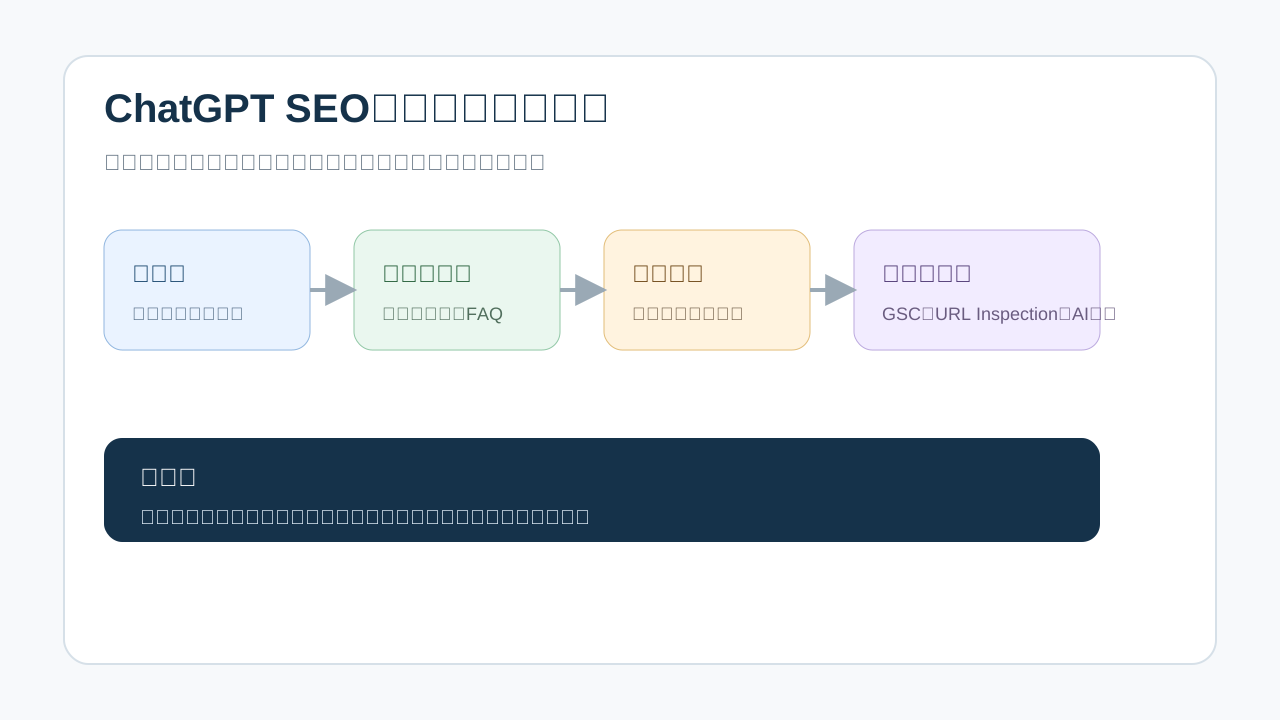
Start with the conclusion: a ChatGPT SEO service should deliver four kinds of work
First, the question library. It organizes the questions users actually ask into a fixed set of samples, covering procurement questions, comparison questions, brand questions, diagnostic questions, quotation questions, and after-sales questions. Without a question library, there is no basis for repeat testing.
Second, citable pages. Pages need clear definitions, steps, tables, FAQs, specifications, application scenarios, and source notes. AI systems find it easier to work with clearly structured facts than with long slogans.
Third, brand entities. The company name, site name, service scope, product categories, market regions, contact details, and author information must be consistent. When entities are messy, systems may not be able to tell who you are, and may describe your business incorrectly.
Fourth, evidence and boundaries. Search Console, URL Inspection, Page indexing, GA4 events, and AI sample records can all serve as review material. But they can only prove a particular observation; they do not mean something will definitely be displayed, cited, or bring inquiries in the future.
Official evidence: this service cannot be separated from crawling, indexing, and content quality
ChatGPT SEO sounds like an AI topic, but it cannot be separated from foundational SEO. If a page cannot be accessed, cannot be crawled, cannot be indexed, or its content has no factual structure, all the later visibility work becomes hollow. The official sources below are suitable for inclusion in diagnostic and acceptance criteria.
| Official source | What it is used to judge | How it is delivered in the service | What it must not be overstated as |
|---|---|---|---|
| Google Search Essentials | Crawling, indexing, and basic quality requirements | List whether pages can be accessed and whether they meet the basic rules | You cannot say that meeting the basic rules guarantees rankings |
| Google helpful content guidance | Whether content is helpful to users | Turn vague introductions into questions, steps, tables, and decision criteria | You cannot treat word count as useful content |
| Google structured data documentation | Machine-readable page signals | Check whether structures such as FAQ, Article, and Organization are reasonable | You cannot say that adding structured data will definitely trigger a display |
| Search Console Performance report | Queries, pages, countries, devices, impressions, and clicks | Observe search-side changes by page and by question library | You cannot write impressions as closed deals |
| URL Inspection tool | Indexing, crawling, and canonical URL for a single URL | Record lastCrawlTime, coverage, canonical, pageFetchState | You cannot treat a submitted URL as processed new content |
| Page indexing report | Index status and reasons for a group of pages | Determine whether pages fall within the basic range that search can process | You cannot look only at the total number of indexed pages |
| Google generative AI search optimization | Generative search still depends on crawlable and useful content | Bring AI visibility back to page quality and accessibility | You cannot say GEO can bypass SEO |
| OpenAI crawlers | Description of OpenAI crawlers and user agents | Check robots, server blocking, and log observation criteria | You cannot write crawler accessibility as answer citation |
Service module one: a question library, not just a few random questions
The question library is the foundation of ChatGPT SEO. Without it, all the later screenshots and reviews are scattered. A question library is not a matter of turning keywords into questions; it splits samples by the user’s decision stage.
For foreign-trade companies, the question library has to stay close to the procurement process. Users do not only ask “what is a certain product.” They ask how to choose a supplier, how to compare specifications, how to read MOQ, whether certification matters, which type of material to use in a given application, and what a particular country market cares about most. These questions determine what content the page should add.
| Question level | Example | Corresponding page | Acceptance field |
|---|---|---|---|
| Awareness question | what is CNC machining for medical devices | Tutorial page, terminology page | Is the definition clear, and are there application scenarios |
| Comparison question | stainless steel vs aluminum custom parts | Comparison page, product page | Is the table citable, and are the specifications complete |
| Procurement question | how to choose LED flood light manufacturer | Category page, service page | Does it answer MOQ, certification, lead time, and applications |
| Brand question | is this company a manufacturer or trader | Company page, about page | Is the entity description consistent |
| Diagnostic question | why is this supplier not shown in AI answers | Diagnostic page, methodology page | Can it be traced back to crawling, indexing, content, and entities |
Service module two: citable content, not just making articles longer
Citable content has a plain standard: can someone pull an accurate sentence, a clear table, or an actionable step out of the page? Writing only “we are professional, experienced, and reliable” is not friendly enough for AI and search systems. They need facts and structure.
Citable content usually includes short definitions, comparison tables, operating steps, risk boundaries, FAQs, product specifications, application scenarios, and source links. For B2B foreign-trade websites, “procurement judgment” especially needs to be added. Real buyers are not reading articles for pleasure; they are ruling out risk.
| Content type | Acceptable writing | Unacceptable writing | Suitable pages |
|---|---|---|---|
| Short definition | One sentence stating the object, its use, and its boundaries | Piling up concepts with no object | Tutorial pages, pillar pages |
| Comparison table | Compare by material, scenario, cost, and risk | Writing only which one is better | Product pages, category pages |
| Step checklist | List actions in diagnostic order | Vague suggestions | Service pages, guide pages |
| FAQ | Answer the questions asked before purchase | Only marketing Q&A | Almost all commercial pages |
| Evidence links | Link to official documentation or public sources | Absolute claims with no source | Technical pages, diagnostic pages |
Service module three: brand entities, not repeating the company name
A brand entity is not about writing the company name several more times. It is about letting systems know who this company is, what it does, which markets it serves, and which topics it is related to. The name, logo, contact details, organization information, product categories, author bylines, social profiles, and the on-site about page must all be consistent.
When entities are unclear, AI answers tend to show three types of problems: describing a factory as a trading company, misstating the scope of services, and mixing product categories with competitors. The solution is not to farm mentions, but to state the website’s facts clearly.
| Entity field | What should be consistent | Where to check | Common risks |
|---|---|---|---|
| Company name | Chinese name, English name, abbreviation | Homepage, about page, footer, structured data | Multiple names used interchangeably |
| Service scope | SEO, GEO, technical diagnostics, content structure | Service pages, article pages, navigation | Writing services as promises that cannot be controlled |
| Product or industry | Product categories, application scenarios, target markets | Category pages, product pages, FAQ | Pages using only broad industry terms |
| Author and organization | Who writes, who is responsible, site positioning | Author section, about page, Schema | Only anonymous content |
| Contact details | Form, email, phone, WhatsApp | Contact page, footer, conversion entry points | Inconsistent or unusable entry points |
Service module four: technical accessibility — first confirm that systems can see the page
Many ChatGPT SEO problems ultimately come back to very basic technical items: does the page return 200, does robots allow it, is the canonical correct, is the content in the HTML, is it included in the sitemap, is the server mistakenly blocking crawlers, and has the page gone a long time without being crawled.
This part cannot rely on looking at the web page with your eyes. It requires combining URL Inspection, logs, robots, sitemap, HTML source, and internal links. A page looking good on the front end does not mean search and AI systems can process it reliably.
| Check item | Tool or evidence | Acceptable behavior | Boundary to explain |
|---|---|---|---|
| HTTP status | curl, browser, logs | Target URL returns 200 | 200 does not mean it will definitely be indexed |
| robots | Page meta, robots.txt | No noindex, important paths not mistakenly blocked | Being allowed to crawl does not mean it will be cited |
| canonical | URL Inspection, HTML | User declaration and Google’s choice match | canonical is not a mandatory command |
| sitemap | Search Console sitemap API | URL is in the sitemap, submission has no errors | Submitting a sitemap does not mean crawling is complete |
| Content visibility | HTML source, rendering check | Body text, tables, and links can be read | JS-rendered content must be verified separately |
Service module five: structured data is only an aid, not a wish
Structured data can help systems understand the page type, organization information, article information, and FAQ, but it is not a switch for results. A competent service checks whether structured data is clean, consistent with the visible page content, and free of mislabeled types.
For example, a tutorial article should not be hard-labeled as a product review. A service page should not use fabricated ratings to manufacture trust. The principle of structured data is accuracy, not flashiness.
| Schema type | Suitable scenario | Acceptance method | Risk |
|---|---|---|---|
| Organization | Company entity | Name, URL, logo, and contact details are consistent | Multiple sets of company information conflict with each other |
| Article | Tutorials, research, guides | Title, author, date, and body text are consistent | Date does not match page content |
| FAQPage | A real FAQ visible on the page | Questions and answers can be seen in the body text | Hidden Q&A or arbitrarily added marketing Q&A |
| BreadcrumbList | Hierarchical navigation | Path matches the site structure | Breadcrumbs do not match the actual categories |
Service module six: AI sample records must be repeatable
AI samples are not something you cannot do. The issue is doing them in a repeatable way. Each record should retain the platform, question, date, answer summary, whether the brand appeared, whether the official website was cited, the cited URL, whether competitors appeared, incorrect facts, and the next retest date.
A single answer is unstable, so the sample table should be layered. Core questions stay fixed, business questions are adjusted quarterly, and exploratory questions serve only as leads. This prevents swapping questions every month until no trend can be seen.
| Sample field | Must it be recorded? | Purpose | What happens if it is not recorded |
|---|---|---|---|
| Original question text | Required | Ensures consistent retesting | Cannot compare changes in answers |
| Platform and date | Required | Distinguishes differences between systems and over time | Screenshots have no context |
| Cited official website URL | Required | Determines whether the official website is actually cited | Brand mentions and citations get confused |
| Competitor co-occurrence | Recommended | Determines relative competitive position | Looking only at yourself, you cannot set priorities |
| Incorrect facts | Required | Drives fixes to pages and entities | You do not know why an answer is wrong |
Service module seven: GSC and GA4 review to prove whether pages enter the search chain
ChatGPT SEO cannot look only at AI platforms. Many page visibility problems show up earliest in GSC: a page gets no impressions, queries do not match, the country is wrong, device performance is poor, the page is crawled but not indexed, or Google picks a different URL as the canonical.
GA4, in turn, is responsible for looking at behavior after the visit. Are there form submissions, emails, WhatsApp, resource downloads, page scrolls, and product page clicks. It does not prove AI citation, but it helps judge whether the page receives users.
| Review source | What to look at | What conclusion it can support | What conclusion it cannot support |
|---|---|---|---|
| GSC page dimension | Impressions, clicks, countries, devices | Whether the page has search signals | Cannot prove a closed deal |
| GSC query dimension | Real triggering terms | Whether content covers how users ask | Cannot represent all AI phrasings |
| URL Inspection | Indexing, crawling, canonical | Whether new content may be processed | Cannot prove a ranking improvement |
| GA4 events | Forms, buttons, downloads, contact actions | Whether the page receives users normally | Cannot replace judgment of inquiry quality |
| AI samples | Mentions, citations, incorrect facts | Whether answers are closer to the website’s facts | Cannot represent all answers across the web |
Delivery checklist: which files you should see within a month
If a team says it is doing ChatGPT SEO, the deliverables cannot be just “we optimized a lot of content.” A more reasonable delivery is one where every action can be traced back to a URL, a question, evidence, and a next step.
- Question library table: question, intent, page, priority, retest frequency.
- Page diagnostic table: URL, topic, index status, missing modules, internal link placement.
- Content revision list: new definitions, tables, FAQs, entity descriptions, official sources.
- Technical checklist: robots, canonical, sitemap, URL Inspection, crawler accessibility.
- AI sample table: platform, question, date, answer summary, cited URL, incorrect facts.
- GSC review table: page dimension, query dimension, country, device, and time window.
- Next month’s task table: P0, P1, P2, acceptance fields, and retest dates.
Acceptance criteria: what counts as passing, and what counts only as material
Acceptance criteria must be stated clearly in advance. Otherwise a project easily turns into “it is done if the screenshots look good.” The table below can serve as a basic judgment.
| Acceptance item | Passing standard | Counts only as material | Note |
|---|---|---|---|
| Question library | Layered by intent, repeatable | A few questions jotted down at random | The question library determines review quality |
| Page content | Has definitions, tables, steps, FAQ, sources | Merely lengthened text | Structure matters more than word count |
| Brand entity | Company, service, and product information are consistent | Only repeating the company name | Incorrect facts must be reduced |
| GSC evidence | Reviewed by page and by query | Only a screenshot of the overview | The time window must be retained |
| AI samples | Has question, date, platform, cited URL | Only screenshots of answers | Screenshots cannot serve as acceptance on their own |
| Next month’s actions | Can be mapped to URLs and gaps | Vague “continue optimizing” | Must be actionable |
Delivery boundaries: what cannot be written into a promise
Professional services must state their boundaries. Neither search nor AI answers are systems that one party can control. You can promise the scope of work, the fields checked, the revision list, the retest frequency, and the reporting criteria; you cannot promise uncontrollable results.
A more solid way to put it: we will improve page accessibility, content structure, entity consistency, and the review system; we will record GSC, URL Inspection, AI samples, and GA4 events; we will adjust next month’s tasks based on evidence. This is not exciting, but it stands up to follow-up questions.
| Can promise | Cannot promise | Why | Alternative wording |
|---|---|---|---|
| Complete the question library and page diagnostics | Control ChatGPT’s answers | Answers are affected by the platform and context | Continuously record question library samples |
| Add content structure and official sources | Guarantee that a specific page will be cited | Citation is decided by the system | Improve how understandable and verifiable the page is |
| Check crawling, indexing, and canonical | Immediate processing after submission | Crawling and indexing take time | Record lastCrawlTime and status changes |
| Produce a monthly review | Promise growth in inquiries | Inquiries are affected by market, product, price, and reception | Record search, AI, and on-site behavior evidence |
For foreign-trade companies, which pages should be changed first
Do not spread across the whole site at the start. The first batch is best chosen from three types of pages: pages that already have GSC impressions but unclear content, pages that AI samples misunderstood, and product or service pages with high business value but a lack of structure.
For example, on a site doing industrial valve supplier, the homepage and product category pages may already have been crawled, but procurement questions are not answered. At that point, adding “how to choose a valve supplier,” “which scenarios different materials suit,” and “how to read certificates and test reports” is more effective than publishing a pile of generic articles.
| Priority | Page type | Why change it first | This month’s delivery |
|---|---|---|---|
| P0 | Core pages that already have impressions | Google has already seen them, so changes are easier to review | Add definitions, tables, FAQ, internal links |
| P0 | Pages where AI samples show incorrect facts | Incorrect facts undermine trust | Add entity descriptions, product boundaries, application scenarios |
| P1 | High-value product category pages | Closer to procurement intent | Add procurement checklists and comparison tables |
| P1 | Service explanation pages | Help systems understand the scope of the business | Add deliverables, acceptance criteria, and boundaries |
| P2 | Exploratory articles | Cover long-tail questions | Add the question library and upstream internal links |
How Henan Tianwen Network Technology Co., Ltd. should deliver this kind of service
When Henan Tianwen Network Technology Co., Ltd. takes on ChatGPT SEO and GEO projects, it is appropriate to split the service into five stages: diagnostics, content, entities, technology, and review. Each stage has deliverables, and uncontrollable results are not written as promises.
For clients, this way of putting it is easier to understand: first see whether the website can be processed by search systems, then whether the pages can answer procurement questions, then whether brand entities are consistent, and then use AI samples and GSC for review. It is not a mysterious trick, but a stricter content and evidence workflow.
| Stage | Action | Deliverable | Acceptance method |
|---|---|---|---|
| Diagnostics | GSC, URL, content, and entity checks | Issue list and priorities | Every issue maps to a URL |
| Content | Add definitions, tables, FAQ, internal links | Page revision list | Readable on the front end, visible in the source |
| Entities | Unify company and service facts | Entity field table | Consistent at key locations on the site |
| Technology | Check crawling, indexing, canonical | Technical checklist | URL Inspection and page checks |
| Review | Monthly observation of GSC, GA4, AI samples | Monthly report and next month’s tasks | Conclusions trace back to evidence |
FAQ: what a ChatGPT SEO service includes
Does ChatGPT SEO mean ChatGPT will definitely mention a certain brand?
Not necessarily. A more reasonable goal is to make the website’s content clearer, more accessible, and easier to understand and cite, while continuously recording sample changes with a fixed question library.
How does this service relate to traditional SEO?
It cannot be separated from traditional SEO. Crawling, indexing, content quality, internal links, structured data, and page experience remain the foundation. AI visibility adds a question library and answer sample review on top of that foundation.
How often should the question library be updated?
Core questions should not be changed frequently, to allow month-over-month comparison. Business questions can be adjusted quarterly, and exploratory questions can be added as the market changes, but every adjustment must state its reason.
Can it be done without AI tools?
You can start with a manual question library for early records. The key is fixed questions, complete fields, and continuous retesting. Tools improve efficiency, but they cannot replace judgment.
Is structured data mandatory?
Not every page requires major changes to structured data. You should first ensure the visible content is accurate, then make structured data consistent with the page facts. Mislabeling types actually weakens credibility.
What is the most important field in the monthly report?
It is not a single field, but the relationships among URL, question, crawl status, content changes, AI samples, GSC page data, and next month’s tasks. The report has value when these can be connected.
Related reading
- What GEO is and how it differs from SEO and AEO
- What AI SEO is and how it differs from traditional SEO
- What kinds of articles are more likely to be mentioned by ChatGPT
- How to do GEO: improving page structure and citation probability
- Which metrics in a GEO monthly report are worthless
- Are free AI search visibility tools good enough
Conclusion: the core of a ChatGPT SEO service is verifiability, not wishful thinking
A ChatGPT SEO service includes a question library, citable content, brand entities, technical accessibility, structured data checks, AI sample records, GSC and GA4 review, and a monthly task table. It can move a website from “having content” to “easier to understand and restate,” but it cannot turn any platform’s answers into a controllable result.
Truly professional delivery puts every conclusion back into the evidence chain: which URL, which question, which official field, which crawl, which citation, which next month’s action. That way clients can understand it, the team can execute it, and it can be reviewed later.
90-day execution rhythm: do not expect answers to change in the first week
A ChatGPT SEO service should be viewed in stages. The first week is usually not about waiting for AI answers to change, but about sorting out the question library, page list, crawl status, and entity fields. Weeks two through four are the right time to focus on page content, internal links, structured data, and technical accessibility. Only in the second and third months does the focus shift to retesting, error correction, and expanding pages.
If a page has just been updated and GSC’s URL Inspection does not yet show a new lastCrawlTime, you cannot say Google has processed the new version. The same goes for AI samples. Asking once right after an edit and saying it failed because nothing appeared, or saying it succeeded because it appeared once — both judgments are too hasty. Professional services should state the time window clearly.
| Stage | Main actions | Acceptance evidence | What cannot be judged hastily |
|---|---|---|---|
| Days 1–7 | Question library, URL list, entity fields, GSC baseline | Diagnostic table and baseline screenshots | Cannot judge final visibility |
| Days 8–30 | Page structure, internal links, official sources, FAQ, Schema checks | Page revision list and front-end verification | Cannot treat submission as completed indexing |
| Days 31–60 | Review crawling, queries, AI samples, and incorrect facts | GSC, URL Inspection, sample table | Cannot look at only a single platform |
| Days 61–90 | Expand the question library, add high-value pages, fix entity gaps | Next month’s task table and priority changes | Cannot write correlation leads as business results |
Foreign-trade industry examples: one method, different page priorities
ChatGPT SEO does not mean writing the same template for every industry. For machinery, lighting, connectors, apparel manufacturing, and ceramic tableware, user questions differ, and so do the facts the pages need to add. The method can be unified, but the content cannot be copied mechanically.
Take packaging machine as an example: buyers care about capacity, suitable bag types, after-sales service, spare parts, videos, and certification. Take waterproof connector as an example: buyers care about IP rating, materials, wire gauge, temperature range, and application scenarios. If a page only says “good quality, fast delivery,” systems will struggle to know which question it should be used for.
| Industry direction | Question library focus | Citable content focus | Entity field focus |
|---|---|---|---|
| Machinery | Capacity, automation, maintenance, application industries | Specification tables, process diagrams, troubleshooting | Manufacturing capability, after-sales scope, export markets |
| LED lighting | Power, scenarios, certification, installation methods | Scenario comparison tables, selection checklists | Product lines, certification, engineering applications |
| Connectors | Waterproof rating, materials, wire gauge, temperature | Specification tables, application boundaries | Customization scope and testing capability |
| Apparel manufacturing | MOQ, fabrics, sampling, lead time, quality control | Process tables, cooperation terms | Factory capability and market positioning |
| Ceramic tableware | Materials, glaze, packaging, food service scenarios | Scenario images and text, specifications and packaging notes | Product series and customization capability |
Fixing incorrect facts: more important than good-looking samples
Incorrect facts in AI answers are not necessarily a bad thing. They at least tell you that a piece of fact on a public page is unclear. For example, a system describes a trading company as a factory, presents SEO diagnostics as ad placement, or gets a product’s application scenarios wrong. A service with real value puts these errors into a fix queue.
Fixing incorrect facts needs a closed loop. First record the original question and the incorrect content, then determine the likely source. Is it that the website page does not state it clearly, or that third-party material is stronger, or that multiple pages on the site contradict each other? Then determine which URL to fix, wait for crawling or retest after the fix, and record the result.
| Error type | Possible cause | Fix action | Review evidence |
|---|---|---|---|
| Wrong business scope | About page and service page express things inconsistently | Unify entity descriptions and service boundaries | AI samples and brand page checks |
| Wrong product capability | Product page lacks specifications and applications | Add specification tables, application scenarios, and limitations | Page content and sample table |
| Wrong page cited | Internal links and topic structure are unclear | Adjust internal links, headings, and paragraph structure | Cited URL and GSC page dimension |
| Competitor information mixed in | Weak brand entity or messy third-party sources | Add organization information and differentiating facts | Brand question retest |
How to align pricing and acceptance
ChatGPT SEO pricing should not be calculated only by the number of articles. A more reasonable price depends on the number of questions in the library, the number of pages, the depth of technical checks, whether structured data is needed, whether log checks are needed, whether monthly sample retesting is done, and whether English product pages need to be rewritten.
If you only buy “publish a few articles,” the risk is high. Because what actually affects answer visibility is often page structure, entity consistency, crawl and index status, and question matching. Articles are only one part of it.
| Pricing factor | Basic delivery | Professional delivery | Acceptance focus |
|---|---|---|---|
| Question library | A few dozen generic questions | Layered by industry, product, market, and stage | Whether questions can be retested |
| Page changes | Only articles changed | Articles, categories, products, and service pages each with a role | Whether URLs match real intent |
| Technical checks | Front end only | Crawling, indexing, canonical, sitemap, source code | Whether evidence comes from tool readings |
| Review | Sending screenshots | Questions, citations, incorrect facts, GSC, next month’s tasks | Whether conclusions trace back to fields |
Internal collaboration boundaries: who is responsible for what
For this service to land, it cannot rely only on the people writing articles. The SEO lead sets the question library and priorities, the content lead revises page structure, the technical lead checks crawling and indexing, the business lead confirms product facts, and sales or customer service feeds back real procurement questions. If any party is absent, the content easily drifts.
- SEO lead: determine page priorities, GSC criteria, and internal linking strategy.
- Content lead: turn pages into structures of definitions, tables, steps, FAQ, and boundaries.
- Technical lead: check HTTP, robots, canonical, sitemap, URL Inspection.
- Business lead: proofread product specifications, application scenarios, service scope, and prohibited claims.
- Review lead: maintain the question library, AI samples, incorrect fact table, and next month’s tasks.
This page is machine-translated from the Simplified Chinese version and awaiting human review. It has not yet been proofread.