Google SEO and GEO Project Analysis Framework — its core is not packaging unauthorized data into “success stories.” It is, within clear factual boundaries, explaining the diagnostic logic, public evidence, page problems, execution actions, observation metrics, and risk boundaries. For export factories and trading companies, this approach matters more than exaggerated storytelling: buyers, owners, sales teams, and search engines all need to know why a page is being changed this way, what the basis is, and which metrics to watch next—not just see unverifiable result numbers.
This article addresses a common question: when a company has no client authorization, cannot disclose client URLs, cannot show Search Console screenshots, and cannot reveal inquiry amounts or client industry details, can an SEO/GEO page still be written? The answer is yes, but it must be written as an analysis framework, public scenarios, diagnostic checklists, and an evidence matrix—not as unauthorized project results. Especially when serving Chinese export businesses, examples should revolve around real export product keywords such as custom metal parts, LED flood light, packaging machine, medical probe, cnc machining parts, ceramic dinnerware, waterproof connector, industrial valve supplier, and private label activewear manufacturer, rather than repeatedly using the SEO service industry’s own keywords as examples.
SERP Top 1 / Authoritative Benchmark Comparison Card
| Benchmark dimension | What the current authority gets right | What is still missing | How Tianwen SEO Research strengthens it |
|---|---|---|---|
| Google helpful content | Emphasizes that content should help users and provide original analysis, complete descriptions, credible sources, clear authorship, and valuable experience. | Official guidelines will not write specific product keywords, inquiry paths, and page diagnostic tables for export businesses. | Translate people-first, E-E-A-T, and Who/How/Why into an evidence matrix for export websites. |
| Google SEO case studies | Official case studies usually explain the background, tools, actions taken, verifiable data, and time frame. | They do not discuss how small and mid-sized export businesses can express their capabilities when they have no authorized data. | Provide a three-tier expression rule of “public, must be anonymized, cannot be disclosed.” |
| AI Search / AI features explanations | Emphasizes crawlability, indexability, previewability, page quality, and control over snippets. | Rarely covers whether AI answers cite the official website, entity consistency, or how product page evidence should be organized. | Add an AI citation observation table, entity evidence, FAQs, and citation-friendly paragraphs. |
| Generic SEO case study articles | Common structures include background, problem, actions, and results. | Many articles overemphasize results and ignore authorization, attribution, and evidence boundaries. | Write diagnostic processes using export product scenarios and do not turn unauthorized projects into results pages. |
The goal of this content is not to be “more authoritative than the official guidelines,” but to turn official principles into page-writing and project-review methods that export businesses can use directly. Google’s helpful content guidance requires content to provide original analysis, complete explanations, clear sources, and user value; Google’s official case studies also present verifiable background and data sources. To go beyond generic articles, Tianwen SEO Research must fill in the export-industry implementation layer: how to choose product keywords, how to assess page problems, how to observe the inquiry path, how to record whether AI cites the official website, and what cannot be written without authorization.
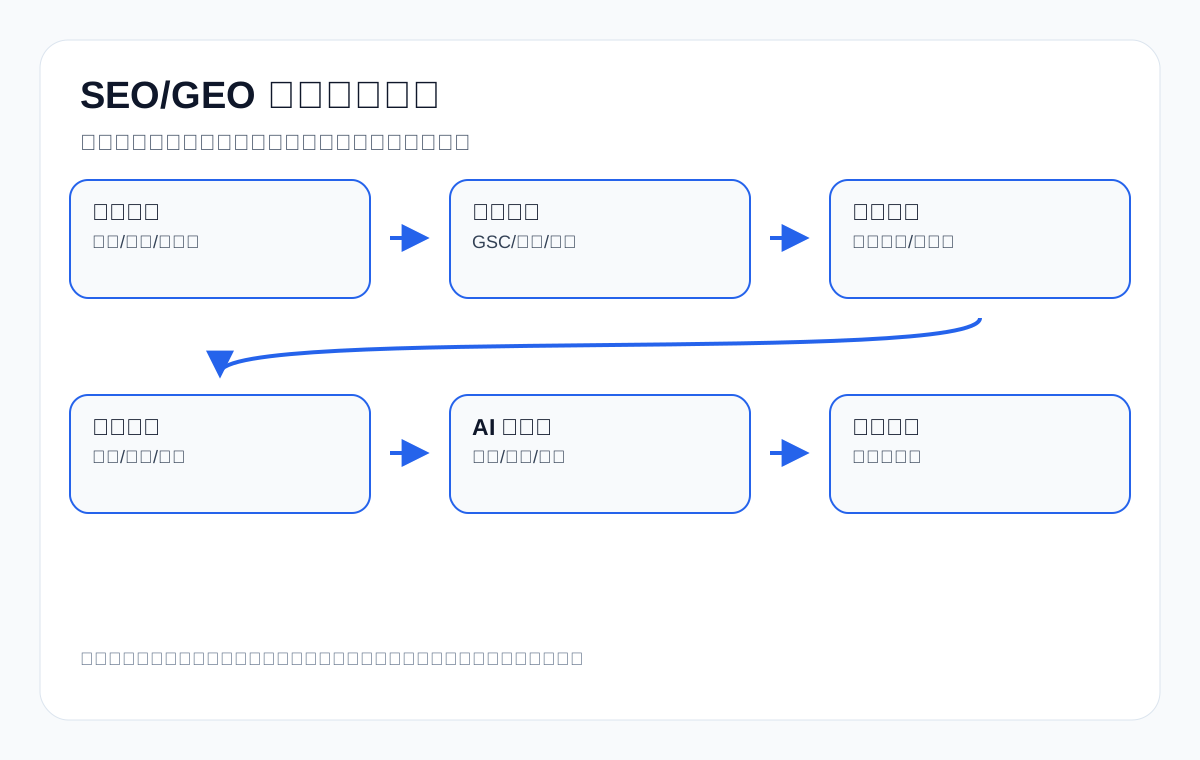
Why you cannot write a results page when there is no authorized data
The most common risk in export SEO/GEO pages is writing “common industry problems,” “internal reasoning,” or “observations of public websites” as if they were “a real client project.” This approach may look persuasive in the short term, but over time it creates three problems. First, when a client asks for the URL, industry, screenshot, time frame, or data source, you cannot answer. Second, the content lacks verifiable evidence, so readers doubt its authenticity. Third, the team may make uncontrollable promises to fit the narrative, affecting expectations for future cooperation.
For Chinese export businesses, trust often comes from details rather than exaggerated results. For example, if an industrial valve supplier website’s category pages are not split by valve type, material, pressure rating, and application, the real diagnostic value is pointing out that page roles are confused, product specifications are insufficient, industry application pages are missing, and inquiry entry points are weak—not writing “a certain valve client’s rankings improved significantly.” If a private label activewear manufacturer website lacks MOQ, fabric, sample process, logo method, and size chart content, what is truly valuable is explaining which pages should be added, which questions should be handled by an FAQ, and which metrics to observe later.
| Poor wording | Risk | Better client-facing wording |
|---|---|---|
| We helped a client generate a large volume of inquiries | Cannot be verified without authorized data and easily misleads | Use a public product scenario to explain how to assess whether the inquiry path is smooth |
| A certain project’s rankings rose steadily | Rankings are affected by many factors; the time frame and data source are missing | Explain how to observe GSC impressions, clicks, queries, and target URL matching |
| AI already recommends the website we optimized | AI answers change dynamically and cannot be treated as a fixed result | Record whether AI cites the official website for different questions, which page it cites, and whether the description is accurate |
| The client cannot be named publicly, so it must be anonymous | Anonymity does not mean you may fabricate; you still need to state the disclosure boundary | Write about anonymous problem types and diagnostic methods, not unverifiable numbers |
| Using broad industry terms instead of real product problems | Readers cannot tell whether you can solve practical export-site problems | Use English product keywords, buyer questions, page types, and metrics as examples |
The four tiers of a credible analysis page
Not all content requires client authorization. The key is to first distinguish content tiers: methodology can be published openly, common industry problems can be written anonymously, observations of public websites must cite accessible pages, and real project data must be authorized. Once the tiers are clear, you will not present service capabilities as unverified results.
| Tier | What you can write | What evidence is needed | Suitable pages |
|---|---|---|---|
| Methodology tier | Diagnostic process, judgment criteria, review metrics | Official documentation, public principles, the boundaries of team experience | Service descriptions, tutorials, analysis frameworks |
| Public scenario tier | Demonstrate common problems using product keywords | Public SERPs, general procurement logic, page structure comparisons | Export SEO tutorials, GEO methodology |
| Anonymous problem tier | Problem types that do not reveal client identity | De-identified descriptions, no sensitive data, clear statements | Problem diagnostic checklists, common pitfalls |
| Authorized evidence tier | Client industry, URL, screenshots, before/after data, action records | Client permission, data source, time frame, attribution boundaries | Formal evidence pages, review pages |
If a page does not reach the “authorized evidence tier,” do not write it as a project results page. It can still be strong—but strong in its judgment framework, tables, processes, and export scenarios, not in packaged numbers. For example, when analyzing a medical probe website, you can openly discuss that the product page needs to cover materials, compatible equipment, clinical departments, certifications, sterilization methods, MOQ, sampling process, and an inquiry document checklist; without authorization, do not write specific client orders, quoted amounts, or conversion data.
What modules an export SEO/GEO analysis page should include
A competent analysis page should leave readers knowing three things: what problem may exist right now, why it is judged that way, and what to check next. It does not need exaggeration; it needs specificity. The structure below suits the SEO/GEO analysis pages of most B2B export websites.
| Module | Question it should answer | Export example | Review metrics |
|---|---|---|---|
| Business and product background | What kind of product this is, who it is sold to, and what the target market is | custom metal parts for equipment manufacturers and purchasing engineers | Target countries, inquiry countries, page language |
| Page role | Product page, category page, industry page, article page, or inquiry page | LED flood light category pages cover models and application scenarios | Whether the target URL matches GSC queries |
| Search intent | Whether buyers want to find suppliers, specifications, comparisons, quotes, or tutorials | IP67 waterproof connector may need specification tables and selection guides | CTR, time on page, inquiry events |
| Content evidence | Whether the page provides specifications, materials, certifications, processes, and FAQs | packaging machine pages must explain the differences for powder, granule, and liquid applications | Query expansion, page scroll, form submissions |
| Technical visibility | Whether the page can be crawled, rendered, indexed, and understood | Product filters, lazy-loaded images, PDF spec sheet links | Index status, crawl time, rich result status |
| GEO citability | Whether AI can extract clear definitions, capability boundaries, and evidence | cnc machining parts pages provide material capabilities and tolerance ranges | Whether AI answers cite the official website and describe it accurately |
| Conversion path | Whether buyers can start an inquiry after reading | Quote buttons, drawing uploads, MOQ and sampling process descriptions | GA4 events, inquiry sources, CRM quality |
Evidence matrix: what you can state directly and what requires caution
The most important thing for an SEO/GEO analysis page is evidence awareness. Not all information is equally reliable, and not all of it can be disclosed. We recommend dividing evidence into six categories and stating the source and boundary for each when writing.
| Evidence type | Reliability | Can it be disclosed | Writing guidance |
|---|---|---|---|
| Google official documentation | High | Can be cited | Use to explain crawling, indexing, helpful content, structured data, and AI feature principles |
| Public SERP observations | Medium-high | Can be described | Record the date, query, and page type; do not write it as a permanent conclusion |
| Public competitor pages | Medium-high | Can be summarized | Analyze structure, modules, and content gaps; do not copy content |
| Own-site GSC/GA4 data | High | Check whether it involves sensitive information | Can be used for internal review; hide sensitive queries and amounts when publishing |
| Client site data | High | Explicit permission is required | Without permission, write only anonymous problem types and do not disclose URLs, screenshots, or numbers |
| AI answer observations | Medium | Can be recorded, but note that it is dynamic | Write the query, date, cited sources, and whether the description is accurate; do not present it as a fixed result |
Boundaries of official sources: without authorized data, SEO/GEO analysis can only present a verifiable framework
When there is no client authorization, no disclosable URL, no disclosable GSC/GA4 screenshots, and no disclosable inquiry data, an SEO/GEO analysis page can still be written. But it must be written as a verifiable framework: public facts, official principles, page diagnosis, action lists, observation metrics, and boundary statements. You cannot write unauthorized data as project results, nor present speculation as something that has already happened.
For export manufacturers and trading companies, this boundary is especially important. Product lines such as custom metal parts, LED flood light, packaging machine, medical probe, waterproof connector, industrial valve supplier, ceramic dinnerware, and private label activewear manufacturer can serve as public analysis scenarios; but rankings, impressions, clicks, CTR, adoption in AI answers, inquiry volume, deal amounts, and client names are only suitable for an evidence page when the data is verifiable, authorization is clear, the time frame is defined, and attribution boundaries are fully stated.
| Official source | What it supports in the analysis framework | How it can be written publicly | What it must not be written as |
|---|---|---|---|
| Google Search Central: Creating helpful, reliable, people-first content | Content should help users and provide original analysis, clear sources, complete explanations, and credible boundaries. | Explain how to assess page facts, procurement questions, content gaps, and the next review step. | Do not present judgments without sources as confirmed results. |
| Google Search Central: SEO Starter Guide | Titles, body copy, images, internal links, and page purpose should serve real users. | Analyze whether LED flood light application pages answer questions about wattage, certification, installation, and scenarios. | Do not claim that a specific action will produce a specific ranking. |
| Google Search Central: Search Essentials | Basic search eligibility, accessibility, spam risk, and minimum content quality standards. | Check whether medical probe pages avoid fabricated certifications, exaggerated compatibility, and misleading content. | Basic compliance does not mean the page already receives impressions or clicks. |
| Search Console Help: Performance report | query, page, clicks, impressions, CTR, average position, country, device. | With authorization, review by page and query; without authorization, only state which dimensions to observe. | Without GSC row-level data, do not write about ranking, impressions, clicks, CTR, or trend improvement. |
| Search Console Help: URL Inspection tool | The index status, crawl status, canonical, and the version Google sees for a single URL. | Explain that the index eligibility of category pages, product pages, resource pages, and inquiry pages should be spot-checked. | Being able to inspect a single URL does not mean it has produced search performance. |
| Google Analytics Help: About events | On-site behaviors such as form submissions, emails, WhatsApp, downloads, RFQs, and resource page clicks. | Explain how GA4 should record drawing uploads, resource downloads, contact buttons, and the inquiry path. | On-site events cannot directly substitute for organic search performance. |
| Google Search Central: AI features and your website | AI search still requires pages to be discoverable and indexable, with clear content and basic SEO. | Analyze whether the page lets AI correctly understand product capabilities, applicable boundaries, FAQs, and sources. | Do not promise that AI answers will always use the official website. |
| OpenAI Platform: Bots | Distinguish the purposes and access boundaries of OAI-SearchBot, GPTBot, and ChatGPT-User. | Explain how robots.txt and logs should be checked for the access policies of different crawlers. | Allowing a crawler does not mean ChatGPT search will display the official website. |
| Bing Webmaster Blog: AI Performance | If visible in the account, you can observe citations, cited pages, and grounding query phrases. | Explain that citation URLs, query phrases, competitor sources, and page actions should be recorded. | A citation is not a ranking, an answer position, or an inquiry result. |
| IndexNow: Documentation | After adding, updating, or deleting URLs, record the submission time, URL list, and response status. | After a page update, you can write about the notification record and the follow-up review plan. | HTTP 200 only means the notification was received; it does not mean the URL has been crawled, indexed, or shown. |
SEO/GEO analysis page evidence matrix: every conclusion needs a source
| Evidence type | Can be written publicly | Requires authorization first | Boundaries that must be stated |
|---|---|---|---|
| Public page facts | Page titles, body structure, product fields, internal links, FAQs, resource download entry points. | Client identity, unpublished product materials, internal sales feedback. | Only describes problems currently visible on the page; it does not represent final search results. |
| Official principles | Public rules from Google Search Central, Search Console, GA4, OpenAI, Bing, and IndexNow. | Specific data screenshots from the client’s account. | Official principles are used to judge boundaries; they are not a promise of results. |
| GSC/GA4 data | Without authorization, write only “you should observe queries, pages, events, paths, and sources.” | Clicks, impressions, CTR, events, conversions, inquiry paths, and date ranges. | Must state the time frame, dimensions, authorization, and attribution boundaries. |
| AI answer samples | Public question sets, platforms, dates, answer summaries, whether the official website is cited, and factual errors. | Client internal strategy, unpublished pages, sensitive brand information. | Samples are observations, not a platform’s promise of results. |
| Inquiries and sales feedback | You can write about field design: product, country, specifications, MOQ, drawings, application scenarios. | Specific clients, amounts, deal status, client lists, and internal follow-up records. | Inquiry quality is affected jointly by product, price, lead time, and sales follow-up. |
How to write a credible report without authorized data
A credible report is not written as “what we achieved,” but as “how we assess this problem.” For example, you cannot write that a certain client’s rankings improved; you can write that custom metal parts pages usually need to verify materials, processes, tolerances, drawing formats, sampling lead times, and RFQ fields. You cannot write that AI has long used the official website; you can write that AI samples should record the platform, query, date, answer summary, cited URLs, and factual errors.
| Scenario | Recommended wording | Wording to avoid | Conditions for upgrading later |
|---|---|---|---|
| No GSC authorization | Explain that you should observe queries, pages, countries, devices, clicks, impressions, CTR, and URL matching. | Claiming existing ranking, impression, click, or CTR improvements. | Obtain authorization, export data, and note the date range. |
| No GA4 authorization | Explain that form, email, WhatsApp, download, RFQ, and resource page events should be configured. | Claiming inquiries have increased or conversions have improved. | Obtain event data and source dimensions. |
| No client case authorization | Use public product keywords and a page diagnostic matrix. | Writing anonymous but unverifiable success stories. | The client gives written permission to disclose URLs, screenshots, and the time frame. |
| Only AI answer screenshots | Write the platform, question, date, cited sources, and errors. | Claiming AI search consistently uses the official website. | Repeatedly retest the same question set and combine it with page actions and GSC/GA4. |
The writing process when there is no authorized data
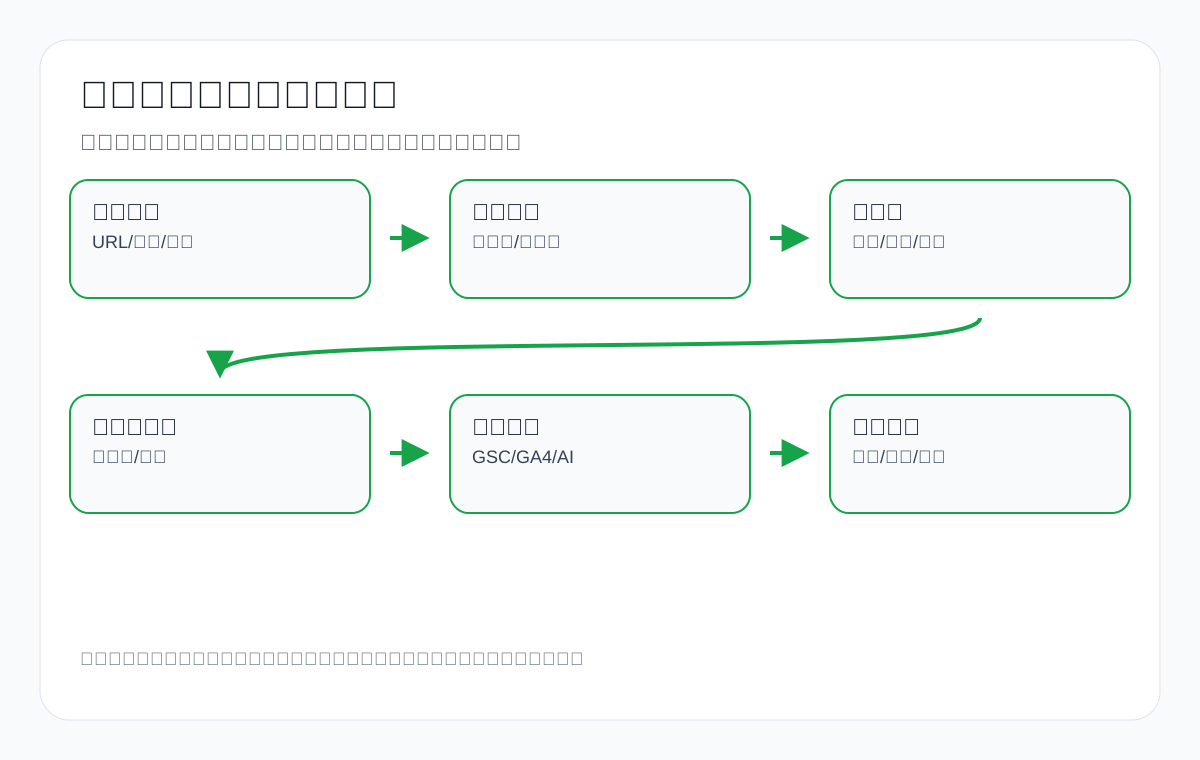
The process below can be used for service pages, methodology pages, diagnostic pages, and tutorial articles. Its goal is not to hide capabilities, but to express them more credibly.
Step 1: Confirm which information is cleared for public disclosure
First list the disclosable scope: whether the client name can be written, whether the industry can be named, whether the URL can be included, whether GSC screenshots can be shown, whether GA4 conversion data can be shown, whether inquiry content can be de-identified, and whether the time frame can be disclosed. If these questions have no clear answers, then by default do not write specific client data. Note that verbal consent does not mean all details are suitable for disclosure; it is best to disclose only the minimum necessary information.
Step 2: Reframe the content as problem types, not client results
If client data cannot be disclosed, reframe the content as “problem types.” For example, instead of writing “how much a certain LED flood light client grew,” write “Common problems for LED flood light export websites: category pages list products only, without distinguishing outdoor, warehouse, stadium, IP rating, and mounting method, so buyers cannot quickly judge the applicable scenario.” This wording is more helpful to clients and does not create unverifiable narratives.
Step 3: Build scenarios with public product keywords
Export business readers care more about whether the approach applies to their own products. Example keywords must stay close to their business: custom metal parts, cnc machining parts, ceramic dinnerware, waterproof connector, industrial valve supplier, private label activewear manufacturer. Each keyword should map to page type, search intent, content modules, and review metrics.
Step 4: Turn the analysis actions into a checklist
Do not just say “we will do a diagnosis.” Write clearly what is diagnosed: index status, target URLs, keyword mapping, product page content, category page structure, technical crawling, page speed, structured data, internal link paths, inquiry entry points, and AI answer citations. Clients need checkable steps, not abstract concepts.
Step 5: Add boundary statements
Every analysis page should state which conclusions are certain and which are only observation directions. For example, “an increase in GSC impressions does not necessarily mean more inquiries,” “AI answer citations change with the query and over time,” “after a page update, you need to observe for a period,” and “SEO/GEO actions interact with the market, product, price, and sales follow-up to affect results.” These boundaries do not weaken persuasiveness; they build professional trust.
Export scenario 1: How to write a diagnostic analysis for a custom metal parts website
Searchers using terms such as custom metal parts, cnc machining parts, and custom metal fabrication are usually purchasing engineers, product managers, or procurement staff at equipment manufacturers. An analysis page should not just say “improve keyword rankings”; it should explain whether the page answers key pre-purchase questions: which materials and processes are available, precision, surface treatment, minimum order quantity, drawing formats, sampling lead time, quality inspection reports, packaging, and export experience.
| Check item | Common problem | How the analysis page should express it | Follow-up metrics |
|---|---|---|---|
| Product keywords | Only writing metal parts, without breaking out CNC, stamping, or casting | Build keyword groups by process and material | Whether process keywords appear in GSC |
| Page role | All processes crammed onto one page | The main capability page targets core keywords, while process pages target long-tail keywords | Whether target URLs match queries |
| Procurement evidence | No tolerances, materials, or inspection capabilities | Add specification tables, QC processes, and a drawing document checklist | Whether inquiries include drawings and specifications |
| GEO citability | No clear definitions or capability boundaries | Write citable capability description paragraphs | Whether AI cites the official website’s description |
Export scenario 2: How to write an analysis for an LED flood light website
The purchasing intent behind LED flood light usually revolves around application scenarios, wattage, luminous efficacy, waterproof rating, mounting method, certification, and project quantity. A credible analysis page can write “how to judge whether an LED flood light category page meets buyers’ needs,” rather than unauthorized client results.
| Page module | What buyers care about | Content recommendation | Verification method |
|---|---|---|---|
| Category page above the fold | Whether it suits outdoor, warehouse, and stadium use | Provide product series entry points by scenario | Click paths and category page CTR |
| Specification table | wattage, lumen, IP rating, beam angle | Present key parameters in a table | Time on page and inquiry fields |
| Application pages | How to select models for different scenarios | Create pages such as warehouse lighting and sports field lighting | Impressions and clicks for industry keywords |
| FAQ | IP65 vs IP66, lifespan, certification, samples | Answer on category pages and in articles | Growth in long-tail question keywords |
Export scenario 3: How to avoid vague language for packaging machines
packaging machine is a very broad term. Food, powder, granules, liquids, hardware, pharmaceuticals, and daily chemicals may all use packaging equipment. If an analysis page only writes “do keyword layout,” clients can hardly tell whether you understand the industry. A better approach is to break the product keyword into material, packaging format, capacity, automation level, target industry, and after-sales issues.
| Keyword group | Search intent | Page type | Analysis focus |
|---|---|---|---|
| powder packaging machine | Looking for powder packaging equipment | Category page / product line page | Dust, dosing, sealing, cleaning |
| liquid filling and sealing machine | Looking for liquid filling and sealing solutions | Product line page | Viscosity, speed, container type |
| small business packaging machine | Budget and small-batch startup | Selection article | Semi-automatic, changeover, ROI |
| food packaging machine manufacturer | Looking for a manufacturer | Capability page | Food-contact materials, cleaning, certification |
Export scenario 4: How to write about medical probes and compliance-sensitive products
Products such as medical probe involve medical applications, compatible equipment, materials, certification, cleaning, and quality control. When writing an analysis page, you cannot exaggerate performance or replace evidence with vague wording. A public scenario can explain what information the page should present: product use, compatible models, materials, safety boundaries, quality systems, packaging methods, sampling process, and the documents required for an inquiry.
| Information module | Why it matters | Publicly acceptable wording | Wording not recommended |
|---|---|---|---|
| Compatible equipment | Buyers need to confirm compatibility | List the compatibility range and the model details that must be confirmed | Vaguely claiming it fits all equipment |
| Materials and processes | Affects safety and durability | Explain material types, processing methods, and inspection items | Exaggerating safety performance |
| Certifications and documents | Affects procurement decisions | List the document types you can provide and their scope of application | Claiming coverage of all markets without evidence |
| Inquiry information | Reduces ineffective back-and-forth | Prompt for model, quantity, application, and target market | Providing only a generic contact button |
GEO analysis cannot just ask whether AI will recommend you
GEO or AI search visibility analysis cannot be written as “getting AI answers to always use a certain website.” A more reasonable object of analysis is: whether the page is crawlable, whether it is indexable, whether entity information is consistent, whether product capabilities are clear, whether FAQs can be extracted, whether cited sources are reliable, and whether AI mentions the official website for different questions. AI answers change with time, region, query method, and system updates, so they can only serve as observation signals, not fixed promises.
| GEO check item | Export implementation issue | Page action | Observation metric |
|---|---|---|---|
| Entity consistency | Whether the company name, brand name, and product capabilities are consistent | Align the About page, product pages, contact page, and structured data | Whether AI describes it accurately |
| Citable paragraphs | Whether the page has clear definitions and boundaries | Write 2–3 sentences that can be cited independently | Whether AI quotes the original sentence or paraphrases |
| Evidence support | Whether product specifications, certifications, and processes are verifiable | Add tables, images, FAQs, and file links | Whether the cited page is the official website |
| Question coverage | What buyers will ask | Write FAQs around MOQ, lead time, sample, and material | AI Q&A coverage rate |
How to write a “public scenario” instead of disguising it as client material
Writing a public scenario follows three principles: use product keywords that genuinely exist, make problems consistent with procurement logic, and ensure conclusions can be verified by checking the page. For example, when writing about waterproof connector, you can analyze IP rating, pin number, cable type, application, certification, drawings, and sample requests; when writing about ceramic dinnerware, you can analyze material, glaze, dishwasher safety, MOQ, custom logo, packaging, and retail vs wholesale; when writing about industrial valve supplier, you can analyze valve type, pressure, material, standard, industry application, and quotation requests.
| Public scenario | What you can write | What you cannot write | Client value |
|---|---|---|---|
| waterproof connector | Specification pages and selection FAQs need to cover IP67, pins, cable, and application | Specific client inquiry amounts without authorization | Helps buyers judge model and application |
| ceramic dinnerware | Category pages should distinguish hotel, restaurant, retail, and custom logo | Brand client information without permission | Helps buyers screen suppliers quickly |
| industrial valve supplier | Industry pages should be split by oil and gas, water treatment, and chemical | Unverifiable project result numbers | Improves the match between industry solutions and needs |
| private label activewear manufacturer | Capability pages should cover fabric, MOQ, sample, logo, and size chart | Client styles and sales data without authorization | Reduces low-quality inquiries and repeated back-and-forth |
How to write the above-the-fold section of an SEO/GEO analysis page
The above-the-fold section should tell clients directly: what problem this page solves, who it is for, and what judgment they can gain. Do not turn it into company self-promotion, and do not open with complex jargon. A better above-the-fold structure is: one sentence on the problem, one on the audience, one on the judgment method, and one on the boundary.
| Above-the-fold element | How to write it | Example |
|---|---|---|
| Problem | State clearly the situation the client faces | The export site has content, but the product pages, category pages, and inquiry path do not form a closed loop |
| Audience | State who it is for | Suited to export factories, B2B trading companies, and the managers of English-language standalone sites |
| Method | Explain how to judge | Cross-check GSC queries, page roles, product keywords, internal links, and AI citation signals |
| Boundaries | State that no uncontrollable results are promised | The page provides diagnostic and review methods and does not present unauthorized data as project results |
Actionable checklist: verify item by item before publishing
Before publishing any SEO/GEO analysis page, run a fact check and a client-perspective check. The checklist below can serve directly as an internal review standard, but when presented on the page it should use language clients understand.
| Check item | Pass criteria | Failing signs |
|---|---|---|
| Target reader | Clearly aimed at export factories and trading companies | Written only for SEO practitioners |
| Product examples | Uses English export product keywords and procurement questions | Repeatedly uses its own service keywords as examples |
| Evidence sources | Official documentation, public pages, verifiable observations, or authorized data | Only subjective judgments |
| Client authorization | Explicit permission exists when client information is involved | Anonymity used to package fabricated results as real |
| Boundary statements | States the time, data sources, and attribution limits | Implies guaranteed rankings or inquiry results |
| Review metrics | Includes GSC, GA4, inquiries, and AI citation observations | Looks only at rankings or word count |
| Page actions | Can guide creating, updating, merging, adding internal links, or adding FAQs | After reading, you still do not know what to do next |
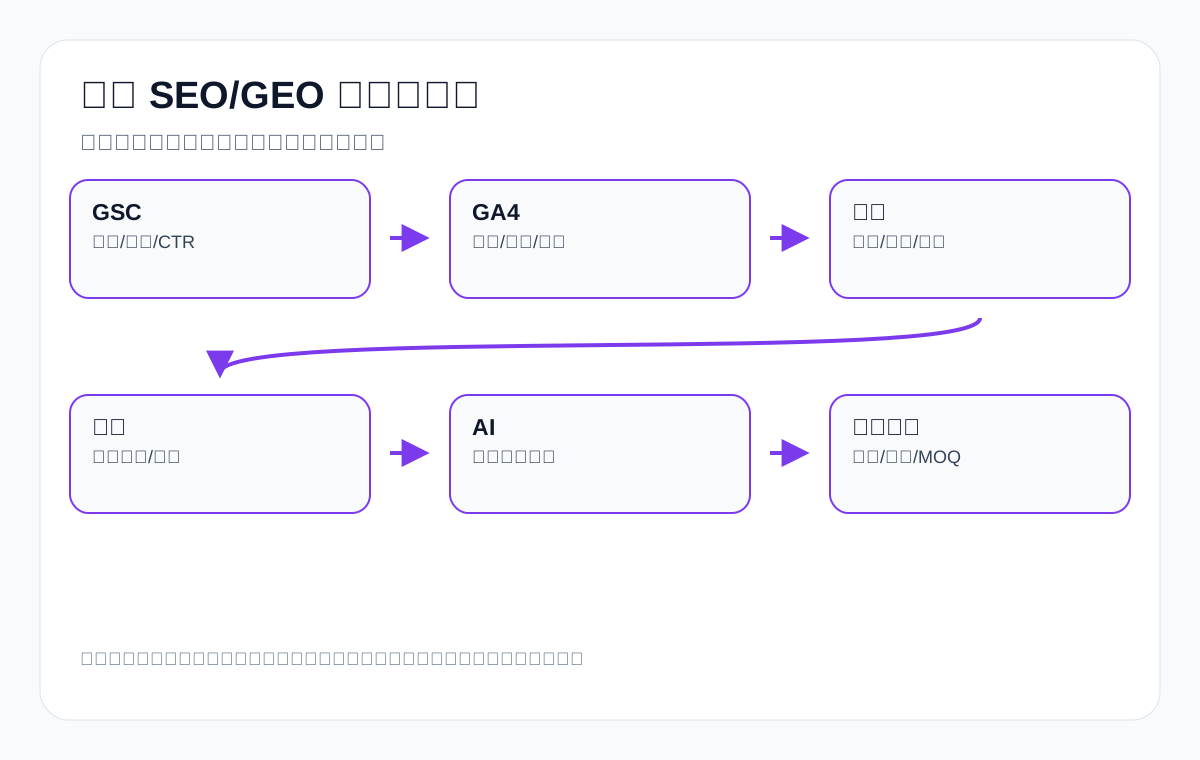
Review metrics: do not look only at rankings
If an SEO/GEO analysis page discusses only rankings, it will ignore the inquiry quality and procurement path that export businesses truly care about. Review should be divided into five categories: search visibility, page matching, conversion path, inquiry quality, and AI visibility.
| Metric category | What to look at | Cycle | Corresponding action |
|---|---|---|---|
| GSC queries | Whether target product, application, and question keywords appear | 30–60 days | Add FAQs, titles, internal links, or new pages |
| URL matching | Whether queries land on the right page | 30–60 days | Adjust keyword mapping and internal links |
| CTR | Whether titles and snippets attract target buyers | 30–60 days | Revise titles, meta descriptions, and above-the-fold answers |
| GA4 paths | Whether users enter the product, resource, and inquiry paths | 30–90 days | Optimize CTAs, resource downloads, and form fields |
| Inquiry quality | Whether it includes product, specifications, quantity, country, and application | 60–90 days | Add document checklists and page explanations |
| AI citation observation | Whether AI cites the official website and describes it accurately | 60–90 days | Add definition sentences, FAQs, evidence, and entity consistency |
Common pitfalls: these wordings weaken trust
- Writing unauthorized client data as real results without stating the source and time frame.
- Writing “an observed change” as “caused by one specific action,” ignoring the effects of market, product, price, and sales follow-up.
- Using your own industry keywords for all examples, so export factories cannot tell whether the approach applies to their products.
- Discussing only keywords and rankings, not product pages, category pages, industry pages, inquiry pages, and the procurement path.
- Treating AI answer screenshots as long-term stable results without recording the date, query, and cited sources.
- Piling up jargon to look professional without tables, checklists, steps, and judgment criteria.
- Not stating whether data is authorized for disclosure, creating risks to client privacy and brand trust.
- Writing the page as company promotion rather than helping clients judge a problem.
- Only writing “we will optimize the content” without explaining how to review GSC, GA4, inquiry sources, and AI citations.
A page writing structure you can use directly
If you are writing content for an export SEO/GEO service page, diagnostic page, or methodology page, you can organize it in the order below. Note that this is not to pad the length, but to let readers fully understand the problem, evidence, actions, metrics, and boundaries.
- Above-the-fold answer: state what export customer-acquisition problem this page solves.
- Audience: state which factories, trading companies, and English-site managers it suits.
- Problem types: list situations such as thin product pages, weak category pages, many articles but few inquiries, and AI not citing the official website.
- Evidence matrix: distinguish public materials, on-site data, client-authorized data, and AI observations.
- Export scenarios: use English product keywords to break down page roles and search intent.
- Diagnostic steps: check by crawling, indexing, content, internal links, conversion, and GEO.
- Judgment table: state the conditions for creating, updating, merging, keeping, adding FAQs, and adding internal links.
- Review metrics: list GSC, GA4, inquiry sources, and AI citation observations.
- Boundary statements: state that unauthorized data is not shown and the controllable scope is not exaggerated.
- FAQ: answer the questions owners and sales teams ask most often.
Authorization tier table: when you can write a case study and when you can only write an analysis
Many export businesses are not completely unable to disclose information; they simply have not clarified “to what extent disclosure is allowed.” Before writing an SEO/GEO project page, the person responsible for content should first make an authorization tier judgment. This judgment avoids two extremes: writing as if something were real project results when there is no authorization, and writing nothing at all for fear of risk even though the method and scenario could be disclosed, leaving the site without credible analytical content.
| Authorization tier | Disclosable content | Non-disclosable content | Recommended page format |
|---|---|---|---|
| Tier 0: No authorization | Public methods, general industry problems, product keyword scenarios | Client names, URLs, screenshots, data, inquiry information | Methodology pages, diagnostic checklists, public scenario guides |
| Tier 1: Anonymized | De-identified problem types, broad industry categories, action frameworks | Products, countries, screenshots, and amounts that could reveal client identity | Anonymous problem reviews, common problem analyses |
| Tier 2: Partial information disclosable | Industry, site type, some page screenshots, non-sensitive metrics | Sensitive client business, quotes, client lists, and unauthorized data | Authorization scope pages, partial evidence pages |
| Tier 3: Full authorization | Client name, URL, screenshots, time frame, action records, and data changes | Information excluded by the authorization agreement | Formal project evidence pages |
For example, if a ceramic dinnerware factory only allows disclosure of the industry and page structure but not client names and inquiry data, the page should be written as “how to judge whether a ceramic tableware export site’s category pages match hotel procurement scenarios,” rather than as specific client results. If a waterproof connector client allows disclosure of some page screenshots but not order amounts, you can show the before-and-after page structure, GSC query types, and FAQ structure, but should not show quotes, client lists, or sensitive inquiry content.
How to bolster credibility when public materials are insufficient
Having no client authorization does not mean the content can only stay at the level of slogans. Credibility can come from four directions: public official principles, public SERP observations, public page structure analysis, and actionable review metrics. As long as every conclusion states “where the basis comes from, what the applicable boundary is, and what the client can check next,” the page will be more valuable than an ordinary promotional page.
| Credibility source | How to obtain it | How to write it into the page | Export example |
|---|---|---|---|
| Official principles | Google Search Central, structured data documentation, AI Search explanations | Explain why pages need to be crawlable, indexable, and understandable | Explain why product specification tables and FAQs help search engines understand the page |
| SERP observations | Search target English product keywords and record the top page types | Explain whether current results favor product pages, category pages, articles, or supplier pages | industrial valve supplier mostly returns supplier and capability pages |
| Page structure analysis | Check public pages’ above-the-fold content, navigation, specifications, FAQs, internal links, and inquiry entry points | Point out which procurement decision information is missing | private label activewear manufacturer pages lack MOQ and sample process |
| Review metrics | Use GSC, GA4, inquiry forms, CRM, and AI Q&A records | Explain what to observe after launch and do not present results as fixed conclusions | Check whether target product keywords reach the corresponding URLs and whether inquiries are more complete |
The advantage of this approach is that the page does not depend on “mysterious achievements” that cannot be disclosed; instead, it lays out facts the client can verify. Export business owners can use the tables to check their own websites: whether product pages have specifications, whether category pages group applications, whether articles lead to commercial pages, and whether inquiry pages prompt for drawings, quantity, materials, target market, and lead time. Even without complete data for now, clients can see whether the analysis framework is professional.
From the client’s decision-making perspective, which sales questions should an analysis page answer
An SEO/GEO analysis page is not only for search engines; it is also for the client’s internal decision-making. Export business owners, sales managers, operations leads, and technical leads care about different questions. A strong page should let every role find answers.
| Client role | Primary concern | Answer the page should provide | Wording to avoid |
|---|---|---|---|
| Owner | Whether this is worth investing in | Explain which pages affect the customer acquisition path and how to review in stages | Only saying rankings will improve |
| Sales manager | Whether it can bring better-matched inquiries | Explain how product keywords, application keywords, and inquiry information connect | Only discussing traffic, not inquiry quality |
| Operations lead | Where content should be changed first | Give priorities for product pages, category pages, articles, and FAQs | Only offering abstract strategy |
| Technical lead | Whether site structure affects crawling and conversion | Explain index, speed, JS, structured data, and form check items | Writing about technical issues as if they were mysticism |
| Sales team | Whether the page reduces repeated back-and-forth | Add MOQ, samples, materials, specifications, applications, and a quotation document checklist | Providing only one contact method |
+
For example, the sales team at a packaging machine company is often asked, “Can it package powder? What is the speed? Is changeover troublesome? Is it suitable for food? Can it start with small batches?” If the analysis page only writes about SEO techniques, the sales team can hardly participate; if the page maps these questions to category pages, product pages, FAQs, and the inquiry form, the SEO/GEO content will genuinely serve sales.
Final acceptance criteria for an analysis page
Before publishing, run a final client-perspective acceptance check: whether the page immediately shows it is for export businesses, whether it contains English product keywords and procurement questions, whether it has tables and process diagrams, whether it explains data boundaries, and whether it tells clients what to check next in GSC, GA4, inquiry sources, and AI citation observations. If all of this is clear, the page can become credible service judgment content even without public client cases.
FAQ: Common questions about the SEO/GEO analysis framework
Is an SEO/GEO page still worth writing without authorized client data?
Yes, but it should be written as methodology, a diagnostic framework, public product scenarios, and a review checklist. What clients really need is to judge the problem and know the next step, not necessarily unauthorized client materials.
Can anonymized cases be written?
You can write about anonymized problem types, but do not include specific result figures that cannot be verified. It is best to frame them as “common problems for a certain type of export website” and state clearly that client information and sensitive data are not disclosed.
Must an SEO and GEO analysis page include data screenshots?
A formal authorized evidence page should ideally include screenshots, a time frame, and data sources; a methodology page does not necessarily need screenshots, but it must have clear judgment criteria and review metrics.
Can you write about ranking improvements or inquiry growth?
Only when the data is verifiable, the client permits disclosure, the time frame is clear, and the attribution boundaries are defined. Otherwise, write about “how to observe impressions, clicks, target URLs, inquiry sources, and inquiry quality.”
Does GEO analysis mean checking whether ChatGPT or AI Overviews mention the brand?
That is one observation point, but it is not enough. You also need to check whether the page is crawlable, whether entity information is consistent, whether product capabilities are clear, whether FAQs can be extracted, whether AI cites the official website, and whether the description is accurate.
Which analytical content should export businesses disclose most readily?
You can disclose product page structure, buyer questions, industry applications, FAQs, page diagnostic methods, content update logic, and review metrics. Client names, URLs, inquiry content, sales amounts, and account data must be handled with caution.
Why should examples use English product keywords?
Because real search demand for export sites occurs on English product keywords, application keywords, supplier keywords, quote keywords, and question keywords. Using SEO service industry keywords as examples makes it hard for export factories to judge whether the method applies to their own product pages.
How often should this type of analysis page be reviewed?
After a new page is published, it is recommended to check GSC queries and indexing at 30–60 days and the inquiry path and content matching at 60–90 days, with a quarterly review of AI citation observations, page roles, and high-value keyword coverage.
Can analysis be done without GSC authorization?
You can do public-level checks of page structure, indexing, content, internal links, SERP, and technical factors, but you cannot write the conclusions as complete project results. Only after obtaining GSC/GA4 authorization can you conduct more precise data reviews.
How do you judge whether an analysis page is useful to clients?
See whether, after reading it, clients know what to check on their pages, what to add, which metrics to observe, and which results cannot be attributed simply. If all they remember is one promotional slogan, the page is not useful enough.
Conclusion: credibility acquires customers better than exaggeration over the long run
Building SEO/GEO content assets for export businesses is ultimately not about making pages look busier, but about letting clients judge problems more clearly. Without authorized data, write methodology, public scenarios, an evidence matrix, diagnostic processes, and review metrics; once authorization is obtained, then write evidence pages with sources, time frames, and boundary statements. Such content will not promise uncontrollable results, but it reduces misleading, increases trust, and better matches the preference of search engines and AI systems for clear, reliable, verifiable content.
For Chinese export factories and trading companies, a truly valuable SEO/GEO page should return to the product and the buyer: whether custom metal parts have material and process pages, whether LED flood light has application scenario pages, whether packaging machine has material and capacity descriptions, whether medical probe has compatibility and quality boundaries, whether waterproof connector has selection FAQs, and whether private label activewear manufacturer has MOQ, sample, and private label processes. Explaining these questions clearly helps clients make judgments better than any unauthorized account of results.
Continue reading this GEO series
If you are systematically learning about GEO and AI search visibility, keep reading the articles below. Start with the concepts, then move on to diagnosis, monitoring, content structure, and cooperation boundaries.
- How to judge the most reliable AI search visibility service team in China: don’t look at AI promises, look at visibility evidence
- What a GEO service includes: AI visibility diagnosis, query sets, and a monitoring deliverables checklist
- Where to start with AI search optimization: should an export website build query sets first or change content first?
- How to do GEO: what to change first, from page structure to citation probability
- What is Schema structured data: which types should export websites add for SEO and AI search
- How to build AI search visibility for B2B export: a guide to getting inquiry and solution keywords into AI answers
{
“@context”: “https://schema.org”,
“@type”: “FAQPage”,
“mainEntity”: [
{
“@type”: “Question”,
“name”: “Is an SEO/GEO page still worth writing without authorized client data?”,
“acceptedAnswer”: {
“@type”: “Answer”,
“text”: “Yes, but it should be written as methodology, a diagnostic framework, public product scenarios, and a review checklist. What clients really need is to judge the problem and know the next step, not necessarily unauthorized client materials.”
}
},
{
“@type”: “Question”,
“name”: “Can anonymized cases be written?”,
“acceptedAnswer”: {
“@type”: “Answer”,
“text”: “You can write about anonymized problem types, but do not include specific result figures that cannot be verified. It is best to frame them as “common problems for a certain type of export website” and state clearly that client information and sensitive data are not disclosed.”
}
},
{
“@type”: “Question”,
“name”: “Must an SEO and GEO analysis page include data screenshots?”,
“acceptedAnswer”: {
“@type”: “Answer”,
“text”: “A formal authorized evidence page should ideally include screenshots, a time frame, and data sources; a methodology page does not necessarily need screenshots, but it must have clear judgment criteria and review metrics.”
}
},
{
“@type”: “Question”,
“name”: “Can you write about ranking improvements or inquiry growth?”,
“acceptedAnswer”: {
“@type”: “Answer”,
“text”: “Only when the data is verifiable, the client permits disclosure, the time frame is clear, and the attribution boundaries are defined. Otherwise, write about “how to observe impressions, clicks, target URLs, inquiry sources, and inquiry quality.””
}
},
{
“@type”: “Question”,
“name”: “Does GEO analysis mean checking whether ChatGPT or AI Overviews mention the brand?”,
“acceptedAnswer”: {
“@type”: “Answer”,
“text”: “That is one observation point, but it is not enough. You also need to check whether the page is crawlable, whether entity information is consistent, whether product capabilities are clear, whether FAQs can be extracted, whether AI cites the official website, and whether the description is accurate.”
}
}
]
}
This page is machine-translated from the Simplified Chinese version and awaiting human review. It has not yet been proofread.
Further Reading on This B2B SEO & GEO Topic
- What Does Google-Based Foreign Trade Customer Acquisition Optimization Include? Technology, Content, GSC Review, and a Delivery Checklist
- How to Monitor AI Search Visibility: A List of Brand Mentions on Foreign Trade Websites, Official Site Citations, and Competitor Responses
- What does GEO Visibility Diagnosis include: AI answers, entity consistency, citation sources, and post-mortem analysis
- What should a monthly GEO Monitoring Report include: AI answers, brand mentions, and changes in citations
- Generative Engine Optimization (GEO) and AI Search Citation Hub for Export Brands
- Generative Engine Optimization Research
- B2B SEO & GEO Scope and Pricing Standards