Conclusion first: Before signing a Google SEO service contract, foreign-trade companies should not look only at “how many keywords” and “how quickly results appear.” More important is confirming the goal boundaries, site access, GSC/GA4 data, page overhaul scope, content ownership, review method, and non-guarantee clauses. The clearer the contract, the easier it is later to judge whether the work actually happened.
For companies running foreign-trade websites in categories such as custom metal parts, LED flood light, and packaging machine, an SEO contract cannot be captured by a single phrase like “improve rankings.” Search traffic comes from combined changes in product pages, category pages, technical articles, inquiry paths, indexing status, and the competitive environment. Before signing, the deliverable work should first be broken down.
1. First confirm the goals: not every goal belongs in a contract
SEO goals can be built around checkable actions and metrics, but final search engine rankings, specified inquiry results, or AI platform answer results are not suitable as guaranteed outcomes. A more reliable contract goal separates “scope of work” from “observed metrics.”
| Goal type | Suitable for the contract? | Suggested wording |
|---|---|---|
| Technical issue fixes | Suitable | List the inspection scope for robots, sitemap, canonical, 404s, redirects, page speed, and so on |
| Page content overhaul | Suitable | State the number of product pages, category pages, and blog pages and the depth of the overhaul |
| GSC performance review | Suitable | Review impressions, clicks, queries, pages, and action records monthly |
| A specified ranking position | Not suitable | You can write “track changes in target queries,” but not a guaranteed position |
| A specified number of inquiries | Not suitable | You can write “check the inquiry path and form events,” but not a fixed number of orders or inquiries |
2. Data and access that must be confirmed before the contract
Without data and access, an SEO engagement easily turns into “writing recommendations only.” Before signing, at least confirm which access can be granted and which can only be handled internally by the company.
| Access or data | Purpose | What the contract must specify |
|---|---|---|
| Google Search Console | Review queries, pages, indexing, coverage, and sitemaps | Who provides access, whether data can be exported, the review cycle |
| GA4 or another analytics tool | Observe organic traffic, time on page, and conversion events | Whether key events are configured, such as form submissions, WhatsApp clicks, and email clicks |
| WordPress site editing access | Edit titles, body content, internal links, and page structure | Access level, backup before changes, how launches are confirmed |
| Server or logs | Troubleshoot crawling, status codes, performance, and abnormal visits | Whether access is granted, read-only or operational, whether the company’s technical staff must assist |
| Product materials | Supplement specifications, applications, certifications, FAQs, and procurement questions | Who provides the materials, which content the company must finally confirm |
The Google Search Central SEO starter guide, crawling and indexing documentation, and sitemap documentation all emphasize basic discoverability, page understandability, and technical configuration. A contract that omits all of this and discusses only “the number of keywords” is usually not solid enough.
3. Deliverables should be written as checkable items
“Doing SEO optimization” is too vague. It is best to write deliverables in the contract as checkable items—reports, checklists, pages, records, and review tables—rather than abstract actions.
1. Technical diagnosis deliverables
- A site crawling and indexing checklist.
- Inspection results for robots.txt, sitemap, canonical, noindex, 404s, and redirects.
- A status table for key pages: list issues separately for product pages, category pages, blog pages, and service pages.
- Fix priority: must fix first, recommended to fix, and not handled for now.
2. Content and page deliverables
- Page titles, H1s, body structure, FAQs, and internal link adjustments.
- A mapping of English foreign-trade product terms and buyer questions, for example which pages LED flood light supplier China corresponds to.
- Fact supplementation for product pages: specifications, materials, applications, certifications, MOQ, lead time, and quality verification.
- Category page overhaul: selection logic, application scenarios, product differences, and related page paths.
3. Review and record deliverables
- A monthly action record: which pages were changed, why, and when they went live.
- GSC changes: changes in queries, pages, impressions, clicks, and average position.
- Anomaly notes: indexing fluctuations, pages not crawled, title rewrites, and sudden traffic changes.
- Next-step recommendations: keep fixing technical issues, add content, expand internal links, or observe.
4. Content ownership and account ownership must be clearly stated
What foreign-trade companies most easily overlook is asset ownership. After the SEO engagement ends, who owns the articles, pages, images, tables, GSC data, and account access should be clarified before the contract.
| Asset | Suggested ownership | Problems to avoid |
|---|---|---|
| Website admin interface and server | The company itself holds final administrator access | Being unable to get the site admin interface back after the engagement ends |
| GSC and GA4 | The company account is the owner, and the partner is an authorized user | Data living in the service provider’s account and unable to be kept long term |
| Article and page content | The company owns the right to use and modify it later | Being unable to continue using the content after the contract ends |
| Keywords and review tables | The company should be able to export and retain them | Seeing only screenshots with no original records |
| Images and materials | Confirm the source, authorization, and permitted commercial scope | Using unauthorized assets creates copyright risk |
5. The contract must clearly state “what is not done”
Boundaries are not about shirking responsibility but about protecting both sides’ expectations. In an SEO project, some items easily become disputes in the middle or late stages if they are not clearly stated.
| Boundary item | Why it must be specified | Example wording |
|---|---|---|
| Programming development | SEO recommendations may involve templates, speed, and structured data | Routine page adjustments are included; complex development is confirmed separately |
| English material translation | Foreign-trade product content needs the company to confirm technical facts | The partner may improve the wording; key specifications are confirmed by the company |
| Backlink purchasing | Opaque backlinks may create long-term risk | Do not use link schemes whose source and risk cannot be explained |
| Ad placements | SEO and SEM differ in budget, goals, and measurement | This contract does not include Google Ads placement management |
| AI search results | AI answers are affected by the platform and context | Visibility can be monitored, but a specified answer format or specified citation result is not guaranteed |
6. Page checklist before a foreign-trade website contract
Before signing, have the partner team review a set of representative pages. This makes the workload easier to judge than sending only the homepage.
- Homepage: whether it explains the company, product range, target industries, and inquiry entry.
- Core product pages: specific pages such as custom metal parts, LED flood light, and packaging machine.
- Product category pages: whether they cover supplier selection, model comparison, and application scenario explanations.
- Technical articles: whether they answer buyers’ questions about specifications, materials, certifications, installation, and quality verification.
- Contact page and inquiry path: whether forms, email, phone, and WhatsApp can be tracked.
- Old articles and old service pages: whether they need to be kept, merged, rewritten, or noindexed.
7. What monthly reviews should look at
The contract should specify the review frequency and review fields. Without review fields, it is hard to judge the value of the work later.
| Review field | What to look at | How to interpret |
|---|---|---|
| Query changes | Which new foreign-trade product terms and question terms appeared in GSC | Judge whether pages are starting to be understood correctly |
| Page changes | Which pages gained impressions or clicks | Decide whether to keep strengthening or adjust direction |
| Indexing status | Whether key pages are discovered, crawled, and indexed | Troubleshoot whether content is not working because of technical blocks |
| Action records | Which pages and structures were changed this month | Connect changes in results with work actions |
| Inquiry path | Whether organic traffic enters product pages, the contact page, or forms | Check whether SEO traffic is close to business goals |
8. Ten questions you can ask directly before the contract
- Will you first look at GSC, GA4, and indexing status?
- Which page types does the quote cover: product pages, category pages, blog pages, or the whole site?
- Will you rewrite page structure based on English product terms and buyer questions?
- What exportable records will you provide each month?
- Who owns GSC, GA4, the website admin interface, and content assets?
- If pages need development or template changes, are they included in the contract?
- Will backlinks be used? If so, how will the source, risk, and records be explained?
- Do you guarantee a specified ranking, a specified inquiry result, or an AI platform answer result? If so, on what basis?
- After the engagement ends, how will materials, reports, and account access be handed over?
- When search fluctuations occur, how do you judge whether it is technical, content-related, competition, or an algorithm change?
9. Which contract statements are healthier
A healthy contract is not conservative; it is verifiable. The following wording is better suited to long-term cooperation.
- “Complete a technical and content diagnosis of 20 key pages and provide a fix list by priority.”
- “Build a page mapping table around 30 English product terms and procurement question terms.”
- “Review GSC queries, pages, impressions, clicks, and this month’s action records every month.”
- “Supplement product pages with specifications, applications, FAQs, internal links, and inquiry path recommendations.”
- “Do not guarantee a specified search engine ranking, a specified number of inquiry results, or the way an AI platform answers.”
10. Contract acceptance should be written as fields, not slogans
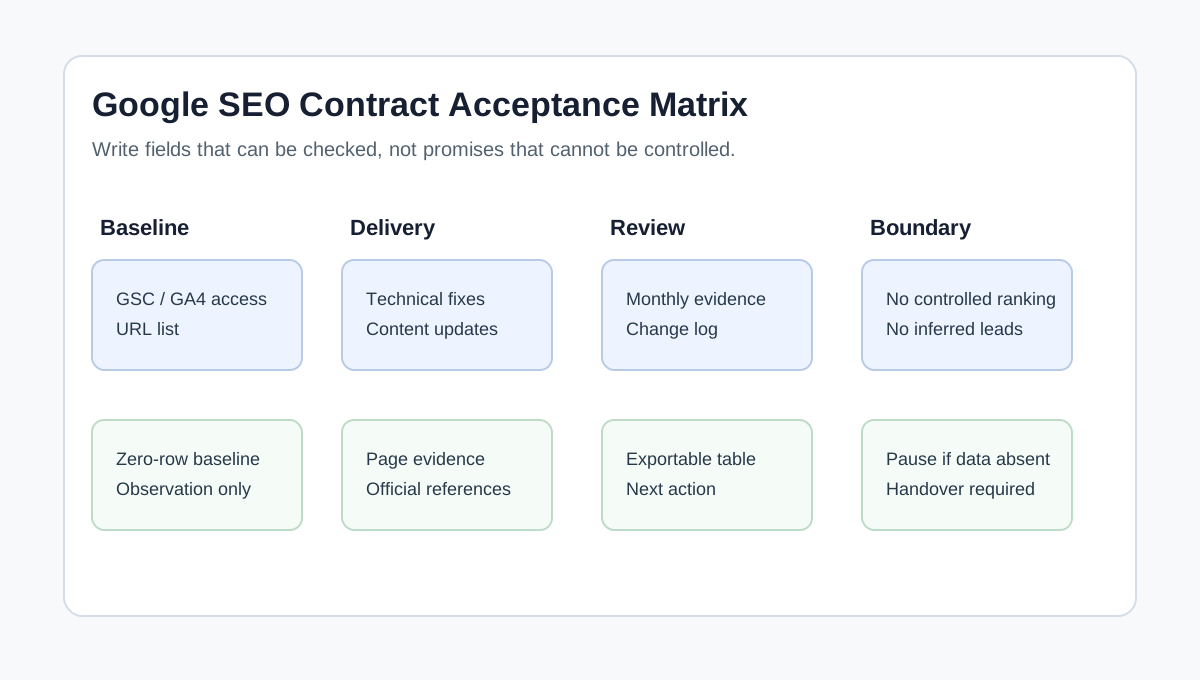
The place where foreign-trade companies most easily run into trouble when signing a Google SEO service contract is not whether “optimization” is mentioned, but that the contract does not clearly state: who provides the data, who has access, how deliverables are accepted, and which results cannot be guaranteed.
If the contract only says “improve rankings,” “increase traffic,” or “improve AI search visibility,” it is very hard to review later. A healthier approach is to break the goals into checkable fields.
| Contract field | Suggested wording | Acceptance method | Boundary |
|---|---|---|---|
| Search data baseline | Based on the Google Search Console performance report, record the date range, queries, pages, clicks, impressions, CTR, and average position | Monthly export or screenshot for the record | If there is no GSC data, you can only write “baseline to be established” |
| Organic traffic and events | Based on the GA4 event definitions, record organic traffic, key events, and the inquiry path | Confirm whether events are configured, and review the source and pages | If events are not configured, inquiry growth cannot be inferred |
| Crawling and indexing | Record results per robots, sitemap, canonical, and URL inspection | List problem URLs, evidence, and fix status | You cannot guarantee that all pages will be indexed |
| Content delivery | Clearly state page types, topics, word-count ranges, tables, FAQs, internal links, and official-source requirements | Accept article by article by URL | A generic article cannot be treated as product page optimization |
| GEO or AI visibility | Record the AI answer query set, platforms, cited URLs, brand descriptions, and recheck times | Verify against the sample record table | You cannot guarantee that AI systems will display it long term, cite a specified result, or display it in a specified way |
11. The access list should distinguish read-only, edit, and publish
Many contract disputes come from unclear access. Foreign-trade companies usually do not want the service team to change product pages at will, and the service team cannot bear technical responsibilities it cannot fulfill without access. The contract should divide access into three tiers.
| Access type | Common objects | What the contract must specify | Who should hold it |
|---|---|---|---|
| Read-only access | GSC, GA4, server logs, CRM lead sources | The data scope that can be viewed, the export method, and confidentiality obligations | Diagnosis and review staff |
| Edit access | WordPress site editing access, product pages, category pages, blog posts | Which URLs can be changed, whether customer confirmation is required, whether backups are required | Content and technical execution staff |
| Publish access | Launching pages, redirects, robots, sitemap, structured data | The launch process, rollback method, responsible person, and confirmation time | The company’s person in charge or designated technical staff |
| Sensitive access | DNS, servers, databases, payments, email | Usually not recommended to hand directly to an external team unless separately authorized | Inside the company or the managed technical lead |
If the project involves Shopify, WooCommerce, or a multilingual foreign-trade site, also state clearly who provides product materials. The SEO team can adjust page structure and keywords, but it cannot fabricate certifications, capacity, export countries, or customer endorsements on behalf of the company.
12. Official material checklist before a foreign-trade website contract
Before the contract, it is best to put official materials in an appendix. That way, later discussions are not based on feelings but on the same set of evidence.
| Material | Why review it | Corresponding contract clause | Common risk |
|---|---|---|---|
| Google SEO Starter Guide | Confirm that basic SEO work is not a mysterious action | Page titles, content, links, crawlability | The service provider packages basic items as unverifiable technology |
| Official robots documentation | Confirm which pages are allowed to be crawled | Technical checks and pre-launch QA | Accidentally blocking product pages, category pages, or resource pages |
| Official sitemap documentation | Confirm whether important URLs are submitted | Indexing diagnosis and page checklist | New pages go live but never enter the sitemap |
| Official structured data documentation | Confirm that Schema helps understanding, not a ranking guarantee | Products, FAQs, breadcrumbs, article structure | Describing structured data as “guaranteed rich results” |
| Official Google AI features documentation | Confirm that AI search display is still decided by the system | GEO monitoring and AI visibility boundaries | Guaranteeing an AI display format or a specified citation result |
13. Which statements in the contract should be changed to acceptable wording
Some statements sound appealing but are not suitable for a contract. Once written in, they are more likely to get out of control later. What foreign-trade companies need to see is whether the work is checkable, not whether the promise is beautiful.
| Wording to avoid | Suggested replacement | Why |
|---|---|---|
| Guaranteeing specified rankings for core terms | Record the GSC impressions, clicks, average position, and page changes of target queries monthly | Rankings are jointly decided by the search system, the competitive environment, and page quality |
| Agreeing on inquiry growth | Set up event tracking from organic traffic to forms, WhatsApp, and email clicks | Inquiries are affected by the product, price, lead time, page conversion, and market demand |
| Guaranteeing that AI platforms will use the official website | Build an AI answer query set and record brand mentions, official-site citations, and reasons competitors appear | AI answers cannot be controlled in a fixed way by the service team |
| Unlimited page changes | State clearly which URLs will be changed this period, the acceptance criteria for each page type, and the boundary for additional fees | Avoid stuffing unbounded requirements into one contract |
| Covering all technical issues | Break them into SEO technical issues, server issues, theme and plugin issues, and third-party system issues | Different issues require different access and responsible people |
14. Contract acceptance example: how to write it for B2B foreign-trade product lines
If a company makes products such as custom metal parts, LED flood light, packaging machine, medical probe, ceramic dinnerware, or waterproof connector, the contract can break acceptance down by product line.
| Product line | Page actions | Acceptance evidence | Non-guaranteed items |
|---|---|---|---|
| custom metal parts | Add materials, processes, tolerances, MOQ, application scenarios, and FAQ | Product page URLs, update records, GSC page data | No guarantee of a specified ranking for a particular English term |
| LED flood light | Add wattage, certifications, installation scenarios, and wholesale procurement questions | A list of category pages and product pages | No guarantee of simultaneous growth in all country markets |
| packaging machine | Add industry applications, specifications, comparison tables, and after-sales questions | Page structure, FAQ, internal links, and inquiry events | No guarantee that complex equipment will definitely bring inquiries |
| medical probe | Add compliance, models, compatible equipment, and procurement restriction notes | Content review records and page versions | Do not fabricate certifications or medical qualifications |
| waterproof connector | Add IP ratings, wire gauges, interfaces, applications, and a selection table | Product page fields and indexing status | No guarantee that AI answers will cite the official website |
15. Monthly review clauses should be clearly stated in advance
The contract should state how to review each month. It is not about producing a beautiful report, but about judging whether the next step is to change pages, change technology, or supplement materials.
| Review item | Minimum output | Question to judge | Next action |
|---|---|---|---|
| GSC queries and pages | Queries, pages, clicks, impressions, CTR, average position | Is there real search exposure? | Update pages that have impressions but a low CTR |
| GA4 organic traffic events | Organic traffic, key events, inquiry path | Does traffic enter commercial pages? | Optimize page conversion and the form path |
| Indexing and crawling | Abnormal URLs, robots, sitemap, canonical | Can Google see the pages? | Fix blocking and duplication issues |
| AI answer samples | Query terms, platforms, answer summaries, cited URLs | Are the brand and official website understood correctly? | Supplement entity consistency and citable pages |
| Product material gaps | Missing specifications, certifications, applications, FAQ, images, or videos | Why is the content not credible enough? | The company supplies materials, then the service team changes the pages |
Written this way, the contract will be plainer. But it can be reviewed later. For foreign-trade companies, that is more useful than a nice-sounding promise that cannot be accepted.
16. Contract appendices can be split into four checklists
If the main body of the contract is too long, it becomes hard to use during execution. A more practical method is to put the core acceptance items in appendices. The main body states the scope of cooperation, and the appendices state the check fields. During later reviews, both sides confirm item by item against the appendices.
| Appendix | Contents | Who confirms | Acceptance evidence |
|---|---|---|---|
| Page checklist | Homepage, category pages, product pages, industry pages, blog pages, FAQ pages | The company’s person in charge and the SEO execution staff | URL, page title, target terms, update date |
| Technical checklist | robots, sitemap, canonical, 404s, redirects, speed, mobile | The technical lead and the SEO diagnosis staff | Inspection screenshots, problem URLs, fix records |
| Content checklist | Product parameters, application scenarios, certifications, procurement questions, images, and video materials | The product lead and the content execution staff | Material sources, page versions, review records |
| GEO checklist | AI answer query set, brand descriptions, official-site citations, reasons competitors appear | The SEO lead and the review staff | Query records, platforms, dates, cited URLs |
These four checklists do not need to be fancy. As long as they can be rechecked, they are valuable. What foreign-trade companies fear most is a contract that looks complete but, at execution time, has no specific URLs, specific data, or specific responsible people.
17. Situations where acceptance judgment should be paused first
Some problems cannot be solved by the SEO team continuing to revise articles. The contract should clearly state the conditions for pausing judgment. This is not about shifting responsibility, but about preventing unverifiable results from being written into the monthly report.
| Situation | Why pause | What to do first | Basis for resuming judgment |
|---|---|---|---|
| GSC has no query or page data at all | There is no search performance baseline | Confirm whether the site is verified, whether pages are indexable, and whether the sitemap is submitted | Reviewable query or page rows appear in GSC |
| GA4 has no key events configured | It is impossible to judge whether organic traffic turns into inquiry actions | Configure events for forms, WhatsApp, email clicks, downloads, and so on | Events start being recorded and sources can be distinguished |
| Product materials are missing | Pages cannot produce credible content | Supplement specifications, certifications, applications, MOQ, lead time, and packaging information | The materials are confirmed by the company |
| The server frequently malfunctions | Both crawling and user access are unstable | First handle status codes, caching, timeouts, and security blocking | Access, crawling, and logs become stable again |
| The page launch process is unclear | It is impossible to judge who changed what | Establish release records and a rollback method | Every launch has a responsible person, time, and version |
When these situations occur, the monthly report can say “this metric cannot be judged this month.” That is more reliable than forcing out a seemingly positive conclusion.
18. What to hand over when the service period ends
The end of an SEO engagement does not mean the materials should be scattered. Foreign-trade companies need to keep maintaining the website and to let the next service provider understand past actions. The contract can state the handover content at the end of the service period in advance.
| Handover item | Content | Purpose | Notes |
|---|---|---|---|
| Accounts and access | The access status of GSC, GA4, CMS, servers, and form tools | Avoid being unable to view data later | Remove external accounts that are no longer needed |
| Page update records | Updated URLs, titles, main changes, and launch dates | Judge the cause of later traffic changes | Do not hand over only a vague summary |
| Issue checklist | Fixed, unfixed, and deferred issues | Help prioritize the next round | State the reason for deferral clearly |
| Content materials | Product term lists, FAQs, images, tables, and industry page plans | Continue expanding pages later | Mark which materials have been confirmed |
| GEO monitoring table | Query sets, AI answer records, cited URLs, competitor records | Continue observing AI search visibility | Do not treat sample records as definite results |
This part does not have to be complicated. One clear table is enough. What is truly useful is that the people who come later can understand it, and the company itself can take it over.
19. Supplement: contract appendices should write acceptance, pause, and handover as one set of fields
The place where a Google SEO service contract most easily generates disputes later is not whether the service provider did the work, but that the two sides did not agree in advance on “what evidence counts as delivery, when results cannot be judged, and which assets are handed over after the service ends.” For foreign-trade websites, these fields matter more than verbal promises, because product pages, category pages, articles, resource pages, inquiry pages, GSC, GA4, and sales feedback all affect the review at the same time.
Contract appendices can break acceptance into four layers: whether pages and technology are complete, whether data and access are available, whether the monthly review has evidence, and whether handover is possible when the service period ends. This way, even if there is currently no usable GSC query, page, or page-query row data, it is still possible to judge whether the basic work was actually completed, instead of padding in rankings, impressions, clicks, CTR, AI adoption, or inquiry results.
Contract Appendix 1: URL-level delivery acceptance table
| URL type | What the contract should specify | Acceptance evidence | Boundary notes |
|---|---|---|---|
| Homepage | Brand, product range, target industries, main entries, and inquiry path. | Page screenshots, source code, internal links, forms, or contact entries. | A homepage overhaul alone cannot represent whole-site results. |
| Category page | Product families, selection logic, application scenarios, related products, and material entries. | URL, title, body modules, tables, internal links, sitemap status. | A category page going live does not equal immediate search performance. |
| Product page | Parameters, materials, images, certifications, MOQ, lead time, FAQ, downloadable materials, and inquiry entry. | Before-and-after page comparison, product data table, image alt text, RFQ events. | A complete product page does not mean a specified ranking. |
| Article page | Topic, target question, internal link targets, official sources, FAQ, and follow-up update rules. | Article URL, official links, internal links, GSC observation fields. | The number of articles is not a customer acquisition result. |
| Resource page | Downloads and explanations for catalogs, datasheets, certificates, manuals, and drawings. | File URLs, HTML explainer pages, download events, version records. | A resource download cannot directly explain a closed deal. |
| Inquiry page | Product, quantity, country, application, file upload, contact details, and source records. | Form fields, GA4 events, test submissions, sales backfill fields. | A working form does not mean a specified inquiry result. |
Contract Appendix 2: Data access and review metric table
| Data metric | Confirm before the contract | Monthly review material | How to handle if missing |
|---|---|---|---|
| GSC Performance | Whether the company account owns the site resource, and whether the service provider is read-only or can edit. | query, page, clicks, impressions, CTR, average position, country, device. | If there is no row data, write only the fields to be observed, not performance improvement. |
| GSC Indexing | Whether the sitemap, page indexing, and URL Inspection sampling can be viewed. | Indexed status, reasons for not being indexed, canonical, crawl time, and page version. | Without sampling, you cannot assert that core pages participate in search. |
| GA4 Events | Whether events are configured for forms, email, WhatsApp, material downloads, and RFQ buttons. | Event names, page paths, sources, trigger counts, and test records. | If events are not configured, you cannot write about organic search inquiry improvement. |
| Sales feedback | Whether sales is willing to backfill the inquiry product, country, stage, and quality monthly. | Product fit, parameter completeness, budget or quantity, follow-up status. | Without sales feedback, you cannot judge lead quality by traffic alone. |
| AI samples | Whether the platform, query set, dates, region, and record format are agreed. | Answer summaries, brand mentions, cited URLs, factual accuracy. | Without samples, you cannot write that an AI platform adopted the official website. |
Contract Appendix 3: Trigger conditions for pausing acceptance judgment
The contract should clearly state in advance which situations require pausing result judgment. Pausing is not evading acceptance, but avoiding writing unusable data as definite conclusions.
| Trigger condition | Why pause | Still acceptable at this time | Resumption condition |
|---|---|---|---|
| GSC has no usable query or page rows | It is impossible to judge whether search performance has formed. | URL checklist, page overhaul, sitemap, index/follow, review metrics. | Exportable Performance row data appears. |
| GA4 key events are not configured | It is impossible to judge the inquiry action after an organic search click. | Event planning, trigger locations, form fields, and the test process. | Events can be recorded reliably and viewed by page. |
| Product materials are missing long term | Pages cannot be completed with real procurement evidence. | Material gap checklist, page structure, fields to be filled. | The company provides parameters, certifications, images, FAQ, or downloadable materials. |
| Major website redesign or migration | Page structure, URLs, templates, and tracking may all change at the same time. | Migration checklist, redirect table, canonical, sitemap, and indexing sampling. | The redesign is complete and has been observed stably for one review cycle. |
| Sales feedback is interrupted | It is impossible to judge inquiry quality and page gaps. | Page actions, GSC, GA4, form fields. | Monthly backfilling of inquiry quality resumes. |
Contract Appendix 4: Service-end handover checklist
| Handover item | What must be handed over | How the company verifies | Must not be omitted |
|---|---|---|---|
| Account access | The read-only access status of GSC, GA4, CMS, servers, form tools, download tools, and ad/CRM-related tools. | The company administrator confirms item by item, not relying on the service provider’s personal account. | Handing over only screenshots, not the access status. |
| Page assets | Changed URLs, titles, body content, FAQ, tables, images, internal links, resource pages, and launch dates. | Check before-and-after records and the final pages by URL. | Handing over only an article list, not the reasons for page changes. |
| Data materials | GSC/GA4 exports, filter conditions, date ranges, event definitions, and monthly review tables. | The company can independently reproduce the review metrics. | Handing over only a zip file without explaining what the fields mean. |
| Issue checklist | Unfinished issues, reasons for pausing judgment, next-round priorities, and suggested owners. | It can be turned into the next stage’s task table. | Writing unfinished items as vague notes. |
| AI and GEO samples | Query sets, platforms, dates, answer summaries, cited URLs, factual errors, and page actions. | The company can continue retesting with the same question set. | Handing over only a one-time screenshot. |
20. Contract acceptance must separate actions, evidence, and observed metrics
A Google SEO service contract is not better the longer it is; its fields must be recheckable. For foreign-trade companies, the contract should contain three types of content at the same time: actions already completed, evidence that can be opened, and data still to be observed. The three must not be mixed together.
| Contract object | Acceptable actions | Evidence | What it must not become |
|---|---|---|---|
| Technical diagnosis | Check robots, sitemap, canonical, noindex, 404s, redirects, and mobile access | Problem URLs, screenshots, source code, before-and-after fix records | It must not become “technical issues will definitely change rankings” |
| Page optimization | Change titles, H1s, body structure, FAQ, tables, internal links, and inquiry entries | URLs, version records, launch dates, page screenshots | It must not become “changing pages will produce a specified inquiry result” |
| Content materials | Add product parameters, applications, certifications, MOQ, lead time, downloadable materials, and procurement questions | Company-confirmed material tables, page fields, image alt text | Do not fabricate certifications, capacity, customer endorsements, or export cases |
| GSC review | View query, page, clicks, impressions, CTR, average position by date range | Search Console exports, filter conditions, and review tables | When there is no row data, do not write about search performance improvement |
| GA4 events | Confirm whether forms, email, WhatsApp, material downloads, and RFQ buttons are recorded | Event names, trigger pages, test records, and source dimensions | When events are not configured, do not infer organic search inquiry changes |
21. Under a zero-row GSC baseline, the contract should first write “to be observed”
If the company’s current Google Search Console has no usable query, page, or page-query row data, the contract cannot write follow-up work as search results that have already happened. A more reliable approach is to first write “establish a baseline” and “fields to be observed.”
This does not mean SEO service cannot start. Technical checks, page checklists, content overhauls, sitemap submission, index/follow checks, internal links, and inquiry path checks can all be done first. It is just that the monthly report must separate these actions from search performance.
| Zero-row baseline scenario | What the contract can state | How to write the review | Boundary |
|---|---|---|---|
| GSC has no query rows | Establish the target query set, page mapping, and review fields | Record “no usable query rows yet; continue observing” | Do not write that keywords have improved |
| GSC has no page rows | Confirm key URLs, sitemap, index/follow, and canonical | Record whether pages are accessible and whether they enter the sitemap | Do not write that pages have gained search performance |
| GA4 has no key events | Plan form, email, WhatsApp, download, and RFQ events | Record the event configuration status and test results | Do not write about organic search inquiry growth |
| Product materials are incomplete | List the parameters, certifications, images, FAQ, and downloadable materials to be added | Record whether the company confirms the materials | Do not fabricate product facts |
| AI samples are not established | Establish fields for the query set, platforms, dates, brand descriptions, and cited URLs | Record samples; do not write definite conclusions | Do not guarantee how an AI system will display |
22. Foreign-trade product page overhauls need URL-level acceptance standards
Many SEO contracts only say “optimize product pages” without saying to what degree the product pages will be changed. For B2B foreign-trade websites, a product page should at least answer procurement questions: what the product is, who it suits, what specifications it has, how quality is confirmed, and how to ask for a quote.
| Product page field | Acceptance question | Evidence | Common gap |
|---|---|---|---|
| Product definition | Can buyers quickly understand the product category, use, and differences? | Above-the-fold explanation, H1, product images, category links | Only piling up keywords without explaining the application |
| Specifications | Are there checkable fields such as dimensions, materials, power, interfaces, capacity, and certifications? | Parameter tables, images, datasheets, or company-confirmed materials | Missing parameters; the page cannot support a procurement decision |
| Application scenarios | Does it explain the applicable industries, equipment, environments, and limits? | Application paragraphs, case-style scenarios, internal links to industry pages | Vaguely writing “widely used” |
| Procurement questions | Does it answer MOQ, lead time, packaging, customization, quality inspection, and after-sales? | FAQ, inquiry form fields, downloadable materials | Buyers must ask the basic questions all over again |
| Technical accessibility | Can Google crawl the body text, links, images, and structured data? | Source code, sitemap, index/follow, internal links | Content blocked by scripts, pop-ups, or a faulty template |
23. Monthly reviews should recheck the same evidence flow
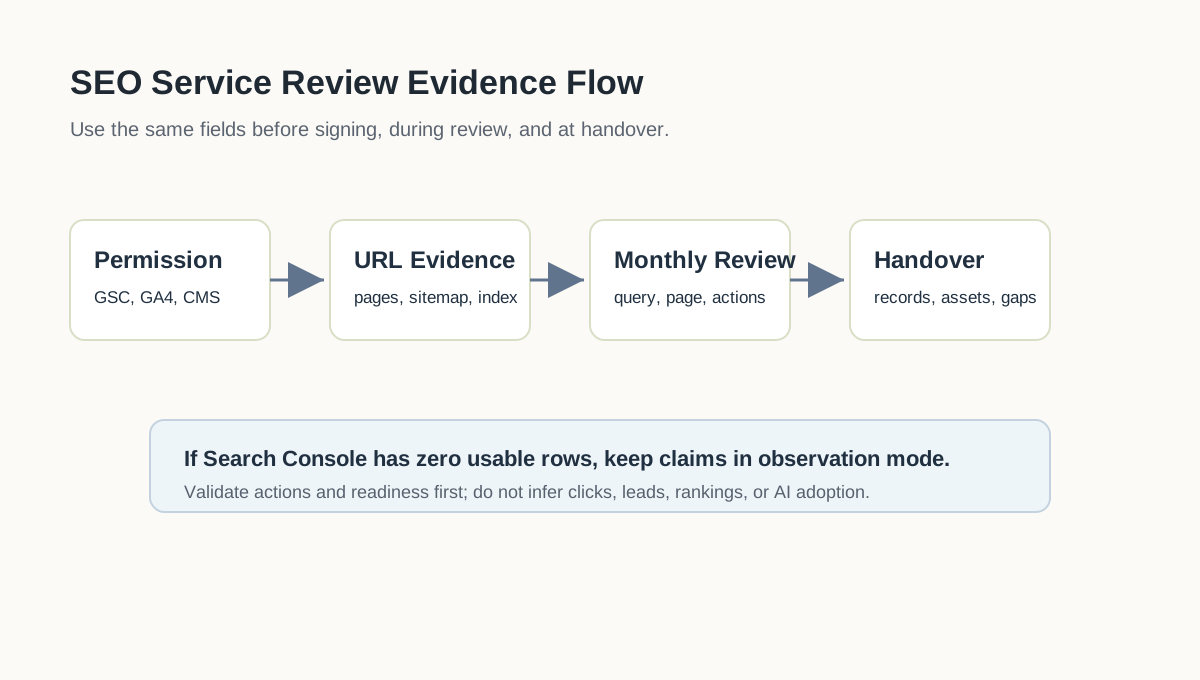
A review is not about using a different story every month. The fields written before the contract should continue to be used with the same metrics in the monthly review and the service-end handover. Otherwise, looking at pages in month one, terms in month two, and screenshots in month three makes it hard to judge whether the work is continuous.
| Review stage | Fields to recheck | Output format | Judgment principle |
|---|---|---|---|
| Week 1 | Access, URL checklist, sitemap, indexing status, event configuration | Kickoff checklist | First confirm whether data can be viewed and pages can be changed |
| Month 1 | Changed URLs, page fields, technical fixes, material gaps | Action records and page evidence | Prioritize proving that the work actually happened |
| Month 2 | GSC queries, pages, clicks, impressions, CTR, average position | Search Console review table | Explain changes once there is data; keep observing without data |
| Month 3 | Page conversion, events, inquiry path, sales feedback | Organic traffic path table | Distinguish traffic actions from sales results |
| Service end | Accounts, pages, data, issue checklist, next-step priorities | Handover checklist | The company can keep maintaining and rechecking |
24. Which risk boundaries should be written into the contract in advance
SEO service is not a unilaterally controllable action. The earlier the contract states the boundaries, the fewer disputes later. The point of boundaries is not to do less, but to separate controllable work from uncontrollable results.
| Risk boundary | Why specify it | Healthy wording | Unhealthy wording |
|---|---|---|---|
| Search result fluctuations | Rankings are jointly affected by algorithms, competition, intent, and page quality | Track changes in target queries and record actions and data | Writing a specified ranking or a definite completion time |
| Inquiry results | Inquiries are affected by the product, price, sales follow-up, and market demand | Optimize the inquiry path and event records | Writing a specified number of inquiry results |
| AI search visibility | AI answers are affected by the platform, context, time, and source selection | Monitor the query set, brand descriptions, and cited URLs | Writing that an AI system will definitely cite the official website |
| Product facts | The service provider cannot confirm technical materials on behalf of the company | The company confirms specifications, certifications, and image authorization | Adding nonexistent qualifications just to make the content complete |
| Development scope | SEO recommendations may involve templates, speed, structured data, and forms | Routine page adjustments are included; complex development is confirmed separately | All technical changes included in a low-priced SEO package |
25. The two weeks before contract kickoff can be arranged like this
If the contract is ready to be signed, do not rush to promise results in the first two weeks. A better rhythm is to first get access, pages, materials, and events in order. That way, every later review has evidence.
| Time | Priority action | Acceptance item | Why first |
|---|---|---|---|
| Days 1-2 | Confirm GSC, GA4, CMS, sitemap, and key URLs | Access table, URL table, sitemap status | Without basic access, later reviews are impossible |
| Days 3-5 | Spot-check the homepage, category pages, product pages, article pages, and contact page | Issue checklist, screenshots, source-code evidence | Find blocking issues first |
| Days 6-8 | Sort out product material gaps and page overhaul priorities | Material checklist, page priority table | Avoid writing vague content |
| Days 9-11 | Configure or check form, email, WhatsApp, and material download events | Event test records | Only then can the inquiry path be reviewed later |
| Days 12-14 | Confirm the deliverable URLs and review fields for the first month | Monthly task table | Turn the contract from a slogan into an execution checklist |
26. When the contract scope should be adjusted
A contract does not need to stay completely unchanged from signing to the end. As long as the basis for adjustment is clear, a scope change can actually make the project more stable. The key is: adjustments must be based on evidence, not on subjective anxiety.
| Trigger signal | What it may indicate | Adjustment direction | What still must not be written |
|---|---|---|---|
| Many non-target queries appear in GSC | Page intent is unclear or content coverage has drifted | Rewrite the page structure and adjust internal links and titles | You cannot write that target-term performance has been achieved |
| Key pages have long failed to enter the sitemap or index | Technical configuration, page quality, or the submission path has a problem | Check technology and page quality first | You cannot just keep adding more articles |
| GA4 has traffic but no events | The conversion path or event configuration has a problem | Check forms, buttons, contact entries, and events | You cannot infer inquiry quality |
| Pages remain thin after product materials are completed | Page structure and procurement question coverage are insufficient | Add comparison tables, FAQ, applications, downloads, and internal links | You cannot fabricate business results |
| AI samples contain factual errors | Brand entities, page facts, or citable content are insufficient | Supplement brand consistency, official-site fact pages, and citation-friendly paragraphs | You cannot promise that the platform will definitely correct it next time |
Finally, the contract appendix should keep a line for “reason why judgment is impossible.” When data, access, materials, or events are incomplete, first record the reason and the next action, then move on to later observation.
FAQ
Can you include ranking targets in an SEO contract?
You can write “track changes in target queries” and “optimize pages around target queries,” but a guaranteed specified ranking is not recommended. Search results are affected by competition, algorithms, page quality, historical data, and search intent, and the service provider cannot control them directly.
Why must GSC access be confirmed?
GSC is an important source for judging Google search performance and indexing issues. Without GSC, you can only rely on external tools and guesswork, and it is hard to confirm whether many pages are discovered, crawled, and displayed.
Does the contract need to mention AI search?
If the cooperation includes GEO or AI search visibility, the monitoring scope, query set, platforms, and recording method should be clearly stated. Do not write AI platform answers as results that can be directly guaranteed.
Should a foreign-trade company hand product materials to the SEO team?
Yes, but they should be provided in layers. Public specifications, applications, and FAQs can be used for page optimization; sensitive information such as quotes, customer lists, and internal costs should be controlled by the company itself, with only the necessary scope provided.
Related reading and official resources
- What to review before getting a quote from a Google SEO partner team: don’t rush to ask about price
- Why Google SEO partner team quotes vary so much: how to look at workload, page count, and review frequency
- What to review before getting a quote from a GEO partner team: the AI visibility baseline matters more than the package
- SEO diagnosis and optimization: a troubleshooting guide to indexing, rankings, technical issues, and inquiry paths for foreign-trade websites
- Google Search Central: SEO Starter Guide
- Google Search Central: Crawling and indexing
- Google Search Central: Sitemaps overview
- Google Search Central: AI features and your website
Continue reading this SEO resource set
If you are systematically working through foreign-trade website SEO, it is worth continuing with the following pieces. First clarify the relationships among crawling, indexing, content, links, and review, then decide which page to change next.
- Why Google SEO partner team quotes vary so much: how to look at workload, page count, and review frequency
- How to use Google SEO analysis tools: how GSC, GA4, and page diagnosis work together to read foreign-trade inquiries
- How to judge the most reliable foreign-trade website building and promotion service team in China: don’t look at promises, look at diagnosis and evidence
- What Google foreign-trade lead generation optimization includes: technology, content, GSC review, and a delivery checklist
- How to choose a Google SEO outsourcing team: access, division of labor, review, and risk boundaries
- What is the difference between a Google foreign-trade website optimization consultant and a foreign-trade website building and promotion service team: how to choose what fits better
{
“@context”: “https://schema.org”,
“@type”: “FAQPage”,
“mainEntity”: [
{
“@type”: “Question”,
“name”: “Contract Appendix 4: Service-end handover checklistnnHandover item What must be handed over How the company verifies Must not be omittednnAccount access The read-only access status of GSC, GA4, CMS, servers, form tools, download tools, and ad/CRM-related tools. The company administrator confirms item by item, not relying on the service provider’s personal account. Handing over only screenshots, not the access status.nPage assets Changed URLs, titles, body content, FAQ, tables, images, internal links, resource pages, and launch dates. Check before-and-after records and the final pages by URL. Handing over only an article list, not the reasons for page changes.nData materials GSC/GA4 exports, filter conditions, date ranges, event definitions, and monthly review tables. The company can independently reproduce the review metrics. Handing over only a zip file without explaining what the fields mean.nIssue checklist Unfinished issues, reasons for pausing judgment, next-round priorities, and suggested owners. It can be turned into the next stage’s task table. Writing unfinished items as vague notes.nAI and GEO samples Query sets, platforms, dates, answer summaries, cited URLs, factual errors, and page actions. The company can continue retesting with the same question set. Handing over only a one-time screenshot.nnnn20. Contract acceptance must separate actions, evidence, and observed metricsnA Google SEO service contract is not better the longer it is; its fields must be recheckable. For foreign-trade companies, the contract should contain three types of content at the same time: actions already completed, evidence that can be opened, and data still to be observed. The three must not be mixed together.nnnContract object Acceptable actions Evidence What it must not becomennTechnical diagnosis Check robots, sitemap, canonical, noindex, 404s, redirects, and mobile access Problem URLs, screenshots, source code, before-and-after fix records It must not become “technical issues will definitely change rankings”nPage optimization Change titles, H1s, body structure, FAQ, tables, internal links, and inquiry entries URLs, version records, launch dates, page screenshots It must not become “changing pages will produce a specified inquiry result”nContent materials Add product parameters, applications, certifications, MOQ, lead time, downloadable materials, and procurement questions Company-confirmed material tables, page fields, image alt text Do not fabricate certifications, capacity, customer endorsements, or export casesnGSC review View query, page, clicks, impressions, CTR, average position by date range Search Console exports, filter conditions, and review tables When there is no row data, do not write about search performance improvementnGA4 events Confirm whether forms, email, WhatsApp, material downloads, and RFQ buttons are recorded Event names, trigger pages, test records, and source dimensions When events are not configured, do not infer organic search inquiry changesnnnn21. Under a zero-row GSC baseline, the contract should first write “to be observed”nIf the company’s current Google Search Console has no usable query, page, or page-query row data, the contract cannot write follow-up work as search results that have already happened. A more reliable approach is to first write “establish a baseline” and “fields to be observed.”nThis does not mean SEO service cannot start. Technical checks, page checklists, content overhauls, sitemap submission, index/follow checks, internal links, and inquiry path checks can all be done first. It is just that the monthly report must separate these actions from search performance.nnZero-row baseline scenario What the contract can state How to write the review BoundarynnGSC has no query rows Establish the target query set, page mapping, and review fields Record “no usable query rows yet; continue observing” Do not write that keywords have improvednGSC has no page rows Confirm key URLs, sitemap, index/follow, and canonical Record whether pages are accessible and whether they enter the sitemap Do not write that pages have gained search performancenGA4 has no key events Plan form, email, WhatsApp, download, and RFQ events Record the event configuration status and test results Do not write about organic search inquiry growthnProduct materials are incomplete List the parameters, certifications, images, FAQ, and downloadable materials to be added Record whether the company confirms the materials Do not fabricate product factsnAI samples are not established Establish fields for the query set, platforms, dates, brand descriptions, and cited URLs Record samples; do not write definite conclusions Do not guarantee how an AI system will displaynnnn22. Foreign-trade product page overhauls need URL-level acceptance standardsnMany SEO contracts only say “optimize product pages” without saying to what degree the product pages will be changed. For B2B foreign-trade websites, a product page should at least answer procurement questions: what the product is, who it suits, what specifications it has, how quality is confirmed, and how to ask for a quote.nnProduct page field Acceptance question Evidence Common gapnnProduct definition Can buyers quickly understand the product category, use, and differences? Above-the-fold explanation, H1, product images, category links Only piling up keywords without explaining the applicationnSpecifications Are there checkable fields such as dimensions, materials, power, interfaces, capacity, and certifications? Parameter tables, images, datasheets, or company-confirmed materials Missing parameters; the page cannot support a procurement decisionnApplication scenarios Does it explain the applicable industries, equipment, environments, and limits? Application paragraphs, case-style scenarios, internal links to industry pages Vaguely writing “widely used”nProcurement questions Does it answer MOQ, lead time, packaging, customization, quality inspection, and after-sales? FAQ, inquiry form fields, downloadable materials Buyers must ask the basic questions all over againnTechnical accessibility Can Google crawl the body text, links, images, and structured data? Source code, sitemap, index/follow, internal links Content blocked by scripts, pop-ups, or a faulty templatennnn23. Monthly reviews should recheck the same evidence flownA review is not about using a different story every month. The fields written before the contract should continue to be used with the same metrics in the monthly review and the service-end handover. Otherwise, looking at pages in month one, terms in month two, and screenshots in month three makes it hard to judge whether the work is continuous.nnnReview stage Fields to recheck Output format Judgment principlennWeek 1 Access, URL checklist, sitemap, indexing status, event configuration Kickoff checklist First confirm whether data can be viewed and pages can be changednMonth 1 Changed URLs, page fields, technical fixes, material gaps Action records and page evidence Prioritize proving that the work actually happenednMonth 2 GSC queries, pages, clicks, impressions, CTR, average position Search Console review table Explain changes once there is data; keep observing without datanMonth 3 Page conversion, events, inquiry path, sales feedback Organic traffic path table Distinguish traffic actions from sales resultsnService end Accounts, pages, data, issue checklist, next-step priorities Handover checklist The company can keep maintaining and recheckingnnnn24. Which risk boundaries should be written into the contract in advancenSEO service is not a unilaterally controllable action. The earlier the contract states the boundaries, the fewer disputes later. The point of boundaries is not to do less, but to separate controllable work from uncontrollable results.nnRisk boundary Why specify it Healthy wording Unhealthy wordingnnSearch result fluctuations Rankings are jointly affected by algorithms, competition, intent, and page quality Track changes in target queries and record actions and data Writing a specified ranking or a definite completion timenInquiry results Inquiries are affected by the product, price, sales follow-up, and market demand Optimize the inquiry path and event records Writing a specified number of inquiry resultsnAI search visibility AI answers are affected by the platform, context, time, and source selection Monitor the query set, brand descriptions, and cited URLs Writing that an AI system will definitely cite the official websitenProduct facts The service provider cannot confirm technical materials on behalf of the company The company confirms specifications, certifications, and image authorization Adding nonexistent qualifications just to make the content completenDevelopment scope SEO recommendations may involve templates, speed, structured data, and forms Routine page adjustments are included; complex development is confirmed separately All technical changes included in a low-priced SEO packagennnn25. The two weeks before contract kickoff can be arranged like thisnIf the contract is ready to be signed, do not rush to promise results in the first two weeks. A better rhythm is to first get access, pages, materials, and events in order. That way, every later review has evidence.nnTime Priority action Acceptance item Why firstnnDays 1-2 Confirm GSC, GA4, CMS, sitemap, and key URLs Access table, URL table, sitemap status Without basic access, later reviews are impossiblenDays 3-5 Spot-check the homepage, category pages, product pages, article pages, and contact page Issue checklist, screenshots, source-code evidence Find blocking issues firstnDays 6-8 Sort out product material gaps and page overhaul priorities Material checklist, page priority table Avoid writing vague contentnDays 9-11 Configure or check form, email, WhatsApp, and material download events Event test records Only then can the inquiry path be reviewed laternDays 12-14 Confirm the deliverable URLs and review fields for the first month Monthly task table Turn the contract from a slogan into an execution checklistnnnn26. When the contract scope should be adjustednA contract does not need to stay completely unchanged from signing to the end. As long as the basis for adjustment is clear, a scope change can actually make the project more stable. The key is: adjustments must be based on evidence, not on subjective anxiety.nnTrigger signal What it may indicate Adjustment direction What still must not be writtennnMany non-target queries appear in GSC Page intent is unclear or content coverage has drifted Rewrite the page structure and adjust internal links and titles You cannot write that target-term performance has been achievednKey pages have long failed to enter the sitemap or index Technical configuration, page quality, or the submission path has a problem Check technology and page quality first You cannot just keep adding more articlesnGA4 has traffic but no events The conversion path or event configuration has a problem Check forms, buttons, contact entries, and events You cannot infer inquiry qualitynPages remain thin after product materials are completed Page structure and procurement question coverage are insufficient Add comparison tables, FAQ, applications, downloads, and internal links You cannot fabricate business resultsnAI samples contain factual errors Brand entities, page facts, or citable content are insufficient Supplement brand consistency, official-site fact pages, and citation-friendly paragraphs You cannot promise that the platform will definitely correct it next timennnFinally, the contract appendix should keep a line for “reason why judgment is impossible.” When data, access, materials, or events are incomplete, first record the reason and the next action, then move on to later observation.nFAQnCan you include ranking targets in an SEO contract?”,
“acceptedAnswer”: {
“@type”: “Answer”,
“text”: “You can write “track changes in target queries” and “optimize pages around target queries,” but a guaranteed specified ranking is not recommended. Search results are affected by competition, algorithms, page quality, historical data, and search intent, and the service provider cannot control them directly.”
}
},
{
“@type”: “Question”,
“name”: “Why must GSC access be confirmed?”,
“acceptedAnswer”: {
“@type”: “Answer”,
“text”: “GSC is an important source for judging Google search performance and indexing issues. Without GSC, you can only rely on external tools and guesswork, and it is hard to confirm whether many pages are discovered, crawled, and displayed.”
}
},
{
“@type”: “Question”,
“name”: “Does the contract need to mention AI search?”,
“acceptedAnswer”: {
“@type”: “Answer”,
“text”: “If the cooperation includes GEO or AI search visibility, the monitoring scope, query set, platforms, and recording method should be clearly stated. Do not write AI platform answers as results that can be directly guaranteed.”
}
},
{
“@type”: “Question”,
“name”: “Should a foreign-trade company hand product materials to the SEO team?”,
“acceptedAnswer”: {
“@type”: “Answer”,
“text”: “Yes, but they should be provided in layers. Public specifications, applications, and FAQs can be used for page optimization; sensitive information such as quotes, customer lists, and internal costs should be controlled by the company itself, with only the necessary scope provided.”
}
}
]
}
This page is machine-translated from the Simplified Chinese version and awaiting human review. It has not yet been proofread.