When a foreign-trade company chooses an outsourced Google SEO team, the least useful first question is “how soon can we rank?” The better first questions are: does the team understand your English product terms and your buyers’ purchasing path; can it tie its diagnosis to specific URLs; can it explain which permissions it needs, who confirms which changes, which data it reviews each month, and which outcomes it cannot promise? If you sell custom metal parts, LED flood lights, packaging machines, medical probes, cnc machining parts, ceramic dinnerware or waterproof connectors, or you are an industrial valve supplier or a private label activewear manufacturer, a good external team must base its judgement on product pages, category pages, application pages, downloadable resource pages and the inquiry path — not just on traffic, rankings and article counts.
This guide is written for Chinese export manufacturers, factories and trading companies. You can use it as a pre-engagement evaluation checklist, a 30-day trial acceptance form and a monthly review framework: first judge whether the team understands foreign-trade purchasing scenarios, then check whether permission and role boundaries are clear, then check whether deliverables can be verified, and only then decide whether to work together long term.
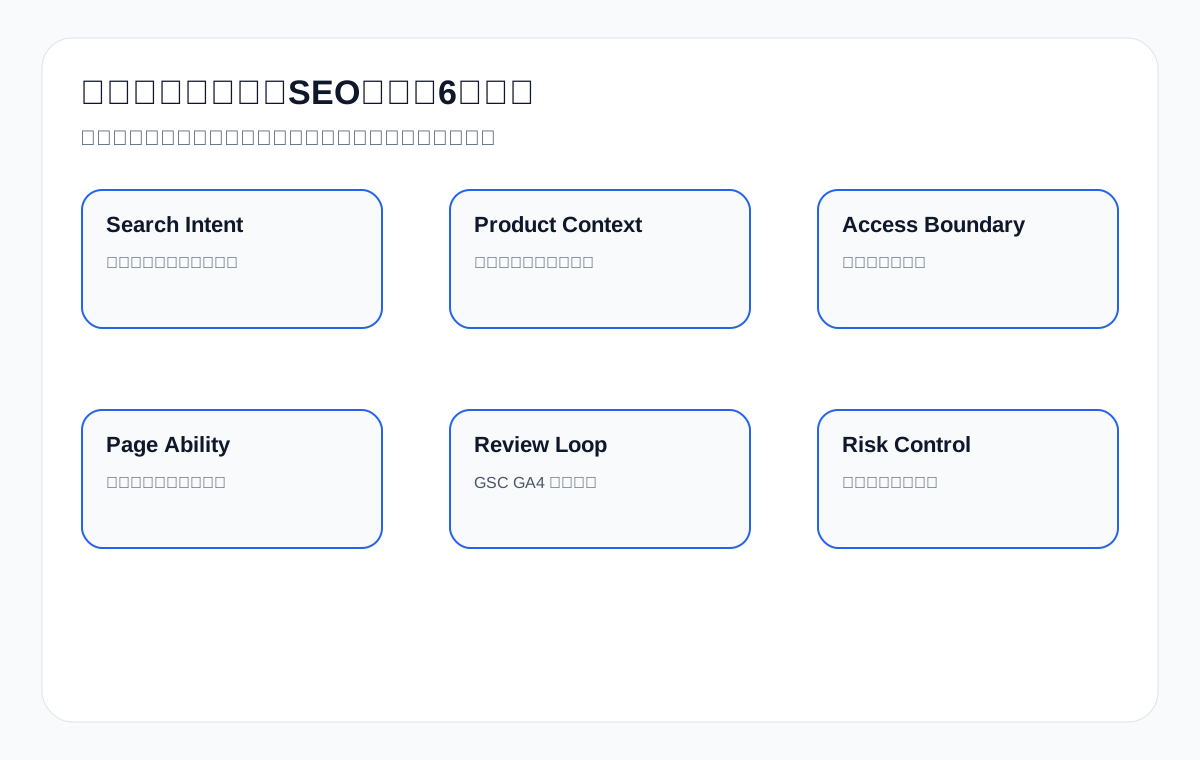
Official evidence boundary: an outsourced team delivers reviewable actions, not external platform results
Choosing an outsourced Google SEO team cannot rest on case studies, quotes and slogans alone. What matters more for a foreign-trade company is whether the team can explain permissions, pages, data, technical actions and review boundaries clearly. Search Console verifies search performance and index status, GA4 verifies on-site events, server logs verify crawl access, and AI/GEO samples verify answer facts and citation records. Each layer must be recorded separately.
If the site currently has no usable GSC query, page or page-query row data, you cannot fill in rankings, impressions, clicks, CTR, AI adoption or inquiry changes. An outsourced team can still deliver diagnostics, fix recommendations, page rewrites, data definitions and a review template, but the report must state clearly which items are completed work, which are metrics awaiting observation, and which are outcomes outside the platform’s control.
Mapping table: official documentation vs. outsourced team acceptance fields
| Official documentation entry point | What it helps you judge | Acceptance fields for the outsourced team | What it cannot prove |
|---|---|---|---|
| Google Search Central: Do you need an SEO? | Before hiring an SEO, you should understand basic search knowledge, require recommendations to be explained by credible sources, and watch out for improper practices. | Whether recommendations have an official basis, whether risks are explained, and whether the company retains the right of confirmation. | You cannot judge a team’s reliability from promises or case studies alone. |
| Google Search Central: SEO Starter Guide | Basic practices for titles, page organization, links, images and understandable content. | Whether content, internal links, page structure, images and readability are tied to specific URLs. | It cannot replace an on-site audit and data review. |
| Google Search Central: Search Essentials | For a page to appear in Google Search, it must meet basic technical, policy and content requirements. | Crawlable, indexable, core content accessible, and no obvious violations. | Meeting the basics does not mean the site already has search performance. |
| Google Search Central: Search Console start guide | Search Console can be used to monitor, debug and improve Google Search performance. | Whether GSC access, properties, sitemaps, indexing and performance reports can be reviewed. | Third-party screenshots cannot replace official account data. |
| Search Console Help: Performance report | query, page, country, device, clicks, impressions, CTR, average position. | Whether the monthly report is broken down by page, query, country and device. | Without row data, you cannot claim improvements in ranking, impressions, clicks or CTR. |
| Search Console Help: URL Inspection tool | The index status, crawl status, canonical and the page version Google sees for a single URL. | Whether key product pages, category pages, resource pages and articles are spot-checked. | A single indexable URL does not mean the whole site is performing. |
| Search Console Help: Page indexing report | Page index status and reasons pages are not indexed. | Whether indexed, excluded, duplicate, noindex, redirect and 404/410 pages are handled in groups. | An indexing report is not an inquiry report. |
| Google Search Central: Sitemaps overview | A sitemap helps Google discover important URLs. | Whether core product pages, category pages, resource pages and articles are in the sitemap. | Being present in a sitemap does not mean a URL has been crawled, indexed or shown. |
| Google Search Central: robots.txt introduction | robots.txt controls crawl access. | Whether it mistakenly blocks product catalogs, resource pages, images, CSS, JS or AI-related access paths. | robots cannot fix content quality problems. |
| Google Search Central: Canonical URL guidelines | Duplicate URLs require canonical tags, redirects, internal links and sitemaps to work together. | Whether parameter pages, old URLs, multilingual pages and duplicate articles have handling actions. | A canonical tag is not a ranking promise. |
| Google Search Central: Structured data general guidelines | Structured data must match the visible page content and comply with policy. | Whether Product, FAQ, Breadcrumb and Article markup matches the body content. | Schema cannot replace page facts. |
| Google Analytics Help: About events | GA4 events let you observe what users do next on the site. | Form, email, WhatsApp, RFQ, download and contact-page events. | On-site events cannot replace GSC search performance. |
| Google Search Central: AI features and your website | AI search still depends on accessible, indexable pages with clear content. | Whether AI/GEO recommendations come back to page facts, indexing eligibility and content clarity first. | You cannot promise that AI answers will use your website. |
| OpenAI Platform: Bots | Distinguish the access purposes of OAI-SearchBot, GPTBot and ChatGPT-User. | Whether robots rules, logs and public pages unintentionally block the relevant access paths. | It does not mean ChatGPT will display things in a specified way. |
| Bing Webmaster Blog: AI Performance | Where visible in the account, you can observe AI citations, cited pages and grounding query phrases. | Record Bing AI samples, GSC, GA4, logs and sales feedback separately. | It does not represent all AI platforms. |
| IndexNow: Documentation | After a URL is added, updated or deleted, you can notify participating search engines. | Whether important page updates trigger a notification. | It cannot replace content quality, crawl eligibility or index eligibility. |
Outsourced team acceptance criteria: keep permissions, actions, data and boundaries separate
| Acceptance layer | Required evidence | How the foreign-trade company judges it | Unacceptable wording |
|---|---|---|---|
| Permission boundaries | A permission list for GSC, GA4, CMS, server, DNS, plugins and code repository. | Read-only, edit, publish, delete and payment permissions are kept separate. | Demanding full top-level access from the start. |
| Diagnostic evidence | URLs, screenshots, source code, GSC, GA4, logs or official documentation. | Every recommendation can be traced back to a specific page and piece of evidence. | Writing only “needs optimization” without evidence. |
| Page actions | Titles, body content, internal links, structured data, canonical, sitemap, robots and speed issues. | Actions must be executable separately by the development, content and sales teams. | Abstract recommendations that cannot be implemented. |
| Data review | Query, page, country, device, GA4 events and inquiry quality feedback. | The monthly report must separate search performance, on-site behavior and sales feedback. | Blending rankings, traffic and inquiries into a single score. |
| AI/GEO samples | Platform, question, date, answer summary, cited URL and incorrect facts. | Treat samples as observation records, not long-term results. | Treating one answer screenshot as a stable conclusion about a platform. |
| Delivery boundaries | Completed actions, metrics under observation, external uncontrollable factors and the next round’s plan. | It can promise work quality, not external platform results. | Presenting algorithms, competitors and buyer choices as controllable outcomes. |
How an outsourced team’s report should be downgraded when there is no GSC data
If the site currently has no usable GSC query, page or page-query row data, the outsourced report cannot be written as a search performance report. It can first be written as a diagnostic, fix, page asset and data definition report.
| Missing evidence | What can be written | What cannot be written | Next review step |
|---|---|---|---|
| No GSC Performance rows | Whether pages are crawlable, indexable, in the sitemap and whether specific fixes were completed. | Ranking, impressions, clicks, CTR or trend improvements. | Keep 28-day and 90-day date ranges and wait for the first rows of data. |
| No URL Inspection sampling | List the home page, category pages, product pages, resource pages, articles and contact pages that need spot checks. | Asserting that core pages already appear in search. | Record index status, canonical, crawl time and page version. |
| No GA4 events | Explain that form, email, WhatsApp, download, RFQ and contact-page events need to be configured. | That organic search inquiries have improved. | First make on-site actions observable. |
| No log samples | Explain that origin, CDN or WAF logs are not yet available, and do not treat tool screenshots as crawl evidence. | That Googlebot or a related crawler has crawled the site. | Obtain logs with clear time coverage, sources and fields. |
| No AI samples | Build a table of platform, question, date, answer summary, cited URL and incorrect facts. | That an AI platform has adopted your website. | Retest with a fixed question set across platforms and record it separately from page actions. |
2. Benchmarking against the Top 1 and authoritative references: where ordinary guides fall short
Among today’s authoritative references, Google Search Central’s “Do you need an SEO?” stresses that before hiring an SEO you should understand basic search knowledge, require recommendations to be explained by credible sources, and be alert to improper practices. Semrush’s “How to Choose an SEO Company in 8 Steps” focuses on goals, budget, scope of services, team background, communication style and evaluating price. Ahrefs’ “What Do SEO Agencies Do?” explains the keyword research, technical audits, content and link work that external teams typically perform, and reminds readers to check data sources and tools.
These resources are strong because they are general, clear and suitable for any business making a basic judgement; their shortcoming is that they do not go deep into how Chinese foreign-trade companies actually operate: how to break down English product terms, who edits product pages versus category pages, who supplies factory certificates and specifications, how GSC queries map to inquiry quality, whether AI answers cite your website’s materials, how sales feeds back on low-quality inquiries, and how development permissions and content permissions are separated. This article fills in those foreign-trade B2B scenarios.
Top 1 / authoritative benchmark gap card
| Benchmark content | What it does well | What foreign-trade companies still lack | How this article goes further |
|---|---|---|---|
| Google Search Central: Do you need an SEO? | Emphasizes credible sources, basic knowledge and the risk of improper practices | No detail on foreign-trade product pages, inquiries, permissions or cross-team division of labor | Adds permission, page, product material and review matrices for foreign-trade websites |
| Semrush: How to Choose an SEO Company | Complete selection steps, suitable for an initial shortlist | Leans toward general marketing and is not enough to judge B2B English product scenarios | Adds English product terms, category pages, application pages, resource pages and sales feedback |
| Ahrefs: What SEO Agencies Do | Explains the work and tools common among external teams | No detail on how Chinese manufacturers should accept deliverables | Adds a 30-day trial, URL-level diagnostics and monthly review metrics |
3. First judge whether the team understands the foreign-trade purchasing path
Many foreign-trade websites fail at SEO not because nobody knows the technical points, but because the external team never really understood how buyers look for suppliers. An overseas buyer searching for custom metal parts does not necessarily ask for a quote right away; they may first search for custom metal parts manufacturer, cnc machining parts tolerance, stainless steel valve supplier, LED flood light IP66 spec, packaging machine for powder, or private label activewear manufacturer MOQ. Behind each query is a different page role.
If the external team treats these terms only as a “keyword list” without distinguishing purchasing stage, page type and inquiry intent, later content easily turns into generic introductions. A reliable team should be able to explain which terms suit category pages, which suit product pages, which suit application pages, which suit technical articles, and which suit only FAQs or resource pages.
Foreign-trade purchasing path and page roles
| Buyer search term | Purchasing stage | More suitable page | The judgement the team should provide |
|---|---|---|---|
| custom metal parts manufacturer | Supplier screening | Category page or industry capability page | Explain materials, processes, size ranges, certificates and delivery capability |
| LED flood light IP66 200W | Specification confirmation | Product page or specification comparison page | Highlight specifications, testing, application environment and downloadable materials |
| packaging machine for powder | Application scenario confirmation | Application page or solution page | Explain material properties, capacity, filling accuracy and target industries |
| medical probe supplier ISO 13485 | Qualification screening | Product line page and qualification page | Place certificates, materials and compliance information where they can be cited |
| private label activewear manufacturer MOQ | Confirming cooperation terms | Service process page or FAQ | Answer MOQ, sampling, fabric, packaging and lead time |
4. Do not just look at case studies — look at whether the diagnosis lands on specific URLs
Case studies shown before cooperation can be a reference, but you should not judge by attractive screenshots alone. A foreign-trade company should ask the team to run a lightweight diagnosis on your own site: list which URLs already have potential, which URLs have titles that do not match search intent, which category pages lack product scope, which product pages lack specifications and FAQs, and which articles do not point to the inquiry path. The diagnosis must land on specific URLs, or it will be very hard to accept later.
For example, if your site has a waterproof connector page, the external team cannot just say “the content needs strengthening.” A better answer is: this page should add modules such as IP rating, pin number, wire gauge, application, certification, datasheet download, MOQ, lead time and comparison with standard connector, and should explain which modules affect search understanding and which affect a buyer’s decision to inquire.
What a URL-level diagnosis should include
| Diagnostic dimension | Weak wording | Acceptable wording |
|---|---|---|
| Title and intent | The title needs optimization | The target for this URL is waterproof connector supplier; the title should reflect supply capability, specifications and applications |
| Body evidence | There is too little content | Missing IP rating, number of pins, materials, application environment, testing and certificate explanations |
| Inquiry path | Conversion can be strengthened | Add an inquiry prompt, resource downloads, links to similar products and application cases after the specification table |
| Internal links | Internal links are needed | Link from waterproof connector to cable assembly, industrial connector and related application pages |
| Review metrics | Observe data later | Track the URL’s GSC queries, GA4 form events, inquiry product match and sales feedback |
5. Permission boundaries: what is read-only, and what must be confirmed before changes
One of the most common problems in outsourcing is unclear permissions. A foreign-trade company needs the external team to see the necessary data while avoiding large-scale changes made without confirmation. It is best to divide permissions into four categories: read-only data, recommendable changes, executable changes, and changes that require company confirmation. GSC, GA4, rank tracking and inquiry source data can start as read-only; changes to website pages, titles, forms, product materials, downloadable files and navigation structure should have a clear approval process.
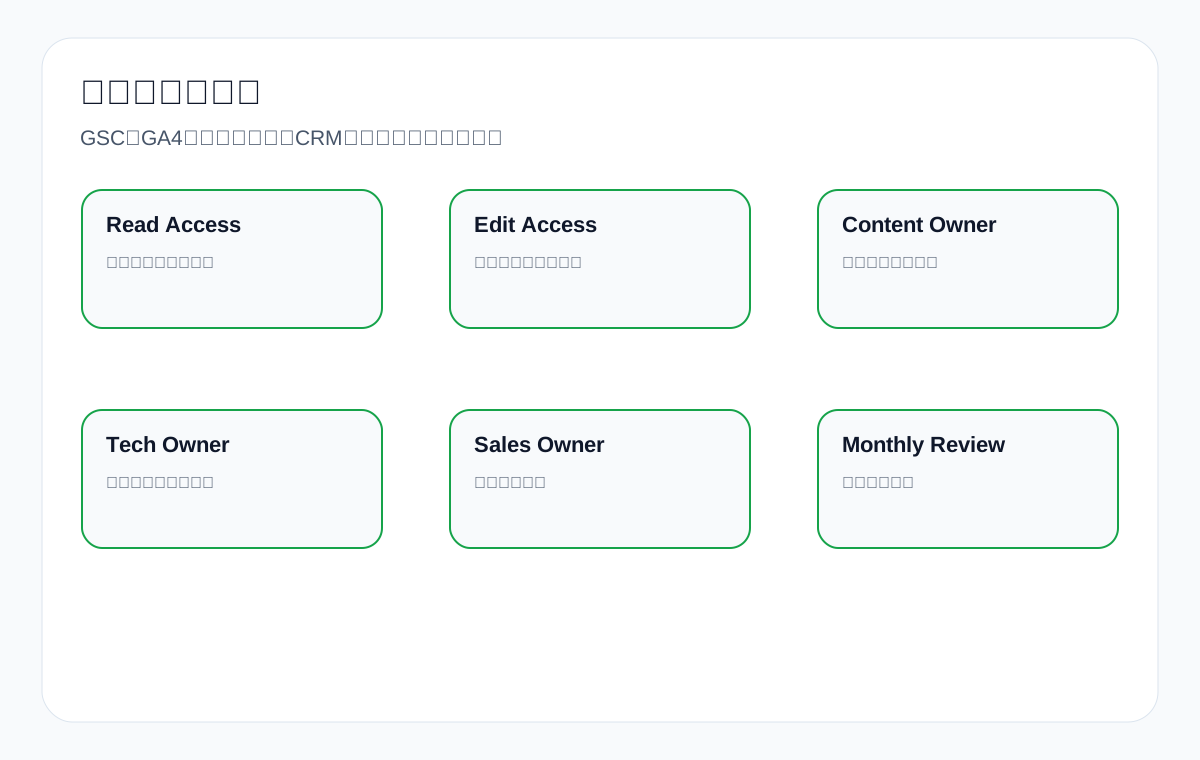
Recommended permission tiers
| System or material | Recommended permission | Why it is needed | Risk control |
|---|---|---|---|
| Google Search Console | Start with read-only | View queries, page impressions, indexing and country/device data | Do not submit deletion or index-affecting actions casually |
| GA4 or analytics tools | Start with read-only | View landing pages, time on site, conversion events and the inquiry path | Confirm that events are accurate before drawing conclusions |
| WordPress posts and pages | Recommend review first | Needs to edit titles, body content, FAQs, internal links and images | Back up and log changes before editing important pages |
| Product materials and certificates | The company provides originals or confirmed versions | Determines content credibility and AI citation potential | Avoid wrong specifications, expired certificates and exaggerated claims |
| Server and performance configuration | Executed by development or operations | Involves speed, caching, redirects, logs and security | The external team advises; technical staff confirm and execute |
| Forms and CRM | Read-only or export statistics | Judge inquiry source and quality | Customer and business data must be anonymized |
6. Division-of-labor matrix: what the company, external team, development and sales each own
Google SEO is not a task one person completes alone. The external team can handle diagnostics, strategy, content structure, page recommendations and data review, but the foreign-trade company must provide product facts, sales feedback, certificate materials and business priorities; development or operations handles technical implementation; sales judges inquiry quality. When roles are unclear, the usual result is: the external team writes a pile of content but nobody confirms the product specifications; page recommendations are sent but no developer acts on them; the data report looks good, but sales says the inquiries are wrong.
Foreign-trade SEO outsourcing division-of-labor matrix
| Task | Company owner | External team | Development/operations | Sales team |
|---|---|---|---|---|
| Organizing product and industry terms | Provide product lines, models and application industries | Break down English keywords and search intent | None | Add frequently asked buyer questions |
| Page diagnosis | Confirm business priorities | Deliver URL-level issues and improvement recommendations | Assess technical feasibility | Point out inquiry quality issues |
| Content expansion | Confirm specifications, certificates, lead time and MOQ | Write structure, FAQs, tables and internal link recommendations | Handle page layout or speed issues | Provide real questions and objections |
| Technical optimization | Approve important changes | Identify crawling, indexing and structure issues | Implement redirects, performance, structured data and other technical items | Watch whether inquiries are affected |
| Monthly review | Decide next month’s priority product lines | Summarize GSC, GA4, inquiries and page actions | Report technical item completion | Feed back inquiry country, product and quality |
7. Page capability: can the team handle the five key page types?
Foreign-trade websites do not rely on article pages alone for traffic. The pages that actually bring inquiries are often product category pages, product detail pages, application scenario pages, resource pages and trust pages. When choosing an external team, check whether it can separately explain the goal, structure, content evidence and review metrics for these five page types.
Product category pages
These target supplier-screening terms such as custom metal parts, industrial valve supplier and ceramic dinnerware manufacturer. The focus is product scope, process capability, material range, application industries, certificates, production capacity and the inquiry entry point.
Product detail pages
These target queries about models, parameters, specifications, materials, application scenarios and downloadable materials. The focus is specification tables, illustrated explanations, FAQs, similar products, certificates and resource downloads.
Application scenario pages
These target scenario terms such as packaging machine for powder, LED flood light for warehouse and waterproof connector for marine. The focus is the problem, environment, solution, suitable products and selection advice.
Resource and certificate pages
These target trust evidence needs such as datasheet, catalog, ISO, RoHS, CE and FDA. The focus is downloadable, citable, clearly versioned and accessible pages.
Inquiry and conversion pages
These target final contact intent. The focus is form fields, inquiry prompts, drawing upload, WhatsApp or email entry points, response time and privacy statements.
Acceptance criteria for the five page types
| Page type | Minimum acceptable | Stronger approach |
|---|---|---|
| Product category pages | Explain product scope and supply capability | Add materials/processes/applications/certificates/FAQ/internal links/inquiry entry |
| Product detail pages | Have basic specifications and images | Add specification tables, application advice, downloadable materials, similar products and purchasing FAQs |
| Application scenario pages | Describe the application industry | Break down purchasing questions, selection criteria, suitable products and common misconceptions |
| Resource pages | Files can be downloaded | Clear version, applicable products, certificate validity and citation path |
| Inquiry pages | A form can be submitted | Reasonable fields, material upload, response expectations and complete source tracking |
8. 30-day trial: use a short cycle to judge real capability
If you are not sure about a long-term engagement, start with a 30-day trial. The goal is not to see ranking changes immediately, but to see whether the team can establish a baseline, understand the products, find key URL problems, give an executable priority list, complete a small batch of page improvements and explain the data review clearly. Thirty days is enough to see whether the way of working is reliable, but not enough to judge final SEO results.
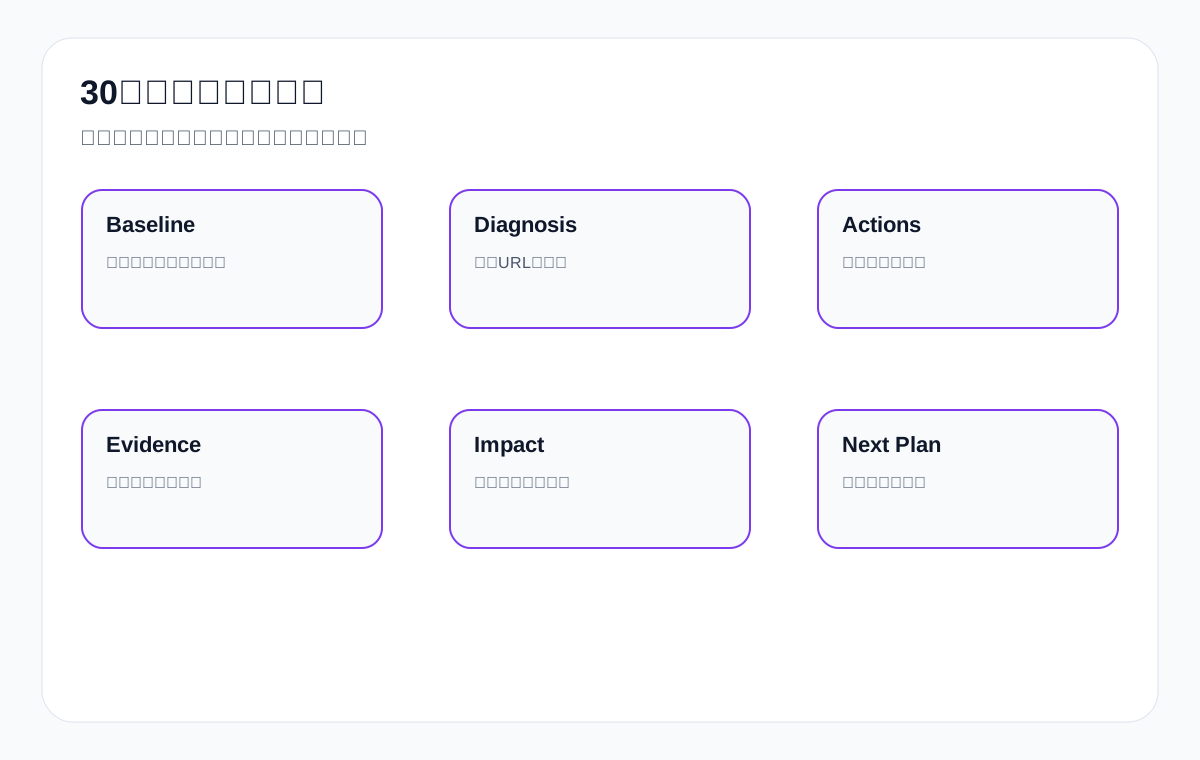
30-day trial schedule
| Phase | What the company provides | What the external team delivers | Acceptance focus |
|---|---|---|---|
| Week 1: Baseline | GSC, GA4, product lines, priority countries, inquiry samples | Current pages, queries, indexing and conversion baseline | Whether it can connect data to business goals |
| Week 2: Diagnosis | Product materials, certificates, common sales questions | URL-level diagnosis, keyword mapping, priority list | Whether it is specific to pages and actions |
| Week 3: Improvements | Confirm specifications and business claims | Complete one set of page titles, body content, FAQs, internal link recommendations or changes | Whether it fits the foreign-trade purchasing context |
| Week 4: Review | Sales feedback and inquiry quality judgement | Review report, risk statement and next month’s plan | Whether it explains what was done, what was not, why, and the next step |
9. Deliverables checklist: what you should receive each month
A foreign-trade company should not receive only a “this month’s optimization report.” The report should be understandable to the owner, the foreign-trade manager, sales and developers: which pages were changed this month, why, on what basis, what changed in the data, whether there is quality feedback on inquiries, and what comes first next month.
Monthly deliverables acceptance checklist
| Deliverable | Should include | Warning sign |
|---|---|---|
| URL change log | Page URL, what changed, when it changed, purpose of the change | Only writing “optimized several pages” |
| Query-to-page mapping | Target terms, page type, search intent, priority | Only a keyword list, no page strategy |
| Content and material needs | Specifications, certificates, images and case materials the company must supply | Only asking for more articles, not product facts |
| Technical issue list | Indexing, speed, redirects, structured data and mobile issues | Only tool screenshots, with no explanation of impact |
| Data review | GSC impressions and clicks, GA4 landing pages and events, inquiry sources, sales feedback | Only looking at rankings, not the inquiry path |
| Risks and boundaries | Which results are controllable, which can only be observed, and which need development support | Promising uncontrollable results or dodging risk |
10. Data review: do not look only at rankings — look at four metric groups
A foreign-trade SEO review should cover at least four metric groups: search visibility, page behavior, inquiry quality and AI answer citations. Ranking is one signal, but not the only one. A page moving from position 20 to position 8 may still bring no inquiries; a page whose impressions rise while CTR falls may have a title mismatch; a page whose inquiries increase but whose sales feedback is poor may be targeting the wrong search intent.
Foreign-trade SEO review metrics
| Metric group | What to look at | How to judge | Next action |
|---|---|---|---|
| GSC | Queries, pages, countries, devices, impressions, clicks, CTR, average position | Check whether target product terms are landing on the right pages | Adjust titles, FAQs, internal links and page content |
| GA4 | Landing pages, engagement, form events, downloads, WhatsApp clicks | Check whether visits move toward the inquiry path | Optimize CTAs, form fields and resource downloads |
| Inquiry sources | Product, country, purchasing stage, validity, likelihood of closing | Check whether traffic matches the business | Adjust keyword priorities and page roles |
| AI citations | Whether ChatGPT, AI Overviews, Perplexity and others mention or cite your website | Check whether AI answers understand the brand, products and evidence | Add resource pages, certificate pages, FAQs and entity consistency |
11. Risk boundaries: which promises need caution
No external team can control Google’s algorithm, competitor spending, changes in overseas demand, how AI answers are displayed or the buyer’s final choice. Before cooperating, therefore, clarify which work is controllable, which are observation metrics and which cannot be promised. What is controllable is diagnostic quality, page improvements, content facts, technical fixes, data review and communication transparency; what is not controllable is external search position, inquiry volume and AI answer presentation.
Risk boundary judgement table
| Claim | Risk | More reasonable wording |
|---|---|---|
| How soon will we definitely reach position X? | Treating an uncontrollable outcome as a promise | Explain target term difficulty, baseline, change plan and observation period |
| A guaranteed number of inquiries per month | Ignores demand, product, price and sales response | Review inquiry source, quality and the page conversion path |
| AI will definitely recommend our website | AI answers are uncontrollable and vary widely by platform | Strengthen citable evidence on your website and track brand mentions and citation changes |
| No cooperation from the company is needed | Product facts and sales feedback are missing | The company provides materials; the external team organizes and optimizes them |
| Only look at ranking reports | Cannot judge business results | Combine GSC, GA4, inquiries and sales feedback |
12. Contract and communication: put “how we work together” in writing
The contract does not need to be complex, but it must be clear about: scope of services, deliverables, communication frequency, permission scope, data ownership, content confirmation, image and material sources, third-party tool costs, responsibility for technical changes, and suspension and exit mechanisms. Foreign-trade companies especially need to confirm that the website account, GSC, GA4, image assets, content copyright, inquiry data and downloadable materials all belong to the company.
Recommended cooperation terms
| Term | Question to state clearly |
|---|---|
| Scope of services | Whether it covers diagnostics, keywords, content, technical advice, internal links and review, or only part of these |
| Deliverables | Monthly URL change log, diagnostic table, content drafts, technical advice, data review and next month’s plan |
| Permissions | What is read-only, what can be changed, what must be confirmed, and who is responsible for backups |
| Material confirmation | Who confirms product specifications, certificates, images, cases and business claims |
| Data ownership | GSC, GA4, website accounts, content, images and reports belong to the company |
| Exit mechanism | How accounts, files, change logs and unfinished items are handed over after the engagement ends |
13. How to judge a quote: do not compare monthly fees alone
When choosing an external SEO team, many foreign-trade companies reduce the question to “who quotes the lowest price.” This leads to a misconception: if a low price covers only simple publishing, generic edits and basic reports, the monthly cost looks low but the real problems go unsolved; and a high price without clear deliverables and a review mechanism may not be worth it either. A more reasonable approach is to break the quote down into scope of work, number of pages, diagnostic depth, content depth, technical collaboration, data review and communication cost.
For example, a website selling industrial valve supplier has dozens of valve categories, hundreds of models, multiple application industries and different certificate requirements. If the external team quotes only by “a few articles per month,” it usually cannot cover category pages, product pages, resource pages and the inquiry path. If you sell ceramic dinnerware or are a private label activewear manufacturer, the content requires a great deal of product photography, materials, dimensions, packaging, MOQ, customization process and confirmation of buyer questions; the quote should also reflect this material organization and page structure work.
Quote evaluation table
| Quote dimension | Low-value approach | High-value approach | How the company accepts it |
|---|---|---|---|
| Diagnosis | Only tool scores and generic advice | Deliver URLs, queries, issues, priorities and responsibility boundaries | Check whether it can turn directly into page actions |
| Content | Pile up ordinary articles by the piece | Add product facts, tables, FAQs, internal links and the inquiry path by page role | Spot-check whether real product terms and purchasing questions are used |
| Technical | Only say the site speed or indexing is poor | Explain affected URLs, likely causes, development actions and review metrics | Whether developers can execute from the list |
| Review | Only provide ranking screenshots | Combine GSC, GA4, inquiry sources and sales feedback | Whether the report explains changes and next steps |
| Communication | Speak up only when there is a problem | Fixed weekly/monthly communication with clear issues, materials and confirmations | Whether it reduces the internal cost of repeated confirmation |
If the budget is limited, start with a small-scope engagement of “diagnosis + a few key page improvements + review” rather than spreading across all pages at once. For example, pick the five most important products or categories first — cnc machining parts, custom metal parts, waterproof connector, packaging machine, LED flood light — and for each do page diagnosis, title rewriting, a specification table, FAQs, internal links and the inquiry path, then observe GSC and inquiry feedback over 30 to 60 days. This makes it easier to judge real value than a low-price, long-term stream of generic articles.
14. Content acceptance: how to tell it is not generic
Foreign-trade companies often face a situation where the content the external team delivers looks long but has no purchasing value after reading. To judge whether content is generic, ask three questions: does it contain specific English product terms, does it answer the technical and commercial questions buyers ask, and can it sit on the corresponding page and help with the inquiry decision?
Take LED flood light as an example. Generic content may only say “LED flood lights are energy-saving, eco-friendly and long-lasting.” A more valuable page explains wattage, lumen, IP rating, beam angle, working temperature, housing material, certificate and application information such as warehouse, stadium and construction site, and answers the MOQ, sample, lead time, custom logo, warranty, IES file and installation bracket questions buyers ask. Only content like this suits foreign-trade B2B inquiries.
Content acceptance matrix
| Page or content | Generic wording | Professional wording the customer can read |
|---|---|---|
| cnc machining parts | We provide high-quality machining services | Explain materials, precision, tolerances, surface treatment, drawing formats, inspection equipment and applicable industries |
| packaging machine | The equipment performs stably | Explain applicable materials, packaging speed, metering method, bag type, production line integration and after-sales spare parts |
| medical probe | The product is safe and reliable | Explain material grade, sterilization method, connector, compatible equipment, compliance documents and traceability requirements |
| ceramic dinnerware | A rich variety of styles | Explain glaze, temperature, dimensions, sets, packaging, dishwasher suitability and custom patterns |
| waterproof connector | Good waterproof performance | Explain IP rating, pin count, wire gauge, locking method, materials, testing and application environment |
Acceptance should also check whether the content has a “next action.” An article that explains keyword research but does not tell the company how to place keywords on category pages, product pages, application pages and FAQs; a page that explains product advantages but has no clear inquiry entry point or resource download; a review that covers the data but has no page actions for next month — none of these is strong enough.
15. How to accept technical recommendations: can developers execute them?
When the external team proposes technical recommendations, do not judge by how many terms are used but by whether developers or operations can execute them. For example, “improve speed” is not an acceptable recommendation; “On the mobile product category page, LCP is mainly affected by the large above-the-fold image and third-party scripts; we recommend compressing the above-the-fold image, delaying non-critical scripts, checking cache hit rate and reviewing with PageSpeed and real visit data after the change” is far more executable.
Likewise, “fix the indexing problem” is not specific enough. An acceptable recommendation should explain which URLs have not been discovered, which were discovered but not indexed, which are duplicates or thin content, which are canonicalized to other pages, and which are hard to crawl because of too few internal links. Then decide whether to add content, add internal links, change canonicals, submit a sitemap or merge worthless pages.
Technical recommendation acceptance table
| Technical issue | Unacceptable wording | Executable wording | How to review |
|---|---|---|---|
| Speed | The site is slow | List the slow URLs, devices, core metrics, main resources and recommended actions | Compare LCP, INP, CLS and the conversion path before and after the change |
| Indexing | Many pages are not indexed | Distinguish undiscovered, discovered-not-indexed, duplicate, soft 404 and low-quality pages | Review with the GSC page indexing report and URL Inspection |
| Structured data | Add schema | Explain which page types it suits, where the fields come from and whether it complies with Google documentation | Observe with the Rich Results Test and Search Console enhancement reports |
| Internal links | Add internal links | Explain which articles link to which category pages, what the anchor text is and why it is relevant | Track changes in crawling, impressions and queries for the target URL |
| Redirects | Handle 404s | List source URL, target URL, reason and whether relevance is preserved | Check status codes, logs and changes in GSC invalid pages |
16. Internal material preparation: what a foreign-trade company should organize in advance
Poor cooperation results are often not because the external team cannot do the work at all, but because the company did not provide enough product facts. SEO content is not written out of thin air, especially for B2B foreign-trade websites. The clearer the materials you provide, the more professionally, credibly and citably the external team can write the pages.
Company material preparation checklist
| Material type | Example | Purpose |
|---|---|---|
| Product line list | custom metal parts, cnc machining parts, waterproof connector | Determine category pages, product pages and priority keywords |
| Specification materials | Dimensions, materials, tolerances, power, IP rating, capacity, compatible range | Write product page specification tables and purchasing FAQs |
| Certificates and compliance | ISO, CE, RoHS, FDA, test reports, material certificates | Improve trust and AI citation evidence |
| Images and drawings | Product photos, application photos, structural drawings, factory photos, inspection photos | Support combined text and visuals and purchasing decisions |
| Sales questions | MOQ, lead time, samples, packaging, payment, customization, after-sales | Generate FAQs and inquiry page prompts |
| Priority markets | United States, Germany, Australia, the Middle East, Southeast Asia, etc. | Determine country pages, wording and review dimensions |
Materials do not have to be organized all at once. A more realistic approach is to organize them in batches by product priority. Start with the product lines that have high margins, high inquiry value and relatively achievable competition; organize specifications, certificates, images and sales questions; then hand them to the external team for page structure and content upgrades.
17. AI search visibility: does the outsourced team understand this new review dimension?
Foreign-trade companies now also need to watch AI search visibility, but do not turn it into mysticism. When choosing an external team, you can ask: if an overseas buyer asks “best waterproof connector supplier for marine application” or “how to choose packaging machine for powder,” is the AI answer likely to cite our website? If not, is the reason that the site lacks clear materials, has no citable FAQs, has inconsistent product entities, or has too few authoritative third-party sources?
A reliable team will not promise that AI will cite you. Instead, it will build a query set, record answers, track brand mentions, website citations, competitor co-occurrence and answer accuracy, then return to the website pages to add evidence. For example, add modules such as datasheet, certificate, application guide, comparison table, FAQ, company profile and manufacturing capability so that both AI and buyers can understand the company more easily.
AI search review dimensions
| Dimension | What to look at | Corresponding page action |
|---|---|---|
| Query set | Whether English purchasing questions cover products, applications, comparisons and supplier screening | Build a fixed question set and sample it monthly |
| Brand mentions | Whether AI answers mention the company or brand name | Align company name, brand name, product lines and page entities |
| Website citations | Whether it cites your product pages, resource pages or FAQs | Add citable paragraphs, tables, certificates and downloadable materials |
| Competitor co-occurrence | Which competitors appear often and where they come from | Analyze competitor page evidence and third-party sources |
| Answer accuracy | Whether specifications, certificates and product capabilities are misread | Correct factual wording and FAQs on your website |
18. Red flags: stop when you see these
- They quote a price without asking about your product lines, priority countries, customer types or profitable products.
- They show only ranking screenshots and do not explain the pages, queries, time frame or changes made.
- They talk only about publishing articles, not about product pages, category pages, application pages, resource pages or the inquiry path.
- They are unwilling to explain which permissions they need or to keep a change log.
- They do not look at GSC, GA4 or inquiry sources and base conclusions only on third-party tool scores.
- They do not understand English product terms or buyer questions and cover every industry with very generic content.
- They avoid risk boundaries and describe uncontrollable outcomes as too certain.
- They ask the company to hand over all accounts without a backup or approval process.
19. Interview questions: 20 questions you can ask before cooperating
- If we work on cnc machining parts, which pages would you look at first?
- What content should the category page and product page for custom metal parts each cover?
- How would you decide which page type suits the specification terms for LED flood light?
- If impressions are high but clicks are low in GSC, which factors would you check first?
- If form events in GA4 are inaccurate, how would you handle the review?
- Which permissions do you need? Which are read-only? Which require company confirmation?
- What records should a page change leave behind?
- If product specifications are uncertain, how would you write the content?
- How would you handle certificates, catalogs, downloadable materials and FAQs?
- How do you distinguish informational articles from pages that can generate inquiries?
- How do you decide that a keyword is not worth pursuing?
- How do you prevent multiple pages from competing for the same intent?
- If sales says inquiry quality is poor, how would you review it?
- If AI answers do not mention your website, what would you check first?
- Which verifiable URLs will the monthly report include?
- Which results would you not promise?
- If development resources are limited, how do you prioritize?
- If you already have many articles but no inquiries, what would you do?
- How do you judge backlink risk?
- After the 30-day trial, how would you advise whether to continue or stop?
20. How foreign-trade companies of different sizes should choose an engagement model
Choosing an engagement model
| Company situation | More suitable engagement model | Reason |
|---|---|---|
| New English site, few product lines | Start with basic diagnosis and core page improvements | First get indexing, structure, product pages and the inquiry path right |
| Years-old website with weak traffic | Run a full-site URL audit and keyword mapping | Find historical pages, category pages and content gaps |
| Many product lines and many countries | Proceed in stages by product line | Avoid changing all pages at once, which makes review impossible |
| Many inquiries but poor quality | Focus on intent and conversion review | Adjust page target terms, form prompts and the sales feedback mechanism |
| Want to appear in AI answers | Add website evidence and entity consistency | Improve the citability of resource pages, certificate pages, FAQs and product facts |
If nobody inside the company is responsible for product materials and sales feedback, results will be limited even if the external team is capable. Foreign-trade SEO cooperation is not about “handing over” the website; it is about combining external methods, internal product facts and sales feedback.
21. FAQ: common questions from foreign-trade companies
Does an outsourced Google SEO team have to understand our products?
At minimum it must quickly understand product lines, materials, processes, application industries, certificates, MOQ and buyer questions. If it cannot even tell apart the page roles for terms like custom metal parts, packaging machine and waterproof connector, later content will easily become generic.
Can rankings alone tell whether the cooperation is working?
No. Rankings must be read together with queries, pages, countries, clicks, inquiry sources and sales feedback. What foreign-trade companies ultimately care about is qualified inquiries and business opportunities, not the short-term position of a single term.
Does the external team need website editing permission?
Not necessarily at the start. We recommend giving read-only access to GSC and GA4 first, then setting up a review process for article or page changes after the diagnosis. Back up and log changes before editing important pages.
Can we see SEO results in 30 days?
Thirty days is better suited to judging the team’s way of working, diagnostic accuracy, page improvement quality and review capability, not final organic search results. Some pages may show early data changes, but that should not be treated as a long-term result.
Should a foreign-trade website fix articles or product pages first?
It depends on the current gap. If product pages and category pages lack specifications, applications, certificates and the inquiry path, prioritize the pages that capture purchasing intent; articles are better for question-type, technical and comparison queries.
How do you judge whether a report has value?
Check whether the report lists specific URLs, queries, issues, evidence, priorities, owners and review metrics. If it only has scores, screenshots and generic advice, its business value is limited.
Should AI search visibility be considered as well?
Yes, but do not mythologize it. A foreign-trade website should first make sure its pages have clear product facts, certificates, specifications, FAQs and entity information, and then observe whether AI answers mention the brand, cite the website or misread the products.
Is a lower price always better?
No. If a low price buys only generic content and unverifiable reports, the long-term cost is higher. What matters more is whether the deliverables are specific, reviewable and grounded in an understanding of the foreign-trade business.
What does the company need to provide internally?
At minimum, product materials, images, certificates, priority markets, profitable products, common sales questions, inquiry quality feedback and read-only access to the necessary accounts.
When should the cooperation be stopped?
If the team repeatedly fails to provide URL-level diagnostics, change logs, data reviews and reasonable risk statements, or never understands the products and purchasing path, consider stopping or adjusting the engagement.
22. Final selection checklist: tick each item before signing
- Target countries, product lines, profitable products and buyer types are clearly stated.
- The external team can explain page roles using English product terms instead of just handing over a keyword list.
- They can provide URL-level diagnostics, not just general advice.
- GSC, GA4, inquiry sources and sales feedback are reviewed together.
- Permission scope, approval process and backup method are clearly written down.
- The company confirms product specifications, certificates, images and business claims.
- Monthly deliverables include a change log, data review, next month’s plan and a risk statement.
- Technical changes are confirmed and executed by development or operations.
- The contract states that accounts, content, images, reports and data belong to the company.
- They clearly do not promise uncontrollable results and commit only to executable work and review transparency.
Choosing an outsourced Google SEO team is essentially choosing a long-term partner who can connect search data, product facts, page structure, technical issues and inquiry feedback. A team truly worth working with will not just show you slogans and screenshots; it will make sure you know exactly which URLs have problems now, why those pages affect buyers’ decisions, what changed this month, what data to look at next month, where the company needs to cooperate, and which results must be treated with caution.
{
“@context”: “https://schema.org”,
“@type”: “FAQPage”,
“mainEntity”: [
{
“@type”: “Question”,
“name”: “Acceptance criteria for the five page typesnnPage typeMinimum acceptableStronger approachnnProduct category pagesExplain product scope and supply capabilityAdd materials/processes/applications/certificates/FAQ/internal links/inquiry entrynProduct detail pagesHave basic specifications and imagesAdd specification tables, application advice, downloadable materials, similar products and purchasing FAQsnApplication scenario pagesDescribe the application industryBreak down purchasing questions, selection criteria, suitable products and common misconceptionsnResource pagesFiles can be downloadedClear version, applicable products, certificate validity and citation pathnInquiry pagesA form can be submittedReasonable fields, material upload, response expectations and complete source trackingnn8. 30-day trial: use a short cycle to judge real capabilitynIf you are not sure about a long-term engagement, start with a 30-day trial. The goal is not to see ranking changes immediately, but to see whether the team can establish a baseline, understand the products, find key URL problems, give an executable priority list, complete a small batch of page improvements and explain the data review clearly. Thirty days is enough to see whether the way of working is reliable, but not enough to judge final SEO results.nFigure 3: A 30-day trial should focus on process quality, diagnostic accuracy, page actions and review capability.n30-day trial schedulennPhaseWhat the company providesWhat the external team deliversAcceptance focusnnWeek 1: BaselineGSC, GA4, product lines, priority countries, inquiry samplesCurrent pages, queries, indexing and conversion baselineWhether it can connect data to business goalsnWeek 2: DiagnosisProduct materials, certificates, common sales questionsURL-level diagnosis, keyword mapping, priority listWhether it is specific to pages and actionsnWeek 3: ImprovementsConfirm specifications and business claimsComplete one set of page titles, body content, FAQs, internal link recommendations or changesWhether it fits the foreign-trade purchasing contextnWeek 4: ReviewSales feedback and inquiry quality judgementReview report, risk statement and next month’s planWhether it explains what was done, what was not, why, and the next stepnn9. Deliverables checklist: what you should receive each monthnA foreign-trade company should not receive only a “this month’s optimization report.” The report should be understandable to the owner, the foreign-trade manager, sales and developers: which pages were changed this month, why, on what basis, what changed in the data, whether there is quality feedback on inquiries, and what comes first next month.nMonthly deliverables acceptance checklistnnDeliverableShould includeWarning signnnURL change logPage URL, what changed, when it changed, purpose of the changeOnly writing “optimized several pages”nQuery-to-page mappingTarget terms, page type, search intent, priorityOnly a keyword list, no page strategynContent and material needsSpecifications, certificates, images and case materials the company must supplyOnly asking for more articles, not product factsnTechnical issue listIndexing, speed, redirects, structured data and mobile issuesOnly tool screenshots, with no explanation of impactnData reviewGSC impressions and clicks, GA4 landing pages and events, inquiry sources, sales feedbackOnly looking at rankings, not the inquiry pathnRisks and boundariesWhich results are controllable, which can only be observed, and which need development supportPromising uncontrollable results or dodging risknn10. Data review: do not look only at rankings — look at four metric groupsnA foreign-trade SEO review should cover at least four metric groups: search visibility, page behavior, inquiry quality and AI answer citations. Ranking is one signal, but not the only one. A page moving from position 20 to position 8 may still bring no inquiries; a page whose impressions rise while CTR falls may have a title mismatch; a page whose inquiries increase but whose sales feedback is poor may be targeting the wrong search intent.nForeign-trade SEO review metricsnnMetric groupWhat to look atHow to judgeNext actionnnGSCQueries, pages, countries, devices, impressions, clicks, CTR, average positionCheck whether target product terms are landing on the right pagesAdjust titles, FAQs, internal links and page contentnGA4Landing pages, engagement, form events, downloads, WhatsApp clicksCheck whether visits move toward the inquiry pathOptimize CTAs, form fields and resource downloadsnInquiry sourcesProduct, country, purchasing stage, validity, likelihood of closingCheck whether traffic matches the businessAdjust keyword priorities and page rolesnAI citationsWhether ChatGPT, AI Overviews, Perplexity and others mention or cite your websiteCheck whether AI answers understand the brand, products and evidenceAdd resource pages, certificate pages, FAQs and entity consistencynn11. Risk boundaries: which promises need cautionnNo external team can control Google’s algorithm, competitor spending, changes in overseas demand, how AI answers are displayed or the buyer’s final choice. Before cooperating, therefore, clarify which work is controllable, which are observation metrics and which cannot be promised. What is controllable is diagnostic quality, page improvements, content facts, technical fixes, data review and communication transparency; what is not controllable is external search position, inquiry volume and AI answer presentation.nRisk boundary judgement tablennClaimRiskMore reasonable wordingnnHow soon will we definitely reach position X?Treating an uncontrollable outcome as a promiseExplain target term difficulty, baseline, change plan and observation periodnA guaranteed number of inquiries per monthIgnores demand, product, price and sales responseReview inquiry source, quality and the page conversion pathnAI will definitely recommend our websiteAI answers are uncontrollable and vary widely by platformStrengthen citable evidence on your website and track brand mentions and citation changesnNo cooperation from the company is neededProduct facts and sales feedback are missingThe company provides materials; the external team organizes and optimizes themnOnly look at ranking reportsCannot judge business resultsCombine GSC, GA4, inquiries and sales feedbacknn12. Contract and communication: put “how we work together” in writingnThe contract does not need to be complex, but it must be clear about: scope of services, deliverables, communication frequency, permission scope, data ownership, content confirmation, image and material sources, third-party tool costs, responsibility for technical changes, and suspension and exit mechanisms. Foreign-trade companies especially need to confirm that the website account, GSC, GA4, image assets, content copyright, inquiry data and downloadable materials all belong to the company.nRecommended cooperation termsnnTermQuestion to state clearlynnScope of servicesWhether it covers diagnostics, keywords, content, technical advice, internal links and review, or only part of thesenDeliverablesMonthly URL change log, diagnostic table, content drafts, technical advice, data review and next month’s plannPermissionsWhat is read-only, what can be changed, what must be confirmed, and who is responsible for backupsnMaterial confirmationWho confirms product specifications, certificates, images, cases and business claimsnData ownershipGSC, GA4, website accounts, content, images and reports belong to the companynExit mechanismHow accounts, files, change logs and unfinished items are handed over after the engagement endsnn13. How to judge a quote: do not compare monthly fees alonenWhen choosing an external SEO team, many foreign-trade companies reduce the question to “who quotes the lowest price.” This leads to a misconception: if a low price covers only simple publishing, generic edits and basic reports, the monthly cost looks low but the real problems go unsolved; and a high price without clear deliverables and a review mechanism may not be worth it either. A more reasonable approach is to break the quote down into scope of work, number of pages, diagnostic depth, content depth, technical collaboration, data review and communication cost.nFor example, a website selling industrial valve supplier has dozens of valve categories, hundreds of models, multiple application industries and different certificate requirements. If the external team quotes only by “a few articles per month,” it usually cannot cover category pages, product pages, resource pages and the inquiry path. If you sell ceramic dinnerware or are a private label activewear manufacturer, the content requires a great deal of product photography, materials, dimensions, packaging, MOQ, customization process and confirmation of buyer questions; the quote should also reflect this material organization and page structure work.nQuote evaluation tablennQuote dimensionLow-value approachHigh-value approachHow the company accepts itnnDiagnosisOnly tool scores and generic adviceDeliver URLs, queries, issues, priorities and responsibility boundariesCheck whether it can turn directly into page actionsnContentPile up ordinary articles by the pieceAdd product facts, tables, FAQs, internal links and the inquiry path by page roleSpot-check whether real product terms and purchasing questions are usednTechnicalOnly say the site speed or indexing is poorExplain affected URLs, likely causes, development actions and review metricsWhether developers can execute from the listnReviewOnly provide ranking screenshotsCombine GSC, GA4, inquiry sources and sales feedbackWhether the report explains changes and next stepsnCommunicationSpeak up only when there is a problemFixed weekly/monthly communication with clear issues, materials and confirmationsWhether it reduces the internal cost of repeated confirmationnnIf the budget is limited, start with a small-scope engagement of “diagnosis + a few key page improvements + review” rather than spreading across all pages at once. For example, pick the five most important products or categories first — cnc machining parts, custom metal parts, waterproof connector, packaging machine, LED flood light — and for each do page diagnosis, title rewriting, a specification table, FAQs, internal links and the inquiry path, then observe GSC and inquiry feedback over 30 to 60 days. This makes it easier to judge real value than a low-price, long-term stream of generic articles.n14. Content acceptance: how to tell it is not genericnForeign-trade companies often face a situation where the content the external team delivers looks long but has no purchasing value after reading. To judge whether content is generic, ask three questions: does it contain specific English product terms, does it answer the technical and commercial questions buyers ask, and can it sit on the corresponding page and help with the inquiry decision?nTake LED flood light as an example. Generic content may only say “LED flood lights are energy-saving, eco-friendly and long-lasting.” A more valuable page explains wattage, lumen, IP rating, beam angle, working temperature, housing material, certificate and application information such as warehouse, stadium and construction site, and answers the MOQ, sample, lead time, custom logo, warranty, IES file and installation bracket questions buyers ask. Only content like this suits foreign-trade B2B inquiries.nContent acceptance matrixnnPage or contentGeneric wordingProfessional wording the customer can readnncnc machining partsWe provide high-quality machining servicesExplain materials, precision, tolerances, surface treatment, drawing formats, inspection equipment and applicable industriesnpackaging machineThe equipment performs stablyExplain applicable materials, packaging speed, metering method, bag type, production line integration and after-sales spare partsnmedical probeThe product is safe and reliableExplain material grade, sterilization method, connector, compatible equipment, compliance documents and traceability requirementsnceramic dinnerwareA rich variety of stylesExplain glaze, temperature, dimensions, sets, packaging, dishwasher suitability and custom patternsnwaterproof connectorGood waterproof performanceExplain IP rating, pin count, wire gauge, locking method, materials, testing and application environmentnnAcceptance should also check whether the content has a “next action.” An article that explains keyword research but does not tell the company how to place keywords on category pages, product pages, application pages and FAQs; a page that explains product advantages but has no clear inquiry entry point or resource download; a review that covers the data but has no page actions for next month — none of these is strong enough.n15. How to accept technical recommendations: can developers execute them?nWhen the external team proposes technical recommendations, do not judge by how many terms are used but by whether developers or operations can execute them. For example, “improve speed” is not an acceptable recommendation; “On the mobile product category page, LCP is mainly affected by the large above-the-fold image and third-party scripts; we recommend compressing the above-the-fold image, delaying non-critical scripts, checking cache hit rate and reviewing with PageSpeed and real visit data after the change” is far more executable.nLikewise, “fix the indexing problem” is not specific enough. An acceptable recommendation should explain which URLs have not been discovered, which were discovered but not indexed, which are duplicates or thin content, which are canonicalized to other pages, and which are hard to crawl because of too few internal links. Then decide whether to add content, add internal links, change canonicals, submit a sitemap or merge worthless pages.nTechnical recommendation acceptance tablennTechnical issueUnacceptable wordingExecutable wordingHow to reviewnnSpeedThe site is slowList the slow URLs, devices, core metrics, main resources and recommended actionsCompare LCP, INP, CLS and the conversion path before and after the changenIndexingMany pages are not indexedDistinguish undiscovered, discovered-not-indexed, duplicate, soft 404 and low-quality pagesReview with the GSC page indexing report and URL InspectionnStructured dataAdd schemaExplain which page types it suits, where the fields come from and whether it complies with Google documentationObserve with the Rich Results Test and Search Console enhancement reportsnInternal linksAdd internal linksExplain which articles link to which category pages, what the anchor text is and why it is relevantTrack changes in crawling, impressions and queries for the target URLnRedirectsHandle 404sList source URL, target URL, reason and whether relevance is preservedCheck status codes, logs and changes in GSC invalid pagesnn16. Internal material preparation: what a foreign-trade company should organize in advancenPoor cooperation results are often not because the external team cannot do the work at all, but because the company did not provide enough product facts. SEO content is not written out of thin air, especially for B2B foreign-trade websites. The clearer the materials you provide, the more professionally, credibly and citably the external team can write the pages.nCompany material preparation checklistnnMaterial typeExamplePurposennProduct line listcustom metal parts, cnc machining parts, waterproof connectorDetermine category pages, product pages and priority keywordsnSpecification materialsDimensions, materials, tolerances, power, IP rating, capacity, compatible rangeWrite product page specification tables and purchasing FAQsnCertificates and complianceISO, CE, RoHS, FDA, test reports, material certificatesImprove trust and AI citation evidencenImages and drawingsProduct photos, application photos, structural drawings, factory photos, inspection photosSupport combined text and visuals and purchasing decisionsnSales questionsMOQ, lead time, samples, packaging, payment, customization, after-salesGenerate FAQs and inquiry page promptsnPriority marketsUnited States, Germany, Australia, the Middle East, Southeast Asia, etc.Determine country pages, wording and review dimensionsnnMaterials do not have to be organized all at once. A more realistic approach is to organize them in batches by product priority. Start with the product lines that have high margins, high inquiry value and relatively achievable competition; organize specifications, certificates, images and sales questions; then hand them to the external team for page structure and content upgrades.n17. AI search visibility: does the outsourced team understand this new review dimension?nForeign-trade companies now also need to watch AI search visibility, but do not turn it into mysticism. When choosing an external team, you can ask: if an overseas buyer asks “best waterproof connector supplier for marine application” or “how to choose packaging machine for powder,” is the AI answer likely to cite our website? If not, is the reason that the site lacks clear materials, has no citable FAQs, has inconsistent product entities, or has too few authoritative third-party sources?nA reliable team will not promise that AI will cite you. Instead, it will build a query set, record answers, track brand mentions, website citations, competitor co-occurrence and answer accuracy, then return to the website pages to add evidence. For example, add modules such as datasheet, certificate, application guide, comparison table, FAQ, company profile and manufacturing capability so that both AI and buyers can understand the company more easily.nAI search review dimensionsnnDimensionWhat to look atCorresponding page actionnnQuery setWhether English purchasing questions cover products, applications, comparisons and supplier screeningBuild a fixed question set and sample it monthlynBrand mentionsWhether AI answers mention the company or brand nameAlign company name, brand name, product lines and page entitiesnWebsite citationsWhether it cites your product pages, resource pages or FAQsAdd citable paragraphs, tables, certificates and downloadable materialsnCompetitor co-occurrenceWhich competitors appear often and where they come fromAnalyze competitor page evidence and third-party sourcesnAnswer accuracyWhether specifications, certificates and product capabilities are misreadCorrect factual wording and FAQs on your websitenn18. Red flags: stop when you see thesenThey quote a price without asking about your product lines, priority countries, customer types or profitable products. They show only ranking screenshots and do not explain the pages, queries, time frame or changes made. They talk only about publishing articles, not about product pages, category pages, application pages, resource pages or the inquiry path. They are unwilling to explain which permissions they need or to keep a change log. They do not look at GSC, GA4 or inquiry sources and base conclusions only on third-party tool scores. They do not understand English product terms or buyer questions and cover every industry with very generic content. They avoid risk boundaries and describe uncontrollable outcomes as too certain. They ask the company to hand over all accounts without a backup or approval process.n19. Interview questions: 20 questions you can ask before cooperatingnIf we work on cnc machining parts, which pages would you look at first? What content should the category page and product page for custom metal parts each cover? How would you decide which page type suits the specification terms for LED flood light? If impressions are high but clicks are low in GSC, which factors would you check first? If form events in GA4 are inaccurate, how would you handle the review? Which permissions do you need? Which are read-only? Which require company confirmation? What records should a page change leave behind? If product specifications are uncertain, how would you write the content? How would you handle certificates, catalogs, downloadable materials and FAQs? How do you distinguish informational articles from pages that can generate inquiries? How do you decide that a keyword is not worth pursuing? How do you prevent multiple pages from competing for the same intent? If sales says inquiry quality is poor, how would you review it? If AI answers do not mention your website, what would you check first? Which verifiable URLs will the monthly report include? Which results would you not promise? If development resources are limited, how do you prioritize? If you already have many articles but no inquiries, what would you do? How do you judge backlink risk? After the 30-day trial, how would you advise whether to continue or stop?n20. How foreign-trade companies of different sizes should choose an engagement modelnChoosing an engagement modelnnCompany situationMore suitable engagement modelReasonnnNew English site, few product linesStart with basic diagnosis and core page improvementsFirst get indexing, structure, product pages and the inquiry path rightnYears-old website with weak trafficRun a full-site URL audit and keyword mappingFind historical pages, category pages and content gapsnMany product lines and many countriesProceed in stages by product lineAvoid changing all pages at once, which makes review impossiblenMany inquiries but poor qualityFocus on intent and conversion reviewAdjust page target terms, form prompts and the sales feedback mechanismnWant to appear in AI answersAdd website evidence and entity consistencyImprove the citability of resource pages, certificate pages, FAQs and product factsnnIf nobody inside the company is responsible for product materials and sales feedback, results will be limited even if the external team is capable. Foreign-trade SEO cooperation is not about “handing over” the website; it is about combining external methods, internal product facts and sales feedback.n21. FAQ: common questions from foreign-trade companiesnDoes an outsourced Google SEO team have to understand our products?”,
“acceptedAnswer”: {
“@type”: “Answer”,
“text”: “At minimum it must quickly understand product lines, materials, processes, application industries, certificates, MOQ and buyer questions. If it cannot even tell apart the page roles for terms like custom metal parts, packaging machine and waterproof connector, later content will easily become generic.”
}
},
{
“@type”: “Question”,
“name”: “Can rankings alone tell whether the cooperation is working?”,
“acceptedAnswer”: {
“@type”: “Answer”,
“text”: “No. Rankings must be read together with queries, pages, countries, clicks, inquiry sources and sales feedback. What foreign-trade companies ultimately care about is qualified inquiries and business opportunities, not the short-term position of a single term.”
}
},
{
“@type”: “Question”,
“name”: “Does the external team need website editing permission?”,
“acceptedAnswer”: {
“@type”: “Answer”,
“text”: “Not necessarily at the start. We recommend giving read-only access to GSC and GA4 first, then setting up a review process for article or page changes after the diagnosis. Back up and log changes before editing important pages.”
}
},
{
“@type”: “Question”,
“name”: “Can we see SEO results in 30 days?”,
“acceptedAnswer”: {
“@type”: “Answer”,
“text”: “Thirty days is better suited to judging the team’s way of working, diagnostic accuracy, page improvement quality and review capability, not final organic search results. Some pages may show early data changes, but that should not be treated as a long-term result.”
}
},
{
“@type”: “Question”,
“name”: “Should a foreign-trade website fix articles or product pages first?”,
“acceptedAnswer”: {
“@type”: “Answer”,
“text”: “It depends on the current gap. If product pages and category pages lack specifications, applications, certificates and the inquiry path, prioritize the pages that capture purchasing intent; articles are better for question-type, technical and comparison queries.”
}
}
]
}
Keep reading this SEO series
If you are systematically reviewing SEO for a foreign-trade website, it is worth continuing with the articles below. First clarify how crawling, indexing, content, links and review fit together, then decide which page to change next.
- What does Google foreign-trade lead generation optimization include: technology, content, GSC review and a deliverables checklist
- What is the difference between a Google foreign-trade website optimization consultant and a foreign-trade website building and promotion service team: how to choose the better fit
- How to judge the most reliable foreign-trade website building and promotion service teams in China: do not look at promises, look at diagnostics and evidence
- How to choose a foreign-trade website building and promotion service team: how to judge B2B inquiries, independent sites and overseas search
- What does B2B Google foreign-trade lead generation optimization include: a guide to long decision cycles, page systems and inquiry review
- What does Shopify Google foreign-trade lead generation optimization include: collection pages, product pages, speed and content division of labor
This page is machine-translated from the Simplified Chinese version and awaiting human review. It has not yet been proofread.