What is the difference between an AI SEO company and a GEO company? Do not look at the names first. Look at the problem each one solves. AI SEO leans toward search fundamentals, content matching, crawling and indexing, click paths, and conversion handoff; GEO leans toward entity consistency in generative answers, answer structure, cited sources, query monitoring, and fact correction. The two are not substitutes for each other — they are an upstream and downstream relationship.
For B2B export businesses, this distinction is very practical. When you target English procurement terms such as custom metal parts supplier, LED flood light manufacturer, packaging machine factory, and industrial valve exporter, the answers on Google search pages, AI Overviews, ChatGPT Search, Bing Copilot, and Perplexity can all shape how users perceive you. But in the end, users still need to see your website pages, product specifications, capability descriptions, evidence sources, and inquiry entry points.
This article only covers public methods and acceptance boundaries. It does not show unauthorized project results, fabricate GSC outcomes, fabricate AI citations, or promise search rankings, answer adoption, clicks, inquiries, or business results.
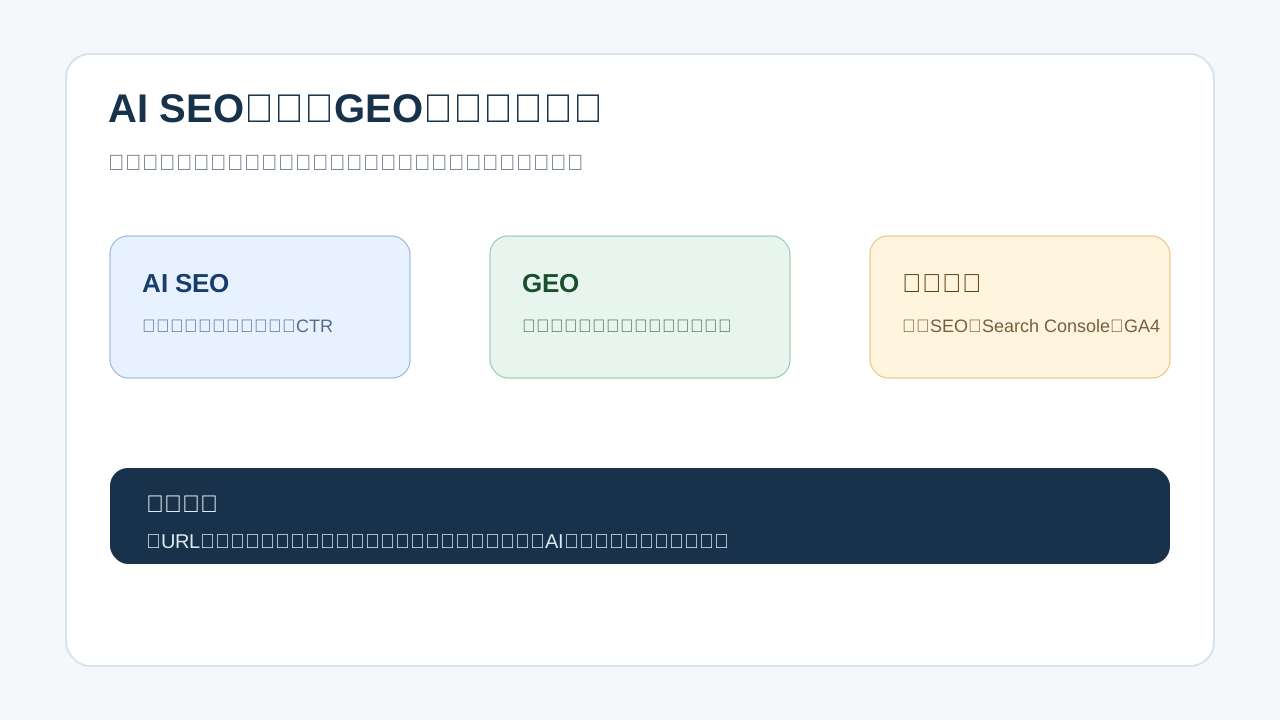
The conclusion up front: AI SEO builds the entrance, GEO builds answer visibility
AI SEO focuses on how search systems discover, understand, and display your pages. It looks at technical SEO, site structure, content intent, titles, opening paragraphs, internal links, structured data, page speed, Search Console queries, CTR, and GA4 behavior. Its core question is: when users search, does your page have a chance to be discovered, clicked, and converted?
GEO focuses on how generative answers understand and cite your brand, pages, and third-party sources. It looks at query libraries, answer samples, entity consistency, website facts, external sources, cited URLs, incorrect facts, and monthly reviews. Its core question is: when an AI answer responds to a procurement question, can it recognize your brand and the evidence on your website?
If a website does not yet have stable crawling and indexing, do the foundational AI SEO work first. If pages already get impressions but answer visibility is weak, then add GEO monitoring and content evidence. Get the order wrong and you will spend a lot of money without seeing any verifiable change.
Official evidence: neither can be separated from search fundamentals
The boundary between AI SEO and GEO comes back to official documentation. Google’s guidance on generative AI search does not let websites bypass foundational SEO. Search Console remains the primary evidence for queries, pages, impressions, clicks, and index reviews. OpenAI also publicly distinguishes the purposes of different crawlers. Putting these sources into service acceptance criteria keeps a new-sounding term from becoming unverifiable packaging.
| Official source | What it supports | How AI SEO uses it | How GEO uses it |
|---|---|---|---|
| Google generative AI search optimization | Generative search is still built on search fundamentals and helpful content | Optimize crawling, indexing, and page quality | Put answer structure and sources back onto accessible web pages |
| Google AI features and your website | AI features relate to site display, preview controls, and web page links | Check snippet and preview settings | Monitor whether AI answers cite website URLs |
| Google Search Essentials | Technical requirements, spam policies, and best practices are the baseline | Handle robots, noindex, canonical, and status codes | Avoid piling up answers with low-quality content clusters |
| Helpful content guidelines | Content should serve real users, not just pile up keywords for systems | Check search intent and page value | Check whether answers have real facts and boundaries |
| Google structured data intro | Structured data helps search systems understand what a page means | Check Article, FAQ, Organization, Product, and other markup | Support entity consistency; do not treat schema as a master key |
| Search Console Performance report | Queries, pages, countries, devices, impressions, clicks, CTR, average position | Judge changes in entrances | Compare AI samples against changes on the search side |
| URL Inspection tool | Check the crawl, index, and canonical status of a single URL | Confirm whether an updated page has been reprocessed | Avoid writing that submitting a sitemap means re-evaluation |
| GA4 events | Record on-site interaction events | Judge behavior after a click | Distinguish impressions, visits, and lead quality |
| OpenAI crawlers | Publicly explains the purposes of OAI-SearchBot, GPTBot, ChatGPT-User, and others | Check server and robots access boundaries | Do not write that allowing crawlers means ChatGPT will definitely cite you |
| Bing Webmaster Guidelines | Bing has public guidelines on content quality, links, and user value | Check Bing search fundamentals | Provide a baseline reference for Bing Copilot-related visibility |
Core division of labor: do not get dizzy over names
AI SEO and GEO overlap a great deal, but their main tasks differ. AI SEO is more like building roads and putting up signs; GEO is more like writing the roadside explanation boards clearly and continuously recording whether AI answers understand them. If an export site has only half of this, results will be unstable.
| Dimension | AI SEO team focus | GEO team focus | Shared boundary |
|---|---|---|---|
| Goal | Gain sustainable search entrances and click handoff | Improve the foundation for AI answers to understand, mention, and cite you | Do not promise results from external systems |
| Data | Search Console, GA4, crawl logs, page speed | Query library, answer samples, cited URLs, incorrect facts | Both must keep raw records |
| Pages | Titles, H1s, opening paragraphs, internal links, structure, conversion path | Definition sentences, tables, FAQ, sources, entity relationships | Do not just pile up word count |
| Technology | Crawling, indexing, canonical, schema, mobile | Crawler access, source visibility, answer page extractability | Technical fixes do not equal immediate visibility |
| Review | Queries, pages, clicks, CTR, events | AI answers, cited sources, brand entity, competitor changes | Compare within the same time window |
When to do AI SEO first
If a website is not yet crawled and indexed consistently by search systems, do AI SEO first. Without search fundamentals, GEO monitoring becomes idle spinning. You will see plenty of answer screenshots but not know whether your website pages even qualify to be read by the systems.
Typical scenarios: a new site has just launched, the post sitemap is unstable, product pages are heavily duplicated, canonicals are messy, important pages have no internal link entries, English titles are mixed with Chinese content, mobile tables overflow, and pages lack clear product specifications and procurement FAQs. If these problems are not fixed, AI answers will also struggle to consistently understand who you are, what you do, and what you can supply.
| Signals to prioritize AI SEO | Specific symptoms | First actions | Acceptance evidence |
|---|---|---|---|
| Indexing problems | Discovered, crawled but not indexed, unclear canonical | Improve page quality and internal links | URL Inspection and Page indexing report |
| Weak queries | GSC has almost no queries from target markets | Rewrite titles, opening paragraphs, and product semantics | Search Console query and page dimensions |
| Thin content | Only a company introduction, with no specifications, applications, or processes | Add parameters, tables, FAQ, processes, and sources | Front-end pages and content audit |
| Broken conversion | Users finish reading and do not know who to contact next | Add inquiry entry points, downloads, and contact paths | GA4 events and form records |
When to add GEO
Once a website already has a batch of target pages that can be crawled, indexed, and read, you can add GEO. At that point it is not about swapping in another new term, but about adding evidence, monitoring, and correction at the AI answer level. The focus becomes: when AI answers procurement questions, whom does it cite, does it know your brand, and does it describe your products and capabilities correctly.
For example, an export site selling packaging machinery already has product category pages, application industry pages, process capability pages, and company trust pages. The next step is not simply publishing another 100 articles, but building a question library: how to choose a food packaging machine, which materials a bagging machine suits, which certifications to check for exports to Europe and the US, and how to judge a supplier. Then record whether AI answers cite your website, competitors, forums, encyclopedias, or third-party media.
| Signals that suit adding GEO | What to do | Deliverables | What not to write |
|---|---|---|---|
| Pages already have basic impressions | Expand the AI question library and answer samples | Query library, answer records, cited URL table | Do not write it as guaranteed answer adoption |
| Brand entity unclear | Unify company name, brand, products, services, and author | Entity consistency table | Do not write that all platforms will recognize it immediately |
| Competitors are frequently cited | Analyze competitor pages and third-party sources | Citation gap table | Do not write it as replacing the competitor’s position |
| Answers contain incorrect facts | Fix website facts and add authoritative sources | Incorrect fact and correction records | Do not write that all errors will disappear immediately |
The real division of labor for B2B export websites
The biggest fear for a B2B export site is calling all the work “content.” In reality, inquiry keywords, technical content, product pages, company trust, AI answers, and conversion paths are different jobs. An AI SEO team is better suited to first make product pages, category pages, and technical pages solid. A GEO team is better suited to build the question library, answer samples, and source reinforcement on top of those pages.
If you sell industrial products, your pages must answer procurement questions: what the material is, how to choose specifications, which industry it suits, which market it exports to, whether there are certifications, how quality is inspected, how to judge lead time, and which parameters to provide in an inquiry. For AI answers to cite you, they need these facts too, not vague praise.
| Page type | AI SEO focus | GEO focus | Example fields |
|---|---|---|---|
| Product category page | Match procurement terms and product terms | Form citable specifications and selection tables | Material, dimensions, MOQ, certifications, industry |
| Process capability page | Cover machining, equipment, quality, and processes | Explain capability boundaries and applicable scenarios | Tolerances, equipment, inspection, processes |
| Application industry page | Capture industry questions and long-tail searches | Add scenarios, risks, and selection advice | Industry pain points, regulations, usage environment |
| Company trust page | Help search systems understand the entity | Help AI answers recognize the company and its capabilities | Company name, address, qualifications, team, export markets |
How to tell before buying whether a team only changed its name
Many so-called AI SEO or GEO proposals are just ordinary content packages with a new name. The way to judge is simple: see whether it has URL-level diagnostics, a query library, official sources, GSC and GA4 reviews, answer sample fields, and uncontrollable boundaries.
If a proposal only contains article counts, keyword counts, tool screenshots, and verbal results, be cautious. The real difference is not the name, but whether the problem can be broken down into pages, fields, and evidence.
| Check item | Acceptable performance | Red flags | Follow-up question |
|---|---|---|---|
| URL-level diagnostics | Every target page has problems and actions | Only says “site-wide optimization” | Please list the top 10 priority URLs |
| Query library | Grouped by search intent, market, and page | Only a keyword list | What are the exact question texts and target pages? |
| Official sources | Cites public documentation from Google, OpenAI, Bing, and others | Only talks from experience, with no links | Which judgments come from official materials? |
| Review metrics | Search Console, GA4, and answer samples viewed separately | Only gives a composite score | How do you distinguish impressions, clicks, visits, and inquiries? |
| Boundary statement | Clearly states it cannot promise adoption by external systems | Overstates results | How are failure scenarios defined? |
How to break down pricing reasonably
Pricing for AI SEO and GEO cannot be based only on article count. A reasonable quote should be broken into diagnostics, technology, pages, content, monitoring, and review. Each item needs an acceptance deliverable. A quote without acceptance deliverables is hard to judge in value no matter how cheap it is.
The same money spent at different stages produces completely different results. When indexing problems are unresolved, buy technical and page diagnostics first; when pages are weak, buy URL-level restructuring first; when pages already get impressions, then buy GEO monitoring and answer source analysis.
| Quote module | AI SEO content | GEO content | Acceptance deliverable |
|---|---|---|---|
| Diagnostics | Crawling, indexing, content, internal links, speed | Entities, queries, answers, sources, competitors | Diagnostic table and priorities |
| Page optimization | Titles, opening paragraphs, H2s, tables, FAQ, schema | Definition sentences, citation blocks, evidence tables, fact correction | URL change log |
| Content production | Search intent and product handoff | AI-extractable structure and source reinforcement | Body text, sources, and internal links |
| Monitoring and review | GSC, GA4, conversion events | Answer samples, cited URLs, competitor changes | Monthly report and next month’s tasks |
Which metrics to look at separately in the monthly report
AI SEO monthly reports and GEO monthly reports can sit together, but their fields must not be mixed. On the search side, look at queries, pages, impressions, clicks, CTR, average position, country, device, and events. On the answer side, look at questions, platforms, dates, answer summaries, cited URLs, whether the brand appears, whether the website appears, and whether facts are wrong.
If a monthly report blends these into one “AI visibility score,” ask for the raw fields. A score can summarize, but it cannot replace evidence.
| Metric group | Fields | Purpose | Risk of misreading |
|---|---|---|---|
| Search entrances | Impressions, clicks, CTR, average position | Judge changes in search visibility | Low sample sizes cannot be over-interpreted |
| Page handoff | Visits, scrolls, forms, downloads, contact clicks | Judge whether users keep taking action | Visits do not equal business opportunities |
| Answer samples | Questions, platforms, answers, cited URLs | Judge how well AI answers understand | A single screenshot does not represent a trend |
| Fact quality | Wrong products, wrong company, wrong capabilities | Locate the sources that need correction | Reporting only good news misses problems |
How to plan 90 days: fix the entrance first, then work on answers
If an export website is just starting AI SEO and GEO, it is not advisable to buy complex monitoring on day one. The steadier approach is to divide it into 90 days. The first 30 days handle search fundamentals, the middle 30 days restructure core pages, and the last 30 days build AI answer samples and monthly reviews. The benefit is that every step has acceptance evidence, rather than compressing all results into one promise.
Phase one looks at technology and indexing. Phase two looks at content and conversion. Phase three looks at answer visibility. That order cannot be scrambled. Without indexing, monitoring is meaningless; without content, answers have no sources; without review, changes cannot accumulate.
| Phase | Core question | AI SEO actions | GEO actions | Acceptance deliverable |
|---|---|---|---|---|
| Days 1-30 | Can the website be discovered? | Check crawling, indexing, sitemap, canonical, and speed | Only basic entity mapping | Technical diagnostic table and URL priorities |
| Days 31-60 | Can the pages answer questions? | Restructure product pages, category pages, technical pages, and internal links | Add definitions, tables, FAQ, and official sources | Page change log and front-end acceptance |
| Days 61-90 | Do answers recognize the brand and website? | Review GSC query and page changes | Build the AI question library, answer samples, and cited URL table | Monthly report, sample table, and next month’s tasks |
How to divide work within the team so no one blames anyone else
AI SEO and GEO are not something one person can complete by casually writing a few articles. There must be at least four types of roles: technical checks, content structure, source verification, and data review. A small team can have one person cover several roles, but responsibilities must not be blurred.
Technical staff make sure pages can be accessed and indexed. Content staff make sure pages answer real questions. Source verification prevents opinions without citations. Data review puts GSC, GA4, and AI answer samples on the same timeline. Miss one link and the project distorts.
| Role | Responsibilities | Delivery evidence | Common mistakes |
|---|---|---|---|
| Technical checks | Status codes, robots, indexing, canonical, schema, mobile | Check tables and fix recommendations | Only looking at the homepage, not specific URLs |
| Content structure | Search intent, opening answer, tables, FAQ, internal links | Before-and-after draft comparison | Only piling up long articles without solving problems |
| Source verification | Official documentation, industry standards, product facts, third-party sources | Source list and citation notes | Treating experiential talk as evidence |
| Data review | GSC, GA4, AI samples, cited URLs, next month’s actions | Monthly report and task table | Only giving screenshots, not fields |
Common misconception: turning both AI SEO and GEO into content farms
The most common misconception is understanding both as “publish more articles.” This causes three problems: pages are highly similar to each other, topic boundaries are muddled, and both search systems and AI answers struggle to judge which page is more important. Worse, after users click in, they see no products, technology, evidence, or next step.
Another misconception is treating tool screenshots as deliverables. Tools can help find problems, but they cannot replace page edits, source verification, and data review. A tool telling you there is a risk does not mean the risk is resolved; a tool showing a score does not mean search and answer systems have reprocessed the page.
| Misconception | On the surface | The real problem | Correction |
|---|---|---|---|
| Delivering only by article count | Lots of output | Duplicate page roles, diluted topics | Plan by URL and query intent |
| Looking only at tool scores | There are reports | No actual changes or re-checks | Turn tool issues into page tasks |
| Looking only at AI screenshots | Very intuitive | Missing question, time, region, and cited URL | Build a standard sample table |
| Ignoring sales feedback | Search data has changed | Users may not match the product | Combine forms, emails, CRM, and inquiry quality |
How to build the loop from search to answers
A mature process does not end when the article is written. It should discover queries and pages from GSC, return to content structure and official sources, then move into AI answer samples, and finally put answer changes and on-site behavior into the monthly report. The clearer this loop, the easier it is to decide which URL to change next.
For example, GSC shows that a product category page gets impressions but no clicks, while AI answers often cite competitors. The next step is not to immediately write a new article, but to check whether that category page has an opening answer, a selection table, a specification table, FAQ, internal links, official or standards sources, and a clear inquiry path. After the changes, wait for a new crawl time to appear in URL Inspection, then look at subsequent data.
| Loop step | Input | Action | Output |
|---|---|---|---|
| Discover | GSC queries, pages, countries, devices | Find URLs with opportunity or problems | Priority list |
| Restructure | Page content, competitor pages, official sources | Add answers, tables, FAQ, internal links, and evidence | Change log |
| Monitor | Question library, platforms, dates, cited URLs | Record AI answers and brand appearances | Answer sample table |
| Review | GSC, GA4, AI samples, sales feedback | Decide whether to change pages, add sources, or fix technology next | Next month’s tasks |
Acceptance template: one page reveals professionalism
When buying, you can ask the other party to fill out a one-page acceptance template first. The template does not need to be fancy, but it must have URLs, questions, actions, evidence, timing, and boundaries. If they cannot even fill out the template, their delivery is still stuck at the talk level.
| Field | Example entry | Why it is necessary | How to verify |
|---|---|---|---|
| Target URL | Product category page, technical capability page, service page | Avoid vague optimization | Open each one and check on the front end |
| Target question | How to choose for procurement, how to read parameters, what the supply capability is | Align search and AI Q&A | Check titles, opening paragraphs, and H2s |
| Evidence source | Official documentation, product materials, industry standards | Improve credibility | Click the links to verify |
| Data fields | Impressions, clicks, CTR, events, answer citations | Support review | Look at raw exports or screenshot notes |
| Boundaries | No promise of adoption by external systems or business results | Reduce disputes | Check the contract and monthly report wording |
When you hit “crawled but not indexed,” how do AI SEO and GEO handle it respectively?
This status is a good illustration of how the two divide work. Crawled but not indexed is first an AI SEO problem: Google can access the page but has not yet put it in the index. Common causes include insufficient content value, duplicate topics, weak page entry points, unclear canonical signals, body text lacking unique information, and too many similar pages on the site.
GEO also has a role here, but it is not directly pushing for indexing. What GEO adds is why the page is worth being understood by answer systems: does it have clear definitions, can it answer user questions, does it have tables, FAQ, official sources, entity relationships, and citable passages. In other words, AI SEO solves “can it enter the search library,” and GEO solves “once it enters, can it be understood by answers.”
| Checkpoint | AI SEO handling | GEO handling | Re-check evidence |
|---|---|---|---|
| Thin content | Add search intent, titles, opening paragraphs, and page depth | Add definition sentences, comparison tables, FAQ, and sources | Content audit and front-end pages |
| Duplicate topics | Merge or differentiate similar page roles | Make each page correspond to a different answer scenario | URL role table |
| Weak entry points | Add internal links and upstream parent article entries | Connect the page into topic clusters and question clusters | Internal link export and crawl paths |
| Few sources | Add official documentation and public materials | Mark which conclusions can be verified | Source links and citation table |
| Re-check after changes | Watch for a new crawl time in URL Inspection | See whether answer samples are more accurate | lastCrawlTime, GSC, sample table |
When an AI answer contains a factual error, who is responsible for fixing it?
When an AI answer gets the company, product, origin, capability, or service scope wrong, you cannot just blame the model. First check whether your website states it clearly, whether third-party sources have outdated material, whether page titles and structure are vague, and whether the brand entity is consistent. AI SEO and GEO also divide work on this issue.
AI SEO is responsible for stating website facts clearly so search systems can crawl the correct pages. GEO is responsible for tracking where the wrong answer comes from, recording which platform, which question, which part of the answer, and which source URL. Only by breaking the error into fields can you know whether to fix the website, add sources, delete old claims, or wait for the system to reprocess.
| Error type | Possible source | AI SEO actions | GEO actions |
|---|---|---|---|
| Wrong company name | Multiple spellings on the website or outdated third-party pages | Unify the company entity and the About page wording | Record the wrong answer and its cited sources |
| Wrong product capability | Missing parameters or vague descriptions on product pages | Add specifications, materials, applications, and limits | Add an answer correction checklist |
| Wrong market positioning | Pages lack the target country and industry context | Add export markets, application industries, and evidence | Re-test with region-specific questions |
| Citing competitors | Competitor pages have more complete information | Add page content and internal links | Analyze the structure of competitor cited URLs |
When you do not need to buy GEO separately
Some stages do not require buying GEO separately. For example, the website has just launched and GSC has no stable data yet; a large number of core pages are not indexed; product pages have no parameters; the site has no English procurement context; and GA4 events are not configured. At these times, doing GEO monitoring first will mostly yield empty samples.
A more budget-friendly approach is to build up the search fundamentals first. Once target pages enter the index, get a small number of impressions, and have clear queries, then start AI answer monitoring. That way GEO has something to observe, and it is easier to match answer changes with page actions.
| When to hold off on GEO | What to do first | What to reach before starting | Tool for judging |
|---|---|---|---|
| Core pages not indexed | Technical and content quality fixes | Target pages get indexed or are crawled consistently | URL Inspection |
| No query data | Titles, opening paragraphs, internal links, and topic structure | Relevant queries appear in GSC | Performance report |
| Too little product information | Add specifications, industries, materials, certifications, FAQ | Pages can answer procurement questions | Content audit |
| No conversion events | Configure form, email, phone, and download events | Can distinguish visits from actions | GA4 events |
How to write contract boundaries more safely
Contracts should state deliverable actions, not guaranteed results from external search or AI answers. They can specify how many URL diagnostics, how many page restructurings, how many query monitoring items, how many monthly reports, which data fields, and which re-check times. Do not write whether an external system adopts a particular answer as the sole result.
This is not lowering the goal, but breaking the goal into executable work. A truly professional team will be willing to write the boundaries clearly. Because when the boundaries are clear, the review is clear.
| Suitable for the contract | Not suitable as guaranteed results | Reason | Safer wording |
|---|---|---|---|
| URL-level diagnostics and change logs | A fixed position for a certain keyword | External ranking systems cannot be directly controlled | Improve the foundation for pages to be crawlable, understandable, and clickable |
| Query library and answer samples | A certain platform always citing the website | Answers are affected by context and platform policies | Continuously record changes in answers, citations, and sources |
| Official sources and fact-checking | All incorrect facts disappear immediately | Third-party sources and model updates have delays | Record errors, fix the website, add sources, re-check regularly |
| GSC and GA4 review | A fixed number of inquiries | Business opportunities are also affected by product, price, sales, and market | Look at impressions, clicks, visits, and lead quality separately |
How should Henan Tianwen Network Technology Co., Ltd. position this kind of service?
Henan Tianwen Network Technology Co., Ltd. is better suited to putting AI SEO and GEO into one continuous method: first use technical SEO and content structure to solve search fundamentals, then use the query library, official sources, answer samples, and GSC reviews to solve AI search visibility. Framed this way, it is steadier than emphasizing a single new term on its own.
The external wording can be very plain: what we do is crawlable, indexable, understandable, citable, and reviewable. Crawlable and indexable are the technical foundation; understandable is content structure; citable is answer evidence; reviewable is Search Console, GA4, and AI samples. This wording is not exaggerated, but it lands in deliverables.
Further reading on this site
If you are evaluating an AI SEO, GEO, or Google SEO team, you can continue with the articles below and check them item by item against the tables in this article.
- How to choose a China Google SEO company
- How to choose a GEO company
- What GEO services include
- How to monitor AI search visibility
- What Google SEO services include
- What is the difference between a Generative Engine Optimization company and an AI SEO company
- How to do GEO
- The relationship between brand authority and AI search
FAQ
Are an AI SEO company and a GEO company the same kind of service?
Not exactly the same. AI SEO leans more toward search fundamentals and click paths, while GEO leans more toward answer visibility, cited sources, and entity consistency. But the two need to be done together. Without an SEO foundation, GEO is hard to stabilize.
If a website is not indexed, can GEO be done first?
It is not advisable to do complex GEO first. Solve crawling, indexing, content quality, and internal links first. Once target pages can be processed by search systems, then do answer samples and citation monitoring.
Does AI SEO just mean using AI to write articles?
No. AI can help organize drafts and structure, but real AI SEO still looks at search intent, technical foundations, page evidence, internal links, structured data, GSC, and GA4. Using AI to generate articles alone does not equal completing optimization.
Is it enough for a GEO monthly report to only look at ChatGPT screenshots?
No. Screenshots need the question, platform, date, region, cited URL, and raw records. They also need to be read together with Search Console page data, query data, and GA4 behavior. A single screenshot is hard to use as long-term evidence.
Which kind of team should an export business choose first?
Look at the site’s stage first. New sites, weak indexing, and weak content should first find a team that can do technical SEO and page structure. Once there are stable pages and search entrances, add GEO query libraries, answer monitoring, and fact correction.
Can you promise AI answer adoption?
You cannot write adoption by external systems as a guaranteed result. You can commit to completing diagnostics, page edits, source reinforcement, query monitoring, and reviews. Whether an answer is adopted must be observed through continuous samples and cannot be treated as a unilaterally controllable deliverable.
The final judgment
The difference between AI SEO and GEO is not whether the names are new, but whether the evidence can land. AI SEO solves the entrance, GEO solves answer visibility. If the entrance is not built well, answer monitoring spins idle. If answers are not monitored, changes in AI search are hard to see.
The steadiest approach is to put both on one line: technical foundation, page structure, official sources, entity consistency, query library, answer samples, GSC review, GA4 events. Every step shows URLs, fields, and time. This is slower, but not hollow.
What truly retains value over the long term is not some new term, but a set of work records that can be checked repeatedly.
{
“@context”: “https://schema.org”,
“@type”: “FAQPage”,
“mainEntity”: [
{
“@type”: “Question”,
“name”: “Are an AI SEO company and a GEO company the same kind of service?”,
“acceptedAnswer”: {
“@type”: “Answer”,
“text”: “Not exactly the same. AI SEO leans more toward search fundamentals and click paths, while GEO leans more toward answer visibility, cited sources, and entity consistency. But the two need to be done together. Without an SEO foundation, GEO is hard to stabilize.”
}
},
{
“@type”: “Question”,
“name”: “If a website is not indexed, can GEO be done first?”,
“acceptedAnswer”: {
“@type”: “Answer”,
“text”: “It is not advisable to do complex GEO first. Solve crawling, indexing, content quality, and internal links first. Once target pages can be processed by search systems, then do answer samples and citation monitoring.”
}
},
{
“@type”: “Question”,
“name”: “Does AI SEO just mean using AI to write articles?”,
“acceptedAnswer”: {
“@type”: “Answer”,
“text”: “No. AI can help organize drafts and structure, but real AI SEO still looks at search intent, technical foundations, page evidence, internal links, structured data, GSC, and GA4. Using AI to generate articles alone does not equal completing optimization.”
}
},
{
“@type”: “Question”,
“name”: “Is it enough for a GEO monthly report to only look at ChatGPT screenshots?”,
“acceptedAnswer”: {
“@type”: “Answer”,
“text”: “No. Screenshots need the question, platform, date, region, cited URL, and raw records. They also need to be read together with Search Console page data, query data, and GA4 behavior. A single screenshot is hard to use as long-term evidence.”
}
},
{
“@type”: “Question”,
“name”: “Which kind of team should an export business choose first?”,
“acceptedAnswer”: {
“@type”: “Answer”,
“text”: “Look at the site’s stage first. New sites, weak indexing, and weak content should first find a team that can do technical SEO and page structure. Once there are stable pages and search entrances, add GEO query libraries, answer monitoring, and fact correction.”
}
}
]
}
This page is machine-translated from the Simplified Chinese version and awaiting human review. It has not yet been proofread.