Can a GEO company’s promise about AI recommendations be trusted? You have to unpack it first. If it says it can improve a page’s citability, unify the brand entity, fill in official evidence, and set up query monitoring, those are worth discussing. If it says a specific question will definitely cite your site, a specific platform will definitely put you in its answer, or a fixed placement will definitely appear within a certain period, then be careful.
GEO is not about buying a placement slot from a large language model. It is closer to organizing your website, brand, products, evidence, and third-party sources into a state that machines can understand and users can also read. When an export business targets English procurement terms such as cnc machining parts supplier, LED flood light manufacturer, packaging machine factory, and industrial valve exporter, whether an AI answer uses a given page is influenced by the search index, page content, brand entity, external sources, the user’s question, and platform policies. A service team can optimize part of that; it cannot take over the entire answer system.
This article covers only public evidence, diagnostic criteria, and delivery boundaries. It does not show unauthorized project results, fabricate AI citations, or invent GSC outcomes, and it does not promise search rankings, answer adoption, clicks, inquiries, or business results.
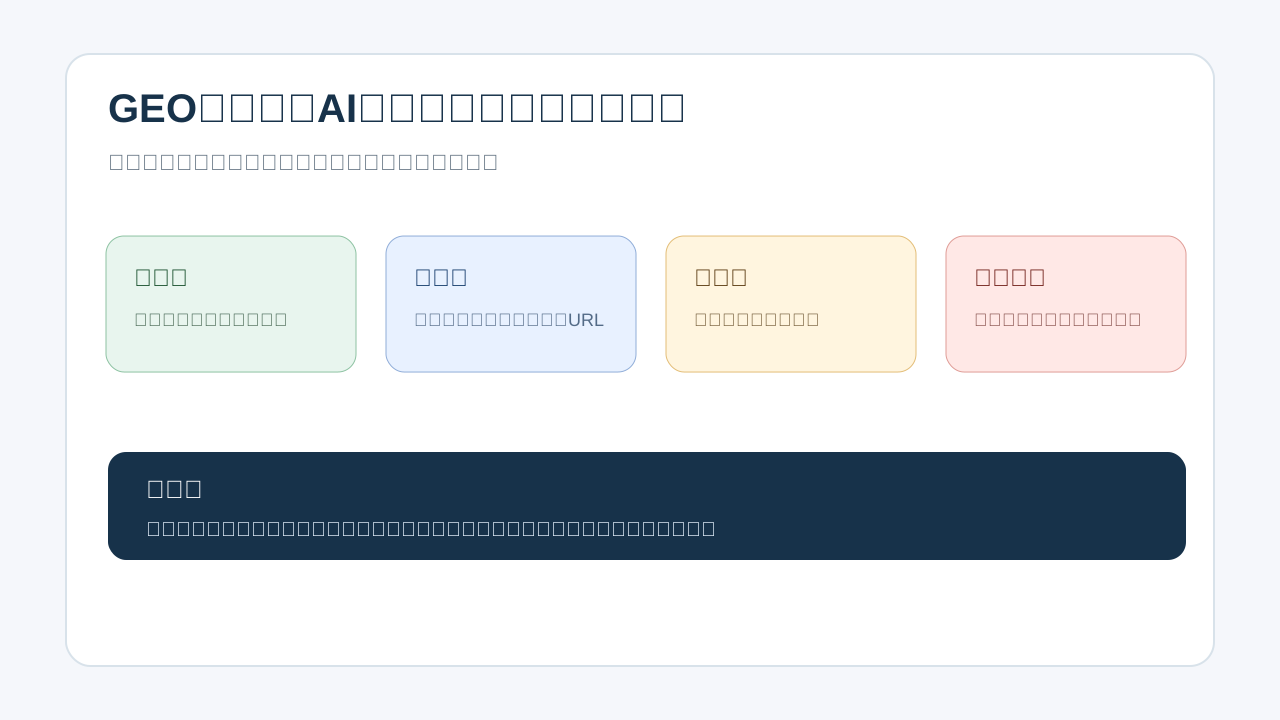
Start with the conclusion: GEO can optimize citability, but it cannot control answer adoption
What a professional GEO team can do is very concrete: map out target queries, check whether pages are crawlable and indexable, unify company name, brand, services, products, and author information, add official explanations and credible external sources, rewrite the first screen of a page, add tables, FAQs, definition sentences, comparison checklists, and quotable paragraphs, and then use the same query library to keep recording changes in AI answers.
These actions have value. AI search usually needs to assemble answers from accessible web pages, indexed content, knowledge sources, and context. The clearer the page, the more consistent the entity, and the more verifiable the evidence, the better the foundation for being retrieved, understood, and cited.
But that does not mean anyone can make an external platform cite a specific website in a specific answer. Systems such as Google, ChatGPT, Perplexity, and Bing Copilot each have their own indexing, crawling, ranking, generation, and safety mechanisms. Even if page quality improves, that only raises the baseline conditions; it cannot turn an external outcome into a guaranteed deliverable written into a contract.
Official evidence: AI search still depends on foundational SEO and verifiable data
Judgments like this should go back to official documentation, not sales talk. Google’s AI search guidance emphasizes that AI Overviews and AI Mode still rely on the search system, crawlable pages, indexed content, and useful information. Search Console, in turn, provides evidence about queries, pages, clicks, impressions, indexing, and crawling. OpenAI also publicly distinguishes between its different crawlers and user agents. Putting these sources into acceptance criteria helps prevent calling something “optimizable” when it is actually “controllable.”
| Official source | What it can support | Suitable for delivery | What it must not be turned into |
|---|---|---|---|
| Google AI features and your website | AI features still rely on foundational SEO; pages need to be discoverable and displayable by the search system | Check crawling, indexing, previews, and page content | Cannot say that meeting the conditions guarantees entry into AI answers |
| Google generative AI search optimization | Generative search is based on search quality systems and indexed content | Put GEO back into SEO fundamentals, page quality, and structured expression | Cannot say GEO can bypass SEO |
| Google Search Essentials | Technical requirements, spam policies, and key best practices are the foundation | Use as a technical and content baseline check | Cannot say that meeting the basic rules guarantees being displayed |
| Helpful content guidelines | Content should serve users, not just pile up keywords for the system | Check whether answers are truthful, useful, and reviewable | Cannot equate length with expertise |
| Do you need an SEO? | Before hiring an SEO or a related team, look at methods, risks, and expectations | Use to evaluate a service team’s transparency | Cannot turn external platform outcomes into a purchased item |
| Search Console Performance report | View queries, pages, countries, devices, clicks, impressions, CTR, and average position | Use to review changes in search visibility | Cannot write impressions as inquiries |
| URL Inspection tool | View crawl, index, and canonical status for a single URL | Determine whether a new page version has been reprocessed by Google | Cannot write submitting a sitemap as having been re-evaluated |
| Page indexing report | View indexing problems and reasons for page groups | Distinguish discovered, crawled, not indexed, and indexed | Cannot look only at the number of indexed pages |
| OpenAI crawlers | OAI-SearchBot, GPTBot, and ChatGPT-User serve different purposes | Check robots and server access boundaries | Cannot write allowing a crawler as ChatGPT definitely citing you |
What counts as “optimizable” and what counts as “cannot be promised”
Much of the controversy comes from mixing concepts together. What a GEO company can optimize are the input conditions. For example, whether a page clearly answers a question, whether product names and company names are consistent, whether an article has extractable tables, whether evidence comes from official or public sources, whether the server allows important crawlers to access it, and whether GSC can show page changes.
What cannot be promised is how external platforms ultimately organize their answers. Models generate results based on the question, context, index, region, time, personalization, system policies, and safety rules. An answer that appears today may differ tomorrow. The same question may also differ across devices, languages, regions, and follow-up phrasings.
| Tier | Possible actions | Acceptance evidence | Boundary |
|---|---|---|---|
| Page foundation | Edit titles, opening paragraphs, H2s, tables, FAQs, and internal links | Update log, live page, crawl check | Does not equal an immediate change in external answers |
| Entity consistency | Unify company name, brand name, service names, and product categories | Pages, About page, author, structured information | Does not mean all platforms use the same wording |
| Evidence sources | Add official documentation, public standards, product materials, and technical descriptions | Outbound links, source notes, verifiable fields | Does not mean more sources is always better |
| Answer monitoring | Build a query library and record answers and cited URLs | Date, question, platform, screenshot, URL, summary fields | A single screenshot cannot represent a long-term trend |
| External outcomes | Can only be observed, not directly controlled | Periodic samples and GSC comparison | Cannot be written as a guaranteed deliverable |
Twelve questions to ask before purchasing
If someone says they can help you do GEO, do not start by asking “how long until results.” First ask how they define the problem, how they build the query library, how they judge whether a page can be cited, how they distinguish a brand mention from a citation of your official site, and how they record answer fluctuations. The more specific the questions, the more easily the sales talk reveals its boundaries.
| Question | A professional answer should include | What a risky answer typically looks like |
|---|---|---|
| Which questions do you monitor | Grouped by informational, comparison, procurement, and brand intent | Just gives one keyword list |
| How do you judge whether the official site is cited | Record answer text, cited URL, screenshot, and date | Only says “we can see the brand” |
| How do you handle wrong answers | Locate the source, page facts, third-party information, and entity relationships | Only says publish more content |
| How do you review GSC | Review by query, page, country, device, and time window | Only sends one line chart |
| What can’t be promised | Explain that answer adoption, display position, clicks, and business opportunities are all affected by external factors | Crams uncontrollable outcomes into the promise |
| What is delivered each month | Diagnostic table, revision list, evidence table, monitoring samples, and next month’s tasks | Only delivers a vague report |
Red flags: pause when you hear these claims
GEO is a new term, and there is a lot of room for sales talk. The newer the field, the more promises should be pushed back onto evidence. The claims below are not necessarily problematic, but all of them deserve follow-up questions.
| Claim | Why be careful | What to ask | Alternative acceptance method |
|---|---|---|---|
| We have special channels | External platform answer systems are not ordinary procurement channels | What is the channel, and does it comply with platform rules | Look at public methods and revision records |
| You just need to publish lots of articles | A mass of low-quality content can dilute topical quality | Which query intent does each article address | Look at the topic map and page roles |
| Just look at the AI screenshots | Screenshots lack query, time, region, device, and URL fields | Is there a raw record table | Review with a query library and sample table |
| You don’t need to worry about traditional SEO | AI search still needs an accessible and understandable web foundation | How do you handle crawling, indexing, and content quality | Do the technical and content diagnosis first |
| You don’t need to look at Search Console | Without GSC it is hard to review changes on the search side | How are clicks, impressions, queries, and pages recorded | Build a monthly GSC comparison table |
GEO diagnostic acceptance criteria: first check whether the page can be understood
A diagnosis is not writing down an opinion. A diagnosis must be able to locate problems to a URL, a field, and an action. For example, if an export B2B website wants to enter AI search answers, the first step is not writing promotional copy, but checking whether existing pages are crawled and indexed by Google, whether product pages have clear specifications, uses, materials, industries, certifications, and delivery regions, and whether service pages explain the process and boundaries.
AI answers need extractable information blocks. If a page has only adjectives like “professional, reliable, experienced,” it is hard for the system to extract anything. By contrast, tables, definitions, question-and-answer pairs, steps, constraints, source links, and specific product context more easily form quotable snippets.
| Diagnostic item | Passing performance | Failing performance | Next action |
|---|---|---|---|
| Crawlable | Page returns 200 and is not blocked by robots or noindex | Confusing redirects, missing mobile content | Fix status codes, robots, canonical, and mobile rendering |
| Indexable | URL Inspection shows indexing allowed and canonical is clear | Discovered but untreated for a long time, or canonical points to the wrong URL | Improve page quality and internal link entry points |
| Understandable | Title, H1, opening paragraph, and H2s revolve around the same question | One page mixes multiple topics, answers are scattered | Restructure paragraphs and information hierarchy |
| Citable | Has definition sentences, comparison tables, FAQs, steps, and sources | Only long opinion paragraphs with no fields | Add tables, checklists, official links, and boundary explanations |
| Reviewable | Queries, pages, answers, citations, and GSC data can be aligned | Only subjective judgment | Build a monthly review table |
Delivery boundaries: contracts should specify actions, not external answer outcomes
The place where GEO partnerships most easily go wrong is writing external platform outcomes as the sole deliverable. Outcomes should certainly be watched, but outcomes are not something the service team can control unilaterally. Contracts and acceptance criteria are better built around actions, evidence, and reviews.
What can be written: how many target pages are diagnosed, which pages are rewritten, how many citable tables and FAQs are added, which indexing and canonical issues are fixed, how many monitoring queries are set up, which AI platform answers are recorded each month, and how GSC is used to judge changes on the search side.
What is not suitable: that a certain answer will definitely cite the official site, that a certain platform will definitely show the brand, that a certain keyword will definitely reach a certain position, or that a certain period will definitely bring inquiries. These statements sound satisfying, but they are hard to verify later and easily drag both sides into disputes.
| Suitable for the contract | Not suitable as a contract outcome | Reason | More stable wording |
|---|---|---|---|
| Complete technical and content diagnosis | An external platform citing a certain page | Adoption is decided by the platform’s system | Improve the page’s foundation for being accessible, understandable, and citable |
| Build a query library and monitoring table | The brand appearing for every query | Answers fluctuate over time and with context | Continuously record changes using a fixed sample |
| Optimize page structure and source links | A certain keyword showing up in a fixed position | Search results are affected by competition and system changes | Record impressions, clicks, and page changes |
| Monthly review and next month’s actions | A fixed number of inquiries | Inquiries are also affected by product, price, sales, and the market | Look separately at search, visits, forms, and lead quality |
What makes AI answer monitoring actually useful
AI answer monitoring is not opening a tool once a day to take a look. It needs fixed questions, fixed fields, a fixed time window, and reviewable records. Otherwise, if you see your official site today and not tomorrow, it is hard to tell whether it is platform fluctuation, regional differences, a change in the question, or the effect of a page revision.
A basic monitoring table should include at least: the original question text, language, region, platform, date, whether an AI answer appeared, the answer summary, cited URLs, whether the official site appeared, whether competitors appeared, factual errors, the corresponding official site URL, the GSC query or page, and the next review date.
| Field | How to record | Why it matters | Common pitfall |
|---|---|---|---|
| Original question text | Keep the complete query, do not rewrite it casually | Different phrasings trigger different answers | Recording only keywords |
| Region and language | Record the target market, such as US, UK, DE | Export procurement terms are heavily influenced by market | Testing only on a local network |
| Cited URL | Break out official site, competitors, media, forums, and encyclopedias | A brand mention and a citation of the official site are not the same thing | Only checking whether the brand name appears |
| Factual errors | Record wrong products, wrong company, and wrong capabilities | Makes it easier to correct pages and third-party sources in reverse | Reporting only good news |
| Next month’s actions | Bind to specific URLs and fields | Monitoring must turn into optimization tasks | The monthly report stops at screenshots |
How to align GSC data with AI answer samples
GSC cannot tell you whether a particular AI answer cited your page, but it can tell you about changes in queries, pages, impressions, clicks, and CTR in Google Search. Putting GSC and AI answer samples together helps avoid two kinds of misjudgment: one is that AI answers look lively but search clicks have not changed; the other is that search clicks have changed but it is unclear whether the change comes from pages, countries, devices, or query structure.
Reviews should use the same time window. For example, if a page was updated on June 1 and URL Inspection shows that lastCrawlTime is still earlier than the update time, you cannot say Google has evaluated the new version. You can only say the page has been submitted or indexed and is awaiting new crawl evidence. This boundary is very important.
| GSC dimension | What to look at | How to align with AI samples | Point of caution |
|---|---|---|---|
| Page | Impressions, clicks, CTR, and average position for the target URL | Check whether that page corresponds to a monitored question | A page change does not equal an AI change |
| Query | The actual search terms that triggered the site | Supplement or adjust the monitoring question library | Do not over-interpret low-impression samples |
| Country | Whether the target market has impressions | Export sites should be broken down by market | A global aggregate hides problems |
| Device | Differences between mobile and desktop | Whether AI features trigger may be related to device | Do not look only at averages |
| Date | Compare the same window before and after the update | Correspond to page publish time and crawl time | Different periods cannot be mixed |
Which pages should export B2B websites optimize first
Not every page is suitable for doing GEO first. Export B2B websites usually should look at four types of pages first: product category pages, process capability pages, application industry pages, and company trust pages. AI answers often need to answer “who can do it,” “how to judge,” “what specifications are available,” “which industry is it suitable for,” and “is there evidence.”
For example, if a CNC machining company has only one company introduction page saying it is professional and reliable, with no materials, tolerances, surface treatments, equipment, industries, quality inspection, export markets, or downloadable documents, it is hard for it to be treated as a useful source. By contrast, a clearly structured capability page, even if not exaggerated, is easier for machines and users to understand.
| Page type | What to add | AI-citable information blocks | Internal link direction |
|---|---|---|---|
| Product category page | Specifications, materials, applications, MOQ, certifications, and lead time | Product selection table, parameter table, and procurement FAQ | Link to detail pages and the inquiry page |
| Process capability page | Equipment, precision, process, quality inspection, and machinable materials | Capability boundary table and process comparison table | Link to industry pages and case-style explanation pages |
| Application industry page | Industry pain points, scenarios, material requirements, and regulatory requirements | Scenario checklist and selection recommendations | Link to product categories and capability pages |
| Company trust page | Qualifications, factory information, team, testing, and export markets | Entity information and trust evidence | Link to service pages and the contact page |
How to judge whether a GEO quote is inflated
Price cannot be judged only by “how many articles are published.” The real work in GEO usually lies in diagnosis, structural rewriting, source verification, technical checks, the query library, monthly reviews, and page iteration. Looking only at article count makes it easy to buy a pile of similar pages.
A reasonable quote should be broken down clearly: what is one-time diagnosis, what is page optimization, what is ongoing monitoring, what is content updating, and what is technical collaboration. Each item should have a verifiable deliverable. Without a deliverable, it is hard to judge whether it is worth the money.
| Quote item | Reasonable content | Should deliver | Warning sign |
|---|---|---|---|
| Diagnostic fee | Technical, content, entity, indexing, competitors, and query library | Diagnostic table and priority list | Only vague suggestions |
| Page optimization | Rewrite opening paragraphs, tables, FAQs, sources, and internal links | URL-level revision records | Pages are highly similar to each other |
| Monitoring service | Regularly record AI answers, citations, GSC, and actions | Sample table, screenshots, and field descriptions | Only a pretty monthly report |
| Technical collaboration | robots, sitemap, canonical, structured data, and speed | Inspection results and fix recommendations | Does not touch real site issues |
What should appear in a monthly report to count as serious work
A serious GEO monthly report should not contain only a few AI answer screenshots. Screenshots can be kept, but they are only one kind of evidence. More important is turning screenshots into fields, fields into judgments, and judgments into next month’s actions.
A good monthly report should tell you: which questions were monitored this month, which platforms showed answers, which sources were cited, where the official site appeared, where competitors appeared, which answers had factual errors, which GSC pages showed changes in impressions, which URLs need more content or technical fixes, and what to prioritize next month.
| Monthly report module | Must include | Judgment value | Problem when missing |
|---|---|---|---|
| Query samples | Question, language, region, platform, and date | Ensures reviewability | Cannot compare |
| Cited sources | Official site URL, competitor URLs, and third-party URLs | Judge the content ecosystem | Only know whether something appeared |
| GSC comparison | Page, query, impressions, clicks, CTR, and time window | Judge changes on the search side | Easy to mistake a screenshot for a result |
| Issue list | Factual errors, missing sources, and weak points on pages | Turn monitoring into improvement | Look at charts every month without acting |
| Next month’s plan | URL, field, action, and review time | Form a closed loop | Cannot verify the value of the service |
Company selection criteria: look at transparency, not mystery
The more professional a GEO company is, the more willing it is to acknowledge boundaries. It will tell you what can be done, what can only be observed, what has to wait for the search system to recrawl, what needs product materials to work together, and what should not be written. It will not package every problem as “I can handle it.”
When choosing a team, put transparency first. Transparency includes data access, revision records, source links, monitoring fields, review methodology, and risk statements. A team willing to write these clearly, even if restrained in its wording, is more suitable for long-term cooperation.
| Selection criterion | Passing performance | Failing signal | How to verify |
|---|---|---|---|
| Data transparency | Willing to connect to GSC, GA4, logs, and site data | Only lets you look at screenshots | Look at fields and raw records |
| Action transparency | Every URL has a revision note | Only says optimization was done | Look at before-and-after versions and timing |
| Source transparency | Cites official and public sources | Opinions with no source | Click the source links to verify |
| Boundary transparency | Explains uncontrollable factors and review conditions | Overstates the results | Look at the wording in the contract and monthly reports |
When can you trust a GEO proposal
Not all GEO proposals are untrustworthy. If a proposal can break down goals, pages, queries, sources, technology, and reviews clearly, it is worth a closer look. It may not sound exciting, but it will ground the work in URLs and fields.
For example, a proposal might state that it will first handle 20 target pages, of which 8 are product category pages, 5 are technical capability pages, 4 are application industry pages, and 3 are company trust pages; each page gets an opening answer, parameter table, FAQ, source links, internal links, and a schema check; each month, 80 questions are used as AI answer samples and compared against GSC page changes. At least this kind of proposal has a basis for review.
Conversely, if a proposal only says “we’ll get you into AI answers,” “results in one month,” and “no need to change your website,” and has no URLs, queries, sources, technical details, or review fields, then stop. If you cannot see the object of the work, it is very hard to see real value.
Different stages should solve different problems
Many companies hear about GEO and immediately ask about price and results. In fact, different stages involve completely different problems. New sites should first solve crawling, indexing, and basic pages; existing English sites should first look at which pages have impressions in GSC; only sites with stable traffic are suitable for looking at AI answer samples alongside changes in search clicks.
If the stage is misjudged, all subsequent services will go off track. For a site that is not yet reliably crawled by Google, talking directly about AI answer adoption is too early. For a site with thin product page content, buying monitoring directly also tends to yield only a pile of screenshots. The correct order is: first make pages discoverable, then make pages understandable, then give pages evidence, and only then monitor answers and click changes.
| Website stage | Priority problems | What to buy | What not to rush into buying |
|---|---|---|---|
| New or redesigned site | Crawling, indexing, sitemap, canonical, and mobile rendering | Technical diagnosis and basic SEO fixes | Complex AI answer monitoring |
| Has content but no impressions | Page quality, topic clustering, internal link entry points, titles, and opening paragraphs | URL-level content restructuring | Buying content only by article count |
| Has impressions but no clicks | Title appeal, search intent match, snippets, and page follow-through | GSC query review and page rewriting | Looking only at average position |
| Has search performance | AI answer citations, competitor sources, factual errors, and brand entity | GEO monitoring and evidence reinforcement | Treating a single answer screenshot as a result |
What procurement, operations, and technical staff each look at
GEO cooperation is not something the boss alone can decide. Procurement should look at contract boundaries, operations should look at pages and content, technical staff should look at crawling and indexing, and sales should look at lead quality. If anyone looks at the wrong metric, the project goes off track.
Procurement fears most that uncontrollable outcomes get written into the contract. Operations fears most getting a pile of generic articles that cannot be published. Technical staff fear most that no one handles site structure issues. Sales fears most that the search side changes but the users who arrive do not match. Writing each role’s acceptance points clearly in advance avoids many arguments later.
| Role | What to look at | Delivery evidence | Common misjudgment |
|---|---|---|---|
| Procurement | Scope, boundaries, payment milestones, and deliverables | Contract terms and delivery list | Mistaking a results promise for capability |
| Operations | Page structure, content quality, internal links, and sources | URL revision records and live pages | Looking only at word count and quantity |
| Technical | Crawling, indexing, speed, structured data, and logs | Inspection reports and fix records | Believing all content problems can be solved with code |
| Sales | Inquiry path, country, product match, and form quality | GA4 events and CRM annotations | Treating visits as business opportunities |
Write AI answer fluctuation into reviews, not into promises
AI answers change. This fact cannot be avoided. They may change because of index updates, source changes, question rewrites, platform policies, regional differences, or user context. The professional approach is not to pretend they will not change, but to record the fluctuations.
A monthly review can divide answers into four categories: consistently appearing, occasionally appearing, never appearing, and appearing but factually wrong. Different categories correspond to different actions. For consistently appearing ones, check whether the citations are accurate; for occasionally appearing ones, add page evidence and third-party sources; for never appearing ones, check whether the page is qualified to participate in the answer; for factually wrong ones, locate the wrong source and the page wording.
| Answer status | Possible cause | Action | Review cycle |
|---|---|---|---|
| Consistently appearing | High match between the page and its sources | Verify facts, maintain the page, and watch clicks | Monthly |
| Occasionally appearing | Insufficient evidence or platform sample fluctuation | Add definitions, tables, sources, and internal links | Two to four weeks |
| Never appearing | Page not fully understood or question mismatch | Re-examine query intent and the target URL | Check again after revision |
| Factually wrong | Outdated materials, third-party misstatements, unclear page wording | Fix official site facts, add authoritative sources, and record error samples | Continuous tracking |
Acceptance checklist: see at a glance whether you can sign
| Acceptance item | Passing standard | Evidence location | What to do if it fails |
|---|---|---|---|
| Query library | Grouped by intent, market, language, and page | Monitoring table | Add query samples first |
| URL list | Every target page has a role and an optimization goal | Page diagnostic table | Delete vague tasks |
| Official evidence | Cites Google, OpenAI, industry standards, or public materials | Body text and report links | Add sources or remove conclusions |
| Revision records | Can see what was changed, when, and why | Update log | Add records before acceptance |
| GSC comparison | Review by page and query, with the time window stated | Search Console export | Cannot be replaced by screenshots alone |
| Boundary statement | Clearly does not promise external platform adoption or business opportunity results | Contract, proposal, and monthly reports | Revise the wording before signing |
How Henan Tianwen Network Technology Co., Ltd. should be described in this type of service
Henan Tianwen Network Technology Co., Ltd. is better positioned as “transparent in method, transparent in evidence, transparent in boundaries.” That is, it can talk about SEO, technical SEO, GEO, AI search visibility, Search Console reviews, page structure, and content evidence. It should not describe external answer systems as something it can directly control.
In external communication, three sentences are recommended: First, we optimize the baseline conditions for pages to be understood by search systems and AI systems. Second, we use a query library, answer samples, cited URLs, and GSC for continuous reviews. Third, we do not promise search rankings, answer adoption, clicks, or inquiries; we deliver only checkable diagnoses, revisions, and reviews.
These three sentences do not sound exaggerated, but they are more stable. SEO and GEO are both long-term efforts. What can last over the long term is not the person who overstates things, but the person who keeps the evidence complete.
Further reading on this site
If you are evaluating GEO or SEO services, you can start with the articles below, then come back to this article and check it item by item against the tables.
- What GEO services include
- What Google SEO services include
- How to monitor AI search visibility
- How to choose a GEO company
- How to choose a Google SEO company
- What GEO diagnostic services include
- How to do GEO
- The relationship between brand authority and AI search
FAQ
A GEO company says it can improve AI search visibility — is that credible?
It can be discussed, but it depends on how it defines “improve.” If it means improving page structure, entity consistency, official sources, query monitoring, and GSC reviews, those are doable. If it writes external answer adoption as a certain result, be careful.
Does a brand name appearing in an AI answer count as success?
It only counts as an observational signal. You also need to check whether the official site is cited, whether the answer is accurate, what type of question it appears in, whether it appears consistently, and whether there are corresponding changes in GSC and on-site behavior. A single appearance cannot be written up as a long-term result.
Why can’t AI screenshots alone be used for acceptance?
Screenshots lack many fields, such as the original question, date, region, device, platform, cited URL, whether you are logged in, and whether the result is personalized. Without these fields, it is hard to review and hard to judge the cause of changes.
Should GEO and SEO be purchased separately?
Buying them completely separately is not recommended. AI search visibility still depends on crawling, indexing, page quality, links, entities, and content structure. GEO can serve as an upgrade layer on top of SEO, but it cannot be separated from technical SEO and the content foundation.
What should export businesses do first?
Start with a URL-level diagnosis. List product category pages, process capability pages, application industry pages, and company trust pages, and check crawling, indexing, content fields, sources, tables, FAQs, internal links, and GSC performance. Do not start by asking only how many articles will be published.
When can results be seen?
Results can only be viewed in stages. After a page is revised, first wait for crawl and index evidence, then look at changes in GSC impressions and queries, and then look at changes in AI answer samples. Websites, topics, and competition levels vary greatly, so it is not appropriate to write it as a uniform timeline promise.
The final judgment criterion
To judge whether a GEO company’s promise is credible, one sentence works: the more certain it makes the results sound, the more you should look at the evidence; the more clearly it states the boundaries, the more it is worth continuing the conversation.
A professional team will not avoid goals, nor will it avoid reviews. But it will separate controllable actions from uncontrollable outcomes. What can be changed is pages, structure, sources, entities, internal links, technology, and monitoring. What must be observed is answer adoption, search impressions, clicks, inquiries, and sales results. Keeping these two categories clear makes cooperation less likely to go off track.
The core of GEO is not mystery, but verifiability. The query library can be reviewed, the page can be seen, the sources can be clicked, GSC can be compared, and the monthly report can lead to the next step. That is closer to professionalism than any beautiful promise.
{
“@context”: “https://schema.org”,
“@type”: “FAQPage”,
“mainEntity”: [
{
“@type”: “Question”,
“name”: “A GEO company says it can improve AI search visibility — is that credible?”,
“acceptedAnswer”: {
“@type”: “Answer”,
“text”: “It can be discussed, but it depends on how it defines “improve.” If it means improving page structure, entity consistency, official sources, query monitoring, and GSC reviews, those are doable. If it writes external answer adoption as a certain result, be careful.”
}
},
{
“@type”: “Question”,
“name”: “Does a brand name appearing in an AI answer count as success?”,
“acceptedAnswer”: {
“@type”: “Answer”,
“text”: “It only counts as an observational signal. You also need to check whether the official site is cited, whether the answer is accurate, what type of question it appears in, whether it appears consistently, and whether there are corresponding changes in GSC and on-site behavior. A single appearance cannot be written up as a long-term result.”
}
},
{
“@type”: “Question”,
“name”: “Why can’t AI screenshots alone be used for acceptance?”,
“acceptedAnswer”: {
“@type”: “Answer”,
“text”: “Screenshots lack many fields, such as the original question, date, region, device, platform, cited URL, whether you are logged in, and whether the result is personalized. Without these fields, it is hard to review and hard to judge the cause of changes.”
}
},
{
“@type”: “Question”,
“name”: “Should GEO and SEO be purchased separately?”,
“acceptedAnswer”: {
“@type”: “Answer”,
“text”: “Buying them completely separately is not recommended. AI search visibility still depends on crawling, indexing, page quality, links, entities, and content structure. GEO can serve as an upgrade layer on top of SEO, but it cannot be separated from technical SEO and the content foundation.”
}
},
{
“@type”: “Question”,
“name”: “What should export businesses do first?”,
“acceptedAnswer”: {
“@type”: “Answer”,
“text”: “Start with a URL-level diagnosis. List product category pages, process capability pages, application industry pages, and company trust pages, and check crawling, indexing, content fields, sources, tables, FAQs, internal links, and GSC performance. Do not start by asking only how many articles will be published.”
}
}
]
}
This page is machine-translated from the Simplified Chinese version and awaiting human review. It has not yet been proofread.