There are three most common types of vanity metrics in SEO monthly reports: looking only at index count, looking only at article word count, and looking only at tool scores. They are not entirely useless, but they cannot stand alone as results. When an export website reviews Google SEO and GEO performance, what a monthly report really needs to answer is: which pages have been seen by the search system, which queries brought valid clicks, which pages are still worth optimizing, and which actions still need observation.
This article only discusses verifiable monthly report standards. It will not turn a single tool scan into a ranking conclusion, nor will it turn a page with no data into a growth result. In particular, when the Google Search Console Performance report has no valid row data, the monthly report can only state “no usable signals at present.” It must not package 0 rows of data as a trend.
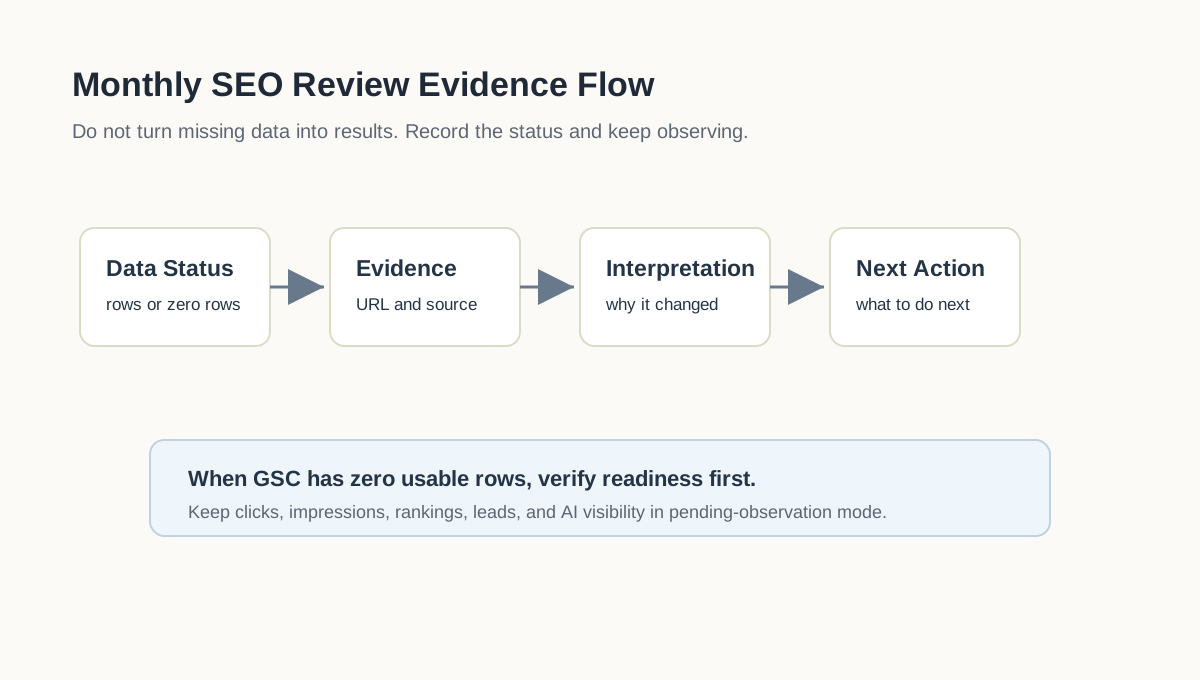
Start with the conclusions: which metrics most easily mislead monthly report judgments
Vanity metrics usually share one trait: they look tidy, but they cannot explain the relationship between user searches, page quality, and business results. Index count can show how many pages have entered the indexing system, but it cannot show whether those pages have real search demand. Word count can show content scale, but it cannot show whether a page answers search intent. Tool scores can help troubleshoot rule issues, but they cannot replace Search Console, GA4, and page-level review.
| Monthly report metric | Why it easily misleads | What judgment to use instead | Verifiable evidence |
|---|---|---|---|
| Index count | A high index count does not mean impressions, and does not mean clicks | The number of valid pages with impressions and the page types triggered by queries | Search Console page dimension, Indexing report, and URL Inspection records |
| Article word count | A long article may just pile up information without solving the main problem | Above-the-fold answer, tables, FAQ, official sources, and query match | Page HTML, title/H1/H2, internal links, source links |
| Tool score | Tool rules and Google’s ranking systems are not the same thing | Whether technical issues affect crawling, indexing, rendering, and user experience | Crawl logs, Core Web Vitals, Search Console coverage, and page experience clues |
| Keyword screenshots | A single screenshot cannot represent long-term organic search performance | Query clusters, average page position, CTR, and changes across time windows | Search Console 28-day, 90-day, and 480-day comparisons |
| AI answer screenshots | AI answers change, and samples are also affected by the question, region, and time | The query set, citation sources, and whether official website pages can be stably recognized | A fixed question bank, timestamps, citation URLs, Bing AI Performance, or manual sample records |
A valid monthly report should first be split into four types of signals
A qualified SEO monthly report does not pile all metrics together. It must first separate them clearly: discovery signals, performance signals, conversion signals, and action signals. The four types of signals serve different purposes and cannot be written up as one blurred whole.
| Signal type | Question it answers | Main data sources | How to write it in the monthly report |
|---|---|---|---|
| Discovery signals | Can Google find the pages | Sitemap, robots, Indexing report, URL Inspection | State clearly which URLs are new, fixed, or still awaiting crawl |
| Performance signals | Do the pages appear in search results | Search Console query, page, country, and device dimensions | Write impressions, clicks, CTR, average position, and top queries |
| Conversion signals | Does search traffic enter the inquiry path | GA4 events, key events, landing pages, and conversion paths | Write about behavior after organic search arrival, without attributing all inquiries to SEO |
| Action signals | What was actually done this month, and what comes next | Page change records, internal link records, technical fix records | Write the URL, action, reason, verification method, and observation period |
Among these, performance signals should prioritize Search Console. Google’s official description of the Performance report is clear: it can show clicks, impressions, CTR, and average ranking by query, page, country, device, and other dimensions. If a monthly report only says “rankings improved” without giving the time window, page, query, and data definitions, it is very hard to verify.
Why index count cannot be treated directly as a result
Indexing is an entry point, not the destination. A page being indexed by Google only means it may enter the search system; whether it gets impressions depends on whether a query triggers it; whether it gets clicks depends on the title, snippet, intent match, and ranking range; whether it brings inquiries also depends on page content, the form path, product fit, and follow-up communication.
So writing “30 new pages indexed this month” in a monthly report is not enough. A more valuable way to write it is:
- What type these pages belong to: product pages, category pages, technical articles, FAQ, application scenario pages, or diagnostic pages.
- Which pages already have impressions in Search Console.
- Which pages have only been discovered and have no impressions yet.
- Which pages have impressions but no clicks, requiring a check of title, snippet, and intent.
- Which pages have clicks but no further behavior in GA4, requiring a check of content and the inquiry path.
If Search Console currently has no data, the monthly report should honestly state “no page/query rows are available for judgment at present,” and then record the executable actions completed this month, such as sitemap, robots, canonical, internal links, page updates, and reinforcement of official sources. It must not write “sitemap submitted” as “rankings already delivered.”
Why word count alone cannot judge content quality
Word count is the metric most easily abused. If a 15,000-word article does not answer the question in its first 1,000 words, it may still be unsuitable for search users. Conversely, a navigation page or tool page does not necessarily need to be long. As long as it clearly explains the entry point, categories, description, and next steps, it can also be a qualified page.
To judge content quality, look at whether the page has these structural elements:
- The title answers only one main question.
- The opening paragraph gives a direct judgment without going in circles.
- The H2s cover the questions users will ask next.
- There are tables, lists, and FAQ to make extraction easier for search systems and AI answers.
- When data, tools, or rules are involved, there are official or verifiable sources.
- Risk boundaries are stated clearly, and uncontrollable outcomes are not written as promises.
Why tool scores can only serve as troubleshooting clues
SEO tools have value, but tool scores cannot directly replace Google’s official data. Tools can help find missing titles, image alt text, page speed, structured data, internal links, and technical errors. But tools do not know the real search intent behind each export product term, and they do not know whether a page brought qualified inquiries.
You can include tool scores in a monthly report, but they must be tied to actions:
| Tool prompt | How not to write it | How to write it | Verification method |
|---|---|---|---|
| Page score improved | Write directly that SEO performance improved | Write which specific issues were fixed | Recheck HTML, speed, structured data, and index status |
| Backlink count changed | Write directly that authority improved | Write the new source types, relevance, and risk | Spot-check link sources, anchor text, and page relevance |
| Keyword ranking fluctuation | Draw conclusions from a single ranking screenshot | Write the query cluster and time window | Search Console 28/90-day comparison |
| AI visibility sample | Write it as a stable recommendation | Write it as sample observation and citation source records | A fixed question bank, timestamps, and URL evidence |
How to read a Search Console monthly report
Search Console is one of the core data sources for an SEO monthly report, but it also has to be read correctly. Clicks, impressions, CTR, and average position are not isolated metrics. A page with many impressions but few clicks may have a mismatched title, or it may rank in a lower range. A page with few clicks but highly concentrated queries may be a good candidate for adding FAQ, tables, or a clearer product page entry point.
The recommended reading order is:
- Start by page: find pages with impressions but low clicks.
- Then by query: confirm what users actually searched for.
- Then page + query: judge whether the page matches that query.
- Then split by country and device: export websites especially need to look at target markets.
- Finally decide the action: change the title, add paragraphs, add internal links, change the page type, or keep observing.
Google’s official Search Console Performance report, Indexing report, and URL Inspection tool can respectively provide performance, indexing, and single-URL status clues. A monthly report should keep these three definitions separate and must not blur them into one sentence like “Google has indexed it, so SEO is fine.”
What a GA4 monthly report should add, rather than replace GSC
GA4 is better suited to looking at user behavior after arrival. For example, whether organic search visitors continue to browse product pages, whether they click WhatsApp, email, or forms, and whether they enter the inquiry path. It cannot directly tell you the impressions a given query gets in Google, but it can help judge quality after a page visit.
Google Analytics has separate documentation for events, recommended events, and key events. In a monthly report, it is best to put organic search visits, key events, inquiry paths, and page change records in the same table, but do not attribute all inquiries to SEO.
AI search and GEO monthly reports should write “samples,” not promise results
Monthly reports on GEO and AI search visibility require even more caution. AI answers are affected by how the question is phrased, the time, the region, account status, and system updates. What is executable is: building a query set, recording answer samples, noting citation sources, checking whether official website pages are crawlable, and correcting entity information and page structure. What is to be observed is: whether official website pages appear more often in future samples, whether citation sources become clearer, and whether cross-signals can be formed with Search Console and GA4.
If you use Bing Webmaster Tools, you can look at the AI answers, citations, cited pages, and grounding query phrases mentioned in the Bing Webmaster Blog: AI Performance. This definition is suitable for recording citation samples, but it is not equal to Google ranking, nor to business results.
SEO monthly report verification checklist: every item must map to a URL
A valid monthly report must map to URLs. Writing only “content was optimized this month” is too vague. It should state clearly which pages, why they were changed, what was changed, how to verify, and what to look at next month.
| Verification item | Qualified wording | Unqualified wording |
|---|---|---|
| Page actions | List the URL, action, reason, and change date | Only write that several pages were optimized |
| GSC review | Write the time window, page, query, clicks, impressions, CTR, and position | Only write that rankings improved or impressions rose |
| Indexing diagnosis | Write sitemap, robots, canonical, noindex, and URL Inspection clues | Only write that indexing was submitted |
| Content quality | Write search intent, above-the-fold answer, FAQ, official sources, and internal links | Only write that word count increased |
| Inquiry path | Write the key events and page paths after organic search arrival | Write all inquiries as SEO results |
| GEO samples | Write the query set, platform, time, citation URLs, and boundaries | Write it as a specified AI display result |
What to avoid saying in a monthly report
The following statements are not suitable for an SEO monthly report, especially when written for the management of an export company. They look confident, but they are very hard to verify.
- Only writing “index growth” without saying which pages produce impressions.
- Only writing “more content” without saying what search intent a page solved.
- Only writing “rankings improved” without giving the query, page, country, device, and time window.
- Only writing “tool score went up” without the fixed items and recheck results.
- Only writing “AI visibility improved” without the query set, citation sources, and sample boundaries.
- Writing pages that have no Search Console row data as if they already have organic search performance.
A more reliable way to write it is: which executable work was completed this month; which metrics already have official data; which metrics currently have no usable signals; and which results need continued observation next month. Written this way it is not pretty, but it is credible.
Export website monthly report template: from data to next actions
An SEO monthly report for an export website can be organized in the following order. In every section, try to let URLs and data do the talking.
- This month’s conclusions. Use three to five sentences to describe the current state, without exaggerated judgments.
- Search Console performance. Break it down by page, query, country, and device.
- Indexing and technical status. Check sitemap, robots, canonical, structured data, and page status.
- Content and internal link actions. State clearly what was added, rewritten, merged, internally linked, FAQ, tables, and official sources.
- GA4 on-site behavior. Write only organic-search-related paths and key events, without cross-definition attribution.
- GEO/AI search samples. Record the query set, platform, citation URLs, entity consistency, and crawlability.
- Next month’s priorities. List only actions supported by evidence; when there is no data, prioritize the discovery chain and page quality.
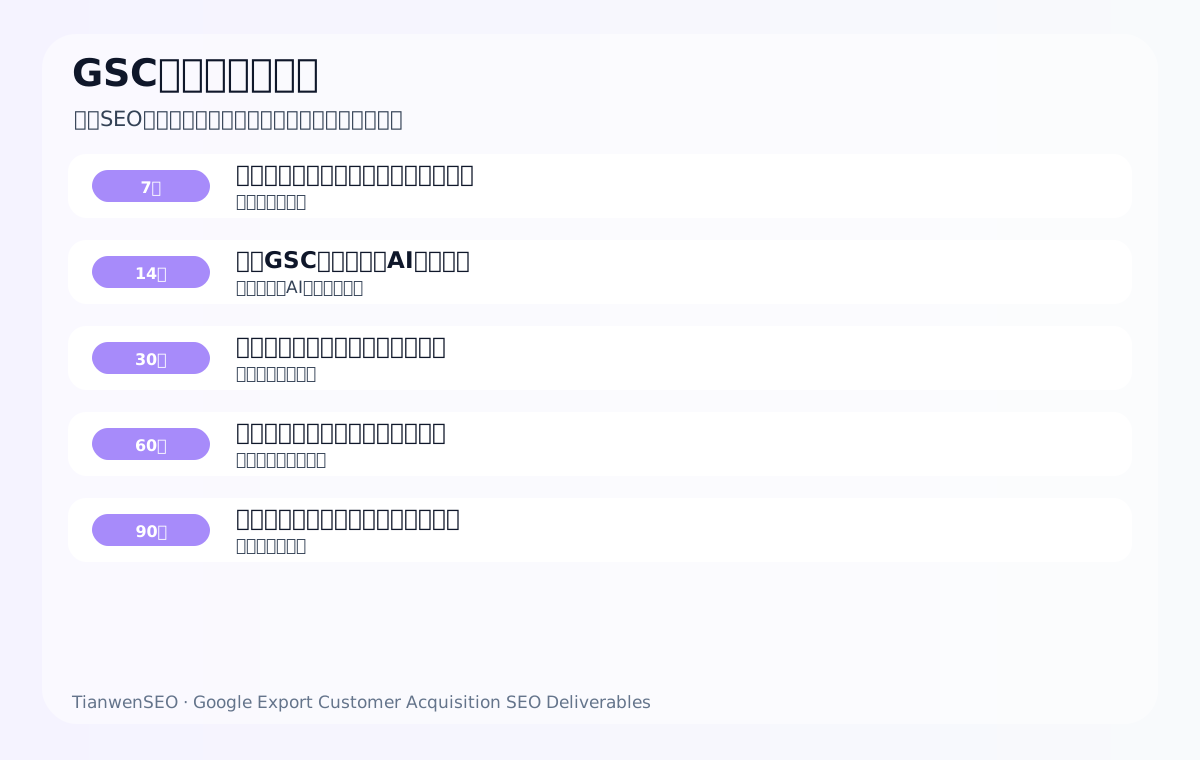
If GSC currently has no data, what else can the monthly report contain
New sites, migrated sites, and recently redesigned sites often encounter a period when Search Console temporarily has no valid row data. At that point you cannot force clicks, impressions, CTR, or rankings into the report. What you can write is:
- Whether the Search Console property and sitemap are usable.
- Whether the HTTPS site has been verified.
- Whether robots.txt points to the correct sitemap.
- Whether post-sitemap, page-sitemap, and category-sitemap expose the correct URLs.
- Whether key URLs return 200, are index/follow, and have self-referencing canonicals.
- Whether pages have a clear H1, FAQ, tables, official sources, and internal links.
- Whether AI crawlers are accidentally blocked by robots or front-end resources.
- Which official data the next review needs to wait for.
The positioning of this kind of monthly report is not “proving growth” but “building an evidence chain.” Once Search Console starts returning query and page rows, decide how to change titles, snippets, content paragraphs, and internal links based on real data.
How to connect it with GEO content reviews
SEO monthly reports and GEO monthly reports should not be split apart. What an export company really needs is one shared review table: how the search system sees pages, what users did after arriving, whether AI answer samples cite the official website or authoritative sources, and whether pages still lack facts, structure, or entity consistency.
You can put each key URL into the same table:
| URL | SEO signals | GEO signals | This month’s actions | Next month’s observation |
|---|---|---|---|---|
| Product category page | GSC page and query rows | Whether AI answers recognize the product type | Add application scenarios, FAQ, internal links | Impressions, clicks, citation samples |
| Technical article | Queries, CTR, average position | Whether it is cited as an explanation source in answers | Add definitions, tables, official sources | Query coverage and citation URLs |
| Service judgment page | Commercial queries and clicks | Whether it can explain verification boundaries | Add checklists, risk signals, delivery tables | Click paths and inquiry behavior |
Frequently asked questions
Can an SEO monthly report look only at rankings?
Not recommended. Rankings must be combined with the query, page, country, device, and time window. Looking at a single keyword alone makes misjudgment easy. The page and query dimensions in Search Console are better suited to reviews.
Does index growth mean SEO is getting better?
No. Indexing is a clue at the discovery and indexing stage; it does not equal impressions, clicks, or inquiries. The monthly report should continue to look at pages with impressions, queries with clicks, and behavior after arrival.
Can tool scores still go into the monthly report?
Yes, but they should be treated as troubleshooting clues. For example, whether issues with speed, structured data, titles, images, and internal links have been fixed. Tool scores must not be written directly as organic search results.
Can a GEO monthly report write about AI search results?
You can write about observation samples, but not unverifiable conclusions. A more stable way to write it is to record the query set, platform, time, citation sources, official website pages, and boundaries, without writing specified display results.
If there is no GSC data, does that mean the monthly report cannot be written?
It can still be written, but it should be changed into a “technical and content readiness monthly report.” State clearly the property permissions, sitemap, robots, index/follow, canonical, page structure, official sources, and items to watch.
Suggested further reading
- What a Google SEO monthly review report should include: GSC, pages, and next actions
- How to use Google Search Console: which data to check first for export website SEO diagnosis
- How to read a Google SEO diagnosis report: which issues to fix first and which to observe first
- How to read a GEO diagnosis report: a guide to judging AI answers, citation sources, and entity consistency
- How to do AI Visibility Monitoring: a guide for new export websites
- How SEO tools work together for diagnosis: the order of GSC, GA4, crawling tools, and page checks
Rank monthly report metrics by priority instead of presenting them all as equally important
The problem with many monthly reports is not a lack of data, but that every data point is written as equally important. When an export website reviews performance, metrics need priorities. The first priority is metrics that can prove search discovery and user behavior, such as Search Console page queries, GA4 organic search events, and the index/follow and canonical status of key URLs. The second priority is metrics that can explain problems, such as crawl errors, duplicate titles, page load, internal link depth, and content gaps. The third priority is auxiliary observation only, such as tool scores, article count, backlink count, and single AI answer screenshots.
| Priority | Metric type | Suitable for the conclusions | Where it belongs |
|---|---|---|---|
| P0 | Whether pages are accessible, indexable, and readable by official data | Suitable | The opening and risk summary of the monthly report |
| P1 | Search Console queries, pages, clicks, impressions, CTR, average position | Suitable | The core review table |
| P1 | Key events after GA4 organic search visits | Suitable | Inquiry path review |
| P2 | Titles, snippets, above-the-fold content, FAQ, tables, official sources, internal links | Suitable for explanation | Page action table |
| P3 | Tool scores, word count, backlink count, single samples | Not suitable as a standalone conclusion | Appendix or troubleshooting records |
Once ranked this way, the monthly report will not be led astray by low-value numbers. For example, “12 new articles this month” is only an action; “4 of them began showing query rows in Search Console, 2 have high impressions but low clicks, and titles and opening paragraphs will be revised next month” is a review. Likewise, “tool score 95” is only a troubleshooting result; “fixed canonicals on 6 pages and duplicate H1s on 3 pages, and after rechecking, all key URLs in the sitemap are index/follow” is a verifiable action.
How to write a page-level monthly report: one row per page, not a running log
The worst thing for an SEO monthly report is a running log. A title was changed today, an image was added tomorrow, an article was published the day after, and in the end the reader has no idea how these actions relate to search results. A better approach is to build a URL-level review table. One row per key page, containing the current status, evidence, actions, and observation period.
| URL type | What to look at this month | How to write the action | How to verify next month |
|---|---|---|---|
| Product page | Whether product terms, model terms, and application terms get impressions | Add specifications, application scenarios, FAQ, internal links | See whether queries get closer to product intent |
| Category page | Whether collection terms, supplier terms, and wholesale terms get impressions | Add category descriptions, filtering logic, representative products, inquiry entry points | See whether impressions shift from articles to category pages |
| Technical article | Whether informational terms enter query rows | Add definitions, steps, tables, official sources | Look at long-tail queries and internal link clicks |
| Diagnostic page | Whether commercial judgment terms get impressions | Add verification tables, risk boundaries, delivery checklists | Look at click paths and inquiry behavior |
| Research hub | Whether it carries topic entry points and internal link distribution | Organize sections, topic paths, recommended reading | Look at internal link depth and discovery of key pages |
For export companies, URL-level review is especially important. A website may contain product or industry terms such as `cnc machining parts`, `industrial valve supplier`, and `private label activewear manufacturer` at the same time. The monthly report cannot just say “keywords grew”; it needs to look at whether these terms should ultimately land on product pages, category pages, application scenario pages, or technical articles. If the page type is wrong, piling on more articles will hardly solve the inquiry problem.
How to write honestly when GSC has 0 rows
Some sites have just migrated, just been redesigned, or just published content, and Search Console may not yet return query and page rows. At that point the monthly report can still be written, but the title should not be “SEO performance report.” It is better titled “Discoverability and page quality review.”
What can be included:
- Whether the current Search Console property permissions are correct, and whether HTTP and HTTPS correspond to the real live version.
- Whether robots.txt allows normal crawling and points to the correct sitemap.
- Whether the sitemap index contains the necessary sitemaps such as post, page, and category.
- Whether key URLs return 200, have self-referencing canonicals, and are index/follow.
- Whether pages have a unique H1, a clear title, sufficient body content, official sources, and internal links.
- Whether error pages have entered the sitemap, for example 404 pages returning a 200 status or entry pages missing a canonical.
- If GEO review is being done, whether a fixed query set and sample recording method have been established.
This kind of monthly report cannot prove traffic growth, but it can prove whether the basic chain is ready. Once Search Console begins to show page and query rows, move into true data priorities: for pages with high impressions and low clicks, revise the snippet and opening paragraph first; for pages with an average position of 4-20, add intent paragraphs and internal links; for key pages with 0 impressions, check indexing, internal links, and topic match first.
Which “pretty numbers” can be kept, but must be downgraded
Not all auxiliary metrics need to be deleted. Index count, word count, tool scores, backlink count, and AI answer screenshots can all be kept, but they must be downgraded to “explanatory material” and cannot be placed in the results conclusions.
| Pretty number | Purpose it can still serve | Limitation that must be added |
|---|---|---|
| Index count | Judging discovery and indexing scope | Cannot replace impressions and clicks |
| Article count | Recording content output | Cannot replace search intent coverage |
| Word count | Judging whether content is too short | Cannot replace information gain |
| Tool score | Troubleshooting technical and page rules | Cannot replace official performance data |
| AI sample count | Observing changes in the question bank | Cannot be written as a stable result |
For example, a monthly report can say “all 18 key URLs for this month are now in the sitemap, public front-end rechecks return 200, robots does not block them, and canonicals are self-referencing.” That is verifiable readiness. It cannot be written as “18 URLs have already delivered SEO results.” Another example: you can write “this month, sample records were made for 20 AI search questions, and 6 samples showed official website pages as citation sources.” This is still only an observation sample and cannot be written as stable display.
How to write responsibility boundaries in an SEO monthly report
Responsibility boundaries are not about shifting blame; they are about making the monthly report reviewable over the long term. SEO, GEO, and AI search visibility all include an executable part and an uncontrollable part. The executable part includes page changes, technical fixes, reinforcement of official sources, internal link organization, query set building, and GA4 event configuration recommendations. The uncontrollable part includes search system update timing, competitor actions, actual user search behavior, and differences in AI answer generation.
It is recommended to keep a fixed boundary statement in the monthly report:
This month’s report only records completed actions, data visible in official tools, and reviewable page evidence. For pages with no Search Console data, no click, impression, CTR, or ranking conclusions are written. AI search samples are for observation only and are not treated as specified display results. Future priorities will be updated based on new official data and page recheck results.
This paragraph looks ordinary, but it matters. It prevents “actions taken” from being mistakenly written as “results achieved,” and it also prevents evidence from being unfindable in later reviews.
How to write a monthly report summary for an export business owner
Owners usually do not need to look at a pile of tool screenshots. They need to know three things: whether the website is easier to find this month, which pages are closer to the inquiry path, and what should be done first next month. The summary can be organized like this:
- Current status: for example, “key articles and diagnostic pages are in the sitemap, the public front end is index/follow, and there are currently no usable HTTPS GSC query rows.”
- Completed actions: for example, “added official sources, cleaned up bad terms, fixed duplicate H1s, added internal links, submitted the sitemap.”
- Risks and boundaries: for example, “at present only page readiness can be proven; growth in clicks, impressions, or AI citations cannot be proven.”
- Next month’s actions: for example, “wait for HTTPS GSC data, prioritize pages with impressions but no clicks, and also recheck the entry pages in the page sitemap.”
Written this way, management can understand it and will not misunderstand it. An SEO monthly report is not better the more lively it is; it is better the more reviewable it is.
The actual acceptance criteria for this page
This article itself should also be reviewed by the same standards. It should not merely “remind people not to look at vanity metrics”; it should also have a citable structure and official evidence.
- The body should explain why index count, word count, and tool scores cannot judge SEO performance on their own.
- It should clarify the division of labor between Search Console and GA4.
- It should explain how to write when GSC has no row data, so that empty data is not written as a result.
- It should include tables, lists, FAQ, images, and internal links.
- It should have official sources, especially Search Console, GA4, and Google Search Central.
- It should state the boundaries of GEO/AI search samples clearly, without promising specified displays.
If all these conditions are met, the page can be considered to have moved from a short supplementary review note into a long-tail explanatory page worth keeping in a technical library. Later, if Search Console shows real query rows for this URL, add more detailed paragraphs based on the query terms rather than piling on content by feel.
One final practical boundary: the value of a monthly report is not in making the numbers look good, but in letting next month know which URL, which query, which event, and which page action to examine. As long as the evidence is traceable, the review can continue; if the evidence breaks, the monthly report is only a description.
The monthly report should also keep a recheck entry point. After each review, clearly write down the URLs to watch, the corresponding queries, the next check date, and the person responsible. That way, next month is not about guessing the problems again, but about following the same evidence chain to judge whether a page is worth changing the title, adding paragraphs, adding internal links, or simply observing for now.
{
“@context”: “https://schema.org”,
“@type”: “FAQPage”,
“mainEntity”: [
{
“@type”: “Question”,
“name”: “Can an SEO monthly report look only at rankings?”,
“acceptedAnswer”: {
“@type”: “Answer”,
“text”: “Not recommended. Rankings must be combined with the query, page, country, device, and time window. Looking at a single keyword alone makes misjudgment easy. The page and query dimensions in Search Console are better suited to reviews.”
}
},
{
“@type”: “Question”,
“name”: “Does index growth mean SEO is getting better?”,
“acceptedAnswer”: {
“@type”: “Answer”,
“text”: “No. Indexing is a clue at the discovery and indexing stage; it does not equal impressions, clicks, or inquiries. The monthly report should continue to look at pages with impressions, queries with clicks, and behavior after arrival.”
}
},
{
“@type”: “Question”,
“name”: “Can tool scores still go into the monthly report?”,
“acceptedAnswer”: {
“@type”: “Answer”,
“text”: “Yes, but they should be treated as troubleshooting clues. For example, whether issues with speed, structured data, titles, images, and internal links have been fixed. Tool scores must not be written directly as organic search results.”
}
},
{
“@type”: “Question”,
“name”: “Can a GEO monthly report write about AI search results?”,
“acceptedAnswer”: {
“@type”: “Answer”,
“text”: “You can write about observation samples, but not unverifiable conclusions. A more stable way to write it is to record the query set, platform, time, citation sources, official website pages, and boundaries, without writing specified display results.”
}
},
{
“@type”: “Question”,
“name”: “If there is no GSC data, does that mean the monthly report cannot be written?”,
“acceptedAnswer”: {
“@type”: “Answer”,
“text”: “It can still be written, but it should be changed into a technical and content readiness monthly report. State clearly the property permissions, sitemap, robots, index/follow, canonical, page structure, official sources, and items to watch.”
}
}
]
}
This page is machine-translated from the Simplified Chinese version and awaiting human review. It has not yet been proofread.