What should a Google SEO monthly review report include? A useful monthly report is not a collection of screenshots, nor is it just the words “rankings, traffic, inquiries” placed together. It must answer four questions: what data we saw this month, which pages we changed this month, which results still cannot be judged, and what to do first next month.
For foreign trade websites, a monthly report especially must not be vague. When working on B2B product pages such as custom metal parts, LED flood light, packaging machine, and waterproof connector, search performance is affected by page quality, product materials, index status, internal links, the competitive environment, sales follow-through, and analytics events together. The monthly report must record these variables separately.
New or restructured sites at this stage may also run into a GSC zero-row baseline: Search Console has no usable rows yet for query, page, or page-query. At that point you must not fill in clicks, impressions, CTR, average position, inquiries, or external AI citation results. The monthly report can still be produced, but it should first verify discoverability, page actions, and fields to be observed.
1. Start with the conclusion: an SEO monthly report must put data, actions, and boundaries together
The most important thing about a monthly report is not length but reviewability. After reading it, the business should know: which data comes from the Google Search Console Performance report, which comes from GA4 event definitions, which is only a page check, and which still needs continued observation.
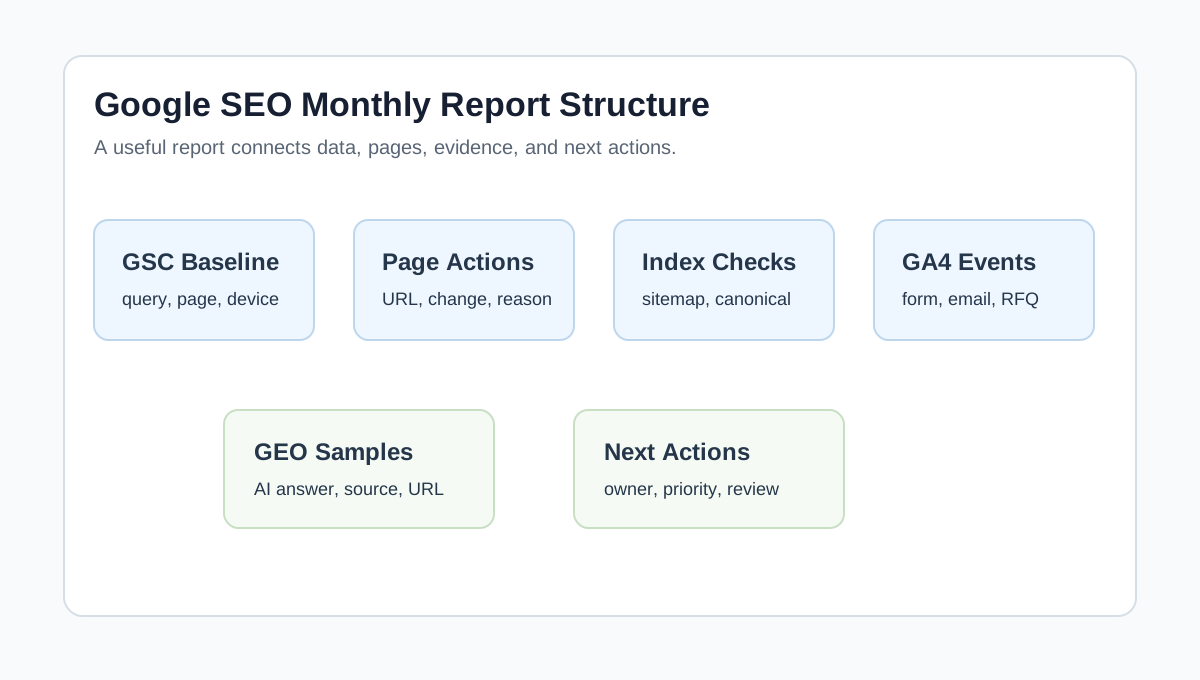
| Monthly report module | Must answer | Evidence source | What it must not become |
|---|---|---|---|
| GSC performance | Are there usable rows for queries, pages, clicks, impressions, CTR, and average position | Search Console export or screenshot | Cannot claim search performance improved when there are no row data |
| Page actions | Which URLs were changed this month, and why | URL list, before-and-after page records | Cannot just write “optimized” |
| Index status | Whether pages are crawlable, indexable, and in the sitemap | robots, sitemap, canonical, index/follow | Cannot turn indexable into already ranked |
| GA4 events | Whether forms, email, WhatsApp, downloads, and RFQ are tracked | Event name, triggering page, source dimension | Cannot claim inquiry changes when events are not configured |
| GEO samples | Whether AI answers mention the brand, cite the official site, and are factually accurate | Platform, question, date, cited URL | A single sample cannot represent long-term results |
2. The first screen should state this month’s conclusion and judgment status
Do not pile up charts at the start of the monthly report. First write one sentence a person can understand: is this month “results can be judged,” “only actions can be judged,” or “insufficient data, look at readiness first.” That sentence determines how the rest is read.
| Opening status | Suitable scenario | How to write | Boundary |
|---|---|---|---|
| Results can be judged | Both GSC and GA4 have stable data | Which queries, pages, and events changed this month | Still explain possible causes; do not write a single attribution |
| Only actions can be judged | Pages were just changed; the data window is too short | Which page and technical checks were completed this month | Do not write about results in advance |
| Insufficient data | GSC zero rows or GA4 events not configured | First verify indexability, sitemap, event planning, and page evidence | Do not write rankings, clicks, inquiries, or AI citation results |
| Judgment needs to pause | Site migration, server issues, missing materials | List the reasons for pausing and the conditions for resuming judgment | Do not force unavailable data into a trend |
3. The GSC section should be broken down by query, page, country, and device
The Search Console performance report is not about looking at one total number. A foreign trade website monthly report should at least break down query, page, country, and device. Because the same growth in impressions may come from brand terms or from irrelevant question terms; the same drop in clicks may be a page title issue or a shift in country or device mix.
| Dimension | What to look at | Questions it suits | Next action |
|---|---|---|---|
| query | Query terms, clicks, impressions, CTR, average position | What words users actually use to find the site | Adjust titles, above-the-fold answers, FAQ, or page intent |
| page | Which URLs receive impressions or clicks | Which page is starting to be understood | Add internal links, content fields, tables, and inquiry entry points |
| country | Impressions and clicks in different countries | Whether the target market shows signals | Add target-market language, applications, and procurement questions |
| device | CTR difference between desktop and mobile | Whether mobile affects clicks and conversion | Check above-the-fold, tables, forms, and page speed |
| date | On which days the changes happened | Whether they are close to page changes, crawling, or algorithm fluctuations | Compare against the page update log |
If GSC currently has no usable rows, the monthly report can record a “GSC zero-row baseline.” This is neither bad news nor good news. It simply means there is not yet enough search performance data. Next, first confirm whether pages are in the sitemap, whether they are index/follow, whether they have internal links, and whether they have crawlable body content.
4. Page action records must go down to the URL level
Many monthly reports write “optimized a product page,” “updated an article,” “added internal links.” That is not enough. A foreign trade website should go down to the URL level. Readers should be able to open the page and see what was changed.
| URL type | What the monthly report should record | Evidence | Why it matters |
|---|---|---|---|
| Homepage | Whether the brand, product scope, industry positioning, and inquiry entry points are clear | Screenshot, source code, above-the-fold copy | Affects how search engines and AI understand the site entity |
| Category page | Whether product families, selection logic, application scenarios, and internal links are complete | URL, title, tables, internal links | Category pages often capture supplier and product-family queries |
| Product page | Specifications, materials, certifications, MOQ, lead time, FAQ, and inquiry entry points | Product materials, page fields, image alt | B2B procurement needs verifiable facts |
| Article page | Topic, official sources, tables, internal links, FAQ, and the reason for updating | Article URL, outbound links, internal link targets | Supports long-tail questions and topical authority |
| Contact page | Form, email, phone, WhatsApp, country and product fields | Test submission, event configuration | Lets organic traffic enter the inquiry path |
5. The index and crawl section must use official sources
An SEO monthly report cannot cover content alone. Whether Google can discover pages must also be reviewed. Here, cite official documentation first, rather than relying only on third-party tool conclusions.
| Check item | Official material | Monthly report field | Boundary |
|---|---|---|---|
| Basic SEO | Google SEO Starter Guide | Titles, links, content, images, crawlability | Completing the basics does not equal earning a specific ranking |
| Search Essentials | Google Search Essentials | Technical requirements, spam risk, page quality boundaries | Cannot package violation risk as a shortcut |
| sitemap | Sitemaps overview | Whether key URLs are in the sitemap | Submitting a sitemap does not mean pages will definitely be indexed |
| robots | robots.txt introduction | Whether key resources are blocked from Google crawling | Allowing crawling does not mean allowing indexing |
| Structured data | Structured data intro | Whether product, FAQ, breadcrumb, and article Schema match page facts | Structured data is not a rich-result promise |
6. The GA4 section should look at events, not just organic traffic
If a foreign trade website monthly report only looks at organic traffic, it will miss a key question: after users arrive, do they enter the inquiry path? In GA4, look at events. At minimum, confirm whether form submissions, email clicks, WhatsApp clicks, RFQ buttons, material downloads, and catalog downloads are tracked.
| Event | Suitable for foreign trade websites? | How to write it in the monthly report | What to do when it is missing |
|---|---|---|---|
| form_submit | Suitable | Whether the form triggers, source page, organic search share | First do a test submission and event configuration |
| email_click | Suitable | Whether the email entry point is clicked | Check the mailto link and event naming |
| whatsapp_click | Suitable | Whether mobile users click WhatsApp | Check button placement and mobile visibility |
| rfq_click | Suitable | Whether product pages lead into the inquiry path | Check product page buttons and form fields |
| download | Suitable | Whether catalogs, datasheets, and manuals are downloaded | Check file links, resource pages, and event triggers |
If key GA4 events are not configured, the monthly report can only say “events are not configured, so inquiry actions after organic search cannot be judged.” That sentence matters. It prevents traffic changes from being miswritten as business results.
7. Title and description optimization should start from a CTR problem
When GSC already has query and page data, pages with low CTR are good candidates for checking titles and descriptions. In particular, pages with an average position in the top 20 but a low CTR often need changes to the title, above-the-fold summary, FAQ, and structured data, rather than writing more articles.
| Signal | Possible cause | Priority action | Monthly report evidence |
|---|---|---|---|
| Impressions grow but CTR is low | The title does not match intent; the above-the-fold answer is unclear | Change title, description, first paragraph, and FAQ | query/page screenshots and page version |
| Ranking is close to the first page but there are few clicks | Page credibility or summary is insufficient | Add tables, official sources, procurement questions, and internal links | Before-and-after page comparison |
| Page gets clicks but no events | The inquiry path is unclear or events are not configured | Check forms, buttons, and contact entry points | GA4 events and test records |
| Multiple pages compete for the same query | Duplicate topics or confused page intent | Decide on page consolidation, internal links, and canonical | query-page comparison table |
8. Content updates cannot just say “published a few articles this month”
The number of articles is not an SEO result. The monthly report should state clearly why this piece was updated, what target question it addresses, where it links, and what data to watch afterward. For a foreign trade website, if an article cannot help product pages, category pages, or resource pages become easier to understand, its business value is limited.
| Content action | Monthly report field | How to verify | Follow-up observation |
|---|---|---|---|
| Write a new article | Topic, target question, internal link target, official sources | Open the URL and check item by item | Whether GSC query/page rows appear |
| Update an old article | Reason for update, content removed or changed, retained paragraphs, date | Page version record | CTR, page impressions, internal link clicks |
| Consolidate content | Merge sources, retained URL, redirect or canonical | URL table and redirect check | Whether duplicate queries decrease |
| Add product pages | Specifications, applications, FAQ, images, inquiry entry points | Material confirmation and page fields | Product terms, model terms, procurement question terms |
| Add resource pages | catalog, datasheet, manual, drawing descriptions | File URL and download events | Download events and organic search entry points |
9. GEO and AI search visibility should be a separate table
Many SEO monthly reports now casually include AI search. But GEO and traditional SEO are not the same data basis. AI answer samples should be recorded separately: platform, question, date, answer summary, whether the brand appears, whether the official site is cited, whether the cited URL is accurate, and whether there are factual errors.
| GEO field | What to record | How to interpret | Boundary |
|---|---|---|---|
| Platform | ChatGPT Search, Perplexity, Google AI features, Bing, etc. | Different platforms have different sourcing mechanisms | Cannot be mixed into one overall result |
| Question | Brand, product, procurement, comparison, after-sales, and resource download questions | Different questions correspond to different page actions | Cannot use a single question to represent all scenarios |
| Cited URL | Whether the official site is cited, and which page is cited | Determines what kind of fact pages to add | Cannot promise how external AI systems will display |
| Factual errors | Whether products, certifications, countries, brands, or contact details are wrong | Fix official site facts and structure first | Cannot fabricate facts just to appear |
| Page actions | Which citable paragraphs, FAQs, Schema, and internal links were added this month | Connect samples with official site actions | Page actions do not mean external results have already happened |
Regarding Google AI-related displays, the monthly report can reference Google AI features and your website. It helps explain the boundary: a website can improve content clarity and accessibility, but cannot control every answer produced by external systems.
10. The monthly report needs a place for “cannot be judged”
The biggest problem with many monthly reports is the unwillingness to write “I don’t know.” But a professional monthly report must keep a place for “cannot be judged.” Because no data means no data, tracking not configured means not configured, and product materials not confirmed means not confirmed.
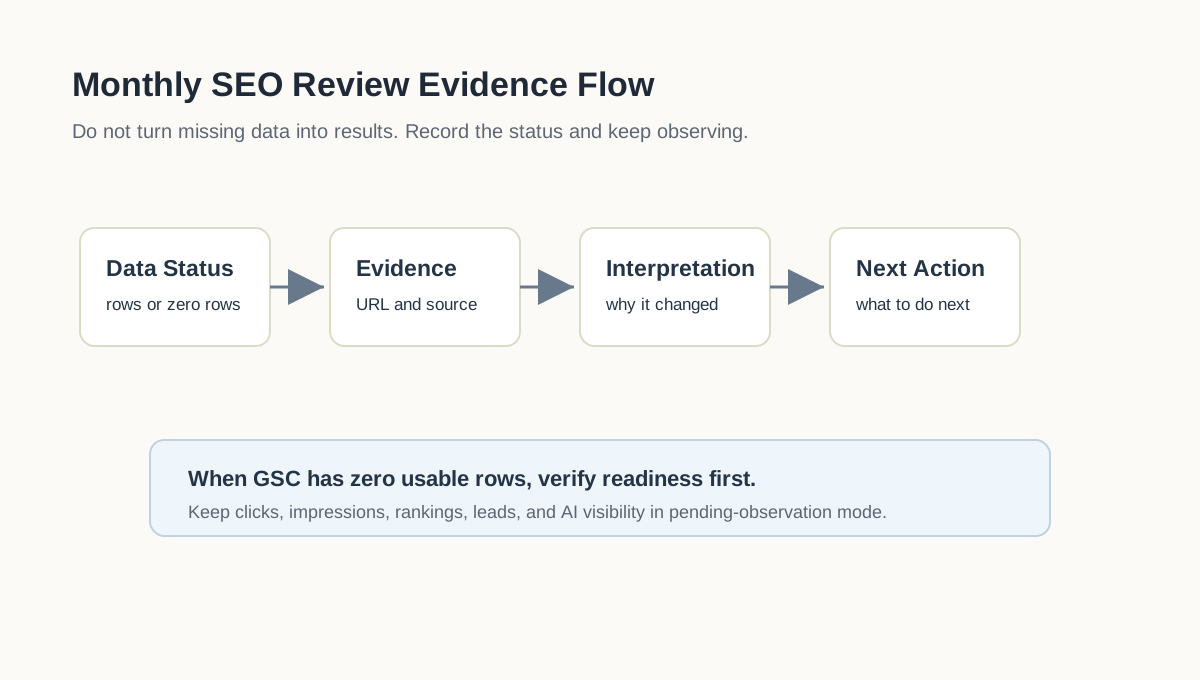
| Reason it cannot be judged | What the monthly report should say | Next step | Condition for resuming judgment |
|---|---|---|---|
| GSC zero rows | No query/page/page-query rows yet; first record discoverability status | Check sitemap, index/follow, internal links, and page body | Exportable row data appears in GSC |
| No GA4 events | Cannot judge inquiry actions after organic search | Configure and test key events | Events can be viewed by page and source |
| Missing product materials | Page trust fields are insufficient | The business supplies specifications, certifications, images, FAQ, and downloadable materials | Materials are confirmed by the business |
| Site was just migrated | The data window is insufficient; observe stability first | Check redirects, canonical, sitemap, and 404s | The site stays stable for one review cycle |
| Insufficient AI samples | The number of samples is not enough; do not draw conclusions | Keep recording with the same question set | There are consecutive samples to compare |
11. “Declines” in the monthly report must be explained, not just marked in red
A page decline is not necessarily a bad thing. It could be that irrelevant queries disappeared, brand terms fluctuated, or it is a normal transition after page consolidation. The monthly report should explain the nature of the decline.
| Decline type | What to look at first | Possible cause | Action |
|---|---|---|---|
| Impressions fall, clicks unchanged | Query list | Low-relevance queries decrease | Do not rush to change; observe first |
| Impressions unchanged, CTR falls | Title, snippet, SERP changes | Title appeal or intent match declined | Change title, description, above-the-fold answer |
| Clicks fall, events fall | Page conversion and forms | Page experience or inquiry entry point problem | Check forms, buttons, and mobile |
| Core pages have no row data | Indexing and internal links | Not discovered, insufficient quality, or too little time | Add internal links, sitemap, content fields |
| Multiple pages decline at once | Site changes and algorithm timing | Template, server, crawling, or competition changes | Do a site-level investigation |
12. “Growth” in the monthly report must also be explained cautiously
Growth cannot be credited casually either. For example, an increase in impressions for an LED flood light supplier China page may be because the title is closer to search intent, because Google recrawled it, or because a competitor’s page weakened. The monthly report should write “possible causes” and “actions to verify.”
| Growth signal | What to check | Conclusion that can be written | What cannot be written |
|---|---|---|---|
| New queries appear | Whether the queries are relevant and whether pages match | The page is starting to cover a certain type of search intent | It has already achieved stable rankings |
| A page’s impressions increase | Whether the page was just updated and whether internal links were added | The page enters the watch list | The page has already brought inquiries |
| CTR rises | Whether the title was changed and whether the SERP changed | The title/snippet may be closer to intent | All similar pages will see CTR rise |
| Events increase | Whether events trigger accurately and whether the source is organic search | An observable action appears in the organic search path | Directly equating it to a closed deal or order |
13. The monthly report should have priorities, not a pile of to-dos
The monthly report must end with next month’s priorities. There should not be too many priorities; usually three to five is enough. Each task should state the corresponding page, the basis for judgment, the owner, and how it will be verified.
| Priority | Suitable tasks | Basis | Verification |
|---|---|---|---|
| P0 | Blocked indexing, unusable forms, noindex on core pages, missing sitemap | Affects discovery or the inquiry path | Front-end, source code, event, and sitemap re-check |
| P1 | Impressions but low CTR, pages near the first page, insufficient materials on important product pages | Clear opportunity or business value | Page update records and GSC observation in the next cycle |
| P2 | Internal link strengthening, old article updates, FAQ expansion, image alt completion | Improves topical clarity | URL list and page checks |
| P3 | Long-term content planning, resource library, industry term expansion | Build topical coverage | Content map and follow-up publishing cadence |
14. A monthly report for a B2B foreign trade website can be implemented like this
Below is an example using foreign trade product lines. These are only field examples; no client results are written.
| Product line | Key pages this month | What the monthly report should look at | Next action |
|---|---|---|---|
| custom metal parts | Category page, machining capability page, materials page | Whether product terms, material terms, and application terms appear | Add material tables, precision, MOQ, QC, and inquiry entry points |
| LED flood light | Product page, application page, installation FAQ | Wattage, certifications, wholesale terms, and country dimension | Add wattage comparison, certifications, installation scenarios, and downloadable materials |
| packaging machine | Industry page, model page, after-sales page | Industry applications, model terms, maintenance questions | Add specification tables, video explanations, after-sales FAQ, and RFQ fields |
| waterproof connector | Product page, selection page, resource download page | IP rating, wire gauge, interface, application environment | Add selection tables, datasheets, application images, and internal links |
15. Monthly report delivery boundaries should be written clearly in advance
If it is an outsourced service, the contract or quote should state the monthly report scope clearly. Otherwise, once the service starts, it is easy to write the report as if it is responsible for everything.
| Boundary item | Suggested wording | Why | Risk |
|---|---|---|---|
| Data sources | Based on GSC, GA4, page records, and public samples | Avoids conclusions based on feelings | Misstating results when there is no data |
| Result promises | The service provider delivers diagnosis, page actions, and reviews, and does not promise specific rankings, specific inquiries, or how external AI will display results | Search and AI results cannot be controlled by the service provider alone | Disputes later |
| Material responsibility | The business confirms product specifications, certifications, images, and business facts | The SEO team cannot confirm technical facts on the business’s behalf | Errors appear on pages |
| Technical development | Template, form, speed, and structured data development are scoped separately | Technical changes often go beyond ordinary content optimization | Unclear task boundaries |
| Sales feedback | Inquiry quality is filled in monthly by sales | SEO data alone cannot judge lead quality | Replacing sales results with traffic |
16. The end of the monthly report should leave a review checklist
The end of a monthly report should not just be “keep optimizing.” It should leave a checklist that can be reviewed next month. The more specific the checklist, the easier it is to judge next month whether the work is continuous.
- The list of URLs added or updated this month.
- The reason for each URL change.
- GSC observation fields: query, page, clicks, impressions, CTR, average position, country, device.
- GA4 observation fields: event name, page, source, trigger count.
- Index fields: sitemap, index/follow, canonical, internal links.
- GEO fields: platform, question, answer summary, cited URL, factual errors.
- Reasons something cannot be judged.
- Next month’s P0/P1 tasks.
- Materials the business needs to supply.
- Pages and fields the service provider needs to review.
17. A quick checklist for judging whether an SEO monthly report is reliable
| Question | Acceptable performance | Unacceptable performance |
|---|---|---|
| Is there a data source | States GSC, GA4, page checks, or public samples | Only writes “traffic increased” or “results got better” |
| Is there a URL-level record | Lists specific pages and reasons for changes | Only writes “optimized several pages” |
| Are there boundaries | States which data is insufficient and what is not yet judged | Writes positive conclusions even without data |
| Are there next-step actions | Writes P0/P1 tasks, owners, and verification methods | Only writes “continue observing” |
| Are there official sources | Cites official documentation such as Google, GA4, and Search Console | Only cites tool screenshots or subjective judgment |
18. The monthly report should separate “hypothesized causes” from “confirmed facts”
The monthly report can contain judgment, but it must be layered. Only what has been confirmed by GSC, GA4, page source code, sitemap, server status, or manual review counts as fact. Parts without evidence can only be written as hypothesized causes or to-be-observed items.
| Monthly report statement | Evidence level | Suggested wording | Not recommended wording |
|---|---|---|---|
| Page is in the sitemap | Directly verifiable | Write the URL and sitemap address | Write “Google will definitely index it” |
| Page has impressions | Verifiable in GSC | Write the date range, query, page, and impressions | Write “the ranking is already stable” |
| CTR falls | Verifiable in GSC | Write the query, page, CTR, and possible cause | Write “the title must have a problem” |
| Inquiry events increase | Verifiable in GA4 or forms | Write the event name, page, source, and trigger count | Write “SEO brought closed deals” |
| An AI answer mentions the brand | Verifiable by sample | Write the platform, question, date, and answer summary | Write “the AI system has long recognized the official site” |
19. The monthly report should record page versions; otherwise next month cannot review them
Many SEO questions cannot be judged in a single monthly report. After pages are changed, you may need to wait for crawling, indexing, impressions, and clicks to appear step by step. Whether it can be reviewed next month depends on whether page versions were recorded this month.
| Version field | How to record | Use for review | Foreign trade website example |
|---|---|---|---|
| URL | Full address, not just the page title | Confirm whether the same page is continuously observed | /led-flood-light/ |
| Title | Record the title before and after the change | Judge whether CTR changes may be related to the title | Changed from a generic product name to application and procurement intent |
| First paragraph | Record the above-the-fold answer or product definition | Judge whether the page answers questions faster | State wattage, certifications, and wholesale procurement scenarios |
| Tables | Record added specification tables, comparison tables, or diagnostic tables | Judge whether the content is easier to understand | Material, size, MOQ, and lead time comparison |
| Internal links | Record which pages link to where | Judge whether the topical cluster is strengthened | Articles link to product pages and resource pages |
Version records do not need to be complex. One table is enough. The key is to be able to answer in the next monthly report: what exactly was changed on this page last month.
20. With a GSC zero-row baseline, the monthly report can still verify three kinds of things
Having no Search Console row data does not mean the monthly report has no value. It just cannot cover search performance. At this point, three kinds of things should be verified: whether pages meet the conditions to be discovered, whether content meets the conditions to be understood, and whether analytics meets the conditions to be reviewed.
| Verification direction | Check fields | Acceptable standard | Next observation |
|---|---|---|---|
| Discoverability | sitemap, internal links, index/follow, canonical | Key URLs can be opened and are not unintentionally blocked | Wait for GSC page rows or spot-check indexing |
| Understandability | Title, H1, first paragraph, tables, FAQ, image alt | The page clearly explains the product, question, or method | Observe whether query terms are close to the page topic |
| Reviewability | GA4 events, form tests, page versions, action records | Next month can review using the same fields | Observe events and page paths |
This kind of monthly report may look less exciting than “how much growth,” but it is more real. It is especially important for new sites, restructured sites, and sites that just switched themes.
21. Product material gaps in the monthly report should be written for the business to see
An SEO service team cannot fabricate product facts for the business. Many foreign trade website pages are weak not because they cannot be written, but because the business has not provided enough specifications, certifications, applications, packaging, lead times, testing, and after-sales materials. The monthly report should write out these gaps.
| Material gap | Affected pages | Business must supply | Service provider can do |
|---|---|---|---|
| Missing specification parameters | Product pages and comparison pages | Size, material, wattage, interface, capacity | Organize specification tables and selection notes |
| Missing certification materials | Procurement trust and compliance statements | Certificates, testing standards, applicable markets | Place certifications in appropriate page positions |
| Missing application scenarios | Industry pages and FAQ | Customer use scenarios, equipment environments, constraints | Write application paragraphs and internal links |
| Missing images and videos | Product understanding and AI citability | Real photos, installation photos, packaging photos, operation videos | Add alt text, captions, and resource pages |
| Missing inquiry fields | Conversion path | Which parameters buyers need to fill in | Design form fields and event tracking |
22. The monthly report should distinguish “page problems” from “business problems”
An SEO monthly report cannot attribute all problems to pages. Pages can improve search visibility and the conversion path, but price, lead time, inventory, sales follow-up, market demand, and product competitiveness also affect inquiry quality. The monthly report should separate page problems from business problems.
| Problem type | What the SEO monthly report can judge | What the business needs to cooperate on | Boundary |
|---|---|---|---|
| Page problems | Titles, content, internal links, indexing, speed, form entry points | Confirm whether page changes match product facts | The SEO team can propose page actions |
| Material problems | Which fields are missing and which pages are weak as a result | Provide parameters, certifications, images, FAQ | Cannot fabricate facts for the business |
| Sales problems | Whether organic traffic enters the inquiry path | Fill in inquiry quality and follow-up status | SEO data cannot replace sales feedback |
| Market problems | Whether target countries and query trends show signals | Confirm product lines and market priorities | Single-site data cannot represent the whole market |
| Technical problems | Whether pages are accessible, indexable, and trackable | Provide server or development support | Complex development should be scoped separately |
23. The monthly report should serve not only the boss, but also the next person who takes over
A truly good monthly report is still useful three months later. It is not just a report; it can also serve as a project history. The next service provider, the company’s in-house operations staff, and the sales lead should all be able to understand it.
| Reader | Cares most about | What the monthly report should give | Wording that is not good enough |
|---|---|---|---|
| Boss | Where the money goes and what to do next | Priorities, risks, judgeable results | Piles of tool screenshots |
| Operations | Which pages to change and how | URL list, fields, internal links, material gaps | Only concepts |
| Sales | Inquiry quality and product questions | Form fields, product materials, buyer questions | Only looking at traffic |
| Technical | Which blocks need fixing | Status codes, canonical, sitemap, speed, and events | Only writing “the experience is bad” |
| Next service provider | Historical actions and unfinished issues | Page versions, data definitions, issue list | Only handing over a summary |
24. A monthly report template can be organized like this
Below is a practical order. It does not chase fancy; it only chases reviewability.
- This month’s conclusion: what can be judged and what cannot.
- GSC data: query, page, country, device, date.
- GA4 events: forms, email, WhatsApp, downloads, RFQ.
- Page actions: URL, fields changed, reason, launch time.
- Index status: sitemap, index/follow, canonical, robots.
- Content quality: material gaps, official sources, tables, FAQ, internal links.
- GEO samples: platform, question, answer summary, cited URL, error type.
- Risk boundaries: which results are not controlled by the service provider alone.
- Next month’s priorities: P0/P1/P2 tasks and verification methods.
- Business cooperation items: product materials, sales feedback, technical access.
25. Finally, judge monthly report quality in one sentence
If a Google SEO monthly review report lets the business open specific URLs, see specific data, understand specific causes, know the specific next step, and clearly understand which results cannot yet be judged, then it is valuable. Conversely, if the report is only screenshots, adjectives, and vague conclusions, it can hardly support long-term SEO and GEO work.
26. The monthly report should separate “on-site actions” from “off-site changes”
On-site actions are those the business and service team can directly control, such as changing pages, adding materials, adjusting internal links, checking the sitemap, and configuring events. Off-site changes are not controllable by one party alone, such as search result displays, AI answer citations, competitor page changes, and shifts in target market demand. The monthly report should write the two separately.
| Type | Monthly report field | Degree of control | How to review |
|---|---|---|---|
| On-site page actions | URL, fields, launch time, owner | High | Open the page and review |
| On-site technical actions | sitemap, robots, canonical, index/follow, event configuration | High | Source code, tools, and front-end verification |
| On-site material actions | Parameters, images, certifications, FAQ, downloadable materials | Medium | Business confirms the material source |
| Search performance changes | query, page, clicks, impressions, CTR, position | Low | Observe by GSC date range |
| AI answer changes | Platform, question, answer, cited URL, error type | Low | Retest against the sample table |
27. The monthly report should leave usable feedback fields for sales
If an SEO monthly report does not connect at all to sales feedback, it easily stays at the traffic level. A B2B foreign trade website should at least have sales fill in a few simple fields each month. Only then can you judge whether page materials are sufficient, instead of only looking at clicks.
| Sales feedback field | Why look at it | How the monthly report uses it | Note |
|---|---|---|---|
| Inquiry product | Judge whether search traffic is close to the main products | Compare against product pages and category pages | Do not disclose customer privacy |
| Country or region | Judge whether the target market matches | Compare against GSC country and page language | When samples are few, only record |
| Procurement stage | Judge whether the user is requesting a quote, making a sample, or collecting materials | Adjust page FAQ and form fields | Do not write early inquiries as closed deals |
| Missing materials | Judge what buyers repeatedly ask about | Add parameters, certifications, case-type scenarios, and downloadable materials | Materials must be confirmed by the business |
| Follow-up status | Judge lead quality | Distinguish page problems from sales problems | The SEO monthly report only records verifiable facts |
28. The monthly report should avoid five nice but useless phrasings
A beautifully written monthly report is not necessarily useful. The following expressions look positive, but are hard to review.
| Useless wording | Problem | What to change it to |
|---|---|---|
| Overall performance was good this month | No data range | Write specific dates, dimensions, and pages |
| Several keywords improved | No queries or pages | List query, page, position, and impressions |
| Page quality continued to improve | No page actions | List URL, fields changed, and verification method |
| AI visibility improved | No samples | List platform, question, answer summary, and cited URL |
| Continue optimizing next month | No priorities | List P0/P1 tasks and review dates |
29. Keep the original tables when handing over the monthly report
If the cooperation ends, handing over only a PDF is not enough. The business should receive the original tables. At minimum, include the GSC export, GA4 event table, page action table, GEO sample table, material gap table, and next month’s task table. That way the next person taking over does not have to guess from scratch.
| Handover table | Fields included | Purpose | Verification method |
|---|---|---|---|
| GSC table | Date, query, page, clicks, impressions, CTR, position | Continue observing search performance | Can reproduce the filter conditions |
| GA4 table | Event name, page, source, trigger count, test records | Continue observing the inquiry path | Can open the event definition |
| Page action table | URL, changes, reason, launch time, owner | Track page versions | Can open and check each URL one by one |
| GEO sample table | Platform, question, answer summary, cited URL, error type | Continue retesting AI answers | Can retest using the same question set |
| Material gap table | Product line, gap, owner, status | Push the business to supply materials | Can be turned into internal tasks |
30. The final standard for a reliable monthly report
A reliable monthly report does not need to overstate. It needs to leave the evidence, write the actions clearly, explain the boundaries, and lay out the next steps. For foreign trade SEO and GEO, this kind of monthly report is more useful than a string of positive conclusions that cannot be reviewed.
If there is currently no GSC row data, write the zero-row baseline. If GA4 events are not configured, write the event gap. If AI samples are insufficient, write to-be-observed. If the page changes are complete, write the URL and fields. Real, reviewable, and possible to continue from — that is the value of a monthly report.
31. The monthly report review checklist can be split by week
If there are many page changes in a month, the monthly report should not wait until month-end to be organized. It can be recorded weekly. Week 1 looks at access and baseline, week 2 looks at page actions, week 3 looks at events and indexing, and week 4 looks at data changes and next month’s priorities. That way, month-end will not be left with only scattered screenshots.
| Week | Recording focus | Deliverable | How it is used at month-end |
|---|---|---|---|
| Week 1 | GSC, GA4, sitemap, key URLs, and event status | Baseline table | Confirm which metrics can be judged |
| Week 2 | Titles, first paragraphs, tables, FAQ, internal links, resource pages | Page action table | Explain changes at the page level |
| Week 3 | Form, email, WhatsApp, download, RFQ events | Event test table | Judge whether the inquiry path is trackable |
| Week 4 | query, page, country, device, GEO samples, and material gaps | Review table | Generate next month’s P0/P1 tasks |
32. Internal links in the monthly report should also be reviewed
For a foreign trade website doing SEO and GEO, internal links are not decoration. The monthly report should record which articles link to product pages, which product pages link to resource pages, and which FAQs link to the inquiry entry point. Without internal links, both search engines and AI systems have more difficulty understanding the relationships between pages.
| Internal link direction | Monthly report record | Purpose | How to review |
|---|---|---|---|
| Article to product page | Question-based articles link to the corresponding product or category | Direct informational intent to procurement pages | Check anchor text and target URL |
| Product page to resource page | Product pages link to datasheet, manual, catalog | Strengthen procurement evidence | Check files and download events |
| Category page to product page | Category pages link to representative products and selection guides | Help understand product families | Check the page list and anchor text |
| FAQ to contact page | Procurement questions link to the inquiry or contact entry point | Shorten the inquiry path | Check mobile buttons and events |
33. The monthly report should end by writing “what to verify next time”
Next-step actions are not enough; you also need to write what to verify next time. For example, if the product page title was changed this month, verify the corresponding query and CTR next month; if FAQ was added this month, verify next month whether page queries are closer to procurement questions; if download events were configured this month, verify next month whether organic search users trigger downloads.
This is how the review stays continuous. Each month, looking forward around the same set of pages, the same set of queries, the same set of events, and the same set of AI samples, the website will gradually form a reliable SEO and GEO evidence chain.
34. The monthly report should give every conclusion a review entry point
Every conclusion in the monthly report should have a review entry point. Otherwise, next month you can only discuss it all over again. The review entry point can be a GSC filter, a GA4 event name, a page URL, a sitemap address, an AI sample table, or a product material confirmation record.
| Conclusion type | Review entry point | How to verify next month |
|---|---|---|
| Query performance | GSC date range, query and page filters | See whether the same query and page continue to appear |
| Page actions | URL, fields changed, launch time | Confirm whether the page version is retained and continues to be observed |
| Inquiry path | GA4 event name and form test records | See whether organic search users trigger the same event |
| AI samples | Platform, question, date, and cited URL | Retest using the same question set; do not mix different conditions |
If the monthly report can keep only one table, keep the “conclusion, evidence, URL, data definition, next-step action” table. It lets the business, sales, technical, and service teams see the same thing, and lets the next review pick up where it left off.
The value of a monthly report is not in explaining every number to the fullest, but in letting every number trace back to a page, an event, a material, and a next-step action. That way, even if there is no search performance that month, it can prove whether the groundwork is ready.
If the next review cannot use the same table, it means this monthly report has not left a complete evidence chain. Fill in the evidence chain first, then discuss trends.
FAQ
Does an SEO monthly report have to include rankings?
It can include average position, but it must come from Search Console or another clear source, and it must be viewed together with query, page, country, and device. Average position alone cannot represent business results.
Can a monthly report still be done without GSC data?
Yes. The monthly report should first record the GSC zero-row baseline, page discoverability, sitemap, index/follow, GA4 event configuration, page actions, and fields to be observed. It cannot claim search performance improved.
Can inquiry changes be written in the monthly report?
Only when GA4 events, form records, CRM, or sales feedback can be tied to a source is it appropriate to write about inquiry path changes. Otherwise, you can only write “inquiry events have not yet formed verifiable data.”
Should AI search visibility be included in an SEO monthly report?
Yes, but as a separate table. AI samples should record platform, question, date, answer summary, cited URL, and factual errors; do not mix them with GSC clicks and impressions.
What is most easily missed in a monthly report?
The most easily missed items are “reasons something cannot be judged” and “next month’s verification method.” Without these two, the monthly report looks complete, but is hard to review next month.
Related reading and official sources
- SEO/GEO project review template: how to write credible analysis without authorized data
- What Google SEO services include: technical work, content, GSC review, and a deliverables checklist
- What GEO services include: AI visibility diagnosis, query sets, and a monitoring deliverables checklist
- What a Google website diagnosis service includes: technical, content, indexing, and GSC diagnosis guide
- How to monitor AI search visibility: brand mentions, official site citations, and a competitor answer checklist
- Search Console Help: Performance report
- Google Analytics Help: Events
- Google Search Central: SEO Starter Guide
- Google Search Central: Search Essentials
- Google Search Central: AI features and your website
Continue reading this SEO series
If you are systematically organizing SEO for a foreign trade website, it is worth continuing with the following articles. First clarify the relationships among crawling, indexing, content, links, and review, then decide which page to change next.
- What to look at before getting a quote from a Google SEO partner team: don’t rush to ask about the price
- What is the difference between a Google foreign trade website building and promotion service team and an outsourcing team: who is responsible for strategy, execution, and review
- How to use Google SEO analysis tools: how GSC, GA4, and page diagnosis work together to look at foreign trade inquiries
- How to build an SEO tool stack: crawling, speed, logs, rankings, content, and inquiry review
- How to validate Google Trends keywords: foreign trade product terms, seasonality, and regional judgment
- Google Trends usage details: region, category, time window
{
“@context”: “https://schema.org”,
“@type”: “FAQPage”,
“mainEntity”: [
{
“@type”: “Question”,
“name”: “Does an SEO monthly report have to include rankings?”,
“acceptedAnswer”: {
“@type”: “Answer”,
“text”: “It can include average position, but it must come from Search Console or another clear source, and it must be viewed together with query, page, country, and device. Average position alone cannot represent business results.”
}
},
{
“@type”: “Question”,
“name”: “Can a monthly report still be done without GSC data?”,
“acceptedAnswer”: {
“@type”: “Answer”,
“text”: “Yes. The monthly report should first record the GSC zero-row baseline, page discoverability, sitemap, index/follow, GA4 event configuration, page actions, and fields to be observed. It cannot claim search performance improved.”
}
},
{
“@type”: “Question”,
“name”: “Can inquiry changes be written in the monthly report?”,
“acceptedAnswer”: {
“@type”: “Answer”,
“text”: “Only when GA4 events, form records, CRM, or sales feedback can be tied to a source is it appropriate to write about inquiry path changes. Otherwise, you can only write “inquiry events have not yet formed verifiable data.””
}
},
{
“@type”: “Question”,
“name”: “Should AI search visibility be included in an SEO monthly report?”,
“acceptedAnswer”: {
“@type”: “Answer”,
“text”: “Yes, but as a separate table. AI samples should record platform, question, date, answer summary, cited URL, and factual errors; do not mix them with GSC clicks and impressions.”
}
},
{
“@type”: “Question”,
“name”: “What is most easily missed in a monthly report?”,
“acceptedAnswer”: {
“@type”: “Answer”,
“text”: “The most easily missed items are “reasons something cannot be judged” and “next month’s verification method.” Without these two, the monthly report looks complete, but is hard to review next month.”
}
}
]
}
This page is machine-translated from the Simplified Chinese version and awaiting human review. It has not yet been proofread.