A GEO visibility diagnosis does not promise that AI answers will always recommend a certain brand. It systematically checks what AI answers currently say about your target buying questions, whether your website is mentioned, whether the description is accurate, which sources are cited, whether your website pages have a citable structure, whether your company entity information is consistent, and how to review results later using GSC, GA4, inquiry sources, and sales feedback. For export manufacturers and trading companies, the value of a GEO diagnosis is reducing the risk of being absent from information, being described incorrectly, and having sources occupied by third parties in the age of AI search.
This article is written for export companies in China, and the examples use English product terms such as custom metal parts, LED flood light, packaging machine, medical probe, cnc machining parts, ceramic dinnerware, waterproof connector, industrial valve supplier, and private label activewear manufacturer. The focus is on how to judge whether a GEO visibility diagnosis is verifiable, reviewable, and clearly bounded, rather than packaging unverifiable performance promises.
Benchmarking against Top1 and authoritative baselines: from a concept service page to a verifiable diagnosis table
In the current English SERP, pages about AI visibility audit, LLMO/GEO audit, AI citation tracking, and entity optimization are usually covered by tool vendors, consultancies, and SEO media. Their strength is explaining AI search visibility, brand mentions, citation sources, prompt testing, entity consistency, content citability, and monitoring tools. Public materials from Google, Bing, OpenAI, Perplexity, and others remind us that AI answers are affected by indexed content, source quality, query phrasing, context, and system changes, so results cannot be treated as fully controllable ad placements.
The gap in these pages is this: many service pages only say “improve AI visibility” without explaining how the query set is built, how the answer baseline is recorded, how incorrect citations are attributed, how website pages are fixed, how external sources are checked, or how the review cycle works. They also lack export-oriented English product terms and buying-question scenarios.
The way this article strengthens the topic is by breaking a GEO diagnosis into verifiable deliverables: the query set, the AI answer baseline, the entity consistency table, the check of citable pages on the website, the citation source list, the competitor answer comparison, the risk boundaries, page revision recommendations, and 30/60/90-day reviews.
| Benchmark dimension | Common GEO / AI visibility pages | What this article adds |
|---|---|---|
| Concept explanation | Explain AI search visibility and citations | Turns them into a diagnosis deliverable for export companies |
| Tool monitoring | See whether the brand is mentioned | Adds answer accuracy and source attribution |
| Entity optimization | Talk about the brand entity | Lands on consistency of company name, product lines, certificates, and platform profiles |
| Content recommendations | Suggest writing FAQs and materials | Adds citable structure for product pages, application pages, and resource pages |
| Review boundaries | Some pages overpromise | States clearly that guaranteed citations or guaranteed inquiries cannot be promised |
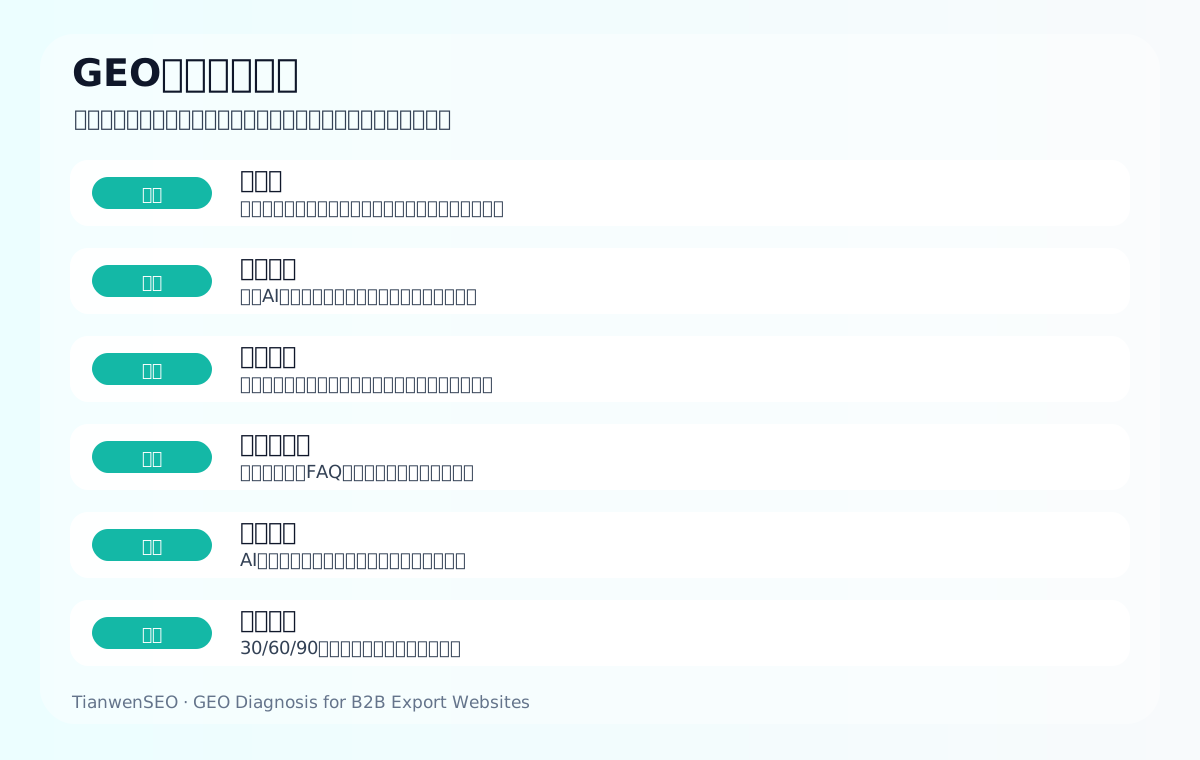
1. The core goal of a GEO visibility diagnosis: see the current state clearly before deciding on actions
The first step of a GEO diagnosis is not to write new articles right away, but to establish a baseline of the current state. You need to know how ChatGPT, AI Overviews, Perplexity, Bing Copilot, or other answer systems currently respond to your target buying questions, whether they mention your brand, whether they mention competitors, which sources they cite, and whether the answers are accurate.
Without a baseline, you cannot tell whether later page updates, entity corrections, or additional external materials are effective.
| Diagnosis object | What to record | Export example |
|---|---|---|
| Target question | How buyers ask | best custom metal parts manufacturer |
| AI answer | Which sources are mentioned | Website / platform / competitor / media |
| Accuracy | Whether product and company are described correctly | Whether it is misdescribed as a trader or with the wrong product |
| Citation sources | Where the answer comes from | Website resource page or third-party directory |
| Next actions | What needs fixing | Definitions, tables, evidence, entity materials |
2. How to build the query set: do not test only brand terms
The query set should cover brand terms, product terms, supplier terms, application terms, question terms, comparison terms, quote-preparation terms, and risk terms. Testing only the company name means you cannot know whether buyers will encounter you in real searches and AI prompts.
For example, a LED flood light company should test not only its brand name but also questions such as led flood light manufacturer, 200w led flood light supplier, outdoor led flood light for parking lot, and IP65 LED flood light.
| Query type | Example | Diagnostic meaning |
|---|---|---|
| Brand term | company name + products | Check entity recognition |
| Category term | waterproof connector manufacturer | Check whether you enter supplier answers |
| Application term | connector for outdoor lighting | Check scenario coverage |
| Question term | how to choose packaging machine | Check content citability |
| Quote term | cnc machining quote requirements | Check inquiry preparation coverage |
3. How to record the answer baseline: screenshots are not enough; be structured
A single screenshot cannot represent long-term results, but it can serve as baseline evidence. A better recording method is: query, tool, time, region and language, answer summary, whether the website is mentioned, cited URLs, competitors, error points, and next-step recommendations.
Only then, when you recheck 30 days later, can you tell whether answer changes come from page updates, source changes, system changes, or changes in query phrasing.
| Field | What to record | Purpose |
|---|---|---|
| Query | Full question | Easy to retest |
| Tool / time | Platform used and date | Control variables |
| Answer summary | How AI responds | See changes |
| Citation sources | URL and source type | Find sources that can be improved |
| Error points | Inaccurate descriptions | Guide page revisions |
4. Entity consistency: when AI does not recognize you, it is often because information is inconsistent
Entity consistency covers company name, English brand, product lines, address, phone, certificates, social media, platform pages, trade show materials, author information, and website descriptions. The more chaotic the information, the harder it is for AI and search systems to judge who you are, what you do, and whether you are trustworthy.
If an industrial valve supplier writes company A on its website, company B on its certificates, a trading company on LinkedIn, and another product line on a B2B platform, AI answers easily become confused.
| Entity item | Common problem | Direction for correction |
|---|---|---|
| Company name | Chinese and English versions differ | Unify the legal entity name |
| Product lines | Descriptions are scattered | Build core product line descriptions |
| Address and phone | Platform profiles differ | Unify public information |
| Certificates | Entity is unclear | Add certificate explanations |
| External materials | Old information not updated | Correct item by item |
5. Citation source checks: why AI cites others instead of your website
When an AI answer cites third-party platforms, directories, media, or competitors, it is not necessarily because your website does not exist. It may be because your website content is not citable, resource pages are thin, definitions are unclear, tables are missing, entity information is weak, or external evidence is insufficient.
For example, if a ceramic dinnerware company’s website does not clearly explain MOQ, materials, customization, packaging, and wholesale capability, while its B2B platform page is more complete, AI is more likely to cite the platform page.
| Citation source | Possible reason | Website improvement |
|---|---|---|
| Third-party platform | Website information is incomplete | Add product and company information |
| Competitor website | Competitor structure is clearer | Add definitions, tables, FAQs |
| Media article | External evidence is stronger | Add resource pages and industry proof |
| Incorrect source | Entity is chaotic | Unify names and product lines |
| No citation | Page is inaccessible or not credible enough | Fix technical and content issues |
6. Citable website pages: it is not only about FAQs
Citable pages include product pages, category pages, application pages, resource pages, selection guides, troubleshooting, FAQs, company profiles, and certificate pages. FAQs are useful, but they cannot replace product facts, tables, and evidence.
If a medical probe page only has marketing copy and no certifications, compatibility, materials, testing, sterilization, or downloadable documents, AI will find it hard to cite accurately even if it sees the page.
| Page type | Citable content | Export example |
|---|---|---|
| Product page | Specifications, applications, FAQ | LED flood light wattage and waterproofing |
| Category page | Product range and selection | waterproof connector series |
| Application page | Working conditions and solutions | industrial valve applications |
| Resource page | Certificates and testing | medical probe certifications |
| Guide page | Decision steps | packaging machine selection |
7. Competitor answer comparison: see why others appear
A GEO diagnosis should record whether competitors appear, under which questions they appear, how the answers describe them, which pages are cited, and what evidence exists. The goal is not to copy competitors, but to judge what our website lacks.
If a competitor often appears in custom metal parts manufacturer questions, it may be because it has clearer materials, tolerances, quality inspection, industry applications, and external materials.
| Comparison item | What to look at | Output |
|---|---|---|
| Mention frequency | Which questions they appear in | Competitor coverage table |
| Cited pages | Whether product pages or resource pages are cited | Page type gap |
| Answer description | How strengths are summarized | Entity and value proposition |
| Evidence | Certificates / cases / media | Credibility material gap |
| Gap | What we do not have | Revision recommendations |
8. Risk boundaries: what a GEO diagnosis cannot promise
A GEO diagnosis cannot promise that AI answers will cite your website every time, cannot promise specific rankings, cannot promise a definite number of inquiries, and cannot use a single screenshot to prove long-term results. What it can do is improve page comprehensibility, entity consistency, source credibility, and review transparency.
Any service that describes AI answers as fully controllable ad placements should be judged with caution.
| Cannot promise | Reason | Work that can be promised |
|---|---|---|
| Being cited every time | AI answers change dynamically | Build a baseline and optimize sources |
| Specific rankings | Search is influenced by many factors | Improve the quality of controllable pages |
| Guaranteed inquiries | Business and market factors | Improve the path and reviews |
| Immediate results | Indexing and system updates take time | Set a review cadence |
| Fake case studies | Not real and not verifiable | Use only authorized data or public methods |
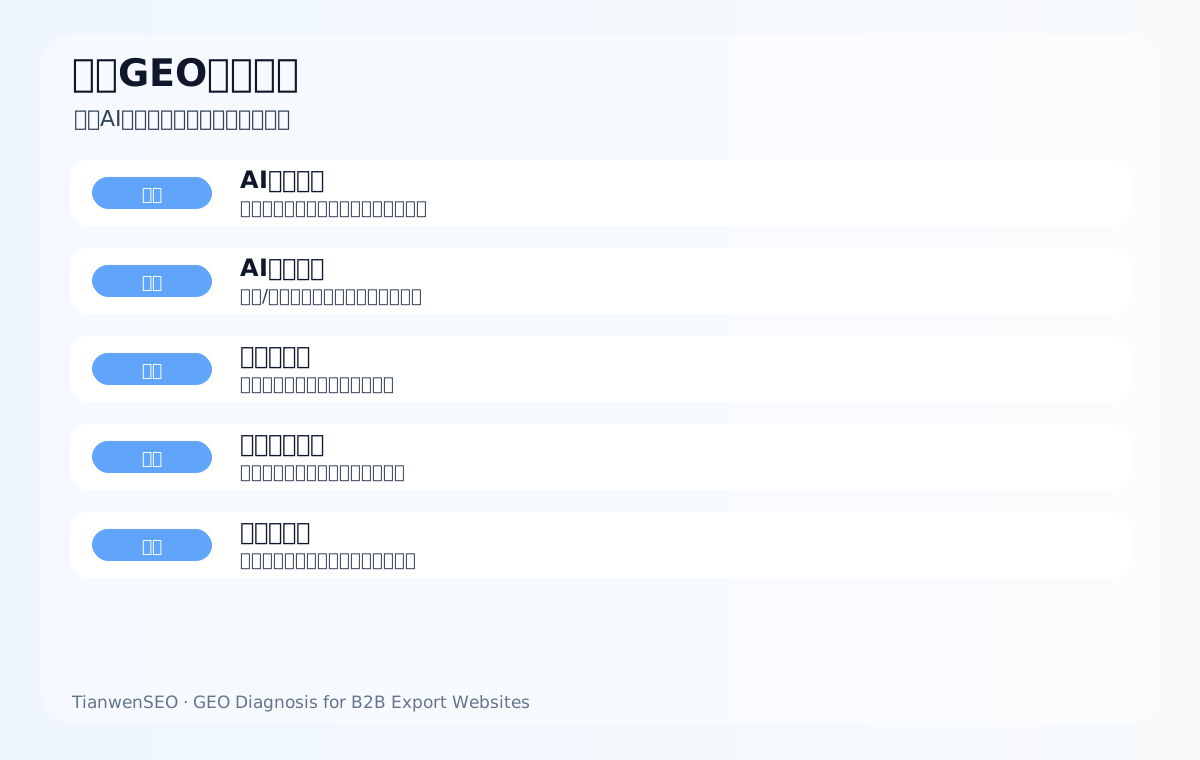
9. What deliverables a diagnosis service should include
A qualified GEO visibility diagnosis should include at least the query set, answer baseline, entity consistency table, citation source table, website page citability check, competitor answer comparison, risk boundaries, page revision recommendations, and a review plan.
When export companies carry this out, they should land it on specific product lines, such as custom metal parts, LED flood light, packaging machine, medical probe, and waterproof connector, and record the AI answers, website pages, and inquiry paths for each product line separately.
10. What is the difference between a GEO diagnosis and an SEO diagnosis
An SEO diagnosis focuses more on crawling, indexing, rankings, clicks, and page quality; a GEO diagnosis focuses more on whether AI answers understand, cite, and describe accurately, and whether sources are reliable. The two share the same technical and content foundation.
When export companies carry this out, they should land it on specific product lines, such as custom metal parts, LED flood light, packaging machine, medical probe, and waterproof connector, and record the AI answers, website pages, and inquiry paths for each product line separately.
11. How a GEO diagnosis relates to AEO
AEO emphasizes answer structure and direct answers, while GEO emphasizes citations, entities, and sources in generative answers. Export companies usually need to look at both together.
When export companies carry this out, they should land it on specific product lines, such as custom metal parts, LED flood light, packaging machine, medical probe, and waterproof connector, and record the AI answers, website pages, and inquiry paths for each product line separately.
12. The role of GSC in a GEO diagnosis
GSC cannot directly tell you whether AI cites you, but it shows query coverage, page performance, countries and devices, and indexing status, making it important data for judging whether your website foundation is solid.
When export companies carry this out, they should land it on specific product lines, such as custom metal parts, LED flood light, packaging machine, medical probe, and waterproof connector, and record the AI answers, website pages, and inquiry paths for each product line separately.
13. The role of GA4 and inquiries in a GEO diagnosis
If AI answers bring branded searches or follow-up visits, GA4 and inquiry records can help judge the user path and business quality.
When export companies carry this out, they should land it on specific product lines, such as custom metal parts, LED flood light, packaging machine, medical probe, and waterproof connector, and record the AI answers, website pages, and inquiry paths for each product line separately.
14. How to correct external sources
External directories, trade shows, social media, B2B platforms, and media materials should be consistent with your website. You cannot control every third party, but you can prioritize correcting important public materials.
When export companies carry this out, they should land it on specific product lines, such as custom metal parts, LED flood light, packaging machine, medical probe, and waterproof connector, and record the AI answers, website pages, and inquiry paths for each product line separately.
15. What to fix on pages first
Fix core product pages, category pages, the company profile, resource pages, and high-value guides first, then expand to the blog and FAQs.
When export companies carry this out, they should land it on specific product lines, such as custom metal parts, LED flood light, packaging machine, medical probe, and waterproof connector, and record the AI answers, website pages, and inquiry paths for each product line separately.
16. How to handle incorrect AI descriptions
First determine whether the error comes from your website, an external source, or AI inference, then add clear definitions, evidence, tables, and entity information.
When export companies carry this out, they should land it on specific product lines, such as custom metal parts, LED flood light, packaging machine, medical probe, and waterproof connector, and record the AI answers, website pages, and inquiry paths for each product line separately.
17. How often should a GEO diagnosis be reviewed
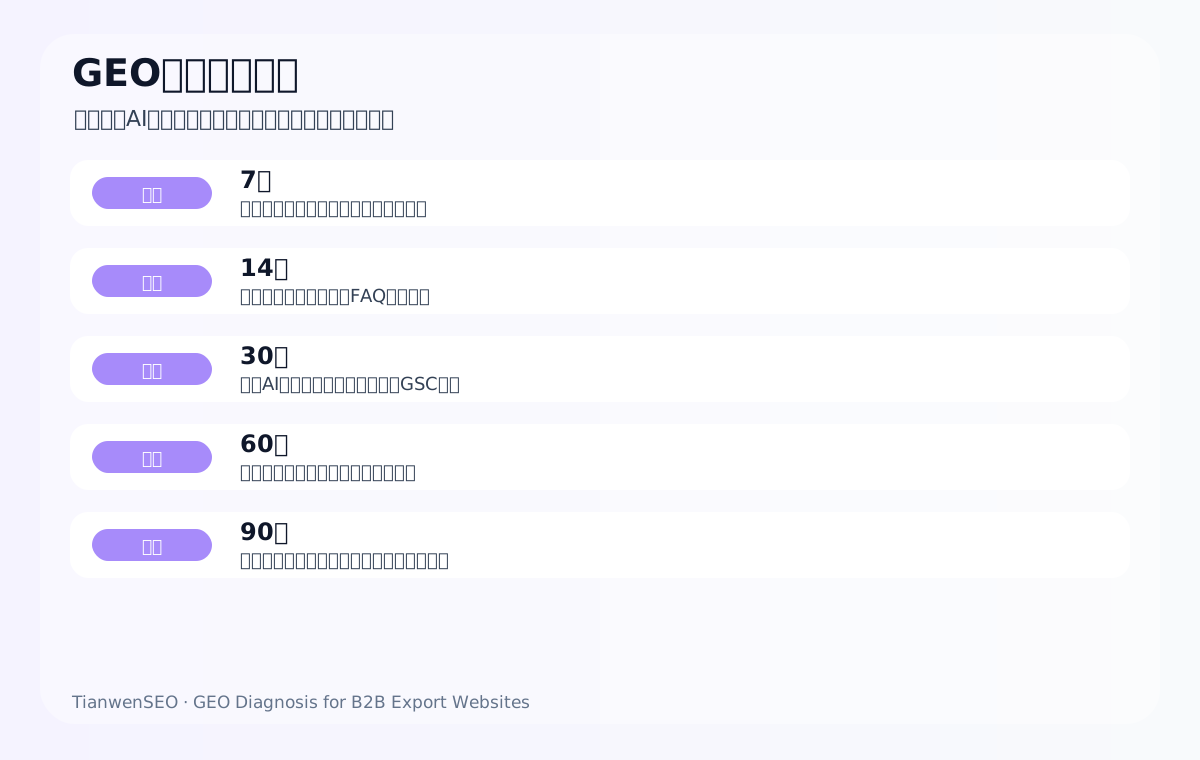
After the initial diagnosis, complete page revisions within 7-14 days, review answers and sources at 30 days, and look at search, traffic, and inquiry changes at 60-90 days.
When export companies carry this out, they should land it on specific product lines, such as custom metal parts, LED flood light, packaging machine, medical probe, and waterproof connector, and record the AI answers, website pages, and inquiry paths for each product line separately.
18. How to judge whether a service provider is reliable
See whether it explains data sources, the query set, deliverables, boundaries, the review method, and what it does not promise. Be cautious of providers that talk only about results and not about methods.
When export companies carry this out, they should land it on specific product lines, such as custom metal parts, LED flood light, packaging machine, medical probe, and waterproof connector, and record the AI answers, website pages, and inquiry paths for each product line separately.
Export example 1: how to run a GEO diagnosis for custom metal parts
Around custom metal parts, a GEO diagnosis should build a set of buying questions, check whether AI answers mention your website or competitors, whether the answers accurately cover materials, tolerances, surface treatment, drawings, and quality inspection, whether citation sources are reliable, and whether your website has citable tables, FAQs, and resource pages.
If AI answers cite third-party platforms instead of your website, judge whether your website information is thin, whether entity information is inconsistent, and whether pages are uncrawlable or lack clear definitions. Then decide whether to add product pages, application pages, resource pages, company entity information, or external public materials.
Export example 2: how to run a GEO diagnosis for LED flood light
Around LED flood light, a GEO diagnosis should build a set of buying questions, check whether AI answers mention your website or competitors, whether the answers accurately cover wattage, waterproofing, mounting height, applications, and warranty, whether citation sources are reliable, and whether your website has citable tables, FAQs, and resource pages.
If AI answers cite third-party platforms instead of your website, judge whether your website information is thin, whether entity information is inconsistent, and whether pages are uncrawlable or lack clear definitions. Then decide whether to add product pages, application pages, resource pages, company entity information, or external public materials.
Export example 3: how to run a GEO diagnosis for packaging machine
Around packaging machine, a GEO diagnosis should build a set of buying questions, check whether AI answers mention your website or competitors, whether the answers accurately cover materials, speed, bag types, automation, and after-sales service, whether citation sources are reliable, and whether your website has citable tables, FAQs, and resource pages.
If AI answers cite third-party platforms instead of your website, judge whether your website information is thin, whether entity information is inconsistent, and whether pages are uncrawlable or lack clear definitions. Then decide whether to add product pages, application pages, resource pages, company entity information, or external public materials.
Export example 4: how to run a GEO diagnosis for medical probe
Around medical probe, a GEO diagnosis should build a set of buying questions, check whether AI answers mention your website or competitors, whether the answers accurately cover certifications, compatibility, materials, sterilization, and testing, whether citation sources are reliable, and whether your website has citable tables, FAQs, and resource pages.
If AI answers cite third-party platforms instead of your website, judge whether your website information is thin, whether entity information is inconsistent, and whether pages are uncrawlable or lack clear definitions. Then decide whether to add product pages, application pages, resource pages, company entity information, or external public materials.
Export example 5: how to run a GEO diagnosis for cnc machining parts
Around cnc machining parts, a GEO diagnosis should build a set of buying questions, check whether AI answers mention your website or competitors, whether the answers accurately cover DFM, volume production, inspection reports, and quote materials, whether citation sources are reliable, and whether your website has citable tables, FAQs, and resource pages.
If AI answers cite third-party platforms instead of your website, judge whether your website information is thin, whether entity information is inconsistent, and whether pages are uncrawlable or lack clear definitions. Then decide whether to add product pages, application pages, resource pages, company entity information, or external public materials.
Export example 6: how to run a GEO diagnosis for ceramic dinnerware
Around ceramic dinnerware, a GEO diagnosis should build a set of buying questions, check whether AI answers mention your website or competitors, whether the answers accurately cover materials, glaze colors, packaging, MOQ, and customization, whether citation sources are reliable, and whether your website has citable tables, FAQs, and resource pages.
If AI answers cite third-party platforms instead of your website, judge whether your website information is thin, whether entity information is inconsistent, and whether pages are uncrawlable or lack clear definitions. Then decide whether to add product pages, application pages, resource pages, company entity information, or external public materials.
Export example 7: how to run a GEO diagnosis for waterproof connector
Around waterproof connector, a GEO diagnosis should build a set of buying questions, check whether AI answers mention your website or competitors, whether the answers accurately cover IP rating, wire gauge, current, and outdoor applications, whether citation sources are reliable, and whether your website has citable tables, FAQs, and resource pages.
If AI answers cite third-party platforms instead of your website, judge whether your website information is thin, whether entity information is inconsistent, and whether pages are uncrawlable or lack clear definitions. Then decide whether to add product pages, application pages, resource pages, company entity information, or external public materials.
Export example 8: how to run a GEO diagnosis for industrial valve supplier
Around industrial valve supplier, a GEO diagnosis should build a set of buying questions, check whether AI answers mention your website or competitors, whether the answers accurately cover materials, pressure, standards, and industry working conditions, whether citation sources are reliable, and whether your website has citable tables, FAQs, and resource pages.
If AI answers cite third-party platforms instead of your website, judge whether your website information is thin, whether entity information is inconsistent, and whether pages are uncrawlable or lack clear definitions. Then decide whether to add product pages, application pages, resource pages, company entity information, or external public materials.
Export example 9: how to run a GEO diagnosis for private label activewear manufacturer
Around private label activewear manufacturer, a GEO diagnosis should build a set of buying questions, check whether AI answers mention your website or competitors, whether the answers accurately cover fabrics, sizes, sampling, MOQ, and packaging, whether citation sources are reliable, and whether your website has citable tables, FAQs, and resource pages.
If AI answers cite third-party platforms instead of your website, judge whether your website information is thin, whether entity information is inconsistent, and whether pages are uncrawlable or lack clear definitions. Then decide whether to add product pages, application pages, resource pages, company entity information, or external public materials.
Export example 10: how to run a GEO diagnosis for solar mounting bracket
Around solar mounting bracket, a GEO diagnosis should build a set of buying questions, check whether AI answers mention your website or competitors, whether the answers accurately cover materials, wind load, installation, and certifications, whether citation sources are reliable, and whether your website has citable tables, FAQs, and resource pages.
If AI answers cite third-party platforms instead of your website, judge whether your website information is thin, whether entity information is inconsistent, and whether pages are uncrawlable or lack clear definitions. Then decide whether to add product pages, application pages, resource pages, company entity information, or external public materials.
Addendum: GSC and GA4 data must be written into the diagnosis according to official reporting definitions
A GEO visibility diagnosis looks at AI answers, website citations, and external sources, but whenever search performance, organic traffic, and conversion events are involved, you must return to official reporting definitions. Otherwise it is easy to mix screenshots, impressions, and unauthorized data into a single conclusion.
| Data item | Official definition | How to use it in the diagnosis | What it must not be written as |
|---|---|---|---|
| Search Console performance data | Google Search Console Performance report | Record only the actual ranges of queries, pages, clicks, impressions, CTR, and average position | Must not turn zero rows of data into “clear growth already achieved” |
| GA4 events and conversions | Google Analytics 4 events | Record only configured events, key events, and organic traffic sources | Must not infer inquiry performance from unconfigured events |
| AI answer monitoring | Public AI answers, citation links, and crawl access logs | Record the platform, query terms, answer summary, cited URLs, and review time | Must not promise that AI systems will display stably or produce specific citation results |
| Citable website pages | Public URLs, titles, body content, structured data, and indexing status | Judge whether pages can explain products, applications, certifications, specifications, and buying questions | Must not write content without public evidence into the diagnosis conclusions |
Addendum: official Google verifiability boundaries must be written into the GEO diagnosis
A GEO visibility diagnosis cannot rely only on screenshots of AI answers. First confirm whether website pages meet basic search eligibility: whether pages can be crawled, whether indexing is allowed, whether they appear in the indexing report or URL Inspection results, and whether key content can be understood by Google. These boundaries must be written into the report; otherwise the later judgment of AI citations can easily become distorted.
| Check item | Official basis | How to write it in the diagnosis report | What it must not be written as |
|---|---|---|---|
| Basic search eligibility | Google Search Central: Search Essentials | State whether pages meet basic technical requirements, content quality, and discoverability requirements | Must not claim that submitting a page guarantees it will be crawled, indexed, or displayed |
| Index coverage status | Search Console Help: Page indexing report | Record whether pages are indexed, discovered but not indexed, crawled but not indexed, or blocked by rules | Must not write “discovered” as “already indexed” |
| Single page inspection | Search Console Help: URL Inspection tool | Use the current crawl time, canonical URL, crawl status, and sitemap membership to judge whether a page has been re-evaluated by Google | Must not use in-site tools or browser screenshots instead of URL Inspection |
| AI feature display boundaries | Google Search Central: AI features and your website | Record AI display eligibility, snippet controls, content comprehensibility, and citation observations separately | Must not claim that AI answers or third-party platform citations can be fixed and controlled |
Therefore, a qualified GEO diagnosis report should keep three types of evidence at the same time: official tool status, records of on-site page changes, and observations of AI answers and citation sources. Only when the three types of evidence corroborate one another can you judge whether the next step is to change content, change links, fix technical blocks, or continue waiting for the search system to re-crawl.
For export projects such as custom metal parts, LED flood light, packaging machine, medical probe, and waterproof connector, the diagnosis report can provide next-step page actions, but it must not write content that has not been verified by GSC, GA4, logs, or public AI answers as if it had already happened.
19. Acceptance criteria for a GEO visibility diagnosis
Acceptance should not be based only on the number of report pages, but on whether the deliverable can guide next actions. A qualified diagnosis should let a company know which queries are worth tracking, which AI answers contain errors, which sources are influencing the answers, which website pages lack citable content, where entity materials are inconsistent, and how to review at 30/60/90 days.
For example, companies in custom metal parts, LED flood light, packaging machine, medical probe, or waterproof connector should all land the diagnosis results on specific product lines: which pages need specifications added, which application questions need FAQs, which certificate materials need dedicated pages, which platform profiles need to be unified, and which AI answers need continuous review.
20. What materials companies should prepare before starting a diagnosis
Companies should prepare core website URLs, the company’s English name, brand name, product lines, certificate materials, target countries, key customer types, existing GSC/GA4 data, B2B platform profiles, social media profiles, and common sales questions. The more complete these materials are, the closer the diagnosis can be to the real business.
For example, companies in custom metal parts, LED flood light, packaging machine, medical probe, or waterproof connector should all land the diagnosis results on specific product lines: which pages need specifications added, which application questions need FAQs, which certificate materials need dedicated pages, which platform profiles need to be unified, and which AI answers need continuous review.
21. Data permission boundaries in a GEO diagnosis
If access to GSC, GA4, or form data is required, the scope of permission and the purpose should be clearly defined. When data is not authorized, judgment can only use public pages, public search results, and public AI answers, and unverified speculation must not be written as an external conclusion.
For example, companies in custom metal parts, LED flood light, packaging machine, medical probe, or waterproof connector should all land the diagnosis results on specific product lines: which pages need specifications added, which application questions need FAQs, which certificate materials need dedicated pages, which platform profiles need to be unified, and which AI answers need continuous review.
22. Three types of sources of incorrect AI answers
The first type is unclear information on your own website, the second is outdated or inconsistent external materials, and the third is AI systems inferring incorrectly from similar information. During diagnosis, attribute each case separately rather than saying broadly that “AI does not understand.”
For example, companies in custom metal parts, LED flood light, packaging machine, medical probe, or waterproof connector should all land the diagnosis results on specific product lines: which pages need specifications added, which application questions need FAQs, which certificate materials need dedicated pages, which platform profiles need to be unified, and which AI answers need continuous review.
23. How to make website pages more citable
Pages need clear definitions, excerptable paragraphs, specification tables, comparison tables, FAQs, evidence sources, company entity information, and internal links. Export websites in particular should write product parameters, application scenarios, certifications, and quote materials as HTML text instead of only images or PDFs.
For example, companies in custom metal parts, LED flood light, packaging machine, medical probe, or waterproof connector should all land the diagnosis results on specific product lines: which pages need specifications added, which application questions need FAQs, which certificate materials need dedicated pages, which platform profiles need to be unified, and which AI answers need continuous review.
24. How external sources influence AI answers
AI answers may cite or learn from industry directories, B2B platforms, trade show pages, social media, press releases, public customer materials, and third-party reviews. If the information in these sources is inconsistent, AI answers can also become confused.
For example, companies in custom metal parts, LED flood light, packaging machine, medical probe, or waterproof connector should all land the diagnosis results on specific product lines: which pages need specifications added, which application questions need FAQs, which certificate materials need dedicated pages, which platform profiles need to be unified, and which AI answers need continuous review.
25. How to handle the frequent appearance of competitors
Competitors appearing frequently is not necessarily only because their brand is bigger; it may also be because their website resource pages are more complete, external materials are more consistent, product definitions are clearer, and FAQs are easier to excerpt. The diagnosis should identify structures worth learning from, not copy their wording.
For example, companies in custom metal parts, LED flood light, packaging machine, medical probe, or waterproof connector should all land the diagnosis results on specific product lines: which pages need specifications added, which application questions need FAQs, which certificate materials need dedicated pages, which platform profiles need to be unified, and which AI answers need continuous review.
26. Why a GEO diagnosis cannot look only at brand terms
Buyers are more likely to ask about products and problems than to directly ask for a company name. Looking only at brand terms overestimates visibility. Export websites should test category terms, specification terms, supplier terms, application terms, and quote-preparation terms.
For example, companies in custom metal parts, LED flood light, packaging machine, medical probe, or waterproof connector should all land the diagnosis results on specific product lines: which pages need specifications added, which application questions need FAQs, which certificate materials need dedicated pages, which platform profiles need to be unified, and which AI answers need continuous review.
27. How a GEO diagnosis connects to content updates
A diagnosis usually produces page update tasks: add definitions, add tables, add FAQs, add resource pages, unify the company entity, correct external materials, add internal links, or merge duplicate pages. A diagnosis without follow-up actions has limited value.
For example, companies in custom metal parts, LED flood light, packaging machine, medical probe, or waterproof connector should all land the diagnosis results on specific product lines: which pages need specifications added, which application questions need FAQs, which certificate materials need dedicated pages, which platform profiles need to be unified, and which AI answers need continuous review.
28. How a GEO diagnosis works with the sales team
The sales team knows customers’ real questions and points of misunderstanding. Adding sales feedback to the diagnosis can reveal places where AI answers or website pages do not explain things clearly, such as MOQ, certifications, lead times, sampling, packaging, after-sales service, and application limits.
For example, companies in custom metal parts, LED flood light, packaging machine, medical probe, or waterproof connector should all land the diagnosis results on specific product lines: which pages need specifications added, which application questions need FAQs, which certificate materials need dedicated pages, which platform profiles need to be unified, and which AI answers need continuous review.
30. Which official verifiable fields a GEO diagnosis report must include
A GEO visibility diagnosis report should not only state “whether the brand appears in AI answers.” A more professional report should break AI visibility into several verifiable fields: whether pages can be crawled and indexed, which URL is cited in the AI response, what query phrase triggered the citation, whether the relevant crawler can access the site, and whether the search system can discover key pages after they are updated.
| Diagnosis field | Corresponding official source | How it should be written in the report |
|---|---|---|
| Basic page eligibility | Google AI features, Google Search Essentials | Whether key pages are indexable and eligible to appear as snippets in search results |
| AI answer citations | Bing AI Performance | Record citations, referenced URLs, grounding query phrases, and changes over time |
| AI crawler boundaries | OpenAI Bots, robots.txt | Distinguish access boundaries for OAI-SearchBot, GPTBot, ChatGPT-User, and others instead of lumping all AI visits together |
| URL discovery chain | sitemap, IndexNow, internal links | Whether key page updates have records of sitemap, internal links, and URL change notifications |
| Review metrics | GSC, Bing AI Performance, on-site action records | Put queries, pages, citations, impressions, clicks, and page changes in the same table |
Here it is especially important to distinguish “evidence” from “conclusion.” For example, the citation count in Bing AI Performance can serve as an observational signal of citation activity in AI answers, but it does not equal page ranking, authority, or a fixed answer position; an HTTP 200 returned by IndexNow only means the URL notification was received, not that the page has been crawled or indexed.
Diagnosis report acceptance checklist
- Does it list the query set instead of looking only at brand terms?
- Does it record the URLs, citation sources, and competitor sources in AI answers?
- Does it check whether website pages are crawlable, indexable, and understandable by search systems?
- Does it explain crawler / robots boundaries instead of describing AI visits as a mysterious black box?
- Does it connect page changes, GSC data, AI citation observations, and next-step actions?
Official resource entry points
- Google Search Central: AI features and your website
- OpenAI Platform: Bots
- Bing Webmaster Blog: AI Performance in Bing Webmaster Tools
- IndexNow: Documentation
29. How to read a GEO diagnosis report
A report should first be read for risk level and business impact, then for the query and answer evidence, and finally for page actions. Do not look only at the number of screenshots, and do not treat a single answer change as a long-term trend.
For example, companies in custom metal parts, LED flood light, packaging machine, medical probe, or waterproof connector should all land the diagnosis results on specific product lines: which pages need specifications added, which application questions need FAQs, which certificate materials need dedicated pages, which platform profiles need to be unified, and which AI answers need continuous review.
30. How to build continuous monitoring after a GEO diagnosis
High-value queries can be divided into monthly reviews, quarterly reviews, and reviews after major updates. Each time, record the answer summary, citation sources, error points, website page status, and inquiry changes to form a long-term trend.
For example, companies in custom metal parts, LED flood light, packaging machine, medical probe, or waterproof connector should all land the diagnosis results on specific product lines: which pages need specifications added, which application questions need FAQs, which certificate materials need dedicated pages, which platform profiles need to be unified, and which AI answers need continuous review.
31. A decision table before choosing a GEO visibility diagnosis
Before export companies choose a GEO visibility diagnosis, they can use the table below to judge whether the other party explains the method, deliverables, and boundaries clearly. If they only talk about “improving AI exposure” without explaining the query set, recording method, source attribution, and review cycle, it will be hard to accept the work.
| Judgment item | What to ask | Qualified answer | Risk signal |
|---|---|---|---|
| Query set | Which questions are tested | Grouped by product terms, application terms, brand terms, and competitor terms | Testing only the company name |
| Answer baseline | How it is recorded | Record platform, time, answer, sources, error points | Providing only screenshots |
| Entity consistency | Which materials are checked | Website, certificates, social media, platforms, trade show materials | Looking only at the website |
| Page actions | What is changed after the diagnosis | URL-level revision recommendations | Only general suggestions |
| Risk boundaries | What cannot be promised | Explain that AI answers change dynamically | Promising specific results |
This table can also be used for internal acceptance. Every diagnosis should be able to answer: which AI questions we are currently absent from, which descriptions are inaccurate, which sources are not ideal, which pages need changes, and when the next review will be done.
If a company does not yet have complete data, it can first do a lightweight public-information version of the diagnosis: look only at the website, public AI answers, public search results, and public external materials. After the basic problems are corrected, connect GSC, GA4, and inquiry records for a deeper review.
This way, obvious errors and omissions can be found first, and then you can decide whether to move into long-term continuous monitoring and review.
FAQ: common questions about GEO visibility diagnosis
What does a GEO visibility diagnosis include?
It usually includes the query set, AI answer baseline, entity consistency, citation sources, citable website pages, competitor comparison, risk boundaries, and a review plan.
Can a GEO diagnosis promise citations on your website?
No. AI answers change dynamically, and a diagnosis can improve comprehensibility and citability, but it cannot promise specific citation results.
What is the difference between a GEO diagnosis and an SEO diagnosis?
SEO looks at crawling, indexing, rankings, and clicks; GEO also looks at AI answers, citation sources, entity consistency, and answer accuracy.
Why do export companies need a GEO diagnosis?
Buyers may learn about suppliers, products, and selection questions through AI tools, and errors or absence can affect brand perception.
How should the query set be built?
Group by brand terms, product terms, supplier terms, application terms, question terms, quote terms, and competitor terms.
Can one screenshot prove GEO results?
No. A screenshot can only serve as one baseline, and retesting must continue with variables recorded.
Which materials are covered by entity consistency?
Company name, English brand, address, phone, product lines, certificates, social media, B2B platforms, trade shows, and website materials.
Is it bad if AI cites third-party platforms?
Not necessarily, but if third-party materials are more complete than your website, the website should strengthen citable content and entity information.
What should be changed first after a GEO diagnosis?
First change core product pages, category pages, resource pages, the company profile, and high-value question pages.
How often should it be reviewed?
In the early stage, review answers and citations at 30 days, and at 60-90 days combine GSC, GA4, and inquiry quality to judge.
Conclusion: a good GEO diagnosis is verifiable, not a mysterious promise
The core value of a GEO visibility diagnosis is turning AI search visibility from a vague feeling into work that can be recorded, judged, corrected, and reviewed. It should tell you what AI answers currently say, where they are inaccurate, whom they cite, what your website lacks, where entities are inconsistent, and which pages should be changed next.
For export companies, a GEO diagnosis must ultimately serve product terms, buying questions, website credibility, and inquiry quality. As long as you insist on not using fake case studies, not making excessive promises, and not treating one screenshot as a long-term result, GEO can become an important review dimension beyond SEO.
Continue reading this GEO resource series
If you are systematically learning about GEO and AI search visibility, it is recommended to continue with the articles below. Understand the concepts first, then look at diagnosis, monitoring, content structure, and collaboration boundaries.
- What is the difference between an AI search visibility consultant and a service team: how export companies should choose
- What to look at before a GEO partner quotes a price: the AI visibility baseline matters more than the package
- How to read a GEO diagnosis report: a guide to judging AI answers, citation sources, and entity consistency
- How to monitor AI search visibility: a checklist of brand mentions, website citations, and competitor answers for export websites
- How to choose GEO monitoring tools: where to look at mentions, citations, and traffic separately
- How to do AI Visibility Monitoring: an AI visibility monitoring guide for new export websites
{
“@context”: “https://schema.org”,
“@type”: “FAQPage”,
“mainEntity”: [
{
“@type”: “Question”,
“name”: “Diagnosis report acceptance checklistnnDoes it list the query set instead of looking only at brand terms?nDoes it record the URLs, citation sources, and competitor sources in AI answers?nDoes it check whether website pages are crawlable, indexable, and understandable by search systems?nDoes it explain crawler / robots boundaries instead of describing AI visits as a mysterious black box?nDoes it connect page changes, GSC data, AI citation observations, and next-step actions?nnnOfficial resource entry pointsnnGoogle Search Central: AI features and your websitenOpenAI Platform: BotsnBing Webmaster Blog: AI Performance in Bing Webmaster ToolsnIndexNow: Documentationnn29. How to read a GEO diagnosis report A report should first be read for risk level and business impact, then for the query and answer evidence, and finally for page actions. Do not look only at the number of screenshots, and do not treat a single answer change as a long-term trend. For example, companies in custom metal parts, LED flood light, packaging machine, medical probe, or waterproof connector should all land the diagnosis results on specific product lines: which pages need specifications added, which application questions need FAQs, which certificate materials need dedicated pages, which platform profiles need to be unified, and which AI answers need continuous review.n30. How to build continuous monitoring after a GEO diagnosis High-value queries can be divided into monthly reviews, quarterly reviews, and reviews after major updates. Each time, record the answer summary, citation sources, error points, website page status, and inquiry changes to form a long-term trend. For example, companies in custom metal parts, LED flood light, packaging machine, medical probe, or waterproof connector should all land the diagnosis results on specific product lines: which pages need specifications added, which application questions need FAQs, which certificate materials need dedicated pages, which platform profiles need to be unified, and which AI answers need continuous review.nn31. A decision table before choosing a GEO visibility diagnosisnBefore export companies choose a GEO visibility diagnosis, they can use the table below to judge whether the other party explains the method, deliverables, and boundaries clearly. If they only talk about “improving AI exposure” without explaining the query set, recording method, source attribution, and review cycle, it will be hard to accept the work.nJudgment item What to ask Qualified answer Risk signal Query set Which questions are tested Grouped by product terms, application terms, brand terms, and competitor terms Testing only the company name Answer baseline How it is recorded Record platform, time, answer, sources, error points Providing only screenshots Entity consistency Which materials are checked Website, certificates, social media, platforms, trade show materials Looking only at the website Page actions What is changed after the diagnosis URL-level revision recommendations Only general suggestions Risk boundaries What cannot be promised Explain that AI answers change dynamically Promising specific resultsnThis table can also be used for internal acceptance. Every diagnosis should be able to answer: which AI questions we are currently absent from, which descriptions are inaccurate, which sources are not ideal, which pages need changes, and when the next review will be done.nnIf a company does not yet have complete data, it can first do a lightweight public-information version of the diagnosis: look only at the website, public AI answers, public search results, and public external materials. After the basic problems are corrected, connect GSC, GA4, and inquiry records for a deeper review.nThis way, obvious errors and omissions can be found first, and then you can decide whether to move into long-term continuous monitoring and review.nFAQ: common questions about GEO visibility diagnosisnWhat does a GEO visibility diagnosis include?”,
“acceptedAnswer”: {
“@type”: “Answer”,
“text”: “It usually includes the query set, AI answer baseline, entity consistency, citation sources, citable website pages, competitor comparison, risk boundaries, and a review plan.”
}
},
{
“@type”: “Question”,
“name”: “Can a GEO diagnosis promise citations on your website?”,
“acceptedAnswer”: {
“@type”: “Answer”,
“text”: “No. AI answers change dynamically, and a diagnosis can improve comprehensibility and citability, but it cannot promise specific citation results.”
}
},
{
“@type”: “Question”,
“name”: “What is the difference between a GEO diagnosis and an SEO diagnosis?”,
“acceptedAnswer”: {
“@type”: “Answer”,
“text”: “SEO looks at crawling, indexing, rankings, and clicks; GEO also looks at AI answers, citation sources, entity consistency, and answer accuracy.”
}
},
{
“@type”: “Question”,
“name”: “Why do export companies need a GEO diagnosis?”,
“acceptedAnswer”: {
“@type”: “Answer”,
“text”: “Buyers may learn about suppliers, products, and selection questions through AI tools, and errors or absence can affect brand perception.”
}
},
{
“@type”: “Question”,
“name”: “How should the query set be built?”,
“acceptedAnswer”: {
“@type”: “Answer”,
“text”: “Group by brand terms, product terms, supplier terms, application terms, question terms, quote terms, and competitor terms.”
}
}
]
}
This page is machine-translated from the Simplified Chinese version and awaiting human review. It has not yet been proofread.