Query Fan-Out is the process by which AI search splits a user question into multiple related sub-queries and then synthesizes several sources to generate an answer. Traditional SEO is more like “one search maps to one set of results,” whereas systems such as AI Mode, AI Overviews, ChatGPT, and Perplexity may, behind the scenes, branch out into materials, applications, risks, suppliers, price factors, standards, follow-up questions, and more when handling a complex question. For foreign-trade independent sites, this means you cannot optimize only a single main-keyword page; you also need product pages, category pages, application pages, resource pages, and FAQs to collectively cover the set of questions buyers will actually ask.
This article uses foreign-trade English product terms such as custom metal parts, LED flood light, packaging machine, medical probe, cnc machining parts, ceramic dinnerware, waterproof connector, industrial valve supplier, and private label activewear manufacturer to explain: why Query Fan-Out changes SEO/GEO content strategy, why AI search splits questions automatically, how foreign-trade websites upgrade from single-keyword pages to a procurement question network, and how to review results with GSC, GA4, AI answer screenshots, inquiry sources, and sales feedback.
Target query terms: what Query Fan-Out is, AI search Query Fan-Out, Google AI Mode query fan-out, query fan-out SEO, why AI search splits questions. Search intent: users want to know the definition of Query Fan-Out, how AI breaks down questions, what impact it has on SEO/GEO, whether it is simply long-tail keywords, and how foreign-trade independent sites should prepare content and review results. Top1/authoritative benchmarks: an Ahrefs 2026 article explains fan-out as “one search expanding into multiple searches”; a Search Engine Land 2026 guide explains that AI search turns a single question into multiple related searches; SEO.com, Rank Math, Search Engine Journal, and Google AI Mode materials also emphasize sub-queries, parallel retrieval, and synthesized answers. This article fills in foreign-trade procurement question breakdown, page mapping, content prioritization, inquiry review, and risk boundaries.
First, the conclusion: Query Fan-Out is not about stuffing long-tail keywords into H2s
Many people, upon hearing about Query Fan-Out, mistakenly assume that simply putting a pile of long-tail questions into subheadings will get them cited by AI. That understanding is too shallow. The point of Query Fan-Out is not “how many questions appear on the page,” but whether the site truly covers the facts, judgments, evidence, and next steps behind those sub-questions.
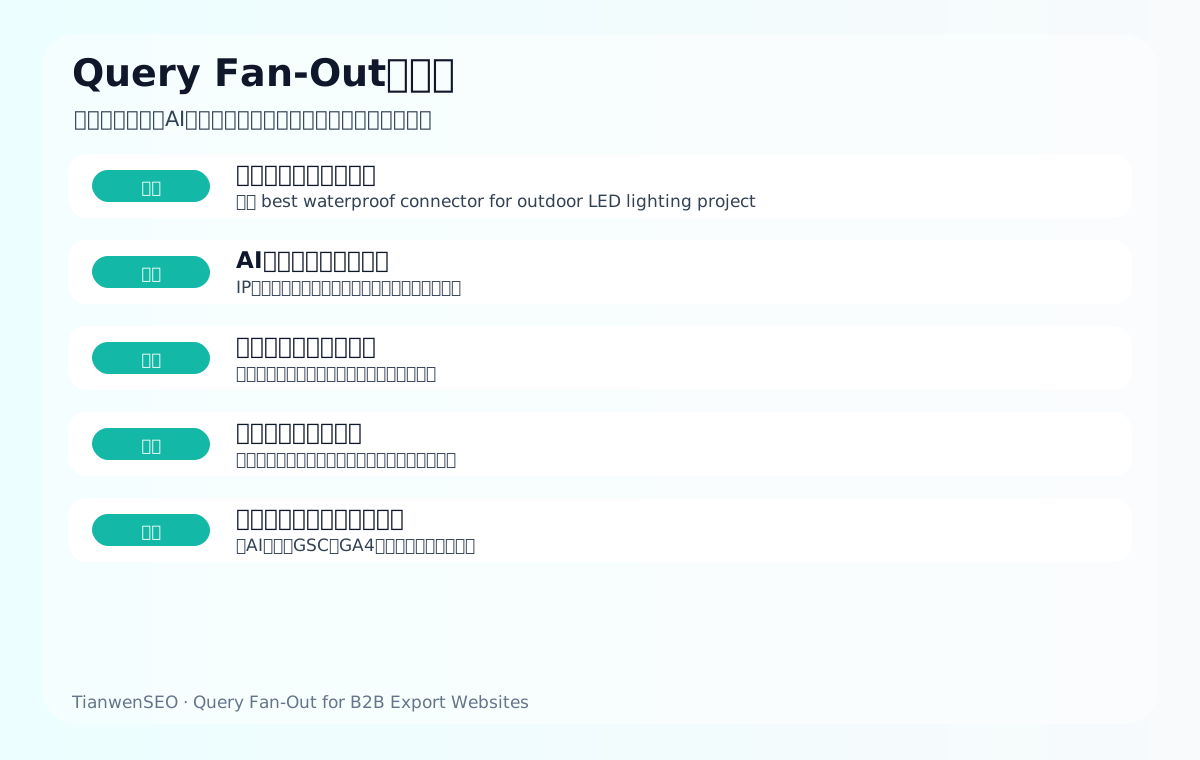
For example, when AI handles “best waterproof connector for outdoor LED lighting,” it may split out multiple sub-questions such as IP rating, cable diameter, pin count, operating temperature, installation environment, certifications, supplier capability, common failures, and RFQ parameters. If the page merely lists these sub-questions as headings but the body has no specification table, application boundaries, installation risks, or RFQ checklist, it will still struggle to become a reliable source.
So the lesson Query Fan-Out offers foreign-trade SEO is: do not write pages around a single main keyword alone; organize your page system around the procurement decision process. Behind one main question, product pages, resource pages, application pages, FAQs, and contact paths usually need to work together.
How Query Fan-Out differs from traditional keyword research
| Dimension | Traditional keyword research | Query Fan-Out approach | Impact on foreign-trade websites |
|---|---|---|---|
| Starting point | The keywords the user types | The sub-questions AI generates to answer the question | You cannot look at search volume alone |
| Scope | Main terms, long-tail terms, related terms | Materials, applications, standards, risks, comparisons, follow-up actions | Content must cover the procurement chain |
| Pages | One term maps to one page or section | A group of questions maps to a page network | Product pages and resource pages must work together |
| Metrics | Search volume, difficulty, ranking, clicks | Answer citations, source accuracy, business path | Requires manual review of the question library |
| Risk | Keyword stuffing | Mechanically chasing AI-guessed branches | Must be validated with real procurement questions |
Why AI splits questions
Complex questions often contain multiple implicit conditions. The user types one sentence, and the system needs to first understand the background, then add context, and finally generate an answer that looks complete. The role of Query Fan-Out is to break one big question into several searchable smaller questions.
Foreign-trade procurement questions are especially well suited to being broken down, because procurement decisions naturally contain multiple dimensions: what the product is, what environment it is used in, what standards apply, whether the supplier is reliable, what determines the price, how lead time and samples are arranged, and where the risks lie.
| User’s original question | Implicit sub-questions | Information AI needs |
|---|---|---|
| which custom metal parts supplier for marine equipment | Materials, salt spray, surface treatment, tolerances, inspection, supplier capability | Material guide, process capability, quality process, RFQ requirements |
| best LED flood light for warehouse | Installation height, wattage, beam angle, certification, energy savings, warranty | Application page, wattage table, certificates, project requirements |
| packaging machine for powder small business | Material flowability, speed, precision, cleaning, budget, after-sales | Equipment selection page, cleaning FAQ, RFQ checklist |
| ceramic dinnerware wholesale for restaurant | Material, durability, packaging, MOQ, lead time, market standards | Category page, material comparison, wholesale FAQ |
The biggest change Query Fan-Out brings to foreign-trade independent sites
In the past, many foreign-trade websites were used to centering on core product terms: build one product page, write a few paragraphs around the main term, and add some images and a contact form. In the AI search era, such pages are still the foundation, but they are not enough to cover complex questions.
| Past practice | Problem under Query Fan-Out | Direction for upgrading |
|---|---|---|
| One product page covers everything | The sub-questions AI splits out do not have enough answers | Add resource pages, application pages, FAQs, and selection tables |
| Only write the main keyword | Long-tail procurement questions are not covered | Add materials, scenarios, standards, and risks along the procurement chain |
| Only look at search volume | Many AI sub-questions have no traditional search volume | Combine sales questions with an AI question library |
| Articles and product pages are separate | Content cannot lead to inquiries | Resource pages link to products and contact paths |
| Only chase rankings | AI answers and inquiry quality are not recorded | Build AI screenshots and business reviews |
Foreign-trade Query Fan-Out content map
Case 1: How a waterproof connector question gets broken down
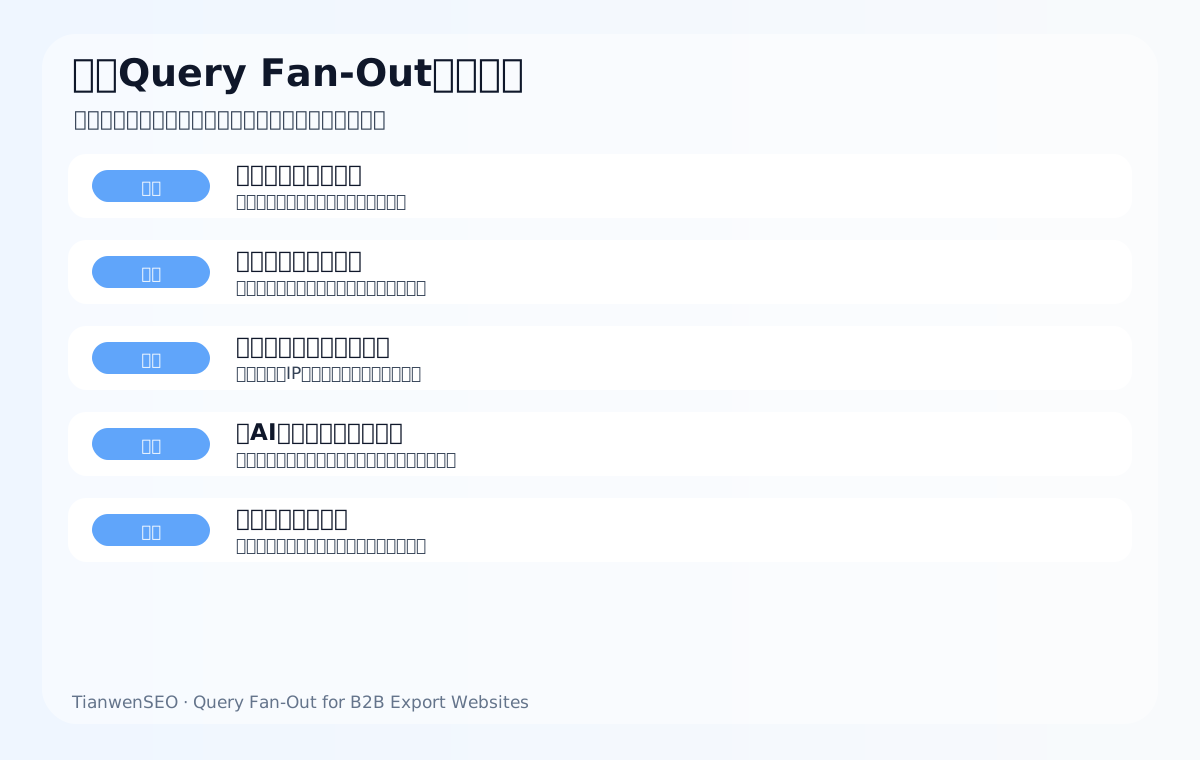
A user types “which waterproof connector should I use for outdoor LED lighting,” and AI may not just search that sentence but split it into a group of questions.
| Sub-question | Corresponding page | What the page must answer | Next business step |
|---|---|---|---|
| What is the difference between IP67 and IP68 | IP rating resource page | Test conditions, applicable environments, limitations | Confirm the project environment |
| How many pins does an outdoor LED lighting connector need | Product page/selection page | Pin count, cable diameter, current, voltage | Submit electrical parameters |
| What are the common installation failures | Installation FAQ | Sealing, locking, cable diameter, temperature | Get installation advice |
| What materials should the supplier provide | Procurement checklist page | Datasheets, certifications, samples, testing | Send the RFQ checklist |
| Is it suitable for a seaside environment | Application page/material page | Salt spray, materials, surface treatment | Confirm environmental conditions |
If the site has only one thin product page, it covers the product term at best; if the site has a product page, an IP rating resource page, an outdoor lighting application page, an installation FAQ, and an RFQ checklist, it is much easier to cover the fan-out branches.
Case 2: How a custom metal parts question gets broken down
| User question | Possible sub-queries | Pages needed | Strong content modules |
|---|---|---|---|
| custom metal parts for salt spray environment | 316 stainless steel, anodizing, zinc plating, salt spray test | Material guide, inspection page | Material comparison table, test description |
| cnc machining parts tolerance for assembly | machining tolerance, drawing requirements, inspection method | Tolerance resource page | Tolerance table, drawing checklist |
| how to reduce custom metal part cost | material cost, process choice, quantity, surface finish | Cost factor guide | Price factor table |
| metal parts supplier with NDA | drawing confidentiality, quality process, supplier capability | Capability page/FAQ | Confidentiality process and RFQ instructions |
Case 3: How a packaging machine question gets broken down
| Original question | How AI may break it down | Page that handles it |
|---|---|---|
| best packaging machine for coffee powder | Powder flowability, metering method, dust control, cleaning, bag type, speed | Coffee powder packaging application page |
| small business packaging machine cost | Budget, degree of automation, speed, after-sales, ease of maintenance | Small business selection guide |
| how to choose powder filling machine | Screw metering, weight range, precision, material characteristics | Powder filling resource page |
| packaging machine supplier China | Factory capability, export experience, sample testing, spare parts supply | Supply capability page and RFQ process |
How to build a content cluster for one main question
Note that “content cluster” here is not an internal execution term; it explains to clients how pages work together. One main procurement question usually requires multiple pages to answer jointly.
| Main question | Pillar page | Sub-pages | Conversion page |
|---|---|---|---|
| How to choose LED flood light | LED flood light selection guide | Warehouse application, parking lot application, IP rating, beam angle FAQ | Project requirement form and quote entry point |
| Custom metal parts supplier selection | Custom metal parts supplier selection guide | Materials, tolerances, surface treatment, quality inspection | Drawing upload and RFQ checklist |
| Packaging machine for powder | Powder packaging equipment selection guide | Material compatibility, cleaning and maintenance, speed and precision, sample testing | Equipment requirement form |
| Ceramic dinnerware wholesale | Ceramic dinnerware wholesale procurement guide | Material comparison, packaging, MOQ, target market standards | Sample and catalog request |
Do not treat AI-guessed sub-questions as absolute truth
Query Fan-Out is inspiring, but it also carries risk. Different AI platforms, different times, and different user contexts may split out different sub-questions. You cannot treat a fan-out list generated by some tool as the only truth and then mechanically build pages.
- Use GSC query terms to verify whether search demand already exists.
- Use sales questions to verify whether it is a real procurement question.
- Use AI answer screenshots to observe whether the same type of sub-question keeps appearing.
- Use product materials to judge whether you have the capability to write a reliable answer.
- Avoid building low-quality pages for every tiny detail.
Query Fan-Out content priority scoring
| Scoring item | 0 points | 1 point | 2 points |
|---|---|---|---|
| Procurement value | Barely affects inquiries | Indirect impact | Directly affects core inquiries |
| Frequency of appearance | Appears only once in an AI answer | Appears occasionally | Appears repeatedly across platforms/sales/GSC |
| Page foundation | No suitable page | A thin page exists | An upgradable page already exists |
| Product facts | Cannot provide specific materials | Some materials available | Specifications, evidence, and case boundaries are sufficient |
| Competitive gap | Top results are already strong | Can partially surpass them | Clearly lacking foreign-trade scenarios and tables |
Page writing method: every sub-question must be answered completely
AI systems may cite a fragment from a page, so every important paragraph should be as complete as possible—but complete does not mean isolated. A good answer to a sub-question usually includes the conclusion, conditions, judgment criteria, an example, and the next step.
| Sub-question | Incomplete answer | Complete answer |
|---|---|---|
| Is IP67 enough for outdoor lighting | IP67 is waterproof. | IP67 is usually suitable for outdoor protection under short-term immersion test conditions, but an outdoor LED project also needs to confirm cable diameter, installation method, temperature, salt spray, and long-term rain exposure. |
| How to choose a powder packaging machine | Look at the powder and the speed. | Powder packaging machine selection must confirm material flowability, target weight, precision, packaging speed, dust control, cleaning of contact parts, and after-sales spare parts. |
| How tight can CNC tolerances be | We can do high-precision machining. | CNC tolerances depend on the material, structure, equipment, surface treatment, and inspection method. Before quoting, you should provide drawings, critical dimensions, tolerance grade, and application. |
Query Fan-Out review dashboard
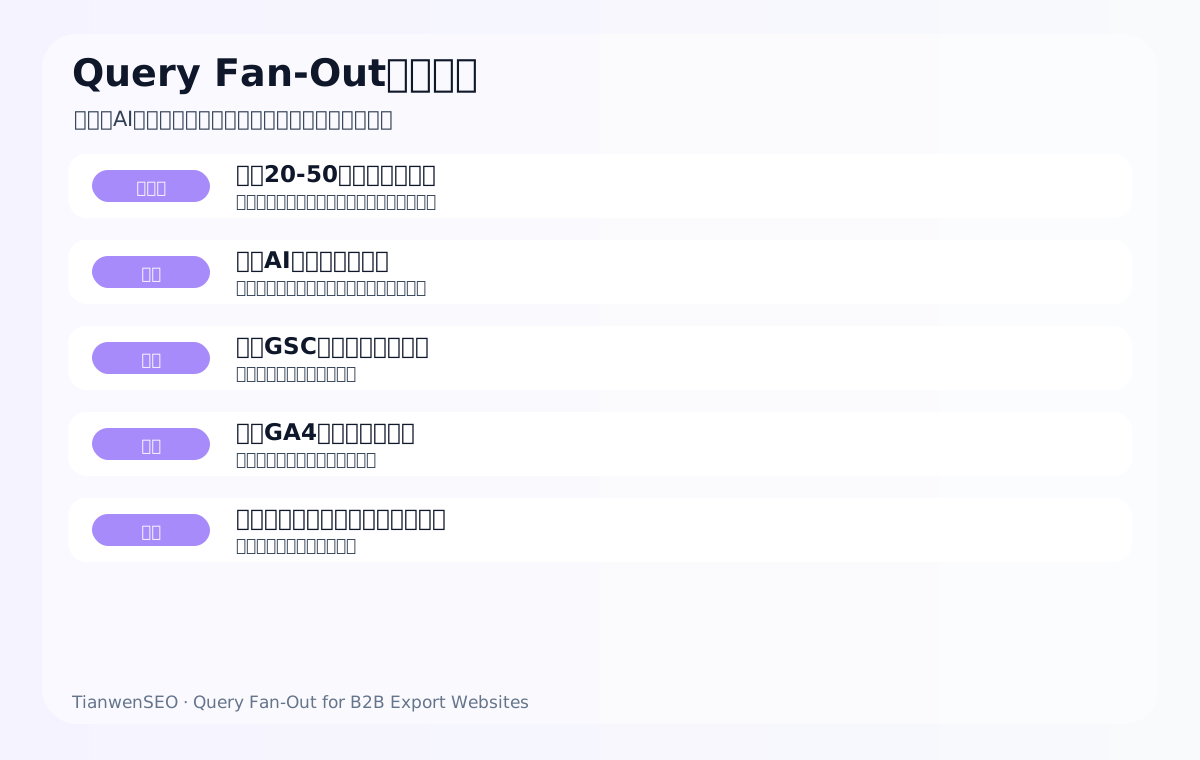
| Review field | What to record | Judgment direction |
|---|---|---|
| Original question | The full wording of the buyer’s or AI’s question | Whether it belongs to the core business |
| Sub-questions | The branches in the AI answer involving materials, scenarios, standards, suppliers, etc. | Whether a page is needed to handle them |
| Cited sources | Official sites, competitors, industry media, directories | Who is becoming the answer source |
| Official site gaps | Missing specifications, missing tables, missing evidence, missing FAQs | Determines the content action |
| Business results | Visits, inquiries, sales feedback | Judges whether continued investment is worthwhile |
FAQ: Common questions about Query Fan-Out
Top1 benchmark: What existing Query Fan-Out content lacks
Most of the currently top-ranking Query Fan-Out content can explain the concept: AI expands one search into multiple searches, content must cover more sub-questions, and traditional keyword research needs an upgrade. This content is suitable for SEO practitioners to quickly understand the trend, but for foreign-trade factories and trading companies, it is still not practical enough.
The place where foreign-trade companies get stuck most easily after reading is: which product page should I change? Into which procurement questions will AI split my product terms? Should existing articles be merged? Should I build a page for every sub-question? What metrics should I look at during review? If these questions are not answered, Query Fan-Out becomes just another concept that sounds advanced but cannot be executed.
| Benchmark dimension | Strengths of Top1/authoritative content | Gap for foreign-trade companies | How this article fills it in |
|---|---|---|---|
| Definition | Explains that fan-out is AI expanding a query | Unclear how foreign-trade procurement questions are split | Breaks them down using connectors, CNC, packaging machines, and other products |
| Strategy | Recommends covering related questions | Unclear how pages should divide the work | Maps product pages, resource pages, application pages, and RFQ pages |
| Examples | Mostly SEO/software/SaaS examples | Lacks B2B products and English product terms | Uses foreign-trade English product terms and inquiry scenarios |
| Review | Discusses visibility and citations | Lacks business metrics | Adds GSC, GA4, AI screenshots, inquiries, and sales feedback |
| Risk | Rarely discusses over-splitting pages | May build large numbers of low-quality pages | Provides a scoring table and merge/split judgment |
Why Query Fan-Out changes the order of content production
The common order of content production in the past was: find keywords, check search volume, write the article, publish the page, watch rankings. Query Fan-Out requires moving the order earlier: first understand the procurement task, then break down real sub-questions, then decide which page should handle which question, and only then write the content.
| Old order | Problem | New order | Benefit |
|---|---|---|---|
| Find keywords first | Easily ignores high-value questions with no search volume | Find procurement tasks first | Closer to real inquiries |
| Write articles by keyword | Pages easily become isolated | Allocate pages by question network | Products, resources, and applications support one another |
| Look for internal links after writing | The structure is passive | Design page relationships first | Easier for users and AI to understand |
| Only look at rankings | Cannot see AI answers and inquiry quality | Look at search, AI, and business at the same time | Avoids chasing surface traffic only |
The five types of Fan-Out branches in foreign-trade procurement questions
When foreign-trade procurement questions are broken down by AI, they usually fall into five types of branches: product facts, application scenarios, selection criteria, supplier trust, and next-step actions.
| Branch type | What it answers | Pages needed | Example |
|---|---|---|---|
| Product facts | What the product is, what the parameters are, whether it can be customized | Product page/specification page | waterproof connector pin count and cable OD |
| Application scenarios | How to choose for a given environment | Application page | LED flood light for warehouse height |
| Selection criteria | How to judge between different options | Resource page/comparison page | 304 vs 316 stainless steel custom parts |
| Supplier trust | Whether the company is reliable | About page/capability page/certificate page | industrial valve supplier certification |
| Next-step actions | How to request a quote, make a sample, confirm requirements | RFQ checklist/contact page | packaging machine quotation requirements |
How to break a problem network out of a single product term
You can use the six-step method: “product term—application—parameters—risks—supplier—RFQ.”
| Step | Questions to ask | Output | Example |
|---|---|---|---|
| Product term | What is the core product | Main product page | waterproof connector |
| Application | What scenarios is it used in | Application page list | outdoor LED lighting, solar cable, marine box |
| Parameters | What must be confirmed before purchasing | Specification table and FAQ | pin count, cable OD, IP rating, temperature |
| Risks | What happens if you choose wrong | Common mistakes page | seal failure, wrong cable diameter, corrosion |
| Supplier | How to judge supply capability | Capability page and evidence page | certification, sample, testing, lead time |
| RFQ | What information needs to be provided | RFQ checklist | drawing, quantity, target market, application |
Why resource pages are more useful than ordinary blog posts in Fan-Out
Ordinary blog posts often write opinions around a broad topic, while resource pages provide facts and tables around one specific judgment. When AI breaks down a question, it needs resource pages that can answer sub-questions even more.
| Ordinary blog post | Resource page | Why the resource page is stronger |
|---|---|---|
| Why choose a good supplier | Supplier evaluation checklist | The latter has specific judgment criteria |
| Benefits of LED flood light | Beam angle and installation height table | The latter can directly answer application questions |
| What is CNC machining | CNC tolerance and drawing requirement guide | The latter can support procurement decisions |
| Packaging machine trends | Powder packaging machine selection checklist | The latter can turn into RFQ preparation |
Map Fan-Out results to pages, not into a single article
A common mistake is putting all fan-out sub-questions into one extremely long article. A pillar page can cover the big picture, but not every detail belongs in it. Important sub-questions should have their own resource page or product page to handle them.
| Importance of the sub-question | Page handling | Reason |
|---|---|---|
| High business value + high frequency | Independent page or strong section | Worth handling search and AI citations |
| High business value + low frequency | Product page FAQ or resource page subsection | Not necessarily worth a separate page |
| Low business value + high frequency | FAQ or supporting content | Satisfies users without over-investing |
| Low business value + low frequency | Leave for now | Avoids creating low-quality pages |
The relationship between Fan-Out and keyword cannibalization
Query Fan-Out will lead a team to discover many sub-questions, but if handled poorly it can cause keyword cannibalization. For example, an LED flood light website builds four similar pages at the same time—”LED flood light for warehouse guide,” “warehouse LED lighting guide,” “best flood light for warehouse,” and “how to choose warehouse flood light”—with highly repetitive content, which may actually leave search and AI unsure which page is strongest.
| Cannibalization symptom | Cause | Solution |
|---|---|---|
| Multiple pages have similar titles | No clear page role | Keep the pillar page, merge the others or turn them into sub-pages |
| The same FAQ appears repeatedly | No unified resource page | Build an authoritative FAQ page and link internally |
| Product pages and blog posts compete for the same term | Unclear product/resource boundary | Product pages cover supply, resource pages cover judgment |
| AI cites competitors instead of the official site | Official site pages are scattered and thin | Merge into a strong page and add evidence |
How to validate Fan-Out with sales questions
AI may split out many theoretical questions, but the sales team can judge which are real procurement obstacles. Every piece of sales feedback can be mapped to a fan-out branch.
| Sales feedback | Corresponding Fan-Out branch | Content action |
|---|---|---|
| Customer does not know whether to choose IP67 or IP68 | Standards/application risk | Add an IP rating comparison and application page |
| Customer only sends pictures without drawings | RFQ preparation | Add a drawing and parameter checklist |
| Customer asks whether the equipment can package sticky powder | Material compatibility | Add material characteristics and the testing process |
| Customer worries about dinnerware breaking in transit | Packaging/quality risk | Add packaging solutions and test descriptions |
| Customer asks whether certifications apply to the target market | Compliance/evidence | Add the certification scope and items to confirm |
Chart and table design in Fan-Out content writing
Every complex procurement question deserves at least one table or diagram. Charts and tables help users and AI understand the relationships between sub-questions.
| Chart/table | Suitable scenario | Example |
|---|---|---|
| Question breakdown diagram | Explains how one question branches | waterproof connector procurement question breakdown |
| Page map | Shows which pages handle which sub-questions | Relationships among product pages, application pages, and resource pages |
| Selection matrix | Compares different materials, models, and applications | custom metal parts material matrix |
| RFQ checklist | Collects procurement parameters | packaging machine requirement fields |
| Review dashboard | Tracks AI answers and business results | GSC + GA4 + inquiries + AI screenshots |
90-day execution roadmap: from a single page to a problem network
Phase 1: Build a core procurement question library
For each product line, first collect 10-20 real procurement questions from sources including GSC queries, sales chats, inquiry forms, customer emails, AI answers, and competitor pages.
Phase 2: Break down Fan-Out branches
Split each question into the five categories of product facts, application scenarios, selection criteria, supplier trust, and next-step actions. Do not try to be exhaustive at once; focus only on high-value branches.
Phase 3: Map existing pages
Check which sub-questions already have pages, which pages are thin, which pages are duplicated, and which questions have no coverage at all.
Phase 4: Strengthen core pages
Prioritize strengthening the product pages, application pages, and resource pages with the most business value. Each page should have at least a table, an FAQ, images and text, an inquiry path, and relevant internal links.
Phase 5: Review AI answers and inquiries
Each month, record the AI answers and citation sources for the target questions, compare them with GSC, GA4, and inquiry quality, and decide the next round of expansion, merging, or splitting.
Fan-Out content quality checklist
- Does the page correspond to one clear procurement question or sub-question?
- Does it use real foreign-trade English product terms rather than generic SEO terms?
- Does it contain product facts such as specifications, materials, certifications, applications, and limitations?
- Does it have tables, processes, matrices, or checklists to help with judgment?
- Does it explain what information needs to be provided for the next RFQ?
- Does it link to and from product pages, resource pages, and application pages?
- Does it avoid building thin pages for low-value sub-questions?
- Can it be reviewed with AI answers, GSC, GA4, and inquiry data?
A few more FAQs
Will Query Fan-Out make SEO more complicated?
It will make content planning more complex, but also closer to real procurement decisions. Foreign-trade websites can start with core product lines and high-value questions, and do not need to cover all branches at once.
Is Fan-Out suitable for all foreign-trade products?
It suits most B2B products, especially those with materials, specifications, applications, certifications, installation, maintenance, and procurement processes.
Can one pillar page cover all Fan-Out questions?
No. The pillar page handles the overall framework, while important sub-questions need product pages, application pages, resource pages, and FAQs to handle them together.
How do you avoid Fan-Out leading to too many pages?
Score by business value, frequency of appearance, page foundation, and product facts, and put low-value questions in FAQs or leave them for now.
Is the page AI cites always ranked first?
Not necessarily. AI answers may cite a resource page, product page, or external source that better answers a particular sub-question.
Does Fan-Out content need multiple languages?
If target customers search in English, core pages and resource pages should have high-quality English content; Chinese-language service sites should also use English product terms in their examples.
Deep dive into an industry scenario: industrial valve supplier
The procurement questions of industrial valve suppliers are very well suited to being understood through Query Fan-Out. Buyers will not just ask “industrial valve supplier”; they are more likely to ask about a combination of medium, pressure, temperature, connection method, material, standard, and lead time. For example, “which industrial valve supplier can provide stainless steel valves for corrosive chemical process.”
| Fan-Out branch | Sub-question | Page that should handle it | Content focus |
|---|---|---|---|
| Medium | Used for water, steam, oil, chemicals, or gas | Medium application page | Material compatibility, sealing materials, corrosion risk |
| Pressure and temperature | What are the working pressure and temperature range | Specification resource page | Pressure rating, temperature curve, test standards |
| Connection method | Flange, thread, welding, clamp | Product category page | Standards, installation, maintenance differences |
| Supply capability | Can certificates, testing, and spare parts be provided | Company capability page | Inspection process, delivery, after-sales spare parts |
| RFQ | Which parameters are needed before quoting | RFQ checklist | Medium, pressure, temperature, dimensions, standards, quantity |
Deep dive into an industry scenario: private label activewear manufacturer
The fan-out for apparel foreign-trade websites differs from industrial products. Buyers care about fabric, fit, sizing, logo techniques, labels, MOQ, sample lead time, bulk lead time, color, packaging, and target market.
| Procurement question | How AI may break it down | Page design |
|---|---|---|
| how to choose private label activewear manufacturer | Fabric, MOQ, samples, logo, sizing, quality control | Supplier selection guide + capability page |
| activewear fabric for yoga brand | nylon, spandex, compression, breathability, squat proof | Fabric resource page |
| private label MOQ activewear | Style, color, size, craftsmanship, stock fabric | MOQ FAQ |
| custom logo methods for leggings | heat transfer, silicone, embroidery, woven label | Logo technique resource page |
If this kind of content only says “we are a professional activewear manufacturer,” it is too weak for both AI and buyers. Strong content should help brand owners judge: which fabric suits which category, how long samples take, how logo techniques affect price and wash resistance, and why MOQ changes with color and size.
How to handle English titles and Chinese service-site titles under Fan-Out
Tianwen SEO Research is a Chinese-language service site, but its content is aimed at Chinese foreign-trade companies, so article titles can explain the method in Chinese while the examples in the body must use English product terms and procurement questions. For the foreign-trade client’s own English site, titles should directly correspond to overseas buyers’ English search intent.
| Page scenario | Chinese service-site title | Foreign-trade English site title | Notes |
|---|---|---|---|
| Methodology article | What is Query Fan-Out | How AI Search Splits B2B Product Questions | The Chinese site teaches clients to understand the method |
| Product resource page | How to choose IP ratings for waterproof connectors | IP67 vs IP68 Waterproof Connector for Outdoor Lighting | The English site directly handles procurement questions |
| Application page | How to choose LED flood lights for warehouses | How to Choose LED Flood Lights for Warehouse Projects | The scenario is clear |
| RFQ page | What to prepare before requesting a packaging machine quote | Packaging Machine RFQ Checklist for Powder Products | Helps buyers take action |
The relationship between Fan-Out and page titles, summaries, and above-the-fold answers
When AI splits a question into multiple branches, the page title and above-the-fold answer should let the system and the user quickly determine which branch the page covers. Titles should be neither too broad nor too narrow.
| Question | Title too broad | Title too narrow | More suitable title |
|---|---|---|---|
| waterproof connector | Connector Guide | M12 4 Pin Connector Model A | Waterproof Connector Selection for Outdoor LED Lighting |
| custom metal parts | Manufacturing Tips | Aluminum Part Cost | Custom Metal Parts Material and Tolerance Guide |
| packaging machine | Packaging Knowledge | One Machine Model Intro | Powder Packaging Machine Selection Checklist |
| ceramic dinnerware | Dinnerware Blog | Blue Plate Product | Ceramic Dinnerware Wholesale Material and Packaging Guide |
Fan-Out is not better the finer it gets: how to control page granularity
If every sub-question is split into an independent page, the site will expand rapidly and produce a large amount of thin content. Page granularity depends on three conditions: whether there is independent search/AI demand, whether there are enough product facts, and whether it can bring business value.
| Question granularity | Suitable for an independent page | Suitable for a section/FAQ | Leave for now |
|---|---|---|---|
| High frequency, high value | Yes | Can also be summarized on the pillar page | No |
| High value but little content | Hold off; use a section first | Yes | No |
| Low value but common | No | Yes | Possibly |
| Purely theoretical with no business relevance | No | Possibly | Yes |
| The company cannot provide facts | No | No | Yes |
How to reverse-engineer Fan-Out gaps from competitor pages
When benchmarking against Top1, do not just look at what the other side wrote; also look at which sub-questions it covers.
| Observation item | How to record | How to surpass |
|---|---|---|
| H2/H3 structure | List the question branches the other side covers | Add foreign-trade product scenarios and more detailed judgment tables |
| Tables and images | Record whether there are comparisons, processes, or matrices | Add actionable checklists and illustrated explanations |
| FAQ | See whether the questions are real | Add frequently asked sales questions and RFQ fields |
| Evidence | See whether official/industry sources are cited | Add verifiable company materials and external sources |
| Conversion path | See whether the answer can lead into action | Add an RFQ checklist, resource downloads, and a contact entry point |
Pre-publish checks for Fan-Out pages
| Check item | Pass criteria | Failure signs |
|---|---|---|
| Target question | One sentence clearly states what the page answers | The page tries to cover everything |
| Sub-question coverage | Covers the main procurement branches | Only an introduction to the main keyword |
| Product facts | Specifications, materials, certifications, applications, and limitations are clear | Only adjectives |
| Structure | H2/H3, tables, FAQ, and images and text are complete | Long stacked paragraphs |
| Internal links | Links to product, resource, application, and RFQ pages | Isolated page |
| Review | Has GSC, GA4, AI answer, and inquiry metrics | Cannot judge the effect after publishing |
How to judge whether a Fan-Out page is effective after publishing
After publishing, do not just look at whether it ranks within a week. AI search and B2B inquiries both have a lag.
| Period | What to look at | Notes |
|---|---|---|
| 7 days | Indexing, front end, images, title, bad words | Confirm the basics are normal |
| 14 days | Whether AI answers have changed | Establish or update the answer baseline |
| 30 days | GSC long-tail queries and page impressions | Observe whether the search system recognizes the sub-questions |
| 60 days | GA4 paths and product page visits | See whether the content guides users to keep taking action |
| 90 days | Inquiry quality and sales feedback | Judge whether business value is generated |
The relationship between Fan-Out content and backlinks/brand signals
External links and brand mentions also participate in AI’s understanding of the question. If external materials only say you are a general supplier while your official site says you are a specialized waterproof connector manufacturer, the conflicting information weakens the signal.
Therefore, when doing Fan-Out content, also check whether external platforms and brand materials support the same product positioning. For example, an industrial valve supplier should keep its product lines consistent across its official site, trade shows, catalogs, B2B platforms, and certificate pages.
Collaboration table between the content team and the sales team
| Collaboration action | Sales provides | Content team handles | Output |
|---|---|---|---|
| Collect questions | Customer emails, chats, inquiry fields | Categorize by product line and branch | Question library |
| Confirm facts | Customer requirements and misunderstandings | Find product/engineering confirmation | Fact table |
| Generate pages | Priority of high-value questions | Write product pages, resource pages, FAQs | Page drafts |
| Review | Inquiry quality and closing obstacles | Compare with GSC/GA4/AI answers | Next round of tasks |
The ultimate goal of Fan-Out content is not to cover AI, but to reduce procurement uncertainty
Query Fan-Out sounds like an AI search concept, but when it lands in foreign-trade business, its essence is reducing procurement uncertainty. Buyers are uncertain about materials, specifications, suppliers, certifications, price factors, and delivery risks. AI splitting questions merely makes these uncertainties explicit.
If the official site can answer these uncertainties in advance, it is more easily understood by search systems, AI answers, and buyers. Even if some AI answer does not cite you, a strong page can still improve traditional search, sales communication, and inquiry quality.
What is Query Fan-Out?
It is the process by which AI search splits one user question into multiple related sub-queries and then retrieves and synthesizes several sources to generate an answer.
Is Query Fan-Out the same as long-tail keywords?
No. Long-tail keywords are terms the user might type, while fan-out is the sub-questions and retrieval branches AI may generate in order to answer the question.
Why should foreign-trade websites care about Query Fan-Out?
Because procurement questions are naturally complex, and AI may look for sources from multiple angles such as materials, applications, standards, suppliers, and risks.
Should you build a page for every sub-question?
No. Content should be organized by business value and page role; build resource pages or sections for important questions and avoid large numbers of low-quality pages.
How do you know which questions AI split out?
You can observe AI answers, cited sources, GSC queries, sales questions, and competitor pages, but do not treat the result of any one tool as absolute truth.
Does Query Fan-Out make the main keyword unimportant?
No. The main keyword is still important, but it is only the entry point. Real competition also includes related sub-questions and the page system.
How should product pages adapt to fan-out?
Add specifications, applications, limitations, FAQs, internal links to resources, and an RFQ checklist so the product page can handle multiple procurement branches.
What role do resource pages play in fan-out?
Resource pages can answer sub-questions about materials, standards, selection, installation, and inspection, and they are the type of source AI answers often need.
Can GSC show fan-out queries?
GSC can show user search queries and page performance, but it cannot show all of AI’s internal sub-queries, so you need to combine AI answer screenshots with a manual question library.
Can you promise that covering fan-out will definitely get you cited?
No. AI citations are affected by the platform, query, sources, and timeliness; you can only improve the chances through content quality, structure, and credible materials.
Conclusion: from keyword pages to a procurement question network
Query Fan-Out reminds foreign-trade companies: in the AI search era, there are often multiple hidden branches behind one user question. Your website cannot prepare just one main-keyword page; it must build product pages, application pages, resource pages, FAQs, evidence pages, and inquiry paths around the procurement process.
The truly effective approach is not to stuff every AI-guessed question into an H2, but to answer each important sub-question clearly with real product facts, procurement questions, tables, images and text, evidence, and review data. In this way, the site can serve traditional Google SEO and also have a better chance of becoming a reliable source in AI answers.
Official sources and the boundaries of Query Fan-Out review
Query Fan-Out can be understood as a question being split into multiple related retrieval directions. What a foreign-trade website needs to do is not guess the system’s internal process, but prepare clear pages and verifiable materials that can cover the sub-questions.
| Official source | What it validates | Delivery boundary |
|---|---|---|
| Google AI features and your website | Confirms that AI Mode and AI Overviews may use query fan-out | A website cannot dictate how the system splits questions |
| Helpful, reliable, people-first content | Checks whether the page fully answers the user’s task | Shallow FAQ stacking cannot replace a complete explanation |
| SEO Starter Guide | Confirms that relevant pages can be discovered and understood | Correct structure does not equal existing search performance |
| Search Console Performance report | Uses query/page to observe which sub-questions begin to appear | When there are zero rows, keep only the query set |
| Bing Webmaster Tools AI Performance | Observes grounding query phrases as AI retrieval samples | Sample data cannot be expanded into conclusions for all platforms |
Review acceptance table
| Check item | Record field | How to write during low-data periods |
|---|---|---|
| Query set | Main questions, sub-questions, English product terms, scenario terms | Build the list first; do not write performance |
| Page mapping | URLs and page roles corresponding to sub-questions | If there is no page, list create/merge actions |
| Evidence fields | Parameters, certifications, case sources, FAQs | If evidence is missing, do not invent cases |
| Review window | GSC date, AI sample date, page action date | Write “to be observed” consistently |
Supplement: Fan-Out pages must also return to indexing eligibility and GSC acceptance
Query Fan-Out pages cannot be judged only by “how finely the questions are split.” If the page itself is not reliably discovered, crawled, indexed, and reviewed by the search system, then sub-question coverage cannot be written up as an AI visibility result. When foreign-trade companies accept this kind of content, they should record page eligibility, indexing status, URL inspection, sitemaps, and GSC performance separately.
| Official basis | What it is used to accept | How to write during low-data periods | What cannot be inferred |
|---|---|---|---|
| Google Search Central: Search Essentials | Whether the page is accessible, whether the main content is readable, whether it serves a real user task, and whether there are obvious blocking or low-quality risks. | Record HTTP status, index/follow, canonical URL, body readability, main internal links, and mobile readability. | Cannot write basic eligibility up as having already gained impressions, clicks, inquiries, or AI citations. |
| Search Console Help: Page indexing report | Whether the page is still in a state such as discovered, crawled but not indexed, or submitted and indexed. | Record by URL, date, status, and sitemap; if nothing has changed, write “to be observed.” | Cannot write “discovered” as “indexed,” and cannot write sitemap submission as completed indexing. |
| Search Console Help: URL Inspection tool | Last crawl time, crawl status, indexing allowed status, user-declared canonical URL, and Google-selected canonical URL. | Use the last crawl time to judge whether Google has evaluated this revision. | Cannot replace Search Console URL inspection evidence with a successful browser open, a front-end screenshot, or the existence of an internal link. |
| Google Search Central: AI features and your website | AI features still require pages to be discoverable and understandable by search systems and to meet the basic conditions for being a summary candidate. | Write Fan-Out optimization as page eligibility, sub-question coverage, evidence modules, and long-term sampled review. | Cannot write that a certain AI platform will always cite the official site, and cannot treat one answer sample as a long-term conclusion. |
Therefore, the acceptance standard for a Query Fan-Out guide like 4661 should be: whether the page can be discovered, whether the core sub-questions have verifiable answers, whether real query/page signals appear in GSC, and whether AI samples are recorded by date and query set. When there are no GSC signals, you can only keep the query set, page mapping, and follow-up review plan, and cannot add impressions, clicks, ranking changes, or AI citation results.
Continue reading this set of GEO materials
If you are systematically learning about GEO and AI search visibility, it is worth continuing with the following articles. First understand the concepts, then look at diagnosis, monitoring, content structure, and collaboration boundaries.
- Are backlinks still important: from link signals to brand signals, how foreign-trade SEO should be done
- What is Google SEO: from crawling, indexing, and ranking to AI search and foreign-trade inquiries
- What a GEO visibility diagnosis includes: AI answers, entity consistency, cited sources, and review
- How to read a GEO diagnosis report: a guide to judging AI answers, cited sources, and entity consistency
- How to monitor AI search visibility: a checklist of foreign-trade website brand mentions, official site citations, and competitor answers
- How to choose GEO monitoring tools: where to look for mentions, citations, and traffic
{
“@context”: “https://schema.org”,
“@type”: “FAQPage”,
“mainEntity”: [
{
“@type”: “Question”,
“name”: “Will Query Fan-Out make SEO more complicated?”,
“acceptedAnswer”: {
“@type”: “Answer”,
“text”: “It will make content planning more complex, but also closer to real procurement decisions. Foreign-trade websites can start with core product lines and high-value questions, and do not need to cover all branches at once.”
}
},
{
“@type”: “Question”,
“name”: “Is Fan-Out suitable for all foreign-trade products?”,
“acceptedAnswer”: {
“@type”: “Answer”,
“text”: “It suits most B2B products, especially those with materials, specifications, applications, certifications, installation, maintenance, and procurement processes.”
}
},
{
“@type”: “Question”,
“name”: “Can one pillar page cover all Fan-Out questions?”,
“acceptedAnswer”: {
“@type”: “Answer”,
“text”: “No. The pillar page handles the overall framework, while important sub-questions need product pages, application pages, resource pages, and FAQs to handle them together.”
}
},
{
“@type”: “Question”,
“name”: “How do you avoid Fan-Out leading to too many pages?”,
“acceptedAnswer”: {
“@type”: “Answer”,
“text”: “Score by business value, frequency of appearance, page foundation, and product facts, and put low-value questions in FAQs or leave them for now.”
}
},
{
“@type”: “Question”,
“name”: “Is the page AI cites always ranked first?”,
“acceptedAnswer”: {
“@type”: “Answer”,
“text”: “Not necessarily. AI answers may cite a resource page, product page, or external source that better answers a particular sub-question.”
}
}
]
}
This page is machine-translated from the Simplified Chinese version and awaiting human review. It has not yet been proofread.