Google SEO ranking factors are not a checklist you can copy mechanically. For export manufacturers and trading companies, the more useful question is: which factors can be changed directly, which need long-term accumulation, which are only explanatory variables, which affect English product-term rankings, and which affect AI answer citations and inquiry quality. This article breaks the five categories of signals — content, links, technical, experience, and brand — into actionable judgments, to help export websites turn “ranking factors” into a page optimization order.
The examples in this article use export product terms such as custom metal parts, LED flood light, packaging machine, medical probe, cnc machining parts, ceramic dinnerware, waterproof connector, industrial valve supplier, and private label activewear manufacturer. We are discussing product pages, category pages, application pages, technical documentation pages, blog guides, and inquiry paths, not abstract terminology for peers.
Benchmarking against Top1 and authoritative references: don’t be misled by “200 factors”
In the current English SERP, Backlinko’s “Google’s 200 Ranking Factors” is the most typical Top1/authority-type benchmark page: it covers a large number of factors across domains, pages, sites, backlinks, user engagement, brand, and spam signals, and it labels some factors as confirmed, disputed, or speculative. Its strength is broad coverage, easy browsing, and suitability for beginners building a complete picture.
Google’s official documentation gives a more conservative benchmark: Google’s ranking systems combine many signals, with the goal of returning relevant and useful results; the official helpful content documentation emphasizes that content should be written for people, be reliable and complete, and provide a good page experience; How Search Works explains that rankings are affected by location, language, device, and query type. In other words, you cannot treat every item in a third-party list as an equally actionable button.
The way this article goes beyond that is not to list another 300 factors, but to rewrite ranking factors into priorities that export businesses can actually execute: first make sure pages can be crawled, indexed, and understood; then make content satisfy purchasing intent; then strengthen trust with internal links, external evidence, and brand entities; and at the same time review with GSC, GA4, inquiry sources, and AI citations — making no promises about specific rankings and managing only controllable improvements.
| Benchmark dimension | Strengths of Backlinko/industry lists | Google official benchmark | How this article adds to it |
|---|---|---|---|
| Coverage | Many factors, good for broad browsing | Emphasizes multiple systems, multiple signals, relevance, and usefulness | Reorganized by executable priority for export sites |
| Evidence boundaries | Some factors are disputed or speculative | No single public recipe | Distinguishes controllable items, indirect items, and explanatory variables |
| Execution context | Suited to general websites and content teams | Principles apply to all websites | Applied to product pages, category pages, application pages, and inquiry pages |
| AI search | Some newer articles mention AI visibility | Official ranking and AI citation are not entirely equivalent | Adds AI citation structure and review metrics |
| Business results | Mostly looks at rankings and traffic | Emphasizes usefulness to users | Adds inquiry quality, product terms, and sales feedback |
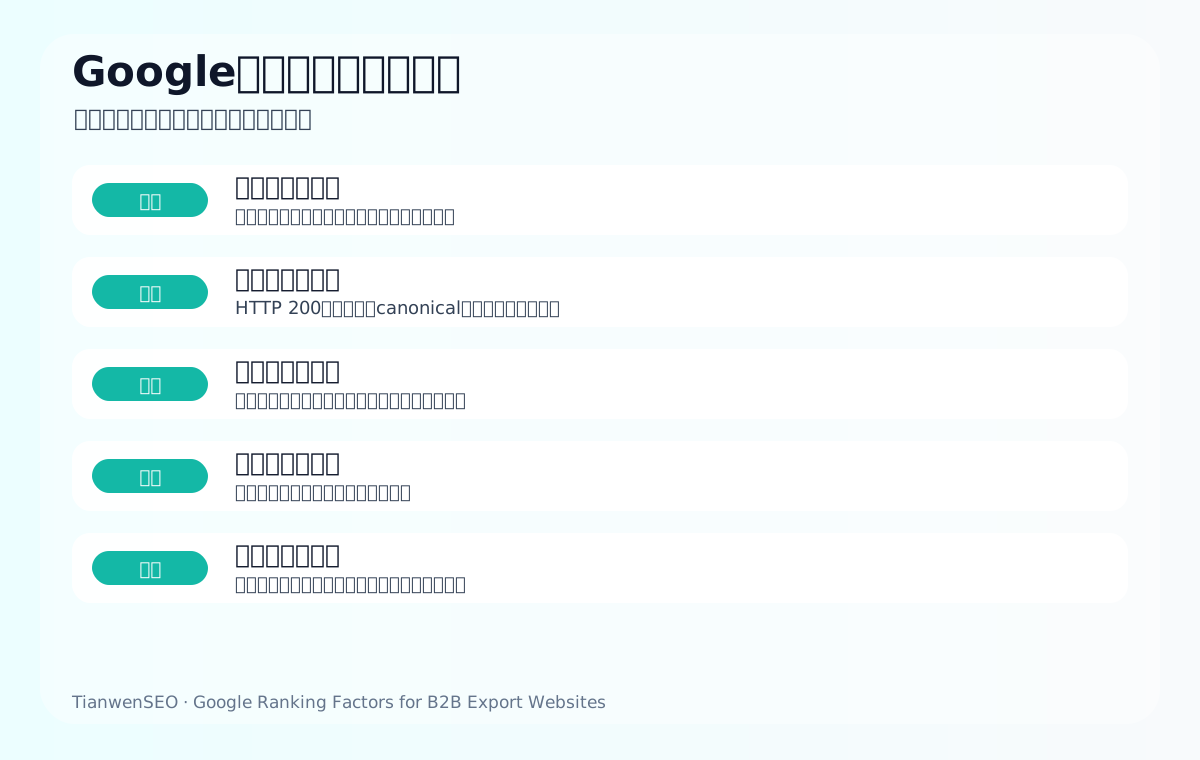
Official evidence boundaries: ranking factors are not a single button, and GEO is not independent magic
Google Search Central’s ranking systems documentation emphasizes that Google uses automated ranking systems to combine many signals and return relevant, useful results; these systems work mainly at the page level and also take site-level signals into account. For export businesses, this means “ranking factors” cannot be written as a single action, nor as a result that a service team can directly control. What is controllable is page quality, the crawling and indexing foundation, content facts, internal link structure, structured data, page experience, external evidence, and review standards.
GEO and AI search visibility also cannot be promised independently of SEO fundamentals. Google’s AI features documentation, the OpenAI bots documentation, and Bing Webmaster Tools’ AI Performance material are all suitable for establishing observation standards, but they cannot prove that a given page will be adopted in an AI answer, nor can they replace GSC, GA4, logs, and page facts. If there is currently no usable GSC row data, you can only write “which fields to observe, how to establish a baseline, and how to re-check next,” and you must not add rankings, impressions, clicks, CTR, AI adoption, or inquiry results.
| Official source | What it supports judging | How to use it in a ranking factors article | What it cannot prove |
|---|---|---|---|
| Google Search Central: Ranking systems guide | Ranking systems combine multiple kinds of signals, understand results mainly at the page level, and also reference site-level signals. | Write content, links, technical, experience, and brand as a priority matrix rather than a list of single buttons. | Cannot state that any single factor determines rankings. |
| Google Search Central: Creating helpful, reliable, people-first content | Content should be helpful, reliable, and user-facing, and should clearly demonstrate experience, expertise, and trustworthy sources. | Check whether custom metal parts, LED flood light, and packaging machine pages answer purchasing decision questions. | Cannot treat word count, keyword density, or templated FAQ as content quality. |
| Google Search Central: SEO Starter Guide | Titles, body text, images, internal links, and site structure should help users and search systems understand the page. | Put page titles, first-paragraph answers, image alt text, product documentation pages, and internal links into the acceptance checklist. | Cannot state that completing basic SEO will earn a specified position. |
| Google Search Central: Search Essentials | Search eligibility, accessibility, spam risk, and the minimum content quality bar. | First check whether core pages meet crawlable, indexable, and non-misleading content requirements. | Meeting the minimum bar does not mean impressions, clicks, or inquiries already exist. |
| Google Search Central: Page experience | Core ranking systems tend to reward content with a good page experience. | Include mobile readability, tables that do not overflow, above-the-fold loading, clear navigation, and usable CTA in the check. | Page speed scores cannot replace content and intent matching. |
| Google Search Central: Sitemaps overview | Sitemaps help search engines discover important URLs. | After core product, category, application, and documentation pages are updated, they should be verifiable in the sitemap. | Being present in a sitemap does not mean the URL has been crawled, indexed, or ranked. |
| Google Search Central: robots.txt introduction | robots.txt controls crawl access; it is not an all-purpose indexing switch. | Check whether WordPress, Shopify, and WooCommerce sites accidentally block core directories or resources. | Allowing crawling does not guarantee inclusion or display. |
| Google Search Central: Canonical URL guidelines | Duplicate URLs need canonical tags, redirects, internal links, and sitemaps to help consolidate signals. | Check whether product variants, parameter pages, pagination, and category filters split signals apart. | Canonical is a hint and a consolidation strategy, not a ranking promise. |
| Google Search Central: Structured data general guidelines | Structured data should match visible page content and follow quality guidelines. | Product, FAQ, Breadcrumb, Organization, and Article markup should match the facts in the body text. | Adding Schema cannot directly control rankings or AI answers. |
| Search Console Help: Performance report | query, page, clicks, impressions, CTR, average position, country, device. | Use page and query groupings to review whether ranking factors translate into real search performance. | With no GSC row data, you cannot write about rankings, impressions, clicks, CTR, or trend improvement. |
| Search Console Help: URL Inspection tool | Index status, crawl status, canonical, and the page version Google sees for a single URL. | Spot-check whether core URLs are indexable, and record technical issues and page actions. | A single URL passing inspection does not mean search performance has already been generated. |
| Google Analytics Help: About events | GA4 events can record forms, email, downloads, WhatsApp, RFQ, and documentation page behavior. | Look at the inquiry path after a search click separately from on-site events. | On-site events cannot replace GSC search performance. |
| Google Search Central: AI features and your website | AI search still depends on pages being accessible, indexable, clearly written, and built on basic SEO. | Check whether a page can be correctly understood as a source of product capability, scenarios, evidence, and FAQ. | Cannot promise that an AI answer will use the official website. |
| OpenAI Platform: Bots | Distinguishes the purposes and access boundaries of OAI-SearchBot, GPTBot, and ChatGPT-User. | Use robots.txt and logs to verify AI crawler access policy. | Allowing crawler access does not mean ChatGPT search will display the official website. |
| Bing Webmaster Blog: AI Performance | If visible in the account, you can observe citations, cited pages, and grounding query phrases. | Record citation URLs, query phrases, platforms, and dates separately. | A citation is not a Google ranking, answer position, or inquiry result. |
| IndexNow: Documentation | After URLs are added, updated, or deleted, participating search engines can be notified. | After a page update, record the submitted URL, time, and returned status. | HTTP 200 only means the notification was received, not that the page has been crawled, indexed, or displayed. |
Acceptance criteria for ranking factors: turn “influencing factors” into “verifiable fields”
Ranking factors articles are most prone to vagueness: they list many concepts but offer no way to verify anything. The more professional approach is to turn each factor into verifiable fields, evidence sources, and boundary notes. This suits traditional Google SEO as well as GEO and AI search visibility reviews.
| Factor layer | Verifiable fields | Evidence source | Pass criteria | Delivery boundary |
|---|---|---|---|---|
| Crawling and indexing | Status codes, robots, index/follow, canonical, sitemap, internal links. | Search Console URL Inspection, server logs, page source, sitemap. | Core URLs are accessible, not accidentally blocked, body text is readable, and canonical URLs are clear. | Passing technical checks does not mean search performance exists. |
| Content and intent | Titles, first-paragraph answers, specifications, certifications, applications, MOQ, FAQ, document downloads. | Page body text, product documentation, Google helpful content principles, public competitor pages. | Buyers can judge whether the product fits and know what they need for the next inquiry step. | Complete content cannot promise a specific keyword position. |
| Structure and internal links | The link relationships among product pages, category pages, application pages, documentation pages, FAQ, and Blog. | On-site crawling, page HTML, breadcrumbs, navigation, related articles. | Important pages are not orphan URLs, and related pages can explain each other. | Internal link optimization does not mean external links or brand trust are already sufficient. |
| External evidence and brand entities | Company name, address, certifications, trade shows, supply chain role, consistency of third-party materials. | Official website pages, public certification pages, trade show pages, social media profiles, B2B platform profiles. | Google and AI systems can consistently understand “who this company is, what it does, and where the evidence is.” | Brand evidence is a trust foundation, not a ranking promise. |
| Page experience | Mobile reading, horizontal table scrolling, image loading, CTA, inquiry path. | Mobile front-end checks, Core Web Vitals, GA4 events, form testing. | Buyers can finish reading key specifications on mobile and move smoothly to contact or document download. | Experience optimization must be judged together with content, indexing, and intent. |
| GSC search performance | query, page, clicks, impressions, CTR, average position, country, device. | Search Console Performance report. | Can explain changes in impressions, clicks, and average position by page and query. | With no row data, you can only state that a baseline still needs to be established. |
| GA4 and inquiry behavior | Forms, email, WhatsApp, RFQ, document downloads, contact page paths. | GA4 events, CRM, sales feedback. | Can distinguish search entry, page reading, inquiry behavior, and sales follow-up. | Inquiry outcomes are affected by price, product, lead time, and sales follow-up together. |
| AI search samples | Platform, question set, date, answer summary, cited URL, factual errors, competitor sources. | Manual samples, Bing AI Performance, logs, page facts. | Can reveal whether AI misunderstands the brand, products, applications, and sources. | Samples are observations, not promises of platform results. |
When there are no GSC signals, ranking factor conclusions must be downgraded
If a site currently has no usable GSC query, page, or page-query row data, a ranking factors analysis cannot claim “ranking improvement,” “click growth,” “CTR improvement,” “AI already uses the official website,” or “inquiry growth.” A more credible approach is to establish a baseline first: check which pages are eligible to be crawled, indexed, and understood; which pages have gaps in product facts; which fields need to be tracked in GA4; which AI samples need continuous re-testing; and which URLs require sitemap and IndexNow notification records after updates.
| No-data scenario | Conclusions you may write | Conclusions you may not write | Next-step evidence |
|---|---|---|---|
| GSC has 0 rows or is not authorized | Core pages need a query/page baseline; first list the dimensions to observe. | Existing rankings, impressions, clicks, CTR, or trend improvement. | Export the Performance report over 28 days and 90 days. |
| URL Inspection has not been checked page by page | List the product pages, category pages, application pages, and documentation pages that need spot checks. | Assert that all key pages can participate in search. | Record index status, canonical, crawl time, and page version. |
| GA4 events are not configured | Explain that form, email, WhatsApp, document download, and RFQ events need to be configured. | Write that organic search inquiries have already improved. | Review by source, page, and event name. |
| AI samples have not yet been re-tested continuously | Build a record sheet for question sets, platforms, dates, cited URLs, and factual errors. | Write that AI search already uses the official website or displays it consistently. | Beyond a fixed query set, also record platform changes, answer changes, and page actions. |
| Only page updates have been completed | Write clearly which page fields, sources, links, FAQ, and structured data were changed. | Present page actions as external platform results. | Wait for crawling, indexing, GSC/GA4, and AI samples to come back. |
GEO and SEO delivery boundaries: page actions can be delivered, platform results cannot
A professional ranking factors diagnosis should separate deliverables: what can be delivered is page actions, technical troubleshooting, an evidence matrix, field configuration, logs, and a review cadence; what cannot be delivered is a specified ranking, a specified AI answer, a specified number of inquiries, or a specified closed deal. For export sites, the shared foundation of SEO and GEO is making the official website a fact source that can be crawled, indexed, understood, cited, and reviewed.
| Deliverable item | Deliverable output | Acceptance materials | Boundary note |
|---|---|---|---|
| Page priority | A priority order listed by product line, purchasing intent, and page role. | URL list, page role, keyword intent, current issues. | Priority is not a ranking promise. |
| Technical troubleshooting | Fix crawling, indexing, canonical, sitemap, structured data, and mobile readability issues. | Before-and-after screenshots, source code, URL Inspection, sitemap, mobile checks. | After technical fixes, you still have to wait for search systems to process them. |
| Content reinforcement | Add product facts, specifications, applications, certifications, documentation, and FAQ. | Page body text, tables, image alt text, internal links, document download entry points. | Content reinforcement cannot directly control rankings or AI answers. |
| GEO samples | Build an AI question set, cited-source table, factual-error table, and competitor-source table. | Platform, date, question, answer summary, cited URL. | AI samples change, so they cannot be written as fixed platform results. |
| Data review | Break out review tables by GSC, GA4, logs, AI samples, and inquiry path. | Date range, filter conditions, exported fields, change log. | With no data, you can only write an observation plan and baseline building. |
1. First separate the three layers of ranking factors: controllable, indirect, and environmental variables
The mistake export businesses most need to avoid is treating every factor as a task that can be changed today. Titles, body text, internal links, index status, product specifications, FAQ, image alt text, and structured data are controllable items; external links, brand mentions, industry reputation, and user behavior are long-term indirect items; geography, language, device, SERP features, competitive changes, and seasonal demand are explanatory variables.
For example, a change in the ranking of an LED flood light page may be related to whether you added a wattage table, to more image and shopping results appearing in the target country’s search results, or to a competitor adding a new warehouse lighting installation guide. Controllable items should be fixed immediately, indirect items should be built up over time, and environmental variables can only be used to explain and adjust strategy.
| Factor tier | Example | How to handle |
|---|---|---|
| Controllable items | Titles, content, internal links, indexing, structured data | Add to this week’s optimization checklist |
| Indirect items | Backlinks, brand mentions, user trust | Build and record continuously |
| Environmental variables | Region, device, SERP style, seasonality | Use to explain fluctuations |
| Non-promisable items | Specified rankings, inquiry results, AI citation results | Do not treat as promises |
| Review items | GSC, GA4, inquiry sources, AI mentions | Verify on a periodic basis |
2. Content quality: not word count, but whether the purchasing decision is resolved
Content quality is the most controllable factor for export websites, and also the most easily misunderstood. Google officially emphasizes content that is useful, reliable, and written for people, rather than content made to manipulate rankings. Content quality for an export site depends on whether a buyer can complete their judgment: is this product right for me, how do I choose specifications, what is the MOQ, do the certifications match, what about lead time and packaging, and what should I prepare before requesting a quote.
For example, if a custom metal parts page only says “we have good quality and competitive prices,” the content can hardly support rankings. A stronger page explains materials, machining methods, tolerances, surface treatment, inspection methods, drawing formats, the sampling process, mass production risks, and quotation materials. Only such content satisfies both search intent and the purchasing decision.
| Content module | Low-quality approach | High-quality approach |
|---|---|---|
| Product introduction | Vague statements about advantages | List materials, specifications, applications, and limitations |
| Selection advice | Only keyword stuffing | Judge by operating conditions, budget, and purchasing stage |
| Evidence | No sources | Provide tests, certifications, images, processes |
| FAQ | Only answers shallow questions | Answers MOQ, lead time, certifications, compatibility |
| CTA | Only contact details | Explain the inquiry materials and the next step |
3. Search intent matching: the same term may call for different page types
One of the most important execution judgments among ranking factors is whether the page type matches search intent. A term may look the same, but the SERP may lean toward an encyclopedia explanation, supplier selection, product comparison, problem diagnosis, price range, specification download, or application case. If the page type is wrong, more optimization will struggle to be stable.
For example, the term packaging machine may need a category page; powder packaging machine may need a product line page; how to choose packaging machine for powder may need a selection guide; packaging machine troubleshooting may need a diagnostic article. Stuffing all needs into one article will make the page chaotic.
| Query type | Export example | Suitable page |
|---|---|---|
| Category term | packaging machine manufacturer | Category page or supplier page |
| Specification term | 200w LED flood light | Product page or specification page |
| Application term | waterproof connector for outdoor lighting | Application scenario page |
| Selection term | how to choose cnc machining supplier | Purchasing guide |
| Problem term | why ceramic dinnerware cracks | Problem diagnosis article |
4. Technical SEO: technical problems won’t rank for you, but they will stop content from working
Technical SEO is not magic that suddenly ranks low-quality content, but it determines whether good content can be crawled, indexed, understood, and displayed consistently. Common technical problems on export websites include important pages being too far from the homepage, non-crawlable navigation, product specifications existing only in images, incorrect canonical tags, missing mobile content, excessive slowness, and structured data that does not match the page.
Google Search Central’s technical requirements emphasize that pages need to be accessible, return a successful status code, and allow crawling and indexing. For export sites, the first goal of technical SEO is not to chase a perfect tool score, but to ensure that core product pages, category pages, application pages, and documentation pages can be discovered consistently.
| Technical item | Impact | How to check on an export site |
|---|---|---|
| HTTP status | Page cannot be served | Core URLs return 200 |
| robots/meta | Blocks crawling or indexing | Check rules for product pages and documentation pages |
| canonical | Signals point to the wrong page | Confirm canonical addresses for category pages and article pages |
| Internal links | Important pages are not discovered | Interlink from the homepage, categories, and articles |
| Rendering | Specifications/FAQ are invisible | Check whether the HTML text contains key information |
5. Internal link structure: pass page authority and semantic relationships to the right URLs
Internal links are a ranking factor that export websites often underestimate. A product line usually needs category pages, product pages, application pages, selection articles, problem diagnoses, and documentation pages to support one another. The role of internal links is not to casually add a few related reads, but to tell search engines and users: which page is the main entry point, which page explains sub-questions, and which page is responsible for conversion.
For example, a waterproof connector website should let waterproof connector category cover the main category, M12 waterproof connector cover specifications, waterproof connector for outdoor lighting cover applications, and IP67 vs IP68 connector cover comparison questions, then link these pages back to the inquiry entry point.
| Internal link relationship | Purpose | Example |
|---|---|---|
| Article to category page | Guide informational demand toward the product entry point | The IP67 explanation page links to the waterproof connector category |
| Category page to selection guide | Resolve purchasing questions | The LED flood light category links to the installation height guide |
| Product page to documentation page | Strengthen trust | The medical probe product page links to certification documentation |
| Application page to product page | Shorten the inquiry path | The industrial valve application page links to the corresponding models |
| Old page to strong page | Consolidate signals | Update internal links after merging duplicate articles |
6. External links and evidence: export sites should not chase quantity alone
External links remain an important trust and discovery signal, but export businesses should not understand links as a numbers game. What is more valuable is industry-relevant, genuine external evidence that demonstrates supply capability: trade show pages, industry associations, public customer materials, certification bodies, media coverage, B2B platform company pages, partner materials, and citations in technical documents.
For a cnc machining parts manufacturer, a mention in a relevant manufacturing directory, certification page, or customer technical document is usually more valuable than dozens of irrelevant blog links. Link building should serve brand credibility and purchasing trust, not just third-party scores.
| Link/evidence type | Value | Cautions |
|---|---|---|
| Industry directories | Improves entity credibility | Information must be consistent |
| Certification bodies | Proves the quality system | Certificates must be genuine and verifiable |
| Trade show pages | Proves industry participation | Company name and product lines must be consistent |
| Public customer materials | Proves application scenarios | Do not fabricate cases |
| Citations in technical documents | Strengthens professionalism | Must center on real product documentation |
7. Page experience: experience is not decoration, it is about letting buyers complete their judgment
Page experience affects whether users can quickly understand and continue acting. The focus of experience for export websites is not flashy animation, but mobile readability, stable loading, clear tables of contents, easy-to-scan tables, described images, clear product entry points, and inquiry buttons that do not interrupt reading.
For example, ceramic dinnerware buyers may quickly compare material, glaze color, packaging, and MOQ on a phone. If the first screen has only a large image and vague slogans, with no table of contents, specifications, or inquiry preparation, experience will hurt conversion and also reduce the real value of the content.
| Experience problem | User perception | Optimization direction |
|---|---|---|
| Vague first screen | Don’t know what the page answers | Give a direct answer and a table of contents |
| Hard-to-read tables | Cannot compare specifications | Optimize tables for mobile |
| Undescribed images | Don’t understand product details | Add alt text and captions |
| Confusing CTA | Don’t know the next step | Clarify the inquiry materials |
| Slow loading | Buyers leave | Compress images and reduce blocking |
8. Brand and entity: export websites need to let Google and AI know who you are
Brand signals are not only for large companies. For export businesses, brand and entity consistency includes company name, English brand, address, phone, certificates, product lines, social media, trade shows, B2B platforms, company introduction, and author or technical team descriptions. The more consistent the information, the easier it is for search systems and AI systems to understand who you are, what you do, and whether you are trustworthy.
For example, if industrial valve supplier uses different company names and different product descriptions on its official website, LinkedIn, trade show pages, certificates, and B2B platforms, entity understanding will be weakened. Unifying entity information is the foundation of brand signals.
| Entity element | What should stay consistent | Export example |
|---|---|---|
| Company name | Chinese and English names consistent | Official website and certificates consistent |
| Product lines | Core product descriptions consistent | industrial valves, control valves |
| Address and phone | Contact details consistent | Official website, directories, social media consistent |
| Certificates | Certificate numbers and legal entity consistent | ISO, CE, FDA, etc. |
| Team description | Professional identity clear | Engineering, QC, sales support |
9. The AI search era: ranking factors and AI citation factors overlap but are not the same
In 2026, discussing ranking factors cannot mean looking only at traditional blue links. Answer-type contexts such as AI Overviews, ChatGPT, and Perplexity change how clicks and citations work. Traditional ranking relies on relevance, quality, links, technical factors, and experience; AI citation favors clear definitions, structured tables, extractable answers, entity consistency, explicit evidence, and concrete examples.
This does not mean giving up on SEO, but writing pages so they are easier for both people and machines to understand. For example, a “what is custom metal parts” page should have a clear one-sentence definition, a material table, the machining process, applicable scenarios, inquiry materials, common misconceptions, and FAQ, rather than a whole paragraph of marketing slogans.
| Dimension | Traditional ranking weighs more | AI citation weighs more |
|---|---|---|
| Relevance | Page matches the query | Whether the answer is directly extractable |
| Content | Complete coverage of intent | Clear definitions, steps, and tables |
| Links | External authority and internal links | Trustworthy sources and entity consistency |
| Experience | Readable and usable for users | Structure that is easy to parse |
| Review | GSC rankings and clicks | AI mentions and citation accuracy |
10. Ranking factor priorities for export websites: start with pages that can affect inquiries
Ranking factor optimization must be carried out by business priority. Export businesses should not optimize all articles equally; they should first handle core product pages, category pages, application scenario pages, inquiry preparation pages, selection guides, and content that already has impressions but insufficient conversion.
If a private label activewear manufacturer website has 100 articles, the highest priority is not the broad knowledge article with the most traffic, but the pages that can cover purchasing terms such as private label activewear manufacturer, custom sportswear supplier, activewear MOQ, fabric selection, and sample lead time.
| Priority | Page type | Reason |
|---|---|---|
| P0 | Core product/category pages | Directly capture inquiries |
| P1 | Application scenarios and selection guides | Influence purchasing decisions |
| P2 | Problem diagnosis and comparison articles | Capture long-tail demand |
| P3 | Documentation and FAQ pages | Strengthen trust and AI citations |
| P4 | Broad knowledge articles | Handle by internal link and brand value |
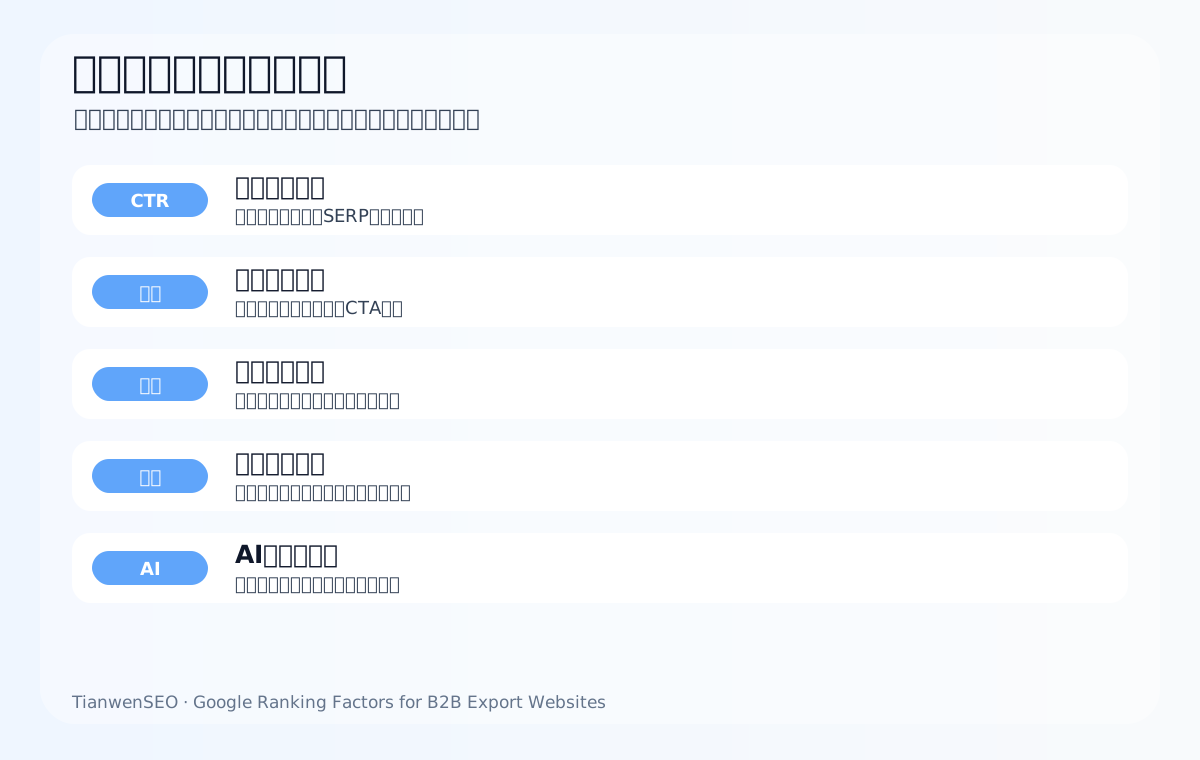
11. Diagnostic scenario: impressions but no clicks — look first at titles and first-screen answers
When GSC shows that a page has impressions but few clicks, do not immediately conclude that the content has no value. The title may fail to reflect purchasing intent, the description may not be specific enough, the top of the SERP may show a stronger comparison table, or an AI summary may already have answered the shallow question. An LED flood light page can reflect wattage, application, waterproof rating, and supplier attributes in the title, and answer the applicable scenario directly in the first paragraph.
In execution, it is advisable to record the issue in a page review table, noting the target English product term, current URL, main decline type, affected pages, planned actions, and review date. This lets the team later judge whether the optimization truly improved search coverage, the visit path, and inquiry quality.
12. Diagnostic scenario: clicks but no inquiries — look first at page role and CTA
If a page gets decent clicks but few inquiries, check whether the content guides users toward the right next step. If a packaging machine article only explains principles, without materials, bag types, speed, automation, after-sales service, or inquiry materials, buyers finish reading without knowing how to get in touch.
In execution, it is advisable to record the issue in a page review table, noting the target English product term, current URL, main decline type, affected pages, planned actions, and review date. This lets the team later judge whether the optimization truly improved search coverage, the visit path, and inquiry quality.
13. Diagnostic scenario: complete content but no indexing — check technical issues and duplication first
When content is complete but has no impressions over a long period, first check indexing, canonical, internal link depth, duplicate pages, and rendering visibility. If a medical probe page keeps a large number of specifications in images, search engines may not see the key facts.
In execution, it is advisable to record the issue in a page review table, noting the target English product term, current URL, main decline type, affected pages, planned actions, and review date. This lets the team later judge whether the optimization truly improved search coverage, the visit path, and inquiry quality.
14. Diagnostic scenario: rankings never rise — check external evidence and brand trust
If both content and technical factors pass, but you consistently lose to stronger competitors, the cause may be insufficient external evidence. A custom metal parts page needs more real production capability, certifications, inspection processes, case-type application explanations, and industry-relevant mentions.
In execution, it is advisable to record the issue in a page review table, noting the target English product term, current URL, main decline type, affected pages, planned actions, and review date. This lets the team later judge whether the optimization truly improved search coverage, the visit path, and inquiry quality.
15. Diagnostic scenario: AI answers do not cite the page — check extractable structure
AI answers not citing the page is not necessarily a ranking problem. The page may lack clear definitions, short-sentence answers, tables, steps, FAQ, and entity consistency. A waterproof connector page should write IP rating, wire gauge, applications, and installation risks as extractable modules.
In execution, it is advisable to record the issue in a page review table, noting the target English product term, current URL, main decline type, affected pages, planned actions, and review date. This lets the team later judge whether the optimization truly improved search coverage, the visit path, and inquiry quality.
16. Link building should not be detached from purchasing trust
Link building for export sites should center on real industry scenarios, not on the number of irrelevant sites. Trade shows, associations, certifications, public customer materials, and partner pages all support trust better than irrelevant blogs.
In execution, it is advisable to record the issue in a page review table, noting the target English product term, current URL, main decline type, affected pages, planned actions, and review date. This lets the team later judge whether the optimization truly improved search coverage, the visit path, and inquiry quality.
17. Page experience must serve complex purchasing
B2B purchasing is not decided from one screen. Pages should let buyers quickly find specifications, scenarios, documentation, FAQ, the inquiry entry point, and trustworthy company information.
In execution, it is advisable to record the issue in a page review table, noting the target English product term, current URL, main decline type, affected pages, planned actions, and review date. This lets the team later judge whether the optimization truly improved search coverage, the visit path, and inquiry quality.
18. Ranking fluctuations should be explained with data, not answered with frequent random changes
The same keyword produces different results in different countries, on different devices, in different languages, and under different SERP styles. Export sites should look at data by target market and should not make frequent changes because of a one-day ranking shift.
In execution, it is advisable to record the issue in a page review table, noting the target English product term, current URL, main decline type, affected pages, planned actions, and review date. This lets the team later judge whether the optimization truly improved search coverage, the visit path, and inquiry quality.
Export example 1: which factors should a custom metal parts page prioritize?
If the target page centers on custom metal parts, the ranking factor judgment cannot stop at the three words “content, links, technical”; it must come down to materials, tolerances, surface treatment, drawings, samples, and quality inspection. Whether the page covers these purchasing judgments determines content quality; whether these modules are visible in the HTML determines technical understandability; whether there are related documents, certificates, and external mentions determines trust; and whether it can guide users to an inquiry determines business value.
During review, you can check core English product terms and long-tail question terms in GSC, check in GA4 whether users reach the product page, documentation page, or contact page, and then combine that with sales feedback to judge whether inquiries are clearer.
Export example 2: which factors should an LED flood light page prioritize?
If the target page centers on LED flood light, the ranking factor judgment cannot stop at the three words “content, links, technical”; it must come down to wattage, beam angle, waterproof rating, installation height, and warranty. Whether the page covers these purchasing judgments determines content quality; whether these modules are visible in the HTML determines technical understandability; whether there are related documents, certificates, and external mentions determines trust; and whether it can guide users to an inquiry determines business value.
During review, you can check core English product terms and long-tail question terms in GSC, check in GA4 whether users reach the product page, documentation page, or contact page, and then combine that with sales feedback to judge whether inquiries are clearer.
Export example 3: which factors should a packaging machine page prioritize?
If the target page centers on packaging machine, the ranking factor judgment cannot stop at the three words “content, links, technical”; it must come down to materials, speed, packaging format, automation, and after-sales service. Whether the page covers these purchasing judgments determines content quality; whether these modules are visible in the HTML determines technical understandability; whether there are related documents, certificates, and external mentions determines trust; and whether it can guide users to an inquiry determines business value.
During review, you can check core English product terms and long-tail question terms in GSC, check in GA4 whether users reach the product page, documentation page, or contact page, and then combine that with sales feedback to judge whether inquiries are clearer.
Export example 4: which factors should a medical probe page prioritize?
If the target page centers on medical probe, the ranking factor judgment cannot stop at the three words “content, links, technical”; it must come down to certifications, compatible devices, materials, sterilization, and testing. Whether the page covers these purchasing judgments determines content quality; whether these modules are visible in the HTML determines technical understandability; whether there are related documents, certificates, and external mentions determines trust; and whether it can guide users to an inquiry determines business value.
During review, you can check core English product terms and long-tail question terms in GSC, check in GA4 whether users reach the product page, documentation page, or contact page, and then combine that with sales feedback to judge whether inquiries are clearer.
Export example 5: which factors should a cnc machining parts page prioritize?
If the target page centers on cnc machining parts, the ranking factor judgment cannot stop at the three words “content, links, technical”; it must come down to DFM, mass production, inspection reports, and quotation materials. Whether the page covers these purchasing judgments determines content quality; whether these modules are visible in the HTML determines technical understandability; whether there are related documents, certificates, and external mentions determines trust; and whether it can guide users to an inquiry determines business value.
During review, you can check core English product terms and long-tail question terms in GSC, check in GA4 whether users reach the product page, documentation page, or contact page, and then combine that with sales feedback to judge whether inquiries are clearer.
Export example 6: which factors should a ceramic dinnerware page prioritize?
If the target page centers on ceramic dinnerware, the ranking factor judgment cannot stop at the three words “content, links, technical”; it must come down to material, glaze color, packaging, MOQ, and customization. Whether the page covers these purchasing judgments determines content quality; whether these modules are visible in the HTML determines technical understandability; whether there are related documents, certificates, and external mentions determines trust; and whether it can guide users to an inquiry determines business value.
During review, you can check core English product terms and long-tail question terms in GSC, check in GA4 whether users reach the product page, documentation page, or contact page, and then combine that with sales feedback to judge whether inquiries are clearer.
Export example 7: which factors should a waterproof connector page prioritize?
If the target page centers on waterproof connector, the ranking factor judgment cannot stop at the three words “content, links, technical”; it must come down to IP rating, wire gauge, outdoor applications, and installation risks. Whether the page covers these purchasing judgments determines content quality; whether these modules are visible in the HTML determines technical understandability; whether there are related documents, certificates, and external mentions determines trust; and whether it can guide users to an inquiry determines business value.
During review, you can check core English product terms and long-tail question terms in GSC, check in GA4 whether users reach the product page, documentation page, or contact page, and then combine that with sales feedback to judge whether inquiries are clearer.
Export example 8: which factors should an industrial valve supplier page prioritize?
If the target page centers on industrial valve supplier, the ranking factor judgment cannot stop at the three words “content, links, technical”; it must come down to materials, pressure, standards, operating conditions, and lead time. Whether the page covers these purchasing judgments determines content quality; whether these modules are visible in the HTML determines technical understandability; whether there are related documents, certificates, and external mentions determines trust; and whether it can guide users to an inquiry determines business value.
During review, you can check core English product terms and long-tail question terms in GSC, check in GA4 whether users reach the product page, documentation page, or contact page, and then combine that with sales feedback to judge whether inquiries are clearer.
Export example 9: which factors should a private label activewear manufacturer page prioritize?
If the target page centers on private label activewear manufacturer, the ranking factor judgment cannot stop at the three words “content, links, technical”; it must come down to fabric, sizing, sampling, MOQ, packaging, and lead time. Whether the page covers these purchasing judgments determines content quality; whether these modules are visible in the HTML determines technical understandability; whether there are related documents, certificates, and external mentions determines trust; and whether it can guide users to an inquiry determines business value.
During review, you can check core English product terms and long-tail question terms in GSC, check in GA4 whether users reach the product page, documentation page, or contact page, and then combine that with sales feedback to judge whether inquiries are clearer.
Export example 10: which factors should a stainless steel fasteners page prioritize?
If the target page centers on stainless steel fasteners, the ranking factor judgment cannot stop at the three words “content, links, technical”; it must come down to material grades, standards, surface treatment, and stock. Whether the page covers these purchasing judgments determines content quality; whether these modules are visible in the HTML determines technical understandability; whether there are related documents, certificates, and external mentions determines trust; and whether it can guide users to an inquiry determines business value.
During review, you can check core English product terms and long-tail question terms in GSC, check in GA4 whether users reach the product page, documentation page, or contact page, and then combine that with sales feedback to judge whether inquiries are clearer.
19. Ranking factor implementation checklist for export sites: handle each page type separately
| Page type | Priority ranking factors | Specific actions | Review metrics |
|---|---|---|---|
| Product page | Content facts, indexing, experience, internal links | Add specifications, applications, image alt text, FAQ, inquiry materials | Product term impressions, product page time on page, form starts |
| Category page | Search intent, internal links, brand trust | Add category descriptions, selection tables, subcategory entry points, supply capability | Category term rankings, entry into product pages |
| Application page | Scenario matching, evidence, external materials | Add industry operating conditions, problems, solutions, and corresponding products | Application term clicks, inquiry industry match |
| Blog guide | Question answers, tables, internal links | Add purchasing judgments, FAQ, comparison tables, and product entry points | Long-tail term coverage, subsequent page paths |
| Documentation page | Credibility, citability, download path | Add certifications, testing, specifications, file descriptions | Document downloads, sales feedback |
The point of this checklist is to keep the team from revising every page to the same standard. Product pages need more accurate specifications and an inquiry path, blog articles need clearer question answers and internal links, application pages need industry operating conditions and product matching, and documentation pages need trustworthy sources and citable structure. Page roles differ, and so do ranking factor priorities.
20. How to run a ranking factor health check on a page
First check whether the page can be accessed and indexed, then whether it matches the target query, then whether the content covers purchasing judgments, then internal links and external evidence, then experience and conversion. Do not start by changing titles or adding terms.
For export businesses in China, judgments must always return to the product line and purchasing scenario. For example, custom metal parts buyers care about drawings, tolerances, and surface treatment; LED flood light buyers care about wattage, waterproofing, and installation; packaging machine buyers care about materials, speed, and maintenance; medical probe buyers care about compatibility, certifications, and testing. Only when ranking factors come down to these specific questions do they become effective improvements.
21. How to judge whether content factors have truly become stronger
Compare, before and after the update, the number of English product terms the page covers, core term impressions, long-tail question terms, first-screen answer clarity, number of tables, FAQ quality, product page entry points, and inquiry material descriptions. If none of these became stronger and only the word count grew, the content factors have not truly improved.
For export businesses in China, judgments must always return to the product line and purchasing scenario. For example, custom metal parts buyers care about drawings, tolerances, and surface treatment; LED flood light buyers care about wattage, waterproofing, and installation; packaging machine buyers care about materials, speed, and maintenance; medical probe buyers care about compatibility, certifications, and testing. Only when ranking factors come down to these specific questions do they become effective improvements.
22. How to judge whether link factors are worth the investment
If a page already satisfies intent well but is persistently outranked by more authoritative suppliers, industry media, or platform pages, you can consider strengthening external evidence. Before investing in links, first confirm that the page is worth citing and that the external sources are relevant to the product industry.
For export businesses in China, judgments must always return to the product line and purchasing scenario. For example, custom metal parts buyers care about drawings, tolerances, and surface treatment; LED flood light buyers care about wattage, waterproofing, and installation; packaging machine buyers care about materials, speed, and maintenance; medical probe buyers care about compatibility, certifications, and testing. Only when ranking factors come down to these specific questions do they become effective improvements.
23. How to judge whether technical factors are the bottleneck
If a page has complete content but no impressions, or different pages compete for the same terms, check indexing, canonical, duplicate titles, internal links, mobile rendering, and structured data first. Until technical bottlenecks are resolved, continued writing usually has limited effect.
For export businesses in China, judgments must always return to the product line and purchasing scenario. For example, custom metal parts buyers care about drawings, tolerances, and surface treatment; LED flood light buyers care about wattage, waterproofing, and installation; packaging machine buyers care about materials, speed, and maintenance; medical probe buyers care about compatibility, certifications, and testing. Only when ranking factors come down to these specific questions do they become effective improvements.
24. How to judge whether experience factors affect inquiries
If clicks and time on page are both decent but inquiries are few, check whether the page tells buyers what the next step is: which specifications, drawings, target quantities, certification requirements, packaging requirements, and lead time requirements to send. Experience optimization is not just visual; it lowers the cost of purchasing communication.
For export businesses in China, judgments must always return to the product line and purchasing scenario. For example, custom metal parts buyers care about drawings, tolerances, and surface treatment; LED flood light buyers care about wattage, waterproofing, and installation; packaging machine buyers care about materials, speed, and maintenance; medical probe buyers care about compatibility, certifications, and testing. Only when ranking factors come down to these specific questions do they become effective improvements.
25. How to judge whether brand factors are insufficient
If your page content is not weak, but users still prefer to click platform pages or big brand pages, check the company entity, certificates, production capability, team introduction, external mentions, and material consistency. The essence of brand factors is credibility, not slogans.
For export businesses in China, judgments must always return to the product line and purchasing scenario. For example, custom metal parts buyers care about drawings, tolerances, and surface treatment; LED flood light buyers care about wattage, waterproofing, and installation; packaging machine buyers care about materials, speed, and maintenance; medical probe buyers care about compatibility, certifications, and testing. Only when ranking factors come down to these specific questions do they become effective improvements.
26. 90-day review example: from ranking factors to business results
Suppose a waterproof connector page completes optimization: in week 1, confirm the page is crawlable, the title is normal, and images and tables load properly; in week 2, see whether impressions expand for waterproof connector, IP67 waterproof connector, and waterproof connector for outdoor lighting; on day 30, look at clicks and the product page path; on day 60, see whether inquiries include wire gauge, current, waterproof rating, and application environment; on day 90, decide whether to add more specific pages such as marine waterproof connector and solar waterproof connector.
This review approach is closer to the real goals of an export business than looking only at rankings. Rankings are an intermediate result; whether buyers understand the product, enter the right page, and submit a clear inquiry are the outcomes long-term optimization should track.
FAQ: common questions about Google SEO ranking factors
How many ranking factors does Google actually have?
Google uses many systems and signals, but it has not published a single recipe that can be applied mechanically. Export businesses should focus on controllable priorities rather than chasing a complete list.
Which matters more, content or links?
You cannot simply choose one over the other. Content determines whether a page satisfies intent, while links and external evidence help build trust; without content matching, links are also hard to keep stable over the long term.
Is page speed a ranking factor?
Page experience has value, but speed is not the only answer. Export sites should ensure mobile usability and stable loading while prioritizing content, indexing, and intent matching.
Can E-E-A-T be added directly to a page?
E-E-A-T cannot be treated as a button. Credibility should be demonstrated through real experience, evidence, author or team information, company entity, certificates, and transparent materials.
Which pages should an export website optimize first?
Start with core product pages, category pages, application pages, selection guides, and pages that already have impressions but insufficient conversion.
Will AI search replace traditional SEO?
It will not simply replace it. AI citation and traditional ranking overlap but are not identical, and pages need to be easy for both search engines and answer systems to understand.
Can you promise a first-place ranking for a keyword?
No. What is controllable is improving page relevance, quality, technical visibility, trust evidence, and review quality; specific rankings are not written as promises.
Are third-party DR/DA ranking factors?
These are third-party estimate metrics, not publicly disclosed Google ranking factors. They can be used as a reference for link strength, but they cannot replace real search and business data.
Can a small-brand website still rank?
Yes, but it needs more precise search intent, more specific product facts, clearer structure, and genuinely trustworthy evidence.
How often should ranking optimization be reviewed?
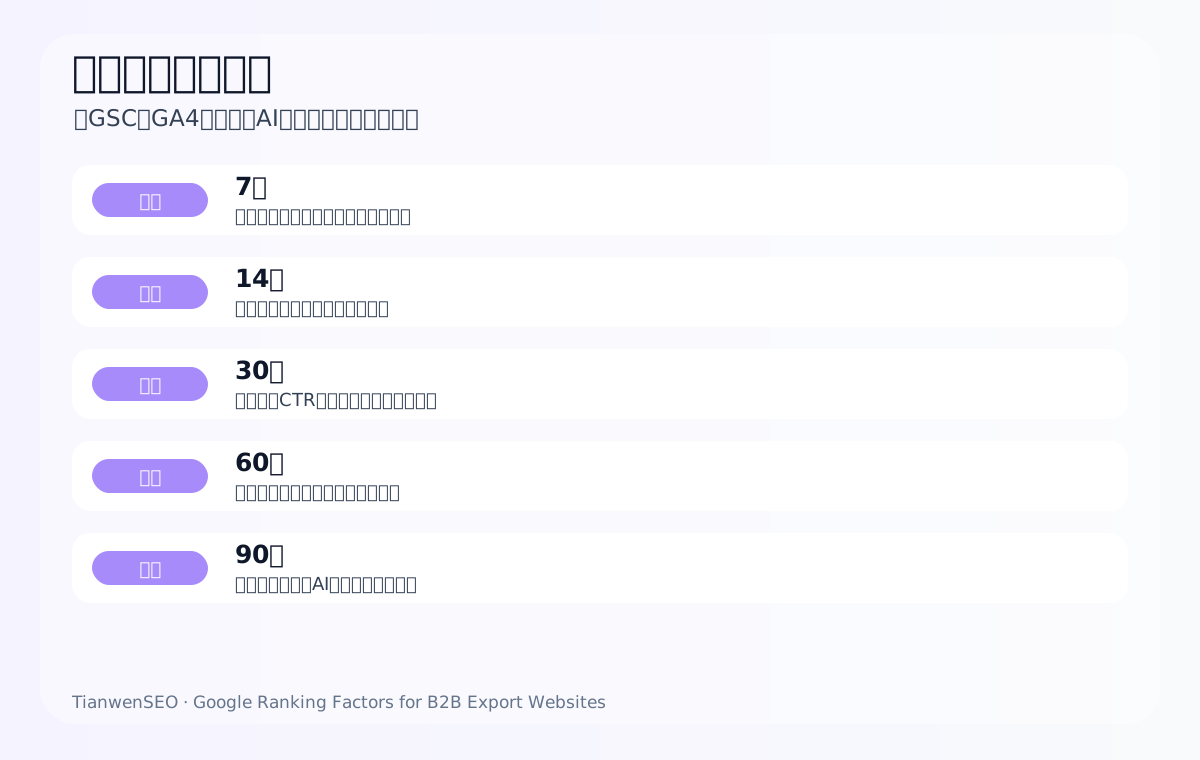
Check technical factors at 7 days, impressions at 14 days, click paths at 30 days, inquiry quality at 60 days, and stability plus the next batch of pages at 90 days.
Conclusion: turn ranking factors into an optimization order for export websites
A truly effective understanding of ranking factors is not about memorizing a list, but about knowing which page to change today, why, and how to verify it. Export websites should first ensure that core pages can be crawled, indexed, and understood; then fill in content with specific product terms and purchasing questions; then build trust with internal links, external evidence, brand entities, and page experience; and finally review continuously with GSC, GA4, inquiry sources, and AI citations.
When you look at ranking factors this way, you will not be intimidated by “200 factors,” and you will not rewrite every page the same way. Every product line has its own search intent and purchasing path, and the goal of ranking factor optimization is to make those paths clearer, more trustworthy, and more likely to bring effective inquiries.
Keep reading this SEO series
If you are systematically working through export website SEO, consider continuing with the articles below. First clarify the relationships among crawling, indexing, content, links, and review, then decide which page to change next.
- Google Trends in practice: regions, categories, and time windows
- Sitemap technical guide: submission, index diagnosis, and common error troubleshooting
- How to do content SEO: a guide to search intent, information gain, and indexable content
- How to do keyword research: export product terms, search intent, and the page mapping process
- How to mine competitor keywords: from competitor pages and English product terms to inquiry opportunities
- How to choose keyword tools: select by diagnostic scenario, not by copying a tool list
{
“@context”: “https://schema.org”,
“@type”: “FAQPage”,
“mainEntity”: [
{
“@type”: “Question”,
“name”: “How many ranking factors does Google actually have?”,
“acceptedAnswer”: {
“@type”: “Answer”,
“text”: “Google uses many systems and signals, but it has not published a single recipe that can be applied mechanically. Export businesses should focus on controllable priorities rather than chasing a complete list.”
}
},
{
“@type”: “Question”,
“name”: “Which matters more, content or links?”,
“acceptedAnswer”: {
“@type”: “Answer”,
“text”: “You cannot simply choose one over the other. Content determines whether a page satisfies intent, while links and external evidence help build trust; without content matching, links are also hard to keep stable over the long term.”
}
},
{
“@type”: “Question”,
“name”: “Is page speed a ranking factor?”,
“acceptedAnswer”: {
“@type”: “Answer”,
“text”: “Page experience has value, but speed is not the only answer. Export sites should ensure mobile usability and stable loading while prioritizing content, indexing, and intent matching.”
}
},
{
“@type”: “Question”,
“name”: “Can E-E-A-T be added directly to a page?”,
“acceptedAnswer”: {
“@type”: “Answer”,
“text”: “E-E-A-T cannot be treated as a button. Credibility should be demonstrated through real experience, evidence, author or team information, company entity, certificates, and transparent materials.”
}
},
{
“@type”: “Question”,
“name”: “Which pages should an export website optimize first?”,
“acceptedAnswer”: {
“@type”: “Answer”,
“text”: “Start with core product pages, category pages, application pages, selection guides, and pages that already have impressions but insufficient conversion.”
}
}
]
}
This page is machine-translated from the Simplified Chinese version and awaiting human review. It has not yet been proofread.