When many teams use ChatGPT to write SEO content, the most common problem is not that they don’t know how to write prompts, but that they hand every task to one vague instruction, such as “write me an SEO article.” The result is usually content that looks complete but stays generic: it fits neither the search intent nor the real-world export procurement scenario. For manufacturers and trading companies doing export business, this approach is especially risky, because the page looks like it has plenty of words without actually answering what buyers care about most when they search for English product terms such as custom metal parts, LED flood light, packaging machine, medical probe, cnc machining parts, and waterproof connector.
So the truly useful approach is not to look for an all-purpose prompt, but to break ChatGPT’s role in SEO writing into separate tasks: which prompts suit content planning, which suit title generation, which suit structural rewriting, and which are only good as assistance and should never go live as-is. Unless that split is clear, the model’s output easily falls back on empty industry platitudes or reads like a service provider talking to itself.
The conclusion up front: ChatGPT is best used in SEO content work for proposing, comparing, reordering, expanding, and assisting with review, not for replacing your own definition of a page’s goal. Content planning prompts should first pin down the target query, page intent, target audience, and the questions that must be covered; title generation prompts should ask for several candidate sets and an explanation of each one’s promise and risk; structural rewriting prompts should focus on information order, tables, FAQs, checklists, and paragraph extractability rather than asking the model to “polish it into something more professional.”
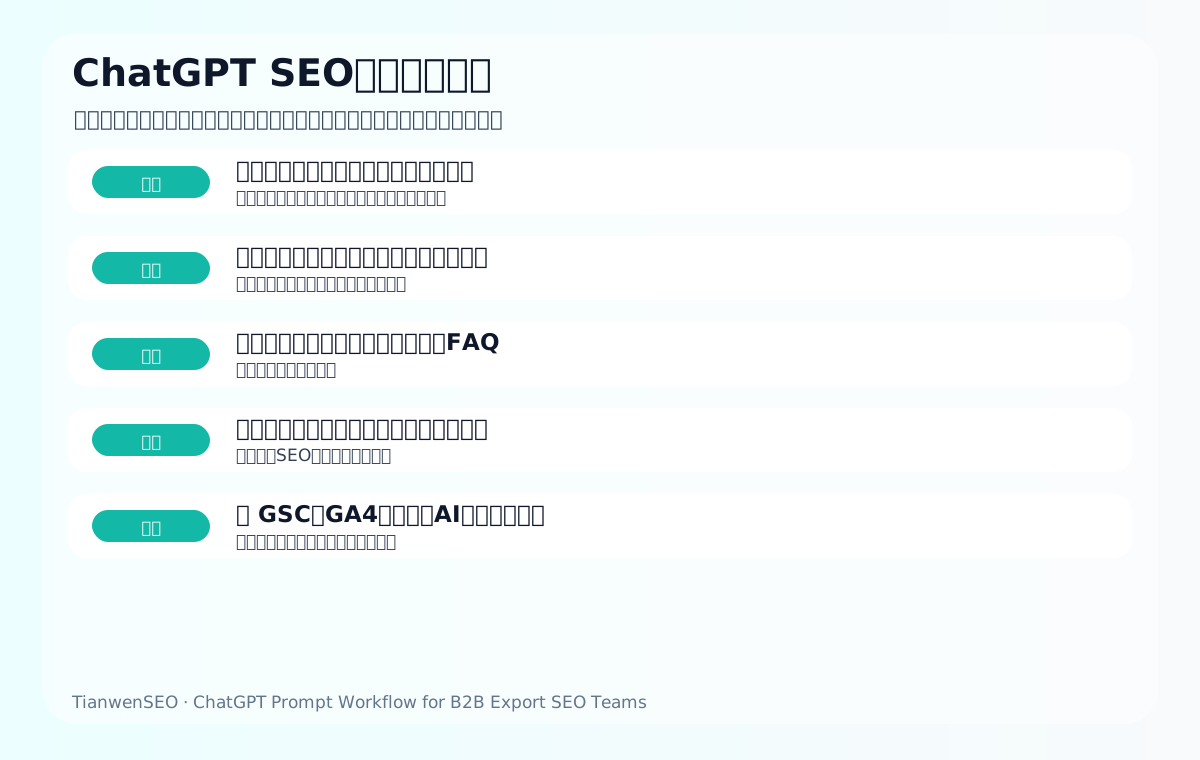
First, be clear: you are not writing prompts, you are designing a content production workflow
Many people think a prompt is just a few sentences phrased more elegantly, but for content that actually has to land on a foreign-trade SEO page, a prompt is part of workflow design. You are specifying what background the model receives, what type of output it produces, what boundaries it observes, and by what standard the result is evaluated.
If the workflow is not defined first, even a long prompt easily spins out of control. For example, if you tell the model to “write an SEO article about waterproof connector,” it will likely mix definitions, advantages, buying advice, brand promotion, and FAQs onto one page without deciding whether that page should serve a product term, a comparison term, or an educational term.
| What to define first | Why define it first | What happens otherwise |
|---|---|---|
| Target query | Determines what question the page actually answers | The model writes a generic article that touches on everything a little |
| Page role | Determines whether it is a product page, tutorial page, FAQ page, or industry page | Mixed intents, weak on both rankings and conversion |
| Target audience | Determines wording, scenarios, and evidence | It ends up written for peers instead of buyers |
| Questions that must be covered | Ensures the page has real decision value | The output stays at surface-level introduction |
| Phrases to avoid | Avoids internal tone and uncontrollable promises | The content may not be publishable as-is |
So when discussing “how to write common ChatGPT SEO prompts,” the point is never just sentence patterns; it is defining the workflow and page responsibilities first.
Content planning prompts: the point is not to make the model write, but to have it break down the problem for you first
The goal of the planning stage is not to produce a final draft but to help you confirm: what query this page should serve, what page type suits it, which questions it must cover, which questions belong on the product page, and which belong on the tutorial page.
In a foreign-trade context, this step matters especially. Someone searching for cnc machining parts supplier and someone searching for “how to choose machining tolerance for aluminum parts” are both related to CNC machining, but the former is closer to supplier screening while the latter is closer to a technical judgment. If you use one vague prompt and let the model start writing, the two intents easily get mixed together.
| What planning prompts should require | Reason | Common mistake |
|---|---|---|
| List the target intent first | Avoids confusion about the page’s role | Asking the model to generate the full text right away |
| List the questions that must be answered | Ensures the page has decision depth | Only asking for “clear logic” |
| List content that should not go on this page | Prevents topic sprawl | Wanting to include everything |
| Require examples using foreign-trade product terms | Keeps content close to the procurement scenario | Still using SEO industry terms as examples |
| Require an outline and information gaps | Fix the direction first, then expand | Producing a full draft first and then reworking it |
A more practical content planning prompt often looks like this: first tell the model who the page is for, for example a Chinese export manufacturer or trading company; then tell it the target query and page type; then ask it to output “the core questions users will ask, which tables are needed, which FAQs are needed, and which content should be split onto its own page.” This approach is more likely to produce usable results than asking the model to write the full text directly.
Title generation prompts: the point is not “more attention-grabbing” but “the promise matches the page content”
Title generation is a step ChatGPT is well suited to assist with, because it really is good at quickly producing multiple phrasings. But a title works not because it “sounds more like marketing copy” but because it accurately describes the value the page provides and stays consistent with the page intent.
In foreign-trade SEO, many titles fail not because they are not eye-catching enough but because the promise is wrong. For example, a technical page about the packaging machine selection process gets titled “the ultimate supplier guide”; a FAQ page comparing waterproof connector IP67 vs IP68 gets titled a vague “complete analysis.” Clicks may come, but once users land and find the page does not match, long-term performance suffers.
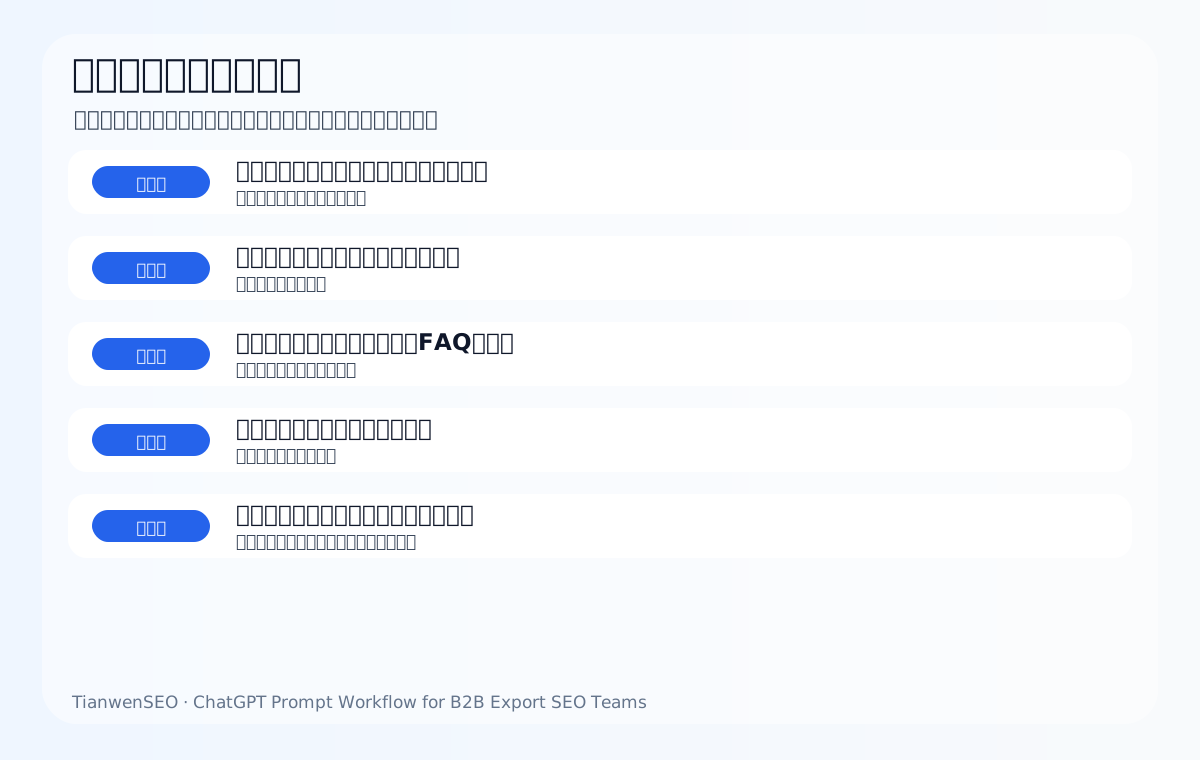
| What title prompts should require | Why it matters | What not to require only |
|---|---|---|
| Give 10–20 candidates at once | Makes side-by-side comparison easy | Producing only one “best title” |
| Explain which intent each title suits best | Avoids mismatches between title and page role | Judging only “attractiveness” |
| Explain possible misleading risks | Prevents overpromising in the click | Asking only for more exaggerated wording |
| Keep the foreign-trade product/scenario context | Keeps the page audience clear | Applying generic SEO phrasing |
| Require titles to be distinguished as tutorial, comparison, supplier, or FAQ types | Avoids mixing different tasks | Writing every page in the same style |
For example, for a page about medical probe material selection, the title prompt should ask the model to produce several directions such as “technical judgment,” “FAQ,” and “comparison,” rather than only asking for “a title better suited to SEO.” That way you can see how the promises differ across directions and then choose based on the page’s actual content.
Structural rewriting prompts: the quickest to show results, and the easiest to misuse
Structural rewriting is often where ChatGPT delivers the most value, because the model is very good at reorganizing existing information in a different order, for example turning long-winded paragraphs into “conclusion first + table + FAQ + checklist.”
But that is also where structural rewriting is most easily misused: many people treat “structural rewriting” as “have the model write the content a bit more professionally,” and the result is just the original text rephrased with no gain in information density. Truly good structural rewriting does not make the language sound more like an industry article; it makes the information easier for users, Google, and AI systems to extract quickly.
| What structural rewriting is most worth requiring | Effect | Common low-value requests |
|---|---|---|
| Conclusion first | Lets users see the direction of the answer first | “Write it more professionally” |
| Add a comparison table | Speeds up judgment | “Polish it appropriately” |
| Break out an FAQ | Covers follow-up questions | “Enrich the paragraphs” |
| Add checklists and steps | Improves actionability | “Make the content more complete” |
| Add boundaries and pitfalls | Strengthens credibility | “Make it look more authoritative” |
If you already have a page about LED flood light selection but it reads like one solid block of expository prose, using a structural rewriting prompt to break the information apart is often more effective than expanding it by another 3,000 words.
When expansion prompts help, and when they actually ruin a page
Expansion prompts are not unusable, but they require that the page direction is already clear. Expansion only makes sense when you know what the page should cover, who it serves, and which questions it has not fully addressed. Otherwise the model just stretches vague content into longer vague content.
This is also why many teams feel that “AI writes quickly but the published result does nothing.” The root cause is not that ChatGPT cannot write; it is that you put it at the wrong stage. If you let the model expand before content planning is done, title intent is set, and structure is organized, the output usually gets vaguer and vaguer.
| Situations where expanding first is fine | Situations where expanding first is not fine |
|---|---|
| The page topic is already clear | The page topic is still muddled |
| A basic structure and key modules already exist | Even the title and page role are undecided |
| You know exactly which scenarios/FAQs/pitfalls are missing | You only know “there are not enough words” |
| You already have foreign-trade context examples | You are still using SEO service terms as examples |
| Someone can review the factual boundaries | You plan to publish without review |
For example, with an article about preparing for a custom metal parts inquiry, if you have determined that it is tutorial-type content and know the modules to add are drawing preparation, material communication, MOQ, sampling, and lead time, then an expansion prompt is valuable; but if you have not even decided whether the page is a tutorial page or a capability page, expansion only creates more cleanup work later.
Why foreign-trade companies cannot simply copy “SEO prompt frameworks”
There are many so-called “fixed SEO prompt formulas” online, but most target general writing scenarios and are not designed for export business. The biggest problem is not that the formulas are bad, but that they do not force the model to use real product terms, procurement judgment context, and supply chain information.
If you copy such formulas directly, the model easily produces sentences like “improve search rankings,” “optimize user experience,” and “increase brand exposure” that sound right but carry very little business substance. For sites in industrial valve supplier, packaging machine, or ceramic dinnerware, these lines do not help buyers judge whether you are a good fit to work with.
So foreign-trade companies are better off building their own prompt frameworks: every prompt should require English product terms, industry terms, inquiry terms, application scenarios, procurement boundaries, delivery factors, and the next-step path. Only then is the model’s output more likely to become a usable page rather than a generic industry piece.
A more practical way to divide prompt work: planning, titles, structure, and review in four steps
If your team wants more consistent results from ChatGPT, use the four-step method. Step one is planning, step two is titles, step three is structure, step four is review. Each step has the model solve only one kind of problem.
- Planning step: have the model output the target intent, page outline, questions that must be covered, and content that should not go on the page.
- Title step: have the model output several sets of title candidates and explain the page role and risk each title suits.
- Structure step: based on the confirmed outline, rearrange the content into conclusions, tables, FAQs, steps, and checklists.
- Review step: check the foreign-trade context, bad words, empty talk, factual boundaries, and whether inappropriate service-industry examples have appeared.
The benefit is that even if one step’s output is not ideal, you know which layer the problem is in, instead of facing a whole article that looks “about right” with no idea where to start.
How to tell whether a title prompt is any good
A genuinely useful title prompt does not produce a “perfect title” every time; it reliably returns a set of comparable, filterable candidates and helps you see the pros and cons of different promise styles.
The criteria can be simple: first, does it preserve the page’s real intent; second, does it avoid overpromising; third, does it keep the foreign-trade product and scenario context; fourth, can it correspond naturally to the body content.
| Dimension | How a good title prompt performs | How a bad title prompt performs |
|---|---|---|
| Accurate intent | Candidates revolve around the same core question | Different candidate directions are at odds with each other |
| Deliverable promise | The title is genuinely supported by the body content | The title clearly exceeds what the body can deliver |
| Context fit | Keeps foreign-trade products and procurement scenarios | Turns into generic SEO jargon |
| Filterability | Lets you compare the pros and cons of different styles | Outputs only one answer |
How to turn ChatGPT output into publishable content instead of a half-finished draft
No matter how well the prompt is written, ChatGPT’s output should be treated as a semi-finished draft. A genuinely publishable page still needs three layers of human handling: the first layer is fact checking, to confirm that models, specifications, terminology, and processes are not wrong; the second layer is business checking, to confirm that it genuinely fits your products, customers, and inquiry path; the third layer is SEO checking, to confirm that the title, structure, FAQs, tables, and internal links serve the target query.
Without these three layers, model-generated content easily looks complete while being neither accurate enough nor conversion-ready enough.
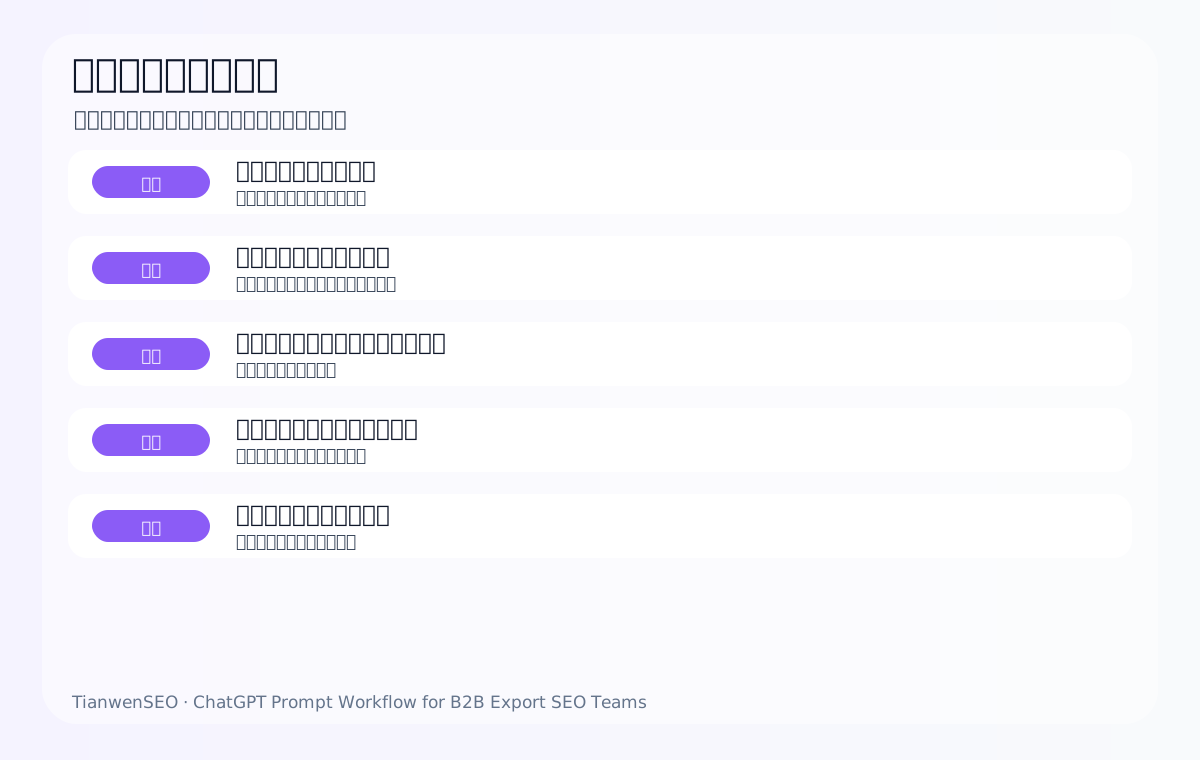
| Human review layer | What to focus on | Why it cannot be skipped |
|---|---|---|
| Fact checking | Terminology, specifications, processes, boundaries | The model may add details that do not exist |
| Business checking | Whether it fits the product and procurement context | Avoids writing industry platitudes |
| SEO checking | Title, structure, FAQs, internal links, review modules | Ensures the page genuinely serves the search task |
How to review after publication: do not just look at “whether this was written by AI”
When many teams review AI content, the first question they ask is “does this read too much like AI wrote it.” That question matters, of course, but the more critical one is: did this content actually make the page perform better?
For foreign-trade sites, what is more worth watching is whether target queries are more concentrated, whether CTR has improved, whether visitors go on to product pages or the RFQ page, whether inquiries are a better match, and whether AI answers are more likely to extract the page’s facts correctly.
| Review dimension | How to judge whether the prompt is effective |
|---|---|
| Writing efficiency | Whether it reduces manual restructuring time at the same quality level |
| Content quality | Whether there is less empty talk and more decision structure and foreign-trade examples |
| GSC performance | Whether target queries, CTR, and target page performance have improved |
| GA4 paths | Whether visitors more often reach category pages, product pages, and the RFQ page |
| Inquiry quality | Whether inquiries are closer to the target products and regions |
| AI citations | Whether the page is mentioned more often with fewer misreadings |
Only when all these dimensions improve over time is the prompt truly serving SEO and the business. Otherwise, even if it makes writing faster, it may only produce a batch of content that needs rework faster.
Practical advice for foreign-trade teams: start by building up three high-frequency prompt types, not a comprehensive library
If your team is just starting to use ChatGPT systematically for SEO, do not begin by building dozens of prompt frameworks. The steadier approach is to first build up the three most used and most reusable prompt types: content planning, title generation, and structural rewriting.
- Content planning: dedicated to opening new page topics and restructuring old pages.
- Title generation: supports comparing directions for titles, H1s, and meta descriptions.
- Structural rewriting: improves the extractability, tables, FAQs, and checklists of existing content.
Once these three types have proven effective across several pages, gradually add finer supporting versions such as “expansion,” “review,” “FAQ completion,” and “competitor breakdown”; that builds a stable method more easily than spreading too thin at the start.
FAQ: the most common misconceptions about ChatGPT SEO prompts
Is a longer prompt always better?
No. What matters more is whether the information is complete, the boundaries are clear, and the task is singular. A very long prompt with a muddled task usually performs worse than a medium-length prompt with clear boundaries.
Can I just have ChatGPT write the entire long article in one go?
You can have it produce a draft, but it is not advisable to treat a single generation as the final draft. For foreign-trade technical and product content, human fact checking, structural rearrangement, and factual additions are almost indispensable.
What should title prompts avoid most?
Most of all, avoid chasing “more attention-grabbing” while ignoring the page’s real intent. When a title promises more than the body can deliver, it may lift clicks in the short term but usually hurts in the long run.
Why insist on examples using English product terms?
Because the page is written for export manufacturers and trading companies, and the real search and procurement context revolves around product terms, industry terms, and application scenario terms, not around SEO service industry terms.
Between structural rewriting and expansion, which is more worth doing first?
Usually structural rewriting first. Information order, tables, FAQs, and leading with conclusions tend to improve readability and extractability faster than expansion alone.
Conclusion: a genuinely useful prompt should make the page look more like what the customer wants to read
ChatGPT’s value in SEO work is not that it writes all the content for you automatically, but that it helps you break down problems, test directions, compare titles, rearrange structure, and do a first round of supporting review faster. If you split the tasks correctly, it really does improve efficiency; but if you hand everything to one catch-all prompt, the result is usually just a generic article produced faster.
For Chinese export manufacturers and trading companies, a prompt truly worth keeping should make the page look more like what the customer wants to read: built around English product terms, application scenarios, procurement judgment, parameter boundaries, FAQs, processes, and the next-step path, rather than circling around the SEO industry’s own talking points. Hold to that standard consistently, and ChatGPT becomes an accelerator for content production rather than a diluter of quality.
Why the same prompt produces completely different results on different pages
Many teams mistakenly assume that if a prompt worked well on one article, it can be copied to every page. That is not how it works. Different pages have different input conditions, the model receives different context, and the page goals differ, so the results naturally differ a great deal.
For example, when writing content around packaging machine, a product collection page cares more about machine types, speed ranges, compatible materials, industry scenarios, and the next-step inquiry path, while a tutorial page cares more about how to select, how to compare, and which situations easily lead to the wrong choice. If you apply a prompt designed for a tutorial page directly to a product collection page, the model often produces a pile of explanatory knowledge with little procurement decision information.
So what is truly worth capturing is not “this sentence works well” but “what inputs this type of page should give the model and what outputs it should avoid.” That is what can be reused again and again.
| Page type | What the prompt should emphasize | What it should not overemphasize |
|---|---|---|
| Product page | Specifications, materials, certifications, MOQ, lead time, application boundaries | Long stretches of background knowledge |
| Category page | Series differences, selection paths, product tiers | Lengthy company introductions |
| Tutorial page | Steps, decision criteria, pitfalls, FAQs | A hard-sell tone |
| Industry page | Scenario problems, solution differences, procurement concerns | Piling on too many product details |
How to feed the model “enough but not too much” context
Another common reason prompts perform poorly is imbalanced context input: either too little, so the model can only write generically, or too much, so the model cannot find the point. The steadier approach is to provide only the background necessary to complete the current task.
For example, when generating titles you usually do not need to stuff in the whole article; four types of key information are enough: target query, page role, target audience, and key information that must be preserved. For structural rewriting, you should additionally provide the existing paragraphs, the tables or FAQs you want added, and the factual information that cannot be deleted.
This “enough but not too much” input style often noticeably improves consistency and is easier for the team to reuse later.
| Task | Required input | Optional additions |
|---|---|---|
| Content planning | Target terms, page role, audience, business goals | Competitor highlights, existing content gaps |
| Title generation | Target terms, page intent, the core promise of the body | Competitor title styles, prohibited wording |
| Structural rewriting | Existing paragraphs, target structure, facts that must be preserved | Tables, FAQs, and checklists you want added |
| Supporting review | Final draft, bad-word list, audience criteria, example requirements | Past pitfalls, brand tone notes |
Which prompts most easily drag content into “industry platitudes”
If you often get sentences like “enhance brand influence,” “increase online visibility,” and “optimize user experience” that are correct but empty, it usually means the prompt contains vague requirements that lead the model astray.
- “Write it more professionally” — the model tends to use more boilerplate rather than more decision information.
- “Better suited to SEO” — without limiting the target query and page role, the output becomes generic SEO language.
- “More persuasive” — without requiring evidence and boundaries, the model may simply praise the advantages more strongly.
- “More complete” — without specifying how complete, the model easily spreads into irrelevant content.
By contrast, more effective requests usually look like: add a material comparison table; turn this passage into an FAQ that buyers can judge from quickly; preserve the boundaries of medical probe sterilization and material compatibility; include sampling lead time, MOQ, and lead time differences. Instructions like these are more specific, and the model is more likely to deliver high-value content.
Connect prompts to your human SOP and efficiency actually improves
Many teams feel that they are still busy after adopting ChatGPT, usually not because the model is useless but because they have not plugged its output into their own SOP. For example, the model returns 15 title candidates and nobody knows how to choose; the model fixes the structure but nobody owns fact-checking and link paths; the model expands the FAQs but nobody judges whether those FAQs really come from common customer questions.
The more mature approach is to put prompts into a fixed SOP: who defines the page goal, who feeds the model its input, who filters the titles, who verifies the facts, who reviews after publication. Only then does the efficiency gain land in team collaboration instead of stopping at “writing a bit faster.”
| Stage | Suggested owner | Key action |
|---|---|---|
| Topic selection and planning | Content lead / SEO lead | Set page role, target terms, competitor gaps |
| Prompt execution | Editor / operations | Feed context by task and collect candidates |
| Factual and business verification | Product / business / technical colleagues | Check specifications, processes, boundaries, cases |
| Publication and review | SEO / operations | Review GSC, GA4, inquiries, and AI mentions |
A few prompt use cases closer to real foreign-trade sites
To make the method more concrete, consider a few real scenarios. The first is when you need to write a pre-inquiry preparation guide for a custom metal parts page. Here the content planning prompt should help you break out drawing preparation, material confirmation, surface treatment, MOQ, lead time, and sampling communication rather than generating a generic introduction. The second is when you need to revise the title of a LED flood light category page; the title prompt should revolve around supplier screening, power ranges, application scenarios, and certification promises. The third is when you already have a waterproof connector comparison article that is hard to read; here the structural rewriting prompt should prioritize adding a comparison table, scenario FAQs, and a pitfalls checklist.
What these scenarios have in common is that the prompt must serve the page task, not the other way around where the page accommodates the prompt. Once that order is reversed, content quality easily falls back to “looks like a lot was written, but the key questions were not answered.”
How to gradually build up your own high-quality prompt collection
The truly sustainable approach is not to collect prompts others share but to reverse-engineer from pages you have already proven effective: what inputs the model received at the time, which outputs helped later work the most, and which requirements clearly reduced the number of revisions.
You can record every prompt that performed well, along with the applicable page type, applicable stage, input fields, common risks, and key points for human re-checking. Over time, what you build is not a pile of scattered sentences but a high-quality prompt library suited to your own business.
What matters most about this knowledge base is not its size but its executability: a colleague can pick it up and know at which stage to use it, what to input, where to look first after output, and which spots are most error-prone. That way ChatGPT’s value compounds as projects accumulate.
How to make prompts actually produce content that foreign-trade customers can read
For export companies, the page is not written for SEO practitioners but for real buyers and project owners. So the prompt must explicitly require: use English product terms, industry terms, application scenario terms, and inquiry-related questions; avoid explaining things from an SEO service provider’s point of view; prioritize information the customer can use to make a judgment.
For example, if you ask the model to write the FAQ for a cnc machining parts page, do not let it produce “common SEO questions” style content; guide it to answer: what to do when drawings are incomplete, how different materials affect tolerances and surface treatment, how sampling lead time is usually arranged, and how communication priorities differ between small batches and mass production. Only then does the output genuinely serve the customer’s reading.’)
This kind of requirement looks like just a few added constraints, but it noticeably changes the model’s output direction. It shifts from “explaining concepts” to “helping judge,” which is exactly the change foreign-trade technical content needs most.
How to write review prompts that specifically catch empty talk, bad words, and factual risk
Besides generative prompts, review prompts are also worth building. Many page problems cannot all be spotted in the first round of generation; they only surface during human review: for example, examples drift back to service industry terms, vague conclusions reappear, or promise-style sentences without supporting evidence show up again.
A review prompt can ask the model to play the role of the fault-finder and check point by point: does this passage lack a specific product or scenario? Does this passage merely repeat SEO principles? Does this passage use internal phrasing unsuitable for customers? Does this passage turn an uncertain judgment into a definite promise?
| Review focus | How to phrase the request | Why it matters |
|---|---|---|
| Detecting empty talk | Find sentences with no specific decision value | Reduces content that looks complete but is useless in practice |
| Audience drift | Find passages that read as if addressing SEO peers | Keeps the content aimed at foreign-trade customers |
| Factual risk | Flag specifications, processes, and conclusions that need human verification | Keeps the model from fabricating details |
| Residual bad words | Check for internal execution tone and improper promises | Ensures it is publishable as-is |
When it is worth using ChatGPT, and when human judgment should come first
Not all work should be handed to the model first. Page positioning, product factual boundaries, procurement path design, and whether to split or merge pages are still better judged by people first. If the direction on these is wrong, the model will only write the wrong direction more completely, faster.
What is better handed to ChatGPT is work where the direction is already clear but needs to be expanded and compared quickly: for example listing FAQ candidates, comparing several title options, compressing a long passage into a clearer checklist, or rearranging existing paragraphs into a structure that is easier to read and extract.
Holding that boundary is often more valuable than continuing to study “prompt wording techniques.”’)
Top1 benchmark card: where this kind of “ChatGPT SEO prompts” content is usually strong and where it falls short
The comparable content currently ranking ahead usually has two clear strengths: first, it classifies prompts by use instead of mixing all tasks together; second, it offers some ready-to-borrow writing frameworks so readers can get started quickly. Both are genuinely valuable because they solve the “I have no idea how to start” problem for many beginners.
But comparable content also tends to have three gaps. First, most examples stay at the level of general content marketing or English blog writing and rarely land in the context of export manufacturers, trading companies, English product pages, and procurement questions. Second, many articles emphasize “generating content” heavily but rarely split titles, structure, FAQs, tables, pitfalls, and review into separate workflows. Third, they lack a post-publication validation perspective: after reading, readers only know how to write prompts, not how to judge whether a prompt is actually making the page stronger.
So to surpass this kind of content, we should not offer more fancy sentence patterns but turn the method into a workflow you can take to a site’s content: when planning prompts fit, when title prompts fit, when structural rewriting is more valuable than expansion, and which signals to watch after publication to confirm that the changes a prompt produced really work.
A more complete prompt input framework
If you want colleagues to reuse the approach more easily, break prompt input into fixed fields instead of writing a paragraph from scratch each time. For planning, titles, or structure, you can prepare the following information first: target query, page type, target audience, current page problem, information that must be preserved, modules to add, and prohibited phrasing.
The benefit is that it turns “prompt skill” from personal experience into a reusable team workflow. A new colleague does not have to write instructions purely by feel; as long as these fields are filled in clearly, the model’s output is usually much more consistent.
| Input field | Purpose | Example |
|---|---|---|
| Target query | Limits the page’s core question | waterproof connector IP67 vs IP68 |
| Page type | Limits the structure and how it serves the query | FAQ comparison page / tutorial page / category page |
| Target audience | Limits tone and information focus | Chinese foreign-trade manufacturers, trading companies, overseas buyers |
| Information that must be preserved | Prevents the model from deleting key facts | MOQ, certifications, sampling lead time, material limitations |
| Modules to add | Improves structural completeness | Comparison table, FAQ, pitfalls checklist, review metrics |
| Prohibited phrasing | Avoids bad words and improper promises | Internal execution tone, industry self-congratulation, uncontrollable promises |
How to use prompts to upgrade old articles, not just serve new ones
When many teams first use ChatGPT for SEO, their first thought is “write new articles.” But for sites that already have a body of content, the higher-value prompt scenario is often upgrading old articles. Old articles usually already have some topical foundation and indexing base, so as long as the direction is right, structural rewriting, FAQ completion, title comparison, and adding pitfalls may show results faster.
For example, if you have an old article about medical probe material compatibility that is professional but loosely structured, you do not need to rewrite it from scratch; instead, first have the model do four things: extract a conclusion-first paragraph, add a comparison table of materials and sterilization methods, compile the six FAQs buyers ask most, and flag which paragraphs need boundary explanations. This is usually steadier than simply asking it to “rewrite a more complete article.”
The key to upgrading old articles is to preserve what already works first, then let the model help you fill the weak spots. Reverse that order and you easily damage content that still had value.’)
Three key judgments prompts should not replace
Even if a team is very familiar with ChatGPT, three judgments should not be handed entirely to the model. First, whether a page should be split: some articles are vague because they cram in content that belongs on two pages. Second, which facts need confirmation from business colleagues: for example processes, tolerances, testing standards, lead time, and the applicable boundaries of certifications. Third, the action the page ultimately serves: after reading, should the user continue to the product, download material, submit an inquiry, or continue to a related tutorial?
If these judgments are wrong up front, the model will not correct the direction on its own. It will only generate seemingly reasonable content within the established direction. So maturity in using prompts is not “let AI decide everything” but knowing which questions a human should settle first.’)
What risk do teams most easily overlook once prompts get better
Once a team starts to see that “prompts really do speed up writing,” the new risk that most easily appears is over-reliance on the model’s first draft, gradually weakening attention to page positioning and factual boundaries. In the short term this speeds up output; in the long term it can slowly make site-wide content stylistically uniform while its information value declines.
This risk is especially worth guarding against on foreign-trade sites. Buyers genuinely care about products, processes, applications, delivery, and the judgment of whether to work together, not whether the article reads smoothly. If a team, because of the efficiency gain, reduces product fact review, reduces confirmation of where FAQs come from, and reduces thinking about page paths, content quality can be diluted without anyone noticing.
So the more frequently a prompt is used, the stricter the review rules it needs alongside it. A prompt can help you reach 70 out of 100 faster, but going from 70 to publishable, rankable, and convertible still requires human oversight.’)
Which post-publication changes show that your prompt strategy has truly matured
After a team uses one prompt method consistently for a while, some positive signals usually appear. First, the structures different editors produce are more consistent, and titles no longer read like a tutorial one moment and a supplier page the next. Second, the number of revisions drops, because the first output is closer to the page’s real task. Third, published pages more easily pick up relevant long-tail queries instead of a mass of irrelevant terms. Fourth, the user’s onward browsing path within the page is clearer, for example jumping from a knowledge page to product pages and the RFQ page more often.
These changes show that what you have built up is not just a few handy formulas but a more mature content production method. Its value lies not only in individual pages but in the long-term consistency of the whole site.’)
From single prompts to a site-level method: why page role belongs in every prompt
When a team has only a little content, the importance of the “page role” concept is not very apparent. But once a site has dozens to hundreds of pieces of content, if prompts never specify the role differences among product pages, category pages, tutorial pages, FAQ pages, and industry pages, the style of the model’s output becomes more and more alike, ultimately causing pages to compete with each other, internal link relationships to blur, and intent boundaries to become unclear.
So the more mature approach is to make page role one of the standard fields of every prompt. Then you are not asking the model to “write better SEO content” but to “help a page in this specific role complete the task it is meant to complete.” This is especially critical for a site-level content system.’)
Pre-publication checklist: can this prompt set actually be used as-is
Before actually using the prompts across pages at scale, run this checklist as a small pre-check. It helps you judge whether the method is still at the level of “writes more smoothly” or has moved to “better for customers to read and better at serving search.”
- Have you defined the target query rather than just a broad topic?
- Have you stated the page role, such as product page, tutorial page, FAQ page, category page, or industry page?
- Does the prompt require the model to use foreign-trade English product terms and procurement scenarios rather than industry self-congratulation?
- Does it ask the model to add tables, FAQs, pitfalls, boundaries, and review metrics, not just expand paragraphs?
- Have you defined prohibited phrasing to avoid internal tone and uncontrollable promises?
- Have you arranged for human verification of facts, product information, and business paths?
- Do you know which signals to watch after publication to judge whether the prompt really works?
If more than three items on this checklist are still unclear, what you need now is probably not more polishing of prompt wording but to think through the content workflow and page roles first. Only when the workflow is clear do prompts become a real asset rather than a one-off coincidence.
Why structural rewriting is often worth prioritizing over title generation on many pages
Titles matter, of course, but on many pages that already have baseline exposure, what really holds them back is often not the title itself but the failure to give an answer quickly once the visitor arrives. In other words, the title only brings people in, while structure keeps them there, helps them understand, and moves them onward. For foreign-trade site content this is especially obvious.
If the title of a page about LED flood light already makes clear that it covers selection, but the body is still one long string of description without clear sections for power, application scenarios, certification differences, and common pitfalls, then further polishing the title usually yields less than rearranging the body first. Similarly, a page comparing waterproof connector ratings without a comparison table and FAQs will struggle to create a strong enough page experience even with a good title.
So when using ChatGPT, teams should also treat “rearrange the structure first or rethink the title first” as an explicit decision. For many old pages, structural rewriting is often the lower-risk, faster-result first step, while title optimization can be refined afterward once the structure is clear.
| Page symptom | More worth doing first | Reason |
|---|---|---|
| Has exposure but weak dwell time and second clicks | Do structural rewriting first | Users do not quickly see useful information after arriving |
| Impressions exist but CTR is clearly low | Look at the title and meta description first | Users were not persuaded to click on the results page |
| Muddled topic, long-winded paragraphs | Do structural rewriting first | Structural problems magnify other flaws |
| New page not yet live | Do planning and titles first | Define the role and promise clearly before going live |
Writing this kind of priority judgment into the prompt workflow often has more long-term value than simply chasing “better title writing,” because it makes the model serve the page’s problems rather than one fixed writing preference.
Official sources and acceptance boundaries for ChatGPT SEO prompts
ChatGPT prompts can assist with content planning and structural rewriting, but they cannot replace official data, page facts, and human acceptance. When foreign-trade companies use AI writing, they need to state the sources of facts, page roles, and review boundaries clearly.
| Official source | What it is used to verify | Boundary that cannot be crossed |
|---|---|---|
| Google: Helpful content | Constrains whether AI-rewritten content is helpful and reliable | AI-generated text cannot replace factual sources |
| Google: AI features and your website | Understand that AI search display still depends on reliable content and basic SEO | Cannot promise that AI features will cite your site |
| OpenAI: Bots documentation | Distinguish different OpenAI crawlers and their access boundaries | Allowing access does not mean being cited |
| Google: SEO Starter Guide | Check titles, links, and page structure after AI rewriting | Rewriting does not equal search performance |
| Search Console Performance report | Review with real query and page data | Tool suggestions cannot replace GSC |
| GA4 events | Observe key actions after AI-assisted pages | Events cannot prove AI recommendation results |
Low-data review table
| Review item | Fields to record | How to write during a low-data period |
|---|---|---|
| Search Console baseline | query, page, country, device, click, impression, date range | If GSC returns zero rows, write zero rows; do not extrapolate rankings, clicks, or impressions |
| GA4 events | Landing page, form, download, email click, WhatsApp, or other configured events | If events are not configured, write “to be configured”; do not infer inquiry results |
| Page eligibility | HTTP status, index/follow, canonical, sitemap, body text, internal links | Record only the current state; do not write technical passes as search results |
| Business boundaries | Actionable steps, metrics to watch, next review date | Write observed, to-be-observed, and non-promisable items separately |
The point of acceptance here is to record official sources, Search Console, GA4, page status, and business actions separately. What can be promised is checking, correcting, adding evidence, and building a review table; what cannot be promised is a specific search position, a specific AI citation, a specific number of inquiries, or a specific platform presentation.
Continue reading this GEO series
If you are systematically studying GEO and AI search visibility, continue with the articles below. Understand the concepts first, then look at diagnosis, monitoring, content structure, and collaboration boundaries.
- How to choose GEO monitoring tools: where to look for mentions, citations, and traffic
- What is Schema structured data: which types foreign-trade sites should add for SEO and AI search
- Where to start with AI search optimization: should a foreign-trade site build a query set first or change content first?
- How to do GEO: what to change first, from page structure to citation probability
- How to build B2B foreign-trade AI search visibility: a guide to getting inquiry terms and solution terms into AI answers
- How to build Shopify AI search visibility: a guide to optimizing collection pages, product pages, and AI understanding
{
“@context”: “https://schema.org”,
“@type”: “FAQPage”,
“mainEntity”: [
{
“@type”: “Question”,
“name”: “Is a longer prompt always better?”,
“acceptedAnswer”: {
“@type”: “Answer”,
“text”: “No. What matters more is whether the information is complete, the boundaries are clear, and the task is singular. A very long prompt with a muddled task usually performs worse than a medium-length prompt with clear boundaries.”
}
},
{
“@type”: “Question”,
“name”: “Can I just have ChatGPT write the entire long article in one go?”,
“acceptedAnswer”: {
“@type”: “Answer”,
“text”: “You can have it produce a draft, but it is not advisable to treat a single generation as the final draft. For foreign-trade technical and product content, human fact checking, structural rearrangement, and factual additions are almost indispensable.”
}
},
{
“@type”: “Question”,
“name”: “What should title prompts avoid most?”,
“acceptedAnswer”: {
“@type”: “Answer”,
“text”: “Most of all, avoid chasing “more attention-grabbing” while ignoring the page’s real intent. When a title promises more than the body can deliver, it may lift clicks in the short term but usually hurts in the long run.”
}
},
{
“@type”: “Question”,
“name”: “Why insist on examples using English product terms?”,
“acceptedAnswer”: {
“@type”: “Answer”,
“text”: “Because the page is written for export manufacturers and trading companies, and the real search and procurement context revolves around product terms, industry terms, and application scenario terms, not around SEO service industry terms.”
}
},
{
“@type”: “Question”,
“name”: “Between structural rewriting and expansion, which is more worth doing first?”,
“acceptedAnswer”: {
“@type”: “Answer”,
“text”: “Usually structural rewriting first. Information order, tables, FAQs, and leading with conclusions tend to improve readability and extractability faster than expansion alone.”
}
}
]
}
This page is machine-translated from the Simplified Chinese version and awaiting human review. It has not yet been proofread.