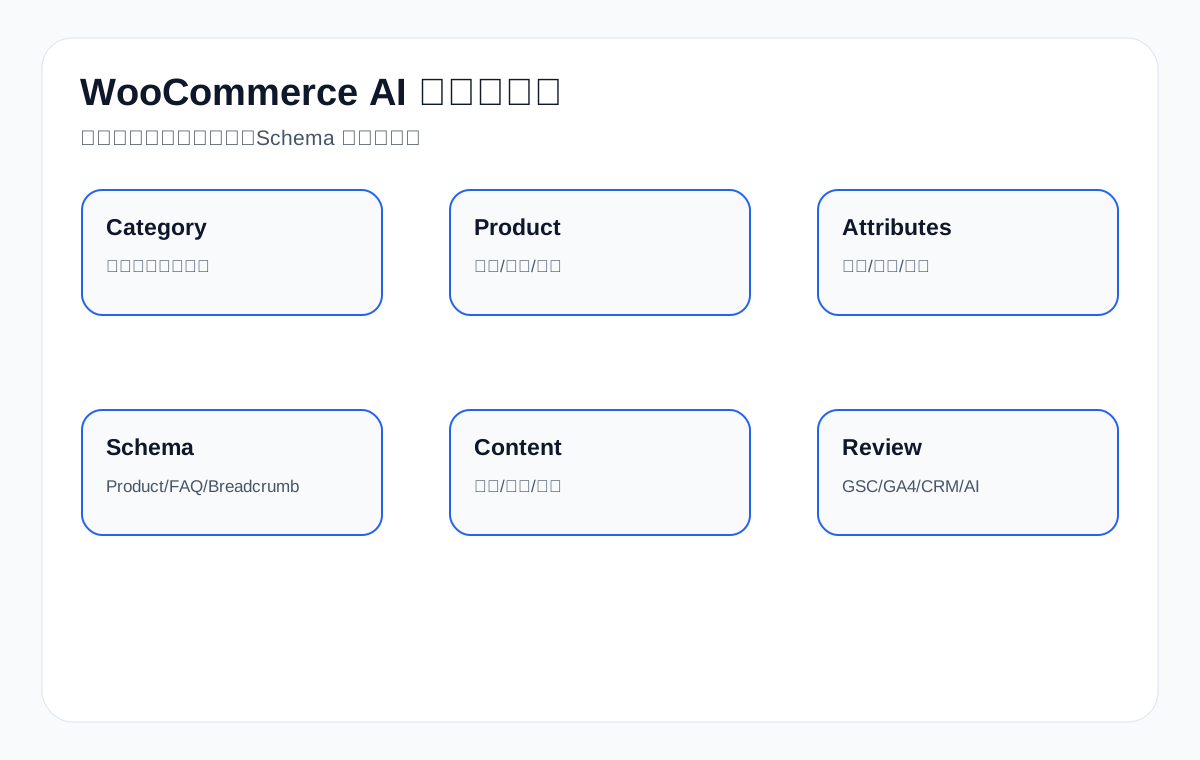
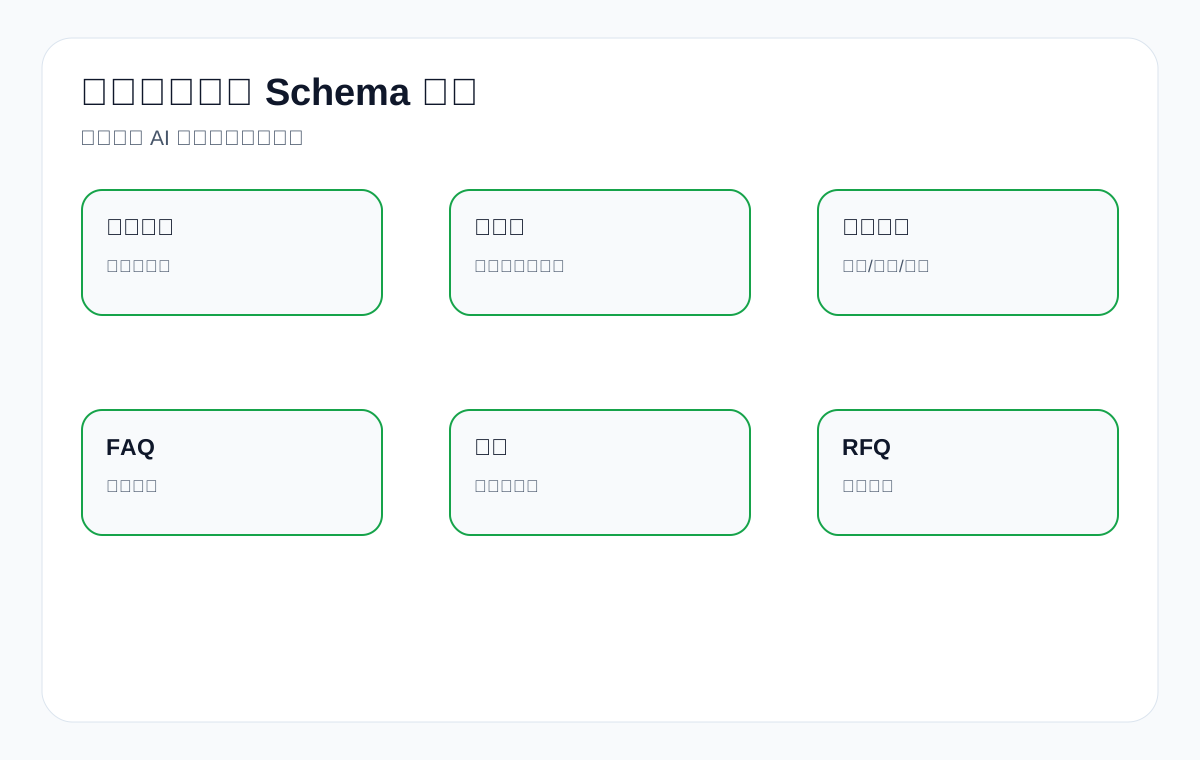
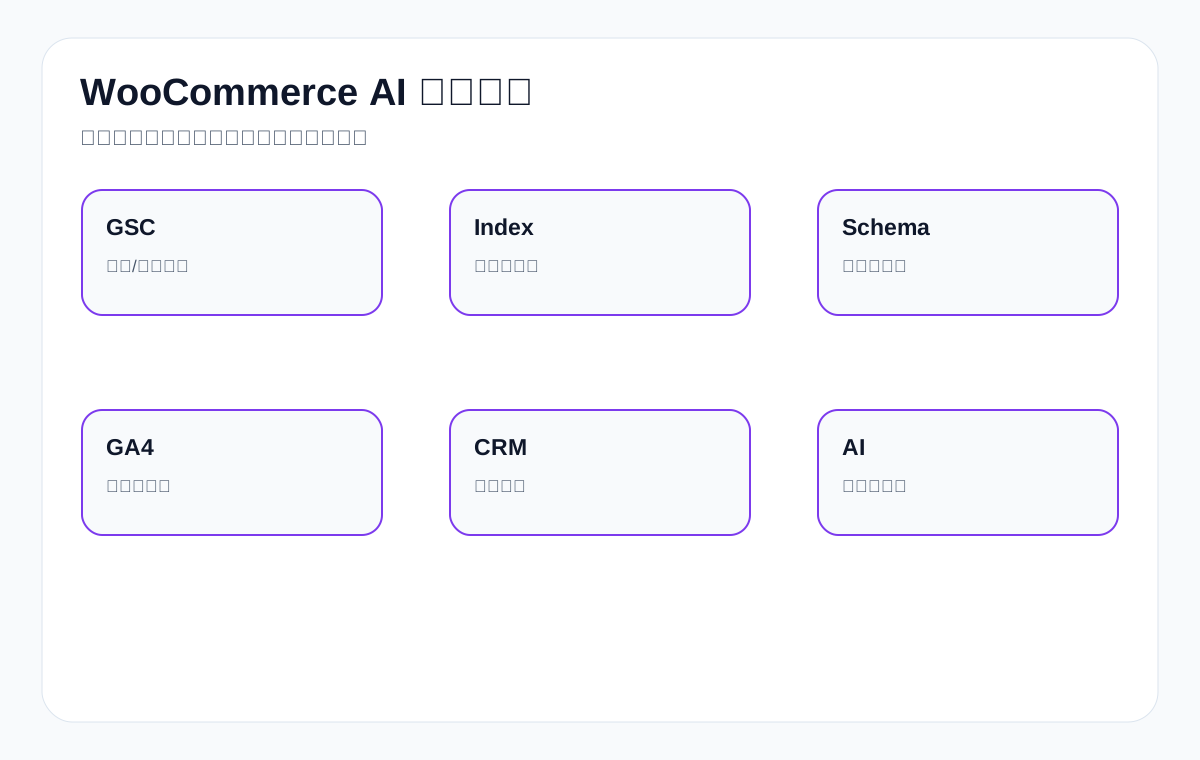
WooCommerce AI search visibility is about making product category pages, product pages, attributes, images, FAQ, Schema, application pages, and resource pages form a clear product entity network. It does not rely on a single plugin to complete automatically, nor does it require AI to adopt the official website; rather, it makes the official website content easier for search systems, AI answers, and overseas buyers to understand.
This article is aimed at foreign-trade factories and trading companies in China and abroad. It uses product keywords such as custom metal parts, LED flood light, packaging machine, medical probe, cnc machining parts, ceramic dinnerware, waterproof connector, industrial valve supplier, and private label activewear manufacturer to explain how WooCommerce sites can optimize category pages, product pages, and Schema, how to avoid low-quality attribute pages and duplicate variants, and how to review performance using GSC, GA4, CRM, and AI citations.
Official evidence boundaries: WooCommerce category pages, product pages, and Schema must be validated separately
When a foreign-trade WooCommerce site works on AI search visibility, the question is not just “which SEO plugin is installed.” More important: whether product category pages act as product family entry points, whether product pages act as factual resource pages, whether attributes and variants can be understood by buyers, whether Schema matches the visible content on the page, and whether GSC, GA4, logs, and AI samples have reviewable records.
If a company sells custom metal parts, LED flood light, packaging machine, medical probe, waterproof connector, industrial valve supplier, or private label activewear manufacturer, category pages usually cover product families and application scenarios, while product pages cover models, parameters, MOQ, certifications, packaging, and RFQ. The two must not be merged into one page type.
Mapping table of official sources and WooCommerce AI visibility validation fields
| Official source | Corresponding page/system | What can be validated | What cannot be inferred |
|---|---|---|---|
| WooCommerce Docs: Managing product taxonomies | Categories, tags, attributes | Whether product categories, attributes, and tags are organized around real product families, materials, specifications, and uses. | Auto-generated attribute pages cannot all be treated as high-value search entry points. |
| WooCommerce Docs: Variable product | Variable products | Whether variants such as color, size, connector, wattage, and material are clearly named and their differences readable. | Internal codes such as A/B/C cannot replace the fields buyers use to make purchasing decisions. |
| WooCommerce Docs: Permalinks | URL structure | Whether product, category, and attribute URLs are stable and avoid duplication and confusing paths. | A clean-looking URL does not mean the page is indexable or performing. |
| WooCommerce Docs: WooCommerce Analytics | Product and order observation | It can help observe product paths, orders, and sales data. | It cannot replace GSC search performance, nor does it indicate AI citations. |
| Google Search Central: Product structured data | Product pages | Fields such as Product, Offer, and Review must match the visible content on the page. | Prices, stock, ratings, certifications, or brand fields must not be fabricated. |
| Google Search Central: Merchant listing structured data | Merchant listing fields | Merchant fields such as price, availability, shipping, and returns require real sources. | B2B quote-based products must not be described with an inaccurate retail product status. |
| Google Search Central: Breadcrumb structured data | Breadcrumbs | Whether the hierarchy of categories, subcategories, and product pages is clear. | Breadcrumbs cannot replace in-body internal links and category descriptions. |
| Google Search Central: Structured data general guidelines | General structured data rules | Whether Schema fields come from facts visible on the page and whether multiple plugins conflict. | Schema is not a ranking switch or a controller of AI answers. |
| Google Search Central: Sitemaps overview | Discovery path | Whether core category pages, product pages, and resource pages are included in the sitemap. | A URL included in the sitemap does not mean the search system has adopted it. |
| Google Search Central: robots.txt introduction | Crawl rules | Whether product images, PDFs, category pages, product pages, and AI-related access are accidentally blocked. | Allowing access in robots does not mean the page will be indexed. |
| Search Console Help: Performance report | GSC performance | View search performance for category pages and product pages by query, page, country, and device. | Without GSC row data, rankings, clicks, or CTR must not be invented. |
| Google Analytics Help: Recommended events for online sales | GA4 product events | Events such as view_item, select_item, add_to_cart, and purchase can help observe product paths. | B2B inquiry sites must also look separately at RFQ, forms, email, and WhatsApp. |
| Google Search Central: AI features and your website | AI search fundamentals | AI features still depend on pages being accessible, indexable, clear in content, and consistent with structured data. | No promise can be made that AI answers will use the official website. |
| OpenAI Platform: Bots | AI bot access | OAI-SearchBot, GPTBot, and ChatGPT-User must be checked separately according to their purpose. | Allowing a bot must not be written up as AI search results. |
| Bing Webmaster Blog: AI Performance | Bing AI observation | If data is available, citations, cited pages, and grounding query phrases can be recorded. | A citation is not a fixed position, ranking, or inquiry result. |
| IndexNow: Documentation | URL update notifications | After product pages and category pages are updated, the submission time, URL, and response status can be recorded. | HTTP 200 only means the notification was received, not that the page is indexed. |
WooCommerce category page and product page AI visibility validation checklist
The problem with WooCommerce is often not “whether pages exist” but confused page roles. Category pages are left with only product cards, product pages have only a short description, attribute pages automatically generate a pile of low-value entry points, and Schema is output by a plugin while the body text has no corresponding facts. AI visibility must first be validated from these fundamentals.
| Page/module | Qualifying fields | Common risks | Review method |
|---|---|---|---|
| Product category page | Product family description, material/wattage/size range, application scenarios, certifications, purchasing FAQ, internal links to representative products. | Only a product list, with no product family semantics. | Spot-check the body text and internal links of the LED flood light and waterproof connector category pages. |
| Product page | Model, parameters, material, MOQ, lead time, packaging, certifications, customizable options, applications, RFQ entry point. | Only a short description and images, with key specifications inside the images. | Check whether the HTML contains a readable parameter table and an inquiry path. |
| Attributes and variants | Attribute names that buyers can understand, with variant differences written into the body text or a table. | Auto-generated attribute pages compete for keywords and variant names are unclear. | Check whether attribute pages should be indexed and whether variant URLs are duplicated. |
| Schema | Product, Offer, Breadcrumb, and FAQ fields match the visible content on the page. | Multiple plugins output duplicates, or stock/ratings not visible on the page are included. | Verify item by item using official tests, page source, and visible body text. |
| Images and resources | Product image alt text, captions, PDF descriptions, and HTML summaries before and after download. | Drawings, parameters, and certifications are hidden only inside images or PDFs. | Carry key facts in body text or tables. |
| Internal link paths | Blog posts explain the problem, category pages cover the product family, and product pages handle specific inquiries. | Articles, categories, and product pages are not linked to one another. | Click from an application-keyword article to a category page, then to a product page and RFQ. |
| Events and inquiries | Record view_item, select_item, RFQ, email, WhatsApp, and download events separately. | Looking only at traffic and not at purchasing actions. | Review GA4, WooCommerce Analytics, and inquiry records separately. |
Without GSC data, WooCommerce AI visibility can only start with a page baseline
If GSC currently has no query, page, or page-query rows, conclusions about WooCommerce AI visibility must be downgraded. You can validate category pages, product pages, attributes, Schema, sitemap, robots, GA4 events, and AI sample baselines; you cannot claim keyword performance, AI citations, clicks, or inquiry results.
| Current evidence | Can be written as | Cannot be written as | Follow-up review |
|---|---|---|---|
| No page or query rows in GSC | There is currently no GSC baseline from which search performance can be judged. | Category page rankings or product page clicks have improved. | Recheck query, page, and page-query in 7-14 days. |
| Product family descriptions added to category pages | The page role and purchasing semantics are clearer. | AI will definitely cite the category page. | Sample AI answers with a fixed query set. |
| Parameters and RFQ added to product pages | Product facts and the inquiry path are more complete. | The number of inquiries will definitely increase. | Look at GA4 events, inquired products, and sales feedback. |
| Schema verified | Structured data is consistent with the visible content on the page. | Search results or AI answers will definitely show a special display style. | Combine official tests, GSC enhancements, and page performance. |
| IndexNow submitted | The URL update notification has been sent. | The page has already been crawled or indexed. | Keep checking logs, GSC, Bing, and the sitemap. |
WooCommerce AI visibility delivery boundaries: page actions can be delivered, platform results cannot
For foreign-trade companies, reliable delivery is not “getting WooCommerce recommended by AI” but turning category pages, product pages, attributes, Schema, internal links, and event tracking into reviewable actions. What can be delivered is page fields, technical fixes, data definitions, and review tables; what must be observed is the behavior of search systems, AI platforms, and buyers.
| Delivery scope | Can be delivered | Can only be observed | Reason |
|---|---|---|---|
| Category pages | Product family descriptions, application scenarios, FAQ, representative products, and internal link paths. | A specified search position for a category keyword. | Rankings are determined jointly by the search system and the competitive environment. |
| Product pages | Parameter tables, certifications, MOQ, packaging, lead time, image descriptions, and RFQ entry point. | A particular product page will definitely generate inquiries. | Inquiries are also affected by price, lead time, sales follow-up, and market demand. |
| Schema | Source verification of fields, cleanup of duplicate output, and testing of Product/Breadcrumb/FAQ. | Special search displays or AI citations. | Structured data is an understanding clue, not a display promise. |
| AI observation | Query sets, answer samples, citation records, and a list of incorrect fact corrections. | Fixed AI citations or a fixed answer position. | AI answers change with the platform, time, query wording, and competing content. |
| Data review | Separate review tables for GSC, GA4, WooCommerce Analytics, and inquiry records. | Filling in trends or results when there is no data. | Review must be based on real observations. |
30-60-90 day review: look at category pages, product pages, Schema, AI samples, and inquiries separately
WooCommerce AI visibility does not end on launch day. The first stage checks whether page and technical actions are in place, the second stage checks whether GSC and GA4 form an observable baseline, and the third stage puts AI citations, product inquiries, and sales feedback into the same table to decide the next step.
| Period | Review focus | Fields to record | What it helps determine |
|---|---|---|---|
| Days 0-30 | Category page body text, product parameters, Schema, sitemap, robots, and mobile tables. | URL, page type, corrective actions, launch date, and review result. | Whether a page baseline has been established. |
| Days 31-60 | Whether category/product page query and page rows appear in GSC, and whether GA4 events are working properly. | query, page, country, device, view_item, RFQ, downloads, email clicks. | Whether pages are starting to be observed through search and user behavior. |
| Days 61-90 | AI answer samples, Bing citations, inquired products, sales feedback, and their relationship to page changes. | Platform, query, cited URL, error points, inquiry fields, sales notes. | Which product family and page type to prioritize in the next round. |
Top 1 benchmark conclusion: WooCommerce technical foundation + AI visibility implementation
This page uses the official WooCommerce product/structured data foundation, Google Product structured data, Merchant/product snippets, Search Central ecommerce and structured data documentation, and mainstream WooCommerce SEO guides as authoritative benchmarks. The benchmark material can explain product pages, categories, Schema, breadcrumbs, speed, and basic SEO.
However, the difficulty in foreign-trade B2B is that many products are not ordered directly but instead involve quotation, samples, drawings, MOQ, certification, and application decisions. This article adds the division of labor between category pages and product pages, the attribute system, RFQ, resource pages, AI citations, inquiry quality, and CRM review.
WooCommerce AI visibility priorities
| Priority | Page/module | What to optimize | Review |
|---|---|---|---|
| P0 | Core category pages | Product family descriptions, attributes, FAQ, internal links | GSC category queries |
| P1 | Core product pages | Parameters, variants, images, evidence, RFQ | Product keywords and inquiries |
| P2 | Attribute system | Material, size, certification, use | Filtering and entity understanding |
| P3 | Schema | Product, Breadcrumb, FAQ | Structured data testing |
| P4 | Applications/resources | Scenario pages and download descriptions | Application keywords and paths |
| P5 | Review | AI citations, GA4, CRM | Description accuracy and lead quality |
Step 1: First define WooCommerce AI search visibility
WooCommerce AI search visibility does not mean requiring AI to display a certain product; it means making category pages, product pages, attributes, FAQ, images, and structured data clear enough for search and AI systems to understand the product entity and purchasing path.
Foreign-trade WooCommerce sites often simultaneously serve as a product catalog, inquiry channel, resource display, and small-order function, so they cannot be written only like ordinary retail ecommerce.
Applied to products such as custom metal parts, LED flood light, packaging machine, medical probe, cnc machining parts, ceramic dinnerware, waterproof connector, industrial valve supplier, and private label activewear manufacturer, the goal of WooCommerce optimization is not to generate more pages but to make core categories, product facts, application scenarios, resource evidence, and inquiry paths easier to understand.
Step 2: Category pages are the entry point for product family entities
A WooCommerce product category page should explain the product series, parameter ranges, application scenarios, filtering logic, certifications, frequently asked questions, and representative products.
Product families such as LED flood light, waterproof connector, and ceramic dinnerware especially need category page explanations.
Applied to products such as custom metal parts, LED flood light, packaging machine, medical probe, cnc machining parts, ceramic dinnerware, waterproof connector, industrial valve supplier, and private label activewear manufacturer, the goal of WooCommerce optimization is not to generate more pages but to make core categories, product facts, application scenarios, resource evidence, and inquiry paths easier to understand.
Step 3: Product pages are fact and inquiry pages
Product pages must clearly show the product name, model, material, specifications, images, uses, certifications, packaging, lead time, samples, downloadable resources, and RFQ information.
Custom products such as custom metal parts and cnc machining parts should highlight drawings, materials, tolerances, and surface treatment.
Applied to products such as custom metal parts, LED flood light, packaging machine, medical probe, cnc machining parts, ceramic dinnerware, waterproof connector, industrial valve supplier, and private label activewear manufacturer, the goal of WooCommerce optimization is not to generate more pages but to make core categories, product facts, application scenarios, resource evidence, and inquiry paths easier to understand.
Division of labor between category pages and product pages
| Page | Suitable for | Must answer | Foreign-trade example |
|---|---|---|---|
| Category page | Product family/series/supplier keywords | How to choose, what series exist, what scenarios they suit | LED flood light series |
| Product page | Model/specification/variant keywords | Parameters, material, certification, packaging, quotation | M12 waterproof connector |
| Attribute page | High-value filter keywords | Differences in material/size/use | stainless steel cnc machining |
| Application page | for + scenario keywords | Environment, pain points, recommended products | packaging machine for frozen food |
| Resource page | datasheet/manual/catalog | Version, compatibility, download description | medical probe datasheet |
| FAQ | Purchasing question keywords | MOQ, samples, lead time, certification | ceramic dinnerware OEM |
Step 4: The attribute system must serve search intent
WooCommerce attributes can be used for filtering and product understanding, but not every attribute combination should become a low-quality index page.
High-value attributes such as material, IP rating, wattage, and application can be planned for content, while low-value combinations should be controlled.
Applied to products such as custom metal parts, LED flood light, packaging machine, medical probe, cnc machining parts, ceramic dinnerware, waterproof connector, industrial valve supplier, and private label activewear manufacturer, the goal of WooCommerce optimization is not to generate more pages but to make core categories, product facts, application scenarios, resource evidence, and inquiry paths easier to understand.
Step 5: Schema must be consistent with the page
Structured data such as Product, Offer, FAQ, Breadcrumb, and Organization must be consistent with the front-end content.
If a B2B quote-based product has no fixed price, do not fill in a false Offer.
Applied to products such as custom metal parts, LED flood light, packaging machine, medical probe, cnc machining parts, ceramic dinnerware, waterproof connector, industrial valve supplier, and private label activewear manufacturer, the goal of WooCommerce optimization is not to generate more pages but to make core categories, product facts, application scenarios, resource evidence, and inquiry paths easier to understand.
Step 6: Images and captions help AI understand
Product photos, structural drawings, installation diagrams, packaging images, application images, and certificate images all help understanding, but they need alt text, captions, and nearby text explanations.
medical probe and industrial valve supplier especially need detail images matched to parameters.
Applied to products such as custom metal parts, LED flood light, packaging machine, medical probe, cnc machining parts, ceramic dinnerware, waterproof connector, industrial valve supplier, and private label activewear manufacturer, the goal of WooCommerce optimization is not to generate more pages but to make core categories, product facts, application scenarios, resource evidence, and inquiry paths easier to understand.
Schema checklist
| Type | Purpose | Common errors | Recommendation |
|---|---|---|---|
| Product | Product entity and quotation information | No corresponding content on the page | Keep consistent with the front end |
| Offer | Price/stock/currency | Filling it in randomly for B2B with no price | Handle quote-based products with care |
| AggregateRating | Rating summary | No real reviews | Do not fabricate |
| FAQPage | Frequently asked questions | FAQ not displayed on the page | Display it for real before marking it up |
| Breadcrumb | Hierarchical relationships | Confusing category paths | Keep consistent with the breadcrumb |
| Organization | Brand entity | Incomplete information | Unify name and contact details |
Step 7: FAQ must come from real purchasing questions
FAQ should come from sales emails, forms, GSC queries, customer service questions, and competitor pages.
Common questions include MOQ, sample, lead time, customization, certification, drawing upload, and warranty.
Applied to products such as custom metal parts, LED flood light, packaging machine, medical probe, cnc machining parts, ceramic dinnerware, waterproof connector, industrial valve supplier, and private label activewear manufacturer, the goal of WooCommerce optimization is not to generate more pages but to make core categories, product facts, application scenarios, resource evidence, and inquiry paths easier to understand.
Step 8: Application pages connect products and industries
Many buyers search by scenario rather than by a specific model. Application pages can connect product families with industry problems.
packaging machine for frozen food and waterproof connector for solar cable are both well suited to application pages.
Applied to products such as custom metal parts, LED flood light, packaging machine, medical probe, cnc machining parts, ceramic dinnerware, waterproof connector, industrial valve supplier, and private label activewear manufacturer, the goal of WooCommerce optimization is not to generate more pages but to make core categories, product facts, application scenarios, resource evidence, and inquiry paths easier to understand.
Step 9: Resource pages need HTML support
PDFs, catalogs, manuals, and datasheets should not be bare files. It is better to create a resource description page and then offer the download.
This makes it easier for search engines to understand and for buyers to confirm the version and scope of application.
Applied to products such as custom metal parts, LED flood light, packaging machine, medical probe, cnc machining parts, ceramic dinnerware, waterproof connector, industrial valve supplier, and private label activewear manufacturer, the goal of WooCommerce optimization is not to generate more pages but to make core categories, product facts, application scenarios, resource evidence, and inquiry paths easier to understand.
Common WooCommerce technical issues
| Issue | Impact | How to check | Optimization |
|---|---|---|---|
| Duplicate variants | Dilutes the product entity | URL/canonical | Unify the canonical page |
| Empty categories | Low-quality indexing | Category sitemap | Add content or exclude |
| Proliferation of attribute pages | Many thin pages | Index report | Keep only high-value attributes |
| Oversized images | Slow LCP | PageSpeed | Responsive images and compression |
| Slow form plugins | Poor INP | Performance trace | Defer non-critical scripts |
| Schema conflicts | Confusing understanding | Rich Results test | Unify plugin output |
Step 10: Internal links must form a product path
Articles link to categories and products, categories link to applications and representative products, and products link to FAQ, resources, and RFQ.
The clearer the internal link relationships, the easier it is for search and AI systems to understand the page hierarchy.
Applied to products such as custom metal parts, LED flood light, packaging machine, medical probe, cnc machining parts, ceramic dinnerware, waterproof connector, industrial valve supplier, and private label activewear manufacturer, the goal of WooCommerce optimization is not to generate more pages but to make core categories, product facts, application scenarios, resource evidence, and inquiry paths easier to understand.
Step 11: Variant pages must avoid duplication
If WooCommerce variants generate too much duplicate content, it causes indexing confusion.
Color, size, packaging, and similar variants of the same product should usually be handled by the main product page unless there is independent search demand.
Applied to products such as custom metal parts, LED flood light, packaging machine, medical probe, cnc machining parts, ceramic dinnerware, waterproof connector, industrial valve supplier, and private label activewear manufacturer, the goal of WooCommerce optimization is not to generate more pages but to make core categories, product facts, application scenarios, resource evidence, and inquiry paths easier to understand.
Step 12: Speed and interaction cannot be ignored
WooCommerce sites are often slowed down by plugins, variants, images, filters, and forms. AI visibility also depends on stable, accessible content.
Core content and the RFQ form must be fast and stable.
Applied to products such as custom metal parts, LED flood light, packaging machine, medical probe, cnc machining parts, ceramic dinnerware, waterproof connector, industrial valve supplier, and private label activewear manufacturer, the goal of WooCommerce optimization is not to generate more pages but to make core categories, product facts, application scenarios, resource evidence, and inquiry paths easier to understand.
90-day review table
| Time | Search/AI signals | Page signals | Business signals |
|---|---|---|---|
| 7 days | Indexing and structured data testing | Core pages normal | RFQ submittable |
| 30 days | Category/product queries appear | Click paths | Inquiry fields complete |
| 60 days | AI description spot checks | Time on product pages | Leads from target countries |
| 90 days | Application keyword growth | Resource downloads/RFQ | CRM quality |
| Ongoing | Competitor and answer changes | Content refresh | Sales feedback |
Step 13: Use GSC to view category and product queries
View by URL which queries category pages, product pages, and article pages each receive.
If product keywords land on articles rather than product pages, the page mapping and internal links may need adjustment.
Applied to products such as custom metal parts, LED flood light, packaging machine, medical probe, cnc machining parts, ceramic dinnerware, waterproof connector, industrial valve supplier, and private label activewear manufacturer, the goal of WooCommerce optimization is not to generate more pages but to make core categories, product facts, application scenarios, resource evidence, and inquiry paths easier to understand.
Step 14: Use GA4 to view product paths
Whether organic traffic that lands on a category then views products, and whether users open resources or the RFQ after viewing a product, are important signals for judging how well pages handle visitors.
Looking only at traffic is not enough.
Applied to products such as custom metal parts, LED flood light, packaging machine, medical probe, cnc machining parts, ceramic dinnerware, waterproof connector, industrial valve supplier, and private label activewear manufacturer, the goal of WooCommerce optimization is not to generate more pages but to make core categories, product facts, application scenarios, resource evidence, and inquiry paths easier to understand.
Step 15: For AI citations, look at description accuracy
Regularly spot-check whether AI answers correctly describe products, categories, capabilities, and the official website source.
If AI confuses product series, page entities and internal links need strengthening.
Applied to products such as custom metal parts, LED flood light, packaging machine, medical probe, cnc machining parts, ceramic dinnerware, waterproof connector, industrial valve supplier, and private label activewear manufacturer, the goal of WooCommerce optimization is not to generate more pages but to make core categories, product facts, application scenarios, resource evidence, and inquiry paths easier to understand.
WooCommerce AI visibility priorities
| Priority | Page/module | What to optimize | Review |
|---|---|---|---|
| P0 | Core category pages | Product family descriptions, attributes, FAQ, internal links | GSC category queries |
| P1 | Core product pages | Parameters, variants, images, evidence, RFQ | Product keywords and inquiries |
| P2 | Attribute system | Material, size, certification, use | Filtering and entity understanding |
| P3 | Schema | Product, Breadcrumb, FAQ | Structured data testing |
| P4 | Applications/resources | Scenario pages and download descriptions | Application keywords and paths |
| P5 | Review | AI citations, GA4, CRM | Description accuracy and lead quality |
Step 16: Do not write non-existent content for Schema
Structured data can only mark up real content on the page. Fake reviews, fake prices, and fake stock harm trust.
Foreign-trade B2B should emphasize real parameters, certifications, resources, and inquiry paths even more.
Applied to products such as custom metal parts, LED flood light, packaging machine, medical probe, cnc machining parts, ceramic dinnerware, waterproof connector, industrial valve supplier, and private label activewear manufacturer, the goal of WooCommerce optimization is not to generate more pages but to make core categories, product facts, application scenarios, resource evidence, and inquiry paths easier to understand.
Step 17: Common mistake one: category pages contain only a product list
A product list is not a product family description. Category pages need selection guidance, parameters, applications, FAQ, and internal links.
Otherwise, both AI and buyers will struggle to understand the value of the category.
Applied to products such as custom metal parts, LED flood light, packaging machine, medical probe, cnc machining parts, ceramic dinnerware, waterproof connector, industrial valve supplier, and private label activewear manufacturer, the goal of WooCommerce optimization is not to generate more pages but to make core categories, product facts, application scenarios, resource evidence, and inquiry paths easier to understand.
Step 18: Common mistake two: product pages only copy specifications
Specifications matter, but pages must also explain applications, differences, evidence, delivery, and inquiry information.
Copying supplier materials does not create unique value.
Applied to products such as custom metal parts, LED flood light, packaging machine, medical probe, cnc machining parts, ceramic dinnerware, waterproof connector, industrial valve supplier, and private label activewear manufacturer, the goal of WooCommerce optimization is not to generate more pages but to make core categories, product facts, application scenarios, resource evidence, and inquiry paths easier to understand.
Division of labor between category pages and product pages
| Page | Suitable for | Must answer | Foreign-trade example |
|---|---|---|---|
| Category page | Product family/series/supplier keywords | How to choose, what series exist, what scenarios they suit | LED flood light series |
| Product page | Model/specification/variant keywords | Parameters, material, certification, packaging, quotation | M12 waterproof connector |
| Attribute page | High-value filter keywords | Differences in material/size/use | stainless steel cnc machining |
| Application page | for + scenario keywords | Environment, pain points, recommended products | packaging machine for frozen food |
| Resource page | datasheet/manual/catalog | Version, compatibility, download description | medical probe datasheet |
| FAQ | Purchasing question keywords | MOQ, samples, lead time, certification | ceramic dinnerware OEM |
Step 19: Common mistake three: relying on plugins to solve everything automatically
SEO/Schema plugins are only tools; they cannot replace page content and business judgment.
Get the content and structure right first, then configure the tools.
Applied to products such as custom metal parts, LED flood light, packaging machine, medical probe, cnc machining parts, ceramic dinnerware, waterproof connector, industrial valve supplier, and private label activewear manufacturer, the goal of WooCommerce optimization is not to generate more pages but to make core categories, product facts, application scenarios, resource evidence, and inquiry paths easier to understand.
Step 20: Common mistake four: ignoring inquiry quality
AI visibility ultimately comes down to whether it brings more relevant inquiries and sales leads.
CRM feedback should guide page updates in the other direction.
Applied to products such as custom metal parts, LED flood light, packaging machine, medical probe, cnc machining parts, ceramic dinnerware, waterproof connector, industrial valve supplier, and private label activewear manufacturer, the goal of WooCommerce optimization is not to generate more pages but to make core categories, product facts, application scenarios, resource evidence, and inquiry paths easier to understand.
WooCommerce AI visibility execution checklist
- List core product categories and product pages
- Add product family descriptions, parameter ranges, and FAQ to category pages
- Add specifications, variants, images, certifications, and RFQ to product pages
- Organize the attribute system and control indexing of low-value attribute pages
- Check Product, Breadcrumb, and FAQ Schema
- Create application pages and resource description pages
- Optimize product image alt text, captions, and surrounding text
- Point article internal links to categories, products, and RFQ
- Use GSC to see whether category/product queries match
- Use GA4 to see the path from category to product to inquiry
- Use CRM to judge inquiry countries and product quality
- Regularly spot-check whether AI answer descriptions are accurate
WooCommerce AI visibility priorities
| Priority | Page/module | What to optimize | Review |
|---|---|---|---|
| P0 | Core category pages | Product family descriptions, attributes, FAQ, internal links | GSC category queries |
| P1 | Core product pages | Parameters, variants, images, evidence, RFQ | Product keywords and inquiries |
| P2 | Attribute system | Material, size, certification, use | Filtering and entity understanding |
| P3 | Schema | Product, Breadcrumb, FAQ | Structured data testing |
| P4 | Applications/resources | Scenario pages and download descriptions | Application keywords and paths |
| P5 | Review | AI citations, GA4, CRM | Description accuracy and lead quality |
Division of labor between category pages and product pages
| Page | Suitable for | Must answer | Foreign-trade example |
|---|---|---|---|
| Category page | Product family/series/supplier keywords | How to choose, what series exist, what scenarios they suit | LED flood light series |
| Product page | Model/specification/variant keywords | Parameters, material, certification, packaging, quotation | M12 waterproof connector |
| Attribute page | High-value filter keywords | Differences in material/size/use | stainless steel cnc machining |
| Application page | for + scenario keywords | Environment, pain points, recommended products | packaging machine for frozen food |
| Resource page | datasheet/manual/catalog | Version, compatibility, download description | medical probe datasheet |
| FAQ | Purchasing question keywords | MOQ, samples, lead time, certification | ceramic dinnerware OEM |
Schema checklist
| Type | Purpose | Common errors | Recommendation |
|---|---|---|---|
| Product | Product entity and quotation information | No corresponding content on the page | Keep consistent with the front end |
| Offer | Price/stock/currency | Filling it in randomly for B2B with no price | Handle quote-based products with care |
| AggregateRating | Rating summary | No real reviews | Do not fabricate |
| FAQPage | Frequently asked questions | FAQ not displayed on the page | Display it for real before marking it up |
| Breadcrumb | Hierarchical relationships | Confusing category paths | Keep consistent with the breadcrumb |
| Organization | Brand entity | Incomplete information | Unify name and contact details |
Common WooCommerce technical issues
| Issue | Impact | How to check | Optimization |
|---|---|---|---|
| Duplicate variants | Dilutes the product entity | URL/canonical | Unify the canonical page |
| Empty categories | Low-quality indexing | Category sitemap | Add content or exclude |
| Proliferation of attribute pages | Many thin pages | Index report | Keep only high-value attributes |
| Oversized images | Slow LCP | PageSpeed | Responsive images and compression |
| Slow form plugins | Poor INP | Performance trace | Defer non-critical scripts |
| Schema conflicts | Confusing understanding | Rich Results test | Unify plugin output |
90-day review table
| Time | Search/AI signals | Page signals | Business signals |
|---|---|---|---|
| 7 days | Indexing and structured data testing | Core pages normal | RFQ submittable |
| 30 days | Category/product queries appear | Click paths | Inquiry fields complete |
| 60 days | AI description spot checks | Time on product pages | Leads from target countries |
| 90 days | Application keyword growth | Resource downloads/RFQ | CRM quality |
| Ongoing | Competitor and answer changes | Content refresh | Sales feedback |
Supplement: Page strategy for different transaction models on foreign-trade WooCommerce sites
Foreign-trade WooCommerce sites do not always involve direct ordering. Many B2B products are better suited to quotation, samples, drawing uploads, customization discussions, or distribution applications. Page strategy must first distinguish the transaction model: products that can be ordered directly should emphasize price, stock, reviews, cart, and logistics; products that require a quote should emphasize specifications, applications, certifications, MOQ, samples, packaging, lead time, RFQ fields, and sales follow-up; mixed products should clearly tell users on the product page which specifications can be purchased directly and which require contact to confirm.
For example, ceramic dinnerware and private label activewear manufacturer may be suited to showing series, colors, packaging, and the sampling process; custom metal parts, cnc machining parts, and industrial valve supplier are better suited to showing materials, drawings, tolerances, working conditions, and inquiry fields; medical probe and waterproof connector should highlight compatibility, certifications, specifications, and technical documentation. AI search visibility is not a one-size-fits-all approach; it means giving every transaction model clear entity information and a clear action path.
Transaction model and page module table
| Transaction model | Page focus | Schema considerations | Review metrics |
|---|---|---|---|
| Direct ordering | Price, stock, shipping, reviews | Offer must be real and consistent | Orders and conversion rate |
| RFQ inquiry | Specifications, MOQ, samples, forms | Do not fabricate a fixed price | Inquiry completeness |
| Custom production | Materials, drawings, tolerances, processes | Attributes and FAQ matter more | Drawing uploads and sales stage |
| Distribution/wholesale | Catalog, packaging, certifications, lead time | Organization and Product consistent | Country and channel quality |
Supplement: WooCommerce plugin governance also affects AI understanding
WooCommerce sites often install multiple SEO, Schema, filtering, inquiry, caching, translation, and image plugins. If these plugins output Product Schema, Breadcrumb, FAQ, or Open Graph at the same time, they may cause duplication, conflicts, or inconsistency between front-end content and structured data. AI and search systems need consistent facts; if one plugin says the product has a price while another module shows a quotation request, the page becomes hard to understand.
It is advisable to regularly spot-check the source code, structured data tests, front-end content, GSC performance, and RFQ forms of core category pages and product pages. Plugins can improve efficiency, but they cannot replace content review. Every time you add a plugin, change the theme, or adjust product attributes, confirm that the page title, description, Schema, images, internal links, and inquiry entry point remain consistent.
FAQ: Common questions about WooCommerce AI search visibility
Is WooCommerce AI visibility just about adding Schema?
No. Schema helps, but category pages, product pages, FAQ, images, attributes, internal links, and inquiry paths matter just as much.
What if a B2B product has no price?
Do not fabricate a price. You can explain the quotation method, samples, MOQ, delivery, and RFQ fields.
Do category pages need written content?
Yes. Category pages should explain the product family, selection guidance, parameters, applications, FAQ, and representative products.
Should all attribute pages be indexed?
Not recommended. Only attribute pages with search demand and business value are worth indexing.
How can product variants avoid duplication?
Most variants are handled by the main product page; only specifications with independent search demand should be considered for separate pages.
How should AI citations be reviewed?
Spot-check AI answers with target product keywords, application keywords, and question keywords to see whether they cite the official website, whether descriptions are accurate, and whether products are confused.
Can plugins handle SEO automatically?
No. Plugins can output technical fields, but page content, product facts, and business judgment still require human planning.
How do you judge whether optimization is effective?
Look at GSC queries, GA4 paths, RFQ completeness, CRM lead quality, and AI description accuracy.
Supplement: Why WooCommerce data and sales feedback should be connected
If sales feedback shows that inquiries often lack model, quantity, country, application, or attachments, it means the product pages and RFQ fields have not been explained clearly enough; if AI answers frequently confuse categories and products, it also means entity relationships and internal links need strengthening.
Conclusion: WooCommerce AI visibility comes from clear product entities and purchasing paths
For a foreign-trade WooCommerce site to be understood by search and AI systems, the key is to make clear the category pages, product pages, attributes, Schema, FAQ, application pages, resource pages, and RFQ paths for products such as custom metal parts, LED flood light, packaging machine, medical probe, cnc machining parts, ceramic dinnerware, waterproof connector, industrial valve supplier, and private label activewear manufacturer. Plugins are only tools; the real asset is product facts that can be verified, read, cited, and used by buyers to make decisions.
Continue reading this GEO series
If you are systematically studying GEO and AI search visibility, we suggest continuing with the articles below. Start with the concepts, then move on to diagnosis, monitoring, content structure, and collaboration boundaries.
- How to achieve Shopify AI search visibility: A guide to collection pages, product pages, and AI understanding optimization
- How to read a GEO diagnosis report: A guide to judging AI answers, citation sources, and entity consistency
- What GEO visibility diagnosis includes: AI answers, entity consistency, citation sources, and review
- How to monitor AI search visibility: A checklist of brand mentions, official website citations, and competitor answers for foreign-trade sites
- How to choose GEO monitoring tools: Where to look for mentions, citations, and traffic
- How to do AI Visibility Monitoring: A guide to AI visibility monitoring for new foreign-trade sites
This page is machine-translated from the Simplified Chinese version and awaiting human review. It has not yet been proofread.